Developing methodologies for large scale wave and tidal stream marine
renewable energy extraction and its environmental impact: An overview
of the TeraWatt project
Keywords:
Marine Renewable Energy Tidal stream
Waves
Environmental impact Energy extraction
This article presents an introduction and overview of a model-ling project“TeraWatt: Large scale interactive coupled 3D model-ling for wave and tidal energy resource and environmental impact”. The project was funded by the SUstainable PowER GENeration (SUPERGEN) “Marine Hub”. SUPERGEN (http://www.rcuk.ac.uk/ research/xrcprogrammes/energy/energyresearch/supergen) is an initiative of the Research Councils UK (RCUK) Energy Programme, led by the Engineering and Physical Sciences Research Council (EPSRC). It is focused on supporting resilient and sustainable gener-ation, supply, transmission and storage of the UK's energy. The Ma-rine Challenge addresses the UK Centre for MaMa-rine Energy Research's (UKCMER) mission to support the wave and tidal energy sector beyond their current state of development.
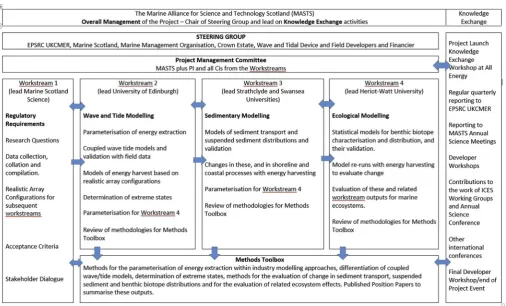
TeraWatt ran from June 2012 until the end of November 2015 and was conducted by a consortium constituted under the Marine Alliance for Science and Technology for Scotland (MASTS) pooling initiative. The consortium was led by Heriot-Watt University and included the University of Edinburgh, University of Strathclyde, University of Swansea, University of the Highlands and Islands (Lewis Castle College and Scottish Association for Marine Science) and Marine Scotland Science (MSS). Marine renewable energy (MRE) developers were also fully engaged and supported many as-pects of the work (seeFig. 1).
Scotland has substantial wave and tidal MRE resources and is at the forefront of the development of marine renewable technologies and ocean energy exploitation. Within Scottish waters, a significant proportion of the wave and tidal energy resource is located in the Orkney Islands and the stretch of water that separates them from the Scottish mainland, the Pentland Firth (collectively referred to the Pentland Firth and Orkney Waters area, PFOW). MRE develop-ments in Scottish waters are subject to licensing conditions under the responsibility of Scottish Ministers. As part of the licensing ar-rangements, environmental effects in the immediate vicinity of
devices and arrays will be addressed in the EIA (Environmental Impact Assessment) process that each developer must undertake. It is essential, however, that the regulatory authorities understand how a number of multi-site developments collectively impact on the physical and biological processes over a wider region, both in relation to cumulative effects of the developments and marine planning responsibilities. At a regional scale, careful selection of sites may enable the optimum exploitation of the resource while minimising any environmental impacts to an acceptable level. MSS is the Science Division of the Marine Scotland Directorate of the Scottish Government, responsible for providing scientific advice to the licensing authority.
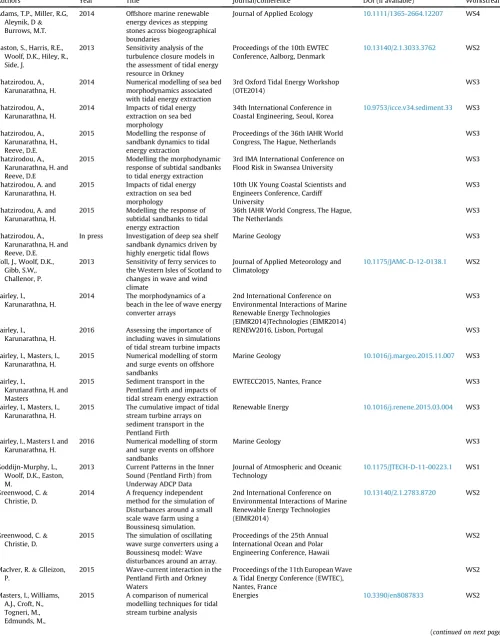
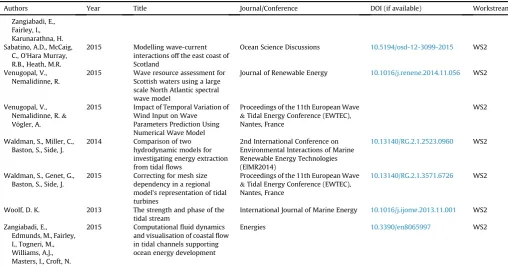
The objectives of TeraWatt are fourfold: Firstly, to minimise de-lays in array licensing by providing answers to 3 specific questions identified by MSS as critical for the regulatory authorities, respon-sible for the licensing of wave and tidal developments; and, sec-ondly, to collect the methodologies used to answer these into a “methods toolbox”that can be more widely utilised for EIA, and in which the MRE developer community has confidence. Much of the toolbox description has been reported in a collection of“ Posi-tion Papers”that are listed below in association with their respec-tive workstreams. The peer review papers included in this special issue contribute to the description of such methodology and are also listed below. For other project dissemination outputs, see Table 1.
The three“research questions”and a fourth“research activity”, the compilation of methodologies, linked directly to the work-stream structure of the project, are detailed below (Workwork-streams 2e4). In addition, Workstream 1 defined these research questions and addressed a number of logistical activities (data acquisition and management, characterization of realistic array scenarios, identification of acceptable impacts criteria and dissemination/ knowledge exchange activities). Data acquisition is described in
O'Hara Murray (2015a) and O'Hara Murray and Gallego (this
issue). Realistic array characterisation is described in O'Hara Murray (2015b). The regulatory framework and acceptable impact criteria are discussed byGallego et al. (this issue).
Research Question 1: What is the best way to assess the wave and tidal resource and the effects of energy extraction on it? The objectives here were to: i) produce methodologies that will in-crease our knowledge and confidence in coupled hydrodynamic models of wave and tidal systems using case studies validated byfield data; ii) produce methodologies for the incorporation of multisite wave and tidal arrays within i) to illustrate changes in the resource in the near and far field from energy extraction; iii) produce methodologies for the determination of resource Contents lists available atScienceDirect
Ocean & Coastal Management
j o u r n a l h o m e p a g e : w w w . e l s e v i e r . c o m / l o c a t e / o ce c o a m a n
http://dx.doi.org/10.1016/j.ocecoaman.2016.11.015
potential under different scenarios of exploitation; and iv) deter-mine extreme wave and tidal conditions for the parameterisation of modelling of physical and environmental consequences. These were mapped as deliverables from Workstream 2 (“Wave and tidal stream modelling”). See Waldman et al. (this issue), Venugopal et al. (this issue), MacIver et al. (2015) and Baston et al. (2015).
Research Question 2: What are the physical consequences of wave and tidal energy extraction? The objectives here, making use of outputs from Workstream 2, were to: i) produce methodol-ogies for linking those outputs to coupled models of sediment transport, again with illustrations validated by available field data; ii) investigate changes in sediment transport patterns occur-ring as a consequence of energy extraction and examine effects on seabed morphology; iii) determine the effect of energy extraction on suspended sediments; and iv) determine effects on the shore-line and coastshore-line using also the extreme wave distributions from Workstream 2. These were mapped as deliverables in Workstream 3 (“Sediment dynamics”). Output from this workstream is pre-sented byFairley et al. (this issue), Heath et al. (this issue), Fairley and Karunarathna (2015), Sabatino et al. (2015) andHeath et al. (2015).
Research Question 3: What are the ecological consequences of wave and tidal energy extraction? The objectives were to: i) pro-duce methodologies for statistical models that will enable benthic biotope characterisation, using given physical parameters and out-puts from Workstreams 2 and 3, illustrating these and validating them withfield data; ii) demonstrate what changes in these may occur as a consequence of various energy extraction scenarios; and iii) evaluate other potential ecological effects. These were map-ped as deliverables from Workstream 4 (“Ecological Consequences
of wave and tidal energy extraction”). Some delays in the comple-tion of these activities prevent us from introducing here the output of this workstream.
Research Activity 4: The overarching objective of the research was to generate a suite of methodologies (a“toolbox”) to provide a better understanding of, and be used to assess, changes to the resource from energy extraction, and the potential physical and ecological consequence. The consequent methodology was demon-strated on a key MRE development area, the PFOW, and its avail-ability as a toolbox should enable the acceleration of wave and tidal stream MRE array deployments there. The output of this work-stream is: i) a combination of the articles presented in this special issue; ii) the Position Papers listed above; iii) the datasets compiled by the project, which are available to the wider community (O'Hara Murray and Gallego (this issue), O'Hara Murray (2015a)), with the exception of a small number of restricted datasets purchased for use within the project; and iv) code used to perform tasks such as large scale processing of inputs for the model runs, available via open source repositories. The arrangements for the manage-ment and organisation or the research are shown inFig. 1.
[image:2.595.41.548.63.369.2]Table 1
Listing of TeraWatt project dissemination outputs (excluding articles in this issue and Position Papers), as recorded in the RCUK's Gateway To Research website (http://gtr.rcuk. ac.uk) at the time of writing. Any outputs not currently in the public domain are available from the authors on request.
Authors Year Title Journal/Conference DOI (if available) Workstream
Adams, T.P., Miller, R.G, Aleynik, D& Burrows, M.T.
2014 Offshore marine renewable energy devices as stepping stones across biogeographical boundaries
Journal of Applied Ecology 10.1111/1365-2664.12207 WS4
Baston, S., Harris, R.E., Woolf, D.K., Hiley, R., Side, J.
2013 Sensitivity analysis of the turbulence closure models in the assessment of tidal energy resource in Orkney
Proceedings of the 10th EWTEC Conference, Aalborg, Denmark
10.13140/2.1.3033.3762 WS2
Chatzirodou, A., Karunarathna, H.
2014 Numerical modelling of sea bed morphodynamics associated with tidal energy extraction
3rd Oxford Tidal Energy Workshop (OTE2014)
WS3
Chatzirodou, A., Karunarathna, H.
2014 Impacts of tidal energy extraction on sea bed morphology
34th International Conference in Coastal Engineering, Seoul, Korea
10.9753/icce.v34.sediment.33 WS3
Chatzirodou, A., Karunarathna, H., Reeve, D.E.
2015 Modelling the response of sandbank dynamics to tidal energy extraction
Proceedings of the 36th IAHR World Congress, The Hague, Netherlands
WS3
Chatzirodou, A., Karunarathna, H. and Reeve, D.E
2015 Modelling the morphodynamic response of subtidal sandbanks to tidal energy extraction
3rd IMA International Conference on Flood Risk in Swansea University
WS3
Chatzirodou, A. and Karunarathna, H.
2015 Impacts of tidal energy extraction on sea bed morphology
10th UK Young Coastal Scientists and Engineers Conference, Cardiff University
WS3
Chatzirodou, A. and Karunarathna, H.
2015 Modelling the response of subtidal sandbanks to tidal energy extraction
36th IAHR World Congress, The Hague, The Netherlands
WS3
Chatzirodou, A., Karunarathna, H. and Reeve, D.E.
In press Investigation of deep sea shelf sandbank dynamics driven by highly energetic tidalflows
Marine Geology WS3
Coll, J., Woolf, D.K., Gibb, S.W,. Challenor, P.
2013 Sensitivity of ferry services to the Western Isles of Scotland to changes in wave and wind climate
Journal of Applied Meteorology and Climatology
10.1175/JAMC-D-12-0138.1 WS2
Fairley, I., Karunarathna, H.
2014 The morphodynamics of a beach in the lee of wave energy converter arrays
2nd International Conference on Environmental Interactions of Marine Renewable Energy Technologies (EIMR2014)Technologies (EIMR2014)
WS3
Fairley, I., Karunarathna, H.
2016 Assessing the importance of including waves in simulations of tidal stream turbine impacts
RENEW2016, Lisbon, Portugal WS3
Fairley, I., Masters, I., Karunarathna, H.
2015 Numerical modelling of storm and surge events on offshore sandbanks
Marine Geology 10.1016/j.margeo.2015.11.007 WS3
Fairley, I.,
Karunarathna, H. and Masters
2015 Sediment transport in the Pentland Firth and impacts of tidal stream energy extraction
EWTECC2015, Nantes, France WS3
Fairley, I., Masters, I., Karunarathna, H.
2015 The cumulative impact of tidal stream turbine arrays on sediment transport in the Pentland Firth
Renewable Energy 10.1016/j.renene.2015.03.004 WS3
Fairley, I., Masters I. and Karunarathna, H.
2016 Numerical modelling of storm and surge events on offshore sandbanks
Marine Geology WS3
Goddijn-Murphy, L., Woolf, D.K., Easton, M.
2013 Current Patterns in the Inner Sound (Pentland Firth) from Underway ADCP Data
Journal of Atmospheric and Oceanic Technology
10.1175/JTECH-D-11-00223.1 WS1
Greenwood, C.& Christie, D.
2014 A frequency independent method for the simulation of Disturbances around a small scale wave farm using a Boussinesq simulation.
2nd International Conference on Environmental Interactions of Marine Renewable Energy Technologies (EIMR2014)
10.13140/2.1.2783.8720 WS2
Greenwood, C.& Christie, D.
2015 The simulation of oscillating wave surge converters using a Boussinesq model: Wave disturbances around an array.
Proceedings of the 25th Annual International Ocean and Polar Engineering Conference, Hawaii
WS2
MacIver, R.&Glleizon, P.
2015 Wave-current interaction in the Pentland Firth and Orkney Waters
Proceedings of the 11th European Wave &Tidal Energy Conference (EWTEC), Nantes, France
WS2
Masters, I., Williams, A.J., Croft, N., Togneri, M., Edmunds, M.,
2015 A comparison of numerical modelling techniques for tidal stream turbine analysis
Energies 10.3390/en8087833 WS2
means that there is a shared understanding of the toolbox of devel-oped methods. During this research we also made recommenda-tions to commercial software developers for improvements to their code. However, the main focus of our research has been providing key shared knowledge of this promising sector to the sci-entific community, regulatory authorities, developers and inter-ested stakeholders. The collection of journal papers introduced by this article covers all aspects of our work and draws out the key messages of our project.
Acknowledgements
This work forms part of the TeraWatt project funded by the En-gineering and Physical Science Research Council SUPERGEN Marine Challenge (Grant Ref: EPJ010170/1). The authors would like to thank the TeraWatt Steering Group (see Fig. 1) for their support and the MRE developers who participated in the project.
References
Baston, S., Waldman, S., Side, J., 2015. Modelling energy extraction in tidalflows. In: TeraWatt Position PaperseA“toolbox”of methods to better understand and assess the effects of tidal and wave energy arrays on the marine environment. MASTS, ISBN 978-0-9934256-0-8, pp. 75e108.
Fairley, I., Karunarathna, H. and Chatzirodou, A. (this issue) Modelling the Effects of Marine Energy Extraction on Non-cohesive Sediment Transport and Morpho-logical Change in the Pentland Firth and Orkney Waters.
Fairley, I., Karunarathna, H., 2015. Modelling the impacts of marine energy extrac-tion on non-cohesive sediment transport and morphodynamics. In: TeraWatt Position PaperseA“toolbox”of methods to better understand and assess the effects of tidal and wave energy arrays on the marine environment. MASTS, ISBN 978-0-9934256-0-8, pp. 109e128.
Gallego, A. et al. (this issue) Large Scale Three-dimensional Modelling for Wave and Tidal Energy Resource and Environmental Impact: Methodologies for Quanti-fying Acceptable Thresholds for Sustainable Exploitation.
Heath, M.R., Sabatino, A.D., Serpetti, N., O'Hara Murray, R.B., 2015. Scoping the impact tidal and wave energy extraction on suspended sediment concentra-tions and underwater light climate. In: TeraWatt Position PaperseA“toolbox” of methods to better understand and assess the effects of tidal and wave energy
arrays on the marine environment. MASTS, ISBN 978-0-9934256-0-8, pp. 143e166.
Heath, M., Sabatino, A., Serpetti, N., McCaig, C. and O'Hara Murray, R. (this issue) Modelling the sensitivity of suspended sediment profiles to tidal current and wave conditions.
MacIver, R., Reddy, N.T., Venugopal, V., 2015. Representing wave energy extraction in regional scale numerical models. In: TeraWatt Position PaperseA“toolbox” of methods to better understand and assess the effects of tidal and wave energy arrays on the marine environment. MASTS, ISBN 978-0-9934256-0-8, pp. 49e74.
O'Hara Murray, R.B., 2015a. Data acquisition and processing for TeraWatt. In: Tera-Watt Position PaperseA“toolbox”of methods to better understand and assess the effects of tidal and wave energy arrays on the marine environment. MASTS, ISBN 978-0-9934256-0-8, pp. 9e30.
O'Hara Murray, R.B., 2015b. Tidal stream and wave energy array scenarios for the pentlandfirth and orkney waters strategic area. In: TeraWatt Position Papers eA“toolbox”of methods to better understand and assess the effects of tidal and wave energy arrays on the marine environment. MASTS, ISBN 978-0-9934256-0-8, pp. 31e48.
O'Hara Murray, R. and Gallego, A. (this issue) Data Acquisition and the Development of Realistic Tidal and Wave Energy Scenarios for Numerical Modelling of Orkney Islands Waters, Scotland.
Sabatino, A.D., Clement, R., Heath, M.R., McKee, D., 2015. Use of ocean colour remote sensing to monitor sea surface suspended sediments. In: TeraWatt Position Pa-perseA“Toolbox”of Methods to Better Understand and Assess the Effects of Tidal and Wave Energy Arrays on the Marine Environment. MASTS, ISBN 978-0-9934256-0-8, pp. 129e142.
Venugopal, V., Nemalidinne, R. and V€ogler, A. (this issue) Numerical Modelling of Wave Energy Resources and Assessment of Wave Energy Extraction by Large Scale Wave Farms.
Waldman, S., Baston, S., Nemalidinne, R., Chatzirodou, A., Venugopal, V. and Side, J. (this issue) Implementation of Tidal Turbines in MIKE 3 and Delft3D Models of Pentland Firth&Orkney Waters.
J. Sidea, A. Gallegob,*, M. Jamesc, I. Daviesb, M. Heathd, H. Karunarathnae, V. Venugopalf, A. Vogler€ g, M. Burrowsg
a
Heriot Watt University, United Kingdom
bMarine Scotland Science, United Kingdom
c
Marine Alliance for Science and Technology for Scotland, United Kingdom
[image:4.595.35.544.75.342.2]dUniversity of Strathclyde, United Kingdom Table 1(continued)
Authors Year Title Journal/Conference DOI (if available) Workstream
Zangiabadi, E., Fairley, I., Karunarathna, H. Sabatino, A.D., McCaig,
C., O'Hara Murray, R.B., Heath, M.R.
2015 Modelling wave-current interactions off the east coast of Scotland
Ocean Science Discussions 10.5194/osd-12-3099-2015 WS2
Venugopal, V., Nemalidinne, R.
2015 Wave resource assessment for Scottish waters using a large scale North Atlantic spectral wave model
Journal of Renewable Energy 10.1016/j.renene.2014.11.056 WS2
Venugopal, V., Nemalidinne, R.& V€ogler, A.
2015 Impact of Temporal Variation of Wind Input on Wave Parameters Prediction Using Numerical Wave Model
Proceedings of the 11th European Wave &Tidal Energy Conference (EWTEC), Nantes, France
WS2
Waldman, S., Miller, C., Baston, S., Side, J.
2014 Comparison of two hydrodynamic models for investigating energy extraction from tidalflows
2nd International Conference on Environmental Interactions of Marine Renewable Energy Technologies (EIMR2014)
10.13140/RG.2.1.2523.0960 WS2
Waldman, S., Genet, G., Baston, S., Side, J.
2015 Correcting for mesh size dependency in a regional model's representation of tidal turbines
Proceedings of the 11th European Wave &Tidal Energy Conference (EWTEC), Nantes, France
10.13140/RG.2.1.3571.6726 WS2
Woolf, D. K. 2013 The strength and phase of the tidal stream
International Journal of Marine Energy 10.1016/j.ijome.2013.11.001 WS2
Zangiabadi, E., Edmunds, M., Fairley, I., Togneri, M., Williams, A.J., Masters, I., Croft, N.
2015 Computationalfluid dynamics and visualisation of coastalflow in tidal channels supporting ocean energy development
eUniversity of Swansea, United Kingdom
f
University of Edinburgh, United Kingdom
gUniversity of the Highlands and Islands, United Kingdom
*Corresponding author.
E-mail address:[email protected](A. Gallego).