ISSN 1392 – 124X INFORMATION TECHNOLOGY AND CONTROL, 2012, Vol. 41, No.2
A New Approach to the Fault Detection Problem for Mobile P2P Network
Mao-Lun Chiang
1, Hui-Ching Hsieh
2* 1Department of Information and Communication Engineering, Chaoyang University of Technology 168, Jifeng E. Rd., Wufeng District, Taichung County, 41349 Taiwan, R.O.C
e-mail: [email protected]
2
Department of Information Communication, Hsing Wu Institute of Technology, no. 101, Sec.1, Fenliao Rd., LinKou District, New Taipei City 244, Taiwan, R.O.C.
e-mail: [email protected] http://dx.doi.org/10.5755/j01.itc.41.2.854
Abstract. To improve the performance of mobile P2P network systems, all the faulty-free peers must be able to
function collaboratively. Regrettably, some peers may be untrustworthy and unwilling to cooperate with others. Some peers may even attack the network resulting in the performance degrades. For this reason, it is very important to provide a reliable protocol to detect and remove faulty peers. In the past, there have some traditional BA protocols been proposed for fault detection, in which all peers require to exchange 2 * ((n-1)/3 +1) rounds of message to collect messages; and the complexity of messages is O(n(n-1)/3*(n-1)/3). However, the previous protocols are inefficient and unsuitable for the mobile P2P network because most of the protocols do not concern the mobility issue, and can cause large number of message results in a large protocol overhead. In this study, we proposed a new fault detection protocol to detect/locate faulty peers by using only three rounds of message exchange. Furthermore, the complexity of protocol we proposed can be reduced to O(n2) even if some peers move around the network. Since, our proposed protocol is more suitable and efficient for mobile P2P network.
Keywords: Peer-to-Peer; P2P; Fault Diagnosis; Byzantine Agreement; Fault-tolerance.
*Corresponding author
1. Introduction
Over the past decade, the world has witnessed an explosion in the development and deployment of new network technologies, in which, mobile Peer-to-Peer (P2P) networks have attracted much attention and have been widely deployed on the Internet for various purposes, such as file sharing networks, collaborative computing and distributed data storages etc. Fundamentally, the success of mobile P2P network systems relies on the cooperation among the peers. This means that some mobile P2P systems can serve thousands of peers with acceptable quality of service [21] with a prerequisite that all peers cooperate closely in the mobile P2P network.
Unfortunately, some peers may be unwilling to share resources with other peers in the mobile P2P network. Besides, some peers may alter messages, send corrupt data, and disseminate viruses to attack the mobile P2P network. As a result, the availability of resources will be decreased in the mobile P2P network. For improving these problems, fault diagnosis of mobile P2P network for assuring that all peers can collaborate with each other becomes an important issue. In previous studies, most researches
are focused on peer selection for requesting files [11], scheduling files for distributed system [22] and clustering peers in P2P networks [2], [13] based on the assumption that all peers are truthfully cooperative. However, it is not reasonable to assume each peer can cooperate with others well.
According to the reason above, some approaches have been proposed to find out the uncooperative peer. Jun, Ahamad and Xu [19] designed a protocol to compute a trust level for each peer according to their behavior. Subsequently, the multicast tree can be constructed by these trustful peers. Besides, Aberer and Despotovic [7] provided a method to manage peer reputation by using a DHT-like distributed information access system. However, these protocols do not consider the influence of faulty peer. Therefore, Kamvar et al. [18] proposed a protocol to make each peer to evaluate other peers’ reputations repetitively according to reports from third-party peers. However, the evaluation procedure needs to take a long time to converge the final values of reputation.
M.-L. Chiang, H.-C. Hsieh
received from all peers. Essentially, this method will increase the overhead of server and it is inefficient to decide which peers are faulty according to their history reports. Besides, peers may have different behaviors at different time. In other words, peers make work incorrectly at this second, and work correctly at next moment. If these peers are determined to be faulty and then be removed, the available mobile P2P resource will be removed at the same time. This will decrease the available resources and the performance for the network. Since, these protocols still have rooms for improvement.
Besides, there also have some fault detection protocols [5], [6], [9], [17], [23] based on the Byzantine Agreement (BA) protocol [3], [8], [10], [12], [14], [15] been proposed in a distributed system (Basically, the mobile P2P network is one kind of a distributed system. Peers in the P2P network can be seen as processors in a distributed system.). Basically, these protocols can detect the faulty processors based on the comparison among the messages which are received from other processors. Through this scheme, the detection results are more objective and correct.
Basically, the BA problem was first studied by Lamport et al. [10], and was defined as follows:
1.There are n processors in the network system, of
which (n-1)/3 processors could fail.
2.The processor communicates with each other
through message exchange and the network model is a fully connected network.
3.The messages sender is always identifiable by
the receiver.
4.One of the processors is chosen as the launch
processor and its initial message is broadcasted to others and to itself.
Based on these assumptions, all fault-free processors can agree on a common message. In addition, the protocol for solving the BA problem must meet the following requirements [3], [4], [8], [10], [12], [14], [15], [16]:
(Agreement): All non-faulty processors agree on a common message.
(Validity): If the source processor is fault-free and its initial message is v, then all fault-free processors
must agree on the message v.
A closely related and important issue, Fault Diagnosis Agreement (FDA) [5], [17], [23], [24], [25] is also in need of review. In general, FDA can be divided into two categories: test-based approaches [24], [25] and evidence-based approaches [5], [17], [23].
In a test-based approach, a processor Pa can test
the condition of a processor Pb unaided. However, this
is impracticable, particularly in light of malicious faulty processors. The symptoms of malicious faulty processors are usually unrestrained (have unrestrained behaviors); and can hide their faulty behavior, allowing them to avoid detection. Thus, test-based approaches are not suitable for arbitrary faults.
Another kind of FDA, the evidence-based approach, primarily collects messages that have accumulated in BA protocols as evidence to detect/locate faulty processors. Since each processor can obtain the evidences about the transmission behaviors of the faulty processors from other processors, these evidences can be used to detect/locate faulty processor. It is more accurate and objective.
Upon achieving FDA, the performance and integrity of a distributed network can be guaranteed. A protocol designed for evidence-based FDA must satisfy the following conditions [5], [17], [23]:
(Agreement): All non-faulty peers identify the common set of faulty peers.
(Fairness): No non-faulty peer is incorrectly detected as faulty by any non-faulty peer.
In the past, there have some evidence-based FDA protocols been proposed [5], [17], [23]. These protocols can make each processor agree on a common set of faulty processors. The amount of the faulty processors that can be detected out is maximal. Unfortunately, all processors need to run 2*((n-1)/3+1) rounds (The term “round” presents the
interval of message exchange between any pair of peers [10]) of message exchange, and the message complexity of previous protocols [5], [9], [23] is O(n(n-1)/3)*(n-1)/3). This is not suitable for mobile P2P
network, because the P2P network may exist millions of peers and will generate a large number of transmission overhead. Furthermore, each peer can move around different mobile P2P networks at any time. The previous protocols [5], [9], [23] can only find out the faulty peers under a static or well-defined network environment, such as fully connected network, broadcast network and so on.
Therefore, the Fault Detection Protocol for mobile P2P networks (FDP2P) is proposed to determine whether peers are faulty. The FDP2P protocol can detect/locate the maximum number of faulty peers by using three rounds of message exchange. It is far superior to previous works [5], [9], [23]. Besides, the message complexity of FDP2P is O(n2). It is less than
previous works [5], [9], [23] (The message complexity of previous works is O(n(n-1)/3)*(n-1)/3)). Furthermore,
we also consider the mobility issue into FDP2P. To sum up, FDP2P can find out the faulty peers with constant rounds of message exchange even when there have some peers moving around the network. Thus the FDP2P protocol has higher performance than previous works [5], [9], [17], [23].
A New Ap
2. The a propose
For im which ha be detect assumptio listed as f
1. M sy pr 2. Ea 3. Le ne 4. W em va pe eq 5. Ea mo 6. If im wi 7. Pe ne ca ne ex wh tha an ne pe me ac fo ac For c following 2.1. The Durin messages called th similar to faulty-fre messages network message initial va message can deno source an each pee faulty-fre more rou by faulty In the peer broa
pproach to the
assumptions ed protocol:
mproving the ave attack acti
ted and remov ons and para follows: Mobile P2P net
ystems where rocessors in a ach peer in the et N be the se etwork and | N Whether there
migrating from alid only whe eers in the mo qual to (n-1)/3
ach peer know obile network
the peers emi mmigrate into ill treat these p eers can mo etwork arbitrar an only immig etwork durin xchange, but hether peers a at all peers nymore. If p etwork during eers are faulty
essages to ccurately. Hen r FDP2P to ccurately. clarity of the g relevant info
ms-tree
ng the execu s are stored he message st o what Bar-N ee peer main s in its ms-tr
is shown in exchange, th alue vs to the
sender can be ote the receiv nd store in th er cannot ide ee peer, thus unds to remov
source peers. e second roun adcasts the ro
e Fault Detect
and concep FDP2P
performance ons or abnorm ved in our pro ameters of pr
twork is one e peers can distribution sy e mobile P2P et of all peers N | = n.
have peers im m the networ
en the total obile P2P netw
3.
ws the total nu k at any time.
igrate from the the same netw peers as new p ove around rily. Here, we grate into or ng the peri not in the p are fault-free o will not ex peers can m g the period o y, peers will find out t nce, this assu o find out
proposed pro ormation must
ution of FDP in a conveni torage tree (m Noy et al. prop
ntains and st ee. An exam Fig. 1. In t he source pee e others and e identified, ea ved message he root of its
entify whethe each faulty-ve the faulty in
nd of messag oot’s value of
ion Problem fo
pts of the
of network, mal behaviors otocol FDP2P otocol FDP2P
kind of distrib n be served ystem.
network is un in the mobile
mmigrating in rk, the protoc number of f work is less th
umber of peer
e network and work later, FD participators.
the mobile e assume that
emigrate from iod of me period of dec or not. It is bec xchange mes move around of deciding w
not have en the faulty umption is he
the faulty
otocol FDP2P t be defined fi
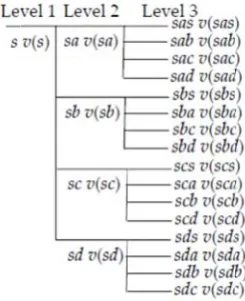
P2P, the rec ient tree stru ms-tree), whi posed in [1]. tores the rec mple of a five the first roun er s broadcas
itself. Due to ach faulty-free
as v(s) from
ms-tree. How er the source
free peer req nfluence gene
ge exchange, f its ms-tree t
or Mobile P2P
peers must P. The P are buted d as nique. e P2P nto or col is faulty han or
rs in a
d then DP2P P2P peers m the essage ciding cause ssages d the which nough peers elpful peers P, the irst. ceived ucture ich is Each ceived e-peer nd of sts its o the e peer m the wever, is a quires erated each to all p f th p r th (s m f p f p a o 2 p T c p b b F ( S e th a P Network peers. Subseq from other pe he second le process of the
ound, and the hird level of it Here, the
ss, saa, sbb, s
ms-tree to rem faulty peers. T peers store the faulty peers in peers may get a simple major of peers must b
2.2. Fault d
In this stud processes by c The peers can conditions to peers.
1. The ma
level maj3(an ancesto tree. Ta v(sac) ancesto whethe and v(s not. 2. There a
from th majorit If the cond be added into belong to v(
Furthermore, ancestorax) w
Subsequently, each peer that he peer is les as a faulty pee
quently, each ers and store evel of its m
third rounds e received val
ts ms-tree. vertices with
scc, and sdd)
move the cyc To put it pla e messages wh n the ms-tree
an incorrect c rity. As a resu be deleted.
Figure 1. A p
detection proc
dy, we propo comparing the n be checked determine wh
ajority value o of the ncestorax), 1 or v(ax) in th
ake Fig. 1 fo and v(sad) or is v(sa). H r the majority sad) are equal
are at least (n he condition 1 y value maj3( ditions above a the Non-Fault (ax) (denoted
the peer y i
when v(axy)
all peers mu appears in the s than (n-(n
-er. In other wo
peer receive es the receive ms-tree. Furt is the same lues will be s
h repeated na must be remo clical influen ainly, when th which are recei repeatedly, th common valu ult, all these re
peer’s ms-tree
cesses
ose the new fa e messages o d with the fo hether the pee
of the vertice ms-tree (d
x n) is e he second leve or example, v
are sibling Here, FDP2P y of v(sas), v l to their anc
n-(n-1)/3) v 1 that are the (ancestorax). are met, then t
ty-Like Peer s d as NFLP is also added
(1 y
ust count the e NFLP. If the -1)/3), this pe
ords, the valu
es the values ed values into thermore, the as the second tored into the
mes of peers oved from the nces from the he faulty-free ived from the he faulty-free ue after taking epeated names
fault detection f the ms-tree. ollowing two ers are faulty
es in the third denoted as equal to their el of the ms-v(sas), v(sab), s, and their P must check v(sab), v(sac) estor v(sa) or
values derived e same as the
the peer x can
set (The set is (ancestorax))).
d into NFLP
n) = v(ax).
M.-L. Chiang, H.-C. Hsieh
sent by the faulty peers, will not be agreed by (n-(n
-1)/3) number of peers. Deservedly, the frequency of these peers in NFLP will be less than (n-(n-1)/3).
Hence, these peers will be defined as faulty peers.
2.3. Whether there have peers immigrate into or emigrate from the network, the protocol is valid only when the total number of faulty peers in the mobile P2P network is less than or equal to
(n-1)/3
According to the previous fault detection protocols [5], [9], [17], [23], the tolerable number of faulty processors is (n-1)/3. When the total number of
faulty processors exceeds the limit, the faulty-free processors cannot decide which processors are faulty. This means that when the total number of faulty peers exceeds this bound, then there may have some fault-free peers been defined as faulty peers. Furthermore, there may also have the condition that the peers cannot be decided as faulty or fault-free peers. In other words, FDP2P is valid only when the total number of faulty peers is less than or equal to (n-1)/3, even when
there have peers moving around the mobile P2P network.
3. The proposed protocol: FDP2P
In this section, the FDP2P protocol is invoked to detect/locate common set of faulty peers in an n-peers
mobile P2P network within three rounds of message exchange. There are three phases in FDP2P, the
message exchange phase, the fault detection phase
and the reorganize phase. Each each faulty-free peer
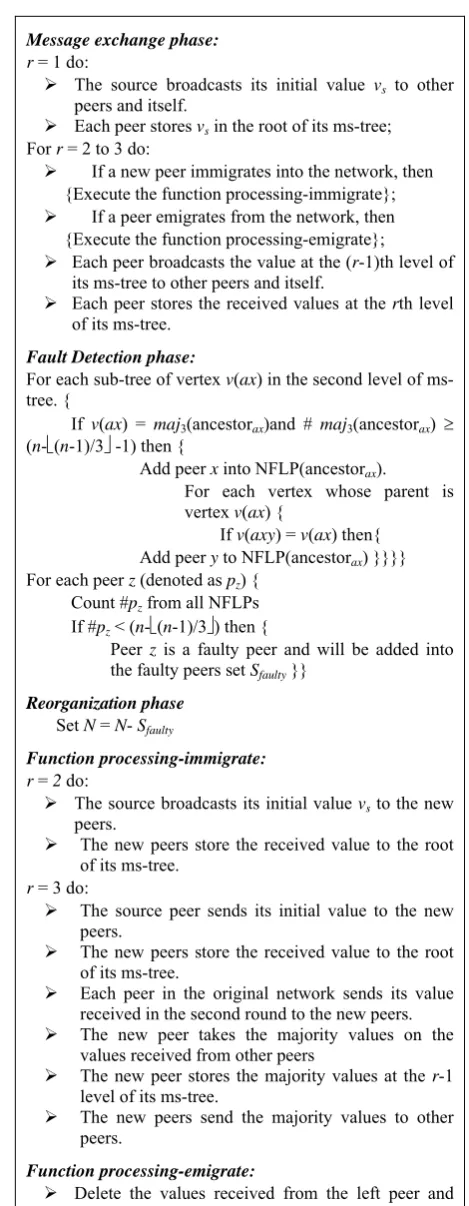
executes the same protocol FDP2P simultaneously. Basically, the procedure of FDP2P is stated in below. Moreover, the details of protocol FDP2P are described as Fig. 2.
Protocol FDP2P Notation:
maj3(ancestorax): The majority value of the vertices (Which are descended from the ancestor v(ax)) in the third level of the ms-tree.
# maj3(ancestorax): The total number of the values (within the vertices which are descended from the ancestor v(ax)) that are equal to maj3(ancestorax). NFLP(ancestorax): The Non Faulty-Link Peer set for
the sub-tree which is descended from v(ax). #pz: The total number of times that the peer z
appears in all NFLPs.
N: The set of peers in the mobile P2P network. Sfaulty: The set of faulty peers in the mobile P2P
network.
Message exchange phase: r = 1 do:
The source broadcasts its initial value vs to other peers and itself.
Each peer stores vs in the root of its ms-tree; For r = 2 to 3 do:
If a new peer immigrates into the network, then {Execute the function processing-immigrate}; If a peer emigrates from the network, then {Execute the function processing-emigrate};
Each peer broadcasts the value at the (r-1)th level of its ms-tree to other peers and itself.
Each peer stores the received values at the rth level of its ms-tree.
Fault Detection phase:
For each sub-tree of vertex v(ax) in the second level of ms-tree. {
If v(ax) = maj3(ancestorax)and # maj3(ancestorax) (n-(n-1)/3 -1) then {
Add peer x into NFLP(ancestorax).
For each vertex whose parent is vertex v(ax) {
If v(axy) = v(ax) then{ Add peer y to NFLP(ancestorax) }}}} For each peer z (denoted as pz) {
Count #pz from all NFLPs If #pz < (n-(n-1)/3) then {
Peer z is a faulty peer and will be added into the faulty peers set Sfaulty }}
Reorganization phase Set N = N- Sfaulty
Function processing-immigrate: r = 2 do:
The source broadcasts its initial value vs to the new peers.
The new peers store the received value to the root of its ms-tree.
r = 3 do:
The source peer sends its initial value to the new peers.
The new peers store the received value to the root of its ms-tree.
Each peer in the original network sends its value received in the second round to the new peers. The new peer takes the majority values on the
values received from other peers
The new peer stores the majority values at the r-1 level of its ms-tree.
The new peers send the majority values to other peers.
Function processing-emigrate:
Delete the values received from the left peer and reconstruct the ms-tree.
Figure 2. The protocol FDP2P
Message Exchange Phase:
In this phase, three rounds of message exchange are collected and stored into each peer’s ms-tree.
Furthermore, all peers can move around the network during message exchange phase. In order to construct a
A New Approach to the Fault Detection Problem for Mobile P2P Network
into the network and peer emigrate from the network) must be considered.
Case 1: New peer immigrates into the network:
If a new peer immigrates into the network before the second round of the message exchange, the source peer must send its initial value to this new peer. The new peer must store the received value into the root of their ms-tree.
If a new peer immigrates into the network before the third round of message exchange, the source peers must send its initial value to the new peers. Besides, the other peers who are in the network originally must send their values in the second level of their ms-tree to this new peer. After that, this new peer must take the majority values on the received values, and then store the majority values into the root and second level of their ms-tree. The new peer must also send the values in the root and the second level of the ms-tree to others.
Case 2: Peer emigrates from the network:
If a peer emigrates from the network, the remaining peers only need to delete the message received from the left peers.
Fault Detection Phase:
In the fault detection phase, each peer must decide
which peers are faulty by comparing the messages sent from all peers by using the conditions described in Section 2.
Reorganization Phase:
After finding out the faulty peers, all faulty-free peers can remove the faulty peers and reorganize the network topology. Since there have no faulty peers in the network, all the fault-free peers can get correct resources with better performance. In other words, the performance of network and correctness can be enhanced without the influence caused by the faulty peers at the same time.
To sum up, previous works [5], [9], [17], [23] require 2*((n-1)/3+1) rounds of message exchange,
however, in FDP2P, all peers only need to run three rounds of message exchange. The message complexity of FDP2P is O(n2) and is more efficient even if the
number of peers is getting larger. Furthermore, the transmission time can be reduced when the rounds of message exchange are decreased. For example, there is a 1000-peers mobile P2P network, and each peer has 2Mb download rate per second. The time complexity for transmitting the messages in previous protocols is O( (1000333*333)/2Mb) seconds. In opposition to the
previous protocols, the time complexity of the FDP2P is
O(10002/2Mb) seconds. FDP2P also considers the
mobility issue of peers. Namely, FDP2P can detect/locate the faulty peers even when there have some peers immigrating or emigrating from the network. Hence, FDP2P is more efficient than previous protocols. The comparison results are shown in Table 1.
Table 1. Comparison between FDP2P and previous protocols
Needed rounds Message complexity Transmission time
complexity (2Mb/s)
Allowable faulty peers Previous protocol
[5], [9], [17], [23] 2*((n-1)/3+1) O(n
(n-1)/3*(n-1)/3) O( (
n(n-1)/3*(n-1)/3)/2Mb) (n-1)/3
FDP2P 3 O(n2) O(n2/2Mb) (n-1)/3
4. An example of implementing FDP2P
In this section, an example including ten peers is shown in Fig. 3 to illustrate how to detect and locate the faulty peers by three rounds of message exchange with FDP2P. In this example, we assume the peer a as
the faulty source peer, which sends different values to all peers. Besides, peers b and c are also assumed to be
faulty peers in Fig. 3(a). For checking the validity of FDP2P, a worst case scenario (the number of 0 and 1 are almost the same) is designed and the transmission behavior of the faulty peers is shown in Fig. 3(b).
At the beginning of the protocol, the source peer a
broadcasts its initial value to all pees in the first round of the message exchange phase. Unfortunately, the source peer a is a faulty peer; it sends different values
0, 1, 0, 1, 0, 1, 0 to peers d, e, f, g, h, i, and j. Here,
each faulty-free peer stores the received value in the root of its ms-tree in the first round, and the results are shown in Fig. 3(c). However, the results of faulty peers do not need to be discussed because the goal of the protocol is to make all faulty-free peers to obtain a
common set of faulty peers. Hence, this example only shows the results of faulty-free peers.
Before the start of the second round of message
exchange phase, peer k wants to immigrate into the
P2P network. The source peer a must send its initial
value to peer k first. After receiving the value 1 from
peer a, peer k must store the value into the root of its
ms-tree, and then continue to execute the protocol. The result is shown in Fig. 3(d).
In the second round of the message exchange phase, each peer exchanges the received value from first round of message exchange phase with all peers. Similarly, the received messages are stored in second level of their ms-tree. The results are shown in Fig. 3(e).
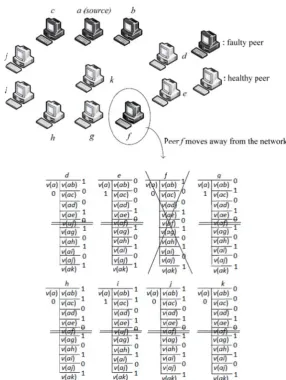
Now, we assume that peer f wants to emigrate from
the mobile P2P network. Here, the ms-tree of peer f
will be deleted automatically. Similarly, all peers need to delete the value v(af) received from peer f, and the
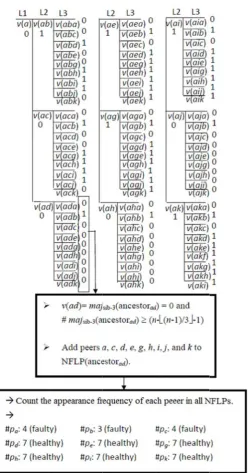
In third each peer e second round peers and sto of their ms-tr ms-trees is sh After the determine wh phase. For ex can be add following con
1.v(ad) =
2.# maj3(
and 3.v(adx)
v(adc), v(adj) =
Then, the of each peer compute whe example, pe appearance f times, and frequency is for peer d is
After det peers can Reorganizati not be alter degraded by can do some In the origin 3(a), peers d
and peers a,
FDP2P, all t faulty peers. Fig. 3(i). c h i j
Figure 3. (a)
a b c
Figure 3. (b
round of the exchanges the d of the mess ores the receiv
ree. In this ex hown in Fig. 3 e message exc
hich peers are xample, the pe ded to the N nditions are s = maj3(ancesto
(ancestorad) =
= maj3(anc
v(ade), v(adg
= maj3 (ancest
e protocol wi r that appears ether #pz is le
eers a, b an
frequency of p 4 times, res less than n-(
shown in Fig. tecting the fau
remove th on phase. At red, and the y faulty peers e activities mo
nal network
d, e, g, h, i, j,
, b and c are
the faulty-fre The new ne
a (source)
g
The environme
d e f 0 1 0 1 0 1 0 0 0
b) The transmis
e message ex e received va age exchange ved values in xample, the re
3(g).
change phase, e faulty in the eers a, c, d, e,
NFLP(ancesto atisfied: orad) = 0,
= 8 (n-(n
-estorad) {suc
g), v(adh), v(a
torad) = 0}.
ll count the f s in all of NF ess than (n-(n
nd c are fau
peers a, b, and
spectively. T (n-1)/3 = 7).
. 3(h). ulty peers, all he faulty p
the same tim e performance s. All faulty-f
ore efficiently environment and k are fau
faulty peers. e peers can r twork structu
b
d
e
f
ent of the origin
g h i j 1 0 1 0 0 1 1 1 1 1 1 1
ssion behavior o
xchange phas alues from th e phase with a n the third lev esult of peer d
, each peer ca e fault detectio , g, h, i, j, and
orad) when th
1)/3 -1 ) =
ch as, v(ada adi), v(adj), an
frequency (#p
FLPs and the
n-1)/3). In th
ulty peers (th d c is 4 times,
he appearanc The procedur
the faulty-fre peers in th e, the data wi e will not b free peers the y and correctl shown in Fi ulty-free peer After runnin remove all th ure is shown i
: faulty p
: healthy
nal P2P network
k 1 0 0
of faulty peers.
se, he all vel d’s an on d k
he
6,
a),
nd
pz)
en his he 3 ce ure ee he ill be en ly. ig. rs, ng he in peer y peer k. F i j Figu pee Fig f j
Figure 3. (c) Th
a ( c
h
ure 3. (d) Peer k er a into the roo
roun
gure 3. (e) The
M. d v(a)= e v(a)= f v(a)= g v(a)= h v(a)= i v(a)= j v(a)=
e results of the exchange ph (source) b f g k 1
k stores the rece t of its ms-tree nd of message e
results of the se exchange ph
.-L. Chiang, H
=0 =1 =0 =1 =0 =1 =0
first round of m hase.
d
e
eived value rece at the start of th exchange.
econd round of hase.
.-C. Hsieh
message
: faulty peer
: healthy peer
eived from he second
A New Appproach to the
F
e Fault Detect
Figur
Figure 3. (g) Th
ion Problem fo
re 3. (f) Each pe
he results of the
or Mobile P2P
eer deletes the v
e third round of
P Network
value received f
message excha
from peer f
Figure 3
i j
F
3. (h) The proce
h k
Figure 3. (i)
Figure 3. An ex
edure of finding
d
g
) New network
xample of execu
g out the faulty p
d
e
:
structure.
uting FDP2P
M.
peers.
healthy peer
A New Approach to the Fault Detection Problem for Mobile P2P Network
5. The correctness and complexity
In the first subsection, we will prove the correctness of the proposed protocol FDP2P. The complexity is proven in Section 5.2.
5.1. The correctness of FDP2P
Here, the correctness of FDP2P can be proved by considering the following requirements:
(Agreement’): Root s is common.
(Fairness’): No faulty-free peer is incorrectly detected as faulty by any non-faulty peer.
Before analyzing the protocol, several terms must be defined.
A vertex is called common [1] if each faulty-free peer computes the same value for . In other words, the values stored in vertex of each faulty-free peer’s ms-tree are identical to all peers, if the values are sent from the faulty-free peers.
To prove that the vertex is common, the term
commonfrontier [1] is defined as: when every
root-to-leaf path of the ms-tree contains a common vertex, then the collection of the common vertices forms a common frontier. In other words, every faulty-free peer has the same messages collected in the common frontier if a common frontier exists in a faulty-free peer’s ms-tree. The above concepts can be used to prove the correctness of the proposed protocol FDP2P.
The term correct vertex is defined as follows:
vertex i of a tree is a correct vertex if peer i is
faulty-free. For instance, vertices v(ad), …, v(ak) in Fig. 3(e)
are correct because peers d, …, and k are faulty-free.
The following lemmas, corollary and theorem are used to prove the correctness of FDP2P.
Lemma 1: All correct vertices of the ms-tree are
common.
▼Proof. In the Fault Detection phase, there are no
repeatable vertices in the ms-tree obtained by deleting the repeating vertices. At the second and third levels, the correct vertex has at least n-1 children in which
at least n-(n-1)/3 children are correct. The values,
which are stored within these n-(n-1)/3 correct
vertices, will be the same. The correct vertex is common in the ms-tree, if the level of is less than or equal to three. Thus, all correct vertices of the ms-tree
are common. ▲
Lemma 2: A common frontier does exist in the
ms-tree.
▼Proof. There are three vertices along each
root-to-leaf path of the ms-tree at any time, in which the root is labeled by the source name, and the others are labeled by a sequence of peers’ names. Since at most
(n-1)/3 peers can fail, at least one vertex is correct
along each root-to-leaf path of the ms-tree. By lemma 1, the correct vertex is common, and a common frontier exists in each faulty-free peer’s ms-tree. ▲
Lemma 3: Let be a vertex. If there is a common
frontier in the sub-tree rooted at , then
is common.
▼Proof. By induction hypothesis on the height of
.
If the height of is 0 and a common frontier ( itself) exists, is common.
If the height of is l, the children of are all in
common, based on the induction hypothesis with the height of the children as l-1; therefore, vertex is
common. ▲
Corollary 1: If a common frontier exists in the ms-trees, the root is common.
Theorem 1: The root of a faulty-free peer’s ms-tree is
common.
▼Proof. By Lemmas 1 to 3, and Corollary 1, the
theorem is proved.▲
Theorem 2: FDP2P can solve the fault detection
problem.
▼Proof. To prove this theorem, FDP2P must meet
the requirements: Agreement and Validity.
Agreement: Root s is common.
By Theorem 1, Agreement is satisfied.
Validity: No faulty-free peer is incorrectly detected as faulty by any non-faulty peer.
If the peer is faulty-free, it will send identical value to other peers. Since there have at least n-(n-1)/3
faulty-free peers, the majority value of the faulty-free peers will be equal to the value sent by the faulty-free sender. In other words, there will have at least
n-(n-1)/3 faulty-free peers agree that the sender is
faulty-free. Hence, no faulty-free peers will be treated as faulty peers. The theorem is proved. ▲
5.2. The complexity of FDP2P
The complexity of the protocol is evaluated in terms of 1) the number of rounds about message exchange, 2) the number of allowable faulty peers and 3) the message complexity of the FDP2P protocol.
Theorem 3: FDP2P requires only three rounds of
message exchanges to detect/locate the faulty peers in the mobile P2P network.
▼Proof. In the second round of the message
exchange phase, the values are sent and received correctly by other n-(n-1)/3 faulty-free peers if the
sending peers are faulty-free. All these correct values are sent in the third round of the message exchange phase. Then, these three level ms-trees can be used to
determine the faulty peers. Here, they have (n-1)
vertices in the second level of the ms-tree. Thus, there will be (n-1) NFLPx (1≤x≤ (n-1)). If the frequency of
the peer x appearing in all NFLPs is less than
n-(n-1)/3, there has less than n-(n-1)/3 peers
believe that peer x is faulty-free. Furthermore, based
M.-L. Chiang, H.-C. Hsieh
detection problem. Hence, three rounds of message exchange can solve the fault detection problem in the
mobile P2P network. ▲
Theorem 4: FDP2P can solve the fault detection
problem by using three rounds of message exchanges, which is the minimum
▼Proof. The number of messages is insufficient
to find out the faulty peers within one round of message exchange because the source peer may be faulty. The source faulty peer may send 0’s and 1’s at the same frequency. It is impossible to determine the faulty peers within two rounds of message exchange if the number of peers is large. Furthermore, based on Theorem 3, FDP2P can solve the fault detection problem utilizing the concept of non-faulty like set in three rounds of message exchange without regard to the number of peers. Hence, three rounds of message
exchange is the minimum. ▲
Theorem 5: The number of allowable faulty peers is
(n-1)/3 in FDP2P protocol, which is the maximum.
▼Proof. If the faulty peers exceed n/2 , then all
may send different values to each peer. Faulty-free peers cannot obtain the common vertices or frontier. Thus, the protocol cannot be certain that all faulty-free peers can find out the faulty peers. If the total number of faulty peers is equal to n/2, and n is an even
number, then the number of 0’s and 1’s in the second level may be equal after applying the VOTE function. Under such conditions, all faulty-free peers cannot obtain a common value. Furthermore, according to the assumptions and constraints of the BA problem, the allowable component is peer only, and the faulty peers cannot exceed (n-1)/3. These are identical to our
constraints. Thus, the total number of allowable faulty peers is (n-1)/3 in FDP2P. ▲
Theorem 6: The message complexity is O(n2).
▼Proof. In the first round of the message
exchange phase, the source peer will send its initial value. Hence, one message must be generated. In the second round of the message exchange phase, all peers must send the received value during the first round of message exchange, and n messages must be generated.
In the third round, n*n messages must be generated.
Therefore, the total quantity of messages to be generated during the execution of FDP2P is (1 + n + n*n). The message complexity is O(n2). ▲
5. 3. Conclusions
In previous studies [9], [11], [20] of mobile P2P networks, most proposed protocols usually assume that peers are cooperative. Unfortunately, some peers may be un-cooperative or perform some transgression to crash and decrease the efficiency of the network systems in practice. As a result, it is important to detect faulty peers for the mobile P2P network, in
which peers can immigrate into or emigrate from the network at any time.
There have some protocols [5], [9], [17], [23] been proposed to detect/locate the faulty processors based on BA problem protocol. However, these protocols require 2 * ((n-1)/3+1) rounds of message exchange
and the message complexity is O(n(n-1)/3)*(n-1)/3).
These protocols [5], [9], [17], [23] also do not concern the mobility issue. Hence, these protocols are not suitable and not efficient for the mobile P2P network in which there exits millions of peers, and peers can move around the network at any time.
In this study, we proposed a novel protocol called FDP2P to detect the faulty peers using three rounds of message exchange only, and the complexity of message can be reduced to O(n2). With less rounds of
message exchange, fewer amounts of messages will be generated during executing FDP2P. This can help for saving the storage. In other words, the protocol has less overhead than previous works. Furthermore, the mobility issue is also been considered in FDP2P. Hence, FDP2P is superior to previous studies [5], [9], [17], [23].
References
[1] A. Bar-Noy, D. Dolev, C. Dwork, R. Strong. Shifting
Gears: Changing Algorithms on the Fly to Expedite
Byzantine Agreement. In: Information and
Computation, vol. 97, pp.205-233, 1992. http://dx
.doi.org/10.1016/0890-5401(92)90035-E.
[2] B. Peter, W. Tim, D. Bart, D. Piet. A comparison of peer-to-peer architectures.Ghent, Belgium: Broadband
Communication Networks Group (IBCN), Department of Information Technology (INTEC), Ghent University.
[3] H. S. Siu,, Y. H. Chin, W. P. Yang. A Note on
Consensus on Dual Failure Modes. In: IEEE
Transactions on Parallel and Distributed Systems, vol.
7, no. 3, pp. 225-230, 1996. http://dx.doi.org/10. 1109/71.491575.
[4] H. S. Siu, Y. H. Chin, W. P. Yang. Byzantine
Agreement in the Presense of Mixed Faults on
Processors and Links. In: IEEE Transactions on
Parallel and Distributed Systems, vol. 9, no. 4, pp.
335-345, 1998. http://dx.doi.org/10.1109/71.667895. [5] H. S. Hsiao, Y. H. Chin, W. P. Yang. Reaching Fault
Diagnosis Agreement under a Hybrid Fault Model. In:
IEEE Transactions on Computers, vol. 49, no. 9, pp.
980-986, 2000.
[6] H. Yoshino, N. Hayashibara, T. Enokido, M. Takizawa. Hierarchical Protocol for Byzantine
A New Approach to the Fault Detection Problem for Mobile P2P Network
Expert Systems Applications, pp. 5-9, 2005.
[7] K. Aberer, Z. Despotovic. Managing Trust in a
Peer-2-Peer Information System. In: ACM Fourteenth
Conference on Information and Knowledge Management, pp. 310-317, 2001.
[8] K. Q. Yan, Y. H. Chin. Achieving Byzantine
Agreement in a Processor and Link Fallible Network. In Proceedings of International Phoenix Conference on Computers and Communications, pp. 407-412, 1989.
http://dx.doi.org/10.1109/PCCC.1989.37423. [9] K. Shin, P. Ramanathan. Diagnosis of Processors
with Byzantine Faults in a Distributed Computing Systems. In: Proc. Symp. Fault-Tolerant Computing,
pp. 55-60, 1987.
[10]L. Lamport, R. Shostak, M. Pease. The Byzantine
Generals Problem. In: ACM Transactions on
Programming Languages and Systems, vol. 4, no. 3 pp.
382-401, 1982. http://dx.doi.org/10.1145/357172.357176.
[11]M. Adler, R. Kumar, K. Ross, D. Rubenstein, T. Suel, D. D. Yao. Optimal peer selection for P2P
downloading and streaming. In: 24th Annual Join
Conference of the IEEE Computer and Communications Societies (INFOCOM 2005), pp.
1538- 1549, 2005.
[12]M. Pease, R. Shostak, L. Lamport. Reaching
Agreement in the Presence of Faults. In: Journal of
ACM, vol. 27, no. 2, pp. 228-234, 1980.
http://dx.doi.org/10.1145/322186.322188. [13]Oztoprak, Kasim, and Akar, Gozde Bozdagi.
Two-Way/Hybrid Clustering Architecture for Peer to Peer
Systems. In: Second International Conference on
Internet and Web Applications and Services, pp. 11-11,
2007. http://dx.doi.org/10.1109/ICIW.2007.66. [14]S. C. Wang, K. Q. Yan, G.Y. Zheng. Dual Agreement
Virtual Subnet Protocol for Mobile Ad-hoc Networks. In: The 22nd Annual ACM Symposium on Applied Computing, pp. 953-954, 2007.
[15]S. C. Wang, K.Q. Yan, H.C. Hsieh. The New
Territory of Mobile Agreement. In: Computer
Standards & Interfaces, vol. 26, no. 55, pp. 435-447,
2004. http://dx.doi.org/10.1016/j.csi.2003.12.002.
[16]S. C. Wang, K. Q. Yan, M. L. Chiang. Optimal
Agreement in a Scale-Free Network Environment. In:
Informatica International Journal, vol. 17, no. 1, pp.
137-150, 2006.
[17]S. C. Wang, Y. H. Chin, K. Q. Yan. Reaching a Fault
Detection Agreement. In: The proceding of
International Conference Parallel Processing, pp.
251-258, 2007.
[18]S. D. Kamvar, M. T. Schlosser, H. Garcia-Molina.
The EigenTrust Algorithm for Reputation Management in P2P Networks. In: Proc. WWW’03, pp. 640-651,
2003.
[19]S. Jun, M. Ahamad, J. Xu. Robust Information
Dissemination in Uncooperative Environments. In:
International Conference on Distributed Computing Systems, pp. 293-302, 2005.
[20]X. Jin, S. H. Gary Chan, W. P. Ken Yiu, Y. Xiong, Q. Zhang. Detecting Malicious Hosts in the Presence
of Lying Hosts in Peer-to-Peer Streaming. In: IEEE international Conference on Multimedia and Expo, pp.
1537-1540, 2006.
[21]X. Zhang, J. Liu, B. Li, T. -S. P. Yum.
CoolStreaming/DONet: A data-driven overlay network for efficient live media streaming. In: IEEE Conference on Computer Communications, March 2005.
[22]Y. Cai, A. Natarajan, J. Wong. On Scheduling of
Peer-to-Peer Video Services. In: IEEE Journal on
Selected Areas in Communications, vol. 25, no. 1, pp.
140-145, 2007. http://dx.doi.org/10.1109/JSAC.2007.070114.
[23]K. V. S. Ramarao, J. C. Adams. On the Diagnosis of
Byzantine Faults. Proc. Symp. Reliable Distributed Systems, pp. 144-153, 1988.
[24]F. Preparata, G. Metze, R. Chien. On the Connection
Assignment Problem of Diagnosable Systems. IEEE Transactions on Electronic Computing, vol. 16, pp.
848-858, 1967. http://dx.doi.org/10.1109/PGEC. 1967.264748.
[25]Mallela S., Masson G. M. Diagnosis without repair
for hybrid fault situations. In: IEEE Transactions on Computers, vol. 29, no. 6, pp. 461-471, 1980.
http://dx.doi.org/10.1109/TC.1980.1675605.