City, University of London Institutional Repository
Citation:
Lipparini, A., Lorenzoni, G. & Ferriani, S. (2014). From core to periphery and back: A study on the deliberate shaping of knowledge flows in interfirm dyads and networks. Strategic Management Journal, 35(4), pp. 578-595. doi: 10.1002/smj.2110This is the published version of the paper.
This version of the publication may differ from the final published
version.
Permanent repository link:
http://openaccess.city.ac.uk/17953/Link to published version:
http://dx.doi.org/10.1002/smj.2110Copyright and reuse: City Research Online aims to make research
outputs of City, University of London available to a wider audience.
Copyright and Moral Rights remain with the author(s) and/or copyright
holders. URLs from City Research Online may be freely distributed and
linked to.
City Research Online: http://openaccess.city.ac.uk/ [email protected]
Strat. Mgmt. J.,35: 578–595 (2014) Published online EarlyView 21 March 2013 in Wiley Online Library (wileyonlinelibrary.com) DOI: 10.1002/smj.2110 Received 24 July 2010;Final revision received 31 July 2012
RESEARCH NOTES AND COMMENTARIES
FROM CORE TO PERIPHERY AND BACK: A STUDY ON
THE DELIBERATE SHAPING OF KNOWLEDGE FLOWS
IN INTERFIRM DYADS AND NETWORKS
ANDREA LIPPARINI,1* GIANNI LORENZONI,1and SIMONE FERRIANI1,2 1Department of Management, University of Bologna, Bologna, Italy
2Cass Business School, City University London, London, U.K.
We study 892 Italian motorcycle industry projects carried out via 184 different buyer–supplier and supplier-supplier relationships to provide evidence on the knowledge dynamics occurring in dyads and networks and to understand the underexplored but important (perhaps even dominant) leading role that some firms play in the evolution of networks and interfirm learning processes. We develop a multiphase model which, from a multilevel perspective addressing different relational subsets, suggests how firms can best organize to generate and exchange knowledge efficiently. We argue that extant theoretical perspectives can profitably draw on our findings to strengthen their dynamic components and help them explain the widely diffused ‘exploring through partner’ strategies more effectively. Copyright2013 John Wiley & Sons, Ltd.
INTRODUCTION
Both executives and academics have recently iden-tified knowledge as one of the most important factors contributing to firms’ ability to achieve sus-tainable competitive advantage (Dyer and Singh, 1998; Dyer and Nobeoka, 2000; Zhao, Anand, and Mitchell, 2005). At the same time, a growing body of research has come to consider networks as an appropriate unit of analysis (Powell, Koput, and Smith-Doerr, 1996; Kogut, 2000) and to exam-ine the question of where a firm should draw its boundaries (Parmigiani and Mitchell, 2009) on the understanding that ‘where boundaries are
Keywords: knowledge exchange and creation; interfirm networks; core and peripheral firms; knowledge-enhanc-ing practices; motorcycle industry
*Correspondence to: Andrea Lipparini, Department of Manage-ment, University of Bologna, Via Capo di Lucca, 34 – Bologna, Italy. E-mail: [email protected]
drawn affects the value placed on knowledge and its usefulness’ (Argote, McEvily, and Reagans, 2003: 574). This work has shown how knowl-edge and other critical resources increasingly span firm boundaries so that the advantage of a sin-gle firm is often linked to those of the network of ties in which it is embedded (Dyer and Singh, 1998). In particular, research rooted in innova-tion literature (Powell et al., 1996; Zhao et al., 2005) and in buyer–supplier relationships (Kotabe, Martin, and Domoto, 2003) has emphasized the increasing importance of networking, alliances and idiosyncratic interfirm relations (Martin, Mitchell, and Swaminathan, 1995), and the advantages of adopting a cooperative mode for knowledge cre-ation (Mesquita, Anand, and Brush, 2008). Strate-gic literature’s focus on knowledge creation and management has been expanding in unprecedented fashion, so that the key knowledge-based ques-tions companies face are not only how to organize themselves to exploit their already developed
© 2013 The Authors.Strategic Management Journalpublished by John Wiley & Sons Ltd.
knowledge or capabilities, but also ‘how to orga-nize to efficiently generate knowledge and capa-bility’ (Nickerson and Zenger, 2004: 617).
Our multiple case, inductive study (Eisenhardt, 1989) attempts to answer the above question. We present a multiphase model of interfirm knowledge creation and exchange across dyads and networks and discuss the important (per-haps even dominant) role that buying firms play in the evolution of networks and of inter-firm learning processes, which has hitherto been underexplored in the strategic literature. We posit that networks become viable organizational forms for sharing and generating valuable knowl-edge when a set of purposefully implemented knowledge-enhancing practices—which we define as distinctive patterns of action and interaction between core firms—‘buyers’—and peripheral firms—‘suppliers’—that enable the exchange, recombination, and co-creation of specialized knowledge—allow firms to leverage knowledge located beyond their organizational boundaries.1In particular, we focus on a total of 892 projects asso-ciated with the design and/or manufacture of com-ponents for motorbikes and/or scooters in the Ital-ian two-wheeler industry. These projects involved 17 leading motorcycle manufacturers—core buyer firms who were responsible for setting up and subsequently ‘orchestrating’ dyads and networks (Dhanaraj and Parkhe, 2006)—and their (periph-eral) first-tier suppliers.
CONCEPTUAL BACKGROUND
Although prominent firm perspectives have con-tributed greatly to explain how firms achieve sus-tainable competitive advantage, they still overlook the fact that, increasingly, even unique resources span firm boundaries and can be selectively trad-able through a network of firms (Kogut and Zan-der, 1992; Gulati, 1999). Even contributions that have significantly extended resource-based reason-ing (Barney, 1991; Peteraf, 1993) and are rooted in knowledge and capability-based views in strategy (Kogut and Zander 1992; Conner and Prahalad,
1Throughout the article, we make use of the core periphery
pattern to convey the particular situation in which core firms, which possess prominence gained through relational skills and their central position in network structures, leverage their position to harness the knowledge dispersed among peripheral firms.
1996; Teece, Pisano, and Shuen, 1997; Felin and Hesterly, 2007) share a main focus on intrafirm
transfers of existing knowledge (Hansen 1999; Tsai 2001; Reagans and McEvily, 2003; Levin and Cross, 2004) and are less well equipped to analyze knowledge transfer and creationacross fully inde-pendent entities (which have become significantly more common over a wide range of industries, from automobiles to semiconductors) (Nickerson and Zenger, 2004; Hansen, Mors, and Løv˚as, 2005; Mesquita et al., 2008). A growing number of empirical studies rooted in innovation literature (Powellet al., 1996; Zhao et al., 2005), and espe-cially those adopting a relational perspective (Dyer and Singh, 1998), explicitly consider the collabo-rative network, rather than the single firm, as the locus for learning and innovation. In particular, research on buyer–supplier networks in the auto-mobile industry (Dyer, 1996; Osborn and Hage-doorn, 1997; Argote et al., 2003) has shown how the extensive involvement of suppliers in product and process development has given lead assem-blers faster product development cycles, lower costs, better end product quality (Womack, Jones, and Roos, 1990; Dyer and Nobeoka, 2000), and faster problem solving (Takeishi, 2001). The idea that networks are critical for knowledge creation and exchange is corroborated by studies conducted from knowledge transfer perspectives (Tsai, 2001; Reagans and McEvily, 2003; Inkpen and Tsang, 2005). Systematic evidence from this research stream indicates that networks with substantial knowledge transfer mechanisms between man-ufacturers and suppliers out-innovate relational sets with less well-developed knowledge-sharing routines.
of relationships—R&D, operations, and other up-and downstream activities. We also investigate learning processes and knowledge-related activi-ties involving both sides of the dyad and consider them as both knowledge transmitters and recipi-ents. Although several studies have included bilat-eral (buyer and supplier) analyses (e.g., Zander and Kogut, 1995; Takeishi, 2001; Kotabe et al., 2003), they have considered knowledge flows only as unidirectional—one unit providing and one receiving—and such perspectives clearly limit our understanding of cases where firms both provide and receive knowledge. Finally, we show how the effective creation and extraction of network value hinges on the purposeful enactment by core firms of practices designed to lead and facilitate knowl-edge sharing and deployment.
METHODS
Research design, setting, and sample construction
Our inductive, multiple case study (Eisenhardt, 1989) examines the Italian powered two-wheeler industry, which we deemed appropriate for sev-eral reasons. First, product architecture: motorcy-cles and scooters2 are made of dozens of mod-ules and subassemblies whose development and manufacture requires diverse and specific know-how and expertise (Helfat, Lipparini, and Verona, 2011). Second, the level of product innovation involved is appropriate: manufacturers are con-tinually challenged by the introduction of new materials—plastics, titanium, carbon fibers, light alloys, etc.—into frames and components, as well as the need to meet changing environ-mental regulations (Helfat et al., 2011). Third, the intense industrial process innovations, which require manufacturers to adopt state-of-the-art equipment and R&D practices and to base their manufacturing activities on leading-edge technolo-gies (Gavetti, 2001). Fourth, the size of Italy’s domestic market—the largest in Europe in terms of powered two-wheeler production (nearly 55%), registrations (26.7%), and numbers of motorcy-cles in use (26%)—and its competitive position as
2A scooter is a small-engined, two-wheeled motor vehicle with
certain design characteristics such as a step-through frame, small wheels, and an automatic transmission.
Europe’s leading exporter, headed only by Japan and Taiwan in world rankings (ACEM - Associa-tion des Constructeurs Europ´eens de Motocycles, 2010).
Our study included core motorcycle firms (assemblers) that sold products in Italy (regard-less of their country of origin) and peripheral firms (suppliers) localized in Italy that special-ized in the design and/or manufacture of industry components. Both of these types of firms work within a network structure of non-equity, long-term cooperative buyer/supplier relationships. We selected core firms on the basis of lists sup-plied by the Italian Ministry of Transportation (from www.trasporti.gov.it) and the trade associa-tion (www.ancma.it), and we used Italian market sales performance figures for 2007, the most recent year for which comprehensive statistics were avail-able. We contacted representatives at the full list of 25 core firms specializing in scooter and/or motor-cycle design and/or production, and 17—covering nearly 85 percent of Italian market sales—agreed to participate. In selecting peripheral firms, we first used business publications to identify relevant groups of two-wheeler components and modules, each including multiple, often specialized, sub-components (thus, ‘body’ includes frame, suspen-sion, forks, etc.; ‘brakes’ include drums, cylinders, pads, shoes, etc.). Working from publicly avail-able sources (e.g., motorcycle and spare parts cata-logs, national and international exhibition business directories, online bikers’ communities, etc.), we identified a list of 43 component suppliers. Check-ing this list with our full core firm group, we identified 19 suppliers who each had links with at least seven core firms: 13 of them agreed to participate and supplied details about their ties to core firms.
Data collection and analyses
To avoid restrictive theoretical or empirical lenses (Santos and Eisenhardt, 2005), we defined knowledge broadly, as encompassing both easily codifiable and transmittable information and com-plex and more difficult to codify know-how. The interaction patterns we noted implied the existence of ties between two entities, which we define as
several data sources: quantitative and qualitative data from semi-structured interviews with exec-utives from both tie partners; archival data (press releases, annual reports, corporate documents, etc.); direct observations, including visits to the R&D units, plants, and headquarters of nearly all core firms and every peripheral firm; and e-mails, phone calls, and follow-up interviews. In particular, we conducted 81 face-to-face on-site interviews (totaling nearly 170 hours) over a 28-month period in 2007, 2008, and 2010 with 52 different executives from both core and peripheral firms. Respondents were selected according to several criteria (Yin, 1994): long tenure in the company; direct involvement in knowledge-related decisions; and functional and hierarchical variety. This use of multiple internal sources helped mitigate the potential biases of any individual respondent (Kumar, Stern, and Anderson, 1993).3 We began our interviews at the core firms. Each consisted of three main parts: background information on the firm and its business strategy; description of key events in the formation and evolution of the firm’s ties (if any) with our sample suppliers; and direct questions about knowledge exchange/creation, including details of develop-ment projects for new scooter/motorcycle com-ponents core firms had with each listed supplier. The first interview round (2007 to 2008) focused on projects from 2004 to 2007, and the second round (2010) focused on 2008 to 2009 projects. We queried the types of knowledge exchanged with each supplier and the main direction of knowl-edge flows, which might be simple—mostly out-bound flows of information and know-how toward suppliers or return flows to core firms—or more advanced—bidirectional and intertwined interac-tions that might contribute to the cogeneration of knowledge. Lastly, we asked core firms about the practices they had implemented to support such knowledge flows and any that facilitated flows between their suppliers. We used interview tech-niques such as ‘event tracking’ to gain accurate information (Eisenhardt, 1989) and repeated the process later with peripheral firms. We triangulated our interview data with observation and archival data to improve its accuracy and completeness, combining contemporary and retrospective data
3The composition of our sample firms, their product ranges, and
the position of each company’s interviewees is available online See Appendix S1.
to improve both external and internal validity (Leonard-Barton, 1990).
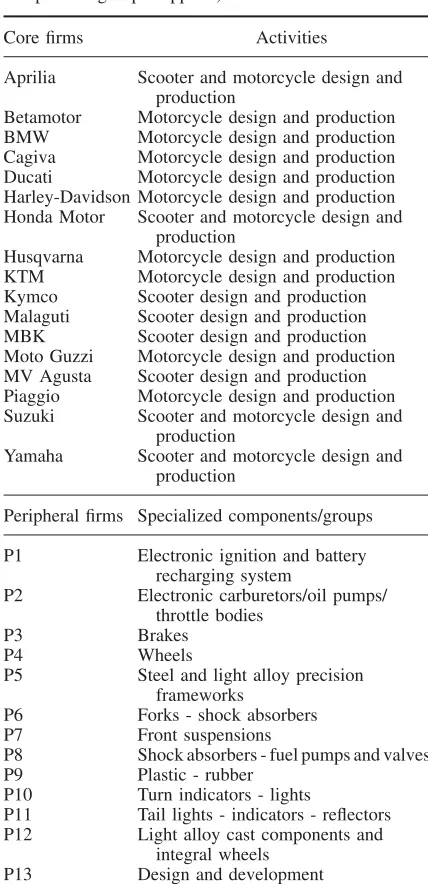
We selected key peripheral firm informants on the same criteria as for core firms and followed the same basic interview structure so that the responses complemented our core firm data. We asked supplier executives to report about the spe-cific projects identified by the core firms—about the levels of relevant information and know-how they had received from their buyers, the knowl-edge they had returned to them embedded in components or services, and about bidirectional flows and joint knowledge creation. They also reported on knowledge flows between them and other peripheral firms promoted by a common core firm. In all, we collected data on 892 projects enacted via 184 dyads connecting 17 core firms and 13 peripheral firms: more specifically, on 776 projects carried out via 163 buyer–supplier ties and 116 stemming from 21 supplier-supplier relationships. All these collaborations (58 of which involved racing) were based on written contracts and (as our interview analysis revealed) could be categorized into one of three broad func-tional areas: R&D, operations, and other up- and downstream activities, which we identified as the industry’s focal organizational areas for knowledge exchange and creation. Figure 1 highlights the whole pattern of ties between core and peripheral firms (solid lines), as well as between peripheral firms (dotted lines). Table 1 highlights the main activities carried out by the core firms and the components/groups supplied by peripheral firms.
P13
P2 P1
nb=7 ns=3
nb=14 ns=4
P12 P3
P11
P4
P5
P10
P9 P6
P8 P7
= tie between core firms and peripheral firms = tie between peripheral firms
nb = number of ties with core firms
ns = number of ties with other peripheral firms
nb=9 ns=3
nb=17 ns=7
nb=11 ns=5
nb=13 ns=4
nb=16 ns=4
nb=12 ns=3 nb=10
ns=5 nb=9
ns=0 nb=16
ns=0 nb=13
ns=0 nb=16
ns=4
Yamaha
Aprilia
Betamotor
Cagiva Suzuki
BMW
MV Agusta Piaggio
Moto Guzzi
Mbk
Malaguti Kymco KTM
H-D
Honda Ducati
[image:6.567.105.460.60.420.2]Husqvarna
Figure 1. Ties between Italian top two-wheeler buyers (or ‘core firms’) and key component suppliers (or ‘peripheral firms’ - P).N=184.
causal and temporal relationships (Eisenhardt, 1989).
We structured our analysis of knowledge-enhancing practices using a ‘temporal bracketing’ strategy (Langley, 1999), organizing the data into successive ‘phases,’ defined so that there is con-tinuity in the activities within each phase but dis-continuities at their frontiers (Langley and Truax, 1994). As Langley (1999: 703) notes, ‘many tem-poral processes can be decomposed in this way, at least partly, without presuming any progressive developmental logic.’ Our data analysis allowed us to develop a four-phase conceptual model of how core firms deliberately shaped knowledge prac-tices to stimulate interfirm knowledge exchange and creation, at both the dyad and network levels. Our firm informants helped us identify and validate the four phases and the knowledge flows involved.
THE SHAPING OF KNOWLEDGE
EXCHANGE AND CREATION IN DYADS AND NETWORK: A FOUR-PHASE MODEL
Table 1. Core and peripheral firms (activities and components/groups supplied)
Core firms Activities
Aprilia Scooter and motorcycle design and
production
Betamotor Motorcycle design and production
BMW Motorcycle design and production
Cagiva Motorcycle design and production
Ducati Motorcycle design and production
Harley-Davidson Motorcycle design and production Honda Motor Scooter and motorcycle design and
production
Husqvarna Motorcycle design and production
KTM Motorcycle design and production
Kymco Scooter design and production
Malaguti Scooter design and production
MBK Scooter design and production
Moto Guzzi Motorcycle design and production
MV Agusta Scooter design and production
Piaggio Motorcycle design and production
Suzuki Scooter and motorcycle design and
production
Yamaha Scooter and motorcycle design and
production
Peripheral firms Specialized components/groups
P1 Electronic ignition and battery
recharging system
P2 Electronic carburetors/oil pumps/
throttle bodies
P3 Brakes
P4 Wheels
P5 Steel and light alloy precision
frameworks
P6 Forks - shock absorbers
P7 Front suspensions
P8 Shock absorbers - fuel pumps and valves
P9 Plastic - rubber
P10 Turn indicators - lights
P11 Tail lights - indicators - reflectors
P12 Light alloy cast components and
integral wheels
P13 Design and development
with core and peripheral firms exchanging knowl-edge simultaneously, making it difficult to identify a predominant direction. In Phase 4, knowledge flows between peripheral firms that are linked to the same core firm, and learning extends from dyads to the network.
These phases do not represent ‘stages’ in the sense of being a predictable and sequential process and do not imply a progressive life cycle logic as found in many normative change theories. Specifi-cally, they allow us to constitute comparative units
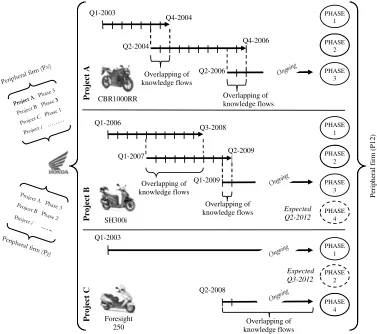
of analysis to explore theoretical ideas (Langley, 1999)—and are especially useful in illustrating how the actions in one period affect those under-taken in the next. Figure 2 illustrates the temporal structuring of the different phases, showing how an example core firm (Honda Italia) maintains a port-folio of ties with different peripheral firms. Each core firm will have such a portfolio of ongoing projects with each supplier, which may be at differ-ent phases and may relate to R&D, operations, or upstream/downstream activities alone, or to them all. This example case shows Honda’s portfolio of eight projects (related to the many versions of its scooters and bikes) in which it collaborates with P12 (a steel alloy body supplier) and their different learning phases. Thus, Project A (the heavyweight CBR1000RR bike entirely designed and manufac-tured in Italy) entered Phase 1 in Q1, 2003 and Phase 2 in Q2, 2004, and has been in Phase 3 since Q2, 2006. Project B (developing and manu-facturing frames for top-selling scooters, e.g., the SH300) spent more than two years in Phase 1, had been through Phase 2 (with inbound flows overlap-ping the Phase 1 outbound flows by a considerable margin), and entered Phase 3 in Q1, 2009. At the time of the survey, it was expected to enter Phase 4 in Q2, 2012, as the peripheral firm P12 starts collaborations with two other suppliers to develop a frame for next-generation scooters. Project C (developing steel alloy frame for scooters like the Foresight 250) has been in Phase 1 since Q1, 2003: Honda Japan had already developed defini-tive engineering details, and suppliers were invited to exploit Honda’s innovation to add value for both partners. But Phase 4-type information and know-how flows have been taking place between the frame maker and partners supplying braking systems and wheels (three highly interdependent components) since Q2, 2008. At the time of the survey, Project C was expected to enter Phase 2 in Q3, 2012, with inbound knowledge flows from P12 constituting the platform for Honda engineers’ future design activities.
Phase 1—Knowledge flows from core firms to peripheral firms
Q1-2003 PHASE 1
Q4-2004
Q2-2006 Overlapping of
knowledge flows CBR1000RR
Q2-2004 PHASE2
PHASE 3
Q4-2006
Overlapping of knowledge flows
Project A
Peripheral firm (P12)
PHASE 1
PHASE 2
Q1-2006
Q3-2008 Q1-2007 Q2-2009
SH300i
Project B
PHASE 3
Q1-2009
Expected Q2-2012
Overlapping of knowledge flows
Overlapping of
knowledge flows PHASE 4
PHASE 1
Q1-2003
Q2-2008
PHASE 2
Project C Foresight 250
PHASE 4
Overlapping of knowledge flows
[image:8.567.92.469.60.394.2]Expected Q3-2012
Figure 2. Example of knowledge flows between core firm (Honda Italia) and peripheral firm (P12-steel alloy frames for bikes and scooters).
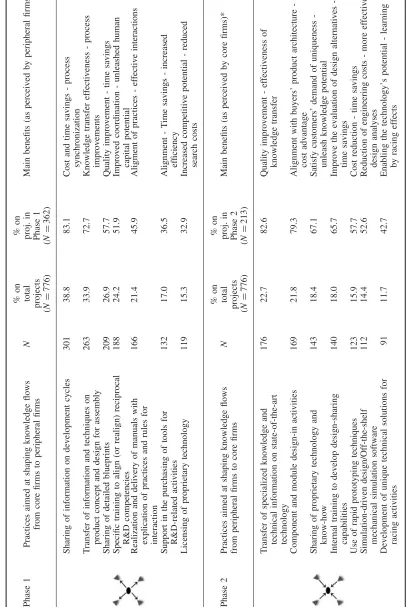
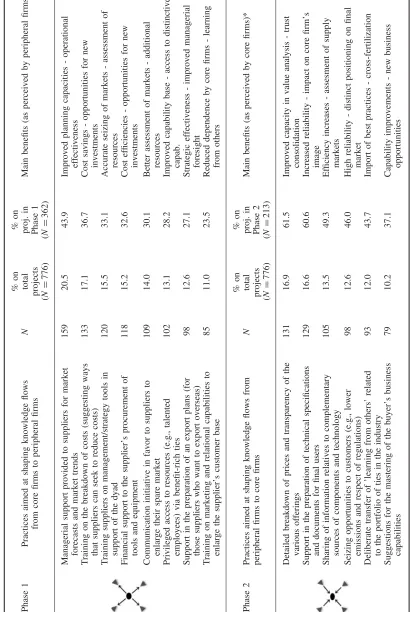
practices that shape outbound flows and the main benefits (peripheral) recipients perceive from those flows. With respect to R&D (Table 2, Phase 1), in 301 projects, we found core firms sharing infor-mation about development cycles with periph-eral firms to ease prototype development and gain time/cost efficiencies. Core firms transferred information and techniques on product concepts and assembly designs to suppliers in nearly one-third of the projects we studied, and they also (to a lesser extent) shared detailed blueprints and offered specific training about product con-cepts and design-for-assembly logics and tech-niques. Other core firm practices we observed included: preparing manuals outlining practices and rules for R&D interactions, supporting pur-chasing costs of R&D tools, and licensing pro-prietary technologies to peripheral firms. Trans-ferring tacit knowledge effectively requires exten-sive personal contact and trust and the supplier
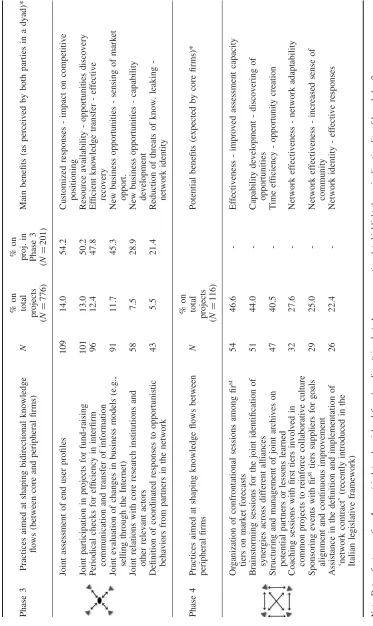
T able 2. Continued %o n %o n Phase 3 Practices aimed at shaping bidirectional knowledge N total proj. in M ain benefits (as perceived by parties in a dyad)* flows (between core and peripheral firms) projects Phase 3 ( N = 776) ( N = 201) Structured meetings on a weekly basis 143 18.4 71.1 Identification of how to fix problems -fast response Implementation of components and modules codesign and co-engineering activities 132 17.0 65.7 Cost reduction -time savings Guest engineers at the customer’s and the supplier’s plant 116 14.9 57.7 Sharing of capab. in concurrent develop. -learning from others Joint tests on a regular basis 115 14.8 57.2 Quality improvement -improved reliability Joint training on value engineering/value analysis activities 98 12.6 48.8 Unleashed technology’s potential -time savings Regular confrontation on how to synchronize and update CAD models 94 12.1 46.8 Updating of tools -time savings Buyer – supplier trial centers for racing experiences 65 8.4 32.3 Shaping of knowledge advancements -fast response %o n Phase 4 Practices aimed at shaping knowledge N total P otential benefits (expected by core firms)* flows between peripheral firms
projects (N=
[image:10.567.99.444.73.685.2]T able 3. Continued %o n % o n Phase 3 Practices aimed at shaping bidirectional knowledge N total proj. in M ain benefits (as perceived by both parties in a dyad)* flows (between core and peripheral firms) projects Phase 3 ( N = 776) ( N = 201) Monthly meetings for a constant assessment of the pull logic (in response to demand) 155 20.0 77.1 Alignment -lower coordination costs Joint assessment of principles and techniques of lean manufacturing and value stream mapping 143 18.4 71.1 High ef ficiency of cost and time -discovery of opportunities Joint optimization of warehouse stock volumes, joint orders for purchasing materials 128 16.5 63.7 Cost savings -reduction of opportunity costs Joint investment for the implementation of integrated enterprise resource planning (ERP) 122 15.7 60.7 Scheduling and monitoring of production -high ef ficiency Activation of quality circles to reduce defects, scraps, and w aste 101 13.0 50.2 Cost savings -development of recovery capabilities Joint initiatives for faster delivery of spare parts, improving the quality of repairing services 90 11.6 44.8 T ime ef ficiency -impact on reputation Constant confrontation on statistical quality control methods and quality performance indicators 85 11.0 42.3 Cost savings -high conformity Initiatives to support the full integration of logistic processes of both parties 85 11.0 42.3 Cost and time ef ficiency -fast responses %o n Phase 4 Practices aimed at shaping knowledge flows between N total P otential benefits (expected by core firms)* peripheral fi rms
projects (N=
[image:12.567.83.469.90.684.2]T able 4. Continued %o n % o n Phase 3 Practices aimed at shaping bidirectional knowledge N total proj. in M ain benefits (as perceived by both parties in a dyad)* flows (between core and peripheral firms) projects Phase 3 ( N = 776) ( N = 201) Joint assessment of end user profiles 109 14.0 54.2 Customized responses -impact on competitive positioning Joint participation in projects for fund-raising 101 13.0 50.2 Resource availability -opportunities discovery Periodical checks for ef ficiency in interfirm communication and transfer of information 96 12.4 47.8 Ef ficient knowledge transfer -ef fective recovery Joint evaluation of changes in business models (e.g., selling through the Internet) 91 11.7 45.3 New business opportunities -sensing of market opport. Joint relations with core research institutions and other relevant actors 58 7.5 28.9 New business opportunities -capability development Definition of coordinated responses to opportunistic behaviors from partners in the network 43 5.5 21.4 Reduction of threats of know. leaking -network identity %o n Phase 4 Practices aimed at shaping knowledge flows between N total P otential benefits (expected by core firms)* peripheral fi rms
projects (N=
[image:14.567.87.460.61.687.2]peripheral firms, thus improving their planning capacities and operational effectiveness, and also gave training on cost breakdowns and on manage-ment and strategy tools to help suppliers improve their efficiency, even providing financial support to help them buy tools and equipment. Core firms also established communication initiatives aimed at helping suppliers find new markets to increase their abilities to identify and enter new markets (often related to racing events) to help improve their financial stability: shaping joint visions and seizing market opportunities allowed these part-ners to develop joint dynamic capabilities.
Phase 2—Knowledge flows from peripheral firms to core firms
Peripheral firms relying simply on markets to access specialized assets and acquire technology are likely to see their capabilities deteriorate (Teece, 1986) and to remain stuck in passive, dependent postures (Rosenberg, 1982). Periph-erals that purposefully supply core firms with return knowledge turn their relationships into partnerships, making it harder for core firms to switch to other suppliers. In terms of inbound R&D knowledge (Table 2, Phase 2), our study depicts peripheral firms as providing special-ized knowledge and technical information: by sharing proprietary technology and know-how, including alerting their partners about advances in state-of-the-art technologies and proposing design alternatives to allow them to fulfill their customers’ unique demands more completely. Other practices included: organizing training sessions to develop design-sharing capabilities, developing rapid pro-totyping techniques, and using simulation-driven design to give core partners with significant engi-neering cost benefits and more effective design analysis. At the operations level (Table 3, Phase 2), suppliers shaped their knowledge flows to core firms by investing in highly specialized finishing processes and treatments, a practice we observed in nearly one-fifth of the projects and which bene-fitted a wide range of activities including product and process feasibility, surfacing, structural anal-ysis, and prototype engineering. Peripheral firms also transferred knowledge embedded in updated production scheduling programs, made consider-able investments in developing quality production capabilities, and offered preventive maintenance of core firms’ production machinery—flows that
were enabled by their possession of dedicated manufacturing tools, CNC machines, CAD-CAM working stations, and flexible manufacturing sys-tems. Such inbound flows also extended to other upstream and downstream activities (Table 4, Phase 2). Peripheral firms provided core firms with detailed price breakdowns and supported the preparation of technical specifications and documents for final users, building core firms’ reliability and reputation. Their practices extended to sharing information about complementary sources of components and technology, which may seem to be counterintuitive behavior, but was aimed at reinforcing network potential and effectiveness and supporting core firms’ reactions to market opportunities, e.g., by speedy response to changing vehicle emissions regulations.
Phase 3—Simultaneous, bidirectional
knowledge flows between core and peripheral firms
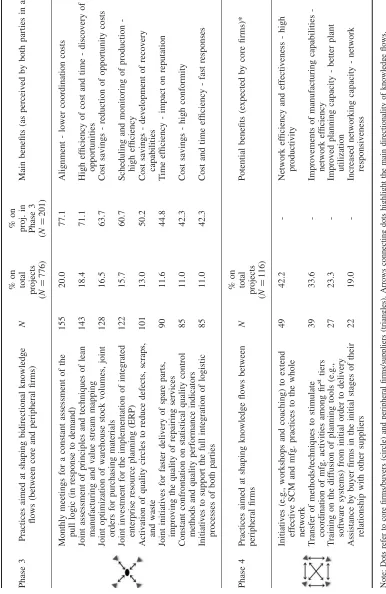
models. At the operations level (Table 3, Phase 3), monthly meetings were arranged in one-fifth of the projects we studied, allowing them to constantly assess the ‘pull’ logic, increasing core/periphery alignment and time efficiency and lowering coordi-nation costs. We also noted how parties interacted to jointly assess lean manufacturing principles and techniques and employed value stream mapping to raise their cost and time efficiency and their effectiveness in attaining manufacturing goals. Other practices supporting bidirectional knowl-edge flows included: synchronizing purchasing orders and optimizing warehouse stock volumes, jointly implementing integrated enterprise resource planning (ERP), and using ‘quality circle’ initia-tives to cut defects and waste. In the ‘other activ-ities’ sphere (Table 4, Phase 3), we saw evidence of joint assessment of end user profiles to improve response effectiveness and participation in fund-raising projects to increase resource availability. Coevolutionary alignment took the form of the periodic updating of communication and informa-tion flows needed to respond quickly to environ-mental jolts or to competitors’ moves.
Phase 4—Knowledge flows between peripheral firms
In the fourth model phase, we observed knowl-edge flowing between different peripheral firms, whose connection had been promoted and sup-ported by a common core firm. Largely unexplored by strategic literature, this guided evolution of learning processes from dyads to networks yields significant insight into how core firms connect alters to gain informational (Burt, 2000) and other difficult-to-replicate network-specific advantages. Redeploying knowledge dispersed across collabo-rative networks requires that core firms possess (or develop) learning and teaching capabilities across organizational boundaries, as this targeted coordi-nation of knowledge mobility is central to a net-work’s ability to co-create value and innovation (Zhao et al., 2005). As for R&D (Table 2, Phase 4), we observed knowledge exchange and cre-ation between peripheral firms being accomplished by: training suppliers on improving team working skills for greater effectiveness across dyads and networks, transferring methods and techniques to stimulate co-design activities among first-tier sup-pliers, and organizing workshops and seminars on R&D organizing principles at the network level.
Core firms supported such intersupplier knowledge flows by identifying second-tier suppliers with complementary R&D capabilities. At the opera-tions level (Table 3, Phase 4), core firms extended effective supply chain and manufacturing activities across their networks by organizing workshops and coaching sessions, transferring methods and tech-niques to stimulate coordination among first-tier suppliers, and providing training to diffuse plan-ning tools covering a range of activities from initial orders to delivery. To a lesser extent, we also saw core firms play active roles in helping peripherals manage the initial stages of their interrelationships, such as helping develop joint manufacturing plans. In other areas (Table 4, Phase 4), core firms orga-nized sessions between peripheral firms on market forecasts and identified synergies across differ-ent alliances. Core firms’ ability to lead by shar-ing strategy also hshar-inged on them sharshar-ing lessons learned, databases, and potential partner profiles to create further opportunities for their suppli-ers. Core firms ran coaching sessions to reinforce the network’s goal alignment and helped suppliers elaborate ‘network contracts’ to give them unique identities in fund-raising applications.4
DISCUSSION AND CONCLUSION
We present a structured framework that takes a multilevel perspective to address different rela-tional subsets, depicting knowledge flows at dyad and network levels. We found core firms that took charge of the processes of interfirm learn-ing from firms to dyads, and from dyads to net-works, and of knowledge-enhancing practices all needed to nurture the transfer, recombination and creation of specialized knowledge. Such practices are favoring the affirmation of higher-order orga-nizing principles (Grant, 1996), the idiosyncratic learning processes (Kotabe et al., 2003), and the interfirm knowledge-sharing routines (Dyer and Singh, 1998). The network we studied combined the advantages of common identity and lan-guage normally associated with hierarchical forms (Kogut and Zander, 1992; Conner and Prahalad, 1996) with the learning incentives that typically occur in dyads and networks. Having multiple
4Key quotes from our interviews across the four phases are
actors involved in defining the rules governing cooperation decisions (Kogut, 2000) led the net-work to develop stronger shared identity and lan-guage, lowering the costs of communication and knowledge exchange, establishing rules and prin-ciples for coordination, and influencing the direc-tion(s) of both searching and learning. The whole network, thus, becomes more expert at captur-ing opportunities, developcaptur-ing new products, and extracting technical and organizational capabili-ties both from current capabili-ties and from dormant or unexpected contacts (Kane, 2010). In our setting, the threat of opportunism appears to have been more than outweighed by the advantages of: learn-ing from other partners (Lorenzoni and Lipparini, 1999), including developing joint ‘interaction rou-tines’ (Nelson and Winter, 1982), making it easier for firms to modify existing behavior patterns as needed and improving transactive knowledge—about who knows what—to better enable information transfer (Reagans, Argote, and Brooks, 2005). These incentives help firms per-ceive networks as ‘safe places’ where ideas and knowledge can be exchanged, but with reduced risk of knowledge spillovers to competitors who share the same partners (Lester and Piore, 2004).
Our findings suggest that all else being equal, the most successful learning processes will accrue in dyads and networks where both sources and recipients possess the requisite knowledge trans-fer capacity. A company’s capacity to effectively deploy knowledge is only as strong as the weakest partner in its innovation value chain, so unilat-eral flows of knowledge to third parties do not guarantee the sustainability of any advantage. We contribute to explaining why some dyads and net-works succeed in learning faster than their com-petitors (Dyer and Nobeoka, 2000), enabling their partner firms to achieve their strategic objectives (Zollo, Reuer, and Singh, 2002). Our study also contributes to clarifying the role of firm ities in alliances and, in particular, the capabil-ities they need when entering alliances. Extant contributions have carefully examined alliance (Kale, Dyer, and Singh, 2002), relational (Loren-zoni and Lipparini, 1999) or boundary-bridging (Takeishi, 2001) and orchestration capabilities (Dhanaraj and Parkhe, 2006), and we add to this list the capacity for transferring and creat-ing knowledge (Smith, Collins, and Clark, 2005) which we show is needed by all parties in dyads and networks. Future research could refine
and build on this study in several directions: it could empirically determine which network structure dimensions are most likely to influ-ence project outcomes, as well as examine the relationship between project phases, knowledge-enhancing activities, and outcomes. Equally inter-esting would be to study whether informal, distant, or infrequent relationships—rather than strong recurring ties among a small number of buyers and suppliers—lead to more or less efficient knowl-edge sharing (Hansen et al., 2005). It would also be interesting to consider ‘negative ties’ (Labianca and Brass, 2006), given that many of the core firms in our sample are competitors. As to this, it could be interesting to examine how competitive relationships between core firms might influence, for instance, choices about forming ties with spe-cific peripheral firms that are already tied to rivals (Gimeno, 2004), therefore gaining a deeper under-standing of both the ‘structure of cooperation’ (Ahuja, 2000) and the structure of competition.
ACKNOWLEDGEMENTS
We received valuable insights from Will Mitchell and from two anonymous reviewers. We thank Jon Morgan of Paraphrase for expert copyediting and Lois Gast for effective management of this manuscript. We express our appreciation to all the firms, respondents, and interviewees who participated in this study. We acknowledge support from the Strategy & Organization Center at the University of Bologna. The authors alone are responsible for errors and omissions.
REFERENCES
ACEM - Association des Constructeurs Europ´eens de Motocycles. 2010. Report on the motorcycle industry. Available at http://www.acem.eu/index.php/media-corner/publications/91-acem-report-2010 (accessed 12 January 2013).
Ahuja G. 2000. Collaboration networks, structural holes, and innovation: a longitudinal study. Administrative Science Quarterly 45(3): 425–455.
Argote L, McEvily B, Reagans R. 2003. Managing knowledge in organizations: an integrative framework and review of emerging themes.Management Science 49(4): 571–582.
Burt RS. 2000. The network structure of social capital. In Research in Organizational Behavior, Sutton RI, Staw BM (eds). Elsevier/JAI: New York; 345–423. Conner K, Prahalad CK. 1996. A resource-based theory of
the firm: knowledge versus opportunism.Organization Science 7(5): 477–501.
Dhanaraj C, Parkhe A. 2006. Orchestrating innovation networks. Academy of Management Review 31(3): 659–669.
Dyer JH. 1996. Specialized supplier networks as a source of competitive advantage: evidence from the auto industry. Strategic Management Journal 17(4): 271–291.
Dyer JH, Singh H. 1998. The relational view: cooperative strategy and sources of interorganizational competitive advantage. Academy of Management Review 23(4): 660–679.
Dyer JH, Nobeoka K. 2000. Creating and managing a high-performance knowledge-sharing network: the Toyota case. Strategic Management Journal 21(3): 345–367.
Eisenhardt KM. 1989. Building theories from case study research. Academy of Management Review 14(4): 532–550.
Eisenhardt KM, Graebner ME. 2007. Theory building from cases: opportunities and challenges.Academy of Management Journal 50(1): 25–32.
Felin T, Hesterly WS. 2007. The knowledge-based view, nested heterogeneity, and new value creation: philo-sophical considerations on the locus of knowledge. Academy of Management Review 32(1): 195–218. Gavetti G. 2001. Ducati. Harvard Business School Case
#701–132, Boston, MA.
Gimeno J. 2004. Competition within and between net-works: the contingent effect of competitive embedded-ness on alliance formation. Academy of Management Journal 47(6): 820–842.
Grant RM. 1996. Prospering in dynamically competitive environments: organizational capability as knowledge integration.Organization Science7(4): 375–387. Gulati R. 1999. Network location and learning: the
influence of network resources and firm capabilities on alliance formation.Strategic Management Journal 20(5): 397–420.
Hansen MT. 1999. The search-transfer problem: the role of weak ties in sharing knowledge across organization subunits. Administrative Science Quarterly 44(1): 82–111.
Hansen MT, Mors ML, Løv˚as B. 2005. Knowledge sharing in organizations: multiple networks, multiple phases. Academy of Management Journal 48(5): 776–793.
Helfat CE, Lipparini A, Verona G. 2011. Exploring ambidexterity in supplier networks: evidence from the Italian motor vehicle sector. Paper presented at the annual meeting of the Strategic Management Society, Miami, FL.
Inkpen AC, Tsang EWK. 2005. Social capital, networks, and knowledge transfer. Academy of Management Review 30(1): 146–165.
Kale P, Dyer JH, Singh H. 2002. Alliance capability, stock market response, and long-term alliance success:
the role of the alliance function.Strategic Management Journal 23(8): 747–767.
Kane AA. 2010. Unlocking knowledge transfer
potential: knowledge demonstrability and superor-dinate social identity. Organization Science 21(3): 643–660.
Kogut BM. 2000. The network as knowledge: genera-tive rules and the emergence of structure. Strategic Management Journal 21(3): 405–425.
Kogut BM, Zander U. 1992. Knowledge of the firm, com-binative capabilities, and the replication of technology. Organization Science3(3): 383–397.
Kotabe M, Martin X, Domoto H. 2003. Gaining from vertical partnerships: knowledge transfer, relationship duration, and supplier performance improvement in the U.S. and Japanese automotive industries.Strategic Management Journal 24(4): 293–316.
Kumar N, Stern LW, Anderson JC. 1993. Conducting interorganizational research using key informants. Academy of Management Journal 36(6): 1633–1651. Labianca G, Brass DJ. 2006. Exploring the social ledger: negative relationships and negative asymmetry in social networks in organizations. Academy of Management Review 31(3): 596–614.
Langley A, Truax J. 1994. A process study of new technology adoption in smaller manufacturing firms. Journal of Management Studies 31: 619–665. Langley A. 1999. Strategies for theorizing from
pro-cess data. Academy of Management Review 24(4): 691–710.
Leonard-Barton D. 1990. A dual methodology for case studies: synergistic use of a longitudinal single site with replicated multiple sites. Organization Science 1(3): 248–266.
Lester RK, Piore MJ. 2004. Innovation: The Missing Dimension. Harvard University Press: Cambridge, MA.
Levin DZ, Cross R. 2004. The strength of weak ties you can trust: the mediating role of trust in effective knowledge transfer. Management Science 50(11): 1477–1490.
Lorenzoni G, Lipparini A. 1999. The leveraging of interfirm relationships as a distinctive organizational capability: a longitudinal study.Strategic Management Journal 20(4): 317–338.
Martin X, Mitchell W, Swaminathan A. 1995. Recreating and extending Japanese automobile buyer–supplier links in North America. Strategic Management Jour-nal 16(8): 589–619.
Mesquita LF, Anand J, Brush TH. 2008. Comparing the resource-based and relational views: knowledge transfer and spillover in vertical alliance. Strategic Management Journal 29(9): 913–941.
Nelson RR, Winter SG. 1982. An Evolutionary The-ory of Economic Change. Harvard University Press: Cambridge, MA.
Nickerson JA, Zenger TR. 2004. A knowledge-based theory of the firm: the problem-solving perspective. Organization Science15(6): 617–632.
Osborn RN, Hagedoorn J. 1997. The institutionaliza-tion and evoluinstitutionaliza-tionary dynamics of interorganizainstitutionaliza-tional alliances and networks. Academy of Management Journal 40(2): 261–278.
Parmigiani A, Mitchell W. 2009. Complementarity, capabilities, and the boundaries of the firm: the impact of within-firm and interfirm expertise on concurrent sourcing of complementary components. Strategic Management Journal 30(10): 1065–1091.
Peteraf MA. 1993. The cornerstone of competitive advan-tage: a resource-based view. Strategic Management Journal 14(3): 179–191.
Powell WW, Koput KW, Smith-Doerr L. 1996. Interor-ganizational collaboration and the locus of innovation: networks of learning in biotechnology.Administrative Science Quarterly41(1): 116–145.
Reagans R, Argote L, Brooks D. 2005. Individual expe-rience and expeexpe-rience working together: predicting learning rates from knowing who knows what and knowing how to work together.Management Science 51(6): 869–881.
Reagans R, McEvily B. 2003. Network structure and knowledge transfer: the effect of cohesion and range. Administrative Science Quarterly 48(2): 240–267. Rosenberg N. 1982. Inside the Black Box. Cambridge
University Press: New York.
Santos FM, Eisenhardt KM. 2005. Organizational bound-aries and theories of organization.Organization Sci-ence.16(5): 491–508.
Simonin BL. 1997. The importance of collaborative know-how: an empirical test of the learning orga-nization. Academy of Management Journal 40(5): 1150–1174.
Smith KG, Collins CJ, Clark KD. 2005. Existing knowl-edge, knowledge creation capability, and the rate of new product introduction in high-technology firms. Academy of Management Journal48(2): 346–357. Takeishi A. 2001. Bridging inter- and intra-firm
bound-aries: management of supplier involvement in auto-mobile product development. Strategic Management Journal 22(5): 403–433.
Teece DJ. 1986. Profiting from technological innovation. Research Policy 15(6): 285–305.
Teece DJ, Pisano G, Shuen A. 1997. Dynamic capabilities and strategic management. Strategic Management Journal 18(7): 509–533.
Tsai W. 2001. Knowledge transfer in intraorganizational networks: effects of network position and absorptive capacity on business unit innovation and performance. Academy of Management Journal 44(5): 996–1004. Womack JP, Jones DT, Roos D. 1990.The Machine that
Changed the World: The Story of Lean Production. Harper Perennial: New York.
Yin R. 1994. Case Study Research (2nd edn). SAGE Publications: Newbury Park, CA.
Zander U, Kogut B. 1995. Knowledge and the speed of the transfer and imitation of organizational capabili-ties.Organization Science6: 76–92.
Zhao Z, Anand J, Mitchell W. 2005. A dual networks perspective on inter-organizational transfer of R&D capabilities: international joint ventures in the Chinese automotive industry. Journal of Management Studies 42: 127–160.
Zollo M, Reuer JJ, Singh H. 2002. Interorganizational routines and performance in strategic alliances. Orga-nization Science 13(6): 701–713.
SUPPORTING INFORMATION
Additional supporting information may be found in the online version of this article:
Appendix S1. List of core and peripheral firms (product mix and company’s interviewees)