
Prospects for Cohesion Policy in 2014-20 and Beyond : Progress with Programming and Reflections on the Future
50
0
0
Full text
(2) This paper was originally produced for the European Policy Research Consortium as Prospects for Cohesion Policy in 2014-20 and Beyond: Progress with Programming and Reflections on the Future, EoRPA Paper 14/4.. European Policies Research Centre School of Government & Public Policy University of Strathclyde 40 George Street Glasgow G1 1QE United Kingdom Tel: +44 (0) 141 548 3061 Fax: +44 (0) 141 548 4898. e-mail: [email protected] [email protected]. The place of useful learning.
(3) The University of Strathclyde is a charitable body, registered in Scotland, number SC015263.
(4) Prospects for Cohesion policy in 2014-20 and beyond: Progress with programming and reflections on the future. Preface This report was prepared by the European Policies Research Centre (EPRC) under the aegis of EoRPA (European Regional Policy Research Consortium), which is a grouping of national government authorities from countries across Europe. The Consortium provides sponsorship for EPRC to undertake regular monitoring and comparative analysis of the regional policies of European countries and the inter-relationships with EU Cohesion and Competition policies. Over the past year, EoRPA members have comprised the following partners: Austria Bundeskanzleramt (Federal Chancellery), Vienna Finland Työ- ja elinkeinoministeriö (Ministry of Employment and the Economy), Helsinki France Commissariat Général à l’Egalité des territoires (General Commissariat for Territorial Equality, CGET, previously DATAR), Paris Germany Bundesministerium für Wirtschaft und Energie (Federal Ministry for the Economy and Energy), Berlin Ministerium für Wirtschaft, Bau und Tourismus, Mecklenburg-Vorpommern (Ministry for the Economy, Construction and Tourism, Mecklenburg-Western Pomerania), Schwerin Italy . Ministero dello Sviluppo Economico (Ministry of Economic Development), Dipartimento per lo sviluppo e la coesione economica (Department for Development and Economic Cohesion), Rome. Netherlands . Ministerie van Economische Zaken (Ministry of Economic Affairs), The Hague. Norway Kommunal- og moderniseringsdepartementet (Ministry of Local Government and Modernisation), Oslo Poland Ministerstwo Infrastruktury i Rozwoju (Ministry of Infrastructure and Development), Warsaw Sweden Näringsdepartementet (Ministry of Enterprise, Energy and Communications), Stockholm Switzerland . Staatssekretariat für Wirtschaft (SECO, State Secretariat for Economic Affairs), Bern. United Kingdom Department for Business, Innovation and Skills, London The Scottish Government, Enterprise, Transport and Lifelong Learning Department, Glasgow The research for the country reviews was undertaken by EPRC in consultation with EoRPA partners. It involved a programme of desk research and fieldwork visits among national and regional authorities. European Policy Research Paper No. 88. i. European Policies Research Centre.
(5) Prospects for Cohesion policy in 2014-20 and beyond: Progress with programming and reflections on the future. in sponsoring countries during the first half of 2014. The EoRPA research programme is coordinated by Professor John Bachtler, Fiona Wishlade, Dr Sara Davies and Heidi Vironen. This paper should be referred to as: C. Mendez and J. Bachtler (2014) Prospects for Cohesion Policy in 2014-20 and Beyond: Progress with Programming and Reflections on the Future, EoRPA Paper 14/4, Paper prepared for the 35th meeting of the EoRPA Regional Policy Research Consortium at Ross Priory, Loch Lomondside, 5-7 October 2014. The country reviews were edited by an EPRC team led by Dr Sara Davies and also comprising Stefan Kah, Stephen Miller, Patricia Robertson, Dr Arno van der Zwet and Heidi Vironen. Country-specific research was contributed by the following research team: Austria: Stefan Kah, EPRC. Latvia: Janis Aprans and Dr Tatjana Muravska, University of Latvia. Belgium: Frederike Gross and Dr Arno van der Zwet, EPRC. Lithuania: Jonas Jatkauskas, BGI Consulting. Bulgaria: Prof Julia Spiridonova, ProlnfraConsult. Luxembourg: Frederike Gross, EPRC. Croatia: Prof Maja Fredotović, Blanka Šimundić and Vinko Muštra, University of Split. Malta: Stephanie Vella, E-Cubed Consultants. Cyprus: Eleftherios Antonopoulos, EPRC Associate. Netherlands: Dr Arno Van der Zwet, EPRC. Czech Republic: Dr Lucie Jungwiertová, Charles University. Norway: Fiona Wishlade, EPRC. Denmark: Heidi Vironen, EPRC. Poland: Dr Martin Ferry, EPRC. Estonia: Dr Kristiina Tõnnisson, University of Tartu. Portugal: Dr Carlos Mendez, EPRC. Finland: Heidi Vironen, EPRC. Romania: Prof Daniela-Luminiţa Constantin, Bucharest University of Economic Studies. France: Frederike Gross, EPRC. Slovakia: Martin Obuch, Consulting Associates. Germany: Dr Sara Davies, EPRC. Slovenia: Dr Damjan Kavaš, Institute for Economic Research, Ljubljana. Greece: Eleftherios Antonopoulos, EPRC Associate. Spain: Dr Carlos Mendez, EPRC. Hungary: Zsuzsanna Kondor, EPRC Associate. Sweden: Heidi Vironen, EPRC. Ireland: Stephen Miller, EPRC. Switzerland: Stefan Kah, EPRC. Italy: Dr Laura Polverari, EPRC. United Kingdom: Rona Michie and Dr Martin Ferry, EPRC. Many thanks are due to everyone who participated in the research. Thanks also to Dr Keith Clement, Lynn Ogilvie and Alyson Ross for editorial, coordination and secretarial support respectively, and to Dr Andrew Judge for research assistance. In addition, the European Policies Research Centre gratefully acknowledges the financial support provided by the members of the EoRPA Consortium. Disclaimer: It should be noted that the content and conclusions of this paper do not necessarily represent the views of individual members of the EoRPA Consortium.. European Policy Research Paper No. 88. ii. European Policies Research Centre.
(6) Prospects for Cohesion policy in 2014-20 and beyond: Progress with programming and reflections on the future. TABLE OF CONTENTS 1.. INTRODUCTION. 2. 2.1 2.2 2.3. THE ECONOMIC, POLITICAL & INSTITUTIONAL CONTEXT 5 The crisis and territorial disparities ...............................................................................................5 Economic governance developments...........................................................................................6 Political and institutional developments ..................................................................................... 10. 3.1 3.2 3.3 3.4 3.5. COHESION POLICY 2014-20 13 Finalisation of the legislative framework .................................................................................... 13 Geographical eligibility & allocations ......................................................................................... 14 State of Play of Partnership Agreements and Operational Programmes .................................. 19 Negotiation issues ..................................................................................................................... 21 Thematic allocations and concentration .................................................................................... 26. 4.1 4.2 4.3. POST-2020 REFORM SCENARIOS 29 Scenarios for spatial coverage and targeting of Cohesion policy ............................................. 29 Reassessing the shared management model of delivering Cohesion policy ............................ 33 Economic Governance scenarios and implications for Cohesion policy ................................... 35. 5.1 5.2. QUESTIONS FOR DEBATE 37 Implications of the 2013 reforms ............................................................................................... 37 Longer term reform of Cohesion policy after 2020 .................................................................... 37. 3.. 4.. 5.. European Policy Research Paper No. 88. 3. iii. European Policies Research Centre.
(7) Prospects for Cohesion policy in 2014-20 and beyond: Progress with programming and reflections on the future. European Policy Research Paper No. 88. iv. European Policies Research Centre.
(8) Prospects for Cohesion policy in 2014-20 and beyond: Progress with programming and reflections on the future. Executive Summary 2014 marks the start of a new seven-year programming period for EU Cohesion policy. The new rules on the European Structural and Investment Funds for 2014-20 were agreed in December 2013, providing for greater strategic realignment of Cohesion policy with the Europe 2020 strategy, a more integrated approach to programming and a stronger performance orientation. This paper provides a review and assessment of the pogramming of the 2014-20 Partnership Agreements and Operational Programmes across the EU and reflects on the implications for the future of Cohesion policy. The economic, political and institutional context The crisis has had a major impact on the economies of EU Member States and regions reversing long-term regional convergence trends. There has been an upturn in economic activity across the EU recently, but the recovery is fragile, unevenly spread and will take time to impact on territorial disparities. The deterioration in public finances across the EU has severely restricted public investment and limited the ability of some Member States to comply with the Cohesion policy principles of additionality and co-financing. There is thus a major tension between the investment goals of EU Cohesion policy and the EU’s fiscal consolidation goals, which may become difficult to reconcile in the absence of strong growth and with more restrictive macro-conditionality requirements on Cohesion policy. Cohesion policy in 2014-20 There are significant shifts in eligibility and allocations across the EU in the 2014-20 period. The coverage of the Less-Developed Regions will fall from 31.7 percent of the EU population (in 2007-13) to 25 percent (in 2014-20), while Transition Region coverage will almost double to 13.5 percent of the EU population and is heavily concentrated in four EU15 countries (Germany, Spain, France and the United Kingdom). Although the overall cohesion budget has fallen, in six countries there is an increase in funding. At the opposite end of the spectrum, there are very significant reductions in a number of countries, particularly in Spain, Germany, Greece and Hungary. Overall, there will be a reduction in the annual aid intensity (allocations per head) in the Less-Developed Regions and Transition Regions, while the More-Developed Regions will see a minor increase in the intensity of support. Programming has advanced considerably over the last year. By mid-September 2014, half of the Partnership Agreements were agreed and the rest were close to agreement, although only a small number of programmes have been approved. The Commission’s preliminary assessment highlights a number of challenges in meeting the expectations of the reform. Member States and regions have found it difficult to formulate well-defined specific goals, partly to maintain flexibility in implementation. Similarly, thematic targeting within objectives has often been regarded by the Commission as insufficiently focussed, although there has been major shift in in funding towards Europe 2020 objectives. Compliance with ex-ante conditionality requirements has proved administratively challenging, in many cases requiring action plans to be adopted. There are also bottlenecks relating to administrative capacity in some countries. Challenges are expected in setting quantified targets that are both ambitious and realistic under the performance frameworks. For their part, many Member States have found the negotiation process to be laborious and have been critical of the lack of flexibility on the part of the Commission, particularly on issues relating to thematic concentration.. European Policy Research Paper No. 88. 1. European Policies Research Centre.
(9) Prospects for Cohesion policy in 2014-20 and beyond: Progress with programming and reflections on the future. Post-2020 reform scenarios The launch dates of the Europe 2020 and EU budget reviews are approaching and will prompt a debate at EU level on the future of Cohesion policy. The age-old debate on spatial targeting in Cohesion policy is likely to be dominated by proposals for retaining the current all-region approach or focusing the Funds more or exclusively on the less-developed countries and regions, potentially involving a form of policy coordination for richer countries/regions without funding. The multi-level governance model of implementation will be an important feature of the next policy review, both in terms of performance management and financial management. More stringent requirements and enforcement of compliance are being pursued. A negative consequence is higher administrative workload and bureaucracy with consequences for how the policy is perceived. In several richer countries, some beneficiaries are avoiding applying for Structural Funds if alternative domestic funding sources are available. Shared management is a fundamental principle, but the time may be right to consider whether a more devolved approach – that provides more scope for nationally determined policy frameworks and domestic administrative systems to be used to achieve EU objectives and to provide a better balance between the goals of simplification, assurance and performance. Recent changes in EU economic governance arrangements are reconfiguring economic and monetary union (EMU) with potentially profound implications for Cohesion policy. In the context of proposals for a genuine EMU, plans for an additional EU fiscal capacity (dubbed “partnerships for growth, jobs and competitiveness”) could complement the European Structural and Investment Funds to promote cohesion, but could also be a source of confusion about their respective functions. Moves towards a comprehensive Genuine Economic and Monetary Union could mean a greater focus on EU's spending priorities in Cohesion policy. This would imply a shift of policy responsibilities to the European level, with Cohesion Policy being run as a ‘top-down’ contribution to EU-wide goals with less territorial emphasis and more intrusive oversight with stricter conditionality and sanctions. Questions for debate With the programming of the new strategies in full swing, the key question is whether the spirit and the letter of the new regulatory requirements will be met in practice and lead to a genuine shift in the performance orientation of Cohesion policy. The launch dates of the Europe 2020 and EU budget reviews are approaching, prompting fundamental questions about the purpose, eligibility, financing and governance of Cohesion policy post-2020. Questions for the EoRPA meeting discussion on Cohesion policy are: . Will the reforms improve the delivery and performance of Cohesion policy in 2014-20?. . What is Cohesion policy for - a tool for Europe 2020 or for tackling regional disparities?. . Who is Cohesion policy for and what is the appropriate level of spatial targeting?. . How could Cohesion policy be simplified?. . What is the scope for separating decisions on the budget from decisions on policy?. European Policy Research Paper No. 88. 2. European Policies Research Centre.
(10) Prospects for Cohesion policy in 2014-20 and beyond: Progress with programming and reflections on the future. 1. INTRODUCTION 2014 marks the start of a new seven-year programming period for EU Cohesion policy. The new rules on the European Structural and Investment Funds for 2014-20 were agreed in December 2013, after two years of intense negotiations and in a challenging context of economic and political crisis in the EU. Key hallmarks of the reform are full alignment of Cohesion Policy with the Europe 2020 strategy; more strategic and integrated programming through Partnership Agreements and programmes; thematic concentration to maximise impact; a stronger focus on results including performance frameworks with milestones and targets; and new conditionality provisions to ensure that the conditions necessary for effective support are in place before programme implementation and that the effectiveness of cohesion expenditure is not undermined by unsound macro-fiscal policies. The programming of the new Partnership Agreements and Operational Programmes for 2014-20 has advanced considerably over the last year. The Commission had approved half of the Partnership Agreements by mid-September 2014 and most others were close to agreement. However, only a small number of Operational Programmes have been approved. Delays in the approval of the programmes could be problematic for some countries that are dependent on Cohesion policy as a core source of expenditure for development, especially given the fragility of the recovery and ongoing constrains on public and private investment. The process of negotiating the Partnership Agreements and programmes is proving challenging. Among the key issues dominating negotiations are the degree of precision in expressed objectives, the extent of strategic coherence across programmes and Funds and with Council recommendations under the European semester, the level of thematic concentration on Europe 2020 objectives, compliance with ex-ante conditionalities and, in some countries, the commitment to administrative capacity-building. More generally, the key question is whether the spirit and the letter of the new regulatory requirements will be met in practice and lead to a genuine shift in the performance orientation of the policy. With the launch dates of the Europe 2020 and EU budget reviews approaching, this question will be central to the debate on the future of Cohesion policy post-2020. Against this background, this paper begins by setting out the recent economic, political and institutional developments at EU level with a bearing on Cohesion policy (Section 2). Section 3 reviews the finalisation of the 2014-20 legislative framework and changes in geographical eligibility and allocations, followed by an overview of the state-of-play of programming, the key issues in the negotiations between the Commission and Member States and the expected shifts in thematic allocations across the EU. Looking forward, section 4 summarises recent studies exploring post-2020 reform scenarios. The final section concludes by reflecting on some of the key implications of the 2013 reform and questions that will inform the debate on the future of Cohesion policy.. European Policy Research Paper No. 88. 3. European Policies Research Centre.
(11) Prospects for Cohesion policy in 2014-20 and beyond: Progress with programming and reflections on the future. European Policy Research Paper No. 88. 4. European Policies Research Centre.
(12) Prospects for Cohesion policy in 2014-20 and beyond: Progress with programming and reflections on the future. 2. THE ECONOMIC, POLITICAL & INSTITUTIONAL CONTEXT 2.1. The crisis and territorial disparities. The crisis has had a major impact on the economies of EU Member States and regions reversing th. long-term regional convergence trends. As the 6 Cohesion Report shows, an increase in regional disparities in GDP per head can be seen between 2009 and 2011 across the EU, along with a marked increase in regional employment and unemployment between 2007 and 2013. These trends are clearly illustrated in changes in the co-efficient of variation of GDP per head, employment and unemployment rates across regions (Figure 1). Figure 1: Coefficient of variation of GDP per head, employment rate and unemployment rate, EU-27 NUTS 2 regions, 2000-12 Coefficient of variation, 2000=100. GDP per head Unemployment rate. 120. 120. 115. 115. 110. 110. 105. 105. 100. 100. 95. 95. 90. 90. 85. 85. 80. 80. 75. 75. 70. 70. 65 2000 2001 2002 2003 2004 2005 2006 2007 2008 2009 2010 2011 2012 2013. 65. Source: European Commission (2014), p3. The Commission’s analysis of sectoral trends confirms that the construction and industry sectors have been hardest hit by the crisis with marked variations across Member States. Construction employment and output fell particularly sharply in the three Baltic States, Ireland, Greece and Spain. The industrial sector has maintained a strong share of total gross value added in Central and Eastern Member States compared to the EU15, as is the case with agricultural employment. Capital metropolitan regions across the EU have witnessed above average reductions in employment and, in the EU13, economic output. GDP growth in rural regions has been more resilient than in urban ones. Poverty and exclusion has also increased, including in many cities in the more developed Member States. The highest increases in deprivation rates since the start of the crisis were witnessed in Greece, Hungary, Lithuania, Latvia and Italy (by 7-8 percentage points between 2008 and 2012). A notable distinction between the more developed and less developed Member States is that poverty tends to be concentrated in urban centres in the latter and in rural areas in the latter. The impact of the crisis on the environment has been mixed. On the one hand, the economic downturn has generally served to moderate greenhouse emissions, albeit with significant variations across countries. On the other hand, energy efficiency has not increased significantly and the costs of allowances for greenhouse gas emissions have fallen reducing the incentive to invest in energy. European Policy Research Paper No. 88. 5. European Policies Research Centre.
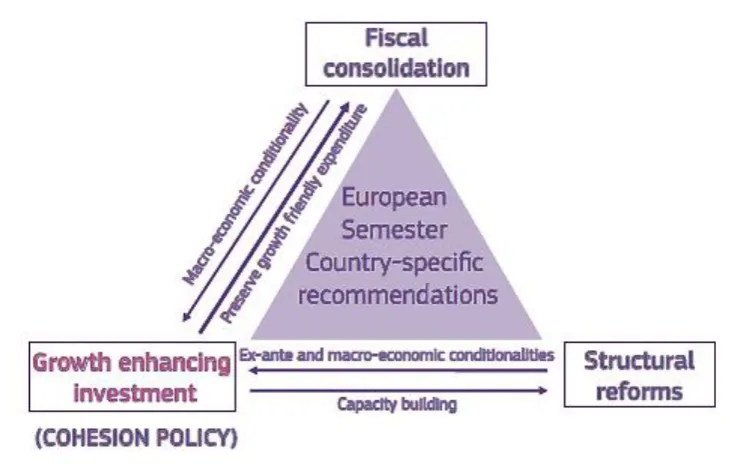
(13) Prospects for Cohesion policy in 2014-20 and beyond: Progress with programming and reflections on the future. efficiency and renewable energy. Finally, the treatment of urban wastewater and solid waste has improved in more towns and cities across Europe, but more needs to be done in the less developed Member States and regions. Looking forward, there are tentative signs of economic recovery across EU Member States, such as increases in trade and positive GDP growth in the latter part of 2013 in almost all EU Member States. At regional level, the Commission anticipates the long-run convergence process to continue after the crisis comes to an end with faster relative growth expected in the less developed EU regions underpinned by technological catch-up and associated productivity gains. By contrast, independent economic forecasts produced as part of a recent ESPON project predict growing national and regional disparities as well as large labour migration and depopulation in many Eastern European regions at least up to 2030.1 While forecasts such as these are inevitably uncertain, the Commission does not recognises that the recovery is fragile, unevenly spread and will take time to impact on territorial disparities. th. The key policy implication derived by the Commission from the 6 Cohesion Report’s analysis is a need for long-term investment to reduce the large economic, social and territorial disparities and to complete the single market with a critical role for Cohesion policy to play in supporting smart, sustainable and inclusive growth and jobs. Yet, the deterioration in public finances across EU countries has severely restricted public investment and limited the ability of Member States to comply with the Cohesion policy principles of additionality and co-financing, as the Commission itself th. highlights in a specific chapter of the 6 Cohesion Report on public investment and the crisis. Put differently, there is a major and arguably irreconcilable tension between the investment goals of EU Cohesion policy and the EU fiscal consolidation goals that have been vigorously pursued under the reinforced economic governance framework.. 2.2. Economic governance developments. The 2013 reform of Cohesion policy has increased the policy’s alignment with the EU’s long-term growth strategy (Europe 2020) and associated economic governance architecture and policy cycle (the European semester), which will play a more important role in both the programming and implementation of the ESI Funds in 2014-20. The most relevant regulatory requirements are (i) thematic concentration on growth-enhancing investments linked to Europe 2020 objectives (ii) addressing Country-specific recommendations issued under the European semester in the programming and implementation of the Funds and (iii) macro-economic conditionality linked to compliance with EU economic governance rules (Figure 2). Longer-term developments with an important bearing on Cohesion policy include the review of Europe 2020 strategy and the ongoing debate about establishing an EU fiscal capacity to support structural reforms in Member States.. 1. Politecnico di Milano (2014) Volume 3: Economic Trends and Scenarios, Draft Final Report, Territorial Scenarios and Visions for Europe (ET2050), ESPON.. European Policy Research Paper No. 88. 6. European Policies Research Centre.
(14) Prospects for Cohesion policy in 2014-20 and beyond: Progress with programming and reflections on the future. Figure 2: Cohesion policy in the EU economic policy mix. Source: European Commission (2014) p. 235.. 2.2.1 The European semester in 2014 As part of the 2014 European Semester cycle, 2 the latest Country-specific recommendations (CSRs) were published by the Commission in June 2014, analysing the economic situation of each Member State and recommending measures to support growth and jobs over the year ahead. The recommendations cover a broad range of topics relating to public finances, the financial sector, structural reforms and employment and social policies. The CSRs most relevant to Cohesion policy must be explicitly addressed in the new Partnership Agreements and programmes for 2014-20.3 Early indications based on the Commission’s assessment of Partnership Agreements and Operational Programmes suggests that the relevant CSRs are being addressed by identifying the related development and investment needs.4 However, in most Member State PAs the results expected from the investment supported by the funds are not clearly related to the CSRs specified, and there is a need for more detail on the way that the CSRs concerned will be put into effect in the programmes. Compliance with the EU Stability and Growth Pact rules on fiscal deficits will become increasingly salient in Cohesion policy because of the new macroeconomic conditionality provisions for 2014-20, which can potentially lead to suspensions of Funds in the event of non-compliance with economic governance rules. In the latest Commission assessment, the excessive deficit procedure was terminated in 6 Member States although there are still 11 Member States under the procedure (Table 1).. 2. The Europe Semester is the annual policy cycle of economic guidance and monitoring at EU level which began in 2011. 3. See: http://ec.europa.eu/europe2020/pdf/csr2014/overview_recommendations_2014_by_member_state.pdf. 4. European Commission (2014) Investment for jobs and growth: promoting development and good governance in EU regions and cities, Sixth Report on economic, social and territorial cohesion. Publications Office of the European Union, Luxembourg.. European Policy Research Paper No. 88. 7. European Policies Research Centre.
(15) Prospects for Cohesion policy in 2014-20 and beyond: Progress with programming and reflections on the future. Table 1: Compliance with Stability and Growth Pact, June 2014. No excessive deficit procedure. BG, DE, EE, FI, HU, IT, LT, LU, LV, RO, SE. Abrogation of excessive deficit procedure. AT, BE, CZ, DK, SK, NL. On-going excessive deficit procedure. CY, ES, FR, GR, HR, IE, MT, PL, PT, SI, UK. Source: Commission (2014) Building growth: Country-specific recommendations 2014, IP/14/623, 2/6/2014.. 2.2.2 Towards an EU fiscal capacity Looking to the future, there has been progress in the debate about establishing an EU fiscal capacity to support structural reforms, with potentially important consequences for Cohesion policy in the long-term. As noted in last year EoRPA report, 5 the Commission’s Blueprint on Deep and Genuine Economic and Monetary Union pointed towards the benefits of a euro area fiscal capacity that could be used to provide incentives to reforms in the Member States, followed up by Commission proposals for a Convergence and Competitiveness Instrument in March 2013. More recently, the European Council agreed in December 2013 on the main features of a system of “partnerships for growth, jobs and competitiveness” based on mutually agreed contractual arrangements and associated solidarity mechanisms:6 “Mutually agreed contractual arrangements will be a "home-grown" commitment which constitutes a partnership between the Member States, the Commission and the Council. The National Reform Programme submitted by each Member State in the context of the European Semester will be the basis for the mutually agreed contractual arrangements, also taking into account the Country Specific Recommendations. Mutually agreed contractual arrangements will be tailored to the needs of each individual Member State and will focus on a limited number of key levers for sustainable growth, competitiveness and job creation. The economic policy objectives and measures included in the mutually agreed contractual arrangements should be designed by the Member States, in accordance with their institutional and constitutional arrangements, and should ensure full national ownership through appropriate involvement of national parliaments, social partners, and other relevant stakeholders. They should be discussed and mutually agreed with the Commission, before being submitted to the Council for approval. The Commission will be responsible for keeping track of the agreed implementation of the mutually agreed contractual arrangements on the basis of jointly agreed timelines. On the associated solidarity mechanisms, work will be carried forward to further explore all options regarding the exact nature (e.g. loans, grants, guarantees), institutional form and volume of support while ensuring that these mechanisms do not entail obligations for the Member States not participating in the system of mutually agreed contractual arrangements and associated solidarity mechanisms; they should not become an income equalisation tool nor have an impact on the Multi-annual Financial Framework; they should respect the 5. Mendez C, Wishlade F and Bachtler J (2013) A new dawn for Cohesion policy? The emerging budgetary and policy directions for 2014-2020, Paper to the 34th meeting of the EoRPA Regional Policy Research Consortium at Ross Priory, Loch Lomondside on 6-8 October 2013. 6. European Council (2013) Conclusions – 19/20 December 2013, EUCO 217/13, 20 December 2013, Brussels: http://www.consilium.europa.eu/uedocs/cms_Data/docs/pressdata/en/ec/140245.pdf. European Policy Research Paper No. 88. 8. European Policies Research Centre.
(16) Prospects for Cohesion policy in 2014-20 and beyond: Progress with programming and reflections on the future. budgetary sovereignty of the Member States. Any financial support agreement associated with mutually agreed contractual arrangements will have a legally binding nature. The President of the EIB will be associated to this work.” The European Council invited the President of the European Council, in close cooperation with the President of the European Commission, to carry work forward and to report to the October 2014 European Council with a view to reaching an overall agreement on both of these elements. As discussed in the final section, the establishment of a new fiscal capacity at EU level raises important questions about the complementarity if not direct competition of the instrument with Cohesion policy funding.. 2.2.3 The launch of the Europe 2020 mid-term review A public consultation of the Europe 2020 strategy was launched on 5 March 2014 setting the basis for a mid-term review in early 2015. In a Communication entitled “Taking stock of the Europe 2020 strategy for smart, sustainable and inclusive growth”7, the Commission set out preliminary lessons on the first four years of implementation of the Europe 2020 strategy. . The impact of the crisis. The crisis has had a negative impact on growth, public finances, access to finance, unemployment and poverty, and led to growing divergence across and within Member States in the economic situation and performance. The recovery since 2013 has been sluggish and the long-term growth challenges identified in the Europe 2020 strategy. . remain valid. Achievement of Europe 2020 targets. Progress has been mixed. The EU is on course to meet or to come close to its education, climate and energy targets, but is not on track to meet employment, research and development or poverty reduction goals, although results and. . forecasts vary widely across Member States. The role of headline targets. The targets are not exhaustive, legally-binding and have some limitations in measuring intended outcomes. However, the targets help to illustrate and. . provide focus to core EU objectives, play a role as policy anchors and are easy to monitor. The role of Flagship Initiatives. It is too early to assess their impact, but achievements include catalysing action at EU level, contributing to mutual learning, steering the use of EU. . Funds and triggering or inspiring policy actions at national and regional levels. The role of the European semester. Provides a credible framework for policy implementation, reconciling economic and budgetary priorities, reinforced contacts between EU and national level, strengthened monitoring capacity at EU level. Key challenges relate to difficulties in reconciling short-term urgencies and long-term needs, the need for more clarity and enhancement of roles of EU actors, varied involvement of national/sub-national stakeholders and excessive bureaucracy.. The Commission has not drawn policy conclusions nor made policy recommendations at this stage. However, the consultation will contribute to informing the Commission’s proposals for further development of the Europe 2020 strategy over the next five years as part of its mid-term review in the. 7. European Commission (2014) Taking stock of the Europe 2020 strategy for smart, sustainable and inclusive growth, Commission Communication, COM(2014) 130 final/2, 19.3.2014, Brussels: http://ec.europa.eu/europe2020/pdf/europe2020stocktaking_en.pdf. European Policy Research Paper No. 88. 9. European Policies Research Centre.
(17) Prospects for Cohesion policy in 2014-20 and beyond: Progress with programming and reflections on the future. first quarter of 2015. The key questions in the public consultation, which is due to conclude in the autumn 2014, are set out below. Box 1: The Europe 2020 Review – Consultation questions 1. Taking stock: the Europe 2020 strategy over 2010-2014 1.1 Content and implementation . For you, what does the Europe 2020 strategy mean? What are the main elements that you associate with the strategy? Overall, do you think that the Europe 2020 strategy has made a difference? Has the knowledge of what other EU countries are doing in Europe 2020 areas impacted on the approach followed in your country? Has there been sufficient involvement of stakeholders in the Europe 2020 strategy? Are you involved in the Europe 2020 strategy? Would you like to be more involved? If yes, how?. 1.2 Tools . Do the current targets for 2020 respond to the strategy's objectives of fostering growth and jobs? Among current targets, do you consider that some are more important than others? Do you find it useful that EU-level targets are broken down into national targets? If so, what is, in your view, the best way to set national targets? So far, have the national targets been set appropriately/too ambitiously/not ambitiously enough? What has been the added value of the seven action programmes for growth? Do you have concrete examples of the impact of such programmes?. 2. Adapting the Europe 2020 strategy for a post-crisis Europe 2.1 Content and implementation . Does the EU need a comprehensive and overarching medium-term strategy for growth and jobs for the coming years? What are the most important and relevant areas to be addressed? What new challenges should be taken into account in the future? How could the strategy best be linked to other EU policies? What would improve stakeholder involvement in a post-crisis growth strategy? What could be done to increase awareness, support and better implementation of this strategy in your country?. 2.2 Tools . 2.3. What type of instruments do you think would be more appropriate to use to achieve smart, sustainable and inclusive growth? What would best be done at EU level to ensure that the strategy delivers results? What would best be done at Member State level? How can the strategy encourage Member States to put a stronger policy focus on growth? Are targets useful? Would you recommend adding or removing certain targets, or the targets in general? What are the most fruitful areas for joint EU-MS action? What would be the added value?. Political and institutional developments. The election of a new European Parliament The European Parliamentary Election was held across Europe from 22-25 May 2014. As in previous elections, voter participation was low with only 43 per cent of eligible voters casting their votes. Against a background of crisis and discontent with the EU, more voters than ever voted for political parties that advocated radical reforms of the EU, campaigned for an exit of their countries from the EU, or even pushed for scrapping the whole European integration project. Around 28 percent of the 751 Members of the European Parliament (MEPs) now belong to a Eurosceptic party, up from less. European Policy Research Paper No. 88. 10. European Policies Research Centre.
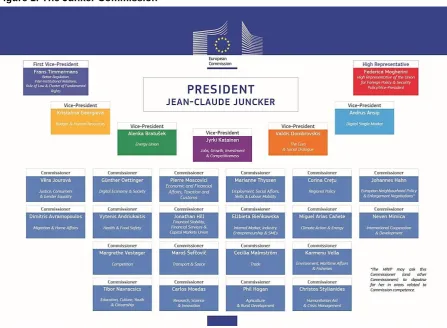
(18) Prospects for Cohesion policy in 2014-20 and beyond: Progress with programming and reflections on the future. than 20 per cent of MEPs in the previous election. 8 Euro-sceptic parties made big gains with France’s Front National, Britain’s UKIP, the Danish People’s party and Syriza in Greece all topping their country’s EU parliamentary elections. The formation of a new Commission Jean-Claude Juncker, the former Luxembourg Prime Minister, was confirmed as European Commission president on 15 July 2014 replacing Jose Manuel Barroso. A new college of Commissioners must be formed by the end of October 2014. Following the nominations for Commissioners by Member States, Jean-Claude Juncker announced a list of proposed Commissioners and portfolios was on 10 September 2014. In terms of the main Cohesion policy portfolios, the new Commissioner for DG Regional and Urban Policy will be Corina Cretu, currently a Romania MEP. Johannes Hahn, the current commissioner at DG REGIO, will stay on as the Neighbourhood Policy commissioner. The existing Commissioner for DG Employment, László Andor, will be replaced by Marianne Thyssen, currently MEP for the Belgian region Flanders. There are several interesting changes in the approach to forming a new Commission. First, in the past, Commissioners have been appointed to posts that are not of strategic interest to their home country. Juncker has done the reverse, deliberately putting people in posts that are problematic for their host country e.g. Hill (UK) in financial services, Cretu (RO) in Cohesion policy, Vella (MT) in environment, and Avramopoulos (migration). Second, the creation of vice-presidents to oversee strategic themes is an innovation, especially as they should have the power to veto decisions by the sectoral Commissioners. The VPs have been largely taken from small countries, especially from newer Member States, mainly because they sent ex –prime ministers or other experienced people (the Italian High Commissioner being an exception on all counts). Whether large member states will be happy to be over-ridden by small country Commissioners is a moot point. Hearings of the nominees will take place during September at the European Parliament followed by a vote on whether to approve the new college of commissioners on 20-23 October 2014. On past performance they will target individual Commissioners, threatening to block the whole Commission if that person is not replaced. The lead candidate for rejection is expected to be the Spanish Commissioner Miguel Cañete, partly because of misogynist comments made during his election campaign.. 8. Trieb O (2014) The voter says no, but nobody listens: causes and consequences of the Eurosceptic vote in the 2014 European elections, Journal of European Public Policy, Vol. 21:10, pp. 1541-54.. European Policy Research Paper No. 88. 11. European Policies Research Centre.
(19) Prospects for Cohesion policy in 2014-20 and beyond: Progress with programming and reflections on the future. Figure 1: The Junker Commission. Source: European Commission (2014) The Juncker Commission: A strong and experienced team standing for change, Press Release, 10 September 2014, Brussels.. The European Council Finally, the European Council elected its new President, Donald Tusk (former Prime Minister of Poland) to replace Herman Van Rompuy, and appointed the Italian foreign minister Federica Mogherini as High Representative of the Union for Foreign Affairs and Security Policy (taking over from Catherine Ashton), on 30 August 2014.. European Policy Research Paper No. 88. 12. European Policies Research Centre.
(20) Prospects for Cohesion policy in 2014-20 and beyond: Progress with programming and reflections on the future. 3. COHESION POLICY 2014-20 3.1. Finalisation of the legislative framework. After two years of negotiations, the new legislation governing the European Structural and Investment Funds in 2014-20 was agreed in December 2013. . A Common Provisions Regulation (CPR)9, including a Common Strategic Framework as an Annex. . Fund-specific Regulations for the ERDF 10, ESF11, CF12 and EAFRD13; and. . ETC14 and EGTC15 Regulations. Developing the basic Regulations, progress was made in the preparation of Delegated and Implementing Acts throughout 2014 according to the degree of urgency for programming (Box 2). However, there at least 10 more Acts being prepared for adoption over the course of 2014 and beyond. Box 2: State of play of Delegated Acts and Implementing Acts Delegated Acts . Code of conduct on the partnership principle (January 2014) Programming and implementation issues, including financial corrections linked to the performance reserve, financial instruments, revenue-generating projects, major projects and the functions of key authorities (March 2014) Eligibility rules for ETC (March 2014) Innovative actions in sustainable urban development (March 2014). Implementing Acts . Model for operational programmes (February 2014) Electronic data exchange and categories of intervention for ETC programmes (February 2014); Methodologies for climate change support, the performance framework and categories of intervention for the ERDF, ESF and CF (March 2014) Transfer and management of programme contributions, reporting on financial instruments, information and communication measures and the system to record and store data (July 2014). In parallel, the Commission issued guidance documents aimed at supporting desk officers and programme authorities on programming, conditionality, community-led local development, financial instruments, management and control, each of the 11 thematic objectives as well as cross-cutting thematic guidance.. 9. Regulation (EU) No 1303/2013 of the European Parliament and of the Council of 17 December 2013.. 10. Regulation (EU) No 1301/2013 of the European Parliament and of the Council of 17 December 2013.. 11. Regulation (EU) No 1304/2013 of the European Parliament and of the Council of 17 December 2013.. 12. Council Regulation (EU) No 1300/2013 of 17 December 2013.. 13. Regulation (EU) No 1305/2013 of the European Parliament and of the Council of 17 December 2013 on support for rural development by the European Agricultural Fund for Rural Development (EAFRD) and repealing Council Regulation (EC) No 1698/2005. 14. Regulation (EU) No 1299/2013 of the European Parliament and of the Council of 17 December 2013.. 15. Regulation (EU) No 1302/2013 of the European Parliament and of the Council of 17 December 2013.. European Policy Research Paper No. 88. 13. European Policies Research Centre.
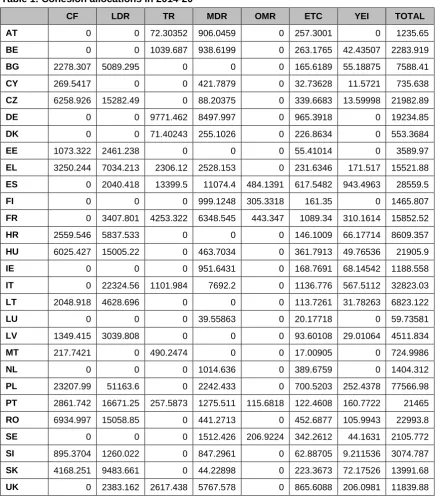
(21) Prospects for Cohesion policy in 2014-20 and beyond: Progress with programming and reflections on the future. 3.2. Geographical eligibility & allocations. Geographical eligibility and financial allocations for 2014-20 were confirmed in Commission implementing decisions in February and April 2014.16 Maps are reproduced below of regional eligibility under the Structural Funds (Map 1), national eligibility under the Cohesion Fund (Map 2) and regional eligibility under the Youth Employment Initiative (Map 3), followed by financial allocations to Member States in Table 1. There will be significant shifts in eligibility across the EU and within certain countries. . Less-developed regions will cover 25 percent of the EU population, down from 31.7 percent in 2007-13. Germany will cease to have any LDR regions, Spain will see LDR coverage significantly reduced (Extremadura only), while Malta loses Convergence status. The capital cities in Poland, Romania and Slovenia will also lose less-developed region status, while. . Croatia will have LDR status in its entirety following a reconfiguration of the NUTS 2 regions. Transition regions coverage will increase from 7.3 percent to 13.5 percent of the EU population, but the eligible regions are heavily concentrated in certain countries, notably. . Germany, Spain, France and the United Kingdom. More-developed regions cover the remaining regions as was the case under the former RCE category. Importantly, it includes four regions which had Convergence status in 2007-13 – namely Galicia (ES), the Warsaw region Mazowieckie (PL), Bucharesti-Ilfov (RO) and the. . Ljubljana region, Zahodna Slovenija (SI). Cohesion Fund eligibility will mainly impact on Cyprus which loses eligibility and Croatia which qualifies for the Cohesion Fund following accession.. 16. Commission Implementing Decision of 18 February 2014 setting out the list of regions eligible for funding from the European Regional Development Fund and the European Social Fund and of Member States eligible for funding from the Cohesion Fund for the period 2014-2020; CPR Art 91(2) Annual breakdown of global resources per MS under IGJ and ETC and the annual breakdown of resources from the specific allocation for the YEI by MS together with the list of eligible regions; CPR Art 92 (6) subpara 2 - Transfer from CF to CEF; Commission Implementing Decision of 16 June 2014 setting up the list of regions and areas eligible for funding from the European Regional Development Fund under the cross-border and transnational components of the European territorial cooperation goal for the period 2014 to 2020.. European Policy Research Paper No. 88. 14. European Policies Research Centre.
(22) Prospects for Cohesion policy in 2014-20 and beyond: Progress with programming and reflections on the future. Map 1: Structural Funds (ERDF and ESF) eligibility 2014-20. Map 2 Cohesion Fund eligibility 2014-20. th. Source: 6 Cohesion Report.. Overall aid intensity will fall from €100 per head of the EU population per year to €84 per head (Table 2). However, there will only be a decline in aid intensity in less-developed regions and transition regions. By contrast, the more developed regions and Cohesion fund allocations have seen a marginal increase in the level of aid intensity. Table 2: Change in eligible population and aid intensity by category of region Category of region Less-developed Transition regions More-developed Cohesion Fund Total. Eligible Population (% of EU) 2007-13 2014-20 31.7 25.4 7.3 13.5 61.0 61.0 34.3 25.8. Annual Aid intensity (€ per head) 2007-13 2014-20 188 180 101 66 21 22 60 62 100 84. th. Source: 6 Cohesion Report.. European Policy Research Paper No. 88. 15. European Policies Research Centre.
(23) Prospects for Cohesion policy in 2014-20 and beyond: Progress with programming and reflections on the future. Regions eligible for support under the Youth Employment Initiative are those with youth unemployment rates of more than 25 percent in 2012 and those with rates of over 20 percent which are in countries where the rate increased by more than 30 percent in 2012 (Map 3). Map 3: Youth employment initiative, 2014-20. European Policy Research Paper No. 88. 16. European Policies Research Centre.
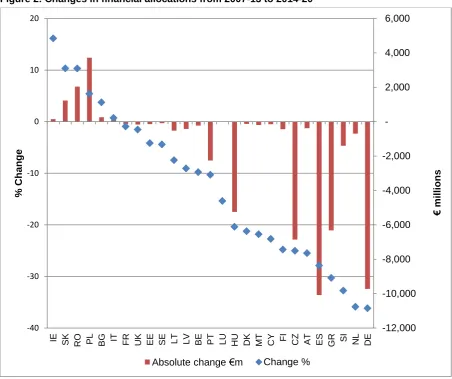
(24) Prospects for Cohesion policy in 2014-20 and beyond: Progress with programming and reflections on the future. Table 1: Cohesion allocations in 2014-20 CF. LDR. TR. MDR. OMR. ETC. YEI. TOTAL. AT. 0. 0. 72.30352. 906.0459. 0. 257.3001. 0. 1235.65. BE. 0. 0. 1039.687. 938.6199. 0. 263.1765. 42.43507. 2283.919. BG. 2278.307. 5089.295. 0. 0. 0. 165.6189. 55.18875. 7588.41. CY. 269.5417. 0. 0. 421.7879. 0. 32.73628. 11.5721. 735.638. CZ. 6258.926. 15282.49. 0. 88.20375. 0. 339.6683. 13.59998. 21982.89. DE. 0. 0. 9771.462. 8497.997. 0. 965.3918. 0. 19234.85. DK. 0. 0. 71.40243. 255.1026. 0. 226.8634. 0. 553.3684. EE. 1073.322. 2461.238. 0. 0. 0. 55.41014. 0. 3589.97. EL. 3250.244. 7034.213. 2306.12. 2528.153. 0. 231.6346. 171.517. 15521.88. ES. 0. 2040.418. 13399.5. 11074.4. 484.1391. 617.5482. 943.4963. 28559.5. FI. 0. 0. 0. 999.1248. 305.3318. 161.35. 0. 1465.807. FR. 0. 3407.801. 4253.322. 6348.545. 443.347. 1089.34. 310.1614. 15852.52. HR. 2559.546. 5837.533. 0. 0. 0. 146.1009. 66.17714. 8609.357. HU. 6025.427. 15005.22. 0. 463.7034. 0. 361.7913. 49.76536. 21905.9. IE. 0. 0. 0. 951.6431. 0. 168.7691. 68.14542. 1188.558. IT. 0. 22324.56. 1101.984. 7692.2. 0. 1136.776. 567.5112. 32823.03. LT. 2048.918. 4628.696. 0. 0. 0. 113.7261. 31.78263. 6823.122. LU. 0. 0. 0. 39.55863. 0. 20.17718. 0. 59.73581. LV. 1349.415. 3039.808. 0. 0. 0. 93.60108. 29.01064. 4511.834. MT. 217.7421. 0. 490.2474. 0. 0. 17.00905. 0. 724.9986. NL. 0. 0. 0. 1014.636. 0. 389.6759. 0. 1404.312. PL. 23207.99. 51163.6. 0. 2242.433. 0. 700.5203. 252.4378. 77566.98. PT. 2861.742. 16671.25. 257.5873. 1275.511. 115.6818. 122.4608. 160.7722. 21465. RO. 6934.997. 15058.85. 0. 441.2713. 0. 452.6877. 105.9943. 22993.8. SE. 0. 0. 0. 1512.426. 206.9224. 342.2612. 44.1631. 2105.772. SI. 895.3704. 1260.022. 0. 847.2961. 0. 62.88705. 9.211536. 3074.787. SK. 4168.251. 9483.661. 0. 44.22898. 0. 223.3673. 72.17526. 13991.68. UK. 0. 2383.162. 2617.438. 5767.578. 0. 865.6088. 206.0981. 11839.88. Source: DG Regional Policy.. Differences between current (2007-13) and future funding (2014-20) allocations are illustrated in Figure 2 which shows marked shifts across countries. In six countries there is an increase in funding in 2014-20 compared with 2007-13. In relative terms Ireland gains most with a 16 percent increase on current allocations. However, in absolute terms this is rather modest and represents only around €150 million. By contrast, three countries gain significantly in absolute terms: in Poland allocations increase by €3.7 billion, while those in Romania increase by €2 billion and those in Slovakia by €1.2 billion.. European Policy Research Paper No. 88. 17. European Policies Research Centre.
(25) Prospects for Cohesion policy in 2014-20 and beyond: Progress with programming and reflections on the future. Figure 2: Changes in financial allocations from 2007-13 to 2014-20 20. 6,000. 4,000 10. 2,000. -. -2,000 -10. -4,000. -20. € millions. % Change. 0. -6,000. -8,000 -30. -10,000. -40 IE SK RO PL BG IT FR UK EE SE LT LV BE PT LU HU DK MT CY FI CZ AT ES GR SI NL DE. -12,000 Absolute change €m. Change %. Source: EPRC calculations.. At the opposite end of the spectrum, there are very significant reductions in expenditure both in absolute and relative terms in a number of countries. These include Spain and Germany which each lose in excess of €9 billion in Cohesion policy receipts, equivalent to well over a quarter of their current allocations. Greece and Hungary also see major reductions in their allocations.. European Policy Research Paper No. 88. 18. European Policies Research Centre.
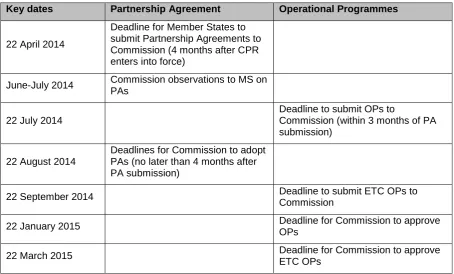
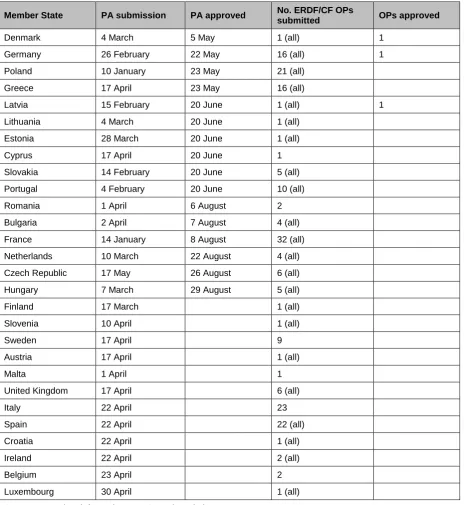
(26) Prospects for Cohesion policy in 2014-20 and beyond: Progress with programming and reflections on the future. 3.3. State of Play of Partnership Agreements and Operational Programmes. The preparation of the new generation of Cohesion policy strategies has been a long-term process. Informal dialogue and negotiations between the Member States and the Commission began at the end of 2012 on the basis of early drafts of Partnership Agreement plans and Commission Position Papers outlining its key priorities in each Member State. The deadline for formal submission of the PAs was set at four months after the Common Provisions Regulation came into force (22 December 2013), namely 22 April 2014. As Table 2 shows, the vast majority of Member States submitted their Partnership Agreements on time. Only two Member States did not meet the deadline, a day late in the case of Belgium and a week late for Luxembourg. The earliest submissions were made in January (France and Poland) but the majority of PAs were submitted during April. Table 2: Programming deadlines for 2014-20 Partnership Agreements and Programmes Key dates. Partnership Agreement. Operational Programmes. 22 April 2014. Deadline for Member States to submit Partnership Agreements to Commission (4 months after CPR enters into force). June-July 2014. Commission observations to MS on PAs Deadline to submit OPs to Commission (within 3 months of PA submission). 22 July 2014. 22 August 2014. Deadlines for Commission to adopt PAs (no later than 4 months after PA submission). 22 September 2014. Deadline to submit ETC OPs to Commission. 22 January 2015. Deadline for Commission to approve OPs. 22 March 2015. Deadline for Commission to approve ETC OPs. Source: based on Common Provisions Regulation.. The Commission is required to approve the PAs within four months of their submission, provided that Commission observations have been adequately taken into account. At the time of writing (September 2014), more than half of the PAs (16) had been approved: a first batch of 4 PAs were approved in April (Denmark, Poland, Germany, Greece), followed by 6 more in June (Latvia, Lithuania, Estonia, Cyprus, Slovakia, Portugal) and 6 in August (Romania, Bulgaria, France). Most of the adopted PAs took around 3 months to agree, except for the PA for Greece which was adopted within 5 weeks of submission. The Commission expects to approve all remaining PAs in the autumn 2014. Progress has also been made with the finalisation and negotiation of Operational Programmes. The majority of Member States have formally submitted all of their ERDF/CF programmes to the Commission. The countries that have yet to submit all of their OPs are Belgium, Cyprus, Italy, Malta, Romania, Sweden and the United Kingdom. The Commission is required to provide comments on the submitted OPs within three month and to adopt them within a further 3 months. At the time of writing (mid-September 2014), only 3 ERDF programme has been approved. It is expected that the majority. European Policy Research Paper No. 88. 19. European Policies Research Centre.
(27) Prospects for Cohesion policy in 2014-20 and beyond: Progress with programming and reflections on the future. of programmes will be approved towards the end of 2014 and in 2015. Delays in the approval of the programmes and accompanying management and control systems could be problematic for some countries that are dependent on Cohesion policy as core source of expenditure for development, especially given the fragility of the recovery and ongoing constrains on public and private investment Table 3: State-of-play of Partnership Agreements and ERDF/CF Operational Programmes Member State. PA submission. PA approved. No. ERDF/CF OPs submitted. OPs approved. Denmark. 4 March. 5 May. 1 (all). 1. Germany. 26 February. 22 May. 16 (all). 1. Poland. 10 January. 23 May. 21 (all). Greece. 17 April. 23 May. 16 (all). Latvia. 15 February. 20 June. 1 (all). Lithuania. 4 March. 20 June. 1 (all). Estonia. 28 March. 20 June. 1 (all). Cyprus. 17 April. 20 June. 1. Slovakia. 14 February. 20 June. 5 (all). Portugal. 4 February. 20 June. 10 (all). Romania. 1 April. 6 August. 2. Bulgaria. 2 April. 7 August. 4 (all). France. 14 January. 8 August. 32 (all). Netherlands. 10 March. 22 August. 4 (all). Czech Republic. 17 May. 26 August. 6 (all). Hungary. 7 March. 29 August. 5 (all). Finland. 17 March. 1 (all). Slovenia. 10 April. 1 (all). Sweden. 17 April. 9. Austria. 17 April. 1 (all). Malta. 1 April. 1. United Kingdom. 17 April. 6 (all). Italy. 22 April. 23. Spain. 22 April. 22 (all). Croatia. 22 April. 1 (all). Ireland. 22 April. 2 (all). Belgium. 23 April. 2. Luxembourg. 30 April. 1 (all). 1. Source: Based on information on DG Regio website: http://ec.europa.eu/regional_policy/what/future/index_en.cfm#1. European Policy Research Paper No. 88. 20. European Policies Research Centre.
(28) Prospects for Cohesion policy in 2014-20 and beyond: Progress with programming and reflections on the future. 3.4. Negotiation issues. The key issues emerging from the negotiations between the Commission and Member States on Partnership Agreements and programmes have been outlined by the Commission in the Sixth Cohesion Report and are summarised below, followed by a Member State perspective based on interviews with national policy-makers. The European Commission’s perspective In developing the 2014-20 strategies, consultation with partners is generally considered to be reasonable, although in some cases the dialogue has been insufficient. Important stakeholders were not always involved or their comments were not reflected in the documents. In terms of programming, key Commission priorities in the negotiations have been to ensure thematic concentration and better targeted investments to maximise impact and reflect EU objectives or to clarify the objectives pursed. . Innovation and R&D. Most Member States and regions have prepared innovation strategies for smart specialisation to accelerate economic development and to narrow the knowledge gap. It is important that these strategies focus on investments which reach a critical mass and best reflect regional potential. More emphasis needs to be put on ‘soft’ forms of support, on promoting market-driven research and cooperation with the private sector instead of funding predominantly research infrastructure and equipment.. . ICT. Some Member States have brought forward programmes that establish clear links between the digital economy and innovation. This is important as investment in high speed broadband and ICT is needed to overcome particular bottlenecks and to encourage marketdriven solutions. For example, it is essential to focus investment in broadband on next generation networks to ensure that less developed regions do not fall further behind. Coordination between Cohesion Policy, Horizon 2020 and other EU programmes is also critical as regards smart specialisation strategies at national and regional level.. . SME competitiveness. Will be central to many of the PA growth strategies and it is expected that financial instruments will play a major role. However, there is limited interest so far in the new SME Initiative and a risk of generic business support for SMEs that does not target particular sectors and activities.. . Energy, climate change and the environment. In the PAs of a number of Member States, energy, climate change and the environment are well integrated into their economic development strategy. Several have put specific emphasis on energy efficiency or developing renewable energy as a means of creating new businesses, jobs and export opportunities, while also reducing greenhouse gas emissions. However, the link between investment and the expected results in relation to the climate change objectives needs to be made clearer in some cases.. . Employment, social inclusion & education. The focus on the inclusive growth objectives could be stronger in some PAs in line with needs. The Commission also considers that the. European Policy Research Paper No. 88. 21. European Policies Research Centre.
(29) Prospects for Cohesion policy in 2014-20 and beyond: Progress with programming and reflections on the future. funding allocated to education is not sufficient to achieve the priorities identified. In some PAs, low priority is given to active measures for social inclusion. To ensure better social outcomes and investment that is more responsive to social change, social policy reform needs to be reflected in programming. . Youth Employment Initiative. Relevant information in some PAs and OPs is relatively general and does not set out how this new initiative will be delivered and if and how it will support the implementation of Youth Guarantee schemes. In some programmes, the actions supported by the YEI need to be more focused on employment creation.. . Marginalised communities. Despite the existence of a CSR on the integration of the Roma minority, some Member States do not plan to have a specific priority for marginalised communities, making it more difficult to assess how much funding will be allocated to this policy area. Some Member States do not sufficiently address the needs of this target group, while others need to develop their strategy and intervention logic further.. . Public administration reform: In a number of Member States where a need for reform of public administration has been identified, a clear strategy is missing and objectives are incomplete and unclear. Moreover, in some of these Member States a clear political commitment to such reform is lacking.. The Commission has emphasised the need for stronger strategic coordination at the national and regional level to ensure consistency between programmes and support for Europe 2020 and the Country-specific Recommendations (CSRs) as well as to avoid overlaps and gaps. CSRs are generally reflected in the 2014-20 strategies in terms of identifying the related development and investment needs. However, in many cases the results expected from the funds are not clearly related to the CSRs and there is a need for more detail on the way that the CSRs will be put into effect in the programmes. Some CSRs require more than one Fund to support the intervention needed and the Commission calls on Member States to ensure that the relevant Funds will do so. The Commission also calls on Member States to be precise on how support from the ERDF and ESF will be coordinated, e.g. infrastructure investments combined with teaching and training measures to ensure that the infrastructure is used effectively. Considerable effort has been made to comply with ex-ante conditionalities in most Member States. However, the process has not been easy and action plans will need to be agreed in many cases. The most problematic conditions have related to the coherence of underpinning strategies (eg. smart specialisation) and compliance with EU Directives (e.g. energy efficiency, environmental impact assessment and public procurement). The results orientation is considered to be a step-change in the philosophy of Cohesion policy but is proving challenging to implement in practice. Member States and regions have found it difficult to formulate well-defined specific goals. Many draft programmes have expressed vague general aims and a large number of possible actions in order to maintain maximum flexibility in project selection. The main challenge when formulating performance frameworks is to fix targets that are both ambitious and realistic.. European Policy Research Paper No. 88. 22. European Policies Research Centre.
(30) Prospects for Cohesion policy in 2014-20 and beyond: Progress with programming and reflections on the future. Finally, in some countries substantial efforts are still needed to tackle bottlenecks relating to administrative capacity. Key priorities for the Commission are to ensure that a clear and stable institutional and regulatory framework is in place, that skilled and motivated staff are attracted and retained and that the tools and instruments used are appropriate for the effective deployment of the funds. Member State perspectives Complementing the Commission’s assessment, a Member State perspective on the negotiations is instructive in revealing alternative views on the negotiation process especially issues that are perceived to be problematic from a national or regional perspective. The process of negotiating the PAs has been considered laborious for some countries owing to the extensive number of observations provided by the Commission on the Partnership Agreements more than 300 observations in some cases, albeit with varying level of importance – or because the transmission of responses was considered to be slow. A key change compared to the past is the stronger role for Commission Directorates-General (DGs) that are not directly responsible for Cohesion policy, notably relating to Europe 2020 themes such as climate change and R&D and innovation, which may have increased the formality of the process. The Commission has also provided a more structured position on its expectations from the outset through the publication of position papers for each country at the preparatory stage, although concerns have been expressed about the legal status of the papers, particularly the level of leeway for negotiation on recommendations and whether they are applicable only at PA level or also at programme level. While some Member States consider that the negotiations focused mainly on presentational issues (such as how to integrate the different elements of the PA into a coherent whole), for others there has been a greater emphasis on substantive content issues. . Thematic concentration. A key negotiation issue in the UK and Italy has concerned the level of thematic concentration. The agreement reached with Italy was that the 11 TOs will be selected differently (and selectively) in the different OPs, while some of the TOs have been revised and rationalised. The UK found resistance to proposals on broadband, transport and climate change flood alleviation measures, partly because the Commission expects EU funding to be only used to support high priority activity where the EU contribution is clearly identifiable. This poses a problem in a country like the UK where the Structural Funds represent a small proportion of overall expenditure eon development. By contrast, in Hungary discussions about the level of thematic concentration on economic development priorities have been eased by adopting a wider interpretation of economic development which extends to climate change support measures.. . Innovation. The approach to smart specialisation has raised some uncertainty in a number of countries. Finnish authorities consider that smart specialisation strategies already exist in the form of innovation strategies, but it remains to be seen whether the Commission agrees to this approach. The financial planning conditions of the smart specialisation requirements could be an issue in Germany, especially the need to commit to financial budgeting for the entire 7 year period when the German public finance law operates on an annual basis. Similarly, the Commission has expressed concerns about whether Austria has fulfilled the. European Policy Research Paper No. 88. 23. European Policies Research Centre.
(31) Prospects for Cohesion policy in 2014-20 and beyond: Progress with programming and reflections on the future. smart specialisation requirements because not all Länder have their own strategies (e.g. Tyrol). Austria instead argues that whatever exists at Land level is irrelevant, as the OP is a national programme strategically underpinned by a national smart specialisation strategy. In the innovation priority of the Dutch PA, the Commission requested more information on innovation infrastructure even though such investments are not envisaged. . SME competitiveness. In Poland, the Commission argued for greater allocations to entrepreneurship in the national OP Intelligent Development. The Polish authorities, however, argued that support for entrepreneurship is covered in all programmes in cross-cutting manner. An increase in repayable types of business aid is foreseen in Hungary, which the Commission would like to increase further but the Hungarian authorities are concerned about absorption challenges.. . Infrastructure. There has been Commission resistance to infrastructure investments in a number of more-developed countries (Finland, France Germany and Sweden). In Finland, the Commission has argued for restricting support to infrastructure linked directly to business activities. Support for transport infrastructure has been discussed in France. The draft PA includes ERDF support for railway interconnections and EMFF support for upgrading port infrastructure. While the Commission is in favour of support for non-polluting urban modes of transport (electric vehicles), there is less support for major infrastructures which account for large amounts of funding. In Germany, the Commission has objected to proposals for (limited) funding for transport, water and waste water infrastructure. By contrast, in Hundary support for the urban/community transport priority was slightly increased following negotiations, although further discussions are expected on non-TEN-T road support.. . ICT/broadband. One of the key negotiation issues in France related to the funding of broadband infrastructure. An agreement was reached to allow ERDF support for broadband targeting research centres, universities and businesses. However, in Germany references to broadband support were removed from the PA following Commission resistance. The Commission has accepted the case for broadband in (less developed/transition regions) in Scotland and Wales. In Sweden, broadband support is considered to be important particularly in the northern-most programmes.. . Low-carbon economy. In the Netherlands, more information was requested concerning the policy issues in relation to the low carbon economy, including a clearer explanation of goals and objectives. The Commission has objected to proposals in the German PA to fund the upgrading of energy efficiency in privately owned buildings.. . Social inclusion. In Italy, the Commission has encouraged a clarification of the labour market orientation of some social inclusion interventions and to show that some measures are not welfare policies but support for the active inclusion of disadvantaged groups.. The programme architecture has been a negotiation issue in several countries, mainly in terms of the Commission seeking more coherence across OPs. Overlaps between the territorial operational programmes and the Economic Development Operational Programme have required the definition of demarcation lines between the OPs (Hungary). In the Netherlands, there are four OPs that have. European Policy Research Paper No. 88. 24. European Policies Research Centre.
(32) Prospects for Cohesion policy in 2014-20 and beyond: Progress with programming and reflections on the future. regional goals but the Commission wants a more integrated PA which sets out national goals. For the OP Eastern Poland, the Commission has asked for clarification of the relationship between this OP and the national Innovation OP and a stronger justification of the focus on innovation. Various territorial issues have arisen in a number of countries. The introduction of the county-level planning process and implementation regime has represented a significant change in Hungary. The Commission expressed concerns about the replacement of NUTS 2 level programming and the establishment of a new delivery structure for the territorial OPs. The Hungarian Authorities argue that the proposed regime better suits the new public administration system and the regional decentralization process. Additionally, stronger reliance on the county level enhances the taking on board of local conditions. Concerns over the complexity of the territorial OPs and the wide-ranging use of new instruments (ITIs, CLLDs) in the absence of experience have been raised as well. A particular feature of the Territorial OPs programming has been the introduction of pre-defined budget allocations for counties, cities with county rights and sub-county areas. The Commission has voiced concerns about the impact of pre-defined allocations on the quality of projects and argued for competition to be considered to increase the value for money. Italian authorities contested some Commission feedback relating to the cross-cutting approach to the urban strategy, the European territorial cooperation aspects (which is not required in the PA), and some observations on the integrated territorial approach were judged to pertain to the OPs rather than the PA. In the UK, London had been proposed to meet the 5 percent urban allocation but the Commission finds that while this ‘meets the letter of the regulation, it goes against its spirit’. Finally, in Germany the Commission is arguing that local authorities must be intermediate bodies (IBs) for urban development strategies. This will have the effect of increasing the number of IBs and make control issues more onerous for the MAs. In the area of financial management, control and audit, a number of issues have come up in relation to new Commission Acts and guidelines. The German authorities consider that the Commission is either going beyond what was agreed during the negotiations on the regulations, or is interpreting the regulations in an extreme way. One example of the additional burden is the Commission proposal to introduce a new fraud prevention system (ARACHNE), which will require Managing Authorities to provide more information on each project holder for external assessment on the risks of fraud/error. This is seen as contrary to a number of key principles in German law e.g. legality and proportionality, as well as Germany’s very strong data protection laws. More proportionality and a better balance between steps to reduce corruption and administrative burden are considered necessary. Technical assistance and management capacity issues have featured in discussions in Hungary and Italy. The Hungarian Government chose to charge a predominant share of the programme implementation expenditure against the national budget so that most of the technical assistance allocation can be spent on sectoral/territorial operations. The Commission observed that technical assistance funds are key factors to improving delivery capacity and that a broad scope of functions need to be fulfilled and human resources developed. Italy committed to administrative capacity development plans of authorities in charge of programme management. These will be concise documents outlining the human resources (quality and quantity) devoted to the management of the funds and show that there is adequate capacity for an efficient and effective delivery of Cohesion policy. In Poland, the extent to which ESF is used to fund technical assistance in OPs was contested.. European Policy Research Paper No. 88. 25. European Policies Research Centre.
Figure


+7


Related documents
The empty dots represent the instances for which a Mann-Whitney U-test could not reject the null hypothesis of the algorithms having an identical performance at significance level. α
The simple benchmark denes the size of the initial database to contain 3,000 objects of type SMALL and 400 objects of type BIG.. 2.2 The
Materials and Methods: The study analyses retrospectively data from 10 women with hydrosalpinx, who were unable to undergo laparotomy due to extensive pelvic adhesion and
This observational study of paired samples from COPD subjects in the stable and exacerbated states demonstrates that CD4+ T cells and CD8+ T cells decreased in peripheral blood
Politically motivated users of social networks in MENA popular uprisings may appraise the reliability of social media content using a decidedly different measure than
chain practices namely Environmental Certification; Pollution Prevention; Design for the Environment; Life Cycle Assessment; and Reverse Logistics are positively associated
Just as the mining of Tanzanite is the process of extracting large block of hard rock's by using sophisticated hard rock mining techniques to find valuable
Effects of traditional Thai massage versus joint mobilization on substance P and pain perception in patients with non-specific low back pain. Traditional Thai
