Rochester Institute of Technology
RIT Scholar Works
Theses
Thesis/Dissertation Collections
2012
Performance comparison between Ad Hoc On
Demand Distance Vector and Dynamic Source
Routing Protocols with security encryption using
OPNET
Jaseem Jafferi
Follow this and additional works at:
http://scholarworks.rit.edu/theses
This Thesis is brought to you for free and open access by the Thesis/Dissertation Collections at RIT Scholar Works. It has been accepted for inclusion in Theses by an authorized administrator of RIT Scholar Works. For more information, please [email protected].
Recommended Citation
Performance comparison between Ad Hoc On
Demand Distance Vector and Dynamic Source
Routing Protocols with security encryption using
OPNET
By
Jaseem Jafferi
Thesis submitted in partial fulfillment of the requirements for the
degree of Master of Science in
Networking and System Administration
Rochester Institute of Technology
B. Thomas Golisano College
of
Rochester Institute of Technology
B. Thomas Golisano College
of
Computing and Information Sciences
Master of Science in
Networking and System Administration
Project Approval Form
Student Name: Jaseem Jafferi
Thesis Title: Performance comparison between Ad Hoc On Demand
Distance Vector and Dynamic Source Routing Protocols with
security encryption using OPNET
Project Committee
Name
Signature
Date
Prof. Tae Oh
01/06/2012
Chair
Prof. Charles Border
01/06/2012
Committee Member
Abstract
Application for wireless networking has been evolving rapidly and is becoming an integral part in our everyday life. Also with the recent performance advancement in wireless communication
Table of Contents
1. Introduction 5
2. Reactive Routing Protocols 9
3. Literature Review 15
4. Network Simulators 29
5. Why SHA-1? 32
6. Why RSA 34
7. Methodology 35
8. Simulation Results 40
9. Conclusion 41
10. Deliverables 43
11. Research Timeline 43
12. Appendix 45
1. Introduction
MANETs are infrastructureless wireless networks. MANETs are basically self-configuring network of mobile devices connected by wireless links and can be rapidly deployed offering mobility and
connectivity without constraints anywhere and anytime. A MANET is a multi-hop network where each node is responsible for sending data packets to the other node until the data packet reaches the destination. Nodes in MANET are constantly moving making the multi-hop network topology dynamic. Due to the mobile nature of the nodes some links break while new links between nodes are created. Nodes may be deployed in an unpredictable environment like unknown terrains, hazardous conditions, hostile environments and there is a high possibility of the nodes could get tampered or destroyed completely. MANET is also affected by the unreliability of the wireless network. Wireless networks are unreliable and subject to errors due to the method of transmission of data. Unpredictability is also due to high levels of electro-magnetic interference (EMI) or severe changes in weather conditions. MANET is characterized as a resource constrained network. The nodes in the network operate on batteries and have limited memory and processing capabilities. The nodes may be situated in areas where it is not possible to recharge or replace the batteries and are considered to have a limited life time [1]. Mobility makes mobile wireless networks more prone to attacks than the wired network. An attacker can secretly join the network and perform attacks like eavesdropping, spoofing and Denial-of-Service attack [2]. Since the MANET network is constantly mobile each node must act as a router and should be able to find a route to send the packets to the node that would eventually forward it to the destination node. The routers in the network communicate with each other by following a set of rules defined in the standard called a protocol or a routing protocol .
Routing Protocols
: A routing protocol specifies how nodes in the network communicate with eachdetermine the optimal routing paths and b. transfer the packets through the network. The packet is transmitted hop-by-hop from one node to another node depending on the routing algorithm a routing protocol runs to calculate the route. Initially each node only knows about its one hop neighbor and then about the entire network. A MANET routing protocol should have the following characteristics:
1. Distributed nature: In a MANET network there is no centralized control. Every node is responsible for transferring the packets and the protocol should be able to adapt to the distributed nature of the MANET network
2. On demand Operation: A MANET routing protocol find routes only on a demand or need basis in order to make use of the limited resources in an efficient manner. This type of protocol is also called a Reactive Routing Protocol.
3. Proactive operation: In certain situations latency caused due to demand based route calculation may be unacceptable. Therefore the routing protocol should also be able to find routes ahead of time if resources are available. This type of protocol is also called a Proactive Routing Protocol.
4. Loop Free: A routing protocol must be loop free to ensure proper message delivery and efficient network operation.
5. Scalable: A routing protocol should be scalable. As new nodes join and existing nodes gets disconnected from the network the routing protocol should be able to find new routes to forward the packets without having to restructure the entire network.
7. Bidirectional/Unidirectional links: Because of the dynamic nature of MANET networks, a routing protocol should be able to execute on both bidirectional and unidirectional links [3].
Security in Mobile ad hoc networks has become a major concern and has emerged as an important research area. MANETs are wireless networks, more susceptible to intrusion by malicious agents than any wired network. Wired networks can be protected by restricting the physical access to the network infrastructure which reduces the risk of intrusions. However, physical security measures are less effective in limiting access to the wireless media. Authentication mechanism is needed to prevent unauthorized access to the MANETs. Also, we need to ensure the integrity of the messages transferred from the source to the destination. There are chances that the malicious node could change the message and pass it on in the network which may either result into loss of data and in some cases no data is been transferred. Therefore there is a need to implement security parameters in order to protect MANETs from malicious users.
In this thesis I have implemented encryption techniques in two reactive routing protocols AODV and DSR to protect the routing messages that are forwarded by the nodes to deliver the data to the intended destination. SHA-1 was used to maintain the integrity of the routing messages to make sure the hop count field in AODV was not changed during transmit. RSA was used to authorize the nodes in the network running AODV and DSR routing protocols.
Types of Routing Protocols
: There are three types of routing protocols. They are as follows:other node in the network. They maintain multiple routing tables. One is considered to be active
currently in use and other as a backup when the topology changes. The protocols are not suited for large network as they need t maintain route information to each and every node in the network which may cause more overhead leading to consumption of more bandwidth. Examples of proactive routing protocols are OLSR, DSDV and IARP.
2. Reactive routing protocols: Reactive routing protocols are also called as On-Demand routing protocols. It get its name because of the fact that nodes are active only when there is a need to set up communication to transfer data. They do not maintain any routing information or routing activity in the network if there is no communication. Only when there is a need to transfer data communication is established by the source, looking for a route to reach to the destination. The route discovery is done by flooding the network with route request packets. Due to its on-demand nature these protocols have less overhead, are bandwidth efficient and suitable for large networks. Since they do not have any back up route in case of the change in the topology the source node needs to initiate another route discovery process which makes route maintenance a little expensive. Examples of such protocols are AODV and DSR.
3. Hierarchical routing protocols: An hierarchical routing protocol makes use of the advantage of both proactive and reactive routing protocol. Depending on the type of application they are for, the nodes can be active only until they the path to reach to every other node in the network and then operate in an on-demand manner. Examples of hierarchical routing protocols are CBRP and FSR.
Statement of Purpose:
The aim of this thesis was to compare the performance of two reactiveThrough this thesis I went one step further as compared to other researches where either two traditional routing protocols were compared to get to a conclusion which one outperforms the other or security was implemented in a particular protocol and its performance was evaluated.
2.
Reactive Routing Protocol
A reactive routing protocol is an on-demand routing protocol for MANETs. A source node using reactive routing protocol will initiate a route lookup process only when it has to send data to another node in the network. Hence need for a route triggers the route look up process and therefore it is named as
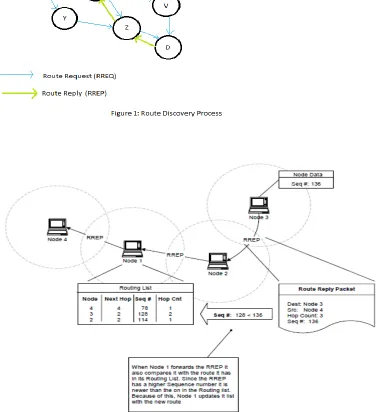
routing table is still valid. If it gets a Route Response (RREP) from “D” it sends back the RREP to “S” else “X” sends a RREQ to its neighbors until it reaches “D”. Now as the RREQ is been propagated each node in the network also maintain a list of node from whom they received RREQ creating a reverse path to the initiator of the RREQ. Once RREQ reaches “D” it uses the reserve path created during RREQ and sends a RREP to the source node “S”. This is how route discovery takes place using a reactive routing protocol. Node “S” starts sending packets after route discovery is completed. There might be a case where there are multiple routes from one source to the destination. In such a case the most optimal route is kept in the active routing table while the other routes are kept in the passive routing table which can be used as a backup route in case a link breaks. Optimal route is based on the metrics like hop count from source to the destination or route cost. In case of the tie with one metric, other metric is used to determine the optimal path. Figure 1 below describes the route discovery process of a reactive routing protocol.
the route in the RREP has a better sequence number than the route in its RREP. So it replaces the its route with a fresh enough route.
Ad Hoc On Demand Distance Vector (AODV) and Dynamic Source Routing (DSR)
routing protocol:
AODV and DSR are reactive routing protocol. They initiate a route request processonly when there is a need to transfer data from one source to the destination. Both uses RREQ and RREP packets during a route discovery process, Hello messages to maintain the routes and RERR packets to notify the sender in case of a link failure. Both AODV and DSR work the same when it comes to route discovery process and router maintenance process but the way they maintain routing information.
AODV uses traditional routing table one entry per destination. It relies on the routing table to send RREP packets back to the source and then send data packets to the destination. It uses sequence numbers to determine the freshness of routing and to avoid routing loops. These sequence numbers are carried in the packet header of the data packet. It sets a timer on each route in the routing table and once the timer expires the route is considered to be a stale route. Stale routes are deleted and if in the future data is to be transferred to the same destination, route request process is initiated. So in case of AODV nodes maintain information about only its one hop neighbor in its routing table [4].
using DSR makes use of the Promiscuous Listening. The nodes check whether it has a better route to the destination. If so, it sends a gratuitous RREP to the source of the route with the new route [5].
Therefore the nodes using DSR are exposed to more routing information than AODV. In a single RREQ and RREP cycle the nodes are aware of the entire network topology. Nodes using AODV has a limited routing information one hop per node. DSR makes use of route caching and replies to all the RREQ reaching a destination. So there may be a possibility of having multiple routes to reach the destination which can be used in case of a link failure. AODV replies to one RREQ the one that reaches first to the destination i.e. the route with the least number of hops. So in case of a route failure the source initiates a route discovery process. In DSR, there is no such mechanism of stale routes. In case of a multiple routes, the nodes may use stale routes which can start polluting other caches. In contrast AODV has a much better approach to take care of the stale routes. It uses sequence numbers to determine the freshness of the route in case of multiple routes. The route with a higher sequence number is considered to be fresh.
AODV and DSR are the most widely used MANET routing protocols. This can be proved by the number of researches going on with these protocols. There are also academic papers that clearly mention the popularity of these protocols.
common use in the real world environment.
DSR is popular because of it being simple and efficient MANET routing protocol. It easily guarantees loop free routing through source routing, can be operated in a network with unidirectional links, and performs fast network recovery when there is a route change in the network. Researchers have showed much interest to improve the performance the DSR since its invention. The way to efficiently make use of the energy resources was introduced in a paper “Modified Energy-Aware DSR Routing for Ad Hoc Network” by Yang Tao and Wei Luo. In this paper the protocol was modified in such a way that it would select a route which would require the least amount of energy and have the maximum energy at that point in time [16]. Another research by Asokan R. and Chandrashekhar S, “Performance Enhancement of Dynamic Source routing using Simulated Annealing” was proposed with QoS as the main component. This QoS aware routing protocol had better performance than the traditional DSR in terms of throughout, end-to-end delay and packet delivery ratio [17].
All these researches in the area of AODV and DSR directly or indirectly were aimed at improving the performance of the traditional protocols. Thus it can be concluded that AODV and DSR are amongst the most popular and widely used Reactive Routing Protocols in MANET.
3. Literature Review
the interface queue, retransmission delays at the MAC, propagation and transfer times, (iii) Normalized routing load-the number of routing packets transmitted per data packet delivered at the destination [6].
Another research work in the area of MANET routing protocols was the implementation of
AODV-SEC. AODV-SEC aims at securing AODV routing protocol. It is a protocol extension to the AODV protocol. To implement security in AODV the research relies on PKI. Every node in the network owned a certified keypair, current certificate of the certificate authority (CA) to verify unknown certificates from other nodes and every node owned a certificate in order to participate in the network. AODV-SEC used Digital Signatures to guarantee the origin and integrity of the data. Hence digital signatures were used to protect the content of messages from been modification and to verify the originator of the request or reply. Digital signature was included in the route setup packets. RSA algorithm and SHA-1 hashing was used to implement AODV-SEC. Hashing can be used to secure data and in this research it was used to secure the minimal length of the route. SHA-1 hashing implemented in the protocol protected the number of hops from being modified by the nodes as the current hop count value was secured using hash chain values.
AODV protocol was extended to implement AODV-SEC functionality. The 8-bit Length field in AODV was changed to 16-bit to guarantee AODV-SEC extension. Message formats of RREP, RREQ, RERR and Hello messages for AODV was extended to include Hash function, Top hash, CrypteOR, CryptLH, Signature, and Certificate.
Model. A random way point mobility model was used. Two scenarios sizes were used in the simulation. Small scenario had a size of 900 x 200m and 20 simulated nodes. Large scenario had a size of 1500 x 300m and 50 simulated nodes. The node pause time varied between 0s (high mobility) and 600s (low mobility). Constant Bit Rte model was used to model data traffic. The simulation was done on different number of data sources distributed evenly. In a small scenario either 4 or 16 sources were used and in the large scenario either 10 or 20 sources were used. The packet size had a size of 512 bytes. The simulation was done to obtain the following results: (i) packet delivery fraction, (ii) average end-to-end delay, (iii) normalized routing load, (iv) normalized MAC load, (v) route acquisition time, (vi) number of RREQs per node [7].
case as it is a route discovery process), IP address of the destination (IPD), certificate of node “S”, a
nonce and the current time t, all signed by S’s private key.
S brdcast: [RDP , IPS, certS, NS, t] KS
When a node receives a RDP message is sets up a reverse path to the source by recording the IP address of the node it received the RDP. Suppose that RDP send by “S” RDP is received by node “P”. “P” uses S’s public key from S’s certificate to validate the signature and verify that S’s certificate has not expired. Node “P” also checks the IP address of the source to make sure it has not already processed the RDP packet. If the RDP is not processed the nodes sign the contents of the message, removes the signature of the previous nodes and append its own signature and rebroadcasts the RDP. Once the RDP reaches the destination a REP packet is send by the destination to the source which follows the reverse path. The REP packet also contains the fields as the RDP packet.
established and data is forwarded aver the established route. Figure 3a-3e below explains the routing process.
http://dl.acm.org/citation.cfm?id=664514
Note: All the gray colored nodes in the figure have energy above the threshold level.
key and PK was the Public key. The certificates were signed using the private key which was verified by the public PK. Threshold secret sharing is such that SK was shared among the network entity. Each entity vi holds a secret share Pvi and any K of such secret share holders could collectively function as a CA. Each
entity also had their own RSA public and private keys {ski , pki} to maintain end-to-end security. The
nodes obtain its secret share during the bootstrapping process or through self initialization service. So in order to compromise the security of the network the attacked had to compromise the K nodes in the network to get the secret of the keys, making it hard for the attacker. An assumption is made that at the bootstrapping phase an entity can obtain certificates form a trusted centralized management. Later if an entity joins a network or wishes to recover its certificate from a system crash, then a well known
policy must be predetermined before the ad hoc network is formed. The initial certificate issued was renewed on a timely basis within Trenew time. Certificates were also renewed once a node updates its
personal key pair by presenting its current valid certificate and a future expiration time T<(current time + Trenew) for the new certificate. Simulation of the proposed work was done using NS-2 and metrics like
success ratio (the ratio of number of the successful certification services over the number of attempts during simulation time), average delay (average latency for each node to perform certification services) and average number of failures (number of times an entity fails on average before successfully
accomplishing its certification) were obtained [10].
An extension to the above research Certification and Authentication Services for Securing MANET Protocols was basically done to improve the certificate distribution and renewal process that had some assumptions. A set of configurable policies options was proposed for certificate issuing and renewal, and private-key share issuing and updating. The policy was used to enforce the new certificate and he private key of the system SKCA issuing in the DCA follow strictly the same identity verification that
The above researches were mainly focused on either implementing security in a MANET on-demand routing protocol or comparing AODV and DSR to get to a conclusion of which protocol is better in which environment. In my thesis, the first thing I did was implemented some security parameters using encryption techniques in AODV and DSR routing protocol. Then compared the secured protocols against each other to evaluate their performance and get to a conclusion which protocol performs better in which environment. I used RSA and SHA-1 cryptographic encryption schemes to maintain confidentiality, and integrity of the routing messages.
RSA is an algorithm for public-key cryptography. It is based on the generation of two large prime numbers “p” and “q” such that their product is “n”. A secret exponent is computed by doing mathematical calculation on “n”, “p” and “q” through which the public and private keys are generated. Routing messages will be encrypted and decrypted using these keys by the sender and the receiver respectively. I am using RSA because it is considered to be one of the strongest encryption techniques. RSA problem is based upon factorizing a number “n” in order to get the two prime numbers “p” and “q”. In a real world scenario “n” is considered to be very large such that factorizing “n” becomes impractical. The task of RSA is described as finding the eth roots of an arbitrary number modulo “n”. The ability for computers to factor large numbers and attack RSA encryption is improving rapidly and there are systems that can find factors of prime numbers with more than 200 digits. Also there is no known factorization algorithm to factor large numbers derived by multiplying two large prime numbers. A test to factor a 200 digit number took 1.5 years and over 50 years of computer time [12].
(RSA in this thesis). SHA-1 is called secure because it is infeasible to find a message that corresponds to a particular message digest or two messages with the same message digest. Any changes to the message in transmit, would cause the message digest to change and the signature would fail to verify indicating the message has been modified [13].
As far as hashing and signatures are concerned, the process is slightly different in the AODV and DSR the way these cryptographic functions are implemented. In an ad hoc network when a node needs to send some data to a distinct node it needs to get the routing information in order to reach to the destination node. Therefore there are two kinds of messages: Routing messages and Data messages. Data messages can be protected by any point-to-point security system like IPSec. While routing messages gets processed, modified and resent by the intermediate nodes. The processing of these routing messages also causes the intermediate nodes to update their routing table in some cases. A need arises for the intermediate node to authenticate the information contained in the routing messages before they update their routing table. Also in some ad hoc networking protocols there are cases where some of the routing information is constantly changed on a hop-by-hop basis like the hop count in Distance-Vector routing protocols. The hop count is either incremented or decremented on a hop-by-op basis. Therefore we can conclude that the routing messages carry two types of information: Mutable; information that changes during transmission by the intermediate nodes and Non-Mutable; information that is never altered during transmission by the intermediate nodes. So there is a need to protect the mutable fields in order to get rid of the assumption “trust between intermediate nodes”.
creating hash chains using SHA-1. Other fields are non-mutable and can be protected by encryption and creating signatures using RSA for the intermediate node to authenticate itself to other nodes.
Hash chain was created by applying a one-way hash function repeatedly to a seed. A seed can be any random number generated, when there is a need to transmit new RREQ/RREP routing messages. Whenever a node needs to generate a RREQ or RREP message it does the following to create hash chain: 1. Generate a random number (seed). 2. Set the “Max Hop Count” field to the Time To Live value from the IP header i.e. Max Hop Count = Time To Live. 3. Set the “hash” field to the seed value i.e hash = seed. 4. Sets the “Hash Function” field to the identifier of the hash function i.e. Hash Function = h. 5.
Calculates “Top hash” by hashing seed Max Hop Count times i.e. Top Hash = hMax Hop Count (seed) where h is the hash function (SHA-1 in my case), hi (x) is the result of applying the function h to x "i" times. When any intermediate node receives a RREQ or RREP message, it performs the following operation to verify the hop count: 1. Applies the hash function h Maximum Hop Count minus Hop Count times to the value in the hash field, verifies if the resultant value is equal to the value contained in the Top Hash Field i.e. Top Hash = hMaz HopCount – Hop Count (hash). 2. Before rebroadcasting a RREQ or forwarding the RREP, the node applies the hash function to the value in the Hash filed to account for the next hop. The “hash function” field in the signature extension indicates which hash function with be used to create hash chains.
before they are sent to the intermediate node. At each node the message is decrypted to process the message and then it is encrypted again before sending it to the next node. When there is a need to transfer data, the source generates an RREQ. To protect hop count, hash chain is created (top hash). Hop count is only in the RREQ and RREP packets. For other routing messages like RERR there is no need to create hash chains. The packet is encrypted, signed and send to the intermediate nodes. The next node grabs the packet and verifies the signature, verifies the hop count, decrypts the packet and before forwarding the RREQ it again calculates top hash, encrypts and signs the packet. Thus the packet is secured from malicious nodes.
DSR is based on Source Routing. Before sending the data the source node gets the route to the destination. Once it has the route to the destination it adds that route in its routing packets (RREQ, RREP, etc) and sends the data along with it. This route is the full route the packet takes from the source to the destination to get data delivered to its destination. Thus in DSR there are no mutable fields which makes life so much easy. DSR routing messages can be protected by encryption and signing the packets by each intermediate node for authentication. Signature and Encryption process is same as in AODV. The RERR message in both AODV and DSR does not have any mutable fields. They are signed and encrypted for protection from malicious nodes. The operation of DSR is the same as AODV except for the hash chains. In case of DSR there is no need to create hash chains, encryption and digital signing does the job of securing the packets. Figures 12a, 12b and 13a, 13b in the appendix section show the signature extension for AODV and DSR respectively.
include signature and hash. The signature and the hash will be appended to the AODV and DSR message. Additions to RREQ and RREP would be hash function, top hash, hash and last hop signature. RERR and HELLO message does not contain any mutable fields and so only signature field would be added to these packets.
4. Network Simulators
The nodes in the MANET network are aimed to accomplish mission critical tasks, detecting fire in a forest, collecting the rise in the level of water, in the battle field by a group of soldiers to
communicate and many more. Also routing is a very challenging task in MANET networks due to the limited functionality and the mobility of the node. These nodes are battery powered and constrained by limited energy, are exposed to hazardous conditions and may get damaged. Therefore it is very
important to carefully test, analyze and evaluate the routing protocol before implementing it in a real world scenario. This can be achieved by simulations. The most popular network simulators commercially available are, OPENT Modeler, NS-2, GloMoSim and the not so popular because of the advancement in technology are REAL, INSANE, NETSim and Meisie.
functions to describe, analyze or visualize the simulation scenario. The tools it has are written using scripting languages by different people and since there is a lack of general analysis tool we may get different values for the same metric. Also in NS-2 debugging is difficult due to the combination of C++ and OTcl scripts. There are issues related to the large amount of memory it uses. With a few hundred nodes simulations done with NS-2 has often lacked scalability.
GlomoSim was designed using parallel discrete-event simulation provided by C-based parallel simulation language, Parsec which provides a scalable simulation environment for wired and wireless networks. GloMoSim is built using a layered approach and standard APIs are also available which can be used between the different layers allowing rapid integration of models developed at different layers by the users. Configuration files like app.conf and Config.in are used to specify the network characteristics. The app.conf describes the application type, bit rate etc which relates to the generation of traffic. The Config.in file was used to describe the remainder of the parameters like simulation range, power range, mobility etc. This simple approach of GloMoSim is not as powerful as the OTcl of NS-2 but still it has proved that it is suitable for wireless simulation and reduces configuration complexity and confusion as compared to NS-2’s OTcl. In GloMoSim a limited set of Ad Hoc routing protocols are been implemented. GloMoSim has also been reported of having programming bugs which leads to simulation crash.
Researches sometimes had to do 1000 simulations in order to get a successful simulation and sometimes would never get a successful simulation. Another disadvantage of GloMoSim is that it measures values per node and not per packet which limits the statistics that can be collected from the simulation.
functionality it provides. OPNET can perform discrete event simulation to analyze the system
performance and behavior. With OPNET most of the deployment can be done with the Graphical User Interface. OPNET supports hierarchical model building. Network editor is used to create the network which defines the position of the interconnection and communicating entities; node and link. Each node in the network is represented by a node model. The node model basically is a collection of
interconnected modules. The modules are either connected by a packet stream or statistics wires. There are two types of modules. The first type has a predefined characteristics and a set of built in parameters. Point-to Point transmitter, radio receivers and packet generators are examples of this type of modules. The second type contains highly programmable modules called processors or queues. Each node is described by a block structured diagram and the functionality of each programmable node is defined by a process model. Process Models are created using process editor which describes the logic flow and the behavior of queue and processor modules. The process model makes use of interrupts to communicate between processes. Proto-C language is use to build process models which consists of state transition diagrams, a library of kernel procedures and the standard C programming language. States and transitions define the progression of the process in response to events. Events are generated which causes a state change in the process model if certain conditions are either true or false. Within each state, logic can be created using the functions provided by the OPNET kernel library or even pure C programming language. Within a process we can create child processes to perform a sub-task which makes the former a parent process.
numerical data, animation and traces provided by the OPNET debugger. OPNET simulations support open interfaces to the C language and the host computer’s operating system it can also generate output in the console window by printing the results required, can even generate binary or ASCII files and even interaction with other programs. We can also display graphs using the OPNET Analysis Tool. It
represents the graph in the form of abscissa axis (horizontal) and ordinate axis (vertical). The plotting area can have one or more graphs describing the relationship between the variables mapped to the two axis [18] [19] [20] [21].
5. SHA-1
SHA-1 is widely used in a number of security applications electronic fund transfer, electronic mail, software distribution, data storage and other application which require data integrity assurance and data origin authentication. It is also used in protocols, including TSL, SSL, PGP, SSH, S/MIME and IPSec. Apart from these applications it can also be used whenever there is a requirement to generate a condensed form of the original message. SHA-1 was considered to be so much secure that it was used in US Government applications and in cryptographic algorithms and protocols for the protection of
researchers claim that there is a weakness in SHA-1 by improving the complexity requirement to 251 operations, it still a big number to calculate and would require a lot of resources and power to compute such a value. Therefore it is infeasible to calculate such a large value making SHA-1 still secure. Also the researchers do not talk anything about the irreversibility feature f SHA-1. The irreversibility of SHA-1 still stands where it is. As of today there are still many applications that rely on SHA-1 making it popular and widely used hash algorithm.
6. RSA
RSA is an algorithm for public-key cryptography. It is based on the generation of two large prime numbers “p” and “q” such that their product is “n”. A secret exponent is computed by doing
I am using RSA because it is considered to be one of the strongest encryption techniques. RSA problem is based upon factorizing a number “n” in order to get the two prime numbers “p” and “q”. In a real world scenario “n” is considered to be very large such that factorizing “n” becomes impractical. The task of RSA is described as finding the eth roots of an arbitrary number modulo “n”. The ability for computers to factor large numbers and attack RSA encryption is improving rapidly and there are systems that can find factors of prime numbers with more than 200 digits. Also there is no known factorization algorithm to factor large numbers derived by multiplying two large prime numbers. A test to factor a 200 digit number took 1.5 years and over 50 years of computer time [25]. The biggest advantage of RSA is that it uses public key encryption. The text message will be encrypted with someone’s public key which is known by everyone. Only the person intended to receive that text message will be able to decrypt it by using its private key which only that person is aware of. This text message cannot be decrypted by the public key. Also the signing of messages by RSA helps the recipient verify that it was sent by the person it was supposed to get from.
The fields for the signature and hash are also called as the extension fields of the signature extension. The signature extension fields were added to the traditional AODV and DSR packets as an extension to the original packet. The signature extension fields for AODV and DSR are shown in the Appendix section.
7. Methodology
and packet delivery fraction. RSA and SHA algorithms would be implemented and hash, and signatures generated by these algorithm will be appended to the AODV and DSR message. Each node will possess a certificate to maintain its identity in the network. As the routing messages are transmitted on a hop by hop basis the nodes check for the changes in the hash value by comparing it with the original hash value. The signature in the routing message helps other nodes to identify the sender of the message. Also nodes in the network cannot deny on sending a particular message. The routing messages will contain the signature of the originator of the message (i.e. RREQ/RREP) and the signature of the last hop.
I started with reading scholarly articles and academic research papers. Google was of great help in finding such articles and I browsed through the ACM and IEEE websites. The research area of my interest was any work done related to AODV and DSR. As I was going through the websites I saw a huge number of papers dedicated only to AODV and DSR amongst all the MANET routing protocols. This was evident that AODV and DSR were amongst the most widely used MANET routing protocol in research as well as in other applications. Before I started the actual research I made sure I had a solid understanding of the operations involved in these protocols. There were papers about improving the performance of these protocols. Some compared them, some created a fancy protocol out of the traditional protocol that would best operate for a particular type of application, and some even implemented security parameters in AODV. People had presented the idea of implementing security parameters in DSR but there was no research that actually secured the DSR protocol. I read a decent amount of papers and got a good understanding about the current researches going on with AODV and DSR.
The devices are represented by a node model. The node model is comprised of different types of modules like; Processor Modules, Queue Modules, Esys Modules, Transmitter Modules and Receiver Modules. Each module in the node model has a process model which is nothing but an event driven state transition diagram. The states may have logic implemented in them for it to perform a particular task in case an event triggers that state. The process model may also have child processes associated to them. So since this was a routing protocol it has to be somewhere in the IP module. I opened the process model for “IP” and opened child process model which took me to the MANET process model. Within the MANET process module there were several other process modules which had the routing protocols process model. I opened the AODV process model and opened the function block which had all the logic related to the operation of the AODV protocol. I went through the program code and got a decent understanding about the flow of the code that would help me implement my security code in it. OPNET’s tutorial was of great help. It gave me a good understanding about the rich set of in-built functions OPNET had. I then started developing an algorithm to implement SHA-1. Then I implemented that algorithm in a C programming code. I tested the SHA code in a simple environment outside of the OPNET. Then I added my code to the OPNET code within the function block. I also added the required function prototype to the project header files. I compiled the code in the OPENT environment. Fixed the issues and ran the simulation. The simulation run was successful. The hash values were printed to the OPNET console. Also the simulation time went up when I added SHA-1 code to the original code. Then I adjusted the packet fields for AODV to add the hash field in the packet. This was done in a C file
project. Added the AODV extension fields for signature to the appropriate C file associated with the project. Added additional parameters to the function call for the routing messages. Again the simulation time went up after adding the RSA code. Results of encryption/decryption and signature/signature verification were displayed on the OPNET console. Performed a test run, both encryption/decryption and signature/signature verification worked flawless. Thus one model for AODV was successfully completed with encryption parameters implemented. For DSR it was pretty simple. I just had to figure out where to add the encryption code. Add it and do test runs. The test runs were successful.
Encryption/decryption and signature/signature verification were working fine. The results were displayed on the OPNET console. Thus the two models were ready for comparison.
The comparison was done by running the protocol over an application. OPNET already has in built applications that we can select and have the application run on the protocol. This can be done by the “application config” object in the object palette. To edit the attributes for the application config object by selecting the “Application Definition” field and then selected the number of rows. The number of rows corresponds to the number applications to be added. If two rows are added two fields for the applications will pop up. I am using FTP as an application. We can also specify the type of application load we want to run like low, medium and heavy load. Then we need to create a profile for the
application. The profile defines the run time parameters for the application. This can be done using the “Profile Config” object from the Object Palette. Right click on it to set the attributes. Click on the “Applications” field and select the type of application which in my case I selected FTP. I named the application as FTP. Then here we can also have multiple FTP sessions or different type of applications by selecting the number of rows. The fields that determine the run time parameter for the defined
1. Start time offset: The value set in this field depends on the type of “Operation Mode” specified. If the operation mode is set to “Simultaneous” the offset refers to the first instance of each application from the start of the profile. If the operation mode is set to “Serial (Order)” or “Serial (Random)” then this offset refers to the time from the start of the profile to the start of the first application.
2. Duration: It defines the amount of time for the application session runs. If it is set to “End of Profile” it lasts until the simulation time expires. If it is set to “End of Last task” it lasts until the last task of the application has completed.
3.
Repeatability: This attribute specifies the method for repeating the profile. Inter-Repetition defines when the next session of the profile starts. Number of repetitions determines thedistribution name and arguments to be used for generating a random number of times
this profile is repeated. Repetition Pattern defines when the next session of the profile
will start.
4.
Operation Mode: This field determines how the application starts. If it is set to Serial
(Ordered) then applications starts one after another in an ordered form. If it is set to
Serial (Random) then the applications starts one after another in a random order. If it is
set to simultaneous then all the applications will start at the same time.
5.
Start Time: This attribute determines when during the simulation the application session
will begin.
compare the two protocols in different scenarios. Also the results were collected considering the number of nodes in the network. The simulation was run with different number of nodes to get to a conclusion about how the application run on the protocols affect the overall performance of the network. Depending on the results a conclusion was made about which protocol performs best in which environment.
8. Simulation Results
Simulation results were collected by running FTP application over the two routing protocols. Before running the simulation I had to specify the desired output values. This can be done by selecting DES -> Choose Individual Statistics from the menu bar of the project editor. I selected AODV, FTP and Wireless by expanding the Global Statistics tab. Global statistics accounts for the performance of the network as a whole.
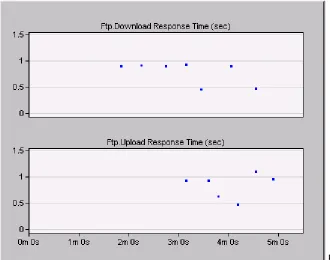
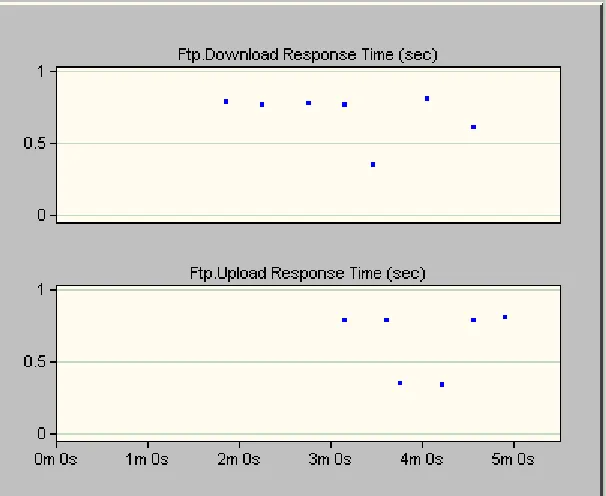
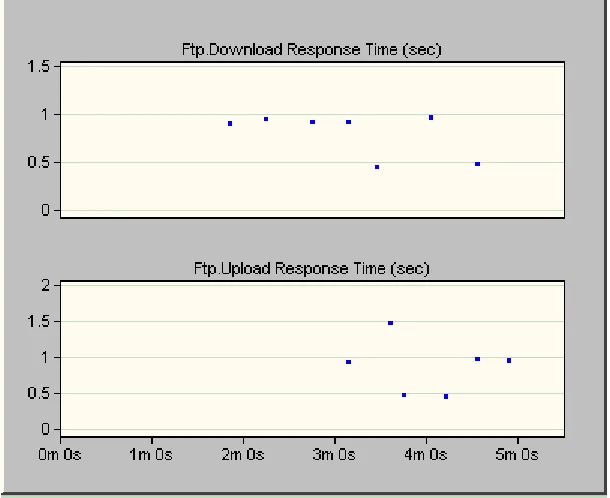
Scenario1: 50 nodes network, medium FTP traffic: The simulation run time was 5 minutes. For AODV it took 5 minutes 35 seconds to complete the simulation. For DSR it took 2 minutes 20 seconds to
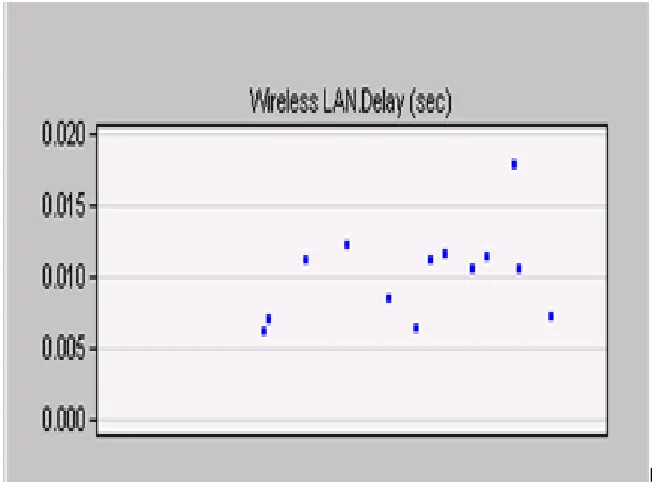
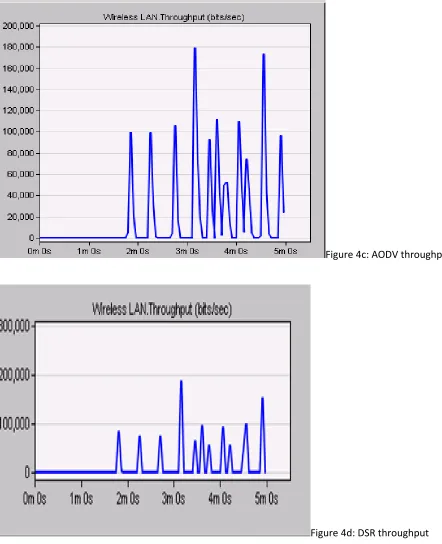
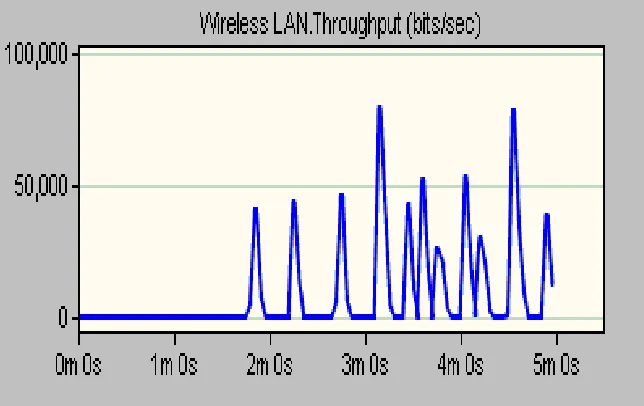
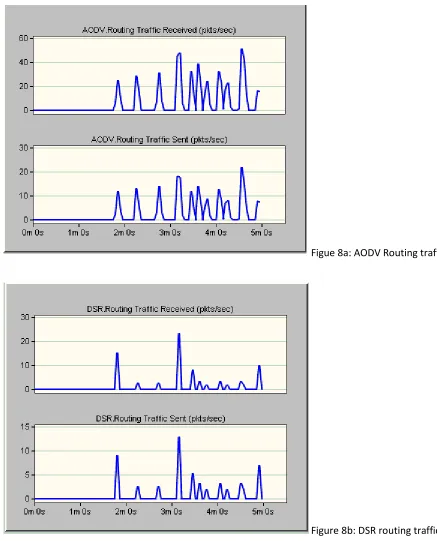
complete the simulation. Figure 3a and 3b represents the output from AODV and DSR respectively. The graph shows the results for the FTP Upload Response Time and Download Response Time. Looking at the graphs for both protocols I get to a conclusion that DSR performs way better than the AODV protocol in this scenario. DSR performs more than 50% better than AODV. In both cases DSR is faster than AODV. Figure 4a and 4b represents delay for AODV and DSR. The graph shows that delay is better in DSR than AODV. Figure 4c and 4d represents the throughput for AODV and DSR. The graphs show that AODV has a better throughput. Figure 5a and 5b represents the routing traffic in AODV and DSR
delivery fraction is defined as the ratio of packets delivered to that generated by the traffic generator. Packet delivery fraction was better in AODV as compared to DSR. The reason for this is DSR being very aggressive in caching routes.
Scenario 2: 32 nodes network, low FTP traffic: The Simulation run time was set to 5 minutes and it took 4 minutes 27 seconds for AODV and 1 minute and 6 seconds for DSR to complete the simulation. Figure 6a and 6b represents the output for FTP upload and download response times for AODV and DSR respectively. DSR takes much less time to upload and download FTP traffic as compared to AODV. Figure 7a and 7b represents delay for AODV and DSR respectively. The graph shows that AODV has more delay than DSR. Figure 7c and 7d shows the output for throughout in AODV and DSR and again the throughput in AODV is a little better than DSR. Figure 8a and 8b shows the output for the routing traffic for AODV and DSR respectively which says that in case of AODV more routing traffic is generated. With the nodes reduced to 32, the packet delivery fraction for AODV was just a little better than DSR. Since the nodes got reduced to 32, it had to do less caching as compared to earlier with 50 nodes in the network.
were only 20 nodes there was less caching and the number of stale routes in the routing table was also reduced, resulting into less number of packet drops.
9. Conclusion
The aim of this thesis was to compare the two reactive routing protocols such that security is implemented in them to protect the network from being compromised. I created security encryption techniques SHA-1 and RSA in AODV and DSR. OPNET simulator was used for comparing the performance of the routing protocols. The protocols were compared under different scenarios like number of nodes, mobility, and type of traffic. Results for all the scenarios are shown in the graphs which are in the Appendix section.
Looking at all graphs of these different scenarios I get to a conclusion that DSR performs than AODV because of the fact that in AODV there is a mutable field (hop count) which needs to be
10. Deliverables
• Comparison results for AODV and DSR
• C++ programming code and the pseudo code
• Graphs from the simulation
• Thesis report that document the whole process of encryption scheme and performance of the two protocols
11. Research Timeline
Proposed Timeline of Thesis process: 2010-2012
Nov 12 to Nov 25 – Research for Thesis Idea begins
Read published research papers
Dec 1 – First Preliminary meeting with Prof. Tom Oh
Dec 2 – Dec 09 – Study OPNET and MANET
Dec 10 – Turn in the Thesis Proposal to NSSA
Situation Analysis
Problem Statement
Dec 11 – Tentative first committee meeting
Jan 2011 (Week1-Week4) – Experimental Research and Analysis
Objectives
Timeline
Evaluation Plan
Bibliography
Glossary
Appendix
March (Week 3) – Review Progress with Committee
Apr (Week 1) – Gather extended information
May (Week 1 - 4) – Develop code for SHA-1
June (Week 1 - 4) – Develop code for RSA
July (Week 1 – Week 4) – Add code to OPNET
Aug (Week 1 – Week 4)
– Add code to OPNET
Sept (Week 1 - Week 4) – Add code to second model of OPNET
Oct (Week 1 – Week 4) – Work on getting results
Nov (Week 1 – Week 4) – Gather data for report writing.
Dec (Week 1 – Week 4) – Report Writing
– Submit first draft to committee members
– Review the comments and as per the committee
– Submit Second draft to committee members
– Prepare for Presentation
12. Appendix
Results of the Simulation
[image:46.612.75.405.135.395.2]Figure3a. AODV FTP traffic
Figure 4a: AODV delay
[image:47.612.76.513.208.587.2]Figure 4c: AODV throughput
Figure 5a: AODV routing traffic
[image:49.612.73.407.110.401.2]Figure 6a: AODV FTP traffic
Figure 7a: AODV delay
Figure 7c: AODV throughput
[image:52.612.74.396.73.276.2]Figue 8a: AODV Routing traffic
Figure 9a: AODV FTP traffic
[image:54.612.73.378.73.322.2]Figure10a:AODV delay
Figure 10c: AODV throughput
Figure11a: AODV Routing traffic
[image:57.612.74.381.72.329.2]Signature Extension Packet Formats
Figure 12a: AODV RREQ Signature Extension
Figure 12b: AODV RREP Signature Extension
0 1 2 3 4 5 6 7 8 9 0 1 2 3 4 5 6 7 8 9 0 1 2 3 4 5 6 7 8 9 0 1 + - + - + - + - + - + - + - + - + - + - + - + - + - + - + - + - + - + - + - + - + - + - + - + - + - + - +-+-+-+-+-+-+ | Type | Length | Hash Function | Sign Method | + - + - + - + - + - + - + - + - + - + - + - + - + - + - + - + - + - + - + - + - + - + - + - + - + - + -+ -+-+-+-+-+-+ | Signature | ………… ………….. + - + - + - + - + - + - + - + - + - + - + - + - + - + - + - + - + - + - + - + - + - + - + - + - + - + -+ -+-+-+-+-+-+ Figure 13b: DSR RREP Signature Extension
Signature Extension Fields:
1. Type: Type represents if it is a RREQ or RREP extension. It is set to 64 for RREQ and 65 for RREP. 2. Length: Length represents the length of the packet excluding the type and Length fields in the
packet extension.
3. Hash Function: Specifies the type of hash function to use. If it is set to 1, it usesMD5 as the hash function. If it is set to 2, it uses SHA-1 as the hash function.
4. Max Hop Count: The maximum hop count supported by the hop count authentication. 5. Top hash: It is the top hash for the hop count authentication in AODV.
6. Signature: This field contains the signature of the node. The node signs all the fields but the hop count and the hash.
Flowcharts
True False
False True aodv_rte_rreq_pkt_arrival_handle
If
hop_cnt=0 set_seed() (calculate seed value for creating hash chains)
Write value of seed in a C file “top_hash”
If h_ch < max_hop_ cnt
Hop_cnt_proc() h_ch=0
Process data for creating a hash
Hop_cnt_hash (<args>)
Write value of top hash in a C file top_hash
h_ch++ Hop_cnt_proc()
Process data for creating a hash
Hop_cnt_hash (<args>)
Write value of top hash in a C file top_hash
Read the file top_hash and save its value in the top_hash_fd (AODV extension field)
Create Hash and Signature for the packet True False True True False False X
Read AODV fields and Extension fields in variables for processing
Open C files “decrypt.txt” and “hash.txt to read ”. Verify decryption.
If( cnt_temp>1
|| hop_cnt>1) Next node signature verification
Open C files “verify.txt” and “hash.txt” to read. Compare each char.
If character mismatch ?
Print character mismatched. Cannot verify signature.
Signature verified successfully Continue to next statement
Check if this is the 1st node ?
Open C file “hash.txt” to write values from variables (AODV field values)
process_pkt_data ()
Open C file “hash.txt” to read packet data
Convert data into a message block format acceptable for SHA
proc_message (<args>)
Perform mathematical
calculations to convert message block in to a HASH
Open C file “hash.txt” and write HASH value in it.
A
rsa_encrypt ()
Create encrypted code by calling each encrypt () function
Open C file to copy value of encrypted code
Calculate value of “d” for decryption
Decrypt the encrypted code by calling the decrypt () functions
Open a C file to copy the value of decrypted code i.e. original message
Sign the message packet by calling the sign () functions
Open a C file to copy the value of the signature
Calculate sign verification value by calling v_sign () functions
False True
process_pkt_data ()
Open C file “hash.txt” in read mode
Read the first/next 8 numbers from the file hash.txt one at a time
Convert each number into its binary equivalent
Make sure the binary number is a 4 bit BCD
32 bit string is created which can be represented as 8 hex digits
Convert this 32 bit string into its decimal equivalent for the computer to process
Store this decimal number into an array “mblk_arr[]”
If ch != EOF Add 1 in the end for message padding. Make sure the message chunk is 32 bit by adding 0s. Convert it into decimal
Store this decimal number into an array “mblk_arr[]”
int proc_message (<args>)
Copy the decimal numbers in mblk_arr[] into array “words[]”
Make sure words[] has 16 numbers in it.
Set the 16th number in words [] to the original length of the message
Create 80 words out of the 16 words by performing SHA1 mathematical calculations
The resultant hash value is stored in an array “h[]”
Open a C file “hash.txt” and write the value of array h[] in it
int rsa_encrypt (<args>)
Assign value to prime numbers. p= 1061, q= 1013. Also assign e=3
Break individual message digest from h[] into two. Thus we have 10 parts of message digest
Call the encrypt () functions to encrypt each part of message digest
Open C file and write the encrypted message in it
Calculate phi = (n-1) * (p-1)
Calculate vaule of “d” using e and phi
Call the decrypt () functions to get the original hash value out of each crypted code
Open C file and write the decrypted message in it
Call the sign () functions with hash values to sign the message digest
Open C file and write the signature value in it
Call the v_sign () functions with signature values to get the orig meaasge digest for verification
Algorithm
For AODV hop count:
1. Check if the hop count is zero.
2. If hop count is zero then it is at the first node. Calculate seed for top hash by calling set_seed() function.
3. Write value of seed in a C file “top_hash”.
4. Calculate hash chain by hashing seed max_hop_cnt times by calling the hop_cnt_proc() function to create a message block and then call the hop_cnt_hash() function(<args>) to calculate the top hash.
5. Write value of top hash in a C file top_hash. Then goto Step 8.
6. Else if the hop count is not zero then it is not at the first node. The node will verify and calculate its top hash by calling the hop_cnt_proc()function to create a message block and then call the hop_cnt_hash() function(<args>) to calculate the top hash.
7. Write value of top hash in a C file top_hash. 8. Increment the hop count by 1.
For Packet hash and Signature:
1. Read the AODV fields in the variables for packet processing. Also write the values of the fields in a C file hash.txt.
2. Check if the hop count > 1.
3. If hop count is greater than 1 then it is not at the first node. So the current node first verifies the signature.
4. Opens the verify.txt and hash.txt files for signature verification.
5. If there is any character mismatch during verification the signature is not verified.
6. Then decryption of the message takes place. Decryption can be verified by reading the value from hash.txt. Since the hash value was encrypted, decryption should result into hash value.
7. If the hop count is not greater than 1 than it is at the first node. The packet needs to be processed to create a message block for hashing. Call process_pkt_data function.
8. Open the file hash.txt in read mode.
9. If hash.txt has not reached EOF.
10. Read the first/next 8 numbers from the file hash.txt one at a time.
11. Convert each number into its binary equivalent.
12. Make sure the binary number is a 4 bit BCD.
13. 32 bit string is created which can be represented as 8 hex digits.
15. Store this decimal number into an array “mblk_arr[]”. Then go to Step 10.
16. If the file hash.txt has reached EOF.
17. Add 1 in the end for message padding.
18. Make sure the message chunk is 32 bits long by adding zeros to the end.
19. Store this decimal number into an array “mblk_arr[]”.
20. Then call the proc_message(<args>) function to calculate the hash value.
21. Copy the decimal numbers in mblk_arr[] into array “words[]”.
22. Make sure words[] has 16 numbers in it.
23. Set the 16th number in words [] to the original length of the message.
24. Create 80 words out of the 16 words by performing SHA1 mathematical calculations .
25. The resultant hash value is stored in an array “h[]”.
26. Open a C file “hash.txt” and write the value of array h[] in it.
27. Then call the rsa_encrypt(<args>) function to encrypt and sign the message digest.
28. Assign value to prime numbers. p= 1061, q= 1013. Also assign e=3.
29. Break individual message digest from h[] into two. Thus we have 10 parts of message digest.
30. Call the encrypt () functions to encrypt each part of message digest.
31. Open C file encrypt.txt and write the encrypted message in it.
33. Calculate vaule of “d” using e and phi.
34. Call the decrypt () functions to get the original hash value out of each crypted code.
35. Open C file decrypt.txt and write the decrypted message in it.
36. Call the sign () functions with hash values to sign the message digest.
37. Open C file signature.txt and write the signature value in it
38. Call the v_sign () functions with signature values to get the original message digest for verification
39. Open C file verify.txt and write the signature verification value in it.
C Programming code
int proc_message(unsigned long int mblk_arr[], int orig_len, int msg_chnk) {
FILE *fp; int t;
unsigned long int words[80], tempr, h[4], a, b, c, d, e, f, k; unsigned long int *ptr_mblk_arr;
FIN (proc_message (unsigned long int mblk_arr[], int orig_len, int msg_chnk));
h[0] = 0x67452301, h[1] = 0xEFCDAB89, h[2] = 0x98BADCFE, h[3] = 0x10325476, h[4] = 0xC3D2E1F0;
ptr_mblk_arr = mblk_arr; for(t=0;t<msg_chnk;t++) {
words[t] = *ptr_mblk_arr; //Get each word by incrementing the memory location ptr_mblk_arr++;
}
for(t=msg_chnk; t<=14; t++) {
words[t] = 0xFFFFFFFF; }
words[t] = orig_len;
for(t = 16; t < 80; t++) {
words[t] = words[t-3] ^ words[t-8] ^ words[t-14] ^ words[t-16]; words[t] = words[t] << 1;
}
a = h[0]; b = h[1]; c = h[2]; d = h[3]; e = h[4];
for(t = 0; t < 80; t++) {
if(t<=19) {
f = (b & c) | ((~b) & d); k = 0x5A827999; }
else if(t<=39) {
f = b ^ c ^ d; k = 0x6ED9EBA1; }
else if(t<=59) {
f = (b & c) | (b & d) | (c & d); k = 0x8F1BBCDC;
} else {
f = b ^ c ^ d; k = 0xCA62C1D6; }
tempr = a << 5;
tempr = (tempr + f + e + k + words[t]) & 0xFFFFFFFF; e = d;
a = tempr; }
h[0] = h[0] + a; h[1] = h[1] + b; h[2] = h[2] + c; h[3] = h[3] + d; h[4] = h[4] + e;
printf("\n\n");
printf("Hash Field (Packet Hash): %u %u %u %u %u",h[0], h[1], h[2], h[3], h[4]); printf("\n\n");
fp = fopen("c:\\test\\hash.txt","w");
fprintf(fp,"%u%u%u%u%u",h[0],h[1],h[2],h[3],h[4]); fclose(fp); rsa_encrypt(h); FRET (0); }
int rsa_encrypt(unsigned long int h[]) {
FILE *fp;
unsigned long int *h_ptr; unsigned int p,q,n,phi,d;
unsigned int h1, h2, h3, h4, h5;
unsigned int h11, h12, h21, h22, h31, h32, h41, h42, h51, h52;
unsigned int mess1,mess2,mess3,mess4,mess5,mess6,mess7,mess8,mess9,mess10; unsigned int c1,c2,c3,c4,c5,c6,c7,c8,c9,c10;
unsigned int s11,s12,s21,s22,s31,s32,s41,s42,s51,s52; unsigned int v11,v12,v21,v22,v31,v32,v41,v42,v51,v52; int e;
FIN (rsa_encrypt(unsigned long int h));
h_ptr = h;
h1 = *h_ptr; h_ptr++; h2 = *h_ptr; h_ptr++; h3 = *h_ptr; h_ptr++; h4 = *h_ptr; h_ptr++; h5 = *h_ptr; h_ptr++;
n = p*q; e = 3;
//Break individual message digest(H) into two h11 = h1/100000;
h12 = h1%100000;
h21 = h2/100000; h22 = h2%100000;
h31 = h3/100000; h32 = h3%100000;
h41 = h4/100000; h42 = h4%100000;
h51 = h5/100000; h52 = h5%100000;
c1 = encrypt1(n, h11, e); c2 = encrypt2(n, h12, e); c3 = encrypt3(n, h21, e); c4 = encrypt4(n, h22, e); c5 = encrypt5(n, h31, e); c6 = encrypt6(n, h32, e); c7 = encrypt7(n, h41, e); c8 = encrypt8(n, h42, e); c9 = encrypt9(n, h51, e); c10 = encrypt10(n, h52, e);
printf("\nEncrypted code of message is %u %u %u %u %u %u %u %u %u %u", c1, c2, c3,c4, c5, c6, c7, c8, c9, c10);
fp = fopen("c:\\test\\enc_code1.txt", "w"); fprintf(fp,"%u", c1);
fclose(fp);
fp = fopen("c:\\test\\enc_code2.txt", "w"); fprintf(fp,"%u", c2);
fclose(fp);
fp = fopen("c:\\test\\enc_code3.txt", "w"); fprintf(fp,"%u", c3);
fclose(fp);
fp = fopen("c:\\test\\enc_code4.txt", "w"); fprintf(fp,"%u", c4);
fp = fopen("c:\\test\\enc_code5.txt", "w"); fprintf(fp,"%u", c5);
fclose(fp);
fp = fopen("c:\\test\\enc_code6.txt", "w"); fprintf(fp,"%u", c6);
fclose(fp);
fp = fopen("c:\\test\\enc_code7.txt", "w"); fprintf(fp,"%u", c7);
fclose(fp);
fp = fopen("c:\\test\\enc_code8.txt", "w"); fprintf(fp,"%u", c8);
fclose(fp);
fp = fopen("c:\\test\\enc_code9.txt", "w"); fprintf(fp,"%u", c9);
fclose(fp);
fp = fopen("c:\\test\\enc_code10.txt", "w"); fprintf(fp,"%u", c10);
fclose(fp);
phi = (p-1)*(q-1);
d = calc_d(e, phi);
mess1 = decrypt1(c1, n, d); mess2 = decrypt2(c2, n, d); mess3 = decrypt3(c3, n, d); mess4 = decrypt4(c4, n, d); mess5 = decrypt5(c5, n, d); mess6 = decrypt6(c6, n, d); mess7 = decrypt7(c7, n, d); mess8 = decrypt8(c8, n, d); mess9 = decrypt9(c9, n, d); mess10 = decrypt10(c10, n, d);
printf("\n**********Decrypting the encrypted code*********");
printf("\nOriginal message after decryption is %u %u %u %u %u %u %u %u %u %u",mess1, mess2, mess3, mess4, mess5, mess6, mess7, mess8, mess9, mess10);
s31 = sign31(h31, d, n); s32 = sign32(h32, d, n); s41 = sign41(h41, d, n); s42 = sign42(h42, d, n); s51 = sign51(h51, d, n); s52 = sign52(h52, d, n);
printf("\nThe signature is %u %u %u %u %u %u %u %u %u %u",s11,s12,s21,s22,s31,s32,s41,s42,s51,s52);
fp = fopen("c:\\test\\signature.txt", "w");
fprintf(fp,"%u%u%u%u%u%u%u%u%u%u",s11,s12,s21,s22,s31,s32,s41,s42,s51,s52); fclose(fp);
fp = fopen("c:\\test\\signature11.txt", "w"); fprintf(fp,"%u",s11);
fclose(fp);
fp = fopen("c:\\test\\signature12.txt", "w"); fprintf(fp,"%u",s12);
fclose(fp);
fp = fopen("c:\\test\\signature21.txt", "w"); fprintf(fp,"%u",s21);
fclose(fp);
fp = fopen("c:\\test\\signature22.txt", "w"); fprintf(fp,"%u",s22);
fclose(fp);
fp = fopen("c:\\test\\signature31.txt", "w"); fprintf(fp,"%u",s31);
fclose(fp);
fp = fopen("c:\\test\\signature32.txt", "w"); fprintf(fp,"%u",s32);
fclose(fp);
fp = fopen("c:\\test\\signature41.txt", "w"); fprintf(fp,"%u",s41);
fclose(fp);
fp = fopen("c:\\test\\signature42.txt", "w"); fprintf(fp,"%u",s42);
fclose(fp);
fclose(fp);
fp = fopen("c:\\test\\signature52.txt", "w"); fprintf(fp,"%u",s52);
fclose(fp);
v11 = v_signn11(s11, e, n); v12 = v_signn12(s12, e, n); v21 = v_signn21(s21, e, n); v22 = v_signn22(s22, e, n); v31 = v_signn31(s31, e, n); v32 = v_signn32(s32, e, n); v41 = v_signn41(s41, e, n); v42 = v_signn42(s42, e, n); v51 = v_signn51(s51, e, n); v52 = v_signn52(s52, e, n);
printf("\nThe Signature Verification is %u%u%u%u%u%u%u%u%u%u", v11,v12,v21,v22,v31,v32,v41,v42,v51,v52);
fp = fopen("c:\\test\\verify.txt", "w");
fprintf(fp,"%u%u%u%u%u%u%u%u%u%u", v11,v12,v21,v22,v31,v32,v41,v42,v51,v52); fclose(fp);
FRET(0); }
unsigned int sign(unsigned int h, unsigned int d, unsigned int n) {
int i;
unsigned long long int mod1, mod2;
FIN (sign(unsigned int h, unsigned int d, unsigned int n));
mod2=1;
for(i=0;i<d;i++) {
mod1 = h % n;
mod2 = (mod2*mod1)%n; }
unsigned int v_signn(unsigned int s, int e, unsigned int n) {
int i;
unsigned long long int mod1, mod2;
FIN (v_signn(unsigned int s, int e, unsigned int n)); mod2 = 1;
for(i=0;i<e;i++) {
mod1 = s % n;
mod2 = (mod2*mod1)%n; }
FRET (mod2); }
unsigned int decrypt(unsigned int c, unsigned int n, unsigned int d) {
long long unsigned int mod1, mod2 = 1; int i;
FIN (decrypt(unsigned int c, unsigned int n, unsigned int d));
for(i=0; i<d; i++) {
mo