https://doi.org/10.1080/21693277.2017.1401495
A methodology for near net shape process feasibility
assessment
Daniele Marini and Jonathan R. Corney
department of design, Manufacturing and engineering Management (dMeM), university of strathclyde, glasgow, uK
ABSTRACT
Manufacturing engineers are frequently asked to select the best process for creating components but often the judgement is qualitative rather than quantitative. This paper presents a methodology (DCFA – Differential Cost and Feasibility Analysis) for assessing the technological and economic feasibility of using Near Net Shape (NNS) processes for the manufacturing of specific components. The methodology examines changes in raw material usage and finish processes (e.g. machining processes) that would result from adaption of a new manufacturing process. To illustrate the method, a case study that assesses the feasibility of using centrifugal casting for the production of valve cages is detailed. The case study concludes that the application of this process to the current manufacturing lines could result in significant cost reductions (particularly in machining time and reduction of scrappage). The feasibility methodology is generic and can potentially be used to investigate the application of a broad range of NNS processes in general manufacturing applications. Further, the developed cost models also allow the economic impact of a new process to be assessed, even at the early stages of product design.
1. Introduction
Near Net Shape (NNS) is a generic term given to manufacturing processes that aim to produce products which are close to the final shape and material of the component. NNS technologies aim to minimise finishing steps (e.g. machining operations, heat treatments) and as a consequence reduce the wastage of raw material (e.g. swarf, flashing) and energy. Because of this, NNS technologies are often associated with Lean manufacturing methods where variations in processes, part design and material choices are driven by the desire to reduce waste. However, NNS processes do not need a complex justification, as it is clear to any manufacturing engineer that any reduction of lead-times and waste will produce many collateral advantages beyond the basic savings. Many authors have pioneered this field of research (Altan & Miller, 1990; Boothroyd & Dewhurst, 1983; Kudo, 1990) and developed
KEYWORDS
centrifugal casting; cost model; differential cost analysis; feasibility analysis; near net shape
ARTICLE HISTORY received 15 July 2017 accepted 2 november 2017
© 2017 the author(s). Published by informa uK Limited, trading as taylor & francis group.
this is an open access article distributed under the terms of the creative commons attribution License (http://creativecommons.org/ licenses/by/4.0/), which permits unrestricted use, distribution, and reproduction in any medium, provided the original work is properly cited. CONTACT daniele Marini [email protected], [email protected]
OPEN ACCESS
literature the phrase was only used in reference to plastic deformation processes, NNS con-cepts have now been extended to casting and powder technologies and are implicit in the justification of many specialist forming processes (e.g. flow forming, hydroforming, SSMC), powder technologies (HIP, MIM) and additive layer manufacturing systems . Indeed, today, the term NNS is frequently used to convey the generic capabilities of manufacturing tech-nologies and distinguish them from systems that aim to deliver finished components. The literature also highlights that NNS has been associated with the creation of advantageous process and material combination for particular designs whose form has been manually tailored for that purpose (Marini, Cunningham, & Corney, 2017).
The global desire to reduce energy, material consumption and emission continuously pushes companies to adopt more automated techniques in their processes in order to reduce waste and increase productivity.
2. NNS processes feasibility approaches: a literature survey
The following sections provide a brief summary of the academic work reported on NNS processes and assessment. For more detailed information see (Marini et al., 2017).
NNS is often a relative rather than an absolute property, so consequentially many authors have reported various form of using differential analysis in their academic investi-gations: for example, (Morita, Hattori, Tani, Takemura, & Ashida, 1991; Witulski, Heussen, Winkelmann, Hirt, & Kopp, 1994), similarly studies of different combinations of processes and product designs (Bewlay et al., 2003) or even different combinations of processes, product designs and materials (Cominotti & Gentili, 2008) have been reported. Authors use comparison criteria which include process economics (Cominotti & Gentili, 2008) and technological output evaluations (Bewlay et al., 2003; Morita et al., 1991; Witulski et al.,
1994). The technological output evaluation considers product quality, product conformity and the generic proprieties (e.g. part weight, required final product features). The latter are final product characteristics which are not described as quality or conformity requirements (i.e. depending on the specific product application).
Some papers describe applied frameworks that take into consideration process variation combinations (Castro, António, & Sousa, 2004; Kudo, 1990; Onodera & Sawai, 1992). There are also process-specific methodologies: for example, Ishikawa diagrams (Onodera & Sawai,
1992), the application of evolutionary strategy to numerical NNS simulation (Castro et al.,
2004) and a computational model for the interaction between process equipment, process parameters and workforce specifically for hot and cold forging processes (Kudo, 1990).
However, no general model has been presented that evaluates whether or not a process is feasible (i.e. a process that uses less resources while potentially maintaining the same quality).
3. Methodology for assessing a near net shape process feasibility: differential cost and feasibility analysis (DCFA)
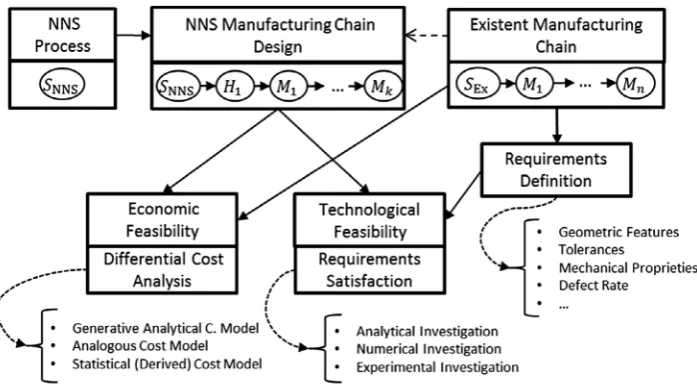
To assess the potential benefit of a new NNS manufacturing process replacing an existing process, the feasibility needs to be systematically assessed. Because the authors’ proposed methodology considers both technological and economic feasibility (shown schematically in Figure 1), it is referred to a ‘Differential Cost and Feasibility Analysis’ (DCFA). The first step assesses the ability of the new process chain to produce a component that satisfies the specifications (i.e. geometric features, tolerances, mechanical properties, defect rates). In contrast, the economic feasibility describes the efficiency of the new manufacturing chain and by measuring the resources used for producing the component (i.e. cost) and comparing them to the current method of production.
In other words, the approach uses the current manufacturing chain as a benchmark for comparison: consequently, both technology (i.e. the product quality) and costs analyses are defined relative to the old manufacturing process.
[image:3.493.73.422.360.555.2]Although NNS processes can vary in nature (e.g. casting, forging, additive layer manu-facturing), they are always a primary shaping process (i.e. one that facilitates the transition from raw material to a semi-finished product). So the choice of NNS operation inevitably
Figure 1. a generic methodology for assessing the feasibility of adopting an nns process.
Analytical, or numerical, feasibility studies have to be connected to a theoretical model that defines the engineering science of the process; however, other factors, reliability, accuracy and cost, also need to be taken into consideration before simulating the process. Consequently, the final geometry produced by the NNS process and its raw material usage are defined during this phase.
In this work, the economic feasibility is treated as a differential cost analysis. In other words, its main target is to compare the cost differences between the old and new man-ufacturing process from a holistic view. Such a cost model can be statistical or genera-tive-analytical (Layer, Brinke, & Houten, 2002) depending on the nature of the process, the information available, the required level of accuracy and cost variables. Many dedicated cost models (Bariani, Berti, & D’Angelo, 1993; Jung, 2002; Nagahanumaiah, Mukherjee & Ravi, 2005; Park & Simpson, 2005) and general cost models (Allen & Swift, 1990; Esawi & Ashby, 2003; Niazi, Dai, Balabani, & Seneviratne, 2006; Weustink, ten Brinke, Streppel, & Kals, 2000; Yang & Lin, 1997) can be found in the literature (Table A1).
3. Case study – near net shape manufacturing of a valve cage by centrifugal casting process
The following sections describe a case study conducted to both detail and validate the application of the framework.
3.1. Valve cages for flow control valves
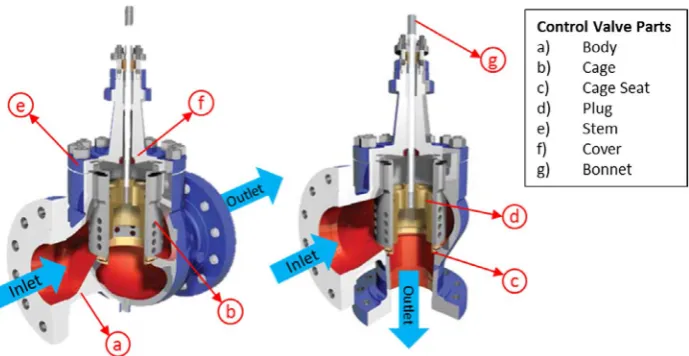
The case study is focused on flow control valves, which are used in many industries such as food and beverage, heating, water, energy, paper and pulp. In each of these applications, flow control valve regulates the flow and/or pressure of a fluid. Control valves normally respond to signals generated by independent devices such as flow meters and temperature gauges. The valve modulates the flow of the controlled fluid passing through a valve body, and would typically include internal components such as closure member, seat ring, cage, stem and stem pin (Figure 2). This case study was developed in collaboration with a man-ufacturer of industrial valves in the UK.
The Valve Cage is a hollow cylindrical trim element that is sometimes used as a guide to align the movement of a valve plug with a seat ring. It may also act to retain the seat ring in the valve body. On some types of valves, the cage may contain different shaped openings (i.e. usually cylindrical or conical holes of different diameters) which act to
characterise the flow through the valve. The cage may also act as a noise attenuation or anti-cavitation device. The cage is a part of the valve that surrounds the plug and is located inside the body of the valve. Typically, the cage is one of the greatest determiners of flow within the valve. As the plug is moved, more of the openings in the cage are exposed and flow is increased and vice versa. The design and layout of the openings can have a large effect on the movement of liquid through the valve (i.e. the flow characteristics of differ-ent materials over a range of temperatures and pressures). Cages are also used to guide the plug to the seat of the valve to ensure a good shutoff, which removes the need for the movement to be guided from the valve’s bonnet. The walls of the cage contain openings that usually determine the flow characteristic of the control valve (i.e. quick opening, linear and equal percentage)
The valve cage used in this study varied in diameter from 80 to 700 mm (approximately), corresponding to the nominal size range of the valve, which varies between 40 and 60 0 mm (1.5”–24”) (i.e. reference for the cages dimensions). Similarly, the cage materials varied across a range of steel: 420 Stainless Steel, 316 Stainless Steel, 17–4PH Stainless Steel, Monel K500, Hastelloy, Duplex and Inconel. Some of the cages include tungsten carbide or stellite coatings (in areas in direct contact with the seat). The high percentage of material costs in the final component together with extensive machining required for the bigger sizes made this component ideal for a NNS study.
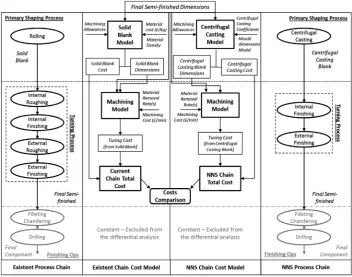
[image:5.493.78.423.52.230.2]Currently, the valve cages production volume of the case study manufacturer is around 310 components per year (based on 2014/2015 production). In the past, the component was turned from a solid stock bar (cylinder). The requested blank dimensions need to take into consideration the machining allowances. The turning process is performed in a sequence of steps: internal roughing, internal finishing, external roughing, external finishing, filleting and chamfering and holes drilling. Figure 3 illustrates the manufacturing chain and the shape of the parts (i.e. detailed engineering drawings could not be shown for reasons of commercial confidentiality).
Figure 2. Basic control valve showing the cage used for the case study.
3.2. Centrifugal casting process
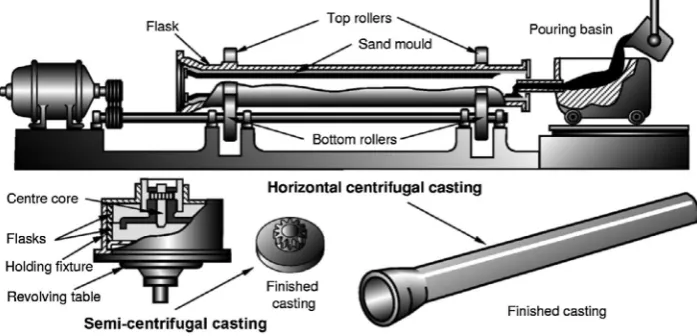
In centrifugal casting (Figure 4), a permanent mould is rotated continuously about a fixed axis at high speeds (300–3000 rpm) as molten metal is poured. The molten metal is centrif-ugally ‘thrown’ towards the inside mould wall, where it solidifies after cooling. The result-ing castresult-ing is usually fine-grained with size of the grains decreasresult-ing towards to the outer diameter. Impurities and inclusions are squeezed by the more dense (i.e. purer) material to the surface of the inner diameter, which can be machined away. The combination of grain structure and purity results in material properties that are superior to conventional casting and close to hot forging.
[image:6.493.77.415.55.227.2]The process can use a rotating semi-permanent, or expandable, mould to both guide the melted material movement under centrifugal force, and catalyse the solidification while
Figure 3. schematic of the existing manufacturing process chain (top) and the proposed nns manufacturing process chain (bottom).
Figure 4. true centrifugal casting and semi-centrifugal casting (swift & Booker, 2013).
[image:6.493.72.421.291.459.2]enhancing quality. Most metals suitable for static casting are also suitable for centrifugal casting (i.e. all steels, iron, copper, aluminium and nickel alloys). The process’s most common variants are referred to as: true centrifugal casting, semi-centrifugal casting and centrifuge casting (Kalpakjian & Schimd, 2009).
In true centrifugal casting, the molten metal is poured into a high-speed rotating mould (300–3000 rpm depending on diameter) until solidification takes place. The axis of rotation is usually horizontal, but may be vertical for short work pieces (Swift & Booker, 2013). Good-quality castings (i.e. low defect rate and impurities), high-dimensional accuracy (i.e. in comparison with other casting processes) and good external surface detail are produced by this process. Material properties of the castings vary with distance from the axis of rotation. Mechanical properties and grains structure are comparable with forged product ones. Because centrifugal force is largest at the periphery, the inner material is less dense (in the molten state) and so collects all impurities (that typically have lower density than the metal). This material is usually machined away. Centrifugal casting has the lowest porosity among the casting processes (Schey, 1999). True centrifugal casting is used for cylindrical components with high duty applications.
In the literature, experimental articles (Chirita, Soares, & Silva, 2008; Huang, Liu, Lv, Liu, & Li, 2011; Jain, Rathore, & Gorana, 2016; Karun et al., 2015; Lee & Hyun, 2012; Liu et al., 2005; Luan, Song, Bai, Kang, & Li, 2010; Sui et al., 2016; Watanabe, Miyakawa, Takada, Okuno, & Okabe, 2003) focus mainly on the impact of process parameters and interaction between materials (i.e. moulds and workpiece) on the final product’s microstructure and mechanical properties. Numerical articles (Chang, Kim, & Hong, 2001; Fu et al., 2008; Keerthiprasad, Murali, Mukunda, & Majumdar, 2011; Long & Zebin, 2016; Ping et al.,
2006; Song et al., 2012; Zagorski & Sleziona, 2007) focus on predicting the microstructure’s mechanics (in macroscale and microscale), fluid dynamic behaviour (turbulences and fluid states), temperature and velocity fields and mould filling conditions for different process parameters and mould geometries.
3.3. Application of centrifugal casting to valve cage production
In Figure 3, the current process chain and the NNS process chain are illustrated. The cur-rent process includes cold rolling (solid blank), internal and external roughing, internal and external finish turning, filleting/chamfering and drilling; on the other hand, the NNS process line consists of centrifugal casting (centrifugal casting blank), internal and external roughing, internal and external finishing, filleting/chamfering and drilling. All the machin-ing operations are executed on a CNC lathe at the valve manufacturer.
The total number of machining operations is reduced because of the reduction in roughing operations. This geometry allows roughing operations to be avoided because casting blank is directly finish machined (i.e. internally and externally), as it has been proof machined after centrifugal casting (i.e. this operation will be taken into account in the centrifugal casting cost model). The finish machining operations act on very similar surfaces (i.e. the difference is only the machining allowances used in centrifugal casting); meanwhile, the chamfering/filleting and drilling operations result are unchanged from the current to the NNS manufacturing chain (i.e. as they work on the same geometry and material).
As pointed out in the literature review, the current numerical and analytical methods have been built for evaluating different characteristics and more complex materials and
applications. In this study, a 450-mm valve cage diameter (i.e. 420 STST) was produced in addition to the analytical cost analysis to validate the results. Its assessment against the specifications and its performance testing is discussed in the following sub-section.
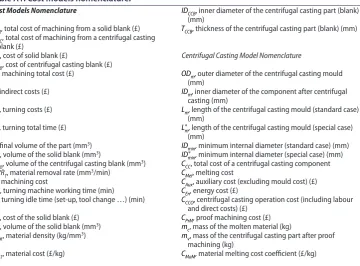
Figure 5 schematises the differential analysis, which determines the economic feasibility of the NNS process. The analytical cost model has been derived from supplier information (i.e. centrifugal casting and solid blank) and machining cost estimation by material removal rate approximation. The complete formulas are showed in Appendix A and described in this section. The cost models’ nomenclature is showed in Table A1. Information on moulding and centrifugal casting costs has made it possible for the authors to report the first centrifugal casting cost model (Appendix B).
3.3.1. Technological feasibility
Commercial confidentiality prevents the reporting of the key features and specified tolerances.
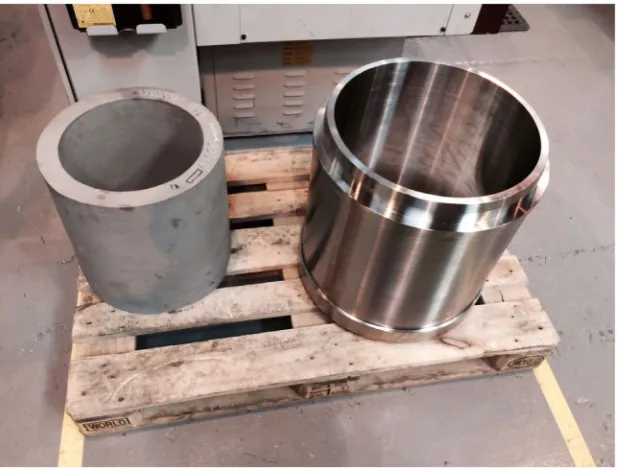
Experimental trials have been conducted in order to determine the technological feasi-bility of the component. An initial 400-mm cage, made in 420 STST, has been manufactured by the centrifugal casting process supplier and subsequently machined to the final shape (Figure 6). This experimental practice helped define the centrifugal casting allowances for inner and outer diameter (as in Equation (9)). Although the best centrifugal casting material proprieties (highest density, hardness, tensile strength) are on the external diameter (i.e. density is highest on the periphery due to the centrifugal force exerted during centrifugal
Figure 5. schematic of the two process chains and the associated differential cost analysis (i.e. cost models comparison).
casting operation), 20 mm is used as a default machining allowance on both the inner and outer faces of the cylinder. These allowances are required to allow finish machining of the blank to the final tolerances.
The resultant prototype satisfies the geometrical tolerances and the required mechanical properties. The cage has been assembled in 400 mm nominal diameter valve and has been tested at a high static pressure test (i.e. standard test for every final control valve manufac-ture at the case study company). The valve, including the centrifugal casting component, passed the test successfully.
The centrifugal casting parts’ defect rate (non-conformances) has been identified as a requirement. The centrifugal casting supplier rate of 1.19% (AMPO, 2016) of non-conform-ity has been considered as satisfactory.
3.3.2. Economic feasibility – differential cost analysis
As described in Figure (5), the differential analysis model is based on the evaluation of both the current and NNS processes being considered. The cost models aim to give an estimation of the cost difference between the processes chains, estimating the blanks production and machining costs (Appendix A). For the purpose of the case study, the material considered is 420 STST throughout both of the manufacturing processes. As described above, the final machining operations (filleting and chamfering) and drilling operations can be excluded from the differential analysis.
[image:9.493.93.402.52.286.2]The cost of machining from a solid blank (i.e. current manufacturing chain) can be written as the sum of the solid blank cost, machining cost (i.e. roughing and finish turning) and indirect costs (1); meanwhile, NNS chain’s total cost is the sum of centrifugal casting blank cost (casting operation and proof machining), machining cost (finish turning) and indirect costs (2). As stated above, the machining is operated in the same facility and both
Figure 6. centrifugal casting blank (left), semi-finished valve cage (right).
required solid blank outer diameter and length also need to take the machining allowances (7, 8) into account.
The centrifugal casting blank cost is defined by the Centrifugal Casting cost model (16–28), which is presented in detail in the next sub-section and Appendix B. As discussed previously, the centrifugal casting blank needed machining allowances even although pre-viously proof machined. Therefore, the final centrifugal casting blank dimension required is as in Equation (9). The length does not require machining allowances, as it is already cut to shape and proof machined.
As the material is the same for both the processes and the dimensions are similar to each other, the machining parameters can be considered as constants. Therefore, an estimation of the machining time can be obtained using a material removal rate. Removal rate Expression (11) can be used for calculating the solid blank turning time (12) and centrifugal casting blank turning time (13). The expression of the centrifugal casting blank volume (14), solid blank volume (7) and final (pre-finish operations) volume (15) can be used for calculating the required machining time.
3.3.4. Centrifugal casting cost model
In Figure 7, the developed cost model for centrifugal casting is schematised. The model’s inputs are the final dimensions which are required for casting blank (including machining allowances, as in Equation (10)). The model is defined by two phases: (1) mould section, whose definition is important for defining the cost and the process mechanics, and (2) the centrifugal casting cost estimation. The complete model formulation is presented in Appendix B.
Phase 1: Mould selection: The first step is to select a standard or custom mould, depending on the final dimensions of the component (16). The two cases can be distinguished by the size of the outer diameter and ratio between the outer and inner diameter (i.e. high com-ponent thickness). Comcom-ponent size and its thickness influence the pouring of the melting metal and the rate of its solidification during mould spinning. If the outer diameter (bigger than 800 mm) or the ratio (bigger than 3) is too high, the mould needs to be shorter than a standard case (usually more than 2000 mm) for allowing the molten material to spin and solidify properly. Special moulds are more expensive because they produce fewer compo-nents in comparison with a longer mould (i.e. stacked production). For this reason, the formula (16) distinguishes between ‘Standard’ and ‘Special’ Cases, utilising this distinction throughout the mould selection phase.
The second step is to select the mould dimensions. They can be estimated from the external diameter of the final part. Relationships (17–19) have been derived through general linear models from a centrifugal casting supplier.
The first step is the selection of the mould’s outer diameter. This selection depends on supplier availability and so on the customer demand. In Appendix B, a step graph (Figure 9) has been developed from the supplier’s mould dimensions (including both the standard and special cases). Selecting the required outer diameter (x-axis) as input, the step graph defines the mould’s outer diameter (y-axis)
The mould length is determined by Equation (17), whose input is the previously obtained outer diameter of the mould and which again distinguishes between standard and special cases. Both expressions define a general linear relationship based on the supplier’s data. The input to the equation is the previously obtained mould outer diameter. The error in the linear relationship of Equation (17) is 6.68 and 8.12% for the standard and special cases, respectively.
[image:11.493.72.423.51.213.2]The inner diameter of a component after centrifugal casting is dependent on the volume of molten material poured into the spinning mould. As stated above, the mould’s internal diameter is selected by considering the minimum internal diameter allowed. Again, the internal diameter Formulas (18, 19) were defined as general linear models derived from the supplier data. Using the mould’s outer diameter and length (previously selected) as input, the calculation of the minimum diameter is able to verify if the required inner diameter is feasible to cast. In the standard case (18), if the required inner diameter is bigger than the minimum calculated inner diameter, it can be selected as the mould’s inner diameter (i.e. casted inner diameter). The formula includes an allowance of 10 mm on the inner diameter. This needs to be taken into account because of the debris and smaller particles concentrated on the internal part of the component. If the requested diameter is smaller than the standard minimum inner diameter, the special case formula is considered. If the required diameter is even less than the special case minimum inner diameter, the mould will be completely filled with metal (so the internal diameter is effectively 0) and the component will need to be machined to the size. In the special case (19), only the special minimum inner diameter
Figure 7. schematic of the centrifugal casting cost model.
cost coefficient is usually equivalent to the alloy surcharge; meanwhile, the melting chips coefficient is a measure of the saving produced by material saving.
Usually excess lengths of cast components can be amortised by other centrifugal casting productions (i.e. other customers’ request) or re-melted, so the final length and requested length can be considered coincident (Lm = Lf).
4. Discussion: differential analysis results and applications
Differential cost analysis results allow the feasibility of a range of component sizes to be assessed. Although commercial confidentiality does not allow the final cage dimension to be stated, they can be compared though the nominal valve size. The considered model input values are:
• Cost of machining per hour per hour: 86 £/h
• Centrifugal casting coefficients (used by the centrifugal casting for 420 STST): material melting cost coefficient (cMaM): 1.8 £/kg; machining chips re-melting cost coefficient (cChM): 1.17 £/kg; auxiliary cost coefficient (cAux): 0.31 £/kg; energy cost coefficient (cEn): 0.62 £/kg; centrifugal casting operation cost coefficient (cCCO): 2 £/kg; proof machining cost coefficient (cPrM): 2 £/kg.
• Material data (solid blank, 420 STST): density, 7200 kg/m3; cost 2.3 £/kg.
• A detailed justification for these estimates and also the effective operative and idle machining times cannot be given because of commercial confidentiality.
Figure 8 displays the different costs predicted for different valve sizes. Figure 8(a) and (b) compares the prediction for blank costs (i.e. centrifugal casting blank and solid blank) and machining cost for the NNS chain and the existing chain, respectively. The resultant machining cost (i.e. wasted material) is less in the NNS chain for every size considered, even though the blank costs are higher for the smaller size variants (they reduce as the dimensions increase). Figure 8(c–e) shows the cost breakdowns for different valve sizes (100, 250, 400 mm, respectively): it is interesting to note how the centrifugal casting cost is bigger than the solid blank cost but decreases as the size increases. On the other hand, the machining cost on NNS chain (i.e. using centrifugal casting) is always smaller than the existing manufacturing chain (i.e. using a solid blank), and the magnitude of this difference grows with the component size. Figure 8(f) shows the break point between the two different process chains for a range of cage sizes suggesting that the NNS chain will be economic for all the cages having outer dimensions over 200 mm.
Figure 8. cost comparison of the nns process chain (a) and existing chain (b). cost details for different cages sizes: 100 mm (c), 250 mm (d) and 400 (e). component cost comparison of component evaluated costs for the nns process chain (i.e. centrifugal casting and finish machining) and the existing process chain (i.e. machining from solid blank) (f).
The potential impact of the introduction of NNS methods for larger parts (i.e. assuming current production methods are retained for cage < 8”) on a biennial production of 636 products change the manufacturing process (i.e. from current process to centrifugal cast-ing application) of 113 cages. The total biennial cost of the current process is £305,150 (i.e. machining costs and raw materials), whereas the use of centrifugal casting would result in a reduction of 26.5%, with an estimated biennial saving of 490 machining hours and 18.9 tons of raw material (The Weir Group PLC, 2015). It is interesting to note that for more expensive material (e.g. 316 STST, Inconel), the impact of centrifugal casting would be even larger. As collateral advantage, the lead time has been also reduced from months to weeks due to blank production (i.e. production of large solid blank components takes longer than centrifugal casting) and savings in machining time. As result of this study, all the cages for valves over 250 mm are currently produced through centrifugal casting process, using the designed NNS chain.
5. Concluding remarks and future works
[image:14.493.90.404.49.302.2]The impact of applying an NNS process to the production of the valve cage known as Centrifugal Casting has been evaluated by assessing the difference in machining costs for both established and alternative processes (finish machining and drilling costs have been excluded, as they are necessary for both the approaches). An adaptable cost model has been created for centrifugal casting, and a methodology (DCFA) has been established for assess-ing a differential analysis between the old and new process chains. The model can be used for assessing the economic feasibly of every general centrifugal casting application in general.
Figure 9. step diagram for selecting the outer diameter of centrifugal casting’s mould given the outer diameter of the final component.
Introduction of centrifugal casting into the production plan for the manufacture of a control valve’s cage reduces waste and machining time by between 19 and 22%, respectively, generating expected saving of around £50,000 per year (The Weir Group PLC, 2015).
Further work could optimise the design of the associated valve shape and the machining process parameters using the cost model reported here (i.e. using evolutionary or other opti-misation algorithms). Another possible development is the production of similar component in the valve, directly stacked on the cage (e.g. cage seat), or even including components from other products. Thus, a general framework could be constructed in order to detect possible NNS component/process combinations and assess their feasibility.
Acknowledgements
A special thanks to Weir Valves & Controls (Elland), particularly to Matthew Charlton and Steven Brayley, and AMPO (the centrifugal casting supplier), particularly to Iban Mateos and Gillyan Evans. The authors want also to thank WARC (Weir Advanced Research Centre), Weir Group PLC and DMEM of the Strathclyde University of Glasgow for the fundamental and continuous support in this research.
Disclosure statement
No potential conflict of interest was reported by the authors.
ORCID
Daniele Marini http://orcid.org/0000-0003-3672-6017
References
Allen, A. J., & Swift, K. G. (1990). Manufacturing process selection and costing. Proceedings of the
Institution of Mechanical Engineers, Part B: Journal of Engineering Manufacture,204(2), 143–148. doi:10.1243/PIME_PROC_1990_204_057_02
Altan, T., & Miller, R. A. (1990). Design for forming and other near net shape manufacturing processes. CIRP Annals – Manufacturing Technology,39(2), 609–620. doi:10.1016/S0007-8506(07)62998-9
AMPO. (2016). Mrs Gillyan Evans, Pers.Comm, March 16.
Bariani, P. F., Berti, G., & D’Angelo, L. (1993). Tool cost estimating at the early stages of cold forging
process design. CIRP Annals – Manufacturing Technology,42(1), 279–282. doi:
10.1016/S0007-8506(07)62443-3
Bewlay, B. P., Gigliotti, M. F. X., Hardwicke, C. U., Kaibyshev, O. A., Utyashev, F. Z., & Salischev, G.
A. (2003). Net-shape manufacturing of aircraft engine disks by roll forming and hot die forging.
Journal of Materials Processing Technology,135(2–3), 324–329. doi:10.1016/S0924-0136(02)00864-6
Boothroyd, J., & Dewhurst, P. (1983). Design for assembly: A designers handbook. Boothroyd Dewhurst
Inc. Wakerfield, Rhode Island. University of Massachusetts, Department of Mechanical Engineering.
Castro, C. F., António, C. A. C., & Sousa, L. C. (2004). Optimisation of shape and process parameters
in metal forging using genetic algorithms. Journal of Materials Processing Technology, 146(3),
356–364. doi:10.1016/j.jmatprotec.2003.11.027
Chang, S. R., Kim, J. M., & Hong, C. P. (2001). Numerical simulation of microstructure evolution of Al
alloys in centrifugal casting. ISIJ International,41(7), 738–747. doi:10.2355/isijinternational.41.738
Chirita, G., Soares, D., & Silva, F. S. (2008). Advantages of the centrifugal casting technique for
the production of structural components with Al–Si alloys. Materials and Design,29(1), 20–27.
doi:10.1016/j.matdes.2006.12.011
Jung, J. Y. (2002). Manufacturing cost estimation for machined parts based on manufacturing features. Journal of Intelligent Manufacturing,13(4), 227–238. doi:10.1023/A:1016092808320
Kalpakjian, S., & Schimd, S. R. (2009). Manufacturing engineering and technology (6th ed.). Englewood Cliffs, NJ: Prentice Hall. ISBN: 0136081681.
Karun, A. S., Rajan, T., Pillai, U., Pai, B., Rajeev, V., & Farook, A. (2015). Enhancement in tribological behaviour of functionally graded SiC reinforced aluminium composites by centrifugal casting. Journal of Composite Materials,50(16), 2255–2269. doi:10.1177/0021998315602946c
Keerthiprasad, K. S., Murali, M. S., Mukunda, P. G., & Majumdar, S. (2011). Numerical simulation
and cold modeling experiments on centrifugal casting. Metallurgical and Materials Transactions
B,42(1), 144–155. doi:10.1007/s11663-010-9402-4
Kudo, H. (1990). Towards net-shape forming. Journal of Material Processing Technology,22, 307–342.
Layer, A., Brinke, E., & Houten, F. (2002). Recent and future trends in cost estimation. International Journal of Computer Integrated Manufacturing,15(6), 499–510. doi:10.1080/09511920210143372
Lee, Y. S., & Hyun, S. K. (2012). Centrifugal casting for unpressurized fabrication of lotus-type porous
copper. Materials Letters,78, 92–94. doi:10.1016/j.matlet.2012.02.098
Liu, K., Ma, Y. C., Gao, M., Rao, G. B., Li, Y. Y., Wei, K., … Loretto, M. H. (2005). Single step centrifugal
casting TiAl automotive valves. Intermetallics,13(9), 925–928. doi:10.1016/j.intermet.2004.12.004
Long, W., & Zebin, X. (2016). Research on centrifugal casting of combustion engine cylinder. In
The 2nd International Conference on Control, Automation and Robotics Research (pp. 268–272). Luan, Y., Song, N., Bai, Y., Kang, X., & Li, D. (2010). Effect of solidification rate on the morphology and
distribution of eutectic carbides in centrifugal casting high-speed steel rolls. Journal of Materials
Processing Technology,210(3), 536–541. doi:10.1016/j.jmatprotec.2009.10.017
Marini, D., Cunningham, D., & Corney, J. R. (2017). Near net shape manufacturing of metal: A review
of approaches and their evolutions. Proceedings of the Institution of Mechanical Engineers, Part B:
Journal of Engineering Manufacture. doi:10.1177/0954405417708220
Morita, A., Hattori, S., Tani, K., Takemura, A., & Ashida, Y. (1991). Near net shape forging of titanium
alloy turbine blade. ISIJ International,31(8), 827–833. doi:10.2355/isijinternational.31.827
Mukherjee, Nagahanumaiah N. P., & Ravi, B. (2005). An integrated framework for die and mould
cost estimation using design features and tooling parameters. International Journal of Advanced
Manufacturing Technology,26(9–10), 1138–1149. doi:10.1007/s00170-004-2084-9
Niazi, A., Dai, J. S., Balabani, S., & Seneviratne, L. (2006). Product cost estimation: Technique
classification and methodology review. Journal of Manufacturing Science and Engineering,128(2),
563–575. doi:10.1115/1.2137750
Onodera, S., & Sawai, K. (1992). Current cold-forging techniques for the manufacture of
complex precision near-net-shapes. Journal of Materials Processing Technology, 35, 385–396.
doi:10.1016/0924-0136(92)90329-Q
Park, J., & Simpson, T. W. (2005). Development of a production cost estimation framework to support
product family design. International Journal of Production Research,43, 731–772. doi:10.1080/0
0207540512331311903
Ping, W. S., Rong, L. D., Jie, G. J., Yun, L. C., Qing, S. Y., & Zhi, F. H. (2006). Numerical simulation
of microstructure evolution of Ti–6Al–4 V alloy in vertical centrifugal casting. Materials Science
and Engineering A,426(1–2), 240–249. doi:10.1016/j.msea.2006.04.014
Progress in challenging markets – The Weir Group PLC Annual Report and Financial Statements
2015. (2015). Retrieved from https://www.global.weir/assets/files/investors/reports/The%20
Weir%20Group%20PLC%20Annual%20Report%20and%20Financial%20Statements%202015.pdf
Schey, J. A. (1999). Introduction to manufacturing processes. New York, NY: McGraw-Hill.
Song, N., Luan, Y., Bai, Y., Xu, Z. A., Kang, X., & Li, D. (2012). Numerical simulation of solidification
of work roll in centrifugal casting process. Journal of Materials Science and Technology,28(2),
147–154. doi:10.1016/S1005-0302(12)60035-8
Sui, Y., Feng, K., Cheng, C., Chen, X., Qi, J., He, Y., … Sun, Z. (2016). Effects of pouring temperature
on interfacial reaction between Ti–47.5Al–2.5V–1Cr alloy and mold during centrifugal casting . Journal of Wuhan University of Technology-Materials Science and Edcation,31(5), 1105–1108. doi:10.1007/s11595-016-1497-2
Swift, K. G., & Booker, J. D. (2013). Manufacturing process selection handbook. Oxford:
Butterworth-Heinemann. doi:10.1016/B978-0-08-099360-7.00005-7
Watanabe, K., Miyakawa, O., Takada, Y., Okuno, O., & Okabe, T. (2003). Casting behavior of titanium
alloys in a centrifugal casting machine. Biomaterials, 24(10), 1737–1743. doi:
10.1016/S0142-9612(02)00583-5
Weustink, I. F., ten Brinke, E., Streppel, A. H., & Kals, H. J. J. (2000). A generic framework for cost
estimation and cost control in product design. Journal of Materials Processing Technology,103(1),
141–148. doi:10.1016/S0924-0136(00)00405-2
Witulski, T., Heussen, J. M. M., Winkelmann, A., Hirt, G., & Kopp, R. (1994). Near net shape forming
of particulate reinforced Al-alloys by isothermal forming compared to semi solid forming. Journal
of Material Processing Technology,45(1–4), 415–420.
Yang, C., & Lin, T. S. (1997). Developing an integrated framework for feature-based early manufacturing
cost estimation. International Journal of Advanced Manufacturing Technology, 307–320.
Zagorski, R., & Sleziona, J. (2007). Pouring mould during centrifugal casting process. International
Scientific Journal,28(7), 441–444.
[image:17.493.69.430.385.651.2]Appendix
Table A1. Cost models nomenclature.
Cost Models Nomenclature ID
CCB, inner diameter of the centrifugal casting part (blank)
(mm) CTM, total cost of machining from a solid blank (£) T
CCB, thickness of the centrifugal casting part (blank) (mm)
CTCC, total cost of machining from a centrifugal casting
blank (£)
CSB, cost of solid blank (£) Centrifugal Casting Model Nomenclature CCCB, cost of centrifugal casting blank (£)
CM, machining total cost (£) ODm, outer diameter of the centrifugal casting mould
(mm)
CI, indirect costs (£) IDm, inner diameter of the component after centrifugal
casting (mm)
CTu, turning costs (£) Lm, length of the centrifugal casting mould (standard case)
(mm) TTu, turning total time (£) L∗
m, length of the centrifugal casting mould (special case)
(mm)
Vf, final volume of the part (mm3) IDmin, minimum internal diameter (standard case) (mm) VSB, volume of the solid blank (mm3) ID∗
min, minimum internal diameter (special case) (mm)
VCCB, volume of the centrifugal casting blank (mm3) CCC, total cost of a centrifugal casting component MRRT, material removal rate (mm3/min) C
Mel, melting cost
cM, machining cost CAux, auxiliary cost (excluding mould cost) (£) TOP, turning machine working time (min) C
En, energy cost (£)
TId, turning idle time (set-up, tool change …) (min) CCCO, centrifugal casting operation cost (including labour
and direct costs) (£) CSB, cost of the solid blank (£) CPrM, proof machining cost (£) VSB, volume of the solid blank (mm3) m
c, mass of the molten material (kg)
𝜌Mat, material density (kg/mm3) mv, mass of the centrifugal casting part after proof
machining (kg)
cMAT, material cost (£/kg) CMaM, material melting cost coefficient (£/kg)
Appendix A. Differential cost models
(1) CTM=CSB+CTu+CI
(2) CT
CC =CCCB+CTu+CI
(3) CTM=CSB+CTu
(4) CT
CC=CCCB+CTu
(5) CTu=TTucM= (TOp+TId)cM
(6) CSB=VSB𝜌MatcMat
(7) VSB=
𝜋
4
(
OD2SB
)
LSB
(8) ODF+20mm
{
<350mm=Standard order→ODSB=nearest roundup to standard size
>350mm=Non Standard order→ODSB=ODF+40mm
(9) LSB=LF+5mm
(10)
{
ODCCB=ODF+20mm
IDCCB=IDF−20mm
(11) MRRT=
VF−VSB
TTu(solid blank) =
Vf−VCCB
TTu(centrifugal casting blank)
(12) TOp(solid blank) =
VF−VSB
RTu
(13) TOp(centrifugal casting blank) =
VF−VCCB
RTu
Appendix B. Centrifugal casting cost model
• Model Input
o Final Dimensions (ODF, IDF, LF)
o Centrifugal Casting Cost Coefficients (cMaM, cChM, cAux, cEn, cCCO, cPrM)
• Model Output:
o Mould Dimensions aka Casting blank dimensions (ODm, IDm, Lm)
o Centrifugal casting cost (CCC)
Phase 1: Mould Selection
(1) Selecting Mould dimensions.
(a) Selecting ODm: Figure 9 shows the relationship between the external diameters of the mould and the required outer diameters of the component. The selection of the external diameter depends on the available moulds and the specification of the customers. These dimensions reflect the centrifugal casting supplier avail-able range of moulds.
Selecting Lm: in the two different cases, the mould length can be estimated as in Equation (17)
(b) Selecting IDm: Equation (18) refers to the standard case, Equation (19) refers to the special case.
(14) VCCB=
𝜋
4
(
ODCCB2 −ID
2
CCB
)
LCCB
(15) VF=𝜋
4
(
OD2
F−ID
2
F
)
(LF−lf) + 𝜋
4
(
OD2
Fb−ID
2 F ) lf (16) Selecting case: ⎧ ⎪ ⎨ ⎪ ⎩
if ODf <800mm∧ODf IDf
<3→Standard Case
if ODf >800mm ∨ ODf
IDf
>3→Special Case(∗)
(17)
{
if Standard Case→Lm=3186−1815ODm
if Special Case→L∗m=253.5+0.357ODm
(18) ⎧ ⎪ ⎪ ⎨ ⎪ ⎪ ⎩
IDmin = −255− 0.655ODm+0.287Lm+0.001387OD
2
m − 0.00006L
2
m+0.00014ODmLm
if IDF>IDmin →IDm=IDf−20mm
if IDF <IDmin∧IDF> ID
*
min→IDm=IDF−30mm
if IDF<ID
*
min→IDm=0
(19) ⎧ ⎪ ⎨ ⎪ ⎩
ID*min =99−1.161ODm+1.15Lm+0.0024OD
2
m+0.0002L
2
m−0.00237ODmLm
IDf > ID
*
min→IDm=IDF−30mm
if IDF<ID*min→IDm=0
Cost models nomenclature
(25) CEn=
(
mccEn
)
(26) CCCO=
(
mccCCO
)
(27) CPrM= ((mc−mv
)
cPrM)