Designing an Evaluation Framework for
Spoken Term Detection and Spoken Document Retrieval
at the NTCIR-9 SpokenDoc Task
Tomoyosi Akiba
(1), Hiromitsu Nishizaki
(2)Kiyoaki Aikawa
(3), Tatsuya Kawahara
(4), Tomoko Matsui
(5)(1)Toyohashi University of Technology, 1-1 Hibarigaoka, Tenpaku, Toyohashi, Aichi, JAPAN,
(2)University of Yamanashi, 4-3-11, Takeda, Kofu, Yamanashi, JAPAN,
(3)Tokyo University of Technology(4)Kyoto University(5)The Institute of Statistical Mathematics
Abstract
We describe the evaluation framework for spoken document retrieval for the IR for the Spoken Documents Task, conducted in the ninth NTCIR Workshop. The two parts of this task were a spoken term detection (STD) subtask and an ad hoc spoken document retrieval subtask (SDR). Both subtasks target search terms, passages and documents included in academic and simulated lectures of the Corpus of Spontaneous Japanese. Seven teams participated in the STD subtask and five in the SDR subtask. The results obtained through the evaluation in the workshop are discussed.
Keywords:spoken document retrieval, spoken term detection, passage retrieval
1.
Introduction
The growth of the internet and the decrease in storage costs are resulting in the rapid increase of multimedia content today. To retrieve these contents, available text-based tag information is limited. Spoken Document Retrieval (SDR) is a promising technology for retrieving content using in-cluded speech data.
The NTCIR Workshop1is a series of evaluation workshops
designed to enhance research in information access tech-nologies by providing large-scale test collections and a fo-rum for researchers. We proposed a new task called “IR for Spoken Documents,” shortened to “SpokenDoc,” and it was accepted as one of the core tasks in the ninth NTCIR Workshop(Sakai and Joho, 2001). In the NTCIR-9 Spo-kenDoc(Akiba et al., 2011), we evaluate SDR, especially based on a realistic ASR condition, where the target doc-uments are spontaneous speech data with high word error rates and high out-of-vocabulary rates.
The Spoken Document Processing Working Group, which is part of the special interest group of spoken language processing (SIG-SLP) of the Information Processing So-ciety of Japan, had already developed prototypes of SDR test collections, the CSJ Spoken Term Detection test col-lection(Itoh et al., 2010) and the CSJ Spoken Document Retrieval test collection(Akiba et al., 2009). The target documents of both test collections are spoken lectures in the Corpus of Spontaneous Japanese (CSJ)(Maekawa et al., 2000). By extending these test collections, two subtasks were defined.
Spoken Term Detection (STD): Within spoken
docu-ments, find the occurrence positions of a queried term. The evaluation should consider both the efficiency (search time) and the effectiveness (precision and recall).
1
http://research.nii.ac.jp/ntcir/index-en.html
Spoken Document Retrieval (SDR): Among spoken
documents, find passages including information relevant to the query. This is like an ad hoc text retrieval task, except that the target documents are speech data. To accomplish the task, the results of STD may be used.
The organization of this paper is as follows. Section 2. de-scribes the data prepared for our evaluation task. In Section 3. and 4., the task definitions and the evaluation results are presented for the STD and SDR subtasks, respectively. Fi-nally, in Section 5., we give our conclusions.
2.
Data
2.1. Document Collection
Our target document collection is the CSJ released by the National Institute for Japanese Language. Within CSJ, 2702 lectures were used as the target documents for our STD and SDR tasks (referred to as ALL). A subset of 177 lectures, called CORE, was also used as the target for our STD subtask (referred to as CORE). The participants were required to purchase the data for themselves. Each lecture in the CSJ is segmented by pauses that are no shorter than 200 ms. The segments are called Inter-Pausal Units (IPUs). An IPU is short enough to be used as an alternate to the position in the lecture. Therefore, the IPUs are used as the basic unit to be searched in both our STD and SDR tasks.
2.2. Transcription
Standard STD and SDR methods first transcribe the audio signal into its textual representation by using Large Vocab-ulary Continuous Speech Recognition (LVCSR), followed by text-based retrieval. The participants could use the fol-lowing two types of transcriptions.
1. Reference automatic transcriptions
Table 1: ASR performances [%]. (a) For the CORE lectures.
Transcriptions W.Corr. W.Acc. S.Corr. S.Acc.
REF-WORD 76.7 71.9 86.5 83.0
REF-SYLLABLE — — 81.8 77.4
(b) For the ALL lectures.
Transcriptions W.Corr. W.Acc. S.Corr. S.Acc.
REF-WORD 74.1 69.2 83.0 78.1
REF-SYLLABLE — — 80.5 73.3
SDR but not in ASR to participate in our tasks. They also enabled comparisons of the IR methods based on the same underlying ASR performance. The partici-pants can also use both transcriptions at the same time to boost the performance.
The textual representation of the transcriptions will be the N-best list of the word or syllable sequence de-pending on the two background ASR systems, along with their lattice and confusion network representa-tions.
(a) Word-based transcription (denoted as “REF-WORD”) obtained by using a word-based ASR system. In other words, a word n-gram model was used as the language model of the ASR system. With the textual representation, it also provides the vocabulary list used in the ASR, which determines the distinction between the in-vocabulary (IV) query terms and the out-of-vocabulary (OOV) query terms used in our STD subtask.
(b) Syllable-based transcription (denoted as “REF-SYLLABLE”) obtained by using a syllable-based ASR system. The syllablen-gram model was used for the language model, where the vo-cabulary is all Japanese syllables. Using this model can avoid the OOV problem of the spo-ken document retrieval. Participants who want to focus on the open-vocabulary STD and SDR can use this transcription.
Table 1 shows the word-based correct rate (“W.Corr.”) and accuracy (“W.Acc.”) and the syllable-based cor-rect rate (“S.Corr.”) and accuracy (“S.Acc.”) for these reference transcriptions.
2. Participant’s own transcription
The participants could use their own ASR systems for the transcription. To enjoy the same IV and OOV con-ditions, we recommended that their word-based ASR systems should use the same vocabulary list as our ref-erence transcription, but this was not necessary. When participating with their own transcriptions, the partici-pants were encouraged to provide them to the organiz-ers for future SpokenDoc test collections.
2.3. Speech Recognition Models
To realize open speech recognition, we used the following acoustic and language models, which were trained under
the condition described below.
All speeches except the CORE parts were divided into two groups according to the speech ID number: an odd group and an even group. We constructed two sets of acous-tic models and language models, and performed automaacous-tic speech recognition using the acoustic and language models trained by the other group.
The acoustic models are triphone based, with 48 phonemes. The feature vectors have 38 dimensions: 12-dimensional Mel-frequency cepstrum coefficients (MFCCs); the cep-strum difference coefficients (delta MFCCs); their accel-eration (delta delta MFCCs); delta power; and delta delta power. The components were calculated every 10 ms. The distribution of the acoustic features was modeled using 32 mixtures of diagonal covariance Gaussian for the HMMs. The language models are word-based trigram models with a vocabulary of 27k words. On the other hand, syllable-based trigram models, which were trained by the syllable sequences of each training group, were used to make the syllable-based transcription.
We used Julius (Lee and Kawahara, 2009) as a decoder, with a dictionary containing the above vocabulary. All words registered in the dictionary appeared in both train-ing sets. The odd-group lectures were recognized by Julius using the even-group acoustic model and language model, while the even-group lectures were recognized using the odd-group models.
Finally, we obtainedN-best speech recognition results for all spoken documents. The followings models and dictio-nary were made available to the participants of the Spok-enDoc task.
• Odd acoustic models and language models • Even acoustic models and language models • A dictionary of the ASR
3.
The Spoken Term Detection Subtask
3.1. Task Definition
Our STD task is to find all IPUs that include a specified query term in the CSJ. A term in this task is a sequence of one or more words. This is different from the STD task produced by NIST2
Participants can specify a suitable threshold for a score for an IPU; if the score for a query term is greater than or equal to the threshold, the IPU is output. One of the evaluation metrics is based on these outputs. However, participants can output up to 1000 IPUs for each query. Therefore, IPUs with scores less than the threshold may be submitted.
3.2. STD Query Set
We provided two sets of query term lists, one for ALL lec-tures and one for CORE leclec-tures. Each participant’s sub-mission (called a “run”) should choose the list correspond-ing to their target document collection, i.e., either ALL or CORE.
2
“The Spoken Term Detection (STD) 2006 Evaluation Plan,”
We prepared 50 queries each for the CORE and ALL lec-ture sets. For the CORE, 31 of the 50 queries are OOV queries that are not included in the ASR dictionary and the others are IV queries. On the other hand, for the ALL, 24 of the 50 queries are OOV queries. The average occurrences per term is 7.1 times and 20.5 times for the CORE and ALL sets, respectively.
Each query term consists of one or more words. Be-cause the STD performance depends on the length of the query terms, we selected queries of differing length. Query lengths range from 4 to 14 morae.
3.3. System Output
When a term is supplied to an STD system, all of the occur-rences of the term in the speech data are to be found and the score for each occurrence of the given term is to be output. All STD systems must output the following information:
• document (lecture) ID containing the term; • IPU ID;
• a score indicating the likelihood for the term’s exis-tence, with more positive values indicating its occur-rence is more likely;
• a binary decision as to whether the detection is correct or not.
The score for each term occurrence can use any scale. How-ever, the range of scores must be standardized for all terms.
3.4. Evaluation Measures
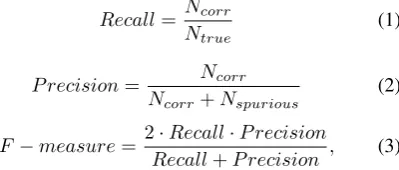
IPUs detected by each system were judged by whether or not the IPUs included the specified term. The judgment was based on a “correct IPUs list” for each specified term. The definition of correct IPUs for a specified term is based on perfect matching to the manual transcriptions of the CSJ in Japanese representation (Kanji, Hiragata and Katakana). The official evaluation measure for effectiveness is the F-measure at the decision point specified by the partici-pant, based on recall and precision averaged over queries (described as “F-measure (spec.)”). The F-measure at the maximum decision point (described as “F-measure (max)”), Recall–Precision curves and mean average preci-sion (MAP) were also used for analysis purposes. They are defined as follows:
Recall= Ncorr
Ntrue
(1)
P recision= Ncorr
Ncorr+Nspurious
(2)
F−measure= 2·Recall·P recision
Recall+P recision , (3) whereNcorrandNspuriousare the total number of correct and spurious (false) term (IPU) detections having scores greater than or equal to the threshold, andNtrueis the total number of true term occurrences in the speech data. Recall– precision curves can be plotted by changing the threshold value. In the evaluation, the threshold value is varied in 100 steps. TheF-measure at the maximum decision point
Table 2: STD evaluation results on each measurement for all submitted runs of the CORE set. The∗mark indicates the organizers’ team.
Runs F-measure F-measure MAP (max) [%] (spec.) [%]
Baseline 0.527 0.516 0.595 AKBL-1∗ 0.393 0.393 0.264 AKBL-2∗ 0.385 0.370 0.272 ALPS-1∗ 0.725 0.708 0.837 ALPS-2∗ 0.714 0.697 0.757
IWAPU-1 0.644 0.628 0.772
IWAPU-2 0.510 0.297 0.733
NKGW-1 0.645 0.585 0.491
NKI11-1 0.570 0.559 0.684
NKI11-2 0.569 0.556 0.672
RYSDT-1 0.318 0.152 0.393
RYSDT-2 0.526 0.287 0.468
RYSDT-3 0.521 0.334 0.469
YLAB-1 0.425 0.425 0.344
is calculated as the optimal balance of Recall and Precision values from the recall–precision curve.
MAP for the set of queries is the mean value of the aver-age precision values for each query. It can be calculated as follows:
M AP = 1
Q Q
∑
i=1
AveP(i), (4)
whereQis the number of queries andAveP(i)means the average precision of theith query of the query set. The av-erage precision is calculated as the avav-erage of the precision values computed for each of the relevant terms in the list in which retrieved terms are ranked by a relevance measure:
AveP(i) = 1
Reli Ni ∑
r=1
(δr·P recisioni(r)), (5)
where r is the rank, Ni is the rank number at which all relevant terms of queryiare found, andReliis the number of relevant terms of queryi. δris a binary function on the relevance of a given rankr.
3.5. Evaluation Results
3.5.1. STD Subtask Participants
In the NTCIR-9 SpokenDoc STD subtask, seven teams par-ticipated in the task (Kaneko et al., 2011; Nishizaki et al., 2011; Saito et al., 2011; Iwami and Nakagawa, 2011; Kat-surada et al., 2011; Nanjo et al., 2011; Yamashita et al., 2011). Eighteen runs were submitted. All seven teams sub-mitted results for the CORE query set. However, only two teams submitted results for the ALL query set.
3.5.2. Results
Table 4: System information related to the offline and online processing for those runs using indexing method. Set Runs Offline Time Index Size Search Time Machine Specifications
[s.] [K byte] [ms.]
CORE AKBL-1∗ 1147.716 3400000.00 1.7 Xeon X5560 2.67 GHz, 6 core×2 CPUs, 24 GB mem. AKBL-2∗ 692.875 3400000.00 1.3 Xeon X5560 2.67 GHz, 6 core×2 CPUs, 24 GB mem. NKGW-1 1420.700 3590000.00 1.6 Xeon 2.93 GHz 24 core CPU, 74 GB memory
NKI11-1 626.497 5715.55 0.94 Core i7-2600 3.4 GHz, 8 GB memory NKI11-2 626.497 5715.55 0.94 Core i7-2600 3.4 GHz, 8 GB memory ALL NKI11-1 9009.770 83570.50 3.1 Core i7-2600 3.4 GHz, 8 GB memory NKI11-2 9009.770 83570.50 3.1 Core i7-2600 3.4 GHz, 8 GB memory
Table 3: STD evaluation results on each measurement for all submitted runs of the ALL set.
Runs F-measure F-measure MAP (max) [%] (spec.) [%]
Baseline 0.459 0.310 0.451
NKI11-1 0.367 0.360 0.339
NKI11-2 0.396 0.332 0.344
RYSDT-1 0.531 0.070 0.431
RYSDT-2 0.530 0.082 0.426
RYSDT-3 0.531 0.119 0.434
are also shown in Table 4 only for the runs using some in-dexing method for efficient search.
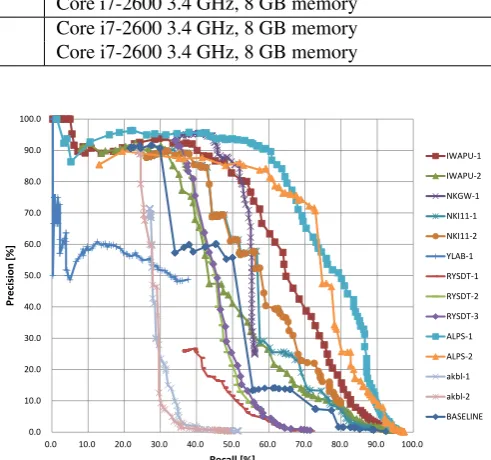
The baseline system used dynamic programming (DP)-based word spotting, which could decide whether or not a query term is included in an IPU. The score between a query term and an IPU was calculated using the phoneme-based edit distance. The phoneme-based index for the baseline system was made of the transcriptions of REF-SYLLABLE. The decision point for calculatingF-measure (spec.) was decided by the result of the dry-run query set. We adjusted the threshold to be the bestF-measure value on the dry-run set, which was used as a development set. For the CORE query set, most of the runs that used subword-based indexing and a simple matching method (DP or exact matching) outperformed the baseline perfor-mance for F-measure (max) and F-measure (spec.). On the other hand, the runs based on the Hough Transform al-gorithm (AKBL and RYSDT) and the VQ code book (YLAB) performed below the baseline.
The best STD performance was “ALPS-1,” which uses much more of the information in the speech. It used 10 kinds of transcriptions of the speech. However, the retrieval time was the worst among all the submissions. “IWAPU-1” also obtained good STD performance by using a few subword-based indices. Therefore, combinations of mul-tiple indexes may be effective in improving STD perfor-mance. TeamsNKGWandNKI11achieved performance a little better than the baseline. However, their searches were far faster than those of teamsALPSandIWAPU.
The tasks using the ALL query set may be more difficult than those using the CORE query set because the baseline performance for ALL is less than that for CORE. Neverthe-less, the only runs of teamRYSDToutperformed the base-line forF-measure (max). These results are better than the
0.0 10.0 20.0 30.0 40.0 50.0 60.0 70.0 80.0 90.0 100.0
0.0 10.0 20.0 30.0 40.0 50.0 60.0 70.0 80.0 90.0 100.0
P
re
ci
si
o
n
[
%
]
Recall [%]
IWAPU-1 IWAPU-2 NKGW-1 NKI11-1 NKI11-2 YLAB-1 RYSDT-1 RYSDT-2 RYSDT-3 ALPS-1 ALPS-2 akbl-1 akbl-2 BASELINE
Figure 1: Recall–precision curves for the CORE query sets.
0.0 10.0 20.0 30.0 40.0 50.0 60.0 70.0 80.0 90.0 100.0
0.0 10.0 20.0 30.0 40.0 50.0 60.0 70.0 80.0 90.0 100.0
P
re
ci
si
o
n
[
%
]
Recall [%]
NKI11-1
NKI11-2
RYSDT-1
RYSDT-2
RYSDT-3
BASELINE
Figure 2: Recall–precision curves for the ALL query sets.
CORE query set.
4.
Spoken Document Retrieval Subtask
4.1. Task Definition
Two tasks (sub-subtasks) made up the SDR subtask; they share the same query topic list. The participants could sub-mit the result of either or both tasks. The difference was in the unit of the target document to be retrieved.
also, information retrieval
is used for the evaluation
well ... ah ...
in the information retrieval, that is so called conceptual retrieval, its word’s feature vector
and almost same result is, well, observed in the other evaluation.
well, this is obtained, by using BMIRJ2, well ...
retrieving and, its precision and recall are
calculated
and then, F-measure is, well, calculated.
again, this shows that the proposed method is almost best ...
the answer segment the segment including the support information
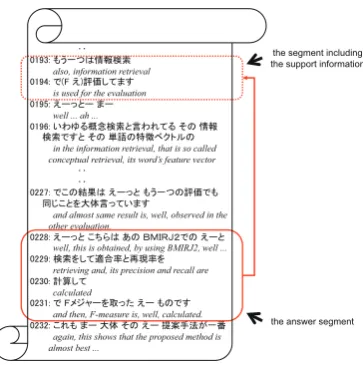
Figure 3: An example of an answer and its supporting seg-ment.
Find the lectures that include the information de-scribed by the given query topic.
• Passage retrieval
Find the passages that exactly include the information described by the given query topic. A passage is an IPU sequence of arbitrary length in a lecture.
4.2. Query Set
We constructed queries that asked for passages of varying lengths from lectures. Five people were relied upon to in-vent such queries by investigating the target documents and we obtained about 90 initial queries in total. Then, we checked their appropriateness. Some queries were removed because their topics were not appropriate for the SDR task, and the expressions of some were revised to reduce their ambiguity. Finally, we obtained 86 query topics.
4.3. Relevance Judgment
The relevance judgment for the queries was performed against every variable-length segment (or passage) in the target collection. One of the difficulties related to the rel-evance judgment comes from the treatment of the support-ing information. We regarded a passage as irrelevant to a given query, even if it was a correct answer to the query in itself, when it had no supporting information that would convince the user who submitted the query of the correct-ness of the answer. For example, consider the query “How can we evaluate the performance of information retrieval?” The answer “F-measure” is not sufficient, because it does not say by itself that it is really an evaluation measure for information retrieval. The relevant passage must also in-clude supporting information indicating that “F-measure” is one of the evaluation metrics used for information re-trieval. Figure 3 shows an example of an answer and its supporting information for the query “How can we evalu-ate the performance of information retrieval?”
As shown in Figure 3, the supporting information does not always appear together with the relevant passage, but may appear somewhere else in the same lecture. Therefore, we regarded a passage as relevant to a given query if it had
some supporting information in some segment of the same lecture. If a passage in a lecture was judged relevant, the range of the passage and the ranges of the supporting seg-ments, if any, along with the lecture ID, were recorded in our “golden” file.
For each query, one assessor, i.e., its constructor, read the relevant passages and judged their degrees of relevance. The assessor classified them according to the degree of their relevance: “Relevant,” “Partially relevant,” and “Ir-relevant.” Both the pooled passages or documents submit-ted from the participant groups and the search results using conventional word-based document search engines against the manual transcription of the target document collection were checked by the assessor.
4.4. Evaluation Measures
4.4.1. Lecture Retrieval
Mean Average Precision (MAP) was used for our official evaluation measure for lecture retrieval. For each query topic, the top 1000 documents were evaluated.
Given a questionq, suppose the ordered list of documents d1d2· · ·d|D| ∈ Dq is submitted as the retrieval result. Then,AvePqis calculated as follows:
AvePq =
1
|Rq|
|∑Dq|
i=1
δ(di∈Rq)
∑i
j=1δ(dj∈Rq)
i , (6)
where
δ(a∈A) =
{
1 · · · a∈A
0 · · · a̸∈A. (7)
Alternatively, given the ordered list of correctly retrieved documentsr1r2· · ·rM(M ≤ |Rq|),AvePq is calculated
as follows:
AvePq = 1
|Rq| M
∑
k=1
k
rank(rk), (8)
whererank(r)is the rank of documentr.
MAPis the mean of theAvePover all query topicsQ:
MAP= 1
|Q|
∑
q∈Q
AvePq. (9)
4.4.2. Passage Retrieval
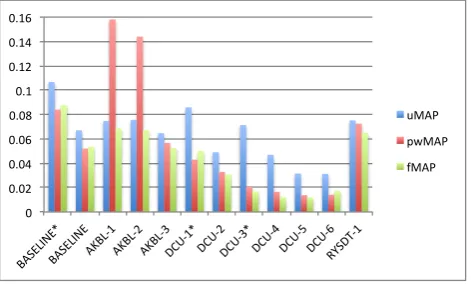
In our passage retrieval task, the relevance of each arbi-trary length segment (passage) rather than each whole lec-ture (document) must be evaluated. Three measures were designed for the task; one (uMAP) is utterance based and the other two (pwMAP and fMAP) are passage based.
4.4.3. Utterance-based Measure
uMAP
By expanding a passage into a set of utterances (IPUs) and by using an utterance (IPU) as a unit of evaluation like a document, we can use any conventional measures used for evaluating document retrieval.
Suppose the ordered list of passagesPq = p1p2· · ·p|Pq|
Yasuda, Yoichi Yamashita, and Katunobu Itou. 2009. Developing an sdr test collection from japanese lecture audio data. InProceedings of the 1st Asia-Pacific Signal and Information Processing Association Annual Summit and Conference (APSIPA ASC2009), pages 324–330. Tomoyosi Akiba, Hiromitsu Nishizaki, Kiyoaki Aikawa,
Tatsuya Kawahara, and Tomoko Matsui. 2011. Overview of the IR for spoken documents task in NTCIR-9 workshop. In Proceedings of The Ninth NT-CIR Workshop Meeting, pages 223–235.
Maria Eskevich and Gareth J. F. Jones. 2011. DCU at the NTCIR-9 SpokenDoc passage retrieval task. In Proceed-ings of The Ninth NTCIR Workshop Meeting.
Kiichi Hasegawa, Hideki Sekiya, Masanori Takehara, Taro Niinomi, Satoshi Tamura, and Satoru Hayamizu. 2011. Toward improvement of SDR accuracy using LDA and query expansion for SpokenDoc. InProceedings of The Ninth NTCIR Workshop Meeting.
Yoshiaki Itoh, Hiromitsu Nishizaki, Xinhui Hu, Hiroaki Nanjo, Tomoyosi Akiba, Tatsuya Kawahara, Seiichi Nakagawa, Tomoko Matsui, Yoichi Yamashita, and Kiyoaki Aikawa. 2010. Constructing japanese test col-lections for spoken term detection. InProceedings of In-ternational Conference on Speech Communication and Technology, pages 667–680.
Keisuke Iwami and Seiichi Nakagawa. 2011. High speed spoken term detection by combination of n-gram ar-ray of a syllable lattice and LVCSR result for NTCIR-SpokenDoc. InProceedings of The Ninth NTCIR Work-shop Meeting.
Taisuke Kaneko, Tomoko Takigami, and Tomoyosi Akiba. 2011. STD based on hough transform and SDR using STD results: Experiments at NTCIR-9 SpokenDoc. In Proceedings of The Ninth NTCIR Workshop Meeting. Kouichi Katsurada, Koudai Katsuura, Yurie Iribe, and
Tsu-neo Nitta. 2011. Utilization of suffix array for quick STD and its evaluation on the NTCIR-9 SpokenDoc task. InProceedings of The Ninth NTCIR Workshop Meeting. A. Lee and T. Kawahara. 2009. Recent development of open-source speech recognition engine julius. In Pro-ceedings of the 1st Asia-Pacific Signal and Information Processing Association Annual Summit and Conference (APSIPA ASC2009), page 6 pages.
Kikuo Maekawa, Hanae Koiso, Sadaoki Furui, and Hitoshi Isahara. 2000. Spontaneous speech corpus of Japanese. InProceedings of International Conference on Language Resources and Evaluation, pages 947–952.
Hiroaki Nanjo, Kazuyuki Noritake, and Takehiko Yoshimi. 2011. Spoken document retrieval experiments for spok-endoc at ryukoku university (RYSDT). InProceedings of The Ninth NTCIR Workshop Meeting.
Hiromitsu Nishizaki, Hiroto Furuya, Satoshi Natori, and Yoshihiro Sekiguchi. 2011. Spoken term detection using multiple speech recognizers’ outputs at NTCIR-9 Spok-enDoc STD subtask. InProceedings of The Ninth NTCIR Workshop Meeting.
Hiroyuki Saito, Takuya Nakano, Shirou Narumi, Toshiki Chiba, Kazuma Kon’No, and Yoshiaki Itoh. 2011. An STD system for OOV query terms using various
sub-word units. InProceedings of The Ninth NTCIR Work-shop Meeting.
Tetsuya Sakai and Hideo Joho. 2001. Overview of NTCIR-9. In Proceedings of The Ninth NTCIR Workshop Meeting, pages 1–7. http://research.nii.ac. jp/ntcir/workshop/OnlineProceedings9/ NTCIR/01-NTCIR9-OV-SakaiT.pdf.
Amit Singhal, Chris Buckley, and Mandar Mitra. 1996. Pivoted document length normalization. InProceedings of ACM SIGIR, pages 21–29.
Satoru Tsuge, Hiromasa Ohashi, Norihide Kitaoka, Kazuya Takeda, and Kenji Kita. 2011. Spoken document re-trieval method combining query expansion with continu-ous syllable recognition for NTCIR-SpokenDoc. In Pro-ceedings of The Ninth NTCIR Workshop Meeting. Yoichi Yamashita, Toru Matsunaga, and Kook Cho. 2011.
![Table 1: ASR performances [%].(a) For the CORE lectures.](https://thumb-us.123doks.com/thumbv2/123dok_us/1064037.1133203/2.595.50.303.79.188/table-asr-performances-core-lectures.webp)