http://fla.sagepub.com/
First Language
http://fla.sagepub.com/content/6/16/53
The online version of this article can be found at:
DOI: 10.1177/014272378600601605
1986 6: 53
First Language
Glenn Waller
comprehension and production
Linear organization of spatial instructions: development of
Published by:
http://www.sagepublications.com
can be found at:
First Language
Additional services and information for
http://fla.sagepub.com/cgi/alerts
Email Alerts:
http://fla.sagepub.com/subscriptions
Subscriptions:
http://www.sagepub.com/journalsReprints.nav
Reprints:
http://www.sagepub.com/journalsPermissions.nav
Permissions:
http://fla.sagepub.com/content/6/16/53.refs.html
Citations:
What is This?
- Feb 1, 1986
Version of Record
Linear
organization
of
spatial
instructions:
development
of
comprehension
and
production*
GLENN WALLER,
University
of Oxford
ABSTRACT
Spatial
instructions can belinearly
ordered so that the sequence inwhich landmarks are mentioned
corresponds
to thespatial ordering
ofthose landmarks en route. Two
experiments
wereperformed
toin-vestigate
theability
of children to utilize and toproduce
suchlinearity
in
receiving
andgiving
spatial
instructions. Children were shown to beable to use
highly
linear instructionsby
four years, but were able toreorganize
lessorderly input only by
seven years. It wassuggested
thatthis
ability might
be related to theability
toidentify
relevant locativeprepositions.
There was also adevelopment
in theability
to ’make allowances’ for theability
of thelistener,
with older children(eight
years) producing
instructions that were suited to the skills of the otherchild. It is
suggested
that this demonstrates adevelopment
ofcom-prehension
of thecognitive
andlinguistic
skills of others.Children communicate about their
spatial
environment from anearly
age,giving descriptions
of their own whereabouts as well as those of otherobjects.
There has been little research into this use ofspatial
reference,
partly
because of the difficulties inclassifying language
used in a ’natural’setting.
1 heseexperiments
examine two linked issues.Firstly,
whether theformat of an instruction affects its usefulness to the
listener,
andsecondly,
whether thelanguage
used ingiving spatial
instructionschanges
notonly
as afunction of the
speaker’s
age, but also as a function of the age of the listener.This
might
suggest
that thespeaker
isdeveloping
skills ofmodifying
linguistic
structurespecifically
for the listener’s benefit. Animportant
aspect
of any communication is that the
speaker
should be able tojudge
itspotential
effect
upon the listener. In these twostudies,
the effectiveness of* The author would like to thank the staff and pupils of Wolvercote First School, Oxford, for
their extremely kind cooperation, and Susanna Millar, Paul Harris, Usha Goswami and Kate Hellin for comments on earlier drafts of this paper. This research was carried out with the
different instruction formats will be
compared,
and children’sspontaneous
use of these formats will be examined for evidence that the
speaker develops
understanding
of the listener’scapacities.
EXPERIMENT I
DEVELOPMENTAL DIFFERENCES IN THE ABILITY TO FOLLOW SPATIAL
INSTRUCTIONS
An
adequate
response to instructionsdepends
on thecapacity
toidentify,
recall and
implement
the information received. This skill will be affected notonly by
the child’s level of interest andknowledge,
but alsoby
the structureof the message. Studies on
’story
schemata’suggest
that theoptimum
story
structure for young children is a linear one, where events maintain
temporal
order and do not
diverge
intosub-plots during
the main sequence. Forexample,
Brown &Murphy (1975)
have shown that4-year-olds
are poor atreproducing
random or scrambledseries,
but thatthey
tend toreproduce
sequential input
fairly
well. Nelson & Gruendel(1981)
have found thatpreschool
children will tend toimpose
sequence upon recalled storiesby
omission or
repositioning
of an event which ispresented
out oftemporal
order. There is some
disagreement
about the age at which the childimposes
such linearorganization
upon scrambledinput (Buss,
Yussen,
MathewsII,
Miller & Rembold1983,
Poulsen, Kintsch,
Kintsch & Premack1979),
butthere is
general
agreement
that thedevelopmental
trend is towards linearreproduction
ofincoming
information,
provided
thatsequencing
is relevant.The nature of the material used seems to be crucial. Even
3-year-olds
areable to
organize
disorganized input
ofhigh familiarity
andsimplicity
(Faulkner
1983),
but children of 6 years have been shown to omit somespecific
types
ofcomplex
information(e.g.
moral-orientedendings)
whenretelling
stories which werepresented
in a linear format(Geva
& Olson1983).
Sequencing
isobviously
relevant to the test materials in the studies citedabove,
which examine recall for stories. A similar benefit ofsequential input
might
be shown where the recall task does not involve verbalreproduction
of a
story.
In thisexperiment,
theability
of children torespond
appropriately
to instructions about the environment isexamined,
withparticular
referenceto the value of
linearity.
Siegel,
Allen & Kirasic(1979)
use multi-dimensionalscaling
tosuggest
that a ’linear format for thecognitive
construction of routerepresentations’
emerges between 7 and 10 years,though
Cousins,
Siegel
& Maxwell(1983)
found arelatively high ability
to ’order’ landmarks among7-year-olds
with afairly
simple
reconstruction task. In line withfindings
onthe
story
schema(Buss et
al.1983,
Poulsen et al.1979),
onemight
expect
ato an
ability
toimpose
a linear structure on information that ispresented
in aless
orderly
fashion.However,
even if thisprediction
is borne out, thequestion
remains of howthis effect of
linearity
will be mediated. The effect oflinearity
uponstorage
and recall may be due to theprimacy
and recency ofpertinent information,
withend-point
informationhighlighted
for the child.Alternatively,
theremay be a more
complex
mechanism,
whereby
the child uses the order of thelandmarks to construct a linear
cognitive representation
which terminates inthe
end-point
of the route. Thisexperiment
willattempt
to differentiate these two mechanisms. If the morecomplex
mechanism ispresent,
there may besomething
aboutlinearity (other
thansimple temporal order)
thathelps
the child to differentiate theend-point
from any other landmark. Apossible explanation
is that thelinearity
isassisting
the child toidentify
theend-point
of the searchby directing
the child’s attention to the relevantlocative
preposition.
A set of route instructions willgenerally
contain anumber of transient locative
prepositions
(e.g.
past,
through)
andonly
oneunequivocal
static locative(e.g.
next to,under).
If there is adevelopment
inthe
ability
to differentiate static locatives fromtransients,
without(or
inspite
of)
thesurrounding
context, then there should be adevelopment
in theability
to usedisorganized
instructions.Most studies of locative
meaning
have concentrated on thedevelopment
ofunderstanding
ofsingle,
isolated relations such as ’A is in front of B’ or ’Ais on
top
of B’(Clark
1977, 1980,
Johnston1984,
Kuczaj
& Maratsos1975).
There seems to be a
sequential acquisition
of correct usage of differentlocatives,
which is determined inpart
by
the child’sconceptual preferences
(Clark 1973),
by
the child’sknowledge
of thebody’s
frame of reference(Kuczaj
& Maratsos1975)
andby
situationalvariables,
such as thespecific
task
employed
(Durkin
1981).
These factors mean that one cannot assumethat the child who
responds correctly
to a locative(e.g. ’in’) actually
under-stands its
meaning.
Furthermore,
Johnston(1984)
has shown that children’sresponses to locatives reveal that the child
acquires
differentmeanings
atdifferent times for the same locative.
A criticism of this work is that it concentrates on limited
situations,
where an individual static locative ispresented
to the child. Thisprocedure ignores
the
question
of how childrendevelop
skills ofextracting
the relevantin-formation from more
complex,
naturalspeech.
In thisstudy,
a series ofinstructions for
finding
aprize
will begiven
to children in order to find out ifthe
linearity
of instruction format assists them. The first condition willsimply
use a linear set of instructions tospecify
thegoal.
This should be easyfor all
children,
as the structure will be similar to that of asimple
story.
In thesecond
condition,
theend-point
(goal)
will bepresented
before the mainthe terminal item of a set
(Brown
& French1976), performance
should bepoorer than in the first
condition,
but if it is the linearorganization
ofpart
ofthe route instructions which is
relevant,
then the child should becapable
ofusing
the instructionseffectively.
However,
agood performance
on thesecond condition
might
be due to aprimacy
effect in memory. To check thatit is
linearity
of the mainbody
of the instructions rather thanprimacy
or recency of theend-point
information which is crucial to the young child’sunderstanding,
a third condition will beused,
in which the linear order isreversed. A
’primacy/recency’
hypothesis
wouldpredict
that this conditionshould be no harder than the
end-point
+ linearcondition,
and so should notbecome
significantly
easier(across
aparticular
agerange)
if that condition does not. A’linearity’ hypothesis predicts
that theability
to use reversedinstructions should
develop
later than theability
to use theend-point
+ linear format. The finalcomparison
will be with a condition where theinstructions are
scrambled,
which bothhypotheses
wouldpredict
to be themost difficult format for young children.
The literature on
spatial
referencesuggests
a wide age range for theacquisition
of different locatives(e.g.
Johnston1984).
However,
thepresent
study
is concerned more with the effects of linearorganization
of a set ofinstructions,
and will concentrate on children of between 4 and 9 years,presuming
that the wide range of locatives used will be understoodby
thechildren. If there is no such
understanding,
then this canonly
workagainst
the
hypothesis
of more linear formatsproducing
bettercomprehension
inyounger children. This age range was chosen because it seems to encompass
the
period during
whichreorganization
of scrambled stories becomeseasier,
and so should
highlight
the value oflinearity
to the younger children.METHOD
Subjects
64 children from an Oxfordshire First School served as
subjects,
divided into 4 age groups of 16 children each. Mean ages of the groups were4;2
years(range
3;10-4;6),
5;5
years(range
5;2-5;9), 7;1
years(range
6;10-7;3)
and9;5
years(range 9;3-9;9).
All children were fluentEnglish speakers.
Materials
Each child selected a
piece
of fruit(’prize’)
as theobject
to be hidden. There were fourpossible
hiding places -
small whitepots,
in fullview,
under whichthe
prize
could be hidden. Basic instructions weregenerated by
an adult who was familiar with the room but not with the purposes of theexperiment.
Twosets of instructions were made for each of the four
hiding places,
and wereEnd Point. No connectives were used. This format was defined as Linear. Each of the 8 sets of Linear instructions was then transformed into three
different formats.
Thus,
each instruction waspresented
in a total of fourdifferent
formats,
as follows:Linear -
(1)
(2) (3) (4)
End-Point + Linear -
(4) (1)
(2) (3)
Reversed -
(4) (3) (2) (1)
Pseudorandom -
(3)
(1)
(4) (2)
Since there were two sets of instructions for each
hiding place,
fourhiding
places
and four different formats for eachinstruction,
a total of 32 sets ofinstructions were created.
(See
Table 1 fororiginals
andtransformations.)
TABLE 1. Basic instructions and
modifications
given
by
theexperimenter
to describe the locationof
theprize
to the children inExperiment
IProcedure
The
testing
area was the school’s TelevisionRoom,
which all the childrenused at least once a week for other activities. Each child heard 8 sets of
ever heard the same set twice
(even
in a differentorder)
and so that eachchild heard two of each of the four Instruction Formats. The order of these 8
sets was randomized
differently
for each child.The
experimenter
first toured the room with thechild, pointing
oust
thepots
andensuring
that the child could name theadjacent objects (used
asend-points
in theinstructions).
The child then waited in thehallway
whilethe
experimenter
hid theprize
under one of the fourpots.
Theexperimenter
then returned to the
hallway,
asked the child totry
to find theprize
first timeif
possible,
and then read the relevanttranscript.
The child then went backinto the room and looked for the
prize,
while theexperimenter unobtrusively
noted the number ofpots
searched. This wasrepeated
until the child hadsearched for the
prize
in response to each of theeight
sets of instructions.Scoring
Each child’s responses were scored as the mean number of
pots
(ranging
from 1 to
4)
that had been searched(over
twotrials)
to find theprize
for eachof the four different Instruction Formats.
Hence,
each childyielded
fourscores.
RESULTS .. -
,
,
Subjects’
mean scores arepresented
in Table2,
as a function ofAge
and Instruction Format.Inspection
of the meanssuggests
that fewer searches arerequired by
older children. Instruction Format also has a markedeffect,
with more searches needed with the Reversed and Pseudorandom Formats
TABLE 2. Mean number
of searches
takenby
childrenof different
ages to [image:7.422.64.391.410.573.2]and fewer
required
with the Linear Format.However,
this effect ofIn-struction Format appears to be
present
for the younger childrenonly.
Olderchildren
require
relatively
few searchesregardless
of thetype
of format. Toconfirm these
conclusions,
anAge (4 levels)
x Instruction Format(Linear,
End-Point +
Linear, Reversed, Pseudorandom)
ANOVA withrepeated
measures on the second factor was carried out,
using
the mean number ofsearches taken
by
each child over two trials as thedependent
variable. This showssignificant
main effects ofAge
[F(3,60)=7.87,
P<0.001]
and ofIn-struction Format
[F(3,180)=8.58,
P<0.001].
There is also asignificant
inter-action of
Age
x Instruction Format[F(9,180)=2.11,
P<0.05].
The main effect of
Age
is due to ageneral
decrease with age in the numberof searches
required.
The main effect of Instruction Format is due to theLinear,
End-Point + Linear and Reversed Formats allbeing
easier than the Pseudorandom Format.However,
these conclusions must bequalified
by
thetwo-way
interaction ofAge
x Instruction Format. Furtheranalysis
of the
simple
main effects ofAge
of child for the different Instruction Formats showed that whereasAge
has a marked effect for the ReversedFormat
[F(3,240)=5.22,
P<0.01]
and for the Pseudorandom Format[F(3,240)=11.65,
P<0.001],
there is very little effect for the Linear Formatand the End-Point + Linear Format
[F(3,240)<1.2,
bothcases].
Tukey’s
test
[q(4,240)=4.40, HSD(p=0.05)=0.549]
confirmed that the effect forReversed Format is due to the
4-year-olds requiring
more searches than7-year-olds
(P<0.01)
and9-year-olds (P<0.01).
The effect forPseudo-random Format is due to
4-year-olds requiring
more searches than7-year-olds
(P<0.01)
and9-year-olds (P<0.01),
and5-year-olds requiring
moresearches than
7-year-olds (P<0.05)
and9-year-olds (P<0.01).
Thesimple
main effects of Instruction Format for different ages of child showed that there is an effect for
4-year-olds
[F(3,180) =9.39,
P<0.001 ] and
5-year-olds
[F(3,180)=4.95,
P<0.01],
but not for 7- or9-year-olds
[F(3,180)<1,
bothcases].
Tukey’s
test[q(4,180) =4.40,
HSD(P=0.01)=0.563]
confirmed thatthe effect for
4-year-olds
is due to the childrenrequiring
more searches for Pseudorandom instructions than for Linear(P<0.01)
or End-Point +Linear
(P<0.01).
The effect for5-year-olds
is due to the childrenrequiring
more searches for Pseudorandom than for Linear instructions
(P<0.01).
To summarize thisinteraction,
7- and9-year-olds
areequally capable
ofusing
all of the formats.However,
4-year-olds
arehampered by
bothReversed and Pseudorandom
instructions,
and5-year-olds
arehampered by
the Pseudorandom Format.DISCUSSION
These results
strongly
support
thepredictions
that the Linear and End-Pointsupport
for theprediction
that younger children would find it more difficultto cope with the Pseudorandom and Reversed Formats. There was some
indication that young children find it
especially
difficult to cope with thePseudorandom Format as
compared
to the ReversedFormat,
as the5-year-olds were
only
hampered (relative
to the LinearFormat) by
the scrambled instructions. The lack of any difference between the Linear and End-Point+ Linear conditions shows that children are not
being hampered
by
remem-bering only
the terminal item of theinstructions,
even at 4 years. Thissuggests
that thetemporal
order of landmarks and locatives is not sufficientto
explain
the effects oflinearity
upon recall. Thisprobably
differs fromBrown & French’s
(1976) findings
because the children here were not askedto reconstruct an entire sequence, but could
complete
the task ifthey only
identified the
end-point
of the sequence from the wholedescription.
Somegeneral
conclusions can now be drawnregarding
children’sreception
and use ofspatial
instructions. It seems that there is anearly ability
to takeadvantage
of thelinearity
ofincoming
information,
which ispresent
for theLinear and End-Point + Linear Formats. This is
probably
not asimple
ability
to useprimacy
and recency effects toidentify
theend-point
in-formation,
which isequivalently
placed
in the End-Point + Linear and ReversedFormats,
since there was asignificant development
with age in theability
to use Reversedinstructions,
but not End-Point + Linear instructions.Between 4 and 7 years, the child seems to learn how to
’manipulate’
instructions,
eitherthrough
a’screening’
of the information orthrough
a’mental
rearrangement’.
This means that the identification ofend-points
and static locatives is
better,
so that the resultant searchpattern
is moreefficient.
This effect of linear
presentation
on young children iscompatible
with theresults of other research. The
ability
to use linearorganization
ofcognitive
maps for routes seems to bepresent
earlier than waspredicted by Siegel et
al.’s
(1979) study,
but it ispossible
thatSiegel et
al.’s use of MDS may haveled to a less realistic reflection of the
cognitive
representation.
Baird,
Merrill& Tannenbaum
(1979)
showed that adults find thatMDS,
derived from theirown
paired-distance
estimates, gives
an’unsatisfactory’ representation
ofthe environment.
The
present
results are mostcongruent
with those of Poulsen et al.(1979),
who showed a
development
between 4 and 6 years in theability
to recallscrambled
input.
Of course, the results of thisstudy
are based onrelatively
short
descriptions,
and itmight
not be until a later age that children would beable to utilize
longer
scrambleddescriptions (cf.
Buss etal.,
1983).
While thisstudy
has notexplicitly
tested the way in whichlinearity
hashelped
thechild to understand
spatial
reference,
it seemslikely
that it has been effectivestatic locative which
uniquely
marks theend-point
from the other in-structions. The notion that the value oflinearity
may lie in itsability
tohighlight
the staticlocative,
and hence teach the child the locative’smeaning,
will be taken up in the General Discussion.The
following
study
will examine thedevelopment
of children’sability
toprovide
linear instructions whenappropriate.
EXPERIMENT IIDEVELOPMENT OF THE USE OF LINEARITY IN GIVING SPATIAL INSTRUCTIONS
Having
shown that the format ofspatial
instructions influences thecom-prehension
of thelistener,
it is now relevant to ask whether children haveany
insight
into this influence. Thismight
suggest
adevelopment
in theability
to use more linear formsappropriately (i.e.
for youngerlisteners).
Of course, this is related to the classic
problem
of the child’sability
to takealternative
perspectives
incommunication,
which has been examinedusing
two
types
of task: the ’referential communication’ task and the morenaturalistic studies of
sensitivity
to listener status. The referentialcom-munication
paradigm (see
Glucksberg,
Krauss &Higgins 1975)
shows adevelopment
in theability
to select and transmit criticalaspects
of adisplay,
with
development
complete by
11 years.However, Flavell, Botkin,
Fry,
Wright
& Jarvis(1968)
have shown that theability
to take the role of another and to selectappropriate
information may bepresent
at 3 to 4 years if the task issufficiently simple.
The tasks chosenby Glucksberg
and hiscol-leagues
were rathercomplex
and unusual for thechild,
sincethey
involvedhighly
artificial referents anddeprived
the child of some of the normalmechanisms of communication
(e.g. gestures).
A betterstudy
is that ofGreenberg, Kuczaj
II &Suppiger
(1983),
who have shown that children of 2to 6 years
attempt
to communicate more information about a morecomplex
referent,
regardless
of the status of the listener. Five- andsix-year-olds
wereshown to make
spontaneous
allowance for the listener’s characteristics(lack
of visual
knowledge)
by using
agreater
number of informative modifiers.However,
even children of 3 to 4 years werecapable
ofmaking
suchallowances if
they
were made aware of the listener’s characteristicsby
aquestioning
session. It may be that young children can discern and transmitsufficient necessary information in more realistic
settings
andgiven
adequate prompting.
Turning
to the secondtype
oftask,
there is alarge
number of naturalisticstudies
showing
that young children can makesophisticated stylistic changes
in their
speech, according
to theperceived
status of the other person(see
Shatz
1983).
Aproblem
with such studies is thatthey
tend to lack anybe tested. Thus the
finding
that4-year-olds
can use’baby
talk’ to2-year-olds,
forexample
(Shatz
& Gelman1973),
does not mean thatthe ’baby
talk’is
necessarily
animproved
form of communication in thatsetting.
However,
since it
has now been established that a linear account ishighly
informativeto a younger
child,
it ispossible
to ask whether older children havede-veloped
the skill ofusing
this format inspatial
reference. This would besignalled
by
use of more lineardescriptions
by
older childrenaddressing
4-and
5-year-olds,
but notnecessarily
towards their peers.In this
study,
children were asked to describe the location of anobject
which
they
hadjust
hidden(in
the samesetting
as theprevious
study).
It waspredicted
thatonly
the oldest group would be able to makeadjustments
tothe
linearity
of theirdescriptions (as
ratedby
adults) according
to the age of thelistener,
and that theseadjustments
would be in the direction ofgreater
effectiveness.
METHOD
Subjects
A different group of 72
pupils
from the same OxfordshireNursery
and First School served assubjects.
There were three age groups of 24 childreneach,
with mean ages
of 4;6
years(range
4;1
to4;9), 5;9
years(range
5;6
to5;11)
and8;9
years(range
8;5
to8;11).
Thesingle
group of8-year-olds
was used due to theapparent
lack of differences between the 7- and9-year-olds
inExperiment
I.Materials
The same four
hiding places
were used as in theprevious study,
andpieces
offruit were
again
used asprizes.
Nopredetermined
instructions were used inthis
study.
Theonly
additionalequipment
was a cassetterecorder,
used to record the children’sdescriptions.
These were then transcribed for adultrating.
Procedure
The same
testing
area wasused,
with nochanges
in thelayout
of the room.Each child
participated twice,
once as a’Speaker’
and once as a ’Listener’.Children were
paired
so that each age group communicated to each of thethree age groups. Thus there were nine groups for
comparison (4-4, 4-5,
4-8, 5~, 5-5, 5-8, 8-4,
8-5, 8-8),
each with 8pairs
of children. No child evergave and received information from children in the same age
pairing
(so
that a child who told a5-year-old
where theprize
was hidden would never be toldby
a5-year-old,
forexample).
Eachpair performed
two trials.the
previous study.
Then one child(the
listener)
waited in thehallway
whilethe other child
(the speaker)
hid theprize
under apot
designated by
theexperimenter.
Then theexperimenter
and thespeaker
returned to thehallway,
and theexperimenter
asked thespeaker
to tell the listener how tofind the
pot
where theprize
washidden,
so that it could be found first time ifpossible.
Theensuing description
wasrecorded,
and then the listener went to look for theprize.
Theprocedure
was thenrepeated,
with the twochildren in the same roles.
TABLE 3.
Examples from
Experiment
IIof children’s descriptions of how
tofind
theprize,
and adults’ratings of linearity of
thedescriptions
Each of the 144
descriptions
was transcribed(see
Table 3 forexamples).
These
transcripts
weregiven
to fivejudges,
who each rated thetranscripts
for
Linearity
on a scale of 1(Least
Linear)
to 7(Most Linear).
Thejudges
were blind to the children’s ages and to thelayout
of theclassroom,
so thattheir
ratings
would reflect the structuralorganization
of the communicationrather than its reference to
particular
locations in the classroom. The exactquestion
asked was: ’To what extent does the child’sdescription
appear tofollow a
linear,
unidirectionalsequence?’.
Scoring
RESULTS
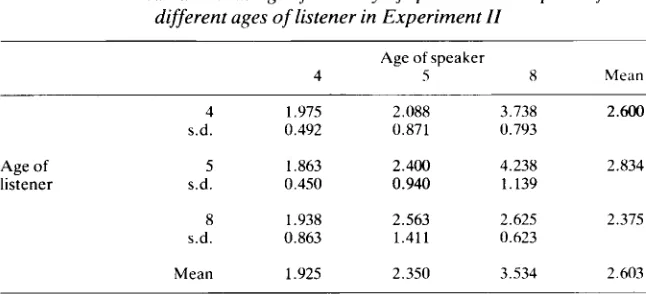
The mean adult
ratings
oflinearity
arepresented
in Table 4. The resultssuggest
that there is ageneral
increase withAge
ofSpeaker
in thelinearity
ofchildren’s instructions. The low
linearity rating
for8-year-old speakers
addressing
8-year-old
listenerssuggests
that there may be atendency
forolder children to use less linear instructions for their peers. In confirmation
of these
findings,
anAge
ofSpeaker
(3 levels)
xAge
of Listener(3 levels)
ANOVA was carried out on the adults’ mean
ratings
ofLinearity
of eachtranscript.
The ANOVA shows asignificant
main effect ofAge
ofSpeaker
[F(2,63)
=21.33, P<0.001 and
asignificant
interaction ofAge
ofSpeaker
x [image:13.420.62.385.233.380.2]Age
of Listener[F(4,63)=3.00,
P<0.025].
TABLE 4. Mean adult
ratings
of
linearity
of speakers’ descriptions for
different
agesof
listener inExperiment
IIThe main effect of
Age
ofSpeaker
is due to a continuousdevelopment
inthe
tendency
toproduce
linearinstructions,
over the age range which wasidentified as
important
in theprevious
study.
However,
this effect must bequalified
by
reference to the interaction ofAge
ofSpeaker
xAge
ofListener. Further
analysis
of thesimple
main effects ofAge
ofSpeaker
fordifferent ages of listener show that there is a
significant
effect ofAge
ofSpeaker
for4-year-old
listeners[F(2,63)=9.97,
P<0.001]
and for5-year-olds
[F(2,63)=15.88,
P<0.001],
but not for8-year-olds
[F(2,63)<1.5].
Tukey’s
test[q(3,63) =3.40, HSD(P=0.05)=1.06]
shows that the effect for4-year-old
listeners is due to8-year-olds giving
more linear instructions than4- or
5-year-old
speakers (P<0.01,
bothcases).
The effect for5-year-old
listeners is also due to
8-year-old
speakers
giving
more linear instructionsof
speaker
shows thatalthough
there is nosignificant
effect ofAge
ofListener for
4-year-old
speakers
[F(2,63)=0.03]
or for5-year-old speakers
[F(2,63) =0.60],
there is a marked effect ofAge
of Listener upon8-year-old
speakers
[F(2,63)=6.98,
P<0.01].
Tukey’s
test[q(3,63)=3.40,
HSD(P=0.05)=1.06]
confirmed that8-year-olds give
less lineardescriptions
to
8-year-old
listeners thanthey give
to5-year-olds
(P<0.01)
or to4-year-olds
(P<0.05).
To
summarize,
these results show that8-year-old speakers
use morelinear instructions than younger
speakers
whenaddressing
4- or5-year-old
listeners,
and that the8-year-old speaker
uses morelinearity
in instructionsto younger children than to same-age peers. This shows a
degree
offlexibility
in the way in which the
8-year-old
delivers instructions.DISCUSSION
This
experiment
wasprimarily
designed
to find whether childrendevelop
anability
to use more effective means ofcommunicating
about theenviron-ment. As it had
previously
been shown(Experiment I)
that a linear format isan effective form at all ages, then a
possible
outcomemight
have been for theolder children to use a
highly
linear Instruction Format at all times.How-ever, the results show that
although
the8-year-olds
do morefrequently
produce
linear information than youngerchildren,
they
areespecially likely
to do this for young
listeners,
who would haveparticular
difficulties withnon-linear information. This
suggests
that the8-year-old
is able to take thesophistication
of the listener into account whenformulating
aspatial
reference.
GENERAL DISCUSSION
These two
experiments
have shown that there is adevelopment
between 5and 7 years in the
ability
to deal withdisorganized
instructions,
and thatchildren as young as 8 years are able to make
adjustments
to theirspeech
which make use of this
developing ability.
Theexamples
in Table 3demonstrate this
development
oflinearity
inproduction.
Someexamples
(e.g.
iii)
suggest
that the8-year-olds
may be able toproduce
the End-Point+ Linear format which was included in the first
experiment.
The studiesrelate
findings
on children’s individualcapacities
in a moreexperimentally
constrained
setting
to more naturalpatterns
ofdyadic
interaction. Thisrelationship
notonly gives
thefindings
ofExperiment
I more relevance tochildren’s normal
behaviour,
but also shows thatExperiment
II isaddres-sing
apattern
of interaction which is of some value to the child.Children appear to be able to use
linearity
inreceiving spatial
instructionsdevelop-ment of such a
style
ofpresentation,
there seems to be adevelopment
of skillin its
application,
so that it isheavily
used when it would beparticularly
beneficial
(i.e.
for youngerlisteners).
These studiessuggest
that there isdevelopment
of the selective use of effective communicativestyles,
rather thansimply
in the use ofsyntactic
styles
(Shatz
& Gelman1973).
Acomplex
model of the child’s
cognitive
andlinguistic processing
would be needed toaccount for these
findings.
It seems that
Siegel
et al.’s(1979)
’linear format forcognitive
constructionof route
representations’
is lessstraightforward
than had beenenvisaged.
Children of a young age can benefit from a linear
presentation, suggesting
that it is more conducive to memory for(or
identificationof)
relevantinformation.
However,
7-year-olds
have theability
to ’select andre-organize’ input,
so thatlinearity
is nolonger particularly
beneficial,
at least forsimple
instructions. It seems that theproduction
of linear instructions(more
likeSiegel
et al.’sfindings)
ispossible by
8 years.A more
linguistic
explanation
may behelpful. Possibly
the children inExperiment
I arebecoming
better atidentifying
the static locativepre-positions
used in all the instructions(by,
under,
near)
as morelikely
toindicate the
end-point
than theprepositions
used in otherparts
of theinstructions
(past,
across,ahead,
etc.).
However,
this cannot be the entirecase, as described
earlier,
because the End-Point + Linear Format wasuseful at an earlier age than the Reversed Format. So the structure of the
whole
spatial
reference isaffecting
the value ofparticular linguistic
formswithin it. The
8-year-olds’
ability
toadapt
instructionsaccording
to the ageof listener
(Experiment
II)
isprobably
theproduct
of a skill ofusing
staticlocatives and landmarks in
appropriate places,
rather thansimply
using
thecorrect locative and landmark
(see
Table4,
examples iii-v). Possibly
it willbe necessary for young children to
develop
a moregeneral cognitive
skill ofbenefiting
fromlinearity prior
tobeing
able to select the static locativepreposition
from acomplex
set ofinstructions,
as linear instructions mayserve to
highlight
and define the locative in a realistic context.Summary
These studies have shown that children are
developing
skills ofadapting
communication in a way which will make theirspeech
morehelpful
to thelistener,
with8-year-olds using
more linearorganization
ofspeech
whenaddressing
children who will benefit from such a structure. It seems that theability
to communicatedepends
notonly
on the amount orformatting
ofthe children’s
knowledge,
but also reflects thespeaker’s
knowledge
aboutREFERENCES
Baird, J. C., Merrill, A. A. & Tannenbaum, J. (1979). II: A familiar environment. Journal of
Experimental Psychology: General, 108, 92-98.
Brown, A. L. & French, L. A. (1976). Construction and
regeneration of
logical sequences usingcauses and consequences. Child Development, 47, 930-940.
Brown, A. L. & Murphy, M. D. (1975). Reconstruction of arbitrary vs. logical sequences by
preschool children. Journal of Experimental Child Psychology, 20, 307-326.
Buss, R. R., Yussen, S. R., Mathews II, S. R., Miller, G. E. & Rembold, K. L. (1983). Development of children’s use of a story schema to retrieve information. Developmental Psychology, 19, 22-28.
Clark, E. V. (1973). Non-linguistic strategies and the acquisition of word meanings. Cognition,
2, 161-182.
— (1977). Strategies and the mapping problem in first language acquisition. In J. Macnamara (ed.), Language Learning and Thought (London: Academic Press).
— (1980). Here’s the top: non-linguistic strategies in the acquisition of orientational terms.
Child Development, 51, 329-338.
Cousins, J. H., Siegel, A. W. & Maxwell, S. E. (1983). Way-finding and cognitive mapping in large-scale environments: A test of a developmental model. Journal of Experimental Child Psychology, 35, 1-20.
Durkin, K. (1981). Aspects of late language acquisition: school children’s use and
com-prehension
of prepositions. First Language, 2, 47-59.Faulkner, D. M. (1983). An Investigation Concerning the Development of Organisation in Semantic Memory. Unpublished Doctoral Thesis, University of Oxford.
Flavell, J. H., Botkin, P. T., Fry, C. L., Wright, J. W. & Jarvis, P. E. (1968). The Development
of Role-Taking and Perspective Skills in Children (New York: Wiley).
Geva, E. & Olson, D. (1983). Children’s story-retelling. First Language, 4, 85-110.
Glucksberg, S., Krauss, R. & Higgins, E. T. (1975). The development of referential
com-munication skills. In F. D. Horowitz (ed.) Review of Child Development Research (Vol. 4)
(Chicago: University of Chicago Press).
Greenberg, J., Kuczaj II, S. A. & Suppiger, A. E. (1983). An examination of adapted communication in young children. First Language, 4, 31-40.
Johnston, J. R. (1984). Acquisition of locative meanings: behind and in front of. Journal of
Child Language, 11, 407-22.
Kuczaj, S. & Maratsos, M. (1975). On the acquisition of front, back and side. Child Develop-ment, 46, 202-210.
Nelson, K. & Gruendel, J. M. (1981). Generalized event representations: basic building blocks of cognitive development. In M. E. Lamb & A. L. Brown (eds), Advances in
Develop-mental Psychology (Volume 1) (Hillsdale, N. J.: Erlbaum).
Poulsen, D., Kintsch, E. K., Kintsch, W. & Premack, D. (1979). Children’s comprehension
and memory for stories. Journal of Experimental Child Psychology, 28, 379-403.
Shatz, M. (1983). Communication. In J. H. Flavell and E. M. Markman (eds) Handbook of
Child Psychology, Vol. 3 (New York: Wiley).
Shatz, M. & Gelman, R. (1973). The development of communication skills: modifications in
the speech of young children as a function of listener. Monographs of the Society for Research in Child Development, 38, (5, Serial no. 152).