This is a repository copy of
Partial Matrix Techniques.
.
White Rose Research Online URL for this paper:
http://eprints.whiterose.ac.uk/2413/
Monograph:
Kirby, H.R. (1979) Partial Matrix Techniques. Working Paper. Institute of Transport Studies,
University of Leeds , Leeds, UK.
Working Paper 111
[email protected] https://eprints.whiterose.ac.uk/ Reuse
See Attached
Takedown
If you consider content in White Rose Research Online to be in breach of UK law, please notify us by
White Rose Research Online
http://eprints.whiterose.ac.uk/
Institute of Transport Studies
University of Leeds
This is an ITS Working Paper produced and published by the University of
Leeds. ITS Working Papers are intended to provide information and encourage
discussion on a topic in advance of formal publication. They represent only the
views of the authors, and do not necessarily reflect the views or approval of the
sponsors.
White Rose Repository URL for this paper:
http://eprints.whiterose.ac.uk/
2413/
Published paper
Kirby, H.R. (1979) Partial Matrix Techniques. Institute of Transport Studies,
University of Leeds, Working Paper 111
W o r k i n g Paper 111
M a r c h
1979
PARTIAL
MATRIX TECHNIQUESABSTRACT
KIRBY, H.R. (1979) P a r t i a l matrix techniques. Leeds: Univ. Leeds, I n s t . Transp. Stud., Work. Pap. 111.
P a r t i a l matrix techniques a r e t h o s e i n which g r a v i t y models a r e f i t t e d t o a p a r t i a l l y observed matrix of t r i p s and journey c o s t s , and used t o i n f e r t h e t r i p s i n t h e
unobserved c e l l s . This paper reviews t h e t h e o r e t i c a l b a s i s from which such techniques have been developed, and
demonstrates t h e need t o pay c a r e f u l a t t e n t i o n t o t h e
-
underlying assumptions, which i n e f f e c t r e q u i r e t h a t t h e model be a good fit t o be observed data (and a l s o a goodPARTIAL MATRIX TECWTIQUES
Howard R . Kirby
1. INTRODUCTION
T r i p d i s t r i b u t i o n models a r e o f t e n f i t t e d t o d a t a i n t h e form of
o r i g i n - d e s t i n a t i o n m a t r i c e s of t r i p s and g e n e r a l i s e d c o s t s . For several
y e a r s , it has been t h e p r a c t i c e t o use matrices i n which, by v i r t u e of
t h e survey design, not a l l o r i g i n - d e s t i n a t i o n movements a r e observable.
Such matrices a r e s a i d t o be p a r t i a l a s opposed t o whole*. C e l l s not
included i n t h e p a r t i a l matrix may be described a s excluded, unobservable,
o r missing.
The phrase ' p a r t i a l matrix techniques' g e n e r a l l y r e f e r s t o t h e p r a c t i c e
of c a l i b r a t i n g a g r a v i t y model t o a p a r t i a l t r i p matrix, and using t h e
r e s u l t s of t h i s c a l i b r a t i o n t o i n f e r something about t h e t r i p d i s t r i b u t i o n
f o r t h e whole matrix (including t h e missing c e l l s ) . The p r a c t i c e was
developed by Wootton (1972) and f i r s t used i n Derbyshire, and subsequently
applied by Neffendorf i n S h e f f i e l d ; see Neffendorf and Wootton (1974). I
I
It drew support from t h e o r e t i c a l considerations f i r s t r e p o r t e d by Kirby (1972)
and subsequently published p a r t l y i n Kirby (1974) and p a r t l y i n Beardwood
and Kirby (1975).
Although p a r t i a l matrix techniques have been widely used, very l i t t l e
has been reported i n t h e published l i t e r a t u r e . Occasionally, however,
statements a r e made
-
f o r example i n Cunliffe and Nesbitt (1977)-
t h a tmake it appear t h a t t h e s e t h e o r e t i c a l considerations a r e thought t o have
a wider v a l i d i t y o r a p p l i c a b i l i t y t h a n was claimed, with perhaps i n s u f f i c i e n t
a p p r e c i a t i o n of t h s assumptions t h a t have t o be made when using t h e p a r t i a l
matrix technique.
Since f a i l u r e t o a p p r e c i a t e t h e t h e o r e t i c a l i s s u e s o r assumptions
might cause t h e p a r t i a l matrix technique t o be used i n conditions i n which
it i s not appropriate, t h i s paper has been prepared with t h r e e o b j e c t i v e s :
*Note
t h a t a whole matrix does not n e c e s s a r i l y mean t h a t t h e observed values f o r each movement o r c e l l a r e non-zero; indeed, whole matrices may containzero e n t r i e s t h a t a r e zero by chance. I f t h e proportion of observable c e l l s t h a t a r e zero i s high (whether i n
a
whole or p a r t i a l m a t r i x ) , t h e matrix i s s a i d t o be sparse. Thus,a
s p a r s e G t r i x i s not n e c e s s a r i l y p a r t i a l , and a p a r t i a l matrix i s not n e c e s s a r i l y s p a r s e-
a d i s t i n c t i o n which has not always been observed i n t h e l i t e r a t u r e ( s e e f o r example C u n l i f f e & N e s b i t t , 1977). The term f u l l matrix i s probably b e s t reserved f o r whole matrices with no empty c e l l s . I n t h e( a ) t o h i g h l i g h t and amplify t h e r o l e of theory and assumption i n t h e use of p a r t i a l matrix techniques;
( b ) t o suggest some p r a c t i c a l t e s t s f o r v e r i f y i n g t h e kinds of conditions under which t h e use of p a r t i a l matrix techniques a r e most a p p r o p r i a t e ;
( c ) t o r e p o r t on some t e s t s t h a t have been c a r r i e d out of t h e kind mentioned i n ( b ) , and t o appeal f o r o t h e r s t o be reported.
2. THEORETICAL BASIS
The t h e o r e t i c a l b a s i s from which p a r t i a l matrix techniques have been
developed was t h a t given i n Beardwood and Kirby (1975), although, a s we s h a l l
see i n Section 3, an extension t o t h e r e s u l t s t h e r e given should a l s o have
been appealed t o i n some circumstances. This extension i s described i n 2.2.
2.1 Basic r e s u l t
The r e s u l t given i n Beardswood and Kirby r e l a t e s t o t h e s y n t h e s i s of a
t r i p matrix ( u s i n g t h e two-way adjustment ( o r b i p r o p o r t i o n a l ) procedure of
Furness) such t h a t it i s b i p r o p o r t i o n a l t o some s t a r t i n g matrix and agrees
with prescribed row and column sums. The r e s u l t demonstrates t h e equivalence
between t h e solutiom f o r bi-proportional (Furness) adjustmentsto s u i t a b l y
r e l a t e d whole and p a r t i a l matrices. It i s simply described i n terms of
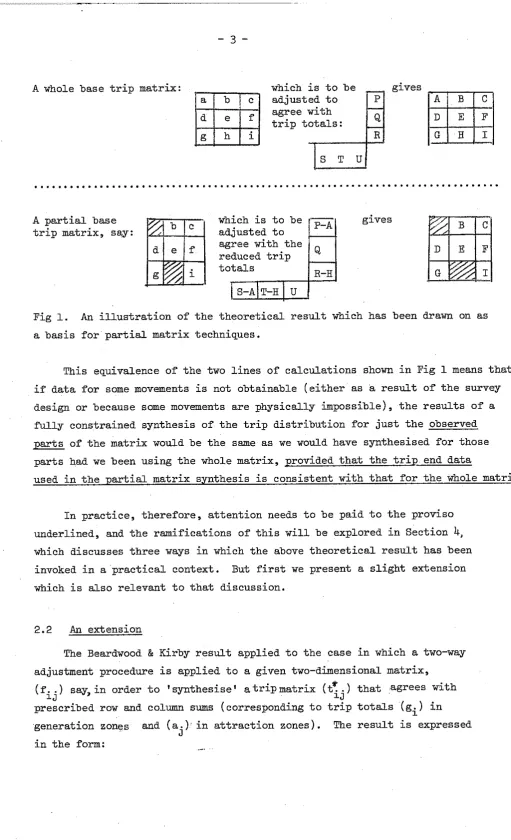
an example, a s i n t h e three-zone example of Fig 1. The diagrams above t h e
d o t t e d l i n e i n Fig 1 d e f i n e values ( a ,
...,
i ) , f o r a s t a r t i n g matrix (whichmay be base-year observations, and contain some values t h a t a r e zero by chance;
o r may be derived by applying some f u n c t i o n t o a cost-matrix); values
( P
. . .
,U) of t h e t r i p ends t o which t h e s t a r t i n g values a r e t o be adjustedpro-rata; and values A , I of t h e r e s u l t s of s y n t h e s i s i n g a whole matrix
t o agree with t h e s e trip-end t o t a l s . The diagrams below t h e d o t t e d l i n e
define how t h e corresponding values f o r t h e s y n t h e s i s of a p a r t i a l matrix
r e l a t e t o t h o s e f o r t h e whole matrix. The c e l l s shown shaded i n t h e lower
l i n e a r e t h o s e excluded from t h e whole matrix i n forming t h e p a r t i a l matrix,
and t h e r e may i n g e n e r a l be s e v e r a l such c e l l s i n each row and column of
t h e matrix. I n g e n e r a l , t h e l o c a t i o n of t h e excluded c e l l s may be b e s t
expressed by an incidence matrix, i n which ' 0 ' i n d i c a t e s an excluded c e l l ,
and '1' i n d i c a t e s a c e l l f o r which an observation i s a v a i l a b l e . (See Fig 2
f o r some examples.) We note i n Section 3 t h a t it may be necessary t o r e s t r i c t
A whole base t r i p matrix:
g h i
which i s t o be gives adjusted t o
agree with t r i p t o t a l s :
A p a r t i a l base t r i p matrix, say:
which i s t o be g i v e s
agree with t h e
Fig 1. An i l l u s t r a t i o n of t h e t h e o r e t i c a l r e s u l t which has been drawn on a s
a b a s i s f o r p a r t i a l matrix techniques.
This equivalence of t h e two l i n e s of c a l c u l a t i o n s shown i n Fig 1 means t h a t
if d a t a f o r some movements i s not obtainable ( e i t h e r a s a r e s u l t of t h e survey
design or because some movements a r e p h y s i c a l l y impossible), t h e r e s u l t s of a
f u l l y constrained s y n t h e s i s of t h e t r i p d i s t r i b u t i o n f o r j u s t t h e observed
parts of t h e matrix would be t h e same a s we would have synthesised f o r t h o s e
p a r t s had we been using t h e whole matrix, provided t h a t t h e t r i p end d a t a
used i n t h e p a r t i a l matrix s y n t h e s i s i s c o n s i s t e n t with t h a t f o r t h e whole matrix.
I n p r a c t i c e , t h e r e f o r e , a t t e n t i o n needs t o be paid t o t h e proviso
underlined, and t h e r a m i f i c a t i o n s of t h i s w i l l be explored i n Section
4,
which discusses t h r e e ways i n which t h e above t h e o r e t i c a l r e s u l t has been
invoked i n a p r a c t i c a l context. But f i r s t we present a s l i g h t extension
which i s a l s o r e l e v a n t t o t h a t discussion.
2.2 An extension
The Beardwood & Kirby r e s u l t applied t o t h e case i n which a two-way
adjustment procedure i s a p p l i e d t o a given two-dimensional matrix,
( f i j ) say> i n order t o ' s y n t h e s i s e l a t r i p matrix (t!
.
) t h a t agrees with 1 Jprescribed row and column sums (corresponding t o t r i p t o t a l s (gi) i n
generation zones and ( a . ) i n a t t r a c t i o n zones). The r e s u l t i s expressed J
[image:7.595.52.564.0.842.2]f
t..
=
p.q.f.. 1J 1 J 1Jin which the generation factors
(pi)
and attraction factors (q.) are such Jthat
t?. = and a
j
The above describes the process carried out in the prediction of
certain types of trip matrix; an obvious extension of the result in 2.1
is to the calibration situation, in which we wish to estimate not only
the parameters
(Pi)
and (q.) but also the parameters of f as a function of Jthe separation or generalised cost c
ij' In the case where the cost is divided into Kranges such that, if the cost falls in the kthinterval,
a factor r expresses the average value of f(c. in this interval,
k lj
we may define a three-dimensional matrix
Aijk
of zeroes and ones whichindicate in which interval a particular cost cij falls, and a maximum
likelihood procedure for estimating the parameters of (pi), (qj ) and (I. k)
is such that, under certain conditions, the value
is such as to satisfy
ljk
t;jk=
gi;lik
tt. 1 J k=
aj;lij
trjk-
-
Sk( 4 )
w$ere the (gi), (aj) and (sk) are here to be understood as, respectively,
the number of trips in each generation zone, attraction zone, and interval
of separation as given by the corresponding summation over an observed trip
matrix. For such a three-dimensionalsituation a three-
way balancing (or triproportional) procedure may be used. (See Kirby,
1974, Evans and Kirby
1974,
and Kirby and Leese,1978
for a discussion of the procedure and conditions).
The result for three dimensions that correspond to t a t given in Fig 1 for 2
dimensions isillustrated in Fig 2; the mathematical demonstration of the
equivalence, and the conditions under which it holds, are similar to those
A whole
base year corresponding
t r i p matrix c o s t i n t e r n a l
and base
year zone t r i p year t r i p cost. t o t a l s : i n t e r v a l
frequency d i s t r i b u t i o n
A t r i p r o p o r t i o n a l c a l i b r a t i o n proced- ure t h a t reaches agreement with t h e above zon@ and i n t e r v a l t r i p t o t a l s
gives a synthesised I
t r i p matrix: \n
...
IIf we have only 1 m t h e n , if t h e
a p a r t i a l m a t r i x w "responding zonal t r i p
P - A
and c o s t t r i p i n t e r v a lk x - A
of base year c o s t - i n t e r v a l s t o t a l s a r e : 9 t o t a l s a r e 1 Y
t r i p s : 1 k r - H m z - H
s-A t-H u
t h e t r i p r o p o r t i o n a l t h a t i s c o n s i s t e n t w i t h This c l e a r l y r e q u i r e s t h a t , f o r t h e whole matrix, t h e sum c a l i b r a t i o n proced- t h a t f o r c a l i b r a t i o n of i t s e s t i m a t e s i n t h e excluded p a r t s agrees e x a c t l y with u r e t h a t reaches t o t h e whole m a t r i x , t h o s e given by t h e survey d a t a f o r t h o s e p a r t s . I n t h i s
agreement with t h e ( s e e above). case: A=a and H=h.
above zonal and i n t e r v a l t r i p t o t a l s gives a synthesised t r i p matrix:
3 APPLICATIONS
There a t l e a s t t h r e e ways i n which t h e t h e o r e t i c a l work described i n
s e c t i o n 2 has been invoked i n a p r a c t i c a l context: s y n t h e s i s f o r a p a r t i a l
matrix, c a l i b r a t i o n and s y n t h e s i s f o r a p a r t i a l matrix, and c a l i b r a t i o n and
s y n t h e s i s f o r a whole matrix with d a t a f o r a p a r t i a l matrix.
3.1
Synthesis f o r a p a r t i a l matrixIf one i s i n t e r e s t e d only i n synthesising t r i p s f o r p a r t s of a matrix
given t h e c o s t matrix ( c . .) and c o s t function f ( c )
,
t h e n t h e r e s u l t given 1 Ji n s e c t i o n 2.1 suggests t h a t it i s i n order f o r t h e trip-end balancing
(Furness) c a l c u l a t i o n s t o be done on t h e p a r t i a l matrix,
provided that the
trip-end estimating procedure yields zonal trip-end t o t a l s t h a t properly
exclude the t r i p s t h a t would have gone t o the missing c e l l s ; t h a t
i s
that
these excluded t r i p s would have been estimated reasonably a c n u a t e l y by the
model had
it
been applied t o the Ohole matrix with f u l l trip-end t o t a l s .
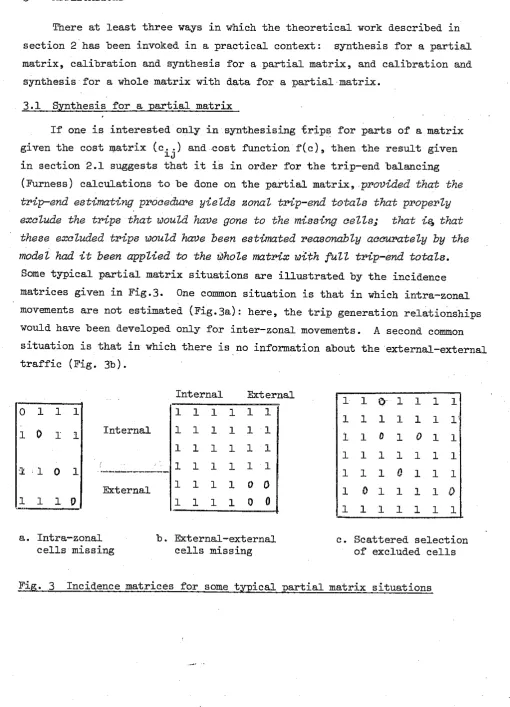
Some t y p i c a l p a r t i a l matrix s i t u a t i o n s a r e i l l u s t r a t e d by t h e incidence
matrices given i n Fig.3. One common s i t u a t i o n i s t h a t i n which intra-zonal
movements a r e not estimated ( F i g . 3 a ) : here, t h e t r i p generation r e l a t i o n s h i p s
would have been developed only f o r inter-zonal movements. A second common
s i t u a t i o n i s t h a t i n which t h e r e i s no information about t h e external-external
t r a f f i c ( F i g . 3b).
I
I
I n t e r n a l External
P
1 1 1 1 1 1 '
I n t e r n a l 1 1 1 1 1 1
1 1 1 1 1 1
1 1 1 1 1 1
e t e r n a l 1 1 1 1 0 0
a . Intra-zonal b . External-external c . S c a t t e r e d s e l e c t i o n c e l l s missing c e l l s missing of excluded c e l l s
[image:10.595.60.571.85.793.2]A t h i r d s i t u a t i o n i s where t h e excluded c e l l s a r e s c a t t e r e d throughout
t h e matrix ( F i g . 3 ~ ) . One way i n which t h i s might occur would be if c e r t a i n
p a i r s of zones were i n a s p e c i a l r e l a t i o n s h i p . That r e l a t i o n s h i p would have
t o be modelled s e p a r a t e l y and t h o s e zone-pairs excluded from t h e u s u a l t r i p
d i s t r i b u t i o n c a l c u l a t i o n s . An example i s t h e l i n k between an RAF base and a
housing e s t a t e containing mainly RAF personnel; o r t h a t which sometimes
happens i n t h e planning of new towns i n which c e r t a i n e s t a t e s may be
( i n i t i a l l y ) earmarked f o r t h e employees of c e r t a i n firms.
3.2 C a l i b r a t i o n and s y n t h e s i s f o r a p a r t i a l matrix
I n Bearwood and Kirby (1975), it was suggested i n t h e conclusions t h a t
"Tha a n a l y s t need not worry t o o much i f , when he wants t o do a c a l i b r a t i o n ,
t h e r e i s information missing about some i n t e r z o n a l t r a n s f e r s . He may omit
completely from h i s c a l i b r a t i o n a l l c e l l s f o r which information i s missing,
and r e s t assured t h a t , had the missing data confomed to his (calibrated) model, t h e t r i p s he s y n t h e s i s e s for the partial matrix would be t h e same a s t h o s e he would have obtained by synthesising t h e whole matrix.
Note f i r s t l y t h a t t h e s e remarks a r e addressed t o t h e problem of c a l i b r a t i n g
and synthesising f o r t h e p a r t i a l matrix, not t o t h a t of c a l i b r a t i n g and
s y n t h e s i s i n g f o r t h e whole matrix, given d a t a only f o r p a r t s of
it.
The l a t t e r problem we d i s c u s s i n 3.3. We again see t h e need f o r ensuring t h a tt h e proviso i n i t a l i c s i s reasonably adhered t o , although, if t h e a n a l y s t
i s not concerned about t h e extent t o which h i s model agrees with t h e model
t h a t he would have f i t t e d i n t h e whole matrix, he need not be concerned if
t h e proviso does not hold; t h e model f i t t e d t o t h e observed d a t a w i l l
s t i l l be t h e b e s t f i t t i n g model f o r t h a t d a t a .
3:3 C a l i b r a t i o n and s y n t h e s i s f o r a whole matrix, from p a r t i a l d a t a
The p a r t i a l matrix techniques which Neffendorf and Wootton (1974)
developed b u i l d on t h e suggestions reproduced i n 3.2 concerning t h e
c a l i b r a t i o n f o r p a r t i a l m a t r i c e s . The e s s e n t i a l d i f f e r e n c e between t h e
s i t u a t i o n s of 3.2 and t h a t now discussed i s a s follows.
a . I n 3.2 we i n f e r something about t h o s e p a r t s of t h e matrix f o r
which we have information, seeking only t o be s a t i s f i e d t h a t
t h i s i s not f a r d i f f e r e n t from what we might i n f e r f o r t h o s e
b. I n 3.3 we i n f e r something not only about t h e p a r t s of t h e matrix
f o r which we have information, but a l s o t h o s e p a r t s f o r which we
do not have information.
The inferences made about t h e p a r t s of t h e matrix f o r which no information
i s a v a i l a b l e r e q u i r e t h e c a l i b r a t i o n r e s u l t i n g from t h e p a r t i a l matrix t o be
applied t o t h e whole m a t r i x , and a r e of two kinds.
i . Estimates o f t h e zonal t o t a l s of t r i p s (summed over both observed
and unobserved c e l l s ) , a s a b a s i s f o r deducting ( o r checking) t r i p
generation r e l a t i o n s h i p s
ii. Estimates o f t h e inter-zonal t r a n s f e r s i n t h e unobserved c e l l s .
It i s now very much more necessary than i n 3.2 t o ensure t h a t t h e
proviso
in
i t a l i c s i n 3.2 holds. Since t h e model f i t t e d t o t h e observed.d a t a i s , i n a sense, being e x t r a p o l a t e d , t h e consequences of a departure
from t h e conditions of t h e proviso a r e more severe, a s we s h a l l s e e i n
s e c t i o n
4.
For ( i ) t o be a reasonable procedure, it i s necessary only t o ensure t h a t , i n t o t a l f o r each of t h e rows and columns over t h e excludedc e l l s , t h e model reproduces t h e number of t r i p s t h a t would have been
observed i n t h o s e c e l l s . For ( i i ) t o be a reasonable procedure, r a t h e r
more i s required: namely, t h a t
each
estimate i n t h e excluded c e l l s would bei n general agreement w i t h what observation would have shown; o r , a t l e a s t ,
t h e agreement i n t h e unobserved c e l l s would be no worse t h a n t h e agreement
between model and d a t a i n t h e observed c e l l s . This implies t h a t t h e model
f i t t e d t o t h e d a t a i n t h e observed c e l l s i s not ordy a good one but i s a l s o ,
i n some sense, r e p r e s e n t a t i v e of t h e unobserved c e l l s a s w e l l . This question
i s discussed f u r t h e r i n s e c t i o n
5.
Note t h a t t h e r e i s no suggestions i n t h e t h e o r e t i c a l l i t e r a t u r e t h a t
t h e parameters of t h e s e p a r a t i o n function ( f o r example, i3 i n f ( c . . ) =
1.3
exp (-Bc-.)) a r e , a s Cunliffe and N e s b i t t (19771 claimed, t h e same a s t h o s e 1 J
t h a t would have been obtained by c a l i b r a t i n g t o t h e whole matrix.
4.
THEORETICAL CONSIDEFWIONSIt w i l l be evident from t h e d e s c r i p t i o n of t h e t h e o r e t i c a l u n d e r g i d i n g
of t h e p a r t i a l matrix technique given i n s e c t i o n s 2 and 3 t h a t , f o r t h e
a. t h e model needs t o be a good fit t o t h e d a t a t h a t one has g o t ;
b. t h e parameters t h a t represent t h e d a t a t h a t one h a s got need
a l s o t o be r e p r e s e n t a t i v e of t h e d a t a one has not g o t .
Strangely, t h e question of whether $he g r a v i t y model i s a good fit
t o t h e d a t a
i s
r a r e l y discussed i n t h e l i t e r a t u r e . Some empirical t e s t s have been described by Haskey (1972, 1979). The standard s t a t i s t i c a l t e s t s(such a s
A')
a r e b i a s e d towards r e j e c t i o n of t h e model, and t h e r e f o r e s u i t a b l e techniques need t o be developed t h a t a r e a p p r o p r i a t e t o t h e kinds of d a t at y p i c a l l y t o be found i n t r i p matrices ( ~ e e s e , 1977). Although it i s
p a r t i c u l a r l y important i n t h e context of s e c t i o n 3.3 t o b e assured of t h e
model's appropriateness, we s h a l l d i s c u s s t h i s question no f u r t h e r here.
The second i s s u e , t h a t of representativeness, i s discussed i n s e c t i o n
7.
There are,however, two o t h e r i s s u e s t h a t assume p a r t i c u l a r
importance i n d e a l i n g w i t h p a r t i a l matrix techniques. These a r e :
c. a s o l u t i o n of t h e form ( l ) , s a t i s f y i n g conditions ( 2 ) ( f o r t h e
s i t u a t i o n described i n 3 . 1 ) , o r of t h e form ( 3 ) , s a t i s f y i n g
conditions
( 4 )
( f o r t h e s i t u a t i o n described i n 3.2) must e x i s td. t h e matrix which i s being synthesised, o r t o which a model i s
being c a l i b r a t e d , cannot be s p l i t ( o r disconnected) i n t o two o r
more independent p a r t s . (The matrix would be a two dimensional
one f o r t h e s i t u a t i o n of
3.1,
and a three-dimensional f o r t h e s i t u a t i o n of 3.2)U n t i l r e c e n t l y , it had been thought l i k e l y t h a t t h e s e conditions would
not be encountered i n p r a c t i c e , and so it i s f o r whole matrices. The
conditions a r e howevermore l i k e l y t o be encountered w i t h p a r t i a l matrix
a p p l i c a t i o n s ; i n p a r t i c u l a r , it h a s r e c e n t l y been r e a l i s e d t h a t disconnectedness
can occur i n t h e c a l i b r a t i o n ( t r i p r o p o r t i o n a l ) problem i n such a way a s
t o cause t h e i n f e r e n c e s about t h e form of t h e s e p a r a t i o n function and
hence t h e estimates f o r unobserved p a r t s of t h e matrix t o be p a r t i c u l a r l y
u n r e l i a b l e . This i s t h e s u b j e c t of t h e companion paper by Hawkins and
Day (1979). The conditions f o r a s o l u t i o n t o e x i s t and t h e meaning and
implications of d i s c o n n e c t i v i t y i n t h e matrix a r e described i n s e c t i o n s
5.
UNIQUENESS OF THE TRIP ESTIMATESIf we wish t o s y n t h e s i s e a t r i p matrix, a s i n 3.1, we need t o be
s a t i s f i e d t h a t a two-dimensional matrix of t h e form (1) t h a t s a t i s f i e s
conditions ( 2 ) e x i s t s . The condition f o r t h i s i s t h a t a s o l u t i o n e x i s t s
if and only i f
some
two-dimensional matrix e x i s t s t h a t s a t i s f i e s t h ec o n s t r a i n t s ( 2 ) and c o n t a i n s zeroes where t h e matrix ( f . . ) i s zero,
1 J
and i s s t r i c t l y p o s i t i v e elsewhere. S i m i l a r l y , when c a l i b r a t i n g ( a s
f o r 3.2 and 3 . 3 ) , t h e e x i s t e n c e of
a
three-dimensional matrix of t h e form ( 3 ) t h a t s a t i s f i e s( 4 )
i s proven i f-
some three-dimensional matrix e x i s t s t h a t s a t i s f i e s t h e c o n s t r a i n t s( 4 ) ,
and contains.
zeroes where t h e matrix ( A . . ) i s zero, and i s s t r i c t l y p o s i t i v e elsewhere. (Evans& Kirby, 1974, p.115 and Beardwood & Kirby, 1975, pp.366, 367). Thus
t h e s e conditions involve considering both t h e l o c a t i o n and number of
zeroes i n t h e matrices ( f . . ) and ( A . . ) r e s p e c t i v e l y . We note t h a t , i n 1 J 1 J k
t h e case of a p r e d i c t i o n , i f a growth f a c t o r method i s being used t h e
( f i j ) would be a ( p a r t i a l ) matrix of observed t r i p s , and t h u s t h e zeroes
present i n it might be e i t h e r ' s t r u c t u r a l zeroes' ( t h a t i s , due t o t h e
movement being impossible t o observe i n t h e base y e a r ) , o r 'sampling
z e r o e s ' , ( t h a t i s , observed as zero by chance). But i n t h e c a l i b r a t i o n
s i t u a t i o n , t h e ( A . . ) matrix i s a defining f u n c t i o n , and a l l t h e zeroes 1.1k
i n it a r e s t r u c t u r a l ones.
To i l l u s t r a t e t h e s e above conditions, we show i n Fig. 4 ( a ) a s t a r t i n g
matrix with two empty c e l l s (shown shaded); t h e remaining c e l l s would
have s t r i c t l y p o s i t i v e e n t r i e s ( i t does not m a t t e r what t h e i r v a l u e s a r e )
which a r e t o be a d j u s t e d ( u s i n g t h e Furness, o r b i p r o p o r t i o n a l procedure)
t o agree with t h e row and column t o t a l s shown. F i g 4 ( b ) shows one of
s e v e r a l a r r a y s of s t r i c t l y p o s i t i v e e n t r i e s t h a t can be made i n a l l t h e
o t h e r c e l l s so a s t o s a t i s f y t h e row and column conditions. Therefore a
s o l u t i o n t o t h i s g r a v i t y model p r e d i c t i o n problem e x i s t s .
For completeness, we should add t h a t t h e above assumes t h a t t h e
c o n s t r a i n t s ( 2 ) and
(4)
a r e c o n s i s t e n t ; t h a t i s , t h a tSince, i n c a l i b r a t i o n , values of ( g . )
(a.)
and ( s k ) i n( 4 )
a r eJ
determined from a base-year t r i p matrix, we know t h a t t h e s e c o n s t r a i n t s a r e
c o n s i s t e n t . Bacharach (1970, Theorem 3, p.51) a l s o formulate a condition
f o r t h e convergence of t h e bi-proportional problem f o r t h e s i t u a t i o n i n which
t h e base matrix ( f . .) contains zero terms; but t h i s t o o i s simply a checlr
1.J
on t h e conistency of t h e c o n s t r a i n t s .
6.
UNIQUENESS OF THE MULTIPLYING FACTORSIn t h e preceding s e c t i o n , we considered t h e conditions under which
P
one w o u l d o b t a i n unique estimates f o r t h e t r i p s i n a given c e l l
-
t h e t . .*
1 Jo r t . values. On considering i n s t e a d t h e estimates of t h e row ( o r generation) ~ j k
f a c t o r s ( ) column ( o r a t t r a c t i o n ) f a c t o r s ( q . ) and l e v e l ( o r s e p a r a t i o n )
1 J
f a c t o r s ( r k ) , which combine t o form t h e t r i p e s t i m a t e s , a more complicated
s i t u a t i o n emerges a s t o t h e conditions a f f e c t i n g t h e i r uniqueness; t h i s we
i l l u s t r a t e f i r s t by reference t o t h e two-dimensional s i t u a t i o n .
6 . 1 Basic concepts: t h e two-dimensional s o l u t i o n
It i s well known t h a t , i n s y n t h e s i s i n g a matrix of t h e form ( 1 ) s a t i s f y i n g
( 2 )
,
t h e f a c t o r s (pi) and ( q . ) a r e only unique up t o an a r b i t r a r y multiplyingJ
f a c t o r : one can multiply each pi by some s c a l i n g f a c t o r
51,
and d i v i d e*
each q . by t h e same f a c t o r , without a f f e c t i n g t h e t r i p estimates t ...
J 1 J
Thus,do i d e n t i f y t h e (pi) and ( q . ) f a c t o r s uniquely, one of t h o s e has t o
J
be s e t a r b i t r a a y t o some value. O r r a t h e r , a t l e a s t one: f o r s i t u a t i o n s
can a r i s e i n which more t h a n one f a c t o r has t o be s e t t o i d e n t i f y t h e o t h e r s
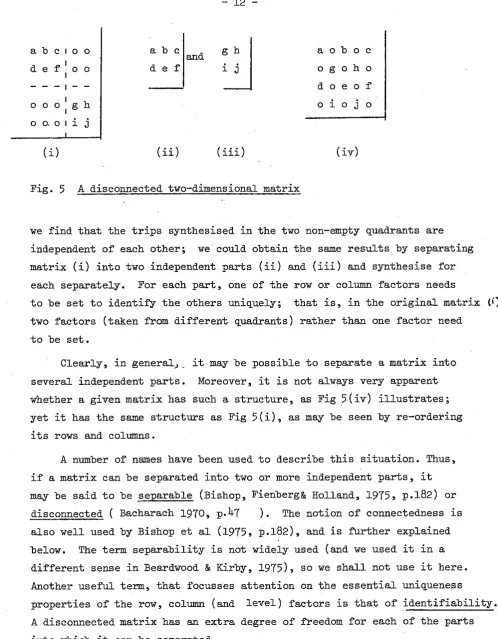
uniquely. Consider t h e s i t u a t i o n shown i n Fig
5
( i ) , i n which oppositequadrants of t h e (f. .) matrix c o n t a i n zero terms. On applying a
I J
a o b o c
d e f i j o g o h o
d o e o f
o i o j o
1
( i ) ( i i ) ( i i i ) ( i v )
Fig.
5
A disconnected two-dimensional matrixwe f i n d t h a t t h e t r i p s synthesised i n t h e two non-empty quadrants a r e
independent of each o t h e r ; we could o b t a i n t h e same r e s u l t s by s e p a r a t i n g
matrix ( i ) i n t o two independent p a r t s ( i i ) and (iii) and s y n t h e s i s e f o r
each s e p a r a t e l y . For each p a r t , one of t h e row o r column f a c t o r s needs
t o be s e t t o i d e n t i f y t h e o t h e r s uniquely; t h a t i s , i n t h e o r i g i n a l matrix ti),
two f a c t o r s ( t a k e n from d i f f e r e n t quadrants) r a t h e r t h a n one f a c t o r need
t o be s e t .
Clearly, i n general,. it may be p o s s i b l e t o s e p a r a t e a matrix i n t o
s e v e r a l independent p a r t s . Moreover, it i s not always very apparent
whether a given matrix has such a s t r u c t u r e , as Fig
5
( i v ) i l l u s t r a t e s ;y e t it has t h e same s t r u c t u r s a s Fig
5 ( i ) ,
a s may be seen by re-ordering i t s rows and columns.A number of names have been used t o describe t h i s s i t u a t i o n . Thus,
if a matrix can be separated i n t o two or more independent p a r t s , it
may be s a i d t o be separable ( ~ i s h o ~ , Fienberg& Holland, 1975, p.182) o r
disconnected ( Bacharach 1970, p.b7
.
The notion of connectedness i sa l s o w e l l used by Bishop e t a 1 (1975, p.182), and i s Purther explained
below. The term s e p a r a b i l i t y i s not widely used (and we used it i n a I
d i f f e r e n t sense i n Beardwood & Kirby, 1975), so we s h a l l not use it here.
Another useful term, t h a t focusses a t t e n t i o n on t h e e s s e n t i a l uniqueness
p r o p e r t i e s of t h e row, column (and l e v e l ) f a c t o r s i s t h a t of i d e n t i f i a b i l i t y .
A disconnected matrix has an e x t r a degree of freedom f o r each of t h e p a r t s
i n t o which it can be separated.
6.1.1
Detecting d i s c o n n e c t i v i t y i n t h e two-dimensional s i t u a t i o nA t e s t f o r d i s c o n n e c t i v i t y i n a two-dimensional matrix ( o r f o r t h e
[image:16.595.53.552.34.674.2]n
a matrix ( t . .) i s found of t h e form ( 1 ) s a t i s f y i n g t h o s e c o n s t r a i n t s ( 2 ) .
1J
The row f a c t o r s (pi) and column f a c t o r s ( q . ) a r e (we hypothesise) uniquely 1
i d e n t i f i e d by s p e c i f y i n g one of t h e s e f a c t o r s a t a p a r t i c u l a r value.
Should we choose t o change t h e value of t h a t ( o r some o t h e r ) s p e c i f i e d
f a c t o r , a 'chain' of pro r a t a m u l t i p l i c a t i o n s would be s e t up i n t h e
matrix, t h e e f f e c t of which would be t o leave t h e o r i g i n a l p r e d i c t i o n s
unchanged. For example, if t h e f i r s t generation f a c t o r (P1) were changed
by a m u l t i p l i e r al, t h e f i r s t a t t r a c t i o n f a c t o r (ql) would have t o be
changed by a m u l t i p l i e r l / a l . The d i f f e r e n c e between a connected and
disconnected matrix i s t h a t , i n t h e former, t h e m u l t i p l i c a t i o n chain
reaches a l l p a r t s of t h e matrix, whereas i n t h e l a t t e r it cannot. For a
matrix t o be connected, it must be p o s s i b l e f o r a l l c e l l s with non-zero
f . . t o be l i n k e d i n a chain, any two consecutive members of which a r e
1J
e i t h e r i n t h e same row or t h e same column.
6.3
The three-dimensional s i t u a t i o nThe two-dimensional s i t u a t i o n described above, i n which t h e f a c t o r s
( p i ) , ( q . ) may not be uniquely i d e n t i f i a b l e , i s i n f a c t of l i t t l e i n t e r e s t
i n p r a c t i c e , because t h e s e f a c t o r s a r e not used i n t h e i r own r i g h t : it
i s t h e i r product, i n t h e form p. q. f . . t h a t i s used i n s y n t h e s i s , and 1 1 1J
f o r t h i s uniqueness conditions were discussed i n
5.
But i n c a l i b r a t i o n , when we a r e dealing with a s i t u a t i o n i n which a
s e t of empirical f a c t o r s a r e determined, one f o r each i n t e r v a l of s e p a r a t i o n ,
t h e f a c t o r s ( r k ) a r e of primary i n t e r e s t , because t h e y a r e r e l a t e d t o t h e
s e p a r a t i o n o r c o s t of t r a v e l l i n g , and used i n f o r e c a s t i n g s e p a r a t e l y from
t h e values of (Pi) and ( q . ) . Moreover, with t h e p a r t i a l matrix technique J
it i s not s u f f i c i e n t t o be s a t i s f i e d t h a t t h e product pi q . r A . i s J k
unique f o r t h e observed p a r t s of t h e matrix ( a s was demonstrated i n Evans
and ~ i r b ~ . 1 9 ' 7 4 ) ; we a l s o want t h e product t o be unique f o r t h e unobserved
p a r t s of t h e matrix a s w e l l , and thislean mean t h a t a l l t h e f a c t o r s
CPi),
( q j ) and ( r k ) need t o be i d e n t i f i e d .
Thus, when c a l i b r a t i n g t o a whole m a t r i x , and even more when
c a l i b r a t i n g t o a p a r t i a l matrix with subsequent s y n t h e s i s of t h e whole
matrix, we need t o be s u r e t h a t t h e three-dimensional matrix ( A . ~ j k ) i s
not disconnected. I n f a c t , t h i s i s r a t h e r more l i k e l y t o occur t h a n with
two-dimensional m a t r i c e s s i n c e , f o r a s i n g l e mode c a l i b r a t i o n , every zone-
p a i r has but one c o s t - i n t e r c a l a s s o c i a t e d with it; and, f o r p a r t i a l
The phenomenon of a disconnected matrix i s r a t h e r more complex
and d i f f i c u l t t o demonstrate i n t h e three-dimensional s i t u a t i o n than
it i s i n t h e two-dimensional one, however. Indeed, it was only when
Hawkins of t h e Department of Transport, was exploring t h e a p p l i c a t i o n
of p a r t i a l matrix techniques t o a hypothetical s i t u a t i o n t h a t t h e
phenomenon was encountered i n t h e p a r t i a l matrix s i t u a t i o n and i n t e r p r e t e d
by D a y . (Hawkins and Day, 1979). Bishop e t a 1 (1975. p 212 e t seq)
show t h a t t h e d e f i n i t i o n of t h e appropriate measure of connectedness
i s l i n k e d with t h e d e f i n i t i o n of t h e model t h a t i s being f i t t e d .
That circumstances might occur i n which more than two of t h e
generation, a t t r a c t i o n and s e p a r a t i o n f a c t o r s ( t a k e n from d i f f e r e n t s e t s )
might need t o be s p e c i f i e d t o uniquely i d e n t i f y them a l l was recognised
by Evans and Kirby (1974, pp
116,
117). As it happened, t h e mainproofs i n t h a t paper, on t h e bniqueness of t h e t r i p s estimated i n t h e
observed c e l l s and on t h e convergence of t h e t r i - p r o p o r t i o n a l process, were v a l i d whether o r not t h e s e circumstances held, and unfortunately they
expressly excluded f u r t h e r consideration of, f o r example, t h e e f f e c t s on
t h e estimates i n t h e unobserved c e l l s should such curcumstances occur.
The e f f e c t of disconnectedness on t h e c a l i b f a t i o n f o r a partiealar
matrix (whether whole o r p a r t i a l ) , i s t h a t we could have two o r more
independent s e t s of s e p a r a t i o n f a c t o r s ; within each s e t , t h e r e l a t i v e
values of t h e s e p a r a t i o n f a c t o r s a r e c o r r e c t l y determined, but t h e r e l a t i v e
values between f a c t o r s drawn from d i f f e r e n t s e t s i s a r b i t r a r y . This
would mean t h a t , on looking a t a l l t h e separation f a c t o r s t o g e t h e r , as
a function of separation, t h e shape of t h e f i n c t i o n would i n general not
be c o r r e c t l y i n t e r p r e t e d . Thus, i n forecasting,the r e l a t i v e e f f e c t s on
t h e mount of t r a v e l of changes i n zone t o zone journey c o s t s may be
inadequately depicted.
Hawkins and
D w
encountered t h i s e f f e c t on examining t h e s i t u a t i o ni n which t h e parameters (pi), ( q . ) and ( r k ) were not only estimated from
J
a
p a r t i a l matrix of observations, but a l s o used t o s y n t h e s i s e t r i p s i n t h e Unobserved p a r t s . They found t h a t a change i n t h e values f o r t h eseparation f a c t o r s assumed at t h e start of t h e i t e r a t i v e process l e d t o
differences i n t h e values f o r t h e t r i p s synthesised f o r t h e unobserved
c e l l s .
6.2.1
Detecting d i s c o n ~ e c t i v i t y i n t h e three-dituensional s i t u a t i o nThe i d e n t i f i a b i l i t y or-otherwise of t h e f a c t o r s ( p i ) , (9.1 and ( r k )
J
cannot be d e t e c t e d by examining t h e performance of t h e c a l i b r a t i o n
zones, and the constraints for the cost bands, are all well met (if
the process converges). Hawkins and Day
(1979)
suggest that the effectcould be detected in practice by doing as they did, applying the partial
matrix technique to an idealised situation. This requires the synthesis
of a trip distribution for the whole matrix, using some arbitrary but
non-trivial separation function; followed by a calibration with an
empirical function to those parts for which observations exist.
A systematic procedure for detecting non-identifiability is similar
in principle to that described in 6.1.1, but is more complex because at
least two factors may now be arbitrarily set. Murchland
(1978)
has provided a rigorous procedure for detecting the effect, dealing with themore comprehensive case in which all possible combinations of i, j and k
might occur. Some simplification of this procedure is probably possible,
for the usual single-mode situation in which there is only one value of k
for a given i, j pair. All that is needed for that situation is a two-
dimensional matrix indicating for each observed zone-pair its corresponding
cost-interval, with unobserved zone-pairs indicated by a 'zero'.
6.2.2 Avoiding disconnectivitg in the three-dimensional situation
An
extreme way of avoiding a calibration situation in whichdisconnectedness occurs is to use an analytic form of separation function
rather than an empirical set of separation factors. Thus the calibration
process becomes one of estimating, say, the parameters a and
B
in afunction of the form f(c) = e c-*- rather than with the' factors (rk); the
three-dimensional situation is itself avoided. Essentially, the analytic
function makes the link between the different cost intervals. Whether
other, related, kinds of estimation problem might occur is not however
yet known for this situation; especially if different parameters are
assumed to apply to different parts of the matrix.
Assuming,however, that one wants to explore the empirical shape of
the separation function before prescribing an analytic form for it, one
might stay with the three-dimensional representation. If disconnectedness
is detected, it may then be removed by redefining one (or more) of the
cost intervals so as to overlap the costs occurring in the two unconnected
portions of the matrix. Such links could be made at different places:
and, indeed, this is advisable, to guard against having a loosely-connected
-.
A l t e r n a t i v e l y , a modified c a l i b r a t i o n procedure could be adopted,
i n which t h e s e p a r a t i o n f a c t o r s a r e e s s e n t i a l l y l i n k e d with one another
by a smoothing process automatically. A method has been suggested by
Murchland (1979) which achieves t h i s by a s s o c i a t i n g with each ( i , j ) p a i r
not j u s t t h e i n t e r v a l k i n which t h e cost c .
.
f a l l s , but a l s o ( s a y ) t h e1 J
i n t e r v a l s k-1 and k + l . I n t h e c a l i b r a t i o n process, a weighted average
of t h e f a c t o r s rk-l, rk, rk+l would be used t o e s t i m a t e t h e t r i p s i n a
given c e l l . It i s understood t h a t such a technique i s used by Wootton.
Whilst t h e technique w i l l undoubtedly reduce t h e r i s k of disconnectedness
occurring, it has y e t t o be demonstrated whether it w i l l avoid
it
i n a l l cases.7. REPRESENTATIVENESS AND RELIABILITY
Even f o r s i t u a t i o n s i n which n o n - i d e n t i f i a b i l i t y i s not a problem,
t h e estimates f o r t h e model parameters may be such a s t o make t h e estimates
of t h e t r i p s i n t h e unobserved c e l l s more u n r e l i a b l e t h a n t h e estimates
f o r t h e t r i p s i n t h e observed c e l l s * . I n o t h e r words, t h e model might
be a good f i t t o t h e d a t a one has g o t , but a poor f i t t o t h e d a t a one has
not got! This i s being i l l u s t r a t e d i n p r a c t i c e by some s t u d i e s which
have found t h a t t h e estimates of t h e trip-end t o t a l s o b t a i n e d by
a p p l i c a t i o n of t h e p a r t i a l m a t r i x techniques can be very d i f f e r e n t from
those obtained by t h e a p p l i c a t i o n of t r i p generation and a t t r a c t i o n
r e l a t i o n s h i p s . Of course, i n t h o s e s t u d i e s , t h e r e may be i n c o m p a t i b i l i t i e s
i n t h e d a t a sources and r e l a t i o n s h i p s which i n p a r t account f o r t h e s e
d i f f e r e n c e s . But o t h e r s t u d i e s have found t h a t t h e e s t i m a t e s f o r t h e
unobserved c e l l s can be very s e n s i t i v e t o changes i n t h e values f o r t h e
observed t r i p end t o t a l s
ranst st on,
1978). We s h a l l h e r e review j u s t t h o s e i s s u e s which might make t h e a p p l i c a t i o n of t h e p a r t i a l matrix techniquei t s e l f u n r e l i a b l e . We d i s c u s s t h e s e i s s u e s i n a t e n t a t i v e way, s i n c e a
c l e a r understanding of all t h e f a c t o r s a f f e c t i n g t h e r e l i a b i l i t y of t h e
estimates i n t h e mobserved c e l l s has y e t t o be reached.
*Note
-
We include h e r e both models with an a n a l y t i c form of s e p a r a t i o n function,such a s I?
*
"
j
c. y e ,
and an empirical s e t of s e p a r a t i o n f: c t o r s ( r ) ;1 J k
and by parameters we mean not only t h e
d,B
oc ( r k ) v a l u e s , but a l s o t h e (pi) and ( q . ) valuesJ
F i r s t of a l l , we note t h a t , i n many p a r t i a l matrix a p p l i c a t i o n s , t h e
d a t a obtained i s not n e c e s s a r i l y r e p r e s e n t a t i v e of t h a t f o r t h e whole matrix.
For example, i n t r a z o n a l t r i p s a r e g e n e r a l l y s h o r t e r t h a n , and external-external
t r i p s g e n e r a l l y longer than t h o s e i n o t h e r p a r t s of t h e matrix, so t h a t ,
were no d a t a t o be a v a i l a b l e f o r e i t h e r of t h e s e movements, t h e t r i p
l e n g t h frequency d i s t r i b u t i o n w i l l be d i s t o r t e d from t h e shape a p p r o p r i a t e
t o t h e whole matrix.
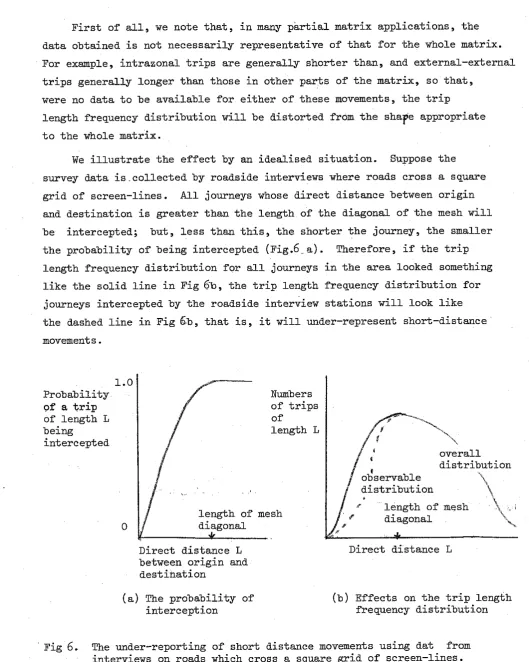
We i l l u s t r a t e t h e e f f e c t by an i d e a l i s e d s i t u a t i o n . Suppose t h e
survey d a t a i s c o l l e c t e d by roadside interviews where roads c r o s s a square
g r i d of screen-lines. A l l journeys whose d i r e c t d i s t a n c e between o r i g i n
and d e s t i n a t i o n i s g r e a t e r t h a n t h e l e n g t h of t h e diagonal of t h e mesh w i l l
be i n t e r c e p t e d ; b u t , l e s s t h a n t h i s , t h e s h o r t e r t h e journey, t h e smaller
t h e p r o b a b i l i t y of being i n t e r c e p t e d
( ~ i ~ . 6
a ) . Therefore, if t h e t r i pl e n g t h frequency d i s t r i b u t i o n f o r a l l journeys i n t h e a r e a looked something
l i k e t h e s o l i d l i n e i n Fig 6 b , t h e t r i p l e n g t h frequency d i s t r i b u t i o n f o r
journeys i n t e r c e p t e d by t h e roadside interview s t a t i o n s w i l l look l i k e
t h e dashed l i n e i n F i g 6 b , t h a t i s , it w i l l under-represent short-distance
movements
.
1 . 0
P r o b a b i l i t y Numbers
of a t r i p of t r i p s
of l e n g t h L of
being l e n g t h L
i n t e r c e p t e d
l e n g t h of mesh 0
D i r e c t d i s t a n c e L between o r i g i n and d e s t i n a t i o n
( a ) The p r o b a b i l i t y of i n t e r c e p t i o n
o v e r a l l d i s t r i b u t i o n observable 'r 'I
/
d i s t r i b u t i o na
"
l e n g t h of mesht
, . . If diagonal i
..
4D i r e c t d i s t a n c e L
( b ) E f f e c t s on t h e t r i p l e n g t h frequency d i s t r i b u t i o n
[image:21.595.46.576.56.719.2]Now t h i s e f f e c t i s not n e c e s s a r i l y important i n i t s e l f , s i n c e t h e
model i s f i t t e d only t o ~ e observed c e l l s , and it i s of course appropriate
t o make it such a s t o agree with t h e t r i p l e n g t h frequency d i s t r i b u t i o n
f o r those observed c e l l s . What we a r e e s s e n t i a l l y t r y i n g t o do though
i s t o estimate from a p a r t i a l matrix values of t h e parameters t h a t a r e
a p p l i c a b l e t o t h e whole matrix. We t h e r e f o r e need t o ensure i f p o s s i b l e
t h a t n e i t h e r t h e d a t a s t r u c t u r e , nor t h e model s t r u c t u r e , nor t h e estimation
procedure used, introduce p a r t i c u l a r d i s t o r t i o n s t o t h e e s t i m a t e s of t h e
parameters. We d i s c u s s t h e s e i n t u r n .
7.1 Data s t r u c t u r e
Clearly, t h e first consideration i s t h a t a l l t h e c o s t - i n t e r v a l s (k)
t h a t occur i n t h e unobserved c e l l s a l s o occur i n t h e observed c e l l s , which
must include a t l e a s t one c e l l with a non-zero observation. But if f o r
a given cost i n t e r v a l ( o r zone f o r t h a t m a t t e r ) t h e number of c e l l s with
non-zero observations i s a low proportion of t h e number of c e l l s observed,
and t h e numbers of c e l l s i n t h e observed p a r t of t h e matrix i s a low
proportion of t h e number i n t h e matrix a s a whole, We might have reason
t o t h i n k t h a t e r r o r s i n t h e d a t a and t h u s i n t h e s e p a r a t i o n f a c t o r s might
be magnified i n t h e i r e f f e c t when used t o estimate t h e values i n t h e
missing c e l l s . This e f f e c t might be a l l t h e more s e r i o u s i f t h e excluded
c e l l s i n a given c o s t i n t e r v a l ( o r zone) were such t h a t t h e y might be
estimated t o contain l a r g e numbers of t r i p s , but t h e included c e l l s i n
t h a t i n t e r v a l contained only small numbers of t r i p s . Such considerations
suggest t h a t some simple explolratory analyses of t h e d a t a might provide
h e l p f u l i n s i g h t s .
I
7.2
Model s t r u c t u r e and d a t a s t r u c t u r eFor t h e i s s u e s discussed h e r e , t h e r e a r e e s s e n t i a l l y two kinds of
problem: well-conditioned ones, t h a t i s , t h o s e f o r which small changes
t o t h e d a t a input l e a d t o small changes i n t h e e s t i m a t e s ; and ill-conditioned
problems, i n which small changes i n d a t a input l e a d t o l a r g e changes i n t h e
estimates. Branston (1979) of Greater Manchester Council has provided an
example of t h e l a t t e r s i t u a t i o n . It i s of course ill-conditioned problems
which we need t o be a b l e t o d e t e c t and i f p o s s i b l e cure.
The considerations of 7 . 1 were suggestive of some exploratory analyses;
o r t h e i r magnitude o r how they might be resolved. Three formal ways of
i n v e s t i g a t i n g t h i s might be a s follows:
a Estimate t h e variances and covariances of t h e model parameters
a s well a s t h e means, and t h u s e s t i m a t e t h e variances of t h e estimates
of t h e number of t r i p s i n t h e observed and unobserved c e l l s .
b. Perturb t h e d a t a input and see what e f f e c t it has on t h e c a l i b r a t i o n .
c. Analyse t h e l i n k a g e s between t h e d i f f e r e n t components of t h e model
f o r t h e given d a t a s t r u c t u r e , and t h e d a t a i t s e l f , i n order t o
i d e n t i f y t h o s e p a r t s o$he matrix which most a f f e c t t h e t r i p
estimates made f o r t h e unobserved c e l l s .
Both ( b ) and ( c ) a r e forms of s e n s i t i v i t y a n a l y s i s , but with methods
of t h e t y p e ( c )
-
a s s m i n g t h a t t h e y can be developed-
it should becomep o s s i b l e t o d e t e c t whereabouts more d a t a might be needed i n t h o s e
s i t u a t i o n s f o r which t h e technique seems u n r e l i a b l e ; and i n due course
t o l e a r n what kinds of p a r t i a l matrix s t r u c t u r e ought t o be avoided.
For ( a ) , methods of estimating t h e variances and co-variances of t h e
parameters a r e well-developed i n t h e s t a t i s t i c a l l i t e r a t u r e on t h e
a n a l y s i s of contingency t a b l e s , p a r t i c u l a r l y i n t h e f i e l d of log-linear
models (which i s t h e form t h a t t h e g r a v i t y model t a k e s ) . Computer packages
such a s GLIM
elder,
1974) and CATLIN ( ~ r i z z l e , Starmer & Koch, 1969) e x i s t f o r making such e s t i m a t e s and may be s u i t a b l e f b r use on smaller s c a l e problems (Hutchinson, 1977); but it i s probable t h a t some adaptationand approximation w i l l be required before t h e variance e s t i m a t e s can be
made f o r problems of t y p i c a l t r a n s p o r t a t i o n study s i z e . It may, however,
i n c e r t a i n cases be p o s s i b l e t o express t h e variances i n t h e e s t i m a t e s
of t h e numbers of t r i p s simply i n terms of t h e variances and means of
t h e parameter e s t i m a t e s (Murchland, 1978).
For ( b ) , it i s very easy i n p r i n c i p l e t o s e e what happens if t h e
input d a t a i s changed. But it can be time-consuming and c o s t l y i n p r a c t i c e
t o do t h i s u n l e s s e i t h e r one perturbs a l l t h e d a t a a t once ( i n which case
one i s u n l i k e l y t o know which changes had g r e a t e s t e f f e c t ) o r one has
a s t r a t e g y f o r s e l e c t i n g t h o s e items of d a t a which one suspects might
have t h e g r e a t e s t e f f e c t . It w i l l a l s o be important i n p r a c t i c e t o
have an adequate means of i s o l a t i n g where t h e main e f f e c t s of such
p e r t u r b a t i o n s a r e apparent. P e r t u r b a t i o n s t o t h e d a t a might be b e s t
For ( c ) , t h e r e a r e a t p r e s e n t no procedures known t o t h e author
which have been developed, but t h e r e a r e a t l e a s t two suggestions t h a t have been
advanced which might i n d i c a t e ways forward f o r t h e s i t u a t i o n i n which a s e t
of empirical s e p a r a t i o n f a c t o r s a r e t o be estimated. Hawkins and Day (1979)
point out t h a t , although a c o s t - i n t e r v a l matrix may be connected, t h e
connections between d i f f e r e n t p a r t s of t h e matrix may be weak; f o r example,
s i n g l e occurrence of a p a r t i c u l a r c o s t - i n t e r v a l may alone a c t a s t h e
'bridge' between two p a r t s of t h e matrix. We can r e f e r t o such a matrix a s
being l o o s e l y or weakly connected. Then t h e r e l a t i v e values i n f e r r e d f o r t h e
s e t s of s e p a r a t i o n f a c t o r s t h a t a r e , i n a manner of speaking, on e i t h e r s i d e
of t h i s bridge, a r e p a r t i c u l a r l y dependent on t h e number of t r i p s i n t h i s
c e l l . If t h i s number i s s m a l l
-
and of course it could be zero-
t h e e f f e c tof d a t a e r r o r on t h e r e l a t i v e values might be l a r g e , Leading t o , % r e l a t i v e
.
i n s t a b i l i t y i n t h e e s t i m a t e s obtained f o r t h e unobserved c e l l s .A second suggestion f o r a s i t u a t i o n which might g i v e r i s e t o
a
r e l a t i v e i n s t a b i l i t y between t h e synthesised values f o r t h e unobservedc e l l s and t h o s e f o r t h e observed c e l l s was made by Kirby i n t h e course
of discussing t h e Hawkins and Day problem. It i s b e s t described by an
example. Suppose t h a t t h e rows and columns of t h e c o s t - i n t e r v a l matrix
have been so re-ordered t h a t t h e unobserved c e l l s a r e contained i n t h e
quadrant a s i n Fig 7. (We do t h i s f o r t h e sake o f c l a r i t y ; it i s i n
general n e i t h e r necessary nor p o s s i b l e t o s o r e - o r d e r t h e m a t r i x ) .
observed c e l l s
Fig.7 Cost i n t e r v a l matrix showing differences i n t h e couplin: of t h e f a c t o r s applying t o t h e observable and unobservable p o r t i o n s
The s i t u a t i o n shown i n Fig 7 i s such t h a t t h e c o s t s occurring i n t h e
unobserved c e l l s (bottom r i g h t hand quadrant) occur only i n t h e opposite
quadrant. Thus, i n c a l i b r a t i o n , t h e s e p a r a t i o n f a c t o r s f o r t h e s e w i l l
be determined i n a s s o c i a t i o n with generation and a t t r a c t i o n f a c t o r s t h a t
do not apply t o t h e unobsewed quadrant. This suggests a looseness i n t h e
coupling of t h e d i f f e r e n t f a c t o r s t h a t may a f f e c t t h e r e l i a b i l i t y of
t h e elements synthesised f o r t h e unobserved c e l l s . But it should be
s t r e s s e d t h a t , a t t h e p r e s e n t time, it i s only a matter of conjecture
7.3
Estimation procedureF i n a l l y , we note t h a t , s i n c e p a r t i a l matrix techniques i n p r a c t i c e
a r e u s u a l l y such a s t o reduce t h e numbers of observations t h a t we have
of shorter-distance movements, t h e e r r o r s a s s o c i a t e d with t h o s e observations
a r e correspondingly g r e a t e r t h a n they would have been. I f t h e c a l i b r a t i o n
process t a k e s proper account of t h e presence of sampling v a r i a b i l i t y
then t h e r e i s l i k e l y t o be g r e a t e r chance of consistency between t h e
r e s u l t s of a c a l i b r a t i o n on a p a r t i a l matrix and a c a l i b r a t i o n on a whole
matrix. Kirby and Leese (1978) showed t h a t assuming (amongst o t h e r t h i n g s )
t h a t t h e survey method i s homogeneous, one a p p r o p r i a t e method would be
t o c a r r y out t h e c a l i b r a t i o n on ungrossed up d a t a i n s t e a d of t h e grossed
up d a t a t h a t i s normally used.
8. EMPIRICAL QUESTIONS
So f a r a s t h e author i s aware, t h e r e has been very l i t t l e work done
t o t e s t out t h e empirical v a l i d i t y of t h e p a r t i a l matrix technique. For
example, t o what e x t e n t i s under o r over estimation i n t h e unobserved
c e l l s l i k e l y t o happen i n p r a c t i c e , a f t e r c a l i b r a t i n g on t h e observed
7
c e l l s . Are t h e r e ways of determining what i s a good p a t t e r n of roadside
interview s t a t i o n s and what i s a bad p a t t e r n (from t h e p o i n t of view
of being a b l e t o e s t i m a t e unobservedmovements from t h i s model)? Are t h e r e
ways of determining where
it
might be h e l p f u l t o c o l l e c t e x t r a d a t a t o improve t h e e s t i m a t i o n procedure? F i n a l l y , what evidence i s t h e r e t h a tt h e model i s any good anyway?
An example of t h e kind of empirical work t h a t would be h e l p f u l
i s a systematic comparison of t h e estimates f o r t h e unobserved c e l l s
obtained using t h e p a r t i a l matrix technique with t h o s e given by t h e
survey d a t a , when d i f f e r e n t p a t t e r n s (and numbers) of c e l l s a r e excluded
from a whole matrix (obtained f o r example from home i n t e r v i e w d a t a ) .
Cunliffe and Nesbitt (1977) s a i d ( b u t d i d not r e p o r t ) t h a t they had made
one such comparison, and Hardcastle (1978) has done another. It i s
not known whether h i s r e s u l t i s t y p i c a l , but Hardcastle found t h a t , on
excluding i n t r a z o n a l c e l l s , t h e s e p a r a t i o n f a c t o r s obtained from a
c a l i b r a t i o n t o t h e p a r t i a l matrix were under-estimated i n t h e s h o r t -
9 . DISCUSSION
I n t h i s r e p o r t we have reviewed t h e t h e o r e t i c a l background t o t h e
use of t h e p a r t i a l matrix technique, t h e conditions under which it f a i l s
t o work a t a l l , and t h e examination of t h e circumstances i n which it
m a y be p a r t i c u l a r l y prone t o e r r o r . Some of t h e problems discussed have
only been r e c e n t l y r e a l i s e d and t h e most appropriate ways of r e s o l v i n g
them a r e very much t h e s u b j e c t of current research and debate. It i s
evident t h a t t h e r e i s a d e a r t h of l i t e r a t u r e and r e s e a r c h t h a t have
i n v e s t i g a t e d t h e b a s i c p r o p e r t i e s of t h e technique, h i t h e r t o , and r e a d e r s
with experience i n t h e use of t h i s technique a r e i n v i t e d t o l e t t h e
author know of t h e i r f i n d i n g s
-
good or bad!-
i n t h e use of t h i stechnique
-
p a r t i c u l a r l y if t h e y have undertaken some of t h e kinds ofanalyses suggested i n s e c t i o n
8.
10. ACKNOWLEDGEMENTS
The f i r s t d r a f t of t h i s a r t i c l e was prepared i n response t o i s s u e s
r a i s e d by D. Hardcastle, formerly of West Sussex County Council. I t s
present form owes much t o t h e discussions t h a t have taken place over t h e
problems encountered with t h e technique by A.F. Hawkins and M. Day
of t h e Department of Transport and by D.M. Branston of Greater Manchester
Council. P a r t i c u l a r acknowledgement i s made of t h e comments of A.F.Hawkins
and D r . J . D . Murchland; H.F. Gunn, J. Wootton and W.Wyley have a l s o
11 REFERENCES
BACHARACH, M. (1970) Biproportional matrices and input-output change. Cambridge : University Press.
BISHOP, Y.M.M., S.E. FIENBERG and P.W. HOLLAND (1975) D i s c r e t e
m u l t i v a r i a t e a n a l y s i s : theory and p r a c t i c e . Cambridge, Mass., London: MIT Press.
BEARDWOOD, J . E . and H.R. KIRBY (1975) Zone d e f i n i t i o n and t h e g r a v i t y model.: t h e s e p a r a b i l i t y , e x c l u d a b i l i t y and c o m p r e s s i b i l i t y p r o p e r t i e s . Transpn. Res
.
9 , 363-369.BRANSTON, D.M. (1979) The s e n s i t i v i t y of t r i p matrices produced by t h e p a r t i a l matrix technique t o e r r o r s i n t h e assumed t r i p end c o n s t r a i n t s . Manchester: Greater Manchester Council,
County ~ n ~ i n e e r ' s Department, Transportation Planning~Group, TPG Note 54.
CUNLIFFE, J . M . and P.G. NESBITT (1977) Bi-modal s p a r s e matrix expansion
-
an I r i s h a p p l i c a t i o n . T r a f f . Enang. Control, (121, 572-574.DAY, M.J.L. and A.F. HAWKINS (1979) P a r t i a l matrices, empirical d e t e r r e n c e functions and i l l - d e f i n e d r e s u l t s . TraffbEngng. & Control,
DELTRAN ANALYSIS
LTD
(1977) Report t o Kent County Council on t h e Deal T r i p Matrix t e s t s , May 197.
van EST, J and J . van SETTEN (1977) C a l i b r a t i o n methods: a p p l i c a t i o n f o r some s p a t i a l d i s t r i b u t i o n models. D e l f t : Planologisch Studie Centrum TNO, Working Paper
6.
EVANS, S.P. and H.R. KIRBY (1974) A three-dimensional Furness procedure f o r c a l i b r a t i n g g r a v i t y models Transpn. Res. 8 , 105-122.
GRIZZLE, J . E .
,
C .F. STAFNER and G.G; ,KOCH (1969) Analyses of c a t e g o r i c a l d a t a by l i n e a r models.Biometries
,
25, 489-504HARDCASTLE, D. J. (1978) P r i v a t e communication
HASKEY, J . C . (1972) Zonal t r i p flow e r r o r a n a l y s i s . London: Department I of t h e Environment, Math.Adv.Unit
.
,
MAU Note 241.i
HASKEY, J . C . (1973) E m p i r i c a l methods f o r judging t h e e f f i c a c y ofmathematical models f o r t r a n s p o r t a t i o n s t u d i e s . Proc.PTRC Seminar on Urban T r a f f i c M-dels, held a t Univ. Sussex, June, 1973. Vol. 1, Paper F 2 ( i )
.
London: Planning &Transport Research & Computation Co. Ltd.
HUTCHINSON, T.P. (1977) Application of CATLIN t o t r i p d i s t r i b u t i o n . London: U n i v e r s i t y College London, Transport Studies Group,