A TARGET
FOR
EURATOM
REPORT
submitted by
Mr. Louis ARMAND, Mr. Franz ETZEL and Mr. Francesco GIORDANI
at the request of the governments
of Belgium, France, German Federal Republic, Italy,
Luxembourg and the Netherlands
CONTENTS
Page
LETTER OF SUBMITTAL • . . • • • • . • • • • . ' . • . . • • • • . . • • . . • . . . • . . 7
REPORT A TARGET FOR EURATOM Preface... 13
Establishment of a Target. Europe's Energy Problem . . . 15
Scope for Nuclear Power . . . 18
Conditions of Achievement. Cooperation with the United States, the United Kingdom and Canada . . . 25
Reactor Construction . . . 28
Fuel Requirements . . . 30
Cost of Nuclear Electricity . . . 33
Investments . . . 36
ANNEXES I. The Energy Economy of the Euratom Countries . . . 43
II. Nuclear Power Prospects... 63
III. Scope for Nuclear Power... 79
IV. Growth of Electricity System in the Euratom Countries . . . 89
LETTER OF SUBMITTAL
of Messrs. Armand, Etzel and Giordani to the Ministers of
Foreign Affairs of the six Euratom countries
May 4th, 1957
Your Excellency,
In accordance with the terms of reference laid down for us
by
yourself and your colleagues, we have the honour to attach our Report
on the amounts of nuclear energy which can be produced in the near
future in the six Euratom countries, and the means to be employed
for this purpose.
In order to draw up our Report, we first of all consulted the
government and industrial circles responsible for nuclear energy in
our countries. We held a series of discussions in Paris, Brussels and
Bonn with the authorities and with leading figures from the French,
Italian, Belgian, Netherlands and German industries. In view of the
shortness of the time at our disposal, the Italian representatives were
good enough to come specially to Paris, and the Netherlands
rep-resentatives to Brussels. In Brussels we had the further advantage
of being able to discuss our problems with Mr. Spaak and his
col-leagues of the Intergovernmental Conference on the Common Market
and Euratom.
-We were enabled in this way to obtain a general picture of
the outlook with regard to energy requirements and resources, and
of the nuclear programmes envisaged in each of the six countries. At
the invitation of the American, British and Canadian Governments,
we then visited their countries in order to study on the spot, with the
assistance of qualified experts, the results of their work in the nuclear
field and the conclusions to be drawn from it. These tours were
exceedingly valuable from the fact-finding point of view.
In the United States, we were received by President
Eisen-hower. We had talks with the Secretary of State, Mr. John Foster
Dulles, with the President of the Atomic Energy Commission, Mr.
Lewis Strauss, and with his colleagues and assistants. We inspected
an atomic power station now in process of completion at
Shipping-port, and also visited the National Laboratory at Oak Ridge, one of
the main American nuclear research centres. In New York, at a
meeting arranged by the Atomic Industrial Forum, we met the heads
of the principal industrial firms working on the peaceful uses of
nuclear energy.
In Canada, we talked with the Minister of Economic Affairs,
Mr. Howe, and with the president of Atomic Energy of Canada Ltd.,
Mr. Bennett. We
w~realso taken on a particularly instructive tour
of the Canadian Atomic Research Centre at Chalk River.
In Britain, we met Lord Salisbury, Lord President of the
Council, Lord Mills, Minister of Power, Sir Edwin Plowden,
Chairman of the Atomic Energy Authority, and his colleagues and
staff, and Lord Citrine, Chairman of the Central Electricity
Authority, and his colleagues. We were given valuable information
when we were shown round Calder Hall. We also had various
profitable discussions with representatives of the industrial groups
which have been set up in Britain to build atomic power stations.
-We take this opportunity to thank the American, British and
Canadian Governments and all those who helped us to derive such
benefit from our inquiries.
The American Atomic Energy Commission and the British
Atomic Energy Authority in addition most kindly put at our
disposal experts whom we were able to consult after we returned, in
order to line up our technical information on the American and
British reactors in our Report and its annexes.
Our special thanks are due on the American side to Mr.
Richard Cook, Deputy General Manager of the Atomic Energy
Commission, Mr. Paul Fine, Director of the Operations Analysis
Division, Mr. Louis Roddis, Deputy Director of the Reactor
Development Division, and Mr. Andrew Vander Weyden, Deputy
Director of the Division of International Affairs; and on the
British side to Dr. Hill, Deputy Director of Technical Policy at
the Atomic Energy Authority, Dr. Brown, Deputy Chief Engineer
of Civil Reactors, and Mr. Johnson, Overseas Manager in the
Technical Policy Branch. We are particularly grateful to them
for their invaluable assistance.
We are, of course, entirely at your disposal as regards
answering any questions you may desire to ask us after reading the
Report and annexes. We would conclude by thanking your Excellency
for the honour which you and your colleagues did us in entrusting us
with a mission which was of such vital importance for the future of
our countries in view of their very serious energy position and the
potentialities opened up
by
nuclear energy.
We have the honour to remaz.n, Your Excellency's most
obedient servants,
ARMAND ETZEL GIORDANI
-REPORT
PREFACE
On November 16, 1956, the Ministers of Foreign Affairs of
Belgium, France, the German Federal Republic, Italy,
Luxem-bourg and the Netherlands instructed us to report 'on the amount
of atomic energy which can be produced in the near future in the
six countries, and the means to he employed for this purpose'.
On March 25, 1957, the Treaty instituting the European
Atomic Energy Community (Euratom) was signed by the same
Ministers in Rome and is now being submitted to the parliaments
of our six countries. In the hope that this Community can begin
to function in the very near future, we have entitled our report:
A Target for Euratom.
While endeavouring to define this objective, we have been
aware of the unique chance which the advent of nuclear energy
offers our countries. Only ten years ago, Europe seemed to be
condemned to have less abundant and more expensive energy
than the United States; nobody would have imagined that this
opportunity would emerge. Today, it can be said that if our
countries, guided and stimulated by Euratom, make the
neces-sary effort they will in future command-as the New World does
now-abundant and cheap energy supplies, enabling them to
enter boldly into the atomic era.
-ESTABLISHMENT OF A TARGET
Europe's Energy Problem.
In the 19th century coal, produced cheaply and
abundant-ly, multiplying a hundredfold the effectiveness of human effort,
turned Europe into the 'workshop of the world'. In the last five
years of postwar expansion, Europe has suddenly discovered that
this favourable situation has entirely changed and that a new
fact conditions all its prospects: the shortage of energy threatens
to become a rna
j
or brake on economic growth. This is the context
in which the new prospects opened up by nuclear power must be
assessed. It has become a practical possibility at a turning point
in Europe's economic history (1).
In 1870, total world energy production amounted to 218
million tons of coal. Of this, the United Kingdom and our six
countries together produced three-quarters. The story of the
industrial development of the nineteenth century is bound up in
these figures. Britain and the Continent not only powered their
own unprecedented industrial progress; they were the great
exporters of energy and its products to the world.
Unfortunately, if Europe's internal resources of energy
were abundant by the standards of 1870, it is becoming clear that
by the far higher ones of 1957 and still more of 1970, they are,
and will be, increasingly inadequate. Though today our six
(1) Annex I gives a detailed picture of the energy problems of the six countries to-gether and individually.
-countries alone mine more coal than the world did in 1870, they
provide only 15o/
0of world energy production. The rapid growth
of their imports since the war shows that Europe's own supplies
of all kinds of energy are falling far behind demand.
On the eve of the second world war, our six countries'
energy imports were only five per cent of total requirements.
During the postwar recovery they began to rise steeply. This was
generally assumed to he temporary, while European coal
pro-duction got back on its feet. And, indeed, in 1950 something like
the pre-war equilibrium seemed to he within reach. But now, after
the growth of the last seven years, it is clear that the demand in
industry and transport, in the home and in agriculture is rapidly
outrunning internal supply. Europe has lost its independence in
energy.
The greatest possible effort to increase the output of energy
from conventional sources must be undertaken in our six
coun-tries. But, however great this effort, it cannot keep pace with our
needs. The conditions in which coal is mined, much less favourable
to mechanization than in the United States, slow up the possible
rate of growth. As more coal is sought, the veins to he exploited
become deeper and more difficult to work, setting a limit to the
further expansion of output. The same applies to hydro-electric
power, the resources of which have been already largely
develop-ed. As for oil and natural gas, the prospects in our countries are
good, but not by any means on a scale to bridge the gap between
needs and supplies.
Europe's energy imports would rise to intolerable heights
without nuclear power. Today already the six countries import
nearly a quarter of their energy supplies, the equivalent of 100
million tons of coal, most of which is oil from the Middle East.
The Suez Crisis has shown how precarious these supplies are.
-For the future, we have assumed the greatest possible
development of conventional power sources, and have based our
estimate of energy requirements on a moderate hut steady rate
of economic expansion which is considerably slower than that
since the war. Every effort has to be made to increase domestic
production, hut it must he realized that even on this assumption
fuel imports into our countries would double in ten years and
treble in twenty. They would reach 200 million tons (33% of total
requirements) in 1967 and might reach 300 million tons (40%) ten
years later. (See Fig. A p. 21.)
These enormous figures in fact call in question the whole
future of Europe's economic growth, and even of its political
security in the world. First, they imply an annual hill for energy
imports rising (in round figures, at constant prices) from$ 2 billion
now to
$
4 billion by 1967 and
$
6 billion by about 1975. Even
taking into account the part of this hill met in national currencies,
especially through the contribution of our merchant marine, the
need for foreign exchange would put a most severe strain upon
the balance of payments of our countries. The need to earn this
additional foreign currency would also involve very important
investments in export industries. And the increased pressure to
sell on the world market would tend to push the terms of trade
against Europe, a point of vital importance to the world's
greatest trading area.
A second, still graver threat is the evidence, provided by
recent political events and the ensuing oil shortage, that even the
availability of imported energy is uncertain. Oil already provides
over a fifth of our countries' energy supplies. It is cheaper per
calorie than imported coal, and it is more convenient to handle
and use. It is therefore likely that most of the increase in the
demand which must be met by imports will take the form of oil.
-We cannot expect to obtain this oil from the -Western
Hemisphere because demand there is rising faster than production.
The only region of the world capable of supplying these quantities
is the Middle East, where a very high proportion of world oil
reserves is located. The oil discoveries in the Sahara are promising,
but it can hardly he expected to provide more than a fifth of our
energy imports by the mid-sixties. Thus without nuclear power,
Europe's dependence on the Middle East is hound to increase.
The Suez Crisis has given us a warning of what this could mean. As
the quantity of oil imported from the Middle East increases, there
will he a corresponding increase in the political temptation to
interfere with the flow of oil from that region. A future stoppage
could be an economic calamity for Europe. Excessive dependence
of our highly industrialized countries on an unstable region might
even lead to serious political trouble throughout the world. It
is essential that oil should be a commodity and not a political
weapon.
The European economy must he protected against an
interruption of oil supplies, by finding alternative sources of
energy to limit the further rise in oil imports. Only nuclear power,
providing Europe with a new source of energy, can achieve this.
Scope for Nuclear Power.
Though it may he used to propel ships and to heat urban
areas, the real contribution of nuclear energy in the next twenty
years will be to produce base-load electricity in big power
stations (1).
Electricity consumption is growing rapidly, doubling every
ten or twelve years. To cover this new demand, the domestic
(1) Base-load electricity ispowerproducedround the clock, as distinctfrom'peak-load' power produced for only a few hours each day.
-sources of energy specially adapted for power production (water,
lignite, low-grade coal and natural gas) must he developed to the
utmost. Even so, they cannot together meet more than one-third
of the increase of electricity needs in the next twenty years.
Two-thirds of the additional output must come from power stations fired
with imported oil or coal, unless nuclear stations are built
in
their
stead. The increase in production of saleable coal will be absorbed
by other uses, especially for coke-ovens. The capacity of such
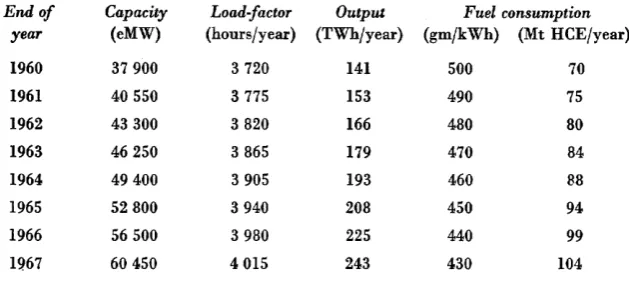
power stations is estimated to rise by 22.5 million kW, from 38
million kW at the end of 1960 to 60.5 million kW by the end of
1967, apart from replacements amounting to more than 5 million
kW
in
this period (see Fig. E Annex III p. 83). This is the field
into which nuclear power can he fitted.
Every year that is lost in constructing nuclear power
stations means that conventional stations, requiring increased oil
or coal imports-and which continue to consume oil or coal
throughout their lifetime of twenty or thirty years-will he built
instead. In view of this situation, Europe must within the limits
set by the pattern of electricity production, construct nuclear
stations as rapidly as possible.
Nuclear plants take up to four years to build. Although
some already under construction (such as the French power plant,
E.D.F. 1), or shortly to he ordered, should come into operation in
1961 and 1962, nuclear power cannot he expected to provide a
big contribution before 1963, since orders cannot he placed for
substantial construction ofplan.ts before the end of 1958. Further,
industry will need time to build up capacity before it can provide
all the nuclear plant that could he used. Industrial firms will have
to adapt their staffs and their production facilities to a new
technology on a big scale. This means that we must expect a
progressive build up in the rate of construction of nuclear power
-stations. This delay will enable us to reach decisions on the basis
of two or more years experience from the big nuclear power
stations now under construction in the United States and the
United Kingdom.
In view of these considerations, we estimate at some 15
million k W the nuclear power capacity that can be accommodated
in the electricity system of the six countries during the next ten
years. If this can he done, it will stabilize imports at the level they
would otherwise reach in 1963 of around 165 million tons of coal
equivalent a year (1).
This is an ambitious target. It will call for a great,
con-tinuous effort, since our industries, with the exception of the
French, have had practically no experience in the nuclear field.
Moreover, far from conflicting with an all-out effort to increase
the output of conventional forms of energy, it is only by close
collaboration between all methods of producing electricity that
this target can be attained and the level of imports stabilized.
Great Britain has already faced a similar issue, and has
come to a similar conclusion. She has in fact reacted very quickly
to an energy problem that is less threatening than our own.
Britain to-day imports only 12% of her total energy requirements,
while we import 23o/
0 ;in ten years' time these imports, if not
checked by nuclear power, would rise to 22% in Great Britain,
against 33 o/
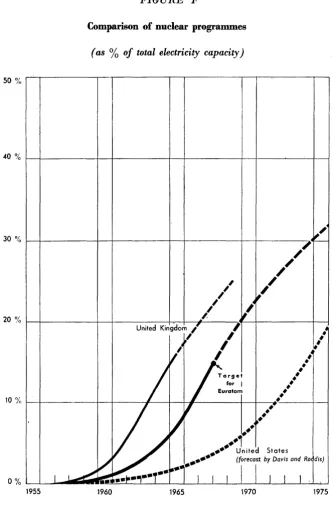
0in our countries. Her programme of 6 million
kilo-watts by 1965 is expected to stabilize fuel imports from 1960
onward. The 15 million kilowatts which we are taking as our
1967 target can achieve the same result for us in 1963.
(1) Since oil has a higher calorific value than coal, it is necessary to convert oil tonnages into their 'coal equivalent' to obtain comparable or total figures for energy im-ports.
-Millions tons per annum coal equivalent
300
200
100
0
1955
FIGURE A
Energy imports of six countries
1960 1965
Net imports
1970
with nuclear power
[image:19.494.60.398.90.595.2]This target is two and a half times the British programme,
which seems reasonable when we consider that the ratio of
popu-lation is 3 to 1, and that of electricity output 2.8 to 1, and that,
as mentioned above, the six countries are starting out from a far
less favourable position than Great Britain in the matter of
energy imports.
It is not for us to translate this target into a programme.
Without doubt our target is far larger than the sum of the
existing plans prepared separately by our six countries, plans
which would involve the installation of about 6 million kilowatts
capacity between now and 1967. Incidentally, it has been possible
to see since our investigations began-perhaps it should he
regarded as one of their first results-a very marked tendency
for each country to expand its programme.
We also had to compare our target and the programme it
entails with the industrial resources available in our six countries
for the building of reactors. The British experience is the only one
to which one may refer in order to have an idea of how industry
can he adapted to an important atomic programme. In Great
Britain, it is considered that, by 1965 (the execution of the
British programme was started in 1955), industry will he in a
position to install 5 to 6 m. kW of nuclear energy and, moreover,
he able to export the same amount (1), totalling 10 to 12 m. kW
of nuclear power capacity. The engineering industries of the six
Euratom countries have an overall capacity which is
approxi-mately 1.6 times that of the same industries in Great Britain (2).
On this basis, one can therefore consider that-given an effort
comparable to that undertaken by Great Britain-our countries
(1) This export capacity is of course dependent on timely arrangements to enable British industry to supply difficult items such as graphite and steel plate for pressure vessels.
(2) See O.E.E.C. report 'Les industries mecaniques et electriques en Europe~ (1956).
-should be able to build over 15 m. k W of nuclear energy in the
course of ten years.
This is, of course, an appreciation of our nuclear
possibili-ties. As in any big industrial development, bottlenecks are bound
to appear. The part which the United States, Great Britain and
Canada play in the way of cooperation with regard to processing,
fuel, reactor components etc., will therefore consist not only of
facilitating our effort from a general point of view, hut also of
helping us to overcome the temporary difficulties which may arise
at the start in various fields. Although our 15 m. target is
ambi-tious, it is compatible with the industrial potential of our countries,
taking into account the help we can expect from Great Britain
and the United States.
Euratom will create new opportunities. It will pool the
scientific as well as the industrial resources of our six countries
and their varied skills. A common market for nuclear equipment
to be set up within a year will promote industrial specialization.
Further, Euratom will represent our nations as a single unit
vis-a-vis other states, and will he far better placed to obtain full
cooperation from then than our countries separately.
Our enquiry abroad has already shown the expanded
opportunities for outside help opened up by Euratom. The
contribution in nuclear fuels, reactor technology and components
can make the difference between a rapid and a slow European
departure in nuclear power production. To take one concrete
example : the scarcity of trained technicians could seriously
hamper the rapid execution of a big programme. During our visit
to America, Britain and Canada, training facilities were offered to
Euratom on a scale never contemplated for our individual nations.
A critical moment has been reached: atomic power is
coming of age. Nuclear power has moved out of the scientist's
-laboratory onto the engineer's drawing hoard; it will now come
quickly into commercial phase. This provides a great opportunity
for our countries if we seize it and a grave danger if we do not.
Scientific and technical knowledge can he borrowed; hut industrial
capacity one must create oneself. If our industries do not go
ahead on a big scale now, at a time when others are poised to do
so, they will soon he unable to face competition from the
full-grown industries which have seen and seized their chances in
time. Later development would only he possible behind protective
walls with all the drawbacks they involve. In view of the growing
importance of atomic techniques for industry, Europe, as the
world's greatest exporter of engineering goods, cannot afford to
miss the chance to move off to a rapid start.
So long as we act with drive and determination, the
possi-bilities created by Euratom give us every hope of meeting the
challenge of the atomic era, and, in so doing, of resolving our
energy problem.
-CONDITIONS OF ACHffiVEMENT
The scientists of our countries made fundamental
contri-butions to the discoveries on which nuclear power prospects are
based. But, as a result of the war and their divisions, they have
taken little part during the last fifteen years in the massive and
costly build-up of the foundations of nuclear industry. France
has already begun to apply nuclear power on an industrial scale,
and Germany, Italy, Belgium and the Netherlands are actively
engaged in power projects and reactor development. But these
efforts fall far short of what Britain, not to speak of the United
States, has done to lay the basis for the commercial application
of nuclear power. If our industries had, today, to start entirely on
their own, an unduly slow and costly growth would be
unavoid-able. The American interest in the world-wide extension of atomic
energy for peaceful purposes to which President Eisenhower's
'atoms for peace' programme testifies, has relieved our countries
of some of the penalties of their handicap.
Cooperation with the United States, the United Kingdom and Canada.
The United States government showed a keen interest in
the prospects of a big Euratom programme for the production of
nuclear energy. Their well-known support for European unity and
their interest in Europe's economic strength and stability explain
this welcoming attitude. Europe can help America in the future
as America is prepared to help us now. The average cost of
electricity in America is about two-thirds of what it is in Europe,
so atomic power will compete in Europe long before it can do so
in the United States. An impressive amount of research and
-development done both through the Atomic Energy Commission
and by private industry have provided America with the most
complete nuclear foundation in the world. But the large-scale
application of this immense potential appears to be .at least five
to ten years off. Europe, on the contrary, needs atomic energy
right now. No amount of research can be a substitute for the
practical knowledge to be gained by the large-scale industrial
application of atomic power. Europe could make this experience
available to the United States. Our talks in Washington convinced
us that, on the healthy basis of a two-way traffic, a close
partner-ship as equals can be built up between the United States and
Euratom and their respective industries.
For peaceful purposes, our visit provided indications of
how the partnership would work. The United States would make
available the necessary fissile materials and the technical
knowl-edge to set our industries going. Once Euratom is established, a
task force composed of some of America's most able men would
be at out disposal to continue studying with European experts
the many technical problems posed by our programme. America
would provide training facilities for our scientists and technicians.
Joint projects, for instance to improve and adapt reactors, can
be envisaged between American and European industries, as well
as between the American and European Atomic Energy
Com-miSSions.
Britain has concentrated on a reactor type which is now
fully in the commercial phase. The British authorities have
declared their readiness to facilitate contacts between British
firms and those in Europe interested in building this type of
reactor. They are also willing to assist Euratom in the vital
matter of training scientists and engineers, and in putting their
experts at our disposal to study the technical aspects of our
programme.
-Canada is equally prepared to cooperate. It can do so in
two important ways. To begin with, it is one of the world's major
sources of natural uranium. It would be ready to provide natural
uranium to supplement European resources, provided it receives
notices several years in advance, and that any agreement with
Euratom guarantees the use of the uranium exclusively for
peaceful purposes.
Further, Canada has done important original work on a
type of reactor which promises to be particularly well adapted to
European requirements, combining as it does many of the
advantages of the natural and slightly enriched uranium
ap-proaches followed so far by Britain and the United States
respectively. This reactor is w·ell into the development stage. We
have every reason to believe that Euratom would find the
Canadian authorities willing to cooperate on the construction of
prototypes.
In consequence of the far-sigh ted view the United States,
Britain and Canada have taken of their interests in cooperating
with our nations in nuclear development, we have the assurance
that a large nuclear programme would obtain not only the benefit
of years of development in these countries, but also the material
supplies and technical assistance indispensable to a quick start.
This broad cooperation is being offered because Euratom gives
prospects of joint action on a scale our countries individually
cannot propose and has been made possible by the Euratom
provisions for an effective system of control of fissile materials.
Agreements of association should therefore be concluded
between these countries and Euratom immediately after its
establishment. At the same time, close cooperation should he
developed with neighbouring countries, particularly Switzerland,
Austria and the Scandinavian States, through O.E.E.C. or in
other ways.
-Strong cooperative ties with other countries-by which we
obtain, now and later, the help of those who have explored
nuclear possibilities more fully than we have, and in return offer
our help in future to them and to other interested nations-must
be the foundation of Europe's atomic progress. Far from
under-mining our independence, it is the only way we can gain our place
as equals in the field. The road to dependence would be the
opposite one, to confirm our backwardness by resorting to the
illusion of self-sufficiency. Cooperation with others will not limit
our opportunities, but create new ones, so that our industries
can eventually acquire their own, distinct nuclear personality.
Reactor Construction.
Our inquiry has convinced us that, though there are at
least a dozen prototype reactors in an advanced stage of design
or under construction, only two types are ready for commercial
use. One has been developed in the United States and the other
in Britain and France ( 1).
The first is fueled with slightly enriched uranium (2), and
Is cooled by water under pressure, or by boiling water. This
system was originally developed for submarines, and one unit has
been functioning without interruption in the Nautilus for nearly
two years. The experience gained on this project gives great
confidence in the reliability of this type of reactor. Full scale
commercial prototypes of both versions of these reactors are
under construction, in several cases entirely by private firms.
The second type, developed furthest in Britain, is the
gas-cooled reactor fueled with natural uranium. Its prototype at
Calder Hall has been working successfully for the last six months.
(1) Annex II describes reactors in greater detail.
(2) Uranium in which the content of the fissile isotope U -235 has been increased above the level of 0. 71% found in nature.
2 8
Confidence in the performance of this reactor enabled Great
Britain first to set up a nuclear programme in the beginning of
1955, and then, at the beginning of this year, to treble it. Several
large stations are now under construction for the British
electrici-ty authorities. The first French reactors now functioning or
being built are of the same type.
Attention should he given by European firms interested in
building power reactors and by Euratom itself to the development
of two other types, not yet in the commercial phase, but which
appear specially appropriate for Europe: a version of the British
gas-cooled reactor, operating on slightly enriched uranium, and
the heavy-water reactor developed mostly in Canada. Joint
projects might he launched by industry or Euratom to solve the
design and development problems to be overcome before these
reactors can become commercial.
To begin quickly we must either buy some reactors from
the United States and the United Kingdom or build them under
license. This will not involve accepting permanent industrial
dependence. On the contrary, it will speed up our industries'
nuclear education, and provide a basis of well tested experience
to root and nourish their own original contribution. Even if the
reactor itself has to he imported, a large proportion of each of the
first nuclear power plants will be built by our own engineering
industries, and the proportion of components that must be
imported will quickly fall.
The industrial re-orientation required will undoubtedly
raise difficult problems, hut they may prove less intractable than
is often thought. Intensive re-training of engineers and scientists
will be needed, but both the United States and the United
King-dom are ready to help. Euratom must carry out training
pro-grammes
wit~the facilities they offer, on top of those already
existing in Europe, and those that it will itself create. Further,
-the number of trained men required to design and build proven
reactors is smaller that that needed to develop entirely new ones.
A high proportion of the construction work in nuclear power plant
differs little from the tasks which engineering firms are
perform-ing today. The industrial groups which have designed and are
now constructing power reactors in the United Kingdom started
with limited nuclear experience 18 months before their tenders
were submitted to the U.K. Electricity Authorities.
Euratom and its objectives will he the stimulus, guiding
and enabling better use to be made of our industries. The
standardization of reactor components and procurement contracts
should be encouraged. Also, a certain amount of general
coordi-nation will be essential because a progra;mme involving millions
of kilowatts under construction at any one time, and requiring a
wide range of new materials and components, might easily be
thrown out of gear by serious shortages and costly delays.
Industry, for example, should he informed of the need for big
high-pressure shells for reactors at least four years ahead of
delivery in view of the likelihood that its capacity for their
manufacture would have to be expanded.
Fuel Requirements.
Fuel requirements will depend very much on the types of
reactor chosen by the electricity suppliers. However,
it
is now
already clear that the fuel required to reach the target envisaged
for Euratom will be obtained without difficulty, since its
require-ments are a small part of world production of nuclear fuels
during the period under review {1). The uranium production in
our countries, although small at present, is expected to rise as
prospecting extends the field of known reserves. Further we have
-assurance that, in Canada, natural uranium output can increase
considerably if the demand is firm.
We also attach particular importance to the statement
made by the U.S. authorities that they do not consider that
nuclear fuels will he a limiting factor. This opinion has been
inserted in the Communique (1) which the Secretary of State and
the Chairman of the Atomic Energy Commission issued jointly
with us at the end of our discussions in Washington. As this
statement comes from the country which is the world's biggest
producer of enriched uranium, and one of the biggest of natural
uranium, we can be sure that the availability of nuclear fuel will
not limit the realization of our target.
Euratom's action on fuel supplies could be of decisive
importance for our industries. The total expenditure on nuclear
fuels in the ten-year period required to reach the target of 15
million kW would amount to about$ 2000 million (2). According
to the Euratom Treaty, special fissile materials will be owned by
the Community. Therefore Euratom will retain title of the
enriched uranium it will put at the disposal of the users and may
well finance both enriched and natural uranium centrally as is
done domestically in the United States and the United Kingdom.
Fuel problems do not end with the supply of fissile
material. Both natural and enriched uranium have to be
fabri-cated into fuel elements (3) before use. And after use they must
generally he processed in chemical plants to recover the valuable
fissile products still left in the spent fuel.
(1) See Annex V.
{2) See Annex III, para. 8.
(3) For the present types of reactor, the nuclear fuel must be formed into cylindri-cal or plate-type elements enclosed in suitable materials (magnesium, zirconium, stainless steel, beryllium, etc.).
-U ndouhtedly, for the needs of the first nuclear power
plants, fuel elements can be imported from abroad, and the spent
fuel returned to he processed. Both America and Britain are
willing to do this, and have indicated the prices they will charge.
But it would he inconsistent with our need to reduce our
de-pendence on costly energy imports to continue to rely on other
countries for these services. Both operations require plants
serving many reactors to be economic. If each of our countries
were to act as separate unit, it would take many years before it
would be possible to build these plants on an economic basis. The
establishment of the European Atomic Energy Community will
allow us to build both fuel fabrication and chemical processing
plants as soon as a large number of reactors are being built.
Euratom could also construct a plant to produce the
enriched uranium needed (1). Till recently, this seemed the only
way to obtain it. But there is now no doubt that our countries
can obtain enriched uranium from the United States in the
necessary quantities, and at the low published prices. These low
prices are a consequence of the vast size of American plants, the
extremely low power costs in the areas where they are located,
low finance costs, and a very highly developed design and
technology. Enriched uranium produced in Europe would,
there-fore, probably cost two to three times as much.
The building of a Euratom diffusion plant has been
advocated to avoid basing nuclear energy production on a material
that must otherwise be obtained from another country. If
important quantities of enriched uranium had to he permanently
imported, this argument would carry weight. But several years
would elapse before Euratom's diffusion plant could operate. And
the future of enriched uranium requirements is very uncertain.
-Even apart from the prospect of breeder reactors (1), plutonium
will he produced in the fuel of Europe's first reactors. It is very
probable that we will find an economic way to use this plutonium,
and so reduce our needs of enriched uranium. Other
improve-ments in reactors may have the same effect. In the end, these
developments might even enable power reactors of all types to
he based exclusively on natural uranium with fuel recycling.
Therefore, while it is essential for our countries to study
with the greatest care the economic and technical aspects of
uranium enrichment, it should he noted that the decision to
build a diffusion plant on a commercial scale, which means a
heavy investment of capital and would consume large quantities
of energy, does not have to he taken before a programme for the
production of nuclear electricity is launched.
Costs of Nuclear Electricity.
At what cost will electricity he produced by the nuclear
reactors commissioned before the end of 1967? And how will this
cost compare with the cost of energy obtained from the new
coal- and oil-fired stations which would have to he built if
nuclear plants are not erected instead? Certain general points
must he mentioned.
In the first place : only very limited experience is available
in regard to full-scale power reactors; nuclear electricity costs are
therefore always estimates, never proven facts. After extensive
checking and discussion, inter alia, with the experts whom the
American Atomic Energy Commission and the U.K. Atomic
Energy Authority so kindly put at our disposal, we \consider those
which follow to he reliable.
In the second place : the cost of electricity produced by a
given reactor will not remain continuously on one level, hut will
-follow a descending curve as the operating technique improves in
the course, of time. Cost estimates must, therefore, he based on
the average estimated cost of the electricity produced by a
nuclear reactor in the course of its life. Operating costs will he
high at the outset of the operation, hut will decline in the following
years-to a lower level as operating conditions are stabilized. Even
in the case of the first reactors, power costs will continue to fall
gradually as the techniques of using fuel improve. Nuclear fuel
costs are low-less than half the fuel costs in conventional
plants-and the saving will apply only to about one quarter of
total nuclear costs, though they could he significant. Unlike
nuclear stations, the fuel costs of conventional plants must be
expected to rise slowly hut steadily, relative to the general level
of prices.
In the third place : comparison with the electricity costs of
conventional plant must be based on new conventional plant
burning imported fuel, because we have seen that nuclear power
plants will only replace those which would have to consume
imported fuel. It is impossible to evaluate in terms of costs the
increasing risk of a stoppage in the flow of oil from the Middle
East. But electricity producers would he ill-advised not to take
this risk into account.
In the fourth place: as it is unlikely that advanced reactors
promising far lower power costs, will come into commercial use
before the end ofour ten-year period, we do not propose to discuss
them. But all the best authorities (1) agree that the cost of nuclear
energy, even for current reactor types, will decline in the next ten
to fifteen years.
(1) Cf. two of the most important recent studies- lecture on 'The Future for Nuclear Power', ,delivered by Sir Christopher Hinton, member of the United Kingdom Atomic Energy Authority (March 15, 1957); and 'The Latest Prospects f~r Economic Nuclear Power\ prepared by W. Kenneth Davis, Director, and Louis H. Roddis, Deputy Director, Division of Reactor Development, of the United States Atomic Energy Commission (March 14, 1957).
-Mills
per kWh
20
15
PriCe of
1m ported
cool or oil
10
5
0
1955
FIGURE B
Future electricity costs · Trends for new plants
$ 22/t L---+-__,i"'""""""
$ 20/t
1---+-r--$
18/t.L..---+-r--r·
Approximate average cost of electricity m Europe today [image:33.496.55.386.109.594.2]Taking these general considerations into account, our
conclusion is that the range of costs of electricity produced by
nuclear reactors of both the American and the British type, may
he estimated at 11 to 14 mills per kWh, while the cost of electricity
from new conventional stations, which must use imported fuel,
will he 11 to 12 mills per kWh (see Fig. B) (1). Further, while the
cost range of conventional stations is moving slowly upwards,
that of nuclear power is moving down. These figures do not apply
to the few large reactors which will he brought into service before
1962, and which are more prototype than commercial in character.
In view of this cost comparison, it is clear that the time has
come when nuclear power can provide an economic means to
stabilize our energy imports. The long-term prospects of reducing
production cost are not an argument for delay; on the contrary,
a big commercial programme now is the best way to secure a solid
basis for massive expansion later.
We must finally point out that the first orders should he
placed by the end of 1958, when results of experience will he
available, not only from Calder Hall, hut also from Shippingport,
which will influence the decisions for subsequent steps of the
programme.
At this stage, it is necessary to start with big plants; hut
this does not imply that the six countries are in a position to
commit themselves now on the plants to he constructed during
the ten-year period.
Investments.
Fuel costs loom large in the cost of conventional power and
play only a minor role in nuclear power. In the case of investment
costs the opposite is true. The investment costs for nuclear plants,
-including fuel inventory, must he estimated for stations to he
brought into service in the next ten years to average somewhat
more than two and a half times the cost of conventional steam
stations, with a gradual decline towards the end of the period.
For 15 million k W the difference would approach $ 4,000 million
(1), or between 1 and 2 per cent of the estimated total gross
investments of our six countries together in the next ten years.
This additional investment burden creates some difficult problems
for our national economies.
To a certain extent, this implies a changed pattern of
investment rather than a truly increased burden. The greater fuel
hill for coal and oil in the absence of nuclear plants would have to
he paid for by increased exports which, in their turn, would
require bigger investments in our export industries. Greater coal
and oil imports for conventional stations would also require new
investments, notably in ships and ports for their transport.
At first, the expenditure on nuclear power stations will
also pose balance of payments problems, because as much as 50%
of their cost may have to he paid in foreign exchange. But over
the whole of the ten-year period the total import content of
expenditure on nuclear plant is unlikely to exceed$ 1,100 million.
Further if
all the fuel for 15 million k W of nuclear plant had to he
imported-a pessimistic assumption in view of the uranium
pro-duction available within our countries-its cost would he about
$ 2,000 million for inventory and make-up (2) in the first ten
years; and only about $ 200 million per year thereafter (ignoring
plutonium credits), compared with an oil and coal hill to import
fuel for the same plant capacity of about $ 800 million a year at
present prices.
(1) of which about $1,100 would be nuclear fuelinventory (see Ann. III, para. 10). (2) Make-up is the amount of fresh fuel which must be put in the reactor periodic-ally as spent fuel is withdrawn.
-Therefore, though the balance of payments situation of our
countries would not benefit immediately by the rapid introduction
of nuclear power, the moderate increase in imports during the
first years will he rapidly offset by big foreign currency savings
subsequently. For these reasons, the expenditure of larger sums
on building nuclear rather than conventional power stations is in
the public interest.
However, this does not help our electricity suppliers to
solve their investment problem; even now the rapid growth of
electricity demand is putting a severe strain on the investment
resources of our electricity industries. There is a gap between the
public interest-which calls for the achievement of our
target-and that of the individual electricity supplier, who faces
commer-cial risks by investing heavily in nuclear rather than conventional
stations. Yet a prompt commitment on the first plants is essential,
both in order to get a quick start and to obtain the greatest
experience of reactor construction in the shortest time.
As conditions differ widely in each of our countries, we are
not in a position to suggest solutions. However, the Euratom
Commission, jointly with the governments and industries
con-cerned, should make a thorough study of this problem, for if it is
not solved, it will make our target and the consequent
stabiliza-tion of energy imports totally illusory. They should also consider
incentives, such as increased depreciation allowances for nuclear
stations, operative in the first and most difficult years, and other
financial measures.
We also attach the greatest importance to a common
legislative approach on insurance for nuclear plant, covering the
third-party liability of companies engaged in constructing and
operating
re~ctors,as well as the liability of manufacturers outside
our
countri~swith respect to the performance of their products.
3 8 -I
In the United States, the absence of adequate Federal legislation
may have seriously retarded the construction of reactors by
private industry. Legislation to cover this gap is now being
dis-cussed by the U.S. Congress. All experts, both in the U.S. and the
U.K., agree that the chance of accidents is exceedingly small.
Nevertheless, additional protection against liability in excess of
the available insurance coverage is necessary. If an accident
should happen on the border of one of our countries, the damage
might extend across frontiers. Big nuclear power stations might
be ordered jointly by electricity companies in several of our
countries. The common market for nuclear products, to be set up
within a year of the establishment of Euratom, will also facilitate
the placing of orders across national borders. For all these reasons,
a common legislative approach to these problems is necessary.
*
*
*
Europe's economic growth is in danger of being seriously
hampered by the lack of energy to nourish it. Being short of
domestic energy supplies, our countries must turn increasingly to
imports to meet their needs. But imports are costly; and in their
most important form of Middle East oil, the supply itself is
uncertain. To rely unduly upon them would be increasingly
burdensome and hazardous. The advent of nuclear power now
gives us a chance to stem their rising tide by building nuclear
instead of new conventional power stations using imported oil or
coal.
Comparison between the price of nuclear and conventional
energy has lead us to conclude that a big effort now would be
justified. Industrially, we believe this would be feasible, if our six
countries act together, with the help of America, Britain and
Canada, who are ahead of us in the application of nuclear
tech-niques, and ready to cooperate fully with us.
-The pooling of our financial resources, industrial capacities
and varied skills through Euratom will enable our countries to
muster the great effort required. Euratom will he able to guide an.d
stimulate action, in particular by providing means to bridge the
gap in the initial period between the commercial risk, which firms
face in building nuclear plants, and the public need for the most
rapid progress.
The establishment of the European Atomic Energy
Author-ity, on which our nations are called to decide, offers the means to
achieve the target we envisage : the construction of 15 million k W
of nuclear plant by the end of 1967, in order to stabilize our
int-ports early in the 1960's.
ANNEX I
THE ENERGY ECONOMY OF THE EURATOM COUNTRIES Historical Survey of the World Output of Energy.
1. Up to the beginning of the first world war the world's economic development was based on coal. After the turn of the century~ first in the U.S.A.-and much later in Europe-oil began to acquire growing import-ance as a source of energy. Between the two world wars natural gas and hydro-electric power have been developed as secondary sources of energy.
World Production of Commercial Energy (l)
Hard coal Brown coal Oil Natural gas Hydro-power Total
Million metric tons hard coal equivalent ( = Mt HCE) (2)
1870 203 4 11 218
1900 701 22 29 9 16 777
1913 1216 39 77 22 45 1399
1955 1604 152 1086 360 190 3392
Percentage of World Production
1870 93 2 5 100
1900 90 3 4 1 2 100
1913 87 3 5 2 3 100
1955 47 4 32 11 6 100
(1) Primary energy in so far as it is commercially used, wood and waste fuels excluded.
(2) Conversion factors:
Hard coal: 7000 Kcal/kg Brown coal: 2100 Kcal/kg
Oil: 10000 Kcal/kg
Natural gas: 9000 Kcal/m3
Hydro-power: 1870-1913: 7000 Kcal/kWh 1955: 2800 Kcal/kWh
Between 1870 and 1955 world production of commercial energy in-creased at an annual rate of about 4%. At the same time the output of oil,
-natural gas, and to a lesser degree also hydro-power, rose at a considerably faster rate than the extraction of hard coal. Nowadays the relative im· portance of hard coal in the world's energy economy is only half as great as it was in the closing decades of the last century.
The reasons for the slower progress of coal extraction since the be-ginning of the first world war lies partly in the technical changes that have occurred in the demand for energy, e.g. the emergence of the internal combustion engine and the diesel motor, and partly in the increasingly unfavourable natural conditions attaching to coal extraction. In Europe the exhaustion of deposits, the greater depths to which mine shafts must be driven, and the unfavourable conditions for the mechanization of coal mining play a particularly important role. They largely explain the rise in the real production costs of coal, its extremely limited adaptability to fluctuations in demand, and the fact that, for 30 to 40 years past, there has not been enough capital available for opening up deposits. The most con-vincing evidence of all these happenings is to be found in the British coal mining industry. In 1870 the United Kingdom produced 54% of all the world's coal, in 1913 it still produced 25% and in 1955 only 13%. On account of the territorial changes that have taken place it is not feasible to make a comparison of coal production in the ECSC countries for the same period, but there is evidence to show that the share of the ECSC countries in world coal production fell from about 21% in 1938 to 16% in
1955. Even the United States of America with rich coal deposits which can be worked cheaply, has seen its share in world coal production fall from
41% in 1913 to 28% in 1955. The United States' share of the world pro· duction of total energy is as high as it was at the beginning of the first world war.
2. A second factor which has made a significant change in the situation as regards output of primary energy is the rapid expansion of oil production in the Middle East, particularly since the end of the second world war. As the Middle East countries alone, on the basis of 1955 estimates, possess
66% of proved world reserves of oil, and in addition produce it considerably more cheaply than other countries, this trend will continue. It is anticipated that by 1975 the Middle East will be producing about 50% of world oil output. During the next decades, the oil consumption of the Western Hemisphere will grow more rapidly than their production with the result that they will become net importers.
-I. Actual 1938 1955
II. Potential (3) 1965 1975
I. Actual 1938 1955 II. Potential (3)
1965 1975
Actual and Potential World Oil Production (Major Areas) (Mt HCE and as
%
of World Production)World U.S.A. Rest of Middle S.E.Asia Europe U.S.S.R.
385 1091 1740 2600 100.0 100.0 100.0 100.0
America East (1)
Mt HCE(2)
235 63 23 477 230 230
635 420 575 635 520 1290
as
%
of World Production61.0 43.7 36.4 24.3 16.5 21.0 24.1 20.0 6.0 21.3 33.2 49.6 12 24 70 115 3.1 2.2 4.0 4.4
11 41 28 100
40 40
2.7 10.7
2.6 9.2
2.3 1.7
(1) Production of USSR in 1938 and 1955 estimated; provisions for 1965 and 1975 not available.
(2) Converted into HCE at the ratio of 10:7 to facilitate comparison with the other tables; excluding natural gas liquids.
(3) These figures do not include the output of the newly discovered Sahara oil reserves, which are estimated at about 10 Mt HCE for 1960 and about 40 Mt HCE for 1965. Realization of these reserves would considerably mitigate Europe's energy supply problem in the years immediately ahead.
Energy Supplies of the Euratom Countries during the Last Twenty Years.
3. In 1935-36 the ECSC-Community's gross domestic consumption (l) (apparent consumption) of energy amounted to 295 Mt HCE or 2.1 t HCE per head of the population. In 1955 it had risen to 400 Mt HCE or2.45t HCE
(1) Gross domestic consumption = apparent consumption plus variations in stocks held by producers; Net imports = gross domestic consumption minus indigenous production.
-per head. Between 1950 and 1955 the energy consumed had risen by 36~/o
while the gross national product rose 34o/0 •
1936(1) 1950 1955
Consumption. . . • • • • . . • • • • • . . . . • • . • . . . • . . . . • . . . . • • • • • 295 Indigenous production • • • . . . • • • • . . . . • . • • . . . • • • . • • • . 275 Net imports. . . • • • . • . . . . • • • • . . . • • . • • . . • • • • . • • • . . . 20
(Mt HCE)
293 261 32
400 316
84
Within this development there has been a great change in the form of demand for energy, becoming more and more one for finished products such as electricity, gas and refined mineral oils. Thus, the consumption of electricity increased almost threefold between 1935 and 1955; and the proportion of mineral oils, which used to he not more than 6-7% of the consumption, is now about 20%.
Even more important is the fact that the six countries are becoming more and more net importers of energy. There are two reasons for this. First, the extraction of hard coal-hitherto, and still today, the ECSC countries' most important source of primary energy-is unable to keep up with the growth in demand, partly because the reserves of coal are n~t large enough to enable it to do so, partly because in our coal-mining areas extraction from deep shafts cannot be easily adapted to a growing demand, and lastly also because it is becoming more and more difficult to obtain manpower. The second reason for the increased dependence on imports is that in our countries sources of energy other than coal are available only to a limited extent. Some of our countries have water power resources, but those which can be economically exploited have already been largely utilized. The deposits of oil and natural gas in our countries are certainly not unimportant, but they are by no means sufficient to meet the rapidly growing demand for these products. In 1955 the imports of mineral oil amounted to about 103 Mt HCE, of which more than 80% came from the Middle East. Nearly 22 Mt HCE of liquid fuel were re-exported as finished products.
(1) Estimated figure for 1936-37; no reliable calculation can he made because of the territorial changes which have occurred.
Future Energy Requirements.
4. The following estimates of the internal requirements, indigenous production and net imports are based on studies-still not all published-made by the High Authority of the European Coal and Steel Community for the years 1955 to 1965 (1). Further forecasts have been made for 1965 to 1975 which, however, indicate a general tendency only.
The estimates made of the general expansion of the national econo-mies comprised in the ECSC countries are based on the following hypothe-ses: a) the active population will be fully employed throughout the whole period and those still unemployed in some countries in 1955 will, except for those seasonally or temporarily out of employment, be absorbed into industry; b) there will be a high rate of increase in productivity per man/ year after allowing for some reduction of weekly working hours and an extension of annual holidays; c) only the long-term development trend is taken into account.
On these hypotheses the development of the gross national product (GNP) is estim~ted to be as follows:
1955-1965
Increase in working population (as% of initial value)... 6.5 Annual rate of increase of productivity(%)... 3.7 Annual rate of increase in GNP (3)
(%)...
4.3(1) Reference is madein detail to the following studies:
1965-1975
3.4 2.7 (2) 3.1
a) Report of the Mixed Committee of the High Authority of the Coal and Steel Com-munity and the Council of Ministers (further referred to as "Mixed Committee') on the prospects and conditions of general economic development in the Community's countries (not yet published).
b) Report of the Mixed Committee on the structure and trends of the energy economy in the Community countries (not yet published).
c) Report of the High Authority on the 'General Objectives for Coal and Steel' (further referred to as "General Objectives'); published in the General Report of the High Authority to the Assembly, April1957.
(2) On the assumption that the working year during this period will be reduced by 3% and productivity per hour increased by an overall 35%.
(3) The transition from a high rate of increase in the first ten-year period to a low rate in the second is actually a continuous, not a discontinuous process, as might be supposed from the figures in the table. As an example, the annual rate of increase in productivity in the years from 1965 onwards should approximate 3% or even a little less.