On Rater Reliability and Agreement Based
Dynamic Active Learning
Yue Zhang
∗, Eduardo Coutinho
∗, Zixing Zhang
†, Michael Adam
‡, and Bj¨orn Schuller
∗†∗Department of Computing, Imperial College London, London, United Kingdom
†Chair of Complex and Intelligent Systems, University of Passau, Passau, Germany
‡Machine Intelligence & Signal Processing Group, MMK, Technische Universit¨at M¨unchen, Munich, Germany
Email: [email protected]
Abstract—In this paper, we propose two novel Dynamic Active Learning (DAL) methods with the aim of ultimately reducing the costly human labelling work for subjective tasks such as speech emotion recognition. Compared to conventional Active Learning (AL) algorithms, the proposed DAL approaches employ a highly efficient adaptive query strategy that minimises the number of annotations through three advancements. First, we shift from the standard majority voting procedure, in which unlabelled instances are annotated by a fixed number of raters, to an agreement-based annotation technique that dynamically determines how many human annotators are required to label a selected instance. Second, we introduce the concept of the order-based DAL algorithm by considering rater reliability and inter-rater agreement. Third, a highly dynamic development trend is successfully implemented by upgrading the agreement levels depending on the prediction uncertainty. In extensive experiments on standardised test-beds, we show that the new dynamic methods significantly improve the efficiency of the existing AL algorithms by reducing human labelling effort up to 85.41 %, while achieving the same classification accuracy. Thus, the enhanced DAL derivations opens up high-potential research directions for the utmost exploitation of unlabelled data.
I. INTRODUCTION
Within the context of Computational Paralinguistics, speech patterns can be characterised using objective and subjective measures [1]. In the case ofobjectivemeasures (e. g. age, gen-der, weight), the labels attributed to speech are referred to as the ‘ground truth’. On the other hand, there are speech phenomena (e. g. voice likeability, degree of interest or nativeness) that can only be reliably assessed (annotated/labelled) by perceptive judgments [2]. In consequence, the reliability of labels for the subjective speech phenomena highly depends on the annotators’ stable and transient characteristics, including a myriad of subjective factors [2], [3]. Further, some of the variations amongst individuals in perception of emotion in the auditory domain can be attributed to personality differences, which are associated with affective biases in emotion judgment [5] due to the interaction of personality with attention, motivation and mood [6]. Other factors which may influence individual variation in the perception of emotion include emotional intelligence (which is associated with improved emotion perception abilities), and age (emotion recognition is at its peak in young adults and declines with age [7]). Therefore, in contrast to the ‘ground truth’ that can be measured objectively,
subjective annotations lead to what is known as the ‘gold standard’, and are necessarily assessed by inter-rater agreement procedures. Thus, a large number of annotators is necessary to establish a well grounded reference. Unfortunately, one of the major barriers of today’s research is the costly consequences of obtaining human annotations, which are time-consuming and expensive to obtain.
Given this scenario, many researchers in the area of Machine Learning (ML) developed approaches for the exploitation of unlabelled data, which is nowadays pervasive in digital format and relatively easy and inexpensive to collect (e. g. from public resources such as social media). The most common methods include Semi-Supervised Learning (SSL) [8], [9], Active Learning (AL) [10]–[12], as well as diverse combinations thereof (e. g. [13]–[15]). The essence of the conventional ML methods is to train a classifier on a small, labelled data set, and re-train the model iteratively by sequentially adding new (machine or human) labelled instances to the training set. The active learner aims at achieving greater accuracy with fewer training labels by (actively) choosing the data from which it learns, and querying human annotators for labelling. It has been shown that AL strategies significantly reduce human labelling work, while still achieving good performance levels [10]. Despite the success that has been achieved with these techniques, the methodology has converged to a degree of standardisation, and major breakthroughs have been lacking in the past years.
As aforementioned, in the case of subjective labelling tasks, reliability of ratings is of paramount importance and therefore AL techniques are preferred as labels are obtained from human and reliability can be assessed. In conventional AL, the most ‘informative’ instances are selected and submitted to a fixed
annotation strategies.
The our previous work [16], we introduced for the first time a novel method called DAL with random query order (rDAL). rDAL is a derivation of the DAL algorithm, in which an adaptive query strategy is used to dynamically determine the number of annotators for each selected instance. The main underlying idea behind this method is to sequentially query human annotators to label a specific instance until a predefined agreement level (i. e. a certain number of votes for one common class label) is achieved, instead of requesting all available raters and then computing the gold standard by majority voting. As a consequence, the number of annotators required for each instance depends solely on the agreement level defined by the user to establish the gold standard. rDAL was shown to significantly reduce the labelling costs up to 79.17 % with the Medium Certainty (MC) strategy in relation to traditional AL methods and warrant the reliability of the subjective labelling procedure without sacrificing the classification performance.
In rDAL, the order in which the raters are queried to label a specific instance was randomised. Considering that some annotators (and groups of annotators) are more reliable than others, it is plausible to assume that the efficiency of rDAL can potentially be improved by querying the most reliable raters first in order to reach the predefined agreement level with less annotators. This idea motivated us to introduce and evaluating new query order strategies that consider both the individual rater reliability as well as inter-rater agreement for every possible combination of raters. Henceforth, we will refer to this method as order-based DAL (oDAL). The core underlying idea behind oDAL is that we approximate the gold standard by selecting the most reliable rater or group of raters first, hoping to achieve further reduction of the annotation costs while maximising the reliability of the gold standard. Moreover, the agreement level in these algorithms is set to a fixed value, which lead to a deterioration of classification performance as learning progressed because of the noisier instances left to be labelled at the end of the learning process. In order to overcome this limitation, a possible option is to switch to higher agreement levels for labelling noisy instances. Therefore, in this paper, we also introduce another variant of DAL – uDAL– which implements an oDAL algorithm that dynamically upgrades the agreement levels dependent on the noisiness of the instance to be labelled.
In what follows we describe the algorithms developed to integrate an efficient query order into rDAL and their applications to speech emotion recognition. In Section II, we describe our proposed algorithms and methodology. Then, in Section III and Section IV, we describe the database and feature set, respectively, which are used to demonstrate the potential of our method. The experimental setup and the results are presented in Section V. In Section VI, we discuss our findings and explore possible extensions of this work.
II. METHODOLOGY
In this section, we introduce the oDAL and the uDAL algorithms and the method for their evaluation in the context
of speech emotion recognition. We employ Support Vector Machines (SVMs) as the classification model. SVMs are introduced in Section II-A as well as the concept of confidence values which are used by the algorithms to select the instances for human annotation. Then we formally define agreement level, rater reliability and inter-rater correlation, which are the basic concepts underlying the DAL algorithms. Finally, we describe the oDAL and uDAL algorithms in Section II-D.
A. SVMs and Confidence Levels
Similar to traditional AL, the dynamic active learner actively selects the data from which it learns by considering the prediction uncertainty of the trained classifier in terms of confidence values. For this purpose, we apply Support Vector Machines (SVMs) that construct decision hyperplanes to sepa-rate instances of different classes by using the decision function
f(x), while maximizing the functional margin. For each instance, the output distances to the decision boundaries are then transformed into probability values through a parametric method of logistic regression [17]. For binary classification, the sigmoid function with the parametersA andB is defined as:
P1(x) =
1
1 +exp(Af(x) +B) (1)
P0(x) = 1−P1(x) (2)
The confidence value for the predicted class is obtained by forming the difference of the posterior probabilities
P0(x), P1(x)for classes ‘0’ and ‘1’, respectively.
C(x) =|P1(x)−P0(x)| (3)
In our experiments, we consider the MC query strategy [18] that has the potential advantage of avoiding the selection of noisy data, which can be caused by distortions of acoustic patterns [19], unreliable or ambiguous annotations [20] as it is usually the case for acoustic emotion recognition tasks due to their subjective nature. Formally, the query function for MC is defined as:
xM C = arg min
x
|C(x)−Cm|, (4)
where C(x) denotes the confidence value assigned to the predicted label of a given instancex. The confidence values are ranked and stored in a queue (in descending order). Accordingly,
B. Agreement Levels
Given the number n of annotators who are available for labelling a specific database, we define the agreement level
as the minimum number of raters agreeing on one common category. Accordingly, j ∈ {1, ...,bn+1
2 c}, with j, n ∈ N, agreement levels can be selected. For the upper limit of the interval, the floor is considered with regard to even numbers of annotators. Specifically, n0∈ {j, ...,2j−1}, n0∈Nraters might be needed until a certain agreement level j is achieved. In practice,j raters would be required simultaneously in the first round of queries to minimise the related time-consumption asjis the minimum number of ratings to achieve the respective agreement level. The SAL performance that is achieved through majority voting among all nraters is set to the baseline in our experiments.
C. Rater Reliability and Correlation
In existing crowd-sourcing platforms (e. g. Amazon Mechan-ical Turk [21]), annotation tasks are distributed to paid click-workers to complete [22], [23]. For work screening in these annotation systems, the rater reliability is usually assessed and guaranteed through a pretest comprising different questions to determine the annotator is taking his task seriously or just clicking haphazardly. Inspired by the quality management system, we implement a preliminary stage preceding the learning algorithm to assess the rater reliability and the representativeness of every possible rater subset in relation to the respective gold standard labels. For this purpose, we randomly select a test set of labelled instances and train a rater-specific model for each single rater. The obtained classification accuracy is used to rank the raters according to their reliability. Additionally, the correlation between the arithmetic mean of the votes within the rater subsets and the respective gold standard label is computed. By this means, we obtain a measure for the inter-rater agreement and the reliability of a rater group, respectively. Table I depicts an example of the correlation values of the rater subgroups with the highest correlations. As it can be seen, the larger rater groups with the highest correlation values always include the smaller ones, which can be explained by the high coherence between rater reliability and inter-rater correlation. This ranking list suits particularly well our adaptive query strategy because the raters are sequentially requested. Depending on the defined agreement level, the subgroup with the minimum numberj of raters is selected. If no consensus is reached, the raters who are most representative by forming a group with the preceding raters are enlisted one after another.
TABLE I
CORRELATION BETWEEN THE ARITHMETIC MEAN OF THE RATINGS OF THE
MOST RELIABLE RATER SUBGROUPS AND THE GOLD STANDARD LABELS,
OBTAINED BY MAJORITY VOTING AMONG ALL FIVE AVAILABLE RATERS.
# Raters Rater Subgroup Correlation
2 3 4 0.852
3 3 4 1 0.891
4 3 4 1 5 0.890
[image:3.612.353.525.206.286.2]In this example, there are five raters available and rater3 achieves the highest performance in the pretest. Consequently, the most efficient query order considering both rater reliability and correlation is defined as3,4,1,5,2. Besides, it should be noted that once a minimum subset ofj raters is selected for an agreement level j, the internal order is not relevant since all raters will be queried in one turn. The principle of the adaptive query strategy is illustrated in Figure 1. The solid line indicates the minimum number of annotations required to achieve the respective agreement level, while the dotted line implies the backup raters who might be enlisted one after another.
Fig. 1. Adaptive query strategy of the DAL method according to different agreement levels
D. Algorithms
Figure 2 shows the pseudo-code description of the oDAL and uDAL algorithms based on the MC strategy. Let L = ([x1, y1], . . . ,[xl, yl]), i= 1,2, ..., l, denote a small set of la-belled training data, wherexi is ad-dimensional feature vector, and yi is the assigned emotion-related label. Additionally, a large pool of unlabelled dataU = (x01, . . . ,x0u), k= 1,2, ...u, exists where ul andx0k is ad-dimensional feature vector. The number of votes for a specific class labely0that is manually assigned to an example instance x0∈ Na is namedv0.
of each instance is fulfilled when the respective agreement level is achieved. Finally, the human labelled instances are removed from U and added to L. The sequential process is repeated until a predefined number of instances are annotated. Taking again our previous example, assuming there are five expert labellers available for a specific binary classification task, the majority is attained if the same opinion occurs three times. In the existing SAL algorithm, all five labellers would be needed in the query process regardless of the actual distribution of votes. In comparison, choosing j= 3, the DAL approach first queries the most reliable group consisting of three raters since this is the minimum number of annotations to obtain the same result as with majority voting among all five raters. If the first three raters agree on one common category, the opinions of the two others are irrelevant, in the sense that they will not affect the final annotation. If this is not the case, the query will be continued by iteratively requesting one more rater according to the ranking until the same opinion occurs three times or there is no rater left. Following the line of thought, the term ‘majority’ can be regarded as relative to the number of the raters actually enlisted, which does not necessarily correspond to the number of all available raters. In this example, j = 3 is the highest achievable agreement level as explained before. However, it is also possible to set the stopping condition to the first or second agreement level, requiring only one or two vote(s) for one common category. The respective numbers of potentially required raters would be n0 ={2,3} forj = 2andn0 = 1 forj = 1, respectively. The related trade-off between learning performance and cost reduction will be further investigated in Section V-B.
III. DATABASE
In our experiments, we use the FAU Aibo Emotion Corpus (AEC) [24] of the INTERSPEECH 2009 Emotion Challenge (IS09 EC) [25], [26]. The database consists of recordings of children interacting with Sony’s pet robot Aibo, which performs a fixed, predetermined sequence of actions. Spontaneous German speech that is emotionally coloured is provoked by leading the children to believe that the Aibo was responding to their commands, whereas the robot was actually controlled by a human operator and sometimes behaved disobediently. The recordings were taken from 51 children (age 10-13, 21 male, 30 female, about 9.2 hours of speech without pauses) at two different schools, referred to as ‘MONT’ and ‘OHM’. Five labellers (advanced students of linguistics) annotated each word independently from each other as neutral (default) or as one of ten emotional states:angry,touchy,reprimanding,emphatic,
surprise,joyful,helpless,motherese,bored, andrest. We use the same natural speech corpus as in the IS09 EC that comprises 18 216 instances. Each instance corresponds to a manually defined chunk that consists of multiple words according to the syntactic-prosodic criteria. For binary classification, the 11-class labels are mapped onto two-class labels by defining states with negative valence (angry, touchy, reprimanding,
emphatic) as NEG(agative), and all other states as IDL(e). A heuristic approach is applied to map the labels from the
Algorithms: Order-based Dynamic Active Learning (oDAL)
Pretest:
1) Selectt random test instances 2) Train a model for each single rater
3) Compute the correlation value for each rater subgroup 4) Define the query order based on rater reliability and
inter-rater agreement
Repeat:
1) (Optional) Upsample the training setLto obtain even class distributionLD
2) UseL/LD to train a classifierH, and then classify the unlabelled data set U
3) Rank the data based on the prediction confidence values
C and store them in a queue
4) Select a subset Na with medium certainty 5) Foreach instancex0 inNa
a) Optional: Upgraded Dynamic Active Learning (uDAL)
IfC > p; j=j; elsej+ +;
b) Submitx0 to the firstj raters c) Ifv0=j;STOPP
elserepeat: select one rater for annotation untilagreement levelj is achieved d) Assigny0 tox0
6) RemoveNa from the unlabelled setU,U =UrNa 7) AddNa to the labelled set L,L=L ∪ Na
Fig. 2. Pseudocode description of the oDAL and uDAL algorithms based on the medium certainty query strategy.
word-level to the chunk-level for each of the five labellers, where a chunk is defined as NEG if it contains at least one word with negative valence. To define the gold standard for the baseline results, we resort to majority voting to combine the labels from all five labellers to one single label for each chunk. The frequencies for the two-class problem are given in Table II. Speaker independence is guaranteed by using the speech samples of the school ‘OHM’ for training and the data of the other school ‘MONT’ for validation. Specifically, the training data referred to as ‘Pool’ contains both the labelled training set Land the unlabelled data pool U.
TABLE II
DISTRIBUTION OF SPEAKERS AND INSTANCES PER PARTITION OF THEFAU
AEC. M:MALE; F:FEMALE; NEG:NEGATIVE EMOTIONS; IDL:NEUTRAL
AND POSITIVE EMOTIONS.
# speakers # instances per class
FAU AEC M F NEG IDL Σ
Pool 13 13 3 358 6 601 9 959
Validation 8 17 2 465 5 792 8 257
0 1000 2000 3000 4000 5000
UAR [%]
64 66 68 70
oDAL, j=1 rDAL, j=1 SAL
0 1000 2000 3000 4000 5000
Std. Dev. [%]0 1 2
# Human Annotations (x 10k)
(a)
0 3000 6000 9000 12000 15000
UAR [%]
64 66 68 70
oDAL, j=2 rDAL, j=2 SAL
0 3000 6000 9000 12000 15000
Std. Dev. [%]0 1 2
# Human Annotations (x 10k)
(b)
0 3000 6000 9000 12000 15000
UAR [%]
64 66 68 70
oDAL, j=3 rDAL, j=3 SAL
0 3000 6000 9000 12000 15000
Std. Dev. [%]0 1 2
# Human Annotations (x 10k)
[image:5.612.66.550.65.237.2](c)
Fig. 3. Comparison between Random Dynamic Active Learning (rDAL) and Order-based Dynamic Active Learning (oDAL): the performance measures show the UAR values averaged across 20 runs of the algorithm and the respective standard deviations vs the number of human annotations for the FAU AEC with IS09 EC feature set by 200 initial training instances for agreement level a)j= 1, b)j= 2, and c)j= 3
0 3000 6000 9000 12000 15000
UAR [%]
64 66 68 70
uDAL oDAL, j=1 oDAL, j=2 oDAL, j=3 SAL
0 3000 6000 9000 12000 15000
Std. Dev. [%] 0 1 2
# Human Annotations (x 10k)
Fig. 4. Order-based Dynamic Active Learning(oDAL) vs Upgraded Dynamic Active Learning (uDAL): the performance measures show the UAR values averaged across 20 runs of the algorithm vs the number of human annotations for the FAU AEC with IS09 EC feature set by 200 initial training instances.
IV. ACOUSTICFEATURES
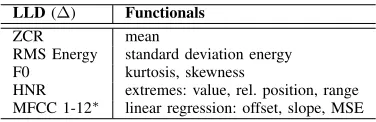
The acoustic features used in our experiments are adopted from the baseline feature set of IS09 EC. This is created with the openSMILE framework [27], [28] by applying statistical functionals to frame-wise low-level-descriptors (LLDs) as depicted in Table III. To each of the 16 LLDs, the delta coef-ficients are computed. Finally, the 12 functionals are applied on a per-chunk level. As result of the ‘brute-forcing’ method, the total feature vector per chunk contains16×2×12 = 384 attributes.
TABLE III
THEIS09 EC ACOUSTIC FEATURE SET:LOW-LEVEL DESCRIPTORS(LLDS)
AND RESPECTIVE FUNCTIONALS.
LLD(∆) Functionals
ZCR mean
RMS Energy standard deviation energy
F0 kurtosis, skewness
HNR extremes: value, rel. position, range MFCC 1-12∗ linear regression: offset, slope, MSE
V. EMPIRICALEVALUATION
In this section, we investigate the performance of the various DAL algorithms by evaluating the classification accuracy in relation to the number of human annotations. Specifically, the rDAL and oDAL algorithms are confronted with regard to different agreement levels. Furthermore, the uDAL algorithm which combines the first and second agreement levels of the oDAL method is evaluated. Additionally, the robustness of the trained model is examined. All results are compared with the baseline performance achieved through the conventional SAL method.
A. Experimental Setup
[image:5.612.342.530.334.395.2]process was repeated in 20 independent runs. As the evaluation measure, we considered the unweighted average recall (UAR) in accordance with the previous IS challenges.
B. Discussion of Results
The following performance figures show the UAR measures across 20 independent runs of the learning process and the respective standard deviations by the use of the rDAL and oDAL algorithms. According to the characteristic curve progression of AL, the sequential addition of human-labelled instances to the initial training set (200 per iteration) leads to continuous im-provements in the performance of the classifier. The UAR first increases steeply with the number of total human annotations before reaching a plateau. In Figure 3, it can be clearly seen that both the oDAL and rDAL algorithm outperform the SAL method by significantly reducing the number of annotations while obtaining the same performance. Or to put it into other words, higher performance can be achieved with the same amount of manual labelling work. For a more detailed analysis of the performance of the various algorithms, we computed Student’st-test to statistically compare the performances at a selected number of human annotations for different agreement levels. The analysis of two-tailed P values (Table IV) confirms our previous observations and clearly indicates that the DAL approaches generally lead to significantly better performance than SAL. This is particularly evident for oDAL that led to the best performance at all three agreement levels by consistently and robustly outperforming the other methods. Above all,
TABLE IV
SIGNIFICANCE LEVELS OBTAINED FROM THE STATISTICAL COMPARISON
(STUDENT’St-TEST)OF THEUARPERFORMANCE MEASURES BETWEEN
ITERATIONS
j= 1 j= 2 j= 3 rDAL vs SAL < .0001 < .0001 >0.05 oDAL vs SAL < .0001 < .0001 >0.05 oDAL vs rDAL < .0001 < .0001 <0.05
Figure 4 demonstrates that the highest efficiency is realised through the uDAL method, which starts at agreement level
j = 1before jumping toj= 2 after reaching 4 000 annotated instances and finishing 20 iterations, respectively. The transition point can be noted by the slight click in the learning curve. In order to substantiate our findings, we compare the relative cost reduction by measuring the number of human annotations at U AR = 68.2 %. According to Table V, the relative cost reduction (CR) increases with lower agreement levels regarding all applied algorithms. This can be explained by the fact that all five labellers are relatively reliable. Consequently, selecting lower agreement levels results in a dramatic cost reduction without affecting much the overall performance. Furthermore, our results reinforce the finding that the rDAL algorithm requires generally more human annotations, resulting in lower CR than with oDAL. Moreover, it is important to note that the average number of annotators per selected instance (AA) inclines to the minimum that is necessary to achieve a certain
agreement level (Section II-B). Finally, the analysis of standard deviation shows that the stability of the model is enhanced during the learning process.
TABLE V
COST CORRESPONDING TO THE NUMBER OF HUMAN ANNOTATIONS AT
UAR =68.2 %AND THE RELATIVE COST REDUCTION(CR)BY COMPARING
THE AGREEMENT LEVELSj= 1,2,3OF THE ODALALGORITHM AND THE
UDALPERFORMANCE WITH THESALBASELINE. THE AVERAGE NUMBER
OF ANNOTATORS PER SELECTED INSTANCE(AA)IS ALSO PROVIDED.
cost (x 10k) CR (%) AA
SAL 1.6 – 5
rDAL j=3 1.27 20.53 3.72
rDAL j=2 0.72 54.69 2.35
rDAL j=1 0.38 76.33 1
oDAL j=3 0.99 38.34 3.52
oDAL j=2 0.42 73.73 2.25
oDAL j=1 0.23 85.41 1
uDAL 0.23 85.41 1.96
VI. CONCLUSIONS ANDFUTUREWORK
In this paper, we introduced two novel approaches for Dynamic Active Learning that further reduce the amount of the costly human labelling work. The adaptive query strategy of the rDAL method is enhanced by considering the reliability of each individual rater and of every possible rater subgroup, leading to the most efficient query order. Additionally, a highly dynamic approach is proposed that upgrades the agreement level to handle noisy data on approaching the end of the learning process. Our results demonstrate that the novel features of the DAL method lead to improvement of the rDAL method for all agreement levels, requiring up to85.41 %less human annotations while achieving the same performance.
The implementation of the preliminary stage also suit the currently emerging and popular crowd-sourcing systems. In this way, we combine enhanced machine learning methods with highly efficient data annotation resources, achieving a new milestone for highly efficient exploitation of unlabelled data.
For future research, we will investigate the robustness of the DAL method by conducting experiments with multiple corpora, different feature sets, and varying amount of initial training instances. Moreover, the reliability and correlation values will be updated after each annotated instance in order to enable more dynamic DAL algorithms. In the long term, the full potential of self-optimising classifiers will be realised by combining SSL methods with advanced DAL techniques.
ACKNOWLEDGMENT
REFERENCES
[1] B. Schuller and A. Batliner, Computational Paralinguistics: Emotion, Affect and Personality in Speech and Language Processing. New York, NY: John Wiley & Sons, 2014.
[2] S. Steidl, M. Levit, A. Batliner, E. N¨oth, and H. Niemann, ““of all things the measure is man”: Automatic classification of emotions and inter-labeler consistency,” inProc. of ICASSP, Philadelphia, PA, 2005, pp. 317–320.
[3] B. Schuller, “Multimodal Affect Databases - Collection, Challenges & Chances,” inHandbook of Affective Computing, ser. Oxford Library of Psychology, R. A. Calvo, S. DMello, J. Gratch, and A. Kappas, Eds. Oxford University Press, 2015, ch. 23, pp. 323–333, invited contribution. [4] A. E. Thompson and D. Voyer, “Sex differences in the ability to recognise non-verbal displays of emotion: A meta-analysis,”Cognition and Emotion, vol. 28, no. 7, pp. 1164–1195, 2014.
[5] C. L. Rusting, “Personality, mood, and cognitive processing of emotional information: three conceptual frameworks.”Psychological bulletin, vol. 124, no. 2, p. 165, 1998.
[6] C. Edgar, M. McRorie, and I. Sneddon, “Emotional intelligence, personality and the decoding of non-verbal expressions of emotion,” Personality and Individual Differences, vol. 52, no. 3, pp. 295–300, 2012.
[7] T. Ruffman, J. D. Henry, V. Livingstone, and L. H. Phillips, “A meta-analytic review of emotion recognition and aging: Implications for neuropsychological models of aging,”Neuroscience & Biobehavioral Reviews, vol. 32, no. 4, pp. 863–881, 2008.
[8] X. Zhu, “Semi-supervised learning literature survey,” Department of Computer Sciences, University of Wisconsin at Madison, Madison, WI, Tech. Rep. TR 1530, 2006.
[9] A. Blum and T. Mitchell, “Combining labeled and unlabeled data with co-training,” inProc. of 11th annual conference on Computational Learning Theory, Madison, WI, 1998, pp. 92–100.
[10] B. Settles, “Active learning literature survey,” Department of Computer Sciences, University of Wisconsin–Madison, Wisconsin, WI, Tech. Rep., 2009.
[11] M. Li and I. Sethi, “Confidence-based active learning,”IEEE Transactions on Pattern Analysis and Machine Intelligence, vol. 28, no. 8, pp. 1251– 1261, 2006.
[12] R. Liere, “Active learning with committees: An approach to efficient learning in text categorization using linear threshold algorithms,” Ph.D. dissertation, Oregon State University, OR, Portland, OR, 2000. [13] G. Tur, D. Hakkani-T¨ur, and R. E. Schapire, “Combining active and
semi-supervised learning for spoken language understanding,”Speech Communication, vol. 45, no. 2, pp. 171–186, 2005.
[14] X. Zhu, J. Lafferty, and Z. Ghahramani, “Combining active learning and semi-supervised learning using Gaussian fields and harmonic functions,” inICML 2003 workshop on the continuum from labeled to unlabeled data in machine learning and data mining, Washington DC, 2003, pp. 58–65.
[15] Z. Zhang, E. Coutinho, J. Deng, and B. Schuller, “Cooperative learning and its application to emotion recognition from speech,”IEEE Transac-tions on Audio, Speech, and Language Processing, vol. 23, no. 1, pp. 115–126, 2014.
[16] Y. Zhang, E. Coutinho, Z. Zhang, C. Quan, and B. Schuller, “Agreement-based Dynamic Active Learning with Least and Medium Certainty Query Strategies,” inProc. of Advances in Active Learning : Bridging Theory and Practice Workshop, ICML 2015, Lille, France, 2015, 5 pages.
[17] J. Platt, “Probabilistic outputs for support vector machines and compar-isons to regularized likelihood methods,” inAdvances in large margin classifiers, A. Smola, P. Bartlett, B. Sch¨olkopf, and D. Schuurmans, Eds. Cambridge, MA: MIT Press, 1999, pp. 61–74.
[18] Z. Zhang and B. Schuller, “Active learning by sparse instance tracking and classifier confidence in acoustic emotion recognition,” inProc. of INTERSPEECH, Portland, OR, 2012, 4 pages.
[19] M. You, C. Chen, J. Bu, J. Liu, and J. Tao, “Emotion recognition from noisy speech,” inProc. of ICME. Toronto, Canada: IEEE, 2006, pp. 1653–1656.
[20] M. Grimm and K. Kroschel, “Evaluation of natural emotions using self assessment manikins,” inProc. of IEEE Workshop on Automatic Speech Recognition and Understanding, Cancun, Mexico, 2005, pp. 381–385.
[21] A. Kittur, E. H. Chi, and B. Suh, “Crowdsourcing user studies with mechanical turk,” inProc. of the SIGCHI conference on human factors in computing systems, Florence, Italy, 2008, pp. 453–456.
[22] J. Howe, “The rise of crowdsourcing,”Wired magazine, vol. 14, no. 6, pp. 1–4, 2006.
[23] M.-C. Yuen, I. King, and K.-S. Leung, “A survey of crowdsourcing systems,” inProc. of Privacy, Security, Risk and Trust (PASSAT) and Proc. of Social Computing (SocialCom). Boston, MA: IEEE, 2011, pp. 766–773.
[24] S. Steidl,Automatic Classification of Emotion-Related User States in Spontaneous Children’s Speech. Berlin: Logos Verlag, 2009.
[25] B. Schuller, S. Steidl, and A. Batliner, “The INTERSPEECH 2009 emotion challenge,” inProc. of INTERSPEECH, Brighton, UK, 2009, pp. 312–315.
[26] B. Schuller, “The computational paralinguistics challenge,”IEEE Signal Processing Magazine, vol. 29, no. 4, pp. 97–101, 2012.
[27] F. Eyben, M. W¨ollmer, and B. Schuller, “openSMILE – the Munich versatile and fast open-source audio feature extractor,” inProc. of ACM MM, Florence, Italy, 2010, pp. 1459–1462.
[28] F. Eyben, F. Weninger, F. Groß, and B. Schuller, “Recent developments in opensmile, the munich open-source multimedia feature extractor,” in Proc. of ACM MM, Barcelona, Spain, 2013, pp. 835–838.