http://eprints.whiterose.ac.uk/104860/ Version: Published Version
Proceedings Paper:
Marsden, H. orcid.org/0000-0002-4885-3446 (2005) L2 poverty of the stimulus at the syntax-semantics interface: Quantifier scope in non-native Japanese. In: Otsu, Y., (ed.) The Proceedings of the Sixth Tokyo Conference on Psycholinguistics. Tokyo Conference on Psycholinguistics, 01 Jan 2005 Hituzi Syobo , Keio University, Tokyo , pp. 217-241.
[email protected] https://eprints.whiterose.ac.uk/
Reuse
Items deposited in White Rose Research Online are protected by copyright, with all rights reserved unless indicated otherwise. They may be downloaded and/or printed for private study, or other acts as permitted by national copyright laws. The publisher or other rights holders may allow further reproduction and re-use of the full text version. This is indicated by the licence information on the White Rose Research Online record for the item.
Takedown
If you consider content in White Rose Research Online to be in breach of UK law, please notify us by
Pre-final version, to appear in Otsu, Yukio (ed.) 2005. The proceedings of the sixth Tokyo Conference on Psycholinguistics. Tokyo: Hituzi Syobo
L2 poverty of the stimulus at the
syntax-semantics interface: Quantifier
scope in non-native Japanese
Heather Marsden
UNIVERSITY OF NEWCASTLE UPON TYNE
1. Introduction
Schwartz & Sprouse (2000) argue that comparative interlanguage research incorporating L2 poverty of the stimulus is the optimal means of determining the roles of Universal Grammar (UG) and first language (L1) knowledge in
non-native language (L2) acquisition. The present study adopts this framework, addressing the following research questions:
(1) When a target language phenomenon P represents an L2
poverty-of-the-stimulus problem, are adult L2 learners able to overcome the problem and acquire P?
(2) Do adult L2 learners show divergence with respect to P when their L1s are typologically distinct with respect to P?
language input, the L1 knowledge, and, where learners are instructed, classroom teaching. If L2 learners demonstrate knowledge of the target language
phenomenon, despite the lack of any direct evidence from which such
knowledge could have been induced, this would provide support for hypotheses that the mechanisms of UG constrain L2 acquisition in the same way as they constrain L1 acquisition (e.g., Flynn 1987; Schwartz & Sprouse 1996; White 1989; among others).
The logic behind comparative interlanguage research is as follows.
Suppose that language X is typologically distinct from language Y with respect to target language phenomenon P. If L2 development with respect to P by learners whose L1 is X differs from that of learners whose L1 is Y, this would provide evidence of an L1 transfer effect, since the target language input should not motivate such a difference.
The present study addresses the questions in (1) and (2) by means of a quantitative investigation of L2 knowledge of idiosyncratic form-meaning mappings in doubly-quantified Japanese sentences. A poverty-of-the-stimulus problem in English-Japanese interlanguage is identified, and the developmental path of adult English-speaking learners with respect to the relevant Japanese facts is compared with the developmental paths of adult native Chinese- and native Korean-speaking speaking learners of Japanese, for whom there is no poverty-of-the-stimulus problem.
with respect to Japanese quantifier scope. The experimental method and results are described in Sections 4 and 5. Section 6 discusses the implications of the findings and presents a speculative account of how L2 acquisition of quantifier scope may proceed in English-Japanese interlanguage. Section 7 concludes.
2. Quantifier scope phenomena in Japanese, Korean, Chinese, and English
Doubly-quantified (QP-QP) SOV sentences in Japanese (3a), Korean (3b), and Chinese (3c) exhibit Ôscope rigidityÕ:1 they permit only a subject-wide (S>O) scope interpretation (3d) (Aoun & Li 1993; Beck & Kim 1997; Huang 1982; Hoji 1985; Kim 1989; Kuroda 1970; among others).2
(3) a. Dareka-ga dono hon-mo/subete-no hon-o yonda. someone-NOM every book-QPt/all-GEN book-ACC read
b. Nwukwunka-ka enu chayk-ina/motun chayk-ul ilkessta. someone-NOM every book-QPt/all book-ACC read
c. Mouren dule mei-ben shu/suoyoude shu. someone read every-CL book/all book
ÔSomeone read every book/all the books.Õ
d. Interpretation:
As shown in (3), scope rigidity occurs whether the object is modified by a distributive universal quantifier (like English every), or a collective universal quantifier (like English all).3 By contrast, English QP-QP sentences additionally allow an object-wide scope (O>S) interpretation when the object quantifier is the distributive every:
(4) Someone read every book.
Interpretation:
S>O: There is some person x, such that x read every book. O>S: For every book y, someone read y.
However, the availability of the object-wide scope interpretation decreases in English if the object quantifier is all (Beghelli & Stowell 1997; Ioup 1975):
(5) Someone read all the books. Interpretation: S>O; ??/*O>S
This generalisationÑthat Japanese, Korean, and Chinese universal
3. L2 acquisition of quantifier scope in Japanese
3.1. Poverty of the stimulus
For native English-speaking learners of Japanese, acquisition of the absence of object-wide scope in Japanese QP-QP sentences represents a
poverty-of-the-stimulus problem. This is because there is no direct evidence in the sources available to the learner from which target-like knowledge could be induced. First, the L1 (English) allows object-wide scope (when the object quantifier is every), so L1 influence cannot rule out object-wide scope in Japanese. Second, the lack of object-wide scope cannot be induced from the target language input: even though learners do not encounter Japanese QP-QP sentences in object-wide scope contexts, this does not logically preclude such sentences ever occurring with object-wide scope. Finally, scope interpretation is not a topic of classroom instruction. Given this absence of external evidence, if target-like knowledge of the lack of object-wide scope arises nonetheless in English-Japanese interlanguage, this would suggest that an internal
sourceÑnamely, the mechanisms of UGÑguide L2 acquisition.
For Chinese- and Korean-speaking learners of Japanese, there is no poverty-of-the-stimulus problem. Like Japanese, Chinese and Korean do not allow object-wide scope. Therefore, L1 transfer could be the source of
3.2. L2 acquisition theory
The investigation of L2 knowledge of Japanese quantifier scope interpretation tests Schwartz & SprouseÕs (1996) Full Transfer-Full Access model of L2 acquisition. According to this model, the initial state of L2 acquisition is characterised by the transfer of the entire L1 grammar to the interlanguage. Restructuring of the L1-based interlanguage grammar is motivated by failure to represent the input. Successive restructurings are hypothesised to be fully constrained by the mechanisms of UG.
Given this assumption that L2 acquisition is fully constrained by UG, then Full Transfer-Full Access predicts that L2 poverty-of-the-stimulus problems can be overcome. Briefly, suppose that the target language represents Option 1 within UG with respect to phenomenon P, and the L1 represents Option 2. Whatever input data cause Option 1 to be instantiated in L1 acquisition of the target language should, in theory, motivate restructuring from Option 2 to Option 1 in the interlanguageÑprovided that the L1-based interlanguage grammar does not obscure the evidence of the triggering data.5 However, such restructuring is unlikely to be instantaneous: learners must first encounter input data that can motivate the restructuring. Thus, compared with Chinese-speaking and Korean-speaking learners of Japanese, whose interlanguage grammar is predicted to be target-like from the outset with respect to quantifier scope interpretation (due to L1 transfer), the development of target-like scope
Three predictions are investigated, based on Full Transfer-Full Access, as follows:
(6) Prediction 1
Due to L1 transfer, lower proficiency English-speaking learners will allow non-target-like object-wide scope on Japanese [∃-NOM ∀-ACC V] sentences
when the universally quantified object is dono N-mo Ôevery NÕ but not when it is subete no-N Ôall the NÕ.
(7) Prediction 2
Due to L1 transfer, lower (and higher) proficiency Korean-speaking and Chinese-speaking learners will reject non-target-like object-wide scope on Japanese [∃-NOM ∀-ACC V] sentences, regardless of the type of object QP.
(8) Prediction 3
Due to UG access, higher proficiency English-speaking learners will reject non-target-like object-wide scope on Japanese [∃-NOM ∀-ACC V] sentences,
regardless of the type of object QP.
4. The experiment
4.1. Participants
Twenty-nine English-speaking learners of Japanese (ÔEJÕ), 38
enrolled in Japanese language classes. The EJ participants were resident in the UK at the time of testing, the CJ participants in Japan, and the KJ participants in Korea or Japan. The three learner groups were each divided into intermediate and advanced proficiency sub-groups on the basis of scores on a 42-blank random cloze test.7 An exact-word scoring method was adopted, and the
criterion for classification as ÔadvancedÕ was a score of at least 12, 12 being the lowest score achieved in a native Japanese control group.8 Accordingly, the following groups were determined: intermediate EJ, n = 20 (mean age: 21); advanced EJ, n = 9 (mean age: 22); intermediate KJ, n = 23 (mean age: 28); advanced KJ, n = 15 (mean age 24). A one-way ANOVA performed on the proficiency test scores shows that the overall effect of group is significant (F(5,78) = 36.73, p < .001).9 Post hoc Games Howell tests show that (i) within each L1 group, the intermediate group scores differ significantly from the advanced group scores (p ≤ .007); and (ii) there are no significant differences
between the scores of the three intermediate groups (p ≥ .999) or the three advanced groups (p ≥ .138).
In addition, data were collected from 21 native speakers of Japanese (ÔJJÕ), 24 native speakers of English (ÔEEÕ), and 24 native speakers of Chinese
4.2. Test design
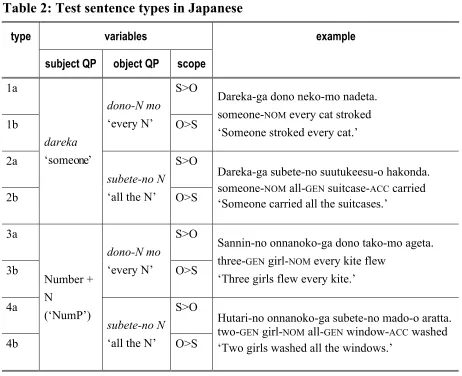
An acceptability judgement task was used. Three variables were
manipulated (in addition to the group variable): subject QP (dareka ÔsomeoneÕ v. a numerically quantified NP, ÔNumPÕ), object QP (dono N-mo Ôevery NÕ v.
[image:10.595.69.531.295.671.2]subete-no N Ôall the NÕ) , and scope (S>O v. O>S). The test sentence types are shown in Table 2.
Table 2: Test sentence types in Japanese
type variables example
subject QP object QP scope
1a S>O
1b
dono-N mo
Ôevery NÕ O>S
Dareka-ga dono neko-mo nadeta.
someone-NOM every cat stroked
ÔSomeone stroked every cat.Õ
2a S>O
2b
dareka
ÔsomeoneÕ
subete-no N
Ôall the NÕ O>S
Dareka-ga subete-no suutukeesu-o hakonda. someone-NOM all-GEN suitcase-ACC carried
ÔSomeone carried all the suitcases.Õ
3a S>O
3b
dono-N mo
Ôevery NÕ O>S
Sannin-no onnanoko-ga dono tako-mo ageta.
three-GEN girl-NOM every kite flew
ÔThree girls flew every kite.Õ
4a S>O
4b
Number +
N
(ÔNumPÕ)
subete-no N
Ôall the NÕ O>S
Hutari-no onnanoko-ga subete-no mado-o aratta. two-GEN girl-NOM all-GEN window-ACC washed
ÔTwo girls washed all the windows.Õ
object-wide scope pictures for Types 1aÐb are illustrated in (9aÐb) (see Table 2 for the accompanying sentence).
(9) a. subject-wide scope picture: b. object-wide scope picture:
Five tokens were created of each type. The test sentences were divided into two sets (Set 1: Types 1a, 1b, 4a, 4b; Set 2: Types 2a, 2b, 3a, 3b). Each set
additionally included 10 scrambled QP-QP sentences and 14 distractors.12 All participants judged both test sets, with at least a short break between the two sets. To control for any effects of the order of presentation, some participants judged Set 1 followed by Set 2, while the others judged Set 2 followed by Set 1. The sentences within each set were presented in two different random orders.
were asked to consider whether the sentence matched the picture, and to answer using a four-point scale of −2, −1, +1, +2, where −2 indicated no match at all,
and +2 indicated a perfect match. A fifth option of ÔcanÕt decideÕ was also available. A pre-test training session was conducted in order to familiarise the participants with the rating system, and the format of the test.
The native English and Chinese control groups completed English and Chinese versions of the task, respectively.
5. Results
5.1. Analysis details
For the analysis, the rating scale of ÔÐ2, Ð1, +1, +2Õ was transformed to Ô0, 1, 2, 3Õ. Mean group ratings were calculated for each type. A rating of less than 1.5 (on the transformed scale of 0Ð3) was considered to indicate rejection of that test type; greater than 1.5 was considered to indicate acceptance. There were very few ÔcanÕt decideÕ responses (<0.5%), and these were excluded from the analysis. The responses of a number of individual participants were excluded due to a high proportion of wrong answers on the distractor items, or to an illegible answer sheet. The revised numbers of participants in each group are shown in Table 3, following.
5.2. Findings
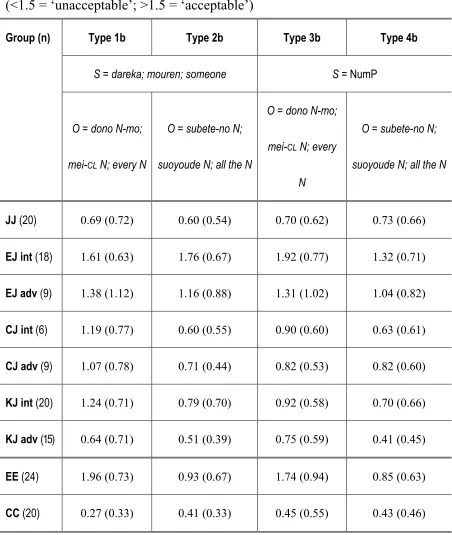
with considerable between-group variation. The object-wide scope ratings (Types 1b, 2b, 3b, & 4b) are presented in Table 3.
A repeated measures ANOVA (subject QP x object QP x scope x group) conducted on the data of all nine groups reveals significant main effects for object QP (F(1,132) = 23.1, p <.001), scope (F(1,132) = 827.15, p <.001), and group (F(8,132) = 15.61, p <.001), but not for subject QP (F(1,132) = .01, p
Table 3: Mean ratings (SD) for object-wide scope
(<1.5 = ÔunacceptableÕ; >1.5 = ÔacceptableÕ)
Group (n) Type 1b Type 2b Type 3b Type 4b
S = dareka; mouren; someone S = NumP
O = dono N-mo;
mei-CL N; every N
O = subete-no N;
suoyoude N; all the N
O = dono N-mo;
mei-CL N; every
N
O = subete-no N;
suoyoude N; all the N
JJ (20) 0.69 (0.72) 0.60 (0.54) 0.70 (0.62) 0.73 (0.66)
EJ int (18) 1.61 (0.63) 1.76 (0.67) 1.92 (0.77) 1.32 (0.71)
EJ adv (9) 1.38 (1.12) 1.16 (0.88) 1.31 (1.02) 1.04 (0.82)
CJ int (6) 1.19 (0.77) 0.60 (0.55) 0.90 (0.60) 0.63 (0.61)
CJ adv (9) 1.07 (0.78) 0.71 (0.44) 0.82 (0.53) 0.82 (0.60)
KJ int (20) 1.24 (0.71) 0.79 (0.70) 0.92 (0.58) 0.70 (0.66)
KJ adv (15) 0.64 (0.71) 0.51 (0.39) 0.75 (0.59) 0.41 (0.45)
EE (24) 1.96 (0.73) 0.93 (0.67) 1.74 (0.94) 0.85 (0.63)
The main effect of scope is due to the subject-wide scope sentences receiving ratings of >2.00, as noted above, while, as seen in Table 3, the
object-wide scope mean ratings range from 0.27 to 1.96, with the majority being below the mid-point of 1.5. The main effects of group and object-QP are due, at least in part, to evidence in the native control data of the cross-linguistic
differences described in Section 2. Specifically, object-wide scope is highly unacceptable in Japanese and Chinese (mean group rating ≤0.73), regardless of whether the object quantifier is distributive (Types 1b & 3b) or collective (Types 2b & 4b). However, in English, object-wide scope is acceptable with the
distributive quantifier every (mean rating ≥1.74 on Types 1b & 3b), but it is
unacceptable with the collective quantifier all (mean rating ≤ 0.93 on Types 2b & 4b).14 Games Howell between-group post hoc tests show that the native
English ratings for Types 1b and 3b differ significantly from the native Japanese and native Chinese ratings (p ≤.002). Within-group comparisons of means
(using a Bonferroni correction) show that, in the native English group, the mean ratings for object-wide scope with every (Types 1b and 3b) are significantly higher than the mean ratings for object-wide scope with all (Types 2b and 4b) (95% confidence intervals: Type 1b, 1.65Ð2.27; Type 2b 0.65Ð1.22; Type 3b, 1.38Ð2.14; Type 4b, 0.58Ð1.12). Within the native Japanese and Chinese groups, there are no comparable significant differences.15
intermediate EJ group accepts object-wide scope on Types 1b, 2b and 3b (mean rating ≥ 1.61), while on Type 4b, the mean rating falls on the ÔrejectionÕ side of
the mid-point, at 1.32. Games Howell post hoc tests show that the intermediate EJ group ratings differ significantly (p <.005) from the native Japanese group on Types 1b, 2b and 3b. None of the other learner groups differ significantly from the native Japanese group. In addition, the intermediate EJ group differs
significantly (p <.01) from the intermediate KJ group on Types 2b and 3b, and the intermediate CJ group on Type 2b.16 There are no between-learner-group differences that do not involve the intermediate EJ group. Moreover, there are no within-group differences due to object QP.
6. Discussion
6.1. Predictions
Three predictions were set out in Section 3.3. The first two concerned L1 transfer, predicting that (i) the intermediate English-speaking learners of
Japanese would (incorrectly) accept object-wide scope for dono N-mo Ôevery NÕ but (correctly) reject object-wide scope for subete-no N Ôall the NÕ; and (ii) the intermediate (and advanced) Chinese- or Korean-speaking learners of Japanese would reject object-wide scope regardless of quantifier type. The third was concerned with UG in L2 acquisition, and predicted that advanced
Considering L1 transfer first, Prediction 1 is partially confirmed. As detailed above, the intermediate English-speaking learners accepted
non-target-like object-wide scope for dono N-mo Ôevery NÕ. However, contra the prediction, they also accepted non-target-like object-wide scope for subete-no N
Ôall the NÕ on Type 2b (subject QP = dareka ÔsomeoneÕ). Prediction 2 is confirmed. Both intermediate and advanced Korean- and Chinese-speaking learner groups consistently rejected object-wide scope. Considering, for the moment, just the sentences with dono N-mo Ôevery NÕ as object (Types 1b and 3b),17 the intermediate learner groupsÕ responses provide clear support for the ÔtransferÕ element of Full Transfer-Full Access. English allows object-wide scope for every N, whereas Chinese and Korean do not allow object-wide scope for mei-CL N/enu N-(i)na Ôevery NÕ. Thus, the contrast between the intermediate
EJ acceptance of object-wide scope for dono N-mo Ôevery NÕ and the
intermediate CJ and KJ rejection of object-wide scope for dono N-mo Ôevery NÕ is precisely as expected if L1 knowledge transfers to the interlanguage.
Moving on to Prediction 3, the advanced English-speaking learners reject object-wide scope for dono N-mo Ôevery NÕ and subete-no N Ôall the NÕ, as predicted. However, the mean ratings for dono N-mo Ôevery NÕ are only barely below the 1.5 midpoint (Type 1b: 1.38; Type 3b: 1.31) and the standard
deviations are high (≥1.02). In this context it is informative to explore the
consistency with which individual informants accepted or rejected particular types. If consistent acceptance on a particular sentence type is defined as
−1 or −2 on at least four or the five tokens for that type, then examination of the nine advanced EJ informantsÕ responses patterns shows that six consistently rejected object-wide scope on Types 1b and 3b, and three consistently accepted object-wide scope. In other words, each participant was highly consistent in her/his answering, but six demonstrated target-like behaviour (i.e., rejection of object-wide scope) while three demonstrated English-like behaviour. This polarisation within the group is the reason for the mean ratings that are close to 1.5 and the high standard deviation. The response pattern is fully compatible with Full Transfer-Full Access: the interlanguage grammar of the six learners who consistently rejected object-wide scope has undergone restructuring with respect to scope interpretation, while the grammar of the remaining three is still based on the L1 grammar. Thus, the six advanced EJ learners who consistently reject object-wide scope can be taken as evidence that poverty of the stimulus can be overcome in L2 acquisition.
In short, the overall pattern of the learner results supports Full
6.2. Quantifier scope in UG
The findings described aboveÑthat intermediate English-speaking learners of Japanese differ from intermediate Korean- or Chinese-speaking learners with respect to scope interpretation; and that some advanced English-speaking
learners show knowledge of native-like Japanese scope interpretation despite poverty of the stimulusÑobtain independently of any theory of quantifier scope. However, in order to consider how an interlanguage manifesting English-based knowledge of quantifier scope can be restructured so that it manifests
Japanese-like knowledge of quantifier scope, it is necessary to look at the specifics of UG architecture with respect to quantifier scope. Among the existing accounts of quantifier scope interpretation, the Target Landing Sites model by Beghelli (1995) and Beghelli & Stowell (1997) can be readily applied to the data in the present study.18
(10)
Ref(erential)P
Spec GQP
AgrSP
[+GROUP REF]
Spec Dist(ributive)P
Spec DQP
ShareP
[+SG]
[+DIST]
Spec GQP
AgrOP
[+GROUP REF]
Spec VP
Distributive quantifiers (DQPs, including English every) take scope in
Spec,DistP, while group-denoting quantifiers (GQPs, including English some
and all) take scope in Spec,RefP or Spec,ShareP. LF-movement to the scope projections is feature-driven: DQPs check a distributive feature in Spec,DistP and GQPs check a group referent feature in Spec,RefP or SpecShareP. The LFs of the subject-wide and object-wide scope readings of Someone read every book
(11) a. [RefP Someonei [AgrSPti [DistP every bookj [AgrOP tj [VP read tj]]]]]
b. [AgrSPti [DistP every bookj [ShareP {someone}i [AgrOPtj [VP read tj]]]]]
In (11a), the object every book is c-commanded by, and hence under the scope of, someone in RefP, while in (11b) it c-commands, and hence takes scope over,
someone which has reconstructed from AgrSP to ShareP. (QPs can reconstruct, in this theory, if the landing site of reconstruction is one in which semantic or morphological features are checked.)
A crucial property of DQPs is that they have a [+singular] feature. Therefore, all cannot be a DQP because it is inherently plural:
(12) *all the child/all the children (cf. every child/*every children)
Consequently, all cannot move to Spec,DistP, and hence cannot take scope in a position that c-commands a subject QP. This accounts for the lack of
object-wide scope with all.
If this account is correct, then the presence or absence of a universal quantifier with a [+singular] feature (like every) is the factor that differentiates English QP-QP interpretation from Japanese, Korean and Chinese. It is plausible that cross-linguistically, the presence or absence of a universal quantifier with a [+singular] feature is a corollary of the presence or absence in a language of a mass/count distinction for nouns. As noted above, Japanese, Korean and
Chinese do not have a mass/count distinction; however, English does. Assuming that these speculations hold, then for English-speaking learners of Japanese to acquire native-like knowledge of Japanese scope rigidity, their English-based interlanguage grammar must be restructured so that there is no mass/count distinction. Chierchia (1998) proposes a nominal mapping parameter, in which the setting for languages like Japanese, with no mass/count distinction,
represents a subset of the setting for languages like English. Hallmarks of the Japanese setting include the lack of plural morphology and the requirement that numerals can modify nouns only with the intervention of a classifier:
(13) san-biki-no neko/*san neko three-CL-GEN cat/three cat
Ôthree catsÕ
provides positive evidence about the status of Japanese with respect to the nominal mapping parameter, while the absence of plural morphology provides indirect negative evidence (Chomsky 1981: 8): in initial-state English-Japanese interlanguage grammar, plural morphology is ÔexpectedÕ in plural contexts, therefore learners may ÔnoticeÕ its consistent lack. However, a number of factors complicate this evidence. First, with mass nouns, English also uses classifiers (e.g., two pieces of paper). Therefore, the English-Japanese interlanguage grammar could potentially parse Japanese numeral expressions with classifiers, without restructuring. Second, Japanese makes of use of optional plural markers on human nouns (e.g, gakusei-tati student-PL). This obscures the indirect
negative evidence of Ôno plural morphology in plural contextsÕ. In short, evidence pertaining to the nominal mapping parameter may be too obscure, or too easily accommodated by the English-based interlanguage grammar to motivate the relevant resetting in all but more advanced learners who have had more exposure to Japanese. Hence only six of the advanced EJ learners in the present study demonstrated target-like scope interpretation.
6.3. Subete-no N Ôall the NÕ in English-Japanese interlanguage
The intermediate English-speaking learners allowed object-wide scope for
subete-no N Ôall the NÕ on Type 1b (subject = dareka ÔsomeoneÕ), even though their L1 does not readily allow object-wide scope for all. Even on Type 4b, the other test type with subete-no N Ôall the NÕ as object (subject = NumP), the intermediate EJ groupÕs rating (1.31) was only barely below the mid-point (1.5) between rejection (<1.5) and acceptance (>1.5). Moreover, the advanced EJ group also had higher ratings (i.e., a higher rate of non-target-like acceptance of object-wide scope) for Types 2b (1.16) and 4b (1.04) than any of the
Chinese-speaking or Korean-speaking learner groups.
The reason for these relatively high rates for object-wide scope with
subete-no N Ôall the NÕ can only be speculated on at present. One possibility, which maintains the role of L1 transfer, is that dono É-mo ÔeveryÕ and subete
ÔallÕ are not directly associated with the lexical slots in the interlanguage
7. Conclusion
The present study yielded two key findings with respect to the acquisition of Japanese scope interpretation by English-, Korean-, and Chinese-speaking learners. First, intermediate-level English-speaking learners of Japanese
accepted non-target-like object-wide scope in Japanese while intermediate-level Korean- and Chinese-speaking learners did not. This provided clear evidence of L2 developmental paths differing according to the L1. Second, some advanced English-speaking learners demonstrated target-like rejection of object-wide scope in Japanese, despite poverty of the stimulus. This provided evidence that L2 acquisition at the syntax-semantics interface is constrained by UG. These results were shown to support the Full Transfer-Full Access model of L2 acquisition. Finally, a speculative account was provided of how L2 acquisition of Japanese scope rigidity may proceed in English-Japanese interlanguage.
Notes
* Data collection for this project was supported by an award from the Japan Foundation Endowment Committee (502214). I am grateful to the teachers who helped to organise the experiments, and the students who participated.
1
ÔQPÕ = Quantifier Phrase. Throughout this paper, this indicates a quantified NP (e.g., every cat, three cats) or PP (e.g., in every house).
2
In the Japanese and Korean examples (3aÐb), quantificational force in the object QPs dono hon-mo/enu chaek-ina Ôevery bookÕ derives from a pre-nominal
quantificational particle (-mo/-ina). These are glossed throughout as Ôevery N-QPtÕ, where ÔQPtÕ indicates Ôquantificational particleÕ. Note that the -i- in the
Korean particle Ðina is dropped after a vowel. See (among others) Gill, Harlow & Tsoulas (2003); Nishigauchi (1990) for detailed analysis.
3
ÔEveryÕ and ÔallÕ are used to gloss East Asian distributive and collective quantifiers, respectively. However, this does not indicate direct semantic equivalence between each East Asian quantifier and English every or all.
4
Note that scrambled QP-QP sentences in Japanese and Korean allow object-wide scope.
5
The important question of what evidence could trigger the relevant restructuring is explored in Section 6.
6
Thirteen of the CJ participants gave Mandarin Chinese as their native dialect, three gave Cantonese, and one gave Taiwanese. It was decided to include the Cantonese and Taiwanese speakers in the study on the basis of discussion with native Cantonese- and Taiwanese-speaking linguists that indicated that an object-wide scope interpretation of QP-QP sentences is ruled out in these languages, as in Mandarin Chinese (personal communication, Yuet Wah Lam, July 2002; Nonie Chang, June 2004).
7
detected, this could have indicated that the intermediate-level English-Japanese interlanguage had already undergone restructuring.
8
The native Japanese control group comprised 30 Japanese students, all resident in Japan. Their age range was 18 to 31, with a mean age of 20.
9
LeveneÕs test of equality of variance yielded a significant result (p = .005), which means that the accuracy of the ANOVA may be somewhat degraded. However, since the between-group differences are robustly either significant or non-significant, it seems justifiable to report these results.
10
The native Chinese group included two native speakers of Taiwanese.
11
There was no native Korean control group. However, relevant native Korean data from separate sources are reported in Section 5.
12
Marsden (2004) discusses the data on the scrambled QP-QP sentences.
13
robustness even when assumptions of normality and homogeneity are broken (Greene & dÕOliveira 1999: 99; among others), and because, for the relatively complex test design, there is no perfectly suitable non-parametric test. Games Howell post hoc tests are used, as these are designed to control for lack homogeneity of variance, and for small population sizes (Field 2000).
14
While the native English ratings for object-wide scope of every fall above 1.5, indicating acceptability, they are nonetheless lower than the ratings for subject-wide scope (Type 1a: 2.68, Type 3a, 2.91). This evidence of depressed acceptability of object-wide scope compared with subject-wide scope is corroborated by other studies of English QP-QP interpretation (e.g., Lee, Yip & Wang 1999). Object-wide scope appears to be globally less easy to obtain than subject-wide scope, even when it is theoretically possible.
15
Regarding Korean, Marsden (2004) presents experimental data showing that subject-wide scope is readily available while object-wide scope is rejected in Korean QP-QP sentences such as (3b) with motun N Ôall the NÕ as object. With
enu N-(i)na Ôevery NÕ as object, informal discussion with five native Korean-speaking linguists confirms that, in SOV sentences, subject-wide scope is acceptable and object-wide scope is not.
16
There are also significant differences between the intermediate EJ ratings and the advanced KJ and CJ ratings. However, since these are predicted on the basis of higher proficiency alone, they are less interesting than differences between the intermediate groups.
17
for subete-no N is discussed in Section 6.3.
18
See Szabolcsi (2001) for an overview of other accounts, and Marsden (2004) for application of several accounts to the languages discussed here.
References
Aoun, J. and Y.. A. Li. (1993) Syntax of scope. Cambridge, MA: MIT Press. Beck, S. and S.-S. Kim. (1997) On wh- and operator scope in Korean. Journal of
East Asian Linguistics, 6, 339-384.
Beghelli, F. (1995) The phrase structure of quantifier scope. PhD dissertation, UCLA.
Beghelli, F. and T. Stowell. (1997) Distributivity and negation: the syntax of
each and every. In A. Szabolcsi (Ed.) Ways of scope taking (pp. 71-107). Dordrecht: Kluwer.
Chierchia, G. (1998) Reference to kinds across language. Natural Language Semantics, 6, 339Ð405.
Chomsky, N. (1981) Lectures on Government and Binding. Foris: Dordrecht. Field, A. (2000) Discovering statistics using SPSS for Windows. London: Sage
Publications.
Flynn, S. (1987) A parameter-setting model of L2 acquisition. Dordrecht: Reidel. Gill, K.-H., S. Harlow and G. Tsoulas. (2003) Disjunction, quantification and
Greene, J. and M. dÕOliveira. (1999) Learning to use statistical tests in psychology (second edition). Buckingham, Philadelphia: Open University Press.
Hoji, H. (1985) Logical form constraints and configurational structures in Japanese. PhD dissertation, University of Washington.
Huang, C.-T. James. (1982) Logical relations in Chinese and the theory of grammar. PhD dissertation, MIT.
Ioup, G. (1975) Some universals for quantifier scope. In J. Kimball (Ed.) Syntax and Semantics, Volume 4 (pp. 37Ð58). New York: Academic Press. Kim, S. W. (1989) The QP status of wh-phrases in Korean and Japanese. In E. J.
Fee (Ed.) Proceedings of the Eighth West Coast Conference on Formal Linguistics (pp. 358Ð372) Stanford: CSLI Publications. Kuroda, S.-Y. (1970) Remarks on the notion of subject with reference to words
like also, even and only, Part II. Annual Bulletin, Research Institute of Logopedics and Phoniatrics, University of Tokyo, 4, 127-152. Lee, T. H., V. Yip and C. Wang. (1999) Rethinking isomorphism as a scope
principle for Chinese and English. In C. Sun (Ed.) Proceedings of the Tenth North American Chinese Linguistics Conference (pp. 169Ð186). Graduate students in linguistics: Department of Linguistics, University of Southern California.
Marsden, H. (2004) Quantifier scope in non-native Japanese: A comparative interlanguage study of Chinese, English, and Korean-speaking
Nishigauchi, T. (1990) Quantification in the theory of grammar. Dordrecht: Kluwer.
Schwartz, B. D. and R. A. Sprouse. (1996) L2 cognitive states and the Full
Transfer/Full Access model. Second Language Research, 12, 40-72. Schwartz, B. D. and R. A. Sprouse. (2000) When syntactic theories evolve:
Consequences for L2 acquisition research. In J. Archibald (Ed.)
Second language acquisition and linguistic theory (pp. 156-186). Oxford: Blackwell.
Szabolcsi, A. (1997) Strategies for scope taking. In A. Szabolcsi (Ed.) Ways of scope taking (pp. 109Ð155). Dordrecht: Kluwer.