This is a repository copy of
The wavelet-NARMAX representation : a hybrid model
structure combining polynomial models with multiresolution wavelet decompositions
.
White Rose Research Online URL for this paper:
http://eprints.whiterose.ac.uk/1972/
Article:
Billings, S.A. and Wei, H.L. (2005) The wavelet-NARMAX representation : a hybrid model
structure combining polynomial models with multiresolution wavelet decompositions.
International Journal of Systems Science, 36 (3). pp. 137-152. ISSN 1464-5319
https://doi.org/10.1080/00207720512331338120
[email protected] https://eprints.whiterose.ac.uk/
Reuse
Unless indicated otherwise, fulltext items are protected by copyright with all rights reserved. The copyright exception in section 29 of the Copyright, Designs and Patents Act 1988 allows the making of a single copy solely for the purpose of non-commercial research or private study within the limits of fair dealing. The publisher or other rights-holder may allow further reproduction and re-use of this version - refer to the White Rose Research Online record for this item. Where records identify the publisher as the copyright holder, users can verify any specific terms of use on the publisher’s website.
Takedown
If you consider content in White Rose Research Online to be in breach of UK law, please notify us by
White Rose Research Online
http://eprints.whiterose.ac.uk/
This is an author produced version of a paper published in International Journal
of Systems Science.
White Rose Research Online URL for this paper:
http://eprints.whiterose.ac.uk/1972/
Published paper
Billings, S.A. and Wei, H.L. (2005) The wavelet-NARMAX representation : a
hybrid model structure combining polynomial models with multiresolution wavelet
decompositions. International Journal of Systems Science, 36 (3). pp. 137-152.
Prepublication draft of the paper published in
International Journal of Systems Science, Vol. 36, No. 3, 20 February 2005, 137–152
The Wavelet-NARMAX Representation: A Hybrid Model Structure Combining
Polynomial Models with Multiresolution Wavelet Decompositions
S.A. Billings and H.L. Wei
Department of Automatic Control and Systems Engineering, University of Sheffield Mappin Street, Sheffield, S1 3JD, UK
[email protected] , [email protected]
Abstract: A new hybrid model structure combing polynomial models with multiresolution wavelet decompositions is
introduced for nonlinear system identification. Polynomial models play an important role in approximation theory,
and have been extensively used in linear and nonlinear system identification. Wavelet decompositions, in which the
basis functions have the property of localization in both time and frequency, outperform many other approximation
schemes and offer a flexible solution for approximating arbitrary functions. Although wavelet representations can
approximate even severe nonlinearities in a given signal very well, the advantage of these representations can be lost
when wavelets are used to capture linear or low-order nonlinear behaviour in a signal. In order to sufficiently utilise
the global property of polynomials and the local property of wavelet representations simultaneously, in this study
polynomial models and wavelet decompositions are combined together in a parallel structure to represent nonlinear
input-output systems. As a special form of the NARMAX model, this hybrid model structure will be referred to as the
WAvelet-NARMAX model, or simply WANARMAX. Generally, such a WANARMAX representation for an
input-output system might involve a large number of basis functions and therefore a great number of model terms.
Experience reveals that only a small number of these model terms are significant to the system output. A new fast
orthogonal least squares algorithm, called the matching pursuit orthogonal least squares (MPOLS) algorithm, is also
introduced in this study to determine which terms should be included in the final model.
Keywords: Nonlinear system identification; NARMAX models; wavelets; orthogonal least squares.
1. Introduction
Modelling and identification of nonlinear systems have been extensively studied in recent years, and several
model structures and modelling approaches have been developed. These include the polynomial NARMAX
(Nonlinear AutoRegressive Moving Average with eXogenous inputs) model (Billings and Leontaritis 1982,
Leontaritis and Billings 1985), neural networks (Chen et al. 1990b, Chen and Billings 1992, Billings and Chen
1998, Yamada and Yabuta 1993, Delgado et al. 1995), radial basis function networks (Chen et al 1990a, 1992),
wavelet networks (Zhang and Benveniste 1992, Zhang 1997) , fuzzy logic based models (Wang 1992),
neuro-fuzzy networks (Brown and Harris 1994), wavelet multiresolution decompositions (Billings and Coca 1999,
Coca and Billings 2001), support vector machines and kernel methods(Campbell 2002, Lee and Billings 2002),
and other basis function expansion based models. In input-output observational data based modelling, the main
task is to determine a suitable model structure, which involves the smallest number of input variables (the lagged
inputs and outputs for dynamical systems) and adjustable parameters. In practice, however, model parsimony
accuracy and validity have to be considered. Another property often considered while modelling a dynamical
system is the prediction (forecasting) capability of the model.
Among existing model structures, polynomial based model structures play a very important role in linear and
nonlinear system modelling and identification. The well-established linear and nonlinear models such as AR(X),
ARMA(X) (Ljung 1987) and bilinear models, which have been widely used in linear and nonlinear system
modelling, all belong to the polynomial model class and can be viewed as special cases of the polynomial
NARMAX model (Billings and Leontaritis 1982, Leontaritis and Billings 1985, Pearson 1995, 1999).
Polynomials are globally smooth functions. It has been proved that any given continuous function on an infinite
interval can be uniformly approximated using a polynomial (Schumaker 1981). Experience shows that even a
simple polynomial model can track the linear trend of a dynamical system very well. However, a polynomial
model of a low degree possesses a poor ability to track severe nonlinear behaviour, such as jumps and
discontinuities.
Local function expansion based model structures including the wavelet decomposition techniques provide a
powerful tool for representing nonlinear signals, even severely nonlinear signals with discontinuities. Among
almost all the basis functions used for the purpose of approximation, few have had such an impact and spurred so
much interest as wavelets. Wavelet decompositions outperform many other approximation schemes and offer a
flexible capability for approximating arbitrary functions. Wavelet basis functions have the property of
localization in both time and frequency. Due to this inherent property, wavelet approximations provide the
foundation for representing arbitrary functions economically, using just a small number of basis functions.
Wavelet algorithms (Coca and Billing 2001) process data at different scales or resolutions, and this makes
wavelet representations more adaptive compared with other basis functions. Although wavelet decompositions
can represent nonlinear signals very well, the advantage of these decompositions might be lost when a signal
displays linear or low-order nonlinear trends.
In order to sufficiently utilise the global property of polynomial models and the local property of wavelet
representations simultaneously, polynomial models and wavelet decompositions will be combined together in a
parallel way to represent a nonlinear input-output system in the present study. As a special form of the
NARMAX model, this hybrid model structure will be referred to as the WANARMAX model.
One of the common problems in nonlinear system modelling is the curse of dimensionality. Theoretically, an
n-dimensional system should be represented using an n-variate function. However, for large n, it is almost
always true that the observational data only forms a sparse distribution in the space
R
n. Consequently, the identification problem, which can be converted into a regression problem in most cases and for most modelstructures, is often ill-posed and various methods have been employed to resolve this problem. One way of
representing a continuous function of several variables is to decompose a multivariate function into a
superposition of a number of continuous functions with fewer variables and this is the essence of Hilbert’s 13th
problem, which was resolved by Kolmogorov. Several applicable approaches have been proposed to realize the
idea of representing multivariate functions using a superposition of a number of functions with fewer variables.
The projection pursuit regression algorithm (Friedman 1981), radial basis function networks (Chen et al 1990b,
1992a), and multi-layer perceptron (MPL) architecture (Haykin 1994) are among the representations that have
been studied for multivariate functions. The existing strategies that attempt to approximate general functions in
NARMAX representation introduced by Billings and Leontaritis (1982, 1985), the multivariate adaptive
regression spline (MARS) method introduced by Friedman (1991), and the adaptive spline modelling of
observational data (ASMOD) introduced by Kavli (1993).
Although experience shows that most systems in practice can be expressed as a supposition of a number of
low-dimensional submodels if the system variables are appropriately selected, a large number of potential model
terms might still be involved when expanding each functional component. Practice and experience show that
often many of the model terms are redundant and inclusion of redundant terms can result in a complex model
structure and the model may become oversensitive to the training data and is likely to exhibit poor generalisation
properties. It is therefore important to determine which terms should be included in the model. A new fast
orthogonal least squares algorithm, called the matching pursuit orthogonal least squares (MPOLS) algorithm, is
introduced in the present paper as one solution to the model term selection problem.
This paper is organised as follows. In Section 2, the wavelet transform and wavelet decompositions are briefly
reviewed. In Section 3, the Wavelet-NARMAX model structure, or simply WANARMAX, is introduced. The
model term selection problem is discussed in Section 4, where a new matching pursuit orthogonal least squares
(MPOLS) algorithm is proposed. Section 5 discusses the implementation of the WANARMAX model. In section
6, two examples are provided to illustrate the applicability of the new modelling framework. Conclusions are
given in Section 7.
2. Multiresolution wavelet decompositions
Assume that the wavelet
ϕ
and the corresponding scaling functionφ
constitute an orthogonal wavelet system.From wavelet theory (Mallat 1989, Chui 1992, Daubechies 1992), any function can be expressed as
the following multiresolution wavelet decomposition
)
(
2
R
L
f
∈
∑∑
∑
≥
+ =
0 0
0 ( ) ( )
)
( , , , ,
j
j k
k j k j k
j k
k
j x x
x
f
α
φ
β
ϕ
(1)where
φ
j,k(x)=2j/2φ
(2jx−k),ϕ
j,k(x)=2j/2ϕ
(2jx−k), j ,k0
α
andβ
j,k are the wavelet decompositioncoefficients, j,k∈Z(Zis a set consisting of whole integers), is an arbitrary integer representing the coarsest resolution or scaling level. Note that from Eq. (1) and the property of wavelet multiresolution analysis, any
function can be arbitrarily closely approximated with some sufficiently large integer J, that is, for
any
0
j
)
(
2
R
L
f
∈
ε
>0, there exists a sufficiently large integer J, such thatε
φ
β
<−
∑
k
k J k
J x
x
f( ) , , ( ) (2)
Therefore,
≈
∑
(3) kk J k
J x
x
This means that the multiresolutin wavelet series decomposition (1) can be replaced by wavelet series (3) with
respect to the orthogonal scaling functions , where J is a sufficiently large scale
number.
) 2 ( 2 ) ( /2
, x x k
J J k
J =
φ
−φ
Using the concept of tensor products, the multiresolution decomposition (1) can be immediately generalised to
the muti-dimensional case, where a multiresolution wavelet decomposition can be defined by taking the tensor
product of the one-dimensional scaling and wavelet functions (Mallat 1989). The one-dimensional wavelet
decomposition (3) can also be extended to d-dimensional (d >1) case by a tensor product approach as below
f12Ld(x1(t),x2(t),L,xd(t))
(4)
) ) ( 2 , , ) ( 2 , ) ( 2 (
1
2
1, , 1 1 2 2
; d d
J
k k
J J
d k k k
J B x t k x t k x t k
d
d − − −
=
∑
LL
L
α
wherek=[k1,k2L,kd]T ∈Zdis an d-dimensional index, Bd(⋅) is an d-dimensional scaling function and can
be decomposed as the direct product of d one-dimensional functions
∏
==
= d
i i d
d
d x B x x x x
B
1 2
1, , , ) ( ) (
)
( L
φ
(5)where
φ
(⋅)is a scalar scaling function.3. The WANARMAX model
The WANARMAX model is formed by combining a polynomial model with wavelet decompositions. In this
study, polynomial NARMAX models and semi-orthogonal multiresolution wavelet decompositions will be
considered and combined in a parallel way.
3.1 The NARMAX representations for nonlinear input-output systems
In the past few decades, modelling and identification techniques for nonlinear systems have been extensively
studied with many applications in approximation, prediction and control. Several nonlinear models have been
proposed in the literature including the NARMAX model representation which was initially proposed by Billings
and Leontaritis (Billings and Leontaritis 1982, Leontaritis and Billings 1985). The NARMAX model takes the
form of the following nonlinear difference equation:
y
(
t
)
=
f
(
y
(
t
−
1
),
L
,
y
(
t
−
n
y),
u
(
t
−
1
),
L
,
u
(
t
−
n
u),
e
(
t
−
1
),
L
,
e
(
t
−
n
e))
+
e
(
t
)
(6)where is an unknown nonlinear mapping, and are the sampled input and output sequences,
and are the maximum input and output lags, respectively. The noise variable with maximum lag
, is unobservable but is assumed to be bounded and uncorrelated with the inputs and the past outputs. The
model (6) relates the inputs and outputs and takes into account the combined effects of measurement noise,
modelling errors and unmeasured disturbances represented by the noise variable .
f
u
(t
)
y
(t
)
u
n
n
ye
(t
)
e
n
)
(t
One of the popular representations for the NARMAX model (6) is the polynomial representation which takes
the function
f
(
⋅
)
as a polynomial of degreel
and gives the form as
∑
∑ ∑
L
= = =
+
+
+
=
n i n i i i i i i n i ii
x
t
f
x
t
x
t
f
t
y
i 1 1
0
1 2 1
2 1 2 1 1
1
(
(
))
(
(
),
(
))
)
(
θ
)
(
))
(
,
),
(
),
(
(
1 2 1 2 1 1 1t
e
t
x
t
x
t
x
f
i n i i i i i i i n i l+
+
∑
∑
− == l l l
L
L
L (7)where
m
i i i12L
θ
are parameters,n
=
n
y+
n
u+
n
e and
∏
, ==
m k i i i i i i i i ii
x
t
x
t
x
t
x
t
f
k m m m 1)
(
))
(
,
),
(
),
(
(
2 1 2 1 21 L
L
θ
L1
≤
m
≤
l
,⎪
⎩
⎪
⎨
⎧
+
+
≤
≤
+
+
−
−
−
+
≤
≤
+
−
−
≤
≤
−
=
e u y u y u y u y y y y kn
n
n
k
n
n
n
n
k
t
e
n
n
k
n
n
k
t
u
n
k
k
t
y
t
x
1
))
(
(
1
))
(
(
1
)
(
)
(
(8)The degree of a multivariate polynomial is defined as the highest order among all terms. For example, the degree
of the polynomial
h
(
x
1,
x
2,
x
3)
=
a
1x
14+
a
2x
2x
3+
a
3x
12x
2x
32 isl
=
2+1+2=5, which is determined by thelast term, . Similarly, a NARMAX model with polynomial degree
l
means that the order of each termin the model is not higher than .
2 3 2 2 1 3x x x
a
l
The NARX model is a special case of the NARMAX model and takes the form
y
(
t
)
=
f
(
y
(
t
−
1
),
L
,
y
(
t
−
n
y),
u
(
t
−
1
),
L
,
u
(
t
−
n
u))
+
e
(
t
)
(9)In this case the variable xk(t) defined in (8) reduces to
⎪⎩
⎪
⎨
⎧
+
=
≤
≤
+
+
−
≤
≤
−
=
u y y y y kn
n
n
k
n
n
k
t
u
n
k
k
t
y
t
x
1
),
(
1
),
(
)
(
(10)3.2 The wavelet-based ANOVA expansion
Generally, a multivariate nonlinear function can often be decomposed into a superposition of a number of
functional components via the well known functional analysis of variance (ANOVA) expansions (Friedman
1991, Chen 1993) as below
y
(
t
)
=
f
(
x
1(
t
),
x
2(
t
),
L
,
x
n(
t
))
∑
∑
≤ < ≤ =+
+
=
n j i j i ij n i ii
x
t
f
x
t
x
t
f
f
1 1
0
(
(
))
(
(
),
(
))
+
∑
+
L
≤ < < ≤i j k n
k j i ijk
x
x
x
f
1)
,
,
(
∑
≤ < < ≤+
n i i i i i i i i m m mx
t
x
t
x
t
f
L LL
1 2 1 2 1 1))
(
,
),
(
),
(
(
+
L
+
f
12Ln(
x
1(
t
),
x
2(
t
),
L
,
x
n(
t
))
+
e
(t
)
(11)where the first functional component is a constant to indicate the intrinsic varying trend; , , are
univariate, bivariate, etc., functional components. The univariate functional components represent the
independent contribution to the system output that arises from the action of the ith variable alone; the
0
f
f
if
ij,
L
bivariate functional components represent the interacting contribution to the system output from the
input variables and , etc. Let (k=1,2,…,n) be defined as (8) or (10), the ANOVA expansion (11) can
then be viewed as a special form of the NARMAX or NARX models for dynamic input and output systems.
Although the ANOVA decomposition of the NARMAX model (6) involves up to different functional
components, experience shows that a truncated representation containing the components up to the bivariate or
tri-variate functional terms often provides a satisfactory description of for many high dimensional
problems providing that the input variables are properly selected. It is obvious that adopting a truncated ANOVA
expansion containing only low-dimensional function components does not mean such an approach will always
be appropriate. An exhaustive search for all the possible submodel structures of (11) is demanding and can be
prohibitive because of the curse-of-dimensionality. A truncated representation is advantageous and practical if
the higher order terms can be ignored. In practice, the constant term can often be omitted since it can be
combined into other functional components.
)
,
(
i j ijx
x
f
i
x
x
jx
k(t
)
n
2
)
(t
y
0
f
It will generally be true that, whatever the data set and whatever the modelling approach, the structure of the
final model will be unknown in advance. It is therefore not possible to know up to how many order functional
components in a truncated ANOVA expansion will be sufficient for a given nonlinear system. This is why model
validation methods, which are independent of the model fitting procedure and the model type, are an important
part of the NARMAX modelling methodology (Billings and Chen 1998). If the model is adequate to represent
the system the residuals should be unpredictable from all linear and nonlinear combinations of past inputs and
outputs. This means that the identified model has captured all the predictable information in the data and is
therefore the best that can be achieved by any model. It is therefore perfectly acceptable to fit a model that
includes just up to one, two or three-dimensional functional terms initially. The model validity tests should then
be applied to test if the model that is obtained has captured all the predictable information in the data. If the
model fails the model validity tests higher order terms should be included in the initial search set and the
procedure should be repeated. It is therefore not necessary to prove that it is always possible to proceed based on
just up to certain order submodels. The identification proceeds a stage at a time and uses model validation as the
decision making process. This is the NARMAX methodology (Billings and Chen 1998), which is implemented
here, and which mimics the traditional approach to analytical modelling. In the latter case the most important
model terms are included in the model initially then the less significant terms are added until the model is
considered to be adequate. This is exactly what the OLS algorithm and the ERR does but based on the data. The
most significant model terms are added first, step by step, a term at a time. The ERR cut-off value is used as a
stopping mechanism but the model should never be accepted without applying model validity tests. If these tests
fail go back and either reduce the ERR cut-off, or allow more complex model terms in the initial model library,
or both and continue until the model validity tests are satisfied.
In practice, many types of functions, such as kernel functions, splines, polynomials and other basis functions
can be chosen to express the functional components in model (11). In the present study, however, mutiresolution
wavelet decompositions will be chosen to describe the functional components. For example, the functional
components
f
p(
x
p(
t
))
(p=1,2,…,n) andf
pq(
x
p(
t
),
x
q(
t
))
(1
≤
p
<
q
≤
n
) can be expressed using the∑∑
∑
≥ + = 1 11 ( ()) ( ())
)) ( ( (,) , (,) , j j k p k j p k j p k j k p k j p
p x t x t x t
f
α
φ
β
ϕ
,p
=
1
,
2
,
L
,
n
, (12)=
∑∑
1 2 2 2 1 2 2 12 ( ()) ( ())
)) ( ), (
( (;)(,1) , ,
k k q k j p k j pq k k j q p
pq x t x t x t x t
f
α
φ
φ
∑∑∑
≥+
2 1 2
2 1
2
1 , ( ()) , ( ())
) 1 )( ( , ; j
j k k
q k j p k j pq k k
j
φ
x tϕ
x tβ
∑∑∑
≥+
2 1 2
2 1
2
1 , ( ()) , ( ())
) 2 )( ( , ; j
j k k
q k j p k j pq k k
j
ϕ
x tφ
x tβ
∑∑∑
≥
+
2 1 2
2 1
2
1 , ( ()) , ( ())
) 3 )( ( , ; j
j k k
q k j p k j pq k k
j
ϕ
x tϕ
x tβ
,1
≤
p
<
q
≤
n
. (13)3.3 The WANARMAX model
The wavelet-NARMAX model, or simply WANARMAX, which incorporates a polynomial NARMAX model
and a multiresolution wavelet decomposition in a parallel way, can be defined as
) ( )) ( ( )) ( ( )) ( ( )) ( ( )
(t f x t f x t f x t f t e t
y = = P + W + E
ξ
+ (14)where and (k=1,2,…,n) are defined as in (10), is a
polynomial model; is a wavelet decomposition model; and is a polynomial model with
respect to the noise variable and .The submodels ,
and can be combined into the WANARMAX model (14) in various forms and the
following are some examples
T n
t
x
t
x
t
x
t
x
(
)
=
[
1(
),
2(
),
L
,
(
)]
x
k(t
)
f
( t
x
(
))
P
))
(
( t
x
f
Wf
E(
ξ
(
t
))
)
(t
e
ξ
(
t
)
=
[
e
(
t
−
1
),
e
(
t
−
2
),
L
,
e
(
t
−
n
e)]
Tf
P( t
x
(
))
))
(
( t
x
f
Wf
E(
ξ
(
t
))
∑∑
∑
= = = + + = n p n p q q p pq n p p p P t x t x b t x a a t x f 1 10 ( ) ( ) ( )
)) (
( (15)
∑∑
∑
= = = + = n p n p q q p pq n p p p W t x t x f t x f t x f 1 1 )) ( ), ( ( )) ( ( )) (( (16)
∑
∑∑
(17) = = = − − + −= e ne e
p n p q pq n p p E q t e p t e c p t e c t f 1 1 ) ( ) ( ) ( )) ( (ξ
where the functional components (p=1,2,…,n) and ( ) in (16)
can be expressed using the multiresolution wavelet decompositions.
))
(
(
x
t
f
p pf
pq(
x
p(
t
),
x
q(
t
))
1
≤
p
<
q
≤
n
For a selected wavelet
ϕ
(⋅) and the scaling functionφ
(⋅), once the maximum lags , and are given, and the initial(coarsest) and highest(finest) resolution scales in the multiresolution decomposition are determined,the WANARMAX model can be rearranged and converted into a linear-in-the-parameters regression model of
the form
y
n
n
un
e(18) ) ( ) ( ) ( ) ( ) ( 3 2 1 1 1 1 t e t p t p t p t y M k E k E k M j W j W j M i P i P
i + + +
=
∑
∑
∑
= = =θ
θ
θ
where the regressors piP(t),p (t)and ( W
j p (t)
E
k i=1,2,L,M1;j=1,2,L,M2;k =1,2,L,M3) are related to
model fE( t
ξ
( )), respectively.θ
iP, and ( Wj
θ
Ek
θ
i
=
1
,
2
,
L
,
M
1;
j
=
1
,
2
,
L
,
M
2;
k=1,2,L,M3) are parametersto be estimated.M1 =(ny +nu +1)(ny +nu +2)/2,M3 =ne and depends on not only the wavelet type
used but also the initial and the highest resolution scales.
2
M
A special case for the WANARMAX model (18) is the Wavelet-NARX, or simply WANARX model
) ( ) ( )
( )
(
2 1
1 1
t e t p t
p t
y
M
j
W j W j M
i
P i P
i + +
=
∑
∑
= =
θ
θ
(19)Although many functions can be chosen as scaling and/or wavelet functions, most of these are not suitable in
system identification applications, especially in the case of multidimensional and multiresolution expansions. An
implementation, which has been tested with very good results, involves B-spline and B-wavelet functions in
multiresolution wavelet decompositions (Billings and Coca 1999, Coca and Billings 2001, Wei and Billings
2002). B-spline wavelets were originally introduced by Chui and Wang (1992) to define a class of
semi-orthogonal wavelets.
For large and , the model (18) might involve a great number of model terms or regressors. Experience
shows that often many of the model terms are redundant and therefore are insignificant to the system output and
can be removed from the model. An efficient algorithm is required to determine which terms should be included
in the model. The significant model term selection problem is discussed in the next section. y
n
n
u4. Model term selection
The selection of which terms should be included in the WANARMAX model (18) is vital if a parsimonious
representation of the system is to be identified. For a selected basic wavelet and associated scaling function, once
the initial resolution scale level is given, simply increasing the orders and of the dynamic terms and the
highest resolutions in the multiresolution wavelet model will in general result in an excessively over
parameterised complex model. Fortunately, experience has shown that only a small number of subsets of these
model terms are significant and the remainder can be discarded with little deterioration in prediction accuracy.
Several possible ways can be used to determine which terms are significant and should be included in the model,
including the well-known orthogonal least squares (OLS) algorithm. In this section, the forward orthogonal least
squares (OLS) algorithm is briefly summarised and then a new matching pursuit orthogonal least squares
(MPOLS) algorithm is introduced.
y
n
n
uThe WANARMAX model (18) can be expressed as a linear-in-the-parameters equation of the form
) ( ) ( )
( 1
t e t p t
y M
m m
m +
=
∑
=
θ
(20)where pm(t)= pmP(t) for
m
=
1
,
2
,
L
,
M
1 , p (t) p (t) for Wm
m =
M
1+
1
≤
m
≤
M
1+
M
2 , andfor
) ( )
(t p t
pm = mE
M
1+
M
2+
1
≤
m
≤
M
=
M
1+
M
2+
M
3.θ
m (m=1,2,L,M ) are parameters to be estimated. Define} , , 2 , 1 ; 1
: { )
( p i M k m
Pm i k
k ≤ ≤ = L
The model term selection procedure is in fact an iterative process which searches through a nested term set in the
sense that
L
L
⊂
⊂
⊂
⊂
(2) ( )) 1
( m
P
P
P
(22) This makes both the complexity and the accuracy of the representation based on these term sets increase until asuitable term set is found, that is, there exists an integer
M
0 (generallyM
0<<
M
), such that the model(23)
) ( ) ( )
(
0
1
t e t p t
y M
k i
ik k +
=
∑
=
θ
provides a satisfactory representation over the range considered for the measured input-output data.
4.1 The forward orthogonal least squares (OLS) algorithm
A fast and efficient model structure determination approach can be implemented using the forward orthogonal
least squares (OLS) algorithm and the error reduction ratio (ERR) criterion, which was originally introduced to
determine which terms should be included in nonlinear models (Billings et al. 1988, 1989, Korenberg et al. 1988,
Chen et al. 1989). This approach has been extensively studied and widely applied in nonlinear system
identification (see, for example, Chen et al. 1991, Wang and Mendel 1992, Zhu and Billings 1996, Zhang 1997,
Hong and Harris 2001). The forward OLS algorithm involves a stepwise orthogonalization of the regressors and
a forward selection of the relevant terms in (20) based on the error reduction ratio (ERR) (Billings et al. 1988,
1989). The procedure can be briefly summarised as follows:
Consider the linear-in-the-parameters model (20), where the regression matrix with
, N is the length of the observational data set. With the assumption that P is full
rank in columns, then P can be orthogonally decomposed as
]
,
,
,
[
p
1p
2p
MP
=
L
T i i
i
i p p p N
p =[ (1), (2),L, ( )]
WA
P= (24) where
A
is an M×M unit upper triangular matrix andW
is anN
×
M
matrix with orthogonal columnsin the sense that M
w
w
w
1,
2,
L
,
WTW=D=
diag
[
d
1,
d
2,
L
,d
M]
with . Model (20) can then be expressed asm T m
m
w
w
d
=
Ξ + = Ξ + Θ
= PA− A WG
Y ( 1)( ) (25)
where are the observations of the system output, is the
parameter vector, is the vector of the noise signal, and is an
auxiliary parameter vector, which can be calculated directly from
Y
and by means of the property oforthogonality as
T N y y
y
Y =[ (1), (2),L, ( )] T
M]
, , ,
[
θ
1θ
2 Lθ
= Θ
T N )]
( , ), 2 ( ), 1 (
[
ε
ε
Lε
=
Ξ T
M g g g
G=[ 1, 2,L, ]
W
i T i
i T
i
w w
w Y
g = ,
i
=
1
,
2
,
L
,
M
(26)The number M of all the candidate terms in model (20) is often very large. Some of these terms may be
redundant and should be removed to give a parsimonious model with only terms ( ). Detection
of the significant model terms can be achieved using the OLS procedures described below.
0
M M0 <<M
Assume that the residual signal
ε
(t) in the model (20) is uncorrelated with the past outputs of the system, then the output variance can be expressed asΞ Ξ + =
∑
=
T M
i
i T i i T
N w w g N Y Y N
1 1
1
1 2
(27)
Note that the output variance consists of two parts, the desired output
∑
M=i i
T i iw w g N
1 2 )
/ 1
( which can be
explained by the regressors, and the part which represents the unexplained variance. Thus
is the increment to the explained desired output variance brought by , and the
i
th errorreduction ratio, , introduced by , can be defined as
Ξ ΞT N )
/ 1 (
∑
=M
i i
T i i w w g N
1 2 )
/ 1
( pi
i
ERR pi
% 100 ) ( 2
× =
Y Y
w w g ERR
T i T i i
i 100%
) )( (
)
( 2
× =
i T i T
i T
w w Y Y
w Y
, i=1,2,L,M , (28)
This ratio provides a simple but effective means for seeking a subset of significant regressors. The significant
terms can be selected in a forward-regression manner according to the value of step by step. The
significant terms can be selected in a forward-regression manner according to the value of . Several
orthogonalization procedures, such as Gram-Schmidt, modified Gram-Schmidt and Householder transformation
(Chen et al. 1989) can be applied to implement the orthogonal decomposition. The improved version of this
algorithm (Zhu and Billings 1996) provides a significant reduction in the computations and is advantageous
compared to standard Gram-Schmidt algorithm when dealing with high order MIMO systems. Other recent
studies by Hong and Harris (2001) have proposed other improvements to this procedure. i ERR
i
ERR
Remark 1: The forward orthogonal least squares algorithm for model term selection is described and
expounded in a matrix form here for convenience of introducing and explaining the concept of error reduction
ratio (ERR). In practical identification, however, this algorithm is often implemented in a forward stepwise way
(Wei and Billings 2004). The most significant model terms are added first, step by step, a term at a time. The
ERR cut-off value is used as a stopping mechanism but the model should never be accepted without applying
model validity tests.
Remark 2: The candidate terms that are not chosen in the first step are orthogonalized with respect to all
previously selected basis functions. Because of the orthogonality the
j
th term can be selected in the same way as in the first step.w
j is thej
th selected orthogonal term and is the corresponding parameter. Any numerical ill conditioning can be avoided by eliminating the candidate basis functions for which are lessthan a predetermined threshold
j
g
i T i
w
w
Remark 3: The assumption that the regression matrix P is full rank in columns is unnecessary in the iterative
forward OLS algorithm(Wei and Billings 2004). In fact, if the M columns of the matrix P are linearly dependent,
and assuming that the rank in columns of the matrix P is L (<M) , then the algorithm will stop at the L-th step.
Remark 4: If required, the procedure can be terminated at the -th step ( ) when
, where
0
M M0 ≤L
ρ
< −∑
= 0 1 1 M i iERR
ρ
is a desired error tolerance called the cutoff, which can be learnt during theregression procedure. The final model is the linear combination of the M0 significant terms selected from the
M candidate terms
{
p
i}
Mi=1)
(
)
(
)
(
0 1t
e
t
w
g
t
y
M i i i+
=
∑
= (29)which is equivalent to
)
(
))
(
(
)
(
0 1t
e
t
x
p
t
y
M i i i+
=
∑
= l l
θ
(30)where the parameters are calculated from the triangular equation
with and
T OLS M ] , , , [ 0 2 1 ) ( l l l
θ
Lθ
θ
=
Θ (OLS) (OLS)
AG =Θ
T M
OLS g g g
G [ , , , ]
0
2 1 )
( = L
⎥ ⎥ ⎥ ⎥ ⎥ ⎥ ⎥ ⎦ ⎤ ⎢ ⎢ ⎢ ⎢ ⎢ ⎢ ⎢ ⎣ ⎡ = − 1 0 0 1 0 1 0 1 0 0 0 0 , 1 2 1 12 L L M O M M L L M M M M a a a a
A (31)
The entries aij(1≤i< j≤M0) are given in the above OLS algorithm.
Remark 5: The key point in the forward OLS-ERR algorithm is focused on detecting the most significant
model terms from a great number of candidates by introducing an orthogonalization procedure and the concept
of error reduction ratio (ERR). The estimation of the model parameters is only a by-product of the model term
selection procedure. It requires that the orthogonalization should be explicit so that the significant model terms
selected by the algorithm are transparent to the model builders. Many other singular value decomposition
methods including the standard SVD, Krylov subspace and Lanczos bidiagonalizaiton methods, which are
proved to be more numerically stable compared with the present OLS algorithm, can be used to solve linear least
squares problems, where the main task is to estimate the unknown parameters for a given linear equation. These
methods, however, cannot provide any information about which model terms are the most significant. In other
words, for a given linear-in-the-parameters form (20), these methods cannot tell which model terms or regressors
make the most significant contributions to the system output y(t). These methods could however provide an aid
for solving the identification problem by combining the methods with the forward OLS-ERR algorithm. For
example, the most significant model terms could then be selected initially using the forward OLS-ERR algorithm,
4.2 Matching pursuit orthogonal least squares (MPOLS) algorithm
Note that in the forward OLS algorithm, at each step all the unselected regressors are made to orthogonalize
with the previously selected regressors, and most of the computational cost is based on these orthogonalization
transforms. An iterated orthogonal projection algorithm, the matching pursuit method, proposed by Mallat and
Zhang (1993) is a simple regressor selection algorithm which is relatively computationally efficient. But the
matching pursuit algorithm is less efficient than OLS, since the number of regressors selected by the matching
pursuit algorithm is almost always larger than that selected by OLS for the same given threshold value of
approximation accuracy. A trade-off between the efficiency and the computational cost is considered here by
combining the advantages of the forward OLS with the matching pursuit algorithm to create a new algorithm
called the matching pursuit orthogonal least squares (MPOLS) algorithm. The algorithm is described below.
For the output vector in (20), find a vector from the candidate regressor
family , so that is the “best” matching regressor to Y, i.e., makes the mean squared
error of the following linear regression
T
N
y
y
y
Y
=
[
(
1
),
(
2
),
L
,
(
)]
1 l
p
}
,
,
,
{
p
1p
2L
p
M1 l
p
1 lp
)
(
)
(
)
(
t
c
p
t
t
y
=
m m+
ξ
m (32) achieve a minimum in the sense that⎭
⎬
⎫
⎩
⎨
⎧
−
=
−
=
∑
∑
∑
= = = N t m m m N t N tt
p
c
t
y
N
t
p
c
t
y
N
t
N
1 2 1 2 1 2)]
(
)
(
[
1
min
))
(
)
(
(
1
)
(
1
1 11 l l
l
ξ
(33)The “best” matching regressor can be found using orthogonal projection approach by defining 1 l
p
m T m T m Tp
p
Y
Y
p
Y
=
α
cos
(34)m T m m T m
p
p
p
Y
Y
p
1=
cos
α
=
(35)Such that 2 1 2 2 1 2
)
(
m mN
t
m
t
=
=
Y
−
p
∑
=ξ
ξ
m T m m T Tp
p
p
Y
Y
Y
2)
(
−
=
(36)Thus
⎭
⎬
⎫
⎩
⎨
⎧
≤
≤
=
m
M
p
p
p
Y
m T m m Tm
,
1
)
(
max
arg
2 1l
(37)Set
(
)
(
)
, , , , and1
1
t
p
t
q
=
lw
1(
t
)
=
q
1(
t
)
g
1(
Y
w
1)
/(
w
1w
1)
T T
=
(
1 1)
/(
)
2 1
1
g
w
w
Y
Y
ERR
=
T T)
(
)
(
)
(
1 11
t
=
y
t
−
g
w
t
η
.At the second step, find a vector from the candidate regressor family 2
l
p
{
p
m:
1
≤
m
≤
M
,
m
≠
l
1}
, so thatis the “best” matching regrssor to 2
l
p
η
1. Following the approach in (32) and (33),l
2 should be chosen as⎭
⎬
⎫
⎩
⎨
⎧
≠
≤
≤
=
1 2 12
,
1
,
)
(
max
arg
l
l
m
M
m
Set
(
)
(
)
. Orthogonalize with as below 22
t
p
t
q
=
lq
2w
11 1 1 2 1 2 2
w
w
w
q
w
q
w
T T−
=
(39)And set
g
2(
Y
w
2)
/(
w
2w
2)
, , andT T
=
(
2 2)
/(
)
2 2
2
g
w
w
Y
Y
ERR
=
T Tη
2(
t
)
=
η
1(
t
)
−
g
2w
2(
t
)
. Generally, at step k, select⎭
⎬
⎫
⎩
⎨
⎧
≠
≠
≠
≤
≤
=
− − 1 2 1 2 1,
,
,
,
1
,
)
(
max
arg
k m T m m T k mk
m
M
m
m
m
p
p
p
l
L
l
l
l
η
(40)Set
q
(
t
)
p
(
t
)
and orthogonalize with as belowk
k
=
lq
kw
1,
w
2,
L
,
w
k−11 1 1 1 2 2 2 2 1 1 1 1 − − − −
−
−
−
−
=
k k T k k T k T k T T k T k kw
w
w
q
w
w
w
w
q
w
w
w
w
q
w
q
w
L
(41)Calculate
(
)
/(
k)
, , and setT k k T
k
Y
w
w
w
g
=
ERR
g
2(
w
w
k)
/(
Y
TY
)
T k k
k
=
η
k(
t
)
=
η
k−1(
t
)
−
g
kw
k(
t
)
. A similar algorithm has been used for basis selection in wavelet neural networks (Xu 2002). Note that in theMPOLS algorithm, only the most recently selected regressor
j
p
q
j=
l at step j is made to be orthogonal with the previous selected regressors (k=1,2,…,j-1). Therefore, the computational load of theorthogonalization procedure in OLS, which involves making all the unselected regressors orthogonal with the
previously selected regressors, is significantly reduced in the new MPOLS algorithm. Therefore, the
computational cost of the MPOLS algorithm is much less than that of the OLS algorithm, and the new algorithm
is much faster then most existing OLS and fast OLS algorithms.
k
p
q
k=
lIn the MPOLS algorithm, any numerical ill conditioning can be avoided by eliminating the candidate terms for
which
p
iTp
iis less than a predetermined thresholdτ
, for example,τ
=
10
−r andr
≥
10
.w
j is thej
th selected orthogonal term and is the corresponding parameter. If required, the procedure can be terminated atthe -th step ( ) when , where
j
g
0
M
M
0≤
L
−∑
<ρ
= 0 1 1 M i i
ERR
ρ
is a desired error tolerance, which can be learntduring the regression procedure. The final model is the linear combination of all the selected significant terms in
the form of (29) and (30).
Notice that, for the same problem, MPOLS may select different model terms (regressors) and different
numbers of model terms compared with OLS even for the same threshold value of termination. It is nearly
always true that the MPOLS selects more model terms than that of OLS. However, the first term selected by
both algorithms is always the same. The computational efficiency of the MPOLS algorithm compared with OLS
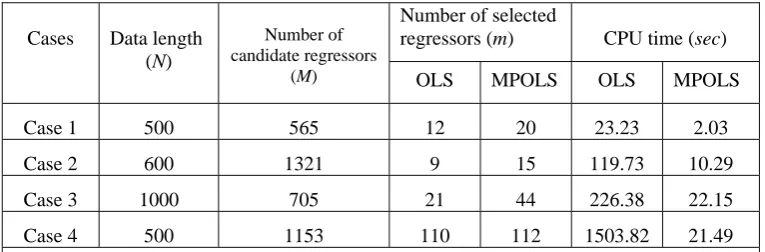
can be demonstrated using the CPU time required to perform a bench test example on the same computer. This is
Table 1 The comparison of the computational efficiency between OLS and MPOLS
Number of selected
regressors (m) CPU time (sec) Cases Data length
(N)
Number of candidate regressors
(M) OLS MPOLS OLS MPOLS
Case 1 500 565 12 20 23.23 2.03
Case 2 600 1321 9 15 119.73 10.29
Case 3 1000 705 21 44 226.38 22.15
Case 4 500 1153 110 112 1503.82 21.49
Note: The threshold values to terminate the OLS and MPOLS algorithms were the same.
5. Implementing a WANARMAX Model
This section summarizes the procedure for implementing a WANARMAX model. The implementation of a
WANARMAX model involves several practical issues including observational input-output data pre-processing,
significant variable selection (Wei and Billings 2004), resolution level determination in the wavelet
decomposition submodels, and model validity tests (Billings and Voon, 1986; Billings and Zhu, 1995).
The iterative identification procedure to implement a WANARMAX model consists of the following steps.
Step 1: Data pre-processing
For convenience of implementation, convert the original observational input-output data u(t) and y(t)
(t=1,2, …,N) into unit intervals [0,1]. The converted input and output are still denoted by u(t) and y(t).
Step 2: Determining the model initial conditions
This includes:
(i) Provide values for
n
y,n
u,n
e,ρ
andρ
e(whereρ
andρ
e are threshold values for terminating the model term selection procedure,ρ
is used in Step 3 andρ
e in Step 4, notice in generalρ
e<ρ
).(ii) Set
e
(
t
)
=0 for t=1,2,…,N.(iii) If possible, select the significant variables from all the candidate lagged output and input variables
{
y
(
t
−
1
),
L
,
y
(
t
−
n
y),
u
(
t
−
1
),
L
,
u
(
t
−
n
u)}
. This involves the model order determination andvariable selection problems.
(iv) Select a polynomial submodel
f
P( t
x
(
))
, a wavelet submodelf
W( t
x
(
))
, and a noise modelf
E(
ξ
(
t
))
from the representations (15)-(17).(v) Determine the initial and the highest resolution scales. Generally the initial resolution scales
j
1andj
2 in the wavelet models can be set toj
1=
j
2=0, and the highest resolution scalesJ
1 andJ
2 can be chosen in a heuristic way.Step 3: Identify the WANARX model
(i) Calculate the regressors