Page | 1
UNIVERSITEIT TWENTE
Conflict Management
Conflict Management in Concurrent Engineering:
A Case Study
Stephan Meijers
10/9/2009
Page | 2
A
BSTRACT
Page | 3
T
ABLE OF
C
ONTENTS
Page | 4
INTRODUCTION
“When we reached the construction phase of the project we discovered that the design drawings indicated that the
Air-conditioning ducts passed straight through a horizontal structural beam designed to support a crane system. Of
course, we couldn’t just move the piping down under it because it would prevent the crane from functioning; above
the structural beam we also lacked space due to the roof of the building. Eventually we had to redesign the
air-conditioning system to split up into two separate, smaller ducts that could pass above the crane beam. This entire
process cost us several days to resolve.”
Conflict in design such as indicated in the example above is not a novel principle and has plagued many projects throughout the history of construction. Managers around the world continually face the challenge of managing conflicts within their design teams to achieve the prerequisite deadlines. With the introduction of Concurrent Engineering into the construction industry and continually more complex building challenges, conflicts such as this are increasing in occurrence and severity. Additionally, the continually growing complexity of structures requires ever larger design teams, and ensures that conflicts that occur become increasingly difficult to resolve.
In today’s harsh economic climate these delays are unacceptable for construction firms. This combination of circumstances provides an excellent stepping stone for this research into increasing understanding of these design conflicts and improving methods to manage it effectively. I define conflict from a design management perspective as: The occurrence of interfering designs between different parties in the concurrent engineering process. These interfering designs can be either physical or conceptual in nature. These parties include different disciplines within a team of engineers or external parties such as the client and contractor involved throughout the engineering process.
Page | 5
research into how engineering teams should handle conflicts in the design phase of the CE process has inspired me to conduct this research.
In this research, I present a case study of conflicts occurring in a design team at a consultancy firm. I analyzed historical projects at the case firm in combination with process analyses in order to increase understanding of design conflicts and seek a set of causes behind them. I developed a collection of suggestions to assist in the case firm’s design management procedures to increase its conflict detection capabilities and to minimize the negative effects of discovered conflicts.
This research helps the construction industry to increase its understanding of the causes of conflicts and improve existing methods on how to efficiently detect and manage them. This combination of knowledge and awareness will lead to a reduced design risk and a shorter overall development time. These improvements have the potential to increase engineering firms’ competitiveness and allow for a reduction in costs, both in terms of time and money. In the future, researchers can expand on this paper to benefit industries outside of the construction world as well as detailing the findings presented in this research pertains to specific scenarios.
In this research, I discovered four main causes for conflicts occurring during the concurrent engineering process, namely Team cooperation, Client Integration, Innovation, and Communication. Effective prevention and management of these conflicts requires several changes from the involved company in these areas including improved conflict detection processes, structuring of design reviews, space & interface management, effective integration of innovation, effective design change management and increased client involvement.
Stephan Meijers,
Page | 6
T
HEORETICAL
C
ONTEXT
C
ONCURRENT
E
NGINEERING
B
ACKGROUNDConcurrent design is a methodology that many different fields of design currently employ, including the construction industry as a method to increase design efficiency and more efficiently handle sizeable and highly complex design tasks.
Winner, (1988) defines concurrent engineering (CE) as the attempt to optimize the design of the project and its construction process to achieve reduced lead times, and improved quality and cost by the integration of design, fabrication, and construction activities and by maximizing concurrency and collaboration in working practices.
CE is seen as a method to avoid the pitfalls that traditional ‘sequential’ engineering deals with as stated by Evbuomwan, (1998). These pitfalls include:
The fragmentation of the different participants in the construction project; The fragmentation of design and construction data;
The occurrence of costly design changes and unnecessary liability claims; The lack of true life-cycle analysis of the project;
The lack of communication of design rationale and intent.
CE is designed to facilitate the simultaneous consideration of all project-related issues and processes starting at the conception stage. According to Evbuomwan, (1998) some of the benefits of this integrated approach include;
getting the job right the first time around;
client satisfaction;
reduced product development time and costs, without compromising quality;
Page | 7
R
EQUIREMENTSTo integrate CE efficiently into the design process, a company needs to adapt its structure and working methods to accommodate the requirements that CE has on design teams. In CE, design team members perform tasks concurrently with a specified degree of overlap; effective knowledge transfer between the various disciplines and team members is a cornerstone to prevent problems from occurring. As Bogus, Molenaar & Diekmann, (2005) indicate, communication scheduling should be determined on the basis of the theories of evolution and sensitivity. Evolution in this sense describes the rate at which design information is generated from the start of an activity through the completion of the activity, and sensitivity in this sense is the sensitivity of the design work to upstream design changes.
The construction industry adopts CE during the design process by considering all aspects of the project’s downstream phases concurrently. Incorporating requirements from the construction, operation and maintenance phases at an early stage of a project lead to an overall improvement in project performance. The essential constituents of concurrent construction are as follows (Anumba, 2002):
The identification of associated downstream aspects of design and construction processes. The reduction or elimination of non-value-adding activities.
The development and empowerment of multi-disciplinary teams.
CE can help to overcome the problem of fragmentation in the construction industry, and therefore the organization of the team is a critical factor in successfully implementing the method. Anumba, (2002) recommends implementing integrated team structures mainly at the project level. The company should support these teams with appropriate communication and decision-making tools and technologies. As indicated by Gratton, (2007), CE design teams, besides requiring a specific organizational structure, function best when paired with the following eight factors:
Investing in signature relationship practices. Modeling collaborative behavior.
Page | 8
Ensuring the requisite skills.
Supporting a strong sense of community.
Assigning team leaders that are both task- and relationship-oriented. Building on heritage relationships.
Understanding role clarity and task ambiguity.
Besides organizational structure, CE relies heavily on adequate communication. As indicated before, the reliance on overlapping different design activities ensures that interdependent work is performed simultaneously. This in turn, requires a specific method of communication to ensure minimal uncertainty and rework (Loch, 1998).
C
ONFLICT
M
ANAGEMENT
CE is plagued by tensions between the various disciplines. The findings in the research performed by Cicmil (2005) indicate that between various parties there is a lack of trust, which prevents team members from communicating about mistakes, design decisions, and things that they could have done better. These findings imply that CE has an extremely high communication risk. With communication being one of the requirements of effective CE, this implies that there are potential issues in conflict management that occur during the application of CE. The high communication risk can lead to a lot of rework and long decision times, and subsequently lead to long delays in projects. Despite CE promoting co-design, where an interdisciplinary design team is intent on achieving the same goal (Kleinsmann, 2008), tensions still exist in the design team as Cicmil, (2005) indicates.
Page | 9
managerial intervention in the CE process to prevent conflict and ensure a project can be completed by the company within the desired timeframe.
Although abundant research is available in the field of communication risks (Loch, 1998), rework and various other aspects important to the functionality of concurrent engineering (Détienne, 2005); (Evbuomwan, 1998); and (Kleinsmann, 2008), little research is available about conflict between the various disciplines involved in an integrated, multidisciplinary design team in the construction industry. The presence of these conflicts, however, is undeniable, as indicated by research (Lu, 2000); (Cicimil, 2005) and by practitioners (Erkamp, 2009). The importance of managing these conflicts is critical to the successful organization of the design process (Lu, 2000).
These communication difficulties and risks conflict with the improvements that CE aims to achieve in interdisciplinary communication. The occurrence of conflict despite integrated communication highlights the necessity for companies to integrate an effective conflict prevention and management system into their working methods. This research, therefore, aims to clarify these effects and provide potential solutions for companies to improve overall project communication and efficiency.
Page | 10
R
ESEARCH
M
ETHODOLOGY
C
OMPANY
I conducted this case study research with the Chinese division of an international consultancy firm based in Shanghai with further branch offices in Guangzhou and Tianjin. Employing a workforce of ca. 60 people, the office is relatively small compared to the company’s other offices around the world, and focuses mostly on serving international clientele in the building and industry sector looking to construct in China. The Shanghai office fulfills mostly an advisory role, acting as a conduit between the client, the Chinese government, the contractors and the local companies involved in the projects, such as Local design institutes, Chinese authority companies and other, similar parties. The design capabilities of the Shanghai office are supported by in house experts from company offices around the world. In this way the company is able to guide a multitude of projects at the same time for a large client base.
The company relies heavily on external design parties, which allowed me to analyze and observe design conflicts from a design management perspective due to the extreme difficulty if not impossibility of modifying the internal processes of the external design firm. This is a great opportunity for this research as design management issues are the predominant issues that the Shanghai office has to deal with.
The company applies a method referred to as Total Design Management (TDM), which is an adaptation of the theories of concurrent engineering. It stresses client involvement and interdisciplinary working attitudes. Increasing the effectiveness of the implementation of TDM in China is part of the practical research assignment. This also includes recommendations on how to proceed and an analysis of most critical aspects that should be addressed by the company in the structure of their design methodology.
Page | 11
procedures for potential streamlining and upgrading of its design process meaning that documents and knowledge was readily available amongst the employees.
M
ETHODOLOGY
In this case study I focus on four different projects recently completed by the company. I structured this research in six phases including: A first round of semi structured interviews, analysis, further interviews, development of a conflict management strategy, validation, final modification and presentation.
1. In a first round of interviews I talked to 2 project managers and 5 engineers, one from each discipline to get an overview of the company and its operation.
2. After initial interviews I performed a process analysis of the firm’s design procedures to increase my understanding of the company’s method of operation.
3. I used all the gathered information to develop further questions for engineers and project managers and used these to conduct a second round of interviews with a total of 4 project managers and 11 engineers including all the interviewees from step 1 to clarify certain details and improving upon my process analysis and understanding of conflict occurring at the company.
4. Based on the results of my process analysis I developed an improved conflict management strategy for the company
5. I validated my strategy by presenting my findings to the team and asking for critical feedback.
Page | 12
R
ESEARCH
R
ESULTS
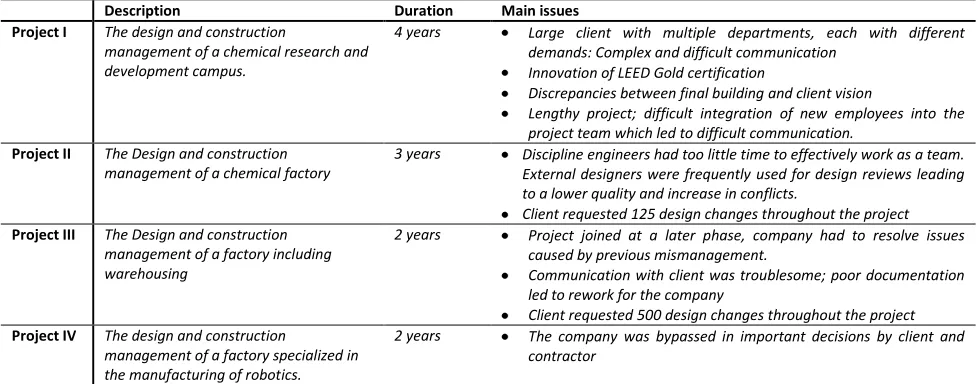
In this section, the research results are displayed according to cause and effect1 on the basis of four different projects as shown in Table 1. The company completed each of these projects2 within a year of the interviews.
Description Duration Main issues
Project I The design and construction
management of a chemical research and development campus.
4 years Large client with multiple departments, each with different demands: Complex and difficult communication
Innovation of LEED Gold certification
Discrepancies between final building and client vision
Lengthy project; difficult integration of new employees into the project team which led to difficult communication.
Project II The Design and construction management of a chemical factory
3 years Discipline engineers had too little time to effectively work as a team. External designers were frequently used for design reviews leading to a lower quality and increase in conflicts.
Client requested 125 design changes throughout the project
Project III The Design and construction management of a factory including warehousing
2 years Project joined at a later phase, company had to resolve issues caused by previous mismanagement.
Communication with client was troublesome; poor documentation led to rework for the company
Client requested 500 design changes throughout the project
Project IV The design and construction
management of a factory specialized in the manufacturing of robotics.
[image:12.612.65.555.168.360.2]2 years The company was bypassed in important decisions by client and contractor
TABLE 1: OVERVIEW OF CASE PROJECTS ANALYZED
C
AUSES AND
E
FFECTS
The causes for conflict that I encountered are categorized as follows: Team cooperation, Client Integration, and Innovation. These three categories encompass all the interview results I collected and present a good overview of the conflicts discussed in these interviews.
T
EAMC
OOPERATIONSocial interaction is one of the cornerstones of the effective functioning of concurrent design as indicated by Lu (2000) and Gratton (2007). Interdisciplinary cooperation is the key to an effective CE process. It became evident that there were a number of difficulties for design engineers to effectively interact to cooperate efficiently. This led to several delays and a significant amount of rework for the team on a number of projects.
1
From a moral standpoint, all names have been removed from this section and have been renamed with either ‘Engineer (Letter)’ or ‘PM (Letter)’.
2
Page | 13
Team cooperation is one of the largest hurdles in implementing CE, and as stated by Gratton (2007) and Anumba (2002), it requires very special organizational and team conditions to work correctly. There are two different aspects to effective team cooperation that I have observed at the case firm: Internal fragmentation and the lack of heritage relationships. Internal fragmentation indicates that engineers have difficulty integrating the different disciplines due to a lack of communication and knowledge between the various involved disciplines. The lack of heritage relationships indicates the lack of stable teams throughout the project and a relatively low comfort level that engineers have when working together, which discourages engineers from sharing information.
I observed internal fragmentation during a number of interviews with company staff; a quote from an architect illustrates this well:
“I am the architect, I focus on the looks of the building and the layout, the rest is up to the other discipline
engineers. This is my job; it is not my job to look at what the other discipline engineer is doing.”
The above quote displays exactly the kind of mindset that causes internal fragmentation and prevents appropriate interdisciplinary communication and cooperation. In general, the projects I interviewed design team engineers about frequently upheld this mindset. ‘PM A’ states that in project I:
“Engineers were very passive during design review meetings. They were not straightforward with each other, didn’t
listen well to engineers of different disciplines, didn’t have much patience with each other and were looking at the
project exclusively from their own discipline (perspective).” And, “The amount of communication between the
engineers was very low. The engineers were very reluctant to look over to other disciplines. Everyone is working on
their own little island and hoping it will fit in the end. “
Page | 14
“Design team engineers here are very reluctant to break the discipline ‘walls’. Integrated design requires all
discipline engineers to participate proactively in the process. It doesn’t work if only one person is trying to
communicate his discipline to others.”
Interviewees also addressed fragmentation with external parties that make up part of the design team as a large issue. Communication between the various parties was a large issue in one of the sample projects. According to ‘PM B’ during project IV,
“Communication was not well controlled; during the construction of the building the client frequently bypassed the
consultancy team when making design changes. This means that design changes made during the construction
phase were not relayed to the design manager of the operation and led to frequent conflicts between the various
parties. Despite repeated memo’s and comments by the consultancy firm, the contractor refused to cooperate. This
was not resolved until the client got involved in this conflict resolution process.”
Apparently this is common practice, as it also happened on two different projects as indicated by ‘Engineer J’ and ‘Engineer A’ indicating the need to set stricter guidelines for communication in these cases. Design changes during
construction were additionally adversely affected by the sheer amount of subcontractors on site. According to ‘PM B’,
“There were too many subcontractors on (project IV), they didn’t care to mention to each other when design
conflicts were present.”
This in turn led to the design team not being made aware in time of these design issues, which then led to delays in the overall construction of the project. This problem was also indicated by ‘PM C’ on project I, “There were too many firms. It is very difficult to manage correctly, and leads to more conflict issues.” This view was confirmed by ‘Engineer A’ when speaking of project III where he had to manage 30 subcontractors,
“The amount of subcontractors made it very difficult to manage the communication between the different parties.”
Page | 15
“The client indicated a certain request in the early design phase, this was implemented and the design was
approved. During the construction phase however, the client “forgot” that he had asked for this and changed his
mind. There was no documentation available to back this up and therefore this led to long discussions about the
increased costs that the design change would impose on the client. In total we lost about 3 weeks due to bad
communication like this.”
In another case on the same project he indicates that,
“During the design a rule was set for ducting, saying that they should be 1 meter under the roof. There were,
however, no drawings made of this. The contractor subsequently used this loophole to claim that they thought that
the ducts should be 1 meter under the structural ceiling and not the suspended ceiling. This led to a significant
increase in the costs for that contractor.”
In addition to internal fragmentation, heritage relationships play a large role in efficient team cooperation. In the case firm, engineers are frequently dealing with new people and this frequently leads to a lack of trust between engineers and the integration of someone into the team who is not familiar with CE methodology. When interviewing ‘PM A’ about project I, she said,
“Almost everyone was replaced in the duration of this project at one point or another; it would be extremely
beneficial if we somehow created a procedure to reintegrate the knowledge that is lost with this employee quickly.”
When questioned about the effects that leaving employees had on the project: “Of course, when an engineer left the team, it took a lot of time to find a new employee and get him up to date on the project, this cost us a lot of
time and effort.”
More interviews confirm these statements, as architect ‘Engineer F’ indicates about the general situation at the company,
“One of the biggest problems is that people here do not stay at the company long enough to reach a level of
Page | 16
people in the team that are very knowledgeable of not only their own discipline, but also have extensive knowledge
of how the other discipline engineers work.”
Unit Manager ‘PM D’ confirms this and claims,
“The problem is that when people leave during a project, much of their knowledge isn’t written down and that
makes is hard to train a new person to replace the empty position. This is especially a problem on longer projects
such as (project I).”
‘Engineer A’ indicates that in project I,
“The discipline engineers were changing throughout the engineering project. The designers were not the same
people that were involved with solving the onsite construction projects. This meant that the discipline engineers had
to take a lot of time to study the design drawings when a problem occurred during the construction phase.”
Another important aspect which interviewees brought up is the time commitment that is required to support heritage relationships. Organizational circumstance ensured that discipline engineers were frequently working on three or more different projects at a time. ‘Engineer A’ indicates,
“When I was working on project II, I was unable to ask our discipline engineers to help me with conflicts that
occurred on site. This meant that I had to work with the discipline engineers from the contractor and the JianLi
(Chinese supervisory organization). I had to deal with people who were not very familiar with the design, so looking
into conflicts frequently took a lot of time because the engineers had to study the plans in detail beforehand. The
working pressure for the discipline engineers also led to quality issues.”
Page | 17
“The design conflicts in project I didn’t come to light until the contractor reviewed the final design and this in turn led to changes in the design during the construction phase and consequently led to an increase in the overall costs
and a reduced quality of the final construction.“
A specific example as presented by ‘Engineer A’,
“During project II the structural and HVAC engineer didn’t communicate efficiently so when we reached the
construction phase of the project we discovered that the design drawings indicated that the air-conditioning ducts
passed straight through a horizontal structural beam designed to support a crane system. Of course, we couldn’t
just move the piping under it because it would prevent the crane from functioning; above the structural beam we
also lacked space due to the roof of the building. Eventually we had to redesign the air-conditioning system to split
up into two separate, smaller ducts that could pass above the crane beam. This entire process cost us several days
to resolve.”
C
LIENTI
NTEGRATIONAs indicated earlier, it is essential in the CE process to involve the client into the design at an early phase. In this case study, cooperation between multiple design firms, the contractor, specialists and the client often led to conflicts. The tensions that exist between the different parties are usually related to the field of expertise and the lack of knowledge of other companies and disciplines. These conflicting views often lead to the lack of compatibility between various elements in the design.
The interview results suggest that there were various cases in which the communication between the design team and the client was troublesome and that the client was not involved in several elements of the design. ‘PM C’ recalls that during project I.
“Electrical engineers designed an electrical system where there were many different electric rooms spread
throughout the building. During the construction however, the client indicated that this was not what he was
Page | 18
electrical system expectations with the client, and in the end we were unable to modify the system to completely
satisfy the client requirements. In the future we should communicate these things better.”
In addition, ‘PM C’ recalled another case during the same project,
“The general contractor wanted to implement a design change: They wanted to increase the concrete thickness of a certain part of the pavement because they believed that it would be insufficient to carry the loads that were
required. The design team rejected the change due to the increased costs it would have incurred on the client, but
didn’t communicate this issue with the client. Now, after the construction has been built the client is stuck with a
pavement that doesn’t meet the required quality standards. In hindsight, the client indicated that they would much
rather have paid a bit of extra money for the durability gain in the concrete.”
In general, ‘PM C’ concludes,
“We need to involve the client more in the design phase of (project I). In this case, it was not done 100%, but we did
quite a good job in general.” This is reflected in the high client satisfaction which all interviewees indicated for the
related project.”
In project II, ‘Engineer A’ indicates, “The client made 125 design changes in the duration of the construction period.” When asked about the amount he claims, “This is because the client cannot predict and see everything in the design drawings. It is difficult to read these drawings and although they may look fine on paper, when the building is being
constructed this view may change and the client will file a change order.”
This means that the client will generally be unable to understand the design drawings and translate them completely to a finished product. The result is that they will order these design changes to ensure that the final result is still what they envisioned.
Findings from project III reinforce all the above. ‘Engineer J’ indicates, “The client only had a very basic Idea of what he wanted. He was only able to indicate the type of rooms that he wanted, and nothing else. Our company joined
(project III) when the design was already completed, and we discovered that the design was not what the client
Page | 19
months of extra time. Combined with a severe error on behalf of the contractor, the project was delayed about 8
months!”
Despite involving a client early in the design phase of a project, inevitably the client will change demands for the building, especially on longer term projects. In a sample project, the market in which the client operated ensured that it was necessary to keep up with evolving technology, and over the 4 year design and construct period of the building it was inevitable that the design team had to make numerous changes to the design to accommodate technological innovation. This conflicted with available designs and eventually led to repeated redesign of laboratory spaces in the building costing extra time and effort for the consultancy design team.
The design changes occurred when the client came to certain realizations during a specific phase of the project, or changing requirements that the company has of the building. These design changes frequently conflict with completed work, and thus force the design team to alter the designs. Consequently, they usually cause unplanned delays depending on the severity of the design change.
Another issue was related to the design that was submitted by a firm operating in a different country. Their design included an element which didn’t exist in the target Chinese market; in fact they didn’t exist anywhere. The consultancy firm had to step in and resolve this conflict.
I
NNOVATIONPage | 20
‘PM A’ indicates, “Integrating the new LEED requirements (An American based Green Building Certificate) into the design (of project I) proved very difficult, it was difficult for the engineers to detail the design to comply with the
rules set by the standard.” ‘PM E’ indicates, “Despite the presence of a lead engineer specialized in LEED in the
team, engineers indicated that they often had difficulty integrating the new requirements into their designs.”
During team meetings for project I the team discovered that the design was frequently not up to the required demands and that the design team had to rework certain areas. Most of the conflict occurring was between the specialist and the design engineers of all the other disciplines, specifically due to design errors attributed to a lack of experience of the engineers in appropriately integrating the new technology into their designs. When confronting ‘Engineer F’ with this finding, he states,
“Indeed, the team had a lot of difficulty working with the specialists requirements needed to achieve this certificate.
Engineers had difficulty integrating these new ideas into their designs and had a lot of conflict with the specialist
engineer who had the required knowledge.”
Referring to the example displayed in the section, Client Integration, above: this difficult design issue relating to the development of new laboratory spaces was not only affected severely by the client constantly changing their demands for the laboratory spaces, but also by the design team being unfamiliar with the design of laboratory spaces. The engineering team invited an expert from the Netherlands to assist in the design work, but similarly to integrating LEED technology into the design work, the team had difficulties integrating the specialist requirements into the designs. A concrete example of this as stated by ‘PM E’,
“The (design)-engineers had produced a design for the lab spaces that included the ducts for air filtering. The client
however, wanted to change the locations of several machines in the labs due to changing technologies and keeping
up with the industry. The locations of the ducts, however, were incompatible with the newly suggested machine
locations. Engineers has to change the design to the ducts would be in the right location.”
Page | 21
biweekly basis during meetings between the design team and the client. According to interviewees, a significant portion of time was spent on managing the specialist requirements for the laboratories. ‘Engineer K’ claims,
“There were three different divisions (Client-side) that were going to use the laboratories. Each of these wanted to
handle different design elements that often conflicted with each other. A special job was created for me to handle
Page | 22
A
NALYSIS AND
R
ECOMMENDATIONS
Using my research results, I worked together with members of the company to develop solutions to address key issues responsible for design conflicts. I will provide several examples of discussed and developed methods to more effectively manage conflict in design and conclude with suggestions for more possible areas in which effectiveness can be ascertained.
My research shows that engineers and project managers perceive design conflicts in concurrent design as being overwhelmingly negative in effect. Empirical data suggests that they are a major cause for delays and redesign work for the engineering team. Reducing the amount of conflict that occurs will have a positive effect on the efficiency of the overall project.
An effective conflict management strategy requires three different approaches: prevention, detection, and management. Preventing conflict in advance by maintaining effective processes and management strategies can be perceived as proactive conflict management. Additionally, detecting conflicts before the project reaches the construction phase is critical to avoid soaring costs and, therefore, an efficient way to handle conflict needs to be integrated into the company.
Page | 23
C
ONFLICT
P
REVENTION
To effectively prevent conflict, an integrated working environment is required as CE theory shows. Engineers should communicate information freely and this should be based on mutual trust and heritage relationships between the engineers. As my empirical data shows, this was not the case at the company, meaning that engineers frequently had difficulty communicating design information efficiently. Additionally, discrepancies between the client’s vision of the building and the design frequently conflict. I recommend that the company increases client involvement, improves on their design change management procedures, implements effective space and interface management, and improve innovation integration procedures.
C
LIENTI
NVOLVEMENTMy findings support CE theory which shows that it is important to involve the client early in the design phase to prevent downstream design changes. To achieve this, it is important to ensure that the design team and the client have the same idea of the building at every stage throughout the design process. Even despite having regular client meetings, my data shows that clients still frequently see discrepancy with their vision and the final design when the building is constructed. The communication and presentation of early designs with 3D models instead of only applying such visualizations during the final stages of the design and the tendering procedure might help the client oversee the design intent more clearly and prevent conflicts in later phases of design.
Additionally, my data shows that conflict occurs due to misunderstandings between the client and the engineering firm. In project III, for example, client change requests were not all documented. At a later stage in the design, the client backed out on the design change, and due to the lack of documentation, the consultancy had no choice but to rework the area for no additional fee, and a conflict occurred between the design and client expectations. To avoid this in the future, the company should always ensure that all requests and decisions are recorded formally.
D
ESIGNC
HANGEM
ANAGEMENTPage | 24
basis of this the project team can develop a time schedule in order to implement the design change without causing new conflicts.
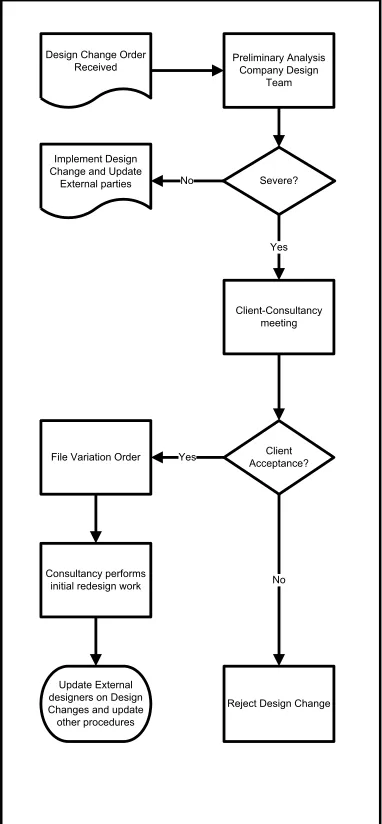
The procedure, as outlined in Figure 1 outlines the importance of analyzing the affected areas of influence (e.g. which design work it interferes with) in addition to client related negotiations regarding the influence on the time schedule and the costs of the design and construct work. The main goal of this procedure is to ensure that engineers are aware of the scope of changes, which drawings engineers will need to check for conflicts after redesign and to ensure that the design changes are in line with
client expectations.
The design team initiates the procedure once the client files a design change order. The Company Internal Design Team will review the order and determine whether or not the design change is fundamental enough to alter the design process. If the team finds the design change order to be small and achievable within current budget and time schedule, they update the design change to the external design party for redesign work. If the design change order is found to be severe, the company organizes a client meeting to discuss the impact of the design change. Negotiations take place to determine the consequences for the design process. Upon client acceptance, a variation order is placed and the company initiates initial design rework. The team will update all relevant procedures, schedules, and templates to correspond with the new design process. This information will be transferred to the external design
party for final redesign. In case of no agreement being reached, the team rejects the design change, and an alternative can be discussed.
Design Change Order
Received Preliminary Analysis Company Design Team Severe? No Client-Consultancy meeting Yes Implement Design
Change and Update External parties
Client Acceptance? File Variation Order Yes
Update External designers on Design Changes and update other procedures
Reject Design Change No Consultancy performs
[image:24.612.357.548.229.641.2]initial redesign work
Page | 25
S
PACE ANDI
NTERFACEM
ANAGEMENTThe design team needs to structure interdisciplinary design reviews to function properly. When engineers of different disciplines review their work it is impossible for the team to be consistent in conflict detection without guidelines for design and a procedure for control. For this reason, we
developed a space management procedure which serves a role in both conflict prevention and conflict detection.
The goal of space management is effective interface control. Space management allows for a design team to preset areas in a design where the target discipline is given a certain amount of space to use for its design
solution. For example, the team can choose to divide up a building core shaft as Figure 2 shows.
This space management diagram is created by the entire design team during a design meeting. Based on client and building requirements, each discipline will be able to predict a reasonable amount of space that will be necessary for each the design works. Once this space division has been agreed
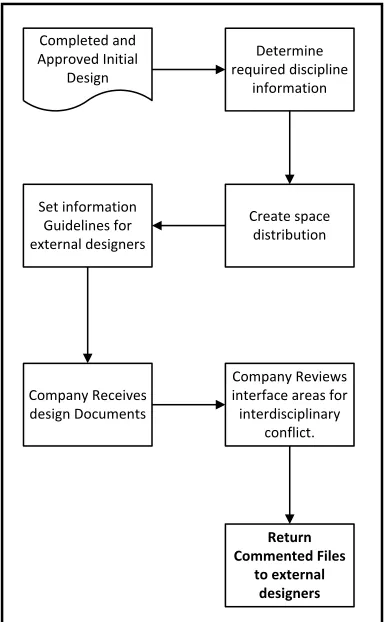
upon, engineers will attempt to design within their boundaries. If an engineer has to supersede these boundaries, he has to inform all other engineers immediately and the team will review these areas in detail. Figure 3 displays a detailed procedure.
This procedure is initiated once the initial design is approved by the client and design detailing starts. Engineers will determine the required discipline information with regards to space usage (e.g. approximate space needed for plumbing pipes). The internal design team holds a joint team meeting verifying the required information. This information will be condensed into a set of space usage rules for each discipline. These guidelines will be communicated with
[image:25.612.78.549.135.280.2]Expansion Space Maintenance Access Electrical HVAC X mm Y mm Z mm A m m B m m C m m D m m Q mm F m m R mm Mechanical Support Plumbing
FIGURE 2: BUILDING CORE SPACE DIVISION
Completed and Approved Initial Design Determine required discipline information Return Commented Files to external designers Create space distribution Set information Guidelines for external designers Company Reviews interface areas for interdisciplinary
conflict. Company Receives
design Documents
[image:25.612.358.550.378.689.2]Page | 26
externals. During the design phase of the project the consultancy will receive the required design drawings from external parties at which point engineers will have a joint meeting to review the interfaces as prescribed by the space usage rules. The company returns commented drawings to the external design party for further design detailing. A meeting with these external engineers can be organized in the event of major errors or ambiguity.
I
NNOVATIONApplying a new concept or technology to a design project requires a solid approach. Interview results show that the design team frequently encountered difficulties with the new technology, the main issue being the communication between the expert in the field and the rest of the engineering team. To ensure that the entire design team is aware of the required approach to implement new technology or ideas into design work, companies should spend more time on training employees. Additionally they can add more experts directly to the design team that can support the other team members with the integration of new technology.
C
ONFLICT
D
ETECTION AND
M
ANAGEMENT
The engineers and project managers indicated that conflict detection at the company occurs at three stages in the concurrent design process at design the consultancy firm:
1. During design, when engineers communicate information.
2. During design reviews, when engineers check the work completed by an external design company
3. During construction, after the final design drawings have been approved by all parties.
The company performs design reviews of the designers work at certain preset times in the design process. These dates are agreed upon beforehand and, therefore, involve certain deadlines for external design parties. Once the external design firm transfers the design works to the consultancy, the relevant discipline engineers check the work, a design review meeting is held at the company with all involved review engineers, and the company returns the commented drawings to the external design parties.
Page | 27
its current state, however, the design reviews are done in an ad-hoc fashion with engineers only checking work within their own disciplines. During the review meetings certain conflicts do appear when discipline engineers communicate, but still a portion of them is missed due to the lack of structure in design reviews. As ‘PM A’ indicated earlier, communication was very passive between the engineers and they didn’t communicate very well.
In addition to check for design conflicts between disciplines, the engineers check whether or not the design fulfills client requirements. When doubt occurs, the client representative is contacted to ensure that the design is heading in the right direction. Overall the design reviews have much potential to be restructured and improved.
D
ESIGNR
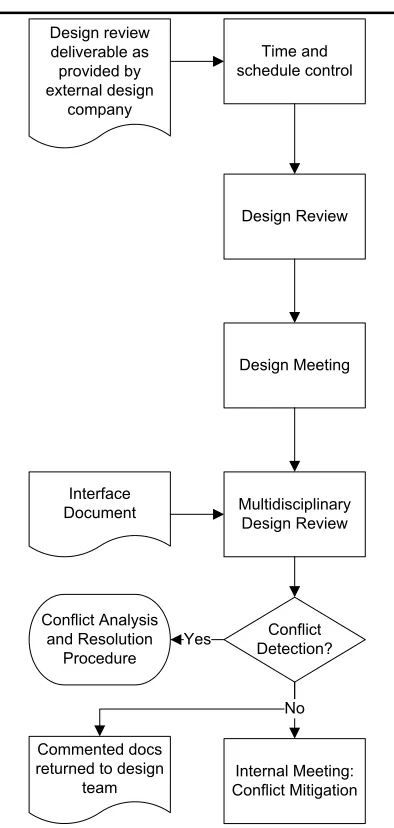
EVIEWSI recommend consultancy companies working with external design firms to implement design reviews to regularly check the work and ensure that there are no design conflicts. This form of control will also ensure that the design team is on the right path and understands their job. In addition to serving as a method of schedule control during a design project, the design reviews allow engineers to focus on finding and resolving conflicts whilst designs are still in a relatively fluid state, meaning a cheap solution can be agreed upon before the issue reaches the construction stage. Figure 5 shows the detailed design procedure.
The design review consists of a single-disciplinary design review and a multidisciplinary design review. Initially the design review engineer will receive copies of all drawings related to his field, and he will check whether client requirements are satisfied. (E.g. is the chosen air conditioning system powerful enough to keep the building at the required temperature in summer conditions, and is the piping adequate to fulfill these needs?). After commentary, the team will proceed to a multidisciplinary analysis.
Page | 28
The external designers hand in deliverable design drawings and documents to the company as required by the design schedule. The external party transfers the design documents to the company discipline engineers according to area of expertise. Engineers review and comment on the deliverables and prepare to present major findings. The internal project team holds a design review meeting. Review results are shared by the discipline engineers. Interface breaches indicated according to the space management procedure are discussed. Multidisciplinary design reviews are carried out by Discipline Engineers. In case of conflict detection, the Conflict Management procedure is initiated. Otherwise, the team returns the commented design drawings to the external design team immediately. Using the interface documents resulting from the space management procedure, the team performs a design review. Design review concludes with a brainstorming
session including the whole design team. Engineers discuss and prepare for possible conflicts during the next design review and prepare a checklist.
C
ONSTRUCTIONAll conflicts that are not detected during design or during design reviews come to light during construction. The goal of effective design conflict management is to ensure that all conflicts are removed by this point, but inevitably this is not the case at this firm, and very likely an issue for other companies well. Conflicts occurring in construction are the most expensive to resolve, and can frequently lead to the largest time and quality issues in the entire CE process. This is partly due to the late stage of detection, but also largely because construction involves a very large
Design review deliverable as provided by external design company Time and schedule control Design Review Design Meeting Multidisciplinary Design Review Conflict Detection? No Yes Conflict Analysis and Resolution Procedure Commented docs returned to design
team Conflict Mitigation Internal Meeting: Interface
[image:28.612.341.538.63.477.2]Document
Page | 29
amount of parties (usually subcontractors) which drastically increases communication complexity and therefore difficulty. Conflict resolution at this stage involves sending the design drawings back to discipline engineers on site, and a quick fix is frequently applies. If it is a major conflict, the client is involved in the resolution process to ensure an adequate resolution is reached. A complete conflict management strategy includes a method of dealing with conflict during the construction stage.
C
ONFLICTM
ANAGEMENTDespite integrating conflict prevention methods, empirical data suggests that conflict will occur during CE. Therefore, a company should have a conflict management scheme to efficiently manage the consequences of these conflicts. Effective and consistent Conflict management ensures that the design team approaches conflicts in a systematic and analytical way. An effective conflict management scheme ensures that the design team gives each conflict a certain amount of attention that is directly related to
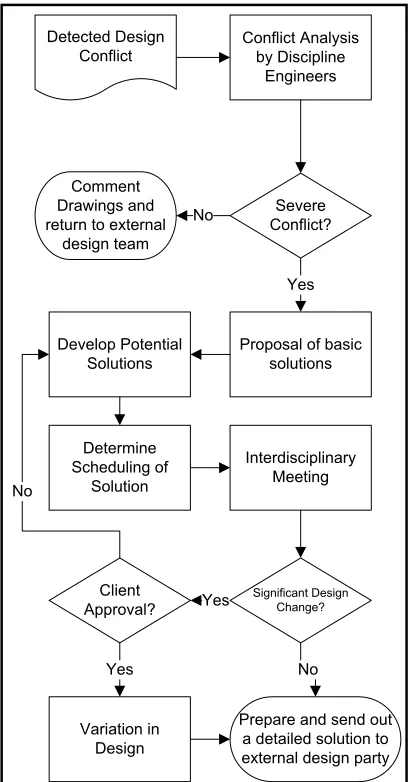
its impact, and to prepare the best possible schedule. Figure 6 gives a detailed look at the proposed conflict management procedure.
The team detects a design conflict during the Design Review Procedure or otherwise, and initiates the conflict management procedure. Company discipline engineers that detected the conflict will provide a short analysis. On basis of the analysis and a discussion with the discipline engineers, the project manager will determine whether the conflict is severe enough to demand intervention, if not then the team returns a commented design note to the external design team. Discipline engineers propose basic solutions and further develop them with all relevant discipline engineers and the project manager. The Design team analyses whether the conflict is best solved immediately, or if
Detected Design Conflict Conflict Analysis by Discipline Engineers Severe Conflict? Comment Drawings and return to external
design team No
Proposal of basic solutions Yes Determine Scheduling of Solution Develop Potential Solutions Significant Design Change? Client Approval? Yes Interdisciplinary Meeting No Variation in Design Yes No
[image:29.612.346.550.317.708.2]Prepare and send out a detailed solution to external design party
Page | 30
Page | 31
C
ONCLUSIONS
M
AIN
F
INDINGS
During this case study it became apparent that conflicts in concurrent engineering (CE) is still prevalent in design teams in the construction industry and it is important for companies applying the CE method to implement effective conflict management and control methods and conflict resolution strategies during the design phase of the CE process to avoid costly design changes and issues during the construction phase. The empirical data that I present in this paper suggests that conflicts during CE are mainly caused by problems in four areas of design: Team cooperation, Client Integration, Innovation, and Communication.
T
EAMC
OOPERATIONDespite using CE techniques such as design overlap, integrated design teams and regular design team communication, the company I observed during the case study had difficulty supporting the team structures and the mindset needed to effectively apply CE. Engineers had difficulty breaking the discipline ‘walls’ as described by N.F.O. Evbuomwan (1998). Engineers focused mostly on their own disciplinary work and showed a lack of interest in other disciplines. Additionally, a lack of trust between engineers reduced the effectiveness and frequency of interdisciplinary cooperation (Cicimil, 2005).
C
LIENTI
NTEGRATIONPage | 32
I
NNOVATIONThe integration of new technologies into a design proved difficult for the design team at the case firm. Despite the introduction of experts to the design team, most discipline engineers had difficulty integrating the novel design elements into their design work. As a result there were frequent conflicts between the disciplinary designs, and the overall design work took much longer than anticipated.
C
OMMUNICATIONEffective communication is a critical element of CE. Communication between various parties involved on the project proved to be a key trouble spot at the case firm. Frequently subcontractors don’t communicate about design conflicts they discover during construction and the problem builds up increasing the costs for the project on sometimes very large scales. Additionally, communication between various parties not being recorded caused several conflicts during sample projects leading to long redesign times. Communication between the design team and a large client involving several representatives also proved to be a difficult task causing a wide scale of conflicts with each representative.
R
ECOMMENDATIONS
In this case study I present six different recommendations to effectively tackle conflicts occurring during the CE process: Client involvement, Design Change Management, Innovation, Space and Interface Management, Design Reviews, and a Conflict Management procedure.
Client Involvement: Improve early client involvement in the design by improving visualization techniques during the early design phase to prevent downstream conflicts and design changes.
Design Change Management: Integrate a structured design change management procedure into the company to ensure consistency and manage design changes without causing undue conflicts in existing designs.
Page | 33
Space and Interface Management: Create a set of guidelines for the design team in advance to identify and control interdisciplinary interfaces and to structure design reviews.
Design Reviews: Perform regular design reviews using the space and interface management guidelines as a structure to identify conflicts.
Conflict Management Procedure: Structure a conflict management procedure to deal with conflicts consistently and efficiently and avoid ad-hoc solutions.
O
UTLOOK AND
F
UTURE
R
ESEARCH
The research results presented in this paper could prove valuable for managers in design and consultancy companies to assist them in identifying conflict issues arising during their design processes. Additionally it will allow such companies to apply my recommended techniques to reduce these conflicts and provide time and effort savings for the design team in future design projects.
Page | 34
B
IBLIOGRAPHY
Bogus, S. M., Molenaar, K. R., & Diekmann, a. J. (2005). Concurrent Engineering Approach to Reduce Design Delivery Time. Journal of Construction Engineering and Management , 1179-1185.
C.J. Anumba, C. B. (2002). Organisational structures to support concurrent engineering in construction. Industrial Management & Data Systems , 260-270.
Cicimil, M. (2005). Insights into collaboration at the project level: complexity, social interaction and procurement mechanisms. Building Research & information , 523-535.
Détienne, F. (2005). Collaborative Design: Manageing task interdependencies and multiple perspectives. Interacting with Computers , 1-20.
Erkamp, R. (2009, March 13). Total Design Management. (S. Meijers, Interviewer)
Kleinsmann, V. (2008). Barriers and enablers for creating shared understanding in co-design projects. Design Studies , 369-386.
Loch, T. (1998). Communication and Uncertainty in Concurrent Engineering. Management Science , 1032-1048. Lynda Gratton, T. J. (2007). 8 Ways to build collaborative Teams. Harvard Business Review , 102-109.
N.F.O. Evbuomwan, C. A. (1998). An integrated framework for concurrent life-cycle design and construction. Advances in Engineering Software , 587-589.
S.C.Y. Lu, J. C. (2000). A methodology for Collaborative Design Process and Conflict Analysis. Los Angeles: University of Southern California.