Australian National University Canberra ACT 0200 Australia
USE OF THESES
This copy is supplied for purposes
of private study and research only.
Passages from the thesis may not be
copied or closely paraphrased without the
written consent of the author.
)
No
SUSAN MARGARET HOUSE
A thesis submitted for the degree of
Doctor .of PhilosophX
at the
Australian National Unive!sity
Canberra,
May
1985
...
SUSAN H. HOUSE
. : . ~·
r
r I: ..
\ I
'\
.f
Neolitsea dealbata
I \
,..
' . f,
ACKNOWLEDGEMENTS
This study has benefitted tremendously from the support of a
great many people. I extend heartfelt thanks to Donald Walker who,
besides giving enthusiastic encouragement, provided thoughtful
criticism as the enquiry took shape. I am indebted to Bryan Barlov
for valuable discussion concerning details of plant breeding systems.
David Green and John Burton developed computer programmes that
facilitated the spatial analyses.
I am grateful to Martin Kellman, Julian Ash, Rbd Griffin, Judy
West, Jelena Emmerick, Meg Lowman, Cliff Ohmart and Len Webb who
discussed theoretical considerations and technical procedure early in
the · study. I appreciate the critical assessments of Donald, Bryan,
David and Alan who commented on the manuscript. Many thanks to Judy
Owen and others for their efforts in proof-reading.
The staff at CSIRO, Atherton were generously supportive and I
made full use of the herbarium, micloscope and drying facilities. I
especially thank 'Tony Irvine, Bernie Hyland, Geoff Tracey, Geoff
Stocker, Don Fitzsimon, Keith (Sandy) Sanderson, Frank Crome, dreg
Unwin and Tom Risley who identified species and freely shared their
knowledge of the north Queensland rainforests. Don Nicholson supplied
useful phenological data. DPI, Atherton made various essential
facilities available and special thanks go to Neil Gough and John
Brown for sharing their laboratory. The State Forest Department
issued permits to work in Curtain Fig and Wbngabel Forests and the
National Parks and Wildlife Service gave permission to work in Lake
Barrine National Park and Halloran's Hill Environmental Park.
Valuable help in the field was given willingly by Alan H., Tony,
Don, Sandy, Bruce, Alan G. and Gary. Jim Neale constructed the
"jungle-proo~" carry-box and Dean Gibson loaned the light trap. Ross
Storey, Ian Naumann, Josep Cardale, Tom Weir and D. Colless
identified the insect collection. Alan McDonell responded promptly to
all manner of awkward requests and, with Marcia and Caroline, solved
all those day to day, institution-based proble~s. Bernadette Hendry
and Joan Robb industriously typed th~ tables. The research was funded
by an Australian National University scholarship through the
Department of Biogeography and Geomorphology.
Warm hospitality was enjoyed on the Tablelands: Sandy and Alan,
Suzanne, Bruce and James, Claire and Gary, Tony and Helen, Judy and
Don all made the task that much more pleasant.
A
big thank you to the)
Canberran company; including the Bio. and Geo.
provided that breath of fresh air and the checks and
helped the work go smoothly.
collective, who
balances which
When such an all-consuming project is undertaken, the ideal
partner is interested and patient; is able to anticipate, willingly
assist at no notice, prqvide intellectua~ support and is a good
\ '
companion. Alan was all these things. Thank you.
/
xvi
three species of insect pollinated dioecious trees is examined in
northern Australian tropical rainforests. Flowering patterns, fruit
production, pollinator periodicities and efficiences and the
quantiti~s
of pollen transferred to pistillate trees are described.Ways in which the distance between staminate and
pist'ill~'e
tr'ees~ffects pollen capture and fecundity in pistillate trees are a· lysed.
0 .
'
Densities of polle~ trapped at pistillate trees are negatively
correlated with int~r-~ex distances .and positively correlated with th~
I
local density of staminate trees ia
and Litsea leefeana. Fecundity
negatively correlated with the local
populations of
is limited
density of
Neolitsea dealbata
by pollination and
staminate/_trees in
these species. Both species flower synchronously over a
produce massive quantities of flowers and are pollinated
of small insects, the most effective o~ which are Dipterans.
The effects of inter-sex distances on polJen flow and
are greater in small pistillate trees than in larger ones. Female
trees in the vicinity of large males enjoy access to a more abuhliant
pollen supply than those situated within similar distances f·rom l·ess
productive males. The amounts of pollen transported to females is
only rel,atecl,' to male distribution where male density is below
a
certain threshold density and so pollination
IS
not linearly relatedto inter-sex distances. Pollination efficiency is greatest in
~reas
of high tree density;
likely to move
conspecifics.
In low density areas, pollinators are equally
between non-conspecifics
as
between floweringI
Diospyros pentamera trees flower more or less·synchronously over
a longer time period. Male trees exhibit two pulses in flower
production which are separated by a phase of non-production,
encouraging polli,nators to move to .other, flowering trees. The trees
are visited by a v~riety of small insects but Coleopterans transfer
. ~ ~--- ~
pollen to pistillate trees more regularly than othe~ groups. Pollen ·
capture by females is related to the local
d~nsiif
of males only inthe early flowering phase, over a time
p;ri~
comparable with thetotal flowering phase in Neolitsea dealbata ~nd Litsea leefeana.
Fecundity is not related to local male density since there is a
relatively long period in which pollen can be disseminated among the
female population.
'
A large proportion of flowers produced by female
Neolitsea dealbata and Litsea leefeana are aborted, whether pollinated
or: not. Despite this, a relationship between fecundity and spatial
pattern was 'discernable. The ratio of fruit to flowers is less
~
variable in Diospyros pentaniera females and fecundity levels are
probably related to the allocation of resources for reproduction
rather than defined by pollen availability.
Pattern analyses of the spatial• distribution of dioecious and
non-dioecious species populations reveal that dioecious species are
consistently clustered whereas hermaphrodite species display a greater range of spatial patterns. The average nearest-neighbour distance in
Neolitsea dealbata and Litsea leefeana is less than the threshold
male-female distances at which pollen supply is reduced. Dioecious
species also tend to be relatively common and the association between
frequency and breeding system is discussed.
The spatial
configu~a~n
of male and female t*ees governs thedirection and distances oyer which pollen flows and is potentially
limiting to fecundity in isolated female trees in species with brief
flowering periods. On the other hand, high density populations,
synchronous flowering and plant-pollinator interactions largely offset
pollination inefficiencies.
\
l
Acknowledgements
Abstract
Table of Contents
List of Tables
List of Figures
List of Appendices
Glossary
Chapter 1 PATTERN AND BREEDING IN TREES
1.1 Some relationships between spacing and breeding success.
1.2 Breeding systems and the uniqueness of dioecy.
1.3 Relationships between breeding success and spatial pattern
in tropical rainfqrest trees.
1.4 Pollen supply as a factor determining fecundity.
1.5 Plant spacing as a control of fecundity.
1.6 Tree
spacing,
quantities
transport.
1.7 An hypothesis.
and
1.8 Objectives and thesis organisation.
qualities
Chapter 2 LOCATION AND DESCRIPTION OF THE STUDY AREA
2.1 Physiography and climate.
2.2 Floristics of the study site.
,.,Chapter
3
THE EXPERIMENTAL SPECIES
of
pollen
3.1 Occurrence of dioecy in north Queensland
rainforest tree
species.
3.2 Choice of experimental species and populations.
3.3 Age and sex structures of the
exp~rimentalpopulations.
3.4 Summary.
Chapter 4 SPATIAL PATTERN LN POPULATIONS
4.1 Introduction
4.2 A desrription of radial distribution functions.
4.3 Methods.
·
4.4 Results.
4.4.1 Compa...,ons of RDFs between populations.
4.4.2 Nearest neighbour analyses.
4.5 Discussion.
4.6 Summary.
Chapter 5 FLOWERING PERFORMANCE AND INTER-TREE SYNCHRONY
5.1 Introduction.
i
iii
v
ix
xii
xv
xvi
1
3
4
5
7
7
9
9
12
13
25
30
31
36
37
40 42 49 49
63
65
66
...
lt:\
:·;
5
.2
5 . 3
Species descriptions.
5.2.1 Litsea leefeana.
?:,2.2 Neolitsea dealbata.
5.2.3 Diospyros
~entamera.
Flower
developme~
and
l~ngevit~.
5.3.1 Diospyros pentamera.
5.3.2 Neolitsea dealbata.
5.3.3 Litsea leefeana.
~5.4
Floweri~gsynchrony.
5.4.1 General methodology.
5.4.2 Results.
5.5 Dil>cussion.
5.5.1 Flower morphology.
5.5.2 Flower longevity.
5.5.3 Timing.
-
(5.5.4 Duration and synchrony of flowering.
5.5.5 Reproductive output.
5.6 Summary.
)
Chapter 6 FLOWER.PRODUCTION AND MEASURES OF FECUNDITY
6.1 Introduction.
PART l:Potential fecundity.
6.2 Potential fecundity.
6.3 Fecundity tests in Neol\tsea dealbata.
6.3.1 Apomixis.
6.3.2 Tests for potential fecundity.
6.4
6.3.3 Open pollination.
Fecundity tests in Diospyros
6.4.1 Apomixis.
6.4.2 Open pollination.
/ '
p.entamera.
6.5 Fecundity tests in Litsea leefeana.
6.5.1 Apomixis.
6.5.2 Open pQllination.
6.6 Discussion.
PART 2:
Natural fecundities.
6.7 Flower production and natural
(?
6·.i>.,General methodology.
6.'8.1 Flower production.
6.8.2 Female fecundity.
6.8.3 Density of pollination events.
6.9 Neolitsea dealbata.
6.9.l Flower production.
6.9.2 Fruit production and fecundity.
9.9.3 Density of R9llination events.
6.10 Diospyros pentamera.
• ... >
6.10.1 Flower production.
179
6.10.2 Frtiit production and fecundjty.
6.10.3 Density of pollination events.
. 182
\
6.11 Litsea leefeana.
6.11.1 Flower production.
6.11.2 Fruit production and fecundity.
6.12 Discussion.
6.13 Summary.
Chapter 7 POLLEN VECTORS AND POLLEN DENSITIES
7.1 Introduction.
7.2 Methods.
7.3 Results.
7.3.1 Reliability of sticky traps.
7.3.2 Flower visitors and pollinators.
7.3.3 Pollinator specialisation.
7.3.4 insect abundance.
7.3.5 Pollen densities
~rapped.7.3.6 Relative efficiences of pollinators.
7.4 Discussion.
7.4.1. Pollinator specificity and
effici~ncy.7.4.2 Insect and poilen
~bundance.7
~4.3 Transfer of pollen ..-t:o female trees.
7 • 5 . s'ummary.
Chapter 8 RELATIONSHIPS BETWEEN FECUNDITY, POLLEN CAPTURE.
AN~DISTRIBUTIONS, OF MALE TREES
8.i Influences
o~"1aledistributions on pollen transport and
female
f~cundities.PART 1
8.2 Pattern of male trees and pollen capture and
fecundities
185
189
189
192
196
200
202
203
206
206
207
210
212
218
225
230.
230
232
233
238.
.239
of female trees.
"
242
8.2.l Methods.
242
8.2.2 Neolitsea dealbata.
8.2.3 Litsea leefeana.
8.2.4 Diospyros pentamera.
8.2.5 RDFs of males in relation to females.
8.2.6 Summary.
PART 2
8.3 The pollen dispersal process.
8.3.1 Rate of pollen movement.
8.3.2 Directness of pollen transfer.
8.3\3 Summary.
8.4 Discussion.
,.
243.
249
251
260
267
270
270
272
'~
1~·
$ ~·\,
·.•.
~-·
Chapter 9 DISCUSSION ~
9.1
Pollination efficiency and fecundity is limited by9
distaqce between trees.
a
9.2 Interactions between trees and pollinators tend to
limits to poll~n flow imposed by spatial pattern.
9.3
The significance of pattern. '!:.•9.4
Some wider implications.BIBLIOGRAPHY
APPENDICES
'{
~
\)
a
)
~\\
.
J.
''
offset
4
289
2.90
292
295
297
311
(}
2-1
Species occurrenc_e, at six study sit'es.
3-1
Dioecious tree species in northeast Queensland
rainforests.
3-2
Proportions of dioecious tree species·in several
rainforest plois.
()
3-3
Sex ratios of .5 dioecious species (7 populations) in
if'
,
north Queensland rainforests.
4-1
Features of the mapped populations and the artificial
populations (RAND).
4~
Population treatments for radial distribution function
analysis.
4-3 Major features in the behaviQ;Ur of radial distribution
4.
functions.
4-4 RDF features for 12 field populations and 12
artifi~ial
populations.
4-5
Frequencies of dioecious and hermaphrodite species
exhibiting selected RDF features.
4-6
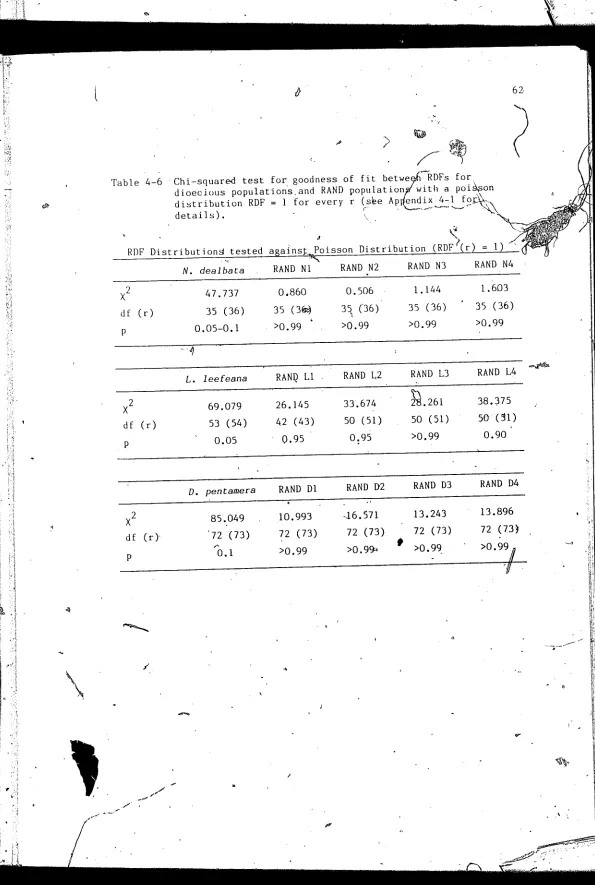
Chi-squared test for goodness of fit.
4-7
Results of spatial analysis using the average nearest
neighbour measurement.
5-1
D. pentamera: flower counts per shoot.
5-2 · D. pentamera: persistence of flowers and stigmatic
5-3
5-4
receptivity.
~
Summary of aborted flower callee
tio~experiments·.
Synchrony in flowering,initiation.
5-5 D.
pen~amera:synchrony in
flo~eringpeaks between
near-neighbour male trees.
~
5-6 D.
~ntamera:
ratio of pollinated:non-pollinated
6-1
6-2
6-3
6-4
6-5·
6-6
6-7fl~wers
trapped beneath female trees.
•
Results of hand pollination tests on flowers of two
female N. dealbat?·
N.
D.
L.
N.
~~albata:
fruit set in open pollination.
pentamera: fruit set in ·open pollination'.
' .
.
leefeana: fruit set in open
po1li~ation.dealb?ta; flower production per shoot and per
square metre of
0crown shadow in male ·trees.
N.
·dealbat~flowe~
and
tr~ft
prodµction and fecundity·.
. N.
dealbata: correlations· between flower· producrtion
and d:b.h. in male and female trees.
6-8 N. dealbata: correlations between tree gir'th, ·fruit
and flower densities ancl ftuit:flower ratios.
,.
!
\
17
~7
28
3343
44
46.
/
/
52
.t
:' ·:
; 1
)
. 1. 'f /
6-9
6-10
6-11
6-12
6-13
6-14
6-15
6-16
6-17
N. dealbata: density of pollination events per metre squared of branch.
N. dealbata: correlation between flower density and '
density of pollination events./~
D. pentamera: flower densities' per rep,roductive shoot
and per metre squared of crown shadow.
D. pentamera: correlat~On between tree size and flower
production.
D. pentamera: density of fruits per shoot and per
m7tre squared
Ti.
pentamer.a:fecundity and
of branch.
correlations between fruit density or
d.b.h.
D. pentamera~ calculation of density of pollination
events.
D. pentamera: correlations between number of pollination events, flower and fruit density. L. leefeana: flower,production in male trees.
6-18
L. l'eefeana: flower production in female trees.6-19
L. leefeana: fruit density, fruit:flower ratios and fruit:meristem ratios.6-20
L. leefeana: correlations between d.b.h. and fecu~dity.6-21
Summary of significant correlations between measures of"
fecundity, tree girth and flowering propensity.
'
7-1
Sampling programme for vectors and pollen.7-i
Density of in~ects trapped using a sticky screen and a'
light trap in a female L. leefana.
7-3
Flower visitors and known pollen vectors.7-4
Representation of families~ species and size classes in7-5
7-6
7-7
7-8
7-::-9•
insect Orders as pollen vectors.Pollinator specialisat,ion: proportion of testtd ~cies
scoring positive for 'home' pollen.. ·
Proportion of tested individuais carryipg 'home' pollen.
Total number of insects per tree trappea in each
collection interval~
D.
penta'.mera: density of pollen trapped for ma la trees.D.
pentamera: density of -pollen trapped for femaletrees.
7-10
L. leefeana: average pollen densities trapped at male and female trees in two years.7-11
L. leefeana:1983
pollen densities per insect an4 totalpollen for one
15
~ay sample.7-12
Amounts of pollen carried by three insect Orders..
,
7-13
Vector reliability: proportion ·of -pos:l,tive scores forpolle~ in three insect Orders.
1$ ·.
-.
..,,~)
\
rt
175
176
180
181
183
184
187
188
190
191
194
195
'197
205
205
208
. 209
-8-1 N. dealbata: significan~ correlations between f~cundity,
pollen or insect density and locaLmale density in
female trees.
8-2 N. dealbata: correlations between fecundity and local
male denstity.
8-3 L. leefeana: significant correlations between measures
&- •
of fecundity, polleh'density and local male density.
8-4 D. pentamera: Spearman's rank correlations between
cumulative pollen densities and local male density.
8-5 N. dealb?ta: number of male trees in
conse~utive
annuliaround female trees ~ith high and low fecundities and
cumulative values for number of males and RDF.
<!>8-6 N. dealbata and
n'.
pentamera: cumulative RDF values formale, adult and all trees for .two groups of female trees
with
contrastin~cundities.
8-7 N. dealbata: percentage of styles positive for pollen
. A
_,-tubes and number "@f ·_,-tubes per style.
8-8 Correlations between the percentage of styl~s with pollen tubes or the ,mean number of tubes per style and
distance to the nearest pollen d6nors.
8-9 N. dealbata: pollen grains trapped"for 12 sets of male,
female and non-target tree triplets.
8-10 N. dealbata: pollen densities at triplet groups:
Wi1coxon's signed-ranks test.
8-11 N. dealbata: pollen densities at female and non-ta1rget
trees in high and low local male densities:
'
)
· I
244
246
250
252
264
2,65
273
275
277
278
279
I
~
"'LIST UF FIGURES
2-1 The Atherton Tableland: location of study sites.
2-2 Seasonal patterns in rainfall and tcmperaturl'S on the
A~herton Tableland.
3-1 Frequency of trees in a range of size (d.b.h.) classes.
4-1
4-2 4-3
5-1 5-2 5-J 5-4 5-5 5-6 5-7
Arrangement of annuli with,increment size I for the
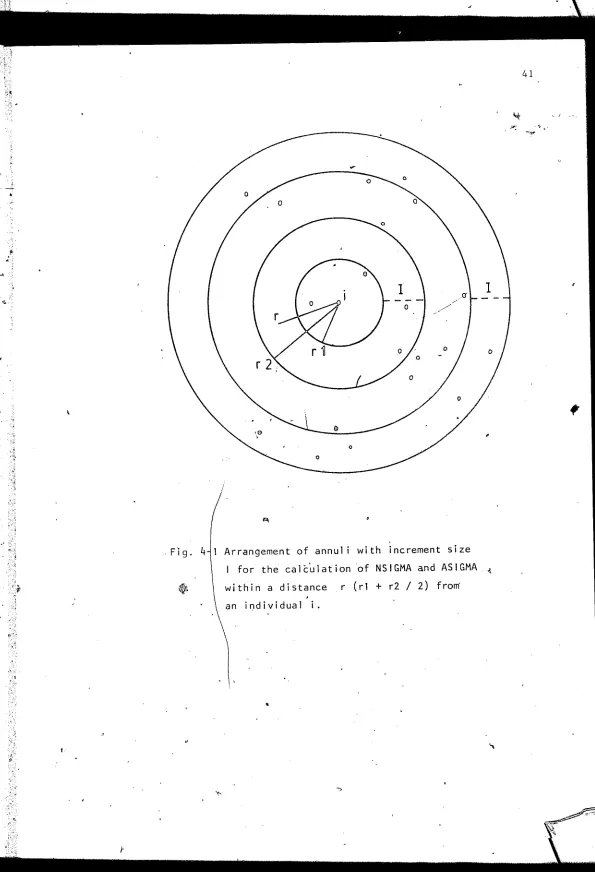
calculation of NSIGMA and ASIGMA within a distance r from and individual i.
Population maps for experim~ntal species.
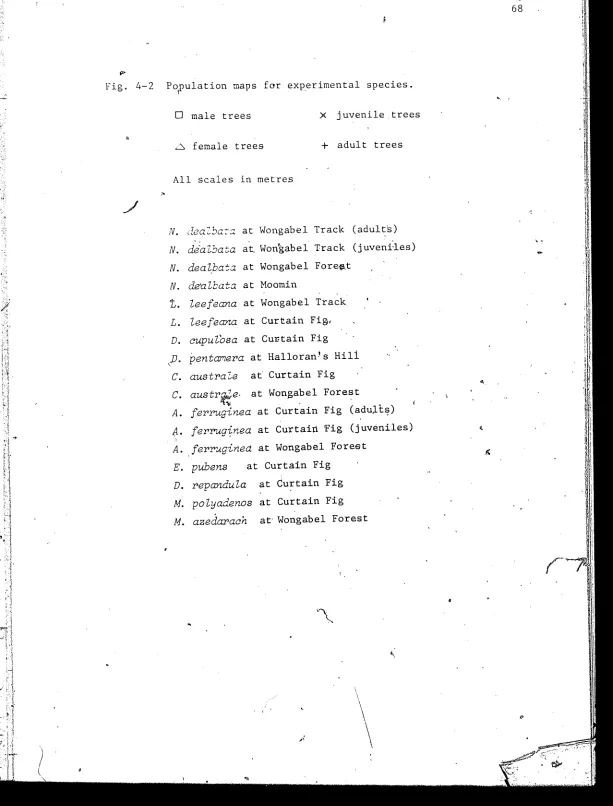
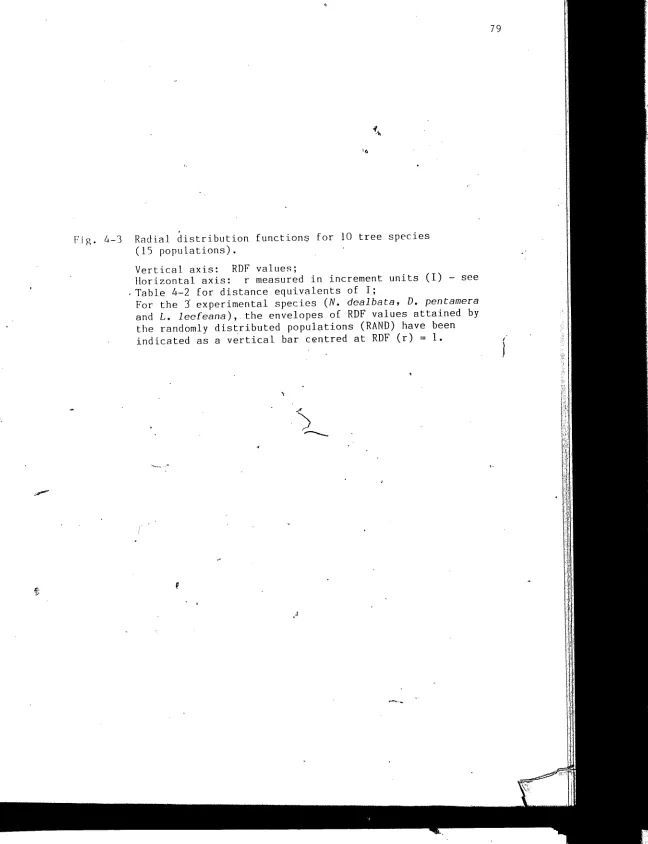
Radial distribution functions for 10 tree species (15 popula_t_ions).
L.
leefeana: flower morphology. ;.L. leefeana: male and female inflorescences.
'N. dealbata: flower morphology.
N. dealbata: male a~d female inflorescences.
o.
pentamera: flower morphology.o.
pentamera: male and female flowers.D. pentamera: mean flowers trapped per metre squared of
15
16
35
41
68
79
98
99
101
102
105
106 , _ /
crown shadow per day for male aqd female trees.
118
5-8 D '-.,'f!:'l :'~entamera: total flowers trapped per day for
individual trees. 119
5-9
N. de/ilbata: mean inflorescences trapped per metresquared of c1own shadow per day for male and female
trees~
.1235-10 N. dea1bata: flower catch per metre squared of crown
.
shadow for individual trees.
124
5-11 L. leefeana: mean inflorescences trappe·d per metre
squared of crown shadow per day for male and female trees in.
1982
and1983.
129
5-12 L. leefeana: flower catch per metre squared crown
shadow per day ·for ·individual trees.
130
5-13
o.
pentamera and N. dealbata: percentage of male andfemale trees exhibiting peak flower loss.
134
5-14 N. dealbata: Flowering synchrony in male and female
5-15
trees.
o.
pentamera: cumulativewho~lower
and corollacounts per metre'squared of crow? shadow per day for. ea~h
collect ion perio/d for 7 female trees.
5-16
o.
pentamera: cross-correlograms of per.1.g_dj..e4-ties inmale and female1flower fall.
5-17
L. leefeana and N. dealbata: cro~s-correlograms of periodicities in male and female flower fall.139
140
145
146
•·.
6-la Position of insect exclosure bag on a reproduJrive
branch. of D. pentamera.
6-lb Method of branch area calculation for fl~wer and fruit
density determinations.
6-2 N.'dealbata: pollination density as a function of
in~tial flower density in female trees.
7-1 Sticky insect trap positioned in the canopy
~
N. dealbata.7-2 Sticky trap with insects.
7-4 D. pentamera: average catches of three insect groups at
11 male and 9 female trees.
7-5 N. dealbata: average catches of three insect groups at
6 male and 12 female trees.
7-6
L.
leefeana: average catches of three insect groups at3 male and 3 female trees.
7-7 D. pentamera: average pollen catches at 11 male and 9
female trees.
7-8 N. dealbata: average pollen catches at 6 male and 12
female trees.
8-1 N. dealbata: 1983 pollen density as a function of
distance to the nearest male tree.
8-2 N. dealbata:
198.._1
pollen density as a function of theaverage ~istance to the nearest 10 male trees.
8-3 N. dealbata: 1982 fecundity as a function of the
distance to the nearest male tree with dbh
>
10 cm.8-4 N. dealbata: 1983 fecundity as a· function of distance
to the nearest male tree with dbh
>
lOcm.8-5 N~ dealbata: 1982 fecund~ty as a function of the
average distan~e to the nearest 10 male trees.
8-6 N. dealbata:
19?3
fecundity as a function of theaverage distance to the 10 nearest male trees.
8-7 N. dealbata: 1983 fecundity as a function of 1982
fecundity·.
8-8 N. dealbata: 1983 fecundity as a function of pollen
density.
8-9 N. dealbata: 1982 fecundity as a function of insefct
density.
8-10 L. leefeana: pollen density as a function of the
average distance to the 3 nearest male tr~es.
8-11
L. leefeana: fecundity as a function of the average distance to the nearest 3 male trees.8-12 N. dealbata~ radial ~istri8ution functions.
8-13
o.
pentamera: radial distribution functions.9
167
167
17
i
204
204
204
216
217
219
223
254
254
- 255
255
256
256
257
258
258
259
259
'·
8-14 Cumulative counts of the average number of males
situated within successive annuli at increasing distances
from high and low fecundity females.
8-15 Squashed preparation of pollen grains and pollen tubes growing through the stigma and style of N. dealbata
266
and D. pentamera. 271
8-16 N. dealbata: percentage of styles with pollen tubes as
a function of distance from the nearest male tree. 274'
•·
LIST OF APPENDICES (SHORT TITLES)
4-la Method for testing the RDF distributions against a
Poisson distribution.
4-lb RDF values for successive increments (I) for the field
populations and four populations whose spatial patterns are
based on randomly-generated coordinate pairs.
4-2 Results of spatial analysis using the average nearest
neighbour measurement of Clark and Evans (1954).
4-2 Legend.
5-1 Litter trap areas for the experimental trees.
5-2 Flower t9tals trapped per day for each collection
period for female and male trees.
6-1 Proportion of aborted styles containing pollen tubes in
N. dealbata and D. pentamera.
7-1 Methodology for insect and pollen sampling.
7-la Construction and positioning of sticky insect traps.
7-lb Light trap and fan.
7-lc Millipore filtration unit.
7-2
7-3
7-4
7-5
Heights of insect traps in experimental trees.
Flower litter and insect collection dates.
Insect counts per trap per day for individual trees and
means for male, female and all flowering trees.
Pollen densities per insect and total pollen for male
and female trees.
7-6 Pollen densities washed from 3 major Orders of flying
insects: Coleoptera, Hymenoptera and Diptera.
8-1 Variables used in correlations b~tween fecundity ~ measures, pollen densities and male densities.
8-2 N. dealbata: probability values for correlations
between fecundity and distance measures.
g
8-3 L. lee£~ana: probability values for correlations
between fecun~ measures, pollen density and local male
den~ity.
8-4 D. pentamera: probability values for correlations
between fecundity measures, pollen density and local male
density.
8-5 D. pentamera: cumulative pollen densities per trap for
each collection period.
8-6 RDFs calculated for male, adult and all trees using
c
females with high and low fecundities as initials.11 311
312
315 316
317
318
321
322
324
32~
326
327 328
329
333
337
340'
342
343
J44
345
GLOSSARY
Abortion: spontaneous rejection of immature fruits (and in this
study) flowers.
Androdioecious: some plants with staminate flowers and some with
perfect flowers.
..
Anp~omonoecious: plants with staminate and perfect flowers.
Anthesis: strictly the period of pollen release from anthers but in
this study' it also refers to the receptive phase in female "
flowers.
Anthophilous: insects that feed··on pollen.
Apomixis: the formation of seeds without fertilisation taking place.
Conspecific: individual plants of the same species.
Corbicula: 'pollen
bask~t'
- a concavity in theh~n~
legs of beesthat is used for storing pollen.
Density-dependent foraging: the number~ of pollinators and the amount
of time spent foraging is directly related to the quantity of the
resource available or to ~he density of flower~/plants .
..
Dioecious: Individual plants bear flowers of only one sex (i~perfect ·
flowers).
Fecundity: a ratio of t<be number of fruit set per flower· or other
reproductive structure (e.g. meristem).
Fitness: a term relating to how well an individual is ge~etically
adapted to its environment; in 'this study it may also be used in
the context of physiological health or robustness.
Foreign pollen: pollen from a non-conspecific plant.
Gynodioecious: some plants with pistillate and some with perfect
flowers.
Gynomonoecious: plants with pistillate and perfe~t flowers.
(
.
___.)'
Hermaphrodite: flowers which bear both a gynoeciu~ and an androecium.
Home pollen: pollen from a plant of the same species.
Inbreeding depression:
usually causes
the inbreeding of normally cross-bred plants
depressed vigour and viability in seeds or
seedlings because of the increased homozygosity of deleter~ous
genes.
Iteroparous: plants which are lonarlived and reproduce more than once
<luting their lifespan.
Maternal investment: resources allocated to the maturation of seeds.
Monoecious: a breeding system where individual plants bear ,both
staminate and pistillate flowers.
Obligate outcrossing: plants cannot self-fertilise.for morphological
or physiological reasons.
Pistillate: flower (or plant) morphologically or functionally female.
~
Pollen carry-over: the transport of pollen from its source
/.
to a
number of other trees visited sequentially by the vector.
Pollinator constancy: the tendency for pollinators to forage at a
single plant until the resources pecome depleted.
Polygamodioecious; plants dioecious but with some perfect flowers on
staminate or pistiilate plants or both.
Polygamous: plants with perfect and imperfect flowers.
Protandrous: with stamens or anthers developing before carpels or
stigma.
Proto~nous: with carpels or stigma maturing before stamens or
anthers.
Staminate: flower (or plant) morphologically or functionally male.
Traplining: foraging behaviour in p~llinators
'along direct routes between (usually)
plants.
which repeatedly fly
~
conspecific flowering
\
Xenogamous: plants which typically cross-pollinate.
Zoophilous flowers: flowers which show morphological adaptations to
animal pollinators.
\
\
D
?
1.1 Some relationships between spacing and breeding success.
Darwin (1878, p. 391) made the following observation:
'In order that distinct plants should be intercrossed, it
i~
ofcourse indispensible that two or more individuals should grow·near one another; and this is generally the case'.
This statement embraces an assumption that long distances between
plants inhibit cross-pollination but at the same time observes that
conspecifics are closely grouped, thus avoiding any potential
constraints on breeding that~are related.to spacing. Distance is a
relative term. The effects of distance on breeding success depend on
the biological and ecological(/ influences the ·plaqts have over one
another and the effic.iency of th\ poll~mediatror. Nevertheless, this
early recognition that there may~be spatially-oriented constraints to
breeding success has heralded subseqµent interest, particularly in the
field of speciation theory (Federov, 1966; Baker, 1959; Ashton,
1969) and domr-ttic plant reproduction (see Levin and Kerst'er, 1974,
for a review)'.
This chapter introduces some relationships between spacing in
tropical rainforest trees and their breeding $uccess and, examines
potential restrictions to breeding in individuals.· Initially, several
principles relevant to all sexually reP.roducing plants are examined
and then the significance of the dioecious· breeding system is
outlined. The discussion is more particularly concerned with
rainforest trees from section 1.3 but references to relevant work on
various plant types are included so that a perspective is gained on
tropical tree studies in relatibn to plant breeding biology in
general.
Rainforest trees have fixed positions in space
species-rich tropical forests, several ~nrelated trees
between any two potential breeding partners. Yet in
and, in
may stand obligately
outcrossing species, pollen must travel between conspecifics for
successful reproduction. The genetic structure of the population may
further exacerbate the problem since even neighbouring conspecific
trees can be closely related or of like sex (in dioecious species) and
therefore non-compatible as mates. Is pollen flow between individuals
15
restricted and does the spatial configuration of pollen donors in
relation to• pollen receivers determine the r~lative breeding success
of rainforest trees?
Breeding is defined here ~s that part of the reproductive system
L . .
that produces flowers and governs the fusion of gametic nuclei from
pollen and ovules to produce seeds. The result of breeding is seeds
and success may be measured in terms of .. numbers of seeds matured,~
representing the potential for reproduction ,and replacement of the ·
parent(s). This is a rather simplistic view of success since a few
robust seeds may have a•higher capacity t~ become establi~hed and
survive to adulthood than a large number of inferior, perhaps inbred,
seeds. However, in later discussion, a parallel is drawn between
quantities ~nd qua~ities of seeds when outcome of~ing is
considered in the light of the spacing of potential mates. All else
being equal, a tree producing 500 mgture seeds is ten times more
likely to reproduce itself as a surviving adult than a tree which
produces only 50 mature seeds.
J
Breeding success has only dubious significance for a long lived
tree that has the capacity to breed several times ~uring its lifetime.
A tree is adequately successful if it reproduces {tself once aduring
its lifespan, but an individual that reproduces itsel·:1ore than once
''1.s more successful. In population terms, reproduc~e succe~s is
measured as the ability to maintain a group of trees in space and ov~r
time, but this is possible even though several individuals fail to
breed. For the species, success is measured~· terms of genetic
perpetuation that maintains, among its member indi iduals, an array of
character combinations that loosely define th 'ident,ity' of that
species. However, ev_olution ,proceeds tl\rough discrete changes in the
off spring of individuals and clearly success for species and
individuals has different meanings. Speciation through reproductive
isolation 'of populations is an extreme example of the effects of
/
spatial pattern on breeding performance but is not- part of the
processes
de~cribed
in this thesis.This study is concerned with the breeding success of
trees. It asks in what way the spatial geometry of
population affects the reproductive successes of its
members.
\
(
\...}individual
a breeding~
individual
however, fall into three main cat~gories:
1. Obligate outcrossers, .including self-incompatible hermaphrodites
and dioecious plants.
2. Facultative outcr~ssers, ·including self-compatible hermaphrodites
but with morpholdgical (e.g. monoecy, andromonoecy, gynomonoecy,
androdioecy, gynodioecy, polygamy) or 'behavioural' (e.g.
protandry, protogyny) adaptations for promoting pollen flow
O~tween plants.
3. Facultative inbreeders (self-compatible or apomictic plants) which
~
habitually self-fertilise, often because pollinator.s are rare or
potential mates are absent.
All these breeding systems have been described in tropical forest
trees (Zapata and Arroyo, 1978; Bawa, 1974; Ha~ 1980;. Appanah,
1982) and, on the present ecological time-scale, all are manifest
because they are successful; it is not meaningful to £Onsider one
system more 'advantageous' than another.
In general, xenogamy is practised where there is opportunity for
cross-pollination. That outcrossing is 'preferred' to inbreeding is
apparent in the diverse and often extreme adaptations furthering i t
(Faegri and van der Pijl, 1971; Levin, 1971). Cross-pollination is
generally accepted as a means by which genetic variation is maintained
in successive generations of plants. In natural plant populations,
the maintenance of genetic heterogeneity enables ecological plas~icity
and long tepn evolutionary fitness or success of species populations.
The maintenance of genetic variation should confer fitness even on a
long-lived species in a relatively stable environment, such as the
rainforest, because the opportunities for regeneration and
establishment are rare.
Dioecy is an extreme form of obligate outcrossing between plants. A 'dioecious population is .divided between pollen donors (staminate or
male plants) and pollen receivers (pistillate or female plants) and
only the latter are capable of producing seeds. The only useful
..
competing self-pollen, the minimum distance over whieh pollen arriving
at the stigma has travelled can be determined. In dioecious species,
assessment
ot
the balance of investment · for producing pollen an~ovules does not arise since~ the two functions are performed by
separate individuals. However, the relative costs of advertising to
pollinators .against those of investing in viable gaipetes remain. The
occurrence of ~ioecy can usually be established from the ~orphologicai
or functional nature of the flowers. Although the existence of
perfect (i.e. bisexual) flowers in the population can never be
~ ~
entirely ruled out, their extreme rarity assumes their insfghificance·
,.
'for the reproduction of the population as a whole.
Spatial pattern is also likely to impose serious constraints on
reprodiictive capacity in self~incompatible hermaphr!>dites but car,eful
experimentation is required to . determine the presence of
f
self-incompatibility in outcrossing hermaphrodite trees. Even then,
detailed examination of fertilisation processes may be necessary to
. determine whether' failure to set fruit. is due to inbreeding depression
(in self-compatible plants) or incompatibility. mechanisms (in
<~
self-incompatible plants). Dioecious species were chosen to represent
.
.
an oblig . .ate outcrossing breeding system where the unidirectional flow
of pollen could be moni tor'ed and, with provisos, fruit. se.t viewed as a measure of pollination ,efficiency.,
The genetic outcome of breeding is determined by the quantity and
quality of pollen produced and the distances over which it t.ravels. .·
Levin and Kerster, (1974) distinguisl\ed between potential. gene flow:
'the deposition of pollen.... from· a ,source as a function of
distance' and actu~l gene flow; 'the incidence of fert_ilisation ••••
as a function o~ the distance from a source'. This study describes
both the movement of pollen f~om donor to recipient trees and the rate
of fruit set in female trees as functions of. distaq.ce from· .a pollen
source and the local density of pollen sources.
1.3 Relationships between breeding success and spatial patt~rn in
tro~ical rainforest trees .
. Until comparatively recently, it was generally believed that most
tropical tree species are widely spaced in natural populations, that
outcrossing must be a rare occurrence and that a high incidence of
inbreeding has contributed to speciation in tropical .forests (e.g.
Baker, 1959; federov, 1966). Hubbell (1979) has since demonstrated
f~J
5
that most tropical' tree speciEi:.S., in a dry
~o
ical forest, whethercommon or rare, are cluinped or rando~ly <lisper iU--- space. Ashton
(1969)
emphasised. the likelihood of outcross~i g between members ofclumped populations in troprcal tairffoJests. In reviews of breeding
systems adopted by trees in tropical lowland semi-decidu~us fore5t
(Bawa and Opler,
1975),
lowland tropical rainforest (Bawa,i979)
andsecondiry deciduous forest (Arr0yo,
1976;
Zapata and Arroyo,1978),
the majority of species were adapted fo~ outcrossing and a large
proportion obligately so. As yet the effect of distance between
conspecifics on the movement of pollen in the population has not been
examined for rainforest trees.
Long distance travel by some pollinating fauna in the rain.forest
has been demonstrated by Janzen
(1971·, 1974),
Linhart(197•3),
Frankieand Baker
(1974),
Heithaus et al.(1975),
Stiles(1975),
Frankie(1976),
Frankie et al.(1976)
and AC'kerman et al.(1982).
Theapparent interdependance of tropical trees and their pollinators has
led some authors to propose theories and models 'for the coevolution of
pollinator and plant (e.g. Frankie,
1975;
-Ki~ster
et al.,1984).
'-Following from these observations on tree spacing and pollinator
mobility it.. macte sup~ised ,7hat outcrossing i,s easily achieved .in the
rainforest because conspecif:J.cs are "closely grouped" or' their
p~llinators are capable of transporting pollen over long distances.
Indeed, Zapata~d Arroyo
(1978)
concluded that fruit set in tropicaltrees is not limited by pollination. However, cross-fertilistiop
within a population may not guarantee th~ reproductive success of all
the individuals of that group. The tendency for unspecialised
pollinators to remain constant to a flowering resource (Heinrich and
R,pven,
1972)
and. the fact that physi~al· barriers and competing floral' '
.
displays·of unrelated trees stand between conspecefics may determine
' .
·to a large extent the relative successes of individual trees. The
tree species chosen fo~ this ,study are all pollinated by a wide range
of smallt unspecialised insects. If spatial pattern affects the
nature of polle~ flow from male to female trees, then a correl~tion
' '
.
would be e~pected between male-fe~ale distances and fecundities (the
·~J
ratio of seeds to ovules) in fem&l~s:
1.4
Pollen supply as a factor determining fecundity:·\
Fecundity (the ratio of seeds to ovules) is a measure of the
degree of successful Qreeding. Factors that govern fecundity in
plants fall into two broad categories~ those related to limited
pollination and those related to pre- or post-zygotic abortion after
pollination. Where fecundity is regula_ted by flower or fruit
"
/
abortion, pollination is not normally limiting. Instead, fecundity is
determined by mat~rnal investment in ·Seed crops which may be related
to environmentally induced stress factors (Pin~ro and Sarukhan, 1982),
excessive r-olll.no...hoV\, for limited resources. (Stephenson, 1984),
selection of better quali.ty ·embryos (Stone Bookman, 1984>},
gametophytic inc~mpatibility systems and the disease or attack of immature seeds.
In fecundities that a~e limited by pollination inefficiency, fewer tha~the potential optimum number of sustainable ovules are fertilised. I:i hermaphroditic plants, competition
foF
physf,cal spaceat the stigma betwee9 self and outcross pollen can contribute to
pollination inefficiencies. In dioecious. spec'ies, all pollen arriving
at the stigma is outcrossed and potentially compatible with the
maternal genotype (Anderson and Stebbins, 1984). Competiti-0n between
staminate plants occurs at the stigma while females compete for the
most vigourous pollen grains (Janzen, 1977) •. In dioecous species,
pollination efficiency at female trees may be limited firstly by the
number of flowers that are pollinated and secondly, the number .of
grains deposited at the stigma (Cruden, 1976) which in turn is
d~termined by the number of grains carried by a pollinator and/or the.
number of visits a stigma receives. The number of grains deposited at.
the stig~a determines seed set per fruit (McDade, 1983) and even in a
single seeded fruit, a threshold number of grains may pe required
before fertil,,isation is successful.
Stephenson (1981) reviewed factors other than pollination
"
___..limitation that control feC'undity. s l t _has been demonstrat,t?d that
fecudity is not limited by the a ilability of pollen in the
moth-pollinated, monocarpic Yucca w ipplei (Udov:Lc, 1981), a•
honeyeater-I?Bllinated temperate shrub (Pyke,·. 1982), temperate,
insect-pollinated hermaphrodi!e herbs (Stephenson, 1984; Stone
Bookman, 1984), a bee-pollinated, dioe·cious herb (Barrett and Thomson,
1982), a tropical shrub (Shemske, 1980) and a dioecious, tropical tree
(Bullock~and Bawa, 1981). On the other hand, potential limitations to
fecundity due to· pollination inefficiancies have been demonst;ated i'n ·
tem~erate
herbs (Levin and Kerster, 1968;Wyatt(/~nd
Helwig, 1979-;Gross and Werner, 1983), shrubs (Whel~n and Burbidge, 1980), trees
(~e, 1962; Primack, 197.9) and in tropical herbs (Dobkin, 1984),
shrubs (Augspurger, 1981; s·nander, 1978) and trees '(McDade, 1983;
Carpenter, 1976; Appanah, 1982; Baker, 1976).. Fecundity levels controlled by pollen suVPlY have not yet been demo-nstrated· in
tropical, dioecious trees.
Clearly, selection will favour the number of seeds which
optimises the energy expenditure on their production and the
probability of successful replacement of the parents. For a plant to
be able to selectively abort inferior seeds, a larger than optimum
flower number must be pollinated. ~
1.5
Plant spacing as a control of fecundity.Direct effects of plant den,sity, and hence the distances between
plants, on pollination efficiency have been demonstrated in domestic
cr9ps (Levin and Kerster,
1974),
hermaphrodi~ic herbs (Platt et al.,1974;
Wyatt and Hellwig,1919)
shrubs (Silander,1978)
and orchardtrees (Free,
1962).
Barrett and Thomson(1982)
failed to show acorrelation between local'1plant density and fecundity in the dioecious
herb Aralia nudicaulis. Similarly, fecundity Jn the dioecious
tropical tree Jacaratia dolichaula was not correlated w~h tree
density (Bullock and Bawa,
1981).
Fecundity (tbe percei¥tage offlowers producing semi-mature fruits or seeds) is usually used as the
unit with which to corre1ate plant density, notwithstanding the .fa,ct
that differential abortion rates may alter the initial fertilised to
"
unfertilised flower ratios: The measurement of pollen movement itself
enables more definite state7· ts to be made as to the potential
significance of pollination eff1ciency .to fecuhdity levels.
'Measurements of the distan9es covered by pollen between plints
"
.
indicated that pollen flow is' normally restricted in space (Levin and
! •
K~rster,
1974;
Levin eta1,
1971;
Webb and Bawa,1983;,
Erlich andRaven,
1969).
In zoophilo s plants, po~linator constancy and/prrelative iniinobility potenti . ly restricts inter-plant pollen flow to a
few individuals (H~inrich,
1975;
Heinrich and Raven,1972).
" Potential for pollen flow and outcross~ng should decrease..,as the
distances between plants ,increase. Density-dependent' controls on
fecundity were not detected in the dioecious herb Aralia nudicaulis
(Barrett and Thomsoi::i,
1982)
growing in dense' populati0ns .~ut otherfactors may operat~ to alleviate testrictions on- ~ollen flow in
tropical trees such as Jacaratia dolichaul.a (B,ullock and.\ Bawa,
1981)
which are often many metres apart.
1.6
Tree spacing, quantities and qualities or pollen transport.
-TJ'le spatial configurat'ion of individuals in a P'?Pulation can
~ determine to a large extent the number and qualities of potentlal
mates and therefore influences relative breeding success. In
xenogamous, zoophilous trees, breeding partners are determined by the
distances over which their p©"llinators move. In bird pollinated
species, br~eding partners can be fuLher apart than those pollinated
"".
by insects. More inter-tree flights occur between nearest neighbours
than between non-adjacent plants. Although pollen carry-over between
trees may occur, the potential for transferr~ng pollen from a source
to more than one conspecific is limited (Levin and Kerster, 1968).
Long distance pollinations by specialised trap-lining vectors do occur
(Janzen, 1970) but the majority of tropical trees are visited by
small, generalist insect pollinators that exhibit density-dependant
• foraging (Baker, 1973; . Augspurger, 1981). Optimum foraging strategy
models for pollinators (Levin, 1978) dictate that pollinators remain
constant to a plentiful floral resource until it becomes
cost-effective to move to a more abundant, neighbouring supply. dioecious tropical trees appear to be pollinated by insects and
.r,,
few are reported as having specialist pollinators (e.g. Baker,
Most only a 1976; Bawa; l 980b).
'
Three aspects of a dioecious tree's breeding success can be
influenced by it~ position ·relative to other members of the
~
population. A p:f,stillate plant may not set any seed and a staminate
plant may fail to donate any pollen to stigmas. Such extreme
isolation, however, is likely to be rare since the relative positions
of trees to one another change during the lifespan of an iteroparou~
individual; as more treeg become reproductively mature within an
individual's neighbou,rhoo.d, so its chances of "finding" compatible·
mates change with time.
Secondly, the proximity of a female to a male may determine
fraction of the optimum number of flowers are pollinated.
proportion of a male tree's comprewent of pollen grains that
target sttgmas is determined by the distance between i t ' s anthers
the fe1Jffile's stigmas.
, I '
what The fi,nd
and
Thirdly, if a female tree has access to pollen from a wide
variety of sources, including the most vigorous males in a population,
the chances of maturing high quality seed should be imprQv,e~"- If more
than the 'optimum' number of flowers.. are fertilised, the. highest
quality embryos may be matured in preference to less fit on~s. It
would be reproductively advantageous for pollen to be disseminated in
as many directions and to as many females as possible so maximising
the number of seeds and seed qualities sired. ·Both male and female
trees should benefit by growing in a contagious group, · several of
whose members are within 'pollinator radius' of a single individual.
' '
The spatifgl relationship an iteroparous tree has with other
members of the population will naturally change during its lifetime
~and therefore its potential breeding partners will also change over
22
·.
:·.:.;
..
~· ..
time. However, a female which habitually mates with several fit males
and produces seeds with high survival potential for a variety of
establishment sites will always be fitter or more successful than a
female that has her entire seed component sired by a single, perhaps
less fit, male.
In clumped populations, a larger variety of matings is possible~
than in a widely dispersed population, modified by the normal flight,
capabilities of the vectors. Trees near the centre of a group would
be expected to,_ have more breeding partners than 'those on the
periphery. Inter-group matings will also be possible between clusters
in
a
common species."
1.7 An hypothesis.
,.,q:
It is predicted that in insect pollinated dioecious tropic;l
rainforest trees the quantities of pollen reaching female trees, and
ultimately their fecundities, are related to the positions and
densities of'\male trees in the population. The problem is addressed
from the point 6f view of the effects of population pattern on the
fecundity of individuals. In relating, the pr()blem specifically. to the
s~ale
of the population, many details of insect-plant interactionshave
no~
been considered. Theprio~ity
throughout the studj is todepict the mechanisms involved in successful breeding of trees within
populations, rather than to describe detailed relationships between
flowers and their pollinators.
Throughout this
<~thesis,
br.eeding success is measured in terms ofpollen arrival• at, and fecundity in, pistillate trees. It is more
convenient to measure pollen arrival at trees and the propdrtion of
flowers that produce seeds than i t is t9 determine how many pollen
grains are dispersed, and to which p!stillate trees they go,
f~om
agiven staminate tree. The implications of the effects of spatial
pattern on the outcome of breeding are, however, similar for both
pistillate and staminate trees.
1.8 °"jectives and thesis organisation.
The broad
pattern-related breeding success
and secondly
aims of this thesis are firstly to describe
constraints on pollen transport and, potentiaily,
of some insect pollinated tropical dioecious trees
to identify relationships between flowering and
ppllination syndromes that effectively minimise those limitations. By
com~aring
the relationshps between pollination and spacing in threespecies, aspects of the reproductive processes that are specifically
'
•,
'.·
•.)
.
'.... ··,
'
~,,.
.I
associated with dioecious trees may be identified. This was achieved
by:
<I
1. Monitoring flowering propensity and synchrony in male and female
trees.
2. Measuring fecundities in female trees.
3. Identifying and rec~rding the abundance of pollinator groups at
'
.
trees during the flowering period.
·4. Measuring amounts of pollen carried by insects from male to female
trees~
5. Correlating amounts of pollen arriving at female trees and their
respective fecundities with aspects of male spatial pattern.
6. Recording the-...proportion of styles holding pollen tubes in females
situated in different male densities after a known period of
flowering.
7. Testing the likelihood of pollen arriving at females in high and
low male densities.
Data presented in the thesis were collected from tropical
rainforest\ on the Atherton Tableland, north Queensland, Australia;
the area and study sites are described in chapter 2. In chapter 3,
the known occurrence of dioecy in tree species in these forests is
documented and an account is given of the population structure of
three experimental species. A description of the spatial pattern of
the experimental populations is given in chapter 4 ~d a comparison is
made with patterns exhibited by non-dioecious species.
The~flowering
process isdescrib~d
for a sample ofmal~
and female trees in chapter S where the timing and duration of floweringand the
significanc~
of inter-tree synchrony for pollen flow is alsodiscussed. In chapter 6, the flowering ptopensity of male and female
trees, and the potential and ac~ual fecund~ty of female trees growing in natural populations is analysed. The identificat,1,.on and abundance
of the pollinating fauna is documented in chapter 7. The efficiency
with which different pollinator groups transfer pollen to female trees
is tested and an account given of the\amounts of pollen arriving at
female trees situated in a variety
~f
male densities. In chapter 8 the quantities of pollen arriving at female trees and their respectivefecundities are correlated with various aspects of local male tree
density. An attempt is made to specify the degree to which spacing
affects fecundity levels in female trees. Finally, in chapter 9, the
implications of spatial pattern for tree breeding are summarised and
various features of the flowering and pollination processes are
proposed as mechanisms that interact to alleviate potential
limitations to pollen flow.
~
\-'
CHAPTER 2 0
LOCATION AND DESCRIPTION OF THE STUDY AREA
In Australia, r~inforest is distributed as a series of disjunct
patches along the east coast, encompassing, from south to north,
temperate rainforest in Tasmania, warm temperate forest and
sub-tropical forest, through to tropical rainforest on Cape York
Peninsula. Less continuous monsoon forest pockets occur across
northern Australia. Descriptions of the Australian rainforest\t:ypes
are given by' Webb and Tracey (198~a) and Webb et al. (1984). The
field data for this study were collected in tropical rainforest on the
Atherton Tableland and adjacent ranges in northeast Queensland
(Fig. 2-1).
2.1 Physiography and climate.
'
The ·Atherton Tableland, approximately 17°5 and 145°50'E, is
forme~ by late Cainozoic basalt flows and pyroclasts (de Keyser,
1964). Altitude ranges from 330m in the north to 900m in the south.
The Tableland is bounded to the west by the Herberton Range, an
extension of the Great Dividing Range, which is a gFanitic highland
with deeply incised valleys reaching• a maximum altitude of 1300m.
Between the Tableland and the lowland coastal plains is the· Bellenden
Ker Range, composed mainly of metamorphics and granites, reaching a
height of 1608m at the peak of Mount Bartle Frere. A more detailed
description of the area can be found in de Keyser (1964) and Kershaw
( 19 7 3) ·.
The climate is regionally controlled by the subrtropical high
pressure belt forming south1easterly trade winds. The inter-tropical
convergenc~ zone (I.T.C.V.) forms a perturbation belt in the region
during the summer, drawing in to the area moist, unstable air masses •
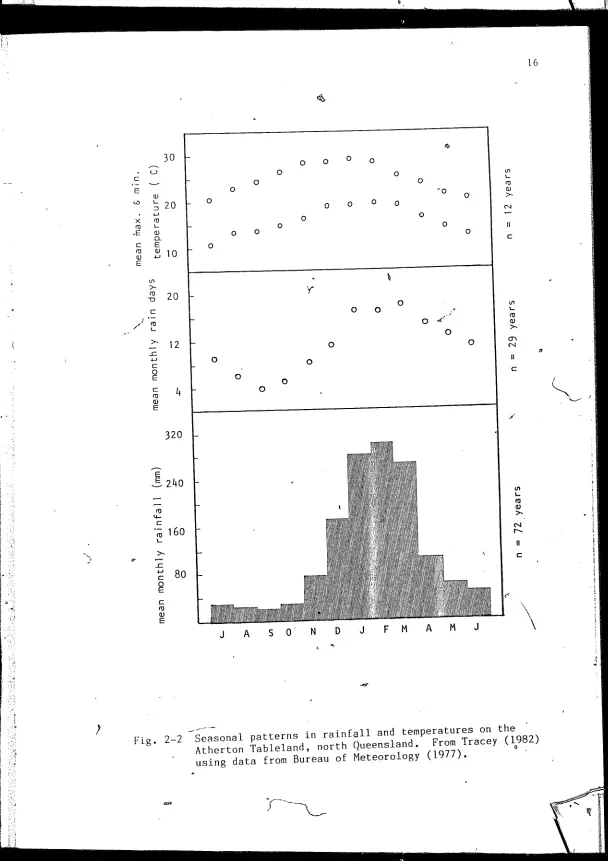
. Most rain, including short intense sto,rms, falls from January to
March, and tropical cyclones occasionally move onto the coast during
the wet season. May and June are characterised by light drizzle with
cloud and the marked dry season extends from July to October. Mean
annual temperatures are' 25 .O
°
C (maximum) and ·15 .5°C (minimum) and meanmonthly temperatures increase with increasing rainfall (Fig. 2-2).
Nix and Kalma (1972) relate in gre~ter detail the climatological
influences in the area.