PROBLEMS IN TWO DIMENSIONAL COMPRESSIBLE FLUID FLOW
A thesis submitted for the degree of Master of Science at the Australian National University
by
YONGWIMON WIRIYAWIT
Statement
I hereby declare that to the best of my knowledge, no work previously written or published has been used in this thesis except where referenced in the text.
....
.
~r~0t6'
IVL{U~v1tRxtrt{;"
\
Acknowledgements
I wish to express my grateful thanks to my supervlsor, Dr. B.
Davies for his help, encouragement and patience in the course of this work. Also my thanks to.members and friends of the Department of
Applied ~lathematics in the SGS for their help and assistance. To my typist Anna Zalucki, my thanks for a job well done. Finally, I wish
I
Abstract
This thesis is devoted to the indirect or design problem for the steady, irrotational, isentropic, two-dimensional motion of an inviscid compressible fluid. The shape of the boundary is determined as part of the complete solution to the problem, assuming that the
velocity on the boundary surface lS prescribed. To obtain the solution numerically, we make use of the Galerkin Method together with suitable
conformal transformations which effect some important simplifications in constructing a trial function.
In the first chapter we glve a brief survey of prevlous work
done on cascades uSlng either the direct method, the indirect method or the hodograph method. In chapter II, variational and related methods are discussed in detail. We propose the use of a Galerkin Method uSlng a trial function which does not satisfy the boundary condition. Then we briefly present numerical solutions obtained through the
application of the Galerkin Method to a channel flow. Chanter III
sets out the conformal transformation used to map the rather complicated potential plane for cascades to a square in which the solution to the
problem can be written down ln a comparatively simple form. The Galerkin Method explained in chapter IllS then applied to cascades in general
and some mathematical details are glven. Chapter IV glves numerical results obtained from the application of the technique so far developed to the case of a cascade with no cir~ulation.
We then consider the case of cascade flow kith circulation, l.e. a cascade which turns the flow. This introduces extra complications ln the analytical process, as will be discussed in chapter V. Finally, general ob ervations concerning our technique and the various results, together ~ith suggestions of some possjble fur~her studies are given in
TABLE OF CONTENTS
STATEMENT
ACKNOWLEDGEMENT ABSTRACT
CHAPTER 1 1.1 1.2 1.3 CHAPTER 2
2.1 2.2 2.3 2.4 2.5 2.6 CHAPTER 3
3.1 3.2 3.3 3.4 3.5 3.6 3.7 3.8
CHAPTER 4 4.1 4.2 4.3 4.4
Introduction Direct Method Indirect Method
The Hodograph Method
Variational and Related Methods for the Indirect Problem
Introduction
The Fundamental Equations Iterative Variational Method The Galerkin Method
A Channel Flow Conclusion
Cascades of Aerofoils Introduction
Description of the Problem The Conformal Transformations
The Transformation in the Compressible Case Application of the Galerkin Method
Limiting Values
The Residuals and the Matrix Elements Conclusion
Non-turning Cascades Introduction
page
CHAPTER 5 Cascades with Circulation
5.1 Introduction 99
5.2 The Turning Angle 100
5.3 The Al'1.g1e a. 103
5.4 Computational Aspects 106
5.5 Results 113
5.6 Conclusion 116
CHAPTER 6 Conclusion 125
subscript u and d subscript S
f1'¥
t.<f>C
v ..., u,v c a qq (n)
qB
~, qd 8
t.e
8
u
,e
d ax,y
dn ds
.
.
,signify values upstream and downstram respectively signifies values at the stagnation PG~nt
velocity potential function stream function
value of ¢ at stagnation point
a paramete~ in qB effecting blade shape
difference in ¢ between two corresponding points of fluid channel
difference in ~ between opposite walls of channel change in ¢ around the closed curve C
local velocity, velocity field velocity components
local speed of sound
stagnation speed of sound fluid speed
th . . f
n approXlmatlon 0 q, n
=
0,1,2" ••. fluid speed on boundaryupstream and downstream speeds
fluid direction in the physical plane turning angle
upstream and dO\ffistream angles respec ti--vely angle at stagnation point
physical coordinates
A .. 1J M •• 1J F c
F, G
N I J y
w
R
'OR
H thcoefficient vector from n iteration with N trial
functions
trial functions, i
=
1,2,."distance in potential plane between corresponding
points on adjacent airfoils
a function giving required behaviour .of q near
stagnati~n point
orthogonal functions in ~ and n respectively
upstream value of q as determined
matrix elements when Galerkin Method is used
matrix elements in Hendry's approach
differential operators
adjoint operators for
L
and~ respectivelycore function in the expression for q
variables introduced by Sylvester and Fitch, both are
functions of q
number of trial functions used in expression 'for q number of ~- functions used in expression for q number of n- 'functions used in expression for q
ratio of specific heats of the fluid
complex variable
=
y+
i~complex variable
=
¢
+
i~¢o
+
i~O (incompressible flow)region of interest
boundary of
R
T
1,T2,Tcp T
P
P
P
s
/)., <5
r
b
factors in qB on two blade surfaces
temperature
pressure
density
density at stagnation point
Jacobians of transformations
circulation
CHAPTER 1
INTRODUCTION
The theoretical analysis of two-dimensional compressible potential
flow is complicated by the intrinsic non-linearity of the equations, and
many different techniques have been developed for obraining numerical
solutions. Potential flow is described by introducing a potential
function
¢
and a stream function tlJ, 1n terms of which the localvelocity v
=
(u,v) and the density pare glven by-v
=
(a<p
a<pJ
ax ' ay(1.1)
pv
=
(al/J
ay , - axal/J J
Thus, there are six basic variables, the physical coordinates
x,y the velocity components u,v, and the potential functions ¢,tlJ.
This division has led to three main approaches to solving the problem
which are classified as follows.
1) The direct method. Here
¢
and tlJ are treated as thedependent variables which are determined as functions of x and y,
the physical coordinates. Since x, yare independent variables, it 1S
natural to prescribe the boundary values of (¢,tlJ) as functions of
(x,y) on some boundary in the physical plane. Thus, the physical shape
of the boundary is given, and the flow must be computed.
2) The indirect method (or potential plane approach). The
essential character of this method is that the local velocity components
(~,~) as the independent ones. The velocity distribution on the boundary is prescribed as a function of ~, but the physical shape
of the boundary must be computed along with the details of the flow.
For this reason, the method is useful as a design tool. However, the
potential plane approach can also be used to solve some direct problems,
by prescribing the flow direction as a function of
¢,
but this is less common.3) The hodograph method. This entails transformation to the hodograph plane, where either (x,y) or (~,~) are the dependent
variables, and the velocity components (u,v) are the independent ones.
Use of the hodograph plane has many advantages for compressible flow.
In particular, the equations which determine the stream and potential functions are linear in this representation and therefore easy to solve.
However, it is extremely difficult to prescribe the boundary conditions,
either in the form uf the shape of the boundary or the boundary velocity
distribution; in addition, complications arise when it becomes necessary
to transform the solution back to the physical plane.
Many papers have been written concerning all three of the above
approaches. Most techniques seem to be successful when the peak velocity
remains subsonic, although the treatment of stagnation points is a
difficulty, particularly with the indirect approach. However, greater
care always seems to be needed when the flow or part of it becomes
supersonic. The area of current activity involves transonic or mixed flows where both subsonic and supersonic areas coexist. We shall discuss
each of the above main headings in more details below, particularly as it
1. 1 DIRECT METHOD
Various techniques have been proposed to solve the equation for
~ for two-dimensional compressible flow, which has the form
~xx + ~yy (1. 2)
In addition to the differ&ntial equation, the physical shape of the
boundary is prescribed on which some boundary condition is specified. The equation is non-linear and hence its solution for the flow around
an airfoil must involve numerical methods. We are particularly
interested, in this thesis, 1n the problem of flow through a cascade of
aerofoils, by which we mean an infinite set of similar aerofoils at the
same incidence, and spaced at equal distance from each other. Then we
have, in addition to the prescribed boundary condition, the property that the flow repeats itself periodically because the cascade 1S periodic.
(For more detail, see section 3.2). For the purpose of setting up
var10us approximate methods for the cascade problem, it is convenient
to introduce the concept of solidity, which is the ratio of c~ord to
the blade spacing in the cascade. Hhen this ratio is comparable to unity, the cascade is of high solidity; conversely low solidity
corresponds to widely spaced blades.
For the flow around a cascade of high solidity, for example a
turbine hub, and some guide vane cascades, Stanitz and Prian (Gostelow
1973) gave solutions based on the channel flow approach, i.e. the flow is analysed approximately by the use of the techniques for channel flows.
A rounding off process was needed to close the blades at the leading and trailing edges. Therefore, accurate results are not possible in the
D.A. Frith (Frith 1973 a,b) sUfgested mappinf the region external
to the airfoils to a regular reglon, the interior of a unit circle.
This simplifies the applications of the boundary conditions as well as
the establishment of uniform inlet and outlet conditions. The periodic boundary conditions are automatically satisfied. He then used the
technique of finite differences (Isaacson and Keller 1966), choosing a suitably spaced grid within the circle, obtaining a solution as a
perturbation stream function which, added to the stream function for
incompressible flow, gives the solution to the compressible case. This
method can be used for high subsonic inlet Mach number which glves rlse
to supersonlc patches on the airfoils; numerical accuracy is good because
of the comparatively small magnitude of the perturbation stream function.
For cascades of low solidity, for e~ample some fan blades, the solution can be approached by linearizing the above potential equation
either in the physical (x,y) plane or in the hodograph plane. Evidence suggests that for a thin profile this method provides dependable results.
Solutions have been given by Stanitz and Prian (Stanitz and Prian 1951)
following the assumption that all boundary gradients and perturbations on
the inlet velocity vector are small.
For general flow around cascades intermediate between the above
two extremes, for example most compressor fan and turbine cascades, Poggi (Poggi 1932) obtained a serles solution for the velocity potential
function ~ consisting of the leading term being the known incompressible flow together with a series of terms in powers of the free stream inlet
Mach number, the ratio of the local velocity to the speed of sound.
incompressible solution ~O. His approach appears to gIve reasonable approximation for local Mach numbers as high as 1.1 provided that the
prominent feature controlling the pressure distribution is the
transverse pressure gradient due to streamline curvature rather than
one dimensional area variations.
Imbach (Imbach 1964) used an iterative method. The source
distribution correspondin~ to the right-hand side of equation (1.2) is firstly obtained from the incompressible flow solution. Then, the
velocity components (u' ,v') In x and y directions due to this
source distribution are computed. A line source must be placed around
the boundaries such that it exactly cancels all normal velocities. The
velocity components (u' ,v') are then treated as perturbations on the original velocities and hence a new flow is established. This new flow
,
is then treated on the same basis and the procedure is repeated until
convergence is obtained. Unfortunately the iterative methods converge
slowly as the sonIC condition is approached.
Smith and Frost (1969-1970) developed a Matrix method for the general
case where a Poisson-type differential equation was solved using finite
difference techniques with a ten-point star (Isaacson and Keller 1966). A band matrix solution was chosen so as to ensure efficiency and
stability, and the inlet Mach number was increased in gradual steps to
the desired value.
The Streamline Curvature technique was proposed by Katsanis
(Katsanis 1969). It is based on finite
differences, using as a grid the intersections between the streamlines
velocity gradient directly to the radius of curvature of the streamline,
hence the name of the technique. The least satisfactory feature of
this method is its inability to give accurate potential flow solution
in the vicinity of the blade edges, although it appears to be an efficient
operation otherwise and is capable of dealing with velocities above the
sonic condition-.
1.2 INDIRECT METHOD
In the potential plane the equations of motion take the form
_I_~+ ae
0 - = 2 acp a1jJ
p q
(1.3)
.e..~_ ae
0 - = q a1jJ acp
the derivation of which will be discussed in more detail ln section 2.2.
Stanitz (Stanitz 1951) combined the equations to yield
2 2
("
q]
a log p + a log q a log p log p + a log
-acp2 acp2 acp acp acp
(1.4) 2
2
d logg d log P 2 (3 log
+p d~)
•
dl~+
P 2 g=
08\[J
He then solved it by either relaxation, matrix or Green's function
techniques. The Green's function solution of the Stanitz method has
been further developed by Payne (Payne 1964) and is extensively used.
Sylvester and Fitch (Sylvester and ~ttc~lg74L ~tt~pted to
calculate the flm-r on a blade to niade surface of revolution Ly- iutroducifl_g
aF
ae
0
aw
a<P
=
(1.5)
aG
+
ae
0aq;
aw=
(see section 5.2 for details.) They then used finite differences on
a rectangular grid ln a new plane mapped from the potential plane . They
.
had difficulties with the leading and trailing edges of the airfoils.
Nevertheless, we have made use of their functions F and G in this
thesis.
In recent years, variational methods have become popular in solving
differential equations numerically. These methods have b EBn appl ied in
Strang and Fix (Strang and Fix 1973) and Whiteman (Whiteman 1973) where
the trial functions are piecewise continuous and non-zero over only a
small part of the region of interest (that is the Finite Element Method).
On the other hand, the trial functions can be chosen to be non-zero
over the whole region of interest, in which case it is termed a Global
Variational Method (GVM) . The conventional method is to use the trial
functions which explicitly satisfy the boundary conditions. However,
work has been done to relax such constraints on the trial functions. Then,
the variational method reproduces the conditions on the boundary as well
as obtaining the solution to the equation in the reglon of interest.
The attempt along this line can be found in Arthurs' work (Arthurs
1970) on Complimentary Principles and in Hendry an~ Rennell (Hendry and
Hennell1975). In Davies and Hendry (Davies and Hendry 1976), the method
is applied to the problem of indirect design of a compressible fluid
channel. In Hendry's recent work, the method is presented in a more
can be handled, at least in principle. Attempts to obtain a solution
in terms of a trial function which is defined directly in the (~,~)-plane were also made by Davies and Hendry, but without much success.
In this thesis, the Ritz-Galerkin Method is applied to the non-linear cascade problem using trial functions which do not explicitly
satisfy the boundary conditions. In prin ciple, we ought to consider
two stagnation points, one associated with the leading, and the other
with the trailing edges of the airfoils. However, we maintain, on
physical grounds, that the behaviour at the leading edge is of much
greater importance than at the trailing edge, and we therefore consider
it a safe enough approximation to ignore the trailing edge stagnation
point. Consequently, some rounding or truncating process will have to be
used at the trailing edge.
1.3
THE HODOGRAPH METHOD
The use of the hodograph transformation in the theory of plane
compressible fluid flow was initiated by Chaplygin in 1904. In this
plane the equations of motion are transformed to the linear hodograph
equations (Yoshihara 1972), given by
ax
lY
-
0av - au
-(1.6)
where a 1S the stagnation speed of sound.
Because of the linearity, g neral solutions of (1.6) can be
meaningful solution only if it is at the same time the solution of
the equations in the physical plane. This 1S assured by inverting the
transformation, a procedure which turns out to be so complicated that it
off-sets the advantages to be obtained from linearity.
The earliest application, to our knowledge, of the hodograph
method to the problem of flow around a body was glven by Von Karman and
Tsien (Von Karman 1941, Ts~en 1939). However, for flow around a body,
the hodograph plane is a multiply sheeted Riemann surface, and this
introduces the problem of how to analytically continue the compressible
flow solution around the various singularities. The exact solution of
transonic flow related to the non-circulatory incompressible flow around
a circular cylinder was given by Goldstein, Lighthill and Craggs (Goldstein,
Lighthill and Craggs 1948), and by Cherry (Cherry 1947). The work was
later extended to the circulatory flow case by Lighthill (Lighthill 1948)
and by Cherry (Cherry 1949a2
A different, more general form of the theory was glven by
Lighthill (Lighthill 1947b) ,in which the transformation from an incompressible
to a compressible flow solution is defined as an operator, for which any
incompressible flow given in the physical plane is admiss~ble as an or1g1n.
However this approach is restricted from the physical point of view because
it is valid only for strictly subsonic flow. Lighthill then proposes
that the solutions can be extended to the transonic flow if the series
expansion of a certain type (a generalized Laurent expansion) for the
analytic potential function 1n the hodograph of the original flow 1S
available. Since only a limited number of incompressible flows are known
as yet from which one might be able to obtain such information, this places
an essential restriction on the class of admissible problems that can make
More recently, significant progress has been made on super
critical flow over airfoils by Nieuwland and Boerstoel and by
Garabedian and Korn (Yoshihara 1972). The solutions as obtained by
them are analytic and general flow feature can be obtained in a precise
fashion. However, the complexity of these solutions caused ln particular
by the highly-oscillatory hypergeometric functions used, and the slowness
of convergence of the series, makes the task of a detailed numerical
CHAPTER II
VARIATIONAL
AND RELATED METHODS
FOR THE INDIRECT PROBLEM
2.1
INTRODUCTION
In this chapter we reproduce the equations of motion which determine
the fluid speed q and the flow direction
e
1n the potential plane,assuming that the steady compressible flow motion is irrotational, inviscid
and isentropic. The problem is stated in two dimensions as a first
approximation to the three dimensional case, as found in turbomachinery,
for example.
The principles of the Global Variational Method are elaborated in
section 2.3 in a form which is applicable to a linear operator. However,
the equations of section 2.2 are non-linear, and to apply a linear method
to this system Hendry made use of linear (or Picard) iteration, and set
up a scheme termed the Iterative-Variational Method (Hendry 1976a), which
1S also discussed in section 2.3.
In section 2.4 we show that the Iterative-Variational Method 1S
closely related to the Galerkin Method (Marchuk 1975) and propose a new
procedure which takes advantage of this fact. Finally we discuss briefly
the application of the technique to the flow through a channel in section 2.5.
2.2 THE FUNDAMENTAL EQUATIONS
We are confining our attention, in this thesis, to the study of the
steady motion of an inviscid fluid, that is the motion 1n which the
density p, and temperature T are known as functions of the space
coordinates so as to satisfy a sufficient set of boundary and initial
conditions. In a macroscop1C sense the fluid may be regarded as a
continuum which is described in the form of the equation of continuity;
div(pv)
=
0 (2.1)Now, if we assume that the motion 1S such that there is no heat
conduction from or to the outside and in the fluid itself, we have an
isentropic flow, and the entropy is constant. Furthermore, if the total
energy of the fluid is constant the motion is irrotational, that is
v
x V=
0Introducing the fluid speed q (in units of the stagnation
speea-6r -sound) and the direction
e
in-fne physical plane , byu
=
q cose
v = q Sln
e
(2.2)
we can define the stream flillction and the potential function, ~ and ~ ,
as
9~ = pqdn (2.3)
d¢
=
qds (2.4)where dn and ds are the different ial dist ances normal to and along t he
density p, and temperature T are known as functions of the space
coordinates so as to satisfy a sufficient set of boundary and initial
conditions. In a macroscop1C sense the fluid may be regarded as a
continuum which is described in the form of the equation of continuity;
div(pv) = 0 (2.1)
Now, if we assume that the motion 1S such that there is no heat
conduction from or to the outside and in the fluid itself, we have an
isentropic flow, and the entropy is constant. Furthermore, if the total
energy of the fluid is constant the motion is irrotational, that is
v
x V=
0 (2.2)Introducing the fluid speed q and the direction 1n the physical
e
e,
such thatu
=
q cose
v = q Sln 8
we can define the stream flillction and the potential function, ~ and ~,
as
d~ = pqdn (2.3)
dcp = qds (2.4)
where dn and ds are the differential dist ances normal to and along t he
dx
=
ds cose
dy = ds sln
e
Under these definitions, therefore, the continuity condition (2.1) for the
steady flow and the irrotational condition become, respectively
1
a
ae
-2- a¢ (.pq) + alJ) - 0
p q
(2.5)
(2.6)
Again, assuming the fluid motion is such that viscosity and heat
conduction can be neglected, which means that changes of state at a fluid
particle are adiabatic, then the pressure is a function of the fluid
density only. For the cases we will be dealing with, the pressure-density
relationship can be written in the form
p
=
kpYwhere y is the ratio of the specific heats of the fluid (y ~ 1.4 for
air) .
Hence dp =; ykp y-l dp
and the square of the local velocity of sound is
2 dn y ... l
with
Making use of Bernoulli's equation,
f
~
1 2P
+
r
=
constantand inserting equation (2.7), we have
1 2 +~
=
0being the density at the stagnation point.
Integrating the above equation gives
yk y-l y-l 1 2 0
y-l (p -Ps )
+"1l
=
which, after rearranging, glves
1
{
I 2}y-l
P = 1 - 2(y-l)q
(2.8)
(2.9)
where q 1S expressed in units of the stagnation speed of sound and p in the units of stagnation density_
Eliminating 8 from the equations (2.5) and (2.6), we obtain a
where
(2.11)
and
p =
q (2. 12)
with q prescribed on the boundary
aR
of the reg10n of interestR.
2.3
ITERATIVE VARIATIONAL
METHOD
We present here Hendry's approach (Hendry 1976a) in which a
Global Variational Method, not requiring the boundary conditions to be met by the trial functions, is used together with Linear (or Picard) Iteration.
The variational principles involved can be found in Arthurs' work (Arthurs
1970); they are also discussed and application given in Hildebrand
(Hildebrand 1962). Hendry extends them to the present non-linear problem
(equation (2.10)), by the use of linear iteration.
Consider, first, the equation
Lq
=
f (2.13)over some reg10n R where L 1S a linear differential operator acting on
q. It has been shown that if
1S the adjoint equation and a suitable inner produc t
< )
)
is defined over< p, Lq > = < L + p,q > (2.14)
then the functional
F (p, q) = < p, Lq > - < p, f > - < f, q > (2.15)
.
1S stationary about the sol~tion of the original equation (2.13). This GVM or Raylieh-Ritz method is a general procedure for
obtaining approximate solutions of the problems expressed in variational form. The procedure consists essentially of assuming that the desired stationary function for a given problem can be approximated by a linear combination of a suitably chosen set of functions, as
q(x)
=
N
L
a.h.(x). 1 1 1 rv
1=
where Nand a. are constants to be determined.
1
(2.16)
Usually the trial functions h. are to be chosen so that the above expression satisfies
1
the specified boundary conditions. However, we will relax this constraint and make use of trial functions which do not explicitly satisfy the boundary conditions.
Suppose therefore that the flow 1S subject to the boundary condi tion of the form
Mq
=g
(2.17)F (p , q) = ( p, Lq) - ( p, f ) - ( f, q) + B {( p, Mq ) B - ( p, g ) B - ( g, q ) B}
(2.18)
1S stationary about the solution of the equation (2.13) subject to (2.17)
and the adjoint equations
1n R
(2.19)
on aR
where ( , )
B
signifies an 1nner product defined on aR and the operatorM+ 1S de f i{}.ed as
+
( M p, q ) B
=
(
p, Mq ) BB
1S an arbitrary parameter which is to be suitably chosen for the problem.Intuitively, though, it is a measure of how much the variational method
should feel the effect of the boundary condition. Hendry's results
obtained from the channel flow indicated that the value of
B
is not ofcritical importance, however the results obtained for cascades (which will
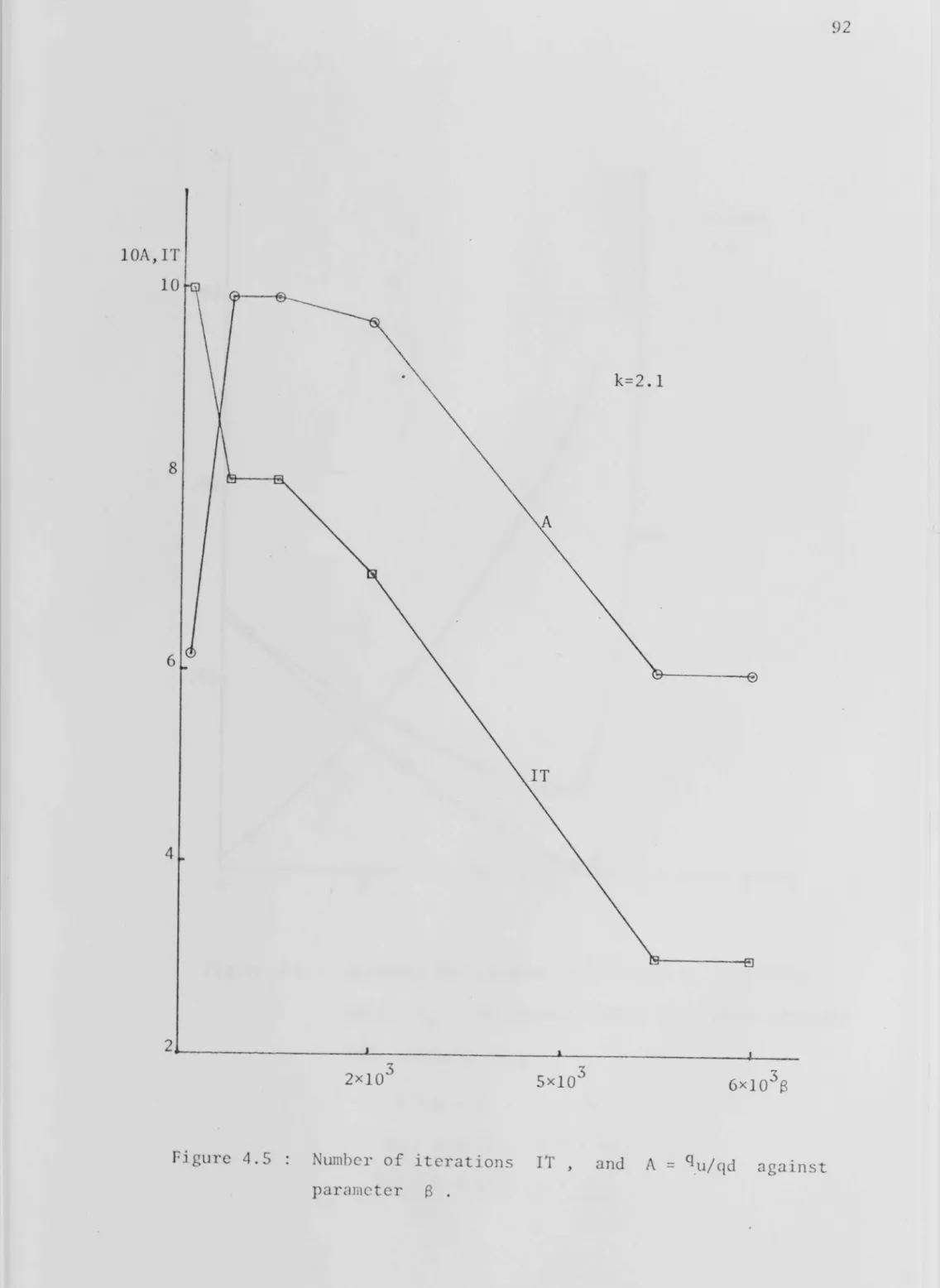
be presented in chapters 4 and 5) indicate that it does play an important
role in the convergence to a reasonable solution of the problem.
Introducing a complete set
condition, we write
q t
=
{h.} which do not satisfy the boundary
1
N
L
i=lN
L
i=la.h.
1 1
b.h.
1 1
(2.20)
On substituting these express10ns into the functional (2.18) and finding
the stationary value of F(Pt,qt) with respect to b. ,
1 we obtain a set of linear equations for the coefficients a. which can be written
1 in a matrix notation as
Ma
=
c (2.22)where
M
1S a matrix with 'elementsM..
= (
h., Lh. ) + S( h., Mh. ) BlJ 1 J 1 J
and c 1S a vector with
whilst
a
=
Now, the idea indicated above is extended to the non-linear problem,
l.e. when
L
is a non-linear operator, as follows. For the flow througha channel, the equation is
(2. 23£1,1
over the reg10n
R,
which 1S the area internal to the channel. q 1Stogether with the values at upstream and downstream infinity. We write
this as
on aR (2.23b)
So that we can apply the variational principle to the equation (2.23a),we
need the differential operator
L
to be linear. This is achieved byassuming, at each stage of the calculation, that fleq) and f
2(q) are
known functions of ~ and ~. The method chosen by Hendry 1S standard
linear iteration, in which the equations (2.23) are written as
L(n)q(n+l)
= 0 1n Rn = 0,1,2, .... (2.24)
M(n)q(n+l) = 0 on aR
where L (n)
,
M (n) are the operators with q set equal to q (n) , the(approximate) value of q determined upon the previous iteration. Thus
(2.25)
1n the equation (2.24). The variational method can then be applied to the
linear system (2.24). A starting value q (0)
commence this scheme.
The function being evaluated, q (n+ 1) ,
must be suitably chosen to
consists of two parts.
So that q (n+l) will satisfy the condition prescribed upstream and
downstr am, the first part of q (n+l) , which we call the core function
Fc' is some simple function ,hich serves this purpose. The second part
which are zero upstream and downstream. Thus, the function takes the
form
q(n+l) = F
c
N
+
L
i=l
a. (n+l)h. (q"IjJ)
J. 1 (2.26)
Inserting the above expressIon of q (n+l) into the functional
(2.18) as before, we obtain a set of linear equations for a. (n+ 1) 1
follows
where
M (n) C .)
N I,J"
(n) C)
~N 1 =
~N (n+1) =
=
M (n) (n+l)
N ~N
=
c (n) ",N n=
0,1,2, ...=
<
h.,L(n)h. ) +s<
h. ,M(n)h. ) B 1 =J J 1 J
j =
s<
hi,qB - M(n)F )- <
h. L (n) F ) 1 = c B l ' C( a (n+ 1)
l ' a 2
(n+l) (n+ 1) )
, ... ,
~J
[~n) J-1~~n)
n = 0,1,2, ...1,2, ... ,N
1,2 •.•• ,N
1,2, ... ,N
as
(2.27)
(2.28)
(2.29)
(2.30)
N being the number of trial functions used which, once the convergence
In n is reached, we keep increasing until the convergence In N IS
reached in turn.
Thus, Hendry's approach is to solve the variational problem
corresponding to the system (2.24), with the linear operator given by
(n+l)
(2.25), and to iterate (2.30) simultaneously, obtaining ~N ,and
hence qN(n+l), from the initial value
~N(O)
, until convergence In2.4 THE GALERKIN
METHOD
We now propose to replace Hendry's rather indirect approach by the
Ga1erkin Method (Marchuk 1975), which will give a set of linear
equations for the coefficients of the expansIon (2.16) directly. We
want to solve the equation
.Lq
=
f 1nR
(2.31)subject to
Mq
=
qB
on aR (2.32)where Land
M
are not necessarily linear operators, and aR 1S, asbefore, the boundary of the region R The method consists of requIrIng
the expressions in (2.31) and (2.32) to be orthogonal to N linearly
independent functions k. , J
Explicitly, we requIre
< k. ,Lq ) =
J
and < kj ,Mq ) B =
(j
=
1,2, ... , N) , over the regIon R.< k., f )
J
J = 1,2, ... ,N
< kj,qB)B
where < ,) 1S some Inner product defined on the regIon Rand < , ) B
1S that defined on the boundary '~ aR . We shall be using the same
as h. (i,j
=
1,2, ... ,N)o Rather than solving equations (2Q3l) and1
(2.32) simultaneously, we add" them with a parameter .3 and then solve
I
a
weaker set of equationsk.
J
=
1,2, ... ,N (2.33a)the function f being, in fact, zero.
At this stage, it is of certain interest to note the connection between our approach and Hendry's (section 2.3). If we write in (2.24)
(n+l)
q
N
_. q (n) +
I
d. (n+l)h. i=l 1 1where d. (n+l) are the coefficients to be determined, then uSlng (2.26),
1
we have
"
By substituting this into (2.27) we find that we have to solve for d. (n+l) from a set of linear equations expressed in matrix form as
1
with M (n)
N and
(n)
~N
n
=
O,1,2, ... ,Nexactly the same as glven before in (2.28) and (2.29). Rearranging a little, the above equations become
where
M (n)d (n+l)
N
,."
MN(n)~N(n) + ~N(n)(n) r
r(n)
=
L(n) (~(n))N
Obviously, Hendry's method converges as r (n) tends to
o ,
andequation (2.33b) is an algorithm for finding a sequence of q(n) 's which gIve this convergence.
Now, our approach to solving the equation
J
=
1,2, ... ,N (2.34 )IS to use Newton's Method (Ortega and Rheinbolt 1970 chapter 7 p.183ff). That is, we express rea) in a Taylor expansion in powers of the
'" '"
differentials da and then retain only the first term in the expansIon. This gives
N
ar
rea) +
L
'"
'" '" 1= . 1aa.
1where
If we write
N
L
i=lda.
=
1 r (a') '" rv
da
=
a' arv
(n+l)
a. h. (CP,l}J)
1 1
(2.35)
we can then set up an iteration on n, starting from some initial values for a.
1
( 0)
(i
=
1,2, ...,N) ,
which, In matrix notation, gIves
using the algorithm
N
ar(n)L
. 1
aa.
1= ' 1
da. (n) = 0
ACn)da Cn ) - - r Cn) (2
0 36)
'V
'"
A. ~n) Ca Cn)) ar. Ca Cn ))
where = - -1
1J '" aa. J
and r. Ca Cn)) = r. Cn)
1 '" 1
= < h.,LCn).qCn) ) + S< h.,MCn)qCn) q )
1 1 - B B (2.37)
with L
Cn )
and MCn) as defined in C2.24) and C2.25). Note that the matrix ACn) 1n our scheme is different from MCn ) used in Hendry's approach. In fact, our fcheme gives much more rapid convergence.The inner products are glven by
< h. ,h . ) =
IJ
R h.h.d¢dlJJ C2 .38)1 J 1 J
and ( h.,h. )B =
faR
h.h.ds (2.39 )1 J 1 J
The boundary 1nner product is a line integral on the boundary aR of R which is, in our case, the two walls of the channel.
A .. =
1J
ar.
1
aa. J
Hence we have
where 6~ 1S the difference in the stream function between the opposite
walls of the channel. The region
R
is the semi-infinite strip extendingto infinity along the
¢
aX1S in both directions, with the streamlines~
=
0 and ~=
6~ as the two walls. An iterative procedure has thusbeen set up consisting of iterating equation (2.24) and solving equation
(2.36) to find d a (n) ,
N
and consequently
from an initial starting value of a (0) •
(n+ 1)
a (and therefore
The converged solution
(n+l))
q ,
(in n) 1S also the variational solution to the Linear problem obtained
by setting q to the converged solution 1n
L.
After convergence in n1S achieved, the number N of functions used 1n the expansion for
is increased, and the whole iteration process repeated until the convergence
(
with respect to the non-linear iteration and the number of functions in
the trial function is reached simultaneously. The algorithm for the
overall procedure explained above is given in Table 1. __
2.5 A CHANNEL FLOW
For the case of fluid motion through a channel, the problem is to
solve the non-linear equation (2.23) with the velocity q given on the
channel boundaries
aR.
Taking the streamline where the stream functiontakes the value of zero at the lower wall, and 6~ to be the difference
in the stream function between the two walls, we have
TABLE I
START
17
(i) N starting value
.
n
=
0 ~N (n)=
0.
'"
...
;. "" ...
(ii) Calculate AN (n) and :N (n)
u j
j
(iii) Solve for dC;;N Cn) l
~N (n+l)
=
~N Cn) + d~ Cn),
1
I
Ci v) Has a Cn+ 1) converged ? NO (n) (n+ 1)
~N
=
~",N
-I
YES ~
I
(v) Calculate 8
,
x , yI
~
(vi) Has the solution converged J
=
J + 1NO
(0)
w.r.t.N ?
.
v n=
0 Set ~~
YES
ar. A .. =
aa.-
11J
J
r
to/
h
[f3h
jah
jJ
a [
aqah"]}
d aq
f 2 d1J/ dc1>d IjJ
= - + fl
acp
+ ~ f4hj - +ac1> ac1> a1jJ
_00 0
- Joo_oo
~hJ.
dhi{f
t (q-q )f }]
dA,L
d1jJ 2 B 4 B ~where f3
af l = aq f4 af 2 = aq If'
(n) N Cn)
and qN = F +
I
a. h. Cc1>,1jJ) as ln (2.26)c 1 1
,
i=l
Here, we have chosen functions k.
=
1
ah. 1
f2 ~ Ci
=
1,2, ... ,N)(2.42)
(2.43)
for the boundary integrals, and set S
= -
1 . This simple choice ispossible for channel flow, because of the insensitivity to S already
noticed by Hendry. Tfte. actual value
p
=< -1 was used by Davies and /IIfe.ndry ill unpublished vTOrk involving their variational iteration" sche~e, based on tne tKeory of self~adjoint linear operators.
We simplify the proceedure by introducing a new set of
coordinates (~ ,n) by
~ = tanh Ac1>
2 (2.44)
n
=
~'¥ IjJ - 1which takes the potential plane into a square plane
where A IS a scaling parameter. Accordingly, the lesidual r. becomes
1
ah.
~r
r
h.Lq1
r
[(q-qB) £2aljJ~J
1
dT)d~ (2.45)
r. = - - d~
1 (1_~2) A 2
-1 -1 -1 (l-~) n=-l,l
In this new plane, we take the trial function to be of the form
q Cn)
=
N
I J
L
I
i=l j=l
F (~) IS gIven the simple form ; c
p. (l,l)p. (T))a. ~n)
1 J IJ
where a and b are constants, and a + b
=
1. Thus=
(a-b) (a+b) qd(2.46)
In our particular channel problem, the results of which are presented
below, the downstream velocity qd IS 0.8; the upstream velocity
qu = 0.4, in units of the stagnation velocity of sound. and b = 0.25 .
The basis set of orthogonal pOlynomials p.(l,l)(~)
1
Hence a = 0.75
and P. (n) J
are the Jacobi polynomial and the Legendre polynomial of degree J , respectively. They do not satisfy the boundary conditions on T) = + 1
and the orthogonal functions are used here in order to ensure the
trial functions uS1ng monomials. Furthermore, in practice, it has
also been found best to have twice as many functions along the channel
as across the channel and so, in (2.46),
I = 2J
Once convergence is reached, information about the flow in the
physical plane can be found. In particular, the angle 8 and the x
and y coordinates, are given by
e
=J
E..
~
d<j>q 31/1
1/1
=
constantx
=
J
CO~
e
d~
1/1
=
constanty =
J
sin qe
d<j>1/1
=
constant=
f
f(~) d~
n
= constantcos 8
q
d~
n
=
constantsln 8
q
d~
n
=
constantand the turning angle of the channel 1S
/
f::..8
=
downstream angle - upstream angleMoreover, Slnce we know that
from (2.3), then
dmvns tream
q being expressed 1n units of the downstream velocity.
and hence
M =
f
pqdn =upstream
~n
=
u
palm
u 'U u
Also,
where ~nu and ~nd are the perpendicular distances across the channel
upstream and downstream respectively.
The results presented below were tabulated for the case where
-y
=
1.4, and the boundary conditions area + b tanh(<p-6<P) on 1/J = 0
a + b tanh(<p~6<P) on tjJ
=
6'i'Computation of the coeffici nts continued until they converged to an
accuracy of 10 -4 x large t coefficient. Figure 2.1 shows the results
obtained for the turning angle along various streamlines. For each J ,
the converged value of q with respect to the non-linear iteration was
used to calculate the turning angles. It 1S seen that as J 1ncreases,
the exact value of the turning angle. (This exact value can be calculated
ln a way which will be described in chapter 5.) From the graphs, the
error ln the calculation of the turning angles, along the various
streamlines, was estimated to be less than .02%. Figure 2.2 shows
the local Mach number M, at some point in the channel, versus J along
the streamlines lJl
=
~'l'
and4
are the corresponding local angle
e.
Also shown ln the same figure
Both M and
e
are converg1ngwith the lncrease ln J . It can be noted that
e
takes longer to converge than ~1 and this 1S to be expected since calculations ofe
involve a first derivative of the velocity distribution, while M 15
tabulated from the local velocity directly.
The shape of the channel is shown in figure 2.3 for the case where
A
=
.6 was used. The design of the channel was p16tted from the solutionobtained for J
=
7. The channel is seen to narrow at the do\\~stream incr< t:!.).i .. ,
i--' ,(end, which is in accordance with the compressibi ity property of the flow.
Figure 2.4 shows the effects different values of the scaling factor
A have on the efficiency of the technique. In this figure the maximum
errors in the turning angle (from the exact value) across the channel are
plotted against A, and it is obvious that there is a particular value
of A where the best efficiency will be obtained from the technique. Also,
figure 2.5 compares the rate of convergence for different values of A by
plotting the errors ln the turning angle against J . From these two
figures we can predict that the best value of the scaling parameter A lies
somewhere between .5 and .6. We chose A =.6 to obtain the results
presented 1n the first 3 figures.
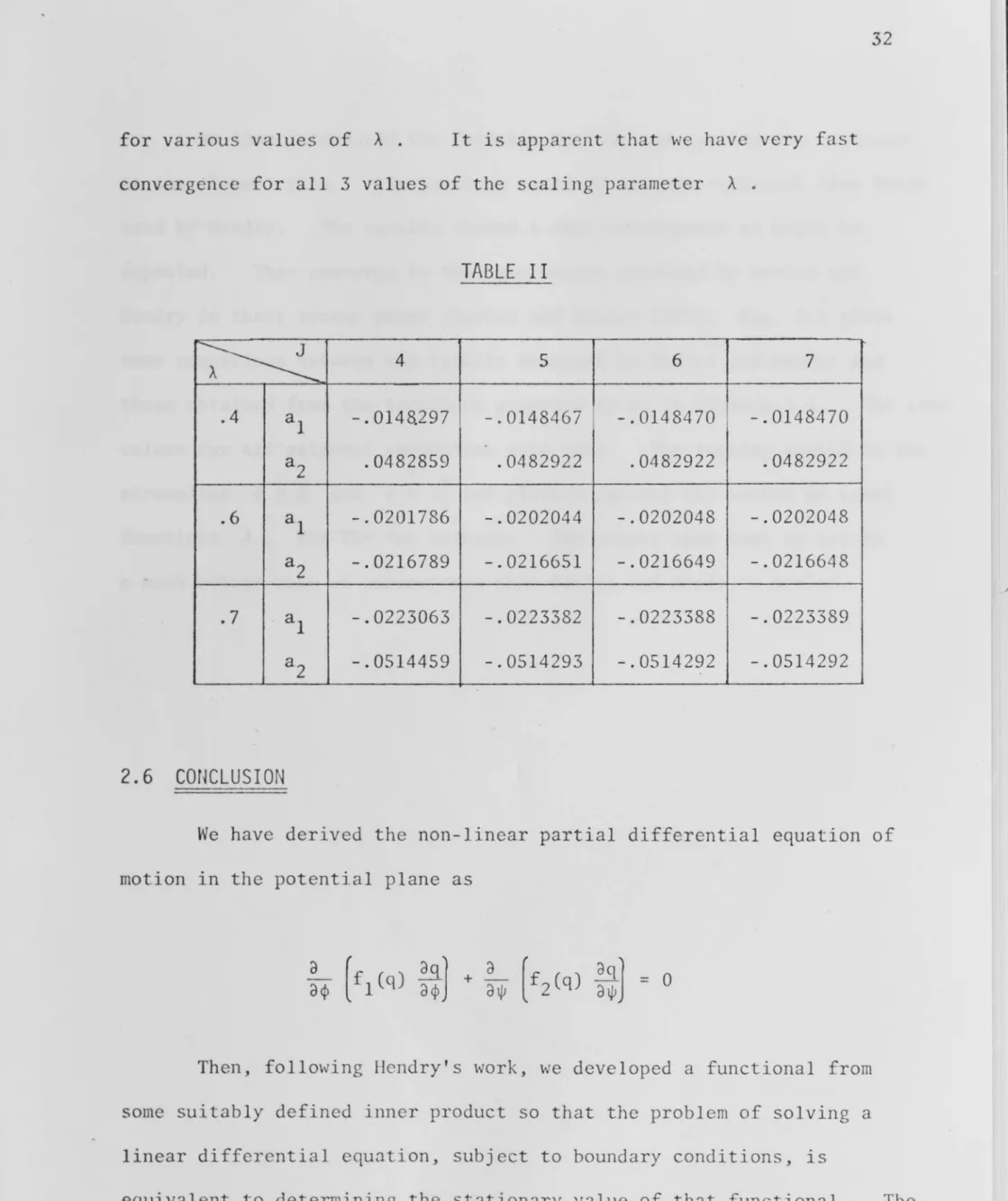
\e also include Table II below, which glves values of the leading
for varlOUS values of A . It is apparent that we have very fast
convergence for all 3 values of the scaling parameter A.
TABLE
II~
4 5 6 7.4 a
l -.0148.297 -.0148467 -.0148470 -.0148470 a
2 .0482859 .0482922 .0482922 .0482922
. 6 a
1 -.0201786 -.0202044 -.0202048 -.0202048 a
2 -.0216789 -.0216651 -.0216649 -.0216648
. 7 a
1 -.0223063 -.0223382 -.0223388 -.0223389 a
2 -.0514459 -.0514293 -.0514292 -.0514292
2.6 Cor~CLUS I ON
We have derived the non-linear partial differential equation of motion ln the potential plane as
Then, following Hendry's work, we developed a functional from some suitably defined inner product so that the problem of solving a linear differential equation, subject to boundary conditions, is
equivalent to determining the stationary value of that functional. The
Iterative Variational Method, using the trial functions not satisfying the
boundary conditions, was extended to the non-linear system above with the
We then introduced the Galerkin Method, and applied the technique to the channel flow. The matrices involved are now different from those used by Hendry. The results showed a fast convergence as might be
expected. They converge to the same values obtained by Davies and
Hendry in their recent paper (Davies and Hendry 1975). Fig. 2.6 gives some comparison between the results obtained by Davies and Hendry and
those obtained from the technique proposed by us ln s~ction 2.4. The same values for all relevant parameters were used. The turning angles on the streamline tIJ
=
0 and ~=
~2 '¥ are plotted against the number of trial functions J , for the two methods. The graphs show that we obtain1.86
1.85
1.84
1.8386
4
Figure 2.1
:\=.6
5 6
Turning angle ~e against number of trial
function~ J for various streamlin s.
3
M
---~---.---~---;;---·--1}·02%
--_._---.---M
---4 5 6
Figure 2.2
7 J 3 4 5
Local Mach number M and angle
e
against numberof trial functions J for various streamlines.
6 7 J
tN
~=~~
I 1 1 _____1 I £)
~=¥~
I -L1
r
~~=~~ I
~=O 1
--~~---'----~
,=n I
--<1>=0 <1>=-3.185 <1>=-2.519
<1>=-1.727
Figure 2.3 Shape of the channel in the (x,y)-plane
- - - - <1> constant
--- ~ constant
J=7
-
.--
-.-I
VJ
Error in 68
.04
.03
.02
.01
J=4
o
L---L---__ L -_ _ _ _ _ _ _ _ _ _ _ _ i -_ _ _ _ _ _ _ _ _ _ _ _ i -_ _ _ _ _ _ _.4
Figure 2.4
.5 .6 . 7 . 8
Error in !J
.03
.02
.01
.0
4
Figure 2.5
5 6 7
Maximum rror ln tun1ing angle against number
of trial functions J for various values of A .
-1.83
-1.8386 -1.84
4 5
Figure 2.6
6 7 8 9 10 4 5 6 7
Turning angle 68 against number of trial functions J
() t='I our result
o EJ Hendry's result
8 9 10 J
CHAPTER III
CASCADES OF
AEROFOILS
3. 1 INTRODUCTION
In this chapter we proceed to the problem of flow through cascades
of aerofoils. The description of the problem, together with the
mathematical formulation, is given in section 3.2. Then in section 3.3,
we deduce the various conformal transformations to map the complicated
potential plane onto a relatively simple region. This effects a
substantial reduction in the analytic difficulties attached to the selection
of a suitable form for the trial function for the velocity distribution.
In this, we make use of the approach adopted by Woods (Woods 1961), who
gave a conformal transformation mapping the potential plane of incompressible
cascade flow onto a semi-infinite, rectangular strip (figure 3.6).
We then extend this work to the case of compressible cascade flow
ln section 3.4. The final modified reglon turns out to be a square, over
which the trial function is defined. In section 3.5, the principles of
the Galerkin Method, described in the previous chapter, are applied to
cascade flow in general. In section 3.6, some relationships amongst the
mapping planes are investigated and some of the limiting values of terms
which are of relevance are worked out. This information is of considerable
use to us ln our later work. Lastly, in section 3.7, the general forms of
the residuals r. , and the matrix elements, relevant ln the proposed
1
non-linear iterations, are given in detail for the tria 1 function q of
3.2
DESCRIPTION OF THE PROBLEM
By a cascade of aerofoils, we mean an infinite set of similar
aerofoils at the same incidence, spaced at equal distance from each other
along the y-axis as shown In figure ~.l
A ' - - - - - H
y
... ,
---~~~~~77~~---~X
z
=
(x+iy) - planeFigure 3.1
"
--
...The solution to this problem is valuable because it is a first
approximation to the flow through the blading of an axial compressor,
especially at the high pressure end, where the blade height is small
(.,~'O{'
space between two blades to the IQIIgtk of the blade tend to infinity, the limiting case becomes the problem of a single aerofoil.
As ShO\ffi 1n figure 3.1, the aerofoils are equally spaced along the y-axis by a distance H. The flow is shown to have the upstream or inlet speed of q
u ' with the inlet angle of 8 u The dO\\TJlstream
or outlet speed at infinity is qd' with the outlet angle of 8 d . The repeat condition 1S the requirement that the flow at points
(x,y+nH) where n
=
O,±1,±2, ... are identical. The flow is shown toseparate from each aerofoil at some point on its upper surface, resulting in a wake of slowly moving turbulent fluid extending to infinity.
Different ways of treating this phenomena are discussed briefly in
Woods (Woods 1961 p. 19 ff). Our model, however, ignores the trailing edge (as has been mentioned), and the aerofoils, therefore, only close at infinity, conveniently bypassing the displacement property created by the wakes.
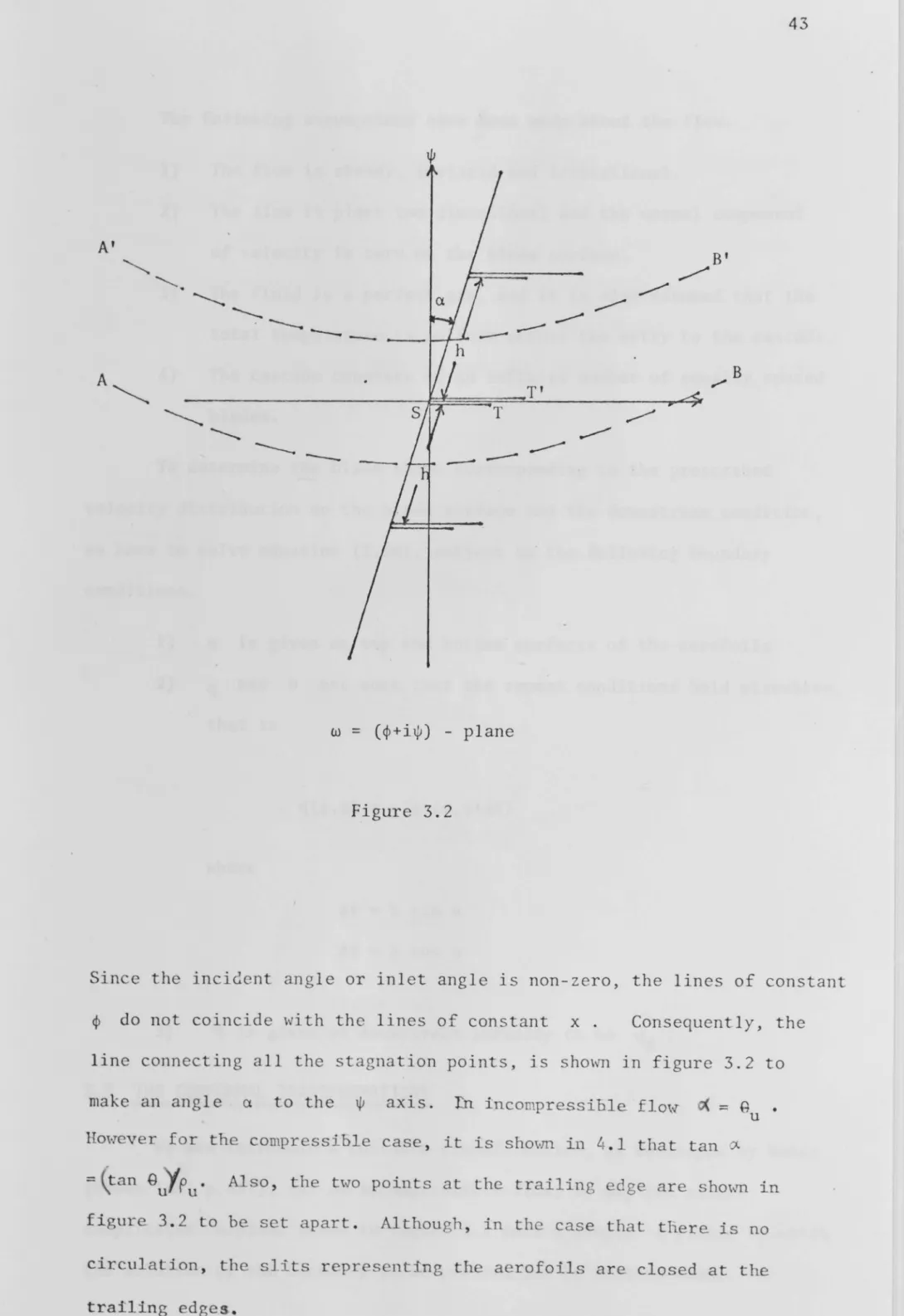
Now consider the representation of the flow in the potential plane as shmffi in figure 3.2. Note that, Slnce the surfaces of the
A'
~
"-.
'-...
.---
~~
--
---
.---
---T'
T
.,-/.---
--
----
---
---
~w
=
(~+i~) - planeFigure 3.2
B'
/
B
~
Since the inciGcnt angle or inlet angle is non-zero, the lines of constant
~ do not coincide with the lines of constant x. Consequently, the
line connecting all the stagnation points, is sho\ffi in figure 3.2 to make an angl e CL to the ~ aX1S. In incompre.ssiole f10\-[ = Q •
u
Hmvever for the compressible case, it is sho~m in 4.1 that tan (J..
= tan
tJuYPu'
Also, the t'170 points at the trailing edge are shmm infigure 3.2 to be set apart. Although, in the case that there is no
circulation, the sli ts repr s nting the aerofoils are closed at the
The following assumptions have been made about the flow.
1) The flow 1S steady, invjscid and irrotational.
2) The flow 1S plane two-dimensional and the normal component
of velocity 1S zero on the blade surface.
3) The fluid is a perfect gas, and it is also assumed that the
total temperature is uniform across the entry to the cascade.
4) The cascade consists of an infinite number of equally spaced
blades.
To determine the blade shape corresponding to the prescribed
velocity distribution on the blade surface and the downstream condition,
we have to solve equation (2.10), subject to the following boundary
conditions.
1) q is glven on top and bottom surfaces of the aerofoils
2) q and
e
are such that the repeat conditions hold elsewhere,that is
where
b¢>
=
h sin ab'¥
=
h cos a3) q 1S glven at downstream infinity to be qd'
3.3 THE CONFORMAL TRANSFOR
MATION
S
We now introduce a suitable transformation, as developed by Woods
(Woods 1961 p.487), for an incompr~ssible flow, to map the rather
complicated w-I lane shown in figure 3.2 onto a simple ~-pla~e, 1n which
First, we take the particular case of the incompressible flow
through the cascade for which both the downstream and upstream angles
are zero, as is shown in figure 3.3. The flow 1n the potential plane
is shown in figure 3.4. We note that there is no circulation Slnce
the inlet and outlet angles are zero, and therefore the slits representing
the aerofoils are closed (see section 4.1 for more detail). h 1S now
the perpendicular distance from one aerofoil to another, and hence equal
to b~ (the jump 1n ~ from one blade to the next).
e
=0 uz - plane
'Figure 3.3
We will distinguish the potential plane of this flow from the one
shown in figure 3.4. If the length of the slits IS k, it can be verified that the transformation
t = 1 - exp(-2nw
O/h) (3.1)
maps the slits into a single slit of length
t~
=
1 - exp(-2nk/h)ln the t-plane shown in figure 3.5, taking the orIgIn of the wO-plane to be at the leading edge
F
S of one of these slits.
o
tPO
T'
h S ,,""====~O __ ... ______ .. __ .. ____ ~ <PO
0'" - - - - ... ... ..
-F'
TO
E'wo - plane Figure 3.4
F
F'
The t-planc IS In turn mapped into the ~-plane by the
transformation
1
t
= 2
{1-exp(-2nk/h)}(1-cos ~)which, In using .(3.1) gIves
1 - exp(-2nw
o
/h)= 2
1 {1-exp(-2nk/h)}(1-cos ~)which may be written as
where
Wo
=
~
-
h £n {cosh r + sinh r coss}
2 2n
*
kn
r
=
h
If we define n by,
*
cosh
n =
coth r(3.2)
then the transformation (3.2) takes the point 4>
o -
- _ 00 In the wO-plane,onto the point 1.1
=
00 In the ~ plane, while the points 4>=
000
,
lJJ >
0 0 and 4>0
=
00,
lJJ 0 < 0 are mapped onto the points (y, 1.1)=
(n, n*
)*
and (-n, n ) respectively. Furthermore, the opposite sides of the
trailing edge streamline in the t-plane, tl
=
0, t£ ~ t2 < 00 - ,where t
=
tl + it2' are mapped to t~o separate lines, y=
+ nand*
. *
-n+ln
-n
E'
o
T
-n+S
S
2
-s
S
So
1 0
- plane
Figure 3.6
n
*
n+in
y
The stagnation points So will coincide, ln this case, with the orlgln
of the z;;-plane. The streamlines t = 1 - exp(-2nW
0/h) are mapped to
*
the lines y
=
± n with n < ~ < 00 The lines ~=
0 , - n < y < 0and 0 < y < n are the opposite sides of the blades.
Now, if we consider the flow in figure 3.2 to be an incompressible
flow, then both wand
Wo
will be analytic functions of z . In thesense used ln Woods, w will consequently be an analytic function of w
o
'
and therefore of z;;.
~n
[q
dZ]
~
~ i8(3.3) T
=
-udw £n - +q
and
~nrq ~
J
£n qu iOO (3.4)
TO
=
udw=
--1-q 0then, again In the sense used In Woods, both T and TO are analytic
functions of
s
-
.
By the repeat condition of the flow, we deduce that T and
are periodic, that is,
and
slnce the points ('IT,ll) and (-'IT,ll) would either be the same point
In the z-plane, or the corresponding points separated by the distance
nH, where n
=
O,±1,±2, in the Oy-direction.The above information enables us to make use of the theory developed
In Woods (Woods 1961 §4.3), where the calculus of residues is employed to
write
(3.5)
and (3.6)
Here 8S and 80S are the directions on the surface of the boundaries.
It is easy to see that 8S and 80S will differ only because of the