0022-538X/08/$08.00⫹0 doi:10.1128/JVI.00410-08
Copyright © 2008, American Society for Microbiology. All Rights Reserved.
Primate Lentivirus Capsid Sensitivity to TRIM5 Proteins
䌤
Zerina Kratovac,
1Cesar A. Virgen,
1Frederick Bibollet-Ruche,
2Beatrice H. Hahn,
2Paul D. Bieniasz,
1and Theodora Hatziioannou
1*
Aaron Diamond AIDS Research Center and the Rockefeller University, New York, New York,1and Departments of Medicine and Microbiology, University of Alabama at Birmingham, Birmingham, Alabama2
Received 25 February 2008/Accepted 8 April 2008
Mammalian cells express several factors that inhibit lentiviral infection and that have been under strong selective pressure. One of these factors, TRIM5, targets the capsid protein of incoming retrovirus particles and inhibits subsequent steps of the replication cycle. By substituting human immunodeficiency virus type 1 capsid, we were able to show that a set of divergent primate lentivirus capsids was generally not susceptible to restriction by TRIM5 proteins from higher primates. TRIM5␣proteins from other primates exhibited distinct restriction specificities for primate lentivirus capsids. Finally, we identified novel primate lentiviral capsids that are targeted by TRIMCyp proteins.
Primates have been colonized by retroviruses at various times during their evolution, leading to the selection of spe-cies-specific variants of genes encoding restriction factors that defend host cells from infection. Reciprocally, in order to col-onize a particular species, retroviruses have evolved resistance to these species-specific barriers by changing their protein se-quences to avoid interactions with restriction factors or by expressing small proteins that specifically neutralize them. However, the specialization involved in overcoming restriction factors present in one host species can come at the expense of acquiring susceptibility to those of another. This could, in prin-ciple, limit cross-species transmission. For example, endoge-nous levels of the capsid (CA)-targeting restriction factor TRIM5␣do not inhibit human immunodeficiency virus type 1
(HIV-1) replication in humans, yet rhesus TRIM5␣is a major barrier to HIV-1 replication in rhesus macaque cells (10, 12, 14, 20, 24, 32). To explore whether TRIM5␣ is a general barrier to cross-species primate lentivirus transmission, we de-termined the abilities of TRIM5 proteins from various primate species to restrict divergent primate lentiviruses.
A limiting factor in undertaking studies of diverse primate lentiviruses is that the complete genome sequence and infec-tious molecular clones are not yet available for a number of these lentiviruses. Furthermore, the generation of virus iso-lates and infectious molecular clones often involves passage in human cells, which might lead to the selection of mutations that alter sensitivity to human restriction factors such as TRIM5␣. However, TRIM5 proteins target the viral CA
pro-* Corresponding author. Mailing address: Aaron Diamond AIDS Research Center, 455 1st Avenue, New York, NY 10016. Phone: (212) 448-5091. Fax: (212) 448-5158. E-mail: [email protected].
[image:1.585.44.540.465.632.2]䌤Published ahead of print on 16 April 2008.
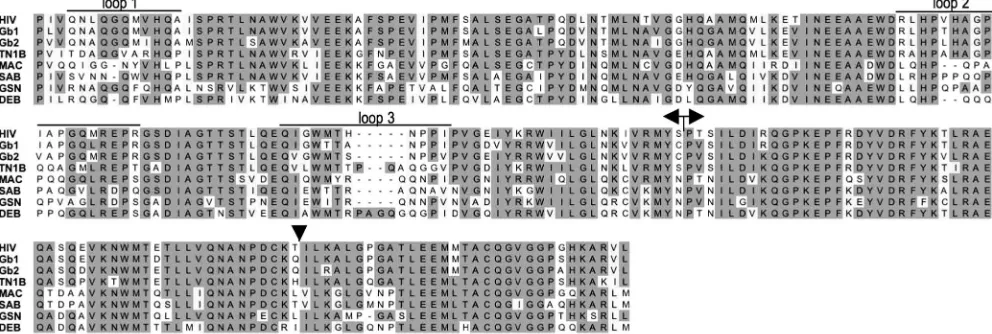
FIG. 1. Generation of lentiviral CA chimeras. Shown is an amino acid sequence alignment of CA proteins from the indicated lentiviruses. Sequence identities are shaded. Three regions defined as loops 1, 2, and 3 are indicated. The double arrow indicates the boundary of the N- and C-terminal domains. The second arrow indicates the C-terminal junction between HIV-1 and the other lentiviral CAs used in the generation of the chimeric GagPol constructs.
6772
on November 8, 2019 by guest
http://jvi.asm.org/
tein (6, 9–11, 25), and the replacement of human ficiency virus type 1 (HIV-1) CA by that of simian immunode-ficiency virus strain MAC239 (SIVMAC) generates a recombi-nant virus that displays the TRIM5␣ sensitivity of SIVMAC
rather than HIV-1 (12). Therefore, we employed the same strategy and introduced CA-coding sequences from various primate lentiviruses (Fig. 1) into an HIV-1 GagPol expression plasmid (9). Where possible, we used Gag sequences obtained without in vitro cultivation in human cells. A second advantage of this approach is that the GagPol chimeras package HIV-1 vector genomes expressing reporter genes, and therefore, chi-meric virion infectivity can be easily measured in the absence of variables that might arise due to other viral proteins. This approach has thus far been successful for the following chime-ras (Fig. 1): HIV-Gb1 expressing CA from SIVcpzGab1 de-rived from a human peripheral blood mononuclear cell-cul-tured isolate (13), HIV-Gb2 expressing CA from SIVcpzGab2 derived from uncultured lymphocyte DNA from a naturally infected Pan troglodytes troglodytes ape (3), HIV-TN1B ex-pressing CA from the TAN1.910 clone constructed based on the consensus of viral sequences from fecal RNA of a naturally infectedPan troglodytes schweinfurthiiape (27), HIV-MAC ex-pressing CA from SIVMAC (12), HIV-SAB expressing CA from SIVagmSAB (9), HIV-GSN expressing CA from SIVgsn71 amplified from uncultured lymphocyte DNA of a wild-caught greater spot-nosed monkey (Cercopithecus nicti-tans) (5), and HIV-DEB expressing CA sequences from SIVdebCNE40 amplified from uncultured lymphocytes of a naturally infected De Brazza’s monkey (Cercopithecus neglec-tus) (2).
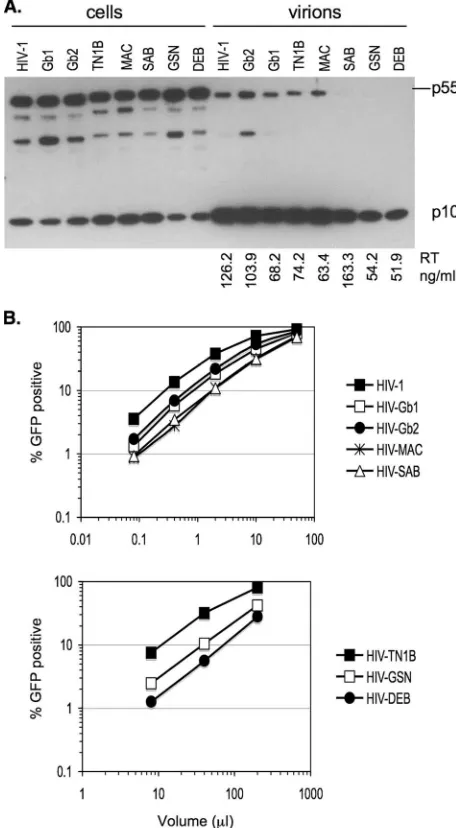
In each case, Gag expression, processing, and particle release, determined by Western blot analysis with an anti-HIV-1-matrix antibody, and particle reverse transcriptase (RT) ac-tivity were comparable to those of wild-type HIV-1 GagPol (Fig. 2A). HIV-GSN and HIV-DEB produced somewhat lower levels of Gag and particles than those of the other chimeras and wild-type HIV-1 GagPol (Fig. 2A). All chimeras produced infectious particles when cotransfected with an HIV-1 green fluorescent (GFP) protein vector (CSGW) and a vesicular sto-matitis virus G envelope glycoprotein expression plasmid (28), although infectious titers varied (Fig. 2B). As expected, HIV-GSN and HIV-DEB titers were lower than those obtained with other chimeras (Fig. 2B), probably due to the fact that particle production was less efficient (Fig. 2A). Surprisingly, HIV-TN1B titers were also lower than those of wild-type HIV-1, even though protein expression and particle release levels were comparable (Fig. 2).
In addition to the previously described human, rhesus ma-caque, pigtailed mama-caque, African green monkey, and owl monkey TRIM5␣, TRIM5, and TRIMCyp proteins, we iso-lated chimpanzee TRIM5␣(cpzTRIM5␣) and gorilla TRIM5␣ (gorTRIM5␣) cDNAs from Pan troglodytes verus peripheral blood mononuclear cells andGorilla gorillafibroblasts, respec-tively. The cpzTRIM5␣amino acid sequence was identical to previously published sequences, whereas gorTRIM5␣differed in a single amino acid position in the coiled coil (Fig. 3A) (18, 22, 23). Both proteins were closely related to each other and to human TRIM5␣(huTRIM5␣), from which they differed only at 9 to 10 amino acid positions (Fig. 3A). We generated single-cell clones of CHO single-cells expressing C-terminally hemagglutinin
(HA) epitope-tagged versions of these proteins as previously described (11). Protein expression levels were comparable for all TRIM5␣ proteins, and only pigtailed macaque TRIM5 (pgtTRIM5) was expressed at somewhat lower levels (Fig. 3B).
Notably, neither huTRIM5␣nor cpzTRIM5␣inhibited the infectivity of any of the chimeric lentiviruses viruses tested, but both inhibited N-tropic murine leukemia virus (NMLV)
infec-FIG. 2. Characterization of lentiviral CA chimeras. (A) 293T cells (10-cm dishes) were transfected with wild-type or chimeric HIV-1 GagPol (5g), HIV-1 GFP vector (5g), and vesicular stomatitis virus G (1g) expression plasmids and harvested 2 days posttransfection. Virions were purified by ultracentrifugation through a 20% sucrose cushion. Cell and virion lysates were analyzed by immunoblotting with an antibody against HIV-1 matrix (p17). The RT activity of viral supernatants, measured using a commercial RT kit (Cavidi), is indi-cated (representative of two independent experiments). (B) Infectivity of viruses generated in A was measured using hamster CHO cells. Infected cells were enumerated by fluorescence-activated cell sorter (FACS) analysis. A representative of three independent experiments is shown.
on November 8, 2019 by guest
http://jvi.asm.org/
[image:2.585.305.533.71.485.2]on November 8, 2019 by guest
http://jvi.asm.org/
tion by 100-fold (Fig. 3C and D). gorTRIM5␣was also inactive against most chimeric viruses but did inhibit HIV-MAC infec-tivity by about 10-fold (Fig. 3E), in agreement with a previous study showing that chimeric huTRIM5␣ expressing the gor-TRIM5␣SPRY domain inhibits SIVMACinfection (18). Addi-tionally, like huTRIM5␣and cpzTRIM5␣, gorTRIM5␣strongly inhibited NMLV infection (Fig. 3E). Rhesus macaque TRIM5␣ (rhTRIM5␣) and African green monkey (agmTRIM5␣) inhib-ited HIV-Gb1 and HIV-Gb2 infection as strongly, about 50-and 10-fold, respectively, as they inhibited wild-type HIV-1 (Fig. 2F and G). This was somewhat expected, given the ex-tensive amino acid sequence homology between the HIV-1, Gab1, and Gab2 CAs (Fig. 1A). Surprisingly, however, the inhibition of HIV-TN1B by the Old World monkey TRIM5 proteins was significantly less potent, fivefold by rhTRIM5␣ and negligible by agmTRIM5␣(Fig. 2F and G). SIVagmSab has been shown to be susceptible to rhTRIM5␣but resistant to agmTRIM5␣(9), and HIV-SAB recapitulated this phenotype (Fig. 3F and G). rhTRIM5␣and agmTRIM5␣exhibited op-posing specificities in terms of the restriction of HIV-GSN and HIV-DEB. Specifically, rhTRIM5␣ reduced HIV-GSN infectivity moderately (threefold) and reduced HIV-DEB in-fectivity considerably (10-fold) (Fig. 3F). In contrast, ag-mTRIM5␣strongly inhibited HIV-GSN infection (10-fold) but had only marginal effects (less than twofold) on the infectivity of HIV-DEB (Fig. 3G). Finally, pgtTRIM5did not signifi-cantly inhibit any of the chimeric viruses tested (Fig. 3H). Of note, the addition of cyclosporine A (CsA) during infection had either no or marginal (twofold) effects on lentivirus re-striction by the various TRIM5 proteins shown in Fig. 3 (data not shown).
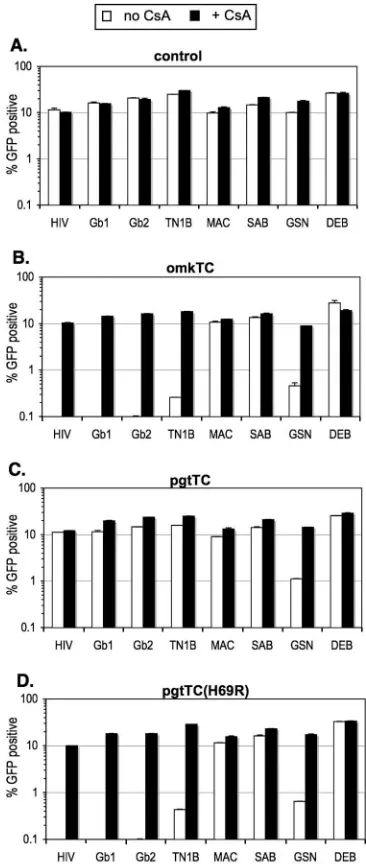
Recently, we and others have shown that a TRIMCyp fusion protein has arisen independently in pigtailed macaques and owl monkeys (4, 16, 29, 30), and remarkably, unlike owl mon-key TRIMCyp (omkTRIMCyp), pgtTRIMCyp is completely inactive against HIV-1 even though it can restrict other lenti-viruses, including feline immunodeficiency virus (FIV) (29). Furthermore, we identified a single amino acid change (R69H) in pgtTRIMCyp, compared to pgtCypA or omkTRIMCyp, that results in a loss of the interaction with the HIV-1 CA but a “gain” of interaction with the FIV CA, insofar as it became more difficult to abolish FIV restriction with CsA (29). These observations suggest that some ancient retroviral infection led to the selection of H69 in pgtTRIMCyp, because H69 enhances the restriction of some as-yet-unknown (perhaps FIV-like) virus.
Like the HIV-1 CA, the SIVcpz (SIV from chimpanzees) CAs were strongly inhibited by omkTRIMCyp (100-fold) but not by pgtTRIMCyp (Fig. 4B and C). However, both omk-TRIMCyp and pgtomk-TRIMCyp inhibited HIV-GSN. Notably, a single amino acid change in pgtTRIMCyp, H69R, which re-verses a change in CypA that was acquired after its
LINE-mediated retrotransposition intopgtTRIM5, was able to confer the ability to restrict SIVcpz as well as HIV-1 CAs (Fig. 4D). The reversal of a second postretrotransposition change, N66D, had no significant effects (data not shown).
[image:4.585.328.511.69.501.2]FIG. 3. Restriction specificities of primate TRIM5 proteins. (A) Amino acid alignment of primate TRIM5␣proteins. Functional domains are indicated. The asterisk indicates the position of the amino acid difference with the published variants of gorTRIM5␣. Numbers indicate the three residues that differ in the gorTRIM5␣SPRY domain compared to huTRIM5␣and cpzTRIM5␣. (B) Expression of primate TRIM5 HA-tagged proteins in stable CHO-derived cell lines as determined by Western blot analysis using an anti-HA antibody (Covance). (C to H) Infection of CHO cells that were unmodified (white bars) or that stably expressed the indicated primate TRIM5 proteins (black bars) by wild-type and chimeric HIV-1 or NMLV or B-tropic murine leukemia virus (BMLV). Infected cells were enumerated by FACS analysis. The dose of each virus was selected to infect 15% to 30% of unmodified CHO cells.
FIG. 4. Restriction specificity of wild-type and mutant TRIMCyp proteins. Unmodified hamster CHO cells (A) or CHO cells stably expressing the TRIMCyp protein indicated (B to D) were infected with wild-type or chimeric HIV-1 in the absence (white bars) or presence (black bars) of 5M CsA. Infected cells were enumerated by FACS analysis. The expression of each TRIMCyp protein in these stable cell lines was previously described (29).
on November 8, 2019 by guest
http://jvi.asm.org/
Overall, these studies describe methods by which the “rep-ertoire” of modern primate lentiviruses that can be inhibited by modern TRIM5 proteins can be determined. Two conclu-sions are particularly noteworthy; first, the ability of lentiviral CAs to interact with CypA is significantly more widespread than originally thought (7, 17, 34), and since SIVgsn CA was sensitive to both omkTRIMCyp and pgtTRIMCyp, SIVgsn represents another example of a lentivirus CA that is capable of binding CypA. CA-CypA interactions likely provided the impetus for the selection of ancestral owl and macaque mon-key individuals that harbored CypA sequences inserted into the TRIM5 locus, and the striking, convergent TRIM5 evolu-tion at the single-amino-acid level following CypA retrotrans-position in these species (21, 29) suggests that the selection pressure imposed by retroviruses in each species was very pow-erful. Second, it was surprising that higher-primate TRIM5␣ proteins did not appear to restrict the majority of lentivi-ruses tested. Indeed, gorTRIM5␣ was the only higher pri-mate protein capable of restricting a pripri-mate lentivirus (SIVMAC). The C-terminal TRIM5␣ SPRY domain, which
determines restriction specificity (18, 19, 26, 33) differs at only three positions in gorTRIM5␣compared to huTRIM5␣ and cpzTRIM5␣ that are presumably responsible for this phenotype (Fig. 2A).
SIVcpz, the immediate ancestor of HIV-1, has been trans-mitted to humans from chimpanzees of the P. t. troglodytes
subspecies on three occasions, yet there is no evidence for SIVcpz transmission fromP. t. schweinfurthiito humans (15, 31). Interestingly, the CA sequences of these viruses are rather different (Fig. 1), particularly in the regions predicted to lie on the exposed surface of the three-dimensional CA structure, and affect its ability to be recognized by various TRIM5 pro-teins (10). These differences probably account for the ability of HIV-TN1B to resist rhTRIM5␣while maintaining its ability to bind CypA. However, because both SIVcpz P. t. troglodytes -and SIVcpzP. t. schweinfurthii-derived CAs were resistant to huTRIM5␣, it is unlikely that huTRIM5␣is responsible for the absence of SIVcpzP. t. schweinfurthiistrains in humans. In-deed, huTRIM5␣did not inhibit any of the CAs tested, sug-gesting that it does not impose a major barrier to colonization of humans by nonhuman primate lentiviruses in general. Sim-ilarly, it was previously shown that huAPOBEC3 activity does not completely account for the inability of certain simian im-munodeficiency viruses to infect humans (8), suggesting that these intrinsic antiviral factors are not the sole determinants of primate lentivirus cross-species transmissibility.
SIVcpz is itself a recombinant virus that derives its 5⬘half, including CA, from SIV from red-capped mangabeys and its 3⬘ half from SIVgsn (1). Since SIVgsn CA was not sensitive to cpzTRIM5␣, it is unlikely that TRIM5␣ drove the selection against SIVgsn CA sequences during the genesis of SIVcpz. Rather, the inability of higher-primate TRIM5␣ proteins to inhibit infection by lower-primate lentiviruses would, predict-ably, facilitate the coinfection of chimpanzees by multiple len-tiviruses. Such permissiveness likely facilitated the birth of a recombinant lentivirus (SIVcpz/HIV-1) that has become well adapted to a close relative of humans, ultimately leading to the initiation of the current pandemic.
REFERENCES
1.Bailes, E., F. Gao, F. Bibollet-Ruche, V. Courgnaud, M. Peeters, P. A. Marx, B. H. Hahn, and P. M. Sharp.2003. Hybrid origin of SIV in chimpanzees.
Science300:1713.
2.Bibollet-Ruche, F., E. Bailes, F. Gao, X. Pourrut, K. L. Barlow, J. P. Clewley, J. M. Mwenda, D. K. Langat, G. K. Chege, H. M. McClure, E. Mpoudi-Ngole, E. Delaporte, M. Peeters, G. M. Shaw, P. M. Sharp, and B. H. Hahn.
2004. New simian immunodeficiency virus infecting De Brazza’s monkeys (Cercopithecus neglectus): evidence for a cercopithecus monkey virus clade.
J. Virol.78:7748–7762.
3.Bibollet-Ruche, F., F. Gao, E. Bailes, S. Saragosti, E. Delaporte, M. Peeters, G. M. Shaw, B. H. Hahn, and P. M. Sharp.2004. Complete genome analysis of one of the earliest SIVcpzPtt strains from Gabon (SIVcpzGAB2). AIDS
Res. Hum. Retrovir.20:1377–1381.
4.Brennan, G., Y. Kozyrev, and S.-L. Hu.2008. TRIMCyp expression in Old World primates Macaca nemestrina and Macaca fascicularis. Proc. Natl. Acad. Sci. USA. [Epub ahead of print.] doi:10.1073/pnas.0709258105. 5.Courgnaud, V., M. Salemi, X. Pourrut, E. Mpoudi-Ngole, B. Abela, P. Auzel,
F. Bibollet-Ruche, B. Hahn, A. M. Vandamme, E. Delaporte, and M. Peeters.
2002. Characterization of a novel simian immunodeficiency virus with avpu
gene from greater spot-nosed monkeys (Cercopithecus nictitans) provides
new insights into simian/human immunodeficiency virus phylogeny. J. Virol.
76:8298–8309.
6.Cowan, S., T. Hatziioannou, T. Cunningham, M. A. Muesing, H. G. Gottlinger, and P. D. Bieniasz.2002. Cellular inhibitors with Fv1-like activity restrict human and simian immunodeficiency virus tropism. Proc. Natl. Acad.
Sci. USA99:11914–11919.
7.Diaz-Griffero, F., N. Vandegraaff, Y. Li, K. McGee-Estrada, M. Stremlau, S. Welikala, Z. Si, A. Engelman, and J. Sodroski.2006. Requirements for capsid-binding and an effector function in TRIMCyp-mediated restriction of
HIV-1. Virology351:404–419.
8.Gaddis, N. C., A. M. Sheehy, K. M. Ahmad, C. M. Swanson, K. N. Bishop, B. E. Beer, P. A. Marx, F. Gao, F. Bibollet-Ruche, B. H. Hahn, and M. H. Malim.2004. Further investigation of simian immunodeficiency virus Vif
function in human cells. J. Virol.78:12041–12046.
9.Hatziioannou, T., S. Cowan, S. P. Goff, P. D. Bieniasz, and G. J. Towers.
2003. Restriction of multiple divergent retroviruses by Lv1 and Ref1. EMBO
J.22:385–394.
10.Hatziioannou, T., S. Cowan, U. K. Von Schwedler, W. I. Sundquist, and P. D. Bieniasz.2004. Species-specific tropism determinants in the human
immu-nodeficiency virus type 1 capsid. J. Virol.78:6005–6012.
11.Hatziioannou, T., D. Perez-Caballero, A. Yang, S. Cowan, and P. D. Bieniasz. 2004. Retrovirus resistance factors Ref1 and Lv1 are
species-specific variants of TRIM5alpha. Proc. Natl. Acad. Sci. USA101:10774–
10779.
12.Hatziioannou, T., M. Princiotta, M. Piatak, Jr., F. Yuan, F. Zhang, J. D. Lifson, and P. D. Bieniasz.2006. Generation of simian-tropic HIV-1 by
restriction factor evasion. Science314:95.
13.Huet, T., R. Cheynier, A. Meyerhans, G. Roelants, and S. Wain-Hobson.
1990. Genetic organization of a chimpanzee lentivirus related to HIV-1.
Nature345:356–359.
14.Keckesova, Z., L. M. Ylinen, and G. J. Towers.2004. The human and African green monkey TRIM5alpha genes encode Ref1 and Lv1 retroviral restriction
factor activities. Proc. Natl. Acad. Sci. USA101:10780–10785.
15.Keele, B. F., F. Van Heuverswyn, Y. Li, E. Bailes, J. Takehisa, M. L. Santiago, F. Bibollet-Ruche, Y. Chen, L. V. Wain, F. Liegeois, S. Loul, E. M. Ngole, Y. Bienvenue, E. Delaporte, J. F. Brookfield, P. M. Sharp, G. M. Shaw, M. Peeters, and B. H. Hahn.2006. Chimpanzee reservoirs of
pan-demic and nonpanpan-demic HIV-1. Science313:523–526.
16.Liao, C.-H., Y.-Q. Kuang, H.-L. Liu, Y.-T. Zheng, and B. Su.1997. A novel fusion gene, TRIM5-cyclophilin A in the pig-tailed macaque determines its
susceptibility to HIV-1 infection. AIDS.21:S19–S26.
17.Lin, T. Y., and M. Emerman.2006. Cyclophilin A interacts with diverse
lentiviral capsids. Retrovirology3:70.
18.Ohkura, S., M. W. Yap, T. Sheldon, and J. P. Stoye.2006. All three variable
regions of the TRIM5␣B30.2 domain can contribute to the specificity of
retrovirus restriction. J. Virol.80:8554–8565.
19.Perez-Caballero, D., T. Hatziioannou, A. Yang, S. Cowan, and P. D. Bieniasz.2005. Human tripartite motif 5␣domains responsible for retrovirus
restriction activity and specificity. J. Virol.79:8969–8978.
20.Perron, M. J., M. Stremlau, B. Song, W. Ulm, R. C. Mulligan, and J. Sodroski.2004. TRIM5alpha mediates the postentry block to N-tropic
mu-rine leukemia viruses in human cells. Proc. Natl. Acad. Sci. USA101:11827–
11832.
21.Ribeiro, I. P., A. N. Menezes, M. A. Moreira, C. R. Bonvicino, H. N. Seua´nez, and M. A. Soares.2005. Evolution of cyclophilin A andTRIMCyp
retrotrans-position in New World primates. J. Virol.79:14998–15003.
22.Sawyer, S. L., L. I. Wu, M. Emerman, and H. S. Malik.2005. Positive selection of primate TRIM5alpha identifies a critical species-specific
retro-viral restriction domain. Proc. Natl. Acad. Sci. USA102:2832–2837.
23.Song, B., B. Gold, C. O’Huigin, H. Javanbakht, X. Li, M. Stremlau, C.
on November 8, 2019 by guest
http://jvi.asm.org/
Winkler, M. Dean, and J. Sodroski.2005. The B30.2(SPRY) domain of the
retroviral restriction factor TRIM5␣exhibits lineage-specific length and
se-quence variation in primates. J. Virol.79:6111–6121.
24.Stremlau, M., C. M. Owens, M. J. Perron, M. Kiessling, P. Autissier, and J. Sodroski.2004. The cytoplasmic body component TRIM5alpha restricts
HIV-1 infection in Old World monkeys. Nature427:848–853.
25.Stremlau, M., M. Perron, M. Lee, Y. Li, B. Song, H. Javanbakht, F. Diaz-Griffero, D. J. Anderson, W. I. Sundquist, and J. Sodroski.2006. Specific recognition and accelerated uncoating of retroviral capsids by the
TRIM5alpha restriction factor. Proc. Natl. Acad. Sci. USA103:5514–5519.
26.Stremlau, M., M. Perron, S. Welikala, and J. Sodroski.2005. Species-specific
variation in the B30.2(SPRY) domain of TRIM5␣determines the potency of
human immunodeficiency virus restriction. J. Virol.79:3139–3145.
27.Takehisa, J., M. H. Kraus, J. M. Decker, Y. Li, B. F. Keele, F. Bibollet-Ruche, K. P. Zammit, Z. Weng, M. L. Santiago, S. Kamenya, M. L. Wilson, A. E. Pusey, E. Bailes, P. M. Sharp, G. M. Shaw, and B. H. Hahn.2007. Generation of infectious molecular clones of simian immunodeficiency virus
from fecal consensus sequences of wild chimpanzees. J. Virol.81:7463–7475.
28.Virgen, C. A., and T. Hatziioannou.2007. Antiretroviral activity and Vif
sensitivity of rhesus macaque APOBEC3 proteins. J. Virol.81:13932–13937.
29.Virgen, C. V., Z. Kratovac, P. D. Bieniasz, and T. Hatziioannou.2008.
Independent genesis of chimeric TRIM-cyclophilin proteins in two primate species. Proc. Natl. Acad. Sci. USA. [Epub ahead of print.] doi:10.1073/ pnas.0709258105.
30.Wilson, S. J., B. L. J. Webb, L. M. J. Ylinen, E. Verschoor, J. L. Heeney, and G. J. Towers.2008. Independent evolution of an antiviral TRIMCyp in rhesus macaques. Proc. Natl. Acad. Sci. USA. [Epub ahead of print.] doi: 10.1073/pnas.0709258105.
31.Worobey, M., M. L. Santiago, B. F. Keele, J. B. Ndjango, J. B. Joy, B. L. Labama, A. B. Dhed, A. Rambaut, P. M. Sharp, G. M. Shaw, and B. H. Hahn.
2004. Origin of AIDS: contaminated polio vaccine theory refuted. Nature
428:820.
32.Yap, M. W., S. Nisole, C. Lynch, and J. P. Stoye.2004. Trim5alpha protein restricts both HIV-1 and murine leukemia virus. Proc. Natl. Acad. Sci. USA
101:10786–10791.
33.Yap, M. W., S. Nisole, and J. P. Stoye.2005. A single amino acid change in the SPRY domain of human Trim5alpha leads to HIV-1 restriction. Curr.
Biol.15:73–78.
34.Zhang, F., T. Hatziioannou, D. Perez-Caballero, D. Derse, and P. D. Bien-iasz.2006. Antiretroviral potential of human tripartite motif-5 and related
proteins. Virology353:396–409.