Evaluating the Foundation Phase
Final Report
Ymchwil gymdeithasol Social researchNumber: 25/2015
Evaluating the Foundation Phase: Final Report
Chris Taylor1, Mirain Rhys1, Sam Waldron1, Rhys Davies1, Sally Power1, Trisha Maynard2, Laurence Moore1, David Blackaby3 and Ian Plewis4 (1Wales Institute of Social and Economic Research, Data and Methods (WISERD), Cardiff University)
(2Canterbury Christ Church University)
(3Wales Institute of Social and Economic Research, Data and Methods (WISERD), Swansea University)
(4University of Manchester)
Views expressed in this report are those of the researchers and not necessarily those of the Welsh Government
For further information please contact: Launa Anderson
Knowledge and Analytical Services Welsh Government
Cathays Park Cardiff
CF10 3NQ
Tel: 029 2082 5274
Email: [email protected]
Welsh Government Social Research, 14 May 2015 ISBN: 978-1-4734-3605-3
© Crown Copyright 2015
All content is available under the Open Government Licence v3.0 , except where otherwise stated.
Table of contents
Glossary of Acronyms ... i
Glossary of Key Terms... ii
Acknowledgements ... iv
EXECUTIVE SUMMARY ... 1
1 Introduction to the Evaluation ... 10
2 Implementation of the Foundation Phase ... 26
3 Foundation Phase Practice ... 50
4 The Impact of the Foundation Phase ... 74
5 An Economic Evaluation of the Foundation Phase ... 97
6 Conclusions and Recommendations ... 110
References... 126
Appendix A. Evaluation Reports and Summaries ... 130
Appendix B. Welsh Government Training and Guidance Materials ... 132
Index of Figures
Figure 1: Overview of Stepped Wedge Design for Evaluating the Foundation
Phase ... 15
Figure 2: Design and Main Elements of Evaluation ... 16
Figure 3: Policy Logic Model (Version 2) for Evaluating the Foundation Phase ... 25
Figure 4. Foundation Phase Training and Support Budget, 2004-05 to 2013-14 ... 36
Figure 5. Distribution of Training and Support Budget, 2008-09 to 2013-14 .. 37
Figure 6. Reported Satisfaction of Training and Support by Foundation Phase Lead Practitioners in Schools ... 37
Figure 7. Reported Satisfaction of Training and Support by Foundation Phase Lead Practitioners in Funded Non-Maintained Settings ... 38
Figure 8. Foundation Phase Capital Budget, 2004-05 to 2011-12 ... 43
Figure 9. Foundation Phase Practice in Schools, by Year Group ... 54
Figure 10. Frequency of Areas of Learning Observed, by Year Group ... 68
Figure 11. Use of Foundation Phase Pedagogies in the Morning and Afternoon, by Year Group ... 72
Figure 12. Perceived Impact of the Foundation Phase on Behaviour, Wellbeing and Attitudes to Learning ... 75
Figure 13. Relationship between Foundation Phase Pedagogies and Children’s Wellbeing ... 76
Figure 14. Relationship between Foundation Phase Pedagogies and Children’s Involvement ... 76
Figure 15. Perceived Impact of the Foundation Phase on Literacy and Numeracy... 86
Index of Tables
Table 1. Evaluation Reports and Summaries (published by the Welsh
Government) ... 13 Table 2: Summary of Data Collection Techniques and Associated Response Rates ... 19 Table 3. Average Adult:Child Ratios in Schools for the Foundation Phase (2012) and in Key Stage 1 (2005), by Year Group ... 32 Table 4. Percentage of Schools Estimated to be Meeting Recommended Ratios (2012) ... 32 Table 5. Perceived Differences in the Delivery of the Foundation Phase
Amongst Foundation Phase Lead Practitioners (Compared to Key Stage 1 National Curriculum) ... 51 Table 6. Perceptions of the Curriculum (by Foundation Phase Lead
Practitioners in Schools) ... 52 Table 7. Estimating the Likelihood of Achieving the Foundation Phase
Index of Boxes
Box 1. Example of Best Practice within the Foundation Phase: Creative Use of Adult:Child Ratios ... 33 Box 2. Example of Best Practice within the Foundation Phase: Balance of Continuous, Enhanced and Focussed Activities ... 55 Box 3. Example of Best Practice within the Foundation Phase: Pupil
Involvement in Lesson Planning ... 58 Box 4. Example of Best Practice within the Foundation Phase: Parental
Engagement... 60 Box 5. Example of Best Practice within the Foundation Phase: Learning Zones ... 62 Box 6. Example of Best Practice within the Foundation Phase: Effective Use of the Outdoors ... 64 Box 7. Example of Best Practice within the Foundation Phase: Welsh
Glossary of Acronyms
3Es Economy, efficiency and effectiveness AWFPA All Wales Foundation Phase Advisers group BERA British Educational Research Association CD Creative Development Area of Learning
DECIPHer Centre for the Development and Evaluation of Complex Interventions for Public Health Improvement
ESRC Economic and Social Research Council
Estyn Estyn is the office of Her Majesty’s Chief Inspector of Education and Training in Wales
FP Foundation Phase FTE Full-time Equivalent
GSR Government Social Research HE Higher Education
KS1 Key Stage 1 National Curriculum KS2 Key Stage 2 National Curriculum
KUW Knowledge and Understanding of the World Area of Learning LLC Language, Literacy and Communication Skills Area of Learning MCS Millennium Cohort Study
MD Mathematical Development Area of Learning NPD National Pupil Database
PD Physical Development Area of Learning PLASC Pupil Level Annual Schools Census
PSDWCD Personal & Social Development, Well-being & Cultural Diversity Area of Learning
SEN Special Educational Needs TSO Training and Support Officer VfM Value for money
Glossary of Key Terms
Active Activity allowed child to be physically active (i.e. not sitting at desk/on floor).
Adult present/absent With = adult close by child/group; Without = adult not close by child/group.
Assessment Child being assessed by adult. Carpet Child was sitting on carpet.
Child/adult Directed Activity was directed by either the child or the adult. Child/adult Initiated Activity was decided upon by either the child or the
adult.
Co-construction Adult was ‘collaborating’ with child.
Desk Child was at desk.
Direct teaching Adult teaching in traditional style (instructional). Early Start schools and
settings
These are the 22 schools and 22 funded non-maintained settings who introduced the Foundation Phase from 2006/07 in the second stage of its roll-out. These were selected because they were in Flying Start areas.
Exploring Child was exploring/experimenting. Final Roll-out schools
and settings
These are the remaining schools and settings that introduced the Foundation Phase from 2009/10 that were not involved in the first two stages of its
implementation (known as Pilot and Early Start schools and settings).
First-hand Direct experience with learning objective. Following adult
instructions
Child was following adult instructions.
Involvement Throughout the report we refer to pupil involvement. This was measured using the Leuven scale of involvement. This is largely a measure of physical involvement in learning that can be used in the observation of individual children.
Multilevel modelling This is a form of statistical analysis that utilises data that is organised at more than one level (i.e. nested data). For example, the units of analysis in a multilevel model could include data for individual pupils, the schools they attend, and the local authorities their schools belong to. Critically, multilevel models consider the residual components at each level in the hierarchy allowing the analysis to estimate observed and
Open/closed questioning
Open = open-ended; Closed = could be answered in single word/phrase.
Outside Child was outdoors.
Pack-away settings This is where funded non-maintained settings do not have permanent premises for their teaching and
learning space, meaning they have to ‘pack-away’ their resources at the end of each session/day.
Pedagogy The method and practice of teaching. Peer collaboration The child collaborated with other children. Pilot schools and
settings
These are the 22 schools and 22 funded non-maintained settings that were chosen to pilot the Foundation Phase from 2004/05 onwards. They were central to the development of the later guidance and training materials published by the Welsh Government. Practical Hands-on/practical experience.
Reflection Child was prompted by an adult to think about (review) what they have just done.
Scaffolding Adult was helping the child learn how to complete the task (prompting).
Stepped wedge design This is used in evaluations where an intervention is rolled-out sequentially to participants (either as
individuals or clusters of individuals) over a number of time periods. Data is collected for each new group of participants as they receive the intervention and for those not receiving the intervention (the control groups). To determine the effectiveness of the intervention comparisons are made of data from the control section of the wedge with those in the
intervention section at different points in time.
Sustained interaction Adult was extending child’s thinking via discussion (> 4 turns).
Wellbeing Throughout the report we refer to pupil wellbeing. This was measured using the Leuven scale of wellbeing. This is largely a measure of physical wellbeing that can be used in the observation of individual children.
Whole-class/group/individual activity
Child was taking part in a whole-class, group or individual activity.
Acknowledgements
The evaluation team would like to thank everyone who participated in, or contributed to, the evaluation. We are particularly grateful to the hundreds of head teachers, lead Foundation Phase practitioners in schools and
Foundation Phase leads in funded non-maintained settings who responded to our national survey, all the Local Authority Foundation Phase Advisers and Training and Support Officers who kindly agreed to be interviewed, and the various stakeholders and organisations who also agreed to participate. But special thanks must go to the 51 schools and funded non-maintained settings who all warmly and openly allowed the evaluation team in to their schools, settings and classrooms. We are hugely indebted to all those practitioners and children who we observed and talked to during the course of our visits. To welcome relatively unknown researchers into classrooms and settings is a significant undertaking but clearly reflects an appreciation of the importance of research in this area. Additional thanks must also go to the hundreds of Year 2 pupils who participated in our pupil survey and to the 1,000+ parents and carers who completed our parent survey. The evaluation team would also like to thank members of its advisory groups for their valuable expertise in
supporting and guiding the evaluation. A final thank you must go to Launa Anderson, the contract manager for the evaluation in the Welsh Government, who has managed the evaluation contract admirably, but who has also
EXECUTIVE SUMMARY
Introduction and Aims of Report
1. This is the final report of the three-year independent evaluation of the Foundation Phase for the Welsh Government. In this report we present the main findings of the evaluation and discuss the implications of these. The report concludes with 29 recommendations.
2. The Foundation Phase is the statutory curriculum for all 3 to 7-year-olds in Wales, in both maintained and non-maintained settings. Marking a radical departure from the more formal, competency-based approach associated with the previous Key Stage 1 National Curriculum, it was designed to provide a developmental, experiential, play-based
approach to teaching and learning. The policy has been progressively 'rolled-out' so that by 2011/12 it included all 3 to 7-year-olds in Wales. 3. In April 2011 the Welsh Government, on behalf of Welsh Ministers,
invited tenders for a three-year independent evaluation of the Foundation Phase. Following a competitive tender process, a multidisciplinary team of researchers, led by Professor Chris Taylor from Cardiff University and the Wales Institute of Social & Economic Research, Data & Methods (WISERD), were appointed to undertake the evaluation in July 2011.
4. The three year evaluation (2011-2014) has four main aims, as outlined by the Welsh Government in its original research tender specification:
to evaluate how well the Foundation Phase is being implemented and highlight ways in which improvement can be made (the process evaluation);
to evaluate what impact the Foundation Phase has had to date (the outcome evaluation);
to assess the value for money of the Foundation Phase (the economic evaluation); and
5. Eighteen reports and research summaries from the evaluation have been published by the Welsh Government and are available from the following website: http://gov.wales/statistics-and-research/evaluation-foundation-phase. This includes two annual reports for 2011/12 (Taylor
et al. 2013) and for 2012/13 (Taylor et al. 2014). These provide a record of progress, including details about the evaluation design. Other reports and summaries provide details on all the findings from the evaluation.
6. This final report presents the main findings from the evaluation. These are organised in four main chapters: the implementation of the
Foundation Phase; Foundation Phase practice; the impact of the
Foundation Phase; and an economic analysis of the Foundation Phase. 7. The final chapter discusses the implications of these findings with
associated recommendations.
Methodology
8. The evaluation uses mixed methods and draws upon a wide range of quantitative and qualitative data from primary data collection and existing administrative data.
9. The main evaluation design is organised at two geographical scales: at a national level, and at the level of individual case study schools and funded non-maintained settings.
10. The main features of the evaluation design include:
content analysis of Foundation Phase documents and guidance materials;
the development of a Policy Logic Model and related Programme Theory;
a national survey of head teachers and funded non-maintained lead practitioners or centre managers;
analysis of national pupil data;
interviews with a wide range of Foundation Phase and Key Stage 2 practitioners;
a survey of parents/carers;
a survey of Year 2 pupils;
and focus group discussions with Foundation Phase pupils. 11. The main analytical approach follows a stepped wedge design. This
exploits the sequential roll-out of the Foundation Phase across schools and funded non-maintained settings. This means it is possible to
compare schools at different stages in their implementation of the Foundation Phase and compare the educational achievements of pupils according to whether they experienced the Foundation Phase or the Key Stage 1 National Curriculum.
Key Findings
12. Attending schools with greater use of Foundation Phase pedagogies is associated with a greater likelihood of achieving the Foundation Phase Indicator (FPI) after controlling for individual pupil and other school-level characteristics (including a measure of each school’s prior effectiveness in Key Stage 1).
13. Schools with greater use of Foundation Phase pedagogies have
greater levels of observed pupil involvement and pupil wellbeing during learning1.
14. Pupils in the Foundation Phase are more likely to achieve Level 4 or above in Key Stage 2 English (based on the first three cohorts of over 1,500 pupils in Pilot schools who have since reached the end of Key Stage 2).
15. The Foundation Phase is associated with improved attainment for pupils eligible for free school meals but the evaluation has found no evidence to suggest it has made any observable impact so far on reducing inequalities2 in attainment at the end of Key Stage 2 (based
on the first three cohorts of over 1,500 pupils in Pilot schools who have since reached the end of Key Stage 2).
16. The Foundation Phase is associated with improvements in overall school attendance3.
1 Based on systematic data analysis of pupils in 41 case study schools.
17. The majority of practitioners and key stakeholders interviewed and surveyed think that the Foundation Phase is having a positive impact on children and learning (behaviour, wellbeing and attitudes to
learning).
18. The majority of practitioners believe that the Foundation Phase has led to improvements in literacy (both English and Welsh) and numeracy.
Recommendations
19. The evaluation finds that the introduction of the Foundation Phase has led to overall improvements in children’s educational achievement, wellbeing and involvement. Furthermore, these improvements have the potential to lead to even greater educational success as the children grow up.
20. The evaluation would therefore encourage the Welsh Government to continue to develop and enhance the Foundation Phase. It would also encourage all schools and funded non-maintained settings to do more to implement the Foundation Phase pedagogies and curricula.
21. In order to fulfil these ambitions the evaluation sets out 29 key recommendations. These recommendations apply to a number of stakeholders, including: the Welsh Government, Estyn, regional consortia, local authorities, head teachers, funded non-maintained setting managers, school governors and practitioners.
Recommendation 1: Practitioners and stakeholders should be made aware of the evaluation findings as a way of highlighting the overall positive view of the Foundation Phase as experienced by those implementing it, but also to highlight areas for further improvement or development. Recommendation 2: Clear guidance is required from the Welsh Government
that clarifies the importance of developmentally appropriate practice alongside a statutory curriculum and expected levels of achievement.
Recommendation 4: Practitioners need to be given practical advice about how to implement the Literacy and Numeracy Framework within the Foundation Phase. In particular, there needs to be more emphasis given to how literacy and numeracy can be taught in classrooms using a variety of different pedagogical approaches and how these different approaches can complement one another.
Recommendation 5: Specific attention (through training and guidance for practitioners) should be given on how to use Foundation Phase pedagogies in Year 1 and especially Year 2 classes.
Recommendation 6: Foundation Phase training modules should be revised in order to improve practitioners’ understanding of the approaches and pedagogies now being emphasised (possibly based on the evaluation’s twelve essential Foundation Phase pedagogical elements). In
particular, training modules should be revised to ensure they: accommodate recent changes to education policies in Wales
(including the Literacy and Numeracy Framework and the emphasis on mitigating the impact of poverty on educational achievement using additional resource such as the Pupil Deprivation Grant);
include more exemplar materials to support understanding rather than just illustrating examples of best practice; are more structured and challenging.
Recommendation 7: Training and guidance materials need to place more emphasis on: observation and assessment; effective use of the outdoors4; delivery of enhanced provision; the roles of teachers and
additional practitioners; as well as general child development topics. Recommendation 8: Greater emphasis on the Foundation Phase should be
given within Initial Teacher Education courses and other professional courses (including Masters’ Level courses). This should include
Foundation Phase curriculum and assessment, but particular attention needs to be given to Foundation Phase pedagogies.
Recommendation 9: Consideration should be given to making participation in Foundation Phase training modules compulsory for all head teachers, Foundation Phase teachers and additional practitioners, and
Foundation Phase lead practitioners in funded non-maintained settings. Recommendation 10: Schools and Local Authorities should undertake
greater monitoring of attendance in training events and activities. Practitioners should have and routinely maintain their own training and learning logs/records.
Recommendation 11: There needs to be more follow-up of training in the Foundation Phase. For example, Training Support Officers should routinely visit practitioners in their schools after their participation in training modules to support implementation.
Recommendation 12: Specific training should be provided for Key Stage 2 teachers to help with continuity and progression in the transition from Foundation Phase to Key Stage 2.
Recommendation 13: Specialist guidance and support for senior
management staff in schools and funded non-maintained settings should also be made available, particularly in relation to staffing, infrastructure, transition from Foundation Phase to Key Stage 2 and tracking and monitoring.
Recommendation 14: Clarification is required on the progress and development of the Early Years Development and Assessment Framework and associated Foundation Phase Profile as well as any training opportunities associated with their implementation.
Considerable support for Foundation Phase practitioners will be required to help them implement and then effectively utilise the new Framework in their Foundation Phase practice.
Recommendation 16: Funding should continue to be provided to ensure all schools and funded non-maintained settings can improve their
Foundation Phase learning environments. Specific attention should be given to ensure there is continuous access between classrooms and the outdoors (where possible) and the development of more ‘learning zones’ indoors and outdoors.
Recommendation 17: Specific support should be provided to schools and funded non-maintained settings to assist them in redesigning and/or restructuring their classrooms and outdoor spaces. This may require access to specialist consultants in the design of learning environments. Recommendation 18: Where schools and funded non-maintained settings
are constrained in what building developments they can undertake, they should be allowed to use capital budgets more flexibly. For
example, capital budgets could also be used to provide better transport provision, more mobile learning environments and to establish
partnerships with other organisations that will encourage greater use of more varied outdoor learning environments.
Recommendation 19: Practitioners should be encouraged to use a variety of ‘learning zones’, both indoors and outdoors, more frequently.
Exemplar materials should be developed for practitioners as a reference on how best to utilise these ‘learning zones’.
Recommendation 20: Specific advice should be provided to practitioners to demonstrate how traditional disciplinary subjects, such as science, history and geography, can be embedded within existing Areas of Learning.
Recommendation 21: There should continue to be support for higher ratios of adults to children in the Foundation Phase, and there should
Recommendation 22: Examples of good practice should be developed that demonstrate how the delivery of Welsh Language Development (in English-medium schools) can be embedded across a variety of learning activities and that utilise a wider range of Foundation Phase pedagogies.
Recommendation 23: Clear guidance is required on the most effective method of Welsh language immersion in the Foundation Phase (depending on main language of instruction). There also needs to be further collaboration between researchers and practitioners as to how to identify and develop best practice that is inclusive of the Foundation Phase approach and pedagogical elements.
Recommendation 24: More attention should be given to the role of
parents/carers and families in the delivery of the Foundation Phase. Examples of best practice for practitioners would be beneficial.
Particular attention should be given to how parents/carers and families could contribute to the choice and design of learning activities.
Recommendation 25: The Welsh Government, local authorities, schools and funded non-maintained settings should provide more information to parents/carers on a regular basis, and offer more support to
parents/carers and families to help them understand the principles of the Foundation Phase, how their child is progressing, and how they can support their learning at home.
Recommendation 26: The Welsh Government should undertake a follow-up process evaluation of the original 41 case study schools and 10 case study funded non-maintained settings in five years’ time (i.e. after 2019/20).
Recommendation 27: The Welsh Government should undertake a second outcome evaluation of the Foundation Phase using educational outcomes from national administrative data (i.e. the National Pupil Database) after 2015/16.
Recommendation 29: Ongoing monitoring and measures of quality and standards for Foundation Phase schools and funded non-maintained settings should be congruent with the principles, pedagogies and curriculum of the Foundation Phase. For example, Estyn should
1
Introduction to the Evaluation
1.1 The Foundation Phase is the statutory curriculum for all 3 to 7-year olds in Wales, in both maintained and funded non-maintained settings. Marking a radical departure from the more formal, competency-based approach associated with the previous Key Stage 1 National
Curriculum, it was designed to provide a developmental, experiential, play-based approach to teaching and learning. Drawing on evidence from good early years programmes in Scandinavia, Reggio Emilia and New Zealand (Te Whãriki) that indicate the adoption of an overly formal curriculum and extensive formal teaching before the age of six or seven can result in lower standards of attainment in the longer term, it set out to provide an experiential, play-based approach to learning for children aged 3 to 7-years-old. The approach emphasises the centrality of the child and the significance of children’s wellbeing and advocates a balance of child-initiated and directed (or practitioner-initiated) activities within stimulating indoor and outdoor environments.
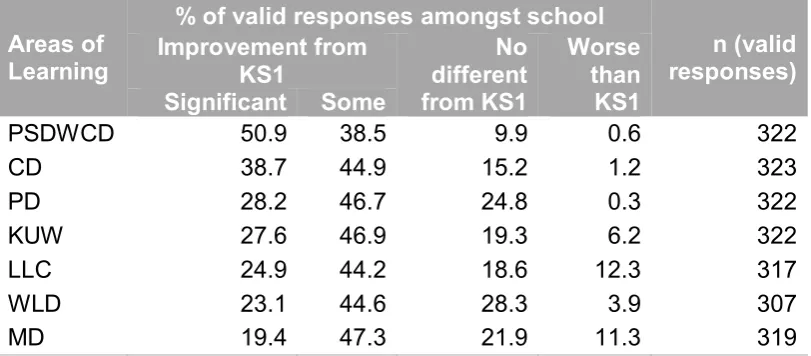
1.2 The Foundation Phase includes seven Areas of Learning: Personal and Social Development, Well-Being and Cultural Diversity (PSDWCD); Language, Literacy and Communication Skills (LLC); Mathematical Development (MD); Welsh Language Development (WLD) (in English-medium schools and settings); Knowledge and Understanding of the World (KUW); Physical Development (PD); and Creative Development (CD).
1.3 The Foundation Phase was implemented in three stages: the Pilot stage of 22 schools and 22 funded non-maintained settings in 2004/05; the Early Start stage of a further 22 schools and 22 funded
non-maintained settings in 2006/07; and all remaining schools and funded non-maintained settings during the Final Roll-out stage in 2009/10.
Foundation Phase. Following a competitive tender process, a multi-disciplinary team of researchers led by Cardiff University and in conjunction with the Wales Institute of Social & Economic Research, Data & Methods (WISERD) were appointed to undertake the evaluation in July 2011.
1.5 The research team includes leading experts in their respective fields and from a number of different universities in Wales and England:
Professor Chris Taylor (Director) (Cardiff University and WISERD)
Professor Trisha Maynard (Co-director) (Canterbury Christ Church University)
Professor Laurence Moore (Cardiff University and DECIPHer)
Professor Sally Power (Cardiff University and WISERD) Professor David Blackaby (Swansea University and WISERD) Professor Ian Plewis (University of Manchester)
Mr Rhys Davies (Cardiff University and WISERD) Dr Sam Waldron (Cardiff University and WISERD)
Dr Mirain Rhys (Cardiff University and WISERD)
1.6 The evaluation employs a stepped wedge design to exploit the sequential roll-out of the Foundation Phase across a number of different schools and settings at different time periods. In particular, much of the evaluation focuses on comparing successive cohorts of children who have been through three sets of school settings at
different stages of the implementation: Pilot Stage settings, Early Start Stage settings and Final Roll-out Stage settings. The evaluation also utilises a range of methods to ensure it captures as many aspects of the implementation, delivery and impacts of the Foundation Phase programme as possible.
This coincided with Stage I of the evaluation design. The report summarised the work that had been completed in that time and highlighted the key findings during that period.
1.8 The second annual report (Taylor et al. 2014) provided a technical update on the design and methodology of the evaluation as it progressed to Stage II of the evaluation design. A more detailed description of the methodologies and data collection tools employed in the evaluation is published as a separate Technical Report (Taylor et al. 2015a). This includes all the research tools used, including the observation schedules and survey instruments.
1.9 In this final report we present the main findings from the evaluation. These findings are structured in the following way:
i. Implementation of the Foundation Phase ii. Foundation Phase practice
iii. The impact of the Foundation Phase iv. Foundation Phase outcomes
1.10 Most of the key findings have been published as separate Government Social Research (GSR) Summaries or GSR Reports, and the order of these largely correspond to the main structure of this report (Table 1). A full list of evaluation reports is outlined in Appendix A.
1.11 Throughout this report we are keen to stress the links between key findings and provide more evidence from the evaluation to support them. The report concludes by considering the future development of the Foundation Phase, including key recommendations and how the Foundation Phase should be evaluated and monitored into the future.
understand the principles and pedagogies of the Foundation Phase rather than as lesson plans to just be replicated.
Table 1. Evaluation Reports and Summaries (published by the Welsh Government*)
Theme Report title Number
Methodology Annual Report 2011/12 43/2012
Update and Technical Report 2012/13 16/2014
Final Technical Report forthcoming
Implementation Policy Logic Model and Programme Theory 37/2012 Key Findings on Management and
Leadership
75/2014
Key Findings on Training, Support and Guidance
54/2014
Key Findings on Staffing 95/2014
Key Findings on Children and Families 94/2014 Practice Key Findings on Pedagogy and
Understanding
43/2014
Key Findings on the Environment (Indoor/Outdoor)
53/2014
Key Findings on Welsh Language 76/2014 Key Findings on Literacy and Numeracy 10/2015
Impact Key Findings on Reported impacts 42/2014
Key Findings on Child involvement and
wellbeing 44/2014
Key Findings on Transitions and assessment 74/2014 Key Findings on Future Development of the
Foundation Phase 09/2015
Outcomes The Outcomes of Foundation Phase Pupils
(Report 1) 43/2013
The Outcomes of Foundation Phase Pupils up to 2011/12 (Report 2)
01/2015
* All currently available from this webpage: http://wales.gov.uk/statistics-and-research/evaluation-foundation-phase/
Aims and Objectives of the Evaluation
1.14 The three-year evaluation (2011-2014) had four main aims:
to evaluate how well the Foundation Phase is being
implemented and highlight ways in which improvement can be made (the process evaluation)
to evaluate what impact the Foundation Phase has had to date (the outcome evaluation)
to assess the value for money of the Foundation Phase (the economic evaluation)
to put in place an evaluation framework for the future tracking of outputs and outcomes of the Foundation Phase (the evaluation framework).
1.15 The Process Evaluation is primarily concerned with evaluating the implementation of the Foundation Phase. The Outcome Evaluation is primarily concerned with the outcomes or impacts of the Foundation Phase on the capabilities of children in the Foundation Phase. The
Economic Evaluation undertakes a costs consequences analysis of the
Foundation Phase. The final key output from the evaluation – the
Evaluation Framework – is a proposal for how the Foundation Phase
could be evaluated in the coming years.
1.16 Alongside published findings from the research the evaluation has also generated a number of other important outputs. These include an evaluation website, various presentations to a wide range of audiences, regular meetings with various stakeholders, and a three-year Economic and Social Research Council (ESRC) funded doctoral research
Design and Methodology
1.17 In developing the methodology and research design for this evaluation, a number of considerations relating to the implementation of the
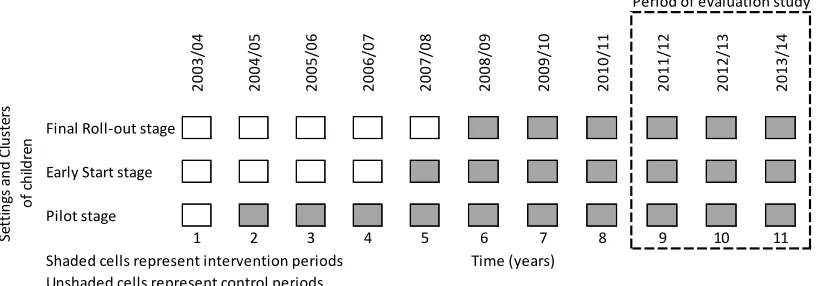
[image:25.595.97.506.347.490.2]Foundation Phase were influential. The principal characteristic from which the evaluation has been designed is the way in which the Foundation Phase was rolled-out sequentially over time. In this evaluation we therefore distinguish between schools/settings at three phases of implementation (Figure 1). Other key characteristics of the Foundation Phase are outlined in Taylor et al. (2013).
Figure 1: Overview of Stepped Wedge Design for Evaluating the Foundation Phase
1.18 The overarching structure of this evaluation follows a stepped wedge design (Brown and Lilford 2006; Hussey and Hughes 2007). This exploits the sequential roll-out of the Foundation Phase across a
number of schools/settings at three different phases of implementation, referred to as Pilot, Early Start, and Final Roll-out settings (see Figure 1). This allows us to compare clusters of children who received the early introduction of the Foundation Phase against control clusters of children who did not follow the Foundation Phase from within the same cohort. This contributes to the outcome evaluation.
2 0 0 3 /0 4 2 0 0 4 /0 5 2 0 0 5 /0 6 2 0 0 6 /0 7 2 0 0 7 /0 8 2 0 0 8 /0 9 2 0 0 9 /1 0 2 0 1 0 /1 1 2 0 1 1 /1 2 2 0 1 2 /1 3 2 0 1 3 /1 4
Final Roll-out stage
Early Start stage
Pilot stage
1 2 3 4 5 6 7 8 9 10 11
Shaded cells represent intervention periods Time (years) Unshaded cells represent control periods
Each cell represents a possible data collection point
Period of evaluation study
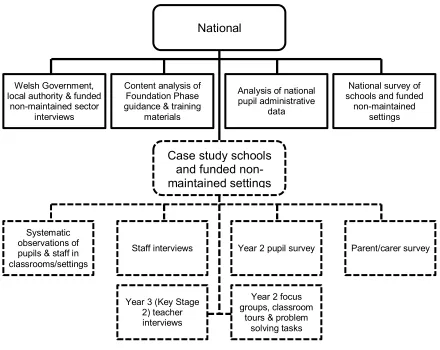
1.19 The evaluation utilises a wide range of data and evidence, both quantitative and qualitative, and is based on primary data collection and using existing data (administrative and other). This has been organised at two geographical scales: at a national level, and at the level of individual case study schools and settings (see Figure 2).
Figure 2: Design and Main Elements of Evaluation
1.20 Data collection has been organised in three stages during the course of the evaluation: Stage I (January 2012-September 2012); Stage II
(September 2012-June 2013); and Stage III (September 2013-April 2014).
National
Case study schools and funded non-maintained settings Welsh Government,
local authority & funded non-maintained sector
interviews
Content analysis of Foundation Phase guidance & training
materials
Analysis of national pupil administrative
data
National survey of schools and funded
non-maintained settings
Year 2 focus groups, classroom
tours & problem solving tasks Systematic
observations of pupils & staff in classrooms/settings
Staff interviews Year 2 pupil survey Parent/carer survey
1.21 Stage I of the evaluation involved:
(a) documentary evidence relating to the design, delivery and
implementation of the Foundation Phase: This encompassed a wide range of materials, such as policy documents, guidance documents, training materials and curriculum materials. A theoretical framework was developed to analyse the extant documentation. This analysis was primarily used to develop the initial Policy Logic Model and Programme Theory for the Foundation Phase evaluation (Maynard et al. 2013); (b) a national survey of head teachers, centre managers and
Foundation Phase lead practitioners covering all Foundation Phase settings: this collected information on, and responses to, staff qualifications, staff-pupil ratios, use of classroom assistants, use of outdoor environments, stumbling blocks to implementation, financial expenditure, obstacles to implementation, attitudes towards the Foundation Phase;
(c) interviews with key Welsh Government and local authority personnel: this invited participants to discuss support for teachers, Welsh-medium provision in the Foundation Phase, monitoring and evaluation strategies, and data sharing; and
(d) an initial analysis of administrative educational data (Pupil Level Annual Schools Census (PLASC) and the National Pupil Database (NPD)): this considered the impact of the introduction of the Foundation Phase on attendance, teacher assessments at the end of Key Stage 1 and the Foundation Phase, and teacher assessments at the end of Key Stage 2.
1.22 Stage II of the evaluation involved the stratified random sampling of 41 case study schools and 10 funded non-maintained settings from across Wales. Between January and June 2013 the evaluation undertook: (a) repeated classroom observations;
(c) a survey of Year 2 pupils in each of the 41 case study schools.
1.23 Stage III of the evaluation involved:
(a) telephone interviews with Year 3 (KS2) teachers in most of the case study schools;
(b) a survey of Foundation Phase parents in the case study schools and settings; and
(c) the evaluation also revisited seven case study schools during 2013-14 (selected on the basis of how much the Foundation Phase appeared to have been implemented in the 41 case study schools in the previous year). During these follow-up visits the evaluation undertook focus groups, classroom tours and other problem-solving tasks with Foundation Phase pupils.
1.24 Table 2 provides a summary of the main data collection techniques employed in the three stages of the evaluation and the associated response sizes for each group.
1.25 The evaluation was designed to ensure we obtained multiple perspectives on the different aspects of the Foundation Phase. Sometimes this means we are asking similar questions to different people or stakeholders. Sometimes it means we are comparing what people (e.g. practitioners) say with what they do or with other ‘objective’ measures of the same outcome. This is commonly referred to as
‘triangulation’ in social science research.
do arise it is important to note that this does not mean that one or the other source of evidence is ‘wrong’. Instead, in trying to understand the contradiction or paradox we are often able to reveal new findings that would have otherwise been unobserved.
Table 2: Summary of Data Collection Techniques and Associated Response Rates
Respondents, Participants & Observations Number*
Stage I
National Survey of Schools 361a
National Survey of Funded Non-Maintained Providers 243b Local Authority Foundation Phase Adviser Interviews 19 Local Authority Training and Support Officer Interviews 18 Non-Maintained Umbrella Organisation Interviews 4
Stage II
Child Observations 3,343
Classrooms Observed 131
Sessions Observed 239
Practitioners Observed 824
Year 2 Pupil Survey 671c
Head Teacher Interviews 41
Teacher Interviews 118
Lead FP Practitioner Interviews 37
Non-Maintained Leader Interviews 10
Non-Maintained Teaching & Learning Assistant Interviews 14 School Teaching & Learning Assistant Interviews 121
Stage III
Parent/carer survey 1,008d
Year 3 teacher interviews 16
Year 1 pupil-led tours (approx. 5 pupils per tour) 6 Year 2 pupil focus groups (approx. 4 pupils per group) 7 * This does not include any observations and participants from the piloting of the data collection tools
Response rates: a 26%; b 30%; c 100%; d approximately 15%.
1.28 Finally the evaluation has adhered to the BERA 2004 Ethical
Guidelines for Educational Research and the BERA Charter for Good Practice in the Employment of Contract Researchers (2001). Prior ethical approval for all components of the evaluation was obtained from the Cardiff University Research Ethics Committee. All researchers have been subject to Criminal Record Bureau (CRB) checks, and all work has been carried out in accordance with the requirements of the Data Protection Act 1998.
1.29 It should be noted that all participating schools and respondents have been assured of confidentiality in the presentation of results. Therefore no staff or schools are named in any evaluation reports and
descriptions of schools or settings have been kept minimal to avoid their identification. In accessing and analysing data from the National Pupil Database, the Welsh Government provided anonymous individual pupil data with only variables that ensure identification of the individual pupil is not possible and cannot be linked to other data that might identify the individual pupils.
Policy Logic Model
1.30 A detailed discussion of the development and underling principles of the Foundation Phase has already been published (Maynard et al. 2013). In particular, this set out the programme theory and an initial policy logic model for the Foundation Phase based on analysis of Welsh Government documents and guidance materials and initial interviews with key stakeholders. In effect this described the
Foundation Phase as it was intended, both in terms of how it should be implemented and what outcomes it was expected to achieve.
Appropriate Practice (DAP). In terms of its approach, the report concluded:
“…the approach underpinning the Foundation Phase is explicitly developmental with a clear focus on the individual child. Development is seen as essentially linear, although not tied to chronological age, and recognises individual variations in rate within and across all areas of development and learning. This approach broadly relates to a
constructivist theory of learning.” (Maynard et al. 2013:v).
1.32 In terms of pedagogy, the report concluded:
“…aspects of suggested pedagogy also reflect constructivist theory although ideas resonating with sociocultural perspectives are
emphasised – for example, a clear role is indicated for the practitioner in supporting children’s learning and development.” (Maynard et al.
2013:v).
1.33 However, the report also noted two key challenges that may face practitioners. The first is to make sense of the terminology used in and across the Foundation Phase documentation. Secondly, how the new pedagogy of the Foundation Phase can best be integrated within a detailed statutory curriculum and a statutory Literacy and Numeracy Framework (Welsh Government 2013a). During the course of the evaluation these two challenges appeared many times.
1.35 In the Inputs of the Foundation Phase we identify the importance of twelve pedagogical elements for teaching and learning practice that we believe embody the principles and guidance of the Foundation Phase. These were identified by the evaluation team based on systematic analysis of Foundation Phase documentation and our previous
expertise in early years education. These pedagogical elements were then ratified by other experts and stakeholders on the evaluation’s Advisory groups. It is the presence of these twelve pedagogical
elements that helps to define Foundation Phase practice (see chapter 3).
1.36 The twelve pedagogical elements to the Foundation Phase, as identified by the evaluation, are:
a. Child choice/participation – children involved in initiating and directing their own learning;
b. Exploration – children learning by exploring and experimenting; c. First-hand – children learning from first-hand and direct
experiences;
d. Practical – children learning from practical hands-on activities; e. Stage not age – children should be appropriately challenged and
supported according to their stage (not age) of learning; f. Balance of continuous/enhanced/focussed activities – for the
majority of learning there is an array of different activities
constantly available that provides continuous learning provision, this is enhanced by the occasional provision of specific activities within continuous provision that provide enhanced learning (i.e. by scaffolding children’s learning), and very occasionally
focussed learning activities are provided to ensure particular learning tasks are achieved;
g. Open questioning – questions to children invite open discursive responses rather than one-word closed responses;
i. Physical activity – children have the opportunity to move around whilst learning;
j. Outdoor learning – learning takes place in indoor and outdoor learning environments;
k. Observation of children – children’s learning should be monitored predominantly through regular observations; l. Learning zones – the learning environment offers a variety of
different learning areas/activities for children to engage with.
1.37 Another addition to the Policy Logic Model under Processes and Activities is the effective delivery of Foundation Phase practice in classrooms. It is quite clear that the success or impact of the
Foundation Phase is heavily dependent on whether the Foundation Phase is being ‘fully’ implemented across schools and classrooms. Hence the delivery and use of the Foundation Phase pedagogy in classrooms is central to its evaluation.
1.38 A further change is in relation to one of the main Outcomes, that is, whether we would expect to see improvements in the educational achievement of children at age seven. Previously, we noted that we would not expect to see any change in the achievement of children at age seven, reflecting a shift in emphasis to more developmentally appropriate practice and outcomes for three to seven year olds. However, the evaluation finds evidence that educational achievement at age seven can be improved in light of the ‘full’ implementation of the Foundation Phase as well as at age twelve (see chapter 4).
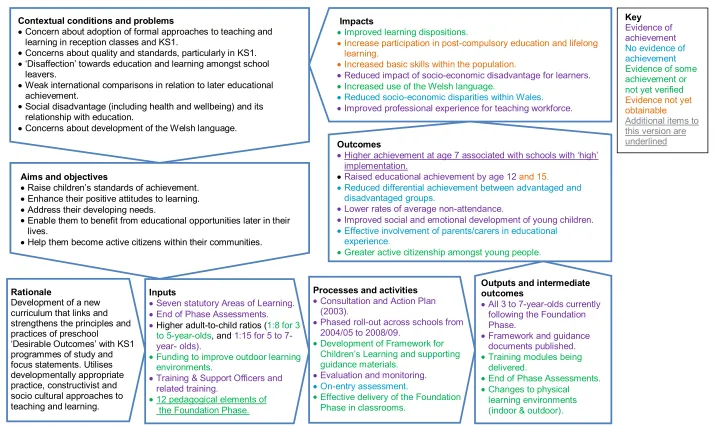
1.39 All the features in this revised Policy Logic Model have also been colour-coded to reflect the relative success to date in meeting the objectives of the Foundation Phase.
1.41 Items coloured purpleindicate aspects of the Foundation Phase where there is evidence from the evaluation to suggest they have been
achieved. Conversely items coloured blue are aspects where there is evidence that they have not been achieved. Items coloured greenare those aspects of the Foundation Phase where there is either partial evidence about whether they have been achieved or not or where there is evidence that they have only been partially achieved.
1.42 New items that have been added to this revised Policy Logic Model are underlined.
1.43 This revised Policy Logic Model therefore provides a summary of the main findings from the evaluation. As can be seen most aspects of the Foundation Phase have been fully or partly met. But it also
Figure 3: Policy Logic Model (Version 2) for Evaluating the Foundation Phase
Rationale
Development of a new curriculum that links and strengthens the principles and practices of preschool
‘Desirable Outcomes’ with KS1 programmes of study and focus statements. Utilises developmentally appropriate practice, constructivist and socio cultural approaches to teaching and learning.
Inputs
Seven statutory Areas of Learning. End of Phase Assessments.
Higher adult-to-child ratios (1:8 for 3 to 5-year-olds, and 1:15 for 5 to 7-year- olds).
Funding to improve outdoor learning environments.
Training & Support Officers and related training.
12 pedagogical elements of the Foundation Phase.
Processes and activities
Consultation and Action Plan (2003).
Phased roll-out across schools from 2004/05 to 2008/09.
Development of Framework for Children’s Learning and supporting guidance materials.
Evaluation and monitoring. On-entry assessment.
Effective delivery of the Foundation Phase in classrooms.
Aims and objectives
Raise children’s standards of achievement. Enhance their positive attitudes to learning. Address their developing needs.
Enable them to benefit from educational opportunities later in their lives.
Help them become active citizens within their communities.
Contextual conditions and problems
Concern about adoption of formal approaches to teaching and learning in reception classes and KS1.
Concerns about quality and standards, particularly in KS1. ‘Disaffection’ towards education and learning amongst school
leavers.
Weak international comparisons in relation to later educational achievement.
Social disadvantage (including health and wellbeing) and its relationship with education.
Concerns about development of the Welsh language.
Outputs and intermediate outcomes
All 3 to 7-year-olds currently following the Foundation Phase.
Framework and guidance documents published.
Training modules being delivered.
End of Phase Assessments. Changes to physical
learning environments (indoor & outdoor).
Impacts
Improved learning dispositions.
Increase participation in post-compulsory education and lifelong learning.
Increased basic skills within the population.
Reduced impact of socio-economic disadvantage for learners.
Increased use of the Welsh language.
Reduced socio-economic disparities within Wales. Improved professional experience for teaching workforce.
Outcomes
Higher achievement at age 7 associated with schools with ‘high’ implementation.
Raised educational achievement by age 12 and 15.
Reduced differential achievement between advantaged and disadvantaged groups.
Lower rates of average non-attendance.
Improved social and emotional development of young children. Effective involvement of parents/carers in educational
experience.
Greater active citizenship amongst young people.
Key
Evidence of achievement No evidence of achievement
Evidence of some achievement or not yet verified Evidence not yet obtainable
2
Implementation of the Foundation Phase
2.1 This chapter focuses on the implementation of the Foundation Phase and considers the key findings relating to the introduction of the
Foundation Phase, including the main inputs, processes and activities associated with its introduction. This includes how the Foundation Phase was initially received by local authorities, practitioners and parents. It then goes on to outline the main changes to the
infrastructure of schools, such as staffing and the environment.
2.2 The chapter then presents the main findings in relation to the introduction of improved adult:child ratios, a key input of the
Foundation Phase, before presenting the main findings in relation to the implementation of training, support and guidance. The chapter concludes with the identification of the main issues with regards to the implementation of the Foundation Phase.
How the Foundation Phase was Received
2.3 The overwhelming majority of practitioners and key stakeholders initially welcomed the introduction of the Foundation Phase, often with a sense of ‘excitement’ but also ‘relief’. From the national survey 54% of head teachers, 59% of lead practitioners in schools and 42% of lead practitioners in funded non-maintained settings said they were ‘looking forward to it’. Only 2% of staff surveyed said they were not looking forward to it. Furthermore, 97% of head teachers thought that their Foundation Phase practitioners welcomed its introduction.
2.5 Nevertheless, it is important to note that the evaluation often finds that the views of Foundation Phase teachers differ significantly from their head teachers, reflecting differences of opinion in terms of educational priorities, pedagogical understanding and resourcing.
2.6 It is also the case that head teachers and practitioners in the Pilot schools were significantly more enthusiastic about its introduction than their peers in other schools. Fifty per cent of Pilot school head teachers surveyed said they were ‘really looking forward to it’ compared to 26% of head teachers in the Final Roll-out schools.
2.7 There are also differences in how the Foundation Phase was initially received in Welsh-medium schools, with 49% of these head teachers reporting reservations, compared to 39% of head teachers in English-medium schools. As the report will discuss later this reflects a general concern about Welsh language immersion within the context of a more child-centred and child-initiated pedagogical approach to learning.
2.8 During interviews Local Authority Early Years Advisers said they were generally very happy with how the Foundation Phase has been
implemented in their areas, although they believe that the extent to which the Foundation Phase is being implemented between schools does vary quite significantly. They often associated this variation in implementation to the initial views and understanding of the
Foundation Phase amongst practitioners in those schools and a fear amongst head teachers in particular that its introduction will lead to a decline in educational achievement in literacy and mathematics, at least for seven year olds,
Government. And I think what they were seeing or what they were interpreting was that children were playing all day and there was a lack of understanding and a distinction between play, pure play, and active learning.” (Local Authority Early Years Adviser).
2.9 According to Local Authority Early Years Advisers, any concern amongst practitioners that the Foundation Phase could lead to a decline in the educational achievement of seven-year-olds,
heightened following the introduction of the Literacy and Numeracy Framework (LNF) as a statutory curriculum requirement in September 2013 and, in particular, the introduction of statutory reading and numeracy tests in September 2014 for seven-year-olds in the Foundation Phase5.
2.10 However, when head teachers were asked about obstacles to the implementation of the Foundation Phase in their schools more than 60% of them said that funding and existing school infrastructure have been the two main difficulties to its implementation.
2.11 The overwhelming majority of head teachers (89%) said they are satisfied with the Foundation Phase; with 54% saying they were very satisfied. Although, as noted previously, 21% of head teachers said that some parents/carers expressed some resistance to the
introduction of the Foundation Phase. This is likely to be a small number, however, since only 3% of parents/carers the evaluation surveyed said that they were dissatisfied with the Foundation Phase.
2.12 Parents/carers report considerable support for their children’s
education to be ‘varied and interesting’, ‘explorative and investigative’ and ‘covering a broad range of skills’. More than 80% of
parents/carers said they strongly supported these aspects. Parents/carers were slightly less supportive of, although still significantly positive towards, their children being able to ‘learn at
their own pace’ or to have ‘choice in their learning’ (approximately 30% of parents/carers did not support these features).
2.13 Despite general support for the Foundation Phase and strong support for many of its key features and principles the evaluation finds that parents have not often been involved in its implementation or
development. Only 20% of school head teachers and 18% of funded non-maintained lead practitioners indicated that parents/carers had a major role in the implementation of the Foundation Phase in their school or setting. Only in a minority of case study schools/settings does the evaluation find parents involved in activity planning sessions (see chapter 3).
2.14 Furthermore, interviews with Foundation Phase lead practitioners and head teachers indicate that, on the whole, parent-school relationships have not changed as a result of the introduction of the Foundation Phase.
Staffing and the Foundation Phase
2.15 One of the key elements of the Foundation Phase was the
introduction of improved adult:child ratios for three to seven-year-olds – 1:8 for three to five-year-olds (i.e. funded non-maintained settings and Nursery and Reception classes/groups) and 1:15 for five to seven-year-olds (i.e. Year 1 and Year 2).
2.17 Despite concerns about the qualification levels of additional
practitioners in early years education (e.g. see the Nutbrown Review 2012) the evaluation found that in the case study schools 81% of additional practitioners had an NVQ Level 3 or above qualification. By comparison this considerably exceeds the target of 70% of additional practitioners having Level 3 or above qualifications in the Early Years Foundation Stage in England by September 2015.
2.18 The qualification levels of practitioners in the case study funded non-maintained settings was generally lower than that of additional practitioners in schools – where 68% of additional practitioners there have at least an NVQ Level 3 qualification (although this is based on a very small sample)6.
2.19 In 2013/14 the Welsh Government allocated just over £92million for the employment of additional practitioners to help schools meet the recommended adult:child ratios. This revenue is allocated to local authorities based on their pupil population who then distribute it to schools using their own funding formulae.
2.20 Of those surveyed, 72% of head teachers and 79% of funded non-maintained setting lead practitioners said they did not have any difficulties in meeting the recommended adult:child ratios. Nine out of every ten head teachers who report that they had experienced
obstacles in meeting the recommended adult:child ratios also cite funding issues as a major obstacle to the successful implementation of the Foundation Phase.
2.21 In interviews with case study school head teachers it is apparent that a majority do not think they have adequate additional funding from their Local authority to meet the recommended ratios. These head
6 Despite the relatively large proportion of Foundation Phase practitioners with high levels of qualifications it should be noted that there is actually very little evidence that higher levels of qualifications amongst additional practitioners (Sutton Trust 2011) or pre-school
teachers say they have to draw upon the rest of their school budget to fund the shortfall in staffing costs.
2.22 For a Reception class of thirty children this would typically mean there should be one qualified teacher and at least two additional practitioners. For a Year 2 class of thirty children this would typically mean there should be one qualified teacher and one additional practitioner.
2.23 Since the number of children in each classroom varies quite
significantly and because this number is not always divisible by the ratios to a whole number (i.e. a single full-time adult) there is inevitably quite a large variation in the actual adult:child ratios that children across Wales experience. Furthermore, of all 144,839 pupils in the Foundation Phase in Wales (2011/12) 38% were in mixed age classrooms of pupils of any age between three and seven and 11% were in mixed age classrooms with pupils also in Key Stage 2.
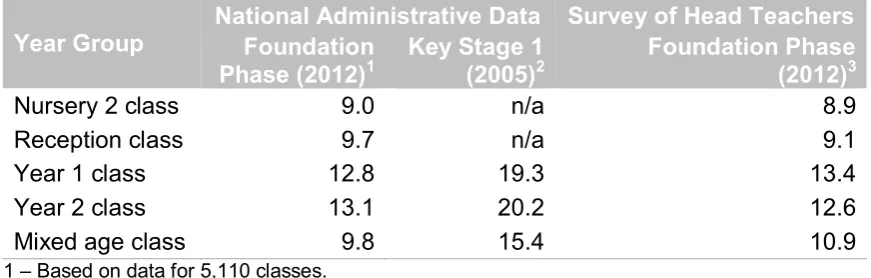
2.24 According to national administrative data the average adult:child ratios in Foundation Phase schools varies from 9.0 for Nursery 2 classes to 13.1 for Year 2 classes (Table 3). For the older age groups, where there is comparable data, this is a considerable improvement in the average adult:child ratios observed in Key Stage 1 (2005).
2.25 The evaluation also asked head teachers to provide more detailed information about the adult and pupil composition for each of their Foundation Phase classrooms. The average adult:child ratios calculated by year group using this source of information produces similar results (Table 3).
being met, whereas the adult:child ratio for five to seven-year-olds (i.e. Year 1 and Year 2) is, on average, being exceeded.
Table 3. Average Adult:Child Ratios in Schools for the Foundation Phase (2012) and in Key Stage 1 (2005), by Year Group
Year Group National Administrative Data Survey of Head Teachers Foundation Phase (2012)1
Key Stage 1 (2005)2
Foundation Phase (2012)3
Nursery 2 class 9.0 n/a 8.9
Reception class 9.7 n/a 9.1
Year 1 class 12.8 19.3 13.4
Year 2 class 13.1 20.2 12.6
Mixed age class 9.8 15.4 10.9
1 – Based on data for 5,110 classes. 2 – Based on data for 2,079 classes. 3 – Based on data for 1,045 classes.
2.27 Using both sources of information it is also possible to estimate the percentage of schools that are meeting recommended ratios (Table 4). This shows that between 43% and 45% of schools are meeting the recommended ratios of 1:8 in their Reception classes and that between 87% and 90% of schools are meeting their recommended ratios of 1:15 for Year 2 classes.
Table 4. Percentage of Schools Estimated to be Meeting Recommended Ratios (2012)
Year Group Administrative DataNational Survey of Head Teachers
Nursery classes (1:8 ratio) 48.7 64.0
Reception classes (1:8 ratio) 45.4 43.0
Year 1 classes (1:15 ratio) 90.5 92.5
Year 2 classes (1:15 ratio) 87.2 89.6
[image:42.595.112.514.568.667.2]schools frequently grouped adults and pupils together quite creatively, both within classes and between classes (and year groups) (see Box 1 for an example of this). This often means that at any point in time the recommended ratio for pupils could sometimes be exceeded and sometimes falls below the recommended levels.
Box 1. Example of Best Practice within the Foundation Phase: Creative Use of Adult:Child Ratios
2.29 Irrespective of whether or not individual schools are able to fully meet the recommended ratios, the presence of additional adults was very noticeable in schools and classrooms. Indeed, the vast majority of head teachers and teachers interviewed said that the improved ratios School #24
Additional practitioners were often seen as a vital resource in the successful implementation of the Foundation Phase, especially when a mixture of continuous, enhanced and focussed activities was in place.
Generally, additional practitioners teamed up with the classroom teacher to implement focussed activities. These activities were generally with a small group of children, which would be rotated throughout the session along with a variety of continuous and enhanced activities in different areas of the classroom. Often, additional practitioners and/or teachers could take their small group to another space within the school to implement the focussed task; the hall and other multi-purpose learning environments were used as well as many outdoor spaces.
have been essential to implementing the Foundation Phase curriculum and pedagogy.
2.30 As discussed in the next chapter this is also demonstrated in our classroom observations, both in terms of the particular roles and contributions that additional practitioners make, but also in ensuring that children can participate in small-group and experiential forms of learning with the support and guidance of an adult.
2.31 Other benefits of the improved adult:child ratios were also reported. These included giving practitioners the opportunity to participate in training or to undertake their own professional development without requiring additional cover within the classroom7. The impact of general staff absences also mitigated by the presence of more practitioners in the Foundation Phase.
2.32 In just over half of schools surveyed (54%) head teachers also reported having made significant structural changes to the
organisation of their school management and senior staff. The most frequently cited example of this was the appointment of a Foundation Phase lead practitioner who had often also become a member of the school’s senior management team or a school’s deputy head teacher.
2.33 Relatedly, a small number of head teachers say they had appointed a Higher Level Teaching Assistant (HLTA) to the Foundation Phase to provide greater practitioner experience than many of the incumbent additional practitioners had.
2.34 It is notable that head teachers and other senior staff report that they were not given any specific guidance as school leaders as to how to implement the Foundation Phase in their school. In the case study schools, decisions as to how far to restructure the management
teams or reallocate experienced school staff to the early years is closely associated to their personal enthusiasm and interest in the Foundation Phase and may have led to some of the inconsistencies in implementation identified elsewhere in the evaluation.
Training and Support
2.35 Another key element to the implementation of the Foundation Phase is in training and supporting Foundation Phase practitioners, primarily aimed at qualified teachers, additional practitioners and practitioners in funded non-maintained settings working in the Foundation Phase.
2.36 The range of training and support provided by the Welsh Government is extensive. It primarily includes the design and production of eight training modules (see Appendix B), guidance materials on each Area of Learning (see Appendix B), additional guidance materials (such as Learning Outdoors), the employment of a full-time Training and Support Officer (TSO) in each local authority and, in funded non-maintained settings, access to 0.1FTE Link Teacher to support
children and practitioners in those settings. During the initial roll-out of the Foundation Phase the Welsh Government also organised annual conferences across Wales8.
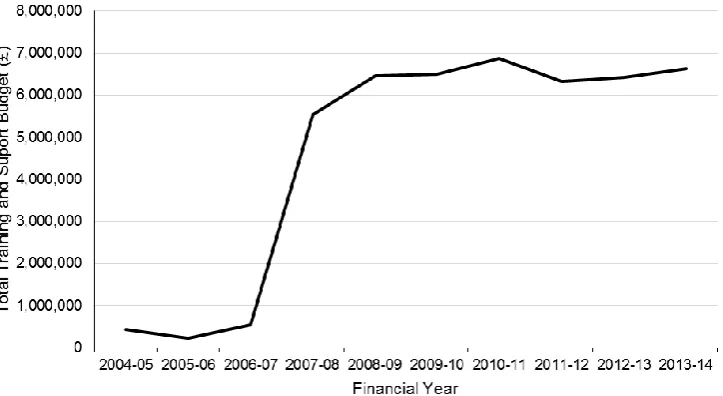
2.37 Between 2004-05 and 2013-14 the Welsh Government spent just under £46million on training and support in the Foundation Phase. This increased substantially in 2007-08, coinciding with the final roll-out in the following year, and has remained relatively constant since (Figure 4).
Figure 4. Foundation Phase Training and Support Budget, 2004-05 to 2013-14
Source of data: Welsh Government
2.38 Figure 5 distinguishes between the costs of the Training and Support Officers (TSOs) and the 0.1FTE Link Teachers from the rest of the training budget. This shows that although the overall budget has remained relatively constant the increasing costs of the TSOs and to a lesser extent the Link Teachers has meant that the remaining budget for training has decreased by 14% over this time period.
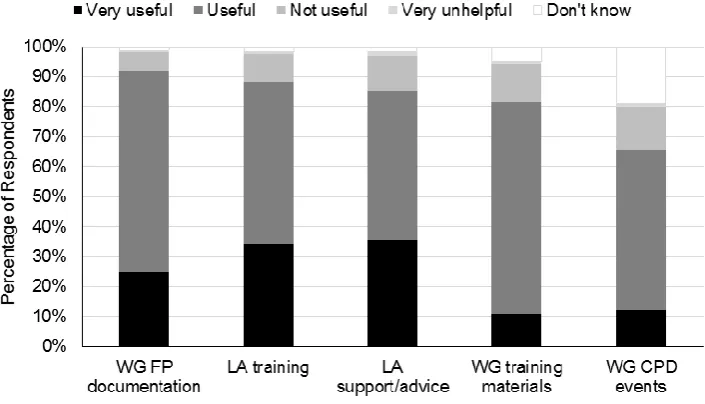
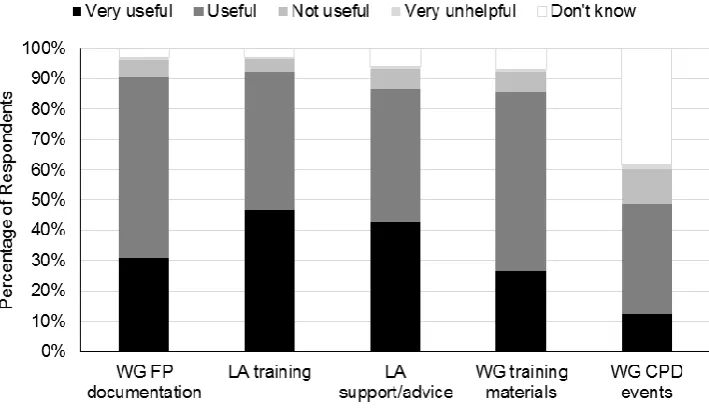
2.39 Overall, Foundation Phase lead practitioners were very satisfied with the training and support provided to them (Figure 6 and Figure 7). Approximately 90% of lead practitioners in schools and funded non-maintained settings thought that the Welsh Government
documentation and Local Authority training was ‘useful’ or ‘very useful’.
Figure 5. Distribution of Training and Support Budget, 2008-09 to 2013-14
Source of data: Welsh Government
Figure 6. Reported Satisfaction of Training and Support by Foundation Phase Lead Practitioners in Schools*
[image:47.595.120.473.482.684.2]Figure 7. Reported Satisfaction of Training and Support by Foundation Phase Lead Practitioners in Funded Non-Maintained Settings*
* Valid number of responses ranged from 219 to 237.
2.41 Relatively fewer respondents had a view about the Welsh
Government continued professional development conferences, but out of those who did the majority thought they had been useful.
2.42 The eight Foundation Phase training modules were produced by the Welsh Government. But it is Local authorities, their Early Years Advisers and TSOs who are largely responsible for their delivery. Advisers and TSOs frequently said they tailor the training modules to (a) make the materials more accessible and (b) to meet the particular needs of their schools and funded non-maintained settings,
practitioners and participants.