This is the Accepted Version of a paper published in the
Journal of Fish Biology:
Carter, A.B., Russ, G.R., Tobin, A.J., Williams, A.J.,
Davies, C.R., and Mapstone, B.D. (2014)
Spatial variation
in the effects of size and age on reproductive dynamics of
common coral trout Plectropomus leopardus.
Journal of
Fish Biology, 84 (4). pp. 1074-1098.
http://dx.doi.org/10.1111/jfb.12346
REPRODUCTIVE DYNAMICS OF P. LEOPARDUS
1
Spatial variation in the effects of size and age on reproductive dynamics of common
1
coral trout Plectropomus leopardus.
2 3 4
A. B. CARTER*†‡, G. R. RUSS†, A. J. TOBIN*, A. J. WILLIAMS*§, C. R. DAVIES# 5
AND B. D. MAPSTONE# 6
7 8
*Centre for Sustainable Tropical Fisheries and Aquaculture and School of Earth and
9
Environmental Sciences, James Cook University, Townsville, QLD 4811, Australia,
10
†School of Marine and Tropical Biology, James Cook University andARC Centre of
11
Excellence for Coral Reef Studies, Townsville, QLD 4811, Australia, §Oceanic
12
Fisheries Programme, Secretariat of the Pacific Community, BP D5, 98848 Noumea,
13
New Caledonia, and #CSIRO Marine and Atmospheric Research, PO Box 1538,
14
Hobart, TAS 7001, Australia.
15 16 17
‡ Author to whom correspondence should be addressed. Current address: Centre for Tropical 18
Water and Aquatic Research, James Cook University, Cairns, QLD 4870, Australia. Tel.: +61 19
7 4232 2015; email: [email protected] 20
2
Abstract
23
24
25
The effects of size and age on reproductive dynamics of common coral trout Plectropomus
26
leopardus populations were compared between coral reefs open or closed (no-take marine
27
reserves) to fishing and among four geographic regions of the Great Barrier Reef (GBR), 28
Australia. The specific reproductive metrics investigated were the sex ratio, the proportion of 29
vitellogenic females, and the spawning fraction of local populations. Sex ratios became 30
increasingly male biased with length and age, as expected for a protogyne, but were more 31
male biased in southern regions of the GBR (Mackay and Storm Cay) than in northern 32
regions (Lizard Island and Townsville) across all lengths and ages. The proportion of 33
vitellogenic females also increased with length and age. Female P. leopardus were capable of 34
daily spawning during the spawning season, but on average spawned every 4.3 days. Mature 35
females spawned most frequently on Townsville reserve reefs (every 2.3 days) and Lizard 36
Island fished reefs (every 3.2 days). Females on Mackay reefs open to fishing showed no 37
evidence of spawning over four years of sampling, while females on reserve reefs spawned 38
only once every 2-3 months. No effect of length on spawning frequency was detected. 39
Spawning frequency increased with age on Lizard Island fished reefs, declined with age on 40
Storm Cay fished reefs, and declined with age on reserve reefs in all regions. We hypothesize 41
that the variation in P. leopardus’ sex ratios and spawning frequency among GBR regions is 42
primarily driven by water temperature, while no-take management zones influence spawning 43
frequency depending on which region the reserve is placed. Male bias and lack of spawning 44
activity on southern GBR reefs, where densities of adult P. leopardus are highest, suggests 45
3
reproductive traits suggests a regional approach to management of P. leopardus is 47
appropriate and highlights the need for considering spatial variation in reproduction where 48
reserves are used as fishery or conservation management tools. 49
50
51
Key words: Batch spawn; coral reef fish; fishing; Great Barrier Reef; marine reserve; 52
reproduction. 53
4
INTRODUCTION
55 56 57
Sustainably managed fisheries require the maintenance of sufficient reproductive adults and 58
egg production (Sadovy, 1996). The importance of incorporating assessment of reproductive 59
biology into the management of fish stocks is now recognized widely (Jakobsen et al., 2009; 60
Murua et al., 2010; Bernal et al., 2012), requiring increased study of the reproductive biology 61
of fish (Lowerre-Barbieri et al., 2011). A proliferation of studies has emerged in the past 62
decade focussed on reproductive biology topics such as maturity schedules, sex ratios, 63
fecundity, and spawning frequency to reveal species-specific variation driven, for example, 64
by female size and age, variation in climate and region (Adams et al., 2000; Portner et al., 65
2001; Fennessy and Sadovy, 2002; Williams et al., 2006), disturbance from fishing (Muñoz 66
et al., 2010), and food availability and body condition (Ganias, 2009; Somarakis et al., 2012).
67
Understanding the factors that influence the reproductive output of a population and their 68
interaction with fishing and management measures is important for the design of fisheries 69
management tools, such as seasonal fishing closures, no-take marine reserves and minimum 70
sizes of retention. 71
72 73
Size and age influence reproductive traits of fishes in a fairly predictable way. Sex 74
ratios of hermaphroditic fishes vary predictably with size and age as individuals change from 75
one sex to the other (Williams et al., 2006). Maturity schedules also vary with size and age, 76
with the proportion of females that are reproductively active often increasing with female size 77
and age as energy balances shift from somatic growth to reproduction (Fennessy and Sadovy, 78
5
than smaller, younger females (Claramunt et al., 2007; Lowerre-Barbieri et al., 2009). Less 80
predictable is the way reproductive traits of individual species vary across geographic scales 81
and respond to fishing pressure. Sex ratios and maturity schedules have been demonstrated to 82
vary spatially (Adams et al., 2000; Williams et al., 2006) and will determine the number of 83
mature females and spawning frequency at the local or regional scale. Spawning frequency of 84
tropical fishes has become increasingly well quantified in recent years (Dadzie and Abou-85
Seedo, 2008; Maki Jenkins and McBride, 2009; van der Velde et al., 2010; Ganias, 2012) but 86
documented cases of spatial variation in spawning frequency for tropical species remains 87
limited (although see Brown-Peterson et al., 2009). Spatial variation in spawning frequency 88
of temperate marine fishes has received particular attention and has been attributed to 89
variations in water temperature and fish health (Korta et al., 2010; Somarakis et al., 2012). 90
91 92
Plectropomus leopardus (Lacepède 1802) is the most commercially important finfish
93
on the Great Barrier Reef (GBR), Australia and has been heavily exploited across its Indo-94
Pacific range (Cornish and Kiwi, 2004). Latitudinal variation in a number of life history and 95
population traits is well documented for P. leopardus. The southern GBR is characterized by 96
male-biased sex ratios (Adams et al., 2000), smaller mean length and age at sex change 97
(Davies et al., 2006), smaller mean size (Mapstone et al., 2004), significantly different otolith 98
chemistry (Bergenius et al., 2005), and higher densities (Mapstone et al., 2004) than in the 99
northern GBR. Plectropomus leopardus are protogynous hermaphrodites (Samoilys, 2000) 100
but can exhibit diandric male development (Adams, 2002), which is particularly prevalent in 101
the southern GBR where the largest proportions of primary males are found (Adams et al., 102
2000). Comparisons between fished reefs and reefs closed to fishing (no-take reserves; 103
6
sexes combined and for females only), change sex when older and larger, and have higher 105
densities on reefs protected from fishing (Ferreira and Russ, 1995; Adams et al., 2000; 106
Adams, 2002; Mapstone et al., 2004; Begg et al., 2005). 107
108 109
The maintenance of larger and older female P. leopardus within reserves may result 110
in enhanced reproductive output, assuming there is a positive effect of female size and age on 111
spawning frequency. Two previous studies estimated that P. leopardus spawn every 2-3 days 112
during the Austral Spring spawning season (Brown et al., 1994; Samoilys, 2000) and 113
determined that there was no relationship between maternal size and spawning frequency 114
(Brown et al., 1994). These estimates were based on fish collected from one small area (two 115
adjacent reefs near Cairns, ~17°S), however, and did not examine the relationship between 116
age and spawning frequency, nor whether no-take reserves affect spawning frequency. 117
Evaluation of the effects of regional variation and reserves on the reproductive dynamics of 118
P. leopardus is particularly important because P. leopardus is currently managed as a single
119
homogenous stock on the GBR, with the implicit assumption that reproductive productivity 120
does not vary spatially throughout the GBR or that the stock is well-mixed during 121
reproduction and does not result in regional variation in productivity. 122
123 124
The objective of this study was to examine the reproductive dynamics of P. leopardus
125
to determine whether sex ratio, maturity schedules, and spawning frequency varied by female 126
size and age, region, and between reefs open and closed to fishing on the GBR. 127
7
MATERIALS AND METHODS
130 131 132
FIELD COLLECTIONS 133
134 135
Plectropomus leopardus were collected over a four year period during structured
136
commercial line fishing surveys from 1998 to 2001 as part of the Effects of Line Fishing 137
(ELF) Experiment (see Mapstone et al., 2004). Fish were caught during the first quarter – full 138
moon or full moon – third quarter moon phases (Geoscience Australia, 2011) of the Austral 139
Spring spawning season (September – December) in each of the four years. Plectropomus
140
leopardus spawn throughout the complete lunar cycle, although spawning activity peaks
141
during new moon periods when spawning aggregations averaging 44 individuals per 1000m2 142
form at the reef edge (Samoilys and Squire, 1994; Samoilys, 1997; 2000). Sampling during 143
the new moon was avoided in the ELF Experiment to reduce potential bias in abundance 144
indices if large spawning aggregations were encountered. We presume that the effects on 145
reproductive metrics we examined were not influenced significantly by lunar phase, within 146
the spawning season, and that any relative differences among regions or zones were 147
consistent regardless of whether sampling occurred during or outside new moon periods. 148
149 150
Four regions were sampled along a latitudinal gradient: Lizard Island (~14.5º S) in the 151
northern GBR; Townsville (~18.5º S) in the central GBR; and Mackay (~20.5º S) and Storm 152
Cay (~21.5º S) in the southern GBR (Fig. 1). Four reefs were sampled within each region: 153
8
fishing for 12-15 years prior to sampling and remained closed to fishing for the duration of 155
the years sampled; and two reefs that were zoned General Use historically and open to 156
commercial and recreational fishing (“fished” reefs), although one of these reefs was closed 157
to fishing for the four years of sampling and the other was closed to fishing from March 2000 158
onwards (Fig. 1). These historically fished reefs were considered to be fished reefs for the 159
purposes of the analyses because the period of closure to fishing was very short (<2 – 4 160
years) relative to the longevity of P. leopardus (up to 16 years) and it was assumed that any 161
response of spawning frequency to changes in fishing intensity or population density would 162
be relatively slow. 163
164 165
Fork length (LF) of each fish was measured (to nearest mm) at the time of capture, 166
which also was recorded, and whole gonads were removed on the day of capture and 167
preserved in 10% phosphate buffered formalin until histological sections were made. Otoliths 168
were removed and age estimated by counting annuli in sectioned otoliths using the method 169
described by Ferreira and Russ (1994). 170
171 172
HISTOLOGICAL PROCESSING 173
174 175
Sex was determined histologically from the preserved gonads of 5901 P. leopardus. 176
Gonad sections were embedded in paraffin wax and sectioned at 5 μm then stained using 177
Myer’s haematoxylin and Young’s eosin-erythrosin (Bean et al., 2003). Histological 178
assessment was conducted on the medial section of one gonad lobe because in P. leopardus
9
oocyte development does not differ between right and left lobes (Samoilys and Roelofs, 180
2000) and is uniform along the length of the lobe (Adams et al., 2000). Females, males, 181
transitionals (proliferating testicular tissue in a female ovary) and bisexuals (male and female 182
germinal tissue present with no evidence of either tissue degenerating) were categorized 183
according to the criteria in Samoilys and Roelofs (2000), Adams (2002), and Brown-Peterson 184
et al., (2011). Transitionals made up a very small portion of the catch (<0.5%), probably
185
because sex change commonly occurs after the Spring spawning season. Transitionals ranged 186
from 1-7 years old, with the largest proportion of transitionals aged 3 – 4. This was consistent 187
among all regions. Sex ratios (PM, proportion male) were calculated from the number of 188
mature males divided by the sum of females and males (n = 5288). Females were further 189
classified histologically into reproductive phases (immature, developing, spawning capable, 190
regressing, regenerating) according to Brown-Peterson et al., (2011). The proportion of 191
vitellogenic, reproductively active females (developing + spawning capable + regressing) 192
(PV) relative to the total mature female population (developing + spawning capable + 193
regressing + regenerating) (n = 2162) was then calculated in each region and management 194
zone (fished or no-take reserve) combination. 195
196 197
Spawning frequency was determined histologically using the postovulatory follicle 198
(POF) method (Hunter and Goldberg, 1980; Hunter and Macewicz, 1985). Postovulatory 199
follicles encase developing eggs and remain in the ovary as ruptured follicles after hydrated 200
eggs are ovulated (Fig. 2). Postovulatory follicles degenerate quickly, lasting 24 hours in P.
201
leopardus (Samoilys, 2000), a common timeframe for POFs in the tropics (West, 1990). The
202
predictability of POF absorption means that they can be used reliably to back-calculate time 203
10
of Samoilys and Roelofs (2000). Presence or absence of POFs, and the stage of POF (early 205
“0-Day”, or late “1-Day”), was determined from 1676 randomly subsampled mature 206
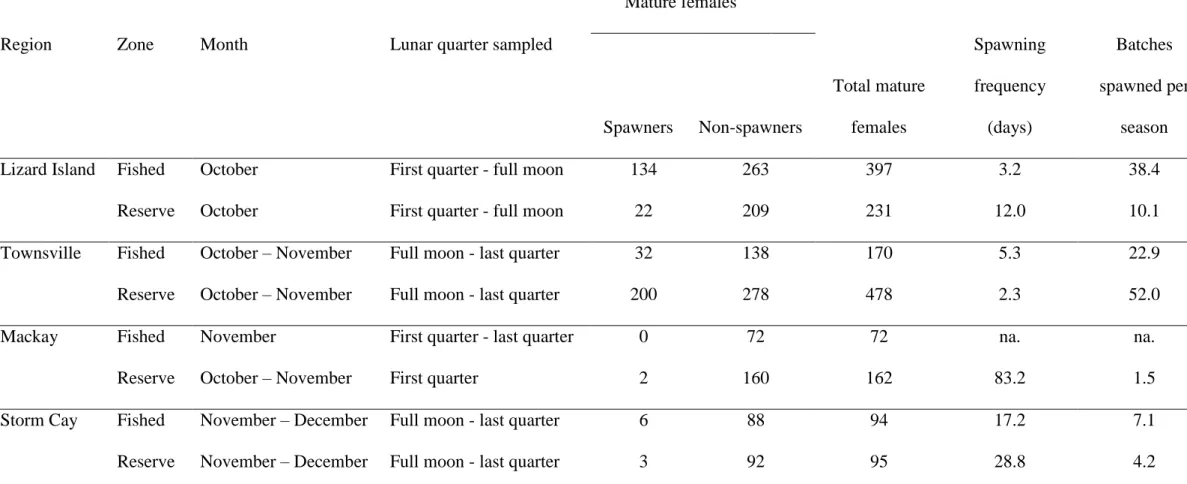
(vitellogenic) ovaries (Table I). The spawning fraction (PS, proportion of mature females that 207
were spawning per day, hereafter proportion of spawners) was calculated as the total number 208
of mature females with 1-Day POFs present divided by the total number of mature females 209
(Picquelle and Stauffer, 1985). These calculations only use the incidence of females with 1-210
Day POFs. Using the incidence of females with hydrated oocytes or 0-Day POFs is 211
inappropriate because the presence of these structures within the ovary is dependent on time 212
of sampling (Hunter and Macewicz, 1980) and because females who are actively spawning 213
may be more susceptible to fishing (Picquelle and Stauffer, 1985). In this study, 1-Day POFs 214
were found throughout the day (0730 – 1800). Plectropomus leopardus spawn at dusk 215
(Samoilys 2000) and sampling occurred during daylight hours, so the presence of 1-Day 216
POFs in the ovary indicated spawning occurred approximately 12 to 24 hours prior to 217
sampling. Spawning frequency for the season was calculated as the days elapsed between 218
spawns, or 1/ PS (Claramunt et al., 2007). The number of batches spawned per season by 219
each mature female was calculated by dividing the length of the Austral Spring spawning 220
season for P. leopardus, commonly reported as lasting four months (122 day) on the GBR 221
(Goeden, 1978; Brown et al., 1994; Ferreira, 1995; Samoilys, 2000; Davies et al., 2006) by 222
spawning frequency (days). 223
224 225
STATISTICAL ANALYSES 226
11
Generalized linear mixed-effects models (GLMM) were used to examine the fixed 229
effects of fork length (LF), age (A), region (R) and management zone (Z), and the random 230
effect of reef, on sex ratio (PM), proportion of vitellogenic females (PV), and spawning 231
fraction (PS). Each factor was modeled as an additive term and as an interaction with other 232
factors. Three-way interactions between R, Z, and LF or A were considered in the analyses. 233
The factor reef was modeled as a random effect term in all models to eliminate potential bias 234
or psuedoreplication resulting from the non-independence of samples collected at the same 235
time from a single location. The response variables sex ratio, proportion of vitellogenic 236
females and spawning fraction were all modeled with a binomial error distribution and logit 237
link function. Akaike’s Information Criterion (AICc) for small sample sizes (Burnham and 238
Anderson, 2002) was used to determine the best set of explanatory factors for adequately 239
predicting each response variable, and to compare functional forms for the relationship 240
between factors and response variables. The best-fit model was considered to be the simplest 241
model within two of the lowest AICc (Burnham and Anderson 2002). The best-fit model was 242
used as a basis to predict the expected values of response variables across the observed 243
ranges in LF and age. All GLMMs were done in R using the lme4 package (Bates et al., 244
2012). 245
246 247
RESULTS
248 249 250
SEX RATIO 251
12
Sex ratios became increasingly male-biased with length and age, as expected for a 254
protogynous hermaphrodite. Variation in sex ratio of P. leopardus was best described by a 255
model that included an interaction between region, zone and LF, and a model that included an 256
interaction between region, zone and age (Table II). Populations at Mackay and Storm Cay 257
had higher proportions of males across all lengths and ages compared with Townsville and 258
Lizard Island in fished and reserve reefs (Fig. 3). Fifty percent of fish were male by the time 259
fish reached 455 mm LF and 464 mm LF at Townsville and Lizard Island reserve reefs, 260
respectively, while over 80% of 453 mm LF and 394 mm LF fish were male at Mackay and 261
Storm Cay reserve reefs. The size at which 50% of fish were male was much smaller at 262
Mackay (359 mm LF) and Storm Cay (303 mm LF) reserve reefs than in other regions (Fig. 3). 263
The size at which 50% of fish were male was consistently smaller on fished reefs than reserve 264
reefs, but the difference varied among regions. Fifty percent of the population were male at 265
455 mm LF on Townsville reserve reefs and 406 mm LF on Townsville fished reefs whilst 266
50% of the population at Storm Cay were male at 303 mm LF on reserve reefs and 300 mm LF 267
on fished reefs (Fig. 3). 268
269 270
Male bias was evident in the youngest of age classes (1 and 2 years) on Mackay and 271
Storm Cay fished and reserve reefs compared with Lizard Island and Townsville. Fifty per 272
cent of the population was male at age 6 on Lizard Island and Townsville reserve reefs, and 273
age 1 on Mackay and Storm Cay reserve reefs (Fig. 4). Plectropomus leopardus populations 274
did not reach 80% male until 10 and 12 years on Townsville and Lizard Island reserve reefs 275
respectively, while 80% of fish were male by age 7 and 4 years on Mackay and Storm Cay 276
reefs respectively. Sex change occurred approximately 3 years younger on Townsville fished 277
13
zones at Lizard Island (6 years, reserve and fished reefs) or Mackay and Storm Cay (1 year, 279
reserve and fished reefs) (Fig. 4). 280
281 282
PROPORTION OF VITELLOGENIC FEMALES 283
284 285
There was an expected increase in the proportion of vitellogenic females with length 286
and age (Fig. 5, Table II). Fifty percent of females were vitellogenic at 263 mm LF, and 80% 287
of females were vitellogenic by 333 mm LF (Fig. 5). Fifty per cent of 1 year old females were 288
vitellogenic, and 80% of females were vitellogenic by age 3 (Fig. 5). 289
290 291
SPAWNING FREQUENCY 292
293 294
Ovaries from 23.5% of mature female P. leopardus contained 1-Day POFs, indicating 295
spawning on the GBR occurred approximately every 4.3 days during the Austral Spring 296
spawning season (Table I). Sixty five per cent of mature females with hydrated ovaries 297
contained histological evidence of two potential spawning events. That is, the ovary 298
contained both hydrated oocytes and 1-Day POFs, indicating that 18% of mature female 299
spawners spawned on consecutive days. Only three ovaries contained “0-Day” POFs. These 300
females were caught in the late afternoon (1530-1630), indicative of the narrow time period 301
14
present during all lunar periods surveyed during the Austral Spring spawning season (first 303
quarter, full moon, and last quarter, Table I). 304
305 306
A broad length range of mature P. leopardus was sampled (263 - 585 mm LF) but 307
there was little support for any of the spawning fraction models that included LF. Variation in 308
P. leopardus spawning fraction was best described by a model that included an interaction
309
between the terms region and zone (Table II). Townsville’s reserve reefs had the highest 310
spawning fraction of any reefs at 0.43, equivalent to a spawning frequency of 2.3 days, and 311
greater than that for fished reefs in the same region of 0.19, reflecting a spawning frequency 312
of 5.3 days. The pattern was opposite in the Lizard Island region, where 31% of mature 313
females on Lizard Island fished reefs contained 1-Day POFs, indicating spawning occurred 314
on average every 3.2 days, compared with 8% on neighbouring reserve reefs, indicating 315
spawning every 12.0 days (Table I, Fig. 6). Spawning was less frequent at Mackay and Storm 316
Cay reefs. Storm Cay’s mature females spawned every 17.2 days on fished reefs and 28.8 317
days on reserve reefs, though these estimates were effectively indistinguishable (Table I). 318
There was no evidence of recent spawning on Mackay’s fished reefs and on reserve reefs 319
spawning occurred once every 83.2 days. The number of batches per season ranged from 320
approximately 52 spawned by Townsville’s females on reserve reefs, to no batches spawned 321
on Mackay fished reefs. 322
323 324
The best model explaining spawning fraction involving age was an interaction 325
between region, zone, and age (Table II). One and 2 year old P. leopardus spawned most 326
15
in all regions (Figure 7). Spawning fraction decreased approximately linearly on Townsville 328
and Lizard reserve reefs from 50% and 11% at age 1 respectively to 30% and 3% at age 10 329
respectively. Spawning fraction on Mackay and Storm Cay reserve reefs, however, declined 330
sharply from 10-20% age 1 to zero at age 4 and did not change thereafter (Fig. 7). 331
332 333
Spawning fraction on fished reefs increased with age at Lizard Island from 334
approximately 20% at age 1 to 60% at age 10 years (Fig. 7) but spawning fraction at 335
Townsville fished reefs remained approximately 20% irrespective of age. Females with POFs 336
were recorded only in individuals aged 3 and 4 on Storm Cay fished reefs and no females 337
with POFs were recorded on Mackay fished reefs (Fig. 7). 338
339 340
DISCUSSION
341 342 343
This study of P. leopardus’ reproductive dynamics provides one of the few comparisons of
344
sex ratios, the proportion of vitellogenic females, and spawning frequency of fish collected 345
within and outside of reserves across a broad geographic range. Spatial variation in 346
reproductive dynamics of P. leopardus between reserves and among regions of the GBR was 347
striking. Populations of P. leopardus at Mackay and Storm Cay in the southern GBR were 348
characterized by male-bias and very infrequent spawning for a given size and age, relative to 349
P. leopardus from Townsville and Lizard Island in the central and northern GBR. Spawning
350
frequency was greater on reserves than on fished reefs off Townsville but the reverse in the 351
16
was no significant relationship between length and spawning frequency and the effect of age 353
varied with GBR region. These results add to the knowledge of P. leopardus’ reproduction 354
required for management of this commercially important species, raise some striking 355
questions, and highlight the need for understanding spatial variation in reproduction where 356
spawning closures and reserves are used as fisheries or conservation management tools. 357
358 359
EFFECTS OF LENGTH AND AGE ON SPAWNING FREQUENCY 360
361 362
The absence of a positive relationship between maternal length and spawning 363
frequency for P. leopardus and the inconsistent relationship between maternal age and 364
spawning frequency both are unusual. Larger and older females generally spawn more 365
frequently than their smaller and younger counterparts (Claramunt et al., 2007; Lowerre-366
Barbieri et al., 2009). Assessments of the relationship between maternal length or age with 367
spawning frequency for commercially important tropical reef fish is lacking, although a 368
positive relationship between maternal length or age, or both, with spawning frequency has 369
been confirmed in a number of temperate (Bani et al., 2009; Ganias, 2009; Mehault et al., 370
2010), tropical pelagic (Farley et al., 2013) and tropical estuarine (Lowerre-Barbieri et al., 371
2009) species. The lack of influence that female length has on spawning frequency is not 372
unprecedented, however, and has been documented for northern anchovy Engraulis mordax
373
(Girard 1854) (Hunter and Macewicz, 1980). A previous assessment of P. leopardus from 374
reefs adjacent to Cairns (central GBR) also reported no effect of female length on spawning 375
frequency (Brown et al., 1994). Larger and older females commonly spawn more batches, 376
17
duration (Claramunt et al., 2007). For example, E. mordax displays no relationship between 378
spawning frequency and female size (Hunter and Macewicz, 1980), but older females spawn 379
more batches annually compared with young females because spawning season duration 380
increases with age (Parrish et al., 1986). Maternal effects on spawning season duration could 381
not be determined for P. leopardus from this study due to the limited sampling intervals (one 382
lunar period) in each year but warrant further research. 383
384 385
SPATIAL VARIATION IN REPRODUCTIVE DYNAMICS 386
387 388
Significant spatial variation in P. leopardus’ reproductive traits is not surprising given
389
the large geographic scale of this study and the variation in oceanographic influences 390
(Wolanski, 1994; Hopley et al., 2007), population density of P. leopardus, fishing effort, and 391
other species, including prey species of P. leopardus (Mapstone et al. 2004), along the GBR. 392
Variation in reef fish population biology often occurs at much finer spatial scales, such as 393
within individual reefs or among reefs within a single region (Gust, 2004). Spatial variation 394
in reproductive traits is influenced by genetics, the environment, or both (Wakefield et al., 395
2013). No significant genetic variation in P. leopardus exists along the GBR (van Herwerden 396
et al., 2009), so spatial variation in P. leopardus’ reproduction is more likely driven by
397
environmental factors, which in turn affects demography and social dynamics. 398
399 400
Variation in water temperature is a common driver of spatial variation in fish 401
18
reduced at higher latitudes for marine fishes with broad geographic distributions (Chauvet, 403
1991; Fennessy and Sadovy, 2002; Williams et al., 2006; Wakefield et al., 2013). Relatively 404
low water temperatures in the southern half of P. leopardus’ range maycause reduced 405
spawning frequency and influence sex ratios. Mean sea surface temperature (SST) in the 406
Mackay and Storm Cay region of the GBR is generally 1 to 2°C below mean SST in the 407
central and northern GBR (Lough, 1999). Spawning omission at high latitudes, with reduced 408
water temperature hypothesized to be the most likely cause, has been documented in fishes 409
where a large proportion of female ovaries remain “resting” in a pre-vitellogenic stage during 410
the spawning season (Fennessy and Sadovy, 2002; Williams et al., 2006), the entire female 411
population fails to mature (Wakefield et al., 2013), or females mature but fail to spawn 412
(Chauvet, 1991). Temperature also can influence sex change for hermaphrodite fishes. For 413
example, eggs of the simultaneous hermaphrodite Rivulus marmoratus (Poey 1880) incubated 414
at low temperatures resulted in the proportion of primary males increasing from 4% to 75% 415
(Harrington Jr, 1975). Male-bias was evident on fished and reserve reefs in the southern 416
GBR, consistent with the hypothesis that male-bias is a natural phenomenon on the GBR 417
rather than an effect of fishing (Adams et al., 2000). 418
419 420
Water temperature frequently operates as a “physiological switch” for the beginning 421
and end of the spawning season (Conover, 1992; Ganias, 2009) and it may be argued that our 422
sampling was confounded by spatial variation in spawning season along the GBR. Delayed 423
spawning has been correlated with low water temperatures in the temperate species G.
424
morhua (Hutchings and Myers, 1994; Kjesbu, 1994), and capelin Mallotus villosus (Müller
425
1776) (Carscadden et al., 1997) and may confound spawning frequency estimates depending 426
19
season with increasing latitude (Table III) but spawning frequency estimates in this study are 428
unlikely to be confounded by latitudinal variation in the onset of spawning as spawning peaks 429
in October – November regardless of latitude (Table III). Mackay and Storm Cay reefs were 430
sampled late October – early December, and therefore were sampled during the spawning 431
peak for P. leopardus on the southern GBR. 432
433 434
Social dynamics are known to play an important role in sex change and spawning 435
behaviour of fishes (Munday et al., 2006; Godwin, 2009), including P. leopardus (Goeden, 436
1978; Samoilys and Squire, 1994; Samoilys, 2000). Environmental conditions and social 437
dynamics may interact to affect sex ratios, the prevalence of diandry, and spawning 438
frequency for P. leopardus. The relatively low water temperature in the southern GBR may 439
inhibit spawning and therefore diminish the reproductive benefits of maintaining a female-440
biased sex ratio. Perhaps the male biased sex ratio results because females that do not 441
successfully spawn are genetically predisposed to change sex. 442
443 444
The estimates of spawning frequency reported here are less than Samoilys’ (2000) and 445
Brown’s (1994) estimates of P. leopardus spawning every 2 to 3 days during the spawning 446
season on reefs off Cairns (Fig. 1). Our estimate of spawning frequency may be conservative 447
because samples were not collected during the new moon period when P. leopardus’ spawn
448
most frequently (every 1.6 days) (Samoilys, 2000). Lunar phase also may have a stronger 449
influence on spawning frequency for P. leopardus at higher latitudes, but no sampling 450
occurred during the new moon period, precluding further examination of lunar effects. Lunar 451
20
synchronizing reproduction (Taylor, 1984; Takemura and Rahman, 2004; Bushnell et al., 453
2010). Plectropomus leopardus on Cairns reefs favour group spawning during the new moon 454
and pair spawning during remaining lunar phases (Samoilys, 1997; 2000).This study and 455
previous work (Ferreira, 1995; Samoilys, 2000) demonstrates that P. leopardus are capable of 456
frequent spawning outside of new moon periods (Table I). Lizard Island and Mackay reefs 457
were surveyed from first quarter to full moon phase, and Townsville and Storm Cay reefs 458
were surveyed full moon to last quarter phase. The male-biased sex ratio in our samples from 459
the southern GBR may indicate that the new moon may play a more significant role in 460
gathering females and eliciting a spawning response in the south than in other regions. 461
462 463
It is unlikely that significant male bias and relatively infrequent spawning in the 464
southern GBR reported here was due to a region-specific sampling bias where large females 465
in spawning condition were unintentionally not accessed by the fishers. Post-settlement
466
movement of P. leopardus is limited. Among-reef movement is rare (Davies, 2000), and
467
within-reef movement to and from aggregations typically ranges from hundreds of metres to
468
several kilometers (Davies, 2000; Zeller, 1998; Zeller and Russ, 1998). Sampling also
469
avoided the new moon period when spawning aggregations were most likely to bias sampling
470
(Mapstone et al., 2004). Even when new moon P. leopardus spawning aggregations do occur,
471
they occur at multiple sites on a reef, possibly with only one or two major aggregation sites
472
(Samoilys and Squire, 1994). Sampling at each reef was highly structured around each reef
473
and across the range of depths at which P. leopardus habitat occurred, making it unlikely that
474
sex ratios and spawning frequency estimates were influenced by differences in reef-scale
475
movements between sexes.
21 478
EFFECT OF FISHING ON REPRODUCTIVE DYNAMICS 479
480 481
There is no indication reproductive compensation occurs for P. leopardus at an 482
individual level in the central and southern GBR where fishing pressure is greatest. Fishing-483
induced reproductive compensation is common in temperate fishes (Koslow et al., 1995), 484
where per capita reproductive output of target species in fished areas increases due to reduced 485
competition for food and space (Rose et al., 2001). For example, losses in total egg 486
production due to increased exploitation were partially compensated for by approximately 487
25% due to changes in growth, maturation, and fecundity for North Sea plaice Pleuronectes
488
platessa L. 1758, sole Solea solea L. 1758, and cod Gadus morhua L. 1758 (Rijnsdorp et al.,
489
1991). This pattern was only evident at Lizard Island where females spawned three times 490
more frequently on fished reefs than reserves. This region of the GBR receives less fishing 491
pressure than more southern regions (Mapstone et al., 2004; Tobin et al., 2013) and no-take 492
marine reserve zoning has no measurable effect on mean size, age, and density of P.
493
leopardus there (Mapstone et al., 2004). Reproductive compensation due to fishing does not
494
seem a plausible explanation for increased spawning frequency on fished reefs at Lizard 495
Island, therefore, and it remains unclear why spawning frequency differed between zones in 496
that region. 497
498 499
Female to male sex change occurred at smaller sizes and younger ages on fished than 500
reserve reefs at Townsville, and on Townsville fished reefs spawning frequency was also 501
22
documented for protogynous species (Hawkins and Roberts, 2003; Hamilton et al., 2007; 503
Götz et al., 2008). The effect on spawning frequency is consistent with the small amount of 504
published research on tropical species regarding the effects of fishing on reproductive output. 505
A complete lack of spawners of the protogynous hogfish Lachnolaimus maximus (Walbaum 506
1792) in fished areas was attributed to a total breakdown of social structure because of 507
intense fishing pressure adjacent to the Florida Keys National Marine Sanctuary (Muñoz et
508
al., 2010). Reduced spawning frequency for P. leopardus on Townsville fished reefs may 509
indicate similar fishing-induced pressures on social structure. The lack of a positive 510
relationship between maternal length and age with spawning frequency on Townsville, 511
Mackay, and Storm Cay reefs indicates that the key benefit of reserves for P. leopardus
512
spawning frequency comes from maintaining greater densities of P. leopardus inside reserves 513
and perhaps reducing disturbance from fishing, rather than from protecting larger and older 514
individuals from harvest. Protection also led to a stronger spawning response in Townsville’s 515
females. These results indicate that reserves are beneficial for maintaining “less disturbed” 516
spawning populations of P. leopardus on the GBR. 517
518 519
Marine reserve design theory suggests that in the absence of information on larval 520
connectivity and important larval sources reserves are best placed in areas considered 521
pristine, or where there is an abundance of targeted species (Botsford et al., 2003; Bode et al., 522
2012). Bode et al. (2012) recently modelled marine reserves using “connectivity surrogates” 523
for P. leopardus and concluded that using the existing biomass characteristics of the species
524
on a reef provided the best indication of transporting larvae in the GBR metapopulation. This 525
logic would suggest that reserves would be best placed in the southern GBR where the P.
526
leopardus fishery is concentrated, abundance is highest and, presumably, so too is
23
reproductive output. Male-biased sex ratios and the lack of spawning activity on southern 528
GBR fished and reserve reefs, however, indicates that applying biomass as a connectivity 529
surrogate to measure the benefits of reserves for P. leopardus may be flawed. The importance 530
of considering empirically measured larval dispersal and connectivity in the design and 531
function of marine reserves is recognized increasingly (Almany et al., 2009; Jones et al., 532
2009; Gaines et al., 2010; Kininmonth et al., 2011; Bode et al., 2012; Harrison et al., 2012; 533
Almany et al., 2013). This study highlights the importance of understanding and 534
incorporating spatial variation in reproductive characteristics that affect the sources of larvae 535
into the design of marine reserves, and when assessing any benefits of reserves for target 536
species. 537
538 539
MANAGEMENT IMPLICATIONS 540
541 542
Male-bias and lack of spawning activity in the southern GBR is surprising given the 543
southern region supports the majority of commercial catch and effort for P. leopardus, with 544
catch and catch per unit effort up to four times higher than in the northern GBR (Mapstone et
545
al., 2004; Bergenius, 2007; Tobin et al., 2013). Greater densities of P. leopardus in the 546
southern GBR possibly indicate that southern recruits originate from more productive reefs in 547
the central or northern GBR. The lack of genetic variation among regions indicates larval 548
dispersal occurs along the GBR (van Herwerden et al., 2009). Pelagic larval duration for P.
549
leopardus is approximately 25 days and recruitment of juveniles at larger spatial scales
550
largely appears to be driven by current patterns and geomorphology (Doherty et al., 1994), 551
24
Australia Current (EAC) (Wolanski and Pickard, 1985). Larval dispersal modelling in the 553
central GBR (Cairns region) supports the theory that there is net export of larvae from 554
northern source to southern sink reefs, with self-recruitment accounting for less than 9% of 555
the settling cohort in 80% of reefs (James et al., 2002; Bode et al., 2006). The hypothesis of 556
long distance larval dispersal on a scale of hundreds of kilometres is contrary to recent 557
genetic parentage analysis, however, which indicates the majority of larvae for congenerics 558
P. areolatus (Rűppell 1830) (Almany et al., 2013) and P. maculatus (Bloch 1790) (Harrison
559
et al., 2012) and other reef fish (Jones et al., 2005; Planes et al., 2009; Saenz-Agudelo et al.,
560
2009; Harrison et al., 2012) settle within tens of kilometres of their natal reef. These studies 561
were conducted in different environments, however, where along-shore transport, such as the 562
East Australia Current, is not as influential and transport dynamics are presumably different 563
to those present on mid-shelf reefs of the GBR. Parentage analysis should also be applied to 564
determine the role that central GBR reefs play as a source of recruits for southern reefs. 565
566 567
Alternatively, greater densities of adult P. leopardus may occur in the southern GBR 568
because the relatively small numbers of eggs and larvae produced on southern reefs have a 569
greater proportion survive to settlement compared with larvae produced at lower latitudes. 570
Temperature has a well-known effect on larval development in marine fishes, where as water 571
temperature decreases larvae generally experience slower growth, longer larval stage 572
duration, smaller energy budgets, decreased larval mortality rates, and greater net 573
survivorship (see review by Houde, 1989). Higher survival rates for P. leopardus larvae at 574
high latitudes possibly could compensate for reduced spawning frequency and male bias in 575
the GBR region. Increased survival of larvae as they enter cooler waters also might mean that 576
25
survival and so enhance recruitment to southern reef populations compared with larvae that 578
remain in warmer, more northern waters. 579
580 581
Understanding spatial variation in reproductive traits is essential when assessing 582
management policies (e.g. no-take marine reserves, minimum sizes, and spawning closures) 583
where the management objective is maintaining sufficient reproductive adults and 584
reproductive output of exploited species. This study highlights the pitfalls of assuming 585
reproductive traits are homogenous when a stock is distributed over a broad geographic area, 586
even when the stock apparently is genetically homogeneous. The current management of P.
587
leopardus as a homogenous population is likely to be ineffective for maximising reproductive
588
output, given the striking regional differences demonstrated here. A regional approach to 589
management of the P. leopardus fishery may be required if a specific and confined region is 590
disproportionately responsible for maintaining populations at a much broader geographic 591
scale through larval source and sink relationships. If this was the case, management of 592
exploited species would benefit by understanding where these key reproduction areas are so 593
that management measures can mitigate effects of fishing on key reproductive components of 594
the population. Perhaps more importantly, this study clearly demonstrates that P. leopardus
595
population(s) on the GBR do not fit the conventional model of reproductive biology and sex 596
structure following protection from fishing and highlights the need for more systematic long-597
term studies of the population biology of large protogynous hermaphroditic tropical reef fish. 598
599 600
Thanks to the Effects of Line Fishing Experiment for supplying P. leopardus samples 601
26
Research Centre, the Fisheries Research and Development Corporation, and Great Barrier 603
Reef Marine Park Authority. ABC was supported by a James Cook University Postgraduate 604
Research Scholarship. The ELF Experiment was conducted under permits granted to James 605
Cook University by the Great Barrier Reef Marine Park Authority and Queensland’s 606
Department of Primary Industries and Fisheries (now Department of Agriculture, Fisheries 607
and Forestry). C. Wright (Department of Agriculture, Fisheries and Forestry, Queensland) 608
provided valuable statistical advice. Comments from two anonymous reviewers greatly 609
27
References
611 612 613
Adams, S. (2002). The reproductive biology of three species of Plectropomus (Serranidae) 614
and effects of fishing. PhD thesis. Townsville: James Cook University. 615
Adams, S., Mapstone, B. D., Russ, G. R. & Davies, C. R. (2000). Geographic variation in the 616
sex ratio, sex specific size, and age structure of Plectropomus leopardus (Serranidae) 617
between reefs open and closed to fishing on the Great Barrier Reef. Canadian Journal of
618
Fisheries and Aquatic Sciences57, 1448-1458. doi: 10.1139/f00-076
619
Almany, G. R., Connolly, S. R., Heath, D. D., Hogan, J. D., Jones, G. P., McCook, L. J., 620
Mills, M., Pressey, R. L. & Williamson, D. H. (2009). Connectivity, biodiversity 621
conservation and the design of marine reserve networks for coral reefs. Coral Reefs28, 339-622
351. doi: 10.1007/s00338-009-0484-x 623
Almany, G. R., Hamilton, R. J., Bode, M., Matawai, M., Potuku, T., Saenz-Agudelo, P., 624
Planes, S., Berumen, M. L., Rhodes, K. L. & Thorrold, S. R. (2013). Dispersal of grouper 625
larvae drives local resource sharing in a coral reef fishery. Current Biology23, 626-630. doi: 626
10.1016/j.cub.2013.03.006 627
Bani, A., Moltschaniwskyj, N. & Pankhurst, N. (2009). Reproductive strategy and spawning 628
activity of sand flathead, Platycephalus bassensis (Platycephalidae). Cybium33, 151-162. 629
Bean, K., Mapstone, B. D., Davies, C. R., Murchie, C. D. & Williams, A. J. (2003). Gonad 630
development and evidence of protogyny in the red-throat emperor on the Great Barrier Reef. 631
Journal of Fish Biology62, 299-310. doi: 10.1046/j.0022-1112.2003.00021.x
632
Begg, G. A., Mapstone, B. D., Williams, A. J., Adams, S., Davies, C. R. & Lou, D. C. 633
28
measure the performance of no-take zones in a marine protected area. Canadian Journal of
635
Fisheries and Aquatic Sciences62, 679-692. doi: 10.1139/F04-237
636
Bergenius, M. A. J. (2007). Stock structure of a coral reef fish, Plectropomus leopardus: 637
identification and implications for harvest strategy evaluation. PhD Thesis. Townsville: 638
James Cook University. 639
Bergenius, M. A. J., Mapstone, B. D., Begg, G. A. & Murchie, C. D. (2005). The use of 640
otolith chemistry to determine stock structure of three epinepheline serranid coral reef fishes 641
on the Great Barrier Reef, Australia. Fisheries Research72, 253-270. doi: 642
10.1016/j.fishres.2004.10.002 643
Bernal, M., Somarakis, S., Witthames, P. R., van Damme, C. J. G., Uriarte, A., Lo, N. C. H. 644
& Dickey-Collas, M. (2012). Egg production methods in marine fisheries: An introduction. 645
Fisheries Research117, 1-5. doi: 10.1016/j.fishres.2012.01.001
646
Bode, M., Bode, L. & Armsworth, P. R. (2006). Larval dispersal reveals regional sources and 647
sinks in the Great Barrier Reef. Marine Ecology Progress Series308, 17-25. doi: 648
10.3354/meps308017 649
Bode, M., Armsworth, P. R., Fox, H. E. & Bode, L. (2012). Surrogates for reef fish 650
connectivity when designing marine protected area networks. Marine Ecology Progress
651
Series466, 155. doi: 10.3354/meps09924
652
Botsford, L. W., Micheli, F. & Hastings, A. (2003). Principles for the design of marine 653
reserves. Ecological Applications13, 25-31. doi: 10.1890/1051-654
0761(2003)013[0025:PFTDOM]2.0.CO;2 655
Brown-Peterson, N. J., Burns, K. M. & Overstreet, R. M. (2009). Regional differences in 656
Florida red snapper reproduction. Proceedings of the 61st Gulf and Caribbean Fisheries
657
Institute61, 149-155.
29
Brown-Peterson, N. J., Wyanski, D. M., Saborido-Rey, F., Macewicz, B. J. & Lowerre-659
Barbieri, S. K. (2011). A standardized terminology for describing reproductive development 660
in fishes. Marine and Coastal Fisheries: Dynamics, Management and Ecosystem Science3, 661
52-70. doi: 10.1080/19425120.2011.555724. 662
Brown, I. W., Doherty, P. J., Ferreira, B., Keenan, K. C., McPherson, G., Russ, G., Samoilys, 663
M. & Sumpton, W. (1994). Growth, reproduction and recruitment of Great Barrier Reef food 664
fish stocks. In Fisheries Research and Development Corporation Project No. 90/18. 665
Brisbane: Southern Fisheries Centre, Queensland Department of Primary Industries. 666
Burnham, K. P. & Anderson, D. R. (2002). Model Selection and Multi-model Inference: A
667
Practical Information-Theoretic Approach, 2nd Edition. New York: Springer.
668
Bushnell, M. E., Claisse, J. T. & Laidley, C. W. (2010). Lunar and seasonal patterns in 669
fecundity of an indeterminate, multiple-spawning surgeonfish, the yellow tang Zebrasoma
670
flavescens. Journal of Fish Biology76, 1343-1361. doi: 10.1111/j.1095-8649.2010.02569.x
671
Carscadden, J., Nakashima, B. S. & Frank, K. T. (1997). Effects of fish length and 672
temperature on the timing of peak spawning in capelin (Mallotus villosus). Canadian Journal
673
of Fisheries and Aquatic Sciences54, 781-787. doi: 10.1139/f96-331
674
Chauvet, C. (1991). Statut d’Epinephelus guaza (Linnaeus, 1758) et éléments de dynamique 675
des populations méditerranéen et atlantique. In Les Espèces Marines à Protéger en
676
Méditerranée (Boudouresque, C. F., Avon, M. & Gravez, V., eds.), pp. 255–275. France: GIS
677
Posidonie. 678
Claramunt, G., Serra, R., Castro, L. R. & Cubillos, L. (2007). Is the spawning frequency 679
dependent on female size? Empirical evidence in Sardinops sagax and Engraulis ringens off 680
northern Chile. Fisheries Research85, 248-257. doi: 10.1016/j.fishres.2007.01.009 681
Conover, D. O. (1992). Seasonality and the scheduling of life history at different latitudes. 682
Journal of Fish Biology41, 161-178. doi: 10.1111/j.1095-8649.1992.tb03876.x
30
Dadzie, S. & Abou-Seedo, F. (2008). Reproductive guilds (maturation, spawning frequency 684
and fecundity) in the black pomfret, Parastromateus niger (Carangidae) in the Kuwaiti 685
waters of the Arabian Gulf. Journal of Applied Ichthyology24, 562-568. doi: 10.1111/j.1439-686
0426.2008.01074.x 687
Danilowicz, B. S. (1995). The role of temperature in spawning of the damselfish Dascyllus
688
albisella. Bulletin of Marine Science57, 624-636.
689
Davies, C. R., Williams, A. J., Mapstone, B. D., Benzie, J., van Herwerden, L., Choat, J. H., 690
Adams, S., Murchie, C. D., Bean, K., Carlos, G., Tobin, A. & Ackerman, J. (2006). Stock 691
structure and regional variation in population dynamics of the Red Throat Emperor and other 692
target species of the Queensland tropical reef line fishery. In CRC Reef Research Centre
693
Technical Report No. 61. Townsville: CRC Reef Research Centre.
694
Doherty, P. J., Fowler, A. J., Samoilys, M. A. & Harris, D. A. (1994). Monitoring the 695
replenishment of coral trout (Pisces: Serranidae) populations. Bulletin of Marine Science54, 696
343-355. 697
Farley, J. H., Williams, A. J., Hoyle, S. D., Davies, C. R. & Nicol, S. J. (2013). Reproductive 698
dynamics and potential annual fecundity of South Pacific Albacore Tuna (Thunnus alalunga). 699
PloS One8, e60577. doi: 10.1371/journal.pone.0060577
700
Fennessy, S. T. & Sadovy, Y. (2002). Reproductive biology of a diandric protogynous 701
hermaphrodite, the serranid Epinephelus andersoni. Marine and Freshwater Research53, 702
147-158. doi: 10.1071/MF01189 703
Ferreira, B. P. (1995). Reproduction of the common coral trout Plectropomus leopardus
704
(Serranidae: Epinephelinae) from the central and northern Great Barrier Reef, Australia. 705
Bulletin of Marine Science56, 653-669.
31
Ferreira, B. P. & Russ, G. R. (1994). Age validation and estimation of growth rate of the 707
coral trout, Plectropomus leopardus, (Lacepede 1802) from Lizard Island, Northern Great 708
Barrier Reef. Fishery Bulletin92, 46-57. 709
Ferreira, B. P. & Russ, G. R. (1995). Population structure of the leopard coralgrouper, 710
Plectropomus leopardus, on fished and unfished reefs off Townsville, Central Great Barrier
711
Reef, Australia. Fishery Bulletin93, 629-642. 712
Frisch, A. J., McCormick, M. I. & Pankhurst, N. W. (2007). Reproductive periodicity and 713
steroid hormone profiles in the sex-changing coral-reef fish, Plectropomus leopardus. Coral
714
Reefs26, 189-197. doi: 10.1007/s00338-006-0183-9
715
Gaines, S. D., White, C., Carr, M. H. & Palumbi, S. R. (2010). Designing marine reserve 716
networks for both conservation and fisheries management. Proceedings of the National
717
Academy of Sciences107, 18286-18293. doi: 10.1073/pnas.0906473107
718
Ganias, K. (2009). Linking sardine spawning dynamics to environmental variability. 719
Estuarine, Coastal and Shelf Science84, 402-408. doi: 10.1016/j.ecss.2009.07.004
720
Ganias, K. (2012). Thirty years of using the postovulatory follicles method: Overview, 721
problems and alternatives. Fisheries Research117-118, 63-74. doi: 722
10.1016/j.fishres.2011.01.009 723
Godwin, J. (2009). Social determination of sex in reef fishes. Seminars in Cell &
724
Developmental Biology20, 264-270. doi: 10.1016/j.semcdb.2008.12.003
725
Goeden, G. B. (1978). A Monograph of the Coral Trout, Plectropomus leopardus (Lacepede). 726
In Research Bulletin No 1, p. 42. Brisbane: Queensland Fisheries Service.
727
Götz, A., Kerwath, S., Attwood, C. & Sauer, W. (2008). Effects of fishing on population 728
structure and life history of roman Chrysoblephus laticeps (Sparidae). Marine Ecology
729
Progress Series362, 245-259. doi: 10.3354/meps07410
32
Gust, N. (2004). Variation in the population biology of protogynous coral reef fishes over 731
tens of kilometres. Canadian Journal of Fisheries and Aquatic Sciences61, 205-218. doi: 732
10.1139/f03-160 733
Hamilton, S. L., Caselle, J. E., Standish, J. D., Schroeder, D. M., Love, M. S., Rosales-734
Casian, J. A. & Sosa-Nishizaki, O. (2007). Size-selective harvesting alters life histories of a 735
temperate sex-changing fish. Ecological Applications17, 2268-2280. doi: 10.1890/06-1930.1 736
Harrington Jr, R. W. (1975). Sex determination and differentiation among uniparental 737
homozygotes of the hermaphroditic fish Rivulus marmoratus (Cyprinodontidae: 738
Atheriniformes). In Intersexuality in the Animal Kingdom, pp. 249-262. Berlin, Heidelberg, 739
New York: Springer Verlag. 740
Harrison, H. B., Williamson, D. H., Evans, R. D., Almany, G. R., Thorrold, S. R., Russ, G. 741
R., Feldheim, K. A., van Herwerden, L., Planes, S. & Srinivasan, M. (2012). Larval export 742
from marine reserves and the recruitment benefit for fish and fisheries. Current Biology22, 743
1023-1028. doi: 10.1016/j.cub.2012.04.008 744
Hawkins, J. P. & Roberts, C. M. (2004). Effects of fishing on sex-changing Caribbean 745
parrotfishes. Biological Conservation115, 213-226. doi: 10.1016/S0006-3207(03)00119-8 746
Hopley, D., Smithers, S. G. & Parnell, K. E. (2007). The Geomorphology of the Great
747
Barrier Reef: Development, Diversity, and Change. Cambridge: Cambridge University Press.
748
Houde, E. D. (1989). Comparative growth, mortality, and energetics of marine fish larvae: 749
temperature and implied latitudinal effects. Fishery Bulletin87, 471-495. 750
Hunter, J. R. & Goldberg, S. R. (1980). Spawning incidence and batch fecundity in northern 751
anchovy, Engraulis mordax. Fishery Bulletin77, 641-652. 752
Hunter, J. R. & Macewicz, B. J. (1980). Sexual maturity, batch fecundity, spawning 753
33
during the 1979 spawning season. California Cooperative Oceanic Fisheries Investigations
755
21, 139-149. 756
Hunter, J. R. & Macewicz, B. J. (1985). Measurement of spawning frequency in multiple 757
spawning fishes. In An Egg Production Method for Estimating Spawning Biomass in Pelagic
758
Fish: Application to the Northern Anchovy, Engraulis mordax (Lasker, R., ed.), pp. 79-94.
759
US Department of Commerce: NOAA Technical Report NMFS. 760
Hutchings, J. A. & Myers, R. A. (1994). Timing of cod reproduction: interannual variability 761
and the influence of temperature. Marine Ecology Progress Series108, 21-32. 762
Jakobsen, T., Fogarty, M. J., Megrey, B. A. & Moksness, E., eds. (2009). Fish Reproductive
763
Biology: Implications for Assessment and Management. Chichester, UK: Wiley-Blackwell
764
Scientific Publications. 765
James, M. K., Armsworth, P. R., Mason, L. B. & Bode, L. (2002). The structure of reef fish 766
metapopulations: modelling larval dispersal and retention patterns. Proceedings of the Royal
767
Society of London. Series B: Biological Sciences269, 2079-2086. doi:
768
10.1098/rspb.2002.2128 769
Jones, G. P., Planes, S. & Thorrold, S. R. (2005). Coral reef fish larvae settle close to home. 770
Current Biology15, 1314-1318. doi: 10.1016/j.cub.2005.06.061
771
Jones, G. P., Almany, G. R., Russ, G. R., Sale, P. F., Steneck, R. S., van Oppen, M. J. H. & 772
Willis, B. L. (2009). Larval retention and connectivity among populations of corals and reef 773
fishes: history, advances and challenges. Coral Reefs28, 307-325. doi: 10.1007/s00338-009-774
0469-9 775
Kininmonth, S., Beger, M., Bode, M., Peterson, E., Adams, V. M., Dorfman, D., Brumbaugh, 776
D. R. & Possingham, H. P. (2011). Dispersal connectivity and reserve selection for marine 777
34
Kjesbu, O. S. (1994). Time of start of spawning in Atlantic cod (Gadus morhua) females in 779
relation to vitellogenic oocyte diameter, temperature, fish length and condition. Journal of
780
Fish Biology45, 719-735. doi: 10.1111/j.1095-8649.1994.tb00939.x
781
Korta, M., Domínguez-Petit, R., Murua, H. & Saborido-Rey, F. (2010). Regional variability 782
in reproductive traits of European hake Merluccius merluccius L. populations. Fisheries
783
Research104, 64-72. doi: 10.1016/j.fishres.2009.03.007
784
Koslow, J. A., Bell, J. D., Virtue, P. & Smith, D. C. (1995). Fecundity and its variability in 785
orange roughy: effects of population density, condition, egg size, and senescence. Journal of
786
Fish Biology47, 1063-1080. doi: 10.1111/j.1095-8649.1995.tb06030.x
787
Lough, J. M. (1999). Sea surface temperatures on the Great Barrier Reef: a contribution to the 788
study of coral bleaching. In GBRMPA Research Publication No. 57, p. 31. Townsville: Great 789
Barrier Reef Marine Park Authority. 790
Lowerre-Barbieri, S. K., Henderson, N., Llopiz, J., Walters, S., Bickford, J. & Muller, R. 791
(2009). Defining a spawning population (spotted seatrout Cynoscion nebulosus) over 792
temporal, spatial, and demographic scales. Marine Ecology Progress Series394, 231-245. 793
doi: 10.3354/meps08262 794
Lowerre-Barbieri, S. K., Brown-Peterson, N. J., Murua, H., Tomkiewicz, J., Wyanski, D. M. 795
& Saborido-Rey, F. (2011). Emerging issues and methodological advances in fisheries 796
reproductive biology. Marine and Coastal Fisheries3, 32-51. doi: 797
10.1080/19425120.2011.555725 798
Maki Jenkins, K. L. & McBride, R. S. (2009). Reproductive biology of wahoo, 799
Acanthocybium solandri, from the Atlantic coast of Florida and the Bahamas. Marine and
800
Freshwater Research60, 893-897. doi: 10.1071/MF08211
801
Mapstone, B. D., Davies, C. R., Little, L. R., Punt, A. E., Smith, A. D. M., Pantus, F., Lou, D. 802
35
effects of line fishing on the Great Barrier Reef and evaluations of alternative potential 804
management strategies. In CRC Reef Research Centre Technical Report No. 52. Townsville: 805
CRC Reef Research Centre. 806
Mehault, S., Domínguez-Petit, R., Cerviño, S. & Saborido-Rey, F. (2010). Variability in total 807
egg production and implications for management of the southern stock of European hake. 808
Fisheries Research104, 111-122. doi: 10.1016/j.fishres.2010.03.019
809
Munday, P. L., Buston, P. M. & Warner, R. R. (2006). Diversity and flexibility of sex-change 810
strategies in animals. Trends in Ecology & Evolution21, 89-95. doi: 811
10.1016/j.tree.2005.10.020 812
Muñoz, R. C., Burton, M. L., Brennan, K. J. & Parker, R. O. (2010). Reproduction, habitat 813
utilization, and movements of hogfish (Lachnolaimus maximus) in the Florida Keys, U.S.A.: 814
comparisons from fished versus unfished habitats. Bulletin of Marine Science86, 93-116. 815
Murua, H., Quincoces, I., Garcia, D. & Korta, M. (2010). Is the Northern European hake, 816
Merluccius merluccius, management procedure robust to the exclusion of reproductive
817
dynamics? Fisheries Research104, 123-135. 818
Parrish, R. H., Mallicoate, D. L. & Klingbeil, R. A. (1986). Age dependent fecundity, number 819
of spawnings per year, sex ratio, and maturation stages in northern anchovy, Engraulis
820
mordax. Fishery Bulletin84, 503-518.
821
Picquelle, S. & Stauffer, G. (1985). Parameter estimation for an egg production method of 822
northern anchovy biomass assessment. In An Egg Production Method for Estimating
823
Spawning Biomass of Pelagic Fish: Application to the Northern Anchovy, Engraulis mordax.
824
(Lasker, R., ed.), pp. 7-15. US Department of Commerce: NOAA Technical Report NMFS. 825
Planes, S., Jones, G. P. & Thorrold, S. R. (2009). Larval dispersal connects fish populations 826
in a network of marine protected areas. Proceedings of the National Academy of Sciences
827
36
Pörtner, H., Berdal, B., Blust, R., Brix, O., Colosimo, A., De Wachter, B., Giuliani, A., 829
Johansen, T., Fischer, T. & Knust, R. (2001). Climate induced temperature effects on growth 830
performance, fecundity and recruitment in marine fish: developing a hypothesis for cause and 831
effect relationships in Atlantic cod (Gadus morhua) and common eelpout (Zoarces
832
viviparus). Continental Shelf Research21, 1975-1997.
833
Portner, H. O., Berdal, B., Blust, R., Brix, O., Colosimo, A., De Wachter, B., Giuliani, A., 834
Johansen, T., Fischer, T., Knust, R., Lannig, G., Naevdal, G., Nedenes, A., Nyhammer, G., 835
Sartoris, F. J., Serendero, I., Sirabella, P., Thorkildsen, S. & Zakhartsev, M. (2001). Climate 836
induced temperature effects on growth performance, fecundity and recruitment in marine fish: 837
developing a hypothesis for cause and effect relationships in Atlantic cod (Gadus morhua) 838
and common eelpout (Zoarces viviparus). Continental Shelf Research21, 1975-1997. doi: 839
10.1016/S0278-4343(01)00038-3 840
Rijnsdorp, A. D., Daan, N., Van Beek, F. A. & Heessen, H. J. L. (1991). Reproductive 841
variability in North Sea plaice, sole, and cod. ICES Journal of Marine Science: Journal du
842
Conseil47, 352-375. doi: 10.1093/icesjms/47.3.352
843
Rose, K. A., Cowan, J. H., Winemiller, K. O., Myers, R. A. & Hilborn, R. (2001). 844
Compensatory density dependence in fish populations: importance, controversy, 845
understanding and prognosis. Fish and Fisheries2, 293-327. doi: 10.1046/j.1467-846
2960.2001.00056.x 847
Russ, G. R., Lou, D. C. & Ferreira, B. P. (1995). A Long-term Study on Population Structure
848
of the Coral Trout Plectropomus leopardus on Reefs Open and Closed to Fishing in the
849
Central Great Barrier Reef. Townsville: CRC Reef Research Centre.
850
Sadovy, Y. J. (1996). Reproduction of reef fishery species. In Reef Fisheries (Polunin, N. V. 851