S H O R T R E P O R T
Open Access
Functional relations between locomotor
performance traits in spiders and implications
for evolutionary hypotheses
John Prenter
1*, Diana Pérez-Staples
2, Phillip W Taylor
1Abstract
Background:Locomotor performance in ecologically relevant activities is often linked to individual fitness. Recent controversy over evolution of extreme sexual size dimorphism (SSD) in spiders centres on the relationship between size and locomotor capacity in males. Advantages for large males running over horizontal surfaces and small males climbing vertically have been proposed. Models have implicitly treated running and climbing as functionally distinct activities and failed to consider the possibility that they reflect common underlying capacities.
Findings:We examine the relationship between maximum climbing and running performance in males of three spider species. Maximum running and climbing speeds were positively related in two orb-web spiders with high SSD (Argiope keyserlingi andNephila plumipes), indicating that for these species assays of running and climbing largely reveal the same underlying capacities. Running and climbing speeds were not related in a jumping spider with low SSD (Jacksonoides queenslandica). We found no evidence of a performance trade-off between these activities.
Conclusions:In the web-spidersA. keyserlingiandN. plumipesgood runners were also good climbers. This indicates that climbing and running largely represent a single locomotor performance characteristic in these spiders, but this was not the case for the jumping spiderJ. queenslandica. There was no evidence of a trade-off between maximum running and climbing speeds in these spiders. We highlight the need to establish the relationship between apparently disparate locomotor activities when testing alternative hypotheses that yield predictions about different locomotor activities. Analysis of slopes suggests greater potential for an evolutionary response on performance in the horizontal compared to vertical context in these spiders.
Background
Locomotor performance of individual animals reflects underlying variation in morphology and physiology and has fitness consequences over a range of ecological and evolutionary contexts [1]. Inferior locomotor perfor-mance may have important repercussions in terms of increased risk of predation, reduced intraspecific compe-titive success and reduced survival [2,3]. Maximum loco-motor performance is commonly assessed as burst speed, which may be determined through a variety of experi-mentally distinct challenges in laboratory and field stu-dies. In spiders, burst speed has been examined in both
horizontal running and vertical climbing, and studies have addressed predator avoidance, foraging/predatory behaviour and mate searching ability separately [4-8]. However, the question of to what extent different tests of burst speed assay common underlying capacities has not been examined.
Spiders show the most extreme cases of sexual size dimorphism (SSD) in terrestrial animals, especially some web-building spiders in which females are often massive compared to males [9-11]. Small male size has been repeatedly suggested to promote locomotion and disper-sal in males [12-14] and explanations of the evolution of SSD in spiders have explored the link between SSD and locomotor capacity. Recent debate over the role of loco-motor performance in the evolution of extreme SSD in spiders proposes speed advantages for small males in * Correspondence: [email protected]
1
Department of Biological Sciences, Macquarie University, Sydney, NSW 2109, Australia
Full list of author information is available at the end of the article
climbing in species where males must travel vertically to reach mates [14,15], and alternatively for large males run-ning in ground-dwelling species [5]. These conflicting arguments implicitly treat climbing and running as differ-ent performance traits subject to differdiffer-ent selection pres-sures. To date, the validity of this presumption has not been tested empirically.
In general, different assays of locomotor performance and burst speed are examined in isolation. An exception is the study of constraints and evolutionary trade-offs. Evolutionary trade-offs may result from conflicting demands of opposing performance traits [16] that selec-tion cannot maximize simultaneously. There is evidence of such a trade-off between sprinting performances and endurance capacity in different vertebrate groups [17] and sprinting ability and clinging ability in chameleons [18]. Despite the central role of locomotion in evolu-tionary hypotheses, such trade-offs have not been empirically investigated in spiders.
Here we examine relations between maximum climb-ing and runnclimb-ing burst speed in males of three spider species, two web-builders with high SSD (Argiope keyser-lingiand Nephila plumipes), and a jumping spider ( Jack-sonoides queenslandica) with low SSD. If running and climbing represent common locomotor capacities, then we predict a positive relation between performance abil-ity in each. If they are different capacities with different morphological, physical and physiological demands, then we do not expect a relationship between them. If, how-ever, the physiological and morphological demands of running and climbing in spiders oppose, we expect a trade-off that would be evident as a negative relation between running and climbing ability. We also examine the influence of size on the relation between running and climbing performance because the existence and direction of size-dependent locomotor performance abil-ity in spiders has been the subject of much debate [4-6,14,15]. Furthermore, size is known to influence whole-organism locomotor performance in diverse taxa [2]. As our ability to detect any functional relationship between running and climbing performance relies on a suitably high degree of repeatability in individual perfor-mance [17], we also investigate the repeatability of maxi-mum running and climbing performance.
Methods Locomotor assays
We measured the maximum climbing speed and maxi-mum running speed of 35 male A. keyserlingi, 25 male
N. plumipesand 31 maleJ. queenslandica. As climbing speed is influenced by substrate diameter [6], climbing performance was examined on substrates of 0.6, 1.6 and 2.5 cm diameter. We measured cephalothorax width and length for each spider (see Additional file 1).
Statistical Analysis
Because we were interested in maximum performance, we used only the fastest of three trials in each assay in statistical analyses. This approach mitigates variance due to low motivation and sub-maximal performance [19]. We examined the relationship between maximum climbing and running performance in spiders using ran-dom coefficients models in SAS (v. 9.1), with climbing speed as the dependent variable and running speed as the predictor variable. This estimates individual slopes for spiders and then estimates the overall slope for the population [20]. We assumed an unstructured covar-iance matrix for the intercept and slope. Non-significant quadratic terms and two-way interactions between dowel diameter and running speed were removed from models. As size is known to effect running speed in
J. queenslandica [6] and is central to motility explana-tions of SSD in spiders, we also included it in the model. We derived a measure of fixed body size from the factor scores of a principal components analysis of cephalothorax width and length. As the slope of the relationship between running and climbing speeds might affect the potential for selection on each, we also investigated whether the observed slope differed signifi-cantly from a 1:1 relationship. Performance data were natural log transformed prior to analyses.
Repeatability (R), variation in performance resulting from inter-individual differences, is estimated by the intraclass correlation coefficient (Icc) [21]. We calculated the intraclass correlation coefficient between the fastest and the next fastest trails for each assay of locomotor performance to determine repeatability of running and climbing performance [5,6] using SPSS 16.
Results
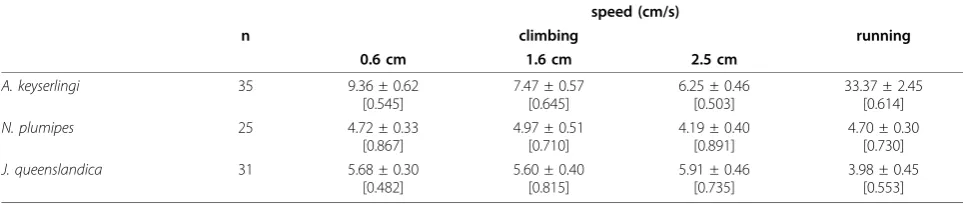
Maximum running and climbing speed varied across species (Table 1), with males of the orb-weaverA. key-serlingirunning and climbing faster than the other spe-cies. The jumping spiderJ. queenslandicaclimbed faster than the orb-builderN. plumipes, but ran slower. Indivi-dual climbing and running performance was generally highly repeatable (Table 1).
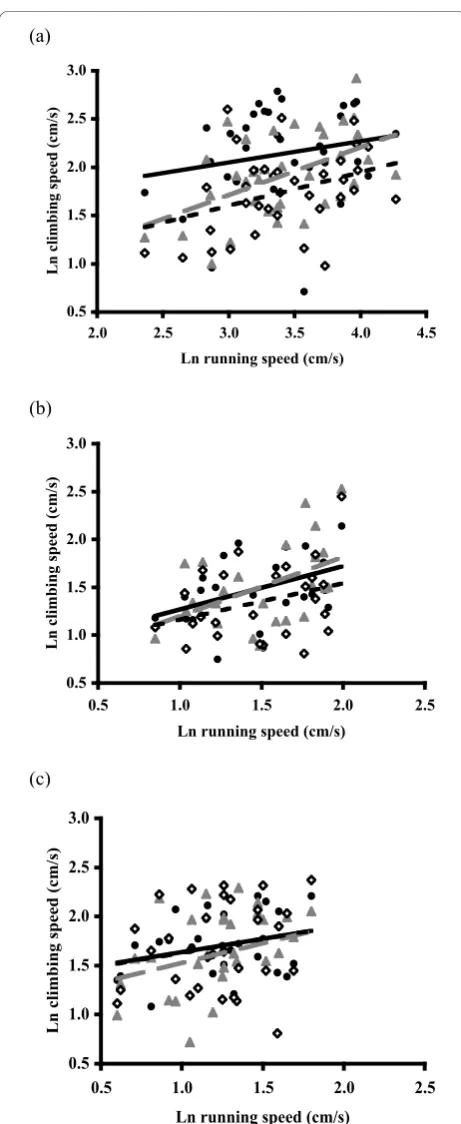
Figure 1c; comparison to 1:1 slope, t29 = 7.09, P < 0.0001). Substrate diameter was negatively related to climbing speed in A. keyserlingi (F1,34 = 22.86, P < 0.0001, b= -0.021) and N. plumipes(F1,24 = 6.48, P = 0.018,b = -0.007) but not inJ. queenslandica(F1,30= 0.03, P = 0.869, b = -0.001). Consistent with Prenter
et al. [6], body size affected climbing speed only in
J. queenslandica(F1,31= 4.34, P = 0.046,b= 0.113).
Discussion
In the web-building spiders A. keyserlingi and N. plu-mipes, males that were fast runners were also fast clim-bers. This suggests that climbing and running largely equate to a single locomotor performance characteristic in these spiders. As variation in performance is consid-ered to be rooted in morphological and physiological specialization in animals, high performance in running and climbing may be promoted by the same morpholo-gical and physiolomorpholo-gical characteristics in these spiders. In contrast, the absence of a relation between maximal climbing and running speeds in the jumping spider J. queenslandica suggests that we assessed performance in two different (but non-conflicting) modes of locomotion. We would predict, therefore, differences in the morpho-logical and physiomorpho-logical characteristics that promote high performance in these distinctive locomotor modal-ities. Data for all three species are consistent in the absence of evidence for a trade-off between running and climbing performance. We found no evidence of a nega-tive relation between maximum running and climbing speeds in any of the spiders examined that would indi-cate a trade-off between running and climbing ability.
While there is no support for trade-offs between run-ning and climbing, it is likely that trade-offs exist between other performance measures. A trade-off between sprinting and endurance capacity is known in various animal taxa [16,17,22], but whether it exists in spiders remains to be determined. Indeed foraging mode may influence selection for these two putatively antago-nistic performance traits, with sprinting paramount in
sit-and-wait foragers and adaptation for endurance being important in active foragers [8]. The trade-off between sprinting and endurance capacity is normally considered to be influenced by different muscle fibre types that are associated with endurance and sprinting performance [16]. However, spiders differ from the groups so far examined in that hydrostatic pressure plays a key role in their leg movements during locomotion [23]. It would, therefore, be intriguing to determine whether such a trade-off exists in the hydrostatically assisted movement of spiders. There remains potential for different muscle fibres to influence sprinting and endurance capacity in spiders, as the hydrostatic pump controlling this system has been determined to lie in the muscles of the cepha-lothorax and leg flexion is still achieved using leg muscles [24,25].
[image:3.595.56.538.101.203.2]Intra-individual variation and low number of trails per individual are known to result in underestimation of maxi-mal speed and repeatability estimates in locomotor perfor-mance trials [26]. However, the standard practice [5,6] of calculating the intraclass correlation coefficient using the fastest and second fastest trials is biased in the opposite direction and compensates for any influence of low num-ber of trials per individual spider. The generally high repeatability in both climbing and running performance indicates that individual differences in performance are stable over trials and is consistent with previous studies of locomotor performance in web and wandering spiders [5-7], and other animals [17,26]. This repeatability of run-ning and climbing performance underlines the reliability of our protocols and establishes a platform for future investigation of mechanisms underlying performance var-iation and heritability in these locomotor traits [21]. Furthermore, our ability to detect a functional relationship between these performance traits depends on high repeat-ability of individual performance [17]. The repeatrepeat-ability of a trait also determines the upper limit on heritability and represents an estimate of its potential to react to direc-tional selection [[27], but see [28]]. Without repeatability in performance, selection is unlikely to distinguish
Table 1 Locomotor performance in spiders
speed (cm/s)
n climbing running
0.6 cm 1.6 cm 2.5 cm
A. keyserlingi 35 9.36 ± 0.62
[0.545]
7.47 ± 0.57 [0.645]
6.25 ± 0.46 [0.503]
33.37 ± 2.45 [0.614]
N. plumipes 25 4.72 ± 0.33
[0.867]
4.97 ± 0.51 [0.710]
4.19 ± 0.40 [0.891]
4.70 ± 0.30 [0.730]
J. queenslandica 31 5.68 ± 0.30
[0.482]
5.60 ± 0.40 [0.815]
5.91 ± 0.46 [0.735]
3.98 ± 0.45 [0.553]
Maximal climbing and running speeds in male spiders (means ± s.e.). Repeatability (R) of performance (intraclass correlation coefficients,ICC) is given in
between high and low performance levels and there would be no directional selection on locomotor performance.
Our results have implications for motility-based expla-nations for the evolution of SSD in spiders. Recent debate has focused on two alternative explanations; (1) the‘ grav-ity hypothesis’ [14,15] that explains the evolution of extreme SSD in spiders because smaller males have a mating or survival advantage through their ability to climb faster, and (2) that larger males have an advantage in running faster [5]. Empirical tests of the two models concentrate on separate laboratory-based assays of run-ning and climbing performance [4-6,15] (but see [29,30] for field studies), with the implicit (but untested until now) assumption that climbing and running represent distinct locomotor modalities. The positive relation between climbing and running performance in male web-spiders in our study contradicts this assumption. Our results highlight the need to consider the relation-ship between running and climbing performance before embarking on tests that aim to distinguish between alter-native motility-based explanations of SSD. In practice it may be difficult to differentiate selection for climbing and running in species where they represent aspects of the same locomotor modality. The direction of the rela-tionship between size and locomotor performance, how-ever, may still retain important discriminatory power. The gravity hypothesis [4,15] predicts a negative relation-ship between size and climbing speed, while Brandt and Andrade [5] predict a positive relationship between size and running performance. Given the non-independence of running and climbing assays for orb-weaving spiders, selection favouring small males for climbing might also generate a small male advantage in running, and selec-tion favouring large males for running might also gener-ate a large male advantage in climbing.
The slopes of the observed relationships between max-imum running and climbing performance were less than unity and suggest that selection cannot act equally on performance on vertical and horizontal surfaces. Our results suggest that the potential for selection on climb-ing performance (on vertical surfaces) is less than that for running on horizontal surfaces (ground). Any response from selection on body size, via performance, therefore, may differ in the two contexts, with greater potential for a response in the running (ground) context.
Conclusions
Running and climbing performance were found to be non-independent in the two orb-web spidersA. keyser-lingiandN. plumipes. Assays of these performance traits appear to equate to a single locomotor performance characteristic in these spiders and suggest that high per-formance in each may be promoted by the same morpho-logical and physiomorpho-logical characteristics. This was found 0.5
1.0 1.5 2.0 2.5 3.0
0.5 1.0 1.5 2.0 2.5
Ln running speed (cm/s)
Ln climbing speed (cm/s)
0.5 1.0 1.5 2.0 2.5 3.0
0.5 1.0 1.5 2.0 2.5
Ln running speed (cm/s)
Ln climbing speed (cm/s)
0.5 1.0 1.5 2.0 2.5 3.0
2.0 2.5 3.0 3.5 4.0 4.5
Ln running speed (cm/s)
Ln climbing speed (cm/s)
(a)
(b)
[image:4.595.57.288.84.647.2](c)
Figure 1Inter-relation between two locomotor performance
traits in orb-web and jumping spiders. Positive relation between
not to be the case for the jumping spiderJ. queenslan-dica. Our results have implications for motility-based explanations of the evolution of SSD in spiders and sug-gest greater potential for an evolutionary response in horizontal compared to vertical performance. A trade-off between running and climbing performance in these spi-ders was not evident.
Additional material
Additional file 1: Additional material.
Acknowledgements
We thank Ben Fanson for statistical advice, Yoni Brandt, Maydianne Andrade and Rowan McGinley for helpful comments and Maria Castillo-Pando for technical assistance in maintaining spiders in the laboratory. We thank the Australia & Pacific Science Foundation for financial support.
Author details
1Department of Biological Sciences, Macquarie University, Sydney, NSW 2109,
Australia.2Instituto de Biotecnología y Ecología Aplicada (INBIOTECA), Universidad Veracruzana, Apartado Postal 250, CP 91090, Xalapa, Veracruz, Mexico.
Authors’contributions
JP, PWT and DP-S conceived and designed the experiments. JP and DP-S conducted the experiments. JP and PWT analysed the data and wrote the manuscript. All authors read and approved the manuscript.
Competing interests
The authors declare that they have no competing interests.
Received: 7 January 2010 Accepted: 16 November 2010 Published: 16 November 2010
References
1. Husak JF, Lappin AK, Fox SF, Lemos-Espinal JA:Bite-force performance predicts dominance in male venerable collared lizards (Crotaphytus antiquus).Copeia2006,2006:301-306.
2. Irschick DJ, Garland T Jr:Integrating function and ecology in studies of adaptation: investigations of locomotor capacity as a model system.
Annu Rev Ecol Syst2001,32:367-396.
3. Irschick DJ, Meyers JJ, Husak JF, Le Galliard JF:How does selection operate on whole-organism functional performance capacities? A review and synthesis.Evol Ecol Res2008,10:177-196.
4. Moya-Laraño J, Vinkovic D, Allard C, Foellmer MW:Mass-mediated sex differences in climbing patterns support the gravity hypothesis of sexual size dimorphism.Web Ecol2007,7:106-112.
5. Brandt Y, Andrade MCB:Testing the gravity hypothesis of sexual size dimorphism: are small males faster climbers?Funct Ecol2007,21:379-385. 6. Prenter J, Pérez-Staples D, Taylor PW:The effects of morphology and
substrate diameter on climbing and locomotor performance in male spiders.Funct Ecol2010,24:400-408.
7. Pruitt JN, Husak JF:Context-dependent running speed in funnel-web spiders from divergent populations.Funct Ecol2010,24:165-171. 8. Pruitt JN:Differential selection on sprint speed andad libitumfeeding
behaviour in active vs. sit-and-wait foraging spiders.Funct Ecol2010,
24:392-399.
9. Vollrath F:Dwarf males.Trends Ecol Evol1998,13:149-163. 10. Prenter J, Elwood RW, Montgomery WI:Sexual size dimorphism and
reproductive investment by female spiders: a comparative analysis.
Evolution1999,53:1987-1994.
11. Hormiga G, Scharff N, Coddington JA:The phylogenetic basis of sexual size dimorphism among spider species (Class Araneae).Syst Biol2000,
49:435-462.
12. Ghiselin MT:The economy of nature and the evolution of sex.Berkeley, University of California Press; 1974.
13. Vollrath F, Parker GA:Sexual dimorphism and distorted sex ratios in spiders.Nature1992,360:156-159.
14. Moya-Laraño J, Halaj J, Wise DH:Climbing to reach females: Romeo must be small.Evolution2002,56:420-425.
15. Moya-Laraño J, Vinkovic D, Allard C, Foellmer MW:Optimal climbing speed explains the evolution of extreme sexual size dimorphism in spiders.J Evol Biol2009,22:954-963.
16. Vanhooydonck B, Van Damme R, Aerts P:Speed and stamina trade-off in Lacertid lizards.Evolution2001,55:1040-1048.
17. Oufiero CE, Garland T Jr:Repeatability and correlation of swimming performances and size over varying time-scales in the guppy (Poecilia reticulata).Funct Ecol2009,23:969-978.
18. Losos JB, Walton BM, Bennett AF:Trade-offs between sprinting and clinging ability in Kenyan chameleons.Funct Ecol1993,7:281-286. 19. Losos JB, Creer DA, Schulte JA:Cautionary comments on the
measurement of maximum locomotor capabilities.J Zool2002,258:57-61. 20. Littell RC, Milliken GA, Stroup WW, Wolfinger RD, Schabenberger O:SAS for
mixed models.2 edition. Cary, NC, SAS Institute Inc; 2006.
21. Nakagawa S, Schielzeth H:Repeatability for Gaussian and non-Gaussian data: a practical guide for biologists.Biol Rev2010,85:935-956. 22. Reidy SP, Kerr SR, Nelson JA:Aerobic and anaerobic swimming
performance of individual atlantic cod.J Exp Biol2000,203:347-357. 23. Foelix RF:The biology of spidersNew York, Oxford University Press; 1996. 24. Ellis CH:The mechanism of extension in the legs of spiders.Biol Bull
1944,86:41-50.
25. Anderson JF, Prestwich KN:Fluid pressure pumps of spiders (Chelicerata, Araneae).Zeit Morpho Tier1975,81:257-277.
26. Adolph SC, Pickering T:Estimating maximum performance: effects of intraindividual variation.J Exp Biol2008,211:1336-1343.
27. Boake CRB:Repeatability: its role in evolutionary studies of mating behaviour.Evol Ecol1989,3:173-182.
28. Dohm MR:Repeatability estimates do not always set an upper limit to heritability.Funct Ecol2002,16:273-280.
29. Foellmer MH, Fairbairn DJ:Selection on male size, leg length and condition during mate search in a sexually dimorphic orb-weaving spider.Oecologia2005,142:653-662.
30. Kasumovic MM, Bruce MJ, Herberstein ME, Andrade MCB:Risky mate search and mate preference in the golden orb-web spider (Nephila plumipes).Behav Ecol2007,18:189-195.
doi:10.1186/1756-0500-3-306
Cite this article as:Prenteret al.:Functional relations between locomotor performance traits in spiders and implications for evolutionary hypotheses.BMC Research Notes20103:306.
Submit your next manuscript to BioMed Central and take full advantage of:
• Convenient online submission
• Thorough peer review
• No space constraints or color figure charges
• Immediate publication on acceptance
• Inclusion in PubMed, CAS, Scopus and Google Scholar
• Research which is freely available for redistribution