International Journal of Distributed Sensor Networks
2017, Vol. 13(6) ÓThe Author(s) 2017 DOI: 10.1177/1550147717713626 journals.sagepub.com/home/ijdsn
Scale-free topology optimization for
software-defined wireless sensor
networks: A cyber-physical system
Ru Huang
1, Xiaoli Chu
1,2, Jie Zhang
1,2and Yu Hen Hu
3Abstract
Due to the limited resource and vulnerability in wireless sensor networks, maximizing the network lifetime and improv-ing network survivability have become the top priority problem in network topology optimization. This article presents a wireless sensor networks topology optimization model based on complex network theory and cyber-physical systems using software-defined wireless sensor network architecture. The multiple-factor-driven virtual force field and network division–oriented particle swarm algorithm are introduced into the deployment strategy of super-node for the imple-mentation in wireless sensor networks topology initialization, which help to rationally allocate heterogeneous network resources and balance the energy consumption in wireless sensor networks. Furthermore, the preferential attachment scheme guided by corresponding priority of crucial sensors is added into scale-free structure for optimization in topol-ogy evolution process and for protection of vulnerable nodes in wireless sensor networks. Software-defined wireless sensor network–based functional architecture is adopted to optimize the network evolution rules and algorithm para-meters using information cognition and flow-table configure mode. The theoretical analysis and experimental results demonstrate that the proposed wireless sensor networks topology optimization model possesses both the small-world effect and the scale-free property, which can contribute to extend the lifetime of wireless sensor networks with energy efficiency and improve the robustness of wireless sensor networks with structure invulnerability.
Keywords
Software-defined wireless sensor network, scale-free network, topological optimization, super-nodes, cyber-physical systems
Date received: 30 October 2016; accepted: 14 May 2017
Academic Editor: Wei Yu
Introduction
Wireless sensor networks (WSN)1is a major component in cyber-physical systems (CPS),2which showing power-ful potentials in interfacing with the physical world and making its control much easier, achieved by the integra-tions of network, computation, and communication cap-abilities to the components of physical world. Interacted heterogeneous physical devices (e.g. sensor and actuator) are key physical elements in CPS.3,4The heterogeneities reflect the diversity in capabilities, complexities, types, and mobility among sensors in CPS. It is crucial for CPS to support the ability of heterogeneity tolerance.
From the perspective of network functional architec-ture, most current traditional network topology
1
School of Information Science and Engineering, East China University of Science and Technology, Shanghai, China
2
Department of Electronic and Electrical Engineering, The University of Sheffield, Sheffield, UK
3
Department of Electrical & Computer Engineering, University of Wisconsin-Madison, Madison, WI, USA
Corresponding author:
Ru Huang, School of Information Science and Engineering, East China University of Science and Technology, Shanghai 200237, China. Email: [email protected]
optimization researches limited to non-software-defined network architecture are based on distributed algo-rithms, which result in the generation of a large quan-tity of network loads, reduction of life cycle, and lack of adaptability in the network evolution due to dynamic topology changes. Traditional network architecture does not support the dynamistic, scalability and hetero-geneity in WSN cyber system and is lack of the feed-back control functional component, which can efficiently exert impact on WSN physical system. Software-defined wireless networks (SDWNs) architec-ture5,6presents an innovative framework for decoupling the original closed system, which can achieve novel feedback control in CPS with logical centralized control and physical distributed control to decouple control plane and data plane. The combination of SDWNs-based architecture and WSNs’ function, that is, software-defined wireless sensor network (SDWSN) based on programmable control of common hardware and software, enables flexible task configuration. Motivated by the advantages in SDWSN technology, we propose a SDWSN-based cyber-physical system framework (SD-CPSF) via introducing the software-defined network technology and actuator-based func-tional component into existing WSN infrastructure.
Based on SD-CPSF, the functionality, reliability, adaptability, compatibility, and autonomy can be effi-ciently improved in WSN. Sensors in WSN with limited energy supply always deploy in harsh environment to achieve the classical application of CPS. Consequently, sensors often suffer from fail due to natural hazards and energy resource depletion. The breakdown of some sensors can greatly damage the functionality of WSN. It is crucial for WSN to improve the ability of fault tolerance.
Network topology structure has intrinsic characteris-tics, which can impact on WSN’s performance. Therefore, build robust network topology to improve the survivabil-ity and energy efficiency of WSN is crucial.
Network robustness has become one of the most central topics in the complex network research.7Fault tolerance is well known as the typical scale-free network properties,8 which can help to defend against random failure caused by energy depletion and environmental disturbances in CPS application. Complex network the-ories9provide new research ideas and methods to estab-lish a reliable and energy-efficient network topology model by exploring the statistical properties inherited in networks.
Comprehensively considering the characteristic of node heterogeneity, resource scarcity, and structure vul-nerability in WSN, we propose a novel WSNs topology optimization model according to scale-free complex network theory–based network evolution algorithm and SD-CPSF-based network functional architecture. We take the improvement of robustness of WSN as the
design goal for WSN topology optimization, which help to prolong network lifetime and enhance the network invulnerability.
The contributions of our researches in the article mainly focuses on the improvement on adaptive ability, invulnerability, and energy efficiency on WSN, via introducing SDWN architecture and complex network theory (scale-free and small-world theory) based strate-gies in topology optimization and evolution mechanism. The rest of the article is organized as follows. Section ‘‘Related work’’ states a summary of related work on network topology control. Section ‘‘System model and functional framework’’ elaborates the system model based on cognitive SDWSN prototype and its functional architecture. Section ‘‘Topology initialization based on super-nodes configuration’’ presents an implementation of topology initialization. In section ‘‘Topology evolu-tion based on improved scale-free network model,’’ an optimal topology evolution model is proposed based on improved scale-free theory model and specific mathe-matical analysis on proposed evolution model is pre-sented. Network structure characteristics are evaluated through experiments in comparison with BA model10in section ‘‘Experimental results and analysis.’’ Finally, conclusion is drawn in section ‘‘Conclusion.’’
Related work
edge betweenness in small-world model via introducing special threshold mechanism, so as to equip with a high clustering coefficient and obvious cluster structure after network optimization, but this work took little change on average path length.
Based on the complex networks theory, a new weighted local WSNs evolution model15 was designed to deduce intensity distribution and weight distribution meeting the power-law; however, the dynamic changes in network topology were not considered. In research works,11 the impact of the residual energy on network growth was considered in process of complex network models evolution, but the invulnerability in network model was not analyzed. Jian et al.13 proposed two scale-free network models based on local world model, where the new sensors with high energy level had the priority to be connected, but the dynamic changes in network topology due to the expense of limited resource were not taken into account.
The above researches based on complex network theory focus on the topology control methods to homo-geneous and tight coupling network architecture; how-ever, none of those methods have been designed from the viewpoint of network heterogeneity and network functional architecture in CPS.
System model and functional framework
WSN is abstracted into a weighted directed graph,
GðV;L;IÞ, which forms a reverse multicast tree rooted at Sink, which has non-replenished enough energy, higher storage capacity and stronger computing ability. InG,Vis the set of vertexes and maintains a hierarchi-cal cluster. Sensors inVown heterogeneous functional characteristics (energy, perception radius, mobility,
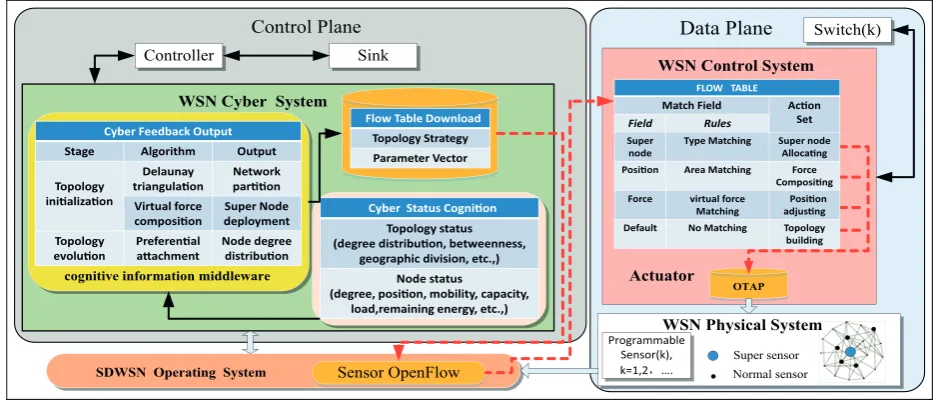
computing, and storage capacity) are grouped into super and normal node types. Normal sensors without moving-ability in data plane are randomly distributed in environment monitoring area and have low average energy level, while super-nodes with moving-ability have several times the energy equivalent and communi-cation radius as normal sensors.Lconsists of a set of wireless links andI is the set of vertex weights, which denote the diversity for crucial level of sensors in V. SDWSN applies decoupled network architecture and has the ability of heterogeneity tolerance. By introdu-cing SD-CPSF into WSN, cyber feedback functions performed by actuators are added into WSN control system and the constituted elements in WSN physical system can be endowed with software defined networks based (SDN-based) functional characteristic. SD-CPSF-based system functional framework for WSN topology optimization is shown in Figure 1.
Cyber feedback and control process are illustrated as follows. Sensors in data plane gather the information on WSN physical system to the Sink entities, which can develop control algorithms based on WSN cyber sys-tem to produce strategy commands and instruct actua-tors to achieve the control on WSN physical system. The main idea of feedback control is to exploit cogni-tive information middleware (CIM) to reinforce learn the physical dynamics in WSN. Then, utilizing the out-put functional model determines the actions that yield the optimal topology control behaviors.
Based on SDN technology, Sink takes the role of controller to manage network services according to SDN protocol and develop topology optimization stra-tegies based on WSN cyber system in control plane.
The core functionality module in the control plane of SD-CPSF is a CIM,16 which performs
knowledge-Controller
Sensor OpenFlow
Data Plane
SDWSN Operating System
Sink
Programmable Sensor(k),
k=1,2ˈ…. Super sensorNormal sensor
OTAP
Actuator
WSN Control System
WSN Cyber System
FLOW TABLE
Match Field Acon Set Field Rules
Super node
Type Matching Super node Allocang Posion Area Matching Force
Composing Force virtual force
Matching
Posion adjusng Default No Matching Topology building
WSN Physical System
Cyber Feedback Output
Stage Algorithm Output
Topology inializaon
Delaunay triangulaon
Network paron Virtual force
composion
Super Node deployment Topology
evoluon
Preferenal aachment
Node degree distribuon
Cyber Status Cognion
Topology status (degree distribuon, betweenness,
geographic division, etc.,) Node status
(degree, posion, mobility, capacity, load,remaining energy, etc.,)
Flow Table Download
Topology Strategy Parameter Vector
Controller
Switch(k)
cognitive information middleware
[image:3.595.69.537.72.272.2]Control Plane
guided reinforcement learning17 for mining heteroge-neous information in WSN cyber system. The following procedures should be executed after the cyber-learning phase has been finished in CIM. Controller outputs the strategy rules and optimal algorithm parameters consti-tuted by vector form to the data plane using pipelined flow-table mode. Then, topology evolution process should be executed based on the optimized algorithm parameters (e.g. parameters of particle swarm and vir-tual force algorithm (VFA) calculated by CIM). Specifically, each switch, which is designed as software-defined virtual sensor and acts as actuator in data plane, performs the appropriate topology evolution matching rules (i.e. flow-table entries) and configures the sensors in data plane to realize the position optimization of super-node for network initial configurations and scale-free model optimization for network evolutionary.
Other sensors in data plane can be provided with programmable ability and become cluster members to execute the specific actions guided by controller strate-gies and transmitted by switches using Over-the-Air Programming (OTAP) technique.18
Total optimal topology generation process in logi-cal field reflects the functionalities decoupling between control plane and data plane, where sup-ported SDN protocol, Sensor OpenFlow,19 enables the communication between the data plane and a remote controller (Sink). Correspondingly, the topol-ogy optimization process in temporal field is divided into two stages. First, in the cyber-learning phase, Sink takes the role of controller to collect the network status information based on the packet-in messages from the data plane and perform the configuring and scheduling in network resource (e.g. position adjust-ment for super-node, preferential attachadjust-ment for edge) using particle swarm and VFA.
Topology building process reveals a tradeoff between resource efficiency and computational com-plexity, SDN-based design can yield very low complex-ity, which efficiently reduce the information exchange for topology optimization process over the cyber-world, which can effectively reduce energy consump-tion in the process of topology optimizaconsump-tion and improve the re-configurability and scalability of net-work topology. The fundamental functionalities of pro-posed SD-CPSF reflect the interaction between physical world and cyber systems in WSN using SDN technology.
Topology initialization based on
super-nodes configuration
Network division using particle swarm method
According to Delaunay triangulation,20 which uses computational geometry to mathematically abstract
two-dimensional network region, we propose an opti-mal planar triangulation with geometric criteria to divide entire network with N sensors into azones via particle swarm algorithm.21 In each zone, super and normal sensors join the network in accordance with a certain proportion, and then, normal sensors are dis-tributed around certain super-nodes, which form like a spider web-like structure according to initial topology generation algorithm.
At the first step, determining a first region division line network, the whole network is divided into two dif-ferent sub-regions via zone dividing line determined by equation (1)
Lu¼ðx;y;uÞ ð1Þ
wherein the pointðx;yÞbelongs toLuandudenotes the
angle between Lu and x-axis. Values of particle
para-metersx,y,uare randomly assigned.
Particle swarm optimization (PSO) is introduced in network division problem by iteratively improving can-didate solutions with regard to given measure of qual-ity. Fitness function in PSO can efficiently adjust plurality of different fitness values to determine the lat-est search results and corresponding particles used as global minimum plurality. The proposed fitness func-tion in PSO is defined as mean squared error (MSE) form using normk kR pnormðp¼2Þ
fitness¼ ðn1f1NÞ2+ðn2f2NÞ2
2norm
s:t: fi¼ ai
aði¼1;2Þ
ð2Þ
whereaiis the expected number of super-nodes, which
denotes the number of reserved super-nodes in corre-sponding divided zone andniði¼1;2Þis the number of
sensors belongs to corresponding zonei.N denotes the number of sensor nodes in entire WSN andaindicates the number of divided zones. Determining a plurality of different fitness values, a minimum fitness value is compared with the latest search results and the corre-sponding particles may be used as global minimumPgd;
similarly, individual particle obtains the smallest extreme value pt
lid and then updates the algorithm
parameters as equation (3) to get the optimal non-inferiority solution set.
vt +lid1¼wt*vtlid+c1*r1*ðptlidX t
lidÞ+c2*r2*ðptgdX t lidÞ
s:t:Xlidt+1¼Xlidt +vtlid+1
l¼x;y;u
wt¼
k1*ðwminwmaxÞ
M *t+wmax;ð0\t\ M
k1+k2;k1.0;k2.0Þ
k2*ðwminwmaxÞ
M *t+
k1*wmax+k2*wmin
k1+k2 ;ð0\
M
k1+k2t\MÞ
8 < :
wt2 ½wmin;wmax
whereXid andXyid denote the position of the particles;
Xuid is the dividing line inclination; vxid,vyid,vuid
repre-sent the corresponding search speed in three dimen-sions x, y, u; ci;i¼1;2 and wt denote learning factor
and inertia weight factor, respectively; r1 and r2 are random numbers in the range [0, 1]; andtis the number of iterations. Since the standard PSO algorithm has dis-advantages like premature convergence and slow evolu-tion,22 it is necessary to make appropriate adjustment on parameters in particle update formula to update local optimum and track global optimum in solution.
In equation (3), wt is defined as the PSO inertia
weight factor, which can be used to regulate global and local search capabilities in network division optimiza-tion by solving the premature convergence and slow evolution problem. Therefore, a self-adaptive learning method is proposed to take wt linearly varies as the
number of iterations t at different intervals, which enables wt to maintain a larger value at preliminary
search to improve the global search ability and to keep a smaller value at late search to improve the local search accuracy. The search process is terminated until the particles get the right value ofx,y, anduto find fit-ness function, which approximates zero. In this case, the entire area can be divided into two parts. After the first region segmented, two sub-regions continue to be segmented according to similar partition algorithm untilazones with equal size are produced.
Compared with classical topology segmentation in WSN,23the above program can make use of SDWSN architecture to achieve ‘‘coarse-grained’’ network seg-mentation step, which depends on the smaller number of network border switches and does not need to calcu-late the path information of the entire network, which helps to significantly reduce computational complexity and substantial reduction in information exchange between the control plane and switches in data plane.
Virtual force–oriented deployment of super-nodes
VFA24abstracts the mobile sensors into virtual charged particles to simulate distance-threshold–based virtual compositional force. Motivated by the principle of VFA, the multiple factors driven virtual force are uti-lized to optimize the deployment of super-nodes in WSN physical system, which can promote the rational allocation of resources within WSN to reduce the topo-logical fragility using percolation theory.
In the first step of VFA, super-nodes adjusts its loca-tion in adjacent sub-target zone based on composiloca-tion force, which is constructed by Fni, Fbj, and Fji.
Specifically, Fni denotes the force generated between
super-nodes and normal sensors within the same zone F; Fbj indicates the impact of adjacent sub-region
boundary setuon super-nodes.Fjirepresents the force
created by other members in super-nodes setO. When the properties of force exhibit gravity or repulsion, cor-responding virtual force will take a positive value or negative value, respectively.
Based on the above analyses, super senoriis driven by virtual composition force shown as equation (4) to find out subinterval and continually adjust its deploy-ment position in the sub-region until forceFiis less than
a given threshold.
Fi¼
X
n2F Fni+
X
b2u
Fbi+
X
j2O Fji
pnorm
s:t:Fni¼kni*ð kn*cn
En
Þ;n2FG
Fbi¼kbi*jiaddrDbj;b2uG Fji¼kji*ðjiaddrjaddrj dsÞ;j2OG
i2OG
ð4Þ
whereinFni indicates the impact level on virtual force
caused by the interaction between super-nodes and nor-mal sensors in zoneF.En,kn,cn represents the
remain-ing energy level, node degree and node betweenness of sensor n2F, respectively. And cn is defined as the
number of shortcut paths across the sensor. The value of control parameter kni takes 1 when super senor
i2F; otherwise, it takes 0.Fbi denotes the
correspond-ing component virtual force produced by sub-region boundaries, which are generated by network partition algorithm (mentioned in section ‘‘Network division using particle swarm method’’), and reflects the relation between the initial super-nodes position and the corre-sponding sub-target zone boundary. jiaddrDbj
repre-sents the Euclidean distance between the location of super-nodeiand the centroidDbof sub-regionu.kbi is
a gain coefficient parameter that indicates the relation-ship between the actual density and the expected den-sity of sensors in adjacent sub-regions.
Fji represents the interaction force between two
dif-ferent super-nodes in O,where jiaddrjaddrj is the
Euclidean distance between super-nodei andj, andds
Topology evolution based on improved
scale-free network model
Based on SD-CPSF, a WSN topology optimal model (WTOM) according to complex theory is proposed via introducing super-nodes driven initial topology deploy-ment and crucial-node associated topology evolution, which possesses both the small-world effect and the scale-free property.26
WTOM generation algorithm
Suppose the network has originally deployed isolatedm0
normal sensors and a0 super-nodes in each time step, mðm\m0Þsensors are newly added to networks according
to a certain rule, wherein the new added sensor n with node degreemis probably a super-node with probability
por a normal node with probabilityð1pÞ. Super-nodes have the priority to connect newly added sensors with inherent advantages. Then, local world Y is constructed by theMðM mÞsensors, which are within the commu-nication range and with the latest joining time. The newly added node n is connected with existing super-nodes in local worldYor normal nodeiin neighborhoodOv.
Comprehensively considering the influencing factors in network evolution, we define Ii as the integrated
influence factor (see equation (5)) of sensoriin the pro-cess of network evolution. The greater the value of Ii,
the large the probability of QðkiÞ is obtained.
Therefore, the preferential attachment probability will be greatly affected by the crucial level of selected sensor in network topology generation
Ii¼fðEiÞ*ki*ci*ð1+biÞ; Ii2I s:t: fðEiÞ ¼n*Ei;ð1n8Þ
ð5Þ
wherein, fðEiÞ denotes the remaining energy level of
sensor i. when n¼1, i is a normal node, otherwise, it becomes a super-node with n.1. c denotes the node betweenness, which is defined as the number of shortest paths through sensori. From the perspective of overall network structure, ci is a measure of centrality in net-work and indicates node’s critical level in the global network routing. ki is the node degree of sensor i.
Parameters bi obeys (0–1) distribution and reflects the super-nodes-related influence on network evolution, if the newly added sensors connect existing super-nodes with high probability, thenbi!1, otherwisebi!0.
The connection probability based on integrated influence factor is shown as follows
Y
ðkiÞ ¼ Ii
P
j2Ov
Ij
s:t: i;j2 ðOv[OÞ \Y Ii;Ij2I
ð6Þ
Network topology optimization mechanism is achieved by repeating the algorithm steps from 2 to 4 until the required network size is met and the corre-sponding evolutionary process can produce small-world effect, directly affecting the energy saving performance of CPS for monitoring application.
Mathematical analysis on topology
optimal model
Dynamic characteristics in scale-free network model can be analyzed based on continuous field theory.27 Given the nature of continuous performance in pro-posed model WTOM, more detailed characteristics can be captured and predicted according to the degree dis-tribution, which is denoted as time-varies and obtained via continuous approximation field method.
At each time step, the increment of node degree is in accordance with the following ratio
∂ki
∂t ¼m
Y
ðkiÞ ¼ M m0+t
m*Ii
P
j2Ov
Ij
; ðM mÞ ð7Þ
Initial boundary conditions of equation (6) are sub-stituted askið0Þ ¼m, and then, the solution of
differen-tial equation (7) can be obtained as follows
kiðtÞ ¼m*
m0+t
m0+ti
P j2Ov Ii
M*m*Ii
ð8Þ
The average node degree in local world is shown as
P
j2Ovkj¼M\k., and when time meets the situation t!+‘, the average node degree is described as
\k.¼ 2m*t
t+m0
’2m ð9Þ
Algorithm 1. WTOM generation.
1: Set the initial configuration of SD-WSN with size N;//Initial setting
2: Divide the network based on equation (1) to equation (3);// Network partition
3: Deploy the super-nodes based on equation (4)//Super-nodes configuration
4: while network size\N do
5: Add new sensors into network according to equation (5) in each time step;
6: Build the local world;//Network growth
7: Choose preferential attachment based on equation (6);// Network evolution
8: Repeat the evolution steps until the required network size is met;
9: Output the WSN topology optimal model;//Topology optimization
Time t obeys uniform distribution PðtiÞ ¼
1=ðm0+tÞ; therefore, the distribution of node degree tends to equation (10), which follows power-law and dis-plays scale-free phenomena in physical infrastructures
pðkÞ’Y*mY1*kY
s:t: Y ¼
2*P
j2Ov
fðEjÞ*cj*ð1+bjÞ
M*fðEiÞ*cj*ð1+biÞ
+1
ð10Þ
The probability of super-node chosen to construct network is limited in the range 0p\0:1, when the conditions (p¼0andn¼1) are met and the deduced result is described as Y ¼3. Therefore, the generated network with WTOM is actually reduced to an improved BA28networks, which can improve both the robustness and energy efficiency in network topology with percolation theory–based super-nodes optimal deployment29 and scale-free theory–based node degree optimal distribution. Taking the upper bound of cod-ing runncod-ing time and the amount of nested loops into account, the analysis on WTOM algorithm complexity is mathematically transformed into a solution on topol-ogy evolution problem with solving asymptotic order in corresponding recursive equation. Based on the max-imum incremental coding running time calculated according to cyclic iteration steps in WTOM topology generation, where the upper limit of created edges in evolution process is subjected to proposed preferential attachment and the average path length is increased approximately logarithmically with the network sizeN, WTOM algorithm complexity is finally deduced as
OðN*log2NÞ.
Flow-table driven control in WSN physical
system
In proposed SD-CPSF, the specific mobile behavior of super-nodes is driven by composite virtual force and the optimal deployment principle is achieved according to ‘‘force field’’ (virtual force matching rule and thresh-old) set in flow-table entry. Furthermore, network evo-lution process is instructed by the preferential attachment probability stored in ‘‘default field.’’ Based on the functional module for cyber cognition and min-ing, WTOM is designed by controller in control plane and downloaded into switches in data plane via flow-table mode using OTAP. Based on the topology poli-cies determined by WTOM, switches are acted as actuators in CPS to output the cyber feedback control on the physical system and the corresponding control processes by flow-table mode. As a result, super-nodes move to the suitable location and normal sensors choose preferential attachment to perform specific topology optimization actions.
Experimental results and analysis
We do experiments to evaluate the performance of proposed WTOM in SD-CPSF by analyzing the net-work characteristics including average path length, clustering coefficient, energy consumption, and life cycle.
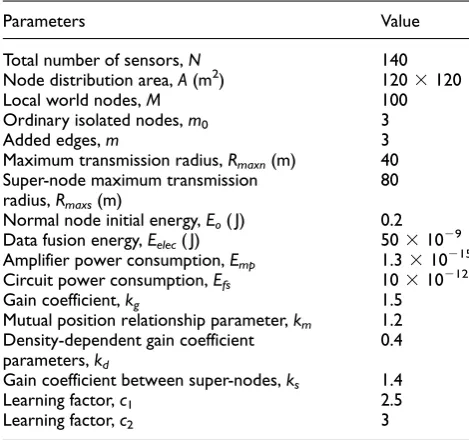
The network simulator NS330and network building tool Gephi31are used to construct the experiment envi-ronment and analyze the performance of the proposed topology optimization mechanism using SDWSN pro-totype. Table 1 lists experimental parameters.
Performance comparison on network topology
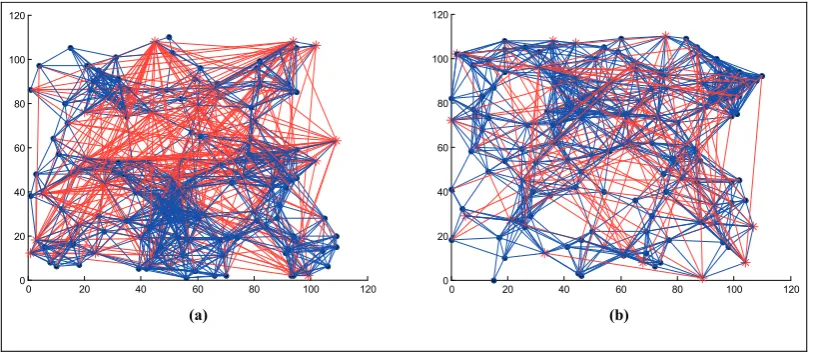
This simulation situation is divided into two groups of comparison counterparts, the first group is in accor-dance with WTOM based on preferential attachment probability model and the second topology generation model is formed according to the BA scale-free model.28The red edges in Figure 2(a) denote the edges built by crucial nodes–dependent preferential attach-ment mechanism, which includes the set of shortcut paths created by super-nodes in networks. The red edges in Figure 2(b) represent the edges constructed by node degree–based attachment method.
The set of blue lines in Figure 2 belongs to subset of the communication sides created by the network evolu-tion process. The union set of blue and red edges con-stitute together the basic network communication topology.
[image:7.595.309.544.85.305.2]Table 2 shows that the selected energy-rich sensor has the higher node degree and energy-barren sensor has the lower node degree in WTOM than the
Table 1. Parameters of simulation experiment.
Parameters Value
Total number of sensors,N 140
Node distribution area,A(m2) 1203120
Local world nodes,M 100
Ordinary isolated nodes,m0 3
Added edges,m 3
Maximum transmission radius,Rmaxn(m) 40
Super-node maximum transmission radius,Rmaxs(m)
80
Normal node initial energy,Eo( J) 0.2
Data fusion energy,Eelec( J) 5031029
Amplifier power consumption,Emp 1.3310215
Circuit power consumption,Efs 10310212
Gain coefficient,kg 1.5
Mutual position relationship parameter,km 1.2
Density-dependent gain coefficient parameters,kd
0.4
Gain coefficient between super-nodes,ks 1.4
Learning factor,c1 2.5
corresponding sensor with the same node ID in BA model. The main reason is that super-nodes with higher energy level in WTOM can contribute to build more shortcut paths to balance network energy consumption and result in the decrease in the average node degree of energy-barren sensors in networks.
The topological properties with power-law degree distribution, large clustering coefficient and
disassortative degree correlation should contribute to improve the robustness in WSN network structure.
Comparison of degree distribution
The scenery of sensors death caused by exhausted energy and environment interferes is similar as the net-works suffer from random attack. The degree distribu-tion of formed topology follows a power-law with exponential cutoff, which can help to enhance the fault tolerance and reliability of WSN.
Figure 3 shows that both WTOM and BA have the similar scale-free structure characteristic on the distri-bution of node degree, that is to say, sensors with high degree are with small distribution probability, while other sensors with small degree are with large distribu-tion probability. According to the analysis on degree distribution of WTOM, there exists of flat status within a certain degree range, but the network reflects the scale-free feature in overall degree distribution. The main reason is that super-nodes play an important role in network evolution mechanism, which contribute to smooth the exponential degree distribution and the amount of sensors with higher degree is reduced. This helps to reduce sensors’ premature death rate due to large energy consumption caused by high sensor degree. When p= 0, there is no super-node in network and WTOM has the similar functions as BA model.
0 20 40 60 80 100 120 0
20 40 60 80 100 120
(a)
0 20 40 60 80 100 120 0
20 40 60 80 100 120
[image:8.595.89.496.71.248.2](b)
[image:8.595.47.533.310.375.2]Figure 2. Network topology: (a) WTOM (N= 100,p= 0.05) and (b) BA model (N= 100,p= 0).
Table 2. Corresponding variety in degree with energy-diversity sensors in WTOM and BA model.
Node ID Energy-rich sensors Energy-barren sensors
13 40 67 94 110 25 53 77 86 112
Node degree in WTOM 23 16 25 29 12 19 13 9 17 11
Node degree in BA 6 11 7 5 2 21 18 14 19 16
WTOM: wireless sensor networks topology optimization model.
100 101 102
10-5 10-4 10-3 10-2 10-1 100 101 102
k
P(
k
)
theoretical value of BA theoretical value of WTOM BA
[image:8.595.49.284.413.600.2]WTOM
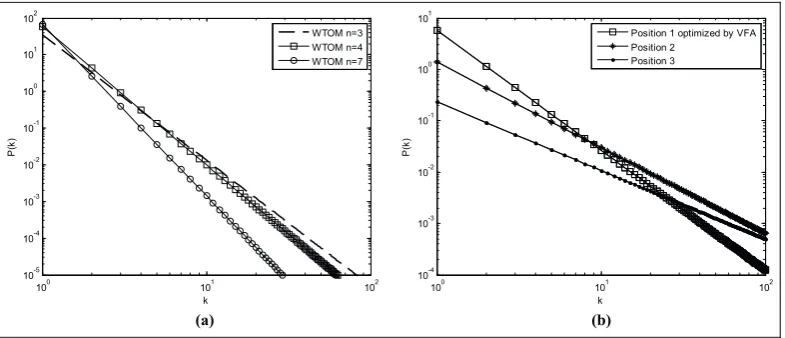
From Figure 4(a), we can see that the total failure rate of sensors can also be greatly reduced by adding appropriate initial energy to super-nodes adjusted by taking different values of parametern. The super-node with higher energy level can do more contribution than the one with lower level to smooth the distribution of node degree and achieve balanced network energy con-sumption. Figure 4(b) shows the influence of super-nodes’ position for the degree distribution in WTOM, which can be seen that the node degree distribution tends to be more uniform as the position of super-nodes optimized by VFA.
Analysis on small-world effects
WTOM can find the weak disorder in the distribution of link length and reduce the average path length via
optimally deploying the supper-nodes in WSN. Figure 5 focuses on the analysis on small-world effects in WTOM, which are inherent in the law of proposed WSN topology evolution. Figure 5(a) shows that the increase in initial energy of super-nodes can effectively reduce the average path length (shown as equation (11)) and the average hops of information transfer process in WSN.
L¼ 1
N
XN
i¼1
Di ð11Þ
whereDi represents the average number of hops when
sensor i sends data to Sink along the shortcut path. Figure 5(b) indicates that an appropriate increase in the number of super-nodes can help to reduce L by the introduction of small-world effect with the short aver-age network path length, but the amplitude range ofL
100 101 102
10-5 10-4 10-3 10-2 10-1 100 101 102
k
P(
k
)
WTOM n=3 WTOM n=4 WTOM n=7
(a)
100 101 102
10-4 10-3 10-2 10-1 100 101
k
P(
k
)
Position 1 optimized by VFA Position 2
Position 3
[image:9.595.109.502.71.240.2](b)
Figure 4. Degree distribution of WTOM: (a) influence of super-nodes’ energy level for degree distribution of WTOM (n= 3,
n= 4) and (b) influence of super-nodes’ position for degree distribution of WTOM.
100 200 300 400 500 600 700 800 900 1000 2.3
2.4 2.5 2.6 2.7 2.8
The network size N
Av
e
ra
g
e
p
a
th
l
e
n
g
th
L
WTOM, n=2,p=0.04 WTOM,n=4,p=0.04 BA
(a)
0 1 2 3 4 5 6 7 8 9 10
1 1.2 1.4 1.6 1.8 2 2.2 2.4 2.6
Number of super nodes
A
v
er
age pat
h
l
e
ngt
h
L
BA WTOM, n=3 WTOM, n=4 WTOM, n=5
[image:9.595.108.505.308.472.2](b)
should hardly change when the number of super-nodes reaches a certain threshold. In comparison, the average path length of BA network is not sensitive to the num-ber of super-node, because there are no special consid-erations on the effect of super-nodes in the construction of network topology.
Comparison in the effect of clustering coefficient
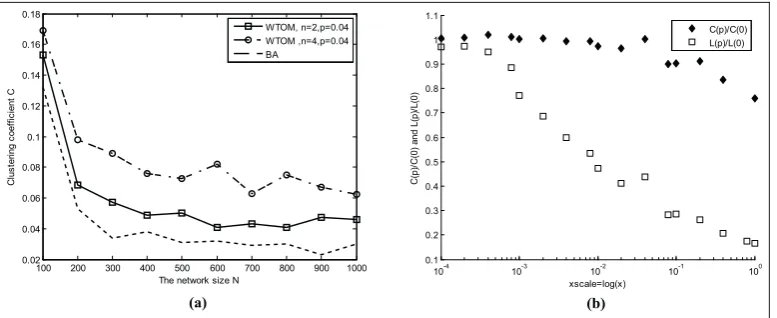
Figure 6(a) shows the fact that WTOM has a larger clustering characteristic than BA model, which contri-butes to improve the robustness in local network con-nection denoted as an invulnerability indicator in WSN and the value of clustering coefficient C (see equation (12)) increases with the initial energy of super-nodes
C¼ 1
N
X
i
2*li ki ðki1Þ
ð12Þ
Clustering coefficient of the entire network repre-sents the average interconnected probability between any pair of connected sensors and is defined as the ratio of total number of connections li to the number
of connections betweenkineighbors of sensoridivided
by the actual presence among neighbor sensors fully connected.
Figure 6(b) indicates the change processes in average path length and clustering coefficient of the network with sensors = 120 and average vertex degree = 10. We can see that when the adjusting probability of edge remains a very small value, the average path length has been substantially shortened, while the opposite branch coefficient nearly not changes in value. This means that the network state has already reflected notable char-acteristic in small-world model, that is, network struc-ture feastruc-tures ranged between random and ordered architecture show a high degree of group property in local range and a short average path length in global range.
The comparison in robust of invulnerability
The comparison with the robustness in invulnerability of WSN between WTOM (p= 0.1) and BA model is shown in Table 3, which provides the statistics result on the model-related value c(denoted by maximum num-ber of sensors belong to the maximal connection branch fraction) changing with the number of cycles.
As can be seen from Table 3, WTOM has the better robustness in network survivability compared with BA model in the course of data gathering. The main rea-sons are that the failure of WSNs is mainly caused by
100 200 300 400 500 600 700 800 900 1000 0.02
0.04 0.06 0.08 0.1 0.12 0.14 0.16 0.18
The network size N
C
lus
te
ri
ng c
o
ef
fi
c
ient
C
WTOM, n=2,p=0.04 WTOM ,n=4,p=0.04 BA
(a)
10-4 10-3 10-2 10-1 100 0.1
0.2 0.3 0.4 0.5 0.6 0.7 0.8 0.9 1 1.1
xscale=log(x)
C
(p)
/C
(0
) and L(
p)
/L
(0
)
C(p)/C(0) L(p)/L(0)
[image:10.595.99.488.71.230.2](b)
[image:10.595.51.540.322.380.2]Figure 6. Small-world characteristics: (a) clustering coefficient of WTOM and BA model (n= 2,p= 0.04;n= 4,p= 0.04) and (b) small-world characteristics in WTOM.
Table 3. Maximum connected component of branchcversus lifetime cycles.
Parameters Variety in value of parameters
Cyclesr 300 340 380 420 460 500 540 580 620 660 700
WTOM 100 100 99 97 96 94 76 49 41 32 20
BA model 100 100 91 82 73 61 49 42 33 21 10
the energy depletion node, while WTOM takes the resi-dual energy and degree distribution into consideration in topology construction procedure and also takes the protection of critical sensors into account, which con-ducts to maintain network connectivity, thereby improving the robustness of network survivability.
Comparison in network lifetime
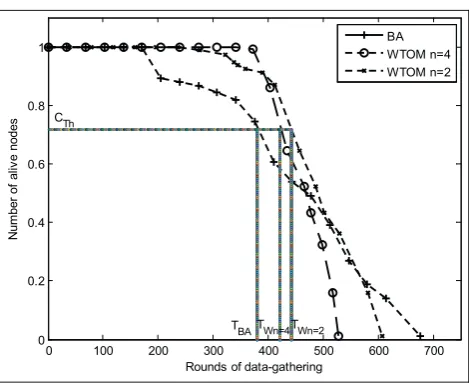
The lifetime of WSN is defined that at least 70% sen-sors are alive to support environment monitoring func-tionality in CPS service application. The lifetime is also an important index to reflect the energy efficiency of network. Figure 7 plots the average survival ratio of sensors to the number of data-gathering rounds for WTOM and BA model. The survival rate of sensors in a network can be used to evaluate the total energy con-sumption in data-gathering mechanism for CPS service. The lifetime of SDWSN is denoted as the duration of network operations (e.g. data gathering) while the sen-sors survival rate is above an application-based thresh-old (Cth2 ½0:6;0:8). In Figure 7, we setCth= 0.72 and
denote the network lifetime achieved by BA, WTOM (n= 4), and WTOM (n= 2) asTBA,TWn¼4, andTWn¼2,
respectively. We can see that TBA\TWn¼2\TWn¼4, with
WTOM achieving the highest average node survival
rate among the three schemes. This is mainly because the small-world features have been introduced into the topology evolution in WTOM, which can efficiently reduce the average path length for data routing and consequently improve the efficiency of energy utiliza-tion in WSN, which helps to prolong network lifetime. Furthermore, the energy efficiency can be further improved by increase the energy level of super-nodes in WTOM.
Table 4 shows that the network lifetime cycles should be prolonged with the more super-nodes being added into network using WTOM, which also contribute to increase the invulnerability of WSN.
The negative performance that some sensors with high node degree easily exhaust their energy leading to network fragmentation in BA model is covered by introducing small-world–based super-nodes deploy-ment and energy-aware network evolution with SDN-based mechanism in WTOM. Therefore, the overall routing performance and structure robustness of global network are optimized, which finally help to achieve energy efficiency and robustness in WSN.
Conclusion
Based on complex network theory and SDWN frame-work, an optimization WSN topology model is pro-posed to improve the invulnerability for fault tolerance, the adaptability for heterogeneity compatibility, and the energy efficiency for lifetime extendancy in WSN.
By introducing virtual force driven super-nodes deployment mechanism, redundant network resources can be reconfigured and allocated to vulnerable crucial network element, and small-world phenomenon can produced according to complex network theory–based percolation process, which can improve the survivabil-ity and energy efficiency in WSN. According to resource-driven preferential attachment mechanism in topology evolution strategy, the formed network can show the scale-free–based topology structure character-istics, which can efficiently defend against random fail-ure caused by node breakdown or network attack.
The experimental results show that compared with the original BA model, the proposed optimal network model can efficiently prolong the lifetime of WSN by reducing the amount of exchanged information
0 100 200 300 400 500 600 700 0
0.2 0.4 0.6 0.8 1
Rounds of data-gathering
N
u
m
b
er
of
al
iv
e nodes
TBAT
Wn=4TWn=2
CTh
BA
[image:11.595.62.549.89.147.2]WTOM n=4 WTOM n=2
Figure 7. Network lifetime.
Table 4. Life time versus the number of super-nodes.
Parameter Variety in the value of parameters
Probabilityp 0 0.01 0.02 0.03 0.04 0.05 0.06 0.07 0.08 0.09 0.1
Numbera 0 1 2 3 4 5 6 7 8 9 10
[image:11.595.63.298.175.367.2]benefited from SDN-based functional architecture and shortening the average path length due to small-world effects created by rational deployment of super-nodes. In terms of survivability, the invulnerability of WSN can be enhanced by the scale-free–based network topol-ogy characteristic.
Declaration of conflicting interests
The author(s) declared no potential conflicts of interest with respect to the research, authorship, and/or publication of this article.
Funding
The author(s) received no financial support for the research, authorship, and/or publication of this article.
References
1. Silva FA. Industrial wireless sensor networks: applica-tions, protocols, and standards.IEEE Ind Electron Mag
2014; 8(4): 67–68.
2. Xia F, Ma L, Dong J, et al. Network QoS management in cyber-physical systems. In:Proceedings of the interna-tional conference on embedded software and systems sym-posia (ICESS), 29–31 July 2008, pp.302–307. New York: IEEE.
3. Xia F. QoS challenges and opportunities in wireless sen-sor/actuator networks.Sensors2008; 8(2): 1099–1110. 4. Zhang D, Zhu M, Cheng H, et al. Handling
heteroge-neous device interaction in smart spaces. In: Zhang D, Portmann M, Tan A-H, et al. (eds) Ubiquitous intelli-gence and computing. Berlin: Springer, 2006, pp.250–259. 5. Huang J, Chang G, Wang C, et al. Heterogeneous flow
table distribution in software-defined networks. IEEE Trans Emerg Top Comput2016; 4(2): 252–261.
6. Zeng D, Li P, Guo S, et al. Energy minimization in multi-task software-defined sensor networks. IEEE T Comput2015; 64(11): 3128–3139.
7. Baraba´si A-L, Ravasz E and Vicsek T. Deterministic scale-free networks.Physica A2001; 299: 559–564. 8. Wang B, Tang H, Guo C, et al. Entropy optimization of
scale-free networks robustness to random failures. Phy-sica A2006; 363(2): 591–596.
9. Tian J, Yan T and Wang G. A network coding based energy efficient data backup in survivability-heterogeneous sensor networks.IEEE T Mobile Comput
2015; 14(10): 1992–2006.
10. Baraba´si A, Albert R and Jeong H. Scale-free characteris-tics of random networks: the topology of the world-wide web.Physica A2000; 281: 69–77.
11. Wang D, Liu E, Zhang Z, et al. A flow-weighted scale-free topology for wireless sensor networks. IEEE Com-mun Lett2015; 19(2): 235–238.
12. Sun K, Ning P and Wang C. Secure and resilient clock synchronization in wireless sensor networks.IEEE J Sel Area Comm2006; 24(2): 395–408.
13. Jian Y, Liu E, Zhang Z, et al. Percolation and scale-free connectivity for wireless sensor networks.IEEE Commun Lett2015; 19(4): 625–628.
14. Jiang N, Yang S, Zhou L, et al. Impact of small-world topologies on broadcasting for wireless sensor networks.
J Syst Eng Electron2009; 20(1): 192–196.
15. DeLellis P, Di Bernardo M and Garofalo F. Evolution of complex networks via edge snapping.IEEE T Circuits: I
2010; 57(8): 2132–2143.
16. Huang R, Chu X, Zhang J, et al. Energy-efficient moni-toring in software defined wireless sensor networks using reinforcement learning: a prototype.Int J Distrib Sens N
2015; 15(5): 1–12. Hindawi Publishing Corporation. 17. Ma X and Likharev KK. Global reinforcement learning
in neural networks.IEEE T Neural Networ2007; 18(2): 573–577.
18. Lee Y-F and Shen C-C. A transaction-based approach to over-the-air programming in wireless sensor networks. In:
Proceedings of the international symposium on communica-tions and information technologies (ISCIT ’07), Sydney, NSW, Australia, 17–19 October 2007, pp.1377–1382. New York: IEEE.
19. Luo T, Tan H and Quek TQS. Sensor OpenFlow: enabling software-defined wireless sensor networks.
IEEE Commun Lett2012; 16(11): 1896–1899.
20. Edelsbrunner H and Shah N. Incremental topological flipping works for regular triangulations. Algorithmica
1996; 15(3): 223–241.
21. Yang J, Zhang H, Ling Y, et al. Task allocation for wire-less sensor network using modified binary particle swarm optimization.IEEE Sens J2014; 14(3): 882–892.
22. RejinaParvin J and Vasanthanayaki C. Particle swarm optimization-based clustering by preventing residual nodes in wireless sensor networks. IEEE Sens J 2015; 15(8): 4264–4274.
23. Lee S and Younis M. Optimized relay placement to feder-ate segments in wireless sensor networks.IEEE J Sel Area Comm2010; 28(5): 742–752.
24. Bartolini N and Bongiovanni G. On the vulnerabilities of the virtual force approach to mobile sensor deployment.
IEEE T Mobile Comput2014; 13(11): 2592–2605. 25. Smirnov S. Critical percolation in the plane: conformal
invariance, Cardy’s formula, scaling limits.Cr Acad Bulg Sci2001; 333(3): 239–244.
26. Wang Y and Liu E. NLL: a complex network model with compensation for enhanced connectivity.IEEE Commun Lett2013; 17(9): 1856–1859.
27. Lomakin V, Steinberg BZ and Heyman E. Multiresolu-tion homogenizaMultiresolu-tion of field and network formulaMultiresolu-tions for multiscale laminate dielectrics labs. IEEE T Antenn Propag2003; 51(10): 2761–2777.
28. Albert R and Baraba´si A-L. Statistical mechanics of com-plex networks.Rev Mod Phys2002; 74(1): 47–97. 29. Bolloba´s B and Riordan O. Sharp thresholds and
percola-tion in the plane.Random Struct Algor2006; 29(4): 524–548. 30. Ashok Kumar R, Rao SV and Goswami D. NS3 simula-tor for a study of data center networks. In:Proceedings of the 2013 IEEE 12th international symposium on parallel and distributed computing, Bucharest, 27–30 June 2013, pp.224–231. New York: IEEE.