This is a repository copy of
Verification of BOUT++ by the method of manufactured
solutions
.
White Rose Research Online URL for this paper:
http://eprints.whiterose.ac.uk/101319/
Version: Accepted Version
Article:
Dudson, Benjamin Daniel orcid.org/0000-0002-0094-4867, Madsen, Jens, Omotani, John
Tomotaro et al. (3 more authors) (2016) Verification of BOUT++ by the method of
manufactured solutions. Physics of Plasmas. 062303. ISSN 1089-7674
https://doi.org/10.1063/1.4953429
[email protected] https://eprints.whiterose.ac.uk/ Reuse
Items deposited in White Rose Research Online are protected by copyright, with all rights reserved unless indicated otherwise. They may be downloaded and/or printed for private study, or other acts as permitted by national copyright laws. The publisher or other rights holders may allow further reproduction and re-use of the full text version. This is indicated by the licence information on the White Rose Research Online record for the item.
Takedown
If you consider content in White Rose Research Online to be in breach of UK law, please notify us by
Verification of BOUT++ by the Method of Manufactured Solutions
B.D.Dudson,1,a) J.Madsen,2 J.Omotani,3 P.Hill,1 L.Easy,1, 4 and M.Løiten2
1)York Plasma Institute, Department of Physics, University of York, Heslington,
York YO10 5DD, UK
2)Department of Physics, Technical University of Denmark, DK-2800 Kgs. Lyngby,
Denmark
3)Department of Physics, Chalmers University of Technology, SE-412 96 G¨oteborg,
Sweden
4)CCFE, Culham Science Centre, Abingdon, OX14 3DB,
UK
BOUT++ is a software package designed for solving plasma fluid models. It has
been used to simulate a wide range of plasma phenomena ranging from linear
sta-bility analysis to 3D plasma turbulence, and is capable of simulating a wide range
of drift-reduced plasma fluid and gyro-fluid models. A verification exercise has been
performed as part of a EUROfusion Enabling Research project, to rigorously test
the correctness of the algorithms implemented in BOUT++, by testing
order-of-accuracy convergence rates using the Method of Manufactured Solutions (MMS).
We present tests of individual components including time-integration and advection
schemes, non-orthogonal toroidal field-aligned coordinate systems and the shifted
metric procedure which is used to handle highly sheared grids. The Flux
Coordi-nate Independent (FCI) approach to differencing along magnetic field-lines has been
implemented in BOUT++, and is here verified using the MMS in a sheared slab
configuration. Finally we show tests of three complete models: 2-field
Hasegawa-Wakatani in 2D slab, 3-field reduced MHD in 3D field-aligned toroidal coordinates,
and 5-field reduced MHD in slab geometry.
PACS numbers: 52.25.Xz, 52.65.Kj, 52.55.Fa
I. INTRODUCTION
The BOUT++ code1,2 is an open source toolkit for the simulation of plasma models.
Its applications include the study of plasma transients including Edge Localised Modes and
filament / blob transport, and turbulence in magnetised plasma devices. Here we present a
rigorous code verification exercise3,4 of the BOUT++ core algorithms and numerical
meth-ods, using the Method of Manufactured Solutions (MMS)3,5. Code verification is a process
of checking that the chosen set of partial differential equations is solved correctly and
con-sistently, and is a purely mathematical exercise. Code verification is not concerned with
verifying that the chosen numerical methods are appropriate for the chosen set of equations.
Code verification is also not concerned with testing the ability of a given model to explain
experimental observations. This testing is dealt with in the subsequent validation process.
Code verification tests typically rely on a known solution against which to check the result
(the Method of Exact Solutions). In relatively simple geometries (e.g. slabs or cylinders)
and equations (usually linearised) an analytical solution can sometimes be found, and this
kind of test is used to verify BOUT6 and BOUT++1 as part of a test suite, run regularly
to reduce the chances of errors being introduced. The requirement that there be an
analyt-ical solution restricts the usefulness of the tests, as the code cannot be verified for realistic
geometries and problems of interest, where no such exact solution exists.
The Method of Manufactured Solutions (MMS)3,5 provides a method by which a
simu-lation code can be verified in general situations, even where analytic solutions cannot be
found. This is done by imposing a known “manufactured” solution, and adding sources to
the equations such that the manufactured solution is an exact solution to the modified set
of equations. The manufactured solution and therefore also the source can be composed of
primitive analytical functions sin, cos, tanh etc. which can be evaluated with a very high
accuracy, typically double floating point precision. The difference between the numerically
calculated solution and the “exact” manufactured solution provides the numerical error.
The scaling of the numerical error with the numerical spatial resolution is known a priori,
and hence any deviation from the theoretical scaling must be due to code inconsistencies or
errors. The MMS is a very general technique, which has been used to verify a wide range of
engineering codes, particularly in the fluid dynamics community7. MMS has been applied to
simulations9, and has recently been applied to the GBS turbulence code10and tokamak edge
simulations11.
As in10, here we focus on order-of-accuracy tests as they provide the most rigorous test of
numerical implementation4. In section II we describe in more detail the MMS procedure, and
the changes made to BOUT++ to facilitate its routine use. BOUT++ simulations typically
employ non-orthogonal curvilinear coordinate systems, which are described in section III
along with the method used to perform tests in these coordinates. Individual components of
BOUT++ are first tested independently, including time integration schemes in section IV A,
advection schemes in section IV B, and operators for wave and diffusion equations along
magnetic fields in section IV C. Coordinate systems are then tested in section IV E. In
section V complete models are tested, in which these components are combined: The
2-field Hasegawa-Wakatani model of drift-wave turbulence in section V A; a 3-2-field reduced
Magnetohydrodynamics (MHD) model in section V B; and a 5-field reduced MHD model
similar to that in10 is tested in section V C.
All source code, input files, and scripts needed to produce the figures and results in
this paper are publicly available as part of the BOUT++ development repository at
https://github.com/boutproject/BOUT-dev, revision 83c1f53. Due to automation of
the testing procedure (section II), most results and figures in this paper can be reproduced
by running a single Python script. The location of these scripts will be specified relative to
the root of the git repository.
II. TESTING FRAMEWORK
The BOUT++ code is not limited to a single set of equations, but has been developed
to allow an arbitrary number of evolving fields, and input of custom evolution equations
in a form close to mathematical notation (see1,2 for details). This flexibility presents a
challenge for verification, due to the large number of possible combinations of operators and
settings such as boundary conditions, which could be employed. Fortunately, as pointed
out in5, only mutually exclusive settings and operators need be independently tested, not
all possible combinations of options. This still requires a relatively large number of tests
to adequately cover the code components, and to verify each model. The process of MMS
to be specified in an input text file. This allows the same code to be tested with different
inputs, and new tests to be created more easily. Here we briefly outline the MMS procedure,
before describing the mechanisms implemented in BOUT++ to carry out MMS testing.
Time integration codes such as BOUT++ evolve a set of nonlinear equations for quantities
f, e.g. for a two field model evolving particle density and temperature f = {n, T}. The
system of equations is solved using the Method of Lines, and can be written in a general
form as:
∂f
∂t =F f
(1)
where F (·) is a nonlinear operator which contains discretised differential operators in the
spatial dimensions. In order to test the correctness of the numerical implementation, a
time-dependent function fM(t) is chosen (manufactured) using a combination of primitive
mathematical functions which can be evaluated to machine precision. Manufactured
solu-tions should be chosen so that they exercise all parts of the code, so should be varying in
time and all spatial dimensions. Ideally the magnitude of the terms in the equations solved
should be comparable, so that the error in one does not dominate over the others. Since
derivatives of the solution will be taken numerically, the solution should also be smooth.
Where the domain is periodic, such as toroidal angle in tokamak simulations, the
manufac-tured solutions must also be periodic in those directions. A detailed discussion of selection
criteria for manufactured solutions can be found in5.
The manufactured functionfM is now inserted into the functionF (·) and ∂fM
∂t to calculate
a source function S analytically:
S(t) = ∂f
M
∂t −F f
M
(2)
The function F (·) is typically composed of a combination of algebraic operations and
dif-ferential operators. This results in a closed analytic form for F fM
even when F(·) is
nonlinear or evaluated in non-orthogonal curvilinear coordinate systems, since fM is only
ever differentiated with respect to time and spatial coordinates, and not integrated. In some
cases F (·) contains integrals, as in the models tested in section V, where the potential φ
is calculated by integrating the vorticity. These integrals may not have a closed analytic
solution, and so in these cases a solution to the integral (potential φ) is manufactured, and
Here the symbolic packages Mathematica and the Sympy library12were used to calculate
source functions. Both can generate representations of the resulting expressions which can
be copied directly into source code or text input files. For large sets of equations such as
those in section V C this is essential in order to avoid introducing errors.
The system of equations to be solved numerically is now modified to:
∂f
∂t =F f
+S(t) (3)
so that the function fM is an exact (manufactured) solution of equation 3. Since S has
been calculated analytically, it can be evaluated to within machine precision at any desired
time, and passed to the time integration routines. At the start of the simulation t = 0
the state is set to the manufactured solution f = fM (t = 0). The simulation time is then
advanced to some later timet= ∆t, at which point the numerical solutionf is compared to
the manufactured solution fM(t = ∆t). The norm of the difference between the numerical
solution and the manufactured solution ǫ =
f−fM
at t = ∆t then gives a measure of
the error in the numerical solution, which should converge towards zero as the spatial and
temporal mesh is refined. Note that in order to obtain convergence in the solution of a
time-dependent Partial Differential Equation (PDE), both the spatial and temporal mesh
(time step) must be refined13. In general separating the spatial and temporal convergence is
non-trivial, but in section IV D we use a slightly different procedure than outlined above, to
verify spatial convergence and boundary conditions independently of temporal convergence.
Boundary conditions must also be modified for testing with the MMS. A Dirichlet
bound-ary condition on a quantity n (e.g. particle density), for example, must be modified to set
the solution equal to the time-varying manufactured solution nM on the boundary:
n(boundary) =nM(boundary, t) (4)
Similarly for Neumann boundary conditions:
∂n
∂x (boundary) = ∂nM
∂x (boundary, t) (5)
More complex boundary conditions such as sheaths, which couple multiple fields together,
can be treated by adding a source function as for the time integration equation 3. The
boundary conditions applied to all fields now become time-dependent, and must be evaluated
In order to test a numerical model using the Method of Manufactured Solutions, three
analytic function inputs are therefore required for each evolving field (e.g. density n,
tem-perature T, ...):
1. A manufactured solution
2. A source function calculated from equation 2 using a symbolic package like SymPy
3. Analytic expressions for boundary conditions
As described in2, BOUT++ contains an expression parser which evaluates analytic
expres-sions in input files. This was added as a convenient means to specify initial conditions, but
has been extended and adapted for use in MMS testing. Once MMS testing is enabled by
setting a flag in the input, BOUT++ reads a manufactured solution from the input for each
evolving variable, using it to initialise the variable and to calculate an error at each output
time; a source function is read and used to modify the time derivatives which are passed
to the time-integration code; and expressions for boundary conditions are evaluated at the
required times. All of this machinery is independent of the specific model, and in most cases
does not require any modification of the problem-specific code1. The form of the analytic
expressions is of course problem specific, but once calculated, a BOUT++ executable can
be tested using MMS and then used to perform physics simulations without recompiling,
only changing the input file. This automation of the testing process aims to lower the
bar-riers to routine testing of BOUT++ simulation models using the Method of Manufactured
Solutions.
III. COORDINATE SYSTEMS
In strongly magnetized plasmas the characteristic gradient length scales parallel to the
magnetic field are often much longer than the perpendicular length scales. This scale
sepa-ration is often exploited in numerical simulation to reduce the computational cost by using
a coarser discretisation in the direction parallel to the magnetic field. A widely used
ap-proach is to express the model equations in magnetic field-aligned, curvilinear coordinates.
1 The only code changes required for MMS testing are Laplacian inversions, which currently require some
In most previous BOUT++ simulations1 we have used the so-called ballooning coordinates.
Starting from orthogonal toroidal flux coordinates14 (ψ, θ, ζ) with radial flux-surface label
ψ, poloidal angle θ, and toroidal angle ζ, the coordinates are transformed to field-aligned
ballooning coordinates (x, y, z)15
x=ψ y=θ z =ζ−
Z θ
θ0
νdθ ν = Bζr
BθR
(6)
where Bζ and Bθ are the toroidal and poloidal magnetic field components, r is the minor
radius, R is the major radius, and ν is the local magnetic field-line pitch. Moving along y
at fixed x and z follows the path of a field-line in both θ and ζ. The covariant basis vector
(the vector between grid-points) is1:
~ex =
1 RBθ
~ˆeψ+IR~ˆeζ (7a)
~ey =
hθ
Bθ
~
B (7b)
~ez =R~ˆeζ (7c)
where~eˆare the unit vectors in the original orthogonal toroidal (ψ, θ, ζ) coordinate system,
and I =R ∂ν
∂ψdθ is the integrated shear. The magnetic field is given by B~ =∇z× ∇x, and
so the derivative along the magnetic field reduces to a simple partial derivative B~ · ∇ =
∇z × ∇x · ∇y∂y. Since fluctuations typically have long wavelengths along field-lines, a
lower resolution can be used in this parallely coordinate, with a corresponding reduction in
computational resources, both run time and memory.
In order to reduce the deformation of the coordinates caused by magnetic shear I (see
~ex in equation 7), a shifted metric method16,17 is usually used, a discussion of which can
be found in1 and more recently in18. At each y = const plane, a local coordinate system
is defined in which x and z are orthogonal. Mapping between these local coordinates and
the global field-aligned coordinates can be done using Fast Fourier Transforms (FFTs) in
the toroidal (ζ, z) direction. As implemented in BOUT++, this procedure has no effect on
differencing in the parallel direction, but differencing in x is modified by shifting quantities
inz using FFTs before calculating finite differences.
A toroidal coordinate system for MMS testing is generated by first specifying the path of
magnetic field lines in poloidal and toroidal angle. The poloidal magnetic field can then be
have relatively compact closed forms. The formula used here for the toroidal angle ζ as a
function of the radial (flux) coordinateψ and poloidal angle θ is:
ζ =q(ψ) [θ+ǫsinθ] (8)
where q(ψ) is the safety factor, which is taken to be a parabolic function of ψ varying
between 2 and 3 in sections IV E and V B. ǫ =r/R0 is the inverse aspect ratio, here taken
to beǫ= 0.1. From this, the field line pitch is calculated as
ν =q(ψ) [1 +ǫcosθ] (9)
A fixed value of the poloidal current function f =BζR and minor radius r = ǫR0 is used,
and the major radius of a field line varies asR =R0+rcosθ. Equation 9 is then rearranged
to give an expression for the poloidal field. The integrated shear is calculated from the
differential of the field-line toroidal angleζ with respect to ψ:
I =
Z θ
θ0
∂ν ∂ψdθ=
∂q(ψ)
∂ψ [1 +ǫcosθ] (10)
The resulting covariant and contravariant metric tensors have the same non-zero
pat-tern as in simulations of real devices, and elements of the covariant metric tensor vary in
both radial and poloidal coordinates15. Differencing operators parallel and perpendicular
to the magnetic field are tested in this coordinate system in section IV E, and a 3-field
electromagnetic reduced MHD model is verified in this coordinate system in section V B.
A. Flux Coordinate Independent scheme
Recently a new approach to plasma turbulence simulations has been developed18,19, and
work is ongoing to implement this scheme in several simulation codes. We have implemented
this Flux Coordinate Independent (FCI) scheme in BOUT++, enabling the development of
complex turbulence models in arbitrary magnetic geometry. By assuming that the poloidal
plane equals the plane perpendicular to the magnetic field, complex non-orthogonal
curvilin-ear field-aligned flux coordinates do not need to be used in the perpendicular direction, but
can use simple geometries (e.g. Cartesian). Here we verify that these numerical schemes
have been implemented correctly for a sheared slab geometry. Further development and
Magnetic fieldB
[image:10.612.165.447.72.269.2]Interpolation
FIG. 1. Flux Coordinate Independent (FCI) scheme. To calculate the derivative along the
mag-netic field at grid cells (large solid circles), field-lines are followed in both directions to points on
neighbouring planes of grid cells (small open circles). Values at these points are found by high-order
interpolation using nearby points (blue box).
The Flux Coordinate Independent scheme, as implemented in BOUT++, employs 3rd
-order Hermite polynomial interpolation in the plane perpendicular to the magnetic field, and
2nd-order central differencing along the magnetic field. The idea is illustrated in figure 1:
The grid is constructed to be dense in planes perpendicular to the magnetic field and sparse
along the magnetic field, since from physical arguments we expect the solutions to vary
slowly along magnetic field-lines (k|| ≪k⊥). To calculate derivatives of a quantity f along
magnetic fields, the magnetic field is first followed from each grid point onto neighbouring
planes; values of f on neighbouring planes are then interpolated onto these intersection
locations. This gives the value of f at 3 points along the magnetic field (the starting
grid point, and one point along the field in each direction), which is sufficient to calculate
second-order accurate first or second derivatives using central differencing. If higher order
derivatives are required, then the magnetic field could be followed to calculate intersections
with further planes. There are subtle issues with this scheme which will not be addressed
here, and are left to future work: the treatment of boundary conditions where magnetic
field-lines intersect material surfaces, and time-evolving magnetic fields where the mapping
efficiency of the scheme in terms of the computing time required for high-order interpolation
is also important in determining the best overall scheme to employ, and is also left to future
work.
IV. RESULTS
Since operators can be tested and verified independently (see5 and discussion in
sec-tion II), a suite of smaller tests is generally more useful than a test which combines
every-thing together. Whole models are tested in section V, but require considerable computing
resources to run, and if one of these fails then it is difficult to know where the error lies.
Tests of individual components can run in minutes on a desktop, rather than hours on a
su-percomputer, and a test failure provides better guidance as to the location of the error. The
difficulty is in the large number of tests needed to ensure coverage: Here we verify the
ma-jor components of BOUT++, including time integration schemes (section IV A), advection
operators (section IV B), central schemes for wave and diffusion equations (section IV C),
and the curvilinear coordinate system used for tokamak simulations (section IV E). Other
components, such as calculation of potential φ from vorticity, are verified as part of full
models (section V), and development of individual tests for these components is a matter of
ongoing work.
A. Time integration
Several explicit and implicit time integration schemes are implemented in BOUT++,
allowing users to choose at run-time which scheme to use. Methods tested are the Euler,
RK420, a multi-step method derived by Karniadakis et al21,22, and a third-order Strong
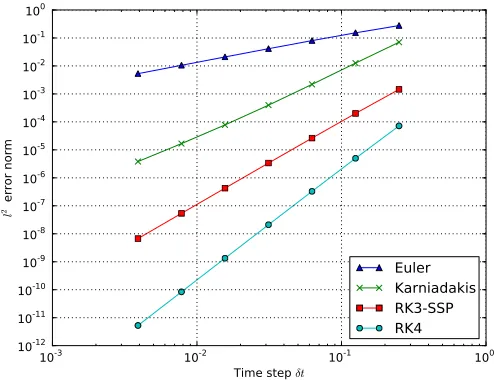
Stability Preserving Runge-Kutta method (RK3-SSP)23. Results obtained by integrating ∂f
∂t =f between t= 0 and t = 1 are shown in figure 2. Other functions such as ∂f
∂t = cos(t)
have also been tested, resulting in the same convergence rate.
The Euler, RK3-SSP and RK4 methods all reproduce their expected convergence rates
(first, third, and fourth order in δt respectively), and so can be considered verified. The
Karniadakis scheme is expected to be third order accurate, but only second order convergence
10-3 10-2 10-1 100
Time step δt
10-12
10-11
10-10
10-9
10-8
10-7
10-6
10-5
10-4
10-3
10-2
10-1
100
l
2 er
ror
no
rm
[image:12.612.174.421.88.278.2]Euler Karniadakis RK3-SSP RK4
FIG. 2. Error norm for explicit time integration schemes. Measured convergence rates based on
the two highest resolution cases are: 0.995 (Euler), 2.13 (Karniadakis), 3.00 (RK3-SSP), and 3.99
(RK4). Script:examples/MMS/time/runtest
At each step the value of f and its time derivative at two previous timesteps are required,
and so to start the simulation these previous steps are constructed using Euler’s method.
This results in an O(δt2) error, reducing the overall convergence to second order in δt.
Time integration in BOUT++ simulations is typically done using implicit adaptive
Jacobian-Free Newton Krylov (JFNK) schemes, provided by either the SUite of
Nonlin-ear and Differential/ALgebraic equation Solvers (SUNDIALS24) or the Portable, Extensible
Toolkit for Scientific Computation (PETSc25,26). These use adaptive order and adaptive
timesteps in order to achieve a user-specified tolerance, and so are difficult to validate using
the MMS method. Here we take as given that the time integration methods in these libraries
are implemented correctly, and use SUNDIALS for time integration in the remainder of this
paper with a relative tolerance of 10−8 and absolute tolerance of 10−12. These small
toler-ances are used so that the spatial discretisation error we are interested in dominates over
B. Advection schemes
A key component of drift-reduced plasma simulations are operators for drifts across
mag-netic field-lines. These can be written in the form of an advection equation, or as a Poisson
bracket. For example the E ×B drift of a scalar quantity f (e.g. density), due to an
electrostatic potential φ is:
∂f
∂t =−
1
B~b× ∇φ· ∇f =−[φ, f] (11)
Several schemes for calculating the Poisson bracket using both finite difference and finite
volume discretizations are implemented in BOUT++. Some of these preserve the symmetries
of the Poisson bracket (e.g. second order Arakawa27), whilst others are designed to handle
shocks and discontinuities robustly (e.g. WENO28,29). As with time integration schemes,
users can switch between these methods at run-time. In order to test advection schemes, we
simulate a single scalar field f advected by Poisson bracket using an imposed potential φ:
∂f
∂t =−[φ, f]−H·δx
4∇4
⊥f (12)
where H is a hyper-diffusion constant, δx is the mesh spacing, and the ∇4
⊥ operator is
calculated using second-order central differences. The manufactured solutions were chosen
to be:
f = cos 4x2+z
+ sin (t) sin (3x+ 2z) (13)
φ= sin 6x2−z
(14)
where the coordinates perpendicular to the magnetic field are normalised such that 0≤x≤1
and 0 ≤ z ≤ 2π. This solution varies smoothly in both x and z, and in time. Note that
the WENO scheme is a limiter scheme, which adapts its stencils depending on the local
gradients, and this functionality is not properly tested here. Limiter and other adaptive
schemes reduce accuracy in steep gradient regions in order to reduce or eliminate overshoot
oscillations. This presents a challenge for MMS testing of convergence order, and as far as
we are aware there is no accepted means of fully verifying these schemes using the MMS.
Advection schemes require some form of dissipation at the grid scale, in order to avoid
numerical oscillations. In the upwind and WENO schemes this dissipation is provided by
Arakawa have low dissipation, and require additional dissipation to stabilise the solution,
either physically motivated or numerical. Since there is no other dissipation in this toy
problem, a 4th-order hyper-diffusion term is added to equation 12, with a coefficientHwhich
converges to zero at δx4 for grid spacing δx. Without this dissipation term convergence is
typically reduced to first order, and becomes dependent on the integration time due to the
growth of numerical oscillations. When dissipation with H = 20 is included, the results are
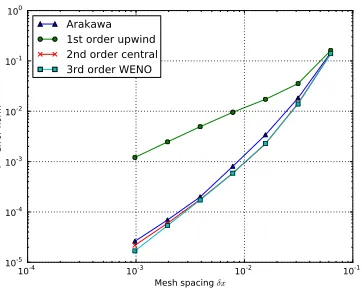
shown in figure 3.
10-4 10-3 10-2 10-1
Mesh spacing δx
10-6 10-5 10-4 10-3 10-2 10-1 l
2 err
or
no
rm
Arakawa 1st order upwind 2nd order central 3rd order WENO
(a)l2 (RMS) error norm
10-4 10-3 10-2 10-1
Mesh spacing δx
10-5 10-4 10-3 10-2 10-1 100 l
∞ er
ror
no
rm
Arakawa 1st order upwind 2nd order central 3rd order WENO
(b)l∞
[image:14.612.323.504.231.377.2](maximum) error norm
FIG. 3. MMS test of advection operators. Equation 12 is solved on a 2D domain with
uniform grid spacing. The resolution varies from 16 × 16 to 1024 × 1024. Convergence
rates for second-order Arakawa (1.998), 1st-order upwind (0.993), 2nd-order central
differenc-ing (2.005), and 3rd-order WENO (2.019). All methods are limited to at best second-order
in mesh spacing δx due to the central differencing applied to φ and the boundary conditions.
Script:examples/MMS/advection/runtest
Both global error and local error are found to converge at the expected rate in the
asymptotic (small δx regime, as measured by the l2 (RMS) error in figure 3(a), and thel∞
(maximum) error in figure 3(b) respectively. Apart from the first order upwind scheme, all
schemes converge at second order in grid spacing δx: The WENO scheme is formally third
order accurate in the bulk of the domain, but the advection velocity is calculated from φ
using 2nd-order central differences, and boundary conditions are only second-order accurate,
reducing the overall convergence rate to second order. The WENO scheme implementation
cannot therefore be considered fully verified, and as noted above the verification of limiter
C. Schemes for wave equations
Along the magnetic field methods are implemented which model wave propagation, such
as sound and shear Alfv´en waves, and diffusion processes such as heat conductivity. Wave
propagation operators often appear in the form of coupled first order equations:
∂f
∂t =
∂g ∂x
∂g
∂t =
∂f
∂x (15)
The manufactured solution was chosen to be
f = 0.9 + 0.9x+ 0.2 cos(10t) sin(5x2)
g = 0.9 + 0.7x+ 0.2 cos(7t) sin(2x2)
and the equations are solved using staggered 2nd-order central differencing: Variable g was
shifted to the cell boundaries, whilstf was cell centred. This arrangement requires different
handling of boundary conditions to account for this shift. To test boundary conditions and
handling of staggered variables, this test was performed in xand then iny(replacingxwith
y/2π in the above manufactured solutions).
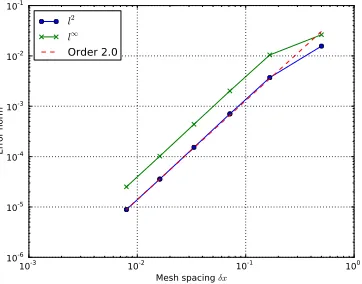
Results of a convergence test are shown in figure 4, which shows the l2 (RMS) and
l∞ (maximum) error norms for quantity f as a function of the mesh spacing δx. This
shows convergence at an order around 1.97, as expected for this scheme. This test has
been conducted with combinations of Dirichlet and Neumann boundary conditions, finding
essentially the same result in all cases.
10-3 10-2 10-1 100
Mesh spacing δx
10-6 10-5 10-4 10-3 10-2 10-1
Error norm
l2
l∞
[image:15.612.212.393.520.662.2]Order 2.0
FIG. 4. Error norms forf in wave equation 15 using 2nd-order central differencing. A convergence
D. Second derivative operators
In order to verify the second derivative (diffusive) operators and boundary conditions,
a series of tests have been performed: First we verify the spatial convergence rate towards
a steady state (independent) manufactured solution; and then we verify using a
time-dependent manufactured solution.
1. Steady-state manufactured solution
In order to verify spatial convergence for time-dependent systems of equations, the
ap-proach taken in5 is to evolve the equations towards a steady-state solution. Here we use this
approach to verify boundary conditions and second-order operators by solving the equation:
∂f
∂t =
∂2f
∂x2 +S (16)
The manufactured solution is chosen to be
fM = 0.9 + 0.9x+ 0.2 sin 5x2
(17)
in the range 0 ≤ x ≤ 1 i.e. boundaries are at x = 0 and x = 1. The source function is
therefore:
S = 20x2sin 5x2
−2 cos 5x2
(18)
In contrast to the time-dependent MMS tests presented in this paper, for this steady-state
problem we initialise the simulation at t = 0 with f = 0, and not the exact manufactured
solution. This is suggested by5 since even though this increases the number of iterations
to convergence, using the exact solution can hide coding mistakes. Equation 16 was then
integrated in time to t = 10 using an absolute tolerance of 10−15 and relative tolerance of
10−7. This is a sufficiently long time that f reaches a steady state to within tolerances.
Results are listed in table I, showingl2 andl∞ errors and convergence rates. We first
per-form the test with Dirichlet boundary conditions, then with mixed Dirichlet and Neumann
TABLE I. Error norms and convergence rates for integration of equation 19 as a function of number
of grid pointsN. Shown are cases with Dirichlet boundary conditions, then with one Dirichlet and
one Neumann boundary (mixed).
Dirichlet Mixed
N l2 Rate l∞ Rate l2 Rate l∞ Rate
8 2.624e-02 6.088e-02 3.504e-02 6.317e-02
16 4.332e-03 2.126 1.227e-02 1.890 5.514e-03 2.182 1.242e-02 1.919
32 9.224e-04 2.030 2.720e-03 1.978 1.165e-03 2.039 2.733e-03 1.986
64 2.149e-04 2.007 6.400e-04 1.993 2.712e-04 2.009 6.415e-04 1.997
128 5.199e-05 2.001 1.552e-04 1.997 6.554e-05 2.003 1.554e-04 1.999
256 1.271e-05 2.009 3.822e-05 1.999 1.607e-05 2.005 3.825e-05 2.000
512 3.395e-06 1.894 9.572e-06 1.986 4.000e-06 1.996 9.488e-06 2.000
2. Time-dependent manufactured solution
Diffusion equations in all three dimensions, separately and in combination, have been
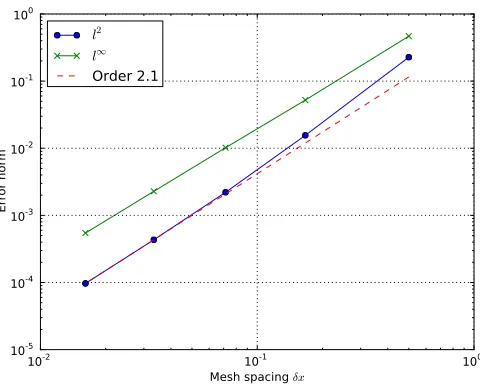
verified, with convergence for one example shown in figure 5. The equation solved is
∂f
∂t =∇
2f (19)
which is solved using 2nd-order central differences on a uniform grid. In 3D the
manufacu-tured solution used was
f = 0.9 + 0.9x+ 0.2 cos (10t) sin 5x2−2z
+ cos (y) (20)
in the range 0 ≤ x ≤ 1; 0 ≤ y ≤ 2π and 0 ≤ z ≤ 2π. Results for a uniform 3D grid are
shown in figure 5, showing convergence at the expected order.
These tests confirm that these simple operators and the Dirichlet and Neumann boundary
conditions have been implemented correctly for uniform orthogonal grids. More complicated
geometries are tested in the next section, but the advantage of these simple tests is that
they run in under a minute on a desktop and so are now included in the standard BOUT++
10-2 10-1 100
Mesh spacing δx
10-5
10-4
10-3
10-2
10-1
100
Error norm
[image:18.612.180.420.86.279.2]l2 l∞ Order 2.1
FIG. 5. Error norms for diffusion equation 19 in 3D on a uniform grid as a function of grid spacing
δx, showing convergence with an order of 2.06. Script:examples/MMS/diffusion2/runtest
E. Coordinate systems
The field-aligned coordinate system used for tokamak simulations has been tested using
the analytic input mesh described in section III. The manufactured solution was
f = cos 4x4+ζ−θ
+ sin (t) sin (3x+ 2ζ−θ) (21)
wherex=ψ/∆ψis a normalised radial coordinate with a range between 0 and 1. The safety
factor was chosen to beq= 2 +x2, and inverse aspect ratioǫ= 0.1. Following the procedure
outlined in section III, this results in toroidal and poloidal magnetic field components:
Bζ =
1
1−0.1 cos (θ) (22a)
Bθ =
0.1 (x2+ 2) [1−0.1 cos (θ)]2
(1 + 0.1 cos (θ)) (22b)
and integrated shear
I = 1125x[θ+ 0.1 sin (θ)] (23)
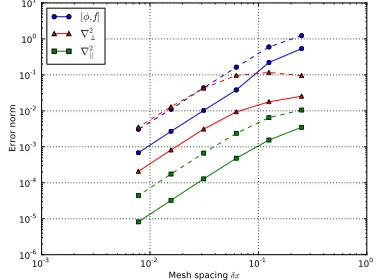
Results are shown in figure 6 for a range of resolutions from 43 to 1283, showing
con-vergence of the Arakawa bracket operator [φ, f], a perpendicular diffusion operator ∇2
⊥,
and parallel diffusion operator ∇2
||. Tests in both ballooning coordinates (equations 6,
to verifying these operators in non-orthogonal curvilinear coordinates, this test exercises the
twist-shift matching used to close field-lines in the core region of tokamak simulations, and
the calculation of radial derivatives in the shifted metric scheme. Note that in figures 6(a)
and 6(b) the parallel diffusion operator∇2
|| results are identical, as the use of shifted metrics
does not affect derivatives in the parallel direction (see section III).
10-3 10-2 10-1 100
Mesh spacing δx
10-6 10-5 10-4 10-3 10-2 10-1 100 101 Error norm [φ,f] ∇2 ∇2 ||
(a)Ballooning coordinates. Convergence rates for
Arakawa bracket (2.03); perpendicular diffusion
operator (1.97); and parallel diffusion operator
(1.99)
10-3 10-2 10-1 100
Mesh spacing δx
10-6 10-5 10-4 10-3 10-2 10-1 100 101 Error norm [φ,f] ∇2 ∇2 ||
(b)Shifted metric method. Convergence rates for
Arakawa bracket (2.07); perpendicular diffusion
operator (1.98); and parallel diffusion operator
[image:19.612.316.504.194.334.2](1.99)
FIG. 6. Verification of operators in toroidal field-aligned coordinates. Coordinate system and input
described in section III. Script:examples/MMS/tokamak/runtest
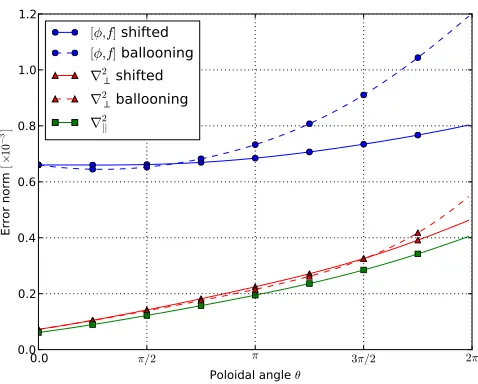
For this test case the reference poloidal angle θ0 in equation 10 was set to zero, so I = 0
atθ= 0. At θ= 0 thex−z mesh is therefore orthogonal, and there is no difference between
ballooning and shifted metric results in figure 7 at this location in θ. Moving away from
θ = 0 thex−z mesh becomes increasingly deformed, and differences between the ballooning
and shifted-metric procedures become apparent. As expected, the error norm is largest close
toθ = 2π where the mesh is most sheared, and the error at this point is reduced significantly
by using the shifted metric procedure. The shifted metric method is however not always
more accurate than the ballooning coordinate method, as shown for the advection operator
aroundθ =π/4 in figure 7, where the ballooning coordinates are more accurate: In general
the accuracy of these methods will depend on the solution. It has been found in simulations
of Edge Localised Modes with BOUT++30,31, that the use of the shifted metric method
0.0 π/2 π 3π/2 2π
Poloidal angle θ
0.0 0.2 0.4 0.6 0.8 1.0 1.2
Err
or
no
rm
[×
10
−
3]
[φ,f] shifted [φ,f] ballooning
∇2 shifted ∇2 ballooning ∇2
[image:20.612.181.420.86.278.2]||
FIG. 7. Comparison of RMS error norm for ballooning (dashed lines) and shifted-metric scheme
(solid lines), as function of poloidal angle θ, for the highest resolution case in figure 6 (1283 grid
points). Integrated shear I (equation 10) is zero atθ= 0, and a maximum atθ= 2π.
abruptly. This coordinate system is used in section V B to verify the 3-field equations used
for ELM simulations.
F. Flux Coordinate Independent scheme
To verify the interpolation and central differencing schemes implemented in BOUT++
for FCI coordinates, we simulate a wave (equation 15) in a sheared slab. On each x−z
plane perpendicular to the magnetic field a Cartesian mesh is used, and the magnetic field
is sheared so that the points to be interpolated (small open circles in figure 1) span a range
of locations between neighbouring grid points.
A sheared slab of size Ly = 10m along the magnetic field; Lx = 0.1m in the
ra-dial direction, and Lz = 1m in the binormal direction was used, with magnetic field
(Bx, By, Bz) = (0,1,0.05 + (x−0.05)/10). The variation of the magnetic field-line pitch
with x therefore ensures that the interpolation location varies so as to test the 3rd-order
Hermite interpolation scheme. The manufactured solution used was
f = sin (y−z) + cos (t) sin (y−2z) (24a)
whereyand z are normalised to be between 0 and 2π in the domain (as in all manufactured
solutions presented here).
10-3 10-2 10-1 100
Mesh spacing δx
10-4
10-3
10-2
10-1
100
Error norm
[image:21.612.179.420.137.328.2]f g
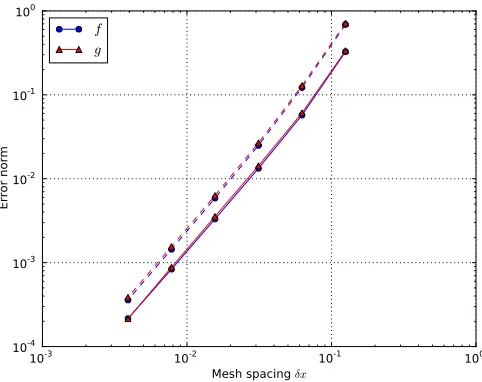
FIG. 8. Convergence of f (1.95) and g (2.04) in equation 15 solved using the FCI method in
a sheared slab. Solid lines show l2 (RMS) error, whilst dashed lines show l∞ (maximum) error.
Script:examples/fci-slab/runtest
Figure 8 shows the error norm as the resolution in both parallel and perpendicular
direc-tions is varied. This shows second-order convergence, most likely limited by the accuracy of
the second-order central differencing scheme used to calculate parallel derivatives. Note that
in order to obtain good convergence, it was necessary to stabilise the collocated scheme, by
adding a parallel diffusion term of the formδx2∂2
|| to each equation. This has been previously
discussed in the context of MMS testing of collocated numerical schemes in5.
V. MODELS
After verification of individual operators, the MMS technique is now applied to the
ver-ification of entire models, which combine operators and couple multiple fields. Here three
models of interest are verified: the 2-field Hasegawa-Wakatani system (section V A), a
3-field reduced MHD model which has been used extensively to simulate Edge Localised Modes
(ELMs) with BOUT++ (section V B), and a 5-field cold-ion model for tokamak edge
Due to the large number of models which have been implemented in BOUT++, we have
introduced a naming scheme which can be used in future publications to refer to a specific
model. A scheme BOUT++/name/year such as BOUT++/HW/2014 is used here.
A. Hasegawa-Wakatani (BOUT++/HW/2014)
The Hasegawa-Wakatani model is a good starting place as it contains many of the
ele-ments of more complicated models, such as Poisson brackets, diffusion, and calculation of
electrostatic potential from vorticity, whilst being 2-D and faster to run than 3D models
at high resolutions. As such, it often forms a starting point for the construction of more
complex models. The equations solved are for plasma density n and vorticityω =~b0· ∇ ×~v
where~v is the E×B drift velocity in a constant magnetic field, and~b0 is the unit vector in
the direction of the equilibrium magnetic field:
∂n
∂t =−[φ, n] +α(φ−n)−κ ∂φ
∂z +Dn∇
2
⊥n (25a)
∂ω
∂t =−[φ, ω] +α(φ−n) +Dω∇
2
⊥ω (25b)
∇2⊥φ=ω (25c)
The manufactured solutions were chosen to be
n = 0.9 + 0.9x+ 0.2 cos (10t) sin 5x2−2z
(26a)
ω = 0.9 + 0.7x+ 0.2 cos (7t) sin 2x2−3z
(26b)
φ = sin (πx)
0.5x−cos (7t) sin 3x2−3z
(26c)
along with parameters
α = 1 κ= 1
2 Dn= 1 Dω = 1 (27)
These parameters were chosen so that the magnitude of each term in equations 25 was
comparable; in a realistic simulation the parameters might be different, in particular the
diffusion terms Dn,ω would generally be smaller than is used here. This does not present
a problem for verification, since the correctness of the numerical method implementation
does not depend on these parameters. If the code is correct with Dn = 1 then it will
with arbitrary parameters, and in general the required resolutions and stability critera (e.g.
maximum timestep) will be problem specific.
Note that the solution for both vorticity ω and potentialφare manufactured, despite the
two quantities being related through the vorticity equation 25c. This avoids integration of
manufactured solutions, and is handled by adding an analytic source term to the right hand
side of equation 25c.
Results are shown in figure 9, calculated on a 2D unit domain, showing the l2 and l∞
norms over bothn and ω, and a fit showing second order convergence. This shows that the
10-3 10-2 10-1
Mesh spacing δx
10-5
10-4
10-3
10-2
10-1
Error norm
[image:23.612.179.420.263.453.2]l2 l∞ Order 2.0
FIG. 9. Error norm of Hasegawa-Wakatani system (n and φ, equations 25) on a Cartesian
mesh, showing second-order convergence. Mesh resolutions range from 16× 16 to 512×512.
Script:examples/MMS/hw/runtest
operators in equation 25 including the inversion of potentialφ from vorticityω are correctly
implemented, at least on orthogonal uniform grids. We now proceed to test these operators
in toroidal field-aligned coordinate systems typical of realistic BOUT++ simulations.
B. 3-field reduced MHD (BOUT++/FLUID3/2014)
The 3-field model used for ELM simulations1,30,31has been verified in field-aligned toroidal
geometry with a radially varying safety factor q, using the shifted metric coordinate system
implemented in BOUT++ in coordinate systems with a non-trivial metric tensor.
The equations evolved are for vorticity ω = ~b0 · ∇ × ~v, pressure p, and the parallel
component of the magnetic vector potential A|| =~b0 ·A, where~ ~b0 = ~ B0
|B~0|;
~
B0 is the unit
vector along the equilibrium magnetic field B~0, and B0 = ~ B0
is the magnitude of the
magnetic field
ρ0
dω
dt =B
2 0∂||
J||
B0
+ 2~b0×~κ0· ∇p (28a)
∂A||
∂t =−∂||φ−ηJ|| (28b)
dp
dt =−
1 B0
~b0× ∇φ· ∇p0 (28c)
ω = 1
B0
∇2⊥φ (28d)
J|| =J||0−
1 µ0
∇2⊥A|| (28e)
where the parallel derivative includes the perturbed magnetic field:
∂|| =~b0· ∇ −
1 B0
~b0× ∇A||· ∇ (29)
where ’0’ subscripts denote equilibrium (starting) quantities: ρ0 is the (constant) density;
~
B0 the magnetic field;κ0 =
~b0· ∇
~b is the field-line curvature. The electrostatic potential φ is calculated from the vorticity by inverting a perpendicular Laplacian (with Dirichlet
boundary conditions here), and the parallel current J||=~b0·J~is calculated from the vector
potential. The convective derivative is defined as
d dt = ∂ ∂t+ 1 B0
~b0× ∇φ· ∇ (30)
Background (equilibrium) profiles are chosen to mimic realistic cases, with a pedestal-like
pressure profileP0, and a parallel current profileJ0which peaks on the outboard and inboard
midplanes:
P0/P = 2 + cos (πx) J0/J = 1−x+ sin2(πx) cos (θ) (31)
wherexis the normalised radial coordinate, which lies between 0 and 1, andθ is the poloidal
angle, which lies between 0 and 2π. Normalisation parameters are
ne= 1019 m−3 Te= 3 eV L= 1m B = 1T (32)
The manufactured solutions used were:
φ=
sin (z−x+t) + 10−3cos (y−z)
sin (2πx) (33a)
ψ = 10−4cos 4x2+z−y
(33b)
U = 2 sin (2t) cos (x−z+ 4y) (33c)
P = 1 + 1
2cos (t) cos 3x
2 −2z
+ 5×10⁻³sin (y−z) sin (t) (33d)
A Lundquist number of S = 10 was used to set the resistivity η. This is so that the
resistive term in Ohm’s law (equation 28b) becomes comparable to the other terms, and
S is much smaller (higher η) than would be the case in a realistic tokamak simulation, for
which S = 108 would be more typical.
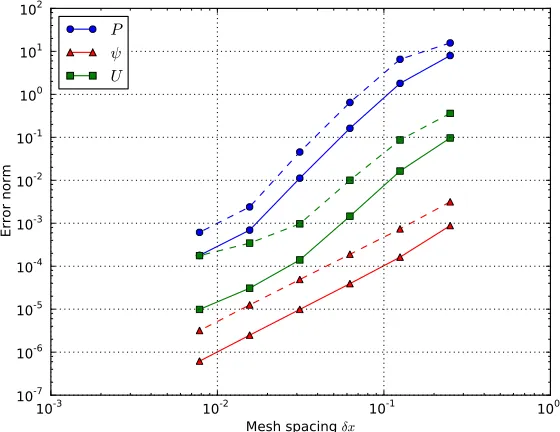
Results are shown in figure 10, with the l2 and l∞ norms shown for each evolving
vari-able (P, ψ, U). The slow convergence at large mesh spacing (small resolution) is due to the
10-3 10-2 10-1 100 Mesh spacing δx
10-7 10-6 10-5 10-4 10-3 10-2 10-1 100 101 102
Error norm
[image:25.612.165.445.342.558.2]P ψ U
FIG. 10. Error norms for 3-field set of equations. Solid lines show the l2 (RMS) error norms,
whilst dashed lines are the l∞ (maximum) error. Convergence orders for pressure p is 1.95;
vorticity ω is 1.64; and vector potential A|| is 2.01. Resolutions range from 43 to 1283.
Sc-tript:examples/MMS/elm-pb/runtest
solutions being under-resolved: the smallest grids have only 4 grid points in each dimension,
insufficient to resolve the manufactured solution. At high resolution the pressure and
at a rate between first and second order. The maximum (l∞) error in vorticity converges
at close to 1st order at high resolution, indicating that the source of this slow convergence
is an order 1 error on a sub-set of the domain, so that when averaged over the domain the
RMS (l2) error converges at a faster rate than the maximum error. The location of the error
maximum at high resolution is at the radial boundary, but the reason for this is not yet clear
despite extensive investigation. Here we conclude that although the model does converge,
it does not converge at the expected rate, and further investigation is needed.
C. BOUT++/FLUID5/2014
Finally, the set of equations implemented in the Global Braginskii Solver (GBS) code32
have been implemented in BOUT++ and verified in a simplified form using the Method of
Manufactured Solutions. In this current work electromagnetic effects and ion viscosity terms
ω, Ohm’s law, and parallel ion velocityV||i:
∂n
∂t =−
R ρs0
1
B [φ, n] + 2n
B
C(Te) +
T
nC(n)−C(φ)
−n~b· ∇V||e−V||e
~b· ∇n+D(n) +S (34a)
∂Te
∂t =−
R ρs0
1
B [φ, Te]−V||e
~b· ∇Te
+4 3 Te B 7
2C(Te) + Te
n C(n)−C(φ)
+2Te 3
"
0.71~b· ∇V||i−1.71
~b· ∇V||e
+0.71 V||i−V||e
n
~b· ∇n
#
+DTe(Te) +D
||
Te(Te) +ST (34b)
∂ω
∂t =−
R ρs0
1
B [φ, ω]−V||i
~b· ∇ω
+B2
"
~b· ∇ V||i−V||e
+ V||i −V||e
n
~b· ∇n
#
+2B
C(Te) +
Te
nC(n)
+Dω(ω) (34c)
∂V||e
∂t =−
R ρs0
1 B
φ, V||e
−V||e
~b· ∇V||e
− mi
me
ν V||e−V||i
+ mi me
~b· ∇φ
− miTe
nme
~b· ∇n−1.71mi me
~b· ∇Te+DV||e V||e
(34d)
∂V||i
∂t =−
R ρs0
1 B
φ, V||i
−V||i
~b· ∇V||i
−~b· ∇Te+
Te
n
~b· ∇n+DV||i V||i
(34e)
where
ρs0 =
Cs0
Ωci
Cs0 = s
eTe
mi
Ωci=
eB mi
(35)
with vorticity and the curvature operator defined as
ω =∇2⊥φ C(A) = B
2 ∇ ×
~b B
!
Here the dissipation operators D(·) were hyper-diffusion terms in the plane perpendicular
to the magnetic field of the form:
D(f) =−δx4∂
4f
∂x4 −δz 4∂4f
∂z4 (37)
In order to test all terms in this set of equations, the parameters of the simulation should
be chosen so that the magnitude of each term is of a similar order of magnitude. If this is
not done, then the error in the result will be dominated by a small number of operators,
and mistakes in the implementation of small terms may not become apparent until very
high (possibly impractical) resolution is reached. In order to handle the large number of
terms in equations 34a-34e, the magnitude of each term was estimated using SymPy by
replacing trigonometric functions sin (·) and cos (·) by their maximum value (1), and the
coordinates (x, θ, ζ) by their maximum values (1,2π,2π). This allowed parameters to be
quickly adjusted to find useful regimes. The resulting manufactured solutions are:
n= 0.9 + 0.9x+ 0.5 cos (t) sin 5x2−z
+ 0.01∗sin (y−z) (38a)
Te = 1 + 0.5 cos (t) cos 3x2 −2z
+ 0.005 sin (y−z) sin (t) (38b)
ω = 2 sin (2t) cos (x−z+ 4y) (38c)
Ve = cos (1.5t)
2 sin (x−0.5)2+z
+ 0.05 cos 3x2+y−z
(38d)
Vi =−0.01 cos (7t) cos 3x2+ 2y−2z
(38e)
φ= [sin (z−x+t) + 0.001 cos (y−z)] sin (2πx) (38f)
Parameters used were:
Te= 3eV ne = 1019m−3 B = 0.1T mi = 0.1mp (39)
wheremp is the mass of the proton. Light ions were used in order to reduce the difference in
timescales between electrons and ion dynamics. Note that the manufactured solutions and
parameters are not required to be realistic, provided that they do not violate any constraints
such as positivity of density and temperature, as discussed in section II.
Simulations were performed in a 3D slab geometry, with resulting error norms shown in
figure 11. In this geometry the curvature polarisation vector ∇ × B~b is set to a constant in
the z (binormal) direction. All fields show convergence at the expected rate, approximately
2nd-order in mesh spacingδx. This demonstrates that complex models can be verified using
10-3 10-2 10-1 100 Mesh spacing δx
10-6 10-5 10-4 10-3 10-2 10-1 100
Error norm
[image:29.612.166.444.71.290.2]Ne
Te
Vort
VePsi
Vi
FIG. 11. Error norms for 5-field set of equations. Solid lines show thel2(RMS) error norms, whilst
dashed lines are the l∞ (maximum) error. Convergence orders for density Ne is 2.02; electron
temperatue Te is 2.70; Vorticity ω is 2.04; Electron parallel velocity Ve is 2.36; and ion velocityVi
is 2.42. Resolutions range from 83 to 1283. Script:examples/MMS/GBS/runtest-slab3d
VI. CONCLUSIONS AND DISCUSSION
The Method of Manufactured solutions has been used to rigorously test numerical
meth-ods implemented in BOUT++, both independently as unit tests, and in combination as
simulation models. Convergence to the correct solution at an asymptotic 2nd order has been
demonstrated for large sub-sets of the BOUT++ framework: Though higher order methods
(3rd-order WENO and 4th-order central differencing) are implemented in BOUT++, the
overall convergence rate is limited to 2nd order by the boundary conditions.
Mechanisms have been implemented into BOUT++, which simplify and partly automate
the process of verifying the correctness of a numerical implementation, requiring minimal
modifications to the code between production simulations and verification runs. This will
facilitate the routine use of the MMS as an increasing variety of models are implemented
in BOUT++. Since code verification is an ongoing process, particularly for an actively
developed scientific code such as BOUT++, the methods and tests detailed here are now
used as part of a test suite which is run routinely and automatically (using Travis-CI) to
It is important to note the limitations of the present work, which will be the subject
of further development. Whilst curvilinear coordinates in tokamak geometry with varying
safety factor have been verified, no tests have yet been performed in X-point geometry.
The Flux Coordinate Independent (FCI) scheme has been implemented in BOUT++, but
only tested in sheared slab geometry. Investigation of methods for simulations of X-point
geometry, including FCI, and verification with MMS will be the subject of future work.
ACKNOWLEDGMENTS
This work has been carried out within the framework of the EUROfusion Consortium
and has received funding from the Euratom research and training programme 2014-2018
under grant agreement No 633053. The views and opinions expressed herein do not
nec-essarily reflect those of the European Commission. The authors gratefully acknowledge
the support of the UK Engineering and Physical Sciences Research Council (EPSRC)
un-der grant EP/K006940/1, and Archer computing resources unun-der Plasma HEC consortium
grant EP/L000237/1.
REFERENCES
1B D Dudson, M V Umansky, X Q Xu, P B Snyder, and H R Wilson. Comp. Phys. Comm.,
180:1467–1480, 2009.
2B D Dudson, A Allen, G Breyiannis, E Brugger, J Buchanan, L Easy, S Farley,
I Joseph, M Kim, A D McGannn, J T Omotani, and M V Umansky. J. Plasma Phys.,
81(01):365810104, 2015. doi:10.1017/S0022377814000816.
3P J Roache. Verification and Validation in Computational Science and Engineering.
Her-mosa Publishers, Albuquerque NM, 1998.
4W L Oberkampf and C J Roy. Verification and Validation in Scientific Computing.
Cam-bridge University Press, New York, NY, USA, 2010.
5K Salari and P Knupp. Code verification by the method of manufactured solutions.
Tech-nical Report SAND2000-1444, Sandia National Laboratories, 2000.
6M V Umansky, R H Cohen, L L LoDestro, and X Q Xu. Contrib. Plasma Phys.,
7C J Roy, C C Nelson, T M Smith, and C C Ober. Int. J. Num. Methods in Fluids,
44(6):599–620, 2004.
8D Kalupin, V Basiuk, D Coster, Ph Huynh, L L Alves, Th Aniel, J F Artaud, J P S
Bizarro, C Boulbe, R Coelho, D Farina, B Faugeras, J Ferreira, A Figueiredo, L Figini,
K Gal, L Garzotti, F Imbeaux, I Ivanova-Stanik, T Jonsson, C J Konz, E Nardon, S Nowak,
G Pereverzev, O Sauter, B Scott, M Schneider, R Stankiewicz, P Strand, I Voitsekhovitch,
ITM-TF contributors, and JET-EFDA Contributors. InEurophysics Conference Abstracts
(Proc. of the 35th EPS Conference on Plasma Physics, Hersonissos, Crete, 2008), volume
32D, pages P–5.027, 2008.
9C S Chang, S Ku, P Diamond, M Adams, R Barreto, Y Chen, J Cummings, E D’Azevedo,
G Dif-Pradalier, S Ethier, L Greengard, T S Hahm, F Hinton, D Keyes, S Klasky, Z Lin,
J Lofstead, G Park, S Parker, N Podhorszki, K Schwan, A Shoshani, D Silver, M Wolf,
P Worley, H Weitzner, E Yoon, and D Zorin. J. Phys.: Conf. Ser., 180:012057, 2009.
10F Riva, P Ricci, F D Halpern, S Jolliet, J Loizu, and A Mosetto. Physics of Plasmas,
21:062301, 2014.
11C Michoski, D Meyerson, T Isaac, and F Waelbroeck. Discontinuous galerkin methods for
plasma physics in the scrape-off layer of tokamaks. J. Comput. Phys., 274:898–919, 2014.
12SymPy Development Team. SymPy: Python library for symbolic mathematics, 2014.
13R LeVeque. Finite Difference Methods for Ordinary and Partial Differential Equations.
SIAM, 2007.
14W D Haeseler. Flux Coordinates and Magnetic Field Structure. Springer, 1991.
15X Q Xu, M V Umansky, B Dudson, and P B Snyder. Boundary plasma turbulence
simulations for tokamaks. Comm. in Comput. Phys., 4(5):pp. 949–979, November 2008.
16A M Dimits. Phys. Rev. E, 48(5):4070–4079, Nov 1993.
17B Scott. Physics of Plasmas, 8(2):447, 2001.
18F Hariri and M Ottaviani. Comp. Phys. Comm., 184(11):2419–2429, 2013.
19A Stegmeir, D Coster, O Maj, and K Lackner. Contrib. Plasma Phys., 54:549–554, 2014.
20Areih Iserles. A First Course in the Numerical Analysis of Differential Equations.
Cam-bridge University Press, 2009. ISBN: 978-0-521-73490-5.
21G E Karniadakis, M Israeli, and S A Orszag. J. Comput. Phys., 97:414, 1991.
22B D Scott. GEM - an energy conserving electromagnetic gyrofluid model. arXiv:physics,
23S Gottlieb, C-W Shu, and E Tadmor. SIAM Review, 43(1):89–112, 2001.
24A C Hindmarsh, P N Brown, K E Grant, S L Lee, R Serban, D E Shumaker, and C S
Woodward. SUNDIALS: Suite of nonlinear and differential/algebraic equation solvers.
ACM Transactions on Mathematical Software, 31(3):363–396, 2005.
25Satish Balay, William D. Gropp, Lois Curfman McInnes, and Barry F. Smith. In E. Arge,
A. M. Bruaset, and H. P. Langtangen, editors, Modern Software Tools in Scientific
Com-puting, pages 163–202. Birkhauser Press, 1997.
26S Balay, S Abhyankar, M Adams, J Brown, P Brune, K Buschelman, V Eijkhout, W Gropp,
D Kaushik, M Knepley, L Curfman McInnes, K Rupp, B Smith, and H Zhang. Technical
Report ANL-95/11 - Revision 3.5, Argonne National Laboratory, 2015.
27Arakawa. A. J. Comput. Phys., 1:119–143, 1960.
28Guang-Shan Jiang and Chi-Wang Shu. J. Comput. Phys., 126:202–228, 1996.
29Guang-Shan Jiang and Danping Peng. SIAM J. Sci. Comp., 21(6):2126–2143, 2000.
30X Q Xu, B Dudson, P B Snyder, M V Umansky, and H Wilson. Phys. Rev. Lett.,
105:175005, 2010.
31B D Dudson, X Q Xu, M V Umansky, H R Wilson, and P B Snyder. Plasma Phys. Control.
Fusion, 53:054005, 2011. doi: 10.1088/0741-3335/53/5/054005.
32P Ricci, F D Halpern, S Jolliet, J Loizu, A Mosetto, A Fasoli, I Furno, and C Theiler.