This is a repository copy of An Application of Multimedia Services on Transportation: The Use of the World Wide Web (WWW).
White Rose Research Online URL for this paper: http://eprints.whiterose.ac.uk/2119/
Monograph:
Sui, Y.L. (2005) An Application of Multimedia Services on Transportation: The Use of the World Wide Web (WWW). Working Paper. Institute of Transport Studies, University of Leeds , Leeds, UK.
Working Paper 470
[email protected] https://eprints.whiterose.ac.uk/ Reuse
See Attached
Takedown
If you consider content in White Rose Research Online to be in breach of UK law, please notify us by
White Rose Research Online http://eprints.whiterose.ac.uk/
Institute of Transport Studies
University of Leeds
This is an ITS Working Paper produced and published by the University of Leeds. ITS Working Papers are intended to provide information and encourage discussion on a topic in advance of formal publication. They represent only the views of the authors, and do not necessarily reflect the views or approval of the sponsors.
White Rose Repository URL for this paper: http://eprints.whiterose.ac.uk/2119
Published paper
Yim Ling Sui (2005) An Application of Multimedia Services on Transportation: The Use of the World Wide Web (WWW). Institute of Transport Studies, University of Leeds, Working Paper 470
UNIVERSJTY
OF
LEEDS
Institute
for Transport
Studies
ITS Working
Paper
470AN APPLICATION OF MULTIMEDIA SERVICES ON
TRANSPORTATION:
THE USE OF THE WORLD WIDE WEB (WWW)
YIM
LING SIU
1. INTRODUCTION
In recent years, there is an ever-increasing demand and interest in the use of multimedia technology and applications in industry, government and academia. Multimedia is often seen by researchers as the next step forward in interfacing science, technology and community. Yet, the terminology of multimedia bears several meanings. It may refer to Compact Disc (CD), moving pictures or video-conferencing. The multimedia technology referred in this paper is the World Wide Web . . (WWW) hypertext publishing information system which was developed by and started at the European Laboratory for Particle Phvsics (CERN) in Geneva, Switzerland. Since the introduction of WWW, its use has increased dramatically within a couple of years in a widely diverse community including government departments, university and research establishments, and commercial
-
organisations. 1thas significant influence to our communities and our daily lives. Yet, in
most cases, applications of WWW services are largely restricted to electronic library referencelcatalogue search facilities, electronic mail systems, electronic conference and discussion systems, electronic news and publishing agents, and remote access to computing resources on the Internet.
The primary objective of this paper is to exploit the potential of this multimedia technology as a simvle, easy-to-use and effective means of telematics application in transportation research.-1t-is hoped that initiatives are highlighted via this study and hence encourage participations and collaborations ffom different sectors of industries.
In this paper, a brief history of WWW is given in section (2). An overview of the technical aspects in providing a WWW service is presented in section (3) in terms of computer hardware requirements, software installation, network connections, application maintenance and administration, and system security. Compared to most commercially available multimedia software in the market, WWW services are cheap to run, user- friendly and readily available to the public on the Internet. In order to exploit the potential of WWW on transportation research, a study was carried out and results of the findings are reported in section (4). To further substantiate the level of usefulness, two particular WWW applications were chosen amongst other web services and they are reported in section (5) for illustrative purposes. The selected applications are the 'Transportation Resources on the Internet' developed in mid-1994 in the Institute for Transport Studies (ITS) at the University of Leeds in England, and the 'Southern California Real-Time Traffic Report' developed by Maxwell Laboratories, Inc. in collaboration with the California State Department of Transportation in the US. Finally, a set of issues are raised in section (6), highlighting the directions of future development of WWW as an easy-to- use, cheap and effective multimedia telematics application on transportation.
2. A BRIEF HISTORY OF THE WORLD WIDE WEB
0
have links to other information either on the same server, or on different servers; it is this information distribution/exchange mechanism which forms the Web itself.
[image:5.605.136.482.343.678.2]Since the introduction of WWW, it has shot into prominence in the last couple of years. Several surveys were conducted on the use WWW in the internet. Information was collected regarding the demographic characteristics of web users, categories of information providers, and types of information provided by web services. For instance, two international 'WWW User Surveys' were conducted by the Graphics, Visualisation, and Usability Centre (GVU) at the College of Computing, Georgia Institute of Technology in January 1994, and from the 10th of October 1994 to the 16th of November 1994, respectively. Results were published and can be obtained from GVU's web server [URL:~~@J://WWW. cc.gatech. e d d g v d u s e r - s u e . It was announced that the
'
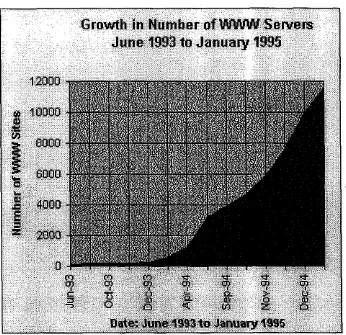
ihird User Survey' would be commenced by GVU on the 10th of April 1995. Figure (1) illustrates the exponential growth of WWW servers from June 1993 to January 1995 and Table (1) gives a summary of the results of the GVU's 'Second User Survey' regarding the demographic characteristics of the web users.Figure (1): netGensis' survey result: The exponential growth of W W W servers
Note: Total number of responses = 3522
Table (1): A summary of the G W ' s Second User Survey: Demographic characteristics of web users
Dnfomation is extracted from Table (1) in Appendii A "Results fmm the general demographics survey";
3. PROVIDING AND RUNNING A WWW SERVICE
There are many documentations available in the Internet on how to use and run web s e ~ c e s . One of the documents is "The Handbook Of Running A WWW Service" (Kelly, 1995) which is available on the Internet. In this section, an overview of different aspects of providing a web service was given in terms of computer hardware and software requirements, application maintenance and administration, and system security. It is hoped that this offers a starting-point for those interested in developing and running a web service.
3.1 Web Servers
To run a Web service, it requires a server process running on a suitable computer platform. Obviously, computer hardware is very diverse, but so are the available Web servers. The most commonly found Web servers are muing as a task on a UhTTX-based machine. There
are other variants of Web servers available on the Internet such as on VAX systems under VMS, on a Macintosh, on Microsoft Windows NT servers, or indeed on a dedicated personal computer (PC). The choice of hardware is therefore fairly flexible. However, a disadvantage of a smaller computer system is that it may become overloaded when the service it is providing becomes popular. For instance, for a UNM system Web server, SUN
IPC systems are adequate for campus-wide services, anything more powerful being an advantage. The two most popular Web servers are those from CERN in Europe, and NCSA in the USA. The current versions of the CERN and NCSA Web servers are broadly similar in terms of system setups. Step-by-step installation and configuration documentation is available and can be downloaded from each site.
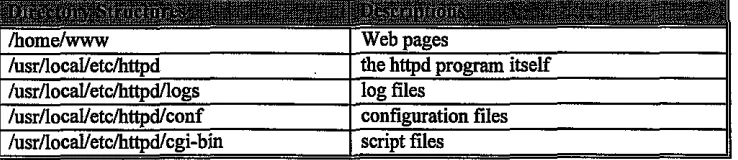
In brief, the Web server itself consists of a program and a set of system configuration files. The configuration files consist of parameters to specify the location of Web pages, to collect and analyse network activities when the web server is being used, and to record errors occurring in network transactions. Table (2) gives an example of an NCSA Web service installation on a SUN workstation.
Table (2): An example of the NCSA Web server configurations on a SUN workstation. /usrAocaYetcmttpd
/usrAocaVetdhttpdAogs /usrAocaYetcmttpd/conf
/usr~ocaVetcmttpd/cgi-him
In addition to the server, there should be sufficient disk space storage to hold information that the server will provide to the Web. Also, the system on which the web server runs should have Internet connectivity, otherwise the number of users who can access the information will be limited to those local users only.
the httpd program itself log files
[image:7.605.123.492.552.632.2]Once a server has been established, its existence should be advertised by means of the Usenet News service or E-mail mailing lists. For instance, pages of information about new web services are available in the 'What's New' page at CERN and NCSA.
3.2 Web Pages
Web servers are information providers and information is normally supplied in form of hypertext data. Within the WWW, the Uniform Resource Locator
(URL)
is used to denote the source of web pages to which user would like to browse. The format of a URL consists of the method of access and Internet machine addresses and filename. For example, the URL of the home page of the University of Leeds in England is:http://www.leedF.ac.uW
whereby the prefix http: indicates that these resources use the 'hypertext transfer protocol'
and then followed by the name of the WWW server at the site to which users wish to connect (i.e. www.leeds.ac.uk). Gopher is another means of accessing information &om remote computers. For instance, the URL of the National Information Services and Systems (NISS) gopher server in England is:
[image:8.602.106.512.381.626.2]gopher://gopher.niss.ac.uW
Figure (2) shows the home page of the University of Leeds using NCSA's Mosaic document browser.
Figure (2): The University of Leeds W W W Home Page: Using NCSA's Mosaic Document Browser
basic hypertext, and there are editors that can be used to incorporate links and other hypertext markup elements.
3.3 Web Browsers
Web servers and web pages are information providers and users have to use computer programs to receive and view information received fiom the Internet. These computer programs are widely known a s 'Web Browsers'. Two popular Web browsers are NCSA's
Mosaic, and Netscape Communications' Netscape, both of which are available for MS
Windows, Macintosh and X-Windows systems. Both of these are full screen browsers which are capable of displaying graphical representations (e.g. figures, pictures). There are web browsers for line mode use, for example Lynx which runs on Unix and DOS systems.
These line mode browsers cannot display inlined images and therefore are suitable for modem users.
3.4 System Administration & Maintenance
The major work load of running a web server comes from the preparation of web pages containing information in hypertext format. Allocation of staff time and computer resources are the major running costs. Comparatively, the costs are relatively low in terms of system administration and maintenance. As a web server administrator, it is only necessary to check the error log maintained by the server to see if any users have had problems in accessing the web service. This will show up errors such as missing files. The access log is usehl to show how many users have accessed the service, what they have looked at, and where they were from. This statistical information can be extremely useful in justifying the existence of a server, especially if the web server carries corporate information, for example a University advertising itself to the world. In addition, to keep information on the server up-to-date, the web administrator must frequently check out for new web servers and subsequently insert new links to them.
3.5 System Security
The Web service basically provides a free information service to the public, and any page of information can be viewed by web browsers, anywhere on the Internet. However, the CERN and NCSA Web servers do have a level of security, in that web pages can be restricted to certain clients, or web pages can be restricted with a password. In this way, it is possible to distribute information to specific groups of clients as required.
3.6 Useful Web Programs
In addition to the Web server itself, there are a host of available programs and packages for administration and indexing tasks. One popular package, Wusage can be used to produce statistics on server usage, either for local use, or to show how popular the web service has
become.
service, and can then be used to return hypertext links as a result of a query, thus providing a hypertext index into that Web service.
More simple methods of indexing or searching for information on a server is to use a script which, when activated, merely extracts information from pages. On a Unix-based system, the 'grep' command can be used in this way, and if hypertext pages are being searched, it is possible to tailor such a mechanism so that hypertext links are returned (Harmer, 1995). This is an effective and simple way to implement, say, a search facility on a set of hypertext pages on a server.
4. EVALUATION OF WWW ON TRANSPORTATION
Since the introduction of WWW, it has been performing many functions such as broadcasting, advertising and exchanging information in the Internet. In recent developments of WWW, web users can 'browse' over the information or become an information provider, or both. The question is to what extent WWW can be used to improve and extend the study of transportation. How can it be done?
There is a wide coverage within the field of transport studies such as public and private transport, freight transport, transport economics, road and traffic safety, transport operations and transport modelling. Different schools of thought introduce different disciplines and sub-disciplines. As a result, there are problems of diversification and fragmentation. The main issue is to build or to find a framework which could provide links to all disciplines and sub-disciplines to improve the situations. We attempt to answer this question using the WWW as the working h e w o r k and the preliminary results of the study are reported in this section.
4.1 Initiatives of transport research using WWW
Based on the recent development of WWW services, a few initiatives were developed on transportation research. A brief discussion of the initiatives is given as follows:
(a) Multi-Layered Transport Database
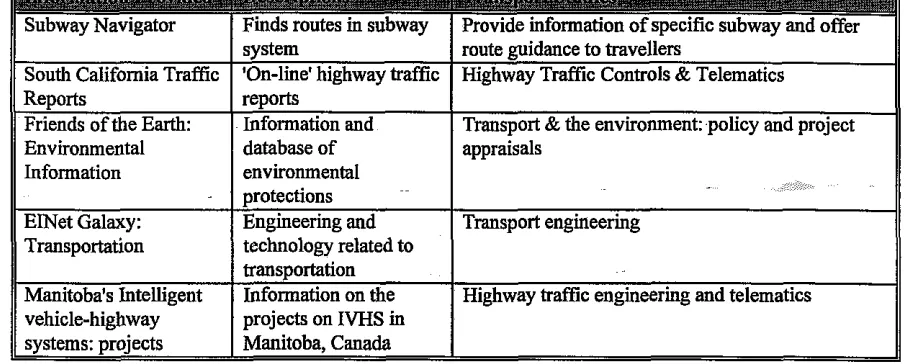
With the growth of the use of WWW, there are vast amounts of information made available to the public via the Internet. In general, two types of information are provided: 'static' and 'dynamic'. 'Static' information usually refers to data recorded in books, journals, project reports, etc. while 'dynamic' information can be a real-time traffic report collected from the on-street sensors in a particular time and a specific location or real-time processing and display of audio-video images. At present, there is no surcharge imposed on the use of existing information. The available information is easy to use and is rapidly growing. Table
multi-national levels. In addition, it offers a cross-effective link to all disciplines and sub- disciplines to examine, for example, a transport environmental issue via a holistic point of view.
Environmental
Table (3): A list of Web servers related to transportation.
(b) A Synthesis Of 'Top-Down' & 'Bottom-Up' Approaches
The use of WWW encourages transport researchers and practitioners to examine transport and environmental issues in a different perspective: a synthesis of the 'top-down' and 'bottom-up' approaches. Assuming the he-flow of information, the use of WWW offers a
valuable means to the public and the policy makers in terms of exchanging information, suggestions and comments. In so doing, neither the conventional 'top-down' nor the 'bottom-up' approach of problem-solving is sufficient. A new perspective of problem solving technique should be used to increase the accountability and public awareness of transport policies and the environment. It enhances and extends links between different levels of the society via multimedia telecommunications.
(c) A New Suwey Technique: Electronic Surveying
In most cases, survey studies conducted by the conventional methods (e.g. sampling questionnaires, on-street surveys) are time consuming and costly. In the recent development of WWW particularly the 'form' design, it offers an alternative means of survey technique
-
electronic surveying. Questionnaires can easily be downloaded and completed questionnaires are instantly returned to the senders via the Internet electronically. It seems to reach the maximum user's response time. A study of the use of "electronic surveying" in WWW can be found in the G W web server at which the two international 'WWW Users Surveys' were conducted.(d) International Search Database On Transportation
[image:11.602.74.526.141.323.2]projects adopted particular acronyms to represent specific projects. Also, transportation terms may be used and interpreted differently across different transport communities. Any lack of understanding may come from an absence of background knowledge. As one of the facilities provided by WWW service is a library reference searching facility, we could use this facility to construct an international database containing the meanings of commonly used transport terminologies and acronyms to help transport researchers.
4.2 Drawbacks Of The Use Of WWW On Transportation
In the current development of the WWW, there are constraints to prohibit its optimal use in transport studies. To encourage the development of the above mentioned initiatives, mutual efforts must be made to tackle these problems. Broadly speaking, the current development of the WWW are restricted to the following constraints.
(a) Legal Issues
In most cases, provisions of information are not all free-of-charge. For example, the provisions of s&et maps and local area maps are usually copyrightedsuch as the &dt&ce
Survey (0s) maps in Britain. Access to a particular database is restricted to account owners . . . - .
only to which subscription may be made to the information provider. In addition, regulations of importing and exporting information vary from country to country. Without a mutual international agreement on importing and exporting information, legal issues are one of the barriers of the optimal use of WWW in terms of research and policy making and appraisal.
(b) Discriminating Who Can Connect And Who Cannot
The use of WWW seems to impose a discrimiition to those who have the ability to
connection to the Internet and those who have not. It is due to the present use of WWW being made freely available to users on the Internet only. In particular, most users in developing countries may not have access to the Internet. The issue of equal opportunity to enjoy the fast growing 'information superhighway' is often problematic.
(c) Problems In Electronic Surveying
5. EXAMPLES OF WWW APPLICATION ON TRANSPORTATION
5.1 Transportation Resources On The Internet: The ITS local web sewer
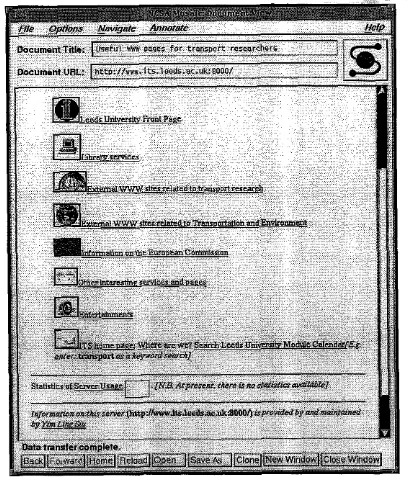
[image:13.608.100.507.233.711.2]As WWW can be used to construct a multi-layered transportation database for researchers and professionals, it was decided to pursue this initiative in two stages. In the first stage, we decided to establish a transportation information exchange centre at Leeds. For this reason, a local WWW server was set up in the Institute for Transport Studies (ITS) at the University of Leeds, England. Figure (3) shows the home page of the 'transportation resources on the Internet' web server.
Figure (3): The home page of the 'Transportation Resources On The Internet':
The aim of this local server is to collect information, available databases, projects and research proposals available in the Intemet related to transportation. It is hoped that in so doing, this ITS local web server provides useful information about available Internet -
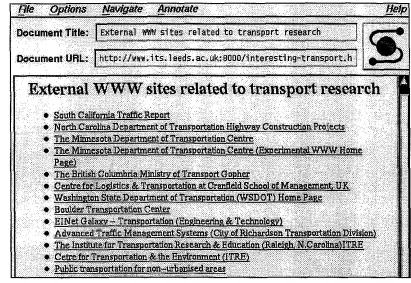
[image:14.605.95.506.274.557.2]resources to transport researchers and professionals. All the Internet addresses of the collected information are made available to the web browsers. With the ever fast-growing interest of WWW, more web sites were made available on the Internet and where known, this is reflected on our ITS local web server on "Transport Resources on the Internet". It is hoped that based on the results of the first stage, we can proceed to the second stage to co- ordinate and develop the proposed multi-layered transportation database for use in transport research. Tackling legal issues will be one of the tasks in the course of development. At present, we are making progress in the first stage. Figure (4) illustrates one of the web pages on a collection of Intemet resources related to transportation.
Figure (4): One of the web pages on the "Transportation Resourees on the Internet": Using NCSA's Mosaic document browser.
5.2 The South Carolina TraMic Reports
Another example of the use of WWW in relation to transportation is the "Southern California Real-Time TmEc Reports. The URL is:
hitp://www.scubed com:8001/caltram/transnet. html
This project is a joint effort of the Maxwell Laboratories, Inc. and the California State Department of Transportation (Caltrans). The aim is to report the current traffic condition
Southern California Traffic Report web server. It is understood that there is a plan to expand the area coverage with given support and participation.
Figure (5): The home page of the 'Southern California Traffic Report': Using NCSA's Mosaic document browser.
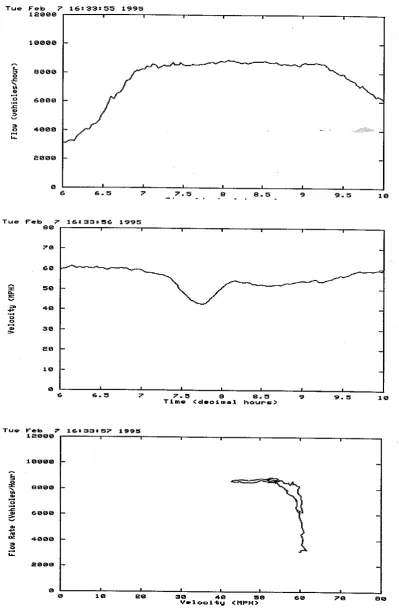
The Southern California home page is one of the most popular transportation web sites in the world. The concepts and designs of WWW services used in this web site to generate traffic reports offers valuable insights in improving and extending the field of transport and telematics. Traffic data collected from sensors can be used to produce diagrams of flow and velocity of travel in a particular period of time and in a specific location. Figure (6)
T u e Fcb 7 1 6 : 3 3 . 5 6 1995
Figure (6): A sample of traffie report: Inbound traffic flow and veloeity (the 7th of Feb., 1995)
a 8
7 8
TUP FCD 1
11888
l 8 W W W
-
'.3 "
s w w w rn
-
-
" .-=
-
6888
%
a.
.,- .v
4-08
o
-
L
e r n - 8
8
- -
1 6 . 3 3 . 5 7 1-95
- -
-
-
-
-
E I E e w SE 68 SE 68
7
78V I ~ O P ~<UP+,> ~ Y e w
6 w
=
L s w -
x!
-
-
.,- 4 8
."
0 0
.-.
-
> 38
e m 18 8 - - - - - - - -
6 6 . 5 7 7 . 5 8 8 . 5 9
Besides traffic reports, other information such as road conditions, weather reports, flood information and satellite images are also available in the Southern California home page. In addition, there is a questionnaire for web users to report any incidents and traffic conditions on any road. Reports are collected and can be viewed by web users around the world. Work implemented in the Southern California web server offers valuable experience and practical examples to transport researchers to explore new ideas in the field of transport telematics and telecommunications.
6. CONCLUSIONS
Since the introduction of World Wide Web, it has shot into prominence in ths ixt coxple of years. It has a significant influence in a widely diverse community including government departments, university and research establishments, and commercial organisations. In recent years, we also encountered the ever-increasing demand and interest in the use of multimedia technology in the studies of transport. For instance, in the European Commission's Directorate General @G) XI11 "Telecommunications, Information Market and Exploitation of Research", bringing multimedia technology and applications into transportation research is seen to be increasingly important. The primary objective of this paper is to examine the progress and to assess the usefulness of the WWW hypertext publishing information system on transportation research.
Arising from the knowledge and practical experience in providing and running a local web senrice (in sections (2) and (3)), insights were gained. Subsequently, several initiatives were proposed (in section (4)) in view of supporting and extending transportation research. Limitations of the use of WWW were also reported. In addition, two existing WWW
applications were given (in section (5)) in this paper to highlight the potential use of this multimedia technology on transportation research.
Through the presentation of this paper at the conference, we would like to receive comments on:
pointers for further research and development directions
experience and issues from other applications and research fields
REFERENCES
1. Boutell, T. (1995) Wusage: Usage Statistics For WWW Servers. [URL:ht@://siva. cshl. org/wusage. html]
2. Georgia Institute of Technology (1994a) The First User Survey. Graphics, Visualisation, and Usability Center, College of Computing, Georgia Institute of Technology, Atlanta, GA 30332-0280, USA.
[URL://htp://www. cc.gatech. edu/gvu/user-surveys/]
3. Georgia Institute of Technology (1994b) The Second User Survey. iiraphics, Visualisation, and Usability Center, College of Computing, Georgia Institute of Technology, Atlanta, GA 30332-0280, USA.
[URL://htp://www.cc.gatech.edu/gvu/user-surveys/l
4. Gupta, S. (1994) The Consumer Survey PreTests. Michigan Business School, USA. [E-mail: sunil_gupta@ccmail. bus. umich, edu]
5. Hanner, J.M. (1995) A Simple String Search Mechanism For The WWW. Administrative Computing Services. The University of Leeds, England.
Also available on the Leeds University Web server via Internet [URL://www. admin. leeds. ac. ulc/people/j. m. harmer/search-paper. html].
6. Kelly, B. (1995) The Handbook Of Running A WWW Service. Computer Services.
The University of Leeds, England.
Also available on the Leeds University Web server via Internet [URL: http://www. 1eeds.a~. u ~ u c s ~ / h a n d b o o k / r e a d m e . html].
7 . National Centre for Supercomputer Applications (NCSA) (1994a)
NCSA
Mosaic Home Page. NCSA, University of Illinois at Urbana-Champaign, USA.[URL:ht@://www.ncsa.uiuc. edu/SDG/Sof[ware/Mosaic/Docs/he(p-about. html]
8 . National Centre for Supercomputer Applications PCSA) (1994b) A Beginner's Guide
To HTML. NCSA, University of Illinois at Urbana-Champaign, USA.
[URL:http://www.ncsa. uiuc. edu/demoweb/html-primer. html]
9. National Centre for Supercomputer Applications (NCSA) (1994~) A Beginner's Guide To URLs. NCSA, University of Illinois at Urbana-Champaign, USA.
[URL:ht@://www.ncsa. uiuc. edu/demoweb/html-primer. html]
10. Netscape Communications Corporation (1994) Welcome to Netscape. Netscape Communications Corporation, USA.
flRL:http:/www. mcorn. com/home/welcome. html]
10. Torkington, N. (1994) World Wide Web Primer.