White Rose Research Online URL for this paper:
http://eprints.whiterose.ac.uk/132658/
Version: Published Version
Article:
Kenter, Jasper Onno orcid.org/0000-0002-3612-086X, Reed, Mark S. and Fazey, Ioan
Raymond Albert (2016) The Deliberative Value Formation model. Ecosystem Services. pp.
194-207. ISSN 2212-0416
https://doi.org/10.1016/j.ecoser.2016.09.015
[email protected]
https://eprints.whiterose.ac.uk/
Reuse
This article is distributed under the terms of the Creative Commons Attribution (CC BY) licence. This licence
allows you to distribute, remix, tweak, and build upon the work, even commercially, as long as you credit the
authors for the original work. More information and the full terms of the licence here:
https://creativecommons.org/licenses/
Takedown
If you consider content in White Rose Research Online to be in breach of UK law, please notify us by
Contents lists available atScienceDirect
Ecosystem Services
journal homepage:www.elsevier.com/locate/ecoser
The Deliberative Value Formation model
Jasper O. Kenter
a,⁎, Mark S. Reed
b,⁎, Ioan Fazey
c,⁎aLaurence Mee Centre for Society and the Sea, Scottish Association for Marine Science (SAMS), Oban PA35 1JE, UK
bCentre for Rural Economy and Institute for Agri-Food Research & Innovation, School of Agriculture, Food and Rural Development, Newcastle University, Newcastle upon Tyne NE1 7RU, UK
cCentre for Environmental Change and Human Resilience, University of Dundee, Dundee DD1 4HN, UK
A R T I C L E I N F O
Keywords: Participatory methods Social learning Shared values Transcendental values Deliberative monetary valuation Deliberative non-monetary valuation
A B S T R A C T
It is increasingly argued that preferences and values for complex goods such as ecosystem services are not pre-formed but need to be generated through a process of deliberation and learning. While the number of studies incorporating deliberation in monetary and non-monetary valuation of ecosystem services is increasing, there is a limited theoretical basis to how values are influenced and shaped in social valuation processes. In this paper we present the Deliberative Value Formation (DVF) model, a new theoretical model for deliberative valuation informed by social-psychological theory. Anchored within a broader theoretical framework around shared and plural values, the DVF model identifies a range of potential positive (e.g. learning) and negative (e.g. social desirability bias) outcomes of deliberation and key factors that influence outcomes (e.g. ability to deliberate, institutional factors, power dynamics). It also conceptualises how values may be formed by ‘translating’
transcendental values, our principles and life goals, into more specific contextual values. Underpinned by this theoretical model, we present a six-step template for designing deliberative valuation processes. The DVF provides a theoretical and methodological framework for more rigorous monetary and non-monetary deliberative valuation, and enables more effective integration of social learning and plural knowledges and values in valuation and decision-making.
1. Introduction
There is broad recognition that ecosystem services have been undervalued in decision-making. Over recent decades this has led to wide-ranging attempts to consider how ecosystems provide benefits to human well-being and what the value of these benefits may be. In economics, values are generally assessed in monetary terms. Neoclassical economics assumes monetary values to reflect fully informed, individual preferences for one alternative over another, revealed in behaviour or stated in willingness to pay surveys (Urama and Hodge, 2006; Lawson 2013). Many non-monetary approaches to ES valuation such as public participation GIS are based on a similar instrumental paradigm (Raymond et al., 2014). However, it is increas-ingly argued that, when considering complex and often unfamiliar goods such as ecosystem services, preferences and values can be incomplete and need to be formed through some sort of deliberation and learning process (e.g.Macmillan et al., 2002; Urama and Hodge, 2006; Parks and Gowdy, 2013; Völker and Lienhoop, 2016; Kenter, 2016a, 2016c; Kenter et al., 2011, 2016a). While the number of studies using such approaches for eliciting values is rapidly increasing, and
there has been significant investigation of broader ethical and political theory that could underpin deliberative valuation (e.g. Wilson and Howarth, 2002;Niemeyer, 2004;O’Neill, 2007;O’Neill, Holland and Light, 2008;Spash, 2007; 2008;Lo and Spash, 2012;Lo, 2013;Kenter et al., 2015; Orchard-Webb et al., 2016), there is only limited conceptual work on how value formation and elicitation is shaped through such processes. In particular, greater clarity is needed about how deliberative processes shape value formation, to both improve the design of valuation methods and to target research activities towards improving general understanding of how values are formed and enacted.
For the purposes of this paper, we take‘deliberation’to be a group-based process of participation, social exchange, reflection, learning and meaningful debate (see Section 2). In such group-based processes, participants have the opportunity to reflect upon, form, express and debate their knowledge, perspectives, values and beliefs (Spash, 2007; McCrum et al., 2009;Lo, 2011;Kenter, 2016c;Orchard-Webb et al., 2016). By integrating deliberation within a structured valuation process such as deliberative monetary valuation or participatory multicriteria analysis to inform and appraise decisions, deliberation
http://dx.doi.org/10.1016/j.ecoser.2016.09.015
Received 9 December 2015; Received in revised form 23 September 2016; Accepted 25 September 2016 ⁎Corresponding authors.
E-mail addresses:[email protected](J.O. Kenter),[email protected](M.S. Reed),[email protected](I. Fazey).
Available online 09 November 2016
2212-0416/ © 2016 The Authors. Published by Elsevier B.V.
This is an open access article under the CC BY license (http://creativecommons.org/licenses/BY/4.0/).
can inform individual values but also lead to group-based values, which, it is argued, can transcend individual concerns and better incorporate broader shared and social values (Howarth and Anderson, 2007; O’Neill et al., 2008; Christie et al., 2012; Kallis et al., 2013; Kenter et al. 2011, 2014a, 2014b, 2015, 2016a, 2016b;Orchard-Webb et al., 2016;Irvine et al., 2016;Ranger et al., 2016). Consequently, integrating deliberation into valuation can help participants better address rights, responsibilities, equity, fairness and other moral and political considerations as part of the value formation process (Niemeyer and Spash, 2001; O’Neill 2007; Orchard-Webb et al., 2016). Deliberative valuation processes are also appealing in that they provide an opportunity to better consider uncertainties and risks (Zografos and Howarth, 2010) and to bring out subtle cultural values (Kenter et al., 2011; Cooper et al., 2016; Edwards et al., 2016;Fish et al., 2016a,2016b).
These qualities are important because policy-makers and practi-tioners currently rely on valuation evidence as a proxy for the social impacts of decisions about the natural environment, without necessa-rily considering the broader ethical and cultural dimensions of the values that may be enhanced or compromised by the decision. This can lead to decisions being made that appear to be environmentally and economically beneficial, but that do not resonate with, or end up being actively opposed by certain social groups or substantial sections of the population (an illustrative examples of this is provided byIrvine et al., 2016).
Deliberation forms values through processes that may either or both inform and enable reflection with reference to ethics and democratic principles (Lo and Spash, 2012). Nonetheless, to date there has not been any model that specifically explains how such a process of value formation is constituted and how values are influenced and shaped in group-based deliberative valuation processes. This is an important gap in our knowledge, because without understanding how values are formed and influenced by deliberation, it is challenging to explain significant differences that have been found between monetary and non-monetary values that people express for the natural environ-ment in deliberated versus non-deliberated and individual versus group settings (Kenter, 2016b; Kenter et al., 2011, 2014b, 2016a). While there are clearly challenges associated with deliberative and participatory methods, such as potential for social desirability biases and unequal power (e.g. Cooke and Kothari, 2001), which we will discuss below, empirical work has shown that valuation participants can feel more confident about group-deliberated values than about their individual than about individual, non-deliberated values, and can prefer the use of deliberative over individual valuations as a basis for decision-making (Clark et al., 2000; Kenter et al., 2016a).
To aid understanding and design of valuation processes, this paper presents a new theoretical framework called the Deliberative Value Formation model (DVF). The DVF was developed as part of a broader framework around shared, plural and cultural values of the environ-ment for the UK National Ecosystem Assessenviron-ment (Kenter et al., 2014b, 2015), which involved the analysis of two large-scale, national and two local valuation case studies, together including 29 deliberative mone-tary and non-monemone-tary valuation workshops across the UK. The DVF integrates what we know about deliberation and values to explain how values are shaped and formed through deliberative valuation. Particularly, it conceptualises how contextual values – the relative importance of particular objects of value (Kenter et al., 2015) – expressed through value indicators such as willingness to pay, rankings and ratings, can be shaped by transcendental values–our overarching principles and life goals that transcend specific contexts, such as honesty, enjoyment, social status, peace (Kenter et al., 2015) –in and through deliberative processes.
The model can assist researchers and practitioners to design more effective and transparent deliberative approaches to both monetary and non-monetary valuation and improve how ethical and cultural con-cerns are incorporated in valuation evidence and decision-making.
While the DVF has been developed in the context of valuing ecosystem services, the relevance of the model extends into any area where there is a need to evaluate and deliberate subtle, complex or contested values, such as in decisions around land use or urban planning, health care, or social services.
This paper first briefly reviews the concept of deliberation, its objectives in valuation, and its relation to shared values (Section 2). We then review current knowledge of how deliberation forms or shapes values and how this influences the extent to which values become shared (Section 3). The next section outlines the DVF, and its three components: 1) the key factors that influence deliberation; 2) the potential outcomes of deliberation; and 3) a chain of influence informed by social-psychological theory, that models how deliberation allows transcendental values to be applied to particular contexts and translated into contextual values and value indicators (Section 4). Building on the theoretical model, we also present a six-step metho-dological template for deliberative monetary and non-monetary valua-tion (Section 5). We then come to afinal discussion (Section 6) and conclusions (Section 7) on the implications of the DVF for the under-standing and design of deliberative valuation.
2. Deliberation, valuation and shared values
Deliberation is essentially a process by which something can be considered, evaluated or appraised. Deliberation can be considered as an individual cognitive-reflective process (e.g.Betsch, 2011), such as a person deliberating over some kind of personal decision, or as a process of social interaction, such as a group of people trying to establish a common point of view. It can also be a wider process of decision-making, such as Habermas’ideal of‘communicative ration-ality’where discussion and making sense of information is considered to generate new knowledge (McCrum et al., 2009) and enhance democratic processes (Orchard-Webb et al., 2016). In the ecological economics literature, deliberation is mostly referred to as some form of group process that aims to enhance the elicitation of preferences and values (e.g. Spash, 2007; Zografos and Howarth, 2010; Lo, 2013;
Kenter, 2017). By definition, the notion of deliberative value formation recognises that contextual values are, initially, unformed or incomple-tely formed–if they were perfectly formed there would be no point in deliberating them (also see Kenter et al., 2016bfor a discussion of unformed vs partially formed values). In other words, contextual values cannnot be independently observed, and need to be recognised as endogenous to the valuation process (O’Hara and Stagl, 2002). This is particularly the case when considering complex and often unfamiliar goods, such as biodiversity and many ecosystem services, where people lack information to inform their values, but also where they may not have fully considered how their transcendental values relate to the object of value.
Lo and Spash (2012)discriminate three main objectives to delib-eration: preference ‘economisation’, ‘moralisation’and ‘ democratisa-tion’, with economisation focusing on informing individual contextual values, moralisation on bringing out transcendental values to deter-mine the morally preferred course for society, and democratisation on providing a platform for communicatively rational debate, emphasising value plurality (Table 1).
To achieve these different objectives, a process of deliberation could include the following elements (based onHabermas, 1989;Daniels and Walker, 1996;Bloomfield et al., 1998;Bessette, 2001;Abelson et al., 2003;Patel et al., 2007;Elwyn, 2010;Mummery and Rodan, 2013;
Halpern and Gibbs, 2012):
1. the search for, acquisition of, and social exchange of information, gaining knowledge (by learning about the information acquired), and the expression and exchange of transcendental values and beliefs, to form reasoned opinions;
coercion), as part of dialogic and civil engagement between partici-pants, respecting different views held by participants, being able to openly express disagreement, providing equal opportunity for all participants to engage in deliberation, and providing opportunities for participants to evaluate and re-evaluate their positions; 3. identification and critical evaluation of options or ‘solutions’ that
might address a problem, reflecting on potential consequences and trade-offs associated with different options; and
4. integration of insights from the deliberative process to establish contextual values around different options, and determining a preferred option, which is well informed and reasoned.
While the above distinctions and other theoretical papers are important for helping focus the design of deliberative valuation approaches towards their intended outcomes, they do not describe in much detail what those designs should include. In terms of empirical papers (for a recent review seeBunse et al., 2015), the main framework used by deliberative monetary valuation studies is the‘Market Stall’ format. Here, by analogy, participants are given the opportunity to ‘browse’and become familiar with the goods they are asked to value
before stating their willingness to pay (Macmillan et al., 2002). The format also provides opportunity for individual deliberation in the form of time to think about preferences. While the Market Stall provides a useful framework for preference economisation, it does not consider transcendental values, value plurality, democratisation and broader process design. As yet, there is little guidance on how to implement a more comprehensive approach to deliberative valuation.
For non-monetary valuation, there are a number of examples of multicriteria analysis being embedded in deliberative processes where the value of different options in relation to chosen criteria are discussed more broadly by participants prior to, or in conjunction with the analysis being performed (e.g. Proctor and Drechsler, 2003;Shriver and Randhir, 2006;Karjalainen et al., 2013). There are also examples of criteria and their weightings being established through deliberation with participants (e.g.Cook and Proctor, 2007;Liu et al., 2010, 2011;
Kenter et al., 2014b). However, there are few examples where participants explicitly consider their transcendental values prior to or as part of the MCA process (Ranger et al., 2016;Orchard-Webb et al., 2016).
2.1. Dimensions and types of shared values
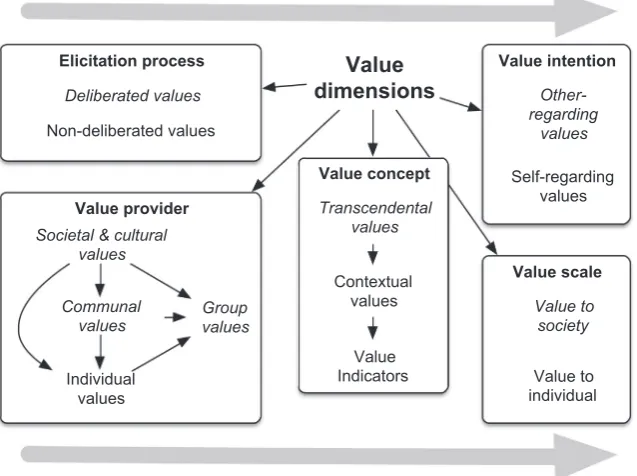
[image:4.595.140.459.447.685.2]Different conceptions of individual and shared or social values lie at the heart of understanding the differences between different under-standings and applications of deliberation, but are often not made explicit, or where they are, referred to in unclear and ambiguous terms. However, to understand how different types of value play out and interact in deliberation it is important to clearly identify and label them. We develop our discussion on deliberative value formation on the basis of the theoretical framework developed by Kenter et al. (2015), who discriminatefivedimensionsof shared and social values: (i) the value concept; (ii) the value provider; (iii) the process used to elicit values; (iv) the scale of value; (v) and its intention (Fig. 1). In terms of the concept of value, the authors distinguishe between (1) transcendental values: guiding principles and criteria that transcend
Table 1
Potential objectives of deliberation in valuation (based onLo and Spash, 2012).
Preference economisation
Use of deliberation to ease the respondent's cognitive burden associated with expressing stated preferences. Information and group discussions are primarily focused to nurture value formation and elicitation at the individual level.
Preference moralisation
Use of deliberation to elicit transcendental values and norms and apply these to the valuation context. Deliberations tend to be focused on finding agreement on the value to society of different goods or policy options.
Preference democratisation
Deliberation to enable deliberative democratic principles of value plurality and communicative rationality, integrating deliberation on both information and transcendental values, without preset terms for value outcomes.
Elicitation process
Deliberated values
Non-deliberated values
Value intention
Other-regarding
values
Self-regarding values
Value
dimensions
Value scale
Value to society
Value to individual Value concept
Transcendental values
Contextual values
Value Indicators Value provider
Societal & cultural values
Communal values
Individual values
Group values
specific situations and that are used to justify actions and evaluate people and events (e.g. health, security, harmony with nature); (2) contextual values: values in the sense of opinions about worth or importance (e.g. the importance of clean water); and 3) value indicators: the worth of something itself, often expressed in monetary terms (e.g. a willingness to pay of $100 to improve some environmental attribute by a certain amount). Differentiation of transcendental and contextual values bears some resemblance to the division of ‘held’ values (guiding principles held as important) and ‘assigned’ values (values assigned to people, places or things) byRokeach (1973)and further discussed in an ecosystem service context byIves and Kendal (2014). However,Kenter et al. (2015)argue that this conceptualisation is incomplete and ambiguous. While transcendental values are indeed held, and indicators are assigned, contextual values, as opinions about the importance of something, could be seen as both held and assigned, so it is unclear into what category they fall. Raymond and Kenter (2016)add that specification of values as context-specific or context-transcendent is also more informative than whether they are held or assigned.
Transcendental values are seen as more stable and enduring than contextual values and indicators, and they are often shared between communities or within society and thus termed as shared or social values.Schwartz (1992, 1999)developed a set of 56 key transcendental values that could be measured across a wide range of cultures. These include both ethical principles such as honesty and things that can be characterised as desirable end states, such as ‘a varied life’, ‘family
security’, or ‘mature love’. While cultures adhere to these values to different degrees, the set as a whole appears to follow a universal structure. For example, cultures that have stronger values relating to tradition also tend to have stronger values around security, and those who are willing to transcend their own interests for others are also more likely to have stronger biospheric values. Transcendental values are often implicit and thus may require explicit prompts and delibera-tion to bring them out (Sagoff, 1998; Niemeyer 2004; Bardi and Goodwin, 2011; Kenter et al., 2011). In social psychology, it has been generally found that their relation with contextual values and beha-viour is mostly indirect, and mediated by various types of beliefs, and norms (Dietz et al., 2005;Raymond and Kenter, 2016). We will discuss this in more detail inSection 4.
The framework distinguishes fourproviders of value: (1) indivi-duals, (2) communities, (3) societies and cultures as a whole, and (4) ad-hoc groups (in a valuation setting), providing individual, communal, societal and cultural, and group values. Here the authors conceive of shared values as values that are expressed collectively, regardless of whether they are held individually or collectively.
The dimension ofscaledistinguishes the individual scale, and the ‘social’ scale, which has bearing on value to society, or values in relation to society. An example is that one might highly value enjoyment and a varied life for oneself (e.g. reflected in consumer behaviour), but in relation to society other values such as fairness or responsibility might be more important (e.g. reflected in voting behaviour). An example at the level of indicators is that one might be willing to pay £10 to improve water quality (individual scale), or think that the local council should invest £1 million in a water treatment plant (social/societal scale).
The dimension of intention relates to whether values are self-regarding or other-self-regarding, altruistic values.Intentiondiffers from
thescaledimension, as values for others are not necessarily values in
relation to society. Finally, the dimension of elicitation process distinguishes between the kinds of values that have been derived from non-deliberative or deliberative processes.
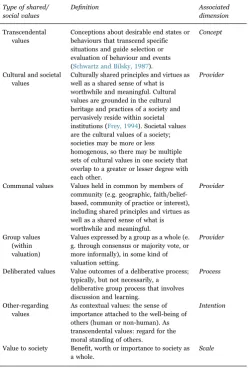
Across these dimensions, the authors identify nine non-mutually exclusive types of shared and social values (Fig. 1;Table 2), and many of these are engaged with in deliberation. Valuation aims to achieve an evaluative outcome, and these outcomes are‘shared’or‘social’in the sense that they may be expressed by the group of people that is deliberating as a whole, e.g. when a citizens’jury votes on one policy option over another, but the notion could also refer to the use of a shared/social valuation process, a focus on a social rather than individual scale or on the transcendental and contextual values that we share as a society or community. Thus, broadly, the notion of ‘shared or‘social values’represents those values that we come to hold and assign through our interactions with others in one way or another, informing and shaping a concept of the common good (Kenter et al., 2015). In the following section, we will consider how deliberation might impact on these values.
3. How does deliberation form values?
Understandings of deliberation have been widely used to concep-tualise or facilitate changes in understanding, behaviours, practices, and decisions. Here we will consider how values are formed and shaped through deliberation, how this might influence the extent to which values become shared, and how deliberation helps people form group values or work with the diverse values expressed.
[image:5.595.41.294.90.460.2]An important mechanism through which deliberation can lead to value formation is social learning (Reed et al., 2010). Compared to ‘deliberation’, there is very little use of the term social learning in the economic and non-economic valuation literature. However, social learning may help explain how values are shaped and shared through deliberative processes. There are many different definitions and ways of conceptualising social learning (Ison et al., 2013; Reed et al., 2010;
Table 2
Main types of shared and social values with definitions and dimensions along which they can be discriminated (Source:Kenter et al., 2015).
Type of shared/ social values
Definition Associated
dimension
Transcendental values
Conceptions about desirable end states or behaviours that transcend specific situations and guide selection or evaluation of behaviour and events (Schwartz and Bilsky, 1987).
Concept
Cultural and societal values
Culturally shared principles and virtues as well as a shared sense of what is worthwhile and meaningful. Cultural values are grounded in the cultural heritage and practices of a society and pervasively reside within societal institutions (Frey, 1994). Societal values are the cultural values of a society; societies may be more or less homogenous, so there may be multiple sets of cultural values in one society that overlap to a greater or lesser degree with each other.
Provider
Communal values Values held in common by members of community (e.g. geographic, faith/belief-based, community of practice or interest), including shared principles and virtues as well as a shared sense of what is worthwhile and meaningful.
Provider
Group values (within valuation)
Values expressed by a group as a whole (e. g. through consensus or majority vote, or more informally), in some kind of valuation setting.
Provider
Deliberated values Value outcomes of a deliberative process; typically, but not necessarily, a deliberative group process that involves discussion and learning.
Process
Other-regarding values
As contextual values: the sense of importance attached to the well-being of others (human or non-human). As transcendental values: regard for the moral standing of others.
Intention
Value to society Benefit, worth or importance to society as a whole.
Rodela, 2012). In some definitions the term ‘social’ refers to the process that results in learning, while in other definitions it refers to the number of individuals undergoing the learning.Reed et al. (2010)
defined social learning as occurring when: 1) there is some change in the relationship between a person and the world (i.e. change in understanding); 2) that this change in understanding occurs through social interaction; and 3) that the learning should occur across more than one person, at the scale of social units or communities of practice. Social learning can build and strengthen relationships, enhance participants’understanding of other perspectives, and trigger systemic thinking (Fazey et al., 2010;Johnson et al., 2012) and can have long lasting effects beyond an initial participatory approach (Bull et al., 2008).
Deliberation encourages participants to learn from each other, to form reasoned opinions, evaluate positions and reach informed deci-sions, implying that social learning is a central component of group deliberative processes (McCrum et al., 2009). However, it is also possible to view deliberation as a process through which social learning occurs (Cundill and Rodela, 2012). For example, deliberation through workshops and stakeholder participation is often used to co-produce new knowledge and insights about the value of the natural environment (Steyaert et al., 2007). Through exposure to different perspectives, and reflecting on them, participants can change their understanding of the social-ecological system, e.g. on the state of the environment or of ecological processes, or the impacts of behaviour or choices (Bardi and Goodwin, 2011). Importantly, deliberation and social learning both suggest that social interactions have potential for helping elicit values that may otherwise be difficult to access.
It has been argued that all forms of deliberation and social learning are implicitly interactions about values (Goldstein, 1981;Gastil et al., 2008). In processes such as policy formation and planning, these interactions can be conceived of as process of ‘valorisation’ where people may come to greater consensus about what they consider to be important and thus how a decision (e.g. about public expenditure) should be made (Klamer, 2003). For example, social dilemmas can drive changes in values, when groups, individuals or actions based on self-interest come into conflict with those based on more altruistic, community or environmental interests, leading to the adoption of values based on varying degrees of co-operation (Gifford, 2008). These changes are more likely in medium-term deliberative processes, e.g. through a process of on-going political negotiation over weeks or months, where deliberative processes can lead to the formation of shared values by enabling a person to “be swayed by rational arguments and to lay aside particular interests and opinions in deference to overall fairness and the common interests of the collectivity”(Miller, 2000, p.10).
Although widely used in the literature about deliberation and social learning, shorter term processes (e.g. facilitated workshops) are less likely to shift contextual values (McCrum et al., 2009), yet there are diverse examples of short-term interventions leading to value change and formation include changes in greater recognition of political views (Gastil et al., 2008), changes in the number and diversity of arguments considered (Dietz, Stern and Dan, 2009;Völker and Lienhoop, 2016), and greater recognition of the interconnectedness between ecosystems, culture and society, resulting in changes in stated monetary values (Kenter et al., 2011).
There has been some cross-comparison between studies to consider how different ways of framing and designing deliberation might influence the values expressed. For example Clark et al. (2000)
contrasted their own study on monetary values for a nature conserva-tion scheme with a study byBrouwer et al. (1999)that had a similar objective and cultural and geographical context, but the former was designed to include in-depth discussion while the other involved more superficial deliberation. In the Brouwer et al. study, participants felt that their willingness to pay reflected their‘true values’, but in the Clark et al. case, most felt that they were not meaningfully able to identity
their values without carefully considering impacts, ethics and wider policies and contexts, and deliberating on this with others. Participants themselves proposed that valuation should be implemented as a democratic decision-making process, so that a plurality of values and moral considerations that could not be captured in a single monetary metric, could be debated. Thus the depth or intensity of deliberation is likely to influence the outcomes.
The diversity of participants in a deliberative process is also likely to influence the outcomes of deliberation, including the degree to which learning takes place and what values are expressed.Newig and Fritsch (2009)found that the composition of groups influenced which values were converged towards.Wright and Rowe (2011)andCuppen (2012)
found that the extent to which participants learned from each other in deliberative processes was dependent upon the diversity of perspec-tives held by those who engaged in the process.
How deliberative processes are managed and facilitated can also substantially influence outcomes. Deliberative inequalities may arise from inequalities in power and communication, and mechanisms are needed to avoid ‘dysfunctional consensus’, biasing outcomes or ex-acerbating conflict (Bohman, 1996;Reed, 2008;Lehoux et al., 2009). For example,de Vente et al. (2016)found deliberative processes that led to conflict resolution (implying either a change towards sharing of values or greater acceptance of the values of others) were significantly more likely to be professionally facilitated, include face-to-face sharing of information between participants, and enable participants to speak freely and participate in discussion and decision-making. Facilitation must be impartial and independent, as far as possible, for these benefits to be seen, otherwise facilitation may exacerbate power inequalities and bias outcomes.
Thus, the extent to which social learning and deliberative processes are likely to lead to greater sharing of values depends on the extent to which power dynamics are effectively managed. One of the most significant ways that power can influence such processes is the way that power is used to decide who and what information is included or excluded from a deliberative process (Fazey et al., 2013). Viewing it in this way, power can be seen to operate at the level of groups rather than individuals, as groups create norms that privilege certain types of knowledge over others (e.g. scientific over local knowledge) and that may exclude certain voices or narratives that challenge the group's norms (Barnes,1988; Orchard-Webb et al., 2016). Foucault and Gordon (1980)describe this notion of power as the‘distribution of knowledge’to empower or disempower. This then emphasises the need to include and respect the knowledge claims of all involved in a deliberative process, explicitly including and empowering marginalized groups, so that it becomes possible for values to be expressed and potentially become shared as a result of engaging in deliberation (also seeRanger et al., 2016).
Another important cause for differences in power are differences between participants in their prior capacity to engage in deliberation, originating from differences in education, professional experience etc. Such experience often also correlates with social status, and this makes it very challenging for facilitators to perfectly level the playingfield. For example,Orchard-Webb et al. (2016) found group dynamics where participants were inclined to subtly follow those who had a role as community leaders. Thus, these tended to take the lead in exercises and set the tone in determining ways to move forward.
culture, previously implicit cultural transcendental values came to play that then impacted on how participants formed their contextual values (Kenter et al., 2011; Kenter and Fazey 2015a; Raymond and Kenter, 2016).Kenter (2016b)showed that making a broader set of transcen-dental values explicit in the context of considering social-ecological system dynamics lead participants to look more broadly at the natural environment in relation to their other interests and priorities, making conflicts and trade-offs between competing priorities (e.g. investing time or money in nature versus the health system or their family) more apparent.
In the short and medium-term processes that we have discussed so far, it is more likely that contextual values are changed and formed than transcendental values. Transcendental values are more ingrained and can be seen as similar to higher order aspects of cognition which change through double or triple loop type learning mechanisms that involve fundamental changes to people's underlying assumptions, metaphors, and mental models (Fazey et al., 2005; Keen and Mahanty, 2006; Reed et al., 2010). Nonetheless, as Raymond and Kenter (2016),Kenter (2016b)andKenter et al. (2016a)demonstrate, some changes in the relative importance of different transcendental values can be seen following short-term deliberation if they are explicitly elicited and deliberated upon. Bardi and Goodwin (2011)
emphasise the importance of explicit cognitive reflection in generating such changes, but also highlight that they are only likely to become ingrained if the social cues that triggered these changes also endure, or are repeated.
Indeed, both transcendental and contextual values are clearly shaped by longer-term social learning processes, starting with the reproduction of cultural values in children through education and modelling adult behaviour (Bandura, 1969, 1977; Brody, 1978), and continuing in intergenerational and community-based interactions that promote particular social norms, values, preferences and behaviours (Rist et al., 2003). These processes are termed ‘socialisation’in the sociological and anthropological literature and can occur at diverse social scales and formations (e.g. group, racial, gender, professional) and at different ages (Grusec, 2011;Sabari, 1985;Singh-Manoux and Marmot, 2005). The values that people express for the natural environment therefore are continuously shaped and moulded by social processes over time, dependent on the cultures and institutions that influence both the values themselves and the ways in which the social interactions that form them occur (Everard et al., 2016).
4. The Deliberative Value Formation model
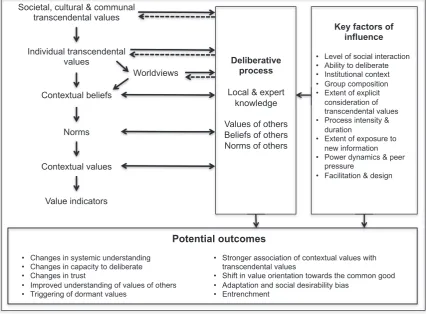
Building on the understanding of values and deliberation developed in the previous sections, we now present the DVF model, consisting of three components (Fig. 2). These include:
1. An understanding of the key factors that influence how deliberation forms values;
2. An understanding of the potential outcomes of deliberation in a valuation context;
3. A chain of influence that conceptualises deliberative value formation as a translation of transcendental values into contextual values and value indicators, and links the key components that constitute this process.
4.1. Key factors influencing deliberative value formation
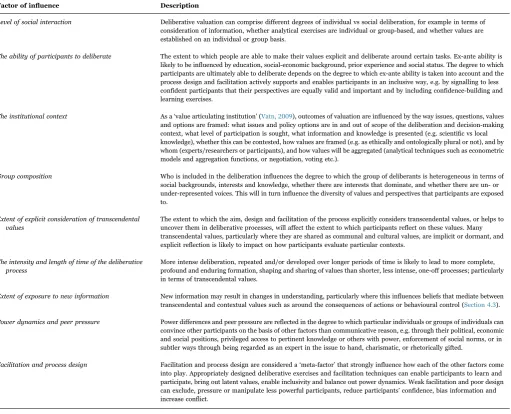
From the above discussion, we distil nine key factors that influence the outcomes of deliberative valuation, described in Table 3. These include: 1) the degree of social interaction; 2) the ability of participants to deliberate; 3) the institutional context; 4) group composition; 5) the extent of explicit consideration of transcendental; 6) the intensity and length of time of the deliberative process; 7) the extent of exposure to new information; 8) power dynamics and peer pressure; and 9)
facilitation and process design. The understanding of these factors forms thefirst component of the DVF model (Fig. 2).
Clearly, these factors do not operate in isolation but interact. For example, there are many interactions between power dynamics and the other factors. The ability of participants to deliberate is likely to be influenced by the management of power dynamics, or lack of it. This can have a strong bearing on the extent to which participants shape each others’values through argumentation, avoiding processes of peer-pressure or ‘dysfunctional consensus’ in which participants express transient shared values that they do not agree with in order to be socially accepted. Also, the institutional context favours particular interests, generating power dynamics; group composition influences power dynamics through the relative weight of different interests (and vice versa), and power dynamics and peer pressure can influence what values and information are deliberated upon.
Factors can also balance each other out. For example, the political context may favour particular values and interests, but this could be counterweighed by overrepresenting less powerful voices, and by explicitly eliciting a broader set of values. Providing more time may allow more space for participants with less power and/or a lesser prior ability to gain confidence.
In all this, the role of facilitators and those that design the process can be considered a‘meta-factor’as it is ultimately the process design and facilitation that will heavily influence how the other factors come into play. For example, to what degree do facilitators represent the institutional context and can vested interests influence the process design, and to what degree do facilitators operate independently? How capable and experienced are facilitators in drawing out those who are less confident and in stimulating social interaction and learning? To what degree is facilitation open andflexible to the needs and wants of participants, whilst at the same time bringing out implicit transcen-dental values, and mitigating peer pressure and bullying?
4.2. Potential outcomes of deliberative value formation
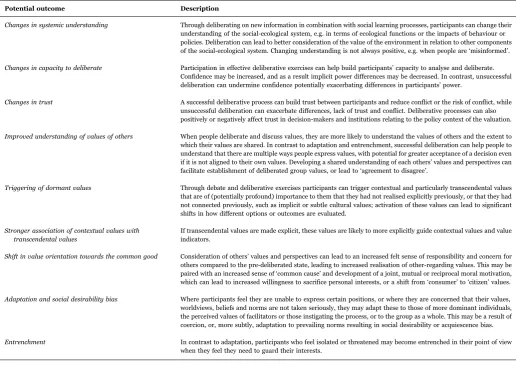
In turn, these factors can lead to a range of potential outcomes in terms of how, ultimately, contextual values are formed and shaped and translated into value indicators, described inTable 4. These outcomes include: 1) changes in systemic understanding; 2) changes in capacity to deliberate; 3) changes in trust; 4) improved understanding of the values of others; 5) triggering of dormant values; 6) stronger associa-tion of contextual values with transcendental values; 7) a shift in value orientation towards the common good; 8) adaptation and social desirability bias; and 9) entrenchment. These outcomesneed to be distinguished from theoutputof deliberative valuation, which would constitute some sort of individual or group deliberated value indicator, such as individual or social willingness to pay or a ranking of policy options in terms of social desirability.
While some outcomes may be generally considered desirable (e.g. improved systemic understanding) or undesirable (e.g. entrenchment), what outcomes are considered positive or negative and which are prioritised are ultimately dependent on the objective of deliberation. For example, closer association of transcendental and contextual values may be seen as important from a democratic deliberative perspective, but as less relevant or even undesirable from a neoclassical economic perspective. A participatory action research project may emphasise capacity building, while a deliberative policy formation process that brings together stakeholders that are unfamiliar with each other may emphasise trust-building.
Particular outcomes can also interact. For example, increased systemic understanding and better reflection of transcendental values can together lead participants to look at the natural environment in a broader context, making conflicts, trade-offs and synergies across different societal priorities more explicit. This is exemplified by
allo-cated social willingness to pay particularly prioritising synergies between social, environmental, cultural and economic interests. In contrast,Kenter (2016b)found that participants’willingness to pay for a range of ecosystem services decreased through deliberative clarifi ca-tion of their relative importance compared to other social priorities.
4.3. Chain of influence connecting transcendental and contextual values
Thefinal component of the DVF model is a‘chain of influence’that discusses the interrelations between key ‘ingredients’ of the DVF process. We build this conceptualisation on the review of deliberation inSection 3, our own experience of facilitating deliberations (e.g.Fazey et al. 2005, 2010, 2011; Kenter, 2016b; Kenter et al., 2011, 2014a, 2014b;2016a;Orchard-Webb et al., 2016;Raymond and Kenter, 2016;
Ranger et al., 2016;Kenter and Fazey, 2015;Reed and Kenter, 2015;
Reed et al. 2013,In press;Scott et al., 2016), and social-psychological theory, particularly the Value-Belief-Norm (VBN) theory, the Theory of Planned Behaviour (TPB), and the Value Change Model (VCM).
The VBN theory was devised by Stern and colleagues (Stern, 2000; Stern et al., 1999). It considers that transcendental values shape one's environmental worldview, which in turn influences beliefs around awareness of the consequences of actions and ascription of responsi-bility beliefs for self or other. These in turn shape one's personal norms, which is thought to determine behaviour. Behaviour is seen to include both personal (e.g. recycling behaviour) and political actions (e.g. involvement in environmental social movements) (Stern et al., 1999). Given this broad conception of environmental behaviour, we consider this also to include evaluative behaviour in both valuation surveys (e.g.
López-Mosquera and Sánchez, 2012), and deliberation (Kenter, 2016b; Kenter et al., 2016a), and thus assume a correspondence between
behaviour in this sense, and contextual values. An important implica-tion of the theory is then that transcendental values are not directly translatable into contextual values, but are mediated by beliefs and norms. For example, someone with strong biospheric values, who is asked if they are willing to provide a donation towards conserving a particular species, may nonetheless not be willing to pay, as they may not feel a moral impetus if they do not believe the species to be at risk, or if they believe someone else is responsible.
The TPB was devised byAjzen (1991; 1985). Behaviour is seen to be associated with intentions, which are in turn influenced by attitudes (positive or negative evaluations of options); perceived behavioural control in relation to options (the personal difficulty or ease to enact something); and subjective norms (the normative influence of signifi -cant others). In relation to the environment, this means that behaving pro-environmentally depends on having a positive attitude to the behaviour, feeling moral support from others, and believing that one can make a difference. Thus, this theory again highlights a set of beliefs and norms that are likely to influence contextual values (Raymond and Kenter, 2016).
[image:8.595.84.511.59.373.2]A third, more recent model that we highlight is the VCM, developed by Bardi and Goodwin (2011). The VCM specifically focuses on potential changes in the relative importance of different transcendental values. The VCM highlights that different values are primed by environmental cues, such as changes in social and cultural contexts. These changes may occur implicitly through unconscious ques in different situations, but can also be enacted by‘effortful’deliberation (Maio and Olson, 1998; Bardi and Goodwin, 2011). The degree of stability in changes in the relative importance of different transcen-dental values will depend on whether these values are implicitly triggered, or explicitly in some kind of intervention, and the depth, intensity and duration of these deliberations, which in turn depend on
the design of an intervention; thus highlighting many of the DVF key factors of influence discussed above. In the longer term, the degree of persistence in value change is also dependent on whether transcen-dental values can be applied and enacted (which reinforces them), the degree to which values can be maintained within one's cultural context, and personal factors such as the degree to which value changes can be integrated in one's identity.
While there are other socialpsychological theories that have rele-vance to value formation (e.g.Everard et al., 2016provide an overview in the context of long term value change and institutional transforma-tion), we particularly highlight VBN, TPB and VCM, because both from our personal experience as facilitators and the insights gleaned from the broader literature on deliberation reviewed inSection 3, it is clear that deliberation inevitably refers back to some subset of individual and cultural transcendental values and norms. Thus understanding this dynamic is essential to understanding contextual value formation. VBN and TPB are the two most frequently used psychological theories to investigate interrelations between values, norms and behaviour in environmental contexts (Raymond and Kenter, 2016). The VBN model focuses on personal transcendental values and worldviews, while the TPB focuses more on social (subjective) norms, and together they identify the key role that particular beliefs (behavioural control, ascription of responsibility, awareness of consequences) play as
mediators. The VCM brings emphasis on societal and cultural trans-cendental values, but also highlights that value change is not solely an intrapersonal but a dynamic and communicative process where in-dividuals interact with their sociocultural environment.
[image:9.595.47.559.83.497.2]Informed by these considerations, the DVF chain inFig. 2starts with societal, cultural and communal transcendental values, which influence individual transcendental values. As discussed inSection 3, and also in line with the VCM, many transcendental values are likely to be dormant, and thus their influence will depend on whether they become explicit through environmental cues in the process, either through explicit exercises or prompts as part of the process design, or more informally through social interaction. The DVF chain aligns with VBN theory in conceiving that individuals form contextual values and indicators through application of their transcendental values and the worldviews that depend on them to a specific context, mediated by beliefs around those contexts. However, these beliefs are seen as dynamic, and again influenced by situational cues. Deliberation can impact on them through the effect of activated transcendental values (e.g. changes in beliefs about personal responsibility in relation to the object of valuation or course of action under consideration), through exchange of information, including expert and lay knowledge, and through individual and joint analysis. This can lead to changes in beliefs around the nature of the social-ecological system or how it
Table 3
Key factors of influence on outcomes of deliberative valuation processes.
Factor of influence Description
Level of social interaction Deliberative valuation can comprise different degrees of individual vs social deliberation, for example in terms of
consideration of information, whether analytical exercises are individual or group-based, and whether values are established on an individual or group basis.
The ability of participants to deliberate The extent to which people are able to make their values explicit and deliberate around certain tasks. Ex-ante ability is likely to be influenced by education, social-economic background, prior experience and social status. The degree to which participants are ultimately able to deliberate depends on the degree to which ex-ante ability is taken into account and the process design and facilitation actively supports and enables participants in an inclusive way, e.g. by signalling to less confident participants that their perspectives are equally valid and important and by including confidence-building and learning exercises.
The institutional context As a‘value articulating institution’(Vatn, 2009), outcomes of valuation are influenced by the way issues, questions, values and options are framed: what issues and policy options are in and out of scope of the deliberation and decision-making context, what level of participation is sought, what information and knowledge is presented (e.g. scientific vs local knowledge), whether this can be contested, how values are framed (e.g. as ethically and ontologically plural or not), and by whom (experts/researchers or participants), and how values will be aggregated (analytical techniques such as econometric models and aggregation functions, or negotiation, voting etc.).
Group composition Who is included in the deliberation influences the degree to which the group of deliberants is heterogeneous in terms of
social backgrounds, interests and knowledge, whether there are interests that dominate, and whether there are un- or under-represented voices. This will in turn influence the diversity of values and perspectives that participants are exposed to.
Extent of explicit consideration of transcendental values
The extent to which the aim, design and facilitation of the process explicitly considers transcendental values, or helps to uncover them in deliberative processes, will affect the extent to which participants reflect on these values. Many transcendental values, particularly where they are shared as communal and cultural values, are implicit or dormant, and explicit reflection is likely to impact on how participants evaluate particular contexts.
The intensity and length of time of the deliberative process
More intense deliberation, repeated and/or developed over longer periods of time is likely to lead to more complete, profound and enduring formation, shaping and sharing of values than shorter, less intense, one-off processes; particularly in terms of transcendental values.
Extent of exposure to new information New information may result in changes in understanding, particularly where this influences beliefs that mediate between transcendental and contextual values such as around the consequences of actions or behavioural control (Section 4.3).
Power dynamics and peer pressure Power differences and peer pressure are reflected in the degree to which particular individuals or groups of individuals can convince other participants on the basis of other factors than communicative reason, e.g. through their political, economic and social positions, privileged access to pertinent knowledge or others with power, enforcement of social norms, or in subtler ways through being regarded as an expert in the issue to hand, charismatic, or rhetorically gifted.
operates, and to the VBN and TPB belief constructs around awareness of consequences, ascription of responsibility, behavioural control and subjective norms. This process ultimately results in personal and intersubjective normative conclusions (what should and should not be done) and these motivate contextual values (the relative evaluations of different objects of value). These contextual values can either be newly formed where a new context is considered, changed in response to perceiving and evaluating the context differently as a result of the deliberation, or remain unchanged. The latter may result from en-trenchment, because the deliberation did not change which transcen-dental values were activated in relation to the particular context, or because it revealed insufficient new insights around that context. These contextual values then determine expression of value indicators, either individually or collectively as a group, through negotiation and collective agreement, voting, or another appropriate mechanism.
5. A template for designing deliberative valuations
In terms of developing and designing a deliberative valuation in practice, we propose a template consisting of six main steps, which map onto the DVF model chain of influence. Across the steps, the focus of deliberation shifts between different components of the deliberative process. Valuations on the basis of this template incorporate the key elements identified in the previous section as necessary for a robust process of value formation. However, in practice, under the constraints of time and resources available, these steps may be combined, re-arranged or applied more loosely or implicitly. Moreover, the template is intended as a high level methodological frame that can be adapted
for a broad range of contexts. While we provide examples of methods and technique that could be used to implement the different steps, this is not intended to be prescriptive, as operationalisation of the template will need to be aligned to social, cultural, institutional and other contextual particularities. The six steps include: 1) the institutional context; 2) transcendental values; 3) contextual beliefs, broader policy impacts and systemic relations; 4) implications for transcendental values; 5) norms and contextual values; and 6) value indicators.
5.1. The institutional context
[image:10.595.39.556.80.451.2]Thisfirst step concerns establishing the terms of reference for the decision-making context to hand, explaining to participants the raison d’être for the deliberation process, the aim of it, the structure, who is in- and excluded and why, and key limitations. It is crucial for participants to understand why they are being asked to deliberate and value, how their values will be utilised and how they will not be, and that the scope of the deliberation matches the scope of the decision-making context. This helps ensure that the deliberations do not omit key issues, but also helps to avoid raising false expectations. For example, in the study by Ranger et al. (2016), the terms for a deliberative valuation of implementation measures for a marine protected area were constrained by the legal competency of the implementing agency, and thus any measures that fell outside of this competency were set to be out of scope from the start. This step will also include an informed consent procedure if appropriate.
Table 4
Potential outcomes of deliberative valuation.
Potential outcome Description
Changes in systemic understanding Through deliberating on new information in combination with social learning processes, participants can change their
understanding of the social-ecological system, e.g. in terms of ecological functions or the impacts of behaviour or policies. Deliberation can lead to better consideration of the value of the environment in relation to other components of the social-ecological system. Changing understanding is not always positive, e.g. when people are‘misinformed’.
Changes in capacity to deliberate Participation in effective deliberative exercises can help build participants’capacity to analyse and deliberate. Confidence may be increased, and as a result implicit power differences may be decreased. In contrast, unsuccessful deliberation can undermine confidence potentially exacerbating differences in participants’power.
Changes in trust A successful deliberative process can build trust between participants and reduce conflict or the risk of conflict, while
unsuccessful deliberation can exacerbate differences, lack of trust and conflict. Deliberative processes can also positively or negatively affect trust in decision-makers and institutions relating to the policy context of the valuation.
Improved understanding of values of others When people deliberate and discuss values, they are more likely to understand the values of others and the extent to which their values are shared. In contrast to adaptation and entrenchment, successful deliberation can help people to understand that there are multiple ways people express values, with potential for greater acceptance of a decision even if it is not aligned to their own values. Developing a shared understanding of each others’values and perspectives can facilitate establishment of deliberated group values, or lead to‘agreement to disagree’.
Triggering of dormant values Through debate and deliberative exercises participants can trigger contextual and particularly transcendental values
that are of (potentially profound) importance to them that they had not realised explicitly previously, or that they had not connected previously, such as implicit or subtle cultural values; activation of these values can lead to significant shifts in how different options or outcomes are evaluated.
Stronger association of contextual values with transcendental values
If transcendental values are made explicit, these values are likely to more explicitly guide contextual values and value indicators.
Shift in value orientation towards the common good Consideration of others’values and perspectives can lead to an increased felt sense of responsibility and concern for others compared to the pre-deliberated state, leading to increased realisation of other-regarding values. This may be paired with an increased sense of‘common cause’and development of a joint, mutual or reciprocal moral motivation, which can lead to increased willingness to sacrifice personal interests, or a shift from‘consumer’to‘citizen’values.
Adaptation and social desirability bias Where participants feel they are unable to express certain positions, or where they are concerned that their values, worldviews, beliefs and norms are not taken seriously, they may adapt these to those of more dominant individuals, the perceived values of facilitators or those instigating the process, or to the group as a whole. This may be a result of coercion, or, more subtly, adaptation to prevailing norms resulting in social desirability or acquiescence bias.
Entrenchment In contrast to adaptation, participants who feel isolated or threatened may become entrenched in their point of view
5.2. Transcendental values
The next step involves deliberation on the transcendental values of participants, the communities they represent, and their shared societal and cultural values. A number of papers in this Special Issue provide examples of how this could be done.Kenter et al. (2016a)and Orchard-Webb et al. (2016)utilitise a‘Transcendental Values Compass’, where participants systematically identify important transcendental values and then discuss them. These studies then use storytelling to draw out values from narratives, which might have otherwise remained dormant.
Edwards et al. (2016)andFish et al. (2016b)use different types of artistic creations to provoke deliberation. Kenter (2016b) harnesses open prompts about values,Ranger et al. (2016)develop an ethno-graphic video-interview method and the Solomon Islands case study in
Raymond and Kenter (2016) apply a combination of ‘participatory psychometrics’, specific prompts around what is culturally important, and storytelling.
5.3. Contextual beliefs, broader policy impacts and systemic relations
At this point, the focus shifts to participants’ beliefs around the issues at hand,including the consequences of different actions or policy interventions, who is responsible and the roles of different institutions, and behavioural control and self-efficacy, i.e. the degree to which actors involved are able to influence potential outcomes. Developing an understanding of the issue within the broader social-ecological system can aid understanding of the broader social and environmental impacts of different options. This step can be implemented through structured analytical approaches, for example through participatory systems modelling (Kenter, 2016b;Orchard-Webb et al., 2016), multicriteria analysis (Ranger et al., 2016andOrchard-Webb et al., 2016), or an option-impact-matrix, where social and environmental impacts, and those who are impacted, are systematically considered for different policy options (Reed and Kenter, 2015). Specific knowledges can also be called upon, including presentations by local and scientific experts through presentations (Ranger et al., 2016;Scott et al., 2016), expert witness hearings (Fish et al., 2013), and structured exercises to elicit participants’own knowledge (Kenter et al., 2011).
5.4. Implications for transcendental values
Given an understanding of the impacts of different options, the deliberation then considers the degree to which options are in accordance with the transcendental values that were deemed of most importance. For example, if social justice and security were important values, to what degree are these enhanced or diminished. This step can be implemented as a follow-on from Step 3, and incorporated through (typically small group) discussion in conjunction with the various techniques listed for the previous step.
5.5. Norms and contextual values
The process now starts to integrate material from the previous stages to discuss and draw conclusions on norms and contextual values. How norms are expressed or questioned depends on the type of outcome sought from the deliberative process as a whole. In a more conventional economic valuation this would be couched in individual, self-regarding, utilitarian terms, e.g.‘Given your understanding of the impacts of different options in terms of the things you value, what should you do to maximise your own individual welfare/preference satisfaction?’. Otherwise, the outcome may be framed in terms of the common good; e.g.‘Now that we are aware of the impacts of different options in terms of the things we value, and the different interests affected, what ought to happen?’Contextual values then reflect the degree to which different objects of value (e.g. different ecosystem services), or response options (e.g. policies that affect those ecosystem
services), contribute to the right outcome, and thus the relative worth or importance of those objects and options. Step 5 can be implemented as a structured discussion leading up to Step 6.
5.6. Value indicators
Establishing indicators to reflect contextual values. This can take places through individuals identifying willingness to pay, or ratings or rankings expressing their preferences, or through a collective process of discussion and negotiation tofind an agreement, a collective ranking or ‘verdict’, or a vote on preferred policy options and/or on how much society or individuals should pay towards them. This step would align with thefinal stages of for example deliberative monetary valuation (e.g.Kenter, 2016b;Kenter et al., 2016a;Orchard-Webb et al., 2016), multicriteria analysis (e.g.Ranger et al., 2016), or citizens’juries (e.g.
Niemeyer, 2004;Fish et al., 2013).
6. Discussion
This paper has presented a new theoretical model of how values are formed through deliberative processes. Thisfills a significant research gap and provides key insights for helping guide deliberative monetary and non-monetary valuation in environmental and other areas of research and policy involving evaluation of complex and unfamiliar goods, uncertainty, contested contexts and conflicting interests. We have conceived deliberative value formation as a process of social interaction involving the values, worldviews, beliefs and norms of those taking part, where this process involves both knowledge exchange and social learning, and deliberation on the transcendental values of individuals, communities, culture and society.
This conceptualisation is particularly salient because both monetary valuation and non-monetary approaches to valuing ecosystem services have so far largely ignored transcendental values (Raymond and Kenter, 2016). Those calling for pluralistic approaches to valuation (e.g. Foster, 1997; Sagoff, 1998; Holland, 2002; O’Neill, 2007;
Howarth and Anderson, 2007; O’Neill, Holland and Light, 2008;
Spash, 2008;Lo and Spash, 2012;Baveye, Baveye and Gowdy, 2013;
Parks and Gowdy, 2013;Lo, 2013;Kenter et al., 2015) have high-lighted certain sets of values that are seen to be particularly important (e.g. fairness, justice, equity) and have more broadly noted the importance of ethical pluralism, but have mostly not characterised how this pluralism can be dealt with in practice. Important contribu-tions that have highlighted the limits of monetary valuation from a cultural values perspective (e.g.Chan et al., 2012;Daniel et al., 2012;
Satterfield et al., 2013) do not always clearly distinguish between transcendental and contextual values and indicators, which makes it challenging to distinguish evaluations from the values that people rely on to help guide their choices (also see Fish et al., 2016a). The ecosystem services literature has so far made few connections with the social-psychological literature on environmental values in terms of characterising transcendental values (Raymond and Kenter, 2016). Conversely, the latter has studied transcendental values in detail but has undertaken little exploration of contextual values of ecosystem services (Ives and Kendal, 2014; Bryce et al., 2016).