Towards Effective Knowledge Application Capability in ITSM through
Socialisation, Externalisation, Internalisation and Combination.
Abdulazeez Ftahi1, Abdul Hafeez-Baig2, Raj Gururajan2, 1
PhD student at USQ University – QLD, Australia
2
Supervisory team, USQ University, QLD, Australia
*Mosul University, Iraq – USQ University, Australia
Prior research has focused on issues that are relevant to knowledge creation and sharing in Information Technology Service Management ITSM. Instead, the purpose of this paper is to examine how
knowledge application capability effectiveness (KACE) in ITSM can be affected through several knowledge management processes. In ITSM, IT service desk function is on the most important
functions that keeps and maintains IT services running. This function deals with various IT problems and incidents on a daily basis through utilisation of all available knowledge resources (i.e.
organisational knowledge and personal knowledge). A framework was developed to identify factors affect KACE in IT service desk function. The framework is based on Nonaka (1994) model of
organisational knowledge creation. The framework focuses upon socialisation, externalisation, internalisation and combination as contributors to the formation of KACE. The empirical research was
conducted at group of eight (Go8) Universities in Australia, based on set of semi-structured interviews. Four major factors are shown to be related to the extent to which IT SD managers feel that KACE can be influenced. The results are founded upon a qualitative data in which manual and computer-aided
content analysis were undertaken.
1 Introduction
Effective knowledge implementation or supplication is considered key to the success of contemporary
organisations in which Information Technology Service management (ITSM) has become an integral part of managing their IT services. In common with many others processes and functions, IT service
function (also referred to as Help desk or call centre) is defined as a set of organisational IT activities which provide support to customers in the form of services (Ortiz & Benitez, 2014). Through the
utilisation of knowledge resources, IT services are provided at less cost and less risk by the contracted company as part of its responsibility for addressing IT issues (e.g. data breach, hardware failure, software compromise, hacking, viruses, fraud, and data theft) (C. Trusson, Hislop, & Doherty, 2017).
Such IT issues or problems could be detrimental to an organisation as a whole, and even impacting the personal data of its customers (Tanovic & Mastorakis, 2016). Therefore, it is very important to consider
the various factors associated with the knowledge application capability effectiveness (KACE). Kim and Lee (2010), defines KACE as a process of applying (i.e. act upon it) available knowledge for the
purpose of solving problems and dealing with challenges.
Previous research has contributed greatly to our understanding of knowledge creation (KC) and knowledge sharing (KS) in ITSM (Conger & Probst, 2014; Graupner, Basu, & Singhal, 2009; Liang &
Baozhang, 2009). However, KACE as an important aspect for the performance of an organisation as a whole (Alavi & Tiwana, 2002; Grant & Baden‐Fuller, 2004; Nickerson & Zenger, 2004) is still
neglected in the literature of ITSM. Although some of the prior attempts have identified the importance
of KACE in improving the performance and creating value of knowledge resources in ITSM, theses attempts have not focused on factors that could affect KACE (Davenport & Prusak, 1998; C. R. Trusson,
Doherty, & Hislop, 2014). This study attempts to address this issue through a qualitative methodology, using interviews conducted with some IT service desk managers in selected universities in Australia.
The reminder of this paper is structured as follows. In the following section, a review of related literature is provided. Next, we outline the theoretical framework, rooting this in literature of KM and ITSM for public services. In the following section, data collection and analysis and findings are explained. The
paper ends with conclusions and future research directions.
1.1
Literature reviewIT services have grown rapidly over the past years and become supreme and integral parts of
contemporary organisations across the globe. According to World Development Report 2017,
IT services in 2016 represented 85% of the United States’ GDP only, and they are increasing
in numbers for the rest of the world (Governance and The Law, 2017). The growth in demand
and expenditure currently being experienced in this sector is also accompanied by the rise in
to realise the importance of Information Technology Service Management (ITSM) (Cronholm
& Salomonson, 2014; C. R. Trusson et al., 2014). Recent research has shown that ITSM is one
of the most salient construct in today’s organisations (Conger & Probst, 2014; Nabiollahi,
Alias, & Sahibuddin, 2011; Shahsavarani & Ji, 2011; van Bon et al., 2007). Perhaps this is
because it is a discipline for managing IT services which are important in both private and
public organisations (Cronholm & Salomonson, 2014). In accord with this view, it is likely that
IT service industry will dominate the world scene for the immediate future.
ITSM is a mix of technology, information and knowledge that forms a new method of
managing IT services, in which emphasis is given to the quality of the services rather than to
the IT assets (Conger & Probst, 2014; C. R. Trusson et al., 2014; van Bon et al., 2007; Wan &
Jones, 2013). ITSM is a relatively new discipline focused on how organisations can provide
high quality IT services to their customers (Hedge, Bhagwatwar, Bala, & Venkataraman,
2014). ITSM covers all IT service functions and activities, and seeks to integrate IT operations
and organisation objectives (Shahsavarani & Ji, 2011). ITSM in its functions and processes,
aims to meet any organisation’s objectives (i.e. making profit, reducing costs, increasing sales,
and even entering new markets) and minimise service disruption. (Brugh & Silvius, 2009; Iden
& Eikebrokk, 2013). This can be achieved when the response time to an IT service incident or
failure is minimised (Jäntti & Hotti, 2016).
Scholars in that area have long recognised that the success of IT SD function hinges on the
effectiveness of using knowledge resources (often refereed to KACE) in addressing IT
incidents (Cater-Steel, Toleman, & Tan, 2006; Jantti & Eerola, 2006; Rance, Rudd, Lacy, &
Hanna, 2011; Schaefer & Woo, 2010; Steinberg, Rudd, Lacy, & Hanna, 2011; C. R. Trusson
et al., 2014). In the literature, KACE is the most important part of any KM initiative (Alavi &
Tiwana, 2002). According to Shahsavarani and Ji (2011) KACE in ITSM is still neglected. A
review of studies published between 2000 and 2017 revealed limited interest KACE in ITSM
as the focus was mainly given to knowledge creation and sharing in ITSM. For instance,
Graupner et al. (2009) aimed to design a domain wiki for better ITIL knowledge-sharing.
Another example is Jantti and Eerola (2006) who discussed using KM in ITSM for Problem
Management (PM). The main aim of their work was to evaluate the usefulness of the IT service
PM model as well as to present a theory-based model for PM. In their research, Jantti and
Eerola (2006) found that in some situations there is no knowledge base available for the IT
myriad forms (e.g. SKMS, YouTube, personal knowledge), but the application of that
knowledge what is lacking.
Since 2014, a number of active researchers in the ITSM field have also provided contributions
to the earlier research. For instance, Conger and Probst (2014) tried to reduce the cost and time
of IM by converting tribal knowledge to organisational knowledge. The focus of this research
was on KS. Similarly, Trusson et al. (2014) examined KS using ITSM tools. They focused on
an important aspect, the dysfunctional process conflict in ITSM. In this study, they collected
data from IT workers and IT managers. They found that the tension between empowering
workers and expecting them to apply or use knowledge is a serious concern for IT managers.
To examine this concern, further research may be needed to investigate how IT service staff
can apply the knowledge that is made available, especially for the IM process. According to
several recent studies, KACE in IM, as an important new area of research in ITSM, is still
overlooked (Bezerra, Pinheiro, & Albuquerque, 2014; Ortiz & Benitez, 2014).
Organisational knowledge creation theory (OKCT) has been used to explain many aspects in
different areas. Several researchers have made contributions in this area (Alavi & Tiwana,
2002; Nonaka, Toyama, & Konno, 2005; Nonaka, Von Krogh, & Voelpel, 2006). This theory
has been used to explain a diverse range of subjects such as innovation and technology
management, leadership and management information systems (Nonaka et al., 2006).
However, it has been rarely used in ITSM research (Shahsavarani & Ji, 2011). What is more,
ITSM scholars used OKCT to explain KC and KS only, but have yet to address KACE in
ITSM. KACE is an important area of research in ITSM if an organisation seeks efficiency and
cost reduction of its IT services (e.g. cost of handling an incident). According to Kim and Lee
(2010, p. 136) “the effective application of knowledge has helped companies improve their
efficiency and reduce costs”. In this aspect, Teo and Bhattacherjee (2014) argue that creating
value for the organisation are tightly related to the effectiveness in its knowledge
implementation process.
The processes of socialisation and externalisation described by Nonaka et al. (2005) are
deemed to be important for knowledge implementation. Firstly, socialisation refers to the way
in which individuals can share their knowledge when they meet each other in a place. For
instance, room meetings, offices, websites and emails allow employees to apply knowledge
Toyama, & Nagata, 2000). Through this process, newcomers can gain skills through
apprenticeships, and by action and/or interaction with experienced workers
(Becerra-Fernandez & Sabherwal, 2001). Secondly, externalisation is the process of creating explicit
knowledge from tacit knowledge through the use of metaphors, models and analogies
(Birasnav, 2014). This involves techniques that translate knowledge into understandable forms
such as images, words, and visuals (Wang, Noe, & Wang, 2014). Individuals can apply other’s
knowledge by following these forms when they perform their tasks and through the sequential
use or practice. This repeated use of knowledge can be understood as KA because individuals
in fact are applying tacit knowledge using explicit forms.
Likewise, the key knowledge actions of internalisation and combination are also important for
knowledge implementation. Internalisation refers to actions in which newly created explicit
knowledge is converted into tacit knowledge through the process of learning by doing (Nonaka,
1994). For instance, in the job of training, internalisation can be used as a method of simulation
and experiment (Nonaka et al., 1998). In this case, IT service desk employees for example,
would have an opportunity to apply their personal knowledge in handling complex and time
consuming IT incidents (e.g. security incident). This is a sort of knowledge creation, but it
could be a method of knowledge application as well, because Alavi and Tiwana (2002) argued
that through this process, existing knowledge could be used for addressing real problems.
Combination on the other hand converts explicit knowledge into more complex sets of explicit
knowledge (Nonaka et al., 1998). It involves reorganizing existing knowledge to create new
knowledge (Nonaka, 1994). It focuses on facilitating coordination, communication and
knowledge integration (KI) at the individual’s level as well as organisational level
(Becerra-Fernandez & Sabherwal, 2001). Thus, internalisation and combination can effect KACE in IT
service desk function (Löhe & Legner, 2013). This may be attributable to the notion that
aggregating knowledge embraces KAC also, especially for tacit knowledge.
All of the aforementioned factors could affect KACE in IT service desk function. Each Factor is expected to foster the application of existing knowledge (i.e. SKMS and personal knowledge) allowing individuals to use that knowledge to achieve ITSM goals. Again, our focus in this paper is on KACE in
IT service desk function rather than on ITSM in general.
1.2 Research method
should be able to provide data required for the purpose of the paper. The sample was, for this reason,
based on a judgement or purposeful selection of participants (Marshall, 1996). With this regards, Flyvbjerg (2006) calls this as “information-oriented selection” which means that the sample is selected
based on the expectations of having rich information about the phenomenon of interest. This selection process was supported by previous studies in information system domain (Becerra-Fernandez &
Sabherwal, 2001; Grimsley & Meehan, 2007; Ho, Ang, & Straub, 2003). In fact, a group of universities were selected as a sample for this study on the basis of their relevance to the main research question
(Mason, 2017). The identified universities thereafter were contacted with request for participation along with information about the research paper. An interview protocol was developed based on previous studies in order to confirm/refute factors that could influence KACE in ITSM.
1.2.1 Data analysis
Before the data analysis started, all interviews were listened several times in order to identify elements
that specifically related to the study objective. The interviews were then coded and verbatim transcribed, reviewed by the interviewer himself to ensure that the transcriptions reflected the actual meaning of the
interview as far as possible. The text was then analysed and categorized following the thematic approach. After that, manual content analysis was used to categorise data in themes that most frequently
mentioned by participants and consistent with factors listed through the literature review. Finally, Leximanacer, a text analytics tool which produces thematic map, was used to further confirm the data
analysis. After the analysis, the researcher listened to the interviews once again, to ensure all important insights had been included in the analysis.
1.2.1.1 Manual content analysis
The first stage of the data involved manual content analysis of the interview transcriptions.
Manual content analysis refers to the process in which qualitative data can be categorised under
emerging themes (Speziale, Streubert, & Carpenter, 2011). In this aspect, Lewis, Zamith,
Hermida, and Media (2013) define this approach as way for making qualitative data
understandable and meaningful by identifying themes within text and for building evidences
that support the research question. Following the recommendation of Miles, Huberman, and
Saldana (2013), three steps were employed for the manual content analysis process. The steps
are data reduction, data display and drawing conclusions or verification.
Data reduction was intended to elicit insights and meanings from the speech of participants,
allowing the researcher to extract maximum results from interviews throughout the process of
identifying, abstracting, transforming and simplifying the raw data (Miles et al., 2013). Data
display was the second stage. In this stage, concepts and thoughts were arranged in matrixes of
pattern codes. In this paper, this step was used for gaining conceptual coherence by collecting
concepts that match each theme (Alhojailan, 2012). This would enabled the researcher to spot
any similarities, differences and other interrelationships in the data that is collected (Alhojailan,
2012). According to Muijs (2010), data display helps in increasing the overall reliability of the
research by providing evidences, support and validate interpretations. In this paper, data was
displayed in narrative text and quotations. Finally, data drawing and conclusion was used for
creating abridgements or summaries and coding of previous steps in order to generate ideas
and meanings. This included establishing and grouping categories of information that can go
together, identifying relationships among constructs, the process of identifying similar
statements and contrasting, and building conceptual coherence and consistency (Miles et al.,
2013). According to Speziale et al. (2011), this step would be essentials for assessing the
validity of the findings.
1.2.1.2 Computer-aided content analysis
Leximancer was used for generating a diagrammatic view of the data and for visual
demonstration of how different concepts and themes are related in order to draw a
comprehensive picture of evidences in summarised from (Beattie, McInnes, & Fearnley, 2004;
Beattie & Thomson, 2007; Clatworthy, Jones, & research, 2003; Hussainey, Schleicher,
Walker, & research, 2003; Thomas, 2014). Two sequential stages of co-occurrence data
extraction: sematic and relational were employed (Smith & Humphreys, 2006; Thomas, 2014).
Sematic extraction was used for extracting data from the frequencies of word co-occurrences
in the actual texts (Landauer & Dumais, 1997). This stage provided a meaningful name for
each concept as a way to allow interpretation and visualization of data (Smith & Humphreys,
2006). Relational extraction on the other hand was conducted for providing further insights and
inductions (Krippendorff & Bock, 2009). According to Thomas (2014), insights and inductions
are needed for providing many general principles based on a set of fact. These principles are
important as they show how closely concepts are linked to one another and how other
significant terms are related to the phenomenon of interest being examined (Smith, 2003).
1.2.2 Results
In order to produce more robust results and eliminate the less relevant ones, the number of
concepts was initially set to 30 as Leximancer can generate very lengthy concept lists (Thomas,
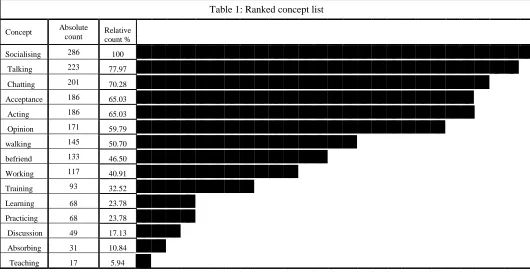
2014). The final list contained 15 concepts, with relative counts ranging from 286 instances
(100%) to 17 instances (5.94%). The list in Table 1 presents concepts in rank order according to
dataset. From the table, it is clear that the foremost concept in the list was “to Socialising”,
mentioned 286 times in the interviews. The second and the third concepts reported by
participants was “Talking’ and “chatting”, with a count of 223 and 201 respectively. The results
in the table reveal that various types of experience of mixing with people were frequently
[image:8.595.31.561.186.458.2]mentioned and were found relevant to KACE in IT service desk function.
Table 1: Ranked concept list
Concept Absolute
count Relative count %
Socialising 286 100
Talking 223 77.97
Chatting 201 70.28
Acceptance 186 65.03
Acting 186 65.03
Opinion 171 59.79
walking 145 50.70
befriend 133 46.50
Working 117 40.91
Training 93 32.52
Learning 68 23.78
Practicing 68 23.78
Discussion 49 17.13
Absorbing 31 10.84
Teaching 17 5.94
As the content analysis results above were based merely on the count of concepts or words in
the transcriptions of the interviews, rational analysis was then employed to provide more
details. Rational analysis is important to explain how concepts are related to one another and
how themes appear close to each other (Thomas, 2014).
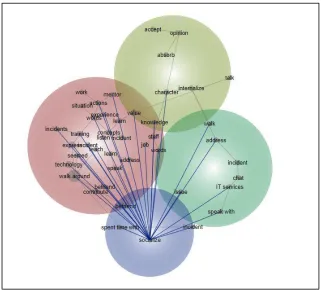
Using relational analysis, Figure 1 shows that the terms most closely connected to KACE in
addressing IT incidents management are Socilisation, Externalisation, Internalisation and
Figure 3: Leximancer map
In interpreting these results, the insights from IT servivce desk managers and the thortical
expectations, the factors that affect KACE of IT service desk fucntion were placed in four
themes: Socilisation, Externalisation, Internalisation and Combination. However, as IT service
desk function is a reapdly changing fucntion in ITSM, the four factors resulted from the
qualitative study, do not suffeciently explain or offer insights into the phenonmon of interset
outside eduactional sector in Austrlian.
1.3 Discussion and conclusion
From the manual and computer-aided data analysis, it is apparent that IT practitioners recognise
the four abovementioned factors to be integral for KACE of IT service desk function. Despite
the importance of KACE for ITSM, the review of the literature in that aspect suggests that there
is a dearth of empirical research concerning that matter. Jäntti and Hotti (2016) and C. Trusson
et al. (2017) also support this view and suggest that the KAC, which allows IT staff members
in organisation to fulfil their duties, has been neglected. The primary contribution of this paper
is that ITSM managers in higher education sector in Australia could the process of Socilisation,
Externalisation, Internalisation and Combination to enhance the performance of IT service desk
utilised in automatic content analysis of qualitative data in the context of knowledge
management and ITSM studies through using two stages of data extraction. The findings
complement and contextualise a growing body of literature that have emerged and written in
both knowledge management and IT service management (Conger & Probst, 2014; Cronholm
& Salomonson, 2014; C. R. Trusson et al., 2014). However, the findings of this paper are not
generalizable, but results can be transferable and have utility in that aspect. Based on results, it was
concluded that the four emerged factors in this study proactively affect KACE in IT service desk function.
In conclusion, the main argument in this study thus has been strongly supported through specific comments made by participants in a qualitative study. Four themes were emerged form data including:
socilisation, externalisation, internalisation and combination. Considering the value of these factors in improving KACE of IT service desk function, we urge IS researchers to move beyond those debates
Alavi, M., & Tiwana, A. (2002). Knowledge integration in virtual teams: The potential role of KMS. Journal of the American Society for Information Science and Technology, 53(12), 1029-1037.
Alhojailan, M. I. (2012). Thematic analysis: A critical review of its process and evaluation.
West East Journal of Social Sciences, 1(1), 39-47.
Beattie, V., McInnes, B., & Fearnley, S. (2004). A methodology for analysing and evaluating narratives in annual reports: a comprehensive descriptive profile and metrics for disclosure quality attributes. Paper presented at the Accounting Forum.
Beattie, V., & Thomson, S. J. (2007). Lifting the lid on the use of content analysis to investigate intellectual capital disclosures. Paper presented at the Accounting Forum.
Becerra-Fernandez, I., & Sabherwal, R. (2001). Organizational knowledge management: A contingency perspective. Journal of management information systems, 18(1), 23-56. Bezerra, G. d. T. V., Pinheiro, V. C. M., & Albuquerque, A. B. (2014). Incident Management
Optimization through the Reuse of Experiences and Natural Language Processing.
Paper presented at the International Conference on the Quality of Information and Communications Technology (Quatic), Braga, Portugal.
Birasnav, M. (2014). Knowledge management and organizational performance in the service industry: The role of transformational leadership beyond the effects of transactional leadership. Journal of Business Research, 67(8), 1622-1629.
Cater-Steel, A., Toleman, M., & Tan, W.-G. (2006). Transforming IT Service Management – the ITIL Impact. Australasian Conference on Information Systems.
Clatworthy, M., Jones, M. J. J. A., & research, b. (2003). Financial reporting of good news and bad news: evidence from accounting narratives. Accounting and Business Research, 33(3), 171-185.
Conger, S., & Probst, J. (2014). Knowledge Management in ITSM: Applying the DIKW Model. In Engineering and Management of It-Based Service Systems. Verlag Berlin: Springer.
Cronholm, S., & Salomonson, N. (2014). Measures that matters: service quality in IT service management. International Journal of Quality and Service Sciences, 6(1), 60-76. Davenport, T. H., & Prusak, L. (1998). Working knowledge: How organizations manage what
they know. USA: Harvard Business Press.
Flyvbjerg, B. (2006). Five misunderstandings about case-study research. Qualitative inquiry, 12(2), 219-245.
Governance and The Law. (2017). Retrieved from Washington:
Grant, R. M., & Baden‐Fuller, C. (2004). A knowledge accessing theory of strategic alliances.
Journal of Management Studies, 41(1), 61-84.
Graupner, S., Basu, S., & Singhal, S. (2009). Collaboration Environment for ITIL. Paper presented at the Integrated Network Management-Workshops, New York.
Grimsley, M., & Meehan, A. (2007). e-Government information systems: Evaluation-led design for public value and client trust. European Journal of Information Systems, 16(2), 134-148.
Ho, V. T., Ang, S., & Straub, D. (2003). When Subordinates Become IT Contractors Persistent Managerial Expectations in IT Outsourcing. Information Systems Research, 14(1), 66-86.
Hussainey, K., Schleicher, T., Walker, M. J. A., & research, b. (2003). Undertaking large-scale disclosure studies when AIMR-FAF ratings are not available: the case of prices leading earnings. Accounting and Business Research, 33(4), 275-294.
Jäntti, M., & Hotti, V. (2016). Defining the relationships between IT service management and IT service governance. Information Technology and Management, 17(2), 141-150. Kim, S., & Lee, H. (2010). Factors affecting employee knowledge acquisition and application
capabilities. Asia-Pacific Journal of Business Administration, 2(2), 133-152. Krippendorff, K., & Bock, M. A. (2009). The content analysis reader: Sage.
Landauer, T. K., & Dumais, S. T. (1997). A solution to Plato's problem: The latent semantic analysis theory of acquisition, induction, and representation of knowledge.
Psychological Review, 104(2), 211-240.
Lewis, S. C., Zamith, R., Hermida, A. J. J. o. B., & Media, E. (2013). Content analysis in an era of big data: A hybrid approach to computational and manual methods. 57(1), 34-52.
Liang, W., & Baozhang, W. (2009). Research on Enterprise ITSM Knowledge Management
Model. Paper presented at the International Conference on Management and Service Science, Wuhan, China.
Löhe, J., & Legner, C. (2013). Overcoming implementation challenges in enterprise architecture management: a design theory for architecture-driven IT Management
(ADRIMA). Information Systems and e-Business Management, 12(1), 101-137.
doi:10.1007/s10257-012-0211-y
Marshall, M. N. (1996). Sampling for qualitative research. Family Practice, 13(6), 522-526. Mason, J. (2017). Qualitative researching. London: Sage Publications.
Miles, M. B., Huberman, A. M., & Saldana, J. (2013). Qualitative data analysis. London: Sage Publication.
Muijs, D. (2010). Doing quantitative research in education with SPSS. London: Sage Publications Ltd.
Nabiollahi, A., Alias, R. A., & Sahibuddin, S. (2011). Involvement of Service Knowledge Management System in Integration of ITIL V3 and Enterprise Architecture. American Journal of Economics and Business Administration, 3(1), 165-170.
Nickerson, J. A., & Zenger, T. R. (2004). A knowledge-based theory of the firm—The problem-solving perspective. Organization Science, 15(6), 617-632.
Nonaka, I. (1994). A Dynamic Theory of Organizational Knowledge Creation. Organization
Science, 5(1), 14-37.
Nonaka, I., Toyama, R., & Konno, N. (2005). SECI, ba and leadership: a unified model of dynamic knowledge creation. Knowledge Management: Critical Perspectives on Business and Management, 2, 317.
Nonaka, I., Toyama, R., & Nagata, A. (2000). A Firm as a Knowledge-creating Entity: A New Perspective on the Theory of the Firm. Industrial and Corporate Change, 9(1), 1-20. Nonaka, I., Von Krogh, G., & Voelpel, S. (2006). Organizational knowledge creation theory:
Evolutionary paths and future advances. Organization Studies, 27(8), 1179-1208. Ortiz, S. S., & Benitez, A. P. (2014). FOSS Service Management and Incidences. In Open
Source Software: Mobile Open Source Technologies (pp. 76-79). Berlin Heidelberg: Springer.
Rance, S., Rudd, C., Lacy, S., & Hanna, A. (2011). ITIL Service Transition. London: TSO. Schaefer, B., & Woo, M. (2010). Structuring the IT Organization for Cloud Services.
EDUCAUSE Center for Applied Reserach, Research Bulletin, 2010(12).
Shahsavarani, N., & Ji, S. (2011). Research in Information Technology Service Management (ITSM): Theoretical Foundation and Research Topic Perspectives. Paper presented at the International Conference on Information Resources Management (Conf-Irm), Seoul, South Korea.
Smith, A. E. (2003). Automatic extraction of semantic networks from text using Leximancer.
Chapter of the Association for Computational Linguistics on Human Language Technology: Demonstrations.
Smith, A. E., & Humphreys, M. S. (2006). Evaluation of unsupervised semantic mapping of natural language with Leximancer concept mapping. Behavior research methods, 38(2), 262-279.
Speziale, H. S., Streubert, H. J., & Carpenter, D. R. (2011). Qualitative research in nursing: Advancing the humanistic imperative: Lippincott Williams & Wilkins.
Steinberg, R., Rudd, C., Lacy, S., & Hanna, A. (2011). ITIL Service Operation. London: TSO. Tanovic, A., & Mastorakis, N. E. (2016). Advantage of using service desk management systems in real organizations. International Journal of Economics and Management Systems, 1, 18-86.
Teo, T. S. H., & Bhattacherjee, A. (2014). Knowledge transfer and utilization in IT outsourcing partnerships: A preliminary model of antecedents and outcomes. Information & Management, 51(2), 177-186.
Thomas, D. A. (2014). Searching for significance in unstructured data: text mining with leximancer. European Educational Research Journal, 13(2), 235-256.
Trusson, C., Hislop, D., & Doherty, N. F. (2017). The rhetoric of “knowledge hoarding”: a research-based critique. Journal of Knowledge Management, 21(6), 1540-1558. Trusson, C. R., Doherty, N. F., & Hislop, D. (2014). Knowledge sharing using IT service
management tools: conflicting discourses and incompatible practices. Information Systems Journal, 24(4), 347-371.
van Bon, J., de Jong, A., Kolthof, A., Pieper, M., Tjassing, R., Veen, A. v. d., & Tieneke Verheijen. (2007). Foundations of ITIL V3: Van Haren Publishing.
Wan, J., & Jones, J. D. (2013). Managing IT service management implementation complexity: from the perspective of the Warfield Version of systems science. Enterprise Information Systems, 7(4), 490-522.