Role of Cysteines in Stabilizing the Randomized Receptor Binding
Domains within Feline Leukemia Virus Envelope Proteins
Leonardo Valdivieso-Torres,aAnindita Sarangi,aJillian Whidby,bJoseph Marcotrigiano,b Monica J. Rotha
Rutgers-Robert Wood Johnson Medical School, Department of Pharmacology, Piscataway, New Jersey, USAa; Rutgers-Center for Advanced Biotechnology and Medicine Department of Chemistry and Chemical Biology, Piscataway, New Jersey, USAb
ABSTRACT
Retargeting of gammaretroviral envelope proteins has shown promising results in the isolation of novel isolates with therapeutic
potential. However, the optimal conditions required to obtain high-affinity retargeted envelope proteins with narrow tropism
are not understood. This study highlights the advantage of constrained peptides within receptor binding domains and validates
the random library screening technique of obtaining novel retargeted Env proteins. Using a modified vector backbone to screen
the envelope libraries on 143B osteosarcoma cells, three novel and unique retargeted envelopes were isolated. The use of
com-plex disulfide bonds within variable regions required for receptor binding is found within natural gammaretroviral envelope
isolates. Interestingly, two of the isolates, named AII and BV2, have a pair of cysteines located within the randomized region of
11 amino acids similar to that identified within the CP Env, an isolate identified in a previous Env library screen on the human
renal carcinoma Caki-1 cell line. The amino acids within the randomized region of AII and BV2 envelopes that are essential for
viral infection have been identified in this study and include these cysteine residues. Through mutagenesis studies, the putative
disulfide bond pairs including and beyond the randomized region were examined. In parallel, the disulfide bonds of CP Env were
identified using mass spectrometry. The results indicate that this pair of cysteines creates the structural context to position key
hydrophobic (F and W) and basic (K and H) residues critical for viral titer and suggest that AII, BV2, and CP internal cysteines
bond together in distinct ways.
IMPORTANCE
Retargeted gammaretroviral particles have broad applications for therapeutic use. Although great advances have been achieved
in identifying new Env-host cell receptor pairs, the rules for designing optimal Env libraries are still unclear. We have found that
isolates with an additional pair of cysteines within the randomized region have the highest transduction efficiencies. This
em-phasizes the importance of considering cysteine pairs in the design of new libraries. Furthermore, our data clearly indicate that
these cysteines are essential for viral infectivity by presenting essential residues to the host cell receptor. These studies facilitate
the screening of Env libraries for functional entry into target cells, allowing the identification of novel gammaretroviral Envs
targeting alternative host cell receptors for gene and protein delivery.
T
he specificity of retroviral vectors is initially conferred by the
envelope (Env) protein present on the surface of virus
par-ticles. This Env protein is responsible for binding to a host cell
receptor, thereby initiating virus entry. In gammaretroviruses,
the Env protein is composed of a transmembrane protein (TM)
and a surface protein (SU). For murine leukemia virus (MLV)
and feline leukemia virus (FeLV) SUs, primary receptor
bind-ing is localized to the N-terminal half of SU (
1
,
2
,
12
). Critical
residues for specificity are encoded within the N-terminal
vari-able regions, VRA and VRB. Secondary receptor binding sites
that promote viral infection have also been identified within
the SU C terminus (
3–5
).
FeLV Envs are classified as A, B, and C, originally based on
interference assays (
6
,
7
). The receptors for these three major
sub-groups have been identified as THTR1 (
8
), PiT1 (
9
), and FLVCR1
(
10
,
11
), respectively, molecularly confirming the distinct
recep-tor usage for each subgroup. For FeLV-A, 19 residues in the VRA
can be replaced with 16 residues of FeLV-C VRA to sufficiently
alter the binding specificity, thus switching receptor usage (
12
). In
FeLV-A, the VRA and VRB each include a pair of cysteines, which
have the potential to form intramolecular disulfide bonds (
5
). The
cysteine contents of MLV and FeLV-B SUs are more complex;
ecotropic MLV SU has six cysteines in the VRA and two in the
VRB (
2
,
13
), while amphotropic MLV and FeLV B SUs have four
cysteines in both VRA and VRB (
1
,
2
,
14
,
15
).
Targeted entry of retroviral particles is a key interest in gene
and protein delivery (
16
,
17
). Insertion of ligand binding
do-mains, single-chain antibody (Ab) regions, and other conjugates
into the Env SU of MLV and FeLV has been explored, with relative
success (reviewed in reference
16
). However, proteins bearing
these modifications may fail to be incorporated into viral particles
and/or the addition of such domains may interfere with
postbind-ing processes. Bindpostbind-ing to the host receptor(s) is the first step in a
series of complex conformational changes required to deliver the
viral core particle into the cells. The localization of the receptor
recognition sequence to the VRA loop in FeLV-A, coupled with
Received7 October 2015Accepted22 December 2015
Accepted manuscript posted online30 December 2015
CitationValdivieso-Torres L, Sarangi A, Whidby J, Marcotrigiano J, Roth MJ. 2016. Role of cysteines in stabilizing the randomized receptor binding domains within feline
leukemia virus envelope proteins. J Virol 90:2971–2980.doi:10.1128/JVI.02544-15.
Editor:K. L. Beemon
Address correspondence to Monica J. Roth, [email protected]. Copyright © 2016, American Society for Microbiology. All Rights Reserved.
on November 7, 2019 by guest
http://jvi.asm.org/
the simplicity of the disulfide bonding potential, made the
FeLV-A/C Env backbone more suitable to generate randomized Env
libraries for receptor retargeting (
18–21
). Generation of the
ran-dom Env libraries within the context of the viral SU while also
screening for gene delivery ensures maintenance of a functional
entry process.
The use of randomized Env libraries within the FeLV-A/C
backbone has yielded a variety of novel Env isolates (
18–21
). For
two of these isolates, A5 and constrained peptide (CP), the
corre-sponding receptors have been identified (
22
,
23
). The receptor for
the A5 isolate is the SLC35F2 protein, a multitransmembrane
spanning protein. The receptor for the CP isolate is GPR172A
(riboflavin transporter; HuPAR-1), which also functions as a
re-ceptor for porcine endogenous retrovirus A (PERV-A) (
24
).
In-terestingly, the VRA region of CP Env shows little homology to
that of PERV-A, despite binding to the same extracellular loop of
the receptor (
25
). The CP Env, selected in tissue culture,
main-tained high viral titers and could be readily concentrated. These
features were attributed to the presence of an internal cysteine pair
located within the randomized VRA region (
22
,
25
).
While a variety of retargeted Env proteins have been obtained,
the overall yield of high-titer isolates remains low. This study
op-timized the selection of high-affinity gammaretroviral Env with
defined specificities, with the goal of identifying novel retroviral
Env-host cell receptor pairs to facilitate targeted viral delivery.
Surprisingly, two isolates identified require a complex disulfide
bonding pattern within the VRA to present the residues essential
for viral binding and entry into the host cell. A better
understand-ing of the gammaretroviral receptor bindunderstand-ing domain (RBD) is
obtained through characterization of these isolates, which can be
applied toward the design of next-generation Env libraries.
MATERIALS AND METHODS
Cell lines.Cells were all cultured in Dulbecco’s modified Eagle medium (DMEM) containing 10% heat-inactivated fetal bovine serum and 1% antibiotic-antimycotic (Gibco) unless mentioned otherwise. Human 143B osteosarcoma cells were used as the target cell for library screening (19), TE671 rhabdomyosarcoma cells were used for binding studies (22), and HEK293T cells were used for virus production. CeB (22)-expressing cell lines were maintained in 9g/ml of blasticidin S (InvivoGen). Virus-packaging 293TCeB (18) and 143BCeB cell lines were grown in DMEM and minimum essential medium, respectively. TELCeB and all other cell lines were maintained as previously described (22,26).
Oligonucleotides.The sequences of the oligonucleotides used in this study will be provided upon request.
Generation of alternative bicistronic vectors.Five alternative bicis-tronic vectors were generated to eliminate aberrant splicing detected within pRVL (22). In order to incorporate the M1 mutation into pRVL-CP (22), the 2,099-bp BamHI-ClaI fragment from pRVL (22) was subcloned into pBABE, generating pBABE⫹2KB. The M1 mutation in the simian virus 40 (SV40) region was amplified using primers FSVE-M1/ RSVE-M1 and SVE-core M1 plasmid as the template (27). The fragment was digested with HindIII/NcoI and ligated with the 1.1-kb HindIII/ClaI fragment of pRVL into NcoI/ClaI-digested pBABE⫹2KB. The 4.9-kb BamHI/ClaI fragment from pRVL encoding the cytomegalovirus (CMV) promoter replaced the pBABE fragment. Finally, the BamHI CP Env cas-sette was inserted into the BamHI site to generate the pRVL-M1-CP. pRVL-CP-NWPRE was constructed by digesting pRVL-CP with BamHI and inserting the 620-bp woodchuck hepatitis virus posttranscriptional regulatory element (WPRE) BamHI-BglII fragment previously described (28). Env was subsequently reinserted back using the BamHI site. The pRVL-CP-CWPRE construct was built by overlapping PCR. Primer pairs
FNeo/RWPREneoX, FneoXWPRE/RDtWPREp4, and FDtWPREp5/ RpRVLClaI were used to amplifyneo, WPRE, and the long terminal repeat (LTR), respectively. All PCR templates used were the same as described below for construction of plasmid SD-env-SA-neo-CWPRE. The final PCR fragment was BssHII digested and inserted into BssHII-digested pRVL-CP.
To build our SD-env-SA plasmid, we introduced an AgeI and PacI site into pRVL using overlapping PCR of fragments amplified with primer pairs FSpRVL1/RAPpRVL2 and FAPKpRVL3/RKpRVL. The PCR prod-uct was digested with SacII and KpnI, and a three-piece ligation was per-formed with the pRVL 4,107-bp KpnI-KpnI and 2,543-bp KpnI-SacII fragments, generating pRVL-AgeI/PacI. The splice site acceptor (SA) site was amplified from the pMX plasmid using primers FBpMX1 and RP-pMX1. The PCR product was digested and ligated into pRVL-AgeI/PacI using the BamHI and PacI sites. The neomycin resistance gene was PCR amplified from pRVL (18) using primers FNeo/RLTR, digested with PacI/ ClaI, and ligated using the PacI/ClaI sites of pRVL-AgeI/PacI. The CPenv was introduced using the BamHI sites as previously described (22). In order to create the library vector SD-env-SA-neo-CWPRE, a point muta-tion was introduced to destroy a BbsI site in the WPRE sequence, using primers FneoXWPRE/RWPRE560 and FWPRE539/RDtWPREp4. The parental template used, HIV2gtmtWPRE (28), encoded a substitution of the ATG start codon in the WPRE sequence, to abrogate translation of the woodchuck hepatitis virus X protein (29). The BbsI⫺WPRE sequence was introduced into the plasmid vector downstream of the neomycin resis-tance gene by overlapping PCR. The neomycin resisresis-tance gene was am-plified from SD-env-SA-neo using FNeo7730/RWPREneoX primers, the BbsI⫺ WPRE region was amplified using FneoXWPRE/RDtWPREp4 primers, and the LTR from the pRVL plasmid was amplified with FDtWPREp5/RpRVLCla primers. The final overlapping PCR product was exchanged into the pSD-CP-SA-neo vector using ClaI and PacI. The cloned product was confirmed using multiple restriction digests and DNA sequencing. Finally, using the BamHI restriction site, we exchanged the CP Env with the library Env containing the BbsI-Stop-BbsI cassette pre-viously described (22).
Library screening.A library of oligonucleotides was inserted at the BbsI site of the plasmid vector as previously described (22). Briefly, the library of retroviral particles was produced transiently in GP2-293 cells (Clontech) by cotransfecting 70g of both the Env library plasmid and pHIT-G (30) using Lipofectamine 2000 (Life Technologies). The follow-ing day, transfected cells were incubated with 10 mM sodium butyrate for
⬃6 h. Two days after transfection,⬃70 ml of supernatant containing the library of virus particles was collected, filtered through a 0.45-m filter, and divided among three HYPERflasks (Corning) seeded with 2⫻107 143BCeB cells per flask. All infections were performed in the presence of 8
g/ml of Polybrene and at a multiplicity of infection (MOI) of 0.6. The medium was replaced after 12 h, and infected positive cells were selected with 400g/ml of G418 after 48 h. The G418rcells constitutively pro-duced the library of virus particles, with each particle expressing a unique Env on its surface.
To screen the library, viral supernatant was collected from confluent producer cells grown in the absence of G418. Filtered supernatant (0.45-m filter) was used to infect 143BCeB target cells in three 15-cm plates in the presence of 8g/ml of Polybrene. Two days after infection, target cells were subjected to G418 selection. Nine clones were identified from the screen. To further characterize the clones, each individual colony was isolated and expanded into a larger plate. The genomic DNA was extracted, and theenvgene was PCR amplified and sequenced using prim-ers FeLV1/2.
Viral titer and receptor interference assays.A total of 2⫻105cells were seeded 1 day prior to infection. Cells were infected with 1 ml of viral supernatant in the presence of 8g/ml Polybrene, and the medium was changed 12 h later. Forty-eight hours postinfection, cells were grown in the presence of 400g/ml of G418. Fourteen days later, colonies were counted. In the case of viral particles carrying thelacZgene, infected cells
on November 7, 2019 by guest
http://jvi.asm.org/
were stained with 5-bromo-4-chloro-3-indolyl--D-galactopyranoside (X-Gal) at 48 h postinfection. The LacZ-positive cells were counted 48 h later.
For viral receptor interference studies, 1 ml of viral supernatant was used to infect 2⫻105HEK293T cells or HEK293T cells constitutively producing the secreted CP-SU1-235.
Statistical analyses. All statistical analyses were performed using MINITAB 17 software. All experimental means represent the results of at least three independent experiments. Significant differences between the means were analyzed using analysis of variance (ANOVA) with apost hoc Dunnet test. The respective wild-type (WT) Env protein was used as a control. The level of significance was set at an␣value of 0.05 unless otherwise indicated.
Mutagenesis of AII and BV2.Specific mutations in the AII and BV2 Env proteins were generated within the pSD-Env-SA-neo-CWPRE vector at the back-to-back BbsI sites using three oligonucleotides, similar to that used to generate the Env libraries. After sequencing, individual mutations were amplified with In-Fusion primers, Fprvltopsin and Rprvltopsin, cloned into BamHI-digested pSinEF1␣-IRES-Puro using In-Fusion HD enzyme (Clontech). pSinEF1␣-IRES-Puro was generated by digesting pSin-EF2-Oct4-Pur (Addgene) with EcoRI and SpeI, treated with Klenow large fragment enzyme (NEB M0210S) to generate blunt ends, and ligated with T4 ligase (NEB M0202S). To establish producer cell lines expressing the individual Env mutants, 2g of each plasmid (pSinEF1␣ -mutantEnv-IRES-Puro, pMD2.G [Addgene], and psPAX2 [Addgene]) were trans-fected into 293T cells overnight using FuGENE (Promega) as per the manufacturer’s protocol. The following day, cells were induced with so-dium butyrate for 5 h. Viral supernatant was collected after a minimum of 20 h and used to infect TELCeB in the presence of 8g/ml of Polybrene. The medium was changed the next day, and cells were selected with pu-romycin (2.5g/ml) 48 h postinfection.
MLV-based viral particles expressing the mutant AII and BV2 Envs were collected from the TELCeB supernatants, normalized by capsid (CA) levels (31), and used to determine viral titers bylacZtransfer as described above.
Western blot analysis.Western blotting was performed using Any kD (Bio-Rad) SDS-PAGE; proteins were then transferred onto Trans-Blot Turbo Mini polyvinylidene difluoride (PVDF; Bio-Rad). Each lane was normalized to contain 100 ng of CA. Membranes were probed with C11D8 mouse anti-GP70 (AbD Serotec; 1:1,000 dilution) and secondary 31430 goat anti-mouse horseradish peroxidase (HRP) conjugate (1:5,000 dilution). Signals were detected using SuperSignal West maximum-sen-sitivity substrate (Life Technologies). To detect the presence of the SU in whole-cell extracts, 5⫻104producer cells were pelleted, resuspended, and lysed in 20l of 2⫻lithium dodecyl sulfate (LDS) buffer. The entire sample was analyzed by Western blotting for SU Env as described above for viral proteins.
CP-SU1-235protein A domain B fusion construct.The Env SU was
PCR amplified from amino acid position 1 to position 235 using pRVL-CP (22) as a template and primers FprvltopPRO and Rprvltop-PRO. The PCR product was digested with SacI and BamHI and ligated into pPro (32) digested with SacI and BamHI using T4 ligase. Ligation into pPro positions the SU upstream of three tandem repeats of the pro-tein A B domain followed by a 3⫻FLAG tag at the C-terminal domain. The tagged SU1-235region was PCR amplified using primers FpJG and RpJG and cloned into lentiviral expression vector pJG (33) digested with PmeI, using In-Fusion HD (Clontech).
Two micrograms each of plasmids pJG, pMD2.G (Addgene), and ps-PAX2 (Addgene) was transfected into 293T cells overnight using FuGENE (Promega) as per the manufacturer’s protocol. The medium was changed the following day, and sodium butyrate was added for 5 h (23). Viral supernatant was collected the following day after a minimum of 20 h and used to transduce HEK293T cells overnight in the presence of Polybrene (8g/ml). Cell medium was changed the next day, and cells were selected in the presence of puromycin (2.5g/ml) at 48 h postinfection.
Binding assay by flow cytometry. Supernatant from 293T-CP-SU1-235cells was collected and filtered. The secreted CP-SU1-235protein was purified on an IgGFF-Sepharose 6 Fast Flow column (GE Healthcare Life Sciences). Binding studies were performed on TE671 human rhabdo-myosarcoma cells, which support high titers of virus bearing CP Env (22). A total of 2.5⫻106TE671 cells were centrifuged at 228⫻gand exposed to 10 ml of supernatant containing CP viral particles or 1 ml with 400 nM purified CPSU1-235on a tube rotator at 4°C for 1.5 h. Env was probed using either the C11D8 mouse anti-gp70 Ab (1:50 dilution) for virus-associated Env or mouse anti-3XFLAG (1:50) for the secreted CP-SU1-235. Sigma PE goat anti-mouse Ab (P9287) was used as a secondary antibody. TE671 cells in the absence of antigen were used as a negative control. The binding analysis was performed on a Beckman Coulter Cytomics FC500 at the Cytometry Core Facility at the Environmental and Occupational Health Sciences Institute of Rutgers University in Piscataway, NJ.
Tryptic digestion of CP-SU1-235.Free cysteines of CP-SU1-235were blocked with 10 mM iodoacetamide (IAM) in 200 mM Tris-HCl, pH 8.0, and 6 M urea in the dark at room temperature for 60 min, followed by SDS-PAGE. The CP-SU1-235protein band was excised and subjected to in-gel tryptic digestion at a ratio of 10:1 (wt/wt, CP-SU1-235to trypsin) in 50 mM ammonium acetate buffer (pH 6.0) at 37°C overnight. Peptides were extracted, dried under vacuum, and then solubilized in 50 mM am-monium acetate buffer (pH 6.0). The digested peptides were then divided into two aliquots. One aliquot was reduced with 10 mM dithiothreitol (DTT) in ammonium bicarbonate buffer (pH 8.0) at 37°C, followed by alkylation with 20 mMN-ethylmaleimide (NEM) in the dark at room temperature for 30 min. For the second aliquot, water was used in the place of DTT and NEM as a control. After the treatment, the samples were acidified with trifluoroacetic acid for liquid chromatography-tandem mass spectrometry (LC-MS/MS).
LC-MS/MS.Peptides were analyzed by nano-LC-MS/MS using a rap-id-separation liquid chromatography (RSLC) system (Dionex, Sunnyvale CA) interfaced with a Velos-LTQ-Orbitrap (Thermo Fisher, San Jose, CA). Samples were loaded onto a self-packed 100-m by 2-cm trap packed with Magic C18AQ (5m, 200 ˚; Michrom Bioresources Inc., Auburn, CA) and washed with buffer A (0.2% formic acid) for 5 min with a flow rate of 10l/min. The trap was brought in-line with the homemade analytical column (Magic C18AQ; 3m, 200 ˚, 75m by 50 cm), and peptides were fractionated at 300 nl/min with a multistep gradient (4 to 15% buffer B [0.16% formic acid and 80% acetonitrile] in 10 min and 15 to 55% buffer B in 35 min). Mass spectrometry data were acquired using a data-dependent acquisition procedure with a cyclic series of a full scan acquired in Orbitrap with resolution of 60,000 followed by MS/MS scans of the 20 most intense ions in the ion trap (CID) with a repeat count of two and the dynamic exclusion duration of 60 s.
Disulfide bond analysis.LC-MS/MS data were first analyzed by an automatic database search against a custom FASTA database composed of target protein sequences and a random collection of⬃2,000 other nonre-lated protein sequences as well as a cRAP database with common contam-inants using X!tandem (SLEDGEHAMMER [2013.09.01];http://thegpm .org). Oxidation of methionine and deamidation on asparagine were set as variable modifications, and 10 ppm and 0.4 Da were set as precursor ion and fragment ion tolerances, respectively. For the purpose of identifica-tion of free cysteines,⫹57.02 Da (carbomidal) was set as a variable mod-ification;⫺1.0079 Da was set as a variable modification on cysteine to identify internal disulfide bonds. All theoretical masses of tryptic se-quences containing cysteine minus two hydrogens were also used as mod-ifications on cysteine for automatic identification of interpeptide disulfide bonds. Any inter- or intrapeptide disulfide bonds identified by MS/MS through a database search as described above were manually verified. Finally, a mass list of all possible combinations of disulfide-bonded tryptic peptide pairs at different charge states was generated, and extracted ion chromatograms were compared for reducing and nonreducing LC-MS/MS runs. The peptide pairs showing significant reduction in reducing LC-MS/MS runs were further confirmed by manual inspection of MS/MS.
on November 7, 2019 by guest
http://jvi.asm.org/
RESULTS
Modification of the vector backbone for improved library
screening.
One critical factor toward achieving successful gene
and drug delivery lies in the specificity of the cell targeting
mech-anism. Our studies have shown that viral gene delivery can be
altered using alternative host proteins as target receptors by
ran-domizing the receptor binding domains within the
gammaretro-viral Env (
18–23
,
25
). Previous techniques produced a limited
number of high-affinity Env isolates in each round of screening
(
18–22
). Additional studies indicated that the pRVL vector (
22
)
used to build the library of Envs had a high frequency of aberrant
splicing into the internal SV40 promoter region, eliminating the
packaging of the RNA into viral particles (
28
).
In order to address this limitation, a panel of modified
bicis-tronic vectors (
Fig. 1A
) was tested for optimal delivery and drug
selection of the CP Env construct into the target 143B cells.
Vari-ations aimed at eliminating the aberrant splice acceptor site,
re-placing the internal promoter with the natural MLV splice site
acceptor (SA) to express the neomycin resistance gene, and
insert-ing a woodchuck hepatitis virus posttranscriptional regulatory
el-ement (WPRE) reported to increase the half-life of the viral RNA
transcripts (
34
). Vectors expressing the secondary
neo
gene through
the MLV splice site acceptor in the presence of the WPRE
down-stream of the neomycin resistance gene (3.4
⫻
10
5neomycin-resis-tant colony-forming units [NCFU]/ml) resulted in titers 15-fold
higher than with the parental pRVL-CP Env constructs (2.3
⫻
10
4NCFU/ml) (
Fig. 1A
). Therefore, the pSD-Env-SA-neo-CWPRE
vec-tor was used for subsequent Env library studies (
Fig. 1B
).
Figure 1B
shows the schematic of the
pSD-Env-SA-neo-CWPRE vector used in the current library screen. The Env cassette
is expressed from the MLV promoter, the neomycin resistance
gene is expressed as a spliced message, and the WPRE is
down-stream of the neomycin resistance gene. The BbsI site within the
WPRE element was mutated to facilitate the generation of the Env
library, which requires back-to-back BbsI sites.
Isolation and characterization of novel Env isolates capable
of infecting 143B cells.
Using the pSD-Env-SA-neo-CWPRE
vec-tor (
Fig. 1B
), a constitutive Env library randomized at 11 positions
within the FeLV-A VRA (
Fig. 2A
) (complexity of 10
6inserts) was
generated and screened for its ability to infect the human
osteo-sarcoma cell line 143BCeB (
26
). After sequencing of the
neomy-cin-resistant isolates, supernatants were collected from the
corre-sponding expanded cell cultures and tested for neomycin transfer
into naive 143B cells for verification of the Env function.
Figure 2B
highlights the sequences of three isolates with confirmed
neomy-cin resistance gene transfer, AII, BVI, and BV2. These three
iso-lates encode unique insertions in the randomized VRA region that
are distinct from each other and from the parental FeLV-A and
FeLV-C (
18–20
,
22
,
23
).
Interestingly, both AII and BV2 encode two cysteines (
Fig. 2B
,
labeled as C
2and C
3) within the randomized VRA region and thus
have the potential to constrain the conformation of the receptor
binding domain by forming disulfide bonds. The FeLV CP Env
isolate (
Fig. 2B
) previously shown to maintain high viral titers on
143B cells (10
5LacZ staining unit [LSU]/ml), recognizes the
PAR1/2 host cell receptor (
22
) and also contains cysteines at 2 out
of the 11 randomized positions. This was surprising, since we
selected to build our library of Envs in the FeLV Env backbone due
to a single cysteine loop within both the VRA and VRB, resulting
in a less complex secondary structure in comparison to those of
the ecotropic and amphotropic MLV Envs (
Fig. 2A
). The two
novel envelope isolates, AII and BV2, were further investigated in
order to understand the role of cysteine pairs within the RBD in
viral entry. Studies of BVI Env will be described independently.
Host range analysis of AII and BV2 Envs.
A dual-expression
construct is necessary for the library screening in order to link the
packaging of the unique Env isolate with the selectable marker.
For subsequent analysis, an alternative vector system that
inde-pendently expresses the Env construct is preferred, providing the
flexibility to vary visual and selectable markers to optimize viral
FIG 1Generation of bicistronic vectors for Env library screening. (A) Schematic of the various vector backbones (left) and their corresponding viral titers (neomycin CFU [NCFU]/milliliter). The internal SV40 promoter was replaced with the M1 mutant variant (27) or the MLV SA sequence. Arrows mark the transcriptional start sites. Positions of the WPRE are indicated. ANOVA and apost hocDunnet test using pRVL-CP as a control were used to calculate significance. **,P⬍0.05; *,P⬍0.1. Error bars indicate the SEMs for at least three independent experiments.⌿, MLV packaging signal. (B) Positions of the viral long terminal repeat (LTR), splice donor (SD), splice acceptor (SA), packaging signal (⌿),env, and WPRE elements are indicated. The arrow marks the transcriptional start site. The position of the randomized 11 amino acids (X11) within the VRA of the FeLV-A/C Env backbone is indicated.on November 7, 2019 by guest
http://jvi.asm.org/
[image:4.585.63.519.65.265.2]titers. The FeLV Env isolates described here were expressed from
the internal EF1
␣
promoter within the self-inactivated (SIN)
len-tiviral vector pSinEF1
␣
-IRES-puro. Vectors were introduced into
TELCeB cells (
26
), which constitutively express the MLV Gag/Pol
proteins and package the retroviral vector expressing the
lacZ
gene. Expression of Env from pSinEF1
␣
-Env-IRES-puro in the
TELCeB cells resulted in titers of 1.63
⫻
10
3LSU/ml for AII and
6.6
⫻
10
3LSU/ml for BV2 in 143B osteosarcoma cells and up to
10
5LSU/ml in HEK293T cells (
Fig. 3
). Using this system, we
ex-amined the host range of AII and BV2. Analysis of the host range
and tissue specificity of AII and BV2 confirmed that their receptor
usage is distinct from that of the parental FeLV-A and -C isolates
due to their inability to infect feline AH927 cells (
Fig. 3
).
Mutagenesis studies reveal that the cysteines within the
ran-domized region of AII are essential for viral titer.
The role of
individual residues within the RBD of FeLV Env AII was
investi-gated by mutating each of the 11 amino acids to alanine in
HEK293T cells.
Figure 4A
shows the results of
lacZ
transfer into
HEK293T cells infected with retroviral particles bearing the
re-spective mutant Env proteins. Viral infections were normalized to
equivalent levels of capsid (CA) (
31
).
For AII Env mutants, five individual positions—V3A, C6A,
H7A, Y8A, and C10A— decreased viral titers at least 1,000-fold
FIG 2Comparison of the Env variable regions A and B. (A) Localization of cysteines within the VRA and VRB of three closely related gammaretroviral Envs. (B) Primary sequence of the VRA from FeLV A and C with four Env library isolates. Constrained peptide (CP) Env was isolated from an Env library screen on Caki1 cells (22). Isolates identified with the highest transduction efficiencies using the pSD-Env-SA-neo-CWPRE vector (AII, BV2, and BVI) are highlighted in dark gray. Cysteines (super-scripted) are numbered based on their order within the AII, BV2, and CP isolates. Cysteines within the randomized regions of VRA are underlined.FIG 3Defining the host range of virus bearing the AII and BV2 Env. A total of 2⫻105cells were infected with viral supernatant containing the corresponding
Env proteins and packaging thelacZgene. Viral titers are LacZ staining units/ milliliter of virus. Individual cell lines are indicated, with the color key at the top. Error bars indicate the SEMs for at least three independent experiments.
FIG 4AII Env mutagenesis studies identify residues critical for viral titers. (A) HEK293T cells were exposed to viral particles carrying the respective Env mutant protein and quantified forlacZgene transfer, normalized to 200 ng of capsid. Error bars indicate the SEMs for at least three independent experi-ments. Asterisks indicatePvalues of⬍0.05 compared to the value for the parental AII. (B) Western blot analysis of virus-associated SU. Viral superna-tant was collected and lanes were normalized to analyze 100 ng of CA. Env was detected using C11D8 mouse anti-GP70 (AbD Serotec; 1:1,000 dilution). (C) Western blot analysis of whole-cell extracts. SU was detected using C11D8 mouse anti-GP70 (AbD Serotec; 1:1,000 dilution). Positions of protein size markers are indicated on the left in panels B and C.
on November 7, 2019 by guest
http://jvi.asm.org/
[image:5.585.136.449.64.274.2] [image:5.585.39.289.547.674.2](
Fig. 4A
). While statistically significant variations in
lacZ
titers
were also observed for S1A, I2A, T4A, V5A, V9A, and R11A
mu-tants compared to viral particles bearing the WT AII Env, this
group of residues is more tolerant to alanine substitutions but still
necessary for optimal viral titer (
Fig. 4A
).
Western blot analysis of the viral particles was performed to
determine whether the reduction in titer was due to incorrect
assembly of the mutant Env onto viral particles (
Fig. 4B
). SU
bear-ing the mutant AII V3A Env was not detected on viral particles,
although SU was observed in whole-cell extracts from the TELCeB
AII V3A producer cell line (
Fig. 4C
), indicating a block in
trans-port or assembly. The H7A and Y8A AII SU proteins were detected
on viral particles, albeit at lower levels for the H7A mutant. The
presence of SU on viral particles indicates a loss of SU function for
viral entry (
Fig. 4B
).
Of particular interest is the role of C6 and C10 in receptor
binding. Individual mutation of each resulted in loss of viral titer
and decreased association of SU on viral particles. Interestingly,
mutation of both C6A and C10A, reestablishing an even number
of cysteine residues within the VRA region, restored assembly of
SU onto the viral particles (
Fig. 4B
) but did not restore viral
infec-tivity. More significantly, the double mutant C6E:C10K, which
introduces the potential for a salt bridge to mimic a cysteine bond,
restored the viral titer to 1
⫻
10
3LSU/200 ng of CA, with levels of
SU similar to those of the parental AII Env (
Fig. 4A
). The
require-ment for either the C6:C10 pair or a salt bridge between these
residues strongly suggests that C6 and C10 form a disulfide bond
in order to present the essential residues H7 and Y8 to the host-cell
receptor. Since the V3A mutant affects the assembly of the Env
onto viral particles, we cannot examine its effect on host cell
re-ceptor binding and entry.
The cysteines within the randomized region of the BV2
iso-late are essential for viral titers.
Mutational analysis of the BV2
Env isolate was performed, again with a particular interest in the
role of the pair of cysteines selected within the randomized region.
In BV2 Env, the spacing between the cysteines is four residues,
similar to that of the CP Env, while the AII Env isolate has three
amino acids between the cysteines (
Fig. 2B
). Strikingly, BV2 Env
C6A, F7A, K8A, and C11A mutants resulted in a total loss of
in-fectivity (
Fig. 5A
), highlighting the importance of the two
cys-teines and a limited number of hydrophobic and charged residues
within this intervening region. An interesting feature of BV2 is the
presence of three phenylalanines at positions 3, 5, and 7. Complete
loss of infectivity was observed only for F7A, while F5A resulted in
a reproducible 10-fold reduction of titer and F3A Env was similar
to the parental BV2 Env. Titers of virus bearing BV2 Env I1A,
Q2A, F3A, S4A, S9A, and L10A mutants were not significantly
lower than those of the parental virus and may therefore be
con-sidered nonessential for viral entry.
For BV2 Env, loss of a single cysteine (C6A or C11A) or both
cysteine residues did not affect the association of SU on viral
ticles. The substitution C6K:C11E maintained SU on the viral
par-ticles but did not restore viral titer. Similarly, substituting a
po-tential salt bridge for the cysteines within the CP SU VRA did not
restore functionality of the Env protein (
22
). Western blot analysis
indicated the presence of Env on viral particles of all mutants with
significantly lower titers in HEK293T cells (
Fig. 5B
). This indicates
that the low titers cannot be attributed to an absence of Env on the
surface of the viral particle but rather that these residues are
es-sential for high titers. Taken together, these data indicate that for
the BV2 Env, the presentation of F7 and K8 within a loop formed
between C6 and C11 is essential for viral titers.
The purified CP-SU
1-235monomer has binding and
interfer-ence activity and does not block AII and BV2 infection.
Since
insertion of a salt bridge did not restore the function of the BV2
(
Fig. 5A
) or the CP (
22
) Env, the use of mass spectrometry was
applied to identify the putative disulfide bonds. The amino acid
sequence within the CP Env randomized region encodes three
arginines (
Fig. 2B
), making it suitable for trypsin digestion and for
mapping of the disulfide bonds using liquid
chromatography-tan-dem mass spectrometry (LC-MS/MS) analysis. In order to obtain
sufficient purified material for the analysis, the N-terminal
resi-dues from 1 to 235 of CP SU were expressed in 293T cells as a
secreted protein, based on the construct used to determine the
crystal structure of FeLV-B SU (
14
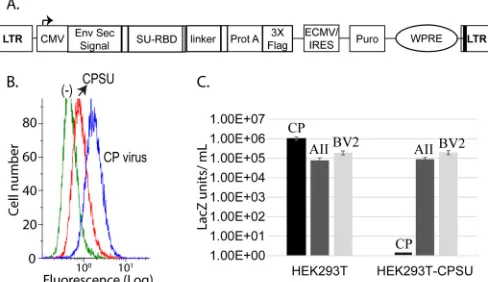
). The schematic of the
con-struct within the vector pJG is shown in
Fig. 6A
. The construct was
modified to replace the prolactin signal peptide with the natural
FeLV signal peptide, which resulted in increased secretion of the
CP-SU
1-235. To ensure that any mass spectrometry results
re-flected data from a functional CP-SU
1-235fusion protein, we
per-formed receptor binding and interference assays. The ability of the
secreted CP-SU
1-235protein to maintain receptor binding was
confirmed using a FACS binding assay on permissive TE671 cells.
Binding of CP-SU
1-235was detected, although it was less efficient
than for retroviral particles bearing the full-length CP Env protein
(
Fig. 6B
). This can be attributed to the fact that the secreted
CP-SU
1-235is a monomer, whereas the virus-associated CP Env, like
its parental FeLV-A/C Env, is likely to form a trimer that binds
more efficiently to its host cell receptor. Alternatively, it is possible
that domains outside the SU RBD region also function in receptor
binding, similar to what has been shown for the SU C-terminal
domain of FeLV-C (
5
).
The ability of secreted CP-SU
1-235to block exogenous infection
of CP retroviral particles packaging the

-galactosidase gene was
tested in receptor interference assays. Expression of the secreted
CP-SU
1-235lowered the titer of the challenge virus bearing the CP
Env greater than 3 orders of magnitude (
Fig. 6C
), similar to
pre-vious results with CP retroviral particles (
25
). In contrast,
consti-tutive expression of the secreted CP-SU
1-235in 293T cells did not
FIG 5BV2 mutagenesis studies revealed that the pair of cysteines and residues in between are critical for viral titers. (A) Viral titers (LacZ units/200 ng of CA) were determined as forFig. 4. (B) Western blot analysis of virus-associated SU. Viral samples were normalized to 100 ng of CA. Env was detected using C11D8 mouse anti-GP70 (AbD Serotec; 1:1,000 dilution).
on November 7, 2019 by guest
http://jvi.asm.org/
[image:6.585.318.522.67.217.2]block infection of virus bearing the AII or BV2 Envs. This indicates
that AII and BV2 Envs use a host cell receptor other than PAR1
and PAR2, in addition to being distinct from the receptors of
FeLV-A and -C (
Fig. 3
). The recombinant CP-SU
1-235monomer
has activity sufficient to block the infection of the Env trimer on
the retroviral particles, indicating the presence of proteins folded
in a functional conformation.
Disulfide bonding within the randomized region of CP.
In
order to determine if the cysteines within the randomized region
of CP-SU
1-235form a disulfide bond, we performed mass
spec-trometry studies with the purified CP-SU
1-235protein. The
pro-tein sample was alkylated using iodoacetamide (IAM) in the
ab-sence of a reducing agent to label free cysteines, whereas cysteines
within a disulfide bond were unavailable for this modification.
After SDS-PAGE and in-gel tryptic digestion, the peptides were
extracted, solubilized, and divided into two samples. One sample
was treated with a reducing agent (DTT) to break the disulfide
bonds, followed by alkylation with N-ethylmaleimide (NEM) to
label the newly formed free cysteines. The second sample was
treated with NEM in the absence of DTT, leaving the disulfide
bonds intact. The results are summarized in
Fig. 7
and
Table 1
.
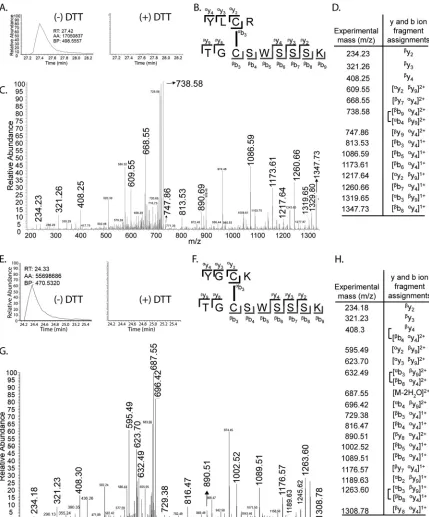
Two disulfide linkage peptides corresponding to C
2and C
3were identified (
Table 1
).
Figure 7A
shows the data for the
peptide with a 498.5557
m/z
and a retention time of 27.42 min
(shown schematically in
Fig. 7B
) that is absent in the presence
of DTT treatment. This corresponds to the oxidized form of
YLC
2R disulfide linked to TGC
3SWSSSK, with a 3
⫹
charge and
a spectral count of 5 (
Table 1
). The fragmentation pattern (
Fig.
7C
) of the 498.5557
m/z
peak in
Fig. 7A
further confirmed that
the peak identified indeed corresponded to C
2-C
3forming a
[image:7.585.41.285.69.210.2]disulfide bond. The ions y and b correspond to the
fragmenta-tion resulting at the amide bond. The y ion contains the
C-ter-minal fragment, and the b ion contains the N-terC-ter-minal
frag-ment. We have named and labeled the smaller and the larger
peptide fragments
␣
and

, respectively, in superscripts in
Fig. 7B
to
D
and F to H. The subscript numbers correspond to the
amino acid relative to the terminal that the fragment contains.
Sixteen y and b ion peptides corresponding to the fragmentation
of the parental peptide were identified (
Fig. 7D
). y and b ion
738.58
m/z
could be assigned to two different peptides yielding the
same theoretical result (
Fig. 7D
). We also observed the YLC
2R
disulfide linked to RTGC
3SWSSSK peptide with an
m/z
of
413.1936 (
Table 1
) with a retention time of 25.44 min and a
spec-tral count of 32, which was further confirmed in the final
fragmen-tation patterns (data not shown).
A second peptide, with a spectral count of 37 and a predicted
C
3-C
4cysteine bond, was identified. This corresponded to the
peptide TGC
3SWSSSK disulfide linked to YGC
4K with a retention
time of 24.33 min (
Fig. 7E
). Seventeen y and b ion peptides
cor-responding to the parental peptide were identified (
Fig. 7G
and
H
). Three of the y and b ions obtained experimentally could be
assigned to two different theoretical fragments, at 408.3, 632.49
and 1,263.60
m/z
(
Fig. 7H
). Additionally, the peptide GSSQD
NNC
9EGKC
10NPLILQFTQK, with a retention time of 44.99
min and a spectral count of 50 (
Table 1
), was identified in the
LC-MS/MS. While spectral count is considered a
semiquanti-tative measure, peptides C
2-C
3, C
3-C
4, and C
9-C
10were
iden-tified as the predominant species, with total spectral counts of
37, 37, and 50, respectively, and peak areas over 10
6. These data
strongly suggest that C
2-C
3, C
3-C
4, and C
9-C
10are cysteine bonds of
a functional CP-SU and indicate the presence of an unexpected
het-erogeneity in the disulfide bond pattern within the VRA.
Interest-ingly, generating the potential to form salt bridges at the C
1-C
2, C
1-C
4, and C
3-C
4positions in CP by introducing Lys and Glu pairs did
not rescue viral titers (data not shown).
DISCUSSION
The success of screening random libraries is greatly influenced
by the vector backbone and the library design. Viruses have
evolved multiple mechanisms for efficient expression of
bicis-tronic RNAs. Herein we show that a bicisbicis-tronic vector that uses
the wild-type MLV SA to express the second gene results in
viral titers that are significantly higher than with our previous
vector, which contained an internal SV40 promoter to express
the selectable marker (
Fig. 1A
and
B
). This is not surprising
given that MLV has evolved an efficient mechanism to balance
the transcription and export of unspliced mRNA encoding the
gag-pol
gene as well as the spliced mRNA expressing the
env
gene (
35
). With the incorporation of the WPRE element
down-stream of the neomycin resistance gene in the SD-env-SA
back-bone, we obtained 15-fold-higher titers (
Fig. 1A
). Using this
vector three novel retargeted Env isolates were identified on
143B osteosarcoma cells (
Fig. 2B
).
A major goal of this study was to optimize the expression and
screening of new Env libraries to obtain high-affinity
gammaret-roviral isolates in 143B osteosarcoma cells. The two isolates with
the highest titers are constrained by the presence of a pair of
cys-teines within the randomized loop. Interestingly, from all of our
Env libraries that were screened, the construct with the highest
titer, CP Env (
22
), was also constrained by the presence of two
internal cysteines. Therefore, we examined the role of these
cys-teines and nearby residues within the randomized loop. Our data
clearly indicate that the internal cysteines are indispensable for
viral titer within the identified Env isolates (
Fig. 4
and
5
).
Comparison of the role of the internal cysteines from the three
FIG 6CP-SU1-235monomer has binding and interference activity and does notblock AII and BV2 infection. (A) Schematic of the vector pJG expressing CP-SU1-235. The black box in the LTR indicates SIN vector. Individual components are
as indicated. (B) SU binding studies on HEK293T cells. Secreted CP-SU1-235from
HEK293T (1 ml of medium, red line) and CP viral particles (blue line) produced in TELCeB6 (1 ml) was incubated with HEK293T (control green line), and binding was verified by flow cytometry as described on the methodology. (C) CP-SU1-235
interference assay, with comparison of infection of 2⫻105HEK293T cells or
HEK293T cells constitutively producing CP-SU1-235. LacZ staining units/milliliter
of virus were determined for virus expressing CP, AII, or BV2 Env, as indicated. Error bars indicate the SEMs for at least three independent experiments.
on November 7, 2019 by guest
http://jvi.asm.org/
Env isolates CP, AII, and BV2 did not result in a uniform model. In
AII Env, substitution of a Glu-Lys salt bridge for the C
2-C
3disul-fide bond restored viral titers, whereas replacement of C6E:C11K
in BV2 Env resulted in complete loss of titers (
Fig. 5A
). In both AII
and BV2 Envs, however, the specific residues identified as critical
for viral entry localize to the loop between the C
2and C
3residues.
Because the AII isolate contains only 3 amino acid residues
be-tween C
2and C
3, while the BV2 isolate contains 4 amino acid
residues between C
2and C
3, it is possible that the spacing and
amino acid side chain organization of the BV2 isolate are not
FIG 7Identification of CP-SU1-235cysteine bonds using mass spectrometry. (A to D) Identification of the C2-C3bond; (E to H) identification of the C3-C4bond.
(A and E) Analysis of products in the presence and absence of DTT); (B and F) schematic of the peptide structure corresponding to the identified products; (C and G) fragmentation pattern of the identified peptides containing a disulfide bond; (D and H) assignment of the experimental mass of peaks in panels C and G with the y and b fragment ions, defined in panels B and F. M, full peptide mass.
on November 7, 2019 by guest
http://jvi.asm.org/
[image:8.585.77.506.65.582.2]conducive to the formation of a salt bridge at these positions. Since
the salt bridge substitutes for the AII Env C6:C10 disulfide bond, it
is reasonable to expect that an isolate with a salt bridge might have
been selected in the initial screen. However, our randomized
li-brary was not saturating, with only 10
6/10
12possible
combina-tions.
In CP Env, like BV2, the C
2-C
3residues are separated by 4
amino acids. Again, providing residues with the potential to form
a salt bridge in CP Env did not substitute for a disulfide bond (
Fig.
5A
) (
22
). However, mass spectrometry analysis of a secreted CP
Env construct shown to be functional for receptor binding
indi-cated the presence of disulfide-linked peptides at C
2-C
3and C
3-C
4, suggesting the existence of heterogeneity in the VRA bonding
pattern. It is interesting that in CP, only two other residues within
the randomized region in addition to C
2and C
3were critical for
viral titer (
22
). The first was a Gly between C
2and adjacent to C
3,
providing flexibility to position C
3. The other residue
indispens-able for infectivity was the Trp at position 11. It is possible that
formation of either C
2-C
3or C
3-C
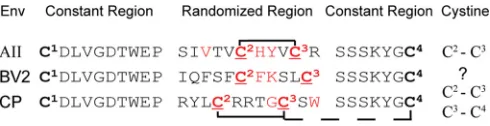
4is required to position the
essential Trp11 for interaction with the host cell receptor (
Fig. 8
).
These results are similar to what has been observed in the study
of HIV Env trimers, where heterogeneity of the disulfide bonding
pattern has been found for the N-terminal variable regions 1 and 2
(V1 and V2). The V1/V2 region is implicated in exposure of the
variable region 3 (V3) to HIV host cell receptors (
36
). Conversely,
the lack of a pair of cysteines present in the V2 region of HIV-2 and
SIV strains but not in the HIV-1 Env glycoprotein has been
sug-gested as a factor contributing to the high virulence of HIV-1 (
37
).
The heterogeneity in the disulfide bond patterns does not appear
to be limited to members of the
Retroviridae
family. Recently, two
crystal structures were solved for the E2 Env protein of hepatitis C
virus (HCV) of the
Flaviviridae
family. These structures revealed two
possible cysteine arrangements of a functional E2 Env glycoprotein
(
38
). These cysteines are known to be conserved across different HCV
genotypes, implying an important role in structure and/or function
of the Env. However, the presence of this heterogeneity in cysteine
bonding on HCV viral particles is not known. It is possible that
cer-tain cysteines are important to hold the structure in place, while other
cysteines can be easily rearranged by the virus as a way to evade the
immune system, without having major conformational changes.
The protein expression system utilized in this study was
iden-tical to that used to express and solve the HCV E2 Env protein
crystal structure (
33
). Interestingly, to achieve successful secretion
of the soluble CP-SU
1-235, we had to exchange the prolactin
secre-tion signal for that of the native FeLV Env signal peptide.
Surpris-ingly, expression of the CP-SU
35-235with the prolactin signal
pep-tide resulted in minimal secretion of the SU protein, with detectable
perinuclear and nuclear signals by immunostaining and confocal
im-aging (data not shown). These results suggest that the signal peptide
of the FeLV Env may have additional unknown properties, leading to
correct transport and secretion of the viral Env.
Ironically, we initially selected the FeLV-A/C backbone for the
library screen due to the absence of complex cysteine bonding within
variable regions A and B. Selecting for the additional cysteine pairs
generates variable loops that are more similar to the complex loops
found in related gammaretroviral Envs. The studies presented here
will assist in the design of third-generation Env libraries. Future
stud-ies will aim at constructing librarstud-ies holding in place C
2and C
3at the
locations found in AII, BV2, and CP Envs and randomizing nine
residues to screen for new retargeted Env proteins.
ACKNOWLEDGMENTS
We thank Haiyan Zheng, Meiqian Qian, and Peter Lobel, Rutgers Biolog-ical Mass Spectrometry Facility of Robert Wood Johnson MedBiolog-ical School, for their discussions on interpreting the mass spectrometry data.
This work was supported by grant R01 CA49932 to M.J.R. and P50GM103368 and R01 GM111959 to J.M. NIH grants T32AI007403, 3R01CA049932-19S1, and 2R25GM05839 supported Leonardo Val-divieso-Torres.
The funders had no role in study design, data collection and interpre-tation, or the decision to submit the work for publication.
[image:9.585.42.546.78.151.2] [image:9.585.41.286.614.677.2]FUNDING INFORMATION
HHS | NIH | National Cancer Institute (NCI) provided funding to Leon-ardo Valdivieso-Torres under grant number 3R01CA049932-19S1. HHS | NIH | National Cancer Institute (NCI) provided funding to Monica J. Roth under grant number R01 CA49932. HHS | NIH | National Institute of Allergy and Infectious Diseases (NIAID) provided funding to Leonardo Valdivieso-Torres under grant number T32AI1007403. HHS | NIH | Na-tional Institute of General Medical Sciences (NIGMS) provided funding to Joseph Marcotigiano under grant numbers R01 GM111959 and P50GM103368. HHS | NIH | National Institute of General Medical Sci-ences (NIGMS) provided funding to Leonardo Valdivieso-Torres under grant number 2R25GM05839.
REFERENCES
1.Battini J-L, Heard JM, Danos O.1992. Receptor choice determinants in the envelope glycoproteins of amphotropic, xenotropic, and polytropic murine leukemia viruses. J Virol66:1468 –1475.
TABLE 1Summary of mass spectrometry data for cysteines within the randomized loop of CP
Cysteine no. Sequencea Spectral count Charge m/z RTb(min)
Peak area
Without DTT With DTT
C2-C3 YLCR RTGCSWSSSK 32 4⫹ 413.1941 25.44 145,006,359 0
C2-C3 YLCR TGCSWSSSK 5 3⫹ 498.5558 27.42 17,050,837 0
C3-C4 TGCSWSSSK YGCK 37 3⫹ 470.5320 24.33 56,186,750 0
C9-C10 GSSQDNNCEGKCNPLILQFTQK 50 3⫹ 808.0429 44.99 366,697,279 31,759,741 aCysteines linked by disulfide bonds are underlined and in bold type. Spaces indicate separate tryptic peptides.
b
RT, retention time.
FIG 8Summary of disulfide bonds and mutagenesis studies. Critical amino acids required for viral entry are indicated in red for each isolate. Cysteines that form intramolecular bonds are indicated via bars (solid and dashed). For AII, the linkage is based on functional substitution of a putative salt bridge. For CP, disulfide bonds were identified by mass spectrometry.
on November 7, 2019 by guest
http://jvi.asm.org/
2.Fass D, Davey RA, Hamson CA, Kim PS, Cunningham JM, Berger JM.
1997. Structure of a murine leukemia virus receptor-binding glycoprotein at 2.0 angstrom resolution. Science277:1662–1666.http://dx.doi.org/10 .1126/science.277.5332.1662.
3.Gemeniano M, Mpanju O, Salomon DR, Eiden MV, Wilson CA.2006. The infectivity and host range of the ecotropic porcine endogenous retro-virus, PERV-C, is modulated by residues in the C-terminal region of its surface envelope protein. Virology446:108 –117.
4.Lavillette D, Boson B, Russell SJ, Cosset FL.2001. Activation of mem-brane fusion by murine leukemia viruses is controlled in cis or in trans by interactions between the receptor-binding domain and a conserved disul-fide loop of the carboxy terminus of the surface glycoprotein. J Virol
75:3685–3695.http://dx.doi.org/10.1128/JVI.75.8.3685-3695.2001. 5.Rey MA PR, Tailor CS.2008. The C domain in the surface envelope
glycoprotein of subgroup C feline leukemia virus is a second receptor-binding domain. Virology370:273–284.http://dx.doi.org/10.1016/j.virol .2007.09.011.
6.Sarma PS, Log T, Jain D, Hill PR, Huebner RJ.1975. Differential host range of viruses of feline leukemia-sarcoma complex. Virology64:438 – 446.http://dx.doi.org/10.1016/0042-6822(75)90121-X.
7. Sarma PS, Log T. 1971. Viral interference in feline leukemia-sarcoma complex. Virology44:352–358.http://dx.doi.org/10.1016/0042 -6822(71)90266-2.
8.Mendoza R, Anderson MM, Overbaugh J. 2006. A putative thiamine transport protein is a receptor for feline leukemia virus subgroup A. J Virol
80:3378 –3385.http://dx.doi.org/10.1128/JVI.80.7.3378-3385.2006. 9.Rudra-Ganguly N, Ghosh AK, Roy-Burman P.1998. Retrovirus receptor
PiT-1 of the Felis catus. Biochim Biophys Acta1443:407– 413.http://dx .doi.org/10.1016/S0167-4781(98)00241-3.
10. Tailor CS, Willett BJ, Kabat D.1999. A putative cell surface receptor for anemia-inducing feline leukemia virus subgroup C is a member of a trans-porter superfamily. J Virol73:6500 – 6505.
11. Quigley JG, Burns CC, Anderson MM, Lynch ED, Sabo KM, Over-baugh J, Abkowitz JL.2000. Cloning of the cellular receptor for feline leukemia virus subgroup C (FeLV-C), a retrovirus that induces red cell aplasia. Blood95:1093–1099.
12. Rigby MA, Rojko JL, Stewart MA, Kociba GJ, Cheney CM, Rezanka LJ, Mathes LE, Hartke JR, Jarrett O, Neil JC.1992. Partial dissociation of subgroup C phenotype andin vivobehaviour in feline leukaemia viruses with chimeric envelope genes. J Gen Virol73:2839 –2847.http://dx.doi .org/10.1099/0022-1317-73-11-2839.
13. Linder M, Wenzel V, Linder D, Stirm S.1994. Structural elements in glycoprotein 70 from polytropic Friend mink cell focus-inducing virus and glycoprotein 71 from ecotropic Friend murine leukemia virus, as de-fined by disulfide-bonding pattern and limited proteolysis. J Virol68:
5133–5141.
14. Barnett AL, Wensel DL, Li W, Fass D, Cunningham JM.2003. Structure and mechanism of a coreceptor for infection by a pathogenic feline retro-virus. J Virol 77:2717–2729. http://dx.doi.org/10.1128/JVI.77.4.2717 -2729.2003.
15. Tailor CS, Kabat D.1997. Variable regions A and B in the envelope glycoproteins of feline leukemia virus subgroup B and amphotropic mu-rine leukemia virus interact with discrete receptor domains. J Virol71:
9383–9391.
16. Mazari P, Roth M.2013. Library screening and receptor-directed target-ing of gammaretroviral vectors. Future Microbiol8:107–121.http://dx .doi.org/10.2217/fmb.12.122.
17. Wu D-T, Roth MJ.2014. MLV based viral-like-particles for delivery of toxic proteins and nuclear transcription factors. Biomaterials35:8416 – 8426.http://dx.doi.org/10.1016/j.biomaterials.2014.06.006.
18. Bupp K, Roth M.2002. Altering retroviral tropism using a random dis-play envelope library. Mol Ther5:329 –335.http://dx.doi.org/10.1006 /mthe.2002.0546.
19. Bupp K, Roth MJ.2003. Targeting a retroviral vector in the absence of a known cell-targeting ligand. Hum Gene Ther14:1557–1564.http://dx.doi .org/10.1089/104303403322495061.
20. Bupp K, Sarangi A, Roth MJ.2005. Probing sequence variation in the receptor-targeting domain of feline leukemia virus envelope proteins with peptide display libraries. J Virol79:1463–1469.http://dx.doi.org/10.1128 /JVI.79.3.1463-1469.2005.
21. Bupp K, Sarangi A, Roth MJ.2006. Selection of feline leukemia virus
envelope proteins from a library by functional association with a murine leukemia virus envelope. Virology 351:340 –348. http://dx.doi.org/10 .1016/j.virol.2006.03.040.
22. Mazari PM, Linder-Basso D, Sarangi A, Chang Y, Roth MJ. 2009. Single-round selection yields a unique retroviral envelope utilizing GPR172A as its host receptor. Proc Natl Acad Sci U S A106:5848 –5853.
http://dx.doi.org/10.1073/pnas.0809741106.
23. Sarangi A, Bupp K, Roth MJ.2007. Identification of a retroviral receptor used by an Envelope protein derived by peptide library screening. Proc Natl Acad Sci U S A104:11032–11037.http://dx.doi.org/10.1073/pnas .0704182104.
24. Ericsson TA, Takeuchi Y, Templin C, Quinn G, Farhadian SF, Wood JC, Oldmixon BA, Suling KM, Ishii JK, Kitagawa Y, Miyazawa T, Salomon DR, Weiss RA, Patience C.2003. Identification of receptors for pig endogenous retrovirus. Proc Natl Acad Sci U S A100:6759 – 6764.
http://dx.doi.org/10.1073/pnas.1138025100.
25. Mazari PM, Argaw T, Valdivieso L, Zhang X, Marcucci KT, Salomon DR, Wilson CA, Roth MJ.2012. Comparison of the convergent receptor utilization of a retargeted feline leukemia virus envelope with a naturally-occurring porcine endogenous retrovirus A. Virology427:118 –126.http: //dx.doi.org/10.1016/j.virol.2012.02.012.
26. Cosset FL, Takeuchi Y, Battini JL, Weiss RA, Collins MK.1995. High-titer packaging cells producing recombinant retroviruses resistant to hu-man serum. J Virol69:7430 –7436.
27. Gendra E, Colgan DF, Meany B, Konarska MM.2007. A sequence motif in the simian virus 40 (SV40) early core promoter affects alternative splic-ing of transcribed mRNA. J Biol Chem282:11648 –11657.http://dx.doi .org/10.1074/jbc.M611126200.
28. Zhang X, Sarangi A, Wu DT, Kanduri J, Roth MJ.2013. Gene delivery in a mouse xenograft of a retargeted retrovirus to a solid 143B osteosar-coma. Virol J10:194.http://dx.doi.org/10.1186/1743-422X-10-194. 29. Zanta-Boussif MA, Charrier S, Brice-Ouzet A, Martin S, Opolon P,
Thrasher AJ, Hope TJ, Galy A. 2009. Validation of a mutated PRE sequence allowing high and sustained transgene expression while abrogat-ing WHV-X protein synthesis: application to the gene therapy of WAS. Gene Ther16:605– 619.http://dx.doi.org/10.1038/gt.2009.3.
30. Fouchier RAM, Meyer BE, Simon JHM, Fischer U, Malim MH.1997. HIV-1 infection of non-dividing cells: evidence that the amino-terminal basic region of the viral matrix protein is important for Gag processing but not for post-entry nuclear import. EMBO J16:4531– 4539.http://dx.doi .org/10.1093/emboj/16.15.4531.
31. Wu DT, Aiyer S, Villanueva RA, Roth MJ.2013. Development of an enzyme-linked immunosorbent assay based on the murine leukemia virus p30 capsid protein. J Virol Methods193:332–336.http://dx.doi.org/10 .1016/j.jviromet.2013.06.020.
32. Whidby J, Mateu G, Scarborough H, Demeler B, Grakoui A, Marcotri-giano J.2009. Blocking hepatitis C virus infection with recombinant form of envelope protein 2 ectodomain. J Virol83:11078 –11089.http://dx.doi .org/10.1128/JVI.00800-09.
33. Khan AG, Whidby J, Miller MT, Scarborough H, Zatorski AV, Cygan A, Price AA, Yost SA, Bohannon CD, Jacob J, Grakoui A, Marcotri-giano J.2014. Structure of the core ectodomain of the hepatitis C virus envelope glycoprotein 2. Nature509:381–384.http://dx.doi.org/10.1038 /nature13117.
34. Zufferey R, Donello JE, Trono D, Hope TJ.1999. Woodchuck hepatitis virus posttranscriptional regulatory element enhances expression of transgenes delivered by retroviral vectors. J Virol73:2886 –2892. 35. Trubetskoy AM, Okenquist SA, Lenz J.1999. R region sequences in the
long terminal repeat of a murine retrovirus specifically increase expression of unspliced RNAs. J Virol73:3477–3483.
36. Go EP, Zhang Y, Menon S, Desaire H.2011. Analysis of the disulfide bond arrangement of the HIV-1 envelope protein CON-S gp140 DeltaCFI shows variability in the V1 and V2 regions. J Proteome Res10:578 –591.
http://dx.doi.org/10.1021/pr100764a.
37. Bohl C, Bowder D, Thompson J, Abrahamyan L, Gonzalez-Ramirez S, Mao YD, Sodroski J, Wood C, Xiang SH.2013. A twin-cysteine motif in the V2 region of gp120 is associated with SIV envelope trimer stabilization. PLoS One8:e69406.http://dx.doi.org/10.1371/journal.pone.0069406. 38. Khan AG, Miller MT, Marcotrigiano J.2015. HCV glycoprotein
struc-tures: what to expect from the unexpected. Curr Opin Virol12:53–58.
http://dx.doi.org/10.1016/j.coviro.2015.02.004.
on November 7, 2019 by guest
http://jvi.asm.org/
![FIG 1 Generation of bicistronic vectors for Env library screening. (A) Schematic of the various vector backbones (left) and their corresponding viral titers(neomycin CFU [NCFU]/milliliter)](https://thumb-us.123doks.com/thumbv2/123dok_us/142264.19408/4.585.63.519.65.265/generation-bicistronic-screening-schematic-backbones-corresponding-neomycin-milliliter.webp)