Bond University
ePublications@bond
Learning and Teaching papers
Learning and Teaching
1-1-2015
Does digital scholarship through online lectures
affect student learning?
Shelley Kinash
Bond University, [email protected]
Diana Knight
Bond University, [email protected]
Matthew McLean
Department of Social Services, Australian Government
Follow this and additional works at:
http://epublications.bond.edu.au/tls
Part of the
Higher Education Commons
This Journal Article is brought to you by the Learning and Teaching atePublications@bond. It has been accepted for inclusion in Learning and Teaching papers by an authorized administrator of ePublications@bond. For more information, please contactBond University's Repository
Recommended Citation
Shelley Kinash, Diana Knight, and Matthew McLean. (2015) "Does digital scholarship through
online lectures affect student learning?"
Journal of Educational Technology & Society,
18 (2) , 129-139:
ISSN 1176-3647.
Kinash, S., Knight, D., & McLean, M. (2015). Does Digital Scholarship through Online Lectures Affect Student Learning?
Educational Technology & Society, 18 (2), 129–139.
129
ISSN 1436-4522 (online) and 1176-3647 (print). This article of the Journal of Educational Technology & Society is available under Creative Commons CC-BY-ND-NC
Does Digital Scholarship through Online Lectures Affect Student Learning?
Shelley Kinash, Diana Knight and Matthew McLean
Bond University, Office of Learning and Teaching, Bond University QLD 4229 Australia // Bond University, Office of Learning and Teaching, Bond University QLD 4229 Australia // Australian Government, Department of Social
Services, Australian Government ACT 2610 Australia // [email protected] // [email protected] // [email protected]
*Corresponding author
(Submitted August 15, 2013; Revised November 29, 2013; Accepted August 19, 2014)
ABSTRACT
University lectures are increasingly recorded or reproduced and made available to students online. This paper aggregates and critically reviews the associated literature, thematically organised in response to four questions. In response to the first question - does student attendance decrease when online content is made available - research indicates that students primarily use digital content for review and revision rather than as a substitute for on-campus attendance. Analysis of the research in response to the second question - is achievement affected when attendance is face-to-face versus online - revealed no empirically supported significant difference. The third question was whether online content is better suited to some pedagogical tasks than others. A predominant theme in the literature is that digital content has potential as a disruptive pedagogy, accelerating an overall shift from didactic lecture to constructivist learning. Analysis revealed a research gap around the fourth question - is there evidence that some online formats are particularly suited to advancing learning. The few published comparative studies revealed contradictory results. Overall conclusions from the combined questions are that online digital content is a worthwhile learning and teaching pursuit and discipline and context must be considered in designing the particular approach.
Keywords
Digital scholarship, E-learning, Lecture capture, Lecture recording, Online digital content
Introduction
Digital scholarship refers to connected and blurred knowledge producers and consumers, creating, sharing and constructing learning with a global network of peers (Losoff & Pence, 2009; Markauskaite, 2010; Weller, 2012). Within universities, a critical (and critiqued) aspect of digital scholarship is providing recorded lectures for online delivery (Newbury, Watten, Holroyd, & Hardman, 2011). Some lectures are recorded while they are being delivered in a theatre or classroom (lecture capture) and then posted online (Al Nashash & Gunn, 2013). Lectures are also produced for online dissemination from computers outside of teaching spaces and rendered in various formats such as podcasts and audio-narrated slideshows, often referred to as web-based lecture technologies (Germany, 2012). Whether and how lectures should be provided online has been a heated debate in higher education (Cardall, Krupat, & Ulrich, 2008; Gosper et al., 2008; von Konsky, Ivins, & Gribble, 2009). There are three primary factors for consideration in support of providing students with online lectures. First, students are requesting online delivery (Copley, 2007; Evans, 2008; Jensen, 2011). Second, education technology offers opportunities to make online content viable and many educational theorists argue that web-based technologies have learning advantages (Grabe & Christopherson, 2007; Holbrook & Dupont, 2009; Lonn & Teasley, 2009; McGarr, 2009; Nworie & Haughton, 2008). Third, educational institutions struggle to continue providing quality learning opportunities, while managing the rising costs of providing them, in the context of knowledge management (Brewer & Brewer, 2010; Guzman & Trivelato, 2011; Omona, van der Weide & Lubega, 2010; Sulisworo, 2012; Yuan & Powell, 2013).
& Brook, 2008; Yuan & Powell, 2013). Although there is a long and rich history of distance education research (e.g., Moore, 2013), the emphasis on MOOCs has renewed attention on student access to learning materials and to study beyond the classroom. Educators are investigating the pedagogy of MOOCs and asking questions about the changing roles of teacher and learner, digital engagement, and balancing between openness and control (Bayne & Ross, 2014). Although MOOC pedagogy research is still in its relative infancy, a critical review of lecture capture may help shape the foundations upon which extended MOOC and distance research may stand. Therefore, while lecture capture has a relatively long history, it is an emergent priority for educators and education leaders.
Universities use lecture capture and streaming and some are beginning to use web-based lecture technologies as a primary means of creating and disseminating digital scholarship. The concerns that are emerging from academics and the content of documented investigations cluster in response to four questions:
Does student attendance decrease when online content is made available?
Does it matter if student attendance decreases?
In other words, does achievement decrease if, and when, student attendance decreases?
Is online content better suited to some pedagogical tasks than others?
Do some types of online content work better than others?
Methodology
There are a large number of publications addressing topics and issues about lecture capture, web-based lecture technologies and online delivery as a form of digital scholarship. Currently, informing decisions about whether and how to capture or produce and distribute lectures requires sifting through numerous abstracts and papers. There appear to be no systematic reviews of the literature and analyses of the overall content, outcomes and conclusions. In response, this paper presents collation of numerous papers and book chapters about online lectures, attendance and student achievement. The research gap addressed by this paper is one of collation, synthesis and application. While the topic of online lectures is reasonably well represented in the literature, the studies are set at individual institutions and within specific disciplines. The gap is a straight-forward response to higher education leaders and academics about whether or not to incorporate online lectures into their pedagogical approach and if so, how to proceed. Gunn and Steel (2012) wrote, “strong, tested and connected evidence that theory informed, technology-enhanced designs can improve learning outcomes is required to further reduce the historical gap between educational research and practice” (p. 11). Theory develops through evaluating, disseminating and exploring synergies, commonalities and relationships between individual, singular, snap-shot studies. The contribution that this particular paper makes to the literature is drawing together individual studies to look for commonalities and inform theory.
The literature was classified to inform a response to each of the four questions. Responses were then combined to provide recommendations as to whether (and how) to proceed with provision of digital scholarship. The methodology of this paper is research synthesis as a process of collecting, collating and analysing the published literature to advise next steps in application and further research (Cooper & Hedges, 2009). The scope of this review includes content on lecture capture, web-based lecture technologies and distribution. Other means of creating and disseminating digital content (e.g., wikis, blogs) have been omitted.
Table 1. Keyword search results Term used (2005-2013) Search returns (no.)
Google Scholar
Search returns (no.) Ebsco Megafile Complete lecture recording (LR) 75,400 228
university LR 68,700 3
university LR, attendance 16,000 0 university LR, achievement 18,100 0
revealed substantially fewer results. There were zero electronic database returns when combining the search terms,
university, lecture, recording with either attendance or achievement. The database uses SmartText searching to source additional results based on the submitted keywords. Most of these papers revealed small mentions as a sub-theme in a paper on a different research sub-theme. A manual search of key educational technology journals and bridging from the relevant papers’ end-text references revealed additional sources. Three coders identified the key scholarly papers with thematic relevance resulting in a detailed analysis of 30 publications.
Combined themes
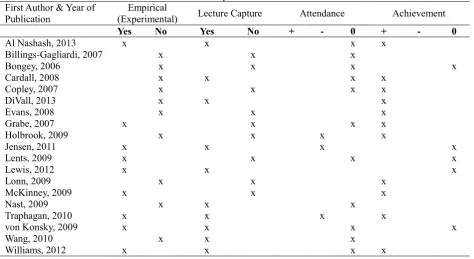
[image:4.612.66.541.256.515.2]Of the 30 publications that addressed one or more of the questions regarding online content, 19 of the papers described a research project whereby some evidence was collected and analysed to address the effect of providing online content, either on student attendance, student achievement or both of these factors. The other 11 are addressed under the heading of each of the paper’s four main questions.
Table 2. Content analysis of the reviewed literature First Author & Year of
Publication (Experimental) Empirical Lecture Capture Attendance Achievement
Yes No Yes No + - 0 + - 0
Al Nashash, 2013 x x x x
Billings-Gagliardi, 2007 x x x
Bongey, 2006 x x x x
Cardall, 2008 x x x x
Copley, 2007 x x x x
DiVall, 2013 x x x
Evans, 2008 x x x
Grabe, 2007 x x x x
Holbrook, 2009 x x x x
Jensen, 2011 x x x x
Lents, 2009 x x x x
Lewis, 2012 x x x
Lonn, 2009 x x x
McKinney, 2009 x x x
Nast, 2009 x x x
Traphagan, 2010 x x x x
von Konsky, 2009 x x x x
Wang, 2010 x x x
Williams, 2012 x x x x
Table 2 presents an analysis of the reviewed literature. The first column identifies the papers by the surname of the first author and year of publication. The full citations are available in the end-text references. The second column classifies the methodological design of the papers into quasi or fully experimental or other - usually conducted through survey. The third column depicts whether or not the paper addressed digital scholarship through lecture capture or some other format. The fourth column identifies whether the research results showed a positive, negative or neutral effect of digital content on student attendance. A small subset of papers did not address attendance, in which case, there is no x inserted in this set of rows. Similarly, the final column identifies whether the results showed a positive, negative or neutral effect on student achievement. Again, where no x is inserted, achievement was not addressed.
papers provided evidence that online lectures positively affect student learning or achievement, while five studies showed no effect. Three papers did not address student learning and three did not address achievement. Analysis of the literature led to the following overall conclusions. Approximately half are experimental in design and approximately half address lecture capture. The weight of the evidence is that providing lectures online does not decrease student on-campus attendance and that it increases achievement.
The approach and results of the survey studies are now briefly presented to provide further information regarding perceptions about the relationship between digital scholarship, attendance and achievement. In survey findings, Billings-Gagliardi and Mazor (2007) and Bongey, Cizadlo and Kalnbach (2006) revealed that the availability of digital materials did not decrease their on-campus attendance. Cardall, Krupat and Ulrich’s (2008) student survey revealed that while the majority of learners continue to attend live lectures when provided both options, those who access recorded lectures do so because they believe their learning is improved. Students in Copley (2007) reported using the online materials for revision, and not decreasing their on-campus attendance. Copley interpreted the survey data as providing evidence of enhanced learning outcomes. He explained that by supplementing students’ online study resources, they were freed-up to engage and participate rather than to record notes in class, thereby scaffolding thinking and activity (Bransford, Brown, & Cocking, 1999). Research findings also indicated a high percentage of surveyed students indicated a belief that lecture capture and podcasts improved learning (DiVall et al., 2013; Evans, 2008, even when students reported decreased attendance (Holbrook & Dupont, 2009). Faculty members were also positive about lecture capture for improved learning, but to a lesser extent (Lonn & Teasley, 2009). The students surveyed by Wang, Mattick and Dunne (2010) perceived face-to-face lectures as more consistently maintaining quality standards and stated that absenteeism would not increase as a result of online content. The reviewed survey literature revealed that the research participants were most often students and that the most common response was favourable to digital scholarship.
Next, the results of the experimental and quasi-experimental research are described to annotate the evidence regarding an overall positive relationship between digital scholarship and achievement and detail how researchers established no significant relationship with student on-campus lecture attendance. Grabe and Christopherson (2007) found that when given options of type of online content, most students used complete text-based lecture notes. Absenteeism did not increase. Notably, there was a positive relationship between student attendance and use of digital resources. Further, this positive relationship extended to achievement as demonstrated through exam performance. Jensen (2011) structured an experiment varying the pedagogical approach in alternate weeks. The attendance at on-campus lectures and viewing of online lectures decreased and quiz scores indicated no significant difference for either approach. The students in this cohort, however, perceived face-to-face lectures as being more advantageous for their learning. Lewis and Sloan (2012) found a slight, but statistically insignificant benefit of online lecture viewing on quiz performance. The researchers continue to explore means of increasing the impact. Williams, Birch and Hancock (2012) provided empirical evidence that some students use captured lectures as a replacement for on-campus attendance and others as a supplement or revision tool, thereby attendance is indicated in Table 2 as neutral. Students who used online lectures as a complement to face-to-face classes achieved higher grades. While a full meta-analysis is not possible due to limited commonality and standardisation between methodologies and factors, common conclusions as to unsupported links between digital content and absenteeism and supported relationships with learning were established.
Four of the analysed papers described research designs such that online lectures were treated as the independent, experimental, causal variable and attendance and/or achievement were treated as the dependent variables, or effect. In the context of introductory biology, Lents and Cifuentes (2009) compared two sections of the same course, whereby 59 students experienced all of their lectures face-to-face and 24 students experienced 8 of their lectures online through screen-casting (adding audio narration to slides and producing as an online video). The outcome was no significant difference in student achievement or attendance in on-campus classes. Studying a single undergraduate software engineering subject with 108 students, von Konsky, Ivins and Gribble (2009) tracked attendance, grades and student access to streamed lectures. Consistent with Lents and Cifuentes (2009), there was no indicated relationship between online lectures, achievement and attendance.
small to overcome potentially interfering variables. Based on class section registration, Traphagan, Kucsera and Kishi (2010) conducted research with 211 geology students who attended face-to-face lectures and 153 on-campus students who also had access to the lectures online, wherein the slides and lecturer played on side-by-side windows. The results indicated reduced lecture attendance by the group with access to online recordings. However, there was no significant difference in achievement between the two groups and there was a positive relationship between online lecture viewing and achievement. As with other presented studies, these researchers did not randomly assign students to research groups.
In summary, the results of the four published empirical studies reviewed above are unanimous in revealing that student achievement is not impaired by having access to online lectures. The studies warrant further investigation into a hypothesised positive relationship between digital scholarship through online lectures and student achievement.
Attendance
The primary articulated question in the online lecture debate is whether attendance decreases when digital content is made available to students. The position that lectures should not be posted online is primarily advanced by the concern that if digital content is made available, students will no longer come to class (Billings-Gagliardi & Mazor, 2007; Romanelli, Cain & Smith, 2011; van Zanten, Somogyi, & Curro, 2012). Analysis of publications on the topic of online lectures and student attendance revealed that survey methodology was the primary empirical approach employed. In short, students were asked whether they would come to class and whether they do attend when lectures are provided online. The compiled strong majority response from students is that they will and do continue coming to class even when lectures are also provided online. Despite large sample sizes, due caution is warranted in that student self-report often results in “recall and social desirability biases” (Cardall, Krupat & Ulrich, 2008, p. 1178). In other words, whereas students reported that they came to class, their attendance was largely not confirmed.
Even with methodological caution, the evidence is compelling in that there is significant agreement between multiple studies that students who have access to online lectures will continue to come to class (Al Nashash & Gunn, 2013; Billings-Gagliardi & Mazor, 2007; Bongey, Cizadlo & Kalnbach, 2006; Brittain, Glowacki, Van Ittersum & Johnson, 2006; Nast, Schafer-Hesterberg, Zielke, Sterry & Rzany, 2009; Wang, Mattick & Dunne, 2010). Each of these studies queried the relationship between student reported attendance and access to recordings or reproduction of lectures. All of the studies reported an insignificant relationship between the two variables. In other words, the argument that lectures should not be provided online because students will stop coming on-campus is largely unsubstantiated.
Achievement
The focus of the debate regarding whether to provide lectures online in digital formats may be misplaced. The follow-up question is whether student attendance at lectures matters. If student attendance were lower in classes where the lectures are provided online, would student achievement (i.e., grades) also be lower? Is there a statistically significant relationship between in-class attendance and student learning outcomes? The focus on learner presence in face-to-face classrooms makes it “easy to forget that student achievement in school also depends on what happens outside of school” (Bransford, Brown, & Cocking, 1999, p. 224). Multiple authors in the analysed literature wrote that the decision about lecture recording should be made on the basis of student learning rather than student attendance (Lents & Cifuentes, 2009; Romanelli, Cain & Smith, 2011). E-learning theory supports the concept that neither learner social presence nor cognitive presence is sacrificed when lectures are online (Garrison & Anderson, 2003). The number of students present in class is not a valid performance indicator if attendance is not a statistically significant proxy for learning. Therefore, before addressing the question of whether attendance in live lectures versus online lectures matters, it is important to consider whether it is assumption or proven that any type of attendance (defined as scholarly presence, face-to-face or online) affects student achievement.
indicated that attendance combined with study versus work hours accounted for only 6-10% of the variance in exam scores. In other words, even when the factors of attendance and out-of-class study time were combined, these factors made a small difference to student grades. Conversely, Fox and Medhekar (2010) reported a strong relationship between attendance and achievement. A regression model run on an undergraduate macroeconomics subject predicted a “25% increase in performance for students with high attendance compared with those with low attendance” (p. 98). Jensen (2011) found no significant difference in achievement between two groups of 115 introductory psychology students experiencing the lectures face-to-face or through video lecture on a rotating schedule. Although some studies have produced empirical support for the argument that students who attend lectures achieve higher grades, this is contradicted by a number of other studies. The results may indicate that some studies have effectively harnessed the potential of technology to enhance learning out of class, whereas other studies used the tools as an add-on. Technology, of course, does not guarantee effective learning and the relationship between student attendance and achievement is far from being confirmed and warrants further research.
Asking students whether online lectures affect learning
The literature reviewed above failed to establish a strong link between any type of lecture attendance (online or face-to-face) and student achievement. Other studies, conducted through surveys, queried whether students believe there is a relationship between online lectures and achievement. A UK survey revealed that 74% of student respondents were of the belief that information technology was very useful in enhancing their learning (Ipsos MORI, 2008). Similarly, an Australian survey found that lecture streaming was perceived to help 68% of students in a significant or moderate way to achieve better results and 80% said that online lectures made it easier to learn (Flores & Savage, 2007). Moreover, the results of multi-university surveys and case studies conducted by Gosper et al. (2008) described a number of learning advantages to online lectures including: use of web-based learning technology for exam revision, clarification of complex concepts, control of one’s study pace and place, and opportunities for comprehensive notes and review prior to approaching the lecturers. In summary, the literature did not support an empirical relationship between in-class attendance and student achievement. Surveyed students, however, believe that a positive relationship does exist between online lectures and their achievement and/or their learning process.
Pedagogy
Format
The fourth question is whether some types of online content work better than others. In particular, this question asks which education technologies (e.g., videos, podcasts) are more effective in improving student learning. Some of the analysed studies experimentally compared multiple approaches. Brittain, Glowacki, Van Ittersum, and Johnson (2006) analysed 70 survey responses from dentistry students. One of the questions asked students to indicate their preference between podcasts that were synced with PowerPoint slides and video podcasts (vodcasts) made by recording lectures. Of those who indicated using the media, the majority (66%) preferred audio-only. Follow-up inquiry indicated that the primary reason given for the preference was mobility. Similarly, Copley (2007) studied comparative uptake and survey-derived student preference (n = 84) for audio-only podcasts versus slides with audio narration saved as video files. More students downloaded the audio-only files (80%) than the video files (61%). However, student indicated preference was slightly higher for the video files (4.7/5) than for the audio-only files (4.4/5), with 91% of students indicating that video format “provides a complete record of the lecture” (p. 393). Grabe and Christopherson (2007) conducted research with 329 introductory psychology students who had access to online content through: (a) slides only, (b) lecture notes and (c) lecture recordings. The download data revealed that 61% of students accessed the slides, 19% the lecture notes and only 3% the lecture recordings. The researchers theorised that students perceive written notes, and particularly those of a compressed or summary nature, as more efficient than listening to an entire lecture. In a more recent study, Jadin, Gruber, and Batinic (2009) asked whether the design of online lecture content affected learning, or whether student learning styles were the principal determinant in achieving learning outcomes. The researchers provided both multi-modal e-lectures containing text, video and links to additional resources and unimodal lectures that did not contain synchronised text. The authors concluded that the additional text of the oral presentation did not affect learning performance. Instead, students’ measured preferences for certain learning strategies were a stronger factor affecting learning. The authors identified two main types of learners; “repeaters”, who watched the same lectures multiple times and “surfers,” who tended to access additional links for supplementary materials. “Repeaters” outperformed “surfers” when tested (Jadin, Gruber & Batinic, 2009). In summary, the findings of the published literature are mixed and contradictory; the research to date does not lead definitively to format design decisions.
Rather than comparing multiple approaches to online lectures, some studies evaluated the perceived success of single technologies. A number of these studies were situated in the context of student diversity and accessibility (e.g., Copley, 2007). English language learners evaluated video-streamed lectures positively, citing one reason being fewer distractions than a face-to-face class (Simpson, 2006). Screencasts were positively evaluated because they allowed for multiple means of representation, wherein the student hears the lecturer’s voice in conjunction with slides (Lents & Cifuentes, 2009). The positive evaluation of multiple technologies indicates that there are numerous possibilities for the creation and distribution of digital content.
Discussion and conclusions
The research established that student attendance does not seem to decrease when online lectures are provided, and that it does not appear to affect student achievement whether they observe lectures live or online. Many authors concluded that face-to-face and online formats are only equivalent when used for didactic information that can be delivered as a lecture. Students require opportunities for experimentation and intellectually rich environments for discussion, debate and Socratic questioning. Among the analysed literature, there was strong support for the proposition that these pedagogical tasks are best facilitated face-to-face. Meanwhile, education researchers also described digital scholarship as a disruptive innovation, in that it can lead to imagination and renewal in the learning and teaching experience.
Throughout the analysed literature, there was minimal specific reference to educational theory. This is a common feature of educational technology research (Gunn & Steel, 2012). However, considering the body of literature as a whole, theory begins to emerge. In the context of educational technology, Gunn and Steel (2012) defined theory as “an organizing framework that brings an additional layer of understanding to concrete experience by implying relationship, consistency and a degree of predictability and testability” (p. 8). The literature that addressed online lectures was concrete, practical and practice-oriented. However, from this practical base, features of a framework emerged.
Learning is the desired outcome and technology is the enabler or enhancer.
Students are important stakeholders in the higher education context and their perceptions are valued.
Diversity is acknowledged and it is appreciated that solutions must be developed within particular disciplines and with unique student cohorts.
Academics are teaching researchers, evaluating, collecting evidence, reflecting and revising their approach.
While these propositions are appealing in their straightforward, linear nature, they are overly simplistic. Education is messy. There are no clear independent and dependent variables, or causes and effects and it is a fallacious deterministic notion to state that technology can enable learning (Selwyn, 2012). Selwyn (2012) challenged readers to move beyond questions such as whether online lectures improve learning to inquire into the broader social contexts and power (im)balances that provoke these issues. It is important to challenge pragmatic interpretations and applications of educational technology theory with critical social theory to examine the consequences of our choices and actions and be clear and transparent about our intentions (Hall, 2011).
Recommendation
The overall intention of this literature review was to recommend whether universities should provide lectures online through digital content. Research across disciplines and in numerous universities worldwide revealed that the benefits of online lectures outweigh the disadvantages. Some specific recommendations accompany the advice to proceed. For learners, in addition to the provision of lectures, universities are encouraged to provide accompanying explicit study strategies. The expectations and purpose for digital content must be communicated to students. For educators, the literature recommends intentional pedagogy and development of strategies for creating lectures that are effectively disseminated online. The creation of digital content must have a clear teaching and learning purpose that aligns with the module’s learning objectives. It must not be a mere add-on with no purpose. Digital scholarship can enable learners and teachers to experience presence and higher order learning, accomplished through moving beyond the dissemination of online content to linking, creating, evaluating and developing. The overall theme throughout this review was that the university must consider the profile of the educators and learners in the specific context.
Future directions in research
References
Al Nashash, H., & Gunn, C. (2013). Lecture capture in engineering classes: Bridging gaps and enhancing learning. Educational Technology & Society, 16(1), 69-78.
Bayne, S., & Ross, J. (2014). The pedagogy of the Massive Open Online Course: The UK view. York, UK: The Higher Education Academy. Retrieved from https://www.heacademy.ac.uk/sites/default/files/HEA_Edinburgh_MOOC_WEB_240314_1.pdf
Billings-Gagliardi, S., & Mazor, K. M. (2007). Student decisions about lecture attendance: Do electronic course materials matter?
Academic Medicine,82(10), 573-576.
Bongey, S. B., Cizadlo, G., & Kalnbach, L. (2006). Explorations in course-casting: Podcasts in higher education. Campus-Wide Information Systems,23(5), 350-367.
Bransford, J.. D., Brown, A. L., & Cocking, R. R. (Eds.). (1999). How people learn: Brain, mind, experience, and school. Washington, DC: National Academy Press.
Brewer, P. D., & Brewer, K. L. (2010). Knowledge management, human resource management, and higher education: A theoretical model. Journal of Education for Business, 85, 330-335.
Brittain, S., Glowacki, P., Van Ittersum, J., & Johnson, L. (2006). Podcasting lectures. Educause Quarterly, 29(3), 24-31. Retrieved from http://net.educause.edu/ir/library/pdf/EQM0634.pdf
Cardall, S., Krupat, E., & Ulrich, M. (2008). Live lecture versus video-recorded lecture: Are students voting with their feet?
Academic Medicine,83(12), 1174-1178. Retrieved from http://nielsolson.us/STLHE020409/HarvardMedLiveVsRecorded.pdf Cooper, H., & Hedges, L. V. (2009). Research synthesis as a scientific process. In H. Cooper, L.V. Hedges, & J.C. Valentine (Eds.)
The handbook of research synthesis and meta-analysis (2nd ed., pp. 3-16). New York, NY: Russell Sage Foundation.
Copley, J. (2007). Audio and video podcasts of lectures for campus-based students: production and evaluation of student use.
Innovations in Education and Teaching International,44(4), 387-399.
Cusumano, M. A. (2013). Are the costs of ‘free’ too high in online education? Communications of the ACM, 56(4), 26-29. Demetriadis, S., & Pombortsis, A. (2007). e-Lectures for flexible learning: A study on their learning efficiency. Educational Technology & Society, 10(2), 147-157.
DiVall, M. V., Hayney, M. S., Marsh, W., Neville, M. W., O’Barr, S., Sheets, E. D., & Calhoun, L. D. (2013). Perceptions of pharmacy students, faculty members, and administrators on the use of technology in the classroom. American Journal of Pharmaceutical Education, 77(4), 1-7.
Dollinger, S. J., Matyja, A. M., & Huber, J. L. (2008). Which factors best account for academic success: Those which college students can control or those they cannot? Journal of Research in Personality, 42(4), 872-885.
Evans, C. (2008). The effectiveness of m-learning in the form of podcast revision lectures in higher education. Computers and Education, 50(2), 491-498.
Flores, N., & Savage, S. K. (2007). Student demand for streaming lecture video: empirical evidence from undergraduate economics class. International Review of Economic Education,6(1), 57-78.
Fox, D., & Medhekar, A. (2010). Links between assessment, attendance and student performance in macroeconomics. Review of Higher Education and Self-Learning, 3(7), 91-100. Retrieved from http://hdl.cqu.edu.au/10018/54482
Garrison, D. R., & Anderson, T. (2003). E-learning in the 21st Century: A framework for research and practice. London, UK:
RoutledgeFalmer.
Germany, L. (2012). Beyond lecture capture: What teaching staff want from web-based lecture technologies. Australasian Journal of Educational Technology, 28(7), 1208-1220.
Gosper, M., Green, D., McNeill, M., Phillips, R., Preston, G., & Woo, K. (2008). The impact of web-based lecture technologies on current and future practices in learning and teaching. Sydney, Australia: Learning & Teaching Council. Retrieved from https://www.mq.edu.au/ltc/altc/wblt/docs/report/ce6-22_final2.pdf
Grabe, M., & Chrisopherson, K. (2007). Optional student use of online lecture resources: Resource preferences, performance and lecture attendance. Journal of Computer Assisted Learning, 24(1), 1-10.
Gunn, C. & Steel, C. (2012). Linking theory to practice in learning technology research. Research in Learning Technology, 20, 1-14.
Guzman, G., & Trivelato, L. F. (2011). Packaging and unpackaging knowledge in mass higher education – a knowledge management perspective. Higher Education, 62, 451-465.
Hall, R. (2011). Revealing the transformatory moment of learning technology: The place of critical social theory. Research in Learning Technology, 19(3), 273-284.
Holbrook, J., & Dupont, C. (2009). Profcasts and class attendance - does year in program matter? Bioscience Education, 13. Retrieved from https://uwaterloo.ca/centre-for-teaching-excellence/people-profiles/jane-holbrook
Hyman, P. (2012). In the year of disruptive education. Communications of the ACM, 55(12), 20-22.
Ipsos MORI. (2008). Great expectations of ICT: How higher education institutions are measuring up. Bristol, UK: Joint
Information Systems Committee. Retrieved from
http://www.jisc.ac.uk/media/documents/publications/jiscgreatexpectationsfinalreportjune08.pdf
Jadin, T., Gruber, A., & Batinic, B. (2009). Learning with e-lectures: The meaning of learning strategies. Educational Technology & Society, 12(3), 282-288.
Jensen, S. A. (2011). In-class versus online video lectures: Similar learning outcomes, but a preference for in-class. Technology of Psychology, 38(4), 298-302.
Lam, S. S., Chung, W. W., & Lam, L. L. (2010). ICT and lifelong learning: Hong Kong’s experience for elderly learners.
International Journal of Emerging Technologies in Learning, 5(2), 61-67. doi:10.3991/ijet.v512.1166
Lents, N. H., & Cifuentes, O. E. (2009). Web-based learning enhancements: Video lectures through voice-over PowerPoint in a majors-level biology course. Journal of College Science Teaching, 38-46. Retrieved from http://www.editlib.org/p/105525/ Lewis, D., & Sloan, T. (2012). Using video capture technology to enhance student performance. Business Education Innovation Journal, 4(2), 73-79.
Lonn, S., & Teasley, S. D. (2009). Podcasting in higher education: what are the implications for teaching and learning? Internet and Higher Education, 12(2), 88-92.
Losoff, B., & Pence, H. E. (2009). Digital scholarship and open access. Journal of Educational Technology Systems, 38(2), 95-101.
Markauskaite, L. (2010). Digital media, technologies and scholarship: Some shapes of eResearch in educational inquiry.
Australian Educational Researcher, 37(4), 79-101.
McGarr, O. (2009). A review of podcasting in higher education: Its influence on the traditional lecture. Australasian Journal of Educational Technology, 25(3), 309-321. Retrieved from http://www.ascilite.org.au/ajet/ajet25/mcgarr.html
McKinney, D., Dyck, J., & Luber, E. (2009). iTunes University and the classroom: Can podcasts replace professors? Computers and Education, 52(3), 617-623.
Moore, M. G. (2013). Handbook of distance education (3rd ed.). New York, NY: Routledge.
Nast, A., Schafer-Hesterberg, G., Zielke, H., Sterry, W., & Rzany, B. (2009). Online lectures for students in dermatology: A replacement for traditional teaching or a valuable addition? Journal of the European Academy of Dermatology and Venereology, 23(9), 1039-1043.
Newbury, P., Watten, P., Holroyd, P., & Hardman, C. (2011, November). Why recording lectures requires a new approach. Paper presented at the 10th European Conference on e-Learning ECEL-2011, Brighton Business School, University of Brighton, Brighton, UK.
Nisar, M., Munir, E., & Shad, S. (2011). Usage and impact of ICT in education sector: A study of Pakistan. Australian Journal of Basic & Applied Sciences, 5(12), 578-583.
Nworie, J., & Haughton, N. (2008). Good intentions and unanticipated effects: The unintended consequences of the application of technology in teaching and learning environments. TechTrends¸52(5), 52-58.
Oliver, R., Harper, B., Wills, S., Agostinho, S., & Hedberg, J. (2007). Describing ICT-based learning designs that promote quality learning outcomes. In H. Beethan & R. Sharpe (Eds.), Rethinking pedagogy for a digital age (pp. 64-80). Abindgon, Oxon: Taylor & Francis Group.
Omona, W., van der Weide, T., & Lubega, J. (2010). Using ICT to enhance knowledge management in higher education: A conceptual framework and research agenda. International Journal of Education and Development using Information and Communication Technology, 6(4), 83-101.
Pence, H. E. (2013). When will college truly leave the building: If MOOCs are the answer, what is the question? Journal of Educational Technology Systems, 41(1), 25-33.
Romanelli, F., Cain, J., & Smith, K. M. (2011). To record or not to record? American Journal of Pharmaceutical Education, 75(8), 1-2.
Selwyn, N. (2012). Making sense of young people, education and digital technology: The role of sociological theory. Oxford Review of Education, 38(1), 81-96.
Simpson, N. (2006). Asynchronous access to conventional course delivery: A pilot project. British Journal of Educational Technology, 37(4), 527-537.
Sulisworo, D. (2012). Enabling ICT and knowledge management to enhance competitiveness of higher education institutions.
International Journal of Education, 4(1), 112-121.
Traphagan, T., Kucsera, J. V., & Kishi, K. (2010). Impact of class lecture webcasting on attendance and learning. Educational Technology Research and Development, 58(1), 19-37.
Van Zanten, R., Somogyi, S., & Curro, G. (2012). Purpose and preference in educational podcasting. British Journal of Educational Technology, 43(1), 130-138.
von Konsky, B. R., Ivins, J., & Gribble, S. J. (2009). Lecture attendance and web based lecture technologies: A comparison of student perceptions and usage patterns. Australasian Journal of Educational Technology, 25(4), 581-595. Retrieved from http://ascilite.org.au/ajet/ajet25/vonkonsky.html
Wang, R., Mattick, K. & Dunne, E. (2010). Medical students’ perceptions of video-linked lectures and video-streaming. Journal of Research in Learning Technology, 18(1), 19-27.
Wei, C., Chen, N., & Kinshuk (2012). A model for social presence in online classrooms. Educational Technology Research & Development, 60(3), 529-545.
Weller, M. (2012). The openness-creativity cycle in education – a perspective. Journal of Interactive Media in Education, 1-12. Wells, M. A., & Brook, P. W. J. (2008). Web 2.0 technologies: A knowledge gatekeeper perspective in the educational environment. Studies in Learning, Evaluation Innovation and Development, 5(3), 30-44.
Williams, A., Birch, E., & Hancock, P. (2012). The impact of online lecture recordings on student performance. Australasian Journal of Educational Technology, 28(2), 199-213.