Duquesne University
Duquesne Scholarship Collection
Electronic Theses and Dissertations
Fall 1-1-2017
Self-Efficacy and the Interaction Model as
Predictors of Student Satisfaction and Perceived
Learning in Online Learning Environments
Emtinan Alqurashi
Follow this and additional works at:https://dsc.duq.edu/etd Part of theOnline and Distance Education Commons
This Immediate Access is brought to you for free and open access by Duquesne Scholarship Collection. It has been accepted for inclusion in Electronic Theses and Dissertations by an authorized administrator of Duquesne Scholarship Collection. For more information, please contact
Recommended Citation
Alqurashi, E. (2017). Self-Efficacy and the Interaction Model as Predictors of Student Satisfaction and Perceived Learning in Online Learning Environments (Doctoral dissertation, Duquesne University). Retrieved fromhttps://dsc.duq.edu/etd/194
SELF-EFFICACY AND THE INTERACTION MODEL AS PREDICTORS OF STUDENT SATISFACTION AND PERCEIVED LEARNING IN ONLINE
LEARNING ENVIRONMENTS
A Dissertation
Submitted to the School of Education
Duquesne University
In partial fulfillment of the requirements for the degree of Doctor of Education
By
Emtinan Alqurashi
Copyright by Emtinan Alqurashi
DUQUESNE UNIVERSITY
S
CHOOL OF
E
DUCATION
D
OCTORATE IN INSTRUCTIONAL TECHNOLOGY PROGRAM
Dissertation
Submitted in Partial Fulfillment of the Requirements For the Degree of Doctor of Education (Ed.D.)
Instructional Technology and Leadership
Presented by:
Emtinan Alqurashi
M.A., Digital Technologies, Communication and Education, The University of Manchester, 2011 B.A., Arabic/English Translation and Interpreting, The University of Salford, 2010
March 17, 2017
SELF-EFFICACY AND THE INTERACTION MODEL AS PREDICTORS OF STUDENT SATISFACTION AND PERCEIVED LEARNING IN ONLINE LEARNING
ENVIRONMENTS
________________________________________, Chair David D. Carbonara, Ed.D., Assistant Professor
Program Director, Instructional Technology Department of Instruction and Leadership in Education
Duquesne University
_______________________________________, Member Launcelot Brown, Ph.D., Professor
Chair, Department of Educational Foundations and Leadership Duquesne University
_______________________________________, Member Deborah Scigliano, Ed.D., Assistant Professor Department of Educational Foundations and Leadership
Duquesne University
Program Director
Misook Heo, Ph.D., Professor
Director, Doctoral Program in Instructional Technology and Leadership School of Education
ABSTRACT
SELF-EFFICACY AND THE INTERACTION MODEL AS PREDICTORS OF STUDENT SATISFACTION AND PERCEIVED LEARNING IN ONLINE
LEARNING ENVIRONMENTS
By
Emtinan Alqurashi December 2017
Dissertation supervised by David D. Carbonara, Ed.D.
This study aimed to explore the relationship between four predictor variables (online learning self-efficacy, learner-content interaction, learner-instructor interaction, and learner-learner interaction) and student satisfaction and perceived learning. The purpose of this study was to investigate the extent to which the four variables are predictive of student satisfaction and perceived learning. A total of 167 students
completed the survey; the survey assessed self-efficacy for completing an online course, interaction with the content, interaction with the course instructor, interaction with other students, student satisfaction, and perceived learning within an online learning
environment. The independent variables were self-efficacy, learner-content interaction, learner-instructor interaction, and learner-learner interaction. The dependent variables were student satisfaction and perceived learning.
Results show that the model with the three predictor variables of interaction (learner-content interaction, learner-instructor interaction, and learner-learner interaction) significantly predicts student satisfaction and perceived learning. Self-efficacy explains 3.5% of student satisfaction and 6.5% of perceived learning above and beyond what is already explained by the other three predictor variables of interaction. The overall model with the four independent variables of interaction (self-efficacy, learner-content
interaction, learner-instructor interaction, and learner-learner interaction) significantly predicts student satisfaction and perceived learning. Learner-content interaction was the strongest and most significant predictor of student satisfaction, where self-efficacy was the strongest and most significant predictor of perceived learning. It was found that learner-learner interaction played the least significant role in predicting both student satisfaction and perceived learning within online learning environments.
DEDICATION
This work is dedicated to many people who were an important part of my life. To my husband, Mohammed Tashkandi, the love of my life. You were always my biggest fan. Thank you for your love, friendship and support throughout this difficult process. You were there to support me day and night, working in the morning and taking care of kids at night while I finish doctoral classes. You always listened to my discussions related to my research. There were of course ups and downs during my doctoral journey, but you always believed in me. I could not have done this without all the support you have given me.
To my son, Yousuf, and my daughter, Maria, the sunshine of my life. I hope this accomplishment inspires you and teaches you that you can be anything you want to be if you try hard enough. Thank you Yousuf and Maria for being patient when mommy was busy and absent sometimes. It is done now.
To my parents, Sameer and Andy, who raised me to be the person I am today, supported every dream I had and made me believe in myself, and taught me the love of learning from an early age. Dad, I appreciate your hard work and leadership, which I always look up to. Mom, you inspired me and encouraged me to continue my doctoral
journey. I wouldn’t be where I am today if it wasn’t for all of your support in my
educational endeavors throughout the years. I know that you both are proud of me, and
while I may not haveexpressed how much your support meant to me, I couldn’t have
completed this journey without you. It probably seems like yesterday you were watching me go to my first day of school and trying to calm me down when I was crying and now,
years later, you are watching me complete my doctorate. I hope you will always know how much I love you.
To my sisters, Eilaf, Eithar and Orjwan, and to my brothers, Ahmed and
Abdulrahman, thank you for believing in me. I know I have been away from home for so many years, but I hope this inspires you to do anything you want anywhere in the world. I love you very much.
ACKNOWLEDGEMENT
Reflecting back on the past several years of my doctoral journey, it was the help of a few inspirational individuals who have led me to this point. One person in particular comes to my mind -- he is my mentor, instructor, supporter, advisor, co-author and trusted friend. Thank you, Dr. David Carbonara, I fully believe that with your help, support and guidance, I was able to achieve my life dream. You will eternally have my respect and admiration.
Dr. Brown, having you as an instructor for a year with my stats courses was a great pleasure for me, I never stop learning from you. You are truly brilliant at what you do. Your statistical expertise and personal tenacity got me through this dissertation. Thank you.
Dr. Scigliano, your support and guidance throughout the dissertation and your expertise in the background of my research has helped to develop and improve my work tremendously. Thank you.
TABLE OF CONTENTS Page ABSTRACT ... iv DEDICATION ... vi ACKNOWLEDGEMENT ... viii TABLE OF CONTENTS ... ix
LIST OF TABLES ... xiii
LIST OF FIGURES ... xv
Chapter I... 1
Introduction ... 1
Statement of the Problem and Significance ... 2
Purpose of the Research ... 5
Research Questions ... 6
Research Hypothesis ... 7
Limitations ... 8
Delimitations ... 9
Definitions of Terms ... 9
Organization of the Study ... 10
Chapter II ... 12
Literature Review... 12
Introduction ... 12
An Overview of Distance and Online Education ... 13
Perceived Learning ... 20
Self-efficacy ... 22
Sources of Self-efficacy ... 24
Self-efficacy and Online Learning ... 25
Computer Self-efficacy ... 30
Internet Self-efficacy ... 31
Learning Management System Self-efficacy ... 33
Measuring Self-efficacy in Online Learning ... 33
Interaction ... 34
Learner-Content Interaction ... 37
Learner-Instructor Interaction ... 38
Learner-Learner Interaction ... 39
Interaction and Online Learning ... 39
Chapter III ... 43 Methodology ... 43 Introduction ... 43 Research Questions ... 43 Research Hypothesis ... 44 Research Design... 45
Participants and Setting... 46
Instrumentation ... 47
Data Collection ... 50
Data Analysis ... 52 Chapter IV ... 56 Results ... 56 Research Questions ... 57 Null Hypothesis ... 57 Sample Size ... 59 Demographics ... 59
Descriptives of the Subscales and Reliability ... 62
Outliers ... 63
Multicollinearity ... 64
Assumptions of Multiple Regressions ... 65
Results of Research Questions and Hypothesis ... 68
Research Question 1 ... 68 Research Question 2 ... 71 Research Question 3 ... 75 Research Question 4 ... 79 Chapter V ... 81 Discussion ... 81
Summary of the Study ... 81
Summary of Procedure ... 82
Findings and Discussions ... 83
Research Question One ... 83
Research Question Three ... 86
Research Question Four ... 87
Limitations and Future Research ... 89
Conclusions and Practical Application ... 91
References ... 98
Appendices ... 112
Appendix A: Survey Instrument ... 112
Appendix B: IRP Approval ... 115
Appendix C: Recruitment Email for Instructors ... 116
Appendix D: Recruitment Email for Students ... 117
Appendix E: Consent Form ... 118
LIST OF TABLES
Page
Table 1 The Definition of terms used in this study ... 10
Table 2 Summary of research on self-efficacy in online learning environments ... 27
Table 3 Questionnaire items ... 48
Table 4 Independent variables ... 51
Table 5 Dependent variables ... 52
Table 6 Research questions and corresponding analyses ... 53
Table 7 Respondent distributions for gender, marital status, and age ... 60
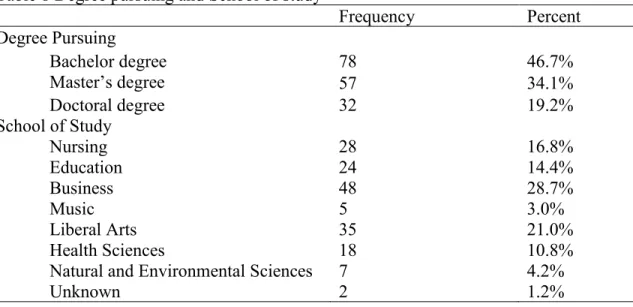
Table 8 Degree pursuing and School of study ... 61
Table 9 Number of online courses taken previously ... 61
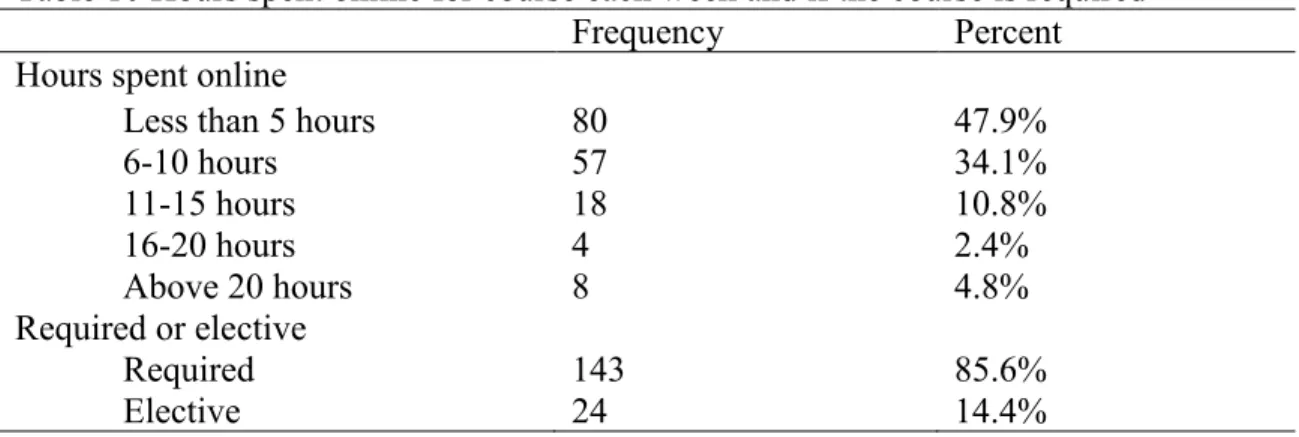
Table 10 Hours spent online for course each week and if the course is required ... 62
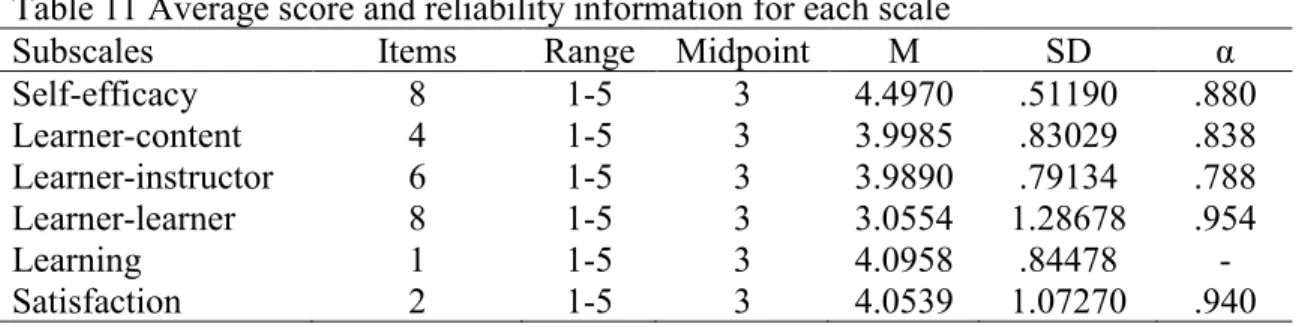
Table 11 Average score and reliability information for each scale ... 63
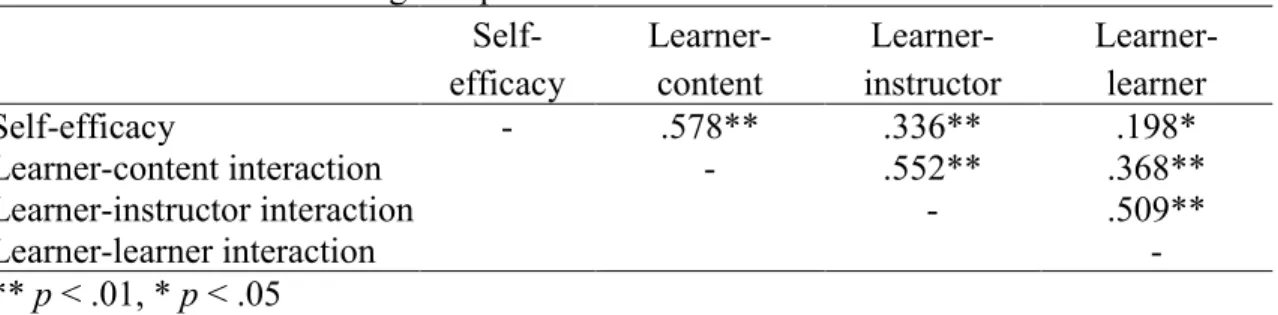
Table 12 Correlations among Independent Variables ... 64
Table 13 Model summary with three predictors and satisfaction as an outcome variable 69 Table 14 ANOVAa with three predictors and satisfaction as an outcome variable ... 69
Table 15 Coefficientsa estimates of the model with three predictors and satisfaction as an outcome variable ... 69
Table 16 Model summary with three predictors and learning as an outcome variable .... 69
Table 17 ANOVAa with three predictors and learning as an outcome variable ... 70
Table 18 Coefficientsa estimates of the model with three predictors and learning as an outcome variable ... 70
Table 19 Model summary of sequential regression with satisfaction as an outcome
variable ... 72
Table 20 ANOVAa of sequential regression with satisfaction as an outcome variable .... 72
Table 21 Coefficientsa estimates of the of sequential regression model with satisfaction as
an outcome variable ... 72 Table 22 Model summary of sequential regression with learning as an outcome variable ... 73
Table 23 ANOVAa of sequential regression with learning as an outcome variable ... 73
Table 24 Coefficientsa estimates of the of sequential regression model with learning as an
outcome variable ... 74 Table 25 Model summary with four predictors and satisfaction as an outcome variable . 76
Table 26 ANOVAa with four predictors and satisfaction as an outcome variable ... 76
Table 27 Coefficientsa estimates of the model with three predictors and satisfaction as an
outcome variable ... 76 Table 28 Model summary with four predictors and learning as an outcome variable ... 77
Table 29 ANOVAa with four predictors and learning as an outcome variable ... 77
Table 30 Coefficientsa estimates of the model with three predictors and learning as an
outcome variable ... 77 Table 31 Coefficientsa with satisfaction as an outcome variable ... 79
LIST OF FIGURES
Page
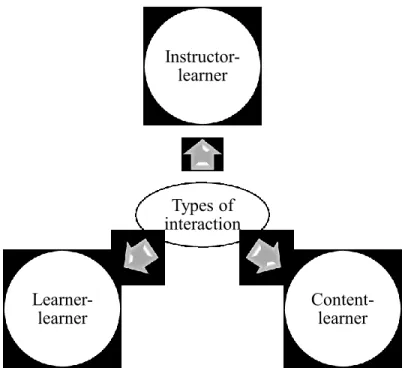
Figure 1 Moore’s Model of Interaction ... 37
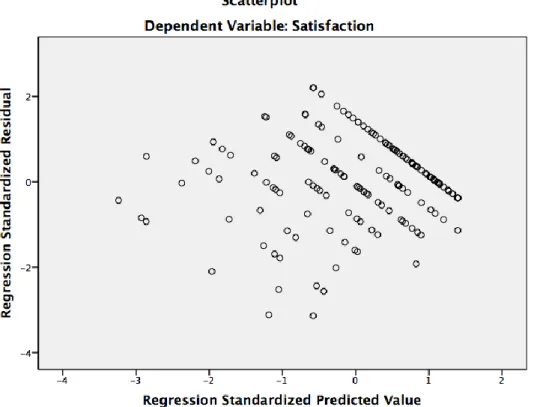
Figure 2 Testing for Linearity with satisfaction as a dependent variable ... 66
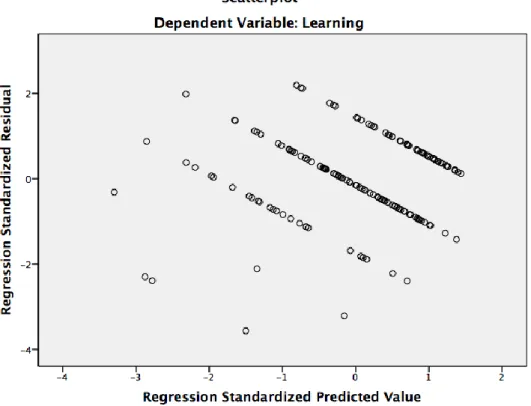
Figure 3 Testing for Linearity with learning as a dependent variable ... 66
Figure 4 Testing for Homoscedasticity with satisfaction as a dependent variable ... 67
Figure 5 Testing for Homoscedasticity with satisfaction as a dependent variable ... 68
Chapter I Introduction
Many higher education institutions are offering online learning and continue to add additional online courses and programs, as a result, the number of students enrolled in online courses is continuing to increase. (Allen & Seaman, 2014) have reported that in Fall 2002, 1.6 million students were enrolled in at least one online course in U.S. colleges and universities; this number increased to 7.1 million students by Fall 2012, this is almost 350% increase. The rate of online courses enrollments continues to grow rapidly as it increased 7% by Fall 2014; while the rate of campus courses enrollment continues to decline (Allen, Seaman, Poulin, & Straut, 2016).
As the number of enrollment in online courses in higher education increases, so does the need for research that identify the factors that increase student satisfaction and learning. Some studies reported successful experiences of students within online learning environments (Lim, 2001; Womble, 2007), other studies found that some learners have had difficulties with online learning (Martin, Tutty, & Su, 2010). Although students are using different types of technologies in their day to day life, the skills needed for online learning are not just bounded by technological skills, it also involves learning and interaction skills in a technology-based environment (Shen, Cho, Tsai, & Marra, 2013).
The absence of face-to-face communication and interaction, facial expression and body language are only some of the limitations of online learning settings. Consequently, students are required to be confident in performing technology-based activities and
interacting with others in online learning. Students with low levels of confidence in online learning might not engage in learning activities, which may lead to dissatisfaction with online learning environments (Kuo, Walker, Belland, & Schroder, 2013). Thus, psychological aspects of online learning are as important as the technological aspects of it; and psychological support is needed as much as technology support for online learners. It is necessary not just to understand how technology is used to deliver the content but also how the technology-based environments can enhance student learning and
satisfaction.
Statement of the Problem and Significance
Student satisfaction reflects how students perceive their learning experience and it is considered as one of the five pillars for the evaluation of the quality of online education as identified by the Online Learning Consortium (formerly The Sloan Consortium) (J. C. Moore, 2005). These pillars can be applied as a framework by educational institutions to evaluate and develop their online programs. Student satisfaction with online learning is greatly associated with dropout rates, persistence, motivation in taking further online courses, student success and student commitment to an online course or program (Ali & Ahmad, 2011; Allen & Seaman, 2004; DeBourgh, 1999; Kuo et al., 2013; Kuo, Walker, Schroder, & Belland, 2014; Yukselturk & Yildirim, 2008). For those potential benefits, student satisfaction with online learning should be studied and investigated in order to increase recruitment and retention of prospective students. Evaluating student satisfaction allows educational institutions to detect areas for development and improvement for online learning (Kuo, Walker, Schroder, et al., 2014).
In addition to student satisfaction, student perceived learning has been considered as an indicator of learning as any other measure, and it is one of the core elements for course evaluation (Wright, Sunal, & Wilson, 2006). Perceived learning is defined as the
feeling that knowledge and understanding are constructed (Rovai, 2002). It is learner’s
opinion and view about the learning that has occured. (Alavi, Marakas, & Youngjin,
2002, p. 406) define perceived learning as “changes in the learner’s perceptions of skill
and knowledge levels before and after the learning experience”. It is important for
educators and instructional designers to evaluate how students perceive their learning in order to improve the quality of online courses in terms of course design, delivery,
evaluation, etc., as well as to improve the student’s learning experience.
One of the factors found to influence student satisfaction and perceived learning is self-efficacy. Research on self-efficacy started between the late 1970s and the early 1990s, which was before the birth of online learning (Hodges, 2008a). In 2008, Hodges
stated, “research on self-efficacy in online environments is in its infancy” (p. 10). He
suggested that more research is needed in the area of self-efficacy in online learning. Many of the research on self-efficacy in online learning environments were conducted in higher education. The focus of previous studies mostly were on one dimension of self-efficacy in online learning which is technology, such as Internet self-self-efficacy, computer self-efficacy, Learning Management System self-efficacy, or web-user self-efficacy (Jan, 2015; Joo, Bong, & Choi, 2000; Kuo, 2010; Kuo, Walker, Belland, Schroder, & Kuo, 2014; Lee & Hwang, 2007; Lim, 2001; Y.-C. Lin, Liang, Yang, & Tsai, 2013; Martin & Tutty, 2008; Martin et al., 2010; Simmering, Posey, & Piccoli, 2009). Although computer
dimensions of online learning such as learning, interaction, collaboration and the
confidence in the ability to complete courses successfully. Such aspects are important to consider when measuring self-efficacy in online learning. The importance of self-efficacy in education is well documented in the literature; it can influence individuals to become committed to achieve their desired outcomes successfully (Bandura, 1977).
Another factor that influences student satisfaction and perceived learning within online learning environments is the level of interaction (Fredericksen, Pickett, Shea, Pelz, & Swan, 2000). (Michael G. Moore, 1989) explained that there are three types of
interaction in distance education: learner-content, learner-instructor, and learner-learner interaction. These types of interaction are critical for a successful learning experience. Many researchers have emphasized the importance of interaction (Abrami, Bernard, Bures, Borokhovski, & Tamim, 2011; Anderson, 2003; Cho & Kim, 2013; Croxton, 2014; Jung, Choi, Lim, & Leem, 2002; Ke, 2013; Kožuh et al., 2015; Kuo et al., 2013; Kuo, Walker, Schroder, et al., 2014; Michael G. Moore, 1989; Sher, 2009; Woo & Reeves, 2008). This is mainly because of the essential role interaction between learners, instructors, and content is believed to play in online formal education, and also because interaction was mostly absent during early stages of distance education (Abrami et al., 2011). Not much research done on how the interaction model developed by Moore can predict both student satisfaction and perceived learning.
In order to fill the gap in research, this research intends to provide a
comprehensive study to investigate the role of self-efficacy, learner-content interaction, learner-instructor interaction, and learner-learner interaction in online learning
designers to improve planning, designing, developing, managing, and delivering quality online education in order to improve students learning as well as their satisfaction. Purpose of the Research
This study aims to explore the relationship between four predictor variables (online learning self-efficacy, learner-content interaction, learner-instructor interaction, and learner-learner interaction) and student satisfaction and perceived learning. The purpose of this study is to investigate the extent to which the four variables are predictive of student satisfaction and perceived learning. To support this, four main objectives were identified.
The first objective is to determine the relationship between the predictor variables (learner-content interaction, learner-instructor interaction, and learner-learner interaction) and student satisfaction and perceived learning. The second objective is to determine the extent to which the predictor variable online learning self-efficacy can predict student satisfaction and perceived learning above and beyond what is already explained by the other predictor variables of interaction (learner-content interaction, learner-instructor interaction, and learner-learner interaction). The third objective is to explore the extent to which the combination of predictor variables (online learning self-efficacy, learner-content interaction, learner-instructor interaction, and learner-learner interaction) predicts student satisfaction and perceived learning; and examine which predictor is the strongest and most significant. The fourth objective is to determine how much unique variance in student satisfaction and perceived learning do the significant predictors explain.
Research Questions
This study examines the following research questions:
RQ1. To what extent does each predictor variable of interaction (learner-content
interaction, learner-instructor interaction, and learner-learner interaction) predict student satisfaction and perceived learning within an online learning
environment?
RQ2. To what extent does the predictor variable online learning self-efficacy explain
student satisfaction and perceived learning within an online learning
environment above and beyond what is already explained by the other predictor variables of interaction (learner-content interaction, learner-instructor interaction, and learner-learner interaction)?
RQ3. To what extent does the combination of predictor variables (online learning
self-efficacy, content interaction, instructor interaction, and learner-learner interaction) predict student satisfaction and perceived learning within an online learning environment; and among these predictors, which one is the strongest and most significant predictor?
RQ4. Of those predictors, how much unique variance in student satisfaction and
Research Hypotheses
The following hypotheses are tested:
H01. The predictor variables of interaction (content interaction,
learner-instructor interaction, and learner-learner interaction) do not relate to student satisfaction and perceived learning within an online learning environment. H01.1. The predictor variables of interaction (content interaction,
learner-instructor interaction, and learner-learner interaction) do not relate to student satisfaction within an online learning environment.
H01.2. The predictor variables of interaction (content interaction, learner-instructor interaction, and learner-learner interaction) do not relate to perceived learning within an online learning environment.
H02. The predictor variable online learning self-efficacy does not explain
student satisfaction and perceived learning within an online learning
environment above and beyond what is already explained by the other predictor variables of interaction (learner-content interaction, learner-instructor interaction, and learner-learner interaction).
H02.1. Online learning self-efficacy does not explain student satisfaction within an online learning environment above and beyond what is already explained by the other predictor variables of interaction.
H02.2. Online learning self-efficacy does not explain perceived learning within an online learning environment above and beyond what is already explained by the other predictor variables of interaction.
H03. The combination of predictor variables (online learning self-efficacy,
learner-content interaction, learner-instructor interaction, and learner-learner interaction) does not predict student satisfaction and perceived learning within an online learning environment.
H03.1. The combination of predictor variables do not predict student satisfaction within an online learning environment.
H03.2. The combination of predictor variables do not predict perceived learning within an online learning environment.
Limitations
While this study attempted to understand how self-efficacy and online interaction relate and predict student satisfaction and perceived learning in online learning
environments, there were some limitations that should be noted. One limitation is that students were asked to self-report their perception of self-efficacy and interaction, as well as their level of satisfaction and perceived learning. Students may have not accurately evaluated their level of satisfaction and learning, and because the survey is based on self-reported measures, actual satisfaction and learning could differ from what is reported. Additionally, Self-report measures were also used to assess learner-content interaction, and learner- instructor interaction, and learner-learner interaction to collect
data. However, this may indicate that not all learner-content interaction, and learner- instructor interaction, and learner-learner interaction were captured.
Another limitation is that students were asked to complete the survey based on one online course of their choice. If students were taking more than one online course during the semester, they must select only one online course to report in the survey. The problem here is when students are taking more than one online course, they could choose a course they like the most or least, which leads to bias in the data.
This research focuses on online courses; hence, the results of this study may only be applicable to fully online learning environments. Students in other formats of learning settings such as hybrid or blended courses may have different interactions with their instructor, classmates, and course content.
Delimitations
This study is limited to students at a private mid-sized university in Western Pennsylvania. A self-report survey was used to measure the predictor variables (online learning self-efficacy, learner-content interaction, learner-instructor interaction, and learner-learner interaction) as well as the outcome variables (student satisfaction and perceived learning).
Definitions of Terms
The definitions of research terms used for the purpose of this study are provided in Table 1.
Table 1 The Definition of terms used in this study
Terms Definitions
Self-efficacy
(Bandura, 1997, p. 3).
“beliefs in one’s capabilities to organize and execute the courses of action required to produce given attainments”.
Online learning self-efficacy (W Taipjutorus, 2014).
One’s beliefs in their own capabilities to succeed in online learning environments.
Interaction It includes interaction between learner and content, interaction between learner and learner, and
interaction between learner and instructor. Learner-content interaction
(M. Moore & Kearsley, 1996).
It is the interaction that occurs between student and the subject matter. It is highly individualized process facilitated by the instructor.
Learner-learner interaction (M. Moore & Kearsley, 1996).
It is a two-way communication between or among learners for the purpose of exchanging information or ideas related to course content. This can occur with or without instructor supervision.
Learner-instructor interaction (M. Moore & Kearsley, 1996).
It is a two-way communication between learners and the instructor of the course.
Student Satisfaction (J. C. Moore, 2005, p. 4).
“Students are pleased with their experiences in learning online”. This was identified by the Online Learning Consortium as one of the five pillars of quality online education.
Perceived learning (Rovai, 2002)
It is the feeling that knowledge and understanding are constructed.
Online Learning Learning that takes place in web-based environments. Online Learners Students who are taking online courses in a formal
learning environment. Organization of the Study
Chapter I – Introduction. This chapter describes the context of the study, which includes: introduction, statement of the problem and significance, purpose of the research, research questions, research hypotheses, limitations, definitions of research terms, and organization of the study.
Chapter II – Literature review. This chapter starts with a brief review of distance
and online education and then reviews the literature on student satisfaction and perceived learning as well as self-efficacy and interaction in online learning environments. It also examines existing research on the relationship between self-efficacy and student
satisfaction and perceived learning, and the relationship between interaction and student satisfaction and perceived learning in online learning environments.
Chapter III – Methodology. This chapter describes and discusses the methodology
used for this study. It describes the research questions, hypotheses, and design, participants of the study and setting, the instruments used for data collection, data collection procedure, and data analysis.
Chapter IV – Results. This chapter presents research results for the qualitative
data collected in relation to research questions and hypotheses. It reports the results of the regression analyses.
Chapter V – Discussion. This chapter provides discussion of the results,
limitations, recommendations for future research, conclusions and implications of the study.
Chapter II Literature Review Introduction
This chapter begins with a brief overview of distance and online education, and then it discusses the importance of student satisfaction and perceived learning in online learning environments. Each predictor variable (online learning self-efficacy, learner-content interaction, learner-instructor interaction, and learner-learner interaction) is then introduced and discussed, emphasizing research on their relationship with student satisfaction and perceived learning.
Most of the research cited in this review have either developed or adapted a self-report survey to measure student’s perception of self-efficacy, interaction, student satisfaction, and perceived learning. (Bandura, 2006) has suggested that self-efficacy is measured through self-reported surveys where participants judge their capability to successfully perform a certain task or activity. That is why in the self-efficacy surveys, it is important not to ask to perform a task, and their judgment should not be related to others. In fact, participants should understand that they are judging their own capabilities to successfully perform a task. So the questions in the self-efficacy surveys should
involve the phrase “cando” instead of “will do” to ask about the judgment of capability,
not intentions. Students satisfaction and perceived learning were also a self-report survey in many research presented in this review. They represent how students are pleased with their experiences and how much they think they have learned in an online learning environment (J. C. Moore, 2005). In order to keep the consistency, this review looks at
self-reported surveys of the three types of interaction (learner-content, learner-learner, learner-instructor interaction). It would be difficult to use another method of data collection (such as observation) of learner-learner or learner-instructor interaction to examine their relationship with a self-reported satisfaction and perceived learning; this requires a great and unwanted amount of data collection. For the purpose of this research, it is appropriate to review literature that utilizes self-reported measurements.
Articles included in this review were related to different aspects of student satisfaction, perceived learning, and self-efficacy within an online learning environment, and articles related to the interaction model developed by (Michael G. Moore, 1989) were also included.
An Overview of Distance and Online Education
The first distance education started in the mid nineteenth century and was offered by Isaac Pitman delivered by correspondence. He taught by using the postal system; which enabled him to mail texts transcribed to his students, receive transcriptions from
them, and provide feedback by correcting students’ work and mail it back to them. This
method of instruction has quickly became popular and extremely successful (Tadajewski, 2011). In 1906, Clark talked about The International Correspondence School, he
explained that the only requirement to enroll in this school is to have the ability to read and write the English Language. The problem they faced was that a quite large number of students easily got demotivated and did not make any attempts to study or complete their courses. That usually happened after receiving the textbooks or the required materials.
overwhelmed with the number of documents they received, while some students wanted only to receive the textbooks to keep, as it was the only way to get them. In the early nineteenth century, the visual media such as films, slides, and photographs were used in the educational system. In 1910, the first catalogue of instructional film was published and schools have adopted it for regular instructional use. During the 1920s and 1930s, there was increase attention to the instructional media as the audiovisual instruction developed. During the 1950s, there was focus on the communication process, which involved a sender and a receiver. The terms instructional technology and educational technology occurred in the early 1970s. However, the interest in using computers as an instructional tool did not occur till the 1980s although it was used for educational training at earlier date. Then, there was a significant increase in the number of technology used in education since 1995 (Reiser, 2001).
Since then, online learning has referred to all forms of electronic-supported teaching and learning (Nagarajan & Jiji, 2010). Commonly used terms involve distance learning, online learning, computer-based learning, computer-mediated learning, web-based learning, networked learning, e-learning and many other terms. Those terms refer to the learning situations in which students are not in the same geographic locations as their institution and other students. It is believed that online learning is most common by learners in higher education. Higher education institutions provide students with online learning management systems such as Blackboard that allow students to attend online
sessions, hold discussions, check out instructors’ posts and access digital materials and
resources. In the last decade, there was a great interest in using web-based instruction in higher education and it has proved to have a significant impact on education, and also it
was used effectively in university teaching in order to enhance the traditional forms of teaching and learning (Laurillard, 2004).
Online learning can be delivered in synchronous or asynchronous formats. Synchronous delivery provides learner with the ability to communicate at the same time.
It is defined as “two or more people in the same real or virtual space at the same time”
(Chow, 2013, p. 127). Technology used for synchronous online learning has changed over time with the rapid development of technology. According to (Butz & Stupnisky, 2016), the most common web-conferencing tools used today include Blackboard Collaborate™, formerly Wimba Classroom and Elluminate Live! ("Blackboard inc,"
2016)(Blackboard Inc., 2016), Adobe Connect™, formerly Macromedia Breeze ("Adobe
systems inc ", 2016)(Adobe Systems Inc., 2016), and WebEx Collaboration Suite("Cisco systems inc ", 2016) (Cisco Systems Inc., 2016). Synchronous tools enable real-time communication and collaboration in a same-time format. They have the advantage of being able to engage people instantly at the same point in time from different geographic locations. The synchronous environment provides learners with the feeling of being part of a more traditional concept of a class, and that means it requires learners to be at computers online at the same time and that needed to be planned ahead (Lynch, 2004).
Asynchronous delivery is the other format of communication in online learning environments. Learners can contribute in asynchronous communication at the times and places that are convenient to them, which provides more flexible schedule. Asynchronous delivery includes the use of E-mail, discussion boards, blogs, wikis and so on.
Asynchronous communication tools provide learners with the ability of communication and collaboration over a period of time through a different time mode. It allows them to
connect together in their own convenient time. Asynchronous delivery has the advantage of allowing more time to think and reflect as well as allowing to preserve and archive entire courses and conversations (Rudestam & Schoenholtz-Read, 2010).
Student Satisfaction
Student satisfaction, as recognized by the Online Learning Consortium (formerly The Sloan Consortium), is one of the five pillars to evaluate the quality of online
education along with faculty satisfaction, access, learning effectiveness and cost effectiveness (J. C. Moore, 2005). All these pillars can be applied as a framework by educational institutions to evaluate and develop their online programs. Although the main aim of this study is not to evaluate a program but to research, the results can help
instructors, instructional designers and decision makers enhance student satisfaction and understand its relation to self-efficacy and interaction in online learning environments in order to improve them.
Student satisfaction with online learning is greatly associated with dropout rates, persistence, motivation in taking further online courses, student success and student commitment to an online course or program (Ali & Ahmad, 2011; Allen & Seaman, 2004; DeBourgh, 1999; Kuo et al., 2013; Kuo, Walker, Schroder, et al., 2014; Yukselturk & Yildirim, 2008). For those potential benefits, student satisfaction with online learning should be studied and investigated in order to increase recruitment and retention of prospective students. Evaluating student satisfaction allows educational institutions to detect areas for development and improvement for online learning (Kuo, Walker,
and affect student satisfaction in online learning environments in the US (Alshare & Lane, 2011; Artino, 2007a; Burgess, 2006; Chen & Chen, 2007; Croxton, 2014;
DeBourgh, 1999; Dziuban et al., 2015; Gunawardena, Linder-VanBerschot, LaPointe, & Rao, 2010; Kuo et al., 2013; Kuo, Walker, Schroder, et al., 2014; J. Moore, 2014; Shen et al., 2013; Sher, 2009) and in other countries (Ali & Ahmad, 2011; Gunawardena et al., 2010; Hassn, Hamid, & Ustati, 2013; Jung et al., 2002; Liaw, 2008; Sahin, 2007; Wu, Tennyson, & Hsia, 2010; Yukselturk & Yildirim, 2008).
In assessing student satisfaction with their learning experience, (Hassn et al., 2013) found that students were generally satisfied with the online program. However, when (Yukselturk & Yildirim, 2008) investigated student satisfaction in an online Information Technologies Certificate Program (ITCP). Their study found that student satisfaction was positive at the beginning of the program then it significantly declined at the final semesters of the program. To have a deeper understanding of student
satisfaction, (Sahin, 2007) investigated and analyzed characteristics of online learning environments, and collected data using the Distance Education Learning Environments Survey (DELES), which was originally developed by (Walker, 2003). The study found that all six DELES scales, which are: personal relevance, instructor support, student interaction and collaboration, active learning, student autonomy, and authentic learning,
were significantly and positively (ranges from r = .22 to r = .38, p < .01) correlated with
student satisfaction.
There are many studies that have attempted to identify the factors that may contribute to student satisfaction in online learning environments. For example, (Gunawardena et al., 2010) explored factors that can predict student satisfaction in an
online educational program, and they found that online learning self-efficacy was the strongest predictor of student satisfaction. Similarly, (Shen et al., 2013) investigated the relationship between online learning self-efficacy and student satisfaction, they found that all factors of online learning self-efficacy have a positive and significant relationship (ranged from r = .320 to r = .562) with student satisfaction, and they were significant predictors of it. Self-efficacy was also investigated by (Artino, 2007a), the researcher
explored the relations between students’ motivational beliefs, their perceptions of the
learning environment and student satisfaction with an online course. The results showed that there is a positive and significant relationship between task value, self-efficacy,
perceived instructional quality, and students’ overall satisfaction with the online course.
Also, task value, and self-efficacy were significant positive predictors of student satisfaction.
Some types of interaction are found to be important elements in student
satisfaction. Two studies, for example, by (Kuo et al., 2013) and (Kuo, Walker, Schroder, et al., 2014) examined some predictors that contribute to student satisfaction in online learning environments. They found that Internet self-efficacy, learner-instructor interaction, and content interaction predicted student satisfaction while learner-content interaction was the strongest predictor. However, learner-learner interaction and self-regulated learning were not predictors of student satisfaction. Similar results by (Burgess, 2006), the researcher explored student satisfaction with fully online courses and its relationship to two elements of Moore’s theory of transactional distance: (a) learner autonomy and (b) dialog between the instructor and student. Results show
autonomy and instructor-student interaction.
Satisfaction with online courses may be related in part to the e-learning system.
(Liaw, 2008) investigated learners’ satisfaction, behavioral intentions, and the
effectiveness of the Blackboard e-learning system with university students. Findings from the study show that perceived self-efficacy was an important factor that influenced
learners’ satisfaction with the Blackboard e-learning system. Also, the study showed that learners’ behavioral intention to use the e-learning system was influenced by both
perceived usefulness and student satisfaction. (Wu et al., 2010) also examined student satisfaction in a blended e-learning system environment based on social cognitive theory. Findings of the study show that the main factors that contribute to student satisfaction were: computer self-efficacy, performance expectations, system functionality, content feature, interaction, and learning climate. However, performance expectations and learning climate significantly affected student satisfaction.
Many different measures exist to assess student satisfaction within online learning
environments. (Lim, 2001) has developed an instrument to measure adult learner’s
overall satisfaction in online courses and learners’ willingness to participate in future
online courses; Cronbach’s coefficient alpha of the scale was not reported in the study.
(Biner, Dean, & Mellinger, 1994) developed the Telecourse Evaluation Questionnaire (TEQ). TEQ measures seven factors of student satisfaction, these factors include: course instruction, course technology, course management, at-site personnel, materials delivery,
support services, and out-of-class communication with the instructor. Cronbach’s
coefficient alpha for each factor was reported in their study. Factor 1
Management and Coordination) = .80; Factor 4 (At-Site Personnel) = .89; Factor 5 (Promptness of Material Delivery) = .74; Factor 6 (Support Services) = .60; Factor 7 (Out-of-Class Communication with Instructor) = .51.
A recent instrument was developed by (Kuo, Walker, Schroder, et al., 2014), which include five items: students’ overall satisfaction with the course, students’
perceived contributions of this course to their professional and educational development,
student satisfaction with the interaction in the course, and student’s willingness to take
further online courses. Cronbach’s coefficient alpha reported in their study was 0.87 for
student satisfaction scale. (Gunawardena et al., 2010) also designed an instrument to measure learner satisfaction, which includes five subscales: online self-efficacy, course design, learner-learner interaction, learner-instructor interaction, and learner satisfaction. Cronbach’s coefficient alpha reported in their study was 0.83 for learner satisfaction scale.
Perceived Learning
Perceived learning is the feeling that knowledge and understanding are
constructed (Rovai, 2002). Perceived learning is the learner’s point of view regarding the
learning that has taken place. (Alavi et al., 2002, p. 406) define perceived learning as “changes in the learner’s perceptions of skill and knowledge levels before and after the
learning experience”. It is important for instructors and instructional designers to assess
how students perceive their learning in order to improve the quality of the course in terms
of course design, delivery, evaluation, etc., as well as to improve the student’s learning
any other measure, and it is one of the core elements for course evaluation (Wright et al., 2006).
There are many factors found in research that can affect student perceived learning. For example, a study by (Fredericksen et al., 2000) surveyed the SUNY Learning Network participants in an asynchronous online course. They received 1,406 responses with a 42% response rate. Findings of their study showed that learner-instructor interaction was the most significant predictor of perceived learning in the online course, and “students who reported the highest levels of interaction with the teacher also reported the highest levels of perceived learning in the course” (p. 20). Learner-learner interaction was also found to be a significant predictor of student perceived learning in online courses, and “students who reported the highest levels of interaction with classmates also reported the highest levels of perceived learning in the course” (p. 21).
In addition, (Fredericksen et al., 2000) found that students who reported the highest levels of perceived learning were more active participants in their online courses compared to their face-to-face courses. Student perceived learning could be affected by the reasons behind why students are enrolled in online courses. (Fredericksen et al., 2000) found that students who were enrolled because of the convenient and the flexibility of the course had higher perceived learning than students who were enrolled because the course was not offered face-to-face. In the same year, (Jiang & Ting, 2000) emphasized on the importance of interaction between students for their perceived learning; they found, however, that learner-instructor interaction was the most important predictor of student perceived learning.
(Sebastianelli, Swift, & Tamimi, 2015) examined some factors related to content and interaction that can impact students perceived learning, satisfaction, and quality in online master of business administration (MBA) courses. The researchers found that course content was the strongest predictor of all three measured outcomes: perceived learning, satisfaction, and quality. However, it was a significant predictor of perceived
learning only. Similarly, (Artino, 2007a) explored the relations between students’
motivational beliefs, their perceptions of the learning environment and student
satisfaction with online courses. The results showed that there is a positive and significant
relationship between task value, self-efficacy, perceived learning, and students’ overall
satisfaction with the online course. Also, task value, and self-efficacy were significant positive predictors of perceived learning.
Self-efficacy
The term self-efficacy refers to “beliefs in one’s capabilities to organize and
execute the courses of action required to produce given attainments” (Bandura, 1997, p.
3). That is, the level of confidence that someone’s has to perform a particular task,
activity, action or challenge. (Bandura, 1994) defines self-efficacy as someone’s beliefs
“about their capabilities to produce designated levels of performance that exercise
influence over events that affect their lives” (p. 71). Self-efficacy beliefs determine how
people might feel, think, be motivated and therefore how they act and behave. According to (Bandura, 1997), efficacy beliefs constitute the key factor of human agency. If an individual believes that he/she cannot achieve the results, they will not make any effort to make things happen. He stated that self-efficacy beliefs
“influence the courses of action people choose to pursue, how much effort they put forth in given endeavors, how long they will persevere in the face of obstacles and failures, their resilience to adversity, whether their thought patterns are self- hindering or self-aiding, how much stress and depression they experience in coping with taxing environmental demands, and the level of accomplishments they realize” (p.3).
Efficacy beliefs can influence individuals to become committed to achieve their desired outcomes successfully. People who have high confidence with their capabilities are considered to have a strong sense of efficacy. They don't take difficult tasks as obstacles to avoid, but instead they take it as a challenge to develop their skills. They set challenging goals for themselves and they commit to them; they quickly recover their sense of efficacy if they failed in a task. As a result, the level of stress and anxiety is reduced; and the number of personal accomplishments is increased (Bandura, 1997).
In the other hand, people who have doubts with their capabilities try to avoid difficult tasks because it can be a threat to them, and those people are considered to have low self-efficacy. (Bandura, 1994) described those people after facing a difficult task, “they dwell on their personal deficiencies, on the obstacles they will encounter, and all
kinds of adverse outcomes rather than concentrate on how to perform successfully” (p.
2). They quickly give up when facing difficulties, and they slowly recover heir sense of
efficacy if they failed in a task. They are considered as “victims” to stress and depression
Sources of Self-efficacy
(Bandura, 1997) has introduced the theory of efficacy, which states that self-efficacy expectations are based on four major sources of information: (1) performance accomplishments (also called inactive mastery experience), (2) vicarious experience, (3) verbal persuasion, and (4) physiological states. These four principles are considered as the core elements in the development of self-efficacy in general including in the learning context.
Performance accomplishments, the first source of information, are the most
influential as it is based on learners’ previous successful experience. Repeated successes
develop strong efficacy expectation that leads to reducing the negative effect of failure.
As a result, Bandura states “improvements in behavioral functioning transfer not only to
similar situations but to activities that are substantially different from those on which the
treatment was focused” (Bandura, 1997, p. 195).
In vicarious experience, people do not depend on their successful experience as the main source of information. They tend to observe others performing an activity successfully. This can be valuable in forming beliefs in self-efficacy. (Bandura, 1997) has
stated that in this source, learners “persuade themselves that if others can do it, they
should be able to achieve at least some improvement in performance” (p. 197). So, it
doesn't depend on someone’s capability to achieve a task but on social comparison.
Therefore, self-efficacy would higher if learners were capable of achieving a task that others have done, in the other hand, self-efficacy would lower if the learners fail to meet the performance of others.
Verbal persuasion, the third source of information, is commonly used because its ease and it is available. Learners see the persuader as someone who is qualified enough to provide authentic feedback. Verbal persuasion can either lead to higher self-efficacy by
encouragements, or lower self-efficacy by providing unrealistic feedback. “skilled
efficacy builders encourage people to measure their success in terms of self-improvement
rather than in terms of triumphs over others” (Bandura, 1997, p. 106).
Physiological states are the last source of information that can have direct effect on learners’ self-efficacy. When people judge stress and anxiety, they depend on their state of physiological arousal. Generally, it is very likely that individual will succeed if they are not in the state of aversive arousal (Bandura, 1997).
Online learners are similar to traditional classroom learners in which where their efficacy comes from. (Y.-C. Lin et al., 2013) investigated the sources of Internet efficacy for older learners and they found that they had the similar sources of
self-efficacy introduced by (Bandura, 1997). However, (Bates & Khasawneh, 2007) found that self-efficacy in the context of online learning is influenced by four factors, which are: (1) previous success with online learning, (2) pre-course training, (3) instructor feedback, and (4) online learning technology anxiety.
Self-efficacy and Online Learning
Research on self-efficacy has started before online learning has occurred, between the late 1970s and the early 1990s, which was before the birth of online learning
(Hodges, 2008a). In 2008, Hodges stated, “research on self-efficacy in online
area of self-efficacy in online learning. Many of the research on self-efficacy in online learning environments was conducted in higher education, which was not the case with research on self-efficacy in traditional learning environments.
The focus of the previous studies mostly was on one dimension of self-efficacy in online learning which is the technology factor (Alqurashi, 2016), such as computer self-efficacy (Jan, 2015; Lee & Hwang, 2007; Lim, 2001; Pellas, 2014; Simmering et al., 2009; Womble, 2007; Wu et al., 2010), Internet self-efficacy (Joo et al., 2000; Kuo, Walker, Belland, et al., 2014; Kuo, Walker, Schroder, et al., 2014; Y.-C. Lin et al., 2013; Womble, 2007), information-seeking self-efficacy (Hill & Hannofin, 1997; Tang & Tseng, 2013), Learning Management System (LMS) self-efficacy (Martin & Tutty, 2008; Martin et al., 2010), and e-learning systems self-efficacy (Liaw, 2008). Other than the technology factor, some studies have focused on the learning factor (Artino, 2007a; Hodges, 2008b; Joo et al., 2000; Joo, Lim, & Kim, 2013; Y.-M. Lin, Lin, & Laffey, 2008; Shea & Bidjerano, 2010; Xiao, 2012) and others focused on general self-efficacy in online learning environments (Gebara, 2010).
Although computer skills, Internet skills and information-seeking skills are needed for online learning, they oversee other dimensions of online learning such as self-efficacy for learning, interaction, collaboration, and for completing online courses
successfully. It is important to consider how the new generation of learners have changed
compared to three decades ago when online learning started in terms of learner’s comfort
level and fluency with technology. Those aspects are important to consider when measuring self-efficacy in online learning.
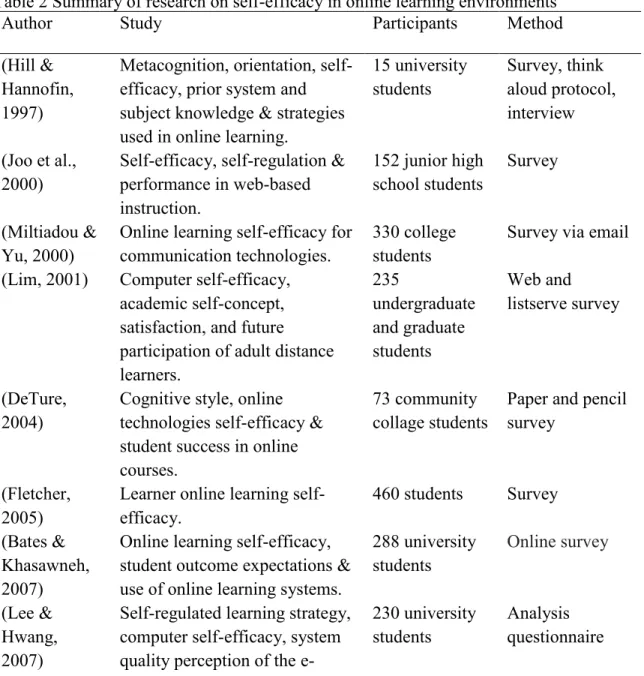
Few studies are available that investigated more than one factor of self-efficacy in online learning (Bates & Khasawneh, 2007; DeTure, 2004; Fletcher, 2005; Miltiadou & Yu, 2000; Puzziferro, 2008; Shen et al., 2013; W Taipjutorus, 2014; W Taipjutorus, Hansen, & Brown, 2012). Table 2 below summarizes studies on self-efficacy in online learning environments between the year of 1997 and 2015; the table is organized by the year of publication.
Table 2 Summary of research on self-efficacy in online learning environments
Author Study Participants Method
(Hill & Hannofin, 1997)
Metacognition, orientation, self-efficacy, prior system and subject knowledge & strategies used in online learning.
15 university students Survey, think aloud protocol, interview (Joo et al., 2000)
Self-efficacy, self-regulation & performance in web-based instruction. 152 junior high school students Survey (Miltiadou & Yu, 2000)
Online learning self-efficacy for communication technologies.
330 college students
Survey via email
(Lim, 2001) Computer self-efficacy,
academic self-concept, satisfaction, and future participation of adult distance learners. 235 undergraduate and graduate students Web and listserve survey (DeTure, 2004)
Cognitive style, online technologies self-efficacy & student success in online courses.
73 community collage students
Paper and pencil survey
(Fletcher, 2005)
Learner online learning self-efficacy.
460 students Survey
(Bates & Khasawneh, 2007)
Online learning self-efficacy, student outcome expectations & use of online learning systems.
288 university students Online survey (Lee & Hwang, 2007)
Self-regulated learning strategy, computer self-efficacy, system quality perception of the
e-230 university students
Analysis questionnaire
Learning environment & learners’ satisfaction. (Womble,
2007)
Learner satisfaction, self-efficacy, and perceived
usefulness within an e-leaning context. 440 government agency employees Survey (Artino, 2007a) Motivational beliefs, perceptions of the learning environment and satisfaction with a self-paced online course.
646 students from a U.S. service academy Self-report survey (Hodges, 2008b)
Motivational email messages, learner self-efficacy and
achievement in an asynchronous course. 125 university students Pretest-posttest control group design
(Liaw, 2008) Learners’ satisfaction,
behavioral intentions, and the effectiveness of the Blackboard e-learning system. 424 university students Survey (Y.-M. Lin et al., 2008)
Task value, self-efficacy, social ability and learning satisfaction.
108 university students
Survey
(Martin & Tutty, 2008)
LMS self-efficacy and course performance for online and hybrid learners. 69 university students Survey (Puzziferro, 2008) Performance as a function of grade and course satisfaction in online learning, students’ self -efficacy for online technologies and self-regulated learning strategies. 815 community college students Questionnaire (Simmering et al., 2009)
Characteristics associated with effective training (initial motivation to learn and computer self-efficacy) and learning in a self-directed online course. 190 university students Self-report data (Gebara, 2010)
General self-efficacy and course satisfaction. 61 undergraduate and graduate students Online survey
(Martin et al., 2010)
Students’ confidence with LMS, LMS self-efficacy and course performance for e-learners.
68 university students Survey (Shea & Bidjerano, 2010)
Learner self-efficacy measures and ratings of the quality of learning in virtual environments.
3165 students from 42 institutions Online survey (Wu et al., 2010) Computer self-efficacy, performance expectations, system functionality, content feature, interaction, learning climate and student learning satisfaction. 212 college, university and graduate students Paper-based and online questionnaire (W Taipjutorus et al., 2012)
Learner control and online learner self-efficacy.
31 university students
Online survey
(Xiao, 2012) Self-efficacy of online learners
and motivation. 20 university students Semi-structured interviews (Joo et al., 2013)
Learners’ locus of control, self -efficacy, task value, learner satisfaction, achievement and persistence in an online university. 897 university students Online surveys (Kuo et al., 2013)
Interaction, Internet
self-efficacy, self-regulated learning & student satisfaction in online learning. 111 undergraduate and graduate students Online survey (Y.-C. Lin et al., 2013)
Sources underlying middle aged and older adults’ Internet self -efficacy.
24 middle aged and older adults
Interview
(Shen et al., 2013)
Online learning self-efficacy, prior online experience, academic status, gender and student satisfaction with online learning. 406 undergraduate and graduate students Online survey (Tang & Tseng, 2013)
Distance learners' information literacy skills in using digital library resources & learners' information seeking self-efficacy.
219 students Online survey
Walker, Belland, et al., 2014)
efficacy & students' satisfaction in synchronous learning
environments.
students electronic survey
(Kuo, Walker, Schroder, et al., 2014)
Interaction, Internet, self-efficacy, self-regulation &
student satisfaction in online learning. 180 undergraduate and graduate students Online survey
(Pellas, 2014) Computer self-efficacy, metacognitive self-regulation, self-esteem & students’ engagement. 305 university students Web-based survey (W Taipjutorus, 2014)
Learner control, online learning self-efficacy, age, gender, prior online experience & computer skills.
75 students Online survey
(Jan, 2015) Academic self-efficacy,
computer self-efficacy, prior experience, and satisfaction with online learning.
103 university students
Online survey
Computer Self-efficacy
Research on self-efficacy and computers is mainly related to learners’ confidence
in their capability of using computers and other types of technology. For example, (Jan, 2015) conducted a study with graduate students taking online courses at a university in USA. The researcher measured academic self-efficacy, computer self-efficacy, prior experience with online learning and student satisfaction. The results of the study found a positive and significant relationship between computer self-efficacy and prior experience with online learning, and between academic self-efficacy and prior experience with online learning, and between academic self-efficacy and student satisfaction. Findings also show a positive and significant relationship between academic self-efficacy and
computer self-efficacy, and between prior experience and student satisfaction. However, computer self-efficacy and student satisfaction have no positive or significant
relationship. Similarly, (Simmering et al., 2009) found that computer self-efficacy is not related to motivation to learn in online courses, however, computer self-efficacy was positively related to prior experience with online learning.
On the other hand, (Lim, 2001) found that computer self-efficacy was a statistically significant predictor of student satisfaction, and there is a positive relationship between student satisfaction and future intention to take online courses. (Womble, 2007) also found a significant positive relationship between computer self-efficacy and student satisfaction in online learning environments. Correspondingly, findings from another study revealed that computer self-efficacy is one of the main determinations of student satisfaction with blended e-learning system environments (Wu et al., 2010). Another empirical study by (Pellas, 2014) with university students who were taking online courses, found that computer self-efficacy has a positive relationship
with students’ cognitive and emotional engagement factors, and a negative relationship
with behavioral factors. (Lee & Hwang, 2007) have proposed a model for measuring e-learning effectiveness, and they suggested that computer self-efficacy is a very important and critical factor to student satisfaction with e-learning.
Internet Self-efficacy
Research on self-efficacy and Internet is related to learners’ confidence in their
capability of using the Internet to seek for information; this is similar to information-seeking self-efficacy in online learning. (Joo et al., 2000) investigated the relationship
between Internet self-efficacy and students’ performance on the written and search tests
in web-based instruction. Internet self-efficacy was found to predict students’
performance on the search test. However, there was no significant relationship between
Internet self-efficacy and students’ performance on the written test. (Kuo, Walker,
Schroder, et al., 2014) survey undergraduate and graduate students taking online courses, they found Internet self-efficacy has a positive significant but very weak relationship with
student satisfaction (r = .181, p < .05); however, Internet self-efficacy was not a
significant predictor for student satisfaction. Similarly, (Womble, 2007) found a
significant positive relationship (r = .40, p < .01) between learner self-efficacy and
e-learner satisfaction in online learning environments.
A study by (Kuo, Walker, Belland, et al., 2014) also found significant but weak
relationship (r = .398, p < .01) between Internet self-efficacy and student satisfaction;
however, Internet self-efficacy does not predict student satisfaction in online learning environments. Seeking or searching for information on the Internet is highly related to students’ perceived self-efficacy; (Hill & Hannofin, 1997, p. 59) found that “lack of
confidence resulted in low-level searches to simply locate information” where high
perceived self-efficacy leads to more exploration and locating desired information. Likewise, (Tang & Tseng, 2013) surveyed distance learners and they found that those who have higher self-efficacy for information seeking and ability to use information showed higher self-efficacy for online learning and exhibited greater knowledge in online resources. On the other hand, distance learners who have low self-efficacy for
information seeking showed more interest in learning how to use the library resources but not the strategies to use online resources.
Learning Management System Self-efficacy
(Martin & Tutty, 2008) and (Martin et al., 2010) have developed an instrument to measure Learning Management System (LMS) self-efficacy, this instrument measures the confidence levels of learners with LMS and how it affect their performance. The
instrument includes five technology parts: (1) assessing the course content, (2) tests and grades, (3) asynchronous communication, (4) synchronous communication, (5) Advanced tools. Cronbach’s coefficient alpha for the instrument was not reported in their study. Their findings revealed that self-efficacy of online learners was significantly higher than hybrid learners. However, LMS self-efficacy does not have a significant effect on course performance for the online learners but it had a positive influence on course performance for the hybrid learners. When assessing the relationship between perceived self-efficacy and perceived satisfaction with e-learning systems, (Liaw, 2008) found that perceived
self-efficacy was a predictor of learners’ perceived satisfaction.
Measuring Self-efficacy in Online Learning
Some other studies investigated a combination of factors to measure self-efficacy in online learning. For example, (Miltiadou & Yu, 2000) have developed an Online Technology Self-Efficacy Scale (OTSES) and it includes four subscales: (1) Internet Competencies, (2) Synchronous Interaction (3) Asynchronous Interaction I, and (4) Asynchronous Interaction II. Cronbach’s coefficient alpha for the whole instrument was reported .95 in their study. The instrument consists of 30 items measured on a 4-point Likert Scale. Participants were asked to rate their level of confidence on each item. All those items measure self-efficacy to use online technology. (Puzziferro, 2008) adapted