Rochester Institute of Technology
RIT Scholar Works
Theses
5-2018
Consumer Preferences in Food Interactive
Packaging
Nuchjarin Pareeratanasomporn
Follow this and additional works at:https://scholarworks.rit.edu/theses
This Thesis is brought to you for free and open access by RIT Scholar Works. It has been accepted for inclusion in Theses by an authorized
Recommended Citation
Consumer Preferences in Food Interactive Packaging
By Nuchjarin Pareeratanasomporn
A Thesis submitted in partial fulfillment of the requirements for
the degree of Master of Science in Print Media in the School of Media Sciences in the
College of Imaging Arts and Sciences
of the Rochester Institute of Technology
May 2018
Primary Thesis Advisor: Dr. Barbara Birkett
Table of Contents
Table of Contents.…..…..………..…..….….…..…..…..…..…..…..………..……....i
List of Figures...…..…..…..…..…..…..…..…...…..…..…..……..…..…..……..……..….iii
List of Tables..…..…..…..…..…..…..……..……...…..….……….v
Abstract…..…..…..…..…..…..…..……..….…..…..…..…...…..…..……….…...vi
Chapter 1 Introduction and Statement of the Problem……..…..……..…………...…….…1
Background………..…...…..……..…..……..……..……...…..1
Statement of the Problem………..…..……..…..…...…..…..…………...…..2
Reasons for Interest…………..……..…..……..………...……..…...….3
Chapter 2 Theoretical Basis………..….…..……..……..………...………….4
Chapter 3 Literature Review………..…..………..…..………...………....8
Packaging Market and Trends………....…….8
Impact of Packaging on Purchase………..…..……..…..………....12
Interactive Packaging Technology………..……..……..…..….………...14
Quick Response Code Scanning (QR Code)…..………..…...15
QR Code Structure and Functional Elements…...15
QR Code Printed Size……..…...…….……..…...17
Augmented Reality (AR) ………...19
Radio-Frequency Identification (RFID) ………...…...19
Near Field Communication (NFC) ……….….………20
Chapter 5 Methodology…………..………..………..………..……….….……...…...23
Chapter 6 Results…………..……..…..…..…..…..…..…..…..…..…..…..…..….….27
Sample Demographic…..…..…..…..…..…..….….…..…..…..…….…27
Smartphone Usage and Behavior…..…..…..…..…..…..….………..….28
Factors and Information Participants Consider When Selecting a Food
Product………..…..….…..………....…..….….…..…..…...…..…..…….29
Interactive Features Awareness, Experience, and Their Opinion to the
Features…..…..…..…..…..…..….………....…..…..…..…...32
The Result Regarding Participants’ Beverage Purchase……….…35
Chapter 7 Summary and Conclusions….…..…..…..…..…..…..…..…..…..…….….43
Research Question 1…..…..…..…..…..…..….….…..…..…..……..….43
Research Question 2…..…..…..…..…..…..….….…..…..…..……..….44
Research Question 3…..…..…..…..…..…..….….…..…..…..……..….45
Analysis and Summary Conclusions…..…....…..…...…..…..…..…..….46
Limitation and Future Research…..…..…..…..…..…..….….…..……….48
Bibliography………..………..………..………...50
List of Figures
Figure 1. Heinz Ketchup Augmented Reality Activity through Blippar Application….…7
Figure 2. Value of Global Printed Packaging and Labeling 2010- 2020……..………...9
Figure 3. Smart Packaging Trends and Annual Growth Between 2014 to 2025……...…10
Figure 4. Percentage of Young Adults Who Have Scanned QR Code, by Media, 2012...11
Figure 5. QR Code Elements and Its Structure………,……….16
Figure 6. Percentage of Respondents’ Background Categorized by College..…….…….28
Figure 7. Frequency of Downloading a New Application onto Smartphone……..……..29
Figure 8. Factors Respondents Consider When Selecting a Food Product …..……...….30
Figure 9. Product Label Information Respondents Consider when Selecting a Food
Product…..………...…….31
Figure 10. Respondents’ Awareness and Experience with Interactive Feature:
QR Codes and Augmented Reality …..…..…..…..…..…..…..…..………..…32
Figure 11. Factors Limiting the Use of Interactive Features....…..…..…..…..…..…..….33
Figure 12. Percentage of Respondents Beverage Purchasing: Only Coffee,
Only Tea, Both Coffee and Tea, or Neither Beverage…..…..………….…....36
Figure 13. The Interactive Content Respondents Consider the Most Valuable When
Making a Purchase …..….…..……….….38
Figure 14. Percentages Showing Respondents' Preferences for Interactive
Figure 15. Percentags Showing Respondents' Preferred Method for Accessing Interactive
List of Tables
Table 1. Independent and Dependent Variables……….…...25
Table 2. Factors That Can Increase the Use of Interactive Features…..…..…..………...34
Table 3. The Interactive Content Respondents Consider the Most Valuable
when Making a Coffee or Tea Purchase ..…..…..………..…..…...……...37
Table 4. Respondents’ Preference in Interactive Content Format in Each Specific
Content Type…..…..…..…..…..…..…..…..…..………..…....39
Table 5. Respondents’ Preference Method for Accessing Each Specific Content Type...41
Abstract
Interactive packaging is an innovation that has been adopted by the packaging
design industry. It enables consumers to interact with packaging through their smart
devices. Although the technology is already available, it is uncertain how many
consumers use it or will ever find it useful.
This research measured the young Millennial (18-24 years old) consumers’
perspectives and their preferencesforinteractive feature on food packaging. College
students between 18 to 24 years old were chosen by using a purposive samplingmethod.
First, a questionnaire asked for information about the participants’ behavior surrounding
two topics. The first topic asked about their smartphone usage, and the second topic
asked about the factors affecting their purchasing decisions concerning food products.
Next, the survey focused on the consumers’ perceptions and their experiences with
interactive activities. QR codes and Augmented Reality were the variables. Participants
without any awareness of interactive features and participants without any experience in
using interactive features, even though they were aware of them, were introduced to the
interactive packaging functions through a video in order to help them to better understand
interactive packaging features.
Lastly, the survey asked for respondents’ opinions and expectations of interactive
features in terms of the content, both function and form, and their preferred method of
access. In this part of the study, coffee and tea products were used as example products.
A sample of 80 students between 18 to 24 years old participated the survey.
Participants were more aware and have experienced the QR code scanning more than the
Augmented reality scanning. Basic information and product reviews were the top two
rated for the content consumers considered important. Short paragraph and text with
graphic elements were preferred interactive content formats. Consumers preferred using a
web browser application on their phones to search for product information more than
Chapter 1
Introduction
Background
The development of technology has a direct and indirect impact on any business.
The packaging industry has been influenced by the increasing use of technologies such as
the Internet. Technologies have generated new features for packaging which can
transform traditional packaging into an interactive medium. Interactive packaging
provides functional enhancement that increases the consumer’s experience with products
(Wilder, 2015). Interactive packaging can be described as a component of packaging’s
ability to provide functionality; in this case, the feature allows a brand to insert
information onto packaging which can be read through smartphones or other digital
devices. The experience at the point of sale may stimulate the purchasing decision. The
design of packaging for both aesthetics and functions is an important factor in attracting
buyers among numerous competitors on the shelf.
The interactive packaging trend is rapidly expanding its markets. VisionGain
(2015) forecasted the smart packaging market from 2015-2025. They reported revenue of
smart packaging in 2015 was $1.9 billion. They predicted revenue to increase 36% by
2020, and 68% by 2025. Interactive packaging activity uses mobile technology, and
smartphone global revenue (Statista, 2016) is predicted to increase to $401.3 billion in
2016. Statista (2016) also reveals that smartphone users worldwide, those with immediate
Statement of the Problem
The forecast of smart packaging trends and the growth of the mobile device
market support the notion that smart packaging will play a significant role in the
packaging industry. Two types of interactive packaging that do not require special
printing techniques to produce them are Quick Response (QR) code scanning and
Augmented Reality (AR) technology.
QR codesare common in consumer advertising. Although the usefulness of
interactive technology is known and available, the functions are not widely used by
consumers. The data comparing the number of mobile phone users who scanned a QR
code from January of 2012 to May of 2013 showed that the number of QR Code
subscribers grew by 13.84% while the number of smartphone owners increased by
39.19% (Marketing Charts, 2013). Thus, the growth of QR code scanning subscribers
was not parallel to the increase in smartphone users even though the applications for QR
codes scanning were available for free download. Will this be the case for other types of
interactive packaging?
As Barton, Formm, and Egan (2012) revealed, the Millennial generation is
increasing in number and has a significant impact on the market. Also, the Millennials
have grown up in a period of advancement in innovation and technology,and they tend to
be more professional in using these advancements than other generations. This thesis
interactive food packaging.
Reasons for Interest
The researcher hasa background in graphic design, with printing technology
being a personal interest. Graphic design and printing are a perfect combination for
developing new packaging products. The researcher believes that graphic design would
not be successful without a good printing method. The researcher took a course on
packaging in the Print Media program, and the package printing industry was shown to
be highly attractive. Packaging can be presented in a variety of design types that use
various techniques to produce them. Smyth (2015) stated that electronic media cannot
substitute for packaging as was the case in other graphic printing sectors.However, the
researcher recognizes that developed technology, for example, new interactive media, can
provide a unique experience for the user as well as increase the ability for the brand to
communicate with consumers. An experience that combines both of these worlds could
prove to be a disruptive marketing approach.
Interactive activity is also the researcher’s personal interest. The researcher
considers that an interactive feature on packaging is an effective marketing or sales
Chapter 2
Theoretical Basis
This chapter presents the theoretical background required to explain pertinent
ideas regarding this study.
Klimchuk, Krasovec, and Sandra (2013), in the book Packaging Design:
Successful Product Branding from Concept to Shelf, state that packaging has been used
since ancient times as humans needed to gather, collect, store, transport, and preserve
goods. Groth (2006) also presented the history of packing and packaging in the book
Exploring Package Design and said that ceramic pottery, wooden boxes and barrels were
used as containers to store products and food. The development of materials andthe
innovation of machinery and technology heightened the possibility to design and to
produce packaging. Subsequently, glass, metal, paper, cardboard, and plastic were used,
and all now play important roles as packaging substrates. They provide varied choices to
create structure, function, and aesthetics in design.
Packaging has become more significant since the period of the Industrial
Revolution (Groth, 2006). Once mechanization flourished, advanced technology was
invented in order to serve demands in the area of commerce. Package labeling is an
important packaging component in that it facilitatesmarketing communicationthrough
the design of a label that differentiates the product. Moreover,today the label can
As mentioned previously, a brand can take advantage of the package to
communicate with the consumer at the point of sale. Information about the particular
product can be made available to the consumer through the product label and package
(Mann, 2007). The guidance for the food industry from A Food Labeling Guide by the
Food and Drug Administration (2013) is that most food is required to clarify nutrient
content claims and health messages. A Food Labeling Guidealso describes the labeling
requirements in detail as follows:
1. Principal Display Panel (PDP) is the place where all required label statements are
shown, such as the statement of product identity and the net amount of the
product. This information is generally on the front panel and should be most
likely attractive to consumers at the point of purchase.
2. Information Panel Labeling presents the information that does not appear on the
PDP which includes the name and address of the manufacturer, packer and/or
distributor, the ingredient list, nutrition labeling, and any required allergy
labeling.
3. Ingredient List provides thelisting of all ingredients.
4. Nutrition Facts Labeling can be placed with the ingredient list and the name and
address of the manufacturer or distributor either on the PDP, or on the
Information Panel Labeling. Also, it can be placed on any alternative panel that
can be seen by the customer.
5. Nutrition Content Claim (NCC) is the information that is required in order to
that characterizes the level of nutrients in the food, for example, “low fat,” or
“contains 200 calories.”
Besides the mandatory information about the product that is revealed on
packaging, the book Design Matters: Packaging 01 (2008)also supports that packaging
can be used to present general information which allows the brand to provide information
to assist consumers’ purchasing decisions.
The package itself is not only a container of a product. It also has a responsibility
to attract consumers’ attention. Edwards, Klimchuk, Wallace, and Werner (2009) wrote
in the book Really Good Packaging Explained that packages not only hold the product
and provide the surface for listing product attributes, but they also produce the
opportunity for the brand to tell its story. Procter and Gamble, a leading company in the
multinational manufacture of family, personal, and household care products, believes that
packaging is the first and almost always the last moment of truth before a purchase is
made. This is supported by the research of Frontiers (1996) who indicated that
approximately 73% of purchasing decisions are made at the point of sale. In addition, the
development in interactive technology also increases the ability of a package to
communicate more information to its customers.
Mobile technology has developed rapidly in the past decades. Consumers have
been surrounded with interactive devices which impact their behavior in some way.
Packaging is one of the media that is trying to connect with consumers through the use of
information beyond the information printed on the package or label. They also increase
the user experience through the activities provided by the interactive technologies.
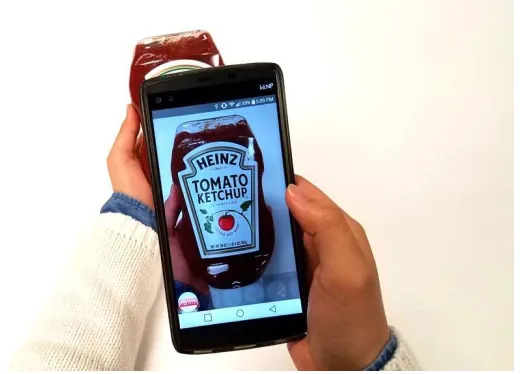
An exampleofinteractive activities on packaging is demonstrated in Figure 1.
Heinz ketchup packaging allows customers to connect to the Blippar application by using
their smartphone to scan the label on the ketchup bottle. When the database recognizes
the element of the label, it generates an augmented reality of a cookbook. While using the
application, customers get choices of recipes in which Heinz ketchup is an ingredient.
Moreover, they receive other information from the Heinz company as well as the link to
the company’s website.
There are several technologies that generate a connection between packaging and
consumers through mobile devices, such as the QR code scanning, augmented reality,
Radio-frequency Identification (RFID) and Near Field Communication (NFC). These are
described in the next chapter.
[image:16.612.235.495.149.336.2]Chapter 3
Literature Review
Packaging has played a significant role in the food industry. Development of
technology has influenced traditional food packaging with its responsibilities to protect,
communicate, and provide convenience and containment (Biji, Ravishankar, Mohan,
Gopal, 2015). Interactive packaging is an innovation that enhances communication
between the brand and the consumers and is the focus of this literature review. Since
packaging has become an important factor in the age of consumption-driven retail,
research on consumer preferences is also reviewed.
Packaging Market and Trends
The package printing industry is growing.Smyth (2015) indicated that demands
for packaging would become more substantial in both its physical protection and its
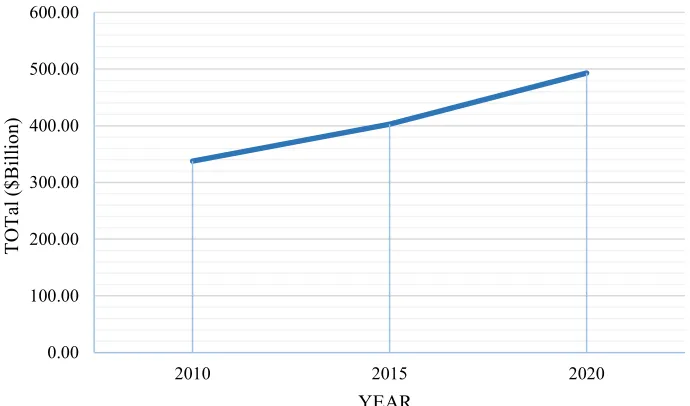
Smyth’s (2015) report, The Future of Digital vs Analogue Printing to 2020,
reveals values for the global printed packaging and labeling market. Both conventional
printing technology and digital printing technology in 2015 were at a high of $402.91
billion. This figure is forecasted to grow to $492.96 billion by 2020. Figure 2 shows this
projected growth.
0.00 100.00 200.00 300.00 400.00 500.00 600.00
2010 2015 2020
T
O
T
al
(
$
B
il
li
o
n
)
YEAR
[image:18.612.149.494.128.331.2]Global Printed Packaging and Labeling Market
Figure 2. Values of Global Printed Packaging and Labeling 2010-2020. Adapted from
The Future of Digital vs Analogue Printing to 2020 (16), by S. Smyth, 2015, Akron,
Smart packaging is also expanding. The development of technology has
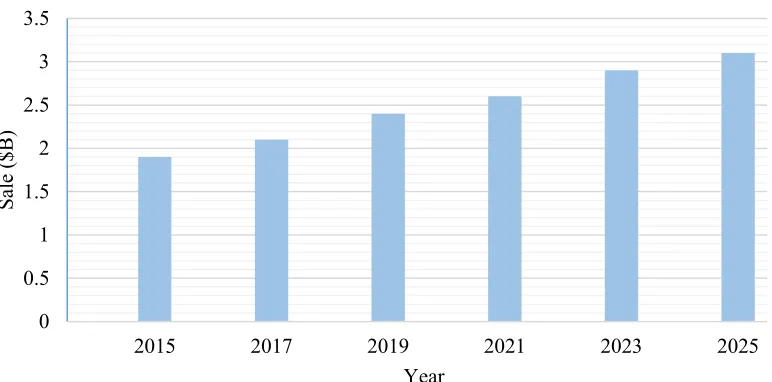
influencedpackaging with conventional packaging becoming smarter. VisionGain (2015)
forecasted the smart packaging market from 2015-2025. The revenue from smart
packaging in 2015 was $1.9 billion. They predicted it to increase 36% by 2020, and 68%
by 2025. The chart showing smart packaging trends and projected annual growth from
2014 to 2025 is presented in Figure 3.
Thenumber of mobile phone users and QR code subscribers (Data Dive: QR
Codes, 2013) in the US from September 2011 to May 2013 indicates that the growth of
QR codes scanning subscribers was not parallel to the increase in smartphone users even
though the applications for QR codes scanning were available for free downloading.
0 0.5 1 1.5 2 2.5 3 3.5
2015 2017 2019 2021 2023 2025
S
al
e
($B
)
Year
[image:19.612.117.503.117.308.2]Smart Packaging Market Forecast 2015-2025
Figure 3. Smart Packaging Trends and Annual GrowthRate between 2014 to 2025.
The QR Code usage among 3,000 young adult consumers between 18-34 years
old in the US and Western Europe was studied by the company, Pitney Bowes. The study
found that consumers were more familiar with the codes on magazines and printed
materials such as posters, mail, and packaging than the codes shown on websites, email,
or television. However, Figure 4 shows that the percentage of users in each media is
lower than 30 percent. 27%
21% 21% 21%
13%
9% 7%
0% 5% 10% 15% 20% 25% 30% 35% 40% 45% 50%
Magazine Poster Mail Packaging Website Email TV
P
er
ce
nt
of
R
es
p
onde
nt
s
Media
[image:20.612.148.510.129.340.2]Percentage of Young Adults Who Have Scanned QR Code, by Media, 2012
Figure 4. Percentage of US and Western Europe Young Adults Who Have Scanned a QR
Code, categorized by Media in 2012. Adapted from US Ahead of Western Europe in QR
Code Usage, 2013. Retrieved from
Impact of Packaging on Purchase
Among the competitive products on the shelf, packaging performs as a
representative of the brand to draw the customer’s attraction. It acts as a silent salesman
(Osborne, 2012). Even the placement of the elements in packaging design impacts the
consumer’s recall of the package. Rettie and Brewer (2000) found that the most effective
layout of packaging design is that the text should be presented on the right-hand side and
the image should be placed on the left-hand side of the package.
The visual influence on in-store buying decisions was studied by Clement in
2007. The experiment used eye-tracking equipment to evaluate how packaging design
influences buying behaviors. The study concluded that in-store purchasing could be
classified into four phases. The first phase is a pre-attention phase where consumers’
attention is attracted by the visual impact of the packaging. The next phase is the
succeeded attention phase in which the packaging design impacts the consumers’ minds.
Then the physical action phase occurs when consumers pick the package up from the
shelf. The last phase is the post-purchase phase where the decision and the purchase are
made.
Visual elements of packaging (Wang and Chou, 2010) are the primary
communication media between the producer and the consumer, especially for food
packaging. However, the consumer’s ability to perceive the design of a package is varied.
Individual consumers have their own decision-making approaches and interest in the type
of information and the appearance of the package (Hawkins, Best, & Coney, 2004). Some
others might be concerned about ingredients and consumption instructions. Moreover,
consumers’ preferences and expectations differ by generation as well.
Every generation has encountered different moments in a specific time that have
an impact on their characteristics. For instance, the conservative view of life of the early
Baby Boomers was influenced by the World War IIperiod, or the Generation X’s life
was affected by the destruction of the Berlin Wall and the AIDS contagion. The
Millennial’s view has been influenced by the terrorist attack on September 11th, or by the
repercussions from the Asian Tsunami. Moreover, a great impact on the Millennial
lifestyle is the substantial use of technology (Downing, 2006; & Lowes, 2015).
The Millennial generation (Barton, Fromm, and Egan, 2012), also known as
Generation Y, is increasing, and has a significant impact in the consumer market. In
2012, the number of U.S. Millennials was 79 million while there were 76 million Baby
Boomers (those born between 1946-1964). In demographic terms, the Millennials are a
group of people whose birth years ranged from the early 1980s to the early 2000s.
Moreover, the generation of Millennials is also divided into two segments (Cohen, n.d.):
Younger Millennials are from 18-24 years old, and the older Millennials are from 25-34
years old. The major difference between these two Millennial groups is the level of
education, and their economic dependence on their parents (Barton, Fromm, and Egan,
2012).
When the Millennials are compared with other generations, the Millennials have
grown up in a period of advancement in technology. Therefore, technological
behavior,including the way they purchase. Moore (2012) conducted a study, Interactive
Media Usage Among Millennial Consumers, comparing the use of interactive technology
in the context of purchasing clothes, shoes, and accessories between the Millennial
consumer and the Generation X consumer, and between the Millennial consumer and the
Baby Boomer consumer. The study found that Millennials were more likely to be
motivated to use interactive technologies for marketing purposes, and to connect with the
brand through mobile devices and conventional internet methods. However, they were
not engaged with the brand’s social network activities as much as Generation X. When
Millennials were compared with the Baby Boomers, Millennials were more likely to use
internet resources for functional and entertainment purposes. They also interacted with
the brands’ and retailers’ links through blogs and coupons. However, the study also found
that the rate of online purchasing in Millennials was lower than that of the Generation X
and the Baby Boomers.
In response to different preferences in consumers and the development of
consuming methods, the packaging industry has also developed innovative technology to
enhance the packaging potential for the consumer to obtain more information. Interactive
packaging is one of the latest technologies that enables consumers to interact with the
packaging through their smart devices. The history and the current state of interactive
packaging is presented in the next section.
Interactive Packaging Technology
As was mentioned previously, interactive activities on packaging can be
scanning, RFID scanning, and NFC scanning. This section describes the characteristic of
each feature.
Quick response code scanning (QR code). The QR code (Lin, Luo, & Chen,
2013) is auniversal two-dimensional barcode that encrypts information. It is widely used
because of its low creation cost. Also, it is easily scanned through smart devices by using
the device’s built-in camera to access information and a downloaded app.
The QR code (Denso Wave Incorporated, n.d.) was designed in Japan for tracking
components in industry. It was first used in the automotive industry, and it was later used
in other industries, such as the food and pharmaceutical industries, to control their
merchandise.
QR Code Structure and Functional Elements. The QR code is able tohandle a
large amount of data, up to 7,089 numerals which is its maximum version. The QR code
(QRStuff, n.d.) can be read either upside down or on a distorted surface because of its
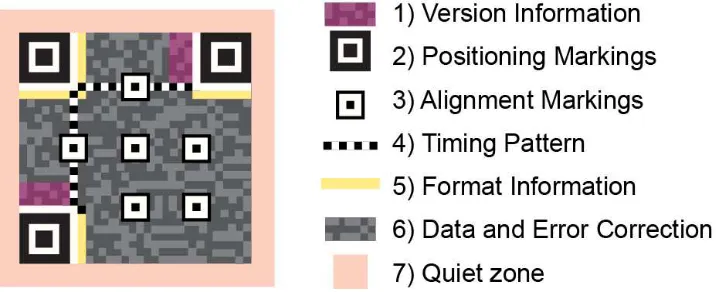
A QR code consists of seven major elements which are shown in Figure 5.
QRCode-Generator.de (n.d.) explains each element of the QR Code structure:
1) Version information demonstrates the datatype, version, and error correction
level of the code.The datatype can be the numerical or the alphanumeric
content. There are 40 versions of the QR Code. Each version indicates the
dimensions and capacities of the code. The largest one is code version 40
which can hold up to 7,089 numerals as mentioned earlier. The error
correction is an element that detects and corrects code errors. It helps the
scanner to read the code, even if some parts of the code are damaged. There
are 4 levels of error correction of which the lever L (Low) is the lowest level.
Seven percent of code words can berestored in level L while 30 percent of
code words can be restored in level H (High) which it is the highest level of
the error correction. However, the capacity decreases in the higher error
[image:25.612.103.461.64.210.2]correction level.
Figure 5. QR Code Elements and its structure. Adapted from What’s A QR Code?,
In QRStuff, n.d., Retrieved September 22, 2016, from http://www.qrstuff.com/
2) Positioning markings signify the direction in which the code is printed.
3) Alignment markings are additional elements for a large scale QR code. They
are used to indicate the code’s orientation.
4) The timing pattern is an indicator for the scanner to specify the size of the data
matrix.
5) Format information helps the code to be more easily scanned. It contains
information about the error tolerance and the data mask pattern.
6) Data and error correction keys hold all the data.
7) The quiet zoneis a barrier to separate the code from its surroundings.
QR Code Printed Size. The website QRStuff (2011) explains that the published
size of the code depends on an appropriate scanning environment factor such as distance
and brightness. Also, the data density is a factor. The greater density of datamakes the
code presented in a smaller pixel size. This means that it requires a more precisescanning
environment to read the code.QRCode-Generator.de (n.d.) supports that a sufficient
simple code size is 20x20 millimeters for a small format publishing, for example, the
code in a magazine, or the code on a package.
QR Codes are available in various types. Each type provides different functions.
Denso Wave Incorporated (n.d.) describes QR Code in five types:
1) QR Code Model 1 and Model 2are the original types of the QR Code. The
numerals. Then, the Model 2 is an enhancement of the Model 1. It can store
up to 7,089 numerals in its version 40.
2) The Micro QR Code is a small size QR Code which allows it to be printed in a
small space. It can store only 35 numerals as the maximum amount of data.
3) TheiQR Code is a type that can be produced in either square modules or
rectangular modules. The maximum capacity of this type is about 40,000
numerals.
4) The SQRC is a code that requires a specific reading instrument. It is generally
used to keep private information. The SQRC has the same appearance as the
regular QR Code.
5) The Frame QR is a QR Code that provides a flexible area to be used in the
center of the code. For example, a brand can insert its logo to present its
identity in the middle of the code, and it is still readable.
The QR Code has been developed and improved in its capability to generate a
connection between offline and online media (Bosomworth, 2011).The QR Code is used
in several applications, such as magazine, poster, mail, packaging, website, email, and
television applications. In addition, it is used for many marketing campaigns.
Pasco (2016) has evaluated the effectiveness of QR code labels that directly
deliver detailed information through free applications for smart devices. Although the QR
Code provides real-time data tracking, scanning requires downloading an application
Augmented reality (AR). Augmented Reality was created in 1968 by Ivan
Sutherland. Carmigniani & Furht (2011) described Augmented Reality as a technology
that integrates virtual and computer-generated digital content. Augmented reality causes
virtual reality to interact with the physical environment. Carmigniani & Furht (2011)
mentioned in the Handbook of Augmented Reality that augmented reality can be used to
enhanceuser’s perception of and interaction with the real environment.
QR code scanning and Augmented Reality technology are two types of interactive
packaging that do not require any special printing techniques. Radio-Frequency
Identification (RFID) and Near Field Communication (NFC) are two other types of
interactive technologies that are used in packaging. However, Schiffner (2011) explains
that the layer of RFID printing contains an antenna and microchip, and its production
requires a particular type of thermal transfer digital printing.Similarly, NFC technology
needs microchips to store data in order to transfer the information to another NFC device.
RFID and NFC technology arefurther described below.
Radio-Frequency Identification (RFID). RFID is explained in the book
Emerging Food Packaging Technology (Yam and Lee, 2012) as the use of radio
frequencies to read information electronically. The book also clarifies that the RFID tag
is classified into two types. The first type is the passive tag whose power is provided by
the energy of the reader; and the second type is the active tag that has its own battery to
transmit signals to the reader.
The book Food and Package Engineering (Morris, 2011) presents the advantages
amounts of memory. RFID in packaging is also used to track the product in its supply
chain by monitoring the products in logistics, or checking its inventories. Since the RFID
system can be traced from a distance, itis also used to prevent counterfeiting and theft.
The tag maximum reading distance depends on several factors such as the individual
RFID reader and the signal power, the integrated circuit in the tag, the material of the tag,
and the material to which the tag is attached. The low frequency (LF) passive RFID tags
can be read in a foot or less, while the super high frequency active tags can be read up to
the range of 325 feet.
Near Field Communication (NFC). McHugh and Yarmey (2014) introduce NFC
in the book Near Field Communication: Recent Developments and Library Implications
as a type of a radio frequency technologythat transmits information wirelessly between
objects, tags, posters, mobile devices, or computers across a small distance. The
theoretical working distance of the NFC is about 20 centimeters.
Nagashree, Vibha, and Aswini (2014) support that NFC functions similar to RFID
tags because it is a non-contact identification and an interconnection. Presently, the use of
NFC enables the popular contactless payment through a mobile phone. It is secure and
convenient. For example, an integration of a credit card and mobile phone and a usage
over NFC generate a purchase through a wireless sensor network. Nevertheless, NFC
technology is in a novel stage of development because it remains challenging to enhance
its compatibility in devices. Moreover, the cost of adopting NFC technology is quite
In conclusion, technology and innovation have enabled packaging to become
more communicative. The point of sale is the last chance for brands to advertise their
products. Packaging then acts as a silent salesperson to present the product to consumers,
and it does have an impact on the consumer’s purchasing decision. Currently, interactive
media involved in the packaging industry enhances the ability of packaging to provide
interactive experiences, and to allow customers to acquire more information. Interactive
activities on packaging are now available. The objective of this research was to
investigate Millennial consumers’ perspectives and preferences concerning interactive
packaging. The significance and potential contribution of this research were to better
understand the views and responses of Millennials in relation to the interactive activities
Chapter 4
Research Objectives
Interactive features can provide extended content to printed packaging for
consumer goods. This research aimed to answer these research questions:
1. For a population of 18 through 24year-old consumers, what are the factors
limiting their use of interactive packaging features?
2. For the same population, what specific interactive content, both function and
form, is considered the most valuable in packaging?
3. For the same population, what is the correlation between the desired specific
Chapter 5
Methodology
This research proposes to examine the consumers’ perspective on the interactive
activities on food packaging. The term, interactive packaging, refers to the ability of
consumers to interact with the packaging through their smartphones or any smart device.
Sample
The sample of the study was chosen by the purposive sampling selective method.
All participants were young Millennial students in college. Both male and female persons
between 18 and 24 years old (includes 18 and 24 years old) were selected. In order to
evaluate the respondents’ perspectives on the interactive functions of packaging;
respondents must be smartphone users.
Procedure
The data about consumers’ perception of interactive packaging and the activities
related to it was accumulated from a survey. The first part of the survey contained
questions that asked for information about the participants’ behaviors concerning two
topics. The first topic related to their smartphone usage, and the second topic related to
the factors affecting their purchasing decisions about food products.
The second part of the survey focused on the consumers’ perceptions of
interactive activities. QR codes and Augmented Reality were variables for this research.
Participants without any awareness of interactive features and participants without any
introduced to the interactive packaging functions through a video in order to enable them
to better understand interactive packaging features.
The last part of the survey asked for respondents’ opinions and expectations about
interactive features in terms of the content, both function and form, and their preferred
method of access. In this part of the study, coffee and tea were used as example products.
The report Coffee Houses and Tea Shops in US by Mintel (2015) provided that
Millennials comprised a large group of coffee and tea consumers. Even though the young
Millennials group was not a premium consumer of coffee and tea as the group of adult
Millennials was, they were beginners that were trying to explore different kinds and
different flavors of coffee. Therefore, the researcher determined that coffee and tea could
be example products for the study.
Key Variables
This research was conducted in order to observe following variables:
1. The Independent variables were the interactive features on packaging, the QR
Codes and Augmented Reality;
2. The Dependent variables were factors limiting the use of interactive features,
the interactive content on packaging, the interactive form of the interactive
Table 1
Independent and Dependent Variables
Independent Variable Dependent Variables
The interactive features on packaging, the
QR Code and the Augmented Reality.
Factors that limit the use of interactive
features
The kind of interactive content on
packaging
The interactive form of the interactive
content
The reference method of access to the
specific content
Analysis
The data was analyzed by using Descriptive Statistics Analysis. The distribution,
the central tendency, and the dispersion were determined.
The method of analyzes depended on the type of question in the questionnaire.
The questionnaire in this survey included four question types (SurveyMonkey, n.d.).
1)A Multiple Choice Question that asked participants to select one or more
choices from a list of answers. The data from this question type was presented as
percentages for each choice. A pie chart was developed to provide data comparison. The
2)A Matrix Question was similar to the Multiple Choice Questions. The question
allowed participants to select an answer from a same preset list of answer choices. The
data from this type of question was also presented in percentages and charts to compare
the results. The distribution, the central tendency, and the dispersion were determined for
each answer choice.
3)A Rating Scale Question or a Likert Scale Question was a question that
assigned weights to each answer. The weighted averaged was calculated for each answer
choice in the analysis. Also, the distribution, the central tendency, and the dispersion
were determined.
x1w1+x2w2+x3w3+…+xnwn
Total
x = response count for answer choice
w = weight of answer choice
4)A Ranking Question was a question that asked participant to compare items by
ranking them in order. The first choice had a weight of the total number of answer
choices (i.e. the question has four answers to be ranked, the first choice will have a
weight of four) and the last choice had a weight of one. An average raking was calculated
for each answer choice. Also, the distribution, the central tendency, and the dispersion
were determined.
x1w1+x2w2+x3w3+…+xnwn Total
x = response count for answer choice
Chapter 6
Results
The methodology described in Chapter 5 was implemented by the researcher over
a two-month period between February and March 2017. The data for the research were
gathered from an online survey. The result and details are described below in the
chronological order of the survey.
- Sample demographic;
- Participants’ smartphone using behavior;
- Factors and information participant consider when selecting a food product;
- Interactive Features (QR Codes and Augmented Reality) awareness,
experience, and perspective;
- Questions with regard to respondents’ beverage purchase which coffee and tea
are example products for this study;
o Specific content participants consider the most valuable;
o Format of interactive content participants prefer to see for each
specific content type;
o Preferred method for accessing each specific content type.
Sample Demographic
The respondents of the survey were RIT Students. A total of 80 surveys were
were 46 males (57.5%) and 34 females (42.5%). Respondents were from different
colleges as shown in Figure 6.
Smartphone Usage and Behavior
From the survey, data showed that respondents spend an average time of 6 hours
on their smartphones. The maximum amount was 14 hours, and the minimum was 1 hour.
The range of the data was 13 hours which is a large number.
25.0%
13.8%
7.5% 16.3%
11.3% 5.0%
6.3% 2.5%
7.5%
5.0%
[image:37.612.123.527.198.419.2]Percentage of Responsents' Background Categorized by College
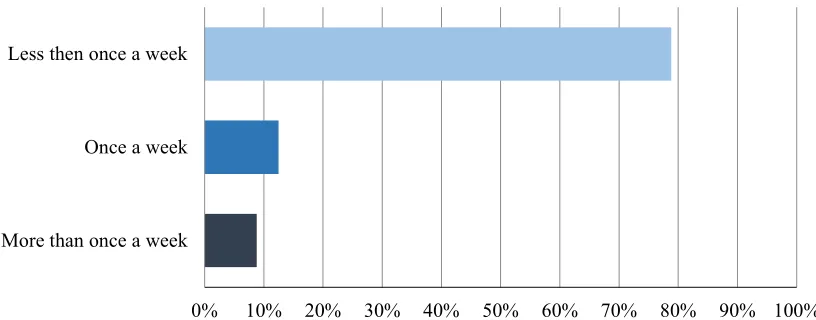
There were 63 responses (78.75%) who download a new application on their
smartphone less than once a week, and 10 responses (12.5%) download once a week, and
only 7 responses (8.75%) download an application more than once a week. The data is
shown in Figure 7.
This data showed that students spend significant time on their smartphone;
however, they rarely download a new application.
Factors and Information Participants Consider When Selecting a Food Product
The research also investigated factors that customers consider when purchasing a
food product. The questionnaire asked respondents to rank important factors they might
consider when making a purchase.
0% 10% 20% 30% 40% 50% 60% 70% 80% 90% 100%
More than once a week Once a week Less then once a week
[image:38.612.109.517.135.295.2]Frequency of Downloading a New Application onto Smartphone
Figure 7. The Data from the Survey Question “On Average, How Often Do You
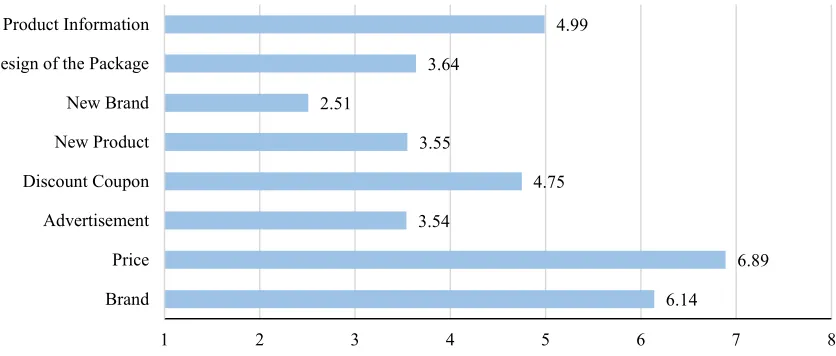
The data from the survey shows in Figure 8 that the respondents considered price
the most important factor when selecting a food product. As shown by the weighted
average of 6.89, brand was the second factor. However, a new brand was the least
considered factor. Furthermore, some respondents also provided additional suggestions as
possible for this choices for this question: Product review, major food allergens, and
expiration date were also mentioned as the factors they considered.
The questionnaire also asked for specific product label information customers
considered when selecting a food product. The list of the labeling requirements from A
Food Labeling Guide by the Food and Drug Administration (2013) were used in the
ranking question.
6.14
6.89 3.54
4.75 3.55
2.51
3.64
4.99
1 2 3 4 5 6 7 8
Brand Price Advertisement Discount Coupon New Product New Brand Design of the Package Product Information
[image:39.612.116.534.126.304.2]Factors Respondents Consider When Selecting a Food Product
Figure 8. The Data from The Survey Ranking Question “Factors You Consider When
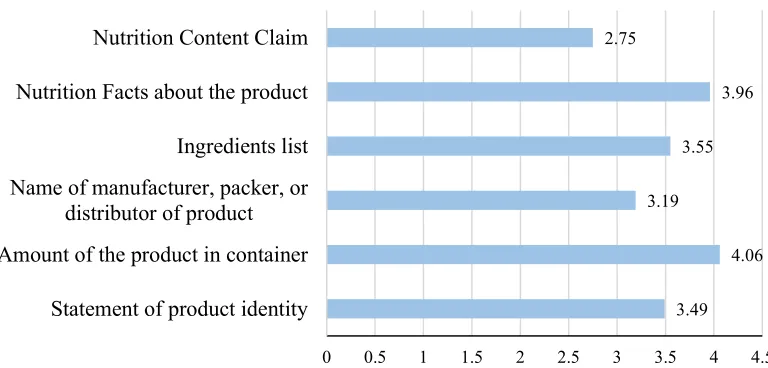
The graph in Figure 9 presents the weighted average of the respondents to each
type of label information. Amount of the product in container and Nutrition facts about
the product receiveda similar weighted average. The amount of the product in the
container was a most considered factor which received a weighted average of 4.06.
Nutrition Facts about the product received 3.96. The nutrition content claim received the
weighted average of only 2.75 which means that this information was considered the
least. Expiration date information and product review were also mentioned by
respondents as additional comments with this question.
3.49 4.06 3.19
3.55 3.96 2.75
0 0.5 1 1.5 2 2.5 3 3.5 4 4.5
Statement of product identity Amount of the product in container Name of manufacturer, packer, or
distributor of product Ingredients list Nutrition Facts about the product Nutrition Content Claim
[image:40.612.152.536.130.314.2]Product Label Information Respondents Consider when Selecting a Food Product
Figure 9. The Data from The Survey Ranking Question “Product Label Information
Interactive Features Awareness, Experience, and Their Opinion to the Features
The questionnaire asked participants about their awareness and experience in
using interactive features. This study, focused primarily on QR Codes and Augmented
Reality.
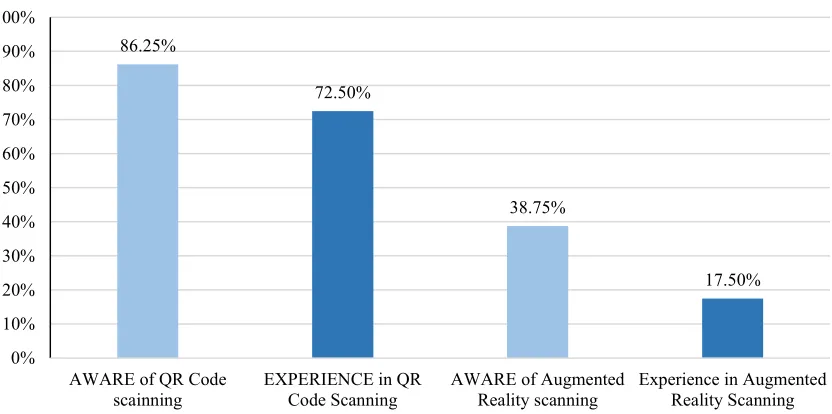
The data presented in Figure 10 shows that 86.25% of respondents (69 people)
were aware of the use of QR Code scanning; however, there was only 38.75% (31
people) of respondents who were aware of the use of Augmented Reality scanning.
Moreover, the results of the survey showed that 72.50% of respondents were experienced
in using QR Codes, and only 17.5% of respondents had used augmented reality scanning.
86.25%
72.50%
38.75%
17.50%
0% 10% 20% 30% 40% 50% 60% 70% 80% 90% 100%
AWARE of QR Code scainning
EXPERIENCE in QR Code Scanning
AWARE of Augmented Reality scanning
Experience in Augmented Reality Scanning
[image:41.612.118.534.237.444.2]Respondents' Awareness and Experience with Interactive Feature: QR Codes and Augmented Reality
Figure 10. The Data from The Survey Question “Are You Aware of The Use of QR
Code Scanning?”, “Are You Aware of The Use of Augmented Reality Scanning?”, and
The factors limiting the use of interactive features were the next item of inquiry.
A Likert Scale question was used. Participants chose the reason they were unaware of the
benefit from scanning the interactive feature as the most prominent reason for their
limited use. The weighted average was 3.44. However, other factors received only a
slightly less rating average.
Figure 11 presentsthe weighted average for each factor that might limit the
respondents’ use of interactive features. If they were arranged by weighted average from
the highest to the lowest score the order would be; 1) Unaware of benefit from scanning
the interactive feature, 2) The content provided by the code is not of sufficient interest, 3)
3.18 3.32 3.15 2.73
3.44 3.36
0 1 2 3 4 5 6
Do not have any scanning application on the phone
Do not want to download any scanning application on the phone
Scanning take too much time Sufficient WIFI/DATA are available for downloading the scanning application Unaware of benefit from scanning the interactive
feature
The content provided by the code is not sufficient interest
[image:42.612.111.535.293.497.2]Factors Limiting the Use of Interactive Features
Figure 11. The Data from The Survey Question “What Factors Limit Your Use of
Do not want to download any scanning application on the phone, 4) Do not have any
scanning application on the phone, 5) Scanning takes too much time, and 6) Sufficient
[image:43.612.108.528.288.472.2]WIFI/DATA are not available for downloading the scanning application.
Table 2
Factors That Can Increase the Use of Interactive Features Total of 78 Responses
(QR Codes and Augmented Reality)
Answer Options Strongly
Disagree Disagree Neutral Agree
Strongly Agree
Rating Average
Having a
universal scanning application for all codes
2 1 11 29 35 4.21
Packaging clearly states the benefit of scanning the code
2 1 10 40 25 4.09
The questionnaireasked for the factors that could increase the respondents’ use of
interactive features. The researcher provided two choices for participants to rate by using
a Likert Scale. The data shows in Table 2 that 35 participants answered strongly agree for
the factor “Having a universal scanning application for all codes.” This factor received
the rating average of 4.21. Moreover, the additional comments from participants also
supported that they preferred that the manufacturer notify consumers about the benefit of
Participants also agreed that if there was a universal scanning application for all
codes, it could increase the use of interactive features as well. This factor received a
rating average of 4.09. Other than the knowledge of product information that could be
provided by the packaging, the participants also suggested that a reward or a promotional
campaign could increase their interest in using the interactive features as well.
The Result Regarding Participants’ Beverage Purchase
The last part of the survey asked for respondents’ opinions and expectations about
interactive features in terms of the content, both function and form, and their preferred
method of access. In this part of the study, coffee and tea were used as example products.
The questionnaire was separated by the respondents’ beverage purchases: only coffee,
Figure 12 presents the percentages showing participants’ beverage purchasing
choices. The data shows that 32 responses (41%) were more likely to purchase coffee.
There was 33.3% of the respondents or 25 responses purchased more tea, 6.4% or 5
respondents purchased both coffee and tea in a similar frequency, and 19.2% or 15
respondents did not purchase any coffee or tea. The group of respondents who did not
purchase coffee and tea were not eligible to participate in the remaining survey questions. Coffee, 41.0%
Tea, 33.3%
Coffee & Tea, 6.4% Neither, 19.2%
[image:45.612.180.467.129.317.2]Percentage of Respondents’ Beverage Purchasing
Figure 12. Percentage of Respondents Beverages Purchasing: Only Coffee, Only Tea,
Table 3
The Interactive Content Respondents Considered the Most Valuable when Making a
Coffee or Tea Purchase
Order Coffee Tea Coffee & Tea
1 Basic information
about the product
Basic information about the product
Basic information about the product
2 Instructions Product Reviews Instructions
3 Product Reviews Coupons and
Promotions
Product Reviews
4 Coupons and
Promotions
Instructions Alternative Recipes
5 Alternative Recipes Alternative Recipes Coupons and
Promotions
The questionnaire asked for the content respondents considered important when
making a purchase of coffee, tea, or both. Table 3 indicates the content respondents
considered when they purchasedtheir beverage of choice. The content topics in Table 3
are arranged by order; number one means the most important content consumers
considered. And the number five means the least important content they considered.
Basic information about the product was selected as the most important content
Figure 13 presents the weighted average for the ranking question about the
specific content respondents considered the most valuable when making a purchase. In
the questionnaire, respondents were asked the question regarding their coffee or tea
purchasing; however, the researcher compiled and calculated the overall weighted
average for each content type without separating them by their beverage preferences.
The data revealed that basic information about the product was the most important
content that participants considered when purchasing. It received the highest weighted
average. Then product review was considered; it was the next important information after
the basic information about the product. The alternative recipes (Instructions and 3.79 2.90
2.40 2.80
3.09
0.00 1.00 2.00 3.00 4.00
Basic information about the product (e.g. nutrition information, calories, caffeine
amount, etc.)
Instructions (i.e. methods to brew the coffee.) Alternative recipes (instructions and alternative ways to prepare the drink)
Coupons and Promotions Product reviews
[image:47.612.123.524.141.340.2]The Interactive Content Respondents Considered the Most Valuable When Making a Purchase
Figure 13. Weighted Average of The Survey Question “What Specific Interactive
Content Would You Consider the Most Valuable When You Make a Beverage
alternative ways to prepare the drink) was considered the least important.
Table 4
Respondents’ Preference for Interactive Content Format in Each Specific Content Type
Coffee Tea Coffee & Tea
Basic information about the product
Short Paragraph Short Paragraph Text with graphic
Elements
Instructions Text with graphic
Elements
Short Paragraph Text with graphic
Elements Video Clip
Alternative recipes Video Clip Short Paragraph Text with graphic
Elements
Coupons and Promotions
Text with graphic Elements
Text with graphic Elements
Short Paragraph
Product reviews Short Paragraph Short Paragraph Short Paragraph
Table 4 provides the content formats participants preferred for each content type
if the content is presented through the interactive features. The questionnaire provided
seven choices which are 1) short paragraph (only text without any graphic element), 2)
long paragraph with full explanation, 3) text with graphic elements, 4) video clip, 5)
Figure 14 presents the overall percentages of the interactive content format
participants preferred. These data accumulated all responses without separating the
information by participant’s beverage purchase. A short paragraph and text withgraphic
element are the top two popular formats.
33.43% 6.89%
28.52% 11.80%
12.80% 2.30%
4.26%
0% 10% 20% 30% 40% Short Paragraph (only text without any graphic
element)
Long Paragraph with full explanation Text with Graphic Elements Video Clip Graphic Animation Audio 3D objects Visualization
[image:49.612.160.527.139.339.2]Percentages Showing Respondents' Preferences for Interactive Content Format
Figure 14. The Overall Response Percentages for the Survey Question “What Format of
Table 5
Respondents’ Preference Method for Accessing Each Specific Content Type
Coffee Tea Coffee & Tea
Basic information about the product
Phone + Individual scanning
application
Phone + Web browser application
Phone + Individual scanning
application
Instructions Phone + Web
browser application
Phone + Web browser application
Computer + Web browser
application
Alternative recipes Phone + Web
browser application
Phone + Web browser application
Computer + Web browser
application
Coupons and Promotions
Phone + Individual scanning
application
Phone + Web browser application
Phone + Individual scanning
application
Product reviews Phone + Web
browser application Computer + Web browser
application
Phone + Web browser application
Computer + Web browser
application
Table 5 indicates the preferred method for accessing the specific content in each
content type.The data shows that a web browser application on a smartphone is the most
The data revealed that respondents preferred using a web browser application on
their phone to search for product information over using an individual scanning
application on the phone. A tablet was the least selected method for searching for the
product information.
The next chapter will review this data and offer conclusions in reference to the
previously outlined research questions.
33.33%
44.98%
1.62% 2.91%
17.15%
0% 5% 10% 15% 20% 25% 30% 35% 40% 45% 50%
(Phone) Individual Scanning Application
(Phone) Web Browser Application
(Tablet) Individual Scanning Application
(Tablet) Web Browser Application
(Computer) Web Browser Application
[image:51.612.115.527.143.354.2]Percentags Showing Respondents' Preferred Method for Accessing Interactive Content
Figure 15. The Overall Percentages of the Survey Question “What is Your Most
Chapter 7
Summary and Conclusions
The results of the study presented significant information which that can be
analyzed and expanded to answer each of the following the research question.
Research Question 1: For a population of 18 through 24year-old consumers, what
are the factors limiting their use of interactive packaging features?
This question was asked in the survey. The researcher provided five choices for
participants to rate their agreement or disagreement by using a Likert scale from
“strongly agree” to “strongly disagree”. There were 78 responses to this question. The
Likert rating along with additional comments indicated that they were unaware of the
benefit of scanning the interactive feature. Also, the content provided by the code was not
of sufficient interest. Moreover, scanning the interactive feature required them to
download a scanning application which they did not want to do.
The questionnaire also asked for the factors that could increase the use of these
interactive features. There were 35 participants who “strongly agreed” that having a
universal scanning application (not available) would likely decrease their use of
interactive packaging features There were 40 respondents who agreed that the package
Research Question 2: For a population of 18 through 24year-old consumers, what
specific interactive content, both function and form, is considered the most valuable
in packaging?
“Function” in this research question relates to the information type or the
interactive content type consumers consider the most valuable (e.g., Basic Information
about the product, Product reviews, Instruction, Coupons and promotions, and
Alternative recipes). And “form” in this research question refers to the interactive content
format (e.g., short paragraph (only text without any graphic element), long paragraph
with full explanation, text with graphic elements, video Clip, graphic animation, audio,
and 3D object visualization).
This question could be answered differently depending on the type of the product:
this research question is then evaluated with regard to participants’ purchase of coffee, or
tea, or both. Basic information about the product with a highest weighted average of 3.79,
was rated the most valuable information for all three groups of participants. The data
demonstrated a slightly different response for the second answer to the most valuable
content. Coffee consumers and coffee and tea consumers rated instructional information
(i.e. methods to brew the drink) as the second most important package information while
tea consumers rated product reviews as the second most important content. If all
respondent choices are combined, the following list shows their choices in
descending order of importance;
1.) Basic Information about the product,
3.) Instruction,
4.) Coupons and promotions, and
5.) Alternative recipes.
Form or format of the interactive content was observed for each specific
content type. “A short paragraph” and “text with graphic elements” were respectively
frequently chosen responses, both of with seem to be options very easy for respondents to
use.
Research Question 3: For a population of 18 through 24year-old consumers, what is
the correlation between the desired specific interactive content in packaging and the
preferred method of access?
The method of accessing the interactive content was surveyed. The response
indicated that consumers used their smartphone to search for product information when
making a purchase rather than a tablet or a computer. In additional, a web browser
application on their smartphone was a preferred method for accessing information rather
than an individual scanning application. Overall respondents preferred using a web
browser application to search for product content, 44.98%, instead of an individual
Table 6
Correlation Between Methods for Accessing Each Specific Content Type
Content Type Method of Access
Basic Information of the Product Individual Scanning Application
Instructions Web Browser Application
Alternative Recipes Web Browser Application
Coupons and Promotions Web Browser Application
Product Reviews Web Browser Application
Table 6 shows the relationship between the method for accessing each specific
content type. The data from the survey showed that respondents preferred using an
individual scanning application to access the basic information of the product. However,
they preferred using a web browser application to access other content types.
Analysis and Summary of Conclusions
Interactive features can advance packaging’s ability to provide functionality.
These features allow a brand to insert information onto packaging which can be read
through smartphones or other digital devices such as tablets. There are two types of
interactive packaging that do not require special printing techniques to produce them: QR
codes and Augmented Reality. These two interactive features were variables in this
research. The results of the study revealed that young Millennials consumers, 18 through
24 years old, were 100% smartphone users. Among the respondent, 86.25% were aware
38.75% of the respondents knew about Augmented Reality, and 17.50% of them had
experienced the Augmented Reality scanning feature. The QR code was better known
than Augmented Reality. In addition, the main factors limiting the respondents, use of
interactive features were that they were unawareness of the benefits of scanning the
codes, and insufficient interest in content provided by the codes. Also, the respondents
did not want to download the scanning application on their phone.
Besides the required information regulated by the FDA, the content on food
packaging now also includes product reviews that participants considered valuable. The
results of the survey showed that the basic information about the product, such as
nutrition information and calories, was the most valuable content that respondents were
looking for when making a purchase. Product reviews were also considered valuable
content after the basic information.
Interactive features for food packaging can be presented in several formats, for
example, a short paragraph, a long paragraph comprising a fully detailed explanation,
graphic elements, graphic animation, video clip, audio, or a 3D object visualization.
Respondents rated the short paragraph and text with graphic elements as their preferred
formats for interactive content. These formats seem to be very easy to use options. Even
though the interactive features are available for use, respondents still preferred using a
web browser application on their phone to search for additional product information over
Limitation and Future Research
The primary limitation of this study is that the number of participants was
relatively small and thus the findings cannot be generalized to represent all 18-24 years
old consumers. Also, only two products, coffee and tea, were used to represent food
products. The researcher believes that the survey response would be different if the
example products were different.
Another limitation of this study is the format of the online survey itself. The
researcher intended to provide more open-ended type of questions so that participants
could fill in their opinions rather than just rank the answers that were provided by the
researcher. However, the format of questionnaire provided by the software did not allow
participants to enter comments to be included with ranking order questions. Another
limitation of the online survey format occurred in the matrix of dropdown menus. The
question allowed respondents to evaluate several items using the same set of
measurements by choosing from a preset list of answer choices, and again the researcher
would have liked to have been able to ask respondents to add their opinion in the list of
answer choices. That option was not available in the online survey format.
In future research, several issues can be examined which they are
listed below;
1.) The representative sampling frame can be larger. For example, the sample size
can be larger, other age groups can be surveyed, or cultural differences can be
2.) Different products as examples can be used. The example products can be
categorized, for example, by the type of food, the type of packages, or the
instructions about how to use the product itself.
3.) Different survey software might have fewer limitations.
4.) Different methods could be used to approach the research data; for example,
observation, interview, or a focus group study might reveal diverse results.
5.) The study can include NFC and RFID as choices of interactive features.
6.) The data of the study can be broken out by participant’s sex, their smartphone
usage, or their educational background.