This is a repository copy of Transportation of small modular reactor modules: What do the
experts say?.
White Rose Research Online URL for this paper:
http://eprints.whiterose.ac.uk/141867/
Version: Accepted Version
Proceedings Paper:
Mignacca, B, Alawneh, AH and Locatelli, G orcid.org/0000-0001-9986-2249 (2019)
Transportation of small modular reactor modules: What do the experts say? In:
Proceedings of ICONE27. 27th International Conference on Nuclear Engineering
(ICONE27), 19-24 May 2019, Tsukuba, Japan. Japan Society of Mechanical Engineers .
© 2019, Japan Society of Mechanical Engineers. This is an author produced version of a
conference paper published in Proceedings of ICONE27. Uploaded in accordance with the
publisher's self-archiving policy.
[email protected] https://eprints.whiterose.ac.uk/
Reuse
Items deposited in White Rose Research Online are protected by copyright, with all rights reserved unless indicated otherwise. They may be downloaded and/or printed for private study, or other acts as permitted by national copyright laws. The publisher or other rights holders may allow further reproduction and re-use of the full text version. This is indicated by the licence information on the White Rose Research Online record for the item.
Takedown
If you consider content in White Rose Research Online to be in breach of UK law, please notify us by
1
Proceedings of ICONE-27 27th International Conference on Nuclear Engineering May 19-24, 2019, Ibaraki, Japan
ICONE27-1235 (DRAFT)
TRANSPORTATION OF SMALL MODULAR REACTOR MODULES:
WHAT DO THE EXPERTS SAY?
Benito Mignacca
University of Leeds, School of Civil Engineering Leeds, United Kingdom
Ahmad Hasan Alawneh
University of Leeds, School of Civil Engineering Leeds, United Kingdom
Dr Giorgio Locatelli
University of Leeds, School of Civil Engineering Leeds, United Kingdom
Keywords: Small Modular Reactor, Modularization, Transportation, Construction, Factory Fabrication
ABSTRACT
One of the key characteristics of small modular reactors (SMRs), as their name emphasised, is the modularization. Modularization implies factory production, which in turn implies transportation of large, heavy, complex and fragile modules from the factory to the site. Various vendors and organisations are developing several SMR concepts and designs, but there are extremely limited information about the crucial element of modules transportation. Conversely, in other industries (e.g. Oil & Gas), the experience on modules transportation is much greater. This paper provides a structured analysis for the knowledge transfer from the general literature (i.e. other major infrastructure) to the SMR world. Firstly, the paper provides a summary of the literature about transporting large modules. In the second part, the paper presents and discusses the results of a series of interviews with transport industry experts about large modules transportation. The third part provides a summary of the findings and the key takeaways.
1 INTRODUCTION
The International Atomic Energy Agency (IAEA, 2016) defines Small Modular Reactors (SMRs) as “newer generation reactors designed to generate electric power up to 300 MW, whose components and systems can be shop fabricated and then transported as modules to the sites for installation as demand arises”. Several SMR designs, detailed in (Locatelli, et al., 2013; IAEA, 2014, 2016, 2018), are currently at different stages of development. (Ingersoll, 2009) provides a summary of the innovative features of SMRs and describes SMRs as “reactor designs that are deliberately small, i.e. designs that do not scale to large sizes but rather capitalize on their smallness to achieve specific performance
2 manufacturing, modules transportation and installation on-site. However, despite the relatively large amount of literature published on SMRs and despite several concepts and designs being developed by various countries, there are extremely limited information about the crucial element of SMR modules transportation. Therefore, it is necessary to explore modules transportation in closely related fields (e.g. Oil & Gas) and transpose the knowledge back to the SMR sector. As later discussed, modules transportation is strictly related to the country. This paper investigates how SMR modules can be transported in the United Kingdom (UK) and what can be learned from previous experiences. The rest of the paper is structured as follows: section 2 summarises the key references about transporting large modules; section 3 presents the methodology used to collect and analyse data; section 4 shows and discusses the results of interviews with transport industry experts about modules transportation. The last part provides guidelines about SMR modules transportation and the key takeaways.
2 TRANSPORTATION IN MODULAR INFRASTRUCTURES
2.1 Modularization: what it is and its implications Modularization is the process of converting the design and construction of a monolithic plant into a plant that facilitates factory fabrication of modules for shipment and installation in the field as complete assemblies (GIF/EMWG, 2007). Several papers deal with the costs and benefit of modularization (De La Torre, 1994; Azhar, et al., 2012; Bondi, et al., 2016; Upadhyay, et al., 2016). Most of these references are qualitative, like the recent review of modularization in the nuclear industry (Upadhyay, 2016). Factory fabrication is usually cheaper than site fabrication, but the costs associated with shipping of modules to the site must also be considered. Smaller plants can take better advantage of modularization since it is possible to have a greater percentage of factory-made components. Although there are a number of works in the literature describing the qualitative advantages of modularization, only a few of them are able to quantify the underlying advantages. (Mignacca, et al., 2018) provide a summary of the quantitative information about two key implications of modularization in infrastructure: schedule reduction and cost saving. Therefore, modularization implies factory production, which in turn implies transportation of large, complex and fragile modules from the factory to the site. According to (Vegel, et al., 2017), SMRs will be in the factory for the first two years (build time and testing), and in the last year will be transported and installed on site. However, the literature about SMR modules transportation is almost inexistent. Conversely, in other sectors (e.g. Oil & Gas), the experience on modules transportation is much greater.
2.2 Transporting large and heavy modules
This section summarises the key concepts about transporting large and heavy modules. According to (De La Colina, et al., 2016), heavy lift impacted successfully on the construction industry, opening the doors to new construction alternatives, methods, and strategies. Modularization is one of them. However, modularization presents significant logistical
challenges (Mammoet, 2018b). Once prefabricated modules are ready, they must be lifted, transported, and installed in the right sequence (Mammoet, 2018b). Modules transportation is recognised as one of the main disadvantages of modularization. According to (Musa, et al., 2016), modularization can reduce the labour and material cost, but can increase the transportation cost. One of the reason is the additional material needed for proper transportation and the structural requirements of the modules (De La Torre, 1994; Choi, et al., 2014). (De La Torre, 1994) also includes modules loss and modules transport damage in the main risks of modularization, and points out how the interdependence of planning, design, fabrication, transportation, handling, and erection determines more planning and communication than the stick-built method. Furthermore, (De La Colina, 2016) states that modules are usually fabricated in different locations respect to their final position. These locations are usually specialised yards away from the site and sometimes even different countries, determining the increase of the transportation cost and making logistics even more complex. Furthermore, modules and equipment have grown in size and complexity, causing new challenges for the transport industry, requiring custom-made techniques depending on the load and dimensions of the module (Mammoet, 2018b). However, (Wrigley, et al., 2018) point out as the recent technology development such as driverless electric transport might reduce the transportation cost. Currently, there is a large range of heavy transport equipment used in the industry, ranging from conventional trailers and barges to skidding system and Self-Propelled Modular Transporters (SPMTs). As common in the transportation industry, the main heavy transport and lifting techniques are here categorized by road, barge, and rail transport methods.
2.2.1 Road transport
3 2.2.2 Barge transport
“The river transport is another important activity […] especially with the size of the items getting bigger and bigger and the new infrastructures do not always supply for these large items to be transported by convoy” (Fagioli, 2018a). More in general transportation by barge is usually used when module dimensions don’t allow using land transport method. This transport method provides an alternative both when the roads are extremely busy and to avoid restrictions such as bridges. The module is usually loaded onto the barge by using a gantry crane. The main advantage of this method is that a standard barge has a capacity 50 times more than a normal trailer, determining a significant cost saving (Fagioli, 2018a). (Devgun, 2013) also states that transport by barge is usually the favoured method for very heavy modules.
2.2.3 Rail transport
Transportation by rail consists of railcars having a carrying capacity ranging from 200 to 1200 tons (Mammoet, 2018a). The heavy-duty railcars have 8-44 axel lines which can be shifted horizontally and vertically allowing the transportation of the over-sized load. (Fagiloli, 2018; Mammoet, 2018a). Rail transport and road transport tend to have a similar cost, but rail transport tends to have lower lead time, frequency, and service flexibility (Larsson, 2009).
2.2.4 Cranes and special equipment
(Devgun, 2013) states that heavy and large modules would require the use of Very High Lift (VHL) cranes, but they are very expensive. Some less expensive alternatives to the VHL cranes are (Fagioli, 2018b; Mammoet, 2018c):
Crawler Cranes: It is a crane that is attached to an undercarriage with a pair of caterpillar’s tracks to provide steadiness and mobility. It is commonly used at power stations and refinery projects and offers lifting capabilities up to 3000 tons and a total lifting height up to 200 meters.
Strand Jack System: It consists of a jack pulling a bundle of wires called strand. It has an upper and bottom clamp which are connected to a hydraulic cylinder that moves up and down. This system has a capacity of 15-750 tons (depending on the number of strands).
Skidding System: This system is used to move extremely heavy loads such as offshore platforms and complete buildings. It is simple and can only be fitted in a straight line which uses a skidding track to allow large loads to be moved with a limited force.
Gantry Lifting System: This system is a combination of 2 or more legs and overhead beam. There are usually four jacking units supported on wheels having one vertical lift cylinder and a vertical lift on top. The legs are hydraulic, which enable the system to lift loads up to 800 tons.
3 RESEARCH METHODOLOGY
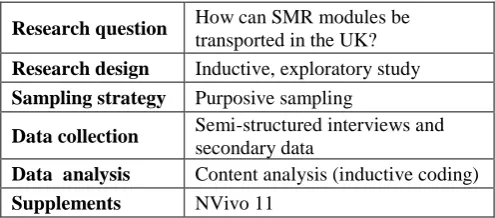
This section is concerned with the methodology used for the study explained above. Table 1 provides a summary of the main research elements of this study.
Research question How can SMR modules be transported in the UK? Research design Inductive, exploratory study
Sampling strategy Purposive sampling
Data collection Semi-structured interviews and secondary data
[image:4.595.306.554.69.178.2]Data analysis Content analysis (inductive coding) Supplements NVivo 11
Table 1: Research methodology - Layout adapted from (Bititci, et al., 2016)
3.1 Research design and method
For this kind of research there are two main research approaches: deductive and inductive (Saunders, et al., 2007). The deductive approach generates hypothesis starting from the existing theory, and then move towards specific observations testing the validity. On the contrary, the inductive does not formulate hypothesis at the beginning of the research but starts from data (Dudovskiy, 2018). In summary, a deductive approach tends to test the theory, while an inductive generates theory. The inductive approach has been selected, in consideration of the research question that aims to explore a phenomenon, identify the patterns and contribute to new generalisations (Saunders, 2011; Bryman, et al., 2015). Furthermore, this research design is categorised as an exploratory study. Secondly, based on (Saunders, et al., 2012), qualitative research works in unity with interviews that consist of open-ended questions. Semi-structured interviews have been selected. This method allows open questions to be flexible in acquiring in-depth knowledge from the experts’ responses (Rubin, et al., 2011).
3.2 Sampling strategy and data collection
4
Table 2: Overview of the experts. TC= Transportation company, HL= Heavy lifting and transportation company, TP= Transportation professional
3.3 Data Analysis
A key point of research is the data analysis, which aims to draw logical conclusions from obtained data (Merriam, 1998). Following the guidelines of (Bailey, 2008), the first step to conduct qualitative data analysis was the transcription, which is the process of converting recorded interviews data into text. Subsequently, following the guidelines of (Hesse-Biber, 2010; Saldaña, 2015), the interview transcripts were formatted in a common layout, and thoroughly read and understood to identify themes and specific sections of information related to the research question. NVivo 11, a Computer-assisted Qualitative Data Analysis Software, was employed to facilitate and speed up the analysis of data. The data was then coded to organise the collected data, assessing which category they would be relevant to. The main purpose of this research is to investigate the pre-conditions, enabling factors, and barriers to transporting SMR modules. Therefore, they were the three main categories. Based on data collected, an additional category called “transportation method” was created to explain which transportation method was preferred based on the background of the experts. Figure 1 and Figure 2
show the main categories with their coded subcategories and codes.
4 FINDINGS AND DISCUSSION
This section summarises the findings and discusses the results of the interviews.
4.1 Pre-conditions
• Evidence from the experts’ interviews
Experts acknowledged the heavy bureaucratic process including several permits and procedures that must be prepared before transport. TC3 stated: “First of all we try to get all approvals from the consultant in the factory before we start shifting the module as this avoids any rejection or correction which might lead us to return the module back to the factory. Then you should make sure that the site is ready to receive the module. And all authorities permits.” Regarding the licenses TC2 stated: “I have a special licence for that, and
that’s called a stig, S-T-I-G-two. That allows me to transport over sixty-five ton on the road”. Conversely, HL4 stated: “special licence no because since it is very specialised work there is no one which can certify you about your abilities”.
[image:5.595.42.290.57.225.2]Figure 1: Summary of categories, sub-categories and codes (part 1)
Figure 2: Summary of categories, sub-categories and codes (part 2)
Furthermore, TC1 highlighted the role of law and authorities: “I mean like the size of the transported object to be matching with the maximum height allowed to be passing under the existing bridges and the weight of the object to be matching with the maximum axle weight permitted by the road authorities”. Another key aspect about pre-conditions is pointed out by HL2: “The preliminary works that we have to before the bid phase is going to see all the path the module have to do in the future”.
• Discussion
Experts highlighted that several relevant permits and procedures must be prepared before transport, respecting local regulations (e.g. load, size, delivery time, storage area). The common documents mentioned are: method statements, risk assessments, permits, drawings, communication plan, and Date
(2018)
Duration
(minutes) Position
Experience (years) TC1 04/04 15 Engineering Manager 10-15
HL1 12/04 60 Site Operations
Manager 5-10
TC2 13/04 30 Transport Manager 30+ HL2 18/04 50 Project Engineer 5-10 TC3 01/05 20 Transport Manager 10-15
TC4 04/05 30 Director 30+
HL3 11/06 50 Project Engineer 5-10 TP 22/06 email Consultant 10-15
HL4 21/07 40 Project Operations
[image:5.595.317.542.327.571.2]5 contingency plan. (ESTA, 2009) also highlights that these documents should be accepted by all parties involved, as they state the method, risks, mitigating actions, and liability of each task. Regarding the licence, experts pointed out the need of a licence (STIG 2) to transport heavy loads (>65 tons) on the road. However, there is a controversial statement about this point. A key point highlighted is that every transport requires a preliminary route survey to be conducted and documented. The transported SMR modules would require the route conditions to be checked and assessed to whether public infrastructure such as roads, bridges, etc. can be used. The route survey would also be used to assess whether any obstructions will be in the way of the transporter or load. Examples of these obstructions could be trees, power lines, pipelines, etc. Furthermore, other route settings such as slopes, ground surface, maximum ground bearing pressure, and permitted axle load would need to be analysed to ensure the module can be transported appropriately. An internal document also states that work preparations such as ground reinforcement would be the responsibility of the client or the operating company depending on the contractual agreement between the stakeholders. Furthermore, heavy and/or large modules are usually required to satisfy special requirements. For example, the transported module must match the maximum eight allowed under a bridge, and the weight must match the maximum axle weight. Prior the transport, the authorities will also need to approve any solutions for constraints such as building a new path or disconnecting overhead electricity. It is also stated that the usual working hours permitted are early morning or late night and that the authority is a key factor to start the transport process. Furthermore, internal documents supplied by the experts point out the importance of communication and contingency plan which tackle unanticipated events, describe the responsibilities of various stakeholders involved, and the communication method agreed.
4.2 Enabling factors
• Evidence from the experts’ interviews
A critical enabling factor identified is the communication. TC2 highlighted a type of communication: “The driver especially needs to know what he is doing, he will probably also be on a walkie-talkie. Ok, so normally we have got walkie-talkies so we always make sure that everybody is communicating with everybody. It does not matter how small it is, whether not there is a small problem to a large problem. Everybody needs to know communication”. TC4 also highlighted the importance of communication, but focusing on another aspect: “communication between the transport company and manufacturer would be very helpful. Like in certain cases they build the module and face many problems due to it being very heavy or for example requiring more expensive lifting methods”. Several equipment were also suggested by the experts. In particular, HL1 stated: “for example I can help you if the path will not be so long. I can suggest to use SPMT, it is a kind of trailer… it is a hydraulic trailer that is driven (sic) by remote control and is very versatile. I mean there is a lot of kind of steering option, it is
very easy to use, and this is used especially in a small area where you do not have so much space to manoeuvre”. Furthermore, HL3 stated: “One thing either for transportation and especially the lifting…the vendor that is designing the equipment he should also involve or he should know how the equipment will be installed so if it will be installed by crane or by strand jack he should know it so he can prepare a lifting point or whatever the way we will transport it”. Another key element to consider is the insurance, as highlighted by HL3: “But when you're transporting a cargo for example from Germany to the Middle East then it should have insurance to transport it there inland transport from the factory to the port also will have another insurance for the sea transportation then another insurance when it reaches the middle east. And at each stage there is one contractor which having insurance for the equipment they transport with”. Furthermore, HL4 pointed how the final location can influence the transportation: “if you go to some bigger big port they have the capabilities to handle. If you go to smaller port they don't have the capabilities”. The quality control is also considered fundamental in this kind of transportation, as highlighted by HL2: “there is a surveyor but there is a team of surveyors around the transport. Because you need to check...ok all the movement”. Furthermore, TC4 pointed out the importance of a proper equipment, stating: “I think safety is an important thing to consider. So use proper equipment”.
• Discussion Communication
The experts presented the importance of communication in ensuring the success of the transportation process. In particular, two types of communication have been pointed out: “Design communication” and “Communication during Transport”. Regarding the first, the transport company should be involved in the design phase, because specific design requirements such as lifting points must be implemented. This might improve the overall cost. The need of involving transport company in design phase is also pointed out by (Naqvi, et al., 2014) in the literature, who states that modules transportation becomes challenging because it is finalized late in a project. Regarding the second, it is an enabling factor that helps reducing errors such as tipping. For instance, the truck driver and convoy vehicle should be in constant contact to be aware if something irregular is happening.
Equipment and design
The experts pointed out the following special equipment and design consideration which would allow SMR modules to be transported and lifted:
6 mechanical steering. SPMTs are also stated to have better manoeuvring than conventional trailers.
Gantry Crane: This equipment is used to lift the module from the SPMT. It can be used in the fabrication yard and on-site and is stated to be cheaper and faster than using a crane due to it requiring less space. It can also be prepared faster than normal lifting cranes and is used to install items at low positions.
Strand Jack: It is a very strong tool used to lift heavy objects. They are sometimes combined with a gantry crane, and is also considered a faster method to install very heavy items than cranes. Usually, this combination is used when the module needs to be installed at a higher height or underground. If strand jacks will be used, the design of the module must have ‘lifting lugs’ to be connected to the strand jacks.
Saddles They are like stools shaped to take the module on the SPMT or trailer. The saddle should be wider than the module and the trailer to make it easier when switching from SPMT to the conventional trailer. The saddles must be designed well to accommodate the module and lashed well to have a good connection between the module, saddle, and the trailer.
Cranes: For small modules which can be transported in containers, it would be cheap to lift them with cranes but would mainly depend on the port cranes lifting capability. Crawler cranes are also mentioned but are considered expensive compared to other lifting solutions.
Overall the experts stated that the transport equipment used would depend on the module’s size, weight, and the location of its final position. It is fundamental for the design of a module to know how it will be lifted and transported, as it will require design requirements such as lifting lugs, span and height requirements, etc.
Insurance
The experts highlighted how the transported module’s insurance is based on the agreement between the client and the transport company. It is usually insured by the manufacturer; however, the insurance company asks for documents from both parties to make sure documents such as the method statement and drawings are signed off and assessed properly prior the transportation. There are also several insurances dependent on the country you are transporting the item in and the transport method selected. Contractors transporting the module would need their own insurance for their equipment such as SPMTs, trucks, etc. However, the experts stated that sometimes the client includes them in their insurance policy. If the item was to be lightly damaged during transport such as a scratch, the client usually fixes it; however, if there are big damages, the insurance party comes in. In summary, the insurance is dependent on the responsibility and risk allocation agreement between the stakeholders involved.
Final location
One of the key enabling factors pointed out is the final location of the modules. Experts stated that if the final location is accessible by river/sea or by rail, then that may be an advantage. However, this is dependent on the availability of equipment and capability of the location. For example, there might be a nearby port to the final location but the available crane there is not strong enough to lift the module and thus would require a special crane leading to a higher cost. The final location also influences the safety measures and quality control required. Furthermore, according to the experts, if the fabrication yard and final location of the modules are in the same country, the transport process is easier and cheaper, since the country’s capability and government requirements would be recognised easily by local transport companies.
Quality control
The experts also showed the importance of the quality control, usually through a visual check before and after the transport. However, it depends on the agreement with the client and their internal requirements. A surveying team may also be assigned to check when the module is being lifted onto a barge or when being transported near bends and obstacles to ensure it does not collide or get damaged. Additionally, qualified personnel are with the transport and keep monitoring that they are on track while regularly updating the risk assessment. One expert mentioned a new technology called ‘Point Cloud’ improving the quality of the pre-surveys and planning of transport, and is usually implemented when the engineering of the transport is very busy. ‘Point Cloud’ is similar to a google car but instead of an image it creates points on a software of the original path and its surroundings such as lamp posts and trees. Nonetheless, another expert mentioned that this method is usually expensive and that the experience of the staff and transport company is more effective.
Health and Safety
The experts stated that transport by rail and barge would be the safest options as interaction with the public is limited. Safety of the transported module must also be prepared. For example, in sea transport, the module must be fastened properly to avoid damage from oscillations. It is also mentioned that when dealing with large and heavy items, safety consideration must be taken for the route to make sure nobody is injured or harmed and not to cause damage to any property. Safety must also be maintained when lifting the item onto a transporter, to a barge, or at the final position.
4.3 Barriers and challenges
• Evidence from the experts’ interviews
7
unit, we couldn’t unload it in the proper place with the
available crane there due to the big distance between our truck and the final location. So we had to wait and change the crane to a bigger size, to cover the big span”. HL4 also stated: “Yes but the problem that in any case you have to deal with the infrastructure actually existing so usually for example in a port the ship to shore crane are designed for a range between twenty to sixty ton”. Furthermore, expert HL1 pointed out two key challenges of modules transportation: “the main challenging (sic) is for sure the load. The load and the size of the module”. Expert HL1 also highlighted this point focusing on possible solution: “This is the main issue yes, that is why in that case as I said, if you have possibility to use barge…the only other option would be barge, otherwise you have to consider to reinforce the road if it is not enough and to reinforce the bridge if they are not strong enough”. Another challenge related to modules transportation is the route, as pointed out by HL3: “mainly the ground preparation like when you have a two thousand ton equipment you need to maintain certain ground preparation and many cases ground not capable to do this so you have to prepare
either…sometimes you have to prepare bridges, sometimes you have to prepare new roads, sometimes you need to level the ground and compact it with some special material”. Another challenge is related to the transport environment, as stated by HL3: “Yes yes for sure the high tide especially when the tide going up then they can make either loadout or load in. If the tide is going low then this will be issue as they start putting equipment inside the barge or taking the equipment out of the barge and the water level going down then the load can tip over”.
• Discussion
Incidents and obstructions
Despite careful planning, unexpected incidents can happen. Based on the experiences of the interviewed sample, one typical incident is the tipping of the module or transporter. It is due to road failure, load capacity, passing over an underground pipe not highlighted in the drawings, mechanical failure due to overloading, etc. When a module is tipped and gets damaged, there would be relevant consequences for the project. If the module gets damaged and cannot be repaired, then a new module needs to be fabricated. This will determine schedule and cost overruns. The lack of adaptability to changes is also mentioned in the literature as one of the main disadvantages of modularization (De La Torre, 1994). According to (Shelley, 1990), it is very important to avoid changes during construction of a modular project because the cost could increase significantly. According to the experts, there have also been incidents where the design of the module was not calculated well and caused issues when transporting/lifting. Sometimes transporting modules over infrastructure such as bridges can cause issues due to its size and weight. Possible solutions mentioned are: building a new bridge specifically for the transport, using an alternative route if available, or for example, if faced with a height constraint sometimes the transport equipment/tires may be slightly adjusted to pass over or under the obstacle.
Module lifting
The experts have identified several barriers regarding module lifting. The main barrier is usually related to sea transport. Several issues are related to the dislocation of the dock and ship as well as the lifting capability of sea/river ports. Some ports may not have the lifting limit required and would require more expensive lifting methods. Another barrier is the availability of cranes and special lifting such as strand jacks. Train terminals and normal seaport usually have lifting capabilities of 20-60 tons, anything larger would require large cranes. The common suggestion for lifting larger SMR modules is a combination of Gantry Crane and Strand Jacks, which are stated to be cheaper and faster than large cranes. Strand jacks would definitely be used as they would allow the SMRs to be vertically installed underground.
Load and dimension
One of the biggest challenges is the load and dimensions of the module being transported. These measurements affect the calculations such as how the load will be spread and determining how many axels are required for the SPMT/conventional trailer. The number of axel lines is determined from the ground pressure caused by the module, the trailer, saddles, and all equipment used to transport it on the road. For road transport, the load capacity is usually 10 ton/sq., and anything higher would require reinforcing the road and infrastructure such as bridges, determining a big cost impact and causing serious delays.
Route
According to the experts, the route has always to be planned before transport. If the route encounters problems such as holes or weak soil, then the ground would need to be reinforced. Additionally, experts who worked on projects in Europe, Asia, and the Middle East state that temporary roads or bridges made with steel stools may need to be built to overcome route barriers. However, one expert states that in the UK it is not a common solution. Often with heavy loads, if the load does not match the ground bearing capacity of a certain road, then an alternative route or transport method would be made. An example of a normal route was 244 kilometres covered in 45 days. An example of a challenging route was around 1300 kilometres covered in 10 months.
Environment
Another challenging aspect which often causes delay is the weather condition. Weather conditions such as fog and snow cause a lot of delays and losses. Additionally, if sea transport is used, rough sea conditions may damage the module through internal and external vibrations.
4.4 Transport method
• Evidence from the experts’ interviews
Regarding the best modules transportation method in the UK, TC4 stated: “But I think best is barge then rail if possible since the UK has the facilities”. On the other hand, other experts stated that rail transport is the quickest one, as TC2: “The
8 for short distance I believe it will be the best to do it either with conventional or SPMT we can consider it the same. Conventional or SPMT this is for short distance”.
• Discussion
The majority of the experts thought that barge would be the best transport method for SMR modules in the UK. It is common in Europe and is considered safer and faster than other methods. However, some experts stated that it is a riskier method especially if the module’s design is weak externally and internally. It is usually considered an option when the module’s weight or dimensions do not match the road capability. It is also faster than road transport but is restricted to the availability of sea or river. On the other hand, some experts stated that rail transport would be the quickest method and the least vulnerable to have an accident. However, this would depend if the final site is near/will use the normal rail routes available in the UK. Empirical findings highlighted how the most common method currently used is road transport. It might not be the fastest or safest, but it is found to be the most flexible. For short distances (10-15 kilometres) SPMTs and conventional trailers would be a preferred transport method. Nevertheless, there are instances where they have been used to transport modules up to 900 km. The main issues related to this transport method is that it is slow and dependent on road capability.
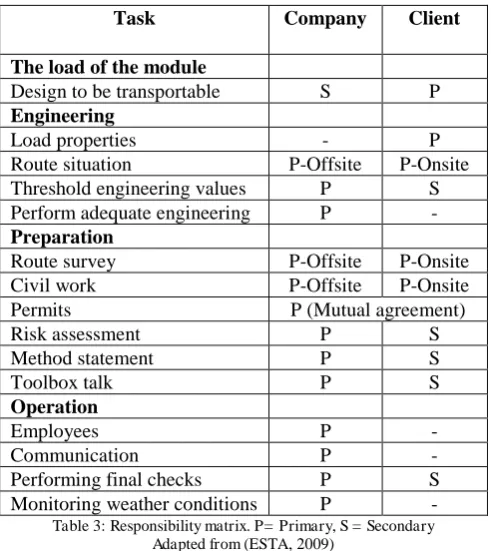
5 Key takeaways for SMR modules transportation Modules transportation is a very complex process requiring the consideration of several factors and (after the module has been fabricated) the participation of two main stakeholders: transportation company and client. One key takeaway from previous experiences of modules transportation is the division of the responsibilities between the transportation company and client. Table 3, developed from a document supplied by one of the experts, provides the division of responsibilities adopted by several transport companies. The SMR sector needs to familiarise with the division of the responsibilities during the SMR modules transportation process. Table 3 also mentions most of the main categories and subcategories come out from the analysis of primary data. In particular, a key result of the research reveals the importance of communication both during the design phase and during the transportation process. Transportation companies should be involved in the design phase, providing cost analysis of different transport options. Furthermore, the involvement of transportation companies in the design phase would allow avoiding the possible incompatibility of module designs with transport method and local regulation. Considering this aspect might be a key advantages for the SMR sector. In particular, it might allow knowing route and site restrictions before the arrival of the heavy/oversized SMR modules to the final location, avoiding any related project delays. Furthermore, it would allow obtaining earlier permits from local authorities if needed, and SMR designs would be developed according to the transport and lifting requirements.
Task Company Client
The load of the module
Design to be transportable S P
Engineering
Load properties - P
Route situation P-Offsite P-Onsite
Threshold engineering values P S Perform adequate engineering P - Preparation
Route survey P-Offsite P-Onsite
Civil work P-Offsite P-Onsite
Permits P (Mutual agreement)
Risk assessment P S
Method statement P S
Toolbox talk P S
Operation
Employees P -
Communication P -
Performing final checks P S
[image:9.595.308.554.56.332.2]Monitoring weather conditions P -
Table 3: Responsibility matrix. P= Primary, S = Secondary Adapted from (ESTA, 2009)
It is also recommended a preliminary route survey before transport. The transported SMR modules would require the route conditions to be checked and assessed to whether public infrastructure such as roads, bridges, etc. can be used. Furthermore, the following special equipment should allow SMR modules to be transported and lifted: SPMT, Gantry Crane, Strand Jack, Saddles, and Cranes. However, the use of one rather than another one depends on module characteristics. The SMR sector needs to familiarise with these practices. Regarding the best transport method for SMR modules in the UK, there are controversial opinions from the experts. There are several factors to consider such as availability of infrastructure, weight and height of the module, safety and speed of the transport method. However, the choice is strictly dependent on the SMR modules final location. A “condicio sine qua non” pointed out by the experts is the attaining of the necessary documentation such as contracts, permits, and licences (in particular the STIG-2 licence to transport more than 65 tons). The SMR sector needs to be aware of the needed licences, contracts and permits to transport SMR modules in the UK. In particular, SMR should be developed considering the UK transport limitations reported in Table 4.
Category Weight Length Width Height Normal 44 tons 18.65 m 2.9 m 4.9 m Abnormal 150 tons 30 m 6.1 m 4.9 m Special >150 tons >30 m >6.1 m 4.9 m
Table 4: UK transport limitations
Data from (Driver & Vehicle, et al., 2018; Harrison, 2018)
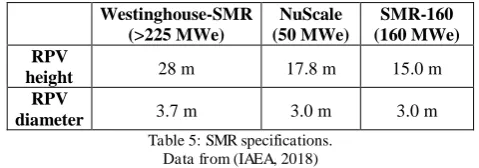
[image:9.595.308.554.636.690.2]9 three SMRs in Table 5, there are no information about weight specifications, except for the NuScale SMR. (NuScale, 2018) reports the following information about SMR weight “~700 tons in total are shipped from the factory in three segments”.
Westinghouse-SMR (>225 MWe)
NuScale (50 MWe)
SMR-160 (160 MWe) RPV
height 28 m 17.8 m 15.0 m
RPV
[image:10.595.45.285.115.199.2]diameter 3.7 m 3.0 m 3.0 m
Table 5: SMR specifications. Data from (IAEA, 2018)
Furthermore, other main factors to consider are: transported module’s insurance (based on the agreement between transportation company and client, but usually insured by the manufacturer), quality control (usually through a visual check before and after the transport, but it depends on the agreement between transportation company and client), weather conditions (often cause of delays and losses, they have to be kept under control).
6 CONCLUSION
“SMR” differ from “small reactors” of just one word: “modular”. Modular refers to modularization. Modularization is a construction technique which implies factory manufacturing. Indeed, SMR components and system are designed to be “factory manufactured” and “transported” to the site as modules. However, despite the relatively large amount of literature published on SMRs, there are extremely limited information about SMR modules transportation. This paper address the gap in knowledge analysing modules transportation in other sectors. It summarises, through a literature review analysis, the main heavy transport and lifting techniques: road transport, barge transport, and rail transport. It also provides a summary of the main cranes and special equipment used to transport and to lift heavy and large modules. Furthermore, this paper summarises and discusses the results of a series of interviews with transport industry experts about transporting large modules. Therefore, this paper aims to summarise the main aspects of modules transportation, in order to allow the SMR sector to avoid mistakes learning from previous experiences. The results of the literature review analysis and the interviews suggest that modules transportation is a very complex process requiring the consideration of several factors. Communication is a relevant factor both in the design stage and during the modules transportation. A right communication and the engagement of transportation companies in the design stage would allow the reduction of cost and schedule overruns. Furthermore, the choice of the “best transport method” for SMR modules is strictly dependent on the final location of SMR modules. There, the complex project of module transportation and the evaluation of several factors (insurance, special equipment, licences, quality control, possible incidents and obstructions, environment, etc.) start after the definition of the final location of the SMR modules. However, SMR sector can learn about modules transportation from the experience accumulated over the years in other sectors.
ACKNOWLEDGEMENTS
This research is partially supported by Major Project Association (MPA). The authors are immensely grateful to the MPA members for their support. The opinions in this paper represent only the point of view of the authors, and only the authors are responsible for any omission or mistake. This paper should not be taken to represent in any way the point of view of MPA or any other organisation involved.
7 REFERENCES
Azhar, S. et al. (2012) ‘Modular v. Stick-Built Construction: Identification of Critical Decision-Making Factors’, in 48th ASC Annual International Conference Proceedings.
Bailey, J. (2008) ‘First steps in qualitative data analysis: transcribing.’, Family Practice, 25(2), pp. 127–131.
Bititci, U. et al. (2016) ‘Impact of visual performance management systems on the performance management practices of organisations’, International Journal of Production Research. Taylor & Francis, 54(6), pp. 1571–1593.
Boarin, S. et al. (2012) ‘Financial case studies on small- and medium-size modular reactors’, Nuclear Technology, 178(2), pp. 218–232.
Boarin, S. et al. (2015) ‘10 – Economics and financing of small modular reactors (SMRs)’, in Carelli, M. D. and Ingersoll, D. T. (eds) Handbook of Small Modular Nuclear Reactors. Elsevier, pp. 239–277.
Bondi, A. et al. (2016) ‘Supporting Decisions on Industrial Plant Modularization : A Case Study Approach in the Oil and Gas Sector’, in International Conference on Industrial Engineering and Operations Management. Kuala Lumpur, pp. 742–753. Brookes, N. J. et al. (2015) ‘Power plants as megaprojects: Using
empirics to shape policy, planning, and construction management’, Utilities Policy, 36, pp. 57–66.
Bryman, A. et al. (2015) Business research methods. Oxford University Press, USA.
Carelli, M. et al. (2010) ‘Economic features of integral, modular, small-to-medium size reactors’, Progress in Nuclear Energy, 52(4), pp. 403–414.
Carelli, M. D. et al. (2007) ‘Smaller sized reactors can be economically attractive’, in Societe Francaise d’Energie
Nucleaire - International Congress on Advances in Nuclear Power Plants - ICAPP 2007, ‘The Nuclear Renaissance at
Work’.
Carelli, M. D. et al. (2008) ‘Competitiveness of small-medium, new generation reactors: a comparative study on capital and O&M costs’, in 16th International Conference on Nuclear Engineering. Orlando, Florida, USA, May 11–15, 2008: ASME, pp. 1–8.
Choi, J. et al. (2014) ‘Evaluation of the modular method for industrial plant construction projects’, International Journal of Construction Management. Taylor & Francis, 14(3), pp. 171– 180.
Devgun, J. (2013) Managing Nuclear Projects. Edited by Cambridge: Woodhead Publishing Limited.
Driver & Vehicle et al. (2018) Special types enforcement guide. Available at: https://www.gov.uk/government/publications/spe cial-types-enforcement-guide/special-types-enforcement-guide (Accessed: 15 August 2018).
Dudovskiy, J. (2018) The Ultimate Guide to Writing a Dissertation in Business Studies: A Step-by-Step Assistance. Available at: https://research-methodology.net/research-methodology/ (Accessed: 4 August 2018).
10 ads/ESTA_A4versie_DEFdigitalHR-pages.pdf.
Fagiloli (2018) Rail Wagons. Available at: https://www.fagioli.c om/en/equipment/transport/rail-wagons (Accessed: 2 July 2018).
Fagioli (2018a) Barges. Available at: https://www.fagioli.com/e n/equipment/transport/barges (Accessed: 2 July 2018). Fagioli (2018b) Heavy Lifting. Available at: https://www.fagioli.
com/en/equipment/heavy-lifting (Accessed: 2 July 2018). Fagioli (2018c) SPMTs. Available at: https://www.fagioli.com/e
n/equipment/transport/transport-spmts (Accessed: 2 July 2018). GIF/EMWG (2007) Cost estimating guidelines for generation IV
nuclear energy systems - revision 4.2.
Harrison, L. (2018) Wide Loads on UK Roads – What is the Maximum Size/Weight Allowed? Available at: https://blog.ntex.co.uk/wide-loads-on-uk-roads-what-is-the-maximum-size-weight-allowed (Accessed: 14 August 2018). Hesse-Biber, S. (2010) ‘Analyzing Qualitative Data: With or
without software’. Available at: https://www.bumc.bu.edu/crro /files/2010/07/Hesse-Bieber-4-10.pdf.
IAEA (2014) Advances in Small Modular Reactor Technology Developments. A Supplement to: IAEA Advanced Reactors Information System (ARIS). Vienna.
IAEA (2016) Advances in Small Modular Reactor Technology Developments. Available at: https://aris.iaea.org/Publications/S MR-Book_2016.pdf.
IAEA (2018) Advances in Small Modular Reactor Technology Developments.
Ingersoll, D. T. (2009) ‘Deliberately small reactors and the second nuclear era’, Progress in Nuclear Energy. Elsevier Ltd, 51(4– 5), pp. 589–603.
Kumar, R. (2011) Research Methodology: A step-by-step guide for beginners. 3rd edn. Edited by SAGE Publications Ltd. De La Colina, M. F. et al. (2016) ‘Handling Heavier Loads in
Construction’, in Procedia Engineering.
De La Torre, M. L. (1994) A review and analysis of modular construction practices. Lehigh University.
Larsson, S. (2009) ‘Weight and dimensions of heavy commercial vehicles as established by Directive 96/53/EC and the European Modular System (EMS)’. Brussels, Belgium.
Locatelli, G. et al. (2015) ‘Load following with Small Modular Reactors (SMR): A real options analysis’, Energy, 80, pp. 41– 54.
Locatelli, G., Pecoraro, M., et al. (2017) ‘Appraisal of small modular nuclear reactors with “real options” valuation’, Proceedings of the Institution of Civil Engineers - Energy. Thomas Telford Ltd, 170(2), pp. 51–66.
Locatelli, G. (2017) ‘Fusion: Go small to go fast’, in Proceedings of the 2017 25th International Conference on Nuclear Engineering, pp. 1–10.
Locatelli, G., Boarin, S., et al. (2017) ‘Load following by cogeneration: Options for small modular reactors, gen IV reactor and traditional large plants’, in 25th International Conference on Nuclear Engineering, ICONE 2017; Shanghai; China. American Society of Mechanical Engineers (ASME). Locatelli, G. et al. (2014) ‘Small modular reactors: A
comprehensive overview of their economics and strategic aspects’, Progress in Nuclear Energy, 73, pp. 75–85.
Locatelli, G. et al. (2011) ‘The role of the reactor size for an investment in the nuclear sector: An evaluation of not-financial parameters’, Progress in Nuclear Energy, 53(2), pp. 212–222. Locatelli, G. et al. (2012) ‘A framework for the selection of the
right nuclear power plant’, International Journal of Production Research, 50(17), pp. 4753–4766.
Locatelli, G. et al. (2013) ‘Generation IV nuclear reactors: Current status and future prospects’, Energy Policy, 61, pp. 1503–1520.
Mammoet (2018a) Heavy-Duty Rail Cars. Available at: https://www.mammoet.com/equipment/transport/heavy-duty-rail-cars/heavy-duty-rail-cars/ (Accessed: 2 July 2018). Mammoet (2018b) Heavy Transport. Available at: https://www.
mammoet.com/heavy-transport/ (Accessed: 2 July 2018). Mammoet (2018c) Special Equipment. Available at: https://www
.mammoet.com/equipment/?filters=j10bV6x%2FGh%2B8Ouj WbD%2F6dQ%3D%3D (Accessed: 2 July 2018).
Mammoet (2018d) SPMT. Available at:
https://www.mammoet.com/equipment/transport/self-propelled-modular-transporter/spmt/ (Accessed: 2 July 2018). Merriam, S. B. (1998) Qualitative research and case study
application in educations. San Fransisco: Jossey-Bass Publishers.
Mignacca, B. et al. (2018) ‘We never built small modular reactors (SMRs), but what do we know about modularization in construction?’, in International Conference on Nuclear Engineering (ICONE26).
Musa, M. F. et al. (2016) ‘Towards the adoption of modular construction and prefabrication in the construction environment: A case study in Malaysia’, ARPN Journal of Engineering and Applied Sciences, 11(13), pp. 8122–8131. Naqvi, D. et al. (2014) ‘Transportation considerations in module
design’, Structures Congress 2014, pp. 1771–1781.
NuScale (2018) How the NuScale Module Works. Available at: https://www.nuscalepower.com/technology/technology-overview (Accessed: 25 November 2018).
Rubin, H. J. et al. (2011) Qualitative interviewing: The art of hearing data. Sage.
Sainati, T. et al. (2015) ‘Small Modular Reactors: Licensing constraints and the way forward’, Energy, pp. 1092–1095.. Saldaña, J. (2015) The coding manual for qualitative researchers.
Sage.
Saunders, M. et al. (2007) Research Methods for Business Students. Edited by E. P. E. Ltd.
Saunders, M. et al. (2012) Research Methods for Business Students. 6th edn. Harlow: Pearson Education Limited. Saunders, M. N. K. (2011) Research methods for business
students, 5/e. Pearson Education India.
Smith, R. E. (2010) Prefab Architecture: A Guide to Modular Design and Construction. Edited by New Jersey: John Wiley & Sons Inc.
Trianni, A. et al. (2009) ‘Competitiveness of small-medium reactors: A probabilistic study on the economy of scale factor’, in International Congress on Advances in Nuclear Power Plants 2009, ICAPP 2009.
Upadhyay, A. K. et al. (2016) ‘Modularity in nuclear power plants: a review’, Journal of Engineering, Design and Technology, 14(3).
Vegel, B. et al. (2017) ‘Economic evaluation of small modular nuclear reactors and the complications of regulatory fee structures’, Energy Policy, 104, pp. 395–403.