Multidatabase Privacy-preserving
Record Linkage
Thilina Ranbaduge
A thesis submitted for the degree of
Doctor of Philosophy in Computer Science
The Australian National University
Thilina Ranbaduge
I would like to express my sincere appreciation to all those who have contributed to this thesis and supported me in one way or the other during this amazing journey.
Firstly, I would like to express my sincere gratitude to my primary supervisor, Peter Christen, for the continuous support of my Ph.D study and related research, for his patience, motivation, and immense knowledge. My Ph.D has been an amazing experience and I thank Peter wholeheartedly, not only for his tremendous academic support, but also for giving me so many wonderful opportunities. His guidance helped me in all the time of research and writing of this thesis. I could not have imagined having the best supervisor and mentor for my Ph.D study.
Similar, profound gratitude goes to my second supervisor, Dinusha Vatsalan, who offered me an invaluable assistance, support and guidance throughout this Ph.D re-search. Dinusha is a knowledgeable, dedicated and motivating supervisor and I have learned greatly from her. Also, I would like to thank my third supervisor, Vassilios S. Verykios, who has been very supportive and helpful in providing constructive feed-back on my research with his expertise. I would also like to extend my thanks to Rainer Schnell and Sean Randall, whom I have co-authored with, for their valuable contributions.
I am sincerely thankful for the funding provided by the Australian Research Council (ARC Discovery Project DP130101801) for my studies, without which it would not have been possible. I also thank the Research School of Computer Science and the Australian National University for offering me an opportunity to conduct my research studies. The school and university are well supportive of students.
I thank my fellow colleagues which I have been fortunate to work with. For the stimulating discussions, feedback, support, and encouragement, I like to thank Jeffrey Fisher, Qing Wang, Yichen Hu, Jingyu Shao, and Anushka Isuru.
Last but not least, I would like to thank my family for all their love and encour-agement. For my parents, Karunadasa and Sunethra, who raised me with lots of love and still support me in all my pursuits. Also a special thank should go to my sister Nilini for being an inspiration and providing guidance throughout my life. Also, I would like to thank my in-laws, Parakrama and Mavis, for providing continuous help and support through out this Ph.D journey.
Finally, I would like to show my gratitude to two important persons in my life my wife, Ishara, and my son, Akitha. Both of you have been a constant source of strength and inspiration for me. There were times during the past years when everything seemed hopeless and I did not have any hope. Your determination and constant encouragement ultimately made it possible for me to see this Ph.D through to the end. Thank you everybody.
“Imagination is more important than knowledge. For knowledge is limited to all we now know and understand, while imagination embraces the entire world, and all
Today many application domains, such as national statistics, healthcare, business an-alytic, fraud detection, and national security, require data to be integrated from mul-tiple databases. Record linkage (RL) is a process used in data integration which links multiple databases to identify matching records that belong to the same entity. RL enriches the usefulness of data by removing duplicates, errors, and inconsistencies which improves the effectiveness of decision making in data analytic applications.
Often, organisations are not willing or authorised to share the sensitive infor-mation in their databases with any other party due to privacy and confidentiality regulations. The linkage of databases of different organisations is an emerging re-search area known as privacy-preserving record linkage (PPRL). PPRL facilitates the linkage of databases by ensuring the privacy of the entities in these databases.
In multidatabase (MD) context, PPRL is significantly challenged by the intrinsic exponential growth in the number of potential record pair comparisons. Such linkage often requires significant time and computational resources to produce the resulting matching sets of records. Due to increased risk of collusion, preserving the privacy of the data is more problematic with an increase of number of parties involved in the linkage process.
Blocking is commonly used to scale the linkage of large databases. The aim of blocking is to remove those record pairs that correspond to non-matches (refer to different entities). Many techniques have been proposed for RL and PPRL for block-ing two databases. However, many of these techniques are not suitable for blockblock-ing multiple databases. This creates a need to develop blocking technique for the mul-tidatabase linkage context as real-world applications increasingly require more than two databases.
This thesis is the first to conduct extensive research on blocking for multidatabase privacy-preserved record linkage (MD-PPRL). We consider several research prob-lems in blocking of MD-PPRL. First, we start with a broad background literature on PPRL. This allow us to identify the main research gaps that need to be investigated in MD-PPRL. Second, we introduce a blocking framework for MD-PPRL which pro-vides more flexibility and control to database owners in the block generation process. Third, we propose different techniques that are used in our framework for (1) block-ing of multiple databases, (2) identifyblock-ing blocks that need to be compared across subgroups of these databases, and (3) filtering redundant record pair comparisons by the efficient scheduling of block comparisons to improve the scalability of MD-PPRL. Each of these techniques covers an important aspect of blocking in real-world MD-PPRL applications. Finally, this thesis reports on an extensive evaluation of the combined application of these methods with real datasets, which illustrates that they outperform existing approaches in term of scalability, accuracy, and privacy.
• Publications contribute to this thesis:
1. A Scalable and Efficient Subgroup Blocking Scheme for Multidatabase Record Linkage: Thilina Ranbaduge, Dinusha Vatsalan, and Peter Chris-ten. In proceedings of the 22nd Pacific-Asia knowledge Discovery and Data Mining Conference (PAKDD), Melbourne, Australia, June 2018. (Full paper, Tier A Conference, Acceptance rate 17.2%) - corresponds to Chap-ter 8 of this thesis.
2. Scalable Block Scheduling for Efficient Multi-Database Record Linkage:
Thilina Ranbaduge, Dinusha Vatsalan, and Peter Christen. In proceed-ings of the 16th IEEE International Conference on Data Mining (ICDM), Barcelona, Spain, December 2016. (Short paper, Tier A* Conference, Ac-ceptance rate 19.6%) - corresponds to Chapter 9 of this thesis.
3. Hashing-based Distributed Multi-party Blocking for Privacy-preserving Record Linkage: Thilina Ranbaduge, Dinusha Vatsalan, Peter Christen, and Vassilios Verykios. In proceedings of the 20th Pacific-Asia knowl-edge Discovery and Data Mining Conference (PAKDD), Auckland, New Zealand, April 2016. In Advances in Knowledge Discovery and Data Min-ing, Volume 9652, Pages 415-427. (Full paper, Tier A Conference, Accep-tance rate 17.2%) - corresponds to Chapter 7 of this thesis.
4. Clustering-Based Scalable Indexing for Multi-Party Privacy-Preserving Record Linkage: Thilina Ranbaduge, Dinusha Vatsalan, and Peter Chris-ten. In proceedings of the 19th Pacific-Asia knowledge Discovery and Data Mining Conference (PAKDD), Ho Chi Minh City, Vietnam, May 2015. In Advances in Knowledge Discovery and Data Mining, Volume 9078, Pages 549-561. (Full paper, Tier A Conference, Acceptance rate 15.6%) - corre-sponds to Chapter 6 of this thesis.
5. Tree Based Scalable Indexing for Multi-Party Privacy-Preserving Record Linkage: Thilina Ranbaduge, Dinusha Vatsalan, and Peter Christen. In proceedings of the 12th Australasian Data Mining Conference (AusDM), Brisbane, Australia, November 2014. In CRPIT, Volume 158, Pages 31-42. (Full paper, Tier B Conference, Acceptance rate 45.6%) - corresponds to Chapter 5 of this thesis.
• Other publications:
1. Pattern Mining based Cryptanalysis of Bloom Filters for Privacy-Pres erving Record Linkage: Peter Christen, Anushka Vidanage, Thilina Ran-baduge, Rainer Schnell. In proceedings of the 22nd Pacific-Asia Confer-ence on Knowledge Discovery and Data Mining (PAKDD), Melbourne, Australia, June 2018. (Full paper, Tier A Conference, Acceptance rate 10%) 2. Efficient Cryptanalysis of Bloom Filters for Privacy-Preserving Record Linkage: Peter Christen, Rainer Schnell, Dinusha Vatsalan, Thilina Ran-baduge. In proceedings of the 21st Pacific-Asia Conference on Knowledge Discovery and Data Mining (PAKDD), Jeju, South Korea, May 2017. In Advances in Knowledge Discovery and Data Mining, Volume 10234, Pages 628-640. (Full paper, Tier A Conference, Acceptance rate 28.2%)
3. Evaluation of Advanced Techniques for Multi-Party Privacy-Preserving Record Linkage on Real-World Health Databases: Thilina Ranbaduge, Dinusha Vatsalan, Sean Randall, and Peter Christen. In proceedings of the International Population Data Linkage Conference (IPDLN), Swansea, Wales, August 2016. In International Journal of Population Data Science (IJPDS), Volume 1, Number 1.
4. MERLIN - A Tool for Multi-party Privacy-preserving Record Linkage:
Acknowledgments vii
Abstract xi
List of Publications xiii
Notation and Terminology xxv
1 Introduction 1
1.1 Multidatabase Privacy-preserving Record Linkage . . . 1
1.1.1 Applications of Multidatabase Linkage . . . 4
1.1.1.1 Census . . . 5
1.1.1.2 Health Analytics . . . 5
1.1.1.3 National Security and Crime Investigation . . . 5
1.1.1.4 Fraud Detection and Prevention . . . 7
1.2 Research Problem . . . 7
1.3 Aims and objectives of this research . . . 11
1.4 Contributions . . . 13
1.5 Research methodology . . . 15
1.6 Thesis Outline . . . 17
2 Background 19 2.1 Record Linkage . . . 19
2.2 Privacy-preserving Record Linkage . . . 20
2.3 The PPRL Process . . . 22
2.4 Privacy Aspects in PPRL . . . 24
2.4.1 Role of Parties . . . 24
2.4.2 Number of Parties . . . 25
2.4.3 Adversary Models . . . 27
2.4.4 Privacy Techniques . . . 28
2.4.5 Privacy Attacks . . . 33
2.5 Evaluation Measures . . . 35
2.5.1 Efficiency (Scalability) Evaluation . . . 35
2.5.2 Effectiveness (Quality) Evaluation . . . 36
2.5.3 Privacy Evaluation . . . 38
2.6 Summary . . . 40
3 Current Progress in Privacy-Preserving Record Linkage 41
3.1 Blocking Techniques for PPRL . . . 41
3.1.1 Two Database Protocols with a Linkage Unit . . . 41
3.1.2 Two Database Protocols without a Linkage Unit . . . 48
3.1.3 Multidatabase Protocols . . . 50
3.1.4 Filtering and Meta-blocking Techniques . . . 51
3.2 Classification Techniques in PPRL . . . 53
3.2.1 Two Database Protocols with a Linkage Unit . . . 53
3.2.2 Two Database Protocols without a Linkage Unit . . . 55
3.2.3 Multidatabase Protocols . . . 56
3.3 Summary . . . 59
4 A Blocking Framework for Multidatabase Privacy-Preserving Record Link-age 61 4.1 Introduction . . . 61
4.2 Framework Overview . . . 65
4.2.1 Layer 1: Block Generation . . . 66
4.2.2 Layer 2: Subgroup Blocking . . . 66
4.2.3 Layer 3: Meta-blocking . . . 67
4.3 Building Blocks used in Blocking Framework . . . 67
4.3.1 Q-grams . . . 67
4.3.2 Bloom Filters . . . 68
4.3.2.1 Optimal Parameter Settings for Bloom Filters . . . 68
4.3.3 Secure Summation protocols . . . 70
4.3.3.1 Basic Secure Summation Protocol (BSS) . . . 70
4.3.3.2 Encrypted Secure Summation Protocol (ESS) . . . 71
4.3.3.3 Salted Secure Summation Protocol . . . 72
4.3.3.4 Randomly-shared Secure Summation Protocol (RSS) . . 73
4.3.3.5 Homomorphically Salted Secure Summation Protocol (HSS) . . . 74
4.3.3.6 Overall assessment of secure summation protocols . . . 75
4.4 Experimental Setup . . . 78
4.4.1 Datasets . . . 78
4.4.2 Evaluation Measures . . . 81
4.4.2.1 Privacy Measures . . . 81
4.4.2.2 Scalability Measures . . . 82
4.4.2.3 Quality Measures . . . 83
4.4.3 Implementation Environment . . . 84
4.5 Cryptanalysis based Privacy Evaluation for MD-PPRL . . . 85
4.6 Summary . . . 86
5 Tree based Blocking for Multidatabase Privacy-preserving Record Linkage 89 5.1 Introduction . . . 89
5.3 Tree Based Scalable Blocking Approach . . . 92
5.4 Conceptual Analysis of Tree based Blocking . . . 99
5.4.1 Complexity . . . 99
5.4.2 Blocking Quality . . . 100
5.4.3 Privacy . . . 101
5.5 Experimental Evaluation and Discussion . . . 102
5.5.1 Scalability . . . 102
5.5.2 Blocking Quality . . . 105
5.5.3 Privacy . . . 107
5.6 Summary . . . 108
6 Clustering based Blocking for Multidatabase Privacy-Preserving Record Link-age 111 6.1 Introduction . . . 111
6.2 Overview of our approach . . . 113
6.3 Clustering based Scalable Blocking Approach . . . 115
6.4 Conceptual Analysis of Clustering based Blocking . . . 122
6.4.1 Complexity . . . 122
6.4.2 Blocking Quality . . . 123
6.4.3 Privacy . . . 124
6.5 Experimental Evaluation . . . 125
6.5.1 Scalability . . . 125
6.5.2 Blocking Quality . . . 128
6.5.3 Privacy . . . 129
6.6 Summary . . . 131
7 A Distributed Blocking Scheme for Multidatabase Privacy-preserving Record Linkage 133 7.1 Introduction . . . 133
7.2 Overview of our approach . . . 135
7.3 Distributed Scalable Blocking Approach . . . 136
7.4 Conceptual Analysis of Distributed Blocking Scheme . . . 146
7.4.1 Complexity . . . 146
7.4.2 Blocking Quality . . . 147
7.4.3 Privacy . . . 148
7.5 Experimental Evaluation . . . 148
7.5.1 Scalability . . . 150
7.5.2 Blocking Quality . . . 150
7.5.3 Privacy . . . 152
7.6 Summary . . . 154
8.2 Overview of our approach . . . 157
8.3 Scalable Subgroup Blocking Approach . . . 159
8.4 Conceptual Analysis of Subgroup Blocking . . . 165
8.4.1 Complexity . . . 166
8.4.2 Blocking Quality . . . 166
8.4.3 Privacy . . . 167
8.5 Experimental Evaluation . . . 168
8.5.1 Scalability . . . 168
8.5.2 Blocking Quality . . . 170
8.5.3 Privacy . . . 172
8.6 Summary . . . 172
9 Scalable Meta-Blocking for Multidatabase Privacy-Preserving Record Link-age 175 9.1 Introduction . . . 175
9.2 Overview of our approach . . . 177
9.3 Scalable Meta-Blocking Approach . . . 179
9.4 Conceptual Analysis of Meta Blocking Approach . . . 189
9.4.1 Complexity . . . 189
9.4.2 Blocking Quality . . . 190
9.4.3 Privacy . . . 190
9.5 Experimental Evaluation . . . 191
9.5.1 Scalability . . . 193
9.5.2 Blocking Quality . . . 194
9.5.3 Privacy . . . 195
9.6 Summary . . . 196
10 Comparative Evaluation of Proposed Techniques 199 10.1 Introduction . . . 199
10.1.1 Comparative Evaluation Techniques . . . 200
10.2 Experimental Evaluation . . . 203
10.2.1 Block Generation . . . 203
10.2.2 Subgroup Blocking . . . 207
10.2.3 Meta-Blocking . . . 211
10.3 Summary . . . 213
11 Conclusion and Future Directions 215 11.1 Outline of the Research Problem . . . 215
11.2 Challenges of blocking in a MD-PPRL context . . . 216
11.3 Summary of Our Contributions . . . 217
11.4 Future Directions . . . 219
11.5 Conclusion . . . 223
1.1 An example PPRL application . . . 3 1.2 Example steps involved in a health surveillance system to link databases
from different data sources . . . 6 1.3 Multidatabase linkage models . . . 12 1.4 The research methodology used in this thesis . . . 16 2.1 Outline of the privacy-preserving record linkage (PPRL) pipeline . . . . 22 2.2 An example secure summation protocol between three database owners 32 4.1 An overview of the multidatabase blocking framework. . . 64 4.2 Mapping of a padded BKV value into a Bloom filter . . . 68 4.3 Collusion scenarios that are possible in MD-PPRL. . . 75 4.4 Average runtime with different number of database owners and
vec-tor sizes, and sizes of communication required for secure summation protocols. . . 77 4.5 Outline of the cryptanalysis attack . . . 86 5.1 A high-level overview of Single-bit tree based blocking for MD-PPRL . 91 5.2 An illustrative example of a single-bit tree . . . 94 5.3 Bloom filter generation and calculation of 0/1 bit ratios . . . 96 5.4 Secure summation of absolute differences and selecting best bit
posi-tion for splitting . . . 96 5.5 The second splitting iteration of list of BFs from Figure 5.3 where bit
position jG =3 is 0. . . 97
5.6 Third splitting iteration of BF lists from Figure 5.3 where bit position
jG=3 is 1 . . . 98
5.7 The resulting three single-bit trees as generated by the database own-ers DOA, DOB, and DOC based on the example in Figures 5.3. . . 99
5.8 Average runtime for Bloom filter and block generation, and total run-time with different number of databases of tree based blocking approach103 5.9 Average BF generation time for different (a) number of hash functions
(nh), (b) q-gram length (lq), and (c) blocking key (A) attributes. . . 104
5.10 Reduction ratio (RR) with different (a) database sizes and (b) maxi-mum block sizes. . . 104 5.11 (a) Pair completeness (PC) and (b) F-measure (FM) with different
num-ber of databases for different corruption levels. . . 106
5.12 Pair completeness (PC) with different (a) maximum block sizes and (b) blocking key attributes for different corruption levels. . . 106 5.13 (a) Average block sizes with minimum block size (bmin), (b) probability
of suspicion (PS), and (c) disclosure risk values with maximum block size (bmax) for a 1,000K database. . . 107
5.14 A cryptanalysis attack performed upon the generated blocks of a 1,000K database with different frequent values for (a) different Bloom filter length and (b) different q-gram length. . . 108 6.1 An example splitting iteration that illustrates similar Bloom filters (BFs)
are assigned to different blocks due to bit selection in the splitting pro-cess. . . 113 6.2 A high-level overview of our clustering based blocking approach. . . . 114 6.3 Selecting best bit positions for multi-bit Bloom filter splitting . . . 118 6.4 Average and total runtime for clustering based blocking approach. . . . 126 6.5 Reduction ratio (RR) with standard canopy clustering (SCC). . . 127 6.6 Reduction ratio (RR) with hierarchical canopy clustering (HCC). . . 127 6.7 Pairs completeness (PC) and F-measure (FM) with different number of
databases for different corruption levels for standard canopy clustering and hierarchical canopy clustering. . . 128 6.8 Average block sizes of standard and hierarchical canopy clustering
based blocking . . . 129 6.9 Probability of suspicion (PS) values for standard and hierarchical canopy
clustering based blocking . . . 130 6.10 Disclosure risk values and the cryptanalysis attack results for standard
and hierarchical canopy clustering based blocking . . . 131 7.1 A high-level overview of the distributed blocking scheme for MD-PPRL 135 7.2 An illustrative example of candidate block tuple (CBTs) generation for
three database owners DOA, DOB, and DOC . . . 137
7.3 Example of mini-block generation according to different bit selections . 139 7.4 Average and total runtime for distributed blocking approach. . . 149 7.5 Pairs completeness (PC) measured against reduction ratio (RR) with
different number of databases for 0%, 20%, and 40% corruption levels for diftributed blocking scheme. . . 151 7.6 Pairs completeness (PC) with different Min-Hash signature length (lmhs),
band sizes (λ), and block sizes (bmin) for blocking of 3 databases. . . 152
7.7 Disclosure risk values, block sizes, and cryptanalysis attack performed on distributed bloking scheme . . . 153 8.1 Overview of our subgroup blocking with its three main steps. . . 158 8.2 An illustrative example of distributed blocking of four databases using
8.5 Runtime forCBT generation with fixed databases and reduction ratio for different number of databases. . . 170 8.6 Pairs completeness and F-measure of subgroup blocking approach
with different subgroup sizes and corruption levels. . . 171 8.7 The cryptanalysis attack performed upon the block description tuples
(BDPs) in the meta-blocking approach . . . 172 9.1 An overview of meta-blocking approach with its three main steps. . . . 177 9.2 An illustrative example of meta-blocking approach. . . 178 9.3 An example of generating the block of matching records M for block
pair (B1A,B1B) under thecentralisedanddistributedmatch settings . . . 184 9.4 Average runtime and record comparisons with different number of
databases for meta-blocking approach. . . 192 9.5 Record comparisons with different weighting schemes for meta-blocking
approach. . . 193 9.6 Pairs completeness and F-measure of meta-blocking approach with
different scheduling methods and corruption levels. . . 195 9.7 The cryptanalysis attack performed upon the generated blocks and
probability of suspicion of meta-blocking approach . . . 196 10.1 Average and total runtime for blocking approaches with different
num-ber and sizes of databases . . . 204 10.2 Pair completeness (PC) and reduction ratio (RR) with different
block-ing techniques for the NC-SYN and the NC-DRT datasets. . . 205 10.3 Block sizes, probability of suspicion (PS), disclosure risk (DR) values,
and re-identification percentages of cryptanalysis attack with different blocking techniques. . . 206 10.4 Average runtime for subgroup blocking approach with the NC-CLN
and NC-DRT datasets. . . 208 10.5 Reduction ratio, pairs completeness, and F-measure for subgroup
block-ing approach with the NC-DRT dataset. . . 209 10.6 Runtime and pairs completeness (PC) for candidate block generation
with Apriori (ACG) and depth-first (DCG) candidate generation algo-rithms. . . 210 10.7 Total and average number of record comparisons with meta-blocking
approach for the NC-CLN, NC-DRT, and the UK datasets. . . 212 10.8 Reduction ratio (RR), paris completeness (PC) and combine F-measure
1.1 Number of candidate record tuples generated with multiple databases for different sizes . . . 8 1.2 Number of subgroups of sizes 2 to dpossible across different number
of databases. . . 11 4.1 Notation and terminology used in Chapter 4 . . . 62 4.2 Categorisation of secure summation protocols in terms of privacy against
collusion between different parties participating in the linkage. . . 78 4.3 Datasets use in the experimental evaluations. . . 79 4.4 Different linkage possibilities of a CRT = hr1A,r1B,r1Ci with r1A ∈ DA,
r1B ∈ DB, andr1C ∈DC. . . 83
5.1 Notation and terminology used in Chapter 5 . . . 90 5.2 Parameter settings used in the experimental evaluation of tree based
blocking . . . 102 5.3 Average maximum memory in Megabytes (MB) used by the tree based
blocking approach. . . 102 5.4 Number of candidate record pairs (CRTs) generated for the linkage of
3 databases. . . 105 6.1 Notation and terminology used in Chapter 6 . . . 112 6.2 Parameter settings used in the experimental evaluation of clustering
based blocking . . . 125 7.1 Notation and terminology used in Chapter 7 . . . 134 7.2 Parameter settings used in the experimental evaluation of distributed
blocking scheme . . . 149 8.1 Notation and terminology used in Chapter 8 . . . 156 8.2 Parameter settings used in the experimental evaluation of subgroup
blocking approach . . . 168 9.1 Notation and terminology used in Chapter 9 . . . 176 9.2 Parameter settings used in the experimental evaluation of meta-blocking
approach . . . 192 10.1 Notation and terminology used in Chapter 10 . . . 200
Notation
B A set of blocks
BF Inverted index of Bloom filters
BDP List of block description pairs
CBT List of candidate block tuples
D A database
G A graph data structure
A Set of blocking attributes
B,Brep A block of records and block representative
BDP A block description pair
CBT Candidate block tuple
CRT Candidate record tuple
DR Disclosure risk value
E List of edges
G Global (publicly available) database H Set of hash functions
PS Probability of suspicion value
Q An queue data structure
S A set ofq-grams
R,R.a,R.id A record, record attribute value, and record identifier
V A list of vertices
VB,VR A binary and a ratio vector
b f Bloom filter
bmin,bmax Minimum and maximum block size
d Number of database owners (or databases)
f p False positive rate
h(·) A hash function used for mapping a value into a Bloom Filter
nh,nq,nr Number of hash functions,q-grams, and records
lq,lb f Length of aq-gram and a Bloom filter
sim() A similarity function
q Aq-gram
w,wt Weight of an edge and weight threshold Terminology
BF Bloom filter
BDP Block description pair
BK Blocking key
BKV Blocking key value
BRP Block representative pair
DO Database owner
FM F-measure
LSH Locality sensitive hashing
LU Linkage unit
MD-PPRL Multidatabase Privacy-preserving record linkage MDRL Multidatabase record linkage
MHS Min-Hash signature
PC Pairs completeness
PPRL Privacy-preserving record linkage
QID A quasi-identifier
RL Record linkage
RR Reduction ratio
Introduction
In this chapter we provide an introduction to the work presented in this thesis. We describe multidatabase privacy-preserving record linkage (MD-PPRL) and the appli-cation areas of multidatabase linkage in Section 1.1. We then describe the research problem addressed by this thesis in Section 1.2, the aim of the research study in Section 1.3, our contributions towards the research problem in Section 1.4, and the methodology addressing the research problem in Section 1.5. Lastly, we provide the organisation of the thesis in Section 1.6.
1
.
1
Multidatabase Privacy-preserving Record Linkage
Many organisations, including businesses, government agencies and research or-ganisations, are collecting vast amounts of data into their databases. Such data is stored, processed, and analysed for interesting patterns and knowledge that sup-port efficient and quality decision making for the improvement of the organisations’ works [70, 121, 217]. These databases often contain many thousands or even millions of records. The size of databases is continuously increasing, and developing tech-niques for efficient processing, analysing and mining has gained much recognition in both academia and industry [22, 24, 74, 151, 191].
To improve the efficiency and effectiveness in decision making and to conduct sophisticated data analysis it is often required the databases from different organisa-tions to be integrated [179]. Data integration not only enriches data, but it can also improve the quality of data by identifying duplicate or similar records that refer to the same real-world entity [66, 96, 155]. A real-world entity represented by a record in a database can be a person, a product, a business, or any other object that exists in the real world. The process of matching and aggregating records that relate to the same entity from different data sources is known as record linkage, data match-ing or entity resolution [66, 71, 96]. For the rest of this thesis we will use the term record linkage (RL). RL is often performed on databases where records are about people [35].
In most situations the linkage of records from multiple sources requires large computational resources for processing. The linkage process becomes even more challenging when records do not contain unique entity identifiers across all the
databases that need to be linked. Though personal information contained in those records (such as first name, last name, address details, age, etc.) could be used for linking records, organisations commonly do not want such sensitive information to be revealed to other data sources due to growing privacy and confidentiality con-cerns [177, 189, 216].
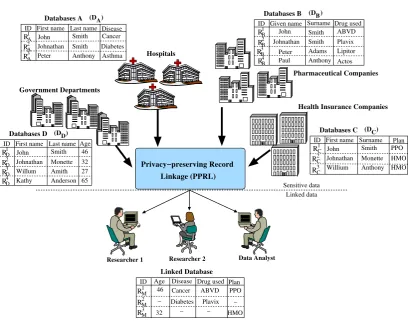
The emerging research area to find records in multiple data sources that relate to the same entity without revealing personal information is known asprivacy-preserving record linkage, blind data linkage or private record linkage [3, 42, 88, 189, 218]. For the rest of this thesis we will use the term privacy-preserving record linkage (PPRL). The record pairs or sets that refer to the same entity are known asmatchesand the record pairs or sets that refer to different entities are known as non-matches[35]. Figure 1.1 illustrates an application scenario of PPRL.
Any linkage application that performs the task of identifying and matching records that refer to the same entities from multiple databases faces various challenges. Scal-ability, linkage quality, and privacy are the three key challenges that are associated with PPRL [176, 212].
1. Scalability: The Big Data era generates major concerns in record linkage ap-plications as many of the linkage techniques employed in these apap-plications are not scalable to very large databases [36, 66, 216, 217]. Scalability generally depends on the complexity of the linkage techniques employed as they can create bottlenecks in the whole linkage process. In two database linkage, as a naïve approach, each record in one database can be compared with every other record in other database to identify the matches. The quadratic complexity con-sists in the naïve pair-wise comparison of records across two databases which does not scale when the numbers of records are increasing in each database. As we discuss in Section 1.2, this becomes even more problematic when the num-ber of databases to be linked is increasing as the naïve pair-wise comparison of records grows exponentially. For example, in a linkage of three databases each record pair resulted in the linkage of first two databases needs to be compared with each record in a third database. Multidatabase linkage, the task of link-ing more than two databases, requires more sophisticated and efficient ways to reduce the record comparison space to make the linkage process more scalable to larger databases as well as an increasing number of databases.
B) (D Drug used First name C) (D
ID Surname Plan
Given name Surname ID A) (D Last name First name ID Disease Last name D) (D Age ID
ID Age Disease Plan
First name
Drug used Hospitals
Sensitive data Linked data
Health Insurance Companies Government Departments
Pharmaceutical Companies
Researcher 2 Data Analyst Researcher 1 Privacy−preserving Record Linkage (PPRL) A 1 R A 2 R A 3 R D 1 R D 2 R D 3 R D 4 R C 1 C 2 C 3 R R R B 1 R B 2 R B 3 R B 4 R M 1 M 2 M 3 R R R Databases B Databases C Databases A Smith Anthony Smith Databases D Plavix Lipitor Actos ABVD Willium Johnathan John Smith Anthony Monette PPO HMO HMO Anthony Adams Smith Peter Paul Peter Johnathan John Cancer Diabetes Asthma Anderson Smith Amith Monette 46 32 27 65 Linked Database
[image:29.595.114.523.104.427.2]Cancer ABVD PPO 46 32 _ _ _ _ HMO John Willum Kathy Johnathan John Johnathan Smith Plavix Diabetes
Figure 1.1: An example health surveillance system that uses PPRL to link different databases. In this example, the researchers and a data analyst (also known as data consumer) aim to investigate correlations between illnesses and different drugs and how people pay for their treatments. This requires data from government depart-ments, hospitals, pharmaceutical companies, and health insurance companies to be linked. Once the linkage is performed the data consumers only receive an aggregated result (selected attribute values that cannot be used to identify personal information)
of the matching record sets.
A possibility to overcome this issue is to use quasi-identifiers (QID) such as first name, last name, address details, age, and so on [95]. The QIDs used in record comparisons can produce ambiguous results as real-world data can contain errors, variations, missing values, and values that can be out of date [174]. Therefore, exact matching of QID values is not sufficient to achieve accurate linkage between databases, and approximate matching techniques are generally required to achieve high linkage quality in RL applications [96, 220].
of individuals cannot be revealed or communicated unless such information is appropriately de-identified (anonymised) or encrypted when linking data from multiple databases [29]. When personal information is used for linking databases across organisations, privacy of this information needs to be con-sidered because when linked, detailed information about individuals that is even more revealing might become available. For example, de-duplicated in-formation can be matched with publicly available inin-formation to re-identify the individual to which the data belongs to. To avoid such re-identification process, it is required that the data used for linking across multiple databases and the identities of entities represented by data, as well as the sensitive details of the matching results of the linkage, are privacy preserved throughout the record linkage process [44, 216].
As shown in Figure 1.1, PPRL only outputs an aggregated result to the data consumers that does not contain any personal or sensitive information.
Given these three main challenges, any PPRL application should be capable of: (1) handling large numbers of records from multiple databases, (2) correctly identifying the true matching records to achieve high linkage quality, and (3) preserving the privacy of sensitive attribute values of all records. We formally define multidatabase PPRL (MD-PPRL) as follows [216]:
Definition 1.1. Multidatabase privacy-preserving record linkage (MD-PPRL)
Assume DOA, DOB,· · ·, DOX areddatabase owners with their respective databases DA, DB, · · ·, DX. The linkage across all these databases determines which of their
records RAi ∈ DA, RBj ∈ DB,· · ·, RXk ∈ DX match according to a decision model
C(hRAi, RBj,· · ·,RXki), that accepts a tuple of records hRAi, RBj,· · ·,RXki as input,
where 1≤i≤ |DA|, 1≤ j≤ |DB|, and 1≤k≤ |DX|, and|D|represents the number
of records in a database D. C(hRAi, RBj,· · ·,RXki) assigns each hRAi, RBj,· · ·,RXki
into the two sets M of matches (where records RAi, RBj,· · ·, and RXk are assumed
to refer to the same entity, i.e. M = {hRAi, RBj,· · ·,RXki|RAi = RBj = · · · = RXk})
and Uof non-matches (where the records refer to different entities, i.e. U = {hRAi,
RBj,· · ·,RXki|RAi 6=RBj 6=· · · 6=RXk}). Each such tuple contains records from two or
more databases. The objective of MD-PPRL is that at the end of the linkage process the database owners learn only which records they have in common according to C without revealing the actual values of the records Ri
A, R j
B,· · ·,RkX with any other
database owner or any party external to the database owners.
1.1.1 Applications of Multidatabase Linkage
1.1.1.1 Census
As a first example, assume a government census agency collects data about various aspects of the population and economy of a country. The information collected is used to generate a diverse range of statistical reports for planning the allocation of funding and resources by the government [77]. Generally, each census is collected at a different point in time and likely into a different database with same schemas (assuming same information is collected about individuals in each different point in time), allowing multiple such databases to be integrated to compile new statisti-cal information. Each database commonly contains longitudinal information about individuals, such as age, gender, birthplace, birth year, religion, race, highest ed-ucational qualification, and so on12. It is commonly accepted that such data are important sources of information to help identify the characteristics of a population as it changes over time [41, 131, 188]. This potentially requires the linkage of such large census databases collected over several decades [78].
1.1.1.2 Health Analytics
Another real-world example application, as shown in Figure 1.1, would be a health surveillance system that continuously integrates and links data from hospitals, phar-macies, insurance companies, and government departments [22, 29]. The data col-lected from these sources can help to investigate the geographical and temporal ef-fects of diseases and drug usages in certain patient groups. Such a system requires the collection and linkage of different databases, as illustrated in Figure 1.2, from certain regions of a country, each potentially containing many hundreds of thou-sands of patient records, where each record needs to be linked across all the different databases to identify how patient groups with different illnesses react to different drugs and medical treatments [24].
As illustrated in Figures 1.1 and 1.2, the databases from different organisations often contain different schemas which require a health surveillance system to select possible attributes that are common in all databases for linking. Next, the values of these attributes are encoded (masked) to preserve privacy. The linkage of records is then performed by comparing the encoded values, and the resulting sets of matching record identifiers are sent to the database owners. Finally, the surveillance system generates a linked database that contains the required sets of attribute values of these matched records that can be used for making decisions [24, 29, 57].
1.1.1.3 National Security and Crime Investigation
Another real-world scenario is an counter-terrorism application34 to track known terrorists or criminal suspects within a country [72, 180]. These applications are
gen-1http://www.abs.gov.au/websitedbs/censushome.nsf/home/2016?opendocument&navpos=110 2https://www.census.gov/
3https://www.globalsecurity.org/security/systems/tia.htm
Share the sensitive attribute values of the identified matching records Link the encoded databases to identify the matching record tuples
ID Record Identifiers
ID Age Disease Drug used Plan Drug used
Given name Surname B)
(D (DC)
Last name D) (D Age ID D) (D Last name ID
First name Surname ID
C)
(D
B)
(D
Given name Surname ID Last name First name ID A) (D First name ID A) (D
Given name Surname B)
(D
ID
C)
(D
First name Surname ID D) (D Last name First name ID First name
ID Surname Plan
ID Last name First name ID Disease A) (D Last name 1 A
R R1B R1C R1D 2
A
R R2B 2 C
R R2D
First name
First name
Attribute selection for linking of records RA1
RA2
A3 R B1 B2 B3 B4 C1 C2 C3 D1 D2 D3 D4 D4 D3 D2 D1 C1 C2 C3 B1 B2 B3 B4
RA1 RA2 RA3
RA1 RA2 RA3
B1 B2 B3 B C1 C2 C3 D1 D2 D3 D4 M1 M2 M3 M1 M M R R R R R R R R R R R R R R R R R R R R R R R R R R R R R R R R R R R R 4 R R R 2 3
Preserve the privacy of individual attribute values (for example using, hash encoding)
Databases B Databases C Databases D
Databases D Databases C Databases B Smith Anthony Smith Databases A
Databases A Databases B Databases C Databases D
Smith
Anthony Smith
Databases A
Matching Result (Records)
Linked Database
Cancer ABVD PPO 46 32 Plavix HMO Plavix Lipitor Actos ABVD Anthony Adams Smith John Peter Paul Anderson Smith Amith Monette 46 32 27 65 Anderson Smith Amith Monette Willium Johnathan John Smith Anthony Monette Anthony Adams Smith John Peter Paul Peter Johnathan John 2d5jght7d k45hdt82s fg7h3ks8d as02kdif2 Willium Johnathan John Smith Anthony Monette PPO HMO HMO Peter Johnathan John Cancer Diabetes Asthma 23jkd57sy 4l5ogh7s sd7ty245e a4f7wt5ry _ _ _ _ 4l5ogh7s sd7ty245e 4l5ogh7s 23jkd57sy st98tc5atl 2dr5t6u8a 4l5ogh7s sd7ty245e
a4f7wt5ry 2n4dtf78h 2n4dtf78h
4l5ogh7s a4f7wt5ry k45hdt82s m3d8ex5fa Willum Kathy Johnathan John Willum Kathy Johnathan John Johnathan Smith Johnathan Smith a4f7wt5ry
2d5jght7d 2d5jght7d 2d5jght7d
4l5ogh7s
[image:32.595.76.481.98.561.2]Diabetes
Figure 1.2: Example steps involved in a health surveillance system to link databases from different data sources, such as government departments, hospitals,
pharmaceu-tical companies, and insurance companies, as shown in Figure 1.1.
However, such a system has to provide two levels of data privacy of the entities in the databases [146]. (1) Since the databases to be matched are very large and diverse, the people who are in the suspect list should not be revealed to any of the database owners or organisations. In most occasions the number of individuals on terrorism watch lists are likely ordinary citizens that show similar characteristics to actual ter-rorists. Revealing information of such non-terrorist individuals as suspects could violate their privacy because these individuals can be scrutinised when they interact with data sources. (2) Subjects or entities who are not in the suspect list should be protected from these counter-terrorism applications because revealing such sensitive data about innocent citizens to third-party or government agencies for matching and analysis purposes without consent can invade their privacy.
1.1.1.4 Fraud Detection and Prevention
As we are living in the Big Data era, financial and transactional data are generated in many different formats and with huge volumes. Analysing such data requires more sophisticated information systems than traditional methods of data analysis [159]. Traditional methods often require complex and time-consuming investigations to deal with different domains of knowledge like financial, economics, business prac-tices and law. Record linkage is an integral component in modern fraud detection systems that link records across databases from government departments, law en-forcement agencies, and financial institutions. Linkage of these databases allows ac-curate identification of individuals or groups of individuals who are suspected to be fraudsters by verifying the personal credentials they present when they, for example, apply for a credit card or a loan [35, 167, 221].
Fraudsters usually provide fake or modified identification information, such as addresses, dates of birth, or social security numbers, when user credential informa-tion is requested by different organisainforma-tions. Such fake informainforma-tion creates a major challenge in linkage applications, since such data could be viewed as erroneous data that is available in databases due to data entry errors. Furthermore, fraudsters delib-erately modify personal details because they do not want to be identified, and they try to make these changes to look like real valid variations [159, 167].
Record linkage provides a way for identifying such falsified identities in databases by linking records across different organisations and matching the credentials pro-vided by each person. This potentially assists in identifying the details propro-vided by an individual as either valid or fake. However, for such a linkage to be employed in fraud detection systems it needs to be capable of matching records in real-time while preserving the privacy of sensitive personal information, as well as being scalable to an increasing number of databases that need to be linked [35, 216].
1
.
2
Research Problem
Table 1.1: Number of candidate record tuples generated with multiple databases for different sizes (number of records) of databases and blocks.
Number of databases (d) Database size / Block size 3 5 7 10
10,000 / 10 106 108 1010 1013 10,000 / 100 108 1012 1016 1022 10,000 / 1,000 1010 1016 1022 1031 100,000 / 10 107 109 1011 1014 100,000 / 100 109 1013 1017 1023 100,000 / 1,000 1011 1017 1023 1032 1,000,000 / 10 108 1010 1012 1015 1,000,000 / 100 1010 1014 1018 1024 1,000,000 / 1,000 1012 1018 1024 1033
pair or a set of records corresponds to the same entity or not. The number of naïve pair-wise record comparisons of multiple databases grows quadratically as the sizes (number of records) of databases to be linked get larger, and exponentially with the number of databases. In such situations, methods or techniques to reduce the comparison space are needed.
In the record linkage process, blocking (indexing) is generally used to scale the linkage to large databases [36, 165]. Blocking identifies candidate records for com-parison and classification by grouping similar records into the same blocks and dis-similar records into different blocks. This enables the record comparison space to only consist of likely true matching record comparisons while removing as many of the true non-matching record comparisons as possible. As a result, blocking of databases decreases the amount of computational efforts required when comparing larger databases. Generally records are grouped according to some criteria (known as ablockingorsortingkey [36]) and only the records in the same block are compared in detail using expensive comparison functions [14, 36].
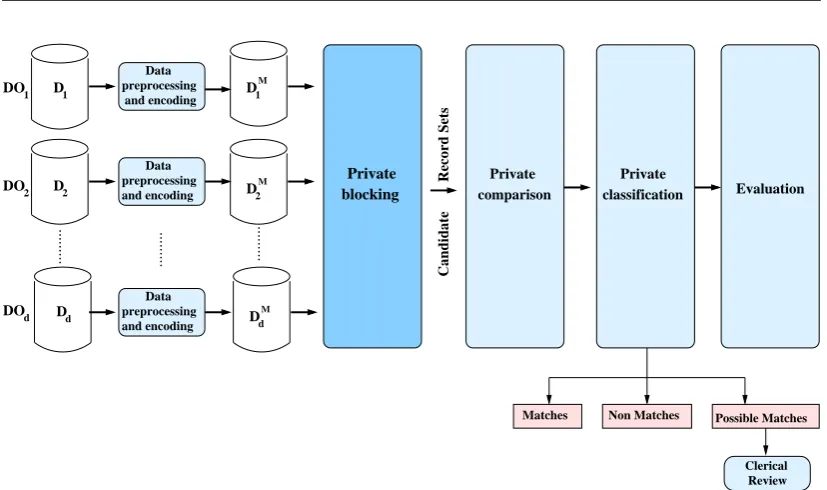
In recent years, various blocking techniques have been proposed for RL and PPRL (this topic is further discussed in Chapters 2 and 3). However, these blocking tech-niques are mainly aimed at the linkage of two databases only, which makes them unsuitable in a multidatabase context. In this thesis we focus on the blocking step of the MD-PPRL process (see Chapter 2). Apart from the three key challenges of PPRL presented in Section 1.1, we aim to address the following challenges that are related to blocking in a MD-PPRL context:
• Challenge 1: Number of databases. When the number of databases is increas-ing the naïve record comparison space grows exponentially. For example, with
ddatabases each containingnrrecords the total number of record pair
compar-isons required can be specified asnrd. Nevertheless, as shown by Sadinle and
linkage context in more detail in Section 4.4 on page 78). This makes multi-database linkage applications currently not scalable with regard to an increas-ing number of records and databases.
As shown in Table 1.1, the number of candidate record tuples (tuples of records from different databases that need to be compared, as we will define in Sec-tion 4.4.2 on page 81) grows exponentially with the number of databases to be linked for a multidatabase linkage, and even with very small sized blocks (such as 10 records per block per database) the number of candidate record tuples can become prohibitively large. Therefore more sophisticated blocking mechanisms are required for MDRL and MD-PPRL applications.
• Challenge 2: Database Sizes. Everyday, organisations generate and store many millions of records in their databases. In the context of these unprecedented volumes of records, existing blocking techniques generate blocks that contain large numbers of records that could potentially require large number of record pairs or sets to be compared. Ultimately, the comparison of these blocks leads to an inefficient linkage.
However, the generation of a large number of blocks with a small number of records each, or a small number of blocks with a large number of records each, could potentially improve the efficiency of blocking. However, such blocking leads to a poor linkage performance as more record pairs need to be com-pared. Furthermore, many of these comparisons could potentially generate more non-matches [170]. Table 1.1 illustrates this problem for MD-PPRL which shows the number of candidate record tuples generated for different num-bers of databases of various sizes and different block sizes (by assuming all blocks have the same size). Therefore, blocking techniques employed in a mul-tidatabase context should be capable of grouping similar records into the same blocks to minimise the number of potential non-matches while controlling the maximum block size to achieve a highly efficient blocking process.
• Challenge 3: Data Quality. In most cases, organisations collect their data through semi-automated processes that cannot filter information of low qual-ity [96, 228]. Often, these collected data contains noise, which includes du-plicate records, or records with missing and inconsistent values. In a multi-database context the effectiveness of the overall linkage is potentially reduced by the variations and erroneous values in records as the diverse nature of data increases with the number of data sources [95]. Therefore, the blocking tech-niques deployed in a multidatabase linkage should be robust with regard to different types of noise in the databases to be linked.
the number of parties that participate in the linkage. This requires the block-ing techniques employed in a multidatabase context to be collusion resistant. However, the techniques that are used in blocking to preserve the privacy of sensitive data also need to be computationally efficient and effective to ensure the scalability and quality of the overall linkage.
• Challenge 5: Redundant record comparisons. As illustrated in Table 1.1, con-ducting multidatabase linkage on block collections from different databases still requires a very large number of similarity comparisons because each record in a block needs to be compared with all records in the same block originating from the other databases (that have the same or similar blocking key values). Assum-ing d databases, each containing nr records, split evenly into nB blocks of size
(nr
nB) records results innB
dpotential candidate block tuples (CBTs). We formally
define a candidate block tuple in Section 4.2 on page 65. The pair-wise compar-ison of theseCBTs will result innB·(nnBr)drecord pair comparisons. However, a
large portion of these candidate block comparisons between different databases consists of redundant record pair comparisons that occur due torepetitiveand
superfluouscomparisons of record pairs, where the latter are comparisons with record pairs that have previously been classified as non-matches [164]. Such redundant record comparisons involve unnecessary computation costs in clas-sification and comparison techniques in the linkage process. Removal of these redundant comparisons in the blocking stage not only improves the effective-ness (reduces non-matches), but also increases the efficiency (reduces the num-ber of record pair comparisons) of the overall linkage.
Therefore, novel blocking techniques are required that process each candidate block tuple by identifying and purging unnecessary comparisons in multi-database linkage in order to increase the overall efficiency. Furthermore, these techniques should not affect the overall effectiveness of the linkage by removing truly matching record sets.
• Challenge 6: Subgroup structures. The primary goal of MDRL and MD-PPRL is to identify similar records that exist across all the databases. However, in real-world applications, being able to identify matching records that occur in two or more databases is important for decision making activities [22]. The sets of matching records across subgroups of databases can be valuable for conducting analytical studies and decision making about sub-populations or groups that exist within a larger population [41, 131].
In order to identify subgroups of records that are matching across multiple databases, the linkage between records from different subgroups of these data-bases is required. However, as the number of datadata-bases to be linked increases the number of subgroup combinations of different sizes increases exponentially. For example, with d databases the potential number of subgroups is equal to
∑d
n=1(nd) = 2d−1. Table 1.2 shows the potential number of subgroups of sizes
Table 1.2: Number of subgroups of sizes 2 to d possible across different number of databases.
Number of databases (d) Number of possible
subgroup combinations
3 4
5 26
7 120
10 1013
the use of existing blocking techniques multiple times for linking subgroups of different sizes of databases is not computationally feasible. Therefore, blocking techniques for multidatabase linkage should be capable of identifying similar records in subgroups of databases efficiently.
We focus on developing novel blocking approaches for MD-PPRL that go be-yond existing blocking techniques by addressing the challenges specified above. In the following section we describe the aims of our research in more detail, while in Sections 1.4 and 1.5 we describe the contributions arising from this thesis and the research methodology we followed to address these challenges, respectively.
1
.
3
Aims and objectives of this research
As we have described in Section 1.2, the comparison of records of multiple databases requires significant computational time and resources. Importantly, the techniques used in MD-PPRL should be scalable to an increase in the size and number of databases to be linked. Furthermore, the techniques used in a MD-PPRL applica-tion should provide enough privacy for sensitive data in those databases to be linked as the collusion risk increases with the number of parties involved in a linkage.
During the past few decades many approaches have been proposed to perform record linkage between two databases [36, 71, 184]. However, as explained in Sec-tion 1.2, the linkage between multiple databases is still an open research problem that requires further investigation. As many real applications require data to be inte-grated from multiple sources, this demands the development of scalable technique in the multidatabase linkage context. Also, these techniques should be able to achieve high linkage quality without compromising the privacy of the sensitive data in those databases.
Database Owner A
Database Owner B
Database Owner X
Database Owner A
Database Owner X
Database Owner B
Unit Linkage
(1)
(1) (1)
(a) (b)
(1)
(3)
(2) (2) (3) (2)
(3)
(3) (2)
(1)
(1) (2)
(3)
(2)
(3)
Figure 1.3: Multidatabase linkage models, (a) with a linkage unit and (b) without a linkage unit. In these models the communication among the participating parties can be given as: (1) exchange of parameter values, (2) communicate the (somewhat)
encoded records of databases, and (3) exchange or send the linkage result.
1. Develop blocking techniques that can be applied in different MD-PPRL link-age models. In a multidatabase context the linkage of different databases can be performed with or without alinkage unit(LU) (more details of this topic are given in Chapters 2 and 3) as illustrated in Figure 1.3 [22, 176, 219]. A LU is a special party or organisation that participates in a protocol to conduct the linkage of the data sent to it by the owners of the databases. We define the LU in more detail in Section 2.4. In a privacy-preserving context the common com-munication steps that can occur between the participating parties within these linkage models can be given as: (1) exchange of parameters, pre-processing standards, secret keys, etc. between the database owners, (2) exchange of the encoded (masked) values in the databases, and (3) exchange of the linkage re-sults. In this thesis we develop blocking techniques under both these linkage models shown in Figure 1.3.
As shown by Mitchell et al. [149], most of the practical linkage applications, such as Microdata Linkage at Statistics Canada5, E-health informatics research in UK6, and health data linkage in Australia7, use LUs (data linkage cen-tres) to facilitate and conduct the linkage of different databases compared to database owners performing the linkage by themselves. As we describe in Sec-tion 2.3, the linkage of databases without a LU can become more computaSec-tion- computation-ally and communicationcomputation-ally expensive compared to the linkage applications with a LU because of the use of more sophisticated encoding or encryption mechanisms [66]. However, linking records at a central location can potentially
5https://www.statcan.gc.ca/eng/record/gen
6
http://www.cancerresearchuk.org/funding-for-researchers/how-we-deliver-research/our-research-partnerships/the-farr-institute-of-health-informatics-research
increase the risk of privacy attacks because the LU can use the frequency in-formation of these encoded values to deduct a sensitive plain-text value of a database. We explain privacy attacks in Section 2.4.5.
Under these linkage models the privacy of the data needs to be considered for different adversary (security) models as described in Chapter 2. First we inves-tigate and identify which PPRL techniques are more suitable for each linkage model and each adversary model. By doing so, a good understanding can be gained about MD-PPRL techniques and their limitations, efficiency, and ef-fectiveness under different adversary models. This will help us to develop different blocking techniques under these linkage models.
2. Develop blocking techniques that are more collusion resistant. As we de-scribed in Section 1.2, the potential risk of collusion between participating par-ties (including database owners, linkage units, or any external organisations participating in the linkage) increases with the number of parties. This in-creases the privacy risk in blocking since a group of participating parties can collude with each other in the blocking step to identify sensitive record values in a database of another database owner that does not collude. Therefore, we investigate the applicability of different techniques to improve the privacy in our multidatabase blocking approaches.
3. Develop blocking techniques that support subgroup blocking. In a multi-database environment, subsets of matching records could also be available in two or more databases to be linked. These subsets of matching records provide important information about the specific entity groups that exist within the whole population. However, to identify subsets of matching records, we need to identify candidate blocks that need to be compared for different subgroups across all the databases to be linked. Therefore, we focus on developing ap-proaches that support subgroup blocking in a multidatabase linkage scenario. 4. Efficiently remove redundant record set comparisons. As shown in Table 1.1,
the record comparison space in a multidatabase linkage results in an exces-sively high number of candidate record tuples that need to be compared even when a blocking technique is applied. However, the record comparison space generated by a blocking technique could encompass redundant record com-parisons that are repetitive and/or superfluous. Our objective is to develop filtering techniques that can be incorporated with the blocking step for mul-tidatabase linkage to remove these redundant record comparisons. This helps to maximise the overall efficiency while retaining the original or high levels of effectiveness in the overall linkage.
1
.
4
Contributions
propose solutions to address the main challenges involved in blocking of multiple databases in a privacy-preserving context. Our contributions can be grouped into six main sections:
1. A blocking framework for MD-PPRL: A major shortcoming in the MD-PPRL context is that a blocking framework that could address the challenges related to multidatabase blocking has so far not been developed. This requires database owners or PPRL practitioners to use PPRL techniques that are not applicable in real-world applications. To address this issue we propose a blocking framework for MD-PPRL that goes beyond existing solutions in three different ways:
• our framework is designed to deal with the challenges of MD-PPRL (as detailed in Section 1.3),
• it divides the blocking process into different steps, which allows users to maximise the overall efficiency and effectiveness of the linkage of multiple large databases, and
• it provides PPRL practitioners and users with different techniques, ap-proaches, and protocols to create highly scalable MD-PPRL solutions that can be easily tailored to the particular settings and requirements of a given application.
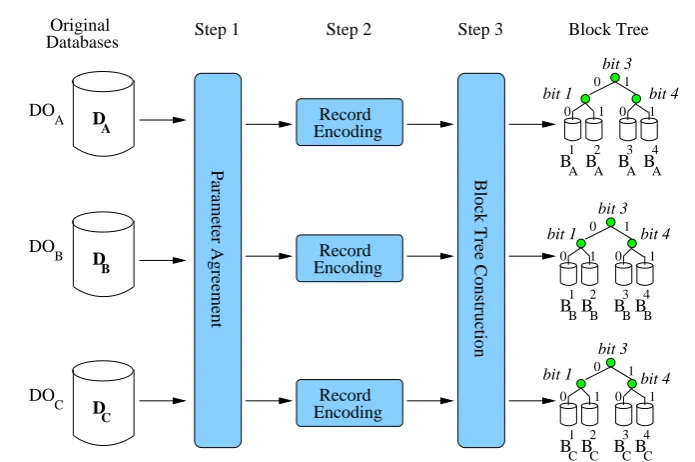
The blocking techniques that are developed in our proposed framework are grouped into different layers. Each layer is responsible for a specific aspect of blocking in the MD-PPRL process and receives as input the output of the previous layer. The goal of this framework is to produce an output from each layer that improves the effectiveness and/or the efficiency of the input pro-vided by the previous layer. This proposed blocking framework is presented in Chapter 4.
2. Scalable blocking techniques for MD-PPRL: As discussed in Section 1.3, we propose several blocking approaches for MD-PPRL. We use a multidatabase linkage model without a linkage unit, as shown in Figure 1.3 (b), in these pro-posed approaches as it provides more privacy in generating blocks. We propose three blocking techniques that use an efficient tree data structure and two clus-tering techniques for generating blocks of multiple databases that need to be linked. The proposed blocking techniques are described in Chapters 5 and 6. 3. A distributed blocking approach for MD-PPRL: As will be detailed in
4. A subgroup blocking approach for MD-PPRL: As detailed in Section 1.2, a ma-jor challenge in MD-PPRL is to identify records across different databases that need to be compared across subgroups of these databases. To address this prob-lem we propose a subgroup blocking technique that groups records into blocks and identifies candidate blocks from different databases that need to be com-pared for subgroup combinations of different sizes across those databases. The proposed technique consists of a graph data structure based candidate block generation method for identifying blocks that need to be compared for differ-ent subgroup combinations. The proposed approach is presdiffer-ented in Chapter 8. 5. A meta-blocking approach to reduce redundant record comparisons: In any multidatabase linkage application, a major portion of the record comparison space consists of repeated and superfluous record comparisons, as we detailed in Section 1.3. We propose a non-parametric meta-blocking approach that can be employed between the blocking and the comparison and classification steps of the MD-PPRL pipeline. The proposed approach efficiently schedules block pairs for comparison ensuring repeated and superfluous record comparisons are eliminated without reducing the effectiveness of the overall linkage. Our approach is designed in such a manner that it can be incorporated into any RL or PPRL applications. The proposed contribution is presented in Chapter 9. 6. A comprehensive evaluation of the proposed techniques: We conduct a
com-prehensive experimental evaluation of our proposed techniques in terms of scalability, blocking quality and privacy using multiple large real and synthetic datasets. We provide a comparative evaluation of our proposed approaches and several state-of-the-art blocking techniques [36, 56, 119] for different MD-PPRL scenarios. The results are presented in Chapter 10.
In addition, all proposed approaches presented in this thesis are conceptually analysed with regard to complexity, blocking quality, and privacy, which are detailed in each corresponding chapter.
1
.
5
Research methodology
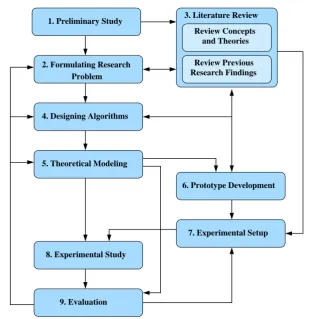
In this thesis the used methodology for designing and developing algorithms for MD-PPRL consists of several steps, as shown in Figure 1.4:
1. Preliminary study: In this step a basic understanding about record linkage was gathered by broadly studying the literature which helped to recognise different research problems in the record linkage context.
2. Formulating research problem: In this step we defined the research problem under the MD-PPRL context.
Review Previous Research Findings
Review Concepts and Theories
4. Designing Algorithms
5. Theoretical Modeling
7. Experimental Setup
8. Experimental Study
6. Prototype Development
9. Evaluation
3. Literature Review 1. Preliminary Study
[image:42.595.118.431.106.426.2]Problem 2. Formulating Research
Figure 1.4: The used research methodology.
understand about, (1) concepts and theories and (2) previous research findings in the context of record linkage. This knowledge was used to refine the research problem, design solutions, implement prototypes, and experimental design. 4. Designing algorithms: In this step new approaches were proposed to address
the identified research problem.
5. Theoretical modeling: In this step the proposed approaches were theoretically analysed in terms of scalability, blocking quality, and privacy.
6. Prototype development: Prototypes of the proposed approaches were devel-oped to be used as proof-of-concept implementations. We develdevel-oped all the prototypes using the Python programming language [142] as separate mod-ules. More information on prototype development is given in Section 4.4 on page 84.
8. Experimental study: The set of experiments on the developed prototypes were conducted to gather results for the experimental evaluation.
9. Evaluation: The experimental results were evaluated with regard to scalability, blocking quality, and privacy to validate the theoretical analysis.
1
.
6
Thesis Outline
Background
In this chapter, we present background knowledge for the following chapters of this thesis. In Section 2.1 we describe the traditional record linkage (RL) process. We provide a detailed description about privacy-preserving record linkage (PPRL) in Section 2.2, and describe each step in the PPRL process in more detail in Section 2.3. In Section 2.4, we provide a detailed description on different privacy aspects related to PPRL, and we describe evaluation measures used in PPRL in Section 2.5.
2
.
1
Record Linkage
Linking records of different databases has a long history. The term Record Linkage
was first introduced by Halbert L. Dunn in 1946 [55]. The article he published in the American Journal of Public Health1 describes an idea of creating a book named
book of life for every individual in the world. Each book of an individual person contains pages covering the principle events of a life, such as the individuals’ contacts with the health and social security systems from birth to death. In his article, Dunn highlighted the importance of having such records about individuals for government statistics and services, and for the identification of individuals. However, collection of such data in real-world could become difficult due to data quality issues.
Over the past few decades an increasing interest has been seen into research in the area of record linkage or data matching in domains such as computer sci-ence, statistics, and the health and social sciences. The probabilistic foundation of modern record linkage has been proposed by Newcombe et al. [156]. In their work phonetic encoding [35, 66] is applied to attribute values to overcome variations in the data. A calculation based on the distribution of records was used to group records into matches and non-matches. This idea was then formalised by Ivan Fel-legi and Alan Sunter who proved that a probabilistic decision rule can be optimal when the comparison of quasi identifier (QID) attributes [94], such as first name, last name, address details, age, etc., are conditionally independent [71]. Even today their work remains the mathematical foundation for many record linkage applica-tions [28, 61, 88, 127, 147, 178, 183, 184, 226, 227].
1http://ajph.aphapublications.org/


![Figure 4.5: Outline of the cryptanalysis attack (adapted from [39]).](https://thumb-us.123doks.com/thumbv2/123dok_us/1866118.143582/112.595.95.450.105.412/figure-outline-cryptanalysis-attack-adapted.webp)