Copyright C 1994, American Society for Microbiology
Characterization of
Epitopes Defining Two Major Subclasses
of
Polytropic Murine Leukemia Viruses (MuLVs) Which Are
Differentially Expressed in Mice Infected with Different
Ecotropic MuLVs
MARCLAVIGNON,1 JESSICA L. WALKER,1 SYLVIA M. PERRYMAN,1 FRANK G. MALIK, ARIFA S. KHAN,2 THEODORE S. THEODORE,3ANDLEONARD H.
EVANS"*
Laboratory of Persistent Viral Diseases, Rocky Mountain Laboratories, National Instituteof Allergy and Infectious
Diseases, Hamilton, Montana 59840,1 andLaboratory of Retrovirus Research, Center for Biologics Evaluation and Research, Federal Drug Administration,2andLaboratory ofMolecularMicrobiology,NationalInstituteofAllergyand
Infectious Diseases,National Institutesof Health,3Bethesda, Maryland20892
Received 18January 1994/Accepted 19May 1994
Polytropic murine leukemia viruses (MuLVs) arise in mice by recombination of ecotropic MuLVs with endogenous retroviral envelopegenesand have beenimplicatedinthe inductionofhematopoietic proliferative diseases. Inbred mousestrains containmanyendogenous sequenceswhicharehomologous tothepolytropic
envgenes;however, theextent towhichparticularsequencesparticipate in the generation of the recombinants is unknown. Previous studies have established antigenic heterogeneity among the env genes ofpolytropic MuLVs, which may reflect recombination with distinct endogenous genes. In the present study, we have examinedmanypolytropic MuLVs and found that nearly all isolates fall intotwomutually exclusive antigenic subclasses on the basis of the abilityof their SU proteins to react with oneof two monoclonal antibodies, termed Hy 7 and MAb 516. Epitope-mapping studies revealed thatreactivitytothetwoantibodies isdependent ontheidentity ofasingle amino acid residue encodedinavariableregionof thereceptor-binding domain of theenvgene.This indicated that thetwoantigenic subclasses of MuLVsaroseby recombination withdistinct setsofendogenousgenes.Evaluation ofpolytropicMuLVs in mice revealeddistinctlydifferent ratios of the two subclasses after inoculation of different ecotropic MuLVs, suggesting that individual ecotropic MuLVs preferentially recombine with distinctsetsof endogenous polytropicenvgenes.
Mice which harbor endogenousecotropicmurine leukemia viruses (MuLVs) and mice inoculated with exogenous eco-tropicMuLVsfrequentlygeneratehost rangevariants termed
polytropicMuLVs(19,20,25, 27, 36, 42, 43,50).The variants
are infectious for mouse cells as well as cells of several
heterologous species(24,27). PolytropicMuLVsare envgene
recombinants of the ecotropic MuLVs with endogenous
retro-viralsequences(4, 7, 8, 11, 15-17, 40,44)andarethoughttobe involved in the induction of hematopoietic proliferative
dis-eases. They are also referredto asdualtropicMuLVs (24)or
mink cellfocus-inducing viruses(MCFs) (27).
Thegenomesof inbred mice containmany sequenceswhich
are closely homologous to the nonecotropic env gene se-quences of polytropic MuLVs (3, 38, 48, 49); however, the
extent to which particular endogenous sequences actually
participateinrecombination togeneratepolytropicMuLVsis
not precisely known. All polytropic MuLVs have undergone substitution of at least the 5' region of the env gene, which encodes thereceptor-binding region of the SU protein(2, 39).
This region frequently exhibits a small degree of sequence
heterogeneityamongdifferent polytropicMuLVisolates(1, 5, 29, 31,52), which, in some cases, may result frommutations
subsequenttorecombination.Ithasbeen demonstrated,
how-ever, that some heterogeneity among polytropic MuLV env genesis duetorecombination with distinct endogenous
retro-viral sequences (20).
We have previously described a number of monoclonal antibodies (MAbs) which are specifically reactive with
poly-*Correspondingauthor.
tropic envelope proteins. The antibodieswere ableto
distin-guishmanypolytropicMuLVisolates(9,12,20),andit seemed plausible that some of the observed antigenic heterogeneity might reflect recombination with distinct endogenous
poly-tropicenvgenes.Twoof the antibodies (MAb 516andHy7) used inouranalyses appearedto reactwith distinctsetsofthe
polytropic MuLVswe had examined (20, 22). In the present study, we have extended this observation to manypolytropic MuLVisolates and found that MAb 516 and Hy7definetwo
mutually exclusive antigenic subclasses. We have analyzed chimeric andmutantMuLVs todetermine ifreactivitytothe antibodies depends on alternative allelic gene sequences.
Furthermore,wehavequantified the polytropic MuLVsfrom miceinfected with differentecotropic MuLVstodetermine the frequency of occurrence of the two subclasses ofpolytropic
MuLVs invivo.
MATERIALS AND METHODS
Cells, viruses, and mice. Mink lung fibroblasts (ATTC CCL-64) (28),mouseSC-1 cells(26),NIH 3T3cells, andMus
dunni (32) cells were used for propagation and assays of MuLVs and for transfection of cloned MuLV proviruses as
indicated in the text. The polytropic MuLV, MCF 247 (13), wasobtainedas amolecularly cloned provirus in pBR322(30). MCF 13 (13) was obtained from J. Hartley (Laboratory of
Immunopathology, National Institute ofAllergy and Infectious Diseases [NIAID], National Institutes ofHealth [NIH],
Be-thesda,Md.).Theecotropic MuLVs, Friend(F)-MuLV57(37) and Moloney
(Mo)-MuLV1387
(21), derived from transfected5194
on November 9, 2019 by guest
http://jvi.asm.org/
Reactivity Hy7 mAbS16
U3RU5L gag pal envy,URUr,
U3RUs L gag pol env U3RU5
Xhol AflIl EcoR1 Xl
U3RUsL gag pol env U3R U5
XhoI Afgll EcoR1
U3RU5L gag pol env U3R 5
Atfl EcoR1 Xbal
U3R\U5 L gag pol env U3RUt
l
1i 1
I
~
1ii
U3 \ 5 L gag pol A nv XbalU3
Xhol AfilIl EcoR1 bl
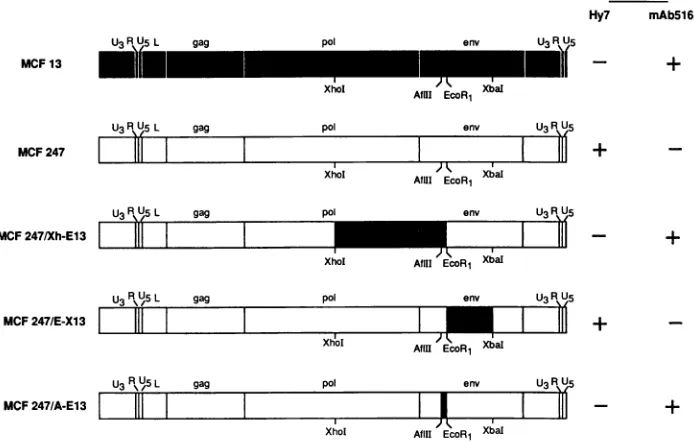
FIG. 1. Reactivities of chimeric MuLVs constructed between MCF 247 and MCF 13. MCF 13, MCF 247, and the chimeric MuLV proviruses
arerepresented by bar diagrams which indicate the locations of the three structuralgenes(gag,pol, andenv), the leadersequence(L),and the elements of thelong terminalrepeat(U3, R, and U5). The chimeric MuLVs correspondtoMCF247proviruseswithfragmentsderived from MCF 13(shaded regions) andwereconstructedasdescribed in Materials and Methods. The Hy 7 and MAb 516 reactivitieswere ascertainedbya
membrane immunofluorescenceassay ontransfectedmousecell lines.
molecularly cloned proviruses, were originally obtained from
E.M.Scolnick(Merck SharpandDohme Research Laborato-ries, West Point, Pa.). The derivation ofFB-29, a molecular
clone of the 1-5 strain of F-MuLV, has been previously
described (46). The mouse strain utilized in this study was
NFS/N.
MAbs. The derivations and specificities of MAbs 514 and 516(9)and ofHy7(12)have beenpreviouslydescribed. MAb
573, which is broadly reactive with MuLVs, was generously supplied by Bruce Chesebro (Laboratory of Persistent Viral
Diseases, Rocky MountainLaboratories, NIAID, NIH,
Ham-ilton, Mont.).
Construction of chimericplasmids.MCF 13wascloned ina
pUC8 plasmidatauniqueEcoRI site in theenvgene
(unpub-lisheddata). MCF247,clonedatthe PstIsite inpBR322,was recloned in another plasmid to facilitate the subsequent
ma-nipulations. The polylinker region of the plasmid pBSKS+ (Stratagene) was excised by KpnI and SacI digestion. The
plasmidwasblunt ended with T4 DNApolymerase, andaPstI linker (5' GGCTGCAGCC 3') was inserted by blunt-end
ligation to generate a plasmid containing a unique PstI site
(pBSP+) but no additional sites originally contained in the
polylinker. The MCF 247 provirus, excised byPstI digestion
from the pBR322 plasmid, was then recloned into pBSP+
(pBSP+/MCF 247).Tosimplifytheconstruction and analyses
ofchimeras, a3.2-kb restriction enzyme fragment between a
uniqueXhoI site in thepolgeneandauniqueXbaI site in the 3' end of the env gene of MCF 247 was subcloned into
pBSIIKS+ (Stratagene).Constructionsweredone between this XhoI-XbaI MCF 247 subclone andfragments of the MCF 13
provirus. The chimeric XhoI-XbaI fragments were then in-serted into a derivative of pBSP+/MCF 247 (delta pBSP+/ MCF247)inwhich the XhoI-XbaIfragmenthad beenreplaced
with a conversionadaptor (5' TCGAGCGCGCCT 3' and 5' CTAGAGGCGCGC 3'). The resulting chimeric proviruses
were used to transfect NIH 3T3 orM. dunni cell lines. The
chimericMuLVs utilized in thisstudyarepresentedinFig. 1. In vitro mutagenesis.Mutationswereintroduced into
plas-mids (pBSIIKS+) containing the XhoI-EcoRI fragment of MCF 247 or MCF 13 (which includes the amino-terminal
coding regionof the SUprotein) by useofamutagenesis kit
(200510; Stratagene) according tothe manufacturer's
instruc-tions. The procedure utilizes a unique ScaI site present in
pBSIIKS+ and initiation primers complementary to that site. The XhoI-EcoRI subcloneswereutilized for thegenerationof
mutations in order to exclude a Scal site present in the
carboxy-terminal coding region of the SU protein. After
mutagenesis, the fragments were purified and ligated in a
plasmid (pBSIIKS+) containing the EcoRI-XbaI fragment of
MCF 247 to obtain mutated XhoI-XbaI fragments. These
fragmentsweresubsequentlyusedtogenerate mutated
provi-rusesbyinsertion into deltapBSP+/MCF247.
Transfection of murine cells. Transfection of NIH 3T3orM. dunni cellswasperformed bythe calcium phosphate precipi-tation procedurewith amammalian transfection kit (200285; Stratagene). Theproviruseswereexcised from theplasmid by cleavagewith theappropriaterestriction endonuclease(EcoRI
forpUC8/MCF 13 and PstI forpBSP+/MCF 247 and
deriva-tives) before transfection. Each transfection utilized 20 to 30
,ugofplasmidDNA.
Focalimmunoassayand membrane immunofluorescence. A focal immunofluorescence assay was used to evaluate the transfections and to detect ecotropic or polytropic MuLVs from infected mice. The focal immunofluorescence assaywas
performedonmonolayersof live M dunni,SC-1,NIH3T3,or minkCCL-64 cellsaspreviouslydescribed(45). MuLVs from infected NFS/N mice were detected in parallel infectious center(IC)assaysofspleenandthymuscells 5to8 weeks after neonatal infection by useof MAb514, MAb516,or Hy7on minkCCL-64 cells andmouseSC-1 cells. Transfectionof NIH MCF 13
MCF 247
MCF247/Xh-E13
MCF 247/E-X13
MCF 247/A-E13
_ +
+
-_ +
+
-- +
on November 9, 2019 by guest
http://jvi.asm.org/
[image:2.612.132.479.84.305.2]TABLE 1. Twomutually exclusiveepitopes of polytropicMuLVs
Parentecotropic Mousestrain
Reactivity'
Vlrus(reference)MuLV origin MAb 514 Hy 7 MAb 516
Viruseswithanendogenous ecotropicparent Mo-MCF (5)b
MCF 247 (27) AKR6AS (8) AKR6AT(8) AKRL3 (13) M60P-S (22) M62P-S(22) M72P-S (22) M73P-S (22) M75P-T(22) M75P-S(22) M81P-S(22) Akv-1-C36(13) Akv-2-C34(13) C58LlB(13) MCF 13(13) AKRL4(13) AKR L5(13) Akv-1-C44-1 (34) Akv-1-C44-2(34)
Viruses withanexogenous ecotropicparent 368-2S (19) 368-3T(19) 368-ST(19) F-MCF-18D(6) F-MCF-1(31) F-MCF-1E (10) MCF-FrNx(1) 383-1T(20) 383-1S(20) 383-2T(20) 383-4T(20) 383-4S (20) 383-5T(20) 383-5S (20) HIX(24) V33(48) 368-2T(19) 368-5S(19) 368-6T(19) 368-7T(19) 368-7S(19) Mo-MuLV Akv Akv Akv Akv Akv Akv Akv Akv Akv Akv Akv Akv-1 Akv-2 C58v Akv Akv Akv Akv-1 Akv-1 F-MuLV F-MuLV F-MuLV F-MuLV F-MuLV F-MuLV F-MuLV Mo-MuLV Mo-MuLV Mo-MuLV Mo-MuLV Mo-MuLV Mo-MuLV Mo-MuLV Mo-MuLV Invitroconstruct F-MuLV F-MuLV F-MuLV F-MuLV F-MuLV
a Membrane immunofluorescenceassaysofmousecell lineschronicallyinfected with thedesignated polytropicMuLV isolate.PolytropicMuLVs reactive withHy 7orMAb 516areboxedtoclearlyillustrate that the reactivitiesaremutuallyexclusive.
bMo-MCFisapolytropicMuLV isolated fromaBALB/cmousestrain withanendogenousMo-MuLV(BALB/Mo).
3T3orM. dunni cellswasmonitoredbythe focal immunoflu-orescenceassaywith MAb 573 until the cellswere morethan 90% fluorescent, indicating nearly complete infection. The infected cellswerethentrypsinized, and cell suspensionswere assayed forreactivity with the polytropic-specific MAb 514or 516 or Hy 7 by a membrane immunofluorescence assay as previously described (12).
DNAsequencing and oligonucleotide systhesis. DNAswere sequenced by the dideoxy-chain termination method (Gem Seq KIRT sequencing system; Promega Biotec, Madison, Wis.). Oligonucleotides were synthesized with an Applied Systems 380B DNA synthesizer (FosterCity, Calif.).
RESULTS
Antigenic subclasses of polytropic MuLVs defined by reac-tivity with MAb 516 and Hy 7. Many polytropic MuLVs,
isolated in this and in otherlaboratories, wereexamined for their reactivities to MAb 516 and Hy 7 (Table 1). These included polytropic MuLVs derived from different mouse strains and fromdifferentexogenousorendogenous ecotropic parents and, in one case(V33), an in vitroconstructwith an SU-codingsequence from a genomiclibrary. Nearlyall poly-tropicMuLVs reacted with either MAb 516orHy 7; however, noneof the isolatesfromany source werefoundto reactwith both of the MAbs.MAb 514 reacted with allpolytropicisolates examined, whichconfirmed and extended previousresults(9). AgroupofpolytropicMuLVswerereactive with MAb514,but notwitheitherHy7orMAb516(Table 1, 368-2T, 5S, 6T, 7T, and7S). These viruseswereisolated fromF-MuLV57-infected
NFS/N mice after extensive selection on mink cells (20). In experiments described below, these exceptional polytropic MuLVs constituted averyminorproportion ofrecombinants
+
+
+
+
+
+
+
F]
I+1
Li
BALB/Mo AKR AKR AKR AKR AKR AKR AKR AKR AKR AKR AKR NFS congenic NFS congenic C58 AKR AKR AKR NFScongenic NFScongenic NFS/N NFS/N NFS/N BALB/c NIHSwiss NIHSwiss NFS/N NFS/N NFS/N NFS/N NFS/N NFS/N NFS/N NFS/N Unknown HRS/J NFS/N NFS/N NFS/N NFS/N NFS/N + + + ± ± ± ± ± + + ± ± + + + + + + + + + + + + + ± + + + + + + + + + + ± ± + + + ± +on November 9, 2019 by guest
http://jvi.asm.org/
A
Afn11 Il MCF 13
MCF 247
MCF 13 MCF 247
CTTAAGC G A G GAAACACRC CCT G TCAGGGCCCCTGTTATGATTCCTCAGr GGTCTC
CTTAAGCGAGGAAACACG CCT[A GGTCAGGGCCCCTGTTATGATTCCTCAG GGTCTC
CAG TCjTCTCAGGGlG GCCACACCGGGGGGTCGATGCAAfCCCCTAGTCCTflGAATTC
CAGT CT GGGCCCCGGGCAGA CCTGCTGAT
l EcoRI
L K R G N T P QN RN RG RN
RN KN
Q G P C Y D Ss ss ss ss
SS DP
131
A V S D I K G A T P G G R C N P L V L E F A - - - N I K
V - - - S V Q - - -
-A - - - G I Q - - -
[image:4.612.56.556.76.280.2]-V - - -G I Q S - - - G V
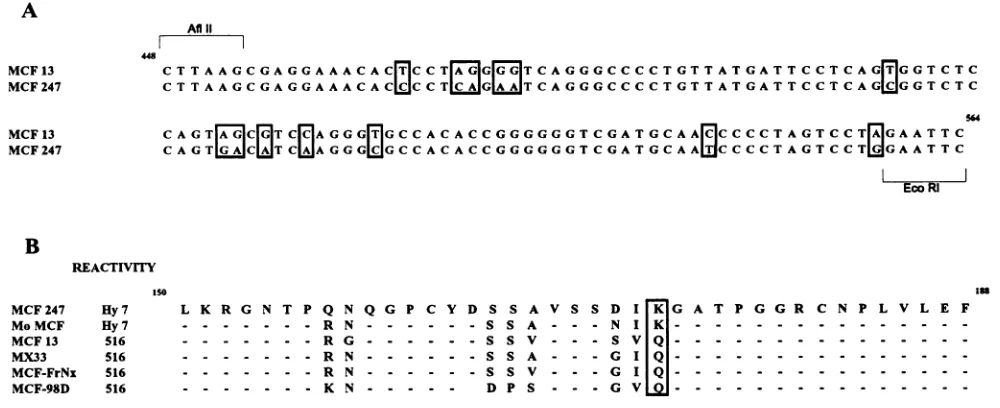
FIG. 2. Nucleotide andamino acidsequence comparisons of polytropic MuLVs. (A) Thenucleotidesequence fromanAflIl site (nucleotide
448)toanEcoRIsite(nucleotide 564) of theenvgeneof MCF13wasdeterminedasdescribed in Materials andMethods and aligned with the
publishedsequenceof MCF247(30). The locations of positionsinthe alignment which differareenclosed in borders. (B) Amino acidsequences werededuced from the nucleotidesequencesfromtheAfllltothe EcoRI sites in the SU-encoding region of theenv genesof the MuLVs. The
nucleotide sequence from AflhI toEcoRI of MCF-98D was kindly supplied by B. Chesebro (8a). Thesequences of this region of MCF 247,
Mo-MCF, MX33, and MCF-FrNx polytropic MuLVs have been reported elsewhere (1, 5, 30, 48).Dashes indicate amino acid identityatthe given positioninall thesequences.Thesingle positionatwhich the amino acid divergence exhibited completeconsensuswith reactivitytoHy 7orMAb 516 is boxed. Hy 7 andMAb516 (516)reactivitiesweredetermined by immunofluorescence onchronically infectedmousecell lines.
detected in NFS/N mice. Ourresultssuggest that the reactiv-itiestoMAb 516 andHy7aremutually exclusiveand thatthe
reactive epitopescorrespond toalternateallelicstructures.
Localization of sequences encoding MAb 516 or Hy 7
reactivity. The envelope protein complex appears important forreactivitywith MAb 516 andHy7 in thatbotharereactive with thegp70-pl5E complexinradioimmuneprecipitation and
immunoblots butnot with gp70 alone (9, 12). Thus, it is not
entirelyclearwhether theantigenic subclassesarethe resultof differencesencodedbythepolytropic regionof theenvgene or of differences inotherregions.Theobservation that thesame
ecotropic MuLV can give rise to both antigenic subclasses
(e.g., MCF 247 and MCF 13 [Table 1]) suggests that the
nonecotropic regionof theSUprotein isveryimportant for the
reactivity to the two MAbs. However, it is possible that
differences in the pointsofrecombination couldgeneratethe
dichotomy.To determine if the MAb 516 andHy7reactivities aredependentontheidentities of thepolytropicsequencesin theenvgene, chimeric viruses were constructed betweentwo
molecularly cloned viruses, MCF 247 and MCF 13, which differed in their reactivities to MAb 516 and Hy 7 (Fig. 1).
MCF 247reacted withHy 7, andMCF 13 reacted with MAb 516. Both viruses were derived from the same parental
eco-tropicvirus(Akv),whichfacilitated theconstruction of recom-binant plasmids. The reactivities of the constructed viruses wereexaminedbymembrane immunofluorescenceoninfected cells after DNAtransfection. Analysesoftwochimeras, MCF 247/Xh-E13 andMCF247/E-X13, identifiedsequencesinthe 5' regionoftheenvgenewhich influenced MAb 516orHy 7
reactivity (Fig. 1). The 5' SU-encoding sequences of MCF 247/Xh-E13 extending 564 bases to the EcoRI site were derived from MCF13,whilethe remainderof theSU-encoding sequences were from MCF 247. Like MCF 13, this chimera reacted with MAb 516. Conversely, MCF 247/E-X13, which contained 5' SU-encoding sequences from MCF 247 and 3'
SU-encoding sequences from MCF 13, was, like MCF 247,
reactivewithHy7.Sequences determining reactivitiestoMAb 516 and Hy 7 were localized to a much smaller region by
analyses of the MCF 247/A-E13 chimera. This virus was
identicaltoMCF 247,exceptfora117-bpsequenceof MCF 13 extending fromanAfllI sitetothe EcoRIsite,andreacted with MAb516 similarlyto MCF 13.
Sequence compansons of Hy 7- and MAb 516-reactive
polytropicMuLVs andthe modificationof Hy7 andMAb 516
reactivitiesbypoint mutation. The results above indicate that Hy 7 and MAb 516 reactivities are influenced by sequences betweentheAflII andEcoRI sites of thepolytropicenv gene
(nucleotides 448 to 564 of the SU-encoding region). The
nucleotidesequenceofMCF13wasdeterminedin thisregion anddifferedby13nucleotides from thepublishedsequenceof
MCF 247 (Fig. 2A). The deduced amino acid sequence en-coded between the Aflll and EcoRI sites of MCF 13 was
compared with that of MCF 247 as well as those of other
polytropic MuLVs which were characterized with respect to
theirreactivities to Hy7 orMAb 516 (Fig. 2B; Table 1). We found eight positions which exhibited amino acid divergence amongthe polytropic MuLVs in this region. Onlyoneof the
eightpositions in thisregionexhibitedconsensuswith respect to Hy 7 or MAb 516 reactivity. Both Hy 7-reactive viruses contained lysine at position 173, while all four MAb 516-reactive MuLVscontainedglutamine.
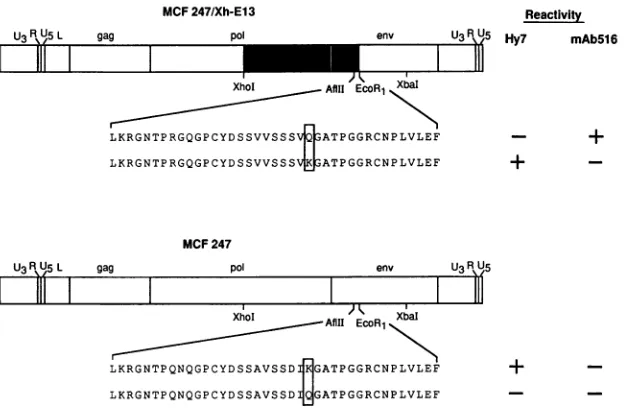
Pointmutationswereintroduced tochange the amino acid at position 173 of the SUproteinofMCF247/Xh-E13 (MAb
516 reactive) from glutamine to lysine and that ofMCF 247
(Hy7reactive)fromlysinetoglutamine (Fig. 3).Inbothcases,
alteration of the codonwas effectedby asingle base change.
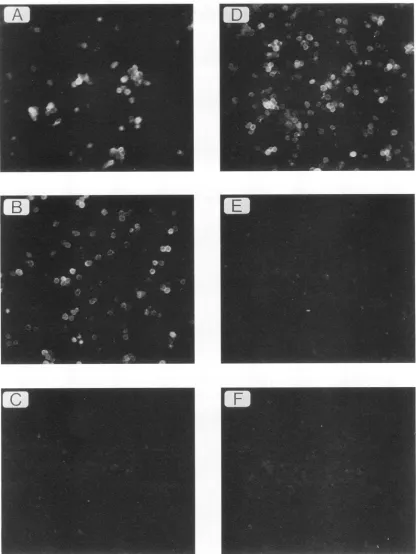
Mutated viruseswere analyzedaftertransfectiontodetermine ifthisresidue influencedreactivitytothe MAbs. The resultsof theseanalyses (Fig. 3)indicated that theidentityof thisamino acid (glutamine or lysine) in MCF 247/Xh-E13 determined
B
REACTIVITY
ISO
MCF 247 Mo MCF MCF 13
MX33 MCF-FrNx
MCF-98D Hy 7 Hy 7 516 516 516 516
on November 9, 2019 by guest
http://jvi.asm.org/
U3R,U5L gag
MCF 247/Xh-E13
pol env U3R\y/
XhoI AfilI EcoR1 XbaI
LKRGNTPRGQGPCYDSSVVSSSVQGATPGGRCNPLVLEF
LKRGNTPRGQGPCYDSSVVSSSVKGATPGGRCNPLVLEF
MCF 247
U3 R Us L gag pol env U3RU5
Xhol Aflll EcoR1
LKRGNTPQNQGPCYDSSAVSSDIKrGATPGGRCNPLVLEF
LKRGNTPQNQGPCYDSSAVSSDIQ_JGATPGGRCNPLVLEF
Reactivity Hy7 mAb5l6
_ +
+_
+_
FIG. 3. Alteration of the SU protein sequences of MAb 516- and Hy7-reactive polytropicMuLVs. Amutation(CtoA)wasintroducedat nucleotide 517 of the env gene of MCF247/Xh-E13 toeffect a glutamine-to-lysine coding change. Themutagenesiswasaccomplished with a mutagenic primer (5' GTCTCCAGTAGCGTCAAGGGTGCCACACCGG3').Amutation (AtoC)wasintroduced at the samepositioninMCF 247 witha mutagenic primer(5' GGTCTCCAGTGACATCCAGGGCGCCACACCGGG3')toeffect alysine-to-glutaminecoding change.The alterations in the aminoacidsequences areboxed. Mouse cell lines were transfectedbythe mutatedproviruses,and the Hy7 andMAb516 reactivitiesweredeterminedinthe experiments presentedinFig.4and 5.Shadingandabbreviations areasforFig. 1.
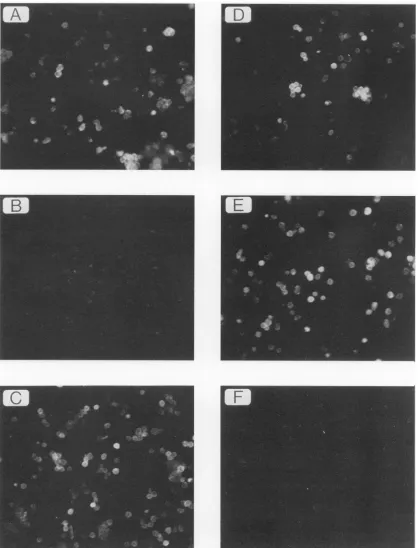
reactivity to MAb 516 or Hy 7. Changing the glutamine to
lysine in this chimeric MuLV resulted in aconversion froma
MAb516-reactive MuLV to one whichwasreactive with Hy 7
(Fig. 4).Similarly, changing the lysinetoglutamineatposition 173 of MCF 247 abolished reactivity to Hy 7, suggesting that lysine at this position is necessary for reactivity to that anti-body. However, with MCF 247 the amino acid conversion did notresult in a conversion of thereactivity to MAb 516 (Fig.5). This result suggests that glutamine at position 173 is not sufficient forreactivity to MAb 516 and that additional
differ-ence(s)between MCF247and MCF 13 also influence reactiv-ity to this MAb.
Our analyses indicate that the two antigenic subclasses of
polytropicMuLVsaredeterminedbyalternative allelic nucle-otide sequences and verylikelyarethe resultof recombination with distinct sets of endogenous polytropic env genes.
Detection of polytropic MuLVs from ecotropic MuLV-in-fected mice: distinct distributions ofpolytropic MuLV anti-genic subclasses are expressed after infection with different ecotropicMuLVs.Theresultspresentedin Table1suggestthat the frequencies of occurrence of the antigenic subclasses of
polytropic MuLVs maydiffer in the same mouse strain after inoculation with different ecotropic viruses. All polytropic
isolates from NFS/N mice inoculated with Mo-MuLV were reactive with MAb 516, whereas polytropic isolates from NFS/N mice inoculated with F-MuLV were reactive with Hy 7
orunreactive with either MAb. Protocols for the isolation of
polytropic MuLVs have generally included extensive ex vivo selectiononminkcells (4, 19, 24, 27). However, in more recent studies we observed that polytropic MuLVs generated in
AKR/J mice, which have an endogenous ecotropic MuLV,
were much more efficiently detected on mouse cell lines (18, 22). In the present study, we compared the efficiency of detection of polytropic MuLVs on mouse and mink cell lines after inoculation of NFS/N mice with F-MuLV57 or Mo-MuLV, to determine which system would minimize the bias imposed by ex vivo selection. We found the efficiency of
detection ofpolytropic MuLVs with themousecellline to be
vastly greater than that with mink cells (Table 2). Polytropic MuLVs from the spleens of Mo-MuLV-infected mice were
detected 10,000-foldmore efficientlyon mouse cells than on
minkcells, and those from thethymusweredetected 100-fold more efficiently. No polytropic isolates were detected in IC assays with minkcellsusing up to 106 spleen orthymuscells
from F-MuLV57-infected mice. Assays using the mouse cell line detected substantial levels ofpolytropic MuLVsfrom the spleens and thymuses of mice infected with Mo-MuLV,
F-MuLV57, ora third ecotropic MuLV, FB-29 (Table 2). The resultspresented in Table2correspondtothesumofparallel IC assaysusing MAb 516 or Hy7.These valueswere corrob-orated in parallel assays using MAb 514 (data not shown).
MAb 514 was reactive with all polytropic MuLVs including
thoseisolates whichwere notreactive with either MAb 516or
Hy 7(Table 1). Thus, polytropicMuLVscorrespondingtothe
two antigenic subclasses constituted the major proportion of
polytropicMuLVs detected from infected mice.
A comparison of the antigenic subclasses of polytropic
MuLVsdetected in theexperiments described above(Table 2)
ispresented inFig.6. Thedataareexpressedasthe percentage offocidetected,with the combinedtotalof MAb 516 andHy 7 foci as 100%. Results obtained with each mouse in the analyses are presented to illustrate the variability observed among individual mice. Most Mo-MuLV-infected mice
ex-pressed both subclasses ofpolytropicMuLVsin thespleenand the thymus, although the percentage of MAb 516-reactive MuLVs usually exceeded that of the Hy 7-reactive MuLVs
(Fig. 6Aand B). F-MuLV57-infected mice exhibited a strik-ingly different pattern of polytropicMuLVexpression (Fig. 6C and D). High percentages of Hy 7-reactive MuLVs were
detected in both the spleen and the thymus, and most mice exhibitedno MAb516-reactive MuLVs.Mice infected with a
second F-MuLV strain, FB-29, expressed both subclasses of
polytropic MuLVs inthespleenandthymus (Fig. 6EandF).
This result was similar to that obtained with
on November 9, 2019 by guest
http://jvi.asm.org/
[image:5.612.158.472.73.277.2]FIG. 4. Conversion of MAb 516 reactivity to Hy 7 reactivity by point mutation. M. dunni cells transfected by the chimeric virus MCF 247/Xh-E13wereassayed bymembraneimmunofluorescenceforreactivitytoMAb573(A)toconfirminfection of the cells.Theantigenicsubclass of the viruswasdeterminedbyreactivitytoHy7(B)orMAb516(C). Thederivative of MCF247/Xh-E13inwhich theglutamineatposition173 of the SUproteinwaschangedto alysinebyin vitromutagenesis(see Fig. 3)wasalso tested forreactivitywithMAb573(D),Hy 7(E),orMAb516 (F).
on November 9, 2019 by guest
http://jvi.asm.org/
[image:6.612.103.521.105.653.2]FIG. 5. Alteration of Hy 7reactivitybypointmutation.Membraneimmunofluorescenceassays wereperformedonM. dunni cells transfected byMCF 247with MAb 573(A)toconfirminfection of the cells. Theantigenicsubclass of the viruswasdeterminedbyreactivitytoHy7(B)or MAb 516(C).Parallel assays of a mutant of MCF 247 in which thelysine atposition173ofthe SUproteinwaschangedto aglutamine byinvitro mutagenesis (Fig.3) determined reactivities with MAb 573 (D), Hy 7(E), and MAb 516(F).
on November 9, 2019 by guest
http://jvi.asm.org/
[image:7.612.100.519.103.657.2]TABLE 2. ICtitersofpolytropicMuLVsfrom spleens or thymuses of infected NFS/N mice Log ICtiter(mean ±SD)b for cells ofindicatedtype
EcotropicMuLVa No.of mice Mouse (SC-1) Mink (CCL-64)
Spleen Thymus Spleen Thymus
Mo-MuLV 9 4.05±0.67 3.95 +0.62 <1 1.96±0.93
F-MuLV57 8 4.05 ±0.32 2.11±0.63 <0 <0
FB-29 5 3.46±0.27 2.92±0.27 NDC ND
a NFS/Nmicewereinoculated neonatallywithMo-MuLV, F-MuLV57,or FB-29 and assayed at 5 to 8weeksof age.
bThepolytropicMuLVtiterwasdeterminedas a sumofHy7-reactiveandMAb516-reactivefoci scored by the focalimmunofluorescenceassay asdescribedin
MaterialsandMethods.The IC titer isthe numberof cellsper million which scoredasfluorescent fociinthe assay.The titer isexpressed as theaverage of the log of the ICs determinedfromindividualmice.
cND, notdetermined.
infected mice; however, the percentage of Hy 7-reactive MuLVs appeared higherinthe spleens of FB-29-infectedmice (Fig. 6E) than in mice infected with Mo-MuLV (Fig. 6A).
DISCUSSION
In this study, we have identified two major antigenic sub-classesofpolytropic MuLVsonthe basis of their reactivity to
M-MuLV
Q
1.).
F-MuLV57
FB-29
80 60 40 20
E Spleen _ ____ F Thymus
r
I
Ir
IF
12 3 4 5MouseNo.
I
123 4 5
Mouse No.
FIG. 6. Percentage of Hy 7- and MAb 516-reactive polytropic MuLVs detected from spleens or thymuses of infected mice. The
assayspresentedinTable 2areexpressedasthepercentagesofHy 7-and MAb 516-positive foci whichwere scored for individual mice. Resultswere obtained withspleenandthymuscells of mice infected
withMo-MuLV(nine mice) (AandB),F-MuLV57(eight mice) (Cand D), or FB-29 (five mice) (E and F). Open bars, MAb 516-reactive
MuLVs;closedbars, Hy7-reactive MuLVs.
MAb 516 orHy 7. Nearly all polytropic isolates reacted with either MAb 516 or Hy 7, while no virus reacted with both MAbs, suggesting that they recognize mutually exclusive
epitopes. Analyses of chimeric viruses and point mutagenesis
studies mapped sequences necessary for the reactivity of the
MAbsto the same codon in thepolytropic region of the SU
protein-encoding sequences. We have demonstrated the con-version of one subclass to the other by a single base change; thus, it isconceivable that mutation subsequent to recombina-tion could contribute to the dichotomy. This seems unlikely,
given that many mice exhibit approximately equal levels of both subclasses and the isolates appear stable upon ex vivo passage. Weconclude that the two subclasses are the resultof recombination of ecotropic MuLVs with two distinct sub-classesof endogenouspolytropic env genes.
Stoye and Coffin have also identified two subclasses of endogenouspolytropicenvgenesby direct analyses ofgenomic DNA(48,49).Itis clear that the subclasses described by Stoye and Coffin do not correspond to the antigenic subclasses defined by MAb 516 and Hy 7. The sequences they have characterized, termedpolytropicand modifiedpolytropic, are distinguished bya small in-frame deletionnear the middle of the SU protein-encoding sequences, approximately 250 bp from thecodon which influencesreactivitiestoHy 7and MAb 516. Furthermore, both Hy 7-reactive and MAb516-reactive
MuLVs are found among polytropic isolates which do not contain a deletion. Modified polytropic sequences constitute about30% of the endogenouspolytropicsequencesinseveral
mousestrains, yet only one naturally occurring isolate contain-ing suchasequence hasbeen described(31). This suggests that modifiedpolytropicsequencesdonotfrequentlyparticipatein recombinationtogeneratepolytropicMuLVs.Ouranalyses of
polytropicMuLV isolates(Table 1),aswellastheanalyses of
populations of polytropic MuLVs released from tissues of infected mice (Fig. 6), indicate that Hy 7-reactive and MAb 516-reactive polytropicMuLVs arefrequently generated and,
together, constitute a major proportion of the polytropic
viruses detected. We are currently investigating the distribu-tion of endogenous polytropic sequences that encode SU proteins reactive with Hy 7orMAb 516.
ItispossiblethatreactivitytoMAb 516orHy 7 couldsignal
different infectivity properties ofpolytropic MuLVs. The re-ceptor-bindingdomain of the SUproteincontainstwovariable
regions,termedVRAandVRB(2).VRAisastrong
determi-nant of receptor choice, whileVRB influences thestabilityof receptorbinding.The amino acidresidue which altered MAb 516 andHy7reactivities lies withinVRBandcould influence receptorbinding which could, in
turn,
affectinfectivity.Mostprotocols for the analysis and isolation of
polytropic
MuLVsinvolve passage and limitingdilution of the viruses inI
80-60
-420
[
ZP
on November 9, 2019 by guest
http://jvi.asm.org/
[image:8.612.62.299.330.644.2]mink cells (4, 19, 24, 27). Wefound that polytropic MuLVs
weredetected much more efficiently on mouse cells thanon
mink cells(Table 2).Itseemslikelythat manyof thepolytropic
MuLVs which have been isolated and studied may not be
representativeof theprevalent recombinantpolytropicMuLVs which arise in mice. Earlier studies, in which polytropic
MuLVsfrom Mo-MuLV-infected NFS/Nmice wereisolated
by
endpoint dilution on minkcells, detected only MAb 516-reactive MuLVs(20).Inthe presentstudy,wehave identifiedmajor polytropic MuLV populations of both antigenic sub-classes fromMo-MuLV-infectedNFS/Nmice(Fig.6A andB).
It is noteworthy that the ratio of MAb 516-reactive to Hy
7-reactive MuLVs from thymus cells of Mo-MuLV-infected micewasapproximatelythreefoldhigheronminkcells thanon mousecells (datanot shown), indicatingaselection for MAb 516-reactive MuLVs in this system. Although polytropic
MuLVisolates whicharemuchmoreinfectious formousecells
thanmink cells have beendescribed,
(18, 22),
it isunlikelythat invitrotropism
of thevirusesaccountsfor thehugedifference between the detection ofpolytropic
MuLVs on mouse cells and that on minkcells. Viral pseudotyping of the polytropicMuLVRNAinecotropicvirionscouldaccountfor the
discrep-ancy. The observation that polytropic MuLVs from the thy-muses ofMo-MuLV-infected mice can be detected on mink cells whereas polytropic MuLVs from the spleens of
Mo-MuLV-infected miceare rarelydetected onmink cells
(Table
2)
suggests that the extent of pseudotyping may differ in different tissues.Our
findings
indicate that infection of NFS/N mice withdifferentecotropicMuLVsgivesrisetodistinctpopulationsof
polytropic
MuLVs. There are anumber ofpossible
explana-tions for this observation. If recombination occurs
during
reverse transcription ofheterodimeric RNA (33), ecotropicMuLVs could exhibit
specificity
at the level of heterodimer formation with different endogenous RNAtranscripts.
Eco-tropic
MuLVsdiffer in theirtissueandcelltropisms (14,
19, 23,35, 41); thus, the type of recombinant virus generated could reflect the type ofRNAtranscriptsavailable for heterodimer formation ina
particular
cell type. Itis also conceivable thatpolytropic
MuLVs are generated by a mechanism involvingDNA.If so,homologybetween theecotropicandendogenous
retroviral sequences could influence the recombination fre-quency.
Alternatively,
differences inpopulations
ofpolytropic
MuLVs observed after inoculation of different ecotropic
MuLVscould be the result of in vivo selection of the
recom-binant virusessubsequenttotheirgeneration.
Differences inpolytropicMuLVpopulationsobserved after infection of mice with different
ecotropic
MuLVs may be relevant to pathology. Mo-MuLVand F-MuLV57causelym-phocytic
leukemia anderythroleukemia, respectively,
andex-hibit strikingly different proportions of the polytropic MuLV subclasses
(Fig. 6).
The FB-29 strain ofF-MuLV also differs fromF-MuLV57 with regard to polytropic MuLV subclasses;however,
this doesnotpreclude the possibilitythat F-MuLVsgeneratea particular polytropic speciesinvolved in the induc-tion of erythroleukemia. A high proportion of thymomas
induced by Mo-MuLV exhibit integration of a polytropic
MuLVprovirusnear ac-oncgene (47, 51). Both subclasses of
polytropic
MuLVs wereidentified inmostMo-MuLV-infectedmice
(Fig.
6A and B). Preliminary studies suggest that MAb516-reactiveandHy 7-reactiveMuLVisolates from these mice exhibit different infectiouspropertiesinvitro. Given that such differencesmightreflectdifferences ininfectivityforparticular
cell types in vivo, it is possible that a particular polytropic
MuLVsubclassis involved in the aberrantexpressionofc-onc
genesin Mo-MuLV-induced tumors.
ACKNOWLEDGMENTS
We thank John Coffin, Marguerite Vogt, Christie Holland, and BruceChesebro for generously supplying particularMuLVsused in thisstudy.Wealso thankBobEvansandGaryHetrick forpreparing artwork and BruceChesebro, KimHasenkrug, John Portis,and Bill Lynchforhelpful discussions.
REFERENCES
1. Adachi, A., K. Sakai, N. Kitamura, S. Nakanishi, 0. Niwa, M. Matsuyama, and A. Ishimoto. 1984. Characterization of theenv geneandlong terminalrepeatofmolecularly cloned Friend mink cellfocus-inducingvirus DNA. J.Virol. 50:813-821.
2. Battini, J.-L., J. M. Heard, and 0. Danos. 1992. Receptorchoice determinantsintheenvelope glycoproteins of amphotropic,
xeno-tropic,andpolytropic murine leukemia viruses.J.Virol. 66:1468-1475.
3. Blatt, C., K. Mileham, M. Haas, M. N.Nesbitt,M. E.Harper, and M. I. Simon. 1983. Chromosomal mapping of the mink cell focus-inducing and xenotropicenvgenefamilyin themouse.Proc. Natl. Acad. Sci.USA 80:6298-6302.
4. Bosselman, R.A.,L.J. L. D.vanGriensven, M.Vogt, and I. M. Verma. 1979. Genome organizationof retroviruses. VI. Hetero-duplexanalysis of ecotropic and xenotropicsequencesofMoloney minkcellfocus-inducing viralRNAobtained from eitheracloned isolateorathymoma cell line.J.Virol. 32:968-978.
5. Bosselman,R.A., F.vanStraaten,C. VanBeveren,I. M.Verma, and M.Vogt. 1982. Analysis of the env gene of a molecularly cloned and biologicallyactive Moloney mink cell focus-forming proviralDNA. J.Virol. 44:19-31.
6. Buller, R.S., K.Wehrly, J. L.Portis,andB.Chesebro. 1990. Host genes conferringresistance to a central nervoussystem disease inducedbyapolytropicrecombinant Friendmurine retrovirus. J. Virol.64:493-498.
7. Chattopadhyay, S. K., M. W. Cloyd, D. L. Linemeyer, M. R. Lander, E. Rands, and D. R. Lowy. 1982.Cellularoriginand role of minkcellfocus-forming viruses inmurine thymic lymphoma. Nature(London) 295:25-31.
8. Chattopadhyay, S. K.,M. R. Lander, S. Gupta, E. Rands, and D. R.Lowy. 1981.Originof minkcytopathic focus-forming (MCF) viruses:comparison with ecotropic and xenotropicmurine leuke-mia virus genomes.Virology113:465-483.
8a.Chesebro,B.Personalcommunication.
9. Chesebro, B.,W.Britt, L.Evans,K.Wehrly, J. Nishio, and M. Cloyd. 1983. Characterizationofmonoclonal antibodiesreactive with murine leukemia viruses:useinanalysisof strains ofFriend MCF and Friend ecotropic murine leukemia virus. Virology 127:134-148.
10. Chesebro,B., K.Wehrly,J.Nishio,and L. Evans.1984.Leukemia inductionbya newstrain of Friend mink cellfocus-inducing virus: synergisticeffect of Friend ecotropic murine leukemiavirus. J. Virol.51:63-70.
11. Chien, Y.-H., I. M. Verma, T. Y. Shih, E. M. Scolnick, and N. Davidson. 1978.Heteroduplex analysis of thesequencerelations between the RNAs of mink cell focus-inducing and murine leukemia viruses.J.Virol.28:352-360.
12. Cloyd, M. W., B. Chesebro, J. L. Portis, and M. Weir. 1982. MCF-specific murinemonoclonalantibodiesmadeagainst AKR-247 MCFvirusrecognizeauniquedeterminant associatedwith the
gp7O-pl5(E)complex.J.Virol. 41:1112-1117.
13. Cloyd,M.W., J.W.Hartley,and W. P.Rowe. 1980.
Lymphoma-genicityofrecombinantmink cellfocus-inducingmurineleukemia viruses. J. Exp.Med. 151:542-552.
14. DesGroseillers, L.,E.Rassar,and P.Jolicoeur. 1983. Thymotro-pism of murine leukemia virus is conferredbyitslong terminal repeat. Proc.Natl. Acad. Sci. USA 80:4203-4207.
15. Donoghue, D.J.,E. Rothenberg,N. Hopkins,D. Baltimore,and P. A.Sharp. 1978.Heteroduplex analysisofnonhomologyregion betweenMoloneyMuLVand the dualhostrangederivative HIX virus. Cell 14:959-970.
16. Elder, J. H., J. W. Gautsch, F. C. Jensen, R. A. Lerner, J. W. Hartley,andW. P. Rowe. 1977.Biochemical evidence that MCF murine leukemiaviruses areenvelope (env) generecombinants. Proc. Natl. Acad.Sci. USA74:4676-4680.
on November 9, 2019 by guest
http://jvi.asm.org/
17. Evans, L., M. Nunn, P. H. Duesberg, D. Troxler, and E. Scolnick. 1980. RNAs of defective and nondefectivecomponents of Friend anemia andpolycythemia virus strains identified and compared. Cold Spring Harbor Symp. Quant. Biol.44:823-835.
18. Evans, L. H. 1986. Characterization of polytropic MuLVs from
three-week-oldAKR/Jmice. Virology 153:122-136.
19. Evans, L. H., and M. W. Cloyd. 1984. Generation of mink cell focus-formingviruses by Friendmurine leukemia virus: recombi-nation with specific endogenous proviral sequences. J. Virol.
49:772-781.
20. Evans, L.H., andM. W.Cloyd. 1985.Friend and Moloney murine leukemiavirusesspecifically recombine with different endogenous retroviral sequencestogeneratemink cell focus-forming viruses. Proc. Natl.Acad. Sci.USA 82:459-463.
21. Evans, L. H., and P. H. Duesberg. 1982. Isolation ofa
transfor-mation-defective deletion mutant of Moloney murine sarcoma
virus. J. Virol.41:735-743.
22. Evans,L. H., and F. G. Malik. 1987. ClassII polytropic murine
leukemia viruses (MuLVs) of AKR/J mice: possible role in the
generation of class I oncogenic polytropic MuLVs. J. Virol.
61:1882-1892.
23. Evans,L. H., and J. D. Morrey. 1987.Tissue-specific replication of Friendand Moloney murine leukemia viruses in infected mice.J.
Virol.61:1350-1357.
24. Fischinger,P. J., S. Nomura, and D. P. Bolognesi. 1975.A novel
murine oncornavirus with dual eco- and xenotropic properties.
Proc.Natl. Acad. Sci. USA 72:5150-5155.
25. Green,N., H. Hiai,J. H.Elder, R. A. Schwartz, R. H. Khiroya,
C.Y. Thomas, P.N. Tsichlis, and J. M. Coffin. 1980.Expressionof
leukemogenic recombinant viruses associated with a recessive
genein HRS/J mice.J. Exp.Med. 152:249-264.
26. Hartley,J. W., and W. P. Rowe. 1975.Clonal cell lines fromaferal
mouse embryo which lack host-range restrictions for murine
leukemiaviruses. Virology65:128-134.
27. Hartley,J. W., N. K. Wolford, L. J. Old, and W. P. Rowe. 1977.A
newclass of murine leukemiavirusassociated with developmentof
spontaneouslymphomas. Proc.Natl. Acad. Sci. USA 74:789-792. 28. Henderson,I.C.,M. M. Lieber, andG.J.Todaro.1974. Mink cell
line MvlLu (CCL-64). Focus formation and the generation of
"nonproducer" transformed cell lines with murine and feline
sarcomaviruses.Virology 60:282-287.
29. Holland, C. A., J. Wozney, and N. Hopkins. 1983. Nucleotide
sequenceof the gp7Ogeneof murineretrovirus MCF 247.J.Virol.
47:413-420.
30. Kelly, M., C.A.Holland,M. L. Lung,S. K.Chattopadhyay,D. R.
Lowy, andN. H. Hopkins. 1983.Nucleotidesequenceof the 3'end
of MCF 247 murine leukemiavirus. J. Virol. 45:291-298.
31. Koch, W., W. Zimmerman, A. Oliff, and R. Friedrich. 1984.
Molecular analysis ofthe envelopegeneand longterminalrepeat
of Friend mink cell focus-inducing virus: implications for the
functionsof thesesequences. J. Virol.49:828-840.
32. Lander, M. R.,and S. K. Chattopadhyay. 1984. A Musdunnicell
line that lacks sequences closely related to endogenous murine
leukemiaviruses andcanbe infected byecotropic,amphotropic,
xenotropic,and mink cell focus-forming viruses. J. Virol.
52:695-698.
33. Linial, M., and D. Blair. 1984. Genetics of retroviruses, p.
649-783.In R. Weiss, N.Teich, H. Varmus, and J. Coffin (ed.), RNAtumorviruses, 2nd ed.Cold Spring Harbor Laboratory, Cold
Spring Harbor,N.Y.
34. Lung, M. L.,J. W. Hartley,W. P.Rowe,andN. H.Hopkins. 1983.
Large RNase
T,-resistant
oligonucleotides encodingplSEandtheU3 regionof the long terminal repeat distinguish twobiological
classesof mink cell focus-formingtypeCvirusesof inbredmice.J.
Virol. 45:275-290.
35. Masuda, M., P. M. Hoffman, and S. K. Ruscetti. 1993. Viral
determinants that control the neuropathogenicity of PVC-211 murine leukemiavirus in vivo determine brain capillary
endothe-lial cell tropism of the virusinvitro. J. Virol. 67:4580-4587.
36. O'Donnell, P. V., E. Stockert, Y. Obata, and L. J. Old. 1981. Leukemogenic properties of AKR dualtropic (MCF) viruses: amplification of murine leukemia virus-related antigens on thymo-cytes and acceleration of leukemia development in AKR mice. Virology 112:548-563.
37. Oliff, A.I.,G. L. Hager, E. H. Chang, E. M.Scolnick,H. W. Chan, and D. R. Lowy. 1980. Transfection of molecularly cloned Friend murine leukemia virus DNA yields a highly leukemogenic helper-independent type C virus. J. Virol. 33:475-486.
38. O'Neill, R. R., A. S. Khan, M. D. Hoggan, J. W. Hartley, M. A. Martin, and R. Repaske. 1986. Specific hybridization probes demonstrate fewer xenotropic than mink cell focus-forming mu-rine leukemia virus env-related sequences in DNAs from inbred laboratory mice. J. Virol. 58:359-366.
39. Ott, D., and A. Rein. 1992. Basis for receptor specificity of nonecotropic murine leukemia virus surface glycoprotein gp70su.
J. Virol. 66:4632-4638.
40. Rommelaere, J., D. V. Faller, and N. Hopkins. 1978. Character-ization and mapping of RNase TI-resistant oligonucleotides de-rived from the genomes of Akv and MCF murine leukemia viruses. Proc. Natl. Acad. Sci. USA 75:495-499.
41. Rosen, C. A., W. A. Haseltine, J. Lenz, R. Ruprecht, and M. W. Cloyd. 1985. Tissue selectivity of murine leukemia virus infection is determined by long terminal repeat sequences. J. Virol. 55:862-866.
42. Rowe, W. P., M. W. Cloyd, and J. W. Hartley. 1980. The status of the association of MCF viruses with leukemogenesis. Cold Spring Harbor Symp. Quant. Biol. 44:1265-1268.
43. Ruscetti, S., L. Davis, J. Feild, and A. Oliff. 1981. Friend murine leukemia virus-induced leukemia is associated with the formation of mink cell focus-inducing viruses and is blocked in mice express-ing endogenous mink cell focus-inducexpress-ing xenotropic viral envelope genes. J. Exp. Med. 154:907-920.
44. Shih, T. Y., M. 0.Weeks, D. H.Troxler,J. M. Coffin, and E. M.
Scolnick. 1978. Mapping host range-specific oligonucleotides within genomes of the ecotropic and mink cell focus-inducing strains of Moloney murine leukemia virus. J. Virol. 26:71-83. 45. Sitbon, M., J. Nishio, K. Wehrly, D. Lodmell, and B. Chesebro.
1985. Use of a focal immunofluorescence assay on live cells for quantitation of retroviruses: distinction of host range classes in virus mixtures and biological cloning of dual-tropic murine leuke-mia viruses. Virology 141:110-118.
46. Sitbon, M., B. Sola, L. Evans, J. Nishio, S. F. Hayes, K. Nathanson, C. F. Garon, and B. Chesebro. 1986. Hemolytic anemia and erythroleukemia, two distinct pathogenic effects of Friend MuLV: mapping of the effects to different regions of the viral genome. Cell 47:851-859.
47. Selten, G., H. T. Cuypers, M. Zijlstra,C. Melieft, and A. Berns. 1984. Involvement of c-myc in M-MuLV-induced T-cell lympho-mas of mice: frequency and mechanisms of activation. EMBO J. 3:3215-3222.
48. Stoye, J. P., and J. M.Coffin. 1987. The four classes of endogenous murine leukemia virus: structural relationships and potential for recombination. J. Virol. 61:2659-2669.
49. Stoye, J. P., and J. M. Coffin. 1988. Polymorphism of murine endogenous proviruses revealed by using virus class-specific oligo-nucleotide probes. J. Virol. 62:168-175.
50. Thomas, C. Y., B. J. Boykin, N. G. Famulari, and M. A. Coppola. 1986. Association of recombinant murine leukemia viruses of the class II genotype with spontaneous lymphomas in CWD mice. J. Virol. 58:314-323.
51. van der Putten, H., W. Quint, J. van Raaij, E. R. Maandag, I.M. Verma, and A. Berns. 1981. M-MuLV-induced leukemogenesis: integration and structure of recombinant proviruses in tumors. Cell 24:729-739.
52. Vogt, M., C. Haggblom, S. Seift, and M. Haas. 1985. Envelope gene and long terminal repeat determine the different biological
properties of Rauscher, Friend, and Moloney mink cell focus-inducing viruses. J. Virol. 55:184-192.