Copyright © 1999, American Society for Microbiology. All Rights Reserved.
Contributions of Viral Splice Sites and
cis
-Regulatory Elements
to Lentivirus Vector Function
YAN CUI, TOMOO IWAKUMA,ANDLUNG-JI CHANG*Department of Molecular Genetics and Microbiology, Gene Therapy Center, and University of Florida Brain Institute, College of Medicine, University of Florida, Gainesville, Florida 32610-0266
Received 28 October 1998/Accepted 9 April 1999
The mobile transgene constructs of most human immunodeficiency virus (HIV)-based lentivirus vectors
currently in use contain viral long terminal repeats, a 5*untranslated region,gagsequences, andenvsequences
that include the Rev-responsive element (RRE). In this study, we examined the possibility of deleting HIV
splice sites andgagandenvsequences from an HIV type 1 recombinant vector established in our laboratory
as part of our ongoing efforts to improve this vector system. Mutations in the major splice donor site (SD)
markedly reduced viral RNA expression but had little effect on vector titer. Deletion ofgagorenvsequences,
excluding RRE, led to a moderate reduction in vector titer. Interestingly, deletion of RRE slightly reduced viral
RNA expression but markedly impaired vector function. Combined deletions of RRE,gag(except for the first
40 nucleotides),env, and the SD mutation resulted in a twofold increase in cytoplasmic viral RNA expression
and a recovery of vector efficiency to;50% of the wild-type level. This increase in cytoplasmic RNA levels is
likely to be due, at least in part, to effects of the TE671 host cells, a human rhabdomyosarcoma cell line used for vector production in our system, on the cytoplasmic distribution of spliced and unspliced viral RNA. These results show that optimal lentivirus vector function can be maintained in the absence of multiple essential viral elements.
Lentiviruses have advantages over traditional Moloney mu-rine leukemia virus-derived vectors in transient and long-term transduction of various types of human cells (11, 23, 30, 31). To establish a safe lentivirus vector system, it is necessary to delete essential viral sequences without compromising vector func-tions. The human immunodeficiency virus (HIV) 59 untrans-lated region (UTR) contains several essential regulatory ele-ments, including the primer binding site for initiation of reverse transcription and a structure of four stem-loops as part of the packaging signal (C) for genome packaging (13, 15, 28). Previous studies demonstrated that deletions in this region markedly reduced packaging efficiency and HIV replication (12, 25). Besides the four stem-loops in the 59 UTR, other sequences have been identified throughout the HIV genome as additional packaging signals. These include 59gag,pol(13), 39
env(13, 24), TAR (14, 17, 29), and the 59poly(A) hairpin motif in U5 (18, 39). Deletion of any of these elements from the vector system may diminish vector function. Another factor affecting vector function is the level of cytoplasmic viral RNA expression controlled by viral regulatory proteins and genetic elements (reviewed in references 19 and 20). This regulation is mediated by Rev, which counteracts the nuclear retention of viral RNA controlled by splice sites and cis-repressive se-quences (CRS) (or inhibitory sese-quences [INS]) to allow nu-clear export of Rev-responsive element (RRE)-containing RNAs (3, 7–9, 32, 35). Some of these CRS/INS elements have been mapped to reside within the splice donor site (SD) (6, 21, 36), p17 of gag (5, 37, 38), pol (16, 27, 33), and env (32). Deletion of these elements may affect viral RNA expression and thus vector function.
We have recently established an HIV type 1-based lentivirus vector system, HP/TV, which produces high vector titers, more than 106infectious particles per ml upon transfection of human
TE671 cells with three plasmids (pTV, pHP, and pHEFVSV-G), without detectable replication-competent virus (11). To further improve the safety and payload of this vector system, we attempted to delete more of the essential viral elements in pTV. Through mutation and deletion analyses, the contribu-tions of these genetic elements to viral RNA expression and vector function were elucidated.
Mutations of the 5* splice site down-regulate cytoplasmic
RNA expression but have only moderate effects on vector titer.
We first mutated the consensus SD sequence in pTV by PCR site-specific mutagenesis (primers are listed in Table 1). Mu-tations of SD from GGTG to GCAG (SD1) or to GGGG (SD2) resulted in a moderate decrease (10 to 30%) in vector titer (Fig. 1A). To determine the mutational effects of SD on pTV RNA expression, TE671 cells were transfected with 20mg of pTV, 2mg of pCEP4tat, 4mg of pCMVrev, and 0.2mg of pXGH5, which encodes human growth hormone, as a trans-fection control. Forty hours posttranstrans-fection, the cells were lysed and cytoplasmic poly(A)1RNA was harvested for North-ern analysis, as previously described (10). As shown in Fig. 1B, wild-type pTV produced four different sizes of RNA: full length, short intron spliced, a cytomegalovirus (CMV) promo-tor-driven nlacZ transcript which comigrated with a spliced RNA species, and large intron spliced. The SD mutations (SD1 and SD2), as predicted, abrogated splicing. However, minute amounts of short intron-spliced RNA, due to the use of a cryptic 59splice site as previously reported (36), were detected (Fig. 1B, lanes 3 and 4). It is noteworthy that mutations of SD reduced expression of cytoplasmic full-length RNA by more than 70% compared with wild-type vector, possibly due to decreased stability of the unspliced RNA or to pretermination of transcription. It has been reported that the 59SD imposes a suppressive effect on activation of the polyadenylation site in * Corresponding author. Mailing address: Rm. R1-252, ARB,
De-partment of Molecular Genetics and Microbiology, Gene Therapy Center, University of Florida, Gainesville, FL 32610-0266. Phone: (352) 392-3315. Fax: (352) 392-3133. E-mail: [email protected] .edu.
6171
on November 9, 2019 by guest
http://jvi.asm.org/
the 59long terminal repeat (1, 2), and thus mutations of SD may activate 59polyadenylation. The decline in genomic RNA expression (70%), however, did not correlate with the reduc-tion in vector titer (10 to 30%). This could be explained by the following two possibilities. First, the amount of full-length RNA is always in excess of the viral packaging requirement and thus is not a determining factor of vector titer. Second, the elimination of spliced RNA by SD mutation abrogates its terference in genomic RNA packaging and thus results in in-direct enhancement of packaging of full-length RNA. In any event, our results demonstrated that SD itself is not directly involved in HIV packaging and can be mutated in the vector system.
Most ofgagand the entireenvsequences, except RRE, are
dispensable for optimal lentivirus vector function.gagandenv
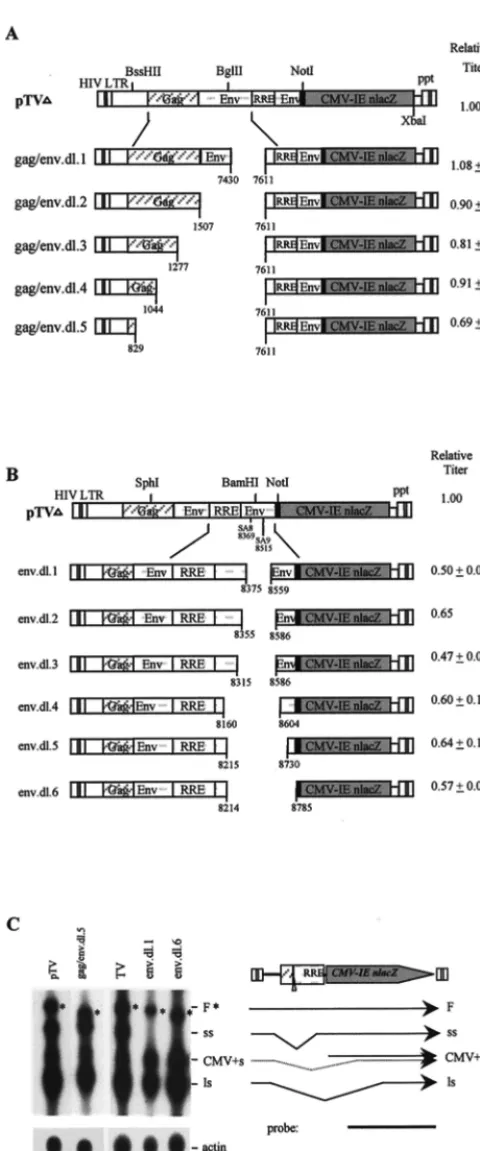
sequences contain potential packaging signals, splice sites, and CRS/INS elements. To examine their effects on vector func-tions, a series of deletions ingagandenvwere generated and tested. An array of deletions of 180, 361, 591, 824, and 1039 bp, in gag and env (upstream of RRE) was made by PCR site-specific mutagenesis (Table 1; Fig. 2A). Deletions ofenv59to RRE and most ofgag39to the first 255-nucleotide (nt) coding sequence in pTV had no significant effects on vector titer (dl.1 to dl.4 [Fig. 2A]). Deletion ofgagup to the first 40 nt led to a 30% decrease in vector titer (dl.5 [Fig. 2A]). Northern analyses showed that these mutants expressed cytoplasmic RNA at lev-els similar to that of wild-type pTV (not shown). Therefore, deletions of 59envand 39gagdid not significantly affect RNA expression and vector titer. Deletion of gag 59 coding se-quences (dl.5) had a mild effect on vector titer (Fig. 2A),
although it did not affect viral RNA expression (Fig. 2C), suggesting a role for the gag 59 255 nt in RNA packaging. These results are consistent with previous observations that the first 21 to 653 nt ofgagare important for RNA packaging (4, 13, 26, 28, 34).
To further dissect the effects of env sequences on vector function, six more deletions (dl.1 to dl.6) in env39 to RRE, which contains two 39splice acceptor sites (SA), were gener-ated byBal31 exonuclease digestion (Fig. 2B). Deletion of 39
envSA resulted in an overall;40% reduction in vector titer (Fig. 2B), and Northern analyses showed reduction in full-length genomic RNA and abrogation of the short intron-spliced RNA species (Fig. 2C, lanes 4 and 5). Therefore, the sequences ofenvSA appear to have moderate effects on full-length RNA expression as well as on vector function.
Deletion of RRE markedly diminishes vector titer. To
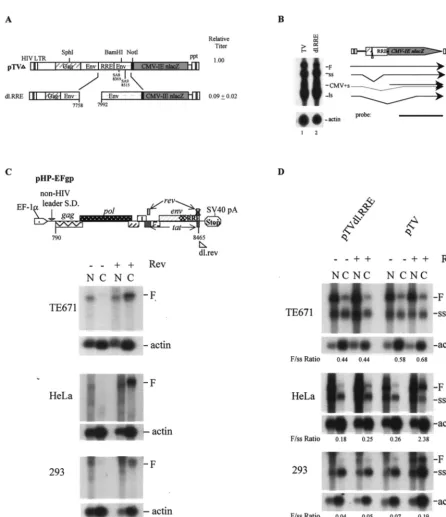
[image:2.612.59.550.83.177.2]de-termine the effects of RRE on lentivirus vector function, pre-cise RRE deletion was made by PCR mutagenesis (Table 1; Fig. 3A). RRE deletion alone led to a marked reduction in vector titer (.90%). Interestingly, Northern analyses indicated that the RRE deletion had only moderate effects on vector RNA expression in TE671 cells (Fig. 3B, lane 2 versus lane 1). This is inconsistent with previous observations that removal of RRE from HIV usually abolishes cytoplasmic expression of full-length viral RNA (24, 34). It is possible that the recombi-nant vector backbone might contribute to this phenotype. Al-ternatively, the specific cell type (TE671) that we used for production of vectors might be different from those used by others. To clarify these issues, three different cell lines— TE671, HeLa, and 293—were transfected with different vector
FIG. 1. Analyses of SD mutations. (A) Schematic diagram of SD mutations and relative vector titers. For virus production, plasmids pTV, pHP, pHEF VSV-G, and pXGH were used to cotransfect TE671 cells. Culture supernatants containing viral vectors were harvested at 48 h posttransfection and used to determine viral titer or to determine transfection efficiency via radioimmunoassay measurement of human growth hormone. The relative vector titer of each mutant was normalized against pTV, which was arbitrarily set at 1.00. The titer of pTV was consistently 23105to 103105CFU/ml. The relative titer represents an average of 4 to 7 independent
experiments6standard error. (B) Northern analysis of poly(A)1cytoplasmic RNA of SD mutants (SD1 and SD2) in transfected TE671 cells. The four major RNA spices are abbreviated as follows: F, full-length unspliced RNA; ss, short intron-spliced RNA (from 59SD to SA in HIVenv); CMV1s, CMV promoter-driven nlacZ
transcript plus a spliced RNA population with 59SD and a cryptic splice site in the CMV promoter; ls, long intron-spliced RNA (from 59SD to a cryptic SA in the nlacZgene). AlacZprobe was used for hybridization, as indicated.
TABLE 1. PCR mutagenesis primers used for construction of pTV mutants
Primer Mutant Mutation or deletion site Primer sequencea
1 SD1 GGTG3GCAG 733-59-ggcggcgactgcagagtacgccaa-39-756
2 SD2 GGTG3GGGG 733-59-ggcggcgactggggagtacgccaa-39-756
3 gag/env.dl.1 D(7431–7610) 7628-59-ctctggtctgaagatct/ttgaccttcagtactc-39-7414 4 gag/env.dl.2 D(1511–7610) 7628-59-ctctggtctgaagatct/actagtagttcctgctatg-39-1494 5 gag/env.dl.3 D(1278–7610) 7628-59-ctctggtctgaagatct/gccttctcttctactact-39-1260 6 gag/env.dl.4 D(1045–7610) 7628-59-ctctggtctgaagatct/gaggactgctattgtatt-39-1027 7 gag/env.dl.5 D(830–7610) 7628-59-ctctggtctgaagatct/ctaattctcccccgctt-39-812
8 dl.RRE D(7759–7992) 8006-59-aaccccaaatcccc/attcccactgctcttttt-39-7741
aThe numbering system corresponds to pNL
4-3.
on November 9, 2019 by guest
http://jvi.asm.org/
[image:2.612.75.530.540.658.2]constructs—pTV, dl.RRE, or pHP-EFgp (a pHP mutant helper construct withrevdeletion [Fig. 3C])—in the presence or absence of arev plasmid. Cytoplasmic and nuclear RNAs were harvested and analyzed by Northern blotting. The results showed that pHP-EFgp did not transport unspliced RNA into the cytoplasm of transfected cells in the absence ofrev(Fig. 3C, lane 2). When rev was present, full-length, unspliced RNA species were detected in the cytoplasm of all three cell types, suggesting that a similar Rev phenotype can be seen with a less-truncated HIV vector construct (Fig. 3C, lane 4). Interest-ingly, when RNA of the wild-type pTV construct was exam-ined, differences in RNA partition ratio were observed in dif-ferent cell types (Fig. 3D). In the presence of Rev, HeLa cells exhibited the highest ratio of cytoplasmic unspliced RNA to spliced RNA (2.38), while 293 cells exhibited the lowest (0.19) (Fig. 3D, lane 8). However, both HeLa and 293 cells showed a loss of full-length RNA in the cytoplasm whenrevwas absent (Fig. 3D, lane 6). TE671 cells, in contrast, did not exhibit an obviousreveffect when transfected with either pTV or dl.RRE (TE671 [Fig. 3D], 0.58 versus 0.68 for pTV and 0.44 versus 0.44 for pTVdl.RRE). Therefore, the specific RNA partition phe-notype of the RRE mutant in TE671 is due to both the cell type and the specific pTV construct that we used.
Despite the presence of similar amounts of cytoplasmic full-length RNA in TE671 cells transfected with wild-type pTV and the dl.RRE mutant, the titer of the RRE mutant was less than 10% of that of wild-type pTV, suggesting an alternative effect of RRE on vector function independent of the known RRE effect on cytoplasmic viral RNA expression.
The combination of SD, SA, RRE andgag-env CRS
muta-tions restores vector titer to 50% of the wild-type level. The
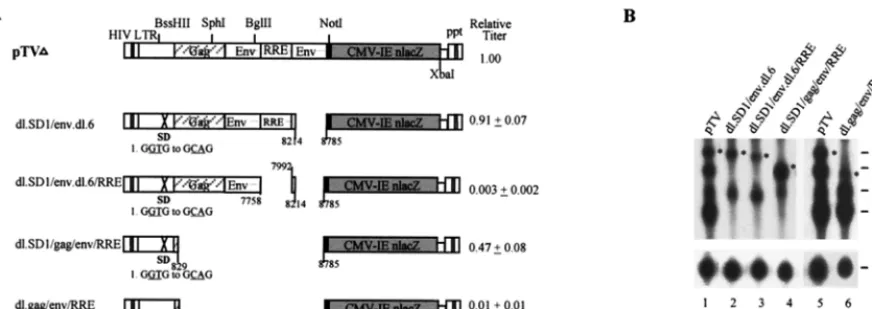
above results suggest that most of the HIV regulatory elements in pTV, except for RRE, have only moderate effects on vector function. To examine whether these regulatory elements could be deleted together, we combined different mutations and an-alyzed their effects. The combination of SD-SA mutation gen-erates a vector with a near-wild-type level of titer (dl.SD1/ env.dl.6) (Fig. 4A), which apparently repaired the defect of the env.dl.6 (SA) mutation (Fig. 2B). When RRE mutation was included, the resulting dl.SD1/env.dl.6/RRE mutant exhibited a vector titer close to zero (0.3% of wild-type level) (Fig. 4A). Interestingly, further removal of gag and env sequences re-sulted in a mutant, dl.SD1/gag/env/RRE, which showed a vec-tor titer close to 50% of the wild-type level. This resvec-tored vector function diminished to about 1% of the wild-type level when the SD mutation was reverted to the wild type (dl.gag/ env/RRE [Fig. 4A]), again suggesting a negative effect of splice site (SD-SA) disparity.
Northern analyses demonstrated that when both SD and SA were deleted (dl.SD1/env.dl.6) (Fig. 4B, lane 2), full-length viral RNA expression was reduced by about 50% but the vector titer was maintained at 90% of the wild-type level. Further deletion of RRE from this mutant did not reduce RNA ex-pression to a great extent (dl.SD1/env.dl.6/RRE) (Fig. 4B, lane 3), but vector function was markedly diminished (;0.3% of the wild-type level [Fig. 4A]). This result corroborated the ob-served effects of the pTV dl.RRE mutant (Fig. 3). Surprisingly, when most of thegag(except for the first 40 nt) and the entire
[image:3.612.53.293.81.657.2]envCRS/INS, including RRE, were deleted, a twofold increase in full-length viral RNA expression, compared to wild-type vector (dl.SD1/gag/env/RRE) (Fig. 4B, lane 4), with an accom-panying increase in vector titer (;50% of the wild-type level [Fig. 4A]), was observed. When the mutated 59 SD was re-verted to generate dl.gag/env/RRE, expression of full-length viral RNA was again suppressed to about 40% of the wild-type level (Fig. 4B, lane 6) and vector function was again abolished
FIG. 2. Analyses of 59gagandenvdeletions. (A) Schematic diagram of 59gag
and 59envmutants and relative vector titers. The relative titer represents the mean of four to six experiments and is normalized to that of pTV. (B) Schematic diagram of 39envmutants and relative vector titers. The relative titer represents an average of four to nine experiments (except for env.dl.2) and is normalized against pTV, which was set at 1.00. (C) Northern analyses ofgagandenvdeletion mutants. The full-length RNA is denoted by asterisks.
on November 9, 2019 by guest
http://jvi.asm.org/
(;1% of the wild-type level [Fig. 4A]). Therefore, only when all of the CRS/INS regulatory elements, including SD, most of
gag, the entireenv, and RRE, are deleted can optimal vector function be restored.
In summary, we have demonstrated that deletion of essential HIV regulatory elements, including splice sites,gag, env, and RRE, from the HP/TV vector system is possible without
[image:4.612.78.525.60.578.2]sig-nificant loss of vector titer. Together with further deletion of long terminal repeat elements in pTV from a separate study (22), we have reduced the HIV sequences in pTV to less than 550 bp. This has effectively increased the lentivirus vector pay-load to more than 9 kb, because the HIV genome is approxi-mately 9,700 nt. These modifications have effectively reduced the sequence homology between pHP and pTV and thus have
FIG. 3. Effects of RRE deletion on vector titer and RNA expression in different human cell types. (A) Schematic diagram of RRE deletion and relative vector titers. (B) Northern analysis of cytoplasmic RNA of the RRE deletion mutant in TE671 cells. (C) Northern analyses of full-length pHP-EFgp RNA in the presence or absence of Rev in TE671, HeLa, and 293 cells. Cells were transfected with pHP-EFgp, a pHP mutant helper construct withrevdeletion, in the presence (1) or absence (2) of arevplasmid. Cytoplasmic (C) and nuclear (N) RNA was harvested and hybridized with anenvprobe from nt 8133 to 8465 of pNL4-3. (D) Northern analyses of
nuclear and cytoplasmic RNA of pTV and pTVdl.RRE in TE671, HeLa, and 293 cells, in the presence and absence of Rev. A single HIVenvprobe was used; it hybridized to both full-length (F) and spliced (ss) RNA. The ratios of full-length to spliced RNA in the cytoplasm, which were determined by quantification of RNA bands with a Fuji BAS1000 phosphorimager, are indicated.
on November 9, 2019 by guest
http://jvi.asm.org/
greatly improved the safety of this vector system. Future mod-ifications of remaining lentivirus sequences will require re-placement of native viral essential elements with alternative functional elements while necessary functions for efficient vec-tor production and gene transduction are preserved.
We thank Martin Stoltzfus and Maurice Swanson for critical com-ments and Gang Guo and Edward Mason for technical assistance.
Lung-Ji Chang is a Markey Scholar of the Lucille P. Markey Char-itable Trust, and this work was supported by grants from the National Health and Research Development Program (NHRDP) of Canada and the National Institutes of Health (HL-59412) of the United States.
REFERENCES
1.Ashe, M. P., P. Griffin, W. James, and N. J. Proudfoot.1995. Poly(A) site selection in the HIV-1 provirus: inhibition of promoter-proximal polyade-nylation by the downstream major splice donor site. Genes Dev.9:3008– 3025.
2.Ashe, M. P., L. H. Pearson, and N. J. Proudfoot.1997. The HIV-1 59LTR poly(A) site is inactivated by U1 snRNP interaction with the downstream major splice donor site. EMBO J.16:5752–5763.
3.Barksdale, S. K., and C. C. Baker.1995. The human immunodeficiency virus type 1 Rev protein and the Rev-responsive element counteract the effect of an inhibitory 59 splice site in a 39 untranslated region. Mol. Cell. Biol. 15:2962–2971.
4.Berkowitz, R. D., M. L. Hammarskjold, C. Helga-Maria, D. Rekosh, and S. P. Goff.1995. 59regions of HIV-1 RNAs are not sufficient for encapsida-tion: implications for the HIV-1 packaging signal. Virology212:718–723. 5.Berthold, E., and F. Maldarelli.1996.cis-acting elements in human
immu-nodeficiency virus type 1 RNAs direct viral transcripts to distinct intranu-clear locations. J. Virol.70:4667–4682.
6.Borg, K. T., J. P. Favaro, and S. J. Arrigo.1997. Involvement of human immunodeficiency virus type-1 splice sites in the cytoplasmic accumulation of viral RNA. Virology236:95–103.
7.Brighty, D. W., and M. Rosenberg.1994. A cis-acting repressive sequence that overlaps the Rev-responsive element of human immunodeficiency virus type 1 regulates nuclear retention of env mRNAs independently of known splice signals. Proc. Natl. Acad. Sci. USA91:8314–8318.
8.Chang, D. D., and P. A. Sharp.1990. Messenger RNA transport and HIV rev regulation. Science249:614–615.
9.Chang, D. D., and P. A. Sharp.1989. Regulation by HIV Rev depends upon recognition of splice sites. Cell59:789–795.
10. Chang, L.-J., and C. Zhang.1995. Infection and replication of Tat2human immunodeficiency viruses: genetic analyses of LTR and tat mutations in primary and long-term human lymphoid cells. Virology211:157–169. 11. Chang, L.-J., V. Urlacher, T. Iwakuma, Y. Cui, and J. Zucali.Efficacy and
safety analyses of a recombinant human immunodeficiency virus type 1 derived vector system. Gene Ther., in press.
12. Clavel, F., and J. M. Orenstein.1990. A mutant of human immunodeficiency virus with reduced RNA packaging and abnormal particle morphology. J. Vi-rol.64:5230–5234.
13. Clever, J., C. Sassetti, and T. G. Parslow.1995. RNA secondary structure and binding sites forgaggene products in the 59packaging signal of human
immunodeficiency virus type 1. J. Virol.69:2101–2109.
14. Clever, J. L., D. A. Eckstein, and T. G. Parslow.1999. Genetic dissociation of the encapsidation and reverse transcription functions in the 59R region of human immunodeficiency virus type 1. J. Virol.73:101–109.
15. Clever, J. L., and T. G. Parslow.1997. Mutant human immunodeficiency virus type 1 genomes with defects in RNA dimerization or encapsidation. J. Virol.71:3407–3414.
16. Cochrane, A. W., K. S. Jones, S. Beidas, P. J. Dillon, A. M. Skalka, and C. A. Rosen. 1991. Identification and characterization of intragenic sequences which repress human immunodeficiency virus structural gene expression. J. Virol.65:5305–5313.
17. Das, A. T., B. Klaver, and B. Berkhout.1998. The 59and 39TAR elements of human immunodeficiency virus exert effects at several points in the virus life cycle. J. Virol.72:9217–9223.
18. Das, A. T., B. Klaver, B. I. Klasens, J. L. van Wamel, and B. Berkhout.1997. A conserved hairpin motif in the R-U5 region of the human immunodefi-ciency virus type 1 RNA genome is essential for replication. J. Virol.71: 2346–2356.
19. Emerman, M., and M. H. Malim.1998. HIV-1 regulatory/accessory genes: keys to unraveling viral and host cell biology. Science280:1880–1884. 20. Frankel, A. D., and J. A. Young.1998. HIV-1: fifteen proteins and an RNA.
Annu. Rev. Biochem.67:1–25.
21. Hammarskjold, M. L., H. Li, D. Rekosh, and S. Prasad.1994. Human immunodeficiency virusenvexpression becomes Rev-independent if theenv
region is not defined as an intron. J. Virol.68:951–958.
22. Iwakuma, T., Y. Cui, and L.-J. Chang.Improved self-inactivating lentiviral vectors with U5 and U3 modifications. Submitted for publication. 23. Kafri, T., U. Blomer, D. A. Peterson, F. H. Gage, and I. M. Verma.1997.
Sustained expression of genes delivered directly into liver and muscle by lentiviral vectors. Nat. Genet.17:314–317.
24. Kaye, J. F., J. H. Richardson, and A. M. L. Lever.1995.cis-acting sequences involved in human immunodeficiency virus type 1 RNA packaging. J. Virol. 69:6588–6592.
25. Lever, A., H. Gottlinger, W. Haseltine, and J. Sodroski.1989. Identification of a sequence required for efficient packaging of human immunodeficiency virus type 1 RNA into virions. J. Virol.63:4085–4087.
26. Luban, J., and S. P. Goff.1994. Mutational analysis ofcis-acting packaging signals in human immunodeficiency virus type 1 RNA. J. Virol.68:3784– 3793.
27. Maldarelli, F., M. A. Martin, and K. Strebel.1991. Identification of post-transcriptionally active inhibitory sequences in human immunodeficiency virus type 1 RNA: novel level of gene regulation. J. Virol.65:5732–5743. 28. McBride, M. S., and A. T. Panganiban.1997. Position dependence of
func-tional hairpins important for human immunodeficiency virus type 1 RNA encapsidation in vivo. J. Virol.71:2050–2058.
29. McBride, M. S., M. D. Schwartz, and A. T. Panganiban.1997. Efficient encapsidation of human immunodeficiency virus type 1 vectors and further characterization ofciselements required for encapsidation. J. Virol.71: 4544–4554.
30. Naldini, L., U. Blomer, F. H. Gage, D. Trono, and I. M. Verma.1996. Efficient transfer, integration, and sustained long-term expression of the transgene in adult rat brains injected with a lentiviral vector. Proc. Natl. Acad. Sci. USA93:11382–11388.
[image:5.612.88.524.73.227.2]31. Naldini, L., U. Blomer, P. Gallay, D. Ory, R. Mulligan, F. H. Gage, I. M. Verma, and D. Trono.1996. In vivo gene delivery and stable transduction of FIG. 4. Analyses of combinations of RRE, SD, SAgag, andenvmutations. (A) Schematic diagram of combinations of mutants and their relative vector titers. Relative vector titers are averages of four to nine experiments and are normalized against pTV, which was set at 1.00. (B) Northern analysis of cytoplasmic RNA of different combinations of mutants, as indicated.
on November 9, 2019 by guest
http://jvi.asm.org/
nondividing cells by a lentiviral vector. Science272:263–267.
32.Nasioulas, G., A. S. Zolotukhin, C. Tabernero, L. Solomin, C. P. Cunning-ham, G. N. Pavlakis, and B. K. Felber.1994. Elements distinct from human immunodeficiency virus type 1 splice sites are responsible for the Rev de-pendence ofenvmRNA. J. Virol.68:2986–2993.
33.Olsen, H. S., A. W. Cochrane, and C. Rosen.1992. Interaction of cellular factors with intrageniccis-acting repressive sequences within the HIV ge-nome. Virology191:709–715.
34. Parolin, C., T. Dorfman, G. Palu, H. Gottlinger, and J. Sodroski.1994. Analysis in human immunodeficiency virus type 1 vectors ofcis-acting se-quences that affect gene transfer into human lymphocytes. J. Virol.68:3888– 3895.
35. Powell, D. M., M. C. Amaral, J. Y. Wu, T. Maniatis, and W. C. Greene.1997. HIV Rev-dependent binding of SF2/ASF to the Rev response element: possible role in Rev-mediated inhibition of HIV RNA splicing. Proc. Natl. Acad. Sci. USA94:973–978.
36. Purcell, D. F., and M. A. Martin.1993. Alternative splicing of human im-munodeficiency virus type 1 mRNA modulates viral protein expression, replication, and infectivity. J. Virol.67:6365–6378.
37. Schwartz, S., M. Campbell, G. Nasioulas, J. Harrison, B. K. Felber, and G. N. Pavlakis.1992. Mutational inactivation of an inhibitory sequence in human immunodeficiency virus type 1 results in Rev-independentgag ex-pression. J. Virol.66:7176–7182.
38. Schwartz, S., B. K. Felber, and G. N. Pavlakis.1992. Distinct RNA se-quences in thegagregion of human immunodeficiency virus type 1 decrease RNA stability and inhibit expression in the absence of Rev protein. J. Virol. 66:150–159.
39. Vicenzi, E., D. S. Dimitrov, A. Engelman, T. S. Migone, D. F. Purcell, J. Leonard, G. Englund, and M. A. Martin.1994. An integration-defective U5 deletion mutant of human immunodeficiency virus type 1 reverts by elimi-nating additional long terminal repeat sequences. J. Virol.68:7879–7890.