EFFECTIVENESS OF VALIDATION THERAPY UPON THE LEVEL OF COGNITION OF OLD AGE PEOPLE
BY
R.SINDHUMATHI
A DISSERTATION SUBMITTED TO THE TAMILNADU DR.M.G.R.MEDICAL UNIVERSITY, CHENNAI, IN PARTIAL FULFILMENT OF THE
EFFECTIVENESS OF VALIDATION THERAPY UPON THE LEVEL OF COGNITION OF OLDAGE PEOPLE
Approved by the dissertation committee on : _____________________
Research Guide : _____________________
Dr. Latha Venkatesan, M.Sc. (N). M.Phil., Ph.D.,
Principal cum Professor,
Apollo College of Nursing,
Chennai - 600095.
Clinical Guide :____________________
Mrs. Anuradha .C,
M.Sc. (N). M.Sc. Psychology,
Associate Professor,
Mental Health Nursing,
Apollo College of Nursing,
Chennai - 600095.
Medical Guide : _____________________
Dr. M. Dhanraj,
MD, (Gen.Med), DM (Neurology) Consultant Neurologist,
Apollo Hospitals, Chennai – 6.
A DISSERTATION SUBMITTED TO THE TAMILNADU DR.M.G.R MEDICAL UNIVERSITY, CHENNAI, IN PARTIAL FULFILMENT OF THE
REQUIREMENTS FOR THE DEGREE OF MASTER OF SCIENCE IN NURSING
DECLARATION
I hereby declare that the present dissertation entitled “Effectiveness of Validation Therapy upon the Level of Cognition of Old Age People” is the outcome of the original research work undertaken and carried out by me, under the guidance of Dr. Latha Venkatesan, M.Sc. (N)., M.Phil., Ph.D., Principal, of Apollo College of Nursing, Mrs.Anuradha.C, M.Sc. (N), M.Sc. Psychology., Associate Professor, Department of Mental Health Nursing, Apollo College of Nursing, Chennai.
I also declare that the material of this has not found in any way, the basis for the award of any degree or diploma in this university or any other universities.
II Year M.Sc. (N) Student
ACKNOWLEDGEMENTS
I thank God Almighty for showering his blessings upon me and guidance in the matters at hand and for clearly showing me the way to conduct my work with a spirit of joy and enthusiasm throughout my study.
I dedicate my heartfelt thanks and gratitude to our esteemed leader Dr. Latha Venkatesan, M.Sc. (N)., M.Phil., Ph.D., Principal of Apollo college of Nursing for her tremendous help, continuous support, enormous auspice, valuable suggestions and tireless motivation to carry out my study successfully.
I also extend my thanks to Mrs. Lizy Sonia.A, M.Sc. (N), vice principal, Apollo college of Nursing for her constant support throughout my study.
My sincere thanks to my professor the head of Mental Health Department and Research Coordinator, Prof.K. Vijaya Lakshmi,M.Sc.(N), M.A.Psychology, for her valuable suggestion and efficient guidance at each step of our study , without which this study would not have materialized.
I am so grateful to my clinical guide Mrs. Anuradha.C M.Sc (N)., M.Sc. Psychology, Associate Professor, Apollo College of Nursing for her worthful suggestions, uninterrupted support, tenacious help in doing my study.
I express my sincere thanks to Dr.M.Dhanraj Consultant Neurologist Apollo Hospitals, Chennai-10 for sincerely going through valuable suggestion and guidance for the successful completion of this research work.
I thank the administrator Mr.Director of Sree Seva Mandhir for permitting me to conduct my study in their esteemed institution and providing continuous encouragement throughout the study.
With special reference I thank Dr. A.S.Ashok Kumar, Ph.D. (Y.Sc), Chief Yoga Therapy Consultant, Siddha Physician & Numerology Consultant, Chennai for rendering me training in validation therapy to proceed with my study.
My genuine gratitude to Mrs. Sathya Nesa Satchi, M.Sc. (N). Reader and Course coordinator for her consecutive ideas and enormous concern.
With the special word of reference, I thank all the experts for validating my tool and offering worthy suggestions to make it effective. It’s my appurtenance to thank all the HODs, teaching and non-teaching faculties and my colleagues who helped me directly or indirectly in carrying out my study.
I thank all the participants of my study for their wonderful participation and cooperation without whom I could not have completed my study. My special gratitude to the members of NET WAY CENTER in helping me to proceed with my paper materials.
SYNOPSIS
A Quasi Experimental Study was conducted to Assess the Effectiveness of Validation Therapy upon the Level of Cognition of Old Age People at selected Old Age Homes, Chennai.
The objectives of the study
1. To assess the level of cognition in control and experimental group of old age people before and after the validation therapy.
2. To assess the effectiveness of validation therapy by comparing the level of cognition in control and experimental group of old age people before and after validation therapy.
3. To determine the level of satisfaction in experimental group of old age people regarding administration of validation therapy.
4. To find out the association between the selected demographic, clinical variables and the level of cognition before and after validation therapy in control group of old age people.
5. To find out the association between the selected demographic, clinical variables and the level of cognition before and after validation therapy in experimental group of old age people.
study of pre-test and post-test design was used. The study included 60 old age people who were selected by purposive sampling30 were in the Experimental group and 30 were in the Control group. The study was conducted at Sree Seva Mandhir old age home, Chennai.
Demographic variable proforma, Clinical variable proforma, Mini- Mental Status Examination and Rating scale on level of satisfaction of validation therapy were the various tools used by the researcher. The validity was obtained from various experts and reliability was obtained through inter rater evaluation and found to be highly reliable. The main study was conducted after the pilot study.
The level of cognition was assessed for the experimental and control group of old age people. The validation therapy was provided for 1 hour for the experimental group. Then the levels of cognition were assessed again for both the groups. The level of satisfaction on validation therapy was assessed among the experimental group of old age people. The data obtained were analysed using Descriptive and Inferential statistics.
Major Findings of the Study
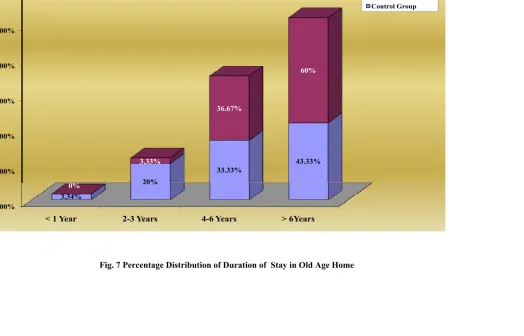
old age people duration of stay in the old age home more than 6 years (43.4%) in control group and most of them in experimental group (60%) respectively. ¾ Majority of them had moderate physical activity (80%, 66.66%), not having
history of taking medications for major illness (100%, 100%), not hospitalized within last five years (100%, 100%), not smoked (100%, 100%), no history of alcoholism (100%, 100%)and did not practice any relaxation technique (60%, 46.66%) in control and experimental group respectively. Significant percentage of them had undergone relaxation therapy (33.33%, 30%) and had sedentary physical activity (20%, 30.33%) in the control and experimental group respectively.
¾ In control group, most of the old age people had moderate level of cognitive impairment (53.34%) before validation therapy and there was not much differences after validation therapy. In experimental group, most of the old age people had mild level of cognitive impairment (56.67%) before validation therapy whereas after validation therapy it has been improved to normal level of cognition (76.66%).
¾ The mean and standard deviation of cognition score before therapy was low (M= 20.03, SD= 2.92) in comparison with the mean and standard deviation of cognition score after therapy (M= 23.9, SD= 3.01). The difference (t=7.17) was found statistically significant at level of confidence p<0.001. So Null Hypothesis Ho1 was rejected.
¾ There was no significant association between the selected demographic, clinical variables of old age people and level of cognition in experimental group before and after validation therapy. So, Null Hypothesis Ho3 was retained.
¾ Majority of the old age people were highly satisfied with all the aspects of administration of validation therapy. (90%).
This study demonstrated that Validation therapy will help to improve the level of cognition in old age people.
Recommendations
¾ The study can be conducted on larger sample to generalize the results. ¾ The study can be conducted in community settings.
¾ A comparative study can be conducted to evaluate the effectiveness of various other interventions to help the old age people in order to improve their cognition. ¾ A longitudinal study with time series design can be conducted with the post test
of an interval of 2, 4, 6 months to assess how long the effectiveness of the programme lasts.
TABLE OF CONTENTS
Chapter CONTENTS Page no
I INTRODUCTION 1-15
Background of the Study 1
Need for the Study 5
Statement of the Problem 8
Objectives of the Study 8
Operational Definitions 9
Assumptions 11
Null Hypotheses 11
Delimitations 12
Conceptual Frame work of the Study 12
Projected Outcome 15
Summary 15
Organization of Research Report 15
II REVIEW OFLITERATURE 16-30
Literature related to Old Age 16
Literature related to Cognition 18
Literature related to Cognition in Old Age 21 Literature related to Validation Therapy 24 Literature related to Effect of Validation Therapy on Cognition
in Old Age
27
III RESEARCH METHODOLOGY 31-45
Research Approach 31
Research Design 31
Research Setting 35
Population, sample, sampling technique 35-36
Sampling Criteria 36
Psychometric Properties of the Study Instruments 39 Selection and Development of Interventions 40
Pilot Study 43
Protection of Human Rights 43
Data Collection Procedure 44
Problems Faced during Data Collection 44
Plan for Data Analysis 44
Expected Outcome 45
Summary 45
IV ANALYSIS AND INTERPRETATION 46-65
V DISCUSSION 66-72
VI SUMMARY, CONCLUSION, IMPLICATIONS AND
RECOMMENDATIONS
73-80
REFERENCES 81-84
LIST OF TABLES
Table No Description Page No
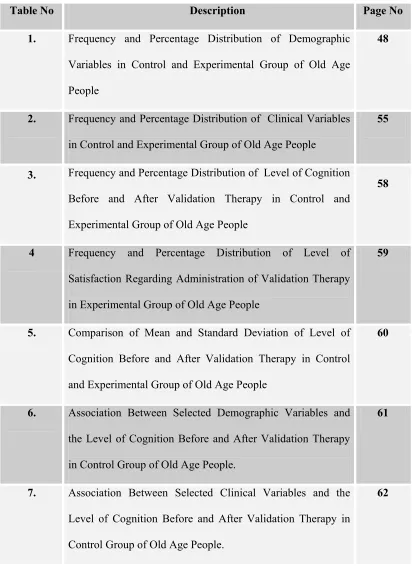
1. Frequency and Percentage Distribution of Demographic Variables in Control and Experimental Group of Old Age People
48
2. Frequency and Percentage Distribution of Clinical Variables in Control and Experimental Group of Old Age People
55
3. Frequency and Percentage Distribution of Level of Cognition Before and After Validation Therapy in Control and Experimental Group of Old Age People
58
4 Frequency and Percentage Distribution of Level of Satisfaction Regarding Administration of Validation Therapy in Experimental Group of Old Age People
59
5. Comparison of Mean and Standard Deviation of Level of Cognition Before and After Validation Therapy in Control and Experimental Group of Old Age People
60
6. Association Between Selected Demographic Variables and the Level of Cognition Before and After Validation Therapy in Control Group of Old Age People.
61
7. Association Between Selected Clinical Variables and the Level of Cognition Before and After Validation Therapy in Control Group of Old Age People.
8. Association Between Selected Demographic Variables and the Level of Cognition Before and After Validation Therapy in Experimental Group of Old Age People.
64
9. Association between Selected Clinical Variables and the Level of Cognition Before and After Validation Therapy in Experimental Group of Old Age People.
LIST OF FIGURES
Fig. No Description Page No
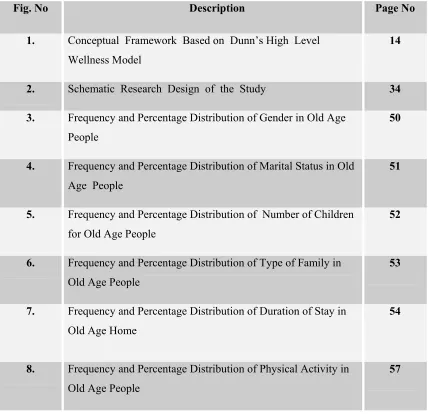
1. Conceptual Framework Based on Dunn’s High Level Wellness Model
14
2. Schematic Research Design of the Study 34 3. Frequency and Percentage Distribution of Gender in Old Age
People
50
4. Frequency and Percentage Distribution of Marital Status in Old Age People
51
5. Frequency and Percentage Distribution of Number of Children for Old Age People
52
6. Frequency and Percentage Distribution of Type of Family in Old Age People
53
7. Frequency and Percentage Distribution of Duration of Stay in Old Age Home
54
8. Frequency and Percentage Distribution of Physical Activity in Old Age People
57
LIST OF APPENDICES
Appendix Description Page No.
I Letter Seeking Permission To Conduct Study xiii
II Ethical Committee Letter xiv
III Plagiarism Report xvi
IV Letter Seeking Permission To use the Tool xvii V Letter Seeking Permission For Content Validity xviii
VI Content Validity Certificate xix
VII List Of Experts For Content Validity xx
VIII Research Participant Consent Form xxii
IX Certificate For Validation Therapy xxiii
X Certificate For English Editing xxiv
XI Certificate For Tamil Editing xxv
XII Demographic Variable Proforma of Old Age People xxvi XIII Clinical Variable Proforma of Old Age People xxxiii XIV Mini-Mental Status Examination to Assess Cognitive
Impairment for Old Age People
xxxix
XV Blue Print Of Rating Scale On Level Of Satisfaction of Validation Therapy
xlvi
XV Rating Scale On Level Of Satisfaction of Validation Therapy xlvii XVI Item Wise Level Of Satisfaction on Administration of
Validation Therapy in Experimental Group of Old Age People.
li
XVII Data Code Sheet liii
XVIII Master Code Sheet liv
CHAPTER I INTRODUCTION Background of the study
“Old age is the most unexpected of all the things that can happen to a man.” -Leon Trotsky
Old age is viewed both as a stage in the life span of individual and also a segment of the population of the society. The public considers people as old, those who are 50-75 years of age. There are currently 580 million elderly aged 60 and over in the world and of these 355 million live in the developing countries. In India, the old age population aged 60 years and above account for 7.4% of the total population. From 5.6% in 1961 and it is projected to rise to 12.4% of the population by the year 2026.
In India about 7% of the elderly population is over the age of 60 and it is expected to increase by 20% by the year 2030. By the year 2030 older adults will comprise 20% of the population, compared to 13% in 2000. By the year 2050, the “oldest old” segment of the population is anticipated to increase between 24% and 30%. In a study conducted by Vijayanunni (1997) it was also worked out by the experts committee the 60 plus population of India will grow from 56 million in 1991 to 96 million in 2011 and 113 million in 2016.
reaction times, reduced ability to clear thinking. Lessened learning, diminished eyesight, difficulty in recalling memories, lessening or termination of sex. Sometimes because of physical symptoms there is a decline in libido. Greater weakness to bone diseases such as osteoarthritis.
Cognition refers to the mental process of comprehension, judgement, memory and reasoning in contrast to emotional and volitional process. Cognition is the scientific term for mental processes. These processes include attention, remembering, producing and understanding language, solving problems, and making decisions. Cognition is studied in various disciplines such as psychology, philosophy, linguistics, and computer science. Usage of the term varies in different disciplines; for example in psychology and cognitive science, it usually refers to an information processing view of an individual's psychological functions. Not everyone declines in cognitive function with age.
Cognitive dysfunction may occur in some patient’s who receive chemotherapy. Cognitive deficits are often subtle, although they are observed consistently in a proportion of patient’s, may be durable and can be disabling. Deficits have been observed in a range of cognitive functions. Underlying mechanisms are unknown, although preliminary studies suggest there may be genetic predisposition and that cognitive impairment may be accompanied by changes in the brain which could be detectable by neuroimaging.
Mild cognitive impairment is a transitional stage between normal aging and dementia, according to background information in the article. Previous studies have found an association between mild cognitive impairment and diabetes. Poor blood glucose control over time may lead to neuron loss, and diabetes is associated with cardiovascular disease risk and stroke, which also may increase the risk of cognitive impairment.
Pharmacological therapies are not as much effective in improving the cognitive function. For cognitive improvement there are some sort of standard non- pharmacological therapies which will improve the cognitive function in the old age people such as Behavioural therapy, Reality orientation, Reminiscence therapy and Validation therapy used in day to day practice.
Validation therapy defined as the use of a method of therapeutic communication with elderly persons that focuses on emotional rather than factual content. It was developed by NAOMI FEIL between the year 1963 and 1980 for older people with cognitive impairment. Mainly it is based on the principle of validation, the acceptance of the reality. The basic principle of the therapy is the concept of validation or the reciprocated communication of respect which communicates that the other's opinions are acknowledged, respected, heard and (regardless whether or not the listener actually agrees with the content), they are being treated with genuine respect as a legitimate expression of their feelings. Feil's own approach classifies individuals with cognitive impairment as having one of four stages in a continuum of dementia. These stages are: Mal orientation, Time confusion, Repetitive motion, Vegetative state.
Validation therapy is a therapeutic communication technique to express their feelings to reduce their stress and involve them in day to day activities. The researcher has used some simple techniques both verbal and non- verbal which is easy to practice. Since validation therapy inexpensive, entertaining, stimulating, thought provoking and motivating factor for positive thinking. Validation support is to reduce stress and restore self-esteem. It also helps in behaviour modification, increases the daily activity, stimulation of self- care.
Validation therapy improves the sense of integrity, sense of dignity, sense of worth and quality of life. Thus nurse can plan for various studies which are incorporated with the regular activities in various settings such as hospitals, old age home and in community.
Need for the Study
Old age is considered as a risk period because they need assistance for most of their day to day activities. They are neglected by everyone and are highly dependent in the community. Aging is one of the developmental issues with social, economic and political impacts.
According to the World Health Organization (2009), the number of 60 year old will increase 1.2 billion by the year 2025. This finding is very important in healthcare to plan the health care services. In Canada, persons aged 65 years and older represent the fastest growing population, with an 11.5% increase in prevalence between 2001 and 2006 (Statistics Canada 2009) ,dementia and cognitive impairment not meeting the criteria for dementia are estimated to affect 8% and 16.8% of Canadians aged 65 years and older, respectively. The lifetime probability of becoming disabled in at least two activities of daily living or of being cognitively impaired is 68% for people age 65 and older.
A study was conducted by Brenda Plassman and colleagues from medical psychology department at Duke University, reported 856 persons aged 71 or older drawn from a nationally representative sample. Subjects provided a clinical and medical history were examined neurologically and underwent neuropsychological tests. The researchers then analyzed the results to determine how many of the subjects reached the threshold for dementia with normal and impaired cognition. Out of the 856 subjects, 241 had impaired cognition without dementia. The investigators used their findings about the subjects with impaired cognition without dementia to compute a national prevalence estimate for the condition. They found that 22 percent of Americans aged 70 or older that is, 5.4 million as of 2002 had dementia. As Plassman told Psychiatric News, “The finding that 22 percent over age 70 have mild cognitive problems is sobering and clearly illustrates the importance of this problem in late life.”
developed by NAOMI FEIL between 1963 & 1980 for older people with cognitive impairment. The basic principle of the therapy is the concept of validation or the reciprocated communication of respect which communicates that the other's opinions are acknowledged, respected, heard and (regardless whether or not the listener actually agrees with the content), they are being treated with genuine respect as a legitimate expression of their feelings.
As old age has many physical symptoms we should focus upon the psychological problems in day to day life. The old age is more prone to get depression, sleep problems and especially cognitive problems. The research studies are more concentrated and done only to resolve depression through some sort of relaxation techniques and psychotherapies. For cognitive improvement there are some sort of therapies such as reminiscence therapy, reality orientation therapy and validation therapy used in day to day practice.
Validation therapy is a therapeutic communication technique to express their feelings to reduce their stress and involve them in day to day activities. The researcher has used some simple techniques both verbal and non- verbal which is easy to practice. Since validation therapy inexpensive, entertaining, stimulating, thought provoking and motivating factor for positive thinking. Validation support is to reduce stress and restore self-esteem. It also helps in behaviour modification, increases the daily activity, stimulation of self- care. Even though Validation therapy is very useful and cost effective, there is paucity of research in this area. Thus the researcher was interested to do the study.
Validation therapy improves the sense of integrity, sense of dignity, sense of worth and quality of life. Thus nurse can plan for various studies which is incorporated with the regular activities in various settings such as hospitals, old age home and in community.
Statement of the Problem
A Quasi Experimental Study to Assess the Effectiveness of Validation Therapy upon the Level of Cognition of Old Age People at selected Old Age Homes in Chennai.
Objectives of the Study
7. To assess the effectiveness of validation therapy by comparing the level of cognition in control and experimental group of old age people before and after validation therapy.
8. To determine the level of satisfaction in experimental group of old age people regarding administration of validation therapy.
9. To find out the association between the demographic, clinical variables and the level of cognition before and after validation therapy in control group of old age people.
10.To find out the association between the demographic, clinical variables and the level of cognition before and after validation therapy in experimental group of old age people.
Operational Definitions
Effectiveness
In this study it refers to increase in the level of cognition as measured by mini mental status examination after conducting the validation therapy of old age people.
Validation therapy
Verbal techniques Centering
In this study it refers to focus on a spot about two inches below your waist, inhale deeply through your nose, filling your body with air. Exhale through your mouth. Repeat this procedure slowly, eight times.
Reminiscing
In this study it refers to explore the past by using loving clear low tone of voice, re-establishing familiar coping methods that the old age people can tap to survive present day, loses (spouse, children and duration of stay in the old age home).
Non-verbal techniques
In this study it refers that maintaining genuine close eye contact, linking the behaviour with unmet needs, touching, using music to enhance the old age people to communicate and to improve the level of cognition.
Cognition
In this study it refers to an ability of higher mental functions such as orientation, recall, attention, delayed verbal recall, reading, writing and copying by old aged as measured by Mini Mental Status examination.
Old age people
Old age home
In this study it refers to the place where the old age people live away from their home with all necessary facilities of daily living.
Assumptions
¾ Each person is unique and deserves respect regardless of age or disorientation. ¾ Aging will have changes in all the dimensions physical, psychological, social,
emotional and behavioural aspects.
¾ Psychological therapies are required during old age for better adjustment in their daily life.
¾ Mental readiness is needed for adaptation of various problems in old age. ¾ Human beings can change and grow in a genuine and loving relationship.
Null Hypotheses The null hypotheses stated are:
Ho1 There will be no significant difference in the level of cognition before and after validation therapy between control and experimental group of old age people. Ho2 There will be no significant association between the selected demographic,
clinical variables and level of cognition before and after validation therapy in control group of old age people.
Delimitations
¾ The study was limited to old age people who had major memory impairment, delayed verbal recall and the age above 75 years.
¾ The study was limited to old age people who were at Sree Seva Mandhir old age home at the time of data collection.
¾ The study period was limited to 6 weeks duration.
Conceptual Framework of the Study
The conceptual framework for research study presents the reasoning on which the purposes of the proposed study are based. The conceptual framework deals with inter-related concepts that are assessable together in some rational schemes by virtue of this relevance to a common theme. (Polit & Beck, 2004).
In the mental health field, a number of proponents have put forward various theories. These theoretical frameworks throw light on to the basic principles on which the life style practices need to be based for an effective healthful living and also when there is a failure, how the entire homeostasis is affected. Keeping these views in mind, an attempt has been made to conceptualize, how an individual with cognitive decline may internalize cognitive impairment and experience diminished esteem and self-efficacy leading to limited prospects for recovery.
Cognitive impairment
Cognition
Mental operations that relate to logic, awareness, intellect, memory, language, and reasoning powers.
Memory
It is the ability of an organism to store, retain, and recall information and experiences.
Group identification
Individuals who belong to inclusion criteria aimed the validation therapy effects on cognition are mediated by stereotype awareness, agreement, and self-concurrence.
Stereotype awareness
Knowledge structures that are learned by most members of the group. When the old age people become aware of their awareness it is stated as stereotype awareness.
Stereotype Agreement
When individuals face the onset of cognitive problem, these stereotypes become relevant to the self.
Self-concurrence
CCC
SS MODEL
Old age people with cognitive impairment
- Attention
- Memory
- Verbal recall
High Level Wellness
Group identification
- Stereotype awareness
- Stereotype agreement
- Self-concurrence
Validation Therapy
9 Over view of validation therapy
o Verbal techniques o Non-verbal
techniques
o Welcoming with the group song
o Group discussion o Finishing with
refreshment of song Improved cognition and self-efficacy
- Healthy life style pattern
[image:30.612.53.753.82.494.2]- Healthy self-concept - Successful relationship - Productive functioning OLD AGE PEOPLE WITH COGNITIVE IMPAIRMENT
Projected Outcome
The study will improve the cognition among old age, in turn to do their work effectively and to cope up with their daily stresses and to improve the quality of life.
Summary
This chapter has dealt with the back ground, need for the study, and statement of the problem, objectives, operational definitions, assumptions, null hypotheses, delimitations and conceptual framework.
Organization of the Report
Further aspects of the study are presented in the following five chapters. In Chapter – II : Review of literature
In Chapter – III : Research methodology – which includes research approach, design, setting, population, sample and sampling techniques, tool description, content validity and reliability of tools, pilot study, data collection procedure and plan for data analysis. In Chapter – IV : Analysis and interpretation of data
In Chapter – V : Discussion
CHAPTER II
REVIEW OF LITERATURE
A literature review is an organized written presentation of what has been published on a topic by scholars (Burns & Grove, 2004).
The task of reviewing literature involves the identification, selection, critical analysis and reporting of existing information on the topic of interest. This chapter deals with a review of published studies, unpublished research studies and from related material for the present study. The review helped the researcher in building the foundations of the study.
The review of literature is presented under the following headings. ¾ Literature related to old age
¾ Literature related to cognition
¾ Literature related to cognition in old age ¾ Literature related to validation therapy
¾ Literature related to effect of validation therapy on cognition in old age
Literature related to old age
These deficits may be related to impairments seen in the ability to refresh recently processed information. In addition, even when equated in memory for a particular item or fact, older adults tend to be worse at remembering the source of their information, a deficit that may be related to declines in the ability to bind information together in memory.”(Hedden & Gabrieli, 2004)
In the year (1988) Scanzoni & Scanzoni, has done Research in the United Kingdom and the United States has found that the older a person is in a chronological sense, the later is the chronological age at which that person tends to think old age begins. The concept of old age also is affected by social stratum: lower-status persons, as an example tend to think that old age begins in the fifties, while higher-status persons tend to think that old age begins around age 65. 156 samples was taken for the study by using purposive sampling technique. Advances in medical science and technology have led to increased life spans for an increasing proportion of the population; however, social development has not kept pace. Thus, many among the growing numbers of older people lead increasingly less rewarding lives. Further, the increasing numbers of persons in the population aged 65 or older demand that research into aging develop methods that address the differences among age groupings within the 65 and over classification.
regarding age, gender, race, and socio-economic class.100 samples were taken and the researchers used quota sampling technique. Results indicated that British viewers did not see misrepresentation nor negative imaging of the old age in programming. The researchers did notice, however, that viewers felt the image of old age in fictional programs (comedies and action/ adventure shows) was less respectful than that seen in news, documentaries and game shows. Overall, the authors stated that conclusions published by Gerber and Aronoff in the U.S. were not supported in Britain.
Literature related to cognition
An intervention study aims to prevent cognitive impairment, dementia and disability in 60-77 year old persons at an increased dementia risk. 300 samples were taken. The researchers used purposive sampling technique. The 2-year multi-domain life-style intervention includes nutritional guidance, exercise, cognitive training, increased social activity, and intensive monitoring and management of metabolic and vascular risk factors. The primary outcome is cognitive impairment measured by a sensitive Neuropsychological Test Battery (NTB), and Stroop and Trail Making tests to capture early cognitive impairment typical for both Alzheimer's disease and vascular dementia. We hypothesize that the multi-domain intervention will reduce cognitive impairment in the study group compared to the control group during the initial 2-year intervention period and reduce dementia incidence after the 7-year extended follow-up. Helsinki, et al. (2010)
nationally representative sample. Purposive sampling technique was used. Subjects provided a clinical and medical history, were examined neurologically, and underwent neuropsychological tests. The researchers then analyzed the results to determine how many of the subjects had normal cognition, how many had cognitive impairment that did not reach the threshold for dementia, and how many dementias had. Out of the 856 subjects, 241 had impaired cognition without dementia. Population sampling rates were derived to adjust for at least some of the potential bias due to nonresponse among subjects and attrition. The investigators used their findings about the subjects with impaired cognition without dementia to compute a national prevalence estimate for the condition. They found that 22 percent of Americans aged 70 or older—that is, 5.4 million as of 2002—had it. As Plassman told Psychiatric News, “The finding that 22 percent over age 70 have mild cognitive problems is sobering—and clearly illustrates the importance of this problem in late life.”
function. Although this area of study is in its infancy, the preliminary data are promising and matched with the declining physical health of industrialized nations; this area of science could provide insight aimed at improving brain health and cognitive function across the human lifespan.
Cournot, et al. (1999) prospective research design over a 5-yr period to assess the relation of BMI to cognitive function and decline in healthy 32- to 62-yr-old men and women in the workforce in United States.50 samples were taken and simple random sampling technique was used. Along with BMI, cognitive tests of attention, learning, and memory were conducted and the results indicated that higher BMI was associated with poorer cognitive performance after adjusting for demographic and psychosocial variables (i.e. age, sex, education, health status). Additionally, higher BMI at baseline was predictive of greater cognitive decline during the 5-yr follow-up, indicating that BMI is independently associated with cognitive function during adulthood.
A prospective cohort study of Japanese Americans living in King County, WA, study (n = 1985) cognitive states were defined as the errors in the Cognitive Abilities Screening Instrument score. Transition probabilities were modelled by the use of a modified Poisson distribution with the Poisson mean and mortality dependent on the cognitive state and covariates. 586 samples were selected and simple random sampling technique was used. During an 8-year follow-up, 21.5% died (95% confidence interval [95% CI], 19.3-23.7), 26.6% experienced cognitive decline (95% CI, 24.2-29.1), and 51.9% remained stable or improved cognitively (95% CI, 49.2-54.6). In multivariable analyses, improvements were notably more likely to occur among younger, more-educated people and in women. Older age, male sex, and less education were each significantly related to mortality. Mitinski, et al. (1985)
Literature related to cognition in old age
A study shows that n this case, 1,740 men and women over the age of 65 yr, without cognitive impairment were asked to report the number of times per week that they performed different physical activities (i.e., walking, hiking, bicycling, aerobics or calisthenics, swimming, water aerobics, or weight training) for at least 15 min per time over the past year. A number of potential confounding factors, including self-reported health, a variety of medical conditions, lifestyle factors such as smoking and drinking, and demographic factors, were also recorded at the initial assessment. An assessment of genetic risk for Alzheimer's disease [one or more e4 alleles on the apolipoprotein E (apoe) gene] was also done at this time. After an average follow-up period of 6.2 yr, 158 individuals had developed Alzheimer's dementia. Alzheimer's disease is the most common type of dementia and negatively affects a variety of cognitive and neurological processes. After adjustment for the covariates obtained at the initial assessment the incidence rate for Alzheimer's disease was significantly higher for individuals who exercised fewer than three times per week (19.7 per 1,000 person yr) compared with those who exercised more than three times per week (13.0 per 1,000 person yr). These results were not influenced by a genetic predisposition for Alzheimer's disease (i.e., one or more e4 alleles on the apoe gene). However, the risk reduction for Alzheimer's disease was greater for those participants who initially had the poorest physical performance (e.g., on tests such as a 10-ft timed walk, which assesses the speed that a person can walk 10 ft, and is considered a proxy of physical fitness, balance test, etc.). Larson, et al. (1978).
conditions. Therefore, cognitive change in old age is described as multidirectional (Baltes and Schaie, 1976, 1977; Nesselroade & Baltes, 1974). This can be viewed two ways. First, change can occur in different directions for different cognitive dimensions. 76 samples were taken for the study by using purposive sampling technique. For example, crystallized intelligence is thought to increase with age (Horn, 1970; Horn & Donaldson, 1976). Secondly, change can be multidirectional for a single dimension. The intervention work of Hartley, Harker, and Walsh (1980) and Fozard (1980) provide examples of such multidirectional change. Harley et al. (1980) found that performance on memory tasks could be improved following decline through the training of encoding strategies. Fozard (1980) also demonstrated improved memory performance through the use of task redesign and training. Thus, these interventions lead to an improvement following a decline in memory performance. Therefore, cognitive change can be multidirectional.
Literature related to validation therapy
In 1993, Scan land and Emershaw conducted a Quasi-experimental study to determine the effect of reality orientation and validation therapy upon the functional status, cognitive status and level of depression in confused older adults. The sample size of 34 was divided into two groups and then subdivided utilizing a non-equivalent control group design. Simple random sampling technique was used in this study design.
Miesen, (1992) study shows that validation techniques are often applied in a group setting, but can be used effectively on a one to one basis. Even a few minutes several times a week is to be worthwhile input; as with other communication based approaches, much can be achieved during routine care giving, although it may well be demanding work in its own right. Music is used as a unity activity and every effort is made to minimize communication difficulties. Group members are encouraged to take on responsibilities with in the group – song- leader, welcome, giving out refreshments and so on.
improvement in social interaction during the period of validation therapy and subsequent decline during reminiscence therapy (Morton and Bleathman, 1991).
In the year 1988 Babins, Dillion, and Merovitz has studied the effect of VT with subjects in stage two, time confusion, and stage three, repetitive motion, of disorientation. They stated Feil had previously reported individuals in these stages appear to benefit more from VT than Reality Orientation. Cognitive, social and behavioural measures were studied. The samples of 12 subjects were divided into a VT group of five and a no-treatment control group of seven. Therapy was conducted for a total of 22 sessions over an 11-week period. Findings were reported by comparing the sum of the scores in the first three sessions to the sum of the scores of the last three sessions. Comparisons between the sum of the first three sessions and last three sessions of the VT group were reported to demonstrate an increase in verbal and non-verbal expression. An increase in irritability scores from 55 to 63 on normalized t-scores was reported. The results must be interpreted carefully since not all of the scales utilized had been standardized.
following treatment. Nonparametric statistical analysis was accomplished with the Wilcoxon Two-Sample Test at the.05 level of significance for a one-tailed test. Major findings indicated that participants in the reality orientation group showed significant improvement in orientation but not in morale or behavioural functioning. There was no significant improvement in morale, behavioural functioning or orientation for the subjects in the validation therapy group. It is recommended that similar studies continue to be replicated despite methodological problems in order to build a substantial body of knowledge from which treatment programs can be justified.
Robb, Stegman, and Wolanin (1986) was conducted the first experimentally designed study to test VT. The purpose of the study was to ascertain the effect of VT on mental status, morale, and social behaviour of cognitively impaired older adults. The findings of the single pre- and post-test measurements were non-significant for all three variables. However, anecdotal information reported some subjects did demonstrate changes in social behaviours, including an increase in demanding behaviour. By the conclusion of the study, the researchers had identified several design problems and reported the results to be severely compromised. Other problems identified include failure to conduct a pilot study, instrumentation problems, attrition of subjects, and difficulty of obtaining informed consent in this patient population. Robb and colleagues (1986) published the findings of their study to provide essential information for possible replication regarding ways to improve study design. The research also provided insight into the difficulty of conducting experimental research in long-term care facilities.
in a VT group. She reported the results in 1992 and noted improvement in "gait, speech, and nonverbal communication." Furthermore she states, "The study group cried less and paced less, resulting in less need for restraints." However the research methods and data to substantiate the above claims have never been published. In 1983, the Validation Training Institute was founded. After this time, several articles based primarily on clinical experiences and impressions began to appear in the literature these articles stressed pursuing communication without attempting reality orientation. Scenarios were given to demonstrate the manner in which validation therapy could be utilized in clinical practice. (Feil, et al. 1988).
Literature related to effect of validation therapy on cognition in old age
There have been relatively few empirical studies assessing the efficacy of the validation approach, as noted by Feil (1967), Mitchell (1987) and Hitch (1994). Hitch noted that validation therapy promotes contentment, results in less negative affect and behavioural disturbance, produces positive effects and provides the individual with insight into external reality. It was, however, suggested that therapists could become too focused on confused communication and could fail to identify simple explanations such as pain or hunger. Neal & Briggs (2002) evaluated validation therapy across a number of controlled trials, employing cognitive and behavioural measures. They concluded that despite some positive indicators, the jury was still out with respect to its efficacy. (Briggs, 2002).
Fine and Rouse Bane (1995) a Quasi-experimental time series design study was conducted to determine the effects of validation therapy approaches on cognitively impaired nursing home residents and their caregivers. This is the first study conducted outside of a group therapy setting and provided consistent application of validation therapy techniques for a long period of time. They incorporated the recommendations of Babins and colleagues (1988) by linking specific validation techniques to specific stages of disorientation. The most significant research finding indicated that problem behaviours were effectively decreased 73% when the communication technique for the specific confusional stage was utilized.
VTI document that hints at a harried and paranoid author justifying their work to sceptical “scientists and academics”.) Notwithstanding the aforementioned caveat, they found that the data does not show statistically significant therapeutic differences that can be attributed to the particular nature of validation therapy. What is interesting is that they highlight the common ground that validation therapy shares with other humanistic / person-centred therapeutic techniques.
despite some positive indicators, the jury was still out with respect to its efficacy. (Mitchell, et al. 1987)
In the year 1972 Feil studies states that validation techniques are used in the groups, 5 to 10 members are selected with cognitive impairment. Each group has a rigid format, beginning with the welcoming of members and the singing of a group song, followed by group discussions of a topic regarding happiness, fear, separation or loss and finishing with the thanking of members, a closing song and refreshments. She found that the old age people has improved speech, less negative affect ( crying , hitting); more positive affect (smiling , talking , helping others); people become aware of their external reality ; they talked outside of group meetings.
Summary
CHAPTER III
RESEARCH METHODOLOGY
The methodology of research study is defined as the way the information is gathered in order to answer the research question or to analyse the research problem.
The present study was conducted to assess the effectiveness of validation therapy on cognition among old age people, at selected old age home in Chennai. This chapter deals in brief on different steps undertaken by the investigator of the study. It involves research approach, the setting, population, sample, sampling technique, selection of tool, content validity, reliability, pilot study, data collection procedure and plan for data analysis.
Research Approach
Research approach is the most significant part of any research. The appropriate choice of the research approach depends on the purpose of the research study which is undertaken. To accomplish the objective of the study, an experimental approach was considered most appropriate as the researcher wanted to assess the effectiveness of validation therapy on cognition.
Research Design
of a therapy, where randomization procedures are not used to control the extraneous variables.
Quasi experimental research design O1 - O2
O1 X O2
O1- Assessment of level of cognition before validation therapy
O2- Assessment of level of cognition after validation therapy
X- Validation therapy
Validation Therapy
It refers to the planned psychological interventions for group of old age people using various methods such as group discussions, and by using verbal techniques such as centering : Focus on a spot about two inches below your waist ,inhale deeply through your nose, filling your body with air. Exhale through your mouth. Repeat this procedure slowly, eight times. Reminiscing: Exploring the past by using a clear loving tone of voice, re-establishing familiar coping methods that the disoriented person can tap to survive present day, losses. Non-verbal techniques such as maintaining genuine close eye contact, linking the behaviour with unmet needs, touching, using music to enhance the old age people to communicate and to improve the level of cognition. It is administered by the researcher on each day 1 hour in the morning for 5 days in a week.
regarding anger, separation or loss and finishing with a thanking of members, a closing song and refreshments.
Programme schedule:
Session 1: Overview of validation therapy (10mts) Session 2: welcoming with group song (5 mts)
Session 3: Validation therapy (verbal techniques) – activity (15 mts) Session 4: Validation therapy (non- verbal techniques) _ activity (15 mts) Session 5: Group discussion (10mts)
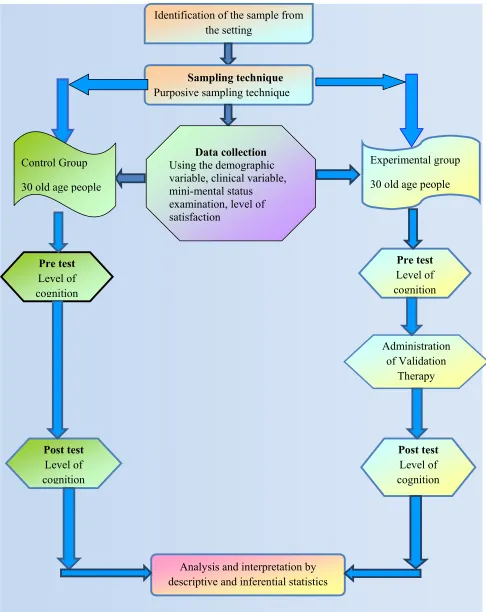
Fig. 2 Schematic Representation of Research Design Identification of the sample from
the setting
Sampling technique Purposive sampling technique
Experimental group 30 old age people
Administration of Validation Therapy Pre test Level of cognition Pre test Level of cognition Post test Level of cognition
Analysis and interpretation by descriptive and inferential statistics
Post test Level of cognition Data collection
Using the demographic variable, clinical variable, mini-mental status examination, level of satisfaction
Variables
Dependent variables
Thevariable hypothesized to depend on or to be caused by another variable. In this study dependent variable is Level of Cognition.
Independent variables
The variable hypothesized to the outcome variable of interest. In this study independent variable is Validation Therapy.
Attribute variables
A variable that confound the relationship between the independent and dependent variable that need to be controlled either in the research design or through statistical procedure. (Polit & Beck, 2005). Demographic variable and clinical variable is the other variable in this study used by the researcher.
Research Setting
Population
Population is the entire aggregation of cases which meet designated set of criteria. (Polit & Beck 2004). The target population is the group of population that the researcher aims to study and to whom the study findings will be generalized. In this study, the target population comprises of all the old age people who satisfy the inclusion criteria at Sree Seva Mandhir, Virugambakkam, Chennai.
The accessible population is the list of population that the researcher finds in the study area. The accessible population in this study the old age people who satisfy the inclusion criteria.
Population of this study includes old age people aged between 60 to 75yeras.
Sample
Polit and Beck (2004) said that a sample consists of the subset of the units that comprises the population. A sample of 30 old age people who satisfy the eligibility criteria in Sree Seva Mandhir, Virugambakkam, Chennai, were selected for the study.
Sample Size
Sample size of the study is 60. (30 samples in experimental group and 30 samples in control group).
Sampling Technique
researcher selects participants based on personal judgement about which ones will be more informative, was used for the study. The researcher used purposive sampling technique and Old age home at Virugambakkam was selected as experimental place.
Sampling Criteria Inclusion criteria
The study will include old age people:
¾ Old age people who are aged between 60 years to 75 years ¾ Old age people who are willing to participate in the study.
¾ Old age people who can read and follow English or Tamil from the investigator.
Exclusion criteria
¾ Old age people were not willing to participate. ¾ Old age people who are having problems such as:
Visual and hearing problem Communication problem Memory problem
Taking any medications
Selection and Development of the Study Instruments
examination by Folstein et al. and Rating scale on the level of satisfaction after the validation therapy.
Demographic variable proforma of old age people
The demographic variable proforma consisted of age, gender, educational status, marital status, source of income, monthly income, number of children, religion, type of family and duration of stay in the old age home.
Clinical variable proforma of old age people
The clinical variable proforma consisted of any medical illness, duration of medical illness, history of taking medications for major illness, history of hospitalization, treatment seeking behavior for any illness, history of smoking, history of alcoholism and the relaxation therapy underwent by the old age people.
Mini-mental status examination
This is a standardized tool to assess the cognition level developed by Folstein et al. It consists of Orientation, Immediate recall, Delayed verbal recall, Attention, Naming, Repetition, Stage command, Reading, Writing and Copying etc. It is a reliable test. Total score is 30.
Scoring Interpretation
Score Percentage Level of satisfaction 24-30 Above 75% Highly satisfied 18-23 51-75% Satisfied
10-17 25- 50% Dissatisfied
Rating scale on level of satisfaction of validation therapy in experimental group of old age people
This is developed by the investigator to assess the satisfaction of validation therapy among old age people. This is a 4 point scale ranging from 4-1 (highly satisfied, satisfied, dissatisfied, highly dissatisfied).It consist of questions related to the researcher (1, 2 3) and questions related to validation therapy (4, 5, 6, 7, 8, 9, 10). Thus the total obtainable score is 30 – 100.
Scoring key
Score Percentage Level of satisfaction Above 30 Above 75% Highly satisfied 21-30 51-75% Satisfied
10-20 25- 50% Dissatisfied Below 10 Below 25% Highly dissatisfied
Psychometric properties of the Study Instruments Validity
Reliability
Reliability refers to the accuracy and consistency of measuring tool. The Mini-Mental status examination by Folstein et al is a standardized tool. The reliability of the tool was determined by the authors using test-retest method and the k-score was found to be 0.71, indicating that the tool is highly reliable. The level of satisfaction scale was tested using split half method and the reliability was found to be 0.8, indicating that the tool.
Selection and Development of Interventions
It refers to the planned psychological interventions for group of old age people using various methods such as group discussions, and by using verbal techniques such as centering : Focus on a spot about two inches below your waist ,inhale deeply through your nose, filling your body with air. Exhale through your mouth. Repeat this procedure slowly, eight times. Reminiscing: Exploring the past can re-establish familiar coping methods that the disoriented person can tap to survive present day, losses. Non-verbal techniques such as maintaining genuine, close eye contact, using a clear, low loving tone of voice, linking the behaviour with unmet needs, touching, using music to enhance the old age people to communicate and to improve the level of cognition. It is administered by the researcher on each day for 5 days for 1 hour from 9.30am to 12.30pm.
topic regarding anger, separation or loss and finishing with a thanking of members, a closing song and refreshments.
Validation Therapy
Session 1 : Overview of validation therapy (10 mts)
Objective : Participants will be able to explain the phases of the therapy, verbal techniques and non-verbal techniques of the therapy.
Activity : Group discussion and clarification of doubts Session 2 : Welcoming with group song (5 mts)
Objective : Participants are interested to sing songs especially old cinema songs and devotional songs.
Activity
¾ Participants plan daily and they will sing a song.
¾ Participants discuss among each other and finally they will decide to sing a song on each day.
¾ Participants are encouraged to sing a song. ¾ Participants feel relaxed while singing. ¾ Participants sing mostly devotional songs.
Session 3 : Activities related to verbal techniques (15 mts)
Activity
¾ Participants are encouraged to ventilate their feelings.
¾ Participants expressed their feelings verbally and non-verbally.
¾ Participants expressed their past stressful situations and events in their life. ¾ Participants are encouraged to use the coping mechanisms.
Session 4: Activities related to non-verbal techniques (15 mts)
Objective: Participants are physically involved in doing the activities for further improvement in daily living.
Activity
¾ Participants are encouraged to do the centering (breathing exercise). ¾ Participants should do this exercise 8 times.
¾ Participants maintained eye to eye contact.
¾ Participants feel happy by using low and clear voice with lovable talk
Session 5 : Group discussion (10 mts)
Objective : Participants will be able to explain their opinions and concepts regarding the topic related to their life in old age.
Activity
¾ Participants expressed their views about the topic happiness. ¾ Participants expressed their views about the topic sadness. ¾ Participants expressed their views about the topic loss. ¾ Participants expressed their views about the topic separation.
Session 6 : Finishing with refreshment of song (5 mts)
Objective : Participants are interested to sing songs especially old cinema songs and devotional songs at the end for their refreshment to forget their stressful matters. Activity
¾ Participants plan daily and they will sing a song.
¾ Participants discuss among each other and finally they will decide to sing a song on each day.
¾ Participants are encouraged to sing a song. ¾ Participants feel relaxed while singing. ¾ Participants sing mostly devotional songs.
Pilot Study
Polit & Beck (2004) stated that a pilot study is a miniature version of actual study in which the instruments are administered to the client’s drawn from the same population. The purpose is to find out the feasibility and practicability of the study design. A Pilot study was conducted among five old age people who satisfied the eligibility criteria at Sahaya illam, St. Thomas mount, Chennai. The client was chosen by purposive sampling and validation therapy was conducted for five days. It was found that the selected tools was practicable to use and understandable by the old age people with some assistance. It was also found that it would be feasible to conduct the study in the research setting.
Protection of Human Rights
¾ Obtained permission from Principal, Apollo College of Nursing and Head of the department of Psychiatric Nursing and Director of Sree Seva Mandhir old age home where the study was conducted.
¾ Written consent was obtained from the participants.
¾ Confidentiality of the data was maintained throughout the study.
Data Collection Procedure
Data collection is the gathering of information needed to address a research problem. The study was conducted at Sree Seva Mandhir old age home. The researcher has chosen the old age people by identifying them through personal interaction.
The researcher introduces herself and obtained consent from the old age people to participate in the study after giving assurance regarding confidentiality. The data collection was done for a period of 6 weeks. The researcher collected data from the old age people by interview method using structured questionnaire. Through extensive review of literature, Samples are divided into three groups. Each group has 5 to 10 individuals and the therapy was given 1 hour for each group. Validation therapy was given for about 1 hour every day for 5 days in the morning from 9.30 am to 12.30 pm. Post test was conducted among the old age people after 30 days by using the same tools. Level of satisfaction of old age people regarding the validation therapy was assessed by using level of satisfaction rating scale.
Problems faced during Data Collection
Plan for Data Analysis
Data analysis is the systemic organization, synthesis of research data and testing of null hypothesis by using the obtained data (Polit & Beck, 2004). Analysis and interpretation of data were carried out by using descriptive and inferential statistics. Descriptive statistics such as frequency, percentage, mean and standard deviation were used to describe the demographic variables, clinical variables, Mini-mental status examination. Inferential statistics such as paired t-test (to analyse the difference in cognition score before and after validation therapy.) and chi-square (to analyse the association between cognition score and selected variables) were used.
Expected Outcome
The study will improve the cognition among old age, in turn to do their work effectively and to cope up with their daily stresses and to improve the quality of life.
Summary
CHAPTER IV
ANALYSIS AND INTERPRETATION
This chapter deals with the analysis and interpretation of data collected from 30 old age people at Sree Seva Mandhir old age home and another 30 old age people at social beatitudes old age home, Chennai. The study was conducted to determine the effectiveness of validation therapy on cognition among old age people. The data were analysed according to the objectives and hypotheses of the study. Analysis of study was compiled after all the data was transferred to the master data coding sheet. The investigator used descriptive and inferential statistics for data analysis.
The data were analysed, tabulated and interpreted using descriptive and inferential statistics in the sequence as follows:
Organization of findings
¾ Frequency and percentage distribution of demographic variables in control and experimental group of old age people.
¾ Frequency and percentage distribution of clinical variables in control and experimental group of old age people.
¾ Frequency and percentage distribution of level of cognition before and after validation therapy in control and experimental group of old age people.
¾ Frequency and percentage distribution of level of satisfaction regarding administration of validation therapy in experimental group of old age people. ¾ Comparison of mean and standard deviation of cognition scores before and after
¾ Association between selected demographic variables and the level of cognition before and after validation therapy in control group of old age people.
¾ Association between selected clinical variables and the level of cognition before and after validation therapy in control group of old age people.
¾ Association between selected demographic variables and the level of cognition before and after validation therapy in experimental group of old age people. ¾ Association between selected clinical variables and the level of cognition before
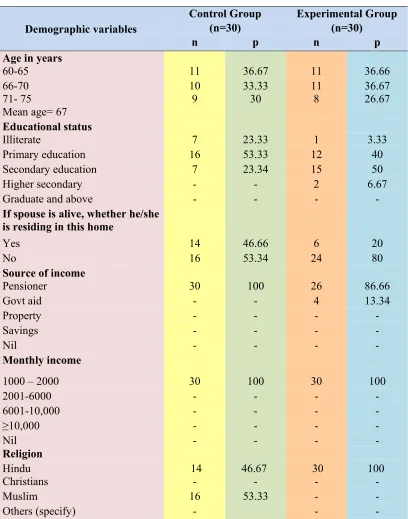
Table 1
Frequency and Percentage Distribution of Demographic Variables in Control and Experimental Group of Old Age People.
Demographic variables
Control Group Experimental Group
(n=30) (n=30)
n p n p
Age in years
60-65 11 36.67 11 36.66
66-70 71- 75 10 9 33.33 30 11 8 36.67 26.67
Mean age= 67
Educational status
Illiterate 7 23.33 1 3.33
Primary education 16 53.33 12 40
Secondary education 7 23.34 15 50
Higher secondary - - 2 6.67
Graduate and above - - - -
If spouse is alive, whether he/she
is residing in this home
Yes 14 46.66 6 20
No 16 53.34 24 80
Source of income
Pensioner 30 100 26 86.66
Govt aid - - 4 13.34
Property - - - -
Savings - - - -
Nil - - - -
Monthly income
1000 – 2000 30 100 30 100
2001-6000 - - - -
6001-10,000 - - - -
≥10,000 - - - -
Nil - - - -
Religion
Hindu 14 46.67 30 100
Christians - - - -
Muslim 16 53.33 - -
Table 1 shows that majority of the old age people in control and experimental group earned a monthly income of Rs. 1000- 2000 (100%, 100%), were having pension as a source of income (100%, 86.66%) respectively. Most of the old age people have completed primary education in control group and in experimental group have completed secondary education (53.33%, 40%), Christian religion in control group (53.33%) and in experimental group (100%) were Hindus respectively. A significant percentage of the old age people in the control and experimental group were aged between 60-65 years (36.7%, 36.7%) respectively.
Fig.3 shows that most of the old age people in control and experimental group were Females (56.6%, 66.6%) respectively.
Fig.4 depicts most of them in control group were separated (53.3%) whereas in experimental group were widow/widower (46.6%) respectively.
Fig. 5 shows that significant percentage of the old age people in control and experimental group had one child (40, 33.40%)respectively.
Fig.6 depicts that most of them in control group belonged to joint family (53.3%) whereas in experimental group belonged to nuclear family (66.6%) respectively.
0.00% 10.00% 20.00% 30.00% 40.00% 50.00% 60.00% 70.00%
Control Group Experimental Group
43.34%
33.34% 56.66%
66.66%
[image:69.612.88.756.131.497.2]0% 10% 20% 30% 40% 50% 60%
Control Group Experimental Group
0%
3.34% 20%
26.66% 53.34%
23.34% 26.66%
46.66%
Married
Unmarried
Separate / Divorced
[image:70.612.84.745.121.491.2]Widow / Widower
0% 5% 10% 15% 20% 25% 30% 35% 40%
Control Group Experimental Group 20%
33.40% 40%
33.30%
30%
33.30%
10%
0%
No of Children One
Two
[image:71.612.91.709.122.450.2]More than two
0.00% 10.00% 20.00% 30.00% 40.00% 50.00% 60.00% 70.00%
Control Group Experimental Group
46.66%
66.66%
53.34%
33.34%
[image:72.612.95.713.128.457.2]Nuclear Joint
0.00% 20.00% 40.00% 60.00% 80.00% 100.00% 120.00%
< 1 Year<