Presented in this book is the documentation of the work produced during 1982-83 within the Master of Fine Arts course at the Tasmanian School of Art, University of Tasmania.
Ann Harris.
ACKNOWLEDGEMENT
A special thanks to my supervisor, Marion Hardman for her assistance and support
CONTENTS
Page 1 Proposal
Page 3 Introduction
Page 6 Changes and Realization of Work A. Skills — Camera Craft
B. 3 Dimensional Form & Greater Manipulation C. Series 'Form & Scale
Page 12 Problems and Philosophy A. Soft Focus B. Sexuality
C. Preciousness of Photography
Page 17 Introduction to Essays
Page 18 The Representation of the Body in Space: Dance and Related Movements in Performance Art.
Page 52 Bibliography
Page 53 The Representation of Women:
Looking at the Question of Looking at Women.
Page 68 Bibliography
Proposal - 1982 ANN HARRIS
My interests are about the unreal world of fantasy, the romance of the past, the feminine viewpoint and the depiction of an environment made personal by the use of objects which hold a personal association for me.
Although my interests might change during the programme or expand or intensify in a specific way, the starting point for work will be those areas of interest outlined above.
My main method of working is in series form. Each image has.? ship to the others and is strengthened and intensified by this relation-ship. By using series I can create a story line which can be read, one image leading onto the next in a narrative/visual way or by a group of images creating a total image with cross-references. Some images have only hints of what is going on which encourages the viewer to interpret the works themselves.
I plan to use infa-red images because of their particular qualities which are suited to the works I am dealing with. The images process a slight distortion tonally and spatially and are enhanced by the
graininess, softness and lack of contrast in the film.
I shall continue to explore the relationships between my objects and the space they are placed in. I am concerned with everything within the frame, the placement of objects, the environment and the symbolism created. For this reason I tend to work a lot with a contrived environ-ment which allows me greater manipulation.
with this and the 'alternative processes' to create a series of images
which perhaps I will put into a book or album form.
Ambiguity is an important factor in this work. I want the statements
to remain mysterious, suggesting or hinting of human interaction using
devices such as my own reflection or shadow anonymous female/male
INTRODUCTION
Having spent the past two years working fairly consistently I found I have worked along different paths than those originally intended. After a period of settling back into an institution and the course, and of gaining confidence in myself and my work, my interests changed. My dissatisfaction with the mechanical and precious nature of photography led to the use of a simpler camera, a greater manipulation of images and the introduction of materials other than mount board and frame for presentation. The most important area of experimentation was that of a more 3 dimensional use of the medium and presentation. All of these changes lead to a larger scale of working. These particular changes are documented later in more detail.
The alternative processes mentioned in my proposal were considered. I spent time working with them intially, however, I felt they were not suited to the images I was dealing with. I will probably return to these
processes later but they were suited to bookform and space restrictions which eventually, I decided not to consider during the course.
Plate lA
'Puppet Pieces' size 111 x 87 cm
Plage 1B
'Puppet Pieces' size 111 x 87 cm
CHANGES AND REALIZATIONS IN WORK . A. Skills - Camera Craft
I had begun experimenting with infa-red film before I entered the course. The images were very grainy and soft in focus and were distorted both in terms of space and tone. These qualities were lust what I wanted but I needed more contrast. I like dark images or images with large areas of black. In addition I wanted to be able to use a larger size negative. This combination of needs lead to the use of box cameras which also had the advantage of very simple controls. Using these cameras also meant I could work inside in low lighting conditions again. One of the problems I had with infa-red was that it wasn't very effective when used inside.
The experimentation of camera related skills was new to me. Most of the manipulation I had done before was either in the darkroom when printing or in setting up the situation to be photographed. The short focal length of the box camera gave me very out-of-focus images. I had - previously been working with images where the moving figure gave
out-of-focus prints. This quality of distorted focus lead to the use of a childs plastic camera which added to the distortion and also gave a strong grain pattern to the image. After working with these cameras for a time I returned to a standard 21/4 camera. This was due to the unpracticable nature of the other cameras. I was able to mimic the qualities I appreciated in the plastic and the box cameras but with more control. However the distorted quality of the plastic camera was not obtainable.
B. Three Dimensional Form and Greater Manipulation of Images
Not long after entering the course I became disillusioned with certain aspects of photography and I wanted to work more sculpturally. (For three years of my B.F.A. course I worked in both sculpture and photography). So for a while I disregarded photography and began working with sketches and ideas of a sculptural nature. I then became interested in combining photography and sculpture. The two 'Puppet Pieces' (plate 1) came
Plate 11
Plastic Piece 1
size 91.5 x 91.5
materials — steel rod frame, sewn plastic,
formative - I adopted a 3 dimensional approach to the presentation of images. The print became a starting point to be added to and worked on. It no longer stood on its own. Examples of this are Plastic Piece 1 (plate 11) and Plastic Piece 11 (plate 111), where the images are only a part of the pieces. In contrast the Portrait Piece 11 (plate 1V) is an image where the prints make the piece.
I feel that photography or images can be used in other ways besides mounting and framing. I have put images in plastic and sewn on them then attached them to metal frames with cotton. The introduction of other materials into my work, for example, felt fabric and sewn images has practical considerations. With the traditional approach, the amount of images put together is invariably determined by work space, mount board size, glass or perspex size, image size and one's own size. This way of presentation disregards all those considerations. All of these approaches to photography allow me greater manipulation and involvement with each piece.
C. Series Form and Scale
The combination of a group of images that is seen together forming a series is not new to my method of working. However the types of relationships between the images and the scale of working is. The majority of series that I had been working on before were images deal-ing with the same subject, usually taken in the same environment with the same lighting as in the case of the Body and Frame Piece (plate V); this piece consists of a large number of images assembled and framed to form a square shape. There was a consistency in subject and tonality and the positioning of the print. Where-as the Road Piece 1 (plate V1) is the end-product of putting seemingly unrelated images together to form a relationship, this piece is larger in scale and made up of images
mpt
- -=
L
60Plate 111
Plastic Piece 11
size 105.5 x 61 cm
materials — steel rod frame, sewn plastic,
viewer in reading it as a whole piece and finding the reading disjointed.
Another problem I had faced with the piece has been the scale. Working
with over thirty images that are 12" x 12" in size is problematic in
that ordering and deciding which images to use and in what order,
becomes all but impossible to handle. Therefore the scale in which
this is done is much smaller. What appears to work in the smaller scale
doesn't necessarily work in the same way when the scale is increased.
Therefore visualizing the finished size takes practice.
The scale change in my work was fairly gradual, the largest pieces were
the last works I did. Previously my work was small in scale. The most
satisfactory method of presentation of this work was in book form. The
course expectation of an exhibition at the end of the two years changed
my thinking and presentation. I had a studio to work in, available
equipment and an exhibition space to work with at the end. This was
condusive to experimentation on a larger scale and in a three dimensional
way, all of which was not available so readily before. Not only was
the image size larger but the type of image also changed. This change
was in direct relationship to the scale. For example the personal aspect
of a small image is suited to the intimate appraisal of book form. A
larger print destroys that intimate relationship between viewer and
image. It confronts the viewer and invades a larger area of space;
one cannot turn the page to avoid it. I wanted to get away from the
personal and intimate viewing of images. My images are still of a
personal nature but I want them to confront the viewer, and cause the
Plate 1V
Portrait Piece 11
size — 9 images, each image 40.6 x 40.6 cm
PROBLEMS AND PHILOSOPHY
A. Soft Focus - lack of focus
Viewers of photography tend to have a pre-conceived notion of 'good' photography. Photography is used widely by the professional, the amateur and the artist and by everybody as a consumer. The familiarity of the photograph has bred a contempt, and a particular set of expectations: colour is preferred to black and white, sharp focus to out-of-focus, technology is the 'creative' force, not the user. The expectations of these viewers (consumers of advertising, television and home snap- shots, and often the informed audience) appears to center upon images that are sharp in focus which contain a good range of tones, recognizable subject matter, and no distortions. Anything which differs from this does not fall within the critera of a 'good' photograph. The focus or lack of it is one of the major problems associated with viewing my work, but is also crucial to the aesthetic intent of the work. It is a device I have made to create ambiguity and atmosphere; it is a means of showing the emotive quality of the image instead of relying on the subject to do it by itself. The subject gives the viewer a description, but, by using soft focus the descriptive, quality of an image is impaired slightly,
like images in a dream or memory. It invokes a sensation within the viewer without necessarily disclosing the full meaning of the image. It is a way of distancing the viewer. I have pushed the ambiguity in some pieces, perhaps a little too far, where the viewer cannot read the piece. This is a difficult problem; it is a question of finding the point before an image fades into ambiguity.
B. Using a Body - Sexuality
Plate V — 'Body and Frame Piece' size 111 x 93 cm.
materials — panel of 20 B/W
Griselda Pollock and Rozsika Parker have said in Old Mistresses, Women
Art and Idealogy:
'Tut what is the effect of these attempts to validate female experience, to reappropriate and valourize women's sexuality? Ubnen, feminist or
otherwise, may well feel affirmed by such work, recognizing the way it
confronts their oppression by exposing hither to hidden, repressed or
censored aspects of their lives. But because meanings in art depend
on how they are seen and fram which ideological position they are
received, such images have a very limited effectivity. They are
easily retrieved and co-opted by a male culture because they do not
rupture radically meanings and 'connotations of women in art as body,
as sexual as nature, as object for male possession" 1
The body used was my own and because of this the accusation pf
narcissism reared its head. At the time of working out the pieces
I had to make a decision about whose body to exploit. I thought it
would create problems if I used my own body, although the pieces did not
require it to be my own. I found some male viewers had difficulty in
dealing with the sexuality of the pieces and tended to dismiss the work,
making no attempt to read the image.
C. The Precious Nature of Photography
After having introduced other materials into my work I find there is
conflict between my photographic training and my use of the medium for other
ends. This duality of interests can be interpreted as a love/hate
relationship with the preciousness of the photograph. By preciousness,
I mean the print that is archivally printed with perfect tones and is the
"art work" without any manipulation.I achieve satisfaction from such an
image, a black and white print can be very seductive. But at the same
time I find its mechanical nature limiting. With an image that is a
starting point to be added to and worked on one loses that preciousness
and achieves greater involvement, although I never totally disregard
the photograph as the main concern, nor do I become a disciple of the
medium. It has produced pieces which show both areas of thinking.
The plastic sewn pieces, Plastic Piece 1 (plate 11) and Plastic Piece 11
(plate 111) have images which are only a part of the total piece while
I]
RIM
III 3I
11
711
1111!IS
AMIE
Plate V1
Road Piece 1
Introduction to the first and second essay.
The first essay is on the use of dance and related movements in Performance Art. My main concerns in this essay were related to the experience of the body in space. For example, the relationship of bodies to one another as in Stev Paxtons Contact Improvisation, that of Oskar Schlemmers 'felt space' and the behaviour demonstrations of Simone Forti.
Some aspects of the performer's concerns can be related to my own practises in photography i.e. an on going concern of mine is the
relationship of the body in space and/or to other objects. In framing an image my concerns are spatial, also my structuring within that
frame is related to aspects of 'the new dance'. I am not concerned with the formal arrangement of a picture frame. The performers and choreographers avoid all classical aspects of the dance, such as style, costume, stage and formal placement. I found Trisha Browns use of the proscenium arch in Glacial Decoy relates to my own use of the camera frame. Brown uses the proscenium arch to fragment the dance, which is never fully visible. The arch cuts it up and gives the appearance
of the dance being continued off stage and not contained within the frame. I use the camera's frame in a similar way giving the impression that
part is missing or obscured from vision.
THE REPRESENTATION OF THE BODY IN SPACE:
Dance exists in both time and space. Traditionally in western culture
the space was determined by the stage frame which minimized the audience's
perception of depth and allowed only a two dimensional view from one vantage
point. The choreography for such a space was organized to traditional
concepts of symmetry or carefully planned asymmetry, having a central
focus. The finished piece was the most important consideration
Dancers and choreographers began to shift their attention from these
conventions by experimenting with various ideas and processes. In the
early fifties Merce Cunningham began to shift the attention from the
finished dance to the process, by creating dance movements by chance
methods. He also changed the spatial conventions of the stage by
occupying the whole of the stage and scattering his movement episodes
over its surface. Other performers and choreographers began to question
more of the conventions. The stage became a spatial restriction which
led performers to seek alternative space. Other elements of dance were also rejected. The use of costumes, a story line, the star person and the theatrical quality were no longer considered. Each dancer that I will talk about in this essay has experimented in different ways with the body moving in space.
"Their common ainwas the establishment of a radically new economy of movement. This required a systematic critique of the rhetoric, conventions, the esthetic hierarchies imposed by traditional or classical dance forms. That rhetoric was, in fact, reversed, destroyed in what came to be known as the dance of 'ordinary language' and of 'task performance." 1
Oskar Schlemmer — The Experience of Space.
Man is always at the center of Schlemmer's stage. With pantomimic
and dancing movements he experiences both himself and the space he
moves in. Schlemmer's choreography is visually conceived, it designs
"space plans" (alluding to a word coined by his predecessor) and is
thereby closer to being architectonic than any other of its kind.
"What is particularly original in Schlemmer's conception is the
integration of the moving body, unfolding in dance and architecture
as a space phenomenom" 2
Oskar Schlemmer
Space Dance 1925-27
(danced and performed by Schlemmer, Siedhoff and Kaminsky)
Schlemmer was a painter and director of the Bauhaus Stage in the 1920's.
Through his theories about space and dance, and his performances he has
established himself as a fore—runner of many of the concerns of the
performers in the sixties and even today. He developed gestures and
2. The Bauhaus Hans. M. Wingler. P. 361.
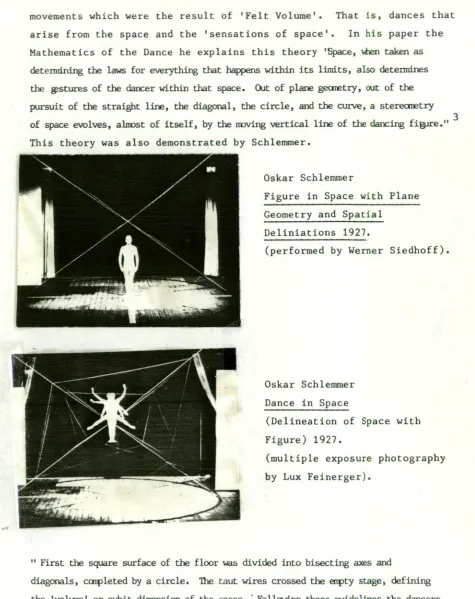
movements which were the result of 'Felt Volume'. That is, dances that arise from the space and the 'sensations of space'. In his paper the Mathematics of the Dance he explains this theory 'Space, 14-km taken as
determining the laws for everything that happens within its limits, also determines the wstures of the dancer within that space. Out of plane gelaietry, out of the pursuit of the straight line, the diagonal, the circle, and the curve, a steremetry of space evolves, almost of itself, by the moving vertical line of the dancing figpre." This theory was also demonstrated by Schlemmer.
[image:25.564.53.528.62.661.2]Oskar Schlemmer
Figure in Space with Plane Geometry and Spatial
Deliniations 1927.
(performed by Werner Siedhoff).
Oskar Schlemmer Dance in Space
(Delineation of Space with Figure) 1927.
(multiple exposure photography by Lux Feinerger).
" First the square surface of the floor was divided into bisecting axes and
diagonals, completed by a circle. The taut wires crossed the empty stage, defining the 'volume' or cubit dimension of the space. 'Following these guidelines the dancers moved within the 'spatial linear web' their movement dictated by the already geo-metrically divided stage." 4
3. Mathematics of the Dance - Journal Vivos Voco. Vol. V. No 8/9
August-September, 1926.
4. Performance - Live Art 1909 to the Present. Roselee Goldberg.
Schlemmer wished to emphasize the human figure as an event, thus he
devised costumes which determined the type of movement the dancer
could do. (These drawings are from "Man and Artistic Figure".
48. "For the mutation of the human body in
the sense of the stage costume, the following
can be fundamentally decisive. The law of
the surrounding cubistic forms; here the cubic
forms are transferred to the human body forms;
head torse, arms, legs are changed into spatial -
cubistic entities. Result: Living architecture."
49. "The functional laws of the human body
in relation to space: these typify the body
forms: the oval head, the base form of the
torso, the club forms of the arms and legs,
the spherical form of the joints. Result:
A technical organism."
50. "The laws of motion of the human body
in space; here they are the forms of
rotation, direction, section of space;
cone, helix, spiral, disk. Result: A
technical organism."
51. "The metaphysical forms of expression
symbolizing the members of the human body:
the star form of the spread hand, the x of
the crossed arms, the cruciform of the spine
and shoulder: also double head, multiple
limbs, division and neutralization of forms
"the body itself can demonstrate its mathematics by setting free its bodily mechanics.
Aides such as poles (the horizontal balancing-pole) or stilts (vertical elements are
as 'extension poles of the tools of movement' capable of vivifying space in framelike,
linear fashion." 5
The Slot Dance 1927 is a good example. The body movements are determined
by the 8 foot slots projecting from the limb of the dancer.
Oskar Schlemmer
'Dance of Slats' 1927
performed by Manda von Kreibig
"The figure, performing in
semi darkness, outlined the
geometrical division of the
space and emphasizing the
perspective view for the
audience". (sie) 6
Oskar Schlemmer P. 70.
'Dance of Hoods' 1927.
The shadow effect is
achieved by multiple exposure
photograph taken by Albert
Braum.
5. P.118. The Bauhaus - Hans M. Wingler.
6. Roselee Goldberg. P. 70.
Oskar Schlemmer. 'Glass Dance' 1929.
performed by Carla Grooch.
The costume consisted of a hooped skirt of glass rods, the head covered by a glass globe, and carrying glass spheres.
During the sixties much performance work was a rejection of all that was to do with theatrical movement and practise. This period was a linking of other areas of the arts and visual arts together. The coming together of dancers, musicians and artists led to collaboration on many levels and helped shape the 'New Dance'. Some of those
involved are Yvonne Rainer, Simone Forti (Whitman), Trisha Brown and Steve Paxton.
"They rejected the formal articulation of conventional dance which isolates body
parts into appendages of MB , legs and them facial expression and syrrbolic gestures." 7
I will take up these views when dealing with each individual performer.
Steve Paxton - Improvisation
Paxton was probably the most radical of the new dancers; he rejected
not only the stage space but also the premise that only trained dancers
were needed. He evolved the idea of performance by non-performers.
He designed pieces which called for little rehearsal and minimum of
rules used by a group assembled for the moment of performance.
Improvisation or acceptance of any kind of movement was an important
part of his work. He wanted to find a new way of dancing and a new
way of structuring dance. The following images are from a piece
performed at The Kitchen. N.Y. 1975.
The performance is Contact Improvisation
"Something that I (Steve Paxton) scored for the Grand Union led to
Contact Improvisation. It was a solo on a mat that started off low,
rolling and stretching through the legs, and ended up high, with
leaping rolls and catches
"Basically it was an investigation of the body in space where the
feet didn't have to be on the ground
—
contact is achieved through different parts of the body, the It was the place where I went through the basic perceptual stuff, peripheral vision, horizon change, the kind of sketching that makes rolling and falling easy
The world just goes whirling around your eyes, and you ave to fin other sources of stability — momentum and sense of gravity are the major ones.
There's one level on which the performers shouldn't be aware of what they're doing: it's not about directing each other's movement its more about falling in space together and improvising freely — other-wise they're manipulating each other
There is an 'it' we're trying to communicate trying to establish a very finely turned form of interaction through touch — you have to relate through the skin first, instead of through the eyes
•
Contact can be viewed as two bodies coming together so that it's
really one body with two sets of motives
Photos: Gwenn Thomas.
'Contact Improvisation' Avalanche. Summer 1975.
Simone Forti - behavioural demonstrations
Forti was another dancer who came into prominence in the sixties. She replaced theatrical movement, space and practice with a type of dance performance directed toward task fulfillment and simple repetitive
activity. Much of her work has been to do with behaviour demonstrations; where she selects something from the environment and observes its
movements and behaviour. Then she tries to imitate a particular element from the movements. "the basic eleffents be(miwrldnglArith for the last few years are bal.ance and hui nturn and their relationships." 8 Forti had been
observing the behavioural patterns of caged animals. "It sears in captivity there cares about a separation of aspects of self. Che aspect remains intact. But the aspect of being part of a system is drastically changed. Even the built-in relationship
between the animals nose and feet can no longer play itself out. And this separation of a sense of wholeness from the being as it operates in its life system scuehow brings the captive animal's dance behaviour into particular relief." 9
8. Simone Forti....Dancing at the Fence"
Avalanche Dec. 1974. P. 20.
9. Simone Forti. P. 20.
", Some an mals are corner wa ers,
something to break the corner up, sometimes
7 1.74e7
thrum, thrum, thrum. Then if you put
they do a triangle, and that's boredom."
Simone Forti.
'7 once observed the pacing patterns of a female bear. She was the snaller of two,
in an open area with a little cave back at the deep end. She was engaged in a kind
of promenade with certain paths which She would nearly always walk in the same sequence,
stopping and turning at certain landmarks on the way. She would walk into the little
cave and then back out, swinging her head to clear the entrance. Sometimes She would
start out on her walk around the space. First along a rather narrow ledge at the end
of which was a big rock nearly obstructing the passage.
The bear would nearly always stop there and turn around
by swinging her head over or under, or occasionally
clearing the rock ass-side. At each stopping point she
would make a choice between her various ways of turning.
But from time to time She would bypass her mark, gazing
around as She paced out one of the less frequent
loops in her pattern. It struck ire that she had been able
to regularize a matrix out of which She could improvise 10
variations."
It' r
-
Yvonne Rainer - body as object
Rainer is a choreographer/performer who began working in the late
fifties. She rejected the dramatic restrictions of traditional dance
and compiled a list in 1963 of the things she did not want in her
work. "No to spectacle, no to virtuosity, no to transformation and
magic and make-believe, no to the glamour and transcendency of the
star image, no to the heroic, no to the anti-hero, no to trash imagery,
no to involvement of performer or spectator, no to style, no to camp,
no to seduction of spectator by the wiles of the performer, no to
eccentricity, no to moving or being moved." 11
Her desire was to produce a new form of dance based on 'ordinary
language' and of 'task performance'. That is "a refusal to project a persona,
but thinking of oneself in dancing as simply a neutral surveyor of infornation." 12
Her overall concern was "to weigh the quality of the human body toward that of
objects, away from the superstylization of the dancer." 13
An example of this is a piece called Parts of Some Sextets 1965. All
these pieces involved not only permutations of movement, sound and
action but also an exploration of the human body in relation to objects.
Thus defining its space.
Yvonne Rainer
Parts of Some
Sextets. 1963
A piece for 10
people and 12
mat resses.
11. "Post Judson Dance", Deborah Jowitt. Art in America. 59 1971
P. 81.
12. & 13. "Yvonne Rainer" Avalanche. Summer 1970. P. 50.
Another piece of Rainer's which deals with movement as task or movement
as object is Terrain 1963.
t
Yvonne Rainer
Terrain. 1963. Parts of Some
Sextets. 1963
Parts of Some Sextets 1963.
In this piece Rainer used taped
readings from the Diary of William
Bentley P.P. He was a late 18th
Rainer's directions to the dancers were "walk, run, crawl-straight legs straight-leg waddle - arms high doing small windmill nnvie death run (Breathless) catch-one squats while other pretends to thnuw ball nharp jerky novements - running back and forth passing ball." 14 These words are only part of the instructions from the five part work.
The works I have talked about are early works of Rainer's. However i her later work is more concerned with personal material and the use of dialogue. "the fascination with verbal material is opposed to her fascination with objects and non-verbal behaviour; her interest in personal material is balanced by her attention to formal concerns; her awareness of process coexists with an interest in structure." 15
Robert Rauschenberg - Motion
Rauschenberg played a role in the shaping of the 'New Dance" of the sixties. His involvement with dancers like Merce.Cunningham had originally been in the areas of designing sets and costumes for Merce Cunningham Company and some performing. In 1963 he presented his performance called Pelican 1963.
In this piece Rauschenberg is examining motion and its presentation in various ways.
14. "Yvonne Rainer: Holding a Mirror to Experience" Studio International 1973. P. 41
15. Yvonne Rainer: Holding a Mirror to Experience. P. 43
Robert Rauschenberg
Pelican 1963 (performers - Rauschenberg,
Trisha Brown and Alex Hay.)
The venue was an ice skating rink with two of the performers on ice
skates with Brown on points. The two skaters glided at speed around
the dancer, who is executing a series of movements slowly. The skaters
open up their parachutes which slowed down their movements. At the
same time the dancer speeds up. "there the ehment of place, as uell as objects
such as parachutes, ballet shoes and roller skates, determined the town of the 16
performance."
Pelican 1963
Trisha Brown — Space and Gravity
Brown A earlier work deals with spatial experience. She uses existing
obstacles (like buildings and walls) in which to experience spatial
disorientation with physical effort. These pieces were designed to
disorientate the audiencds perception of space and gravity. For
example Rituals on Concrete and Air 1973.
Trisha Brown
Rituals on Concrete
and Air. 1973
"Articulating the body on the floor eliminated problems of balance, tension, gravity and
pull which occur when working vertically in space and also allows for quite different
figurations." 17
Brown began working with tackle systems that allowed her to walk on walls,
and mountain climbing equipment for walking down 7 story buildings.
These pieces she called 'Equipment Pieces'. One of these pieces
called 'Walking on the Wall" 1971 was performed in a gallery where the
performers used mountaineering equipment and walked along the wall at
right angles to the audience.
Trisha Brown
Walking on the Wall 1971.
"The audience would virtually swing back on their chairs in an attemt to View the
dance sideways on, rather than from the top-as they were obliged to do." 18
Brown later returned to a more conventional mode of theatrical
presen-tation. She felt she had done all that she wanted to do with gravity
and space. "I'd been going along heavily burdened with my enornous props and
constructions, and I dumped them. They were a burden in a million ways. In terms
of safety to the performer and the audience... There was storage. There was
carrying them into the theatre and installing them. There was the cost." 19
17. "Space as Praxis" Roselee Goldberg.
Studio International Sep./Oct. 1975. Vol. 190. P 134.
18. "Space as Praxis" Roselee Goldberg. P. 134.
19. "Performance and Conversation" Stephen Koch.
Glacial Decoy 1979 was made specifically for the traditional
proscenium arch or stage frame and is danced about the frame. This
piece marks the introduction of sets and costumes (by Rauschenberg)
into her work.
Glacial Decoy 1979
Performers - Trisha Brown, Nina Lundborg and Lisa Kraus.
"ale main agent of the structural fragmentation is the frame imposed on the dance by
the proscenium arch. In the opening sequence, for example, only the peripheries of
the stage are used: one at a time, soloists emerge in mid-phrase from opposite
sides of the stage, only to disappear back into the wings before the phrase can be
completed. This alternating pattern of lateral movement and the play of appearance
and disappearance it inaugurates, suggests that the dance is not contained by the
proscenium but continues off-stage or, rather, that it might continue were it not
interrupted by the frame. By incorporating the proscenium in this way, Brown
has successfully subverted its pictorializing function - its tendency to present
what it frames as integral, complete, self-sufficient but only by delimiting, restricting, 20
confining it."
20. The Pro-scenic Event. Art in America. Dec. 1981. P. 128.
The sets and costumes also add to the ideas of fragmentation, and events
PART B
This section of the essay is a result of my interest, while researching this essay, in aspects of recording 'the dance'. That is, the recording of the movement, gesture, space and the body within that space onto a two dimensional form. Each choreographer has his/her own form of dance rotation.
;
4
t
le
r)
V
r •
SuL , P C , 1■ 4 1ei, S1
Throughout the history of dance, notes and diagrams have been made
of works either before or after the piece has been performed. This
rotation of movement by choreographers and dancers provides a means
for planning and recording and also a method of documenting movement
through space on two dimensional face.
Rudolph Laban (a choreographer and theorist)formulated a complex key
for all movement analysis in the twenties. He interpreted the body
as an instrument, "nothing else than a complicated systan of cranes and levers 21
of various extensions."
Letbenntehon ••.nr don,, morements
on en •,0 ',An, eht solo flsilf (Ind fel! Ira,F 4•• rolurron repreJ•rdt a pa•t of the hodr• ire pt the cent., pair. • furl. trend, for parrs of
the bods a den., a 4, In U•uhf
IN pier nee. on!. thr•• “pdrahrs, coirmns (heel lane,) a.. drag,
h
65
1
Symbols (left) are plated on the stet (above) to show the diteetion • pars Olt body is mos The ref-tootle repreumm the movement of 4 part of the body "into piore"--along th• body's vertical am Hot•Ir ill sped bihr•I at top and bottom indu ate forward andbar Award moremmu Triangles . mow mnent right or le It, and the low
dented 6eur, cf101fonal CI OM
&If. Ain,. 01.10181 sit for '
movement up, hen:entails or doom. LABANOTATION
Tile duration of ea, A 0101 r1.i,n1 is indicated bs the length of the epos tool Tiles, rectangle, 'n eon ,he hod, 1,44 f niOtoil into rime...hiking tip. 111.n• ROW,s It el !rote tithe mot" alequiralroti
41‘,44 :eft to right 1 two beats,
Oaf and • hall beat.
411 Are, elro,ntt of bstran's dam, foaminge are rombined melts e sample Tile hat, hed atro Atm that the olanror rises in plare on hit ne4, loot The
shaded bottle srap. andaregfr. Ow left leg
movies forward. low T monad.. r nil. dots .1,414 flf,o11 "II In the sides
keettonteiv. ,Vernh•ry ma•11 oil hews —the left leg and right food eer uotrig
Ono boat, tho arms taking two beats
21. Performance: The Art of Notation. Roselee Goldberg. Studio International August 1976. P. 55
-7
3
2, (
Oskar Schlemmer 'Gesture Dance' 1926-27.
Labans theories were reflected in the work of Oskar Schlemmer. Schlemmer provided a theory and name for tracks written in the air by dance movement. He called it the stereometry of space.
"If one were to imagine a space filled with a soft, pliable substance in which the figures of the sequence of the dancer's movement were to harden as a negative form, this would demonstrate the relationship of the gecnetry of the plane to the stereceetry of the
22 space."
Oskar Schlenner "Stereametry of Space' Drawing from Mench und Kunstfigur.
Bauhaus book No. 4. 1925
preoccupied with different manifestations of space
"the graphic representations of the dancers path were for him the theory of space, while 23
performance in real space provided the practise to that theory."
In Gesture Dance 1926-27 (or Dance of Gestures)
22. The Bauhaus. Hans M. Wingler. P. 118. 23. Performance: The Art of Notation. P. 55.
he used a diagram which showed graphically the action through space.
The second diagram used for Gesture Dance describes the dance in words.
S t F t
rp,•es•r••■•.•Ader gelbe cl r rote Cde•bleue.4
SC' no: express, I
kildiVirft. i-n d-e•
'tech kehrt' _ ?melt sick 14cuir antl
black! *chart aut drehsluhi male
scnail In geracter lanai
vor venrti_ ebenso .0141 kehrti _ Kens° Mee kehrtl armada. damn nor 11uh4 dann uber Muhl amp masa mats krauipala _ kneCht langgestrecs kreuumer >r herein kreunmer •nd bis _- is Utz t 111111111 vor bank 1000.111 hoch' ' ' ". " und schnelit semi hoer,' ' ' .11.111 loch , ' '1111111111 seta en s ' i C h at 1 -. uP 0-1 h •-1 1-a n lenstirnmen 93533555S-53355355555S SSSSSSSSSSS5SSS S55353555335359394
99ftnsp I 99:11 site! sa091■ 1
aua sa 9 • merle me . A . selbstversunken
winseln f•Isettgesprken $etiqtrunken _ 21
eve.. 3.. C I
•,,•/••••• V • rstandnisinnig•s p•m•uni• IS Mr 11 was Iss Mr —• ha" aamt mu oh, .--- —
• - r - rn-s- e-h- w-u- n -6 - 6 -e -1- I -e - a --1.--e-r- sellestnersunktin 15
Mn ama sms ea, ---a. sae A vas an, P. 0--- may trunnion I
vergniogliches hlind•r•ibin II
bah Masi aas She — - a sags II wet las aka .4--- 0 Is • d•r•p•e•r• 2 •e• 1 •9•C•t1 •1•• ter 15
reckt sich wharf men mkt sun =hart neCh reckt sich kortengerade I vOrn. hinten I Mich!
Mt wily 1 —2— 3 ___-- 4 _ , 65 6 7 —2 9 0,10 11 t,124,
1-- mr- tr.- sr- e--- 11,-- mr- n .--- or- sr- mr- s.-- p.-- iv- n--- n-- t•-• 0
reneger aaaaa II seanetlen 110 511 and drehen *101 woe um sick .911 51 21 droop., e-h en la-nasal% in 1-0 p-psehri-Itenauf
1-- i o-11 s-u. j-e n 11-a .-r 0-4, 510,011 •-n el-e r u-n -d 44- n -1 e-r e-r-m- u n-d k-il-r-p-e-• b-e In • 9 u n-ro -•-n d-ieht b•is•m-men s-i-e-a i-n sich. v-e r- in-a - s s e- I_ h_p in ,,.._,--..-._._,-- r, . 6 - 1-e-m-1.-r-n-s-44-4--s-nr--•-u-s-0-1-4-In-1--r-u-s-4-1-a-nr-i-r-er 30 Sah91111111111 1 1 1 1 1 1 1 I 1 1 1 Inchrecken hoe h 1 It 1 III 1 1 III 1
f 1 I' f 4 1 renn1 senarf mach Kke rennt sChart nech matte rennt *chart nach echo 1:1
links tern hinten teddy worn _ , _ 6 stteren stare ins leere 14 nauS 13 5 'thane vow _
reser rucked-1s Suruck in rr.opeixhret 7 where@ fir resch ruckwanS euruck
schrift@ notn and in erode. triunderenclen •n•rSChschnden voi neduletrishl 1 schrift sere• 1 Khritt ruck. • 1 scnnit sene• 1 schrift volt. u n d sltst 1 1 1 1 I 1 1 'heck: ben •■- Mir arm ri■.
vrirh 1001 1
tea 1,ails Matra
3 schrift0 woe rasch kehrti 3 'Owing not rasch Senn , S Knees not
teal
dwinP49 panolner...n w-e-,-t-a-u-s-n-o-i-e-n-d-e-n t-e , ro s e-a 1 t-e-n 4124-211. 4, rom. 1- m I r •-i-s-e p-e-h-t-11-0 14
schnicksp wool Stieren aul A 14 s-1-4 p 1-e-n vr-ill i-I-0,--r 1-0-i-p-S-C h-r i I 1 k r - e , Si; schnukspruns! (Miner) s t ■ e r • n a u 1 A 14 s t-a p 1 e-n vr-e o-t-e-r 1-•-i-g-s-c.h-r-i_t 1 ki-r-e '-5 11 schreclosmonal (ken) s 1 1 e r e n au 1 A 14 umme brOder!b. est.', setter 1 Alb 1 bedeurend out mile
mat •useestrecklem arm 3
handaufl•gen - 3
fanfare! mehwarri . 7
Ito. I 1 Famine- 4
, . __• • ,_ • i _. ., , , 4 - - -..._ _....F.4._—_.—..41_._. _
roli•ren sich eiegend rn e•Itertakt 2t1 ihren bullpen/ten him., -2-3-49aus ausg• , gs ■ ur in •ustallsteilung 4 paukensentase ...MK ben 40 , 1 4wee. arenkrasttgamtes 3
- 5 -1 erasidueln weal. I 1
Oskar Schlemmer
Notation for Gesture Dance
1926-27
Lucinda Childs was a performer during the sixties who used a form of notation in her pieces. In her earlier work she experimented with movement activity in relation to objects. She then altered and extended these events in time and space.
Lucinda Childs Pastime 1963
'Later on She felt it necessary to impose a structure on the piece other than the intuitive logic derived fram movenent exploration with objects. I created dialogues for this purpose which had ongoing reference to specific subject matter. The
dialogues did not in and of themselves dictate action, but accompanied action as the activity in the dance drifted in and out of a context that was relevant to the
24 content of the dialogue."
Old Europe antiques Window
B 103 End of tags Door-license Burglary, larceny Grating Padlock Flea Market 8 1 (3 Cameras Dolls Face each other Street Dance: Score
mmutes Seconds :50 1:05 1:25 1:45 1:50 2:10 2:22 2:30 2:35 2:54 2:55 2:56 3:10 3:20 3:22 3:30 3:35 3:42 3:50 3:55 4:05 4:10 4:20 4:30 4:35
(Action of performers)
Gurbob Fire escape (Action of performers) Caltype
Y of Caltype (Action of performers) Repeated below C of Caltype cardboard boxes Typewriters etc. written in a vertical column (Action of performers) 5:08 Aluminum column Snow street Arch 5:09 5:10 5:15 5:25 5:50 6:00 52
Street Dance, 1954
at Robert Rauschenberg', studio, fall, 1965, dialogue on taper
To see this dance the observer must stand by the window at the South end of the bit and look across
the street toward the South side of Broadway onto the sidewalk extending between 11th and 12th Streets. I am concerned w ith the area between the Bon Vivant Delicacie Store and Surplus Materials of Nor-bert and Hausknect, I am not concerned with either of these buildings specifically but I am concerned with the area between.
Old Europe Antiques Incorporated—a black sign with white letters is framed in gold—the window below the sign displays various objects, presumably European: clocks, chandeliers, candelabras, various antiques labeled w ith white tags — B 103 — Fa VI( another 64 another 20. The remaining tags remain overturned or blank or no intormation is on them. On the door a small sign informs that the building
is license bonded by New York State protected las,
a Mr Louis Lewis. 1,042-1-S 1.-E-W-1-S. There is a reward tor information leading to the arrest and con-viction of any person committing burglary or larceny against this concern and to call Algonquin 4-3952.
Next to the antique store is a stairway concealed by a grating. The stairway is closed on Saturdays by a padlock which attaches to the center of the grating; to the right of the grating is 816 Broadway. a flea Market. A white sign is numbered 8 1 6 in black. The numbers 8 1 6 are written vertically and surrounded by a fine black ellrpse. Four miniature cameras are displayed in the rine for 51500. another
510.00. On the lett wall in the window two tarsi,: wooden owls face each other. The owls are dom Spain. A white sign with red lettering beneath the window square explains that the nonautomatic sprin-kler is in the basement.
814 Broadway is a Gurbob building — the numbers are in white agarnst the maroon color of the building. A steel ladder extending from underneath the fire escape to the right intersects with the letters. Next to that Caltype Wholesale Office Machines — a white sign with black lettering. The V of Caltype extends downward to the line of the black squarish ellipse that surrounds the sign, the round ball at the bottom tip of the Y is cut in half by the bottom line of the ellipse. The sign is repeated below in the window, however in this instance the C of Caltype is sur-rounded by orange. There are three rows of card-board boxes to the right in the window. A red arrow extends upward on each one and the word "up" is written to the left or each red arrow in red. To the left of this, typewriters adding machines, calculators, photocopy, mimeograph. and dictation machines are advertised in gold writing in a vertical column. A square pillar extends in tront of the second of three doorways of 814 Broadway. The building is sprinkled at 814 Broadway.1vith the .3xception of the cellar and subcellar which is sprinkled at 812 Broad-way, also a Gurbob building.
This is a snow street—no parking 8 am-b pm Mon-day through Friday. There is a broken arch on the roof of the Caltype building and an identical broken arch at the right, but it does not extend as much into the tower Moto. embordment of the building. For example her performance Street Dance 1964.
This was performed on the city street within an area visible from
the sixth floor window of Rauschenberg loft. A group of spectators
looked down while the dialogue on the tape was left with them. These
examples of notation are accompanied by a descriptive score which
tells you what the dance is about as well as the movements involved.
Geranium, 1963
(he materials for Geranium consisted of a winter coat, sunglasses, a wooden pole 66" long, a piece of tin-foil, a platform 48- x 80" raked, a flat, a hammock. a 38" metal chain, a padlock and key, a plate of clear glass, a hand brush, a one-pound bag of soil and a hammer.
The dialogue, a tape of a broadcast of the NFL championship game between the Cleveland Browns and the Baltemore Colts, was edited by me to include specific movement of the players described by the narrator of the game. I also included in the tape a list of the names of the players, and occasional interludes of rock-and-roll music between sections of the dance. The dance had our sections. In the first section I used the pole to indicate the rise in volume of the excitement of the spectators responding to the suc-cess of the individual players in the game. I raised the pole vertically at the pitch of loud sound. Then I pointed the pole down so that the tip made contact with a piece of tinfoil which I dashed around the rim of the raked platform in a frantic manner, finally for-cing the piece of foil up the side of the flat in a fag-ged path to the extent of my reach with the pole. In the second section. I attached myself with chain and padlock to the end of a hammock, the other end being secured to the flat. I moved in a semicircular arc, my weight supported by the hammock, to execute in slow motion the action of a runner, racing in to catch the hall, fumbling and being overturned. I ac-cented his fall with the bang of a hammer on the ground. The third section was a dialogue given by me dressed in a winter coat about the fact that there was no third section It was in fact a gap and I went into theoretical reasons for dealing with the gap. As I did, I also mentioned some ideas for the section and why they were not realized, as well as some bits of infor-mation about the nature of a football helmet which were pure speculation. The final section of the dance was performed on the raked platform. I stepped into a pile of dirt which I had emptied onto one end of the platform. brushing the excess diagonally forward, leav-ing a path of footprints until all the dirt had been
55 used up.
Lucinda Childs
Geranium
1965
It wasn't until Childs began choreographing group pieces that a
form of notation became necessary for teaching and showing the
performers. 'The scores were a time—saver for new dancers learning the work.
Like a musical score she explained, they eliminated the cumberscue trial and
error which wes always part of choreographing new pieces." 25
25. "Performance: The Art of Notation" Roselee Goldberg. P. 57.
"CI
fA
i
4.4,(
(11-k
Scr.
blke “- (1-
0
opGL,
dd.9
00,4
L
G
.°81
0`
,
P,„ 0
/
1
1
7f4.
4t
pf
,
0 0
r
y
r
k
r
6
1441
%0
/i/64
'
f
ineS
creen Lcnier s(inot) re4Model, August, 19b4, dialogue
This is a typical Modern Dance position. It is based on this idea ...
You can use it. There are ways to use it. You can abandon it ...
01 course there are other positions.
This is a typical Modern Dance positron.
It is uncomfortable to be in as well as difficult to get out of and ugly.
The right toot is bent diagonally back toward the right and the left leg is bent diagonally back toward
the left.
It is an expressive position.
Expressive for someone who has nothing to do Ot course Yogis can get down on the floor like this Put one loot like this and the other
Screen, February 191i5, dialogue.
while laying down the dots.
The technique demonstrated here is derived trom an offshoot of a branch of Frem h Impressionism in
which the luminosity is produced by laying on the color in points or small dots of unmixed color which are blended by the eye in the silhouetted lorm 01 the landscape or other subject matter to capture inten-tionally a particular aspect of a part of a time of the day or part of the time of the day or simply the time
ii The day.
belore entering from behind
I think that I am in a position where I can truthlully say that everything I have put down is behind me with the exception ot this mirror which I am holding ill my left hand. The human biology is essentially equipped to enter things in front of itsell and is relatively incapable of entering things from behind without the use ot rear vision which is the re,,,,,, or which I am using this mirror as I enter this body in material — and the reason why I ant entering in this backward manner is I suppose that I wanted to get a new angle on this material in as much as a reporter would return to the scene of a crime to reinvestigate the facts — or perhaps speak too someone he hadn't
spoken to betore to get a new angle on the situation. However the only angle that I have mond here is non new — it is created by a lone extending from that point at which my eye hots the mirror to a point on the floor which I see in the 1111110r. This is a diagonal line. I'm sorry that I don't have a string to demonstrate it more clearly, all I can safely say about this angle is that it is probably more than 45 and inevitably less than 90. Also in the painting from which these colors are derived most ot the figures are spectators and con-siderably fewer figures are pertorming various acro-batic stunts involving precarious balance. One of the players is in this position ... Here it is again and once more ....
LUCINDA CHILDS.
Trisha Brown in her pieces after the 'equipment dances' began using
different forms of notation. For example Locus 1975 is a piece
where she began working with 3 forms of notation. "Firstly, she
drew a cube, numbered it and made a sequence of numbers based on
biological information. She studied the numbers, then matched them with
the drawing, then returned to the number score and back to the drawing.
Following this procedure she invented movements which would allow her to
move from one number to the next.
h
71R/sN r,
Trisha Brown
Notation used
for Locus 1975
040
Part two was for the four dancers involved. She expanded the initial
drawing with explanatory notes. Sometimes she added stick figures but
the drawing were always a reminder for the work, they were not a
representation.
"Pursuing the idea of notation she developed part three of her system. Taking a section
of the original dance, she wrote it out, gave the written text to a dancer who was not
familiar with that piece, but who had a general idea of the style of her work. In
this way she wished to arrive at natural variations — the erosion of the piece, something
that ialpinges on the original and cour it to Change." 26
26. "Performance the Art of Notation" Roselee Goldberg. P. 57,
BIBLIOGRAPHY
The Bauhaus - Hans M. Wingler.
The Massachusetts Institution of Technology Press 1969. "Simone Forti Dancing at the Fence"
Avalanche. Dec. 1974 'Contact Improvisation'
Avalanche. Summer 1975.
Performance - Live Art 1909 to the Present. Roselee Goldberg. Thames and Hudson 1979. 'Space as Praxis' - Roselee Goldberg
Studio International. Vol. 190. Sep./Oct. 1975. 'Post Judson Dance' - Deborah Jowitt
Art in America 59 1971.
'The Performer as Persona: an Interview with Yvonne Rainer" Liza Bear and Willoughby Sharp ed.
Avalanche. Summer 1972.
"Yvonne Rainer. Holding a Mirror to Experience" Studio International 1973.
'Performance, A conversation' - Stephen Koch Art Forum 11. Sept-Dec. 1972.
'The Pro-scenic Event'
Art in America. Dec. 1981. 'Performance: The Art of Notation'
Roselee Goldberg.
Studio International. Aug. 1976. 'Lucinda Childs: A Portfolio'
Art Forum Feb. 1973.
'Yvonne Rainer, Part One: The Dancer and the Dance' Annette Michelson.
THE REPRESENTATION OF WOMEN;
"In a world ordered by sexual inbalance, pleasure in looking has been split between active/male and passive/female. The determining male gaze projects its phantasy onto the female figure which is styled accordingly. In their traiditonal exhibitionist role women are simultaneously looked at and displayed with their appearance coded for strong visual and erotic impact so that they can be said to connote to-be-looked,atness. Women displayed as sexual object is the leit-motif of erotic spectacle: fram pin-ups to strip-tease, fram Ziegfeld to Buiby Berkeley, She holds the look, plays to and signifies male desire."
This quote by Laura Mulvey is relevant in both art and culture: from advertisements to traditional representations of women in art. The patriarchal Society in which we live encourages this sexual split by saturating us with images, showing us 'that those in power, with power, and men in general use many aspects of TIANI verbal canmunication to maintain both capitalism and male privilege." 2 The attitudes of the time are reflected in the representations of women as well as the attitudes of the artists or creators of the image. For example, Renoir continually painted his vision or fantasy of the ideal woman. Yet as he aged, his attitude toward representing women changed. His earlier paintings were scenes of enchantment, gay young and volumptuous nudes usually portrayed in natural settings. These carefree young girls were there for the purpose of
pleasure for men. But, later during the 1008's he became increasingly conservative in his outlook, writing against modernity, industria-lization and the increase of feminism. "He believed that men should be thinkers, artists and intellectuals, while women should be sources of pleasure for
3
men in sex, in mothering, in homemaking." His carefree girls were replaced by mature peasants, represented in various maternal roles. Advertise-Slide ments today to some extend still hold onto these values, throwing them
1
back onto us as reflection of our society. For example a perfume
advertisement in a Mode Australia magazine shows us a business woman who is holding her own with her male associates in the top image and yet as the text says "But up close it is something else" referring to the bottom image. The ad is obviously meant to reach the liberated modern woman who is the likely reader of the magazine, reinforcing a particular behaviour while acknowledging woman's changing role in the workforce.
1. "Visual Pleasure and Narrative Cinema", Laura Mulvey, Screen Vol. 16, 3, 1975. P. 11.
2. "Body Politics: Some Notes on the Stealing and Selling of Non-Verbal Communication: Peter Steven, Film Reader 5 p.205.
3. "Renoir's Sensuous Women" Barbara Ehrlich White, Woman as Sex Object by Hess and Nochlin, P. 169.
The to—be—looked—at—ness that Laura Mulvey talks about is one of the most active forces in much of the representation of women. Within this context the comment by John Berger seems valid: Inenactaldwirmalappear.
4
Mien look at women. Wanen watch themselves being looked at." The depiction of the nude in the history of European painting shows this in, for example, 2 Ingres: The Large Odalisque 1814 (Odalisque is a Turkish word meaning
a harem slave girl). The nude's head is turned to face outwards and is staring at the viewer. She is aware of being looked at. Another example is the Biblical subject of Susannah and the Elders which was painted often by different artists. The theme of Susannah and the Elders is that the two elders who are hidden in the garden have threatened Susannah 3 that they will publicly accuse her of committing adultery with a young
man if she will not yield to them. A comparison can be made between
Rembrandt's Susanna Surprised by the Elders 1647, where Susanna is looking 4 at the viewer and trying to cover her nakedness, and Tinteretto's version
where Susannah is aware of the elders spying on her as well as the viewer. She is objectified by allowing herself to be viewed as well as viewing herself in a mirror. In another version by Tintoretto, Susannah looks straight unashamedly at the viewer.
This very popular theme of women at their toilet has gone through some remarkable changes. Themes from classical and Biblical stories, for example, painted originally within this context, change to being painted 5 purely for their erotic impact; The theme of Bathsheba, is an example,
where a maid or maids are preparing her for the seduction of King David in the painting of Rembrandts, The Toilet of Bathsheba 1643. The nude is aware of the viewer and is looking straight out of the painting.
This theme of maids preparing mistresses slowly lost its Biblical meaning by the eighteenth century and became a type of representation; by this
I mean that anonymous mistresses and maids became genre and the representation became its own intimate and erotic meaning.
Many of the Biblical and Classical stories allowed justification for the 6 representation of nudes. The Judgement of Paris is such a story. discord
Over a period of time the meaning of the painting lost importance. In later portrayals the intention of the painting was to show a seductive line—up of flesh where the viewer becomes the judge. The original story was lost, leaving only the title and a vague story similar to that of a beauty quest.
7 Three examples ranging from the fiteenth century to the ninteenth century 8 show this shift in the importance of meaning.
Judgement of Paris by Cranach 1529.
Judgement of Paris : Rubens 1635-37
Judgement of Paris : Renoir C1914.
The idea of women naked, before the eyes of the judge s poses another question about the representation of women. The majority of images which are made for the enjoyment of the male viewers are young and beautiful women and girls of no particular identity other than youth and beaty. Representation of a married woman or a mother is not considered to be erotic "Onoe
married and a mother she disappeared fram consideration The imlications SIMI' to be
that a warans erotic power was extinguished by its very fulfilment. " However this 5 is not always so, as in the later nudes and genre scenes of Renoir where he portrays motherhood in an erotic and sensual manner. For example, his painting Maternity 1918 "the relaxed and knowing smiles by which these in so often relate to the viewer suggest that their power could be directed to that viewer (not only at the child they maybe holding) and that its basis is erotic, as well as m
nurturing." 6
The advertisements of today rely heavily on selling a particular commodity by the use of this look, that is, using a beautiful and young woman who implies she is offering more to the viewer than the commodity. "At the risk of sounding too speculative I would contend that that which recuperates a bottle of cherry or a car in advertisements from being read as still life with its traditional 9 associations and indicates their status as purchaseable commodities, is the presence of a
woman by virtue of that which the woman introduces into an image." 7
Women are therefore seen as a sign of exchange or sale. This point is taken up and discussed later in the essay.
5. "The Femme Fatale and her Sisters" : Martha Kingsbury, P. 195 6. "Woman as Sex Object", Hess and Kingsbury P. 203 Nochlin. 7. "Whats Wrong with Images of Women?" : Griselda Pollock,
Screen Education No. 24 1977 Autumn. P. 28.
One point in discussing the representation of women is the lack of
identity, the objectification, the universality of type. As I mentioned earlier, not only is the representation of women determined by the artists desires and sexuality,but by the moral and social changes of the period. During the eighteenth century women were represented in a passive role while the male viewer in the picture or of the picture is embodying the power "A mans presence suggests what he is capable of doing to you or for you. By contrast, a womans presence expresses her own attitude to herself, and defines what can and cannot be done to her." 8
In the late nineteenth century the male/female relationship became the problem of human sexuality. The art and literature during this time shows the preoccupation with the character of love and nature of sexual desire. The femme fatale makes its appearance during this time where "A deep-
rooted misogyny had been common amongst many artists since the beginning of the century. The belief was wide spread that women capped creativity and that they uere incapable
9
of elevating feelings or of understanding art." The belief expressed in the quote above is also echoed in the writings of Renoir, who is not really a painter of the femme fatale. "I consider that women are monsters who are authors, lawyers and politicians, like George Sand, Madame Adam, and other bores Who are nothing more than five legged beasts. The woman who is an artist is merely ridiculous, but I feel that it is acceptable for a in to be a singer or a dancer. In Antiquity and amongst simple people, women sing and dance and they do not therefore become less feadmine. Gracefulness is aulaman's domain and even her duty. I knowvery well that today things have become uorse, but what can ue do? In former times, wanen freely sang and danced in order to be winscne and pleasing to men. Today they must be paid off; the charm is gone." 10
These 19th century artists drew their subjects from many sources, particularly the Bible. Three particular stories held fascination for them because of the fate of the victims. The first story is about
Judith, the Jewish widow who decapitated the Philistine general Holofernes after making love to him. The second story is about Salome ) who demanded
the head of John the Baptist as a reward for dancing before Herod. The third is about Delilah,who cut off Sampson's hair which was his strength, then betrayed him to his enemies who put out his eyes.
8. John Berger. P. 45-46.