CHAPTER 5
A chaining of the living to the dead
Essentially regimented penal environments, charitable institutions were conceived not out of humanitarian concerns for the welfare of the aged and infirm, but as a means to restrict the movement of a particular sub-category of the undeserving poor, and to control their social interaction. Invalids felt the full brunt of the 'hated stain'. In the mid 1850s pauper invalids were perceived as an undeserving social element, a group to be confined in secluded, isolated, penal establishments. An aspect of the transformation of the aged poor to a deserving social element involved the casting off of their perceived criminality, for they could not be considered deserving until they ceased to be seen as criminals.
Initially, a conservative paternalistic benevolence which sought to demonise and criminalise pauper invalids held sway, but over time inmates ceased to be viewed as nefarious and came to be accepted as patients. This chapter examines the role of seclusion, isolation and criminalisation upon maintaining a social conviction that invalids were the carriers of a moral contagion. In particular, it explores this theme through an examination of the treatment of female invalids, who in many respects were seen as far more dangerous disseminators of immorality than their male counterparts.
as well as their ~haracter.~ This latter point is discussed in some length as the individuals who made up the membership of benevolent societies tended to be both influential and conservative. It is argued that their conduct inhibited the introduction of progressive reforms to invalid management.
Economic burden, social contagion and criminalisation
Having toiled hard for a number of employers in and about the district of New Norfolk, James Senior found himself destitute at the age of 80. O n 1 8 August 1857, the New Norfolk weekly sitting magistrate, Major Lloyd, signed an application for Senior to be admitted to Hobart Town's colonial hospital. Yet another rural pauper was forwarded to an urban centre intensifying pressure on the limited facilities available to accommodate such individuals. This point was not lost on Lloyd who, like others in similar positions, recognised the likely fiscal implications to the colony.' Lloyd also observed that pauperism was a developing issue which aroused emotions of both disdain and fear: disdain that individuals would fail to make provision for their old age and fear that numbers of such individuals would continue to rise placing an even greater burden upon the more prudent of society. He, nevertheless, recognised that pauperism was not always an individual's fault and expressed a view that the relief of paupers, such as Senior, was the responsibility of the government. Lloyd was at odds with most members of his class in suggesting that poverty might result from factors other than failing to adhere to the middle class virtues of thrift, self-help, prudence and fortitude.
For many in the elite and middle classes, invalidism had come to be intimately associated with'the problem of deviant and criminal behaviour; a connection which remained strong for many decades. This was because pauperism was seen as being occasioned by indolence, intemperance and other kindred vices. In March 1870, for example, The Mercury published the
'
A proficient review of private benevolence can be found in Brown, Poverty is Not a Crime.impressions of a visitor to Port Arthur which described the whole of the invalids as being 'the mere wrecks of humanity' who in their old age were 'suffering the painful consequences of early vicious habit^.'^ This is reflective of middle class thinking as it related to old age. Thomas Cole has argued, in relation to the North American context, that in a dualistic perspective there was the 'good' old age, ensuing from the culmination of proper middle class living, and a 'bad' old age, the punishment for having led an immoral life and indulged in unhealthy behaviour (such as intemperance).' He argues that by the middle third of the nineteenth-century a person's 'physical, material, and spiritual condition in old age had become solely a matter of individual respon~ibility.'~ Cole states that:
the Victorian vision of disease and decay in later life was harsher and more punitive than the old view, rooted in original sin. Rather than assume that everyone who had lived long enough would become ill and bent with years as a punishment for Adam's sin, Victorians assumed that everyone could be healthy and self-reliant in later life - unless they had sinned against God's laws of nature and morality. Hence poverty, disease, and fragility appeared to be shameful; they were the visible signs of personal moral f a i l ~ r e . ~
He further maintains that this Victorian belief in a dualism of ageing, and the distinction made by the middle class between the deserving and undeserving poor, were rooted in the principle of individual responsibility. This was a doctrine which saw poverty and illness as the consequences of individual failure. From this, Cole reasons, the idea of social sanction developed in which:
those unwilling to save for old age or to follow the bourgeois 'regime of temperance and virtue could not expect to be coddled with pensions or health care in their dotage. Fear of disease, de endency, and the almshouse would enforce the ethic of work and self-reliance.
P
For as Shurlee Swain so succinctly expressed it, for Melbourne's poor:
The Mercu y, 25.3.1870, p. 2 c. 7-p. 3 c. I.
'
T.R. Cole, The Journey of Life: A Cultural H i s t o y ofAging in America (Cambridge, 1992), p. 237.Old age brought with it the limitation and finally complete cessation of income and a dependence on such resources as the individual had been able to amass during his working life.'
Michael Sturma has argued, in regard to colonial New South Wales, that there pervaded an assumption that criminality was contagious. He cites that colony's Chief Justice, James Dowling, as stating '[vlice is so fascinating, that she cannot be looked upon without peril to the b e h ~ l d e r . ' ~
Several writers, such as Manning Clark, Lloyd Robson, and A. G. L. Shaw, have maintained that this position was particularly resilient and had a long- term influence upon the social position of both convicts and emancipists, and therefore invalids.I0 Michael Roe, in Questfor Authority in Eastern Australia has argued that 'the stigma of convictism was more potent' in the Tasmanian context." That convicts, and by association, invalids, made up a 'criminal class' is a moot point central to many debates regarding 'convict society'. As Sturma puts it, such arguments 'are as difficult to disprove as to prove.'" He also points out that there is now a body of evidence contrary to the earlier interpretations of Clark, Robson and Shaw, and that there is reason to doubt 'whether convict values differed markedly from those of free irnmigrant~'.'~ It is not significant whether the earlier contention or the revisionists' perspective is the more accurate, what is important is the opinion of the colonial elite and middle class. They perceived a social grouping they identified as criminal and contagious, and it is this perception which is so vital in determining the early administration of invalids and the utilisation of
S.L. Swain, 'Destitute and dependent: case studies in poverty in Melbourne, 1890-1900',
Historical Studies 19 (1974), p. 98.
9 M.
Sturma, Vice in a Vicious Society: Crime and Convicts in Mid-Nineteenth Centuy New South Wales (St Lucia, 1983), pp. 1-2.
I0 See C.M.H. Clark, 'The origins of the convicts transported to eastern Australia, 1787-1852', Historical Studies: Australia and New Zealand 7. nos 26 and 27 (1956): L.L. Robson. The Convict Settlers of Australia: An Enquiry into the 0riGnYnd
har racier
ofionvicts ~ransported to New South Wales and Van Diemen's Land 1787-1852 (Carlton, 1965); and, A.G.L. Shaw, ' Convicts and the Colonies: A Study of Penal Transportation from Great Britain and Ireland toAustralia and Other Parts of the Empire (London, 1966).
a system of secluded and isolated built spaces for addressing their management. Validity is not the core issue, rather it is the repercussions of beliefs that are important, as it is they which formed the social milieu which facilitated the acceptance of institutions as appropriate solutions to the perceived invalid problem.
Like convicts, invalids were viewed as social contaminants, as carriers of what Robin Evans has referred to as 'the contagion of immorality', and thus they were seen as potential conveyors of pauperism amongst elements of the working poor." In defining the 'dangerous classes', J. C. Symons proclaimed that they were not only made u p of 'criminals, paupers and persons whose conduct is obnoxious to the interests of society but of the proximate body who are within reach of its contagion and continually swell its number.'15 Hemy Reynolds has argued that '[flear of moral corruption [through contact with emancipists] influenced the behaviour of prominent free settlers.'I6 John Hargrave also argued that the 'incidence of poverty in Hobart was seen to be closely linked to the convict population', and that observers at the time attributed responsibility for this poverty to the individual who was in each and every case characterised as either a convict or emancipist." Blame was fairly laid at the feet of the individual pauper as opposed to the particulars which circumscribed that individual's life. It was the individual and not the system which'was at fault. The Bishop of Tasmania was reported to have said at a public meeting in 1859 that:
the poverty of which they [paupers] complained was the result of their own vices, of their own misconduct and of their want of desire to work, in short, of their want of social honesty.I8
l3 ibid., p. 3.
" R. Evans, Translationsfiom Drawing to Building and Other Essays (London, 1997), p. 94. l5 J.C. Symons, Tactics for the Time as Regards the Condition 6 Treatment of the Dangerous
Classes (London, 1849), p. 1.
H. Reynolds, "that hated stain': the aftermath of transportation in Tasmania', Historical Studies, Australia and New Zealand 14, no. 53 (October 1969), p. 26.
J. Hargrave, 'A pauper establishment is not a jail: old crawlers in Tasmania 1856-1895', unpublished Master of Humanities dissertation, University of Tasmania, 1993, p. 12.
In the third quarter of the nineteenth-century this was to be expected, as a result of the then widespread philosophy amongst the middle class of individualism and self-help. This was a philosophy which unified various factions of the middle class, such as liberals, conservatives, Fabians, Utilitarians and all proponents of laissez-faire. It was a concept which emphasised the moral virtues of self-exertion and the sanctity of private property.lV It was a belief which reinforced a perspective that poverty resulted from vice, a vice which was communicable. Invalids were seen as the agents carrying this contagion. They were the spreaders of vice, of immorality, of disorder, of sickness (infirmity), of poverty.
Mary Douglas has argued that beliefs in contagion arise out of a response to an anomaly, and that reaction to 'anomaly leads to anxiety and kom there to suppression or a v o i d a n ~ e ' . ~ In the case of this study the anomaly was the appearance of numbers of invalids on the streets of Hobart Town and Launceston in the mid 1850s. This created the anxiety which fomented into suppression and avoidance through incarceration. In an argument related to Judaic dietary practice, Douglas has postulated that imperfect members of a class of animals, or a class which in itself confounds the general scheme, become imbued with concepts of c o n t a g ~ n . ~ ~ By applying this argument to colonial Tasmanian society it is possible to gain some understanding as to why a perceived aberrant social element, the invalid, was seen as akin to an infectious body. This can be observed in the manner in which the social system, in guarding against the danger of the perceived disorderly elements, tends to permanently marginalise those who deviate from prescribed social norms. It also goes some way towards explaining the increasing focus on classification. Thomas Markus has argued, in relation to measures introduced to contain the spread of 'moral contagion' within British prisons, that '[ilf vice
lV See F. Driver, Power and Pauperism: The Workhouse System, 1834-1884 (Cambridge, 1993).
pp. 20-1.
M. Douglas, Purity and Danger: An Analysis of Concepts of Pollution and Taboo (London, 1980), p. 5.
could spread like disease, the sanitary precautions could be extended by classifying and segregating p r i s ~ n e r s . ' ~ Douglas maintains that there is a degree of acceptance of deviancy up to a point but beyond that, at the point at which a person is formally classified as wayward, and in particular where they are institutionalised, tolerance is withdrawn and the behaviour which was formerly judged acceptable is forever deemed abnormal, and- the individual permanently marginali~ed.~
The government addressed the issue of pauper contagion by incarcerating invalids in charitable institutions. These invalid depots were founded as a means to isolate pauper emancipists who were perceived as both social contagion and economic burden. Institutionalisation can therefore be viewed as a form of moral quarantining of those lower class elements of society, perceived by the elite and middle classes as lacking in virtue." In a paradigm paralleling the emerging germ theory of disease, it was believed that without isolation invalids would spread the contagion of their vices and corrupt the rest of society.= Thus, it is the same period, the late 1850s and early 1860% that witnessed the quarantining of patients suffering from epidemic diseases in purpose constructed infectious diseases hospitals and the development of
*
T.A. Markus, Building and Power: Freedom and Control in the Origins of Modern Building Types (London, 1993), p. 120.*
Douglas, Purity and Danger, pp. 97-8.24 This is a point which Michael Meranze has discussed in relation to the development of an
institutional system in the United States during the first decades of the nineteenth- century. He has described the development of prisons as a means to create an environment which could serve as a 'moral quarantine'. (M. Meranze, Laboratories of Virtue: Punishment, Revolution, and Authority in Philadelphin; 1760-1835 (Chapel Hill, 1996), p. 179.) He has further stated in relation to poor relief it was structured around a belief in the ability of 'segregative and reformative incarceration to remove inmates from potential corrupting influences (in order to reform them) and prevent inmates from corrupting the wider community. In this way, the dangers of uncontrolled public communication could be averted.' (ibid., p. 157.)
specialised invalid Building upon this argument, Stanley Cohen has added yet another dimension to society's enthusiasm for the institution. He reasoned that:
The asylum represented not just isolation and confinement, like quarantining the infected, but a ritual of physical exclusion. Without the possibility of actual banishment to another society, the asylum had to serve the class social function of creating a scapegoat: the animal driven into the wilderness, bearing away the sins of the c o m m ~ n i t y . ~
In the first decades of colonial self-rule, invalids were seen as nothing more than 'dross' left in the wake of the receding tide of the imperial convict system, a regime .which had imposed 'a fearful amount of crime, disease and pauperism' upon the colony." They were mere pawns in an ongoing exchange in which an aggrieved colonial government sought to extract maximum financial compensation from its former imperial master. In a most revealing statement those responsible for the care and management. of invalids unambiguously exposed their loathing for these people:
It may truly be said it is a chaining ofthe living to the dead, and many years must elapse before this young Colony can emerge from its present state into a more natural and healthhl condition, encumbered as it is by this moral and material deadweight, retarding its progress, and destroying its best i n t e ~ e s t s . ~
A sentiment shared by many of the Tasmanian elite was that an injustice had been done to the colony, in that it had to shoulder an unequal share of the repercussions of the British convict system. This was evident in the opposition to the concentration of the convict system to Van Diemen's Land' after 1840, as well as animosity towards the prohibition on the movement of many emancipists wishing to relocate to Victoria by the means of that
Jeremy Taylor argues that: 'The architecture of purpose-built infectious diseases and isolation hospitals is essentially one of construction activity from the 1860s on. It was only then that there was a general awakening to the benefits of isolation for infectious fever cases, and the need to organize a system of infectious diseases hospitals throughout the country.' (1. Taylor, Hospital and Asylum Architecture in England 1840-1914: Building for Health Care (London, 1991), p. 105.)
S. Cohen, Visions of Social Control: Crime, Punishment and Classpcation (Cambridge, 1990),
n 77
colony's Convict Prevention Bill. Stefan Petrow has discussed the grievance Tasmania felt in relation to its convict background with regard to the Port Arthur Penal Establishment. He argues that 'the imperial episode left a legacy of dependency and Tasmania became known as the least enterprising.and progressive of the Australian c o l ~ n i e s . ' ~ Joan Brown has reasoned that the dispute between the imperial and colonial governments as to who was financially responsible for the maintenance of pauper emancipists helped to create resentment against invalids. She argues that:
It was this issue, the maintenance of the ex-convict pauper, which did much to poison the atmosphere in which charitable relief was discussed. In the Imperial period the poor were only just beginning to feel the results of this. The full weight of the displeasure of the colonists was to be felt once independence had been attained.31
Raymond Evans has written, in relation to colonial Queensland, but of equal applicability to colonial Tasmania, that:
The fallen individual had shown a deficiency of moral responsibility, lacked the correct motivation and was therefore to be condemned.
This emphatic interlocking of indolence and sin was of greatest significance when judgement was collectively passed upon the unfit, for the pauperized, the incapacitated and the infirm did not fit comfortably anywhere within the grand colonial plan. The normally active, committed colonist, eager for success and suspicious of dependency and uselessness, readily tended to stigmatize such deviants as immoral
. . .
And where long-term incapacity, whether mental or physical, was rapidly identified as the logical achievement of protracted immorality, social and official reactions tended to harden along punitive, exclusionist lines."It was also felt that Tasmania's reputation, particularly in relation to the other Australian colonies, had been adversely affected by the extent of convict transportation. In this affair, however, the colony was not at fault, rather the rising tide of pauperism was regarded as a misfortune which had been
29
. '
rbrd. (Emphasis mine.)
a S. Petrow, 'Claims of the colony: Tasmania's dispute with Britain over the Port Arthur Penal Establishment 1856-1877'. Tasmanian Historical Research Association. Paoers and ~~ ~ ~~. ~ . ,
Proceedings 44, no. 4 ( 1 9 9 5 , ~ ~ . 221-40.
Brown, Poverty is Not a Crime, pp. 36-7.
" R. Evans, 'The hidden colonist: deviance and social control in colonial Queensland' in J.
imposed upon it. Nevertheless, an inferiority was felt with The Hobart Town
Daily Mercury reporting, in 1859, that it was 'high time that the prejudice
which has been entertained towards Tasmania should be allowed to die out.'U In many respects paupers and invalids were scapegoats for the economic woes then prevailing in the colony. Reynolds, for example, has argued that the perception of emancipists, for at least a generation following the ending of transportation, was that they were predominantly responsible for the persistence of crime, disease and poverty." While Shayne Breen has contended that social relations in colonial Tasmania were marked by an edge of anxiety, that apprehensions related to emancipist 'insurrection, insubordination and disorder became entrenched in the minds of many colonists' worried about their safety and security, and the moral standing of . society." He states that after 1850 'emancipists were often portrayed as the
bogeyman.'"
The social perception of invalids as a moral contagion and economic burden was maintained by official measures which sought to criminalise these people. For example, in 1860, the HTjS wrote to the Colonial Secretary seeking assistance, in the form of a building, which it could use as an asylum to relieve destitute paupers.37 They sought to implement a system similar to that in place in Sydney where the indigent received, through that city's benevolent society, lodgings for the night and a light breakfast. It was the practice in Sydney that the police, when encountering such destitute persons, took them to the benevolent asylum and not the watch-house, as was the case in Tasmania. There they were treated with a degree of sympathy and charity.
33 Hobart Town Daily Mercury, 7.2.1859, p. 2 c. 5.
"
H. Reynolds, 'That hated stain', p. 21."
S. Breen, Contested Places: Tasmania's Northern Districts From Ancient Times to 1900 (Hobart, 2001b D. 127."
ibid. '. LIn Tasmania they were dealt with under the auspices of the justice system as if they were criminals."
Thus, in 1859, during works associated with converting his quarters at the Cornwall Hospital into invalid wards, John Miller, the Superintendent, had iron bars installed in two ground floor windows in order 'to prevent anyone getting out at night'.- Rather than being installed for safety reasons, such as preventing senile and demented inmates from wandering at night and potentially harming themselves, the measure almost certainly had more to do with preventing intoxication amongst the more able-bodied of the invalids who, after absconding, were likely to spend the night indulging in the demon drink. The bars added penal overtones to the Cornwall Hospital and are indicative of the disposition of both the political and medical elite in regards to best invalid management practice. A proposal to frost the windows indicates a desire to seclude and isolate invalids and medical patients from the external world. The inmates were to be placed outside the realm of the community through the erection of a physical barrier, excluding those within from those without. But no amount of paint and frosting could erase the institution and the affect it had on the community's psyche, especially in the role of exemplar control agency. For the poor it was a powerful reminder of what could befall them should they encounter misfortune, behave intemperately or fail to provide adequately for their old age.
A desire to isolate invalids and to exdude the public from observing inmate .management practices was also evident in the construction of the LGH.
Miller had lobbied hard for a fence to be erected around the new h o ~ p i t a l . ~ Ostensibly this was to prevent uninvited public scrutiny." The desired six foot high fence would have created a spatial divide between the world of the wider community and the world of the institution, placing the control of movement and the control of the flow of information between these two realms more efficiently in the hands of a ~ t h o r i t y . ~ It would also have allowed greater control and surveillance of the internal movements of invalids and staff, and restricted the capacity for external observation. Fencing the new hospital would neutralise this particular precept of the Benthanian panopticon modeLa Miller saw fences as a necessary barrier in order to exclude the public from the hospital." Such was the pressure brought to bear on the government that the matter was addressed by a select committee inquiry." In particular, concern was expressed that wards and the rear of the hospital would be open to public view. It was this area, more than any other, which would reveal the institution's dirty linen, figuratively and literally, for it was here that bodies were carried to the dead house, the linen and bedding laundered and dried, the slops emptied and new admissions fumigated.& While it would be possible to seclude the inhabitants of the wards from public gaze by whitening the windows or keeping blinds drawn, these outdoor activities could not so easily be concealed without a fence. The desire to conceal external activities, coupled with an inclination to restrict the movements of invalid patients, doubtlessly fuelled demands that the
AOT: CSD 1/84/72, McCracken to Director Public Works, 13.8.1859.
"
AOT: CSD 4/1/13, Miller to Colonial Secretary, 16.12.1861."
AOT: CSD 4/1/13, Miller to Sherwin, 19.8.1862." Michael Ignatieff has argued that high walls were one of the key developments of the new institutionalisation, functioning as a means to 'enforce a markedly greater social distance between the confined and the outside world.' (M. Ignatieff, 'State, civil society and total institutions: a critique of recent social histories of punishment' in S. Cohen and A.T. Scull
(eds), Social Control and the State: Historical and Cornparalive Essays (Oxford, 1985), p. 81.)
U For an excellent discussion of the precepts of the panopticon model see J. Semple,
Bentham's Prison: A Study of the Panopticon Penitentiary (Oxford, 1993).
"
A m : CSD 4/1/13, Miller to Colonial Secretary, 14.11.1862.'>
AOT: CSD 4/1/13, F. M,[...?] I.[...?] to Mayor Launceston, 10.12.1862.government fund enclosing the new hospital. That checking patient movement was an important factor in the thinking of hospital authorities was borne out by subsequent moves taken to further restrict invalids by locating them in the upper storeys of the new building. The whole of the hospital reserve was eventually surrounded by a fence sufficiently high to prevent it from being o v e r l o ~ k e d . ~
Like Miller, John Withrington, the Superintendent of the Brickfields, had also pushed for a timber fence enclosure to that depot. There is no one specific explanation as to why this particular item was held to be a vital work but rather several possibilities, each representing a facet of a more complex rationale. A fence is a barrier, it is a demarcation of space which separates one group of people (the invalids) from another (the wider community). Fences can therefore be interpreted as lines of demarcation. They were also lines of order, discipline and control. There is a defensive/protective aspect. On the one hand fencing the institution would protect the old men from any unwanted intrusion but it would also be a physical barrier stopping inmates communicating with the external community and possible trafficking in contraband. It would have shielded the middle classes from being assailed by old lame vagrants begging for alms, something many found distressing and repugnant. The desire for a fence at the Brickfields, and the LGH, also represented a desire to seclude from view the treatment of invalids. A fence was the means by which to isolate and confine pauper invalids in institutional space. In mid 1865, for example, B. Travers Solly, the Assistant Colonial Secretary, became concerned with reports of ' deficient
accommodation and treatment of invalids housed in the Hobart Town Male House of Correction. As a remedy to this situation, he recommended that vacant public buildings be investigated in order to determine their suitability as temporary or additional spaces for accommodating invalids. He specifically suggested that the old Artillery School (located on premises adjoining the Office of the Inspector of Police) be examined by the Public
47
Works Department with the aim of costing works necessary to modify the space for use as an invalid depot. In his instructions to William Falconer, the Director of Public Works, he expressly requested that 'heightening and repairing the fence and gates and hanging a bell' be included in the'costing." These were seen as essential works in order 'to render the Premises fit for the occupation of Invalid men.'49 They were also the very means by which to seclude, confine and regulate the lives of such men.
The middle class was not unified in the demonisation and criminalisation of pauper invalids. While there were those who viewed invalids as a moral threat, there were others prepared to respond to the invalid crisis of the late 1850s and early 1860s, if not with sympathy, then at least with rectitude. In particular, many felt that the use of Port Arthur as an invalid depot was too harsh an imposition on invalids, particularly given its penal function. An 1858 Joint Committee reviewing charitable institutions, for example, expressed a view that invalids were kept at Port Arthur:
under regulations too nearly approaching to those of a Penal Establishment, at the same time cutting off the inmates from the view of nearly all society, and placing them beyond the reach of such s y p a t h y and kind attention as the well-disposed might be desirous of offering.
As Earnshaw put it, to.'pass from the convict system into the charity system was to exchange one form of restraint for another.I5'
Although some inmates may well have once been recidivist criminals, they were by this time little.more than aged and ailing men suffering from chronic conditions such that they were incapable of supporting themselves. Nevertheless, northern male invalids were subjected to the supervision and control of the Superintendent of Launceston's Penal Establishment, and were
"
AOT: CSD 4/74/122, Solly to Falconer, 1.6.1865.49 ibid.
"
TLCP, 2,1858, Paper 37, p. 5.required to dress 'nd pray as if they were criminals. This not only reflected contemporary thinking but followed the precedent established by the first invalid depots, which were all operational convict stations. Struma has argued that the criminalisation of emancipists was intertwined with the concept of respectability. He views this pervasive colonial term as being intimately connected with the diffusion of middle class virtues. As he puts it, respectability was 'largely a code of middle class propriety which displaced the convict code in regulating the boundaries of socially acceptable behaviour once transportation ended."= It was a product of a social relationship in which .the middle class sought to create a moral image of themselves by portraying emancipists as immoral and disreputable. This is in keeping with an argument put by Douglas that it is only by exaggerating differences that any semblance of order can be imposed upon a social system.-Sturma has further argued that:
In its crudest form, respectability was a synonym for upper-middle class pretensions to moral superiority and power. At a more subtle level, respectability entailed a 'competitive struggle' for status by persons anxious to confirm their place in a new and rapidly changing social e n v i ~ o n m e n t . ~
The stigmatisation of invalids as immoral and criminal can be seen as part of a competitive struggle by the middle class to enhance their 'respectability' by attenuating the moral differences between themselves and e m a n c i p i ~ t s . ~ It was a facet of the process of class formation in colonial Tasmania, and a means of overcoming the stigma of convictism. In relation to the institutionalisation of invalids i t can be seen, not necessarily in a negative light as an aspiration brought on by fear of contamination, but as a concept
"
Sturma, Vice in a Vicious Society, p. 7.U Douglas, Purity and Danger; p. 4.
Sturma, Vice in a Vicious Society, p. 187.
motivated by positive desires to re-order the social environment such that it conforined to an ideal."
From its very beginning the LID shackled the invalid to the penal realm. That invalids and criminals were considered equivalent, was symbolically represented by the fact that LID inmates were, until at least the late 1860s, dressed in the same grey garb as worn by prisonersn The use of such apparel could only have reinforced stereotypical prejudices in the wider community, blurred the distinction between the poor and the criminal, and reaffirmed social divisions with each and every encounter." The medical board administering this establishment forcefully objected to the inmates having to attend religious services in the gaol chapel. They felt that religious instruction should be provided for them within the institution. According to Sherwin, the men found it 'repugnant' to have to cross the road and enter the gaol in order to attend divine service.59 While superficially this issue may seem minor, it in fact ran a lot deeper. The 'medical men' felt snubbed by the appointment of a 'penal man' to head what was essentially a medical institution and they were engaged in a power play whereby they hoped to win back as much control of the operation of the institution as possible. That the invalids had to enter the bastion of the penal world to hear the word of God was clearly an affront to their power. It was, therefore, stridently opposed. This was in keeping with moves commenced earlier, and occurring elsewhere, in which doctors actively intervened and created a position for themselves in both the development and implementation of public policy. Kay Daniels has discussed this subject in relation to female factories, stressing the increasing responsibility of medical practitioners in the management of public
"
For a theoretical expression of this argument see Douglas, Purity and Danger, pp. 1-3.AOT: CSD 4/102/1226, Sherwin to Colonial Secretary, 25.6.1868.
"
The wearing of uniforms was one way in which a physical distinctiveness was achieved between invalids and the wider community. This was in keeping with a practice that had its origins in the management of convicts. For a discussion regarding the use of uniforms within the convict system as a means to solve problems related to distinguishing convicts and also various classifications of prisoners within the convict population see M. Maynard, Fashion From Penuy: Dress as Cultural Practice in Colonial Australia (Cambridge,institutions and, in particular, their part in bureaucratic professionalisation through the development of case histories and centralised record keeping. She states that the increasing role of doctors 'in convict administration, first on the transports and later in the penal institutions, is ~ t r i k i n g . ' ~ Jan Kociumbas has argued that this process was heightened in the Australian colonies for a number of reasons. She maintains that:
The doctors' need to control medical knowledge was especially acute in the Australian colonies which were more than generously supplied with trained practitioners, many of whom had come out as surgeons on convict or emigrant ships.61
Coupled with this, Kociumbas has argued that colonial doctors may have also been professionally ambitious as those arriving as ships' surgeons had orig~nally been engaged as experts in both health and discipline. They held a position of authority second oniy to the captain and, therefore, many may have 'expected to command a similar status when settled on shore."
The Board of the LGH might have been vocal in opposing some aspects of the management practices of the LID, such as the holding of religious services in the gaol chapel, but they were noticeably silent on others. This is quite evident in relation to the regulations governing the institution. For example, to curb the vivacity of those men who manipulated the charitable system and merely wintered in the depot, the institution effectively became a prison with rules which declined inmates day passes. Thus, old, sick and poor men were effectively denied liberty, were incarcerated and made to live a prisoner's life having never been publicly accused, tried or sentenced for any crime. The message was clear - emancipist poverty was a transgression. The depot was in many ways another step on the temporal road of the convict system. Not
59 AOT: CSD 4/99/1121, Dry to Sherwin, 16.7.1868; and, AOT: CSD 4/99/1121, Sherwin to Dry, 22.7.1868.
K. Daniels, Convict Women (St Leonards, 1998), pp. 176-7. For a general discussion of the
medicalisation of public institutions, in relation to the Australian context, see J .
Kociumbas, The Oxford H i s t o y of Australia: Volume 2, 1770-1860 (Melbourne, 1992), pp. 2R5-90.
---
only was the management of the invalid depot under penal control and carceral in nature, but so too was the language employed to describe its administration. The institution was under the charge of a 'Superintendent' who was able to dispense 'passes' effectively creating 'passholders'. His immediate assistant was called the 'Overseer' and, just as in the convict system, this person welded considerable power and influence over the daily lives of the inmate^'.^
Northern male invalids were further treated as if they were criminals by accommodating them within the confines of penal space. Commencing in 1870, male invalids were housed within the precinct of the Launceston Penal Establishment, in space designed for the incarceration of prisoners. The physical linking of invalids to criminals by putting them in the same built space, or the adaptation of prison fabric for invalid accommodation, could not but instil and perpetuate in the minds of the public that these two groups were one and the same. At a governmental level this was reinforced in a number of ways. For example, E. C. Nowell, the Govenunent Statistician and Clerk of the Legislative Council, consistently combined penal and charitable institutions under one heading in his official r e p ~ r t s . ~ Further, ex-imperial convicts, who Nowell referred to as a class, made up 60.9 percent of the 1265 paupers maintained in government charitable institutions in 1873. These were people who Nowell saw as 'burdens on the State'."
Death did not expunge the contempt that the elite felt towards pauper invalids. At New Town, for example, St John's Church, its parsonage and graveyard were immediately adjacent to the female pauper establishment. As
"
Within Britain, 'superintendent' was a term commonly used in medical institutions like asylums. Similarly 'overseer' was mainly a poor law and not a penal term. However, within the Tasmanian context, and indeed throughout nineteenth-century eastern Australia, these designations were closely connected with the convict system. For detail on the terminology used in the convict system and a discussion of the various functionaries of this system, see I. Brand, Penal Peninsula: Port Arthur and its Outstations 1827-1898 (Launceston, n.d.); and, I. Brand, The Convict Probation System: Van Diemen's Dlnd, 1839-1854 (Sandy Bay, 1990)."
See the Statistics of Tasmania in the Tasmanian Parliamentary Papers. 65early as late June 1874, the Reverend Canon Hudspeth had objected to the institution burying its dead in the cemetery attached to St John's, the congregation apparently seeking to avoid the taint of pauperism and the still lingering smell of convictism. The institution had to, therefore, inter its dead at the public cemetery at Comelian Point.' This segregation in death between the common pauper and 'Christian elite' differs somewhat to the earlier convict period. If, for example, we examine the graveyard at the Port Arthur penal settlement, the Isle of the Dead, we find that whilst there was a demarcation behveen differing social groups within the cemetery (as there was at Cornelian Bay) they were not buried in completely separate locations as was the case at New T o ~ n . ~ It appears that when completely immersed in the convict system the noses of the elite were not quite so sensitive. There had been a time when convicts had well served the elite but by the 1870s that time had passed, and Tasmanian society sought to put as much distance between itself and 'the hated stain'. In death such a distance could, for those willing and able to pay, like the parishioners of St John's, be physically achieved.
The treatment of female invalids
Female invalids were subjected to a far grimmer penal experience than most of their male counterparts. This may be a reflection of the patriarchal nature of colonial Tasmanian society, in which men were valued more highly than women, and invalid emancipist females were valued the least of all. The linking of paupers, particularly female invalids, with criminals is well exemplified by the accommodation assigned them in Launceston. As early as 1862, a great many of the prisoners in the ~ a u n c e s t o n Female House of Correction were old and infirm." It is hard to imagine what serious crime geriatric cripples could commit such that they warranted imprisonment unless their age, state of health and economic dependency were indeed the
"
AOT: CSD 7/60/1463, Solly to Scott, 29.6.1874."
For the most accurate description of burial on the Isle of the Dead see L. S. Ross, 'Death and burial at Port Arthur 1830-1877, unpublished Bachelor of Arts (Honours) dissertation, University of Tasmania, 1995.basis of that incarceration. Whatever the case may have been, increasingly female invalids found themselves directly accommodated within penal space.
Prior to September 1857, Launceston's female invalids had been juggled between penal and medical institutions. According to Miller, there were several old women who spent their time between the female factory on charges of vagrancy, and the hospital for 'infirmities of old age.'" Having no facility in the north for housing female invalids, and having heard of wards set aside for them at the HGH, Miller proposed a management solution which had already been determined as unacceptable for their male counterparts. He wrote to the Colonial Secretary asking whether female invalids could be transported south."I Inquiries made in response to Millei's request, however, revealed that part of the HGH was being used as a female infirmary but the space was limited and there was only a single vacancy?' When Miller heard of this vacancy he immediately saw an opportunity to transfer a very troublesome woman out of his domain to Hobart Town. This old woman was, according to Miller:
a [left] by the former Col: Hospital. Having been trained in the old convict establishment I find her a regular stumbling-block in the way of all my new regulations, as she does her best to corrupt both my immigrant nurses, and her fellow patients. I hope that the order for her admission to Hobartton [sic] hospital, accompanied by the prder for her coach hire will be received here as soon as possible[.jR
This case reveals that, like many other male institutional administrators, Miller had difficulties in managing female inmates. In particular, he had an aversion to their mode of resistance to authority and regulations, and the manner in which they attempted to gain some control over their world.73 The option to transfer old infirm female patients south, away from friends and a
"
A m : CSD 1/119/4219, Miller to Henty, 21.9.1857."I ibid.
" Note, Principal Medical Officer to Henty attached to AOT: CSD 1/119/4219, Miller to
Henty, 21.9.1857.
A m : CSD 1/119/4219, Miller to Henty, 6.10.1857. (Emphasis in original.)
" See Daniels, Convict Women, especially Chapter 6: Rough culture and rebellion; D. Oxley,
Convict Maids: The Forced Migration of Women to Australia (Cambridge, 1996), pp. 203-4, and
familiar world could have been used as a means to control through threat, and to punish through action. Like all weapons there were means to fight such moves but these depended upon the individual's capacity to resist. In the case detailed above, the woman resisted by leaving the Cornwall Hospital when she heard it was likely that she would be sent south." Insubordination came at a price, in this case the hardships of life outside the Cornwall Hospital, a daunting prospect for an infirm aged person.
New ward space was constantly surpassed by demand and the establishment of a Female Infirmary attached to the HGH was no exception. For this reason it is questionable whether any Launceston female invalids were transferred to Hobart Town at this time. The Female Infirmary rapidly filled with southern invalids, with the Principal Medical Officer reporting in early October 1857 that no further cases could be admitted. As early as July 1857, all beds in this establishment were occupied. As the Colonial Secretary came to terms with the size of the female invalid problem, he soon realised that some form of accommodation would have to be found in the north as there could be no possibility of centralising female invalids in Hobart Town, when that city lacked the means to fulfil its own needs. He wrote to the Sheriff inquiring whether some portion of the Launceston Gaol could be converted into an infirmary for aged and infirm pauper femalesn This overture possibly developed as a result of a suggestion made by the Chairman of the Cornwall Hospital's Board of Trustees, Isaac Sherwin, who, noting that Launceston's Penal Establishment could house 1000 persons, had asked whether some part of it could not be appropriated as a refuge. After all 'for the most part the applicants [welre expirees, or at least ha[d] been or [welre convict^'?^ The result of the Colonial Secretary's inquiries was that alterations were made and female invalids were accommodated within the 'very defective' walls of
" .AOT: CSD 1/119/4219.
"
AOT: C S D 1/119/4219, Henty to Nairn, 8.10.1857; AOT: C S D 1/119/4219, Henty toSheriff, 15.10.1857; and, AOT: CSD 1/119/4219, Nairn to Henty, 21.10.1857.
this prison for several decades to come; and subsequently male invalids were likewise h ~ u s e d . ~
The conditions and spaces that the females were confined to were appalling even by the standards of the day. In 1860 a Select Committee of the House of Assembly described the buildings as being 'very defective', overcrowded and having insufficient space in both dayrooms and dormitories, and being incapable of any classificati~n.~ Evidence given before this committee unanimously agrees that it was not only the main gaol building and male house of correction which were defective, but also the buildings used for the female house of correction which were to become the receptacle for northern female invalids. Apart from overcrowding, security concerns and want of classification, the three major problems facing inmates in these spaces were insufficient sanitary facilities, negligible ventilation and an infestation of lice." The establishment of the LID did nothing to relieve female invalids from these conditions. The new invalid depot was restricted to males and therefore it did not reduce the numbers of the female invalids at the LGH who occupied space which the Board felt was more fitting for the sick. They therefore drew the government's attention to the desirability of removing these invalids to a'more appropriate i n s t i t ~ t i o n . ~
Part of the rationale for accommodating female invalids within the female house of correction was that they were still tarred with the same brush that convict administrators had applied to female convicts, who were generally regarded as being more dissolute and irredeemable than their male co~nterparts.~' Southern authorities declined to receive northern female
TLCP, 5,1860, Paper 45 and THAP, 5,1860, Paper 89. m TLCP, 5,1860, Paper 89.
TLCP, 6,1861, Paper 27. TLCP, 15,1869, piper 3, p. 3.
''
This argument is well expressed by Kirsty Reid in "Contumacious, ungovernable and incorrigible': convict women and workplace resistance, Van Diemen's Land, 1820-1839' in I. Duffield and I. Bradlev (eds). Revresenting Convicts: New Persvectives on Convict Forced ,.~
~ * , , "invalids. They were to be kept in Launceston." Female convicts were perceived as being not only responsible for their own plight but also for the intemperate and immoral behaviour of men." Their apparent promiscuous and wayward behaviour led them to be regarded as little more than common prostitutes.lu Female invalids were viewed as being the very lowest and worst of humanity; a contagion best avoided, best left in Launceston." In order to keep them there the Colonial Secretary wrote to Launceston's Police Magistrate, William Gunn, requesting that he secure suitable local accommodation for these women.86 It was GUM who suggested that six of the strongest women be removed from the LGH to the Female House of Correction. He further advocated that these women be compelled to accept this change in residence or else face expulsion from government care." They would,-of course, retain the option of leaving the gaol at any time they wished. But where (or more appropriately what) would they leave to? This apparently did not cross the mind of the Governor, or if it did, it was not something he found disagreeable. He approved the proposal, and Miller was informed of this decision on the last day of September 1867; a day when there were five females without beds in the LGH.88 Miller had no option but to enact Gunn's proposal, and thus the Launceston Female House of Correction became the defacto female invalid depot for northern Tasmania some eight months before the establishment of the male d e p ~ t . ~
"
AOT: CSD 25/16/1361, Solly to Miller, 19.9.1867; and, AOT: CSD 25/16/1361, Miller toColonial Secretary, 24.9.1867.'
"
L. Scripps, 'The Ross female Factory, Tasmania', unpublished report for the Departmentof Parks, Wildlife and Heritage, Hobart, 1991, pp. 2-3.
lu For a discussion on this subiect see Daniels, Convict Women,
DD. 211-3.
"
Given the numbers of female invalids presenting themsei's in Launceston, coupled with the want of institutional space to accommodate them, this was not a position which could be successfully maintained. By early 1871 female invalids from the LGH were drafted to the Cascades. (TLCP, 17,1871, Paper 47, p. 48, paragraph 79.)86 AOT: CSD 25/16/1361, Miller to Colonial Secretary, 24.9.1867.
"
AOT: CSD 25/16/1361, Police Magistrate Launceston to Assistant Colonial Secretary,28.9.1867.
Note, Dry to Miller, 30.9.1867 appended to AOT: CSD 25/16/1361, Police Magistrate Launceston to Assistant Colonial Secretary, 28.9.1867.
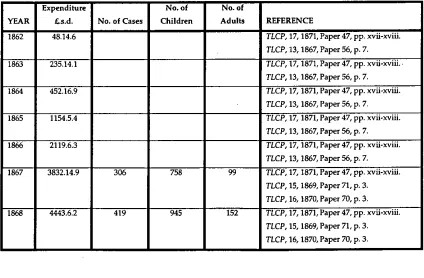
TABLE 5.1: Numbers of female invalids accommodated in the Launceston Female House of Correction, 1876-1901.
The Launceston Penal Establishment was to accommodate in the order of 20 female invalids for most of the latter quarter of the nineteenth-century (see Table 5.1). Information on this invalid facility is sketchy. However, an 1883 Royal Commission into penal discipline in Tasmania recorded in detail all spaces within the Launceston Penal Establishment. The report describes the
AV. Daily Nos. 19 20 18 l8 21 21 20
l 27
l 35 40 47 48 52 51 49 45 52 48 43 41 37 Depot REFERENCE
TLCP, 24.1877, Paper 13, p. 5.
TLCP, 26,18789, Paper 19. p. 4. TLCP, 28, 1879-80, Paper 18, p. 4. TLCP, 29, 1880. Paper 22, p. 4.
TLCP, 30,1881, Paper 24. p. 6.
TLCP, 32,1882, Paper 24, p. 7. TLCP, 32,1882, Paper 1, p. 138.
TLCP, 34,1883, Paper 25. p. 25.
TLCP, 34, 1883, Paper 2, p. 312. TPP, 2,1884, Paper 25, p. 13.
TPP, 5,1885, Paper 25. p. 17. TPP. 8,1886, Paper 26, p. 19.
TPP. 12,1887, Paper 116, p. 32. TPP, 11,1887, Paper 1, pp. 117 and 348. TPP, 14,1888-9, Paper 12, p. 3.
TPP, 15,18889, Paper 15, pp. 3 and 4. TPP, 20,1890, Paper 12, p. 3.
TPP, 23,1891, Paper 15, p. 3. TPP, 26,1892, Paper 15, p. 3.
TPP, 28,1893, Paper 12, p. 3.
TPP, 31,1894, Paper 6, pp. 3 and 4. TPP, 33,1895, Paper 16, p. 3.
TPP, 35,1896, Paper 6, p. 3.
TPP, 37, 1897, Paper 8, p. 3. TPP.39.1898, Paper 26, p. 3.
TPP.41.1899, Paper 7, p. 3. TPP.43.1900, Paper 4, p. 3.
TPP, 45,1901, Paper 16, p. 3.
TPP, 47.1932, Paper 4, p. 1.
[image:24.572.67.548.114.583.2]main dormitory accommodation occupied by invalids as being 'infested with bugs, badly ventilated, although fire-place has recently been built in it.'" It would seem that the aged and infirm women held in this institution were subjected to a cold, stuffy, lice ridden environment.
Like Launceston, Hobart Town continued to experience ongoing problems
identifying institutional space to accommodate invalids, particularly male invalids. In order to relieve pressure on the Brickfields it was proposed in July 1863 to transfer approximately 70 female invalids at both the HGH and the Female Infirmary to the Cascades Female Factory and to reallocate this space for use by male invalids?' As was the case in the north, no one questioned the propriety of a proposal that would ultimately see female invalids incarcerated in a penal space. Indeed, upon receiving this request the Comptroller General merely asked to know how many women it was intended to send to the Cascades and what number of these were bedridden.- The Colonial Secretary informed the Comptroller General that the number would be 70, but that only four of this number were bedridden." A possible reason why the Comptroller General was so receptive to the above request was that the Cascades had to some extent been functioning as a de facto
pauper depot for imperial female invalids for the previous three years. In the same manner that Port Arthur acted as the repository for imperial male invalids, the old Cascade Female Factory became a hplding institution for imperial female invalids. In both instances the imperial invalids were accommodated within a fully operating prison.
"
THAP, 44,1883, Paper 41, p. 61. 91AOT: CSD 4/14/122, Turnley to Colonial Secretary, 18.7.1863; and, AOT: CSD 4/14/122, Tumley to Colonial secretary; 30.7.1863.
92 Bedridden cases were, however, particularly vulnerable and dependent. For example, The
M e r c u y of 1 January 1873, (p. 3 c. 2-3) stated that 'there are altogether eleven nurses
employed to attend to the 114 women who were inmates a few weeks ago. Some of them are very helpless, and can scarcely move about, while it is painful to see some of the poor bedridden creatures, barely able to move, their faces covered in gauze to prevent flies from
annoying them.' (Emphasis mine.)
The conversion of the Cascades had progressed sufficiently that by early July 1867 the new wards were able to receive the female invalids then accommodated in the Female Infirmary." These wards were described by George Turnley, the HGH's Resident House Surgeon, as being 'dull and dismal'." With their occupation, the principal female invalid institution was positioned within the confines of the principal female penal'institution. What this case study on the treatment of female invalids in the third quarter of the nineteenth-century exemplifies is that in the minds of the colonial elite poverty, age, infirmity and crime were inextricably linked.
Keeping a watchful eye: the attitudes and role of private benevolence
Full comprehension of Tasmania's colonial charitable institutional system requires consideration of what occurred outside the realm of the institution. The public system of adult pauper relief in Tasmania was based upon three pillars. First, relief was extended through admission to pauper asylums. Second, it was afforded by private philanthropy principally delivered by organised benevolent societies supported by government grants in aid. The third avenue was by direct government allowances under a program known as outdoor relief. These three inter-linked components formed the basis of Tasmania's response to invalids and paupers. While initially public and private relief was delivered independent of one another, increasingly cooperation and intertwined mutual delivery was to be the hallmark of the relationship between these two bodies. This was especially .evident as professional bureaucratic record keeping came to prominence in the management of paupers.
The two principal private charities in colonial Tasmania were the HBS and the LBS. They were organisations made up of members of most of the various Christian denominations who were able to put aside their religious differences in pursuit of a common goal. Like their counterparts in Britain
and North America, these benevolent organisations were absorbed with determining the worthiness of applicants for relief. Their doctrine was articulated in the first and fundamental rule of the HBS:
That the objects of this Society be to relieve the poor, the distressed, and the afflicted, and thereby to discountenance, as much as possible, mendicity and vagrancy, and encourage industry amongst the indigent, irrespective of religious creed or denomination.%
This objective was 'most scrupulously adhered to' and in its attainment the various elements of the Society were harmoniously united." Such consonance was also sought in their relationship with the government and this can be seen in the role played by the HBS in supporting persons awaiting admission to an invalid depot." The Society was passionate in its disdain of vagrancy and begging. For the unsupported pauper invalid existing outside of a charitable institution, begging alms was essential to survival. As invalid depots were regularly full to capacity, the only means the HBS had to combat this mendicancy was for it to maintain these individuals until such time as space could be allocated within the tender embrace of bricks and mortar. In this manner it achieved its own objectives and also supported the government's system of institutional control of paupers. Maintenance of these individuals allowed the HBS to work with the government in imposing controls and limitations upon the behaviour and liberty of emancipist paupers. This it achieved through continuous surveillance, inspection and the restricting of relief to set places.
Benevolent societies were bastions of middle class conservatism. They held a narrow view of who was deserving and rigidly adhered to the tenets of the
Quoted in TLCP, 12,1866-7, Paper 5, p. 5. 97 ibid., p. 3.
new poor law; in particular the principle of 'less eligibility' believing that every penny bestowed in rendering the condition of the pauper more eligible than that of the independent labourer was a bounty on indolence and vice." Begging represented mendicancy, imposition and idleness which were anathema to their conservative values. However, poverty struck both those deemed deserving and those held to be undeserving. Indeed, the undeserving was a great deal more affected than the deserving, necessitating benevolent society involvement in their relief. These organisations believed in the existence of widespread 'systematic and professional beggarsr and these persons they sought to purge from the c ~ m m u n i t y . ' ~ Yet, their own experience told them that this was a fallacy. For example, the LBS actually encountered extremely few cases of imposition. They told an 1871 Royal Commission that the Society had not even been faced with. one case of imposition in 50.1°' Nevertheless, this did not stop G. P. Crouch, when representing the HBS at the First Australasian Conference on Charity in 1890, from reiterating the Society's belief that there were many who made 'begging a trade because they find it pays better than working.'lm That this belief was based upon unsubstantiated prejudice is reflected i n t h e Society's own statistics for persons refused aid. From their own annual reports it is evident that, out of the hundreds of applications made to them each year, only a handful were ever refused. In 1884, for example, out of 116 new applications, representing 251, individuals only five cases, or 4.3 percent, were rejected.lQ3 The following year 3.4 percent were refused. The indication is that these years were not exceptional. Imposition if it did occur was at such a level that it should not have raised any concerns.
The HBS was noteworthy for the hard line it took in the granting of relief, the substance of a person's character and morality bearing considerably more
"
See ML 361/A, Proceedings of the First Australasian Conference on Charity. Held in Melbourne. From 17th to 21st November, 1890. Convened t n ~ the Charitv Organisation Society of Melbourne. U(Melbourne, 1891), p. 80.
Irn TLCP, 14,1868, Paper 12, p. 3; and, TLCP, 24,1877, Paper 16, p. 3.
IQ' TLCP, 17,1871, Paper 47, p. 46, paragraph 159.
influence on their decision to grant relief than the circumstances which, brought a person to seek the Society's help. This was well exemplified in the case of a seriously ill, deserted, bedridden woman suffering from jaundice and possibly dieing, and her four children, aged 14,12, six, and nine months, who were living in a hovel, and only subsisting on what they could beg. The HBS refused aid to this woman and her children on the grounds 'that the woman bore a bad character!""' In a poignant editorial, The Hobart Town Daily
Mercu ry, asked:
even had this woman's character been of the most abandoned description, for poverty and starving children must be a sore temptation, was that sufficient reason why relief should not be given?'=
The Mercury protested against what appeared to be the introduction of a very
pernicious doctrine and argued that:
If benevolence is only to be extended to the virtuous there will be very few indeed requiring.assistance
. . .
If a case of real distress is made out it ought to be relieved at once. It is no time to inquire into a man's character when he is starving.lMThis, however, was exactly what the HBS did. Their aid was tied to the character and behaviour of the intended recipient, the intent being to control and modify social conduct.'" The Wapping History Group have argued that:
The Hobart Benevolent Society, being very much a product of nineteenth century attitudes 'to poverty and its relief, differentiated between the 'deserving' and 'undeserving poor'. The character of applicants for relief was
Im TPP, 1,1885, Paper 12, p. 3.
l" The Hobart Town Daily Mercury, 17.5.1860, p. 2 c. 1-3. (Emphasis in original.) l" ibid.
'06 ibid.
Irn The tying of relief to behaviour appears to have been a universal phenomena in the distribution of private benevolence. For example, Cecily Forde-Jones has analysed the critical role in which the dispensation of poor relief to impoverished white women in colonial Barbados, particularly during the late seventeenth and early nineteenth centuries, was. used to regulate white female sexuality and behaviour. C. Forde-Jones, 'Mapping racial boundaries: gender, race, and poor relief in Barbadian plantation society', Journal OJ
frequently commented upon.
. .
and often had some bearing on the outcome of their applications.'"This was an organisation intimately concerned with the morality of those they set out to help; one swayed by an ideology that sought to dispense blame as opposed to relief. It uncompromisingly refused to help those who did not comply with the middle class virtues of diligence, prudence, sobriety, thrift, initiative and self-reliance, which it sought to instil in the lower orders of society.'" Failure to abide by conservative, middle class values guaranteed that private benevolence would be denied. Conservative organisations, like the HBS, saw poverty resulting not from social and economic factors, but from the vices of idleness, improvidence and intemperance. Amongst this faction of the middle class there existed a fear that pauperism could become self-perpetuating.
The benevolent societies perceived their role as not only one of rendering aid but they also saw themselves as an agency to discourage pauperism and imposition. For them 'Although poverty [wals not a crime, it [wals certainly not a virtue to be c~ltivated.'"~ They were followers of the principles of self- help and thrift as propounded by the likes of William Cobbett and Samuel Smiles."' Indeed, the HBS saw fit to quote from Smiles in their 1885 annual report. This quote is worth reproducing as it succinctly denotes the position taken by such organisations:
True benevolence does not consist in giving money, nor can charitable donations, given indiscriminately to the poor, have any other effect than to sap the foundation of self-respect, and break down the very outworks of virtue itself.'12
l" The Wapping History Group, Down Wapping: Hobart's Vanished Wapping and Old Wharf Dish'cts (Hobart, 1994), p. 88. For a competent exposition of the relationship between poverty and philanthropy in Hobart, see pp. 78-91.
Im This was manifestly.demonstrated in an almost identical case to the above which occurred fourteen years later. See The Mercury, 26.5.1874, p. 2 c. 5.
'lo TPP, 14,1886, Paper 20, p. 3.
"l W. Cobbett, Cottage Economy (Oxford, 1979); and, S. Smiles, Self-Help (London, 1859).