INTRODUCTION
Many marine invertebrates, whose life histories in-clude external fertilization, synchronise gamete release among individuals within a population to increase
fer-tilization success (e.g. echinoderms, sponges, molluscs, polychaetes, Babcock et al. 1992; scleractinian corals, Fan & Dai 1995; ascidians, Bingham 1997). While syn-chronous spawning is a common phenomenon amongst marine invertebrates, the spawning events themselves are often rare (e.g. occurring once per year) or unpre-dictable. Amongst the haliotids (Mollusca: Vetigastro-poda) there is enormous variation in the length of the spawning season and the number of spawning events
© Inter-Research 2001
*Corresponding author. E-mail: [email protected]
Pattern, synchrony and predictability of spawning
of the tropical abalone Haliotis asinina from
Heron Reef, Australia
Regina T. Counihan
1, 2, David C. McNamara
1, Duncan C. Souter
1, 2,
Edward J. Jebreen
1, Nigel P. Preston
2, Craig R. Johnson
1, Bernard M. Degnan
1,*
1Department of Zoology and Entomology, The University of Queensland, Brisbane, Queensland 4072, Australia 2Division of Marine Research, CSIRO, Cleveland, Queensland 4163, Australia
ABSTRACT: The spawning biology of the tropical abalone Haliotis asininaon Heron Reef, Australia, was investigated to identify putative environmental and endogenous factors controlling spawning. Spawnings by H. asininawere highly regular and, in comparison to most other haliotids and marine invertebrates, frequent and extremely synchronous. These events appeared to be regulated by more than 1 environmental cue. The spawning season of H. asininaextends from October to April and is associated with an increase in water temperature. During the spawning season, recently captured abalone, housed in flow-through aquaria, released gametes for 2 nights every 2 wk during the new and full moons. However, the exact date of spawning did not correlate precisely with the lunar cycle. Occasionally the spawning events between 2 populations of H. asininaon Heron Reef that were 1.5 km apart differed by 1 d, suggesting that differential tidal regimes might influence the date of spawning. The population that was exposed to slightly longer spring low tides occasionally spawned 1 d earlier. In the aquaria, the onset of male spawnings was earlier than the onset of female spawnings by an average of 31 min. The time of spawning of either sex was highly correlated with the evening high tide; males spawned an average of 19 min prior to the high tide, and females spawned 11 min after the high tide. Spawnings were highly synchronous amongst individuals, with 90% commencing spawning within 89 min of the first individual that spawned. A greater percentage of individuals spawned when in the presence of the opposite sex and the frequency of male ejaculation was greater when in the presence of females. Synchronous spawning patterns persisted for 6 wk in H. asinina maintained in aquaria; after this period, spawnings continued but were irregular and asynchronous. We propose that low tide exposure and time of high tide indirectly regulate the date and time of spawning respectively, and that these tidal elements influence the spawning biology of H. asininaby maintaining endogenous rhythms that persist in non-tidal environments for at least 6 wk.
KEY WORDS: Abalone · Mollusc · Spawning · Synchronous · Tidal cycle · Lunar cycle · Endogenous
per season (e.g. Webber & Giese 1969, Shepherd & Laws 1974, Tutschulte & Connell 1981, Wells & Keesing 1989). Natural spawnings for most abalone are unpre-dictable and patterns of spawning are most often deter-mined by indirect measures such as gonad indices (e.g. Webber & Giese 1969, Shepherd & Laws 1974). As such, the mechanisms regulating haliotid spawning remain largely unknown. A number of detailed examinations of abalone spawning biology have identified water temperature (Ino 1952, Webber & Giese 1969, Young & DeMartini 1970), photoperiod (Uki & Kikuchi 1984) and food availability (Shepherd & Laws 1974) as key environmental factors. Factors that directly synchronize
natural gamete release in wild abalone are not known, probably because of the unpredictable nature of spawn-ing events for most haliotids. Several artificial exoge-nous factors are known to induce spawning of abalone, e.g. UV irradiated seawater, temperature shock, desic-cation, hydrogen peroxide (reviewed in Hahn 1989) but these are only effective on fecund abalone.
In this study we investigated the spawning biology of the tropical abalone Haliotis asinina. This abalone is widely distributed throughout the Indo-Pacific, prim-arily inhabiting intertidal reef flats. Recent studies of the life history of this species indicate that it may be an ideal species for aquaculture and biological research (Singhagraiwan & Doi 1992, McNamara & Johnson 1995, Capinpin & Corre 1996, Counihan et al. 1998). H. asin-ina grows faster than other abalone (e.g. McNamara & Johnson 1995) and has frequent and regular spawning events, negating the need for induced spawnings (Sing-hagraiwan & Doi 1992, Capinpin 1995, Capinpin et al. 1998). In Thailand, the spawning season of H. asinina
is year round except April and May, and peaks in Octo-ber and NovemOcto-ber when the water temperature is low-est (Singhagraiwan & Doi 1992). In The Philippines, H. asininaare serial spawners, spawning asynchronously year round except during May and June (Capinpin et al. 1998). In both these studies (Singhagraiwan & Doi 1992, Capinpin et al. 1998) observations were made on captive abalone housed in aquaria for months, or aba-lone that had been bred in captivity.
Here we monitored gonad development and the spawning pattern of recently caught Haliotis asinina
from Heron Reef, Great Barrier Reef, with the goal of detailing long-term spawning patterns and identifying putative environmental and endogenous regulatory factors. An assumption of this study is that the spawn-ing patterns of recently captured abalone (i.e. 1 to 7 d) are the same as for natural populations. As yet there have been no observations of wild spawnings of this species. However, Capinpin et al. (1998) noted that recently captured (less than 6 wk) H. asininaexhibited spawning patterns that were more synchronous than longer-term captive abalone. This implies that recently
captured abalone may more accurately reveal the spawning patterns of natural populations, and that spawnings by wild abalone will be at least as synchro-nous as recently captured abalone.
During the spawning season, we monitored the spawning patterns of individuals from 2 populations of
Haliotis asinina from Heron Reef to determine inter-and intra-population spawning patterns. Since the pres-ence of haliotid gametes is known to induce spawning of the opposite sex (e.g. Murayama 1935, Carlisle 1945, Shibui 1972, Morse et al. 1977) we also investigated the influence that the presence of the opposite sex has on the spawning behaviours of individuals.
METHODS
At Heron Reef, Great Barrier Reef, Australia (23° 27’ S, 151° 55’ E), Haliotis asininainhabits coral bommies in the outer and mid-reef flat zones (Mather & Bennet 1993). This species appears to be nocturnal and feeds primar-ily on red algae (e.g. Gracilaria spp., Laurenciaspp.,
[image:2.595.306.540.507.658.2]Hypnea pannosa, McNamara & Johnson 1995). The reef flat at Heron Reef usually experiences 4 tides each day with a maximum tidal range of 3.3 m (Gourlay & Hacker 1997). The reef crest is 0.5 m above the lowest astronomical tide (Sunmap 1983). This results in pond-ing of reefal waters that change little in depth while the oceanic waters are below the reef crest (i.e. at low tides). This period is greatest at spring low tides. Heron Reef has an artificial harbour (Fig. 1) that influences water movement about the reef flat, particularly the timing and height of tidal changes (Hacker 1995). The wind is predominantly from the south-southeast (150°) and the average wind speed for October to April is
Fig. 1. Heron Reef, Great Barrier Reef, Australia (23° 27’ S, 151° 55’ E). Locations of the 2 populations of Haliotis asinina
that were sampled in this study, northeast (NE) and southwest (SW) are shown. The artificial harbour is marked. The letters A and B represent sites monitored for tide movements by
6.3 knots (HIRS 1998). The water temperature range for the same period is 25.2 to 27.2°C and average salin-ity is 35.7 ppt (HIRS 1998). Precise lunar information was obtained from Auslig (Australian Surveying and Land Information Group, Dept of Industry Science and Resources, Canberra, Australia; available at www.aus-lig.gov.au/geodesy/astro/astro.html).
Gonad indices and spawning observations. The spawning season was determined by monthly examina-tion of gonad development, as described in Shepherd & Laws (1974). Monthly gonad index values were obtained by measuring the cross-sectional area of the gonad and comparing it to the area of the hepatic gland, around which the gonad develops. Twenty adult abalone were collected approximately monthly from the southwest (SW) population (Fig. 1) of Haliotis asininaon Heron Reef between 1993 and 1996. The hepatic gland and sur-rounding gonad were removed and fixed in 5% buffered formalin for 4 d. Sections (5 mm thick) were taken one-third the distance from the tip of the hepatic gland to the tip of the body whorl. The section was photographed us-ing a binocular microscope mounted with a camera, the image then digitized, and the area of the gonad and hepatic gland estimated using the AutoCAD®software
(Autodesk, Inc., San Rafael, CA, USA). The gonad index was calculated as the proportion of the gonad area of the total area. During this period, other abalone were main-tained for up to 1 mo in open circulation seawater aquaria, at Heron Island Research Station, The Univer-sity of Queensland. Abalone were sexed according to the colour of the gonad (Singhagraiwan & Sasaki 1991) and maintained in either male-only or female-only aquaria. The abalone were fed daily to saturation with Laurencia
spp., Gracilaria spp. and Hypnea pannosa. During reg-ular maintenance, the abalone were observed several times per day. A number of spawnings were fortuitously observed during this period (1993 to 1996), the dates of which were recorded.
Observations of populations. Based on the results of the gonad index analyses and the observations of spawnings described above, collection and observa-tion of Haliotis asininawere concentrated during Octo-ber to April of the following 2 yr (1996/97, 1997/98). Adults of H. asininawere collected from Heron Reef approximately every 2 wk (between 2 and 7 d prior to full and new moons) during October 1996 to April 1997 and November 1997 to April 1998 (a few exceptions to the collections existed when access to the Heron Island populations was not possible). At least 30 individuals were collected from each of 2 sites on the reef flat, approximately 1000 m northeast (NE population) and 500 m southwest (SW population) of Heron Island (Fig. 1). Abalone were maintained as described above. PVC-pipe shelters (15 cm diameter, cut lengthwise, approximately 25 cm long) were provided and lights
were on during daylight hours only. These animals were not directly exposed to lunar or tidal influences. The abalone were saturation fed daily with freshly collected
Laurencia spp. Individuals were sexed as described above and maintained in male-only or female-only tanks (350 mm ×350 mm ×500 mm; 60 l). Tanks were checked several times each day for evidence of released gametes. On each potential spawning night, at least 30 individu-als from the NE population (1996/97 season) and from each of the NE and SW populations (1997/98 season) were observed. The time that spawning began by the first individual of each sex was recorded as ‘onset[all]’. These times were compared with local tide cycles: correlation analyses were used to compare the time onset[all] with the evening high tide.
To determine how long the observed spawning pat-terns would persist in captive abalone, individuals were maintained in the aquaria until their spawning patterns were no longer synchronous. Due to the logis-tical constraints of accurately monitoring many indi-viduals concurrently, only casual observations were made of these longer-term captive individuals; spawn-ings that were asynchronous with recently captured abalone were noted.
Observations of individuals. For 1 set of spawning events (new moon, November 1998) 64 individuals were tagged: 16 of each sex from each population (NE and SW, Fig. 1). To examine what influence the presence of the opposite sex has on the spawning behaviour of individual abalone, abalone were maintained in 1 of 2 tank types: mixed-sex (male and female together), or same-sex (male or female only). For each population, the abalone were separated as follows: 2 tanks of 4 females, 2 tanks of 4 males, and 2 tanks of 4 females with 4 males. During the spawning period, the times of spawning of every individual throughout each spawn-ing night was recorded. From these data, the total num-ber of ejaculates (an independent release of gametes), the frequency of ejaculation and time period of spawn-ing (for total ejaculations) for individual abalone were calculated. For each individual, the time period on-set[ind.] was calculated as the time difference between the first ejaculation of each individual and the first ejaculation of the first individual to spawn from the same population, sex and tank type. Onset[ind.] values gave a measure of the spread of individual spawn times, i.e. the synchronicity of spawning.
RESULTS
Spawning season
The gonad indices were determined from monthly inspections of sectioned gonad with hepatic gland samples from Haliotis asinina(Fig. 2). An analysis of variance on the means pooled over 4 yr (1993 to 1996) separates the months that were sampled into 2 signifi-cantly different groups: October to April (excluding November and February which were not sampled) and May to September (Tukey Kramer’s HSD, p < 0.0001, n = 23, Fig. 2). Nineteen spawnings by abalone were observed in aquaria during this period. The date of these spawnings was always closely associated with either a new or full moon. Of the 19 spawnings ob-served, 16 occurred within 2 d of a new or full moon, the remaining 3 occurred either 3 or 4 d following a new or full moon.
Spawning patterns of populations of Haliotis asinina from Heron Reef
Spawning of Haliotis asinina in aquaria occurred over 1 to 3 nights approximately every 12 to 15 d dur-ing the 1996/97 and 1997/98 spawndur-ing seasons (Fig. 3 shows the 1997/98 season). Spawning events always occurred around either the new or full moon, irrespec-tive of how many days (2 to 7 d) prior to the new or full moon the abalone were collected. Occasionally a small number of male abalone (1 or 2 ind.) spawned the night before a major spawning of the rest of the same popu-lation. Only spawning events in which both males and females spawned were used for the analyses of popu-lation spawning patterns. Early in the season (e.g. October) spawning events began 1 d prior to, or on the same day as, the new or full moon. As the spawning
[image:4.595.306.543.78.226.2]season progressed the date of spawning shifted later relative to the lunar cycle, so that by April spawning began 1 to 2 nights after the new or full moon (Fig. 3). Analysis of the spawning dates with respect to the collection site of the abalone (i.e. NE or SW reef flat populations) indicated that individuals from each pop-ulation spawned for a maximum of 2 nights every 2 wk and that the 2 populations spawned on either the same nights or differed by 1 night (Fig. 3). This occasional population-specific pattern occurred in 4 of the 9 spawning events observed during the 1997/98 spawn-ing season (only the NE population was monitored during the 1996/97 season) and resulted in only 1 night of overlap on which abalone from both populations spawned. Differences between the dates of spawning of the 2 populations were observed to occur during full-moon spawnings only, and when they occurred the NE population always spawned 1 d earlier than the SW population (Fig. 3).
Fig. 2. Monthly means for gonad indices of Haliotis asi-nina(male and female) cal-culated from 1993 to 1996. For each month sampled, gonad indices were calcu-lated from 20 individuals of each sex. Error bars are the standard deviations. The months sampled can be divi-ded into 2 statistically signi-ficant different groups: May to September, and October to April (excluding Novem-ber and February, which were not sampled) (Tukey Kramer’s HSD, p < 0.0001,
[image:4.595.47.454.552.728.2]n = 23)
Fig. 3. Seasonal spawning pattern of Haliotis asininaon Heron Reef for 1997/98. (S) Full moon, (D) new moon, ( ) spawning of the NE population only, ( ) spawning of the SW popula-tion only, ( ) spawning of both NE and SW populations,
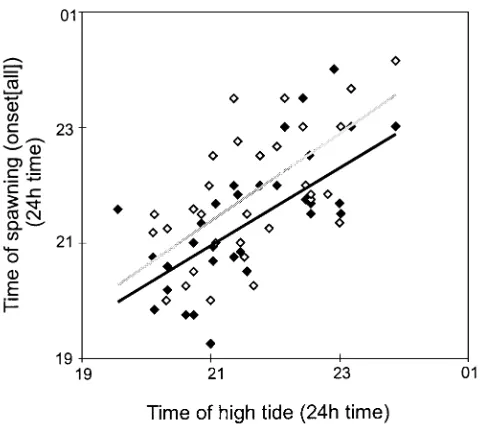
The time of the first spawning by individuals from both sexes (from either population) for each of the spawning events (n = 36 during 1996 to 1998) is repre-sented as ‘onset[all]’. The time of spawning of the first male (i.e. male onset[all]) differed from the female onset[all] (paired t-test, p < 0.0001, n = 36 spawning events). The average time difference of onset[all] between male and female spawnings was 30.7 min (SD = 37.4, n = 36, Fig. 4), with the females commencing spawning after the males. The onset of spawning of the population (onset[all]) on each day was strongly corre-lated with the tidal cycle. A pairwise correlation analy-sis between the times of onset[all] of male spawnings, and the times of the evening high tide (spawn times for the 2 populations were considered together) demon-strated that this relationship was significant (Pearson’s coefficient = 0.68, p < 0.0001, n = 36 spawning events, Fig. 5), with males spawning on average 19.0 min (SD = 49.8, n = 36) before the time of high tide. The range of time differences between male onset[all] and the evening high tide time was –105 to 64 min. A cor-relation of female onset[all] time with the time of the evening high tide was also significant (Pearson’s coef-ficient = 0.62, p = 0.0001, n = 36, Fig. 5). Females began spawning on average 11.6 min (SD = 58.6, n = 36) after the high tide (range = –100 to 136 min).
Observations of individuals maintained in flow-through aquaria (i.e. with no moonlight or tidal influ-ences) for an extended period time indicated that the spawning patterns described above persist for 3 spawning cycles (i.e. 5 to 6 wk). During this time, cap-tured individuals spawned in synchrony with each other and with newly collected individuals of the same population. After 6 wk, some individuals continued to spawn approximately every 2 wk, but were no longer completely synchronous with the lunar cycle, tidal cycle, or other individuals.
Spawning patterns of individual Haliotis asinina
A detailed investigation was conducted of 1 com-plete spawning event (new moon, November 1998) in which 64 individuals were tagged, separated into same- and mixed-sex tanks, and monitored closely. Although the number of independent replicates was low, strong patterns were observed. Each individual spawned 1 or 2 nights, or not at all. Of all individuals, 78.1% spawned on at least 1 night during the spawn-ing event.
[image:5.595.303.543.80.292.2]No statistically significant differences were found between the number of nights that each individual spawned between either population or tank type (3 factor ordinal logistic regression, population p = 0.34, tank type p = 0.31). However, sex had a significant effect upon the number of nights any individual spawned (p = 0.009); a greater percentage of males spawned for at least 1 night than did females (89.7 and 65.7% respectively), and more males spawned for 2 nights than did females (21.9 and 6.3% respectively; Fig. 6). Although not statistically significant, the influence of the opposite sex (i.e. tank type) on the number of spawning nights is noteworthy. A greater percentage of both males and females spawned for 2 nights when in mixed-sex tanks (25 and 12% respectively) com-pared to males or females in same-sex tanks (19 and 0% respectively; Fig. 6).
Fig. 4. Distribution of time differences (min) between the male onset[all] and female onset[all] for each spawning night. Each value is calculated as the time of the first ejaculation (male and female) from either population on a given spawning night
(n = 36 spawning nights between 1996 and 1998)
[image:5.595.77.271.527.666.2]The mean values of the onset[ind.] and ejaculation sta-tistics for each individual were pooled within each tank, since individuals within the same tank could not be con-sidered independent replicates. In general, spawnings were highly synchronous among all individuals. Fifty percent of the individuals that spawned began to release their gametes within 29.5 min of the first individual (across sexes, populations and tank types); 90% began to spawn within 89.1 min of the first individual. An analysis of the onset[ind.] times calculated as the time difference between the first ejaculation of each individual and the first ejaculation of the first individual to spawn (irrespec-tive of sex, tank type, or population) suggested that both sex and population significantly influenced onset[ind.] (3 factor ANOVA, sex p = 0.0331 population p = 0.0001, tank type p = 0.2263, n = 24). However, when onset[ind.]
was calculated according to the sex, population and tank type of each individual (i.e. the time difference be-tween the first ejaculation of each individual and the first ejaculation of the first individual from the same sex, pop-ulation and tank type), sex was no longer significant (3 factor ANOVA, sex p = 0.8289, population p = 0.0079, tank type p = 0.5174, n = 24). This suggests that the mean onset time for males and females differed (in com-parison to each other), but the spread of the individual onset times within each sex, i.e. the synchrony of indi-viduals, was the same for both sexes. The population of origin did influence the individual onset times; abalone from the NE population showed a higher degree of syn-chrony compared to SW abalone (mean onset[ind.]: NE population = 16.4 min, SD = 14.5 min; SW population = 40.7 min, SD = 27.1 min). All abalone (male or female) that spawned on any 1 night did so within 66 min of the first individual for the NE population, and within 102 min for the SW population.
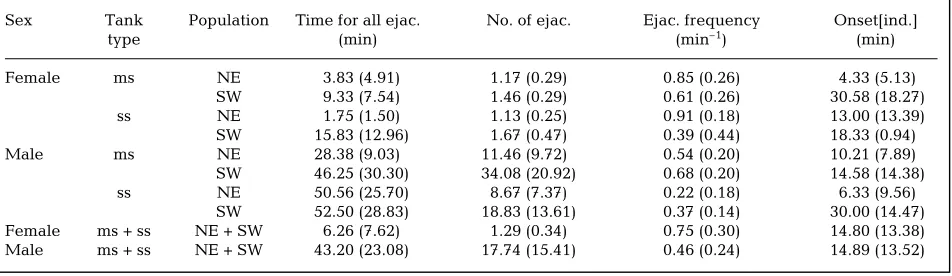
[image:6.595.62.286.80.232.2]In most cases the type of tank (i.e. mixed sex or same sex) did not influence the spawning behaviour of indi-viduals, although the population of origin affected some ejaculation parameters (Table 1). However, the signifi-cance of the population effect cannot be commented upon without replication of observations of other spawn-ing events. In some cases, the presence of the opposite sex did have an influence; males in tanks with females had a significantly higher ejaculation frequency than males without females (2-factor ANOVA, tank effect p = 0.009, population effect p = 0.16). Although not signi-ficant, the total number of ejaculations by male abalone was greater when in the presence of females, and the time to complete all ejaculations was shorter, compared to males without females (for both populations, Table 1). Males had no influence on female ejaculation number, frequency, or total spawn time period (Table 1).
Fig. 6. Number of nights any individual spawned in a single spawning event (2 consecutive spawning nights), for male (m) and female (f) Haliotis asininain mixed-sex (ms) or same-sex (ss) tanks. Numbers in the graph bars represent the
percentage of individuals that spawned 0, 1 or 2 nights
Table 1. Summary of ejaculation statistics for Haliotis asininaindividuals. Means (and standard deviations) are shown for each sex, from either the northeast (NE) or southwest (SW) populations maintained in either mixed-sex (ms) or same-sex (ss) tanks. Mean time for individuals to complete all their ejaculations (ejac.), the total number of ejaculations, and ejaculation frequency are all calculated from pooled means of each replicate tank. The column Onset[ind.] represents the mean of the time difference between the first ejaculation of each individual and the first ejaculation of the first individual from the same population, sex and
tank type, and was also calculated using pooled means
Sex Tank Population Time for all ejac. No. of ejac. Ejac. frequency Onset[ind.]
type (min) (min–1) (min)
Female ms NE 3.83 (4.91) 1.17 (0.29) 0.85 (0.26) 4.33 (5.13) SW 9.33 (7.54) 1.46 (0.29) 0.61 (0.26) 30.58 (18.27) ss NE 1.75 (1.50) 1.13 (0.25) 0.91 (0.18) 13.00 (13.39) SW 15.83 (12.96) 1.67 (0.47) 0.39 (0.44) 18.33 (0.94) Male ms NE 28.38 (9.03) 11.46 (9.72) 0.54 (0.20) 10.21 (7.89) SW 46.25 (30.30) 34.08 (20.92) 0.68 (0.20) 14.58 (14.38) ss NE 50.56 (25.70) 8.67 (7.37) 0.22 (0.18) 6.33 (9.56)
[image:6.595.62.538.585.723.2]DISCUSSION
The season, date and time that Haliotis asininaspawns appear to be regulated by different factors. These fac-tors influence the length and time of the spawning sea-son, the precise timing of the spawning event, and the level of spawning synchronicity within and between populations and individuals.
The spawning season of Haliotis asinina on Heron Reef is from October to April, coinciding with the war-mest water temperatures (25.2 to 27.2°C, HIRS 1998). In contrast, H. asininain the waters surrounding Thai-land and The Philippines spawn all year round, except the summer months when the water temperature is at its warmest (Singhagraiwan & Doi 1992, Capinpin et al. 1998). Combined, these data indicate that H. asinina
spawns within a defined temperature range, rather than above a minimum or below a maximum temperature value. Water temperature has been identified as an im-portant influence of spawning season in other haliotids (e.g. H. cracheroidii, Webber & Giese 1969; H. discus hannai, Uki & Kikuchi 1984).
The highly regular spawnings observed for the 2 Heron Reef populations ofHaliotis asininasuggest that the factors controlling these events are cyclic in nature. Although it has often been suggested the lunar cycle may be a primary environmental cue regulating the synchronous spawning of marine invertebrates (e.g. Olive & Garwood 1983, Parsons et al. 1992), only in a very few cases does the lunar cycle exactly correlate with spawnings (e.g. the limpet Acanthozostera gem-mata, Korringa 1947). Two observations indicated that the lunar cycle alone does not control
the pattern and synchrony of spawning of H. asininaon Heron Reef. First, there is variation in the date of spawning about the new or full moon during the spawning seasons (e.g. 1997/98, Fig. 3). Early in the season abalone tend to spawn prior to, or on the same days as, new and full moons, while later in the season abalone spawn after new and full moons. Second, the spawning dates of the NE and SW populations occasion-ally differ by 1 d. Since these 2 popula-tions are approximately 1.5 km apart on contiguous reef it is unlikely that expo-sure to moonlight (duration or intensity) or gravity differs between these 2 sites.
When the 2 populations of Haliotis asininaspawned on different dates, the NE population always spawned before the SW population, suggesting consis-tency in the variation of regulating fac-tors. Although a number of abiotic and
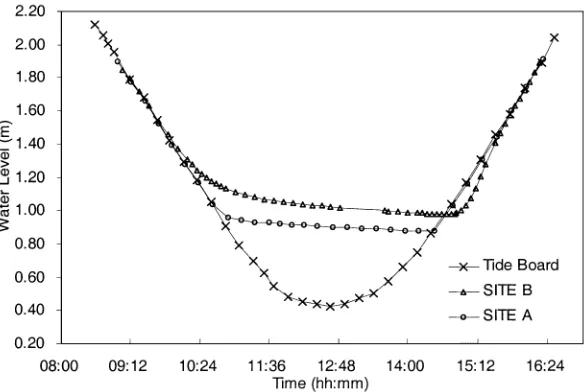
biotic factors may vary between the NE and SW habi-tats, variation in local tidal regimes appear to be the best candidate. Differences in semi-diurnal tidal regi-mes (timing and height) between sites on the Heron Reef flat have been previously detected (Fig. 7, modi-fied from Hacker 1995; refer to Fig. 1 for site locations), with some sites exposed at low tide for longer periods of time or to lower water levels than others (Figs. 1 & 7). Theses differences are particularly apparent during spring tides and are likely to be caused by the artificial harbour and/or variation of the reef’s geomorphology (Hacker pers. comm.). Based on Hacker’s (1995) obser-vations (Fig. 7), it is likely the NE and SW populations of H. asininaon Heron Reef experience slightly differ-ent exposure times to ponding low water and/or to low water levels. This suggests that H. asinina on Heron Reef can detect subtle changes in tidal profile, and that there is a threshold tidal height or exposure time re-quired to induce the physiological changes and behav-iour associated with spawning. These small differences may result in the NE population being exposed to a threshold tide 1 d before the SW population. Evidence that a spawning cue is detected earlier on the day of a spawning is presented by the analyses of H. asinina
gonad development over a 2 wk spawning period on Heron Reef. This analysis indicates that the final stage of oocyte maturation does not begin until about 12 to 18 h, or 2 to 3 tides, prior to spawning (i.e. after being exposed to an early morning spring low tide) (Jebreen et al. 2000).
[image:7.595.245.537.470.666.2]Abalone in this study were collected at least 2 d prior to spawning and as such were not exposed directly to
Fig. 7. Tide height (m) with time of day (h:min) for 2 sites on Heron Reef flat (A and B, refer to Fig. 1) during a spring low tide (1 November 1994). The tide board refers to oceanic water height outside the reef flat. Site B is exposed for approx-imately 10 min longer at low tide than Site A; however Site A experiences a
the tidal influences that appear to be inducing spawn-ing. Furthermore, synchronous spawning patterns persisted for up to 6 wk in Haliotis asinina maintained in aquaria. We propose that an environmental factor associated with local tidal cycles regulates an endoge-nous clock that in turn controls the physiological state of the gravid abalone. The loss of spawning periodicity and synchrony in long-term captive abalone (Capinpin et al. 1998, this study) suggests that these natural envi-ronmental signals are required to maintain these endo-genous rhythms. Variations in the timing of spawning have been reported between populations of H. cra-cherodii that are only 10 km apart (Webber & Giese 1969). In addition, Shepherd & Laws (1974) also des-cribed variability in the timing and duration of spawn-ing of H. ruber at different locations, concluding that local environmental variables are of great importance in regulating reproduction. However, it is yet unknown if other haliotids share spawning regulatory mecha-nisms similar to H. asinina.
Other marine invertebrates can detect and respond to small differences in tide. For example, the spawning behaviour of the scallop Placopecten magellanicus
within 1 bay is tidally cued and sometimes differs be-tween populations (Parsons et al. 1992). In addition, for-aging and spawning activities of siphonarian limpets are cued to low tides, but vary between habitats (Iwasaki 1995). The spawning of many free-spawning marine invertebrates is regulated by a combination of exoge-nous and endogeexoge-nous factors (e.g. the gastropod Gib-bula umbilicalis, Clare 1986; the polychaete Typosyllis prolifera, Franke 1986). Rarely are exogenous factors alone responsible for synchronizing spawning (Naylor 1976, Olive & Garwood 1983).
The precise timing of gamete release by Haliotis asininais highly synchronous between all individuals of the 2 populations and is closely associated with night-time spring high tides (Fig. 5). Nightnight-time with spring tides is particularly favoured for spawning by broad-cast spawners, especially gastropods, probably because they provide protection from predation and increased dispersal (Berry 1986). Spawning by H. asininaduring the relatively slack water of high tide may actually minimize gamete dispersal, thereby increasing fertili-zation success. Fertilifertili-zation success in H. asininamay also be increased by the release of gametes by males prior to females, such that sperm are likely to be pre-sent when the eggs are released. The timing of spawn-ing remains highly correlated with evenspawn-ing tides in abalone maintained in aquaria for up to 6 wk, suggesting that a second component of the endogenous rhythm, regulated by an environmental factor related to the high tide, determines the time of gamete release.
In other haliotids, the presence of gametes induces spawning of the opposite sex (e.g. Murayama 1935,
Carlisle 1945, Shibui 1972, Morse et al. 1977). The per-centage of both female and male Haliotis asininathat spawns on any given night increases in the presence of the opposite sex (although not statistically significant in this study). This suggests that in the absence of the opposite sex, some individuals of H. asinina may delay releasing gametes, perhaps until another date when the opposite sex is in the close vicinity and the chances of fertilization are therefore greater. Neither the fre-quency nor synchronicity ofH. asininafemale ejacula-tions is affected by the presence of males. However, the presence of H. asinina females appears to affect male spawning behaviour by inducing more frequent sperm release. Since the females generally release their gametes afterthe males, it seems the females may release a factor prior to egg release that influences male spawning behaviour. The sex pheromones of most marine invertebrates are released at the same time as the gametes (e.g. Hardege et al. 1996, Zeeck et al. 1998), and other haliotid studies suggest it is the pres-ence of the eggs themselves that induces sperm re-lease (e.g. Morse et al. 1977). It appears here that both individuals may release factors that affect the spawn-ing behaviour of the opposite sex. Whether in fact these factors are sex-specific cannot be determined from these experiments. In this study, the effects of the presence of the opposite sex cannot be separated from the effects of the presence of more individuals, irre-spective of sex. However, if the effects observed are the result of a higher density of abalone rather than the opposite sex specifically, the implications are largely unchanged: abalone may delay releasing their gametes until more abalone surrounds them, and males may ejaculate more frequently when more abalone are pre-sent. Both scenarios result in spawning behaviours that will potentially encourage successful fertilizations. We do not know of any other study with marine inverte-brates that shows that either the density of animals or the density of the opposite sex specifically influences the ejaculation behaviour of individual animals. There is, however, evidence to show that fertilization success is significantly influenced by population density because of the resultant density of gametes (e.g. Levitan 1991, Young et al. 1992, Claereboudt 1999). Experiments de-signed specifically to investigate the presence of spawn-ing-related factors are necessary to confirm their pres-ence, elucidate their nature and detail their effects.
No other abalone has spawning patterns that are as predictable, synchronous and regular as Haliotis asin-ina. H. discus hannai, a cold water Japanese abalone, spawns in a very predictable manner (1 h after sunset on the day the water temperature drops below 20°C), but spawning is not frequent (Ino 1952). H. gigantea
varies (Ino 1952). Many species of haliotids spawn naturally only once or twice per year, e.g. H. fulgens,
H. sorenseni, H. cracherodii, H. iris and H. australis
(Webber & Giese 1969, Poore 1973, Leighton 1974, Tutschulte & Connell 1981). Other species spawn more frequently but with less synchrony, e.g. H. corrugata
and H. roei(Shepherd & Laws 1974, Tutschulte & Con-nell 1981). There is also often considerable variation in spawning seasons and spawning patterns between allopatric populations, making prediction of spawning events difficult, e.g. H. ruberand H. rufescens (Shep-herd & Laws 1974, see Hahn 1989). In all cases, factors that directly synchronize natural gamete release are not known. This is probably because the unpredictability of spawning events for most haliotids has impeded detailed studies of natural spawning behaviours. How-ever, there are other marine invertebrates whose spawn-ing events are predictable and frequent, and controlled by a combination of endogenous and exogenous fac-tors. For example, the spawning of the polychaete Per-inereis nuntiavar. brevicirrusis regulated by an increase in water temperature which induces maturation, the lunar cycle which regulates swarming, and species-spe-cific signals which regulate swarm times and induce gamete release (Hardege et al. 1994).
The highly rhythmic and remarkably synchronous and predictable spawning patterns of Haliotis asinina
from Heron Reef allow for detailed analyses of the en-vironmental and endogenous factors controlling its re-production. We have shown that reproduction is regu-lated by water temperature, by local tidal regimes that maintain endogenous rhythms, and by conspecific fac-tors. This study, when combined with other abalone stu-dies, suggests that a variety of species-specific mecha-nisms underlie the regulation of haliotid spawning.
Acknowledgements. The authors wish to thank K. Townsend and the the staff of Heron Island Research for their assistance with collection and maintenance of abalone, and Ms Jennifer Hacker for helpful discussions regarding tidal water move-ments around Heron Island and Reef. We thank Dr Russ Bab-cock and 2 anonymous reviewers for providing valuable com-ments on earlier versions of this manuscript. This research was funded by Australian Research Council grants to B.M.D. and C.R.J.
LITERATURE CITED
Babcock RC, Mundy C, Keesing J, Oliver J (1992) Predictable and unpredictable spawning events: in situ behavioural data from free spawning coral reef invertebrates. Inver-tebr Reprod Develop 22(1–3):213–228
Berry AJ (1986) Daily, tidal, and two-weekly spawning peri-odicity and brief pelagic dispersal in the tropical inter-tidal gastropod Umboniium vestarium. J Exp Mar Biol Ecol 95(3):211–224
Bingham BL (1997) Light cycles and gametogenesis in three
temperate ascidian species. Invertebr Biol 116(1):61–70 Capinpin EC (1995) Spawning and larval development of a
tropical abalone Haliotis asinina (Linne). Philipp J Sci 124(3):215–232
Capinpin EC, Corre KG (1996) Growth rate of the Philippine abalone, Haliotis asininafed an artificial diet and macro-algae. Aquaculture 144:81–89
Capinpin EC, Encena V, Bayona NC (1998) Studies on the reproductive biology of the Donkey’s ear abalone, Haliotis asininaLinne. Aquaculture 166:141–150
Carlisle JG (1945) The technique of inducing spawning in
Haliotis rufescens, Swainson. Science 102:566–567 Claereboudt C (1999) Fertilization success in spatially
distrib-uted populations of benthic free-spawners: a simulation model. Ecol Model 121:221–233
Clare AS (1986) Induction of spawning in Gibbula umbilicalis
(da Costa) by an homogenate of the cerebral ganglia. Gen Comp Endocr 64:85–90
Counihan RT, Preston NP, Degnan BM (1998) The tropical abalone Haliotis asininaas a model species to investigate the molecular and cellular mechanisms controlling growth in abalone. In: Le Gal Y, Halvorson HO (eds) New devel-opments in marine biotechnology. Plenum Publishing, New York, p 135–140
Fan TY, Dai CF (1995) Reproductive ecology of the scleractin-ian coral Echinopora lamellosain northen and southern Taiwan. Mar Biol 123:565–572
Franke HD (1986) The role of light and endogenous factors in the timing of the reproductive cycle of Typosyllis prolifera
and some other polychaetes. Am Zool 26:433–445 Gourlay MR, Hacker JLF (1997) Reef-top hydrodynamics at
Heron Island. The Great Barrier Reef, science, use and management: a national conference. Proceedings Towns-ville, Nov 1996
Hacker JLF (1995) Heron Island — Bund Wall Construction Report on Monitoring V — October/November 1994. Report to Great Barrier Reef Marine Park Authority, Townsville Hahn KO (1989) CRC handbook of culture of abalone and
other marine gastropods. CRC Press Inc., Boca Raton, FL Hardege JD, Bartels-Hardege HD, Yang Y, Wu BL, Zhu MY, Zeeck E (1994) Environmental control of reproduction in
Perinereis nuntia var. brevicirrus. J Mar Biol Assoc UK 74: 903–918
Hardege JD, Bentley MG, Beckmann M, Muller C (1996) Sex pheromones in marine polychaetes: volatile organic sub-stances (VOS) isolated from Arenicola marina. Mar Ecol Prog Ser 139:157–166
HIRS (1998) Heron Island Research Station Weather Data-base, Heron Island
Ino T (1952) Biological studies on the propagation of Japanese abalone (genus Haliotis). Bull Tokai Reg Fish Res Lab 5: 1–102
Iwasaki K (1995) Foraging and spawning rhythms of the pul-monate limpet Siphonaria sirius (Pilsbry): switching of ac-tivity period by a diurnal forager. J Mollusc Stud 61(2): 275–288
Jebreen EJ, Counihan RT, Fielder DR, Degnan BM (2000) Synchronous oogenesis during the semilunar spawning cycle of the tropical abalone Haliotis asinina. J Shellfish Res 19:845–852
Korringa P (1947) Relations between the moon and periodic-ity in the breeding of marine animals. Ecol Monogr 17: 347–381
Leighton DL (1974) The influence of temperature on larval and juvenile growth in three species of southern Californ-ian abalones. Fish Bull 72(4):1137–1145
population-den-sity on fertilization success and reproductive output in a free-spawning invertebrate. Biol Bull 181:261–268 Mather P, Bennet I (1993) A coral reef handbook. A guide to
the geology, flora and fauna of the Great Barrier Reef. Sur-rey Beatty and Sons Pty Ltd, Chipping Norton, NSW McNamara DC, Johnson CR (1995) Growth of the ass’s ear
abalone (Haliotis asinina Linne) on Heron Reef, tropical Eastern Australia. Aust J Mar Freshw Res 46(3):571–574 Morse DE, Duncan H, Hooker N, Morse A (1977) Hydrogen
peroxide induces spawning in mollusks, with activation of prostaglandin endoperoxidase synthetase. Science 196: 298–300
Murayama S (1935) On the development of the Japanese abalone, Haliotis gigantea. J Coll Agric 8:227–233 Naylor E (1976) Rhythmic behaviour and reproduction in
marine animals. In: Newell RC (ed) Adaptation to environ-ment: essays on the physiology of marine animals. Butter-worths, London, p 393–429
Olive PJW, Garwood PR (1983) The importance of long term endogenous rhythms in the maintenance of reproductive cycles of marine invertebrates: a reappraisal. Int J Inver-tebr Reprod 6:339–347
Parsons GJ, Robinson SMC, Chandler RA, Davidson LA, Lanteigne M, Dadswell MJ (1992) Intra-annual and long-term patterns in the reproductive cycle of giant scallops
Placopecten magellanicus(Bivalvia: Pectinidae) from Pas-samaquoddy Bay, New Brunswick, Canada. Mar Ecol Prog Ser 80:203–214
Poore GCB (1973) Ecology of New Zealand abalones, Haliotis
species (Mollusca: Gastropoda). IV. Reproduction. NZ J Mar Freshw Res 7:67–84
Shepherd SA, Laws HM (1974) Studies on Southern Aus-tralian abalone (Genus Haliotis). II. Reproduction of five species. Aust J Mar Freshw Res 25:49–62
Shibui T (1972) On the normal development of the eggs of Japanese abalone, Haliotis discus hannaiIno, and ecolog-ical and physiologecolog-ical studies of its larvae and young. Bull Iwate Pref Fish Exp Stat 2:1–69
Singhagraiwan T, Doi M (1992) Spawning pattern and fecun-dity of the donkey’s ear abalone, Haliotis asininaLinne, observed in captivity. Thai Mar Fish Res Bull 3:61–69 Singhagraiwan T, Sasaki M (1991) Breeding and early
devel-opment of the donkey’s ear abalone Haliotis asininaLinne. Thai Mar Fish Res Bull 2:83–94
Sunmap (1983) Great Barrier Reef Map — Capricornia Sec-tion, Sheet CA — Heron Island. Department of Mapping and Surveying, Queensland
Tutschulte T, Connell JH (1981) Reproductive biology of three species of abalones (Haliotis)in southern California. Veliger 23(3):195–206
Uki N, Kikuchi S (1984) Regulation of maturation and spawn-ing of an abalone, Haliotis (Gastropoda) by external envi-ronmental factors. Aquaculture 39:247–261
Webber HH, Giese AC (1969) Reproductive cycle and game-togenesis in the black abalone Haliotis cracheroidii (Gas-tropoda, Prosobranchiata). Mar Biol 4:152–159
Wells FE, Keesing JK (1989) Reproduction and feeding in the abalone Haliotis roei Gray. Aust J Mar Freshw Res 40:187–198
Young CM, Tyler PA, Cameron JL, Rumrill SG (1992) Seaso-nal breeding aggregations in low-density populations of the Bathyal echinoid Stylocidaris-Lineata. Mar Biol 113:603–612 Young JS, DeMartini JD (1970) The reproductive cycle, gonadal histology, and gametogenesis of the red abalone Haliotis rufescens(Swainson). Calif Fish Game 56:298–309 Zeeck E, Harder T, Beckmann M (1998) Uric acid: the
sperm-release pheromone of the marine polychaete Platyneris dumerilii. J Chem Ecol 24(1):13–22
Editorial responsibility: Antony Underwood (Contributing Editor), Sydney, New South Wales, Australia