City, University of London Institutional Repository
Citation
:
McBain, H. B., MacKenzie, K., Hancox, J., Ezra, D. G., Adams, G. G. W. &
Newman, S. P. (2016). What do patients with strabismus expect post surgery? The
development and validation a questionnaire. British Journal of Ophthalmology, 100(3), pp.
415-419. doi: 10.1136/bjophthalmol-2015-307027
This is the accepted version of the paper.
This version of the publication may differ from the final published
version.
Permanent repository link:
http://openaccess.city.ac.uk/12203/
Link to published version
:
http://dx.doi.org/10.1136/bjophthalmol-2015-307027
Copyright and reuse:
City Research Online aims to make research
outputs of City, University of London available to a wider audience.
Copyright and Moral Rights remain with the author(s) and/or copyright
holders. URLs from City Research Online may be freely distributed and
linked to.
City Research Online:
http://openaccess.city.ac.uk/
[email protected]
What do patients with strabismus expect post
surgery? The development and validation
of a questionnaire
Q1

Q2

Hayley McBain
Q3

,
1,2
Kelly MacKenzie,
3Joanne Hancox,
3Daniel G Ezra,
3Gillian GW Adams,
3Stanton P Newman
11School of Health
Q7

City University London,Sciences, London, UKQ4

2Community Health Newham, East London Foundation Trust, London, UK
3Moorfields Eye Hospital NHS Foundation Trust, London, UK
Correspondence to
Professor Stanton Newman, School of Health Sciences, City University London,
Northampton Square, London EC1V 0HB, UK;
Received 15 April 2015 Revised 5 June 2015 Accepted 4 July 2015
To cite:McBain H, MacKenzie K, Hancox J,
et al.Br J Ophthalmol
Published Online First: [please includeDay Month Year] doi:10.1136/ bjophthalmol-2015-307027
ABSTRACT
Aims To develop and validate a short questionnaire to assess patients’expectations about outcomes post strabismus surgery.
Methods Questionnaire items were extracted from previous literature and reviewed by a multidisciplinary team. A cross-sectional study was then undertaken with 220 adult patients due to undergo strabismus surgery. Participants completed the 17-item questionnaire. Scale structure was explored using principal component analysis (PCA), and the subscales analysed in relation to demographic and clinical characteristics and psychosocial well-being in order to establish validity.
Results PCA revealed a 3-factor solution for the Expectations of Strabismus Surgery Questionnaire (ESSQ): (a) intimacy and appearance-related issues, (b) visual functioning, (c) social relationships. This 3-factor solution explained 59.30% of the overall variance in the ESSQ. Internal consistency, content and nomological and concurrent validity were considered acceptable.
Conclusions Patients with strabismus have high expectations about their postsurgical outcomes. This questionnaire provides a useful tool to assess the expectations patients have about their surgery, whether these expectations change over time and how they impact on postsurgical outcomes.
Q6
BACKGROUND
Strabismus affects approximately 4% of the popula-tion,1and is an ocular motility disorder presenting
as misalignment of the eyes, commonly known as a squint. Strabismus surgery can successfully realign the eyes, eliminate double vision and improve quality of life up to 18 months post surgery.2 3
However, not all patients are satisfied post surgery despite good clinical outcomes.4
Evidence, across a wide range of conditions, sug-gests that patients’expectations about their health, disease course and treatment can influence a range of clinical outcomes.5 Within ophthalmology, the
literature is scarce, but that which does exist suggests that preoperative expectations, specifically in cata-ract surgery, play an important role in how satisfied a patient is post surgery.6Providing additional
infor-mation about what to expect after cataract surgery has also been found to improve satisfaction, give patients a better understanding about what is hap-pening to them and reduce anxiety post surgery.7
Appearance concerns are one of the major reasons that patients with strabismus seek surgery,8
but little is known about what patients expect post strabismus surgery. Adult patients approaching
surgery experience poor quality of life and clinical levels of anxiety and depression, unrelated to clin-ical measures,9 raising concerns that these patients
may hold unrealistic expectations about the outcome of their surgery. By accurately understand-ing patient expectations, surgeons will be able to identify patients who may have unrealistic expecta-tions and address these prior to surgery,10in order to improve postsurgical outcomes.11
In order to explore patient expectations and how these impact on postsurgical satisfaction, systematic-ally developed and validated scales are required.10 This study, therefore, aims to develop and validate the Expectations of Strabismus Surgery Questionnaire (ESSQ).
METHODS Patients
Between November 2010 and April 2012, consecu-tive adult patients with strabismus (≥17 years old) listed for strabismus surgery at Moorfields Eye Hospital NHS Foundation Trust, London, were prospectively identified. Patients were consented into the study either on the day of being added to the waiting-list or at their preoperative assessment. The questionnaires were given to the patient after they had received verbal and standardised written information about the procedure by their consult-ant ophthalmologist. This information covered the aims of surgery, the surgical procedure, the risks of surgery, that is, allergies, redness, scarring, overcor-rection and undercorovercor-rection and finally the after-care required. The patient then chose to either complete the questionnaire in the waiting-room or to take it home with a freepost envelope for return.
Analytical strategy
Questionnaire development took place in three phases:
Item generation and selection
Q8
Items were identified via a systematic search of the literature,12 and inspection of vision-specific and
disease-specific quality of life questionnaires. These items were reviewed by the research team consist-ing of three consultant ophthalmic surgeons, two health psychologists, an orthoptist and a person with strabismus, in order to establish content valid-ity and any potential areas of omission.
Reduction of the items and questionnaire structure
Participants completed each of the items generated within phase 1 of the study. The questionnaire
1 2
3 4
5 6
7 8
9 10
11 12
13 14
15 16
17 18
19 20
21 22
23 24
25 26
27 28
29 30
31 32
33 34
35 36
37 38
39 40
41 42
43 44
45 46
47 48
49 50
51 52
53 54
55 56
57 58
59 60
61 62
63 64
65 66
67 68 69
70 71
72
73 74
75 76
77 78
79 80
81 82
83 84
85 86
87 88
89 90
91 92
93 94
95 96
97 98
99 100 101
102 103
104
105 106
107 108
109 110
111 112
113 114
115 116
117 118
119 120
121 122
123 124
125 126
asked participants ‘using thefive point scale below, please rate how you expect surgery to change the various aspects of your life’. Responses were on a 5-point Likert scale, for which, 1 was
‘made considerably worse’, 2 ‘made worse’, 3 ‘remain the same’, 4 ‘improve’ and 5 ‘considerably improve’. In order to establish the structure of the questionnaire, patient responses were subjected to a principal component analysis (PCA) using IBM SPSS Statistics V.21. Prior to performing PCA, the suitabil-ity of the data for factor analysis was assessed by inspecting the correlation matrices and by calculating the Kaiser–Meyer–Olkin value and Bartlett’s test of sphericity.13 If the Kaiser–Meyer– Olkin value was 0.6 or above, Bartlett’s test of sphericity reached statistical significance and there were few coefficients below 0.3 in the matrices, this supported the factorability of the items.
Eigenvalues, screeplot and parallel analysis were inspected to identify the number of factors within the questionnaire. Forced factor solutions were then conducted to attain the total variance explained by the proposed structures. To aid interpretation of these solutions, an oblimin rotation was performed to identify if there was a simple structure to the solutions.14 Thefinal step was to go back to the research team to assess whether the struc-ture was theoretically meaningful and possessed good content validity.
Missing data
There was a total of 0.6% missing data across the dataset. Levels of missing data were analysed and judged to be missing com-pletely at random (χ2=1227.94, df=1293, p=0.90). Missing
data was managed using multiple imputation methods in IBM SPSS V.21. Ten-scale level imputation iterations were used to eliminate bias. It has been suggested that between 3 and 10 imputations are sufficient, particularly for datasets with minimal missing data (Rubin, 1987
Q10
). All analyses were performed oneach of these 10 datasets and then pooled to give afinal result.
Validity and reliability
Internal consistency was checked using Cronbach’s alpha, with values above 0.7 considered acceptable.15 Content validity was
established via a review of the items and structure of the ques-tionnaire by the research team and patient. Nomological validity and concurrent validity were established via exploration of the associations between the ESSQ and a series of demographic, clinical and psychosocial measures. Along with the items gener-ated in phase 1, all participants completed the following self-report questionnaires.
The Derriford Appearance Scale
The Derriford Appearance Scale (DAS24)—a measure of appearance-related social anxiety and social avoidance—is widely used in research related to disfigurement.16
Q11
Total scoresrange from 11 to 96 with lower scores representing lower levels of distress.
Perceived visibility
Participants were asked to rate how visible they felt their squint was to other people on a 7-point Likert scale from 1 (not at all visible) to 7 (extremely visible).
Hospital Anxiety and Depression Scale
The Hospital Anxiety and Depression Scale (HADS) is a widely used, validated 14-item questionnaire measuring anxiety and depression in people with physical health problems.17 Total
scores range from 0 to 21, with higher scores indicating greater levels of anxiety or depression.
The Adult Strabismus Quality of Life Questionnaire
The Adult Strabismus Quality of Life Questionnaire (AS-20) is a validated strabismus-specific quality of life instrument.18 The scale consists of 20 items with four subscales: self-perception, interaction, reading and general quality of life.19 Scores range from 0 to 100, with higher scores indicating better quality of life.
[image:3.595.309.551.65.444.2]Age, ethnicity, disease duration, age of onset, previous ocular and treatment history at baseline were obtained from patients’ clinical records. Examination included the assessment of the dir-ection and size of deviation at near (1/3 m) and distance (6 m) using the alternate prism cover test and assessment of binocular functions. For multiplanar deviations, the largest angles, tar-geted for surgical correction, be that at near or distance, were recorded for analysis. Pearson’s correlation coefficients were used to explore the relationship between the ESSQ and all other continuous variables, and either independent samples t tests or analysis of covariance (ANOVA) to explore differences between
Table 1 Demographic and clinical characteristics of the sample
n (%)
Age, mean (SD) 45.17 (17.35)
Female 118 (53.60)
White 178 (80.90)
Q16
Age of onset, mean (SD) 21.06 (23.99)
Comitance
Concomitant 129 (58.60)
Incomitant 91 (41.40)
Classification
Primary 31 (14.10)
Residual 37 (16.80)
Secondary 14 (6.40)
Secondary (iatrogenic) 12 (5.50)
Consecutive 38 (17.30)
Neurogenic 49 (22.30)
Mechanical 35 (15.90)
Other 4 (1.80)
Worse eye visual acuity—LogMAR conversion*, mean (SD) 0.43 (0.73) Best eye visual acuity—LogMAR conversion*, mean (SD) −0.06 (0.12)
Deviation in primary position (PD)
Q9
Esotropia 63 (28.4)
Exotropia 80 (36.0)
Hypotropia 23 (10.4)
Hypertropia 40 (18.0)
Esophoria or exophoria 14 (6.3)
Size of deviation in primary position (PD), mean (SD) 34.19 (19.58) Double vision
No 96 (43.60)
Yes 124 (56.40)
Previous treatment history
Strabismus surgery 112 (50.90)
Botulinum toxin therapy 94 (42.70)
Prism therapy 50 (22.70)
*Visual acuity. Visual acuity measured as Snellen’s acuity, but converted into LogMAR scale for statistical analysis. LogMAR values ranged between−0.20 and 2.1. The score of 2.2 LogMAR being assigned to vision of counting fingers, hand movements, perception of light and non-perception of light.
129 130
131 132
133 134
135 136
137 138
139 140
141 142
143 144
145 146
147 148
149 150
151 152
153 154
155 156
157 158
159 160
161 162
163 164
165 166
167 168
169 170
171 172
173 174
175 176
177 178
179 180
181 182
183 184
185 186
187 188
189 190
191 192
193 194
195 196 197
198 199
200
201 202
203 204
205 206
207 208
209 210
211 212
213 214
215 216
217 218
219 220
221 222
223 224
225 226
227 228 229
230 231
232
233 234
235 236
237 238
239 240
241 242
243 244
245 246
247 248
249 250
251 252
253 254
groups on the ESSQ subscales. Using Šidák correction for mul-tiple comparisons, a significance level of p<0.002 was set.
RESULTS
Sample characteristics
Of the 286 (93.77%) who consented to take part in the study, 220 (76.92%) completed questionnaires were returned.Table 1
details the demographic and clinical characteristics of the sample.
Item generation and selection
Sixteen items were generated from the systematic search of the literature9and relevant quality of life questionnaires. Inspection of the items by our patient representative and research team led to the inclusion of an additional item relating to the ability of people to obtain or maintain their job role.
Reduction of the items and questionnaire structure
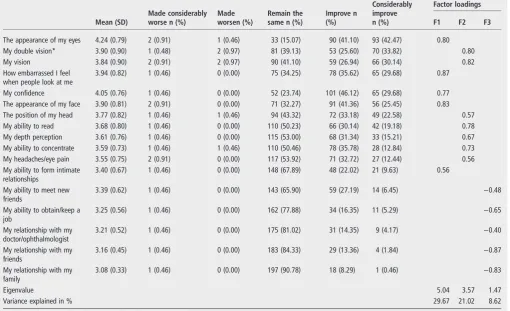
On inspection of the individual items, the data indicated that 42.47% of the sample expected a considerable improvement in the appearance of their eyes as a result of surgery, and 33.82% a considerable improvement in their double vision. Less than 2% of the sample expected worsening of their current state (table 2).
The items were subjected to a PCA on confirmation that the data were suitable for factor analysis. PCA revealed the presence of four components with eigenvalues above 1. Inspection of the screeplots indicated significant breaks after thefifth component for the ESSQ. Results from the parallel analysis, however, showed only three components with eigenvalues exceeding the corresponding criterion values for a randomly generated data
matrix of the same size (17 variables×220 participants). Therefore, a forced 3, 4 and 5-factor solution was undertaken. The data presented here are the results of the 3-factor solution as this was assessed as being both statistically and theoretically superior to the 4 and 5-factor solutions.
The forced 3-factor solution explained a total of 59.30% of the overall variance in the ESSQ (table 2). All components showed a number of strong loadings, and most variables loaded substantially onto one component. The three components repre-sented (a) intimacy and appearance-related issues, (b) visual functioning and (c) social relationships. The communalities were >0.3, which suggested that all itemsfitted well within their cor-responding factor.
Domain scores were then created by calculating a mean of the items within that subscale (table 3). The questionnaire and scoring instructions can be found as online supplementary materials.
Validity and reliability
Internal reliability of all subscales was acceptable with Cronbach’s alpha ranging from 0.76 to 0.89. All other measures were also checked for internal reliability, and were deemed acceptability, with Cronbach’s alpha ranging from 0.82 for the HADS depression subscale to 0.95 for the AS-20 psychosocial subscale.
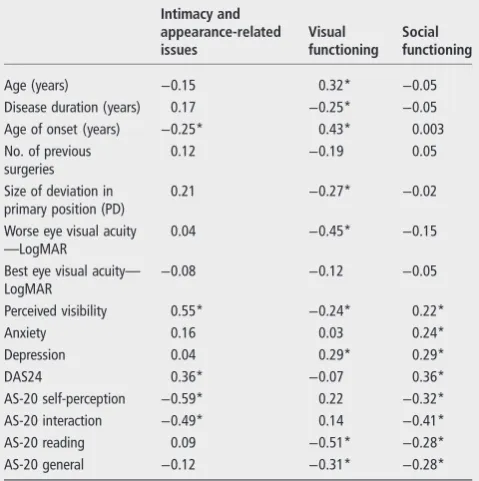
The statistically significant ( p<0.05) Pearson correlation
[image:4.595.45.556.69.380.2]coef-ficients between the ESSQ subscales and demographic, clinical and psychosocial factors were between 0.15 and 0.57 (table 4). Independent sample t tests, for the two-group comparisons, and ANOVAs, for analysis comparing more than two groups,
Table 2 Responses and item loadings for the Expectations of Strabismus Surgery Questionnaire
Made considerably worse n (%)
Made worsen (%)
Remain the same n (%)
Improve n (%)
Considerably improve n (%)
Factor loadings
Mean (SD) F1 F2 F3
The appearance of my eyes 4.24 (0.79) 2 (0.91) 1 (0.46) 33 (15.07) 90 (41.10) 93 (42.47) 0.80
My double vision* 3.90 (0.90) 1 (0.48) 2 (0.97) 81 (39.13) 53 (25.60) 70 (33.82) 0.80
My vision 3.84 (0.90) 2 (0.91) 2 (0.97) 90 (41.10) 59 (26.94) 66 (30.14) 0.82
How embarrassed I feel when people look at me
3.94 (0.82) 1 (0.46) 0 (0.00) 75 (34.25) 78 (35.62) 65 (29.68) 0.87
My confidence 4.05 (0.76) 1 (0.46) 0 (0.00) 52 (23.74) 101 (46.12) 65 (29.68) 0.77
The appearance of my face 3.90 (0.81) 2 (0.91) 0 (0.00) 71 (32.27) 91 (41.36) 56 (25.45) 0.83
The position of my head 3.77 (0.82) 1 (0.46) 1 (0.46) 94 (43.32) 72 (33.18) 49 (22.58) 0.57
My ability to read 3.68 (0.80) 1 (0.46) 0 (0.00) 110 (50.23) 66 (30.14) 42 (19.18) 0.78
My depth perception 3.61 (0.76) 1 (0.46) 0 (0.00) 115 (53.00) 68 (31.34) 33 (15.21) 0.67
My ability to concentrate 3.59 (0.73) 1 (0.46) 1 (0.46) 110 (50.46) 78 (35.78) 28 (12.84) 0.73
My headaches/eye pain 3.55 (0.75) 2 (0.91) 0 (0.00) 117 (53.92) 71 (32.72) 27 (12.44) 0.56
My ability to form intimate relationships
3.40 (0.67) 1 (0.46) 0 (0.00) 148 (67.89) 48 (22.02) 21 (9.63) 0.56
My ability to meet new friends
3.39 (0.62) 1 (0.46) 0 (0.00) 143 (65.90) 59 (27.19) 14 (6.45) −0.48
My ability to obtain/keep a job
3.25 (0.56) 1 (0.46) 0 (0.00) 162 (77.88) 34 (16.35) 11 (5.29) −0.65
My relationship with my doctor/ophthalmologist
3.21 (0.52) 1 (0.46) 0 (0.00) 175 (81.02) 31 (14.35) 9 (4.17) −0.40
My relationship with my friends
3.16 (0.45) 1 (0.46) 0 (0.00) 183 (84.33) 29 (13.36) 4 (1.84) −0.87
My relationship with my family
3.08 (0.33) 1 (0.46) 0 (0.00) 197 (90.78) 18 (8.29) 1 (0.46) −0.83
Eigenvalue 5.04 3.57 1.47
Variance explained in % 29.67 21.02 8.62
*For those with clinical diplopia, n=0, 1, 8, 34, 60, respectively. 257
258
259 260
261 262
263 264
265 266
267 268
269 270
271 272
273 274
275 276
277 278
279 280
281 282
283 284
285 286
287 288
289 290
291 292
293 294
295 296
297 298
299 300
301 302
303 304
305 306
307 308
309 310
311 312
313 314
315 316
317 318
319 320
321 322
323 324 325
326 327
328
329 330
331 332
333 334
335 336
337 338
339 340
341 342
343 344
345 346
347 348
349 350
351 352
353 354
355 356 357
358 359
360
361 362
363 364
365 366
367 368
369 370
371 372
373 374
375 376
377 378
379 380
381 382
revealed a number of statistically significant between-group dif-ferences (table 5).
DISCUSSION
This study aimed to develop a questionnaire, using classical test theory, to measure patients’expectations of their poststrabismus surgery outcomes. Item selection was undertaken using a variety of methods, including data from a published literature review,12 a review of validated vision and strabismus-specific quality of life questionnaires and from a variety of contributors across dif-ferent disciplines. The exploratory PCA presented three distinct domains, in which, convergent validity and reliability were evident by the high loadings within each factor, relatively high Cronbach’s alpha and simple structures. These three domains represented: (a) intimacy and appearance-related issues, (b) visual functioning and (c) social relationships, reflecting the domains found within a number of strabismus-specific quality of life questionnaires.18 20
The individual items of the ESSQ indicated that patients expected surgery to lead to considerable improvements,
primarily in relation to the appearance of their eyes as well as vision and more specifically double vision. Less than 2% of the sample expected worsening of their current status. Research, however, does suggest that only 24% of patients with strabismus are successfully realigned post surgery according to clinical cri-teria;21while 38% are classified as partial successes or failures.22
This might be because the patient requires prism therapy or a patch that was not necessary prior to surgery. They still have a large deviation, or are experiencing double vision, visual confu-sion or other related visual symptoms that may have developed after surgery.22 Of the 124 participants with diplopia prior to
Q12
surgery in this study, 1% expected their double vision to worsen, 7% expected their diplopia to remain the same and all others expected their double vision to improve. Research does, however, suggest that double vision can remain in approxi-mately two-thirds of patients up to 6 months post surgery, with almost one-fifth of patients with horizontal residual deviations stillfinding diplopia problematic in daily life.23This highlights apossible discrepancy between what the patients expect in rela-tion to their double vision prior to surgery and what may actu-ally happen. This potential discrepancy could contribute towards poor quality of life or poor satisfaction post surgery,6
and is particularly pertinent considering that patients appear to be more successfully aligned according to clinical criteria as opposed to quality of life outcomes.4 24
[image:5.595.45.285.77.153.2]Intimacy and appearance-related concerns was the domain in which both men and women expected the most significant
Table 3 Summary data for the Expectations of Strabismus Surgery Questionnaire subscales
Possible range
Actual
range M (SD)
No. of items
Intimacy and
appearance-related issues
1–5 1–5 3.92 (0.64) 5
Visual functioning 1–5 2–5 3.69 (0.60) 7 Social relationships 1–5 1–5 3.22 (0.38) 5
[image:5.595.309.546.79.433.2]M, mean.
Table 4 Correlations between Expectations of Strabismus Surgery Questionnaire subscales and demographic, clinical and psychosocial outcomes
Intimacy and appearance-related issues
Visual functioning
Social functioning
Age (years) −0.15 0.32* −0.05
Disease duration (years) 0.17 −0.25* −0.05
Age of onset (years) −0.25* 0.43* 0.003
No. of previous surgeries
0.12 −0.19 0.05
Size of deviation in primary position (PD)
0.21 −0.27* −0.02
Worse eye visual acuity
—LogMAR
0.04 −0.45* −0.15
Best eye visual acuity—
LogMAR
−0.08 −0.12 −0.05
Perceived visibility 0.55* −0.24* 0.22*
Anxiety 0.16 0.03 0.24*
Depression 0.04 0.29* 0.29*
DAS24 0.36* −0.07 0.36*
AS-20 self-perception −0.59* 0.22 −0.32*
AS-20 interaction −0.49* 0.14 −0.41*
AS-20 reading 0.09 −0.51* −0.28*
AS-20 general −0.12 −0.31* −0.28*
*<0.002.
[image:5.595.46.286.477.718.2]AS-20, Adult Strabismus Quality of Life Questionnaire; DAS24, Derriford Appearance Scale.
Table 5 Differences between categorical participant characteristics on Expectations of Strabismus Surgery Questionnaire subscales
Intimacy and appearance-related issues
Visual functioning
Social functioning
Gender
Male 3.75 (0.64)* 3.72 (0.59) 3.22 (0.41)
Female 4.05 (0.56) 3.69 (0.58) 3.21 (0.29)
Comitance
Concomitant 4.02 (0.64) 3.48 (0.57)* 3.22 (0.39)
Q5
Incomitant 3.76 (0.55) 4.03 (0.44) 3.20 (0.29)Previous surgery
No 3.81 (0.67) 3.78 (0.61) 3.18 (0.40)
Yes 4.01 (0.55) 3.63 (0.55) 3.24 (0.30)
Previous prisms
No 3.98 (0.62) 3.59 (0.57)* 3.22 (0.36)
Yes 3.67 (0.56) 4.07 (0.47) 3.18 (0.31)
Previous Botox
No 3.82 (0.64) 3.79 (0.61) 3.19 (0.38)
Yes 4.03 (0.57) 3.59 (0.53) 3.24 (0.31)
Diplopia
No 4.10 (0.62)* 3.39 (0.53)* 3.21 (0.36)
Yes 3.71 (0.55) 4.03 (0.45) 3.21 (0.34)
Occlusion
No 3.78 (0.63)* 3.83 (0.59)* 3.18 (0.36)
Yes 4.22 (0.46) 3.39 (0.46) 3.29 (0.33)
Deviation in primary position
Esotropia 3.97 (0.60) 3.69 (0.58) 3.24 (0.32) Exotropia 4.06 (0.66) 3.43 (0.55) 3.24 (0.44) Hypotropia 3.71 (0.50) 4.05 (0.56) 3.15 (0.28) Hypertropia 3.67 (0.54) 3.95 (0.44) 3.12 (0.20) Esophoria or
Exophoria
3.80 (0.59) 4.06 (0.45) 3.23 (0.33)
*<0.002. 385
386
387 388
389 390
391 392
393 394
395 396
397 398
399 400
401 402
403 404
405 406
407 408
409 410
411 412
413 414
415 416
417 418
419 420
421 422
423 424
425 426
427 428
429 430
431 432
433 434
435 436
437 438
439 440
441 442
443 444
445 446
447 448
449 450
451 452 453
454 455
456
457 458
459 460
461 462
463 464
465 466
467 468
469 470
471 472
473 474
475 476
477 478
479 480
481 482
483 484 485
486 487
488
489 490
491 492
493 494
495 496
497 498
499 500
501 502
503 504
505 506
507 508
509 510
improvements post surgery. Women did, however, report higher expectations that surgery would improve intimacy and appearance-related issues than men, as did those who were younger at age of onset. This included expectations about increased confidence and a reduction in feelings of embarrass-ment as a result of the way they looked, along with the ability to engage in intimate relationships. These expectations are not unsupported since surgery has been found to improve self-esteem and interpersonal relationships, and more so in women than men.25In contrast, the current study also found that older
participants with late-onset strabismus and shorter disease dur-ation expected significant improvements with regard to double vision and the ability to read and concentrate. This compliments research suggesting that women and younger people with a visible difference express greater levels of distress than men and older adults with a visible difference.26
Across all three domains, higher levels of anxiety and depres-sion were associated with greater expectations about postsurgical outcomes. Similarly, poorer quality of life was associated with significantly higher expectations, particularly in relation to intimacy and appearance-related issues and social functioning. Although the direction of causality is unknown due to the cross-sectional nature of the data collection, this suggests that patients experiencing poorer psychological well-being prior to treatment place a high value on having surgery, and view it as an import-ant route to improving their lives. Not meeting these high expectations may then contribute to poorer satisfaction post surgery.6Therefore, identifying mechanisms by which unrealistic
expectations may be altered could be vital. This could be achieved by improving psychological well-being presurgery, although at present, this hypothesis is purely speculative and would require further exploration, or by targeting unrealistic expectations directly, through the use, for example, of patient decision-making aids.11
There are potential weaknesses to this study. The initial stage of item generation was undertaken using published literature rather than using qualitative semistructured interviews with patients. These methods may have elicited more specific and patient-centred expectations. The items were, however, reviewed by a patient with strabismus as was the structure of the question-naire, and the strabismus-specific quality of life questionnaires from which items were generated were developed from qualita-tive interviews with patients.
This study has led to the development of a questionnaire that provides a structured approach to assessing patients’ expecta-tions about the psychological, appearance-related, functional and social improvements they anticipate post surgery. Further longitudinal work is required in order to assess whether these expectations change over time, and how they impact on psycho-social well-being post strabismus surgery. This then will provide a basis on which to support patients during this important decision-making process.
Twitter Follow Daniel Ezra at @MrDanielEzra
Acknowledgements DGE acknowledges funding by the Department of Health through the award made by the National Institute for Health Research to Moorfields Eye Hospital NHS Foundation Trust and UCL Institute of Ophthalmology for a Specialist Biomedical Research Centre for Ophthalmology. The views expressed in this publication are those of the authors and not necessarily those of the Department of Health.
Contributors Design and conduct of the study: HMB, KMK, JH, DGE, GGWA and SPN. Collection: CA, KMK. Management and Analysis: HMB. Interpretation of the
Q13
data: HMB, KMK, JH, DGE, GGWA and SPN. Preparation, review or approval of the manuscript: HMB, KMK, JH, DGE, GGWA and SPN.Competing interests None declared.
Patient consent Obtained.
Ethics approval The North London Research Ethics Committee granted approval for the study (REC ref. 10/H0724/61), and the study was conducted in accordance with Declaration of Helsinki.
Provenance and peer reviewNot commissioned; externally peer reviewed.
REFERENCES
Q14

1 Beauchamp GR, Black BC, Coats DK,et al. The management of strabismus in adults I. clinical characteristics and treatment.J AAPOS2003;7:233–40. 2 Rosenbaum AL. The goal of adult strabismus surgery is not cosmetic.Arch
Ophthalmol1999;117:250.
3 Gunton KB. Impact of strabismus surgery on health-related quality of life in adults.
Curr Opin Ophthalmol2014;25:406–10.
4 Hatt SR, Leske DA, Liebermann L,et al. Comparing outcome criteria performance in adult strabismus surgery.Ophthalmology2012;119:1930–6.
5 Mondloch MV, Cole DC, Frank JW. Does how you do depend on how you think you’ll do? A systematic review of the evidence for a relation between patients’ recovery expectations and health outcomes.CMAJ2001;165:174–9. 6 Pager CK. Expectations and outcomes in cataract surgery: a prospective test of 2
models of satisfaction.Arch Ophthalmol2004;122:1788–92.
7 Pager CK. Randomised controlled trial of preoperative information to improve satisfaction with cataract surgery.Br J Ophthalmol2005;89:10–13.
8 Menon V, Saha J, Tandon R,et al. Study of the psychosocial aspects of strabismus.
J Pediatr Ophthalmol Strabismus2001;39:203–8.
9 McBain HB, MacKenzie KA, Au C,et al. Factors associated with quality of life and mood in adults with strabismus.Br J Ophthalmol2014;98:550–5.
10 Dawn AG, Lee PP. Patient expectations for medical and surgical care: a review of the literature and applications to ophthalmology.Surv Ophthalmol
2004;49:513–24.
11 Griffiths C. Patient satisfaction: the importance of support in the decision-making process.J Aesthetic Nurs2013;2:498–500.
12 McBain HB, Au CK, Hancox J,et al. The impact of strabismus on quality of life in adults with and without diplopia: a systematic review.Surv Ophthalmol2014;59:185–91. 13 Bartlett MS. A note on the multiplying factors for various c2 approximations.
J R Stat Soc Series B1954;16:296–8.
14 Thurstone LL.Multiple factor analysis. Chicago: University of Chicago Press, 1947. 15 DeVellis RF.Scale development: theory and applications. CA: Sage Publications Ltd,
2011.
16 Carr T, Moss T, Harris D. The DAS24: a short form of the Derriford Appearance Scale DAS59 to measure individual responses to living with problems of appearance.Br J Health Psychol2005;10:285–98.
17 Zigmond AS, Snaith RP. The hospital anxiety and depression scale.Acta Psychiatr Scand1983;67:361–70.
18 Hatt SR, Leske DA, Bradley EA.et al. Development of a quality-of-life questionnaire for adults with strabismus.Ophthalmology2009;116:139–44.
19 Leske DA, Hatt SR, Liebermann L,et al. Evaluation of the Adult Strabismus-20 (AS-20) questionnaire using Rasch analysis.Invest Ophthalmol Vis Sci2012:53:2630–9. 20 van de Graaf ES, van der Sterre GW Polling JR,et al. Amblyopia & strabismus
questionnaire: design and initial validation.Strabismus2004;12:181–93. 21 Beauchamp GR, Black BC, Coats DK,et al. The management of strabismus in
adults-II. patient and provider perspectives on the severity of adult strabismus and on outcome contributors.J AAPOS2005;9:141–7.
22 Hatt SR, Leske DA, Holmes JM. Responsiveness of health-related quality-of-life questionnaires in adults undergoing strabismus surgery.Ophthalmology
2010;117:2322–8.
23 Jackson S, Harrad RA, Morris M,et al. The psychosocial benefits of corrective surgery for adults with strabismus.Br J Ophthalmol2006;90:883–8.
24 Hatt SR, Leske DA, Liebermann L,et al. Changes in health-related quality of life 1 year following strabismus surgery.Am J Ophthalmol2012:153:614–19. 25 Nelson BA, Gunton KB, Lasker JN,et al. The psychosocial aspects of strabismus in
teenagers and adults and the impact of surgical correction.J AAPOS
2008;12:72–6.
26 Rumsey N, Byron-Daniel J, Charlton R,et al. Identifying the psychosocial factors
and processes contributing to successful adjustment to disfiguring conditions. 2008.
Q15
513 514
515 516
517 518
519 520
521 522
523 524
525 526
527 528
529 530
531 532
533 534
535 536
537 538
539 540
541 542
543 544
545 546
547 548
549 550
551 552
553 554
555 556
557 558
559 560
561 562
563 564
565 566
567 568
569 570
571 572
573 574
575 576
577 578
579 580 581
582 583
584
585 586
587 588
589 590
591 592
593 594
595 596
597 598
599 600
601 602
603 604
605 606
607 608
609 610
611 612 613
614 615
616
617 618
619 620
621 622
623 624
625 626
627 628
629 630
631 632
633 634
635 636
637 638