Western University Western University
Scholarship@Western
Scholarship@Western
Electronic Thesis and Dissertation Repository
3-31-2016 12:00 AM
Promoting Resiliency and Managing Behaviour: Evaluation of an
Promoting Resiliency and Managing Behaviour: Evaluation of an
On-line Foster Parent Training Program
On-line Foster Parent Training Program
Laura Bonnell
The University of Western Ontario
Supervisor Alan Leschied
The University of Western Ontario Graduate Program in Psychology
A thesis submitted in partial fulfillment of the requirements for the degree in Master of Arts © Laura Bonnell 2016
Follow this and additional works at: https://ir.lib.uwo.ca/etd
Part of the Counseling Psychology Commons
Recommended Citation Recommended Citation
Bonnell, Laura, "Promoting Resiliency and Managing Behaviour: Evaluation of an On-line Foster Parent Training Program" (2016). Electronic Thesis and Dissertation Repository. 3741.
https://ir.lib.uwo.ca/etd/3741
This Dissertation/Thesis is brought to you for free and open access by Scholarship@Western. It has been accepted for inclusion in Electronic Thesis and Dissertation Repository by an authorized administrator of
ii
Abstract
The purpose of this study was to examine the experience of foster parents using a four
component online training module and to assess the effectiveness of each module as an effective
and relevant educational resource. The study focused on the content of modules one and three
which discussed, respectively, promoting resiliency in children and dealing with challenging
behaviours. Participants included thirty experienced foster parents from southern Ontario. Foster
parents participated in semi-structured interviews as part of the evaluation. Analysis of the
content of the interviews revealed eight themes reflecting both the content of the training
modules and the participants’ evaluation of the experience of their completion. Results suggest
that the content of the modules reflected the lived experiences of foster parents and were
considered to be useful in training, particularly for beginning foster parents. Results are
discussed in their relevance for foster parent retention and recruitment.
Key words: fostering, foster parents, foster children, child welfare agencies, online training,
iii
Acknowledgements
First and foremost I would like to thank my supervisor Dr. Alan Leschied, whose
guidance and kind support was always there when I needed it the most. Thank you for the many
hours of meetings, emails and editing that you spent in helping me write this thesis. I greatly
appreciate your support and I could not have done this without you.
I would like to thank my thesis partner Nadine Bilawski, who supported me through this
whole process and who was always available for meetings or phone calls to discuss our work
together. You were invaluable in encouraging me through this process and brought your
infectious positive energy to moments when I needed an extra boost.
I am thankful to Dr. Susan Rodgers and Dr. Jason Brown for their support throughout my
experience in graduate school, as well as their help and support in writing my thesis.
I would like to acknowledge the foster parents who participated in this study and took
time out of their hectic lives to share with me their personal experiences of fostering.
Finally I would like to thank my parents, who always made themselves available when I
iv
Table of Contents
Abstract……….………..………ii
Acknowledgements……….………...……iii
Table of Contents………..………..iv
List of Appendices………..………vi
Literature Review………1
Status of Fostering in Canada………...………...1
Challenges in Fostering………3
Developing Resiliency in Foster Children………...………4
Protective Factors………...………..5
Positive Parenting Practices………...………..6
The Role of Education………...………..7
Emotional and Behavioural Challenges………...………7
Placement Changes………..………8
Behavioural Interventions ………..……….9
Foster Parent Training………12
Summary………16
The Present Study………..17
Method………...………19
Design………...……….19
Data Analysis……….19
Participants………....……….19
Measures………...……….20
Procedure………..……….21
Results………...……….22
v
Theme 2: Management of a Foster Child’s Behaviour………..28
Theme 3: Changes in the Foster Care System………...…………34
Theme 4: Further Resources………..40
Theme 5: Experience of Completing the Modules………44
Theme 6: Experience of Completing an Online Course………47
Theme 7: Suggested Changed to the Modules……….…………..50
Theme 8: Technical Problems………...…56
Summary of Findings……….………....57
Discussion………..58
Links to Previous Research………...………59
Relevance to Foster Parenting………...………63
Future Research………...………..64
Limitations……….65
Summary………...……….66
References………..…………67
Appendices………...………..72
vi
List of Appendices
Appendix A: Semi-structured Interview Questionnaire………..72
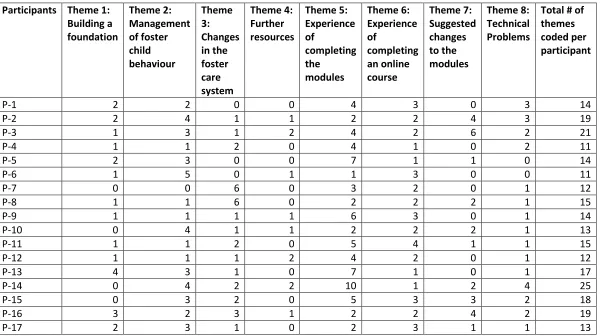
Appendix B: Participant Theme Response Tables……….64
1
1
Literature Review
The number of foster parents in Canada is far from sufficient to meet the number of foster
placements needed (Brown, & Bednar, 2006). There are both challenges to recruitment and
retention in the fostering experience, and foster parents have expressed the need for support if
they are to continue to provide this indispensable service (Brown, 2008; Vanschoonlandt, Van
Holen, Vanderfaeille, De Maeyer, & Andries, 2013). Identification of the factors associated with
successful placements as well as developing an understanding regarding what contributes to the
breakdown of those placements are critical if resources are to be put in place to help foster
parents address these issues (Brown, 2008; Brown, & Bednar, 2006; Brown, & Campbell, 2007).
Focusing on behavioural management of the children in care is a key factor that can help reduce
the stress between foster parents and children (Strijker, van Oijen, & Knot-Dickscheit, 2010).
Many interventions, however, focus only on the management of behaviour (Chamberlain et al.,
2008; Vanschoonlandt et al., 2013); understanding where disruptive behaviours come from and
why they may have become adaptive may be critical in helping foster parents deal with problem
behaviour (Holland, & Gorey, 2004).
Status of Fostering in Canada
Currently there is a shortage of foster parents in Canada, while coincidentally the number
of foster children needing care continues to significantly increase (Brown, & Bednar, 2006). The
Child Welfare League of Canada (CWLC) reported that the number of children in care in 1998
was 36,080, increasing to 76,000 by the year 2000 (Farris-Manning, & Zandstra, 2003). Not only
has the number of foster parents declined, but cutbacks in health, educational, and social services
(Farris-2
Manning, & Zandstra, 2003). With an increasing number of foster children in Canada, it is
especially important to retain current foster parents and develop support systems to ensure that
future foster parents have access to necessary resources to support them in this work.
To help address these concerns, research has been conducted to determine what foster
parents perceive as contributing factors to the decline in recruitment and retention (Brown, 2008;
Brown, & Bednar, 2006; Brown & Campbell, 2007; Vanschoonlandt et al., 2014). Brown and
Bednar (2006) asked foster parents what would make them consider terminating a foster
placement. Based on concept mapping the results suggested the following in contributing to low
rates of foster parent retention: a lack of community resources; unsuccessful attempts at
fostering; problems with an agency; the child not adapting; the child’s behaviour; the child being
a danger to the family; the child having complex needs; and the parent having poor health or
changed circumstances. Brown (2008) also examined what foster parents perceived they needed
for a successful foster placement. Again, concept mapping identified the following factors: the
need for community support; personalized service; a good relationship with the agency, having
information about the child; personality and skills; for the parent to look after themselves; to
have a supportive family; and to have a foster family network. Other studies suggest that a major
issue in the success of a placement relates to effectively responding to the behaviour of the child,
supporting foster parents during periods of stress, and having support systems in place to help
foster parents with this issue (Cooley, Farineau & Mullis, 2015; Stijker, van Oijen, &
Knot-Dickscheit, 2010; van Rooij, Maaskant, Weijers, Weijers & Hermanns, 2015; Vanschoonlandt et
al., 2014). In the final analysis, the relationship between foster parents and their foster child(ren)
3 Challenges in Fostering
When bringing a foster child into their home, foster parents will have expectations of
building a bond with their foster child(ren). Normal child developmental processes suggest that
children usually become attached to a primary caregiver within the first few months of their life
(Gabler et al., 2014). However, a foster child's previous experiences with their biological
parent(s) and previous foster placements can make attachment to their current foster parents
considerably more difficult (Gabler et al., 2014; Puddy & Jackson, 2003). Research suggests that
a previous history of frequent foster placement breakdown is positively correlated with future
placement instability, as the child may disconnect emotionally from future caregivers (Rock,
Michelson, Thomson & Day, 2015). Foster children may have internalized negative feelings
including worthlessness and may have expectations that foster parents will not meet their needs
or care for them due to their past experiences with caregivers (Craven & Lee, 2010; Gabler et al.,
2014; Puddy & Jackson, 2003). Increased parental stress when starting a new placement can
influence a child's mental health and attachment to the foster parent (Gabler et al., 2014; van
Rooij et al., 2015). Foster parent stress has been shown to be associated with internalized
problems in foster children, which contribute to future attachment difficulties (Gabler et al.,
2014). Often foster children feel that they do not belong, that they have a sense of "otherness"
and that they are different from the biological children in the foster home (Storer, Barkan,
Stenhouse, Eichenlaub, Mallillin, & Haggerty, 2014).
When first entering a placement, foster children express a desire to return to their shared
home with their biological parent (Storer et al., 2014) Over time however, this changes.While
attachment may not occur immediately with the foster parent, given time and positive parenting
4
parents may have a strong desire to bond with their foster children, it may take longer for foster
children to develop an attachment to their foster parent. Gabler et al. (2014) indicated that foster
children showed increased attachment to their foster parents within the first six months of
placement, but that the level of attachment security was lower than that of low-risk children. A
foster child’s attachment to their foster parent may be slower to develop than would attachment
with lower risk children (Gabler et al., 2014). Developing attachment and using positive
parenting practices with foster children is a significant factor in teaching children about caring
relationships. However, part of the reality for foster children includes the fact that they may have
to move to a different placement or eventually be returned to their biological parents. It is
important for foster parents to nurture skills that will help foster children when they move on to
their next placement.
Developing Resiliency in Foster Children
When children are provided with a stable environment and the prevalent crisis abates,
there is an opportunity for skills to develop and grow. As the child may have had numerous
placements during their time in foster care, it is important for foster parents to help children
develop skills that improve their resilience. While the foster child may eventually leave the
home, during their time together, the foster parent can provide the child with the opportunity to
learn skills that will allow them to cope better in difficult situations. Thus, though the foster
parent may no longer be present to directly care for the child, they will have helped the child
develop the ability to better care for themselves.
Foster children who are resilient generally cope well despite having experiences that
5
2005). Bell, Romano and Flynn (2013) indicated that 50-70% of foster children in a large
Ontario child welfare sample showed resilience on at least one behavioural outcome. Thus,
capacity for resilience, despite negative conditions, does exist in many children and should be
further encouraged by foster parents. However, though children may show resilience on one
factor such as a specific behavioural outcome, this does not mean that the child will show
resilience in other aspects (Bell, Romano & Flynn, 2013). The greater numbers of skills the child
develops, the more improved their functioning will become across a variety of situations (Bell,
Romano & Flynn, 2013).
In assessing a child’s needs, it is important for the foster parent to recognize both
strengths and deficits in order to deliver care that provides resources to help in areas where the
foster child is having difficulty (Bell, Romano & Flynn, 2013; Craven & Lee, 2010). Resiliency
is created through social competency, problem solving ability, autonomy, optimism and social
support (Craven & Lee, 2010). The ability of foster parents to promote these skills can help build
resiliency in children. However, many of these traits are based on being able to trust others,
which may be an experience which foster children have not had the opportunity to build (Craven
& Lee, 2010).
Protective Factors. Protective factors help to minimize environmental factors that can
create a maladaptive outcome (Alvord & Grados, 2005; Benzies & Mychasiuk, 2008; Schofield
& Beek, 2005). By examining protective factors and encouraging these in foster children, foster
parents can promote resilience. Several protective factors have been identified, the first being
proactive orientation (Alvord & Grados, 2005; Benzies & Mychasiuk, 2008). This includes the
desire to take initiative in one's life and to have positive self esteem and self-efficacy. Children
6
that they can influence a situation, rather than passively accepting its results (Alvord & Grados,
2005; Benzies & Mychasiuk, 2008). They believe in their abilities to overcome obstacles and
treat difficult situations as learning experiences (Alvord & Grados, 2005).
Foster parents may encourage these protective factors by allowing children to have
responsibilities and choices so that they develop a sense of self efficacy, problem solving skills
and promote their self esteem. Self regulation, the ability to control one's attention, emotions and
behaviour is another protective factor (Alvord & Grados, 2005; Benzies & Mychasiuk, 2008;
Schofield & Beek, 2005). By having positive self regulation skills, children are able to
self-soothe in stressful situations, allowing for appropriate responses and thus making the
development of healthy relationships easier (Alvord & Grados, 2005; Schofield & Beek, 2005).
Positive Parenting Practices. Positive parenting practices can be another protective
factor. Children with foster parents who are warm, loving and provide consistent boundaries are
more likely to show resilience (Alvord & Grados, 2005; Bell, Romano & Flynn, 2013; Fuentes,
Salas, Bernedo & García-Martín, 2015; Rock et al., 2015; Inchaurrondo, Bailón, Vicente, Tió &
Bolós, 2015). Encouraging a sense of connection and attachment can help with developing
relationships both with the family and with peers (Alvord & Grados, 2005; Benzies &
Mychasiuk, 2008). Having positive relationships help the child develop self esteem and self
efficacy (Alvord & Grados, 2005). Strong relationships help children cope with stressors in their
life and thus can promote resiliency (Alvord & Grados, 2005; Benzies & Mychasiuk, 2008).
Over time, children who interact with foster parents who use positive parenting practices show a
decline in behavioural problems (Fuentes et al., 2015). Developing these relationships is an
active process to be encouraged and continuously developed (Alvord & Grados, 2005).
7
respect, reciprocity, and develop these positive relationships. Resiliency can also be developed
directly through interactions with the family, as well as with the greater community (Alvord &
Grados, 2005; Bell, Romano & Flynn, 2013).
The Role of Education. Education, extracurricular activities and community are protective
factors outside the family that can encourage resiliency in a child (Alvord & Grados, 2005;
Benzies & Mychasiuk, 2008; Bell, Romano & Flynn, 2013). Absenteeism and academic
difficulties are shown to be significant risk factors in children (Inchaurrondo, Bailón, Vicente,
Tió & Bolós, 2015). Schools, extracurricular activities and community activity can allow the
child to develop the skills they are learning at home in a different setting with people other than
their immediate care givers. Teachers, peers, mentors, community support services, health care
and religious centers are other sources of support that a foster child can draw upon (Alvord &
Grados, 2005; Benzies & Mychasiuk, 2008; Inchaurrondo, Bailón, Vicente, Tió & Bolós, 2015).
Accessing these services so that their foster children can have the opportunity to utilize them is
another way in which foster parents can promote resiliency. In understanding and identifying
protective factors, foster parents can encourage their foster children by promoting skills that help
develop resiliency.
Emotional and Behavioural Challenges. While foster parents seek to encourage their
foster children and help them develop and grow, foster children often show challenging
emotional and behavioural problems due to being maltreated. Facing these difficulties can place
significant stress on a foster parent. One of the major contributing difficulties and stresses in a
foster home is the behaviour of the child (Cooley et al., 2015; Strijker, van Oijen, &
Knot-Dickscheit, 2010). Significant behavioural problems exhibited by a foster child have been shown
8
Strijker et al.2010). These problem behaviours are often due to experiences in the child’s past,
reflecting their histories of abuse or neglect (Holland, & Gorey, 2004). For example, children
who have experienced abuse, neglect, or parental substance abuse are more likely to be in
conflict with foster parents or other children in the home (Holland, & Gorey, 2004). As well,
foster children who have been sexually abused are six times more likely than children who have
not been abused to have multiple foster placements (Holland, & Gorey, 2004). Gabler et al.
(2014) found that younger foster children had fewer behavioural problems than did older foster
children, indicating that longer durations of negative experiences increases the likelihood of the
foster child presenting with behavioural issues.
Placement Changes. A greater number of placements has been shown to be associated
with less favourable outcomes for foster children (Bell, Romano & Flynn, 2013; Rock et al.,
2015; Rork & McNeil, 2011). For example, fewer different caregivers has been associated with
lower levels of both childhood anxiety and physical aggression (Bell, Romano & Flynn, 2013).
Thus, historical factors of the child can be useful predictors of behaviour problems and
placement breakdown.
Simply removing foster children from these situations and transitioning them to other
homes is not an adequate response to address these problems (Vanschoonlandt et al., 2014).
Research indicates that being placed in a caring environment is an inadequate response in
diminishing these problem behaviours. Rather, further interventions are needed beyond being
placed in a positive environment (Gabler et al., 2014). The difficulties that foster parents address
are often exacerbated by the fact that they are frequently not provided the resources to effectively
respond to these problems before the child is placed in the home (Chamberlain et al., 2008).
9
to better understand these issues and manage behaviour may be a key component in reducing this
stressful factor. Thus, an increase in supports may help contribute to an improved experience for
both foster parent and child.
Behavioural Interventions
Behavioural intervention resources are provided to foster parents in one of two ways. The
first is through curriculum based programs where the foster parents are taught about the issues
regarding behaviour and how to manage them (Vanschoonlandt, Vanderfaeillie, Van Holen, &
De Maeyer, 2012), although the effectiveness of these programs has been debated
(Vanschoonlandt et al., 2012). The second behavioural intervention resource is provided through
the implementation of training based programs where the foster parents are provided with
resources and supported in how to implement them (Vanschoonlandt et al., 2012). However, the
effectiveness of these programs has also been shown to be inconsistent (Chamberlain et al.,
2008; Macdonald & Turner, 2005; Vanschoonlandt et al., 2012). While not all interventions have
been successful, there appear to be key variables aiding in program effectiveness. For example,
home based programs that work with the individual child have been shown to be more effective
than group programs (Vanschoonlandt et al., 2012). As well, programs that focus on positive
interactions between the parents and child while practicing the learned skills were shown to be
the most effective (Kaminski, Valle, Filene, & Boyle, 2008). While research has shown some
variables to be effective in dealing with behaviour, new research should focus on developing and
implementing programs incorporating factors which have consistently been found to be effective.
While managing behaviour is important, resources for dealing with behaviour often fail
10
expressed a desire for training in the aetiology of child behaviour (Murrary, Tarren-Sweeney &
France, 2011). Even when programs try to incorporate the origins and functions of problem
behaviours, behaviour management is often the prominent focus due to the urgency of protecting
both the foster family and foster child (Chamberlain et al., 2008; Vanschoonlandt et al., 2013).
For example, one study utilized a module format delivered by a trained professional to foster
parents, explaining common problem behaviours exhibited by foster children and addressing the
implementation of the learned skills (Vanschoonlandt et al., 2012). All participants completed
the sections of the modules that were directly related to managing behaviours. This included
providing praise, effective commands, reward programs, positive involvement and structure.
Those components that were related to understanding behaviour, such as avoiding problems,
solving problems, autonomy and monitoring, were not completed by all participants even though
these were still considered a mandatory part of the program (Vanschoonlandt et al., 2012).
However, helping foster parents better understand where their child’s behaviour originates and
how a maladaptive behaviour may have been helpful to their foster child in the past, may provide
important insight that forms the basis for the foster parent to be emotionally and intellectually
prepared for managing the behaviour. The current module on behaviour represents an attempt to
address this gap in the literature by taking the foster parent through a number of activities that
will help them understand their individual child’s behaviour (Western Foster Parent Project,
2014).
While identifying key areas that foster parents perceive to be difficulties is important in
informing further research, these studies are not without limitations. First, these studies may not
be reflective of the general foster parent population as the sample sizes were small, ultimately
11
participants may influence their perceptions of their needs. More experienced foster parents may
have different perceptions than foster parents who are earlier in their careers (Brown, 2008).
Other factors such as age, socioeconomic status, or living in an urban versus a rural location may
influence foster parents’ perceptions of need. Furthermore, some of these studies do not use
randomization of sampling and rely solely on self-report measures. This may cause a selection
bias due to participants actively deciding to respond and participate. There may be a difference in
the motivations behind choosing to participate in the research, which may cause a bias in the
population sample. Finally, foster parents in dire need for support may not have the time to
participate in a research study or may not have access to the services encouraging participation g
in these research studies.
While the research on the implementation of behavioural management programs is
promising, there are some limitations. Due to the ethical obligations to provide support for all
participants, no control groups were used. One study found that there was a difference between
pre and post tests; however, the finding was not statistically significant (Vanschoonlandt et al.,
2012). The researchers suggest that if a control group was assessed alongside the treatment
group, there may have been a significant difference between the group that received the
behaviour management program compared to those who did not. Due to an over-inclusion of
programs in the meta-analysis of effective aspects of behaviour management programs, the
quality of the studies may be a confounding variable, as poorly developed studies may have been
excluded.
Understanding that resilience can be encouraged through the promotion of protective
factors is important for foster parents to learn. However, as the issues that children experience
12
preparing foster parents prior to a child entering their home. Training foster parents in techniques
such a cognitive reframing, thought stopping, behaviour management, relaxation and self control
can allow both the child and the parent to work together to help manage difficult emotions and
behaviours (Alvord & Grados, 2005). Training foster parents on effective parenting techniques
that include both warmth and affection alongside consistent boundaries and discipline can aid in
the development of a positive relationship (Alvord & Grados, 2005).
Foster Parent Training
Children in foster care exhibit impairment across a variety of developmental areas
(Murrary, Tarren-Sweeney & France, 2011). Foster children often have developmental delays,
medical problems, academic challenges, behavioural and emotional problems (Puddy & Jackson,
2003; Rork & McNeil, 2011). The scope of these difficulties is much more severe when
compared to non-clinical populations (Murrary, Tarren-Sweeney & France, 2011). In developing
a relationship with a foster child, there is increased risk for conflict between the foster parent and
the child (Puddy & Jackson, 2003). Positive parenting practices where the foster parents are
warm and empathetic, yet define clear boundaries have been shown to help decrease problem
behaviours in foster children (Fuentes et al., 2015). Providing the opportunity for foster parents
to learn effective parenting practices can be critical in diffusing these situations and allow for the
opportunity for positive relationships to grow. The stress of helping a child with such
impairments can be intensified by the added pressures of the foster care system, such as
interactions with case workers or foster care agencies (Murrary, Tarren-Sweeney & France,
2011). The high demands on foster parents in caring for foster children, in combination with
foster parents’ feelings of lack of control over the situation and intrusive or negative interactions
13
and thus leads to foster placement breakdowns (Murrary, Tarren-Sweeney & France, 2011).
Foster parents have identified the following areas that would increase their sense of competency.
First is the need to feel acknowledged and respected by the community and agencies. Second, is
the need for preventative practices both on the individual level and through policy that will
improve foster children's development and well being. Third is for improved access to support
systems that are currently unavailable or difficult to access such as respite care, financial
assistance or specialist services (Murrary, Tarren-Sweeney & France, 2011).
It is important to provide foster parents with training in order to help them meet the needs
of their foster children while managing their own needs as well. A lack of foster parent training
was found to be related to foster placement breakdown, as foster parents felt unprepared to face
the difficulties of managing their foster child's behaviour (Puddy & Jackson, 2003; Rock et al.,
2015). Foster parent stress, and behaviour problems of foster children have been shown to be
significant predictors of negative foster placement outcomes (Cooley et al., 2015; Rock et al.,
2015; van Rooij et al., 2015). Foster parents who lack adequate training experience begin
overwhelmed by the challenges that accompany fostering a child. Lack of training is often stated
as one of the reasons foster parents choose to stop fostering (Festinger & Baker, 2013). Studies
have shown that insufficient foster parent training diminished the effectiveness of foster
parenting for both the child and the foster family (Puddy & Jackson, 2003). When asked what
they would include in foster training, foster parents often stated the need for more overall
training along with access to more in depth information of specific topics related to fostering
(Festinger & Baker, 2013).
While a variety of foster training programs exist, the underlying goal of training is the
14
a foster placement. Training programs have been developed to help prepare foster parents for
their placements through instruction on effective parenting practices and behavioural
management techniques (Puddy & Jackson, 2003). Training programs often include topics such
as the following: behavioural management; preparing parents for a new placement; effective
parenting and communication; placement guidelines and regulations including issues related to
the disruption of a placement; communication with child agencies; building relationships with
foster children; developing resiliency in foster children; and other topics related to the health and
safety of the child (Nash & Flynn, 2013; Puddy & Jackson, 2003; Rork & McNeil, 2011).
Placements where the foster parents were characterized as receiving greater degrees of training
have been shown to reflect greater stability, more effective parenting practices, reduced
childhood behavioural problems, increased positive relationships between foster parents and
child agencies, increases in foster parent satisfaction with their experience and decreases in
attrition rates for foster parents (Puddy & Jackson, 2003; Rork & McNeil, 2011). Foster parents
who experienced adequate training reported greater satisfaction in their ability to balance their
biological family demands along side their relationship with their foster child(ren) (Puddy &
Jackson, 2003). Adequate training has also been associated with foster parents’ willingness to
continue to foster (Rork & McNeil, 2011). In a meta analysis of various foster training programs,
Nash and Flynn (2013) found that the majority of participants showed positive improvements on
factors such as being able to better manage their foster child's behaviour, having lower turnover
of foster placements, improved parenting skills, and increased positive outcomes for placements.
However, Nash and Flynn (2013) also found a negative impact of some foster parent training on
their ratings of their foster children. This suggests that foster parent training may have influenced
15
when taking care of foster children (Nash & Flynn, 2013). Thus foster parent training needs to
not only to be informative, but supportive of the foster parents. However, it may not be enough
to simply inform foster parents. What is also required is the necessity to create support groups,
resources and techniques that foster parents can draw upon when facing difficulties related to
their foster children.
It is important to acknowledge in the implementation of foster parent training that a
variety of factors influence a foster family including their parenting history, foster child history,
presence of biological children, culture, motivation for fostering, level of experience, needs of
the foster child and available supports (Rork & McNeil, 2011). These factors can influence the
efficacy and applicability of various training programs and thus these programs need to be
evaluated. Asking foster parents to identify their needs and what they would find useful to be
covered in a training program can help decrease training attrition rates, and present foster parents
with a program that will increase their knowledge and skill set (Rork & McNeil, 2011). Often,
foster parents are required to take training every few years to maintain their status as a foster
home. These training sessions are often provided as onsite instruction and offered in multiple
sessions (Nash & Flynn, 2013). However, it may be difficult for foster parents to take the time to
attend these sessions. Completing home-based sessions through video tapes or online have
become increasingly popular, and allow foster parents to complete training at home, where they
can participate during whatever time suits their schedule (Murray, Tarren-Sweeney & France,
2011; Rork & McNeil, 2011).
However, effectiveness of many of the training programs offered to foster parents has yet
to be evaluated (Puddy & Jackson, 2003; Rork & McNeil, 2011). As such, future training
16
helping to improve foster care. For example, the training program MAPP/GPS was found only to
slightly improve foster parent's behavioural management skills when compared to untrained
foster parents. (Puddy & Jackson, 2003). Evaluation of foster training programs is key in
determining which components influence the efficacy of the program (Nash & Flynn, 2013). For
example, the level of experience a foster parent has, the number of prior placements of the foster
child, and the type of emotional and behavioural problems the foster child experiences may
influence how applicable a specific training program is for a particular foster family (Nash &
Flynn, 2013). Determining these factors also allows agencies to determine which type of foster
training is most relevant to which population of foster parents (Nash & Flynn, 2013). Difficulties
arise because of the variety of programs and the lack of a standardized method of presenting the
material (Nash & Flynn, 2013). Offering the program online means that each participant is
receiving a standardized form of training with minimal variability due to the presentation format.
Thus training fidelity is increased (Nash & Flynn, 2013). As part of the current study foster
parents were invited to evaluate on-line program in order to help identify strengths and
weaknesses of the program and make applicable changes.
Summary
The number of foster children that require a placement in homes greatly outnumbers the
number of foster homes available (Farris-Manning, & Zandstra, 2003). To help address this
challenge, research has been conducted to examine the factors that contribute to foster family
breakdown, and identifying those factors that need to be in place for success in these
relationships (Brown, & Bednar, 2006; Brown, & Campbell, 2007). As the behaviour of a foster
child can have a significant impact on this relationship, it is important that foster parents are able
17
2015; Holland, & Gorey, 2004). Educating foster parents and providing the resources to help
with these behaviours is an important process that can contribute to more successful placements
(Chamberlain et al., 2008; Vanschoonlandt et al., 2012). Understanding behaviour is an
important component that appears to be missing in the implementation of many of the
behavioural training programs. The goal of this project is, in part, to help address this gap.
The Present Study
The purpose of the present study was to examine foster parent’s perceptions of four
educational modules to better understand the experience of being a foster parent. The modules
were separated into four key areas that discussed challenges that occur when fostering. The
modules were developed based on feedback from current foster parents about the difficulties
they had with fostering and the need for resources to help address these problems (Leschied,
Rodgers, Brown, Atkins & Pickle, 2014). Through understanding the experiences of foster
parents, the goal is to identify factors that will help encourage foster parent retention.
This study examined the experience of foster parents using two of the four training
modules in order to assess the effectiveness of the modules as an educational resource to provide
support in managing problems that arise when fostering a child. Educating foster parents on
managing difficulties related to fostering a child has been shown to promote foster parent
retention (Hudson, & Levasseur, 2002). Specifically, the current study examined the first and
third modules. The first module focused on introducing the child to a new placement and how
foster parents can help develop resiliency in the child. Examining protective factors and
implementing these factors can help the child build skills that they can use, even after placements
18
parent is not present. The third module focuses on unpacking the behaviour of a foster child in
order to better understand what precipitates difficult behaviours, which may inform which
interventions can be effectively implemented to address these behaviours. Many studies have
focused on the management of behaviour (Chamberlain et al., 2008; Vanschoonlandt, et al.,
2013). Less emphasis has been placed on understanding where that behaviour has originated and
its function. In examining foster parent feedback, one of the goals of the current study assessed if
the module is an effective resource to help foster parents better understand how to encourage
resiliency in the children they foster, as well as to better understand the reasons behind their
foster child’s behaviour.
It was hypothesized that the foster parents will find these educational modules as an
effective resource in addressing these concerns. Developing resiliency in children by teaching
positive coping strategies can help them function in a variety of situations and thus have a
positive impact on the fostering relationship (Bell, Romano & Flynn, 2013). Management of
maladaptive behaviour has been shown to help reduce foster parent stress and fatigue (Strijker,
van Oijen, & Knot-Dickscheit, 2010). Understanding where a child’s behaviour originates is
expected to help foster parents better understand the function of their foster child’s behaviour,
and thus help with managing it in an appropriate and effective manner. As such, it is expected
that this educational module will be an effective resource in helping mitigate foster parent stress
in relation to their child’s difficult behaviour. By providing foster parents with applicable
resources through these educational modules, it may help reduce the amount of stress
experienced by foster parents by teaching them skills and coping strategies and thus aid in foster
19 Method
Design
The current study used a qualitative design. The choice of a qualitative design is
consistent with the goal of promoting understanding in regards to foster parent retention; the
experience of being a foster parent; understanding the concerns of foster parents; and the
problems they face. Sources of data included narrative data which allows for an in depth
examination of these issues through exploring the subjective experience of foster parents.
Data analysis. The data was collected using written feedback in response to questions
asked of foster parents both prior to and following completion of each module. Content analysis
was used to analyze the data from these written responses. Content analysis requires a close
reading of the narrative data that is coded into common themes. These themes were determined
by the researchers and developed through the responses occurring in the data set. The feedback
from the telephone interviews was added to the data set and coded according to the themes
identified from the written responses. The data was coded for frequency. The frequency of
similar responses was an indication of common concerns or issues in relation to fostering. For
example, the greater the frequency of a specific theme or response, the greater likelihood that it
is a common concern shared by multiple foster parents.
Participants
Participants for the present study reflected a consenting convenience sample of foster
parents. Invitations for foster parents to participate in the study were sent through a national
foster parents organization, as well as child welfare offices in a large Canadian province. The
20
parent’s participation in completing the survey questions that are part of the module, as well as
verbal consent when participating in the telephone interview. The inclusion criteria for
participation in the study included being a current foster parent in Canada and having access to
the internet to complete the online modules. As the participants are foster parents that are living
with foster children and directly dealing with the issues the modules are attempting to address,
these foster parents were considered experts in the experience of fostering. Therefore, the
expectation was that they will be able to assess if these learning resources were applicable to real
world situations and helpful in understanding the needs that are currently not being met by
available support systems for foster parents.
Measures
Five open ended questions were used for the written component of the modules. These
included: “Before doing any viewing of the materials or assigned reading, what do you know
about the content of this module?”; “After watching, listening and reading, what turned out to be
true?”; “What misconceptions have you identified?”; “What did you learn that was new?” and
“What are you left wondering about?”. During the telephone interview eight predetermined
questions will be used, as well as prompts that will be developed from coding the written
responses. The questions for the telephone interview include: 1) What do you think foster parents
and child protection agencies and workers need to know and understand about families and your
experience as a family with a foster child or youth with mental health concerns? 2) What did you
think about the topics in the course? Did you think anything there was not needed, or was there
something that was missing? 3) What did you think about doing an online course? 4) Did you
experience any technical problems? 5) How did taking this course fit with other demands on
21
things for you, your foster child(ren) and your family? 7) What do you think is important for us
to know about developing, delivering, and evaluating this course? Do you have any advice for
us? 8) Any final feedback or thought you wish to share about the course? Foster parents will be
prompted to expand upon and clarify their verbal answers so as to encourage detailed responses.
Procedure
Prior to beginning each module, the participants were asked the following: “Before doing
any viewing of the materials or assigned reading, what do you know about the content of this
module?” The participants wrote their response to this opening question in an email that was
sent to the researchers. The participants then worked through the module and following its
completion, responded to four open ended questions. Responses to these questions were added to
the email sent by participants to the researchers. The researchers then coded these answers
thematically and placed them in a spreadsheet. These themes informed the questions and prompts
that were used during the follow up interview, as well as allowing the researchers to track any
missing written feedback.
Following completion of the modules, participants were contacted by telephone to
complete a semi-structured interview using predetermined questions. During the interview the
participants were asked questions and provided with prompts to allow for further expansion on
their written answers. The interview allowed the participants to express in depth their experience
as a foster parent. If the participants chose not to complete sections of the written feedback, the
researchers then created prompts to ask the participants if they wished to provide verbal
22
would be kept confidential and that they were not obligated to answer all questions but that their
feedback was appreciated.
Following completion of the interviews the researcher thanked the participant. As the
interview questions related to the experience of fostering children, both presently and in the past,
it was expected that for some participants, answering the questions may touch on experiences of
a highly personal and emotional nature. To ensure that no harm had come to the participants
during the course of their involvement, at the end of the interview, the researcher, who has been
trained in counselling, checked in with the participant regarding their experience in the project.
Through completing this check in, the researcher helped ensure that the participant left the
conversation feeling ready to continue their regular schedule. If the participant was experiencing
any level of distress after answering the questions, the researcher used evidence-based practices
to help diminish any distress the participant may be feeling. Once all interviews were completed
and collected, the audio recordings were transcribed. Researchers then coded the data into
common answers and themes, expanding on the themes that appeared in the written submission.
Results
The purpose of this study was to examine the experience of foster parents using the four
foster parent training modules to assess the effectiveness of the modules as an educational
resource to support foster parents through the difficulties associated with fostering a child. In
examining the feedback from these modules, the current study assessed two of these modules
regarding their effectiveness as an educational resource in helping foster parents understand
23
Eight themes were identified based on the content of the thirty foster parent interviews.
These eight themes were: (1) building a foundation; (2) management of foster child behaviour;
(3) changes to the foster care system; (4) further resources; (5) experience of completing the
modules (6) experience of completing on online course; (7) suggested changes to the modules;
and (8) technical problem.
Theme 1: Building a foundation
The focus of this theme was the discussion of the content in Module 1: Building a Foundation.
This module discussed the beginning of foster placements and meeting the child’s immediate
needs based on Maslow’s hierarchy of needs (Maslow, 1943). Subthemes included meeting basic
needs and creating a stable environment; promoting self capacity; the role of social workers in
providing information; and validating foster parents.
Foster parents expressed the importance of ensuring the basic needs of the child were met
before moving on to address other issues. This prioritization was reported by foster parents in
helping to prevent the child from becoming overwhelmed. Foster parents indicated that creating
a stable environment helped foster children in becoming more emotionally stable. As well, foster
parents suggested the importance of meeting the basic needs of the child was critical as these
children may not be emotionally prepared to accept more than that.
“But I would say for certain, regardless of that, I would say it’s very accurate, yes. For a
lot of them, it is their basic needs that will stabilize their emotions. A lot of them have not
had their basic needs met nutritionally and safety-wise, sleep-wise. So for sure that at
24
home. And, you know, they need to have a sense of security in you and in their needs
being met before you can ever approach any emotional needs.”
“So I kind of gave a shorter version when I re-wrote it, but, anyways, what I was going to
say is that a lot of the stuff that was in that module, I had already learned along the way.
But it would have been very very handy, more than handy, would have been really
helpful to have a module like that or have a training session like that uh, just to kind of
give you the heads up as you’re going into it. For a new foster parent because I’m sure
we all go in there going I just have to care about, I just have to love the, and I’m doing
this because I do care and I want to make a difference, Ill hand out lots of hugs and kisses
and tell them how important they are and then bam all of a sudden they are in your face
and they are screaming at you and hate you, and it doesn’t matter if they are two or
twelve or eighteen, you know. Just the fact that being in care can grate on them and they
can turn on you, and, I think it’s really, really important, as you emphasised in the
module, that initially you start with the very basics, and I’m sure that everybody does, but
your bring all the emotion and caring and love that, you know, you really need to hold
back on a little bit on the overt caring and loving because they are not necessarily ready
for that, at least with the older ones you know?”
A subtheme emerged reflecting foster parents’ statements regarding the promotion of self
capacity in foster children as a significant message to send to foster parents. It is important that
foster parents have the ability to not just meet the child’s needs, but to teach them skills that they
25
“Let me see…. Ummm. *pause* I’m just trying to remember it. I’m just scanning quickly
through the intro page. I mean its been a while since I watched it. Life carries on. I swear
to god I have no memory, that’s my problem. I don’t know. Like I said I think for one it
was covering. It was good. Like it was very good. I just feel like I didn’t learn a lot of
new in there. Because I already had most of that information. I’d already been exposed to
those kind of teachings. So for me, it was just a good reminder, of how to…you know..
like how to remember… Like I said I think the one comment I made was the idea to build
the child’s self capacity. I think the trap that we fall into as foster parents, and you get
these kids and they are so far behind where they should be, we tend to start doing things
for them but then we forget to stop doing it for them when they can grasp it and do it for
themselves. I don’t know. I’m guilty of probably still continuing to do it even though
there comes a point where they’re full able and capable of doing it themselves. And I
didn’t realize, really, I’m not building, yeah, their self capacity. I need to build their self
capacity. Even if it’s hard to stand back and watch them do it because it’s not going to be
done perfectly, it’s not going to be done the way you want it, exactly, but you still got to
let them do it, you know. You got to let them try to the best of their ability and learn that,
whatever, using a knife and fork, dressing themselves. Whatever we’re talking about on
any given day. Because I feel like, especially with the littlier ones, I do too much for
them. And my own kids I think, I would be even guilty with my own kids, of still
probably doing too much for them for too long, when they are probably fully able and
capable of doing it for themselves. So I liked that. That was my favorite thing of that
module, was reminding me I need to let them do it. Even if it’s not perfect. And let go of
26
“So, I don’t know. I think sometimes you just think about pouring into them and loving
them while they’re at your house, and then don’t really think too much beyond that when
they’re, you know, when they’ve moved on again. I don’t—I haven’t always thought
about, you know, giving them the skills to deal with stuff after, after they leave our home.
I mean, one thing I’ve always told them is that they can always pray to God and he can
help them wherever they are, you know, even after they’ve gone from our house and
stuff, but I think there’s a lot there that you can do even in, like tools that you can give
them in teaching them how to be independent and dealing with different, you know,
high-stress situations, teaching them how to self-regulate and stuff that would help them in the
future.”
Foster parents expressed the importance of social workers providing accurate information
before the placement began in assessing the appropriateness of the placement. Restricting access
to accurate information places foster parents in a compromised position in meeting the needs of
the child. This fact also creates greater potential for foster placement breakdown. In providing
information, social workers need to provide an accurate depiction of the child’s behaviour and
needs.
“Okay. Well, I think, I think the first thing that you have to consider is whether or not
you’re going to be able to meet the needs of the child that’s coming into your home.
Because if you can’t, then it’s really traumatic for everybody. I think a lot of the workers
are aware of kind of the supports that you need, but maybe, maybe recognizing that, you
know, this is an issue and it’s going to be an issue in your home, and to try and help you
27
know, if you’ve never experienced having a child with mental health issues in your home,
the biggest thing will be realizing what you need to do and how you need to help in
looking for, you know, signs of things that, like early warning for, you know, other issues
that might come up, and safety above everything else, I think.”
The content of this module was considered to be a useful refresher in reminding foster
parents how to meet their child’s basic needs. As well, foster parents reported that its content
validated the actions they took during the transition period of meeting a new foster child coming
into their placement.
“Sure. Well, the first one about bringing the child, I just love the practical suggestions. So
when a child comes in, show them around, show them where they’re going to sleep. Like,
that never really dawned on me, probably ’cause the only full-time placement we had was
a 9-month-old [chuckle]But just—Like, even when she came in, we tried to make her feel
comfortable and show her the toys, and just—So the module, how it showed, or talked
about doing those specific things as being so important. That just kind of drove it home
for me, so that when we do have another full-time placement, I will do those things, I’ll
take the child around the home, show them everything, show them where we’re going to
eat, and when we’re going to eat, and all that stuff. Yeah.”
“Just reading over it, making you feel that you’ve done the right thing. Like I said, like
what I found where you keep the room simple, and that I read that somewhere, and oh,
man, here I thought I was neglecting the child because there wasn’t much in there, but it
was my first child and my first home, and I didn’t have anything there, but in a way, it
28
could move into the bigger room when we got more stuff, and he didn’t want to, but I still
didn’t realize that he was more comfortable in that little room than in the big one.”
Theme 2: Management of a Foster Child’s Behaviour
This theme included content pertaining to issues related to managing a foster child’s
behaviour based on the content from Module 3: Unpacking Behaviour. Subthemes included
understanding the cause and functions of behaviour; the impact of a foster child’s behaviour on
the foster parents and their biological children; content related to the puzzle activity in Module 3;
further information on managing behaviour; and the role of foster care agencies.
Understanding how previous trauma has impacted a foster child and how it effects their
behaviour was a dominant subtheme. Foster parents related that it was important to empathize
with the child and understand the function of their behaviour when dealing with it.
“I think you really need to understand it, and actually my 13-year-old, for the last eight
days, has been just a handful, but when I look at all that she’s dealing with in her life, I
understand it. Now the real struggle is understanding it and still having to somehow put
some boundaries and parameters around the behaviour. Right? So I can understand it, and
I think it’s really essentially to understand it. I mean, otherwise we’re not dealing with,
we’re only dealing with the outside of it, we’re not going to actually be able to change
anything other than maybe compliance, I guess. But if we want to look at long-term
change and development in their lives, we have understand what the behaviour means
and then once we know what it means, then sometimes knowing how to still manage the
behaviour while responding to the underlying concerns is, frankly, it’s a bit of a challenge
29
“Absolutely. I mean, if you know what to look for, if you know that, you know,
something happened, you can understand maybe some of the, some of the responses that
you get. Like, you might get a fear response or something that shouldn’t be fearful, and if
you know, like, the background, you can realize oh, okay, this is a trigger for something
else, and you can help them through it. If you don’t know, that’s amazingly hard to deal
with because you can’t, you can’t prevent the antecedent, you know? Like, you don’t
know where it’s coming from and so sometimes you end up repeating a few things before
you actually catch on to what’s going on. So it helps the children in our home because
then you’re already aware and you can filter for that sort of things that are happening.
Also, if you have, you know, relatives or other, you know, just get-togethers or whatnot,
you can sort of help out and make things less stressful for the kids in the home.”
Foster parents also discussed the impact that a foster child’s behaviour has on themselves
as well as their biological children. Foster parents emphasized the importance of recognizing this
impact and finding supports for themselves and their family. As well, foster parents discussed
their own reactions and parenting when dealing with extreme behaviours.
“I think you don’t really understand initially—I don’t know how long it takes, or when
the light bulb comes on to say how you could get pulled into it emotionally. How, you
know, things can become a tug of war and it’s all based on your emotions and your
perspective because you think, oh, I can handle that, I can handle that. For instance, I
have one child who has very little attachment capability, and it’s very difficult when you
are giving, giving, giving, giving, and you don’t get anything back on an emotional level,
30
and they tell you that this is a possibility with some of these kids, think, yeah, I can
handle that. But, you know, there are still days where that’s difficult. You know, when
you don’t get a good morning or a good night or any interaction that is not initiated or,
you know, pulled along by you. So I think if I were to sum it up, I would say the control
on your own emotions and expectation that you have going into the relationship, you
think you’ll be different and that you’ll be able to handle it, and that’s not necessarily
always true.”
Many foster parents expressed that the puzzle activity outlining that children can have
different developmental, emotional, academic and chronological ages was a very important tool
in understanding the needs and behaviour of foster children.
“You know, it’s one thing to just say, like, “Oh, well. Yeah, she’s 16 but she’s really 6.”
And it’s another thing to have her live with you and realize that that’s not really accurate,
those types of statements of, you know, there’s such a variety. It’s not that she’s just 6;
she’s 2 in certain areas and she’s 16 in some areas and she’s 7 in some areas. So I think
for me, personally, I know that placement was extremely rough just because of the lack
of education, of not even knowing what questions to ask with mental health because as a
foster parent, you know, a lot of us that are coming in don’t necessarily have experience
with mental health.”
“Oh, I found that really helpful, too. Just to understand that chronological age doesn’t
determine how children behave in all those other areas of life, like education, cognitive,
31
chronological age without really recognizing all the other areas of development that may
not match up with that age number. And so I think coming at a situation with a child
who’s come into care, and kind of being aware of those areas and how you can kind of
identify their ages in those different jigsaw puzzle areas, it just will help so much with
expectations and how you approach a child when you recognize those things. So I found
that really helpful; I’d never seen that before. I kind of understood that kids don’t always
match up to their chronological age but it was neat to see it in the puzzle like that, and
how that all fits together. And then the backpack, too. Like, we all talk about baggage,
and that just, in such a vivid picture of the things that a child comes in with and just
recognizing that there’s all this going on in their little brains and their little lives.”
The need for more information regarding how to manage different behaviours and the
gaps in resources in reference to behaviour were a common concern for foster parents. Foster
parents reported that resources on behaviour focus primarily on school age children and that
specific information on infants and teens was more difficult to identify and access. Foster parents
also expressed that they would like more information on attachment and de-escalation of
behaviours specifically related to foster children. Having an encyclopaedia-like resource related
to disorders and behaviour was mentioned by multiple foster parents.
“Like, it’s easy for me to bring them into my home, and it’s easy for me to love them in
spite of themselves, but how do I help them. You know, if a 3-year-old comes in and he’s
acting like he’s 1, do you treat him like he’s 1 or do you push him ’til he gets to 3? Like,
32
taxing is because I have to stop what I’m doing and ignore that child so I can research
how to parent him. So that’s the part that become taxing because not only do you have a
developmentally challenged person in your home, you now have to go research how to
help him.”
“Well, I think more emphasis on de-escalating problems and issues, and like the
how-to’s, and I know that it’s not a cookie cutter thing for every situation, but I think that
would be helpful. Tips on how to de-escalate situations or if a potentially violent situation
could occur, how do you go about making sure that that doesn’t go into a secondary
phase where things could get a little bit more riskier.”
Foster parents reported that the information they were provided by social workers was
critical in understanding and managing behaviours. However, foster parents stated that they
understood their foster child’s behaviour and needs more than the workers due to the amount of
exposure they have to the child compared to the workers. Foster parents also reported that they
too often had to advocate for their children to the agency when trying to meet their foster
children’s needs.
“We’ve had a great working relationship. I’m very vocal with the agency. I advocate for
the kids, so if I don’t like something or I don’t think it’s working, I’m the first one to pick
up the phone and say, Hey, and they always joke with me and say, Tell me how you
really feel. But, you know what? I’m here for the kids; I’m not here for the agency. I
don’t work for them. I’m here for the kids because if I don’t advocate for their needs—
33
it’s really important that if something’s not working that I say to them, Look, what more
can we do? Is there a program? Is there something we can do? I have a little one right
now that, she’s fantastic in the house, she’s fantastic when I take her out, but when she’s
at school she has behavioural problems because socially she’s not at the same age level as
her peers. So I just sent an e-mail to the one worker who’s part of the mental health part,
and I said to her, Hey, I know you did a [counsel? council? – 49:44] program a few years
ago for another child that I had. Can you run another program? Is there something
happening? This child needs something. And I’ll tell you, my e-mail, the response that I
got was, Well, the Doctor Such-and-Such, and I won’t say her name, Such-and-Such was
just at the school and had written a report. I’ll forward it on to you. Well, why didn’t they
forward it on to me a month ago when it was written? I’m the one that has the child, and I
should be given the information because how can I better help her if you don’t tell me
what you’ve written for your report. And it wasn’t shared, and it should be shared. But
they always forget about the foster parents. So then when I asked her about the program,
she said, Well, we’re not running one right now, but you’re doing a great job in the home.
She hasn’t solved the problem at school, so now they’re going to go out to school, and I
had said to her, being me, I’m going to, you know, as soon as you find out the date, let
me know because I’d either like to go or I’d like you to come over here after so we can
discuss it, because I think sometimes foster parents don’t want to get involved, and they’d
rather the workers just do everything, and sometimes I think it’s—Well again, just like
with the bio parents, it’s give and take, and you really need to tell the workers what you
see and what you don’t see, because they don’t know the kids. They don’t know what