The Performance Framework in
Cohesion Policy:
Expectations and Reality
IQ-Net Thematic Paper 41(2)
Irene McMaster and Stefan Kah
December 2017
Target Achieved
Additional Action
Focus on Targets
European Policies Research Centre Delft Technical University Delft
Postbus 5 2600 AA Delft
Netherlands
Tel: +44 (0) 141 548 3672
The IQ-Net Network promotes exchange of experience on the management and implementation of Structural Funds programmes among Managing Authorities and Intermediate Bodies. The network is managed by the European Policies Research Centre Delft under the direction of Professor John Bachtler, Stefan Kah and Dr Laura Polverari. The research for this paper was undertaken by EPRC in preparation for the 43rd IQ-Net meeting held in Zagreb, Croatia on 6-8 December 2017. The paper was written by Dr Irene McMaster and Stefan Kah.
The paper is the product of desk research and fieldwork visits during autumn 2017 to national and regional authorities in EU Member States (notably partners in the IQ-Net Consortium), as well as of interviews with European Commission staff. The field research team comprised:
Stefan Kah (Austria, Slovenia)
Dr Arno van der Zwet (Belgium)
Dr Vinko Muštra (Croatia)
Dr Marie Feřtrová (Czech Republic)
Philip Vernon (Denmark)
Kaisa Granqvist (Finland)
Fabian Gal (France)
Dr Sara Davies (Germany)
Dr Eleftherios Antonopoulos (Greece)
Dr Martin Ferry (Poland)
Dr Carlos Mendez (Spain)
Viktoriya Dozhdeva (Portugal)
Dr Martin Plešivčák (Slovakia)
Heidi Vironen and Dr Irene McMaster (Sweden)
Rona Michie (United Kingdom)
EPRC thanks all those respondents from national and regional authorities and other organisations who participated in the research. EPRC also gratefully acknowledges the financial support provided by participating Member States and regions, whose contributions are partly co-financed by Technical Assistance from the Structural Funds. The authors would also like to thank Dr Martin Ferry and Phil Vernon for their contribution in drafting the paper.
The partners in the IQ-Net network are as follows:
Austria
ÖROK Secretariat
Belgium
Enterprise Agency Flanders
Croatia
Ministry of Regional Development & EU Funds
Czech Republic
Ministry of Regional Development
Denmark
Danish Business Authority
Finland
France
Commissariat Général à l'Égalité des Territoires (CGET)
Germany
Nordrhein-Westfalen (North Rhine-Westphalia), Ministry for Economic Affairs, Innovation, Digitalization and Energy
Greece
Management Organisation Unit of Development Programmes S.A.
Poland
Marshal Office of the Pomorskie Region
Portugal
Agency for Development and Cohesion (ADC)
Spain
Provincial Council of Bizkaia, País Vasco (Basque Country)
Slovakia
Central Coordination Body (Office of the Deputy Prime Minister for Investments and Informatization
Slovenia
Government Office for Development and European Cohesion Policy
Sweden
Swedish Agency for Economic and Regional Growth (Tillväxtverket)
United Kingdom
Department of Communities and Local Government
Scottish Government
Welsh European Funding Office
For further information about IQ-Net, and access to the full series of IQ-Net Papers, please visit the IQ-Net website at: http://www.eprc.strath.ac.uk/iqnet/
To cite this paper, please use the following: McMaster I and Kah S (2017) The Performance Framework in Cohesion Policy: Expectations and Reality, IQ-Net Thematic Paper 41(2), European Policies Research Centre Delft.
Disclaimer
The Performance Framework in Cohesion
Policy: Expectations and Reality
TABLE
OF
CONTENTS
INTRODUCTION ... 3
1. THE RATIONALE OF THE PERFORMANCE FRAMEWORK AND REVIEW ... 5
2. ESTABLISHING THE PERFORMANCE FRAMEWORK ... 11
2.1 Developing the Performance Framework: rationales and principles ... 11
2.2 Content of the Performance Frameworks ... 14
3. IMPLEMENTATION: PREPARING FOR THE PERFORMANCE REVIEW 2019 ... 21
3.1 Progress and challenges ... 21
3.2 Managing preparations for the Performance Review... 23
3.3 Revisions of milestones and targets ... 25
4. EXPERIENCES OF WORKING WITH THE PERFORMANCE FRAMEWORK: VALUE AND LIMITATIONS ... 28
4.1 Value in strategic programme management and driving result orientation ... 29
4.2 Limits and constraints in working with the Performance Framework ... 33
5. RECOMMENDATIONS FOR THE FUTURE ... 37
6. CONCLUSIONS ... 41
7. REFERENCES ... 43
LIST OF ABBREVIATIONS
AIR Annual Implementation Report
CLLD Community-led Local Development
COI Common output indicators
DG REGIO Directorate-General for Regional and Urban Policy
EAFRD European Agricultural Fund for Rural Development
EC European Commission
ECA European Court of Auditors
EMFF European Maritime and Fisheries Fund
ERDF European Regional Development Fund
ESIF European Structural and Investment Funds
ESF European Social Fund
EU European Union
FI Financial instrument
IB Intermediate Body
ITI Integrated Territorial Instrument
LEP Local Enterprise Partnerships (in England, UK)
MA Managing Authority
OP Operational Programme
PA Partnership Agreement
PDRA Performance Data Reliability Audits
PF Performance Framework
PSI Programme-specific indicators
RTDI Research Technological Development and Innovation
SF Structural Funds
SME Small and Medium-sized Enterprise
EXECUTIVE SUMMARY
An increased performance orientation has been a cornerstone of the 2014-20 programmes. For ESI Funds, a key element of the shift towards a stronger performance orientation is the application of a Performance Framework (PF) which involves the establishment of clear, measurable milestones and targets to ensure progress in implementation. In the case of OPs under the investment for growth and jobs goal, the PF is linked to a Performance Review, carried out by DG REGIO in 2019. If the Performance Review shows the milestones set in the PF have been met, a Performance Reserve is made available for use by the Managing Authorities (MAs), which is 6 percent of OP funding. For the PF, MAs can set targets in the form of indicators or, so-called, key implementation steps. Indicators can be financial indicators or output indicators, and these can be either common indicators suggested by the European Commission (EC) or programme-specific (result indicators are only used for the ESF). Key implementation steps can also be used in cases where no outputs are expected by 2018.
Although at an early stage in their implementation, the PF have already been the focus of a number of studies, most notably for the EC and for the European Court of Auditors (ECA).1 Initial findings of the studies identify a role for the PF in, e.g. strengthening the result orientation of programmes. However, other analyses are more critical. In its Annual Report for 2014, the ECA’s assessment of the preparations for the PF was discouraging, particularly in terms of the incentive effect of the Performance Reserve: ‘…the impact of the performance reserve, in terms of encouraging an increased focus on results, is likely to be no more than marginal, since there remain no real financial incentives or sanctions in the 2014-2020 period relating to the results achieved with the EU funding.’2
Much of this evidence is based on the preliminary experiences of the PF and highlight issues linked to programming and establishing the PFs, e.g. concerning its role in reinforcing programme strategies and issues related to establishing appropriate indicators. However, as the PF is implemented in practice, it is possible to provide an early assessment of its contribution to strategic management of programmes and their effect in terms of pursuing the result orientation.
Against this background, the paper examines programmes’ practical experiences of working with the PF. The paper identifies significant differences in the scope and scale of the PF of the IQ-Net programmes. It finds that IQ-Net programme managers largely agree with the underlying logic of the PF from the EC point of view and there is substantial support for some form of performance-related measures. The research found aspects of the process to be useful for focussing efforts on strategic planning, delivery and capturing results. Thus, the PF has value in emphasising that programmes cannot simply wait until the end of the programme period to think about results. Specific benefits identified include the PFs’ role in enhancing programmes’ results focus, its use as a tool for strategic management, its capacity to build commitment to and awareness of targets. Thus, the PF is identified
1
See particularly: SWECO, ÖIR, Spatial Foresight (2016) The Implementation of the Performance Frameworks in the 2014-2020 ESI Funds, European Commission; European Court of Auditors (2017a) Special Report: The Commission’s negotiation of 2014-2020 Partnership Agreements and programmes in Cohesion: Spending more targeted on Europe 2020 priorities, but increasingly complex arrangements to measure performance, European Court of Auditors, No. 2.; and European Court of Auditors (2017b) Ex ante conditionalities and Performance Reserve in Cohesion: innovative but not yet effective instruments, Special Report, No. 15.
2
European Court of Auditors (2015) Annual report of the Court of Auditors on the implementation of the budget concerning the financial year 2014, together with the institutions’ replies, paragraph 3.65,
as having a valued role at various stages in programme development and delivery, and across at various levels. However, a number of challenges are also identified which have led some authorities to question the value of specific aspects/elements of the process; raise broader questions about the added value of the exercise; and propose areas that could be changed in the immediate future and longer-term.
The paper identifies practical challenges in the early stages of establishing the PF, e.g. in relation to identifying appropriate, good quality, reliable data for a wide range of, at times, highly complicated indicators. Further challenges include the lack of flexibility and uncertainty, which programmes feel limit their capacity to accurately convey progress and respond to change. In particular, there is a perceived lack of flexibility from the EC in allowing changes to the indicators/targets. Compounding concerns about the lack of flexibility and the impact of delays is the fact that, currently, the PF only takes into account completed actions.3
The tight focus on key milestones and targets can build in a rigidity into the programmes with the result of disadvantaging more innovative/experimental projects or less experienced/new applicants. Further, uncertainty over how this Performance Reserve will be applied is a frustration.
What the PF adds to existing arrangements is also brought into question by others. Several programme managers point out that the existing n+3 rule already seeks to ensure that sufficient progress is made and incentivises performance to meet financial targets. The idea of the PF working as a sanction rather than a positive incentive was criticised by a number of IQ-Net programme authorities. The effectiveness of the incentive is also diminished by the expectation that the EC will pay the reserve to all Member States, whether specific Priorities meet milestones or not. Further, the award of the Performance Reserve on the basis of what is considered a narrow, partial view of what the programmes are achieving is a concern. For many IQ-Net programme authorities, the PF is a useful tool for measuring efficiency, but is very limited in measuring effectiveness.
Many MAs would like to see an end to the Performance Reserve (or a PF but no reserve) due to the administrative burdens and ‘red tape’ that it generates for the MA and IB. However, there is recognition of the value of a result orientation, but it needs to be done in the right way. With this in mind the paper goes on to outline some suggestions and recommendations for change to reinforce the positive elements of the PF and address concerns. These include recommendations to help address administrative burdens, maximising value and quality of indicators and data, encourage greater differentiation in the thematic application of the PF, improve flexibility and responsiveness, and build added value.
The report concludes that looking to the future in a context of growing needs and budgetary discipline, it is argued that a continued focus on performance is ‘unavoidable’.4
IQ-Net programme managers largely agree with the underlying logic of the PF from the EC point of view. However, while there is support for the general principle, questions are raised about the current application in a highly complex system such as Cohesion policy.
3
Likely regulatory changes for early 2018 would allow the inclusion of partially completed interventions. 4
INTRODUCTION
More attention, time and money are spent on performance measurement and evaluation in the public sector than ever before.5
The aim is better informed budgets, greater administrative efficiency and robust public accountability. An increased performance orientation is a cornerstone of the 2014-20 Operational Programmes (OPs). Requirements envisage a stronger performance orientation involving more clearly specified objectives, intervention logics, targets and results. For ESI Funds, a key element of the shift towards a stronger performance orientation is the application of a Performance Framework (PF), which involves the establishment of clear measurable milestones and targets to ensure progress in implementation.
Previous studies6 highlight a number of perceived benefits in the approach, e.g. strengthening the result orientation, ensuring focus in the programmes, and enabling comparability across indicators. However, an increasing body of literature refers to the unintended consequences of increased measurement in public policy, which can even have negative impacts on performance.7
More specifically, as the PF has been applied in practice, issues have emerged, such as challenges in setting realistic targets and difficulties in measuring complex or innovative interventions. More strategic questions are also asked: whether the PF makes a valuable contribution to the strategic management of programmes; is the current approach adequately conveys the performance of programmes? Thus, key questions/issues for this paper are:
What are the programmes’ experiences of working with the PF?
Is a more strategic role of the PF being fulfilled? What does it actually tell programme managers, what does it do for programme focus, implementation efficiency, improved delivery etc.?
Could this approach to performance management be taken forward in the future?
In a changing policy context, is data gathering worth the effort? Are new approaches needed?
This report paper draws on the experience of the members of the IQ-Net network, based on a mix of desk research and interviews (conducted in autumn 2017) with national and regional government officials working on the implementation of Cohesion policy programmes in the 16 Member States. Interviews have also been carried out with European Commission staff at the DG REGIO Units B.2 ‘Evaluation and European Semester’ and C.2 ‘Audit II’.
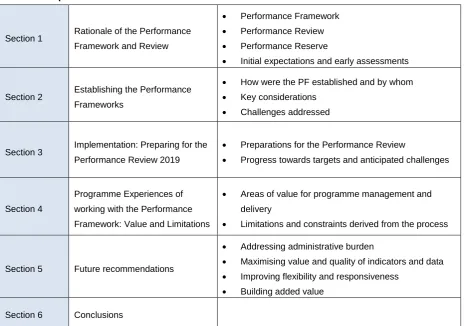
As set out in Table 1, the paper begins (in Section 1) by outlining the EC framework for the PF. Section 2 examines the processes involved in establishing PFs. Section 3 focuses on the implementation of the frameworks and preparations for the Performance Review. Section 4 presents explores programme authorities’ of working with the PF. Section 5 considers recommendations for the future and Section 6 sets out the report’s conclusions.
5
OECD (1996) Performance auditing and the modernisation of government. Paris: Organization for Economic Cooperation and Development Press.
6
SWECO, ÖIR, Spatial Foresight (2016) The Implementation of the Performance Frameworks in the 2014-2020 ESI Funds, European Commission and European Court of Auditors (2017a) Special Report: The Commission’s negotiation of 2014-2020 Partnership Agreements and programmes in Cohesion: Spending more targeted on Europe 2020 priorities, but increasingly complex arrangements to measure performance, European Court of Auditors, No. 2.
7
Table 1: Report structure
Section 1 Rationale of the Performance Framework and Review
Performance Framework Performance Review Performance Reserve
Initial expectations and early assessments
Section 2 Establishing the Performance Frameworks
How were the PF established and by whom Key considerations
Challenges addressed
Section 3 Implementation: Preparing for the Performance Review 2019
Preparations for the Performance Review
Progress towards targets and anticipated challenges
Section 4
Programme Experiences of working with the Performance Framework: Value and Limitations
Areas of value for programme management and delivery
Limitations and constraints derived from the process
Section 5 Future recommendations
Addressing administrative burden
Maximising value and quality of indicators and data Improving flexibility and responsiveness
Building added value
1. THE RATIONALE OF THE PERFORMANCE FRAMEWORK AND
REVIEW
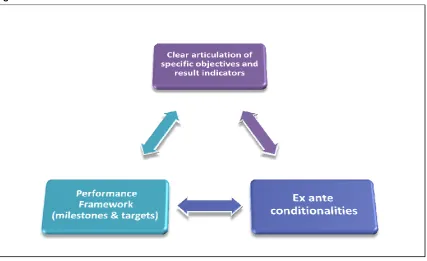
[image:11.595.78.506.168.429.2]The Performance Framework (PF) is one of the three pillars upon which the result orientation of the 2014-20 European Structural and Investment Funds (ESIF) are based (see Figure 1).8
Figure 1: Pillars of the ESIF result orientation
The PF consists of selected indicators, as well as key implementation steps for each Priority. In the case of OPs under the investment for growth and jobs goal, the PF is linked to a:
Performance Review, carried out by DG REGIO in the second half of 2019 on the basis of the Annual Implementation Reports (AIRs) for 2018, which, if positive, results in the payment of the;
Performance Reserve, which is six percent of the OP’s funding, ranging from 5 to 7 percent for each Priority Axis.9
The allocation of a performance-based financial reserve is not new in Cohesion policy. A compulsory Performance Reserve was in place in the 2000-06 programme period. However, it was made voluntary for the 2007-13 period, when only two Member States (Italy and Poland) made use of an ERDF Performance Reserve. IQ-Net research from 201210 found that the approach taken in 2000-06 was not felt to be useful by many IQ-Net programme authorities (Austria, Finland, Nordrhein-Westfalen, United Kingdom), although there were some positive experiences (Greece). Targets were
8
European Commission (2014a) Performance Review and Reserve, Guidance Fiche, Final Version, 14 May 2014.
9
Except for OPs under the European Territorial Cooperation goal, OP Priorities dedicated to Technical Assistance, the Youth Employment Initiative (YEI) and other instances listed in Article 20 of the Common Provisions Regulation (CPR).
10
often set at low levels to make sure they were achievable. Some of these points echo findings from an ECA report from 2007, which assessed the implementation of the Performance Reserve in the 2000-06 programme period and concluded: ‘The performance reserve was used primarily to maximise spending rather than to concentrate spending on areas which were shown to be particularly effective.’11
The new PF for 2014-20 takes a different approach. It is intended to ensure the programmes deliver ‘what is under the control of the Managing Authorities’.12
In practice, this means that Priorities are implemented as planned, the programme is kept on course to achieve its objectives, and problems are anticipated and tackled as soon as they arise.
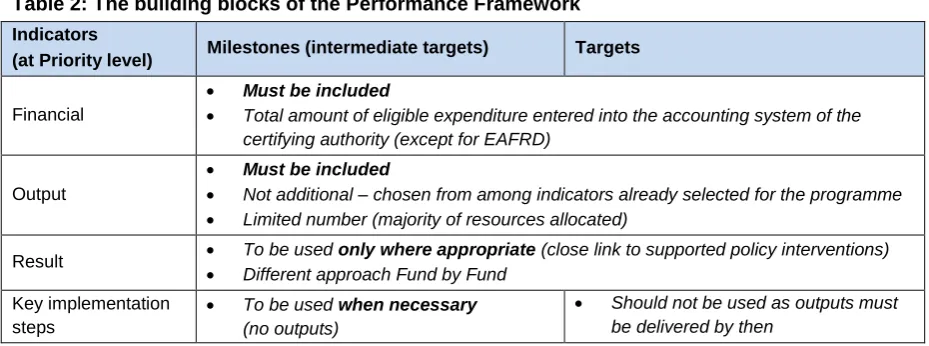
The PF isestablished at Priority level, with the exception of complex Priorities covering more than one Fund or category of region.13 The PF consists of up to four different types of indicator (financial, output, result, and key implementation steps), whose progress is reviewed twice, in 2019 and 2025,14
[image:12.595.66.531.337.510.2]against milestones and targets, see Table 2. EC guidance states that the number of indicators selected for a Priority should be as limited as possible, as the risk of failing to achieve the milestones increases with the number of indicators.
Table 2: The building blocks of the Performance Framework
Indicators
(at Priority level) Milestones (intermediate targets) Targets
Financial
Must be included
Total amount of eligible expenditure entered into the accounting system of the certifying authority (except for EAFRD)
Output
Must be included
Not additional – chosen from among indicators already selected for the programme Limited number (majority of resources allocated)
Result To be used only where appropriate (close link to supported policy interventions) Different approach Fund by Fund
Key implementation steps
To be used when necessary (no outputs)
Should not be used as outputs must be delivered by then
Source: Ziółkowski J-M (2013) Performance Framework 2014-2020, Evaluation and European Semester Unit, DG for Regional and Urban Policy, Brussels, 15 March 2013.
Milestones are intermediate targets set for indicators to be achieved by 31 December 2018. The targets themselves are set to be achieved by 31 December 2023. According to Annex II of the Common Provisions Regulation, both milestones (end of 2018) and targets (end of 2023) should be:
realistic;
achievable;
11
European Court of Auditors (2007) Special Report No 1/2007 concerning the implementation of the mid-term processes on the Structural Funds 2000-2006 together with the Commission’s replies (2007/C 124/01), https://www.eca.europa.eu/Lists/ECADocuments/SR07_01/SR07_01_EN.PDF
12
European Commission (2014a) op. cit., p. 2. 13
‘Where more than one category of region (the Structural Funds only), all the indicators, their milestones and targets, as well as their achieved values, have to be broken down by Fund and category of region’, see European Commission (2014a) op. cit., p. 9. For such complex Priorities, the verification of whether the selected output indicators relate to operations representing the majority of resources is to be carried out at the level of each Fund or category of region within the Priority.
14
relevant;
capture essential information on the progress of a Priority;
consistent with the nature and character of the specific objectives of the Priority;
transparent, with objectively verifiable targets;
have a source data identified (where possible, publicly available);
verifiable (without imposing a disproportionate administrative burden); and
consistent across the programmes, where appropriate.
In its Partnership Agreement (PA), each Member State outlines the methodology and mechanisms to ensure consistency in the functioning of the PF across the programmes and ESI Funds, while the actual PFs are included in the programmes. The PAs include a table with information on the allocation related to the Performance Reserve, broken down by ESI Fund and, where appropriate, by category of region.15
[image:13.595.66.538.453.542.2]The PF is the focus of a formal Performance Review carried out by the EC. This will be carried twice, in 2019 and 2023. For the first Performance Review, data on progress towards PF milestones and targets are presented in the Annual Implementation Reports (AIR) for 2018, which are submitted to the EC by the end of June 2019. In addition to financial data, they are expected to include cumulative values for output indicators and, where appropriate, information about result indicators and key implementation steps. AIRs also include a complimentary section on issues affecting programme performance.16 From the date of receipt of the AIRs, the EC has two months to examine the achievement of the milestones. In practice, this means that decisions about the allocation of the Performance Reserve to successful Priorities will be taken at latest by the end of August 2019 (see Table 3).
Table 3: Timeline of the Performance Review 2019
c. 2014 Performance Frameworks included in OPs
end of 2018 OP implementation towards milestones
end of June 2019 Member States report PF achievements to EC
end of August 2019 EC adopts decision on allocation
end of October 2019 MAs request OP amendments based on decision
Within two months of the Performance Review, the EC will adopt a decision on the programmes and Priorities that have achieved their milestones and, subsequently the Performance Reserve can be made available to the successful Priorities. As has been noted, the Performance Reserve is a percentage of the funding allocation to a programme17 Priority and allocated to the relevant Priorities that achieve their targets by the end of 2018.18
15
European Commission (2014a) op. cit. 16
European Commission (2014b) Guidance Document on Monitoring and Evaluation, European Cohesion Fund and European Regional Development Fund, Concepts and Recommendations. DG Regio, March 2014.
17
Except for the European Territorial Cooperation goal and other resources listed in Article 20 of the Common Provisions Regulation (CPR).
18
‘Serious failure’ to meet targets, which is defined as a failure to achieve at least 65 percent of the milestone value by the end of 2018,19 may lead to the suspension of interim payments. Failure to meet targets in 2025 could give rise to financial corrections. In cases where milestones have not been met in 2018, the reserve related to these Priorities may be reallocated among otherPriorities that have achieved their milestones. If all Priorities in a programme fail to achieve their milestones, the Performance Reserve has to be reallocated to another programme in the same Member State.20 In practice, this means that Member States cannot lose any funding. Allocation to other Priorities or OPs will require formal programme amendment procedures, which need the approval of the EC. In this case, the EC may make observations only if the proposed amendments are not compliant with applicable rules, are not consistent with the development needs of the Member State or the region or entail a significant risk that the objectives and targets included in the proposals cannot be achieved.
The PF, with its Performance Review process and the potential allocation of its Performance Reserve were introduced with the expectation that they would incentivise the achievement of objectives and ensure that progress can be adequately measured.21 According to the EC, the PF provided incentives for MAs:
to focus on the key interventions for the programme;
to carefully select those indicators that best represent what the programme activities; and
to establish meaningful milestone/target values.
The requirement to record information on how the PF was designed and to provide this information at EC request improved the understanding of the way programmes work, for both MAs and the EC.
Although at an early stage in their implementation, the PF have already been the focus of a number of studies, most notably for the Commission and for the European Court of Auditors (ECA).22 Initial findings confirm some of the EC expectations and suggest that the PF would:
strengthen the result orientation/enhance focus in the programmes, e.g. with the PF helping to support the thematic focus of the programmes;
steer and guide programme implementation, with the PF acting as a control mechanism to anticipate and tackle problems,23 or concentrating resources on a smaller number and types of projects allowing better projects to be selected;24
provide realistic target setting on a sounder evidence base, e.g. the process of establishing the PF forced critical thought and analysis on what it was possible to achieve;
19 Ibid. 20
On 6 December 2017, the European Commission published a legislative proposal to reform the ESIF CPR providing for the possibility to use all or part of the Performance Reserve in the current period (2018-20) to support structural reforms as part of the new EMU package: https://ec.europa.eu/info/sites/info/files/economy-finance/com_826_0.pdf
21
SWECO, ÖIR & Spatial Foresight (2016) op. cit. 22
See particularly: SWECO, ÖIR & Spatial Foresight (2016) op. cit., European Court of Auditors (2017a) op. cit. and European Court of Auditors (2017b) Ex ante conditionalities and Performance Reserve in Cohesion: innovative but not yet effective instruments, Special Report, No. 15.
23
SWECO ÖIR & Spatial Foresight (2016) op. cit., p. 5. 24
improve comparability of indicators across programmes, through the use of the EC’s common output indicators;25
promote internal exchanges and dialogue through the process of developing indicators and targets – the process necessitates a dialogue between programme stakeholders, evaluators and the EC;26 and crucially,
act as an incentive to deliver.
However, other analyses are more critical. In its Annual Report for 2014, the ECA’s assessment of the preparations for the PF was discouraging, particularly in terms of the incentive effect of the Performance Reserve: ‘…the impact of the performance reserve, in terms of encouraging an increased focus on results, is likely to be no more than marginal, since there remain no real financial incentives or sanctions in the 2014-2020 period relating to the results achieved with the EU funding.’27
Other concerns that have also emerged relate in particular to the increasingly complex arrangements to measure performance,28
including:
the administrative burden and developing, monitoring and reporting;
large numbers of programme-specific indicators have been developed linked to the way in which the programmes are structured and efforts to convey their at times complex and varied results,29 posing the question over whether a meaningful aggregation of performance data will be possible;
concerns raised about indicators’ capacity to reflect concrete achievements, especially challenges in measuring specific types of complex or innovative intervention;
lack of ownership/understanding of the PF, as developing it was commonly undertaken by experts;
lack of coordinated interpretations – Fund-specific regulations introduced different
requirements for collecting and reporting performance data on outputs and results and for the financial monitoring of investments, e.g. there is no harmonised approach between the different Funds as to the use of common indicators.30
challenges in data gathering linked to poor definition of indicators and weak measurement;
unrealistic targets: either setting conservative milestones and targets or; over ambitious milestones and targets; and
concerns that indicator fixation could drive programmes.31
25
SWECO ÖIR & Spatial Foresight (2016) op. cit., pp. 5-6. 26
Ibid. 27
European Court of Auditors (2015) Annual report of the Court of Auditors on the implementation of the budget concerning the financial year 2014, together with the institutions’ replies, paragraph 3.65,
https://www.eca.europa.eu/Lists/ECADocuments/annualreports-2014/annualreports-2014-EN.pdf 28
European Court of Auditors (2017a) op. cit. and European Court of Auditors (2017b) op. cit. 29
Ibid, p. 12. 30
Ibid. 31
2. ESTABLISHING THE PERFORMANCE FRAMEWORK
2.1 Developing the Performance Framework: rationales and principles
The following section focuses on the development of the PFs, who set the PFs, how, and what are the particular challenges encountered in establishing the Frameworks.
2.1.1 Managing Authorities leading role in establishing programme
Performance Frameworks, complemented by national guidance
In IQ-Net programmes, the selection of PF indicators and setting of milestones/targets was mostly carried out by Managing Authorities (MAs) (e.g. Austria, Czech Integrated Regional OP, Denmark, France). In several countries,the national level provided methodological advice and guidance for the design of indicator systems, including PFs (France, Portugal, Spain, Sweden).
Portugal defined guiding principles for indicators and the PF and discussed these with the EC during the programme period for 2014-20.32 The document provided guidelines to ensure the representativeness of the PF, and it integrated EU-level and domestic requirements. At the level of PA, a list of common indicators was established, which should be used in as many OPs as possible.
In France, the central coordinating body CGET elaborated a methodology report, including targets, which was widely taken into account by MAs when selection indicators and milestones/targets at programme level.
In Spain, the national level MA organised meetings with all regions to coordinate the definition and selection of indicators and provided guidance.
In Sweden, the Ministry of Enterprise and Innovation had several meetings about this issue and put forward strong recommendations that the programmes use one or two indicators
in their PF.
In some cases, Intermediate Bodies (IBs) played an important role (e.g. in Slovenia). In England, milestones and targets were developed jointly by different territorial levels, the MA involved Local Enterprise Partnerships (LEPs), which allowed development needs and the different distribution of financial resources to be taken into account.
2.1.2 Indicators definitions informed by past programme experience
The overarching rationale in selecting indicators was to keep the PF simple and manageable.
Several programme authorities aimed to select as few indicators as possible for the PF (e.g. Austria, Sweden, Wales) and, more generally, to use fewer indicators overall than in 2007-13 (Vlaanderen). In Austria and in most OPs in Sweden, only one output indicator per Priority Axis was selected for the PF. Key implementation steps have not been used in many cases (a notable exception is in Pomorskie). In France, key implementation steps as a new concept are felt to have created some confusion.
32
Agência para o Desenvolvimento e Coesão (2014) Princípios orientadores para indicadores e quadro de desempenho na programação 2020 (Guiding principles for indicators and Performance Framework in 2014-2020 programming), version of 28 July 2014,
IQ-Net programme authorities stressed that indicators should be easy to define and to measure
(e.g. Austria, Czech Integrated Regional OP, Wales). In this context, having experience with the definition and measurement of the selected indicators is important (Finland, Scotland). In Scotland, indicators were chosen from a range of indicators already being measured, either as part of national frameworks or frameworks the lead implementation partners were already using. In Finland, all indicators selected for the PF were already in use in the 2007-13 programme period. An additional consideration in Vlaanderen was selecting indicators where the MA had some scope to ‘steer’ the indicator, so it would be able to adjust target values of the project beneficiaries if necessary and thus reduce the risk of not achieving milestones and targets for the PF.
As suggested by the EC guidance,33 some programme authorities specifically chose to select
indicators that cover a large part of a Priority Axis (Austria, Sweden). Sweden considered their programmes to be focused enough that one output indicator is sufficient to reflect most of their Priority Axes. Having only a few indicators in the PF also makes it easier to monitor their progress and take corrective actions if needed (Sweden Norra Mellansverige OP).
Looking at the definition of milestones and targets, experiences gained in the previous programme period were the most important factors in developing realistic values (e.g. Austria, Czech Republic, Denmark, England, Finland, País Vasco, Slovakia, Slovenia, Sweden, Wales). In the case of the Slovak OP Integrated Infrastructure, the selection of indicators and the setting of milestones has been based on the information provided by a domestic strategic document – the Slovak Transport Master Plan.
However, establishing robust indicators and targets is particularly problematic in cases where there is no ‘track record’ for setting the indicators and targets, e.g. innovative interventions under RTDI, SME support, education
(Pomorskie, Slovakia). For some indicators, neither the EC nor MAs had robust points of reference in developing the PF. In Denmark, issues arose with new thematic priorities for 2014-20. In these areas, the MA could not base the definition of milestones and targets on previous experience. Performance figures thus far indicate that the estimates made were not always accurate. This raises the wider question of whether programmes will unlock the reserve because of good performance or because the targets were set too low.
A more general issue encountered by IQ-Net programme authorities in establishing the PF was the
lack of time to plan a programme’s data requirements properly. For example in Pomorskie, as has been noted, there is a recognised lack of experience in indicator setting, especially at the regional level (in 2007-13, criteria were set at the national level and defined according to previous experience). Compounding the issue, it was felt that the EC had limited time and capacity to discuss and agree indicators with the MA. The MA produced a comprehensive report outlining the assumptions behind its PF, but there was no EC response to this. Similarly, there was little input from the Polish government. Thus, the process lacked transparency and comparability: each Polish region had its own suggested indicators and targets. As a result, the MA has learned very little from the exercise: it suggested certain indicators and targets and no-one from the EC assessed or discussed these: it has proved to be a ‘box-ticking’ exercise rather than a strategic process.
33
2.1.3 Establishing the Performance Framework is a resource intensive
exercise
For IQ-Net programme authorities, establishing the PF was resource intensive exercise. Considerable staff resource was expended on the development of the PF, setting indicators and targets, e.g. in England and Wales. In Sweden, the process was time consuming due in part to the organisation and implementation of a number of training courses related to preparing beneficiaries for the PF and gathering information to inform indicators and targets. In Croatia, ensuring commonly agreed definitions proved challenging and required intensive consultations between the organisations involved, and the EC. As has already been highlighted, in some cases, lack of qualified staff and skills further complicated the task, e.g. in Croatia and Poland. Building technical capacity was also a concern (England, Slovenia). For example, in England, the MA’s eClaims database is still under development and at present, the authority does not have the capacity to store and update all the information on line.
As programmes progress, data gathering and maintenance remains time-consuming and resource-intensive. This substantial administrative load is felt across the institutions involved, down to the level of project applicants (e.g. in Croatia, Finland, Sweden).
In England, the on-going requirement to update performance data requires resource in both the ERDF policy and regional ERDF delivery teams, as producing reliable data at such a detailed level and ensuring consistency across programmes is challenging. In Finland, time and personnel are also committed at project applicant and project levels. Both are required to be familiar with the indicator system and definitions, and ensure indicators are correctly reported. In Scotland, the level of detail required to evidence the outputs has also been challenging for project sponsors.34
All lead partners have said that they have ‘ under-resourced’ for this task – ‘much more information needs to be gathered … way more than
before’. In this case, project sponsors feel that it exceeds what is asked for under other regimes.
All of these issues are especially acute for multi-Fund programmes. France notes that the practical implementation requirements do not favour integrated multi-Fund programmes. In France, most OPs are multi-Fund and the Youth Employment Initiative (YEI) features prominently. This presents a particular challenge, as explained in the EC’s guidance: ‘In the case of priorities which concern more than one Fund providing support under Cohesion policy or category of region (the Structural Funds only), the achievement of milestones will be assessed separately for each of the Funds and each category of region within the priority, taking into account the indicators, their milestones and their achievement values broken down by Fund and category of region. If the YEI is implemented as part of a priority, the YEI specific allocation along with the matching ESF support for the YEI is to be treated separately.’35
34
In England it is suggested that the unique situation in the UK, with Brexit on the horizon, could lead to potential applicants concluding that the effort involved in gathering such large, detailed amounts of data outweighs the benefits of ERDF co-financing.
35
2.2 Content of the Performance Frameworks
2.2.1 Performance Frameworks draw on Common and Programme Specific
Indicators to differing extents
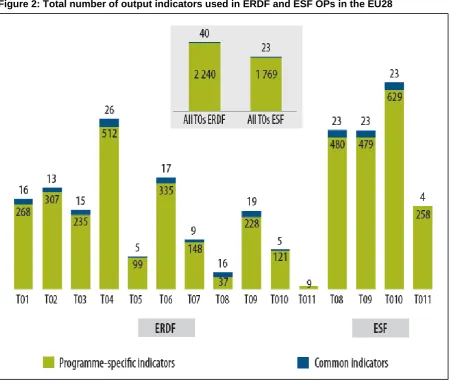
The following sections focus on the practical arrangements in place that make up the programme PF, it is important to note that the figures below relate to the use of indicators in programmes overall, not specifically to their use in PFs. The EU28 combined created a total of 2,240 different programme-specific indicators (PSI) for the ERDF, in addition to the 40 common output indicators (COI, see Annex), which can be used for ERDF OPs under the investment for growth and jobs goal. On average, each ERDF OP used 14.8 COI and 13.2 different PSI.
[image:20.595.74.526.302.683.2]Figure 2 shows the use of COI and PSI in ERDF and ESF OPs. Member States tended to create more PSI for TOs under ESF than under ERDF. For ERDF, the highest numbers of PSI are being used under TO4 (low-carbon).
Figure 2: Total number of output indicators used in ERDF and ESF OPs in the EU28
Source: European Court of Auditors (2017a) op. cit., p. 63.
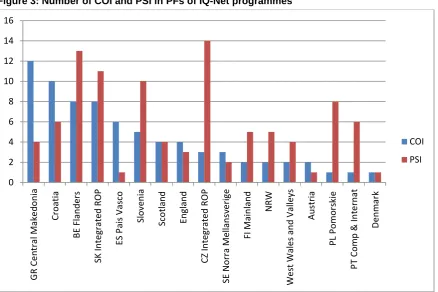
used in PFs ranges from just one (Denmark, Portuguese Competitiveness and Internationalisation OP, Pomorskie) to 12 (Central Makedonia, Greece). At the same time, 14 PSI have been defined in the Czech Integrated OP, compared to only one in Austria, Denmark and País Vasco. The most commonly used COI in the sample of IQ-Net programmes is COI1, which refers to the ‘number of enterprises receiving support’ and is used in 10 out of 17 analysed PFs.
Figure 3: Number of COI and PSI in PFs of IQ-Net programmes
Source: EPRC research based on IQ-Net programme documents.
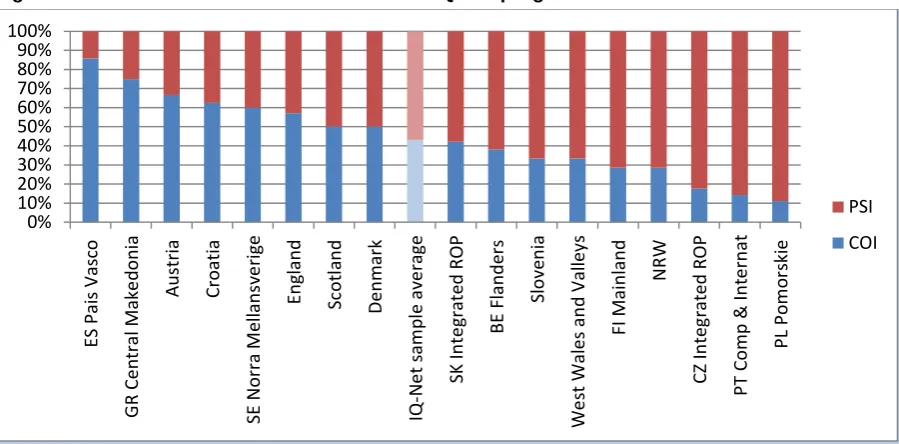
Figure 4: Ratio between COI and PSI in PFs of IQ-Net programmes
Source: EPRC research based on IQ-Net programme documents.
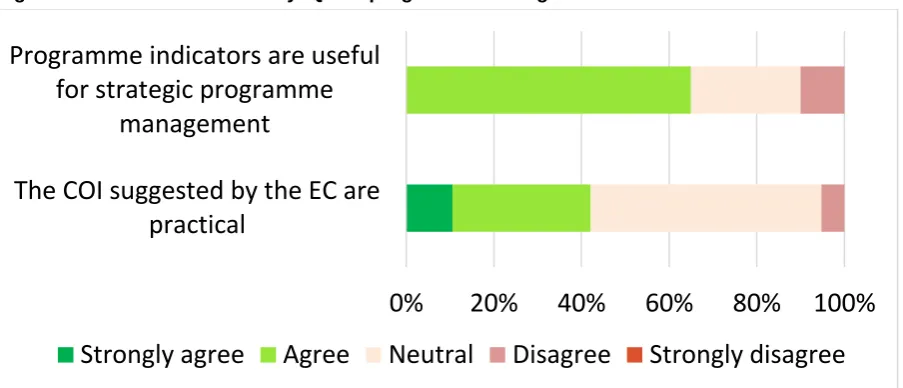
IQ-Net programme authorities recognise the usefulness of indicators more widely and recognise the value of common indicators at EU-level. Several valued EC advice to keep indicator systems simple (Austria, Nordrhein-Westfalen, Portugal). As Figure 5 illustrates, views about COI are generally positive or neutral. Nevertheless, the following issues were highlighted in relation to COI.
In Denmark, the MA feels that, in spite of their usefulness for an EU-wide comparison, COI can be complicated to use in some cases. For instance, COI for green projects under TO4 are not always suitable. For the MA, it is difficult to demonstrate how their activities/outputs can fit the indicators on issues such as CO2 reduction, which are broad indicators and it is difficult to
measure against them.
Some of the indicators are seen as too broad even for PA level and need contextualised (Portugal). In Bizkaia (País Vasco), standard output indicators are used (e.g. no. of projects) under the PF, but more in-depth contextual indicators are collected for internal purposes and accountability to the monitoring committee with a view to providing a more comprehensive account of project performance.
The interpretation of some indicators varies, weakening the value of comparisons across programmes or countries (Czech Republic, Portugal, Wales). As similar point was made by Greece, which argued that there is a need for the EC to provide a ‘methodology’ for the use of the indicators (Greece).
The applicability of a ‘one-size-fits-all’ approach covering such diverse programmes is questioned (e.g. in England).
Some indicators are measured at national level (e.g. business-related ones) and are therefore of limited use for regional programme authorities (Scotland).
Figure 5: Assessment of COI by IQ-Net programme managers
Source: IQ-Net research based on 20 respondents from 12 Member States.
Addressing some of the criticisms of the COI, PSI can be more context and programme-specific, allowing measures of progress to be less general and to better reflect the character of the programmes. However, given their diversity, programmes use an extremely wide range of PSI,36 which can limit the scope for comparisons and reinforces challenges of complexity and administrative burdens. Reinforcing a point made by the ECA, France notes that too many indicators are in use simultaneously. Also, the fact that the indicator is ‘tailored’ to the programme may mean data availability and access is difficult. For instance, in Denmark there have been some isolated problems with certain indicators which can be difficult to collect, e.g. due to issues surrounding data protection.
2.2.2 Challenges in establishing indicators, data and targets
The PF means that MAs and IBs are under pressure to not only under pressure ensure fast, efficient and effective spending, but also to ensure the outputs and results of that spending is useful, and accurately and clearly conveyed. Central to this is the quality of the indicators, data and targets. Several IQ-Net programme authorities (Denmark, England, Nordrhein-Westfalen, País Vasco, Portugal, Vlaanderen) consider all TOs to be suitable for the PF, as long as the appropriate indicators are selected.
PF indicators have been formally evaluated as part of ex ante evaluations and will be considered again as part of subsequent studies (e.g. England, Slovakia, Sweden, Wales).37 In Wales, the indicator system is reviewed yearly in terms of definitions. The MA provides training on indicators, and holds workshops for projects/sponsors. There was also an audit on data quality. Evaluations, along with practical experience, are highlighting some issues and concerns over the value of some indicators. As a result, in some cases, changes are being made to the indicator definitions. Key concerns are in the following areas.
36
ECA (2017a) op. cit. 37
Evaluations and assessment of the indicators are not simply informing Cohesion policy processes. It should also be recognised that the PF is being implemented against a background where domestic policy interventions are also working with performance measurement and indicator systems. For example, Austria plans to use synergies across policy areas, as other Austrian actors are also working on developing and improving
performance measurement and indicator systems. Examples include the Ministry of Agriculture (how to measure the impact of environmental measures) and the Austrian Research Promotion Agency FFG.
0%
20%
40%
60%
80%
100%
The COI suggested by the EC are
practical
Programme indicators are useful
for strategic programme
management
(iii) New areas of intervention
As has already been noted, establishing robust indicators and targets is particularly problematic in cases where there is not a ‘track record’ to draw on for setting the indicators and targets.
(iii) ‘Soft’ interventions
The specificity and complexity of some ‘softer’ interventions make it difficult to find appropriate indicators that directly relate to the planned scope of planned intervention, particularly as there is often a lack of reliable data sources to use as baselines (e.g. in Pomorskie). In Pomorskie, ‘softer’ interventions under RTDI, SME support or education can be problematic – the specificity and complexity of these interventions made it difficult to find appropriate indicators that would directly relate to the planned scope of planned intervention, particularly as there is often a lack of reliable data sources to use as baselines. For these types of intervention, it can be necessary to have quality-based indicators that are context specific and agreed between the EC and the MA on a programme-by-programme basis, requiring substantial capacity-building on both sides. According to Finland, the PF is best suited for measuring TOs that produce tangible quantifiable outputs, as opposed to soft interventions. These are for example TOs related to business support and infrastructure development. TOs related to RTDI, and skills and knowledge development are more difficult, because the results cannot be captured only on numeric terms and the funded projects are very different to each other. Because of this, the numeric indicators are more difficult to define for capturing the real results or become more ambiguous, leaving room for interpretation. Consequently, their reporting becomes more inconsistent and inaccurate.
(iii) Complex interventions
As has been discussed even in apparently ‘straight forward’ areas of intervention setting useful indicators and milestones has proved challenging. The challenges faced are amplified for more complex interventions, e.g. Integrated Territorial Initiatives (ITIs)38 and Financial Instruments (FIs) (Austria, Czech Republic, Pomorskie, Portugal and England). FIsand territorial instruments such as ITIs, Community-led Local Development (CLLD) and urban development strategies (France, Nordrhein-Westfalen, Slovakia) appear also to be less suited for the PF.
Austria’s Priority Axis 5 supports measures encouraging cooperation between cities with their surrounding areas. The progress of these types of interventions are difficult to measure. The Priority consists of diverse and complex projects, therefore any effective measurement of performance would have to take place at project level.
In Pomorskie, there are special provisions for FIs in the PF and there were additional discussions between the Ministry and the MAs in setting output indicators for FIs - assessing progress towards financial and physical targets in grant-based approaches is more straightforward than in loans, guarantees etc. where funding can revolve several times.
In Portugal, ITIs contribute to a wide range of TOs and are ‘spread’ around a range of Priority Axes (under various OPs and Funds). Even in cases where the actions under a specific ITI fulfil (or even exceed) all the targets, if the Priority Axis as a whole does not deliver on its PF target, the whole axis is penalised, and the ITI thus may get affected. A possible solution
38
could be a single dedicated axis for ITIs, but this would make the whole system completely inflexible.
(iii) Interventions relying on major projects
It appears that even support for infrastructure is challenging in a PF context, e.g. under TO7 (transport), due to its comparatively back-ended nature in terms of expenditure and delivery of outputs (Croatia, Greece, Sweden, Wales). While the PF is easy to define for infrastructure projects, the risk of not achieving the milestones is high. Reliance on a few key major projects, such as in the Slovak Integrated Infrastructure OP, can also be risky. Large, complex projects with extensive administrative procedures and bureaucratic obstacles have also proved to be challenging for PF targets, e.g. in the Czech Republic, Slovenia, Wales. For instance, in Slovenia, climate change mitigation measures and anti-flood infrastructure are complicated projects, involving a lot of permits, regulation, complex project planning and implementation, resulting in slow progress. Thus, there is no direct correlation between ‘easy to define’ and ‘easy to achieve’. On the other hand, Pomorskie points out that transport infrastructure and waste management interventions are relatively standardised and commonly used, therefore are more suited to a quantitative, standardised indicator system.
2.2.3 Reliability of data
Even if indicators are suitable and milestones/targets have been set appropriately, there is the
question ofthe reliability of the reported data. In order to have assurance about the quality of the data reported in the context of the PF, DG REGIO is carrying out Performance Data Reliability Audits (PDRA).39 In early 2016, it developed an audit methodology and drafted an Enquiry Planning Memorandum (EPM) on the PDRA. The PDRA focuses on the reliability of data, not on the actual progress in reaching the PF milestones and targets. It covers financial and output indicators in the PF under the ERDF, but can also look at indicators more widely where appropriate (e.g. where there was nothing reported under indicators included in the PF).
In the first half of 2017, DG REGIO’s Unit C.3 Audit II selected three pilot OPs regions to test their audit approach: the Nordrhein-Westfalen ERDF OP); the Nord-Pas-de-Calais ERDF and ESF OP; and the West Wales and the Valleys ERDF OP.
The PDRA used data from the most recent AIRs available, which were from 2015 at the time of pilot audits. The selection of pilot OPs was constrained by the fact that few 2015 AIRs contained any progress data in their PFs.
The result of the PDRA was positive but highlighted a number of issues.
Missing IT interface for beneficiaries, i.e. the requirement of e-Cohesion not fulfilled. This means that data is entered by MA/IB, which can lead to errors
No automatic data extraction possible. Even if the reported data are correct, it has to be transferred into AIRs manually, which creates risks.
Insufficiently clear definition of indicators. Indicators need to be understood correctly and in the same way by all users. In one case, for the indicator, COI26 (number of enterprises
39
cooperating with research institutions) has been interpreted differently by different actors. Some included enterprises that had the intention to cooperate, but were not cooperating yet.
Lack of audit trail. In some cases, data has been modified in IT systems, but the systems do not register by whom and when this was carried out.40
Overall, the audit approach was assessed positively and it will therefore be continued. In order to extend the approach to more cases, the Audit Unit carried out a risk assessment on the basis of the AIR 2016 data. It plans to carry out further PDRAs in 18 OPs until the end of 2018. Of these, 14 cases had already been selected at the time of the interview. The Audit Unit plans to combine these audits with other system audits where possible.
40
3. IMPLEMENTATION: PREPARING FOR THE PERFORMANCE
REVIEW 2019
The overall PF is linked to a Performance Review, carried out by DG REGIO in 2019. If the Performance Review shows the milestones set in the PF have been met a, Performance Reserve equivalent to six percent of the OP’s funding made available for use.41
The first Performance Review of the 2014-20 programme period will take place in 2019, based on achievements up to the end of 2018.
3.1 Progress and challenges
At this stage, it is still early for programmes to comment on the targets that have/have not met. Although previous IQ-Net research noted timely progress on the PF, in line with satisfactory project generation and selection, and good financial progress,42 there is significant versatility in target achievement. In several cases, actual progress in implementing measures had not yet been expressed in PF indicators at the end of 2016, the cut-off date for the most recent AIRs.
In several cases, many (Austria, Croatia, Czech Republic, Nordrhein-Westfalen, Pomorskie, Slovakia, Slovenia) or most (England, Scotland, Wales) values forPF indicators were still at zero at the end of 2016. However, progress made against the milestones and targets for the PF varies naturally between Priorities, and most programme authorities remain optimistic and the PF indicators are considered to be generally on track (Austria, England, Nordrhein-Westfalen, Pomorskie, Sweden, Vlaanderen, Wales). In Vlaanderen, for instance, only one indicator (COI31 - number of households with improved energy consumption classification) still stands at zero, while others progressed well. COI38 (open space created or rehabilitated in urban areas) has already reached 340 percent of its milestone value.
In some cases, there are challenges in individual thematic areas or with specific types of interventions. Some of these areas reflect fields of intervention that have not previously received support, such as poverty, or where the type of support has materially altered e.g. innovation centres (Scotland). Some examples of Thematic Objectives (TOs) that have been mentioned as challenging by IQ-Net programme authorities include:
TO2 – ICT (England, País Vasco, Slovenia, Sweden). In Slovenia, the demand for Cohesion policy funding decreased due to larger private investments than expected. In Sweden, the outputs of implemented operations are not expected to be reported until later into the programme period. In England, the related State aid scheme expired in 2015 and the process of a new State aid notification delayed implementation. This resulted in a programme modification.
TO4 – low-carbon (England, País Vasco, Sweden, Wales). This is a new area of intervention in several cases. In England, many early applicants failed at the outline stage, as they were not compatible with the OP, in part due to programme managers having limited experience in delivering low-carbon activity.
41 It can be argued that the Performance Reserve is not paid, as it has already been included in the OPs’ allocations.
42
TO5 – climate change adaptation (England, Slovenia). In Slovenia, the implementation of anti-flood measures is very complex, requiring demanding environmental procedures and the requirement to involve citizens’ initiatives. In England, the MA established that the PF targets for 2023 were based on incorrect assumptions and required a programme modification.
In other cases progress has been affected by delayed starts to the Programmes. The late approval of the EU regulations and delegated acts led to delays for many OPs. In the Czech Republic, considerable delays with the launch of 2014-20 period mean that milestones will be difficult to achieve by the end of 2018. Instead, they argue, for only using targets for 2023. In some cases, the approach to project generation, specifically involving a preparatory phase, has meant that funds have been slower to be absorbed in the early stages of the OP. The Nordrhein-Westfalen ERDF OP allocates funding mainly via competitive or project calls. As a result, it has been slower to commit funding than would be the case if public authorities were simply allocating funding to projects which were already planned. In a number of cases, milestones and targets appear to have been set too high, making progress less ‘visible’.For example, in Croatia, operational level administrators have warned that in some cases the targets set in the PF were too optimistic. Similarly, in the Czech Integrated Regional OP, some milestones and targets were too high and had to be reduced as part of programme revisions. In other cases the poor selection of targets means progress is not well reflected. In Denmark, there have been issues surrounding Priority Axis 4, which focuses on low-carbon and energy efficiency. The MA acknowledged a lack of familiarity with this thematic area and the potential beneficiaries involved, resulting in certain targets being incorrectly estimated.
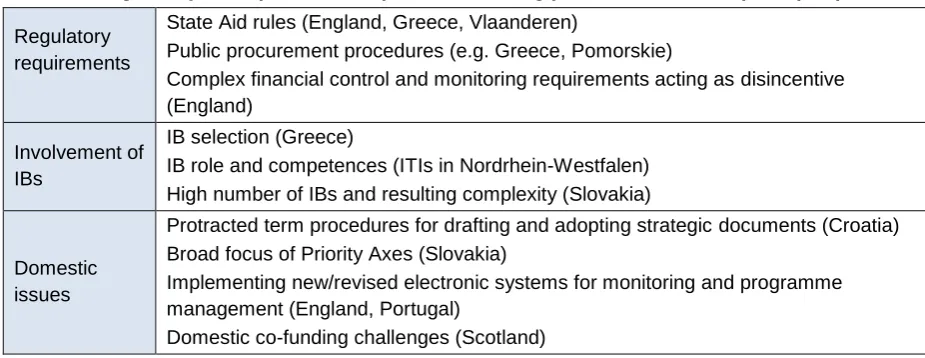
[image:28.595.65.528.464.643.2]Often, the regulatory frameworks set by the EU and Member States result in implementation challenges that impact on the PF progress. However, these relate to programme implementation progress more widely and are not specific to the PF. Table 4 lists a number of examples.43
Table 4: Regulatory and operational aspects influencing performance levels (examples)
Regulatory requirements
State Aid rules (England, Greece, Vlaanderen)
Public procurement procedures (e.g. Greece, Pomorskie)
Complex financial control and monitoring requirements acting as disincentive (England)
Involvement of IBs
IB selection (Greece)
IB role and competences (ITIs in Nordrhein-Westfalen) High number of IBs and resulting complexity (Slovakia)
Domestic issues
Protracted term procedures for drafting and adopting strategic documents (Croatia) Broad focus of Priority Axes (Slovakia)
Implementing new/revised electronic systems for monitoring and programme management (England, Portugal)
Domestic co-funding challenges (Scotland)
Source: IQ-Net research.
43
3.2 Managing preparations for the Performance Review
Research indicates that review management involves six actions: coordination of responsibilities; awareness raising; forecasting; data validation, risk management; and on-going monitoring.
3.2.1 Coordination of responsibilities
Oversight and coordination responsibilities are set and clarified (Austria, England, Greece, Nordrhein-Westfalen). For example, in Austria the MA is responsible, with a strong complementary role played by the monitoring body (based at the ERP-Fund at Austria Wirtschaftsservice). In England, as the review is carried out at Member State level, the MA anticipates that the responsible national-level authority, the Department for Business, Energy and Industrial Strategy, will be coordinating the review, with input from the MAs. In Greece, the MAs are responsible for the data provision, and the National Coordination Authority is performing coordination tasks. In Nordrhein-Westfalen, it is the ERDF OP MA which is leading on preparations for the Performance Review, in cooperation with the IB.
3.2.2 Awareness raising
Steps are taken to alert relevant authorities and officials to the upcoming review and the need to initiate preparations (Croatia, Sweden). Part of this process is to encourage the early identification of problems or changes (Croatia),44 and, more generally, to open channels of communication, ensuring a good flow and exchange of information. For example, in Sweden there have been productive workshops and seminars to ‘catch what is happening’ under each TO, which has helped to inform views of progress. In addition, external evaluations have been looking at each TO.
3.2.3 Forecasting
Efforts are made to forecast where the OPs will be in terms of milestones. In Greece, a preliminary report at national level forecasts progress with programme indicators, and further work will review operations that contribute to the indicators. This involves cooperation between the Greek Special Service for Strategic Planning and Evaluation (EYSSA), the Special Service for Coordination of Implementation (EYSE) and the MA. In December 2017, a thematic workshop will take place in order to communicate the significant issues to the Greek MAs. In País Vasco, a qualitative and quantitative analysis of the likely achievement of indicators was undertaken through an external evaluation, and a further evaluation will be carried out to support preparations. The first is an evaluation of the achievement of indicators using data on projects selected due to the absence of certified expenditure, which was conducted to feed into the Progress Report and AIR 2016, and the second will be a mid-term evaluation conducted in 2019 to assess the OP’s PF using data at the end of 2018. In Pomorskie, the MA gathered data on risks and identifying delays (see Table 5).
44
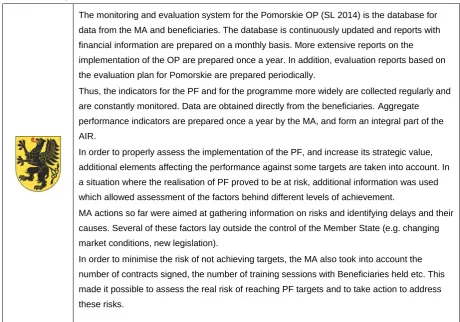
Table 5: Preparations for the Performance Review in Pomorskie
The monitoring and evaluation system for the Pomorskie OP (SL 2014) is the database for data from the MA and beneficiaries. The database is continuously updated and reports with financial information are prepared on a monthly basis. More extensive reports on the implementation of the OP are prepared once a year. In addition, evaluation reports based on the evaluation plan for Pomorskie are prepared periodically.
Thus, the indicators for the PF and for the programme more widely are collected regularly and are constantly monitored. Data are obtained directly from the beneficiaries. Aggregate performance indicators are prepared once a year by the MA, and form an integral part of the AIR.
In order to properly assess the implementation of the PF, and increase its strategic value, additional elements affecting the performance against some targets are taken into account. In a situation where the realisation of PF proved to be at risk, additional information was used which allowed assessment of the factors behind different levels of achievement.
MA actions so far were aimed at gathering information on risks and identifying delays and their causes. Several of these factors lay outside the control of the Member State (e.g. changing market conditions, new legislation).
In order to minimise the risk of not achieving targets, the MA also took into account the number of contracts signed, the number of training sessions with Beneficiaries held etc. This made it possible to assess the real risk of reaching PF targets and to take action to address these risks.
3.2.4 Data validation
Ensuring the validity of data is part of preparations. In Nordrhein-Westfalen, extensive financial/output control work is being conducted and a management tool for forecasting whether they are likely to meet each PF goal was developed. A detailed assessment is undertaken, focussing on ensuring that proof is available to underpin all the data, in order to ensure that no objections are raised to particular blocks of data, which could result in data being challenged or declared invalid. For example, in the case of indicators of ‘number of firms supported or reached’, the MA and IBs are ensuring that the dates of any advisory meetings are recorded.