City, University of London Institutional Repository
Citation
: Bauer, M., Akam, T., Joseph, S., Freeman, E. D. & Driver, J. (2012). Does visual
flicker phase at gamma frequency modulate neural signal propagation and stimulusselection?. Journal of Vision, 12(4), e5. doi: 10.1167/12.4.5
This is the accepted version of the paper.
This version of the publication may differ from the final published
version.
Permanent repository link:
http://openaccess.city.ac.uk/13405/Link to published version
: http://dx.doi.org/10.1167/12.4.5
Copyright and reuse:
City Research Online aims to make research
outputs of City, University of London available to a wider audience.
Copyright and Moral Rights remain with the author(s) and/or copyright
holders. URLs from City Research Online may be freely distributed and
linked to.
City Research Online: http://openaccess.city.ac.uk/ [email protected]
1
Does visual flicker-phase at gamma frequency modulate neural signal
propagation and stimulus selection?
Markus Bauer1,2, Thomas Akam3, Sabine Joseph1,3, Elliot Freeman4, Jon Driver1,2
1. UCL Institute of Cognitive Neuroscience, University College London, London, UK
2. Wellcome Trust Centre for Neuroimaging, University College London, London, UK
3. UCL Institute of Neurology, University College London, London, UK
4. Institute of Psychology, City University, London, UK
Corresponding author address:
Dr. Markus Bauer, Wellcome Trust Centre for Neuroimaging, 12 Queen Square, London, WC1N3BG,
London, UK
2
Abstract
Oscillatory synchronization of neuronal populations has been proposed to play a role in perceptual
integration and attentional processing. However, some conflicting evidence has been found with respect
to its causal relevance for sensory processing, particularly when using flickering visual stimuli with the
aim of driving oscillations. We tested psychophysically whether the relative phase of gamma frequency
flicker (60 Hz) between stimuli modulates well-known facilitatory lateral interactions between collinear
Gabor patches (Experiment 1), or crowding of a peripheral target by irrelevant distractors (Experiment 2).
Experiment 1 assessed the impact of suprathreshold Gabor flankers on detection of a near-threshold
central Gabor target (‘Lateral interactions paradigm’). The flanking stimuli could flicker either in phase or
in antiphase with each other. The typical facilitation of target detection was found with collinear flankers,
but this was unaffected by flicker phase. Experiment 2 employed a ‘crowding' paradigm, where
orientation discrimination of a peripheral target Gabor patch is disrupted when surrounded by irrelevant
distractors. We found the usual crowding effect, which declined with spatial separation, but this was
unaffected by relative flicker-phase between target and distractors at all separations. These results imply
that externally driven manipulations of gamma-frequency-phase cannot modulate perceptual integration
3
Introduction
Oscillatory synchrony in the brain has been shown to undergo significant changes during visual
processing (e.g. Eckhorn et al., 1988; Gray, Konig, Engel & Singer, 1989) and during various tasks
(Jensen, Kaiser & Lachaux, 2007). Neuronal synchrony has been proposed to play a role in mediating
contextual interactions among local stimulus attributes (Eckhorn 1994, Singer 1999, Tallon-Baudry &
Bertrand, 1999), and in selective attentional processing (Gruber, Muller, Keil & Elbert, 1999; Bauer,
Oostenveld, Peeters, Fries, 2006; Womelsdorf & Fries 2007). Mechanistically, local synchrony among
neuronal populations may enhance the impact of signals on downstream targets through more effective
summation at postsynaptic neurons (Salinas & Sejnowski, 2001). The role of selective phase
synchronization between neuronal populations involved in stimulus processing has initially been
emphasized in the original ‘binding-by-synchrony’ hypothesis (Singer, 1999) but also more recently by
Fries (2005) to selectively strengthen the effective connectivity between different neuronal populations.
Computational studies have demonstrated that oscillatory dynamics can modulate network responses to
inputs (Borgers, Epstein & Kopell, 2008; Zeitler, Fries & Gielen, 2008), and can in principle accurately
and selectively control the gain of signal flow between networks (Akam & Kullmann 2010).
However, much evidence for the functional importance of gamma oscillations (40-100 Hz) in visual
processing is correlational (e.g., Tallon-Baudry & Bertrand, 1999), and the topic remains controversial
(Lamme & Spekreijse, 1998; Shadlen & Movshon, 1999; Thiele & Stoner, 2003). One approach to
directly testing the causal significance of oscillatory synchronisation in visual processing is to measure
the effect on perception of perturbing patterns of oscillatory activity. Visual flicker offers a potential
means to do this in humans as it profoundly affects EEG and MEG response (Cosmelli et al., 2004;
Srinivasan, Russell, Edelman & Tononi, 1999; Kamphuisen, Bauer & van Ee, 2008; Müller, Malinowski,
Gruber & Hillyard, 2003). Neurophysiological studies have shown that displays flickering with
frequencies up to approximately 100 Hz reliably entrain activity in early visual cortex (Rager & Singer
1998; Herrmann 2001; Williams, Mechler, Gordon, Shapley & Hawken, 2004).
Several studies have addressed the effects of putative gamma-frequency entrainment by flicker on
perception (Fahle & Koch, 1995; Kiper, Gegenfurtner & Movshon, 1996; Leonards, Singer, & Fahle,
1996; Usher & Donnelly, 1998; Elliott & Muller, 2000; Dakin & Bex, 2002). A recent report by Frank
Bauer and colleagues (Bauer, Cheadle, Parton, Muller & Usher, 2009) argued that gamma-frequency
flicker in particular can enhance stimulus saliency, in accord with some of the theoretical emphasis placed
on this frequency band for vision (Salinas & Sejnowski, 2001; Womelsdorf & Fries, 2007). However, for
4
stimulus confounds might arise to explain the results (e.g.van Diepen, Born, Souto, Gauch, & Kerzel,
2010).
Here we set out to manipulate specifically the phase between stimuli that flickered at 60 Hz (the typical
frequency for human visual gamma oscillations, Hoogenboom, Schoffelen, Oostenveld, Parkes & Fries,
2006) to test theimpact of phase synchrony on the effective summation of oscillatory signals at
postsynaptic sites on the one hand and on the functional segregation of different processing streams on the
other hand. We studied these questions using two well-established visual psychophysical paradigms,
which measure of the perceptual interaction between task-irrelevant stimuli and a separate target
stimulus.
Several previous reports have also tested the impact of phase-manipulation on contextual integration (e.g.
Fahle & Koch, 1995; Kiper, Gegenfurtner & Movshon, 1996; Leonards, Singer, & Fahle, 1996; Kiper,
Gegenfurtner & Movshon, 1996; Usher & Donnelly, 1998) but with a different theoretical emphasis.
These studies manipulated phase between different figure parts to test the binding by synchrony
hypothesis by having the subjects making judgements on stimuli that were explicitly defined by their
relation to other context stimuli. Our study differs from these approaches theoretically in that we set out to
test two different theoretical accounts on the role of neuronal synchronization: namely the hypothesis that
local synchrony affects effective summation of postsynaptic potentials (experiment 1), and the hypothesis
that selective synchronization facilitates attentional selection of different processing streams (experiment
2). On a more operational level, in our experiments the context stimuli (distractors or flankers) were
completely task irrelevant and the subject only needed to make a judgement on the target stimulus itself,
independent of the status of the contextual flanker stimuli. Experiment 1 employed the ‘lateral
interactions’ paradigm, whereby collinear flanking Gabor patches usually enhance detection of a nearby
central target (Polat & Sagi,1993; Polat & Sagi, 1994; Freeman, Sagi, & Driver, 2001). This experiment
tested the idea that manipulations of the phase synchrony of local inputs at gamma-frequencies could
modulate their impact on postsynaptic neurons (Salinas & Sejnowski, 2001). The collinear facilitation
effect is thought to be mediated predominantly by lateral connections in early visual cortex from neuronal
populations representing the flankers to those representing the target (De Weerd, 2006). We hypothesized
that facilitation of a static target by collinear flankers was greater in the context of flankers which were
flickering at 60 Hz in phase with each other due to the imposed synchronous oscillations compared to
when these flankers were flickered in antiphase to each other. The central target itself did not flicker
because we wanted to test the impact of synchronous versus asynchronous entrained flanker oscillations
on the target, under identical stimulation conditions for the latter. Flickering only the flanker stimuli at 60
5
would result in synchronous (versus asynchronous) oscillatory inputs to the target population from both
flankers via lateral interactions. If entrained synchronous rhythmic activity can enhance the efficacy of
driving postsynaptic neurons, then the flanker effect on target detection should be more pronounced
(benefiting central target detection more) for flankers that flicker in phase-synchrony, than for the case
where they are flickered out-of-phase.
In Experiment 2 we utilized a ‘crowding’ paradigm, where judgements of a peripheral target are typically
impeded by the presence of nearby distractors (Pelli, 2008). Here we tested whether the
desynchronization of activity related to target and distractor populations could result in improved
selective processing of the target and distractors (Fries 2005, Womelsdorf & Fries 2007). Therefore, in
this experiment target and distractor stimuli were flickered and their relative phase was manipulated
(in-phase or in anti-(in-phase). We hypothesised that anti-(in-phase flicker between flankers and target would
improve selective processing of the target, thus counteracting crowding, while in-phase flickering would
enhance crowding. Hence, in this experiment the rationale was not to test for differential propagation
effects from the distractor (representing) population to the target (representing) population, but to test for
the effect of desynchronizing activity in target and distractor-populations particularly on downstream
6
Methods
Experiment 1: Flicker phase and target detection
Subjects had to judge which of two presentation intervals contained a near-threshold central grating that
could be surrounded by either collinear or orthogonal gratings. Previous research (Polat & Sagi, 1993;
Polat & Sagi, 1994; Freeman, Sagi & Driver, 2001) had shown that target detection benefitted from the
presence of collinear gratings. Here we added the further manipulation of flicker-phase.
Participants
Fourteen adult participants had normal or corrected to normal visual acuity. Eleven were paid for
participation and were naïve to the purpose of the experiment. The others were some of the present
authors but their results did not differ qualitatively. All subjects had undergone four practice blocks (of 45
trials each) involving the central target detection task (see below) prior to the experimental sessions, to
estimate contrast thresholds. A total of twelve subjects participated in three separate sessions each; two
individuals were excluded earlier due to chance performance in initial sessions, leaving N = 12.
Stimuli
The stimuli comprised localized gray-level Gabor patches, i.e. small sinusoidal gratings within a Gaussian
contrast window. The standard deviation of the Gaussian envelope () was equal to the wavelength () of
the carrier. Here = = 0.439 degrees of visual angle, with a spatial frequency of 2.28 cycles per degree.
Stimuli were presented on a linearised 19-inch CRT monitor, using ‘colour bit-stealing’ to achieve up to
12 bit gray-level resolution (Tyler, 1997). The effective size of the monitor was 40.5 x 32.4 cm. The
video mode was 1280 x 1024 pixels with a vertical refresh rate of 120 Hz, and the background luminance
7
Figure1: Stimulus displays for experiment 1
Static snapshots of stimulus displays consisting of a central low-contrast Gabor target and two
high-contrast peripheral flankers. (a) collinear flanker-to-target configuration. (b) orthogonal flanker-to-target
configuration. The two flankers could flicker at 60Hz, either in- or out-of-phase with each other.
Stimulus displays comprised a low-contrast Gabor target centred at fixation, plus two high-contrast (60%
Michelson contrast) Gabor flankers (Figure 1). The contrast of the target varied over a range of levels. We
ran the first six participants on seven contrast levels, logarithmically spaced between 0.05% - 2%. We
then dropped the lowest two contrast levels (due to poor performance on them) for subsequent
participants, to give 5 levels logarithmically spaced between 0.17% and 2%. The target stimulus was a
vertical Gabor located at screen centre, surrounded by two flankers arranged along the vertical axis (see
Fig 1). The flanker-to-target distance was set to 3. While the orientation of the central target was held
constant, the flanker orientations varied over experimental conditions. The flankers were both either
oriented vertically (thus collinear with the central target, Fig. 1a) or horizontally (orthogonal
configuration, Fig 1b). The collinear condition was expected to facilitate detection of the lower-contrast
central target, to produce the usual facilitation effect (Polat & Sagi, 1994). The novel flanker
manipulations here concerned changes in flicker-phase between the two flankers on each trial. Both
flanker patches flickered either in phase, or in antiphase (with a 180-degree phase shift) to each other, at a
modulation frequency of 60Hz. Hence, this experiment manipulated phase between the two flankers,
rather than between flankers and target, while the central target itself remained static (redrawn on every
screen refresh cycle, as usual for non-flickered stimuli). Static flankers were also used in Experiment 1 as
a further baseline, to provide the standard conditions for the lateral interactions paradigm.
Experimental Design
The 2 x 3 repeated-measures factorial design had two flanker-to-target configurations (collinear,
orthogonal) crossed with three flanker-flicker possibilities (both flankers flicker in-phase with each other;
or out-of-phase with each other; or both flankers are static with no flicker), resulting in four flickering
experimental conditions (in-phase-flicker orthogonal flankers; out-of-phase-flicker orthogonal flankers;
in-phase-flicker collinear flankers; out-of-phase-flicker collinear flankers) plus two baseline conditions
(static orthogonal flankers, static collinear flankers). All six conditions were equiprobable, with each
blocked in random order. If in-phase flicker at 60 Hz does modulate perceptual integration, then the
8
Procedure
Each 90 minute experimental session contained 35 blocks of 45 trials. Target contrast was varied
pseudorandomly and unpredictably between trials. Observers were trained to detect a low-contrast Gabor
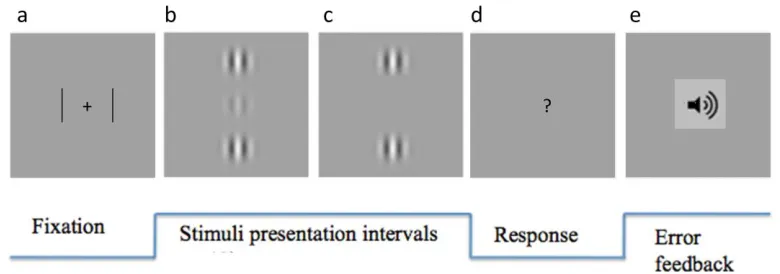
target flanked by two high-contrast Gabor masks in a two-interval forced-choice (2AFC) task. Each trial
comprised two successive displays, with identical flankers, but with a central target present in only one of
these displays, equiprobably the first or second; see Figure 2 for an example of a trial sequence.
Each trial was preceded by a fixation display comprising a high-contrast central cross, with peripheral
markers forming the corners of a square centred on the fixation point with side length of 2. This fixation
display demarcated the area of the screen at which a central target stimulus could appear. The fixation
display was followed by a stimulus sequence. After the fixation display was presented, the stimulus
sequence contained a display of flankers (650 msec) with or without a central target (150 msec, centred
within the 650 msec timewindow of the flankers, see figure 2). This was followed by a second stimulus
display, containing flankers (650 msec) plus a central target (150 msec) if there had been no central target
in the first display on that trial, or just flankers with no central target if the target had appeared in the first
display. Thus a target stimulus appeared only in one of two successive presentation intervals, whereas
identical flankers appeared in both intervals (see Fig. 2). Each interval was paired with a beep sound to
reduce temporal uncertainty (this was identical in all conditions). The observer’s task was to determine
which of the two stimulus intervals on each trial contained the central visual target. Observers responded
by button press (left arrow for the first interval and right arrow for the second on a standard computer
keyboard). When an incorrect response was made, auditory error feedback (beep) was given at trial end.
The stimulus contrast was temporally enveloped so that stimulus intensity slowly ramped up and down.
These envelopes were Hanning tapers of 650 msec length for the flankers and 150 msec for the target, the
latter being presented halfway in the middle of flanker presentation (if there was a target) so that their
amplitude peaks precisely overlapped. This was done to minimise any potential effect of different timings
9
Figure 2: Example trial sequence from experiment 1
(a) Fixation display comprising a high-contrast central cross, with peripheral bar markers. The figure is
schematic rather than displaying exact spatial relations. (b) Interval 1, here shown with a collinear target
present. The target was presented for 150 msec in either Interval 1 or Interval 2. (c) Interval 2, shown here
with no target. (d) Observers pushed a button to indicate which interval contained the stimulus. (e) In case
of an error, an auditory feedback signal was given.
Fitting of the Psychometric Function
The data from the 2AFC visual detection task were used to determine the detection threshold,
corresponding to the contrast necessary for achieving 75% of correct target detection. This was estimated
from the psychometric function (accuracy against target contrast), by first fitting a Weibull function to
each participant’s data, and then reading off from this the target contrast at which detection was midway
between ceiling and floor (Wichmann & Hill, 2001a). Psychometric functions were fitted to the raw data
for each of the six configuration x flicker conditions in each subject, using the PSIGNIFIT toolbox
version 2.5.6 for Matlab (http://bootstrap-software.org/psignifit). We derived from these functions the contrast level (and bootstrapped estimates of its variance) associated with 75% performance levels,
similar to procedures used in previous studies of lateral interactions (Polat & Sagi 1994; Freeman, Sagi &
Driver, 2001).
Group analysis
A factorial repeated-measures 2 x 3 Analysis of Variance (ANOVA) was conducted on the 75%
performance thresholds estimates. (For completeness we also ran an analogous ANOVA on the slope
10
‘Collinearity’, with two levels: collinear vs. orthogonal flanker configurations. The second experimental factor was ‘Flicker’, with three levels: static flankers, in-phase flankers, out-of-phase flankers. To
specifically assess the impact of flicker-phase, a further 2x2 ANOVA was conducted with the same
factors but now excluding the static flanker conditions.
Experiment 2: Flicker phase and crowding
We specifically adopted a task and display parameters used by Mareschal, Morgan, & Solomon (2010).
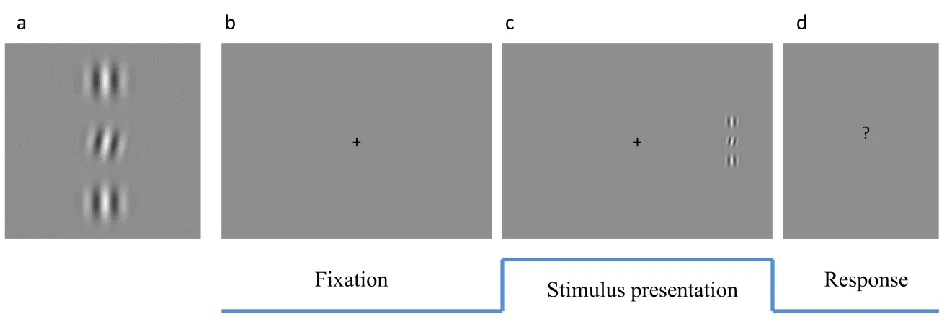
Participants had to judge whether a target Gabor patch, presented unpredictably in the left or right
hemifield, was tilted slightly clockwise or anticlockwise from vertical (see Fig 3a for an example of a
clockwise tilt). This target could be surrounded by nearby crowding distractors, comprising vertical
Gabors, which could be located at different distances from the target location. Previous research (Pelli,
2008, Mareschal, Morgan, & Solomon, 2010) had shown that target orientation discriminations decline
when the crowding distractors are closer to the target. Here we added the further manipulation of
flicker-phase.
Participants
Thirteen adult participants had normal or corrected to normal visual acuity. All were paid for participation
and naïve to the purpose of the experiment. Each participated in five experimental sessions.
Stimuli
We specifically adopted the display parameters and target orientation discrimination task used by
Mareschal et al (2010). All stimuli comprised Gabor patches. Each sinusoidal luminance Gabor patch was
presented at 90% contrast level and had a spread of = 0.175. Target Gabors were almost vertical (see
figure 3) with a spatial frequency of 2.85 c/deg. Distractor Gabor stimuli were perfectly vertical and had
2.85 c/deg. The size of each target or flanker stimulus was 1degree of visual angle. On each trial, the
target (and distracters) was presented at 5 degrees of visual angle (from vertical meridian) to the left or
right of the fixation cross with equal probability in a randomized order; thus hemifield of target (and
distractor) stimulation was unpredictable. All stimuli were presented for 400 msec in all conditions.
Stimuli flickered at 60 Hz (refresh rate 120 Hz) at three spatial separations (1, 1.17 or 1.33 of visual
angle) between the target and the distractors above and below. The display characteristics and viewing
distance were the same as in Expt. 1.
11
The two factors were flicker-phase (target in- or out-of-phase with the distractors, at 60 Hz) and spatial
separation between target and distractor (1, 1.17 or 1.33). All six conditions were equiprobable,
presented in a randomly interleaved stimulus sequence. The crowding effect (suppression of target
detection from distractors) was expected to be most pronounced for the closest spatial distances (see
Mareschal Morgan, & Solomon, 2010).
Procedure
In all sessions observers were instructed to fixate a small white fixation cross (‘+’ sign at 4pt font-size) at
the centre of the screen during each trial and this was carefully monitored via online eyetracking with an
Eyelink 1000 table mounted system. Observers performed an orientation discrimination task for the
peripheral target appearing unpredictably on left or right (always at 5 degrees eccentricity), reporting the
orientation of that target (tilted clockwise or anti-clockwise from vertical). They responded by button
press (right arrow for clockwise and left arrow for anti-clockwise). Feedback on error rate was now given
at the end of each block consisting of 24 trials each. No feedback was given on individual trials here in
order to speed up the task.
The first two experimental sessions contained only target stimuli (no flankers), as practice, lasting for 10
minutes each. The first session was used as a staircase procedure to find approximate tilt angles from
vertical to yield ~ 90% correct performance. Subsequently, in order to identify more precisely the
appropriate value for target deviation from vertical, a method of constant stimuli (MOCS) was employed
in the second session to get a more reliable estimate of performance as a function of target orientation
offset. These two sessions also allowed for some learning and stabilization of performance. The third 20
minutes session contained target and distractor stimuli. The orientation offset was chosen from the ~90%
correct MOCS performance level in session 2 (mean 5.65 degrees offset, SD +- 2.23 degree). Participants
underwent two further 25 minutes sessions with such flicker. The target unpredictably flickered either
in-phase or in anti-in-phase, on each trial, with the two distractors that could be presented at three spatial
separations. The two distractors on any one trial were always in phase with each other, only their relative
12
Figure 3: Stimulus display for experiment 2
(a) Example display (close-up) of target and distractor stimuli. (b-d) Timeline of experiment: (b) Fixation
period, prior to grating stimulus onset either in left or right hemifield, unpredcitable and uncued. (c)
Target (middle) and Distractors were presented at 5 degrees of lateral eccentricity for 500 ms and subjects
had to indicate the direction of the tilt-offset in the target (see a). Figure is schematic and does not
represent actual spatial relations. Target and distractors flicked either in-phase or out-of-phase at 60 Hz.
In either case, the distractors were always in phase with each other, only their phase relative to the target
varied. (d) The response could be given at any time after stimulus onset, there was no cue.
Data Analysis
Two repeated measures ANOVAs were conducted on the accuracy data, each including the factor of
flicker-phase (in- or out-of-phase) crossed factorially with spatial distance. A 2 x 3 ANOVA included all
three target-distractor separations; a further 2 x 2 ANOVA focused on just the closest two separations, the
difference between which can also provide a standard measure of crowding (see Mareschal et al., 2010).
Results
Experiment 1
In this experiment we addressed the question whether synchronized gamma-band oscillations entrained by
flickering flanker gratings (at 60 Hz) could enhance the impact of the flanker stimuli on detection of a low
contrast collinear central target (Polat and Sagi, 1993; Polat and Sagi, 1994; Freeman, Sagi & Driver,
13
centrally and statically presented low-contrast target grating, presented at individually adjusted contrast
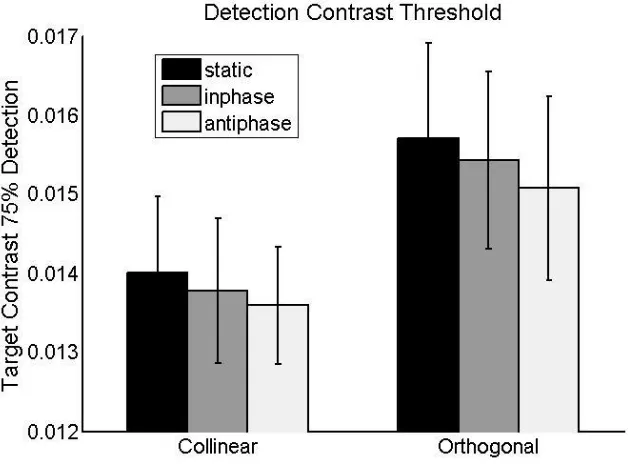
levels. In Figure 4 We show that contrast thresholds for the central target were systematically lower when
the target was collinear with the flankers, replicating previous research (Freeman, Sagi & Driver, 2001;
Polat & Sagi, 1994). This pattern was observed alike in all three flanker flicker conditions (static,
in-phase, and out-of-phase flankers). The 2x3 factorial repeated-measure ANOVA confirmed a significant
main effect of collinearity [F(1, 11) = 14.60, p < 0.01], revealing the classic Lateral interaction effect,
with central target detection thresholds lower (less contrast needed to achieve 75% detection) when the
flankers were collinear with the target. There was no main effect of the flicker factor [F(2, 11) = 1.18 , p >
0.25, ns]. Critically, there was also no interaction between collinearity and flicker [F(2, 11) = 0.14, p >
0.8, ns]. The collinearity effect was significant on pairwise t-tests for the static, in-phase or out-of-phase
conditions alike (all t (11) >2.2, all p<0.05)
A further 2x2 ANOVA excluding the static flanker conditions showed a similar pattern: a significant
main effect for collinearity [F (1, 11) = 13.364, p < 0.01]; there was no main effect of the flicker factor [F
(1, 11) = 0.45 , p > 0.4], and critically no interaction between the two factors [F (1, 11) = 0.25, p > 0.6].
The slight tendency for lower thresholds in the anti-phase condition versus the in-phase, regardless of
collinearity, was far from significant [F (1,11) = 0.50, p > 0.4].
For completeness, an analogous ANOVA was computed on the slope values for the fitted psychometric
functions at the 75% performance level, but this found no significant terms (all Fs < 1.5, n.s.).
To summarize, we could reproduce the classical lateral interactions effect (Polat & Sagi, 1994) whereby
two high contrast Gabors enhance detection (less contrast needed for 75% detection performance) of a
centrally presented target Gabor when all stimuli were collinear, compared to when the flankers were
orthogonal to the target. We observed this collinearity effect robustly under all presentation levels,
‘static’, ‘in phase’ flicker and ‘out of phase’ flicker. But contrary to the hypothesis that (externally driven)
synchrony may enhance perceptual integration, there was no difference in the collinearity effect for in-
14
Figure 4: Results from experiment 1
Contrast thresholds (in units if Michelson contrast) of central target at detection threshold – corresponding
to 75% performance. These were derived from the individually fitted psychometric curve. Group means
are plotted with SEMs as errorbars. A main effect of Collinearity was significant, but not of Flicker
conditions (‘static’, ‘inphase’, ‘antiphase’). Neither was the interaction, nor any simple effect between
Flicker conditions significant.
Experiment 2
In Experiment 2 we addressed the question whether the selective processing of target amongst nearby
distractor stimuli could be modulated by manipulating the phase-synchrony between target and distractor
stimuli. Subjects had to discriminate the orientation of a central target surrounded by distractor stimuli at
various (small) distances. Both target and distracters were flickered, either in phase synchrony or in
15
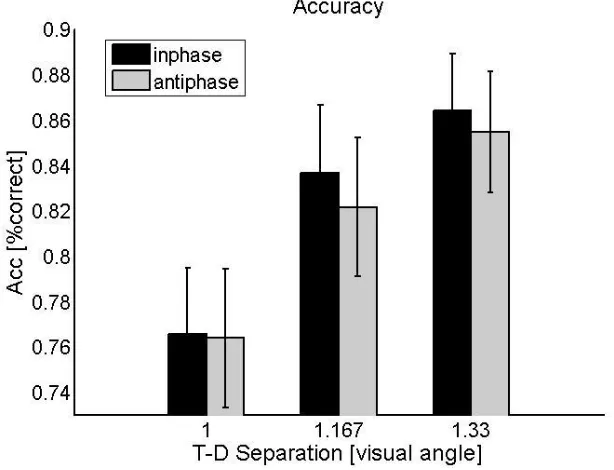
Figure 5: Results from experiment 2
Behavioural data (Accuracy) under 3 spatial target-distractor (T-D) separation conditions and two Flicker
conditions. This reveals a highly significant main effect of Space but no effect of Flicker condition. The
more separated target and distractors are, the more accurate the behaviour.
Figure 5 plots mean accuracy for each condition in the 2 x 3 design. Performance declines as the
distractors appear closer to the peripheral target, reproducing the well-known ‘crowding’ effect. But this
pattern is equivalent for the in-phase and out-of-phase cases. The 2 x 3 ANOVA confirmed a highly
significant main effect of spatial distance [F (2, 11) = 22.90 , p < 0.001]. There was no main effect of
flicker-phase [F (1, 11) = 0.684 , p > .4, ns], but more importantly no interaction between spatial
separation and flicker phase [F (2, 11) = .16 , p >0.8. ns]. This indicates that the crowding phenomenon
was unaffected by the target-flanker flicker-phase manipulation.
In sum, the manipulation of spatial distance had a highly significant impact on target discrimination,
revealing the classic crowding effect for peripheral targets, whereby performance is most impaired by the
closest distractors. However, the relative phase between target and distractor, as manipulated by the
flicker conditions had no influence on performance. Neither did we observe a significant main effect, nor
was the flicker effect more pronounced for crowded stimuli (smallest distances) compared to larger
16
Discussion
In this study we used two well-established psychophysical paradigms (Polat & Sagi, 1993; Polat & Sagi,
1994; Freeman, Sagi & Driver, 2001, Mareschal, Morgan, & Solomon, 2010) to test whether contextual
influences on perceptual processing were influenced by the relative phase between visual stimulus
components that were flickered in the gamma range (60 Hz). In experiment 1 we set out to test whether
local synchrony modulates propagation of neural activity through lateral connections in visual cortex
(deWeerd 2006) and in experiment 2 we set out to test whether synchrony between competing stimulus
representations modulates selective processing of these in the visual system (Pelli 2008). We neither
found that the well established collinear facilitation effect (Experiment 1) was modulated by phase
synchrony between the contextual flanker stimuli, nor did we find that crowding effects (Experiment 2)
depended on the relative phase between target and distractor stimuli.
In these experiments, flicker manipulations served as an external perturbation for causally testing the
influential proposal that phase relations at gamma frequency may modulate propagation of neural signals
or selective processing of different input streams (Salinas & Sejnowski, 2001; Fries, 2005; Womelsdorf &
Fries 2007). It has been shown by several electrophysiological studies that flickering visual displays can
entrain neuronal activity at frequencies of up to 100 Hz (Herrmann, 2001; Williams, Mechler, Gordon,
Shapley & Hawken, 2004). While several studies suggest that visual entrainment of oscillatory activity
can spread through virtually all levels of the cortical hierarchy (Srinivasan, Russell, Edelman & Tononi,
1999; Cosmelli et al., 2004), others suggest that such entrainment may be most pronounced in early visual
cortex (Kamphuisen, Bauer & van Ee, 2008). Accordingly we used two psychophysical paradigms here
for which the stimuli (Gabor patches) and tasks (contrast detection in Experiment 1, orientation
discrimination in Experiment 2) are thought to tap into relatively ‘early’ visual processes.
In contrast to previous studies (e.g. Bauer, Cheadle, Parton, Muller & Usher, 2009) we avoided the
potential stimulus confound of manipulating whether the to-be judged stimulus was either flickered or
not, or flickered at different frequencies. Furthermore here the appearance of flicker could also not serve
as a potentially informative cue for correctly identifying the target stimulus (see also van Diepen, Born,
Souto, Gauch & Kerzel 2010). In our tasks, the crucial comparisons only involved manipulation of
relative flicker-phase between stimulus components (or the flickered/static presentation of a task
irrelevant stimulus as an additional control in experiment 1) which provided no predictive cues that could
aid task performance. Under such more stringent conditions we did not find any impact of
17
manipulating the phase-synchrony between two neuronal populations does not impact on perceptual
integration, the results from each experiment may have different theoretical implications.
In Experiment 1 the hypothesis was that synchronous flickering of the flankers at a frequency typical for
human gamma-band oscillations (60 Hz, see Hoogenboom, Schoffelen, Oostenveld, Parkes & Fries,
2006) should enhance detection of a central target compared to flankers flickering in antiphase. This
outcome would have been consistent with proposals by Salinas & Sejnowski (2001) and Fries (2005) that
synchrony in neuronal populations can enhance the synaptic gain, particularly at higher frequencies
(Azouz & Gray 2003). While there is numerous evidence for this from correlational studies (e.g. Gruber,
Muller, Keil & Elbert, 1999; Bauer, Oostenveld, Peeters, Fries, 2006;Womelsdorf & Fries, 2007; Jensen,
Kaiser, Lachaux, 2007), our results suggest that this does at least not apply for externally driven
gamma-band oscillations.
In Experiment 2 the hypothesis was that in-phase flicker would impair selective processing of
target-orientation, particularly for very nearby distracters. While several theoretical frameworks trying to
explain the crowding effect exist (Dayan & Solomon, 2010; Pelli, 2008), one obvious interpretation of the
results in the context discussed here is that separation of oscillating neuronal populations in phase space
does not separate processing streams as theoretically predicted (Fries 2005; Womelsdorf & Fries 2007).
The clear null-result of gamma frequency flicker phase manipulations on these two carefully controlled
psychophysical measures of perceptual interaction argue against a strong causal influence of relative
gamma oscillation phase on processing in early visual cortex. In that respect this study adds to a number
of other studies using flickering visual displays that failed to find positive effects of gamma-band flicker
(van Diepen, Born, Souto, Gauch, & Kerzel, 2010; Fahle & Koch 1995; Leonards, Singer, & Fahle,
1996), contrasting with others that found such effects (Usher & Donnelly 1998; Bauer, Cheadle, Parton,
Muller & Usher, 2009).
However, it is not entirely clear to what degree entrainment of neural activity at a particular frequency can
reproduce the complex neuronal interactions thought to underlie the generation of brain-rhythms.
Pikovsky, Rosenblum & Kurths (2001) emphasize different regimes of periodic activity, such as coupling
between autonomous oscillators versus entrainment by an external force. For intrinsic gamma oscillations,
it is thought that a complex interplay between excitatory and inhibitory neurons determines their
periodicity (Mann, Suckling, Hajos, Greenfield, & Paulsen, 2005; Tiesinga, Fellous, Jose, & Sejnowski,
2001; Traub et al., 2000). External flickering stimuli may not perfectly mimic this, even if they
undoubtedly do entrain oscillations in visual cortex at the flickered frequencies (Herrmann, 2001;
18
placed near to each other and it is known that genesis of intrinsic gamma-oscillations is brought about by
lateral interactions of neuronal populations with similar feature preferences (Engel, König, Kreiter &
Singer 1991; Robinson 2006). In both regimes (externally entrained and intrinsically generated rhythms)
only a subset of neurons take part in the oscillatory rhythm (Williams, Mechler, Gordon, Shapley &
Hawken, 2004; Maier, Adams, Aura & Leopold, 2010), therefore it is possible that external flicker does
not entrain the relevant populations for contextual integration or that the forces underlying these different
rhythm generators may have counteracted each other and therefore yield in a null-result on the
behavioural level.
In conclusion, our study found that lateral interactions between a central visual target and flankers, or
visual crowding of a peripheral visual target by close distractors, were both unaffected by the flicker
phase manipulation here. Future variations of the manipulations we have introduced could extend the
phase-manipulation to other visual tasks, consider other frequencies, or introduce random phase relations
(rather than in versus 180 degrees out of phase), to fully decorrelate rather than segregate flankers from
targets. However, the present results argue against a special role for oscillatory phase of zero lag versus
higher lag, when driven externally by flickering visual stimuli. More research is needed to understand the
relation between externally entrained rhythms as widely used to study the causal role of brain oscillations
and the dynamics underlying the intrinsically generated rhythm.
References
Akam, T., & Kullmann, D. M. (2010). Oscillations and filtering networks support flexible routing of information. Neuron, 67(2), 308-320.
Azouz R, Gray CM. (2003). Adaptive coincidence detection and dynamic gain control in visual cortical neurons in vivo. Neuron. 37, 513-23.
Bauer F, Cheadle SW, Parton A, Muller HJ, Usher M (2009) Gamma flicker triggers attentional selection without awareness. Proc Natl Acad Sci U S A 106:1666-1671.
Bauer M, Oostenveld R, Peeters M, Fries P (2006) Tactile spatial attention enhances gamma-band activity in somatosensory cortex and reduces low-frequency activity in parieto-occipital areas. J Neurosci
26:490-501.
Borgers, C., Epstein, S., and Kopell, N.J. (2008). Gamma oscillations mediate stimulus competition and attentional selection in a cortical network model. Proc Natl Acad Sci U S A105, 18023-18028 Cosmelli, D., David, O., Lachaux, J. P., Martinerie, J., Garnero, L., Renault, B., et al. (2004). Waves of
consciousness: ongoing cortical patterns during binocular rivalry. NeuroImage, 23(1), 128-140. Dakin, S. C., & Bex, P. J. (2002). Role of synchrony in contour binding: some transient doubts sustained.
J Opt Soc Am A Opt Image Sci Vis, 19(4), 678-686.
19
Eckhorn R, Bauer R, Jordan W, Brosch M, Kruse W, Munk M, Reitboeck HJ (1988) Coherent oscillations: a mechanism of feature linking in the visual cortex? Multiple electrode and correlation analyses in the cat. Biological Cybernetics 60:121-130.
Eckhorn R (1994). Oscillatory and non-oscillatory synchronizations in the visual cortex and their possible roles in associations of visual features. Prog Brain Res. 102:405-26.Elliott, M. A., & Muller, H. J. (2000). Evidence for 40-Hz oscillatory short-term visual memory revealed by human reaction-time measurements. J Exp Psychol Learn Mem Cogn, 26(3), 703-718.
Engel AK, König P, Kreiter AK, Singer W. (1991). Interhemispheric synchronization of oscillatory neuronal responses in cat visual cortex. Science. 252, 1177-9.
Fahle, M., & Koch, C. (1995). Spatial displacement, but not temporal asynchrony, destroys figural binding. Vision Res, 35(4), 491-494.
Freeman, E., Sagi, D., & Driver, J. (2001). Lateral interactions between targets and flankers in low-level vision depend on attention to the flankers. Nat Neurosci, 4(10), 1032-1036.
Fries, P. (2005). A mechanism for cognitive dynamics: neuronal communication through neuronal coherence. Trends in Cognitive Sciences, 9(10), 474-480.
Gray CM, Konig P, Engel AK, Singer W (1989) Oscillatory responses in cat visual cortex exhibit inter-columnar synchronization which reflects global stimulus properties. Nature 338:334-337. Gruber T, Muller MM, Keil A, Elbert T (1999) Selective visual-spatial attention alters induced gamma
band responses in the human EEG. Clin Neurophysiol 110:2074-2085.
Herrmann, C. S. (2001). Human EEG responses to 1-100 Hz flicker: resonance phenomena in visual cortex and their potential correlation to cognitive phenomena. Exp Brain Res, 137(3-4), 346-353. Hoogenboom N, Schoffelen JM, Oostenveld R, Parkes LM, Fries P. (2006). Localizing human visual
gamma-band activity in frequency, time and space. Neuroimage. 29, 764-73.
Jensen O, Kaiser J, Lachaux JP (2007) Human gamma-frequency oscillations associated with attention and memory. Trends in Neurosciences 30:317-324.
Kamphuisen, A., Bauer, M., & van Ee, R. (2008). No evidence for widespread synchronized networks in binocular rivalry: MEG frequency tagging entrains primarily early visual cortex. J Vis, 8(5), 4 1-8.
Kiper DC, Gegenfurtner KR, Movshon JA (1996). Cortical oscillatory responses do not affect visual segmentation. Vision Res. 36(4):539-44.Lamme VA, Spekreijse H (1998) Neuronal synchrony does not represent texture segregation. Nature 396:362-366.
Levi DM (2008) Crowding--an essential bottleneck for object recognition: a mini-review. Vision Res 48:635-654.
Leonards, U., Singer, W., & Fahle, M. (1996). The influence of temporal phase differences on texture segmentation. Vision Res, 36(17), 2689-2697.
Mann, E. O., Suckling, J. M., Hajos, N., Greenfield, S. A., & Paulsen, O. (2005). Perisomatic feedback inhibition underlies cholinergically induced fast network oscillations in the rat hippocampus in vitro. Neuron, 45(1), 105-117.
Maier, A., Adams, G.K., Aura, C., and Leopold, D.A. (2010). Distinct superficial and deep laminar domains of activity in the visual cortex during rest and stimulation. Frontiers in systems neuroscience 4.
Mareschal, I., Morgan, M. J., & Solomon, J. A. (2010). Attentional modulation of crowding. Vision Res, 50(8), 805-809.
Müller MM, Malinowski P, Gruber T, Hillyard SA.(2003). Sustained division of the attentional spotlight.
Nature. 424, 309-12
Pelli DG (2008) Crowding: a cortical constraint on object recognition. Curr Opin Neurobiol 18:445-451. Pikovsky A, Rosenblum M, Kurths J (2001). Synchronization. A Universal Concept in Nonlinear
Sciences. Cambridge University Press. Cambridge, UK.
Polat, U., & Sagi, D. (1994). The architecture of perceptual spatial interactions. Vision Res, 34(1), 73-78. Rager G, Singer W. (1998). The response of cat visual cortex to flicker stimuli of variable frequency. Eur
20
Robinson PA. (2006). Patchy propagators, brain dynamics, and the generation of spatially structured gamma oscillations. Phys Rev E Stat Nonlin Soft Matter Phys. 73, 041904.
Salinas, E., & Sejnowski, T. J. (2001). Correlated neuronal activity and the flow of neural information.
Nat Rev Neurosci, 2(8), 539-550.
Shadlen, M. N., & Movshon, J. A. (1999). Synchrony unbound: a critical evaluation of the temporal binding hypothesis. Neuron, 24(1), 67-77, 111-125.
Singer, W. (1999). Neuronal synchrony: a versatile code for the definition of relations? Neuron, 24(1), 49-65, 111-125.
Srinivasan, R., Russell, D. P., Edelman, G. M., & Tononi, G. (1999). Increased synchronization of neuromagnetic responses during conscious perception. J Neurosci, 19(13), 5435-5448.
Tiesinga, P. H., Fellous, J. M., Jose, J. V., & Sejnowski, T. J. (2001). Computational model of carbachol-induced delta, theta, and gamma oscillations in the hippocampus. Hippocampus, 11(3), 251-274. Tiesinga, P. H., Fellous, J. M., Salinas, E., Jose, J. V., & Sejnowski, T. J. (2004). Inhibitory synchrony as
a mechanism for attentional gain modulation. J Physiol Paris, 98(4-6), 296-314.
Traub, R. D., Bibbig, A., Fisahn, A., LeBeau, F. E., Whittington, M. A., & Buhl, E. H. (2000). A model of gamma-frequency network oscillations induced in the rat CA3 region by carbachol in vitro.
Eur J Neurosci, 12(11), 4093-4106.
Tyler CW. (1997). Colour bit-stealing to enhance the luminance resolution of digital displays on a single pixel basis. Spat Vis. 10, 369-77.
Usher, M., & Donnelly, N. (1998). Visual synchrony affects binding and segmentation in perception.
Nature, 394(6689), 179-182.
van Diepen, R. M., Born, S., Souto, D., Gauch, A., & Kerzel, D. (2010). Visual flicker in the gamma-band range does not draw attention. J Neurophysiol, 103(3), 1606-1613.
Wichmann FA, Hill NJ (2001a) The psychometric function: II. Bootstrap-based confidence intervals and sampling. Percept Psychophys 63:1314-1329.
Williams PE, Mechler F, Gordon J, Shapley R, Hawken MJ. (2004). Entrainment to video displays in primary visual cortex of macaque and humans. J Neurosci. 2004 24, 8278-88
Womelsdorf, T., & Fries, P. (2007). The role of neuronal synchronization in selective attention. Current
Opinion in Neurobiology, 17(2), 154-160.