An analysis of binary microlensing event OGLE-2015-BLG-0060
Y. Tsapras ,
1‹A. Cassan,
2‹C. Ranc,
3E. Bachelet,
4R. Street,
4A. Udalski,
5M. Hundertmark,
1V. Bozza,
6,7J. P. Beaulieu,
2,8J. B Marquette,
2E. Euteneuer,
1D.
M. Bramich,
9M. Dominik,
10R. Figuera Jaimes,
10,11K. Horne,
10S. Mao,
11,12,13J. Menzies,
14R. Schmidt,
1C. Snodgrass,
15,16I. A. Steele,
17J. Wambsganss,
1,18P. Mr´oz,
5M. K. Szyma´nski,
5I. Soszy´nski,
5J. Skowron,
5P. Pietrukowicz,
5S. Kozłowski,
5R. Poleski,
19K. Ulaczyk,
5M. Pawlak,
5U. G. Jørgensen,
20J. Skottfelt,
20,21A. Popovas,
20S. Ciceri,
22H. Korhonen,
20,23,24M. Kuffmeier,
20D.
F. Evans,
25N. Peixinho,
26,27T. C. Hinse,
28M. J. Burgdorf,
29J. Southworth,
25R. Tronsgaard,
30E. Kerins,
13M. I. Andersen,
23S. Rahvar,
31Y. Wang,
32O. Wertz,
33M. Rabus,
22,34S. Calchi Novati,
35G. D’Ago,
6,36G. Scarpetta,
6,37L. Mancini,
22,38,39F. Abe,
40Y. Asakura,
40D. P. Bennett,
3,41A. Bhattacharya,
3,41M. Donachie,
42P. Evans,
42A. Fukui,
43Y. Hirao,
44Y. Itow,
40K. Kawasaki,
44N. Koshimoto,
44M. C.
A. Li,
42C. H. Ling,
45K. Masuda,
40Y. Matsubara,
40Y. Muraki,
40S. Miyazaki,
44M. Nagakane,
44K. Ohnishi,
46N. Rattenbury,
42To. Saito,
47A. Sharan,
42H. Shibai,
44D.
J. Sullivan,
48T. Sumi,
44D. Suzuki,
3P. J. Tristram,
49T. Yamada,
50A. Yonehara,
10The
RoboNet team,
†
The OGLE collaboration,
‡
and The MiNDSTEp collaboration
§
The
MOA collaboration
¶Affiliations are listed at the end of the paper
Accepted 2019 May 16. Received 2019 May 16; in original form 2018 October 18
A B S T R A C T
We present the analysis of stellar binary microlensing event OGLE-2015-BLG-0060 based on observations obtained from 13 different telescopes. Intensive coverage of the anomalous parts of the light curve was achieved by automated follow-up observations from the robotic telescopes of the Las Cumbres Observatory. We show that, for the first time, all main features of an anomalous microlensing event are well covered by follow-up data, allowing us to estimate the physical parameters of the lens. The strong detection of second-order effects in the event light curve necessitates the inclusion of longer-baseline survey data in order to constrain the parallax vector. We find that the event was most likely caused by a stellar binary-lens with massesM1 =0.87±0.12 MandM2 =0.77±0.11 M. The distance to the lensing system is 6.41 ± 0.14 kpc and the projected separation between the two components is 13.85±0.16 au. Alternative interpretations are also considered.
Key words: gravitational lensing: micro – methods: observational – techniques: photomet-ric – Galaxy: bulge.
E-mail:[email protected],[email protected](YT); [email protected](AC)
†The RoboNet team: D. M. Bramich, M. Dominik, R. Figuera Jaimes, K. Horne, S. Mao, J. Menzies, R. Schmidt, C. Snodgrass, I. A. Steele, J. Wambsganss.
‡The OGLE collaboration: P. Mr´oz, M.K. Szyma´nski, I. Soszy´nski, J. Skowron, P. Pietrukowicz, S. Kozłowski, R. Poleski, K. Ulaczyk, M. Pawlak. § The MiNDSTEp collaboration: U. G. Jørgensen, J. Skottfelt, A. Popovas, S. Ciceri, H. Korhonen, M. Kuffmeier, D. F. Evans, N. Peixinho, T. C. Hinse, M. J. Burgdorf, J. Southworth, R. Tronsgaard, E. Kerins, M.I. Andersen, S.
2019 The Author(s)
1 I N T R O D U C T I O N
There are two unique aspects to gravitational microlensing that set it apart from other exoplanet detection methods. First, it is most sensitive to planets at separations∼1–10 au from their hosts (Tsapras et al.2003; Cassan et al.2012; Suzuki et al.2016; Tsapras et al.2016), a region of great relevance to planetary formation theories (Ida, Lin & Nagasawa2013), as this typically places the planet beyond thesnow-line1of the host star (Armitage, Eisner & Simon2016), a region largely inaccessible to the transit and radial-velocity methods. Secondly, it detects planets around faint stars at distances of several thousand parsecs (Penny, Henderson & Clanton 2016), whereas almost every planet discovered to date by other methods lies only within a few hundred parsec from the Sun. Since stellar metallicity decreases with distance from the centre of the Galaxy (Ivezi´c et al.2008), microlensing planets may have formed in more metal-rich environments leading to a potentially different statistical distribution compared to the sample of nearby planets. This hypothesis can only be explored through microlensing.
The phenomenon of gravitational microlensing occurs when a foreground star gravitationally lenses a luminous background star, causing its brightness to gradually increase, and then gradually decrease, over a period of several days to months (Paczynski1986). The angular distance between the images generated by the lensing event is generally too small to resolve with current technology so that only the change in brightness of thebackground object, commonly referred to as the source star, is observed. The only known exception to date is the nearby microlensing event TCP J0507+2447, detected on 2017 October 25 by Japanese amateur astronomer Tadashi Kojima, for which Dong et al. (2019) managed to resolve, for the first time, the two microlensing images using the GRAVITY interferometer on the Very Large Telescope (VLT). A few very bright microlensing events per year might also be within the reach of the PIONIER instrument (Cassan & Ranc2016).
Should theforegroundlensing object be a star–star or star–planet system, its exact geometric alignment and physical parameters may leave an imprint on an otherwise symmetric light curve (Dominik 2010; Gaudi 2012; Tsapras 2018). These anomalous features can be detected and sampled with frequent (∼hourly to daily) observations, depending on the particular event. Due to the transient and unpredictable nature of microlensing events, it is often not possible to distinguish between planetary and stellar binary anomalies when they are first identified. Follow-up observations are therefore typically executed for almost all events where there is evidence of ongoing anomalies and the light curves are continuously re-assessed through real-time modelling. A full characterization is usually obtained only after the event has expired and returned to its baseline brightness.
Recent results from microlensing campaigns suggest that ice and gas giant planets are a relatively common feature (∼35 per cent) around K and M-dwarf stars (Gould et al. 2010). Microlensing
Rahvar, Y. Wang, O. Wertz, M. Rabus, S. Calchi Novati, G. D’Ago, G. Scarpetta, L. Mancini.
¶The MOA collaboration: F. Abe, Y. Asakura, D. P. Bennett, A. Bhat-tacharya, M. Donachie, P. Evans, A. Fukui, Y. Hirao, Y. Itow, K. Kawasaki, N. Koshimoto, M.C.A. Li, C.H. Ling, K. Masuda, Y. Matsubara, Y. Muraki, S. Miyazaki, M. Nagakane, K. Ohnishi, N. Rattenbury, To. Saito, A. Sharan, H. Shibai, D.J. Sullivan, T. Sumi, D. Suzuki, P.J. Tristram, T. Yamada, A. Yonehara.
1Thesnow-lineis the distance from a proto-star beyond which any water
present in the proto-planetary disc will be in the form of ice grains.
searches have also identified a number of very massive cool planets (Batista et al.2011; Koshimoto et al.2014; Tsapras et al.2014; Skowron et al.2015) and brown dwarf companions around low-mass stars (Street et al.2013; Ranc et al.2015; Han et al.2016a), as well as several terrestrial to sub-Neptune mass planets (Beaulieu et al.2006; Kubas et al.2012; Gould et al.2014; Shvartzvald et al. 2017), systems with multiple planets (Gaudi et al.2008; Han et al. 2013) and the first possible detection of an exomoon (Bennett et al. 2014).
In this paper we present the analysis of binary microlensing event OGLE-2015-BLG-0060 using observations collected from 13 different telescopes spread out around the world, providing continuous monitoring of the event. Stellar binary microlensing events are discovered far more often than planetary ones and their diverse morphologies have been the subject of several past studies (Skowron et al.2007; Jaroszy´nski et al.2010; Shin et al. 2012; Han et al.2016b; Shin et al.2017). Typically, their caustic-crossing features are predicted well in advance, given differences in the smoothly rising part of the light curve as compared to single-lens events. OGLE-2015-BLG-0060 is of particular interest because it is the first time automated follow-up observations have achieved excellent coverage of all anomalous features without human involvement, demonstrating the potential of fully robotic observations in characterizing microlensing events.
In Section 2 we provide a summary of the observations and data analysis. Section 3 describes the steps taken to model the event light curve and Section 4 the method used to determine the physical properties of the system. Finally, we provide a summary and conclusions in Section 5.
2 O B S E RVAT I O N S A N D P H OT O M E T RY
2.1 Survey and follow-up observations
Microlensing event OGLE-2015-BLG-0060 was announced on 2015 February 17 by the Early Warning System (EWS)2 of the Optical Gravitational Lensing Experiment (OGLE) survey (Udal-ski2003; Udalski, Szyma´nski & Szyma´nski 2015) at equatorial coordinatesα=17h59m58s.35,δ= −27◦4651.4 (J2000) (l,b= 2.6005◦,−2.1315◦). OGLE observations were carried out with the 1.3-m Warsaw telescope at Las Campanas Observatory in Chile, with the 32-chip mosaic CCD camera. The event occurred in OGLE bulge field 504, which was imaged several times per night when not interrupted by weather or the full Moon, providing good coverage of the light curve when the bulge was visible from Chile. The OGLE survey reported a baselineI0-band magnitude for the blended star of 16.683, which was later revised to 16.933. The predicted maximum magnification at the time of announcement was very low, therefore the target was originally considered low priority for follow-up observations. The event was also independently picked up by the MOA survey (Sumi et al.2003), using the 1.8-m MOA survey telescope at Mount John observatory in New Zealand, on 2015 March 17, and designated MOA-2015-BLG-071.
By mid-March 2015 it became apparent that it might be a high magnification event and the RoboNet (Tsapras et al. 2009) and MiNDSTEp (Dominik et al. 2010) teams began to observe it automatically. RoboNet observations were carried out using the southern ring of 1m robotic telescopes of the Las Cumbres Observatory (LCO) (Brown et al.2013), a total of eight telescopes
2http://ogle.astrouw.edu.pl/ogle4/ews/ews.html
located at the Cerro Tololo International Observatory (CTIO) in Chile, South African Astronomical Observatory (SAAO) in South Africa and Siding Spring Observatory (SSO) in Australia, providing continuous coverage of the event light curve. MiNDSTEp observations were carried out on the Danish 1.54m telescope at ESO La Silla in Chile and the 0.6m telescope at Salerno Observatory in Italy. New photometric reductions of VVV survey observations (Minniti et al.2010) in theKband at the location of the target were also included in the analysis, although none were obtained during the peak of the event.
The event was also observed by the Korea Microlensing Tele-scopes Network (KMTNet) (Kim et al.2016), and their data are analysed separately. TheSpitzersatellite also obtained observations of this target from June 12 (HJD∼2457186) to July 19 (HJD∼ 2457223), as part of an effort to constrain the parallax (Yee et al. 2015), but unlike the case of OGLE-2015-BLG-0966 (Street et al. 2016), these only cover the part of the light curve when the event is returning to baseline and provide no additional constraints. The Spitzerdata are therefore not included in the final model the event. The full light curve of OGLE-2015-BLG-0060 is shown in Fig.1, together with the best-fitting model (cf. Section 3).
2.2 Detection of the anomaly
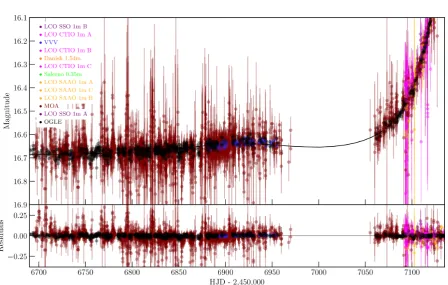
The first evidence that the event deviated from the standard single-lens Paczy´nski curve appeared on March 11, when the SIGNALMEN anomaly detector (Dominik et al.2007) triggered an alert on the ARTEMiS event monitoring system (Dominik et al.2008). The alert was propagated to the real-time modelling software RTModel (Bozza2010) to generate the first set of models, and complementary observation requests aimed at characterizing the anomalous feature were automatically submitted to the LCO robotic telescopes (Hundertmark et al. 2018). On the same day, an email by V. Bozza alerted the community that the broad peak observed at the end of the 2014 season (HJD ∼ 2456920, see Fig. A1 in the Appendix) and the subsequent rise during 2015 (HJD∼2457080) were incompatible with a single lens, and that binary and planetary solutions were possible.3 A second report by Bozza on April 20, using updated data, predicted a possible caustic crossing. On May 3 (HJD∼2457145.5), strong deviations indicating a caustic crossing were detected in the RoboNet and then the OGLE and MiNDSTEp data. Shortly thereafter, D. Bennett alerted the community that a strong anomaly was ongoing, and V. Bozza pointed out that higher order effects needed to be taken into account during the model fitting process. By May 9 (HJD∼ 2457151.5), V. Bozza had determined that the lens was likely to be a stellar binary, and on May 19 (HJD∼2457161.5) the Chungbuk National University group (CBNU, C. Han), using private KMTNet data that covered the anomalous feature, gave a preliminary estimate of the parameters of the system while the event was still ongoing. This solution was confirmed independently by V. Bozza on the same day.
3The small deviation that triggered the follow-up observations was generated
by the source approaching the first set of caustics at a distance of∼1.1 Einstein radii and took place well before the crossing of the second set of caustics.
2.3 Data reduction
The data used for the analysis presented in this paper and the telescopes used for the observations are listed in Table 1. Most observations were obtained in the Iband (SDSS-i), while some images obtained by OGLE inVwere also used to generate a colour– magnitude diagram and classify the source star. MOA observations were performed with the MOA wide-band red filter, which is specific to that survey. We note that there are also observations obtained privately by the KMTNet survey, which will be analysed in a separate paper.
The photometric analysis of crowded-field observations is a challenging task. Images of the Galactic bulge contain thousands of stars whose point-spread functions (PSFs) often overlap, therefore aperture and PSF-fitting photometry offer very limited sensitivity to photometric deviations generated by the presence of low-mass planetary companions. For this reason, observers of microlensing events routinely perform difference image analysis (DIA) (Alard & Lupton1998), which offers superior photometric sensitivity under such conditions. For a given telescope and camera, the technique of DIA uses areferenceimage4to which background, astrometric, photometric, and PSF corrections are applied to match the images of that same field taken at each individual epoch. The fitted model based on thereferenceimage is then subtracted from the matching images to produce residual (or differenceimages). Stars that did not vary in brightness between the times the images were obtained leave no systematic residuals on thedifference images, but stars that underwent brightness variations leave clear positive or negative residuals.
Most microlensing teams have developed custom DIA pipelines to reduce their observations. OGLE and MOA images were reduced using the photometric pipelines described in Udalski (2003) and Bond et al. (2001), respectively. RoboNet and MiNDSTEp obser-vations were processed using customized versions of the DanDIA pipeline (Bramich2008; Bramich et al.2013). Salerno data were reduced with a locally developed PSF-fitting pipeline. The data sets presented in this paper have been reprocessed to optimise photometric precision and it is these data we used as input when modelling the microlensing event. They are available for download from the online version of the paper.
3 M O D E L L I N G
3.1 Wide exploration of the parameter space
The general shape of the OGLE-2015-BLG-0060 light curve, shown in Fig. 1, displays typical features associated with a binary-lens caustic-crossing event: a sharp rise in brightness as the source enters the caustic at HJD∼2457146 (3 May), then a drop in brightness as the source traverses the interior of the caustic structure, followed by another sharp rise in brightness as the source exits the caustic at HJD∼2457150 (7 May). The event then gradually returns to the standard Paczy´nski curve as the source moves further away from the caustic. The anomalous behaviour lasts for a total of∼10 d, while the full duration of the event is120 d.
Strong binary microlensing features, such as those observed here, are subject to well-known model parameter partial degeneracies. These produce multiple local minima located within extended regions, rather than a single well-defined minimum (Kains et al.
4This can be either a single image or a combination of images taken under
the best seeing conditions
12
13
14
15
16
Magnitude
•Danish 1.54m •LCO SSO 1m A •LCO SSO 1m A •LCO SSO 1m B
•LCO SAAO 1m A
•LCO SAAO 1m B
•LCO SAAO 1m C
•LCO CTIO 1m A
•LCO CTIO 1m B
•LCO CTIO 1m C •MOA
•OGLE •Salerno 0.35m
•VVV
7100 7120 7140 7160 7180 7200
HJD - 2,450,000 −0.25
0.00 0.25
[image:4.595.71.522.59.331.2]Residuals
Figure 1. Light curve of microlensing event OGLE-2015-BLG-0060 showing the best-fitting binary model including parallax. The legend on the right of the figure lists the contributing telescopes.
Table 1. Data sets used in this analysis and their properties.
Group Telescope Passband Data points
OGLE 1.3m Warsaw Telescope, Las Campanas, Chile I,V 1629,101
MOA 1.8m MOA Telescope, Mount John, New Zealand MOAred,MOAblue 5674,71
RoboNet 1.0m LCO (Dome A), CTIO, Chile SDSS-i 176
RoboNet 1.0m LCO (Dome B), CTIO, Chile SDSS-i 83
RoboNet 1.0m LCO (Dome C), CTIO, Chile SDSS-i 138
RoboNet 1.0m LCO (Dome A), SAAO, South Africa SDSS-i 92
RoboNet 1.0m LCO (Dome B), SAAO, South Africa SDSS-i 60
RoboNet 1.0m LCO (Dome C), SAAO, South Africa SDSS-i 86
RoboNet 1.0m LCO (Dome A), SSO, Australia SDSS-i 65
RoboNet 1.0m LCO (Dome B), SSO, Australia SDSS-i 62
MiNDSTEp 1.5m Danish Telescope, La Silla, Chile LIred 85
MiNDSTEp 0.6m Salerno Telescope, Salerno, Italy I 25
VVV 4.1m VISTA Telescope, Paranal, Chile K 240
Note: For a description of the MiNDSTEp LIred bandpass see Skottfelt et al. (2015). For a description of the MOAMOAred,MOAbluebandpasses see Sako et al. (2008).
2009). Dedicated methods based on the observed features, such as the dates of the caustic crossings (Cassan2008; Cassan et al. 2010) may help in these cases to limit the extent of the region of parameter space to be explored. Regardless of the chosen fitting strategy, caustic-crossing events require exploring the morphology of the light curve for a wide range of binary-lens separationssand mass ratiosq, which can be visualized as aχ2-map in the (s,q) plane.
At this stage of the analysis we wish to locate all regions of possible local minima without performing a computationally costly full parameter search. We assume that a simple binary-lens model including finite-source effects, but not parallax or orbital motion
(i.e. a static binary-lens, straight line trajectory) can reproduce sufficiently well the gross features of the observed light curve. Besides parameterss(projected binary-lens separation expressed in units of the angular Einstein radius of the lensθE) and mass ratio q, the others parameters of this model are: the impact parameter of the sourceu0expressed inθEunits; the characteristic duration of the event,tE(or so-called Einstein time-scale), which is the time required for the source to cross the Einstein ring angular radiusθE; the time of closest approacht0between the projected position of the source on the plane of the sky and the position of the centre of mass of the binary-lens;α, the angle of the source trajectory with respect to the binary axis; finally ρ =θ∗/θE, the angular source
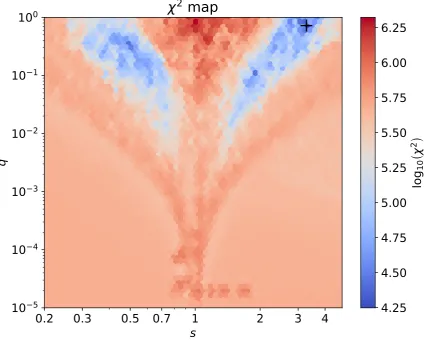
[image:4.595.43.554.401.556.2]size expressed inθEunits. Finite-source effects become prominent when the source trajectory approaches or crosses a caustic, so it is mandatory to include them in the modelling even at this early stage. Hence, as a first step, we compute a high-resolutionχ2(s,q) map, assuming a static binary-lens model including finite-source effects, using the Microlensing Search Map algorithm. The underlying grid is uniformly spaced in logsand logq, and samples 84 values of separation spanning values betweens=0.2 and 5, and 36 values inqspanning values betweenq=10−5and 1, for a total of 3024 grid points; for each grid point, we generate 103 models to find the best-fitting set of parameters. These models are derived from a refined library of pre-computed light curves for different values of u0,α,tE,t0, andρ. The resulting map is shown in Fig.2. The blue regions mark the location of the valleys of local minima, while the red regions are zones of very unlikely sets of parameters. The map clearly displays the classical degeneracy between models withs= s0ors=1/s0(Erdl & Schneider1993; Dominik1999), which results in the twoχ2valleys highlighted in blue. Under our simple static binary-lens model assumption, we find that the global minimum is located in the upper part of the blueχ2valley on the right (i.e. towardsq∼1 and large values ofs), extending approximately along the axis defined by (s,q)∼(1.5, 2×10⁻²) to (4, 1). In the regime we are considering (relatively large value ofs∼2–4 andq∼1), the central and secondary caustics are of very similar shape and produce almost identical light curves, but which are still distinguishable in terms ofχ2. The best fit, marked with a cross, is clearly located at large separation, arounds3.28 andq0.73. In the next section, we shall see that this is already a very good estimate of the basic lens parameters, since adding parallax and/or orbital motion only slightly moves the best fit to larger values ofsandqinside the upper part of theχ2valley.
Once this preliminary investigation of the parameter space is complete, we perform detailed modelling using as initial guesses the parameters found in the wide grid search (cf. Fig.2). Besides the model parameters already mentioned, we include second-order parameters such as limb-darkening (Section 3.2), parallax (Section 3.3) and orbital motion between the two components of the lens (Section 3.4), and we discuss the final model in Section 3.5. Our analysis uses the microlensing modelling software MULAN (MICROlensing Analysis code, Ranc & Cassan 2018), which is an open-source code freely available online.5The software uses an Affine-Invariant Ensemble Sampler (Goodman & Weare 2010; Foreman-Mackey et al. 2013) to generate a multivariate proposal function while running several Markov Chain Monte Carlo (MCMC) chains for the set of parameters to be fitted. Where needed, some of the parameters are fitted within a pre-defined grid. We note that the results presented in this paper have been checked for consistency using the independently developedPYLIMAopen-source package for microlensing modelling (Bachelet et al.2017).
3.2 Source limb-darkening
To take into account the limb-darkening of the source’s extended surface, we model its surface brightness with a classical linear limb-darkening law,Sλ(ϑ)∝1− λ(1−1.5cosϑ), whereϑis the angle between the line of sight towards the source star and the normal to the source surface, and λis the limb-darkening coefficient in pass-bandλ.
5https://github.com/muLAn-project/muLAn
Based on our estimate of the colour of the source star (which we describe in Section 4.1), we adopt a temperatureTeff∼5250 K (Ram´ırez & Mel´endez 2005) and use the Claret (2000) tables to obtain the limb-darkening coefficientsuλfor each pass-band. These values are then converted to linear limb-darkening model parameters through λ=2uλ/(3−uλ). This leads us to adopt V=0.64, R=
0.56, I=0.47, K=0.25, LIred=0.47, and MOAblue=0.64 that we keep fixed during the minimization process (in fact, we find that fitting these parameters does not affect other best-fitting parameters andχ2).
Including limb-darkening and fitting the light curve by allowing sandqto be free parameters [as opposed to the initial (s,q) grid search where they were fixed] leads to the best-fitting static binary-lens model, whose parameters are given in Table2(although the reported values andχ2are those obtained after error bar re-scaling, cf. Section 3.5).
3.3 Parallax
Given the long duration of the event (120 d), it is likely that the positional change of the observer caused by the orbital motion of the Earth around the Sun would have left a signature in the light curve. This so-called parallax effect causes the apparent lens–source motion to deviate from a rectilinear trajectory and manifests as a subtle long-term perturbation in the event light curve (e.g. Gould 1992; Shin et al.2012; Jeong et al.2015; Street et al.2016). In order to model this effect, it is necessary to introduce two extra parameters,
πE,NandπE,E, representing the components of the parallax vector
πE projected on the plane of the sky along the north and east equatorial axes, respectively. With the inclusion of the parallax effect, we use the geocentric formalism of Gould (2004) which ensures that the parameterst0,u0, andtEwill be almost the same as when the event is fitted without parallax. In practice, the parallax is computed using real ephemerides rather than an approximation of the acceleration of the Earth around the Sun for the considered period of time. As a reference date, we choosetp=2457 150.
We inspect two classes of models that are expected to provide a similar (but not identical) fit to the data: one withu0>0 andπE,N >0, and the other with opposite signsu0<0 andπE,N<0. The
resulting best-fitting models have very similar χ2, though with a slight preference foru0<0 as seen in Table2. Compared to the static models that globally reproduce very well the main features of the light curve, we find that including parallax in the modelling substantially improves the χ2of the fit (after error bar rescaling, cf. Section 3.5). Parallax effects are thus clearly detected for this microlensing event. However, we now need to check whether orbital motion is also detected, since these two effects can be strongly degenerate.
3.4 Orbital motion
Parallax is partly degenerate with the orbital motion of the binary-lens (Bachelet et al.2012; Park et al.2013). Orbital motion changes the shape of the caustics with time and, to first-order approximation, can be modelled by introducing two more parameters that represent the rate of change of the normalized separation between the two lens components ds/dtand the rate of change of the source trajectory angle relative to the caustics dα/dt. Given the possible degeneracy between parallax and orbital motion, we explore three classes of models: parallax alone, orbital motion alone, and parallax plus orbital motion. Our fits using a close binary model (s<1) always have much higherχ2than those with a wide binary models>1
Figure 2. χ2map as a function of (s,q), assuming a static binary-lens model including finite-source effects. The underlyings,q-grid has 3024 grid points
and spans binary-lens separations froms=0.2 tos=5 (84 values) and mass ratios fromq=10−5toq=1 (36 values), both uniformly spaced in logarithmic
scale. Red to blue colours are decreasing values ofχ2, on a logarithmic scale displayed on the right. Two wide and symmetric valleys of local minima can be
seen at close and wide binary-lens separations, extending fromq∼2×10⁻²to 1. The best-fitting model is unambiguously located in the wide separation
regime, around (s3.28,q0.73).
Table 2. Best-fitting microlensing parameters for the different competitive models. We choose the same reference date for parallax (tp) and orbital motion
(tb),tp=tb=2457150 (HJD=HJD-2450000). npar =number of fitted parameters.
Parameter Static (npar=7) Parallax (npar=9) Parallax+orbital motion (npar=11)
u0>0 u0<0 u0>0 u0<0
χ2 7738.59 7589.02 7571.63 7383.51 7390.10
t0(HJD) 7030.72±0.75 7038.65± 0.69 7039.06±0.70 7046.22±0.88 7046.07±0.88
u0 0.779±0.004 0.747± 0.003 −0.746±0.003 0.878±0.013 −0.831±0.011
tE(d) 73.90±0.18 72.93± 0.18 72.81±0.18 68.19±0.55 66.703±0.559
s 3.487±0.005 3.433± 0.005 3.430±0.005 3.459±0.006 3.470±0.009
q 0.817±0.006 0.884± 0.006 0.885±0.006 0.837±0.007 0.834±0.009
α(rad) 2.6952±0.0006 2.6900± 0.0007 −2.6894±0.0007 2.622±0.008 −2.655±0.007
ρ 0.0046±10−5 0.0048± 10−5 0.0047±10−5 0.0047±10−5 0.0047±10−5
πE,N – 0.013± 0.002 −0.018±0.002 0.130±0.012 −0.087±0.010
πE,E – −0.046± 0.003 −0.044±0.003 −0.045±0.005 −0.064±0.004
ds/dt(yr−1) – – – 0.26±0.09 0.63±0.09
dα/dt(yr−1) – – – -0.28±0.02 0.22±0.02
(χ2>4000), so we discuss only the latter (forq∼1, which is the case here, we do not expect the classicals−1/sdegeneracy to occur). We also investigate theu0>0 andu0<0 degeneracy, resulting from the mirror-image symmetry of the source trajectory
with respect to the binary-lens axis, which we are unable to break. As expected, the parameters of the event are almost identical for both cases. The calculations were repeated for different initial positions in parameter space to verify the uniqueness of the solution.
[image:6.595.45.546.498.652.2]3.5 Discussion and best-fitting model
The final step is the refinement of the model by adjusting the uncertainties of each data set and refitting. The data sets used in this analysis are obtained from different telescopes and instruments with notable differences in their photometric precision and the mea-surement errors are often underestimated. We therefore normalise the reported flux uncertainties of theith data set using the expression
ei=fi(σ02+σi2)1/2, wherefiis a scale factor,σ0are the originally reported uncertainties andσi is an additive uncertainty term for
each data seti(Yee et al.2012). Thus, the error bars are adjusted so that theχ2per degree of freedom (χ2/dof) of each data set relative to the model is one. The model is then recomputed.
The results of the modelling runs are summarized in Table 2. The reported uncertainties for each parameter correspond to the size of the one-sigma contours of the parameter error distributions generated by the MCMC chains. The best-fitting orbital-motion-only model (u0 < 0) has a χ2 = 7621.61 and is disfavoured compared to the best-fitting parallax-only model (u0<0) which has aχ2=7571.63. Theχ2improves by∼180 when orbital motion is considered together with parallax. However, as we discuss in the next section, these solutions result in unbound systems and are therefore rejected. The best-fitting binary-lens model with parallax is presented in Fig.1, superposed on the data. Fig. 3shows an enlarged view of the region around the peak, where the perturbations are prominent. The source trajectory with respect to the caustic structure is shown as an inset. It crosses the caustic structure twice, causing a substantial increase in magnification at the entry and exit points. Follow-up observations cover all the critical features present in the light curve.
3.6 Survey versus follow up
Our previously described fits include survey as well as follow-up data. To test to what extent each data set can constrain the parameters without the other, we perform three separate fits starting from a full exploration of the parameter space: OGLE+MOA, OGLE-only, and follow-up only. Table 3shows the results of these fits. For the survey data, in analogy to the all-data fit, the model including parallax and orbital motion gives the best fit (χ2∼6382), followed by the parallax-only-model (χ2∼6557). The main microlensing fit parameters are in good agreement with our results from the all-data fits. However, the parallax vector, and especially the north component,πE,N, shows strong variation between the different fits.
In the OGLE data an additional feature can be identified prior to the main event: A broad low-magnification peak observed at the end of the 2014 observing season at HJD∼2456920, as alerted by V. Bozza (see Section 2.2). This feature cannot be seen in the MOA data and is not covered by the follow-up data sets. The scatter and uncertainties in the MOA data are larger than the low amplitude of this feature so they cannot constrain it. To assess how this ‘bump’ influences the parallax values we perform a fit using OGLE data alone. The parallax signal is now more strongly detected (πE,N = −0.0215±0.0038). Given that parallax is a long-term effect, this is expected. Next, we perform an all-data fit but fix the parallax to the value determined by the OGLE-only fit. The result of this fit has aχ2that is worse by∼18 compared to our best fit using all available data but, most notably, this difference is fully attributed to a failure of this model to match the∼20 points of the first peak of the anomaly (HJD∼ 2457146) during the caustic entry. This suggests that OGLE data alone are not sufficient to fully constrain the parallax, and that the full data set that covers the structure of
the peak anomaly remarkably well is required. We also note that, in contrast to the all data-fit, the OGLE-only fit results in a bound system for a source located at the distance of the RC. The inclusion of follow-up data is therefore crucial in deciding between competing solutions.
The fit with follow-up data alone shows similar results. The best-fitting parameters are close to our fit using all data, with the exception of the parallax signal which is only weakly detected. From this we conclude that both survey and follow-up data are needed to reliably constrain the parallax.
4 P H Y S I C A L PA R A M E T E R S
4.1 Source star characterization
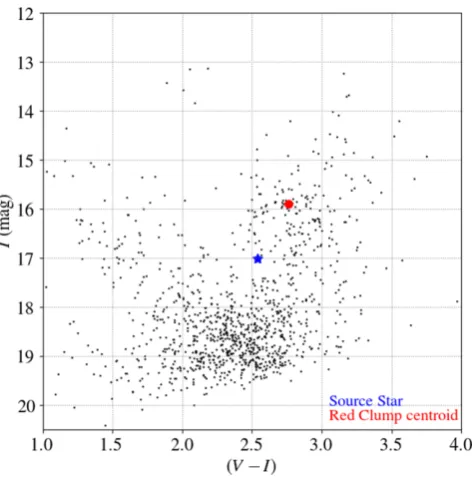
To estimate the angular source radius, we use OGLE-IVIandV -band observations of stars within a 90 arcsec radius centred on the microlensing target to generate the (V−I,I) colour–magnitude diagram (CMD) shown in Fig.4. We then identify the centroid of the red clump (RC) at (V−I,I)RC,OGLE=(2.76±0.02, 15.90±0.05). The unblended instrumental colour and magnitude of the source star is evaluated during the model fit: (V−I,I)S,OGLE=(2.54±0.02, 17.02±0.01). This yields an offset of(V−I,I)OGLE=(V−I, I)S,OGLE −(V− I,I)RC,OGLE =(−0.22±0.03, 1.12±0.05). To account for OGLE’s non-standardVband, the(V−I)OGLEvalue needs to be multiplied with 0.93 (Udalski et al.2015) to bring it to the standard Johnson–Cousins (JC) system, yielding(V−I)JC= −0.21±0.03. The intrinsic mean dereddened colour and apparent magnitude of the RC (at the coordinates of the microlensing event) are (V−I)RC,0=1.06±0.03 (Bensby et al.2013; Nataf et al.2013) and (I)RC,0=14.36±0.02 (Nataf et al.2016), respectively.
The distance to the RC can be derived from the measurement of the distance to the Galactic centre (GC) (Nataf et al.2016),DGC= 8.33 kpc, by computing
DRC=
DGCsinφ
cos(b) sin (l+φ), (1)
whereφ=40◦is the angle between the major axis of the Galactic bulge and the line of sight from the Sun. For OGLE-2015-BLG-0060, we find the RC to be on the close side of the bar at a distance of DRC = 7.9 kpc, corresponding to a distance modulus ofμ =
14.5 mag.
Assuming that the reddening towards the microlensing source is the same as towards the RC and that the distance to the source is the same as the distance to the RC, the intrinsic (dereddened) colour and magnitude of the source can be estimated: (V−I)S,0 =(V − I)JC+(V−I)RC,0 =0.85± 0.04 andIS,0=IRC,0 −IRC,OGLE +IS,OGLE+0.001 68=15.48±0.06. Therefore the source star is most probably a G-type sub-giant. From the dereddened colour and magnitude of the source, we can estimate the angular source radius
θ∗(Kervella & Fouqu´e2008) using
log (θ∗)=3.198−0.2Is,0+0.4895(V −I)s,0 −0.0657(V −I)2s,0,
(2)
where the angular radius is given in μas and the uncertainty of the relation is 0.0238. This yields the angular source size, θ∗ = 2.96±0.36μas.
We then proceed to evaluate the angular Einstein radius,θE= θ∗/ρ=0.62±0.08 mas, and the (geocentric) lens–source relative proper motion,μgeo=θE/tE=2.91±0.35 mas yr−1.
12.0
12.5
13.0
13.5
14.0
14.5
15.0
Magnitude
•Danish 1.54m •LCO SSO 1m A •LCO SSO 1m A •LCO SSO 1m B
•LCO SAAO 1m A
•LCO SAAO 1m B
•LCO SAAO 1m C
•LCO CTIO 1m A
•LCO CTIO 1m B
•LCO CTIO 1m C •MOA
•OGLE •Salerno 0.35m
•VVV
7140 7142 7144 7146 7148 7150 7152 7154 7156
HJD - 2,450,000 −0.25
0.00 0.25
Residuals
−1.70 −1.65 −1.60
[image:8.595.78.522.59.329.2]−0.05 0.00 0.05
Figure 3. Enlarged view around the peak of the light curve of microlensing event OGLE-2015-BLG-0060 highlighting the anomalous structure and showing the best-fitting binary model including parallax. The legend on the right of the figure lists the contributing telescopes. The inset on the top left displays the caustic pattern for this event, while the black line indicates the source trajectory. The source size (in units ofθE) is represented by the small grey circle. The
points of entry and exit are associated with the most highly magnified features in the light curve at HJD∼2457146 and HJD∼2457151, respectively.
Table 3. Best-fitting parameters for the parallax-only models (u0<0) including different data sets. Since the data sets contain different numbers of data points, the reduced-χ2is reported (χ2/dof, dof =degrees of freedom).
Parameter OGLE +MOA OGLE Follow-up
χ2/dof 0.878 0.883 0.779
t0(HJD) 7037.92±0.76 7048.54± 1.31 7045.13±0.95
u0 −0.756±0.004 −0.709± 0.008 −0.720±0.006
tE(d) 72.98±0.19 70.28± 0.31 68.98±0.30
s 3.433±0.006 3.353± 0.010 3.374±0.008
q 0.870±0.007 0.939± 0.012 0.867±0.011
α(rad) −2.687±0.001 −2.689± 0.002 −2.703±0.002
ρ 0.0048±10−5 0.0051± 10−5 0.0050±10−5
πE,N −0.004±0.004 −0.022± 0.004 −0.003±0.003
πE,E −0.049±0.003 −0.055± 0.005 −0.057±0.006
ds/dt(yr−1) – – –
dα/dt(yr−1) – – –
4.2 Physical parameter estimation
The mass and distance to the lens are determined by
Mtot= θE κπE
; DL=
au
πEθE+πS
, (3)
whereκ=4G/(c2au) andπ
S=(au)/DSis the parallax of the source star (Gould1992). To determine these quantities, we needπEand θE. The value ofπEis estimated from the model fit, whereasθE= θ∗/ρ∗depends on the angular radius of the source star,θ∗, and the normalized source radius,ρ∗, which is also returned from modelling
(see Table2). Therefore, to get the value ofθE, we needed first to estimateθ∗.
Our analysis indicates that the lens is a binary system comprised of two stars with almost equal mass (q=0.86–0.9). The physical parameters of the system are presented in Table4based on the best binary-lens model with parallax but no orbital motion.
The two models with parallax and orbital motion produce better fits in terms of their correspondingχ2values, but when we evaluate the ratio of kinetic to potential energy (Udalski et al.2018)
KE
PE
⊥=
(d⊥/au)3 8π2(M
L/M)
1
s
ds
dt 2
+
dα
dt 2
, (4)
[image:8.595.45.550.432.577.2]Figure 4. (V−I,I) CMD of stars from the OGLE-IV catalogue within 90 arcsec from the location of OGLE-2015-BLG-0060, not corrected for interstellar extinction. The red point corresponds to the location of the RC and the blue star to the location of the source.
Table 4. Physical parameters.
Parameter Value
Mass of lens star #1 (M1) 0.87± 0.12 M
Mass of lens star #2 (M2) 0.77± 0.11 M
Distance to the lens (DL) 6.41± 0.14 kpc Projected star–star separation (d⊥) 13.85± 0.16 au Einstein radius (θE) 0.62± 0.08 mas
Geocentric proper motion (μgeo) 3.16± 0.39 mas yr−1
we find that (KE/PE)⊥ > 1.5 for both of them, which results in unbound systems.6 Furthermore, the large projected distance between the two components (∼14 au) implies an orbital period of∼36 yr. Such a long period, when compared to the event time-scale of∼70 d, suggests that any orbital motion effects would be negligible. We therefore conclude that the improvement in theχ2 from the inclusion of the orbital motion is not due to a physical effect, and is most likely caused by long-term systematics in the data.
Adopting the parameters of the model including parallax but no orbital motion, the distance to the lens isDL=6.41±0.14 kpc, in the direction of the Galactic Bulge. The two components have masses M1 = 0.87± 0.12 M and M2 = 0.77± 0.11 M, respectively. The projected separation between them is d⊥ = 13.85±0.16 au.
4.3 Close source interpretation
What if the source were closer? Source distances≤2.85 kpc can lead to bound solutions. Even though the lensing probability for
6The ratio of the kinetic to potential energy should be less than 1 for the
system to be bound.
such nearby sources is extremely small, we explore this possibility next for the sake of completeness. We identified a star at the coordinates of the microlensing event in the Gaia DR2 catalogue (Gaia Collaboration 2016, 2018) and used the distances from Bailer-Jones et al. (2018) to derive a distance for the source of
DS=2.67+−13..5822 kpc at 68 per cent confidence level7). Using the VPHAS + DR2 catalogue (Drew et al. 2014), we generated a colour–colour diagram using a search radius or 60 arcsec around the coordinates of the event. The resulting distribution was compared with the atlas of synthetic spectra of Pickles (1985) and the location of the source on the diagram implied that it is likely a G-type main-sequence star. To estimate the reddening at the assumed source distance of 2.67 kpc, we used the PYTHON DUSTMAPS package (Green2018), which assumes the extinction law derived in Schlafly et al. (2016). We then transformed to different passbands using Schlafly & Finkbeiner (2011) and derivedAI=0.4±0.20. Applying
this correction and repeating the calculations in Section 4.1 we obtained (V−I)S,0=2.13±0.09 andIS,0=16.52±0.21, which implies a larger angular source radius θ∗ =4.351± 0.519μas. The derived physical parameters of the system then becomeM1= 0.58 ± 0.08 M, M2 = 0.48± 0.07 M, d⊥=6.77+1−0..3549 au, leading to a bound system.
5 C O N C L U S I O N S
We analysed the binary microlensing event OGLE-2015-BLG-0060. The caustic-crossing features of the light curve were sampled intensively with automated follow-up observations from the robotic telescopes of the Las Cumbres Observatory. The trajectory of the source star crosses the central caustic structure twice, entering at HJD∼2457146 (May 3) and exiting at HJD∼2457150 (May 7). The light curve does not display the typical ‘U’-shape associated with binary-lenses, but displays a ‘bump’ between the entry and exit points, which is associated with the source trajectory approaching a cusp. We found that considering the parallax is necessary to explain the morphology of the light curve. The two components of the binary-lens have massesM1=0.87 MandM2=0.77 M, and a projected separation ofd⊥=13.85 au. The effect of orbital motion is negligible because of the wide separation between the lensing components, which implies a long orbital period for the binary (P∼40 yr compared to tE ∼77 d). The distance to the lensing system is 6.4 kpc. We are unable to break the ecliptic degeneracy, i.e. the degeneracy caused by the mirror symmetry between the source trajectories withu0>0 andu0<0 with respect to the binary axis. This degeneracy does not affect our estimate of the physical parameters of the lensing system since the underlying model param-eters have similar values. Finally, we considered possible alternative interpretations of the event under the assumption of a nearby source star.
This work demonstrates that timely reactive observations from robotic telescopes are already capable of achieving excellent au-tomatic coverage of anomalous light curve features. However, to place meaningful constraints on the physical parameters of the lens, observations on the wings and baseline of the light curve are essential.
7Note that the Gaia measured parallax is consistent with infinite distance at
2σ.
[image:9.595.47.286.370.453.2]AC K N OW L E D G E M E N T S
AC acknowledges financial support from Universit´e Pierre et Marie Curie under grant ´Emergence@Sorbonne Universit´es 2016. This work was granted access to the HPC resources of the HPCaVe at UPMC-Sorbonne Universit´e. SM was supported by the National Science Foundation of China (Grant No. 11333003, 11390372 to SM). KH acknowledges support from STFC grant ST/M001296/1. YT and JW acknowledge the support of the DFG priority program SPP 1992 Exploring the Diversity of Extrasolar Planets (WA 1047/11-1). The OGLE project has received fund-ing from the National Science Centre, Poland, grant MAESTRO 2014/14/A/ST9/00121 to AU. Work by RAS and EB was supported by NASA grant NNX15AC97G. This work made use of observa-tions from the LCOGT network, which includes three SUPAscopes owned by the University of St. Andrews. The MOA project is supported by JSPS KAKENHI Grant Number JSPS24253004, JSPS26247023, JSPS23340064, JSPS15H00781, and JP16H06287. The work by CR was supported by an appointment to the NASA Postdoctoral Program at the Goddard Space Flight Center, ad-ministered by USRA through a contract with NASA. This work has made use of data from the European Space Agency (ESA) missionGaia(https://www.cosmos.esa.int/gaia), processed by the Gaia Data Processing and Analysis Consortium (DPAC, https: //www.cosmos.esa.int/web/gaia/dpac/consortium). Funding for the DPAC has been provided by national institutions, in particular the institutions participating in theGaiaMultilateral Agreement. Based on data products from observations made with ESO Telescopes at the La Silla Paranal Observatory under public survey programme ID, 177.D-3023.
R E F E R E N C E S
Alard C., Lupton R. H., 1998,ApJ, 503, 325
Armitage P. J., Eisner J. A., Simon J. B., 2016,ApJ, 828, L2 Bachelet E. et al., 2012,ApJ, 754, 73
Bachelet E., Norbury M., Bozza V., Street R., 2017,AJ, 154, 203 Bailer-Jones C. A. L., Rybizki J., Fouesneau M., Mantelet G., Andrae R.,
2018,AJ, 156, 58
Batista V. et al., 2011,A&A, 529, A102 Beaulieu J.-P. et al., 2006,Nature, 439, 437 Bennett D. P. et al., 2014,ApJ, 785, 155 Bensby T. et al., 2013,A&A, 549, A147 Bond I. A. et al., 2001,MNRAS, 327, 868 Bozza V., 2010,MNRAS, 408, 2188 Bramich D. M., 2008,MNRAS, 386, L77 Bramich D. M. et al., 2013,MNRAS, 428, 2275 Brown T. M. et al., 2013,PASP, 125, 1031 Cassan A., 2008,A&A, 491, 587
Cassan A., Ranc C., 2016,MNRAS, 458, 2074
Cassan A., Horne K., Kains N., Tsapras Y., Browne P., 2010,A&A, 515, A52
Cassan A. et al., 2012,Nature, 481, 167 Claret A., 2000, A&A, 363, 1081 Dominik M., 1999, A&A, 349, 108
Dominik M., 2010,Gen. Relativ. Gravit., 42, 2075 Dominik M. et al., 2007,MNRAS, 380, 792 Dominik M. et al., 2008,Astron. Nachr., 329, 248 Dominik M. et al., 2010,Astron. Nachr., 331, 671 Dong S. et al., 2019,ApJ, 871, 70
Drew J. E. et al., 2014,MNRAS, 440, 2036 Erdl H., Schneider P., 1993, A&A, 268, 453
Foreman-Mackey D., Hogg D. W., Lang D., Goodman J., 2013,PASP, 125, 306
Gaia Collaboration, 2016,A&A, 595, A1
Gaia Collaboration, 2018,A&A, 616, A1 Gaudi B. S., 2012,ARA&A, 50, 411 Gaudi B. S. et al., 2008,Science, 319, 927
Goodman J., Weare J., 2010, Commun. Appl. Math. Comput. Sci., 5, 65 Gould A. et al., 2010,ApJ, 720, 1073
Gould A. et al., 2014,Science, 345, 46 Gould A., 1992,ApJ, 392, 442 Gould A., 2004,ApJ, 606, 319 Han C. et al., 2013,ApJ, 762, L28 Han C. et al., 2016a,ApJ, 822, 75
Green G. M., 2018,J. Open Source Softw., 3, 695 Han C. et al., 2016b,ApJ, 828, 53
Hundertmark M. et al., 2018,A&A, 609, A55 Ida S., Lin D. N. C., Nagasawa M., 2013,ApJ, 775, 42 Ivezi´c ˇZ. et al., 2008,ApJ, 684, 287
Jaroszy´nski M. et al., 2010, Acta Astron., 60, 197 Jeong J. et al., 2015,ApJ, 804, 38
Kains N. et al., 2009,MNRAS, 395, 787 Kervella P., Fouqu´e P., 2008,A&A, 491, 855 Kim S.-L. et al., 2016,J. Korean Astron. Soc., 49, 37 Koshimoto N. et al., 2014,ApJ, 788, 128
Kubas D. et al., 2012,A&A, 540, A78 Minniti D. et al., 2010,New Astron., 15, 433 Nataf D. M. et al., 2013,ApJ, 769, 88 Nataf D. M. et al., 2016,MNRAS, 456, 2692 Paczynski B., 1986,ApJ, 304, 1
Park H. et al., 2013,ApJ, 778, 134
Penny M. T., Henderson C. B., Clanton C., 2016,ApJ, 830, 150 Pickles A. J., 1985,ApJS, 59, 33
Ram´ırez I., Mel´endez J., 2005,ApJ, 626, 465
Ranc C., Cassan A., 2018, Astrophysics Source Code Library, record ascl:1811.012
Ranc C. et al., 2015,A&A, 580, A125 Sako T. et al., 2008,Exp. Astron., 22, 51
Schlafly E. F., Finkbeiner D. P., 2011,ApJ, 737, 103 Schlafly E. F. et al., 2016,ApJ, 821, 78
Shin I.-G. et al., 2012,ApJ, 760, 116 Shin I.-G. et al., 2017,AJ, 154, 176 Shvartzvald Y. et al., 2017,ApJ, 840, L3 Skottfelt J. et al., 2015,A&A, 574, A54 Skowron J. et al., 2007, Acta Astron., 57, 281 Skowron J. et al., 2015,ApJ, 804, 33 Street R. A. et al., 2013,ApJ, 763, 67 Street R. A. et al., 2016,ApJ, 819, 93 Sumi T. et al., 2003,ApJ, 591, 204 Suzuki D. et al., 2016,ApJ, 833, 145 Tsapras Y., 2018,Geosciences, 8, 365
Tsapras Y., Horne K., Kane S., Carson R., 2003,MNRAS, 343, 1131 Tsapras Y. et al., 2009,Astron. Nachr., 330, 4
Tsapras Y. et al., 2014,ApJ, 782, 48 Tsapras Y. et al., 2016,MNRAS, 457, 1320 Udalski A., 2003, Acta Astron., 53, 291
Udalski A., Szyma´nski M. K., Szyma´nski G., 2015, Acta Astron., 65, 1 Udalski A. et al., 2018,ApJ, 853, 70
Yee J. C. et al., 2012,ApJ, 755, 102 Yee J. C. et al., 2015,ApJ, 810, 155
S U P P O RT I N G I N F O R M AT I O N
Supplementary data are available atMNRASonline.
lightcurves.zip
Please note: Oxford University Press is not responsible for the content or functionality of any supporting materials supplied by the authors. Any queries (other than missing material) should be directed to the corresponding author for the article.
A P P E N D I X A : A D D I T I O N A L M AT E R I A L
Figure A1. Enlarged view of the light curve of microlensing event OGLE-2015-BLG-0060, centred on the broad peak that was observed at the end of the 2014 season, prior to the main event. The legend on the left lists the observations used to model this event. The solid black curve represents our best-fitting model to the data.
1Zentrum f¨ur Astronomie der Universit¨at Heidelberg, Astronomisches
Rechen-Institut, M¨onchhofstr 12-14, D-69120 Heidelberg, Germany 2Institut d’Astrophysique de Paris, Sorbonne Universit´e, CNRS, UMR 7095,
98 bis bd Arago, F-75014 Paris, France
3Code 667, NASA Goddard Space Flight Center, Greenbelt, MD 20771,
USA
4Las Cumbres Observatory Global Telescope Network, 6740 Cortona Drive,
suite 102, Goleta, CA 93117, USA
5Warsaw University Observatory, Al. Ujazdowskie 4, PL-00-478 Warszawa,
Poland
6Dipartimento di Fisica ‘E.R. Caianiello’, Universit`a di Salerno, Via
Giovanni Paolo II 132, I-84084 Fisciano, Italy
7Istituto Nazionale di Fisica Nucleare, Sezione di Napoli, Via Cintia, I-80126
Napoli, Italy
8School of Physical Sciences, University of Tasmania, Private Bag 37
Hobart, Tasmania 7001 Australia
9New York University Abu Dhabi, PO Box 129188, Saadiyat Island, Abu
Dhabi, UAE
10SUPA, School of Physics & Astronomy, University of St Andrews, North
Haugh, St Andrews KY16 9SS, UK
11Physics Department and Tsinghua Centre for Astrophysics, Tsinghua
University, Beijing 100084, China
12National Astronomical Observatories, Chinese Academy of Sciences, 20A
Datun Road, Chaoyang District, Beijing 100012, China
13Jodrell Bank, School of Physics and Astronomy, The University of
Manchester, Oxford Road, Manchester M13 9PL, UK
14South African Astronomical Observatory, PO Box 9, Observatory 7935,
South Africa
15Planetary and Space Sciences, Department of Physical Sciences, The
Open University, Milton Keynes MK7 6AA, UK
16Institute for Astronomy, University of Edinburgh, Royal Observatory,
Edinburgh EH9 3HJ, UK
17Astrophysics Research Institute, Liverpool John Moores University,
Liv-erpool CH41 1LD, UK
18International Space Science Institute (ISSI), Hallerstrasse 6, CH-3012
Bern, Switzerland
19Department of Astronomy, Ohio State University, 140 W. 18th Ave.,
Columbus, OH 43210, USA
20Niels Bohr Institute & Centre for Star and Planet Formation, University
of Copenhagen Ø ster Voldgade 5, DK-1350 Copenhagen, Denmark 21Centre for Electronic Imaging, Department of Physical Sciences, The
Open University, Milton Keynes MK7 6AA, UK
22Max Planck Institute for Astronomy, K¨onigstuhl 17, D-69117 Heidelberg,
Germany
23Dark Cosmology Centre, Niels Bohr Institute, University of Copenhagen,
Juliane Maries Vej 30, DK-2100 Copenhagen Ø, Denmark
24Finnish Centre for Astronomy with ESO (FINCA), V¨ais¨al¨antie 20,
FI-21500 Piikki¨o, Finland
25Astrophysics Group, Keele University, Staffordshire ST5 5BG, UK
26Unidad de Astronom´ıa, Fac. de Ciencias B´asicas, Universidad de
Antofa-gasta, Avda. U. de Antofagasta 02800, AntofaAntofa-gasta, Chile
27CITEUC – Centre for Earth and Space Science Research of the University
of Coimbra, Observat´orio Astron´omico da Universidade de Coimbra, P-3030-004 Coimbra, Portugal
28Korea Astronomy & Space Science Institute, 776 Daedukdae-ro,
Yuseong-gu, 305-348 Daejeon, Republic of Korea
29Universit¨at Hamburg, Faculty of Mathematics, Informatics and Natural
Sciences, Department of Earth Sciences, Meteorological Institute, Bun-desstraße 55, D-20146 Hamburg, Germany
30Stellar Astrophysics Centre, Department of Physics and Astronomy,
Aarhus University, Ny Munkegade 120, DK-8000 Aarhus C, Denmark 31Department of Physics, Sharif University of Technology, PO Box
11155-9161 Tehran, Iran
32Yunnan Observatories, Chinese Academy of Sciences, Kunming 650011,
China
33Institut d’Astrophysique et de G´eophysique, All´ee du 6 Aoˆut 17, Sart
Tilman, Bˆat. B5c, B-4000 Li`ege, Belgium
34Instituto de Astrof´ısica, Facultad de F´ısica, Pontificia Universidad
Cat´olica de Chile, Av. Vicu˜na Mackenna 4860, 7820436 Macul, Santiago, Chile
35IPAC, Mail Code 100-22, Caltech, 1200 E. California Blvd., Pasadena,
CA 91125, USA
36INAF – Osservatorio Astronomico di Capodimonte, Salita Moiariello 16,
I-80131 Napoli, Italy
37Istituto Internazionale per gli Alti Studi Scientifici (IIASS), Via G.
Pellegrino 19, I-84019 Vietri sul Mare (SA), Italy
38Department of Physics, University of Rome Tor Vergata, Via della Ricerca
Scientifica 1, I-00133 Roma, Italy
39INAF – Astrophysical Observatory of Turin, Via Osservatorio 20, I-10025
Pino Torinese, Italy
40Institute for Space-Earth Environmental Research, Nagoya University,
Nagoya 464-8601, Japan
41Department of Astronomy, University of Maryland, College Park, MD
20742, USA
42Department of Physics, University of Auckland, Private Bag 92019,
Auckland, New Zealand
43Okayama Observatory, National Astronomical Observatory of Japan,
3037-5 Honjo, Kamogata, Asakuchi, Okayama 719-0232, Japan
44Department of Earth and Space Science, Graduate School of Science,
Osaka University, Toyonaka, Osaka 560-0043, Japan
45Institute of Natural and Mathematical Sciences, Massey University,
Auckland 0745, New Zealand
46Nagano National College of Technology, Nagano 381-8550, Japan
47Tokyo Metropolitan College of Aeronautics, Tokyo 116-8523, Japan
48School of Chemical and Physical Sciences, Victoria University, PO Box
600, Wellington 6140, New Zealand
49University of Canterbury Mt. John Observatory, PO Box 56, Lake Tekapo
8770, New Zealand
50Department of Physics, Faculty of Science, Kyoto Sangyo University,
603-8555 Kyoto, Japan
This paper has been typeset from a TEX/LATEX file prepared by the author.