TITLE:A randomised controlled trial of the compuLsive Exercise Activity TheraPy (LEAP): A new approach to compulsive exercise in anorexia nervosa.
Professor Phillipa Hay, PhD, MBBS
Translational Health Research Institute (THRI), School of Medicine, Western Sydney University, Campbelltown, Australia
Professor Stephen Touyz, PhD
School of Psychology, University of Sydney, Sydney, Australia
Professor Jon Arcelus, MD, PhD
Institute of Mental Health, Faculty of Medicine & Health Sciences, University of Nottingham, Nottingham, United Kingdom and Leicestershire Adult Eating Disorders Service, Leicestershire Partnership NHS Trust, Bennion Centre, Glenfield Hospital, UK
Professor Kathleen Pike,PhD, MA
Division of Behavioral Health Services and Policy Research, Columbia University,USA
Professor Evelyn Attia, MD
Department of Psychiatry, College of Physicians and Surgeons of Columbia University, USA
Professor Ross D. Crosby, PhD
Neuropsychiatric Research Institute, Fargo, University of North Dakota School of Medicine and Health Sciences, Fargo, North Dakota, United States of America
Dr Sloane Madden, PhD, MBBS (Hons)
Eating Disorders Service at the Sydney Children’s Hospitals Network, Sydney, Australia
Jackie Wales, BA
Leicestershire Adult Eating Disorders Service, Leicestershire Partnership NHS Trust, Bennion Centre, Glenfield Hospital, Leicester, UK
Michelle La Puma, BA, MPsych
Jeffery & Ree Clinical Psychologists, Subiaco, Perth Australia
Andreea I. Heriseanu, BSc (Hons)
School of Psychology, University of Sydney, Sydney, Australia
Dr Sarah Young, PhD
Eating Disorders Service at the Sydney Children’s Hospitals Network, Sydney, Australia
Prof. Caroline Meyer, PhD
WMG & Warwick Medical School, University of Warwick, United Kingdom; University Hospitals Coventry and Warwickshire NHS Trust, Coventry, United Kingdom.
ACTRN12610000585022 Prospectively registered 21/07/2010 This study was supported by an NHMRC Project Grant no. 634922.
Abstract
Objective: To compare the efficacy of the compuLsive Exercise Activity theraPy (LEAP)
programme integrated with manualised cognitive behavioural therapy for anorexia nervosa
(CBT-AN) compared to CBT-AN alone.
Method: Seventy-eight adults were randomised to CBT-AN, delivered with or without 8
embedded sessions of LEAP, for a total of 34 individual outpatient sessions. Participants
were assessed at baseline, the end of the first phase of CBT-AN (which included LEAP),
mid-therapy, end of therapy, and at 3 and 6-months follow-up. Linear mixed effects
modelling was used for comparing trajectories over time by group in primary outcomes of
pathological exercise cognitions and secondary outcomes of exercise frequency, BMI, eating
disorder (ED) symptoms, AN stage of change, anxiety/depression, and health related quality
of life.
Results: There were significant improvements over time in all outcomes. There were no
significant differences between treatment groups in primary outcome measures. Fidelity and
end-of- treatment participant satisfaction were satisfactory across both conditions.
Discussion: CBT-AN and LEAP added to CBT-AN resulted in improved attitudes and beliefs
towards exercise and general improvements in BMI and eating disorder psychopathology in
Introduction
Compulsive physical activity is common in people with anorexia nervosa (AN) (e.g.,
Fietz, Touyz, & Hay, 2014) and is associated with poorer outcomes (e.g., Steinhausen,
Grigoroiu‐Serbanescu, Boyadjieva, Neumärker, & Winkler, 2008). The Cook et al. (2016) review supported incorporating psychoeducation and cognitive restructuring of exercise
beliefs into AN treatment but empirical research is lacking.
A cognitive behavioural model of compulsive exercise (Meyer, Taranis, Goodwin &
Haycraft, 2011) has proposed a re-conceptualisation of exercise as having multiple
maintaining factors including affect regulation. The present trial aimed to evaluate a
cognitive behavioural therapy (CBT) for exercise embedded in the treatment of AN based
upon this model, namely compuLsive Exercise Activity theraPy (LEAP). Primary outcomes
were reduced pathological exercise cognitions. Secondary outcomes were reduced levels of
driven exercise and eating psychopathology, improved weight gain, motivation to change,
and health related quality of life (HRQoL).
Method
Design
This 3-site 2-armed parallel RCT recruited participants from clinics and community
advertising. Eligibility procedures included an exercise frequency measure, body mass index
(BMI; kg/m2), the Eating Disorder Examination (EDE; Fairburn, Cooper, & O’Connor,
2008), the Mini-International Neuropsychiatric Interview (MINI; Sheehan, & Lecrubier,
2010) and medical assessment.
Those who met eligibility criteria and consented were randomised using an internet
website with stratification by site, restricting vs. binge-eating/purging AN subtype, current
the allocating investigator (PH) had access to randomisation group data. Assessors and
participants were blind to group. Participants were informed they were having alternate forms
of CBT and of the rationale for blinding. At end of treatment all were asked: "Do you think you were in the new (novel) or existing (control) randomised condition for therapy?".
The two treatment groups were: 34 individual sessions over 8-10 months of
manualised CBT for AN (CBT-AN; Pike, Walsh, Vitousek, Wilson, & Bauer, 2003) or two
sessions of CBT-AN, eight sessions of LEAP treatment embedded within CBT-AN sessions,
and then 24 further sessions of CBT-AN. Therapy was twice weekly for four weeks and
weekly thereafter with 3 and 6 months follow-up delivered by CBT-trained specialist
therapists.
Participants
Eligibility criteria were: > 18 years, meeting DSM-5 (APA, 2013) criteria for AN,
BMI 14 - 18.5, and reporting at least one exercise activity during the previous month
Exclusion criteria were: a diagnosis of psychosis or bipolar disorder; and/or a high level of
suicide risk; and/or medical compromise precluding outpatient care; and/or DSM-5
substance use disorder associated with ‘clinically significant impairment or distress’ (APA,
2013).
Ethics approvals were obtained from: the Western Sydney University Human
Research Ethics Committee (HREC; lead committee) Protocol Approval number H7732;
University of Sydney HREC Protocol Approval number 2012/684; the National Research
Ethics Service in the UK, Health Research Authority Approval number 10/H0406/25; and the
Institutional Review Board at Columbia University Protocol Approval number 1205012397.
Assessment measures
Eating disorder features and BMI were assessed using the EDE v6 (Fairburn, Cooper
baseline, end of treatment and 6 months follow-up. Cronbach’s α for the EDE global score
in the present study was .90.
Exercise activity at screening used the validated Exercise Participation Screening
Questionnaire (EPSQ) (Davis, Kennedy, Ravelski, & Dionne 1994, Young et al., 2017).
Participants were asked to report the number of weeks of engaging in any exercise in the
past 4 weeks), the average number of exercise sessions per week, and the average duration
of each session. Exercise frequency was computed by multiplying number of weeks x
number of sessions per week x average duration in 30 minute blocks.
Exercise cognitions: These were assessed with the self-report 21-item Exercise
Beliefs Questionnaire (EBQ), the 24-item Compulsive Exercise Test (CET), and the 8-item
Commitment to Exercise Scale (CES). The EBQ (Loumidis & Wells, 1998) measures
maladaptive beliefs about exercise in four domains: ‘social desirability’; ‘physical appearance’; ‘mental and emotional functioning’; and ‘vulnerability to disease and aging’
with established psychometric properties (Young et al., 2017). Cronbach α for the EBQ total
was .95. The CET (Taranis, Meyer & Touyz, 2011) measures core features of the LEAP
model for compulsive exercise: Avoidance and Rule-Driven Behaviour, Weight Control ,
Mood Improvement, Lack of Exercise Enjoyment, and Exercise Rigidity. It has established
psychometric properties (Young et al., 2017). Cronbach’s α of the CET-total was .92. The
CES (Davis, Brewer, & Ratusny, 1993) measures obligatory aspects of exercise behaviour
(e.g., making up for missed exercise sessions). It has robust psychometrics (Young et al.,
2017) and Cronbach α in this study was .95.
Health Related Quality of Life (HRQoL) was assessed with the widely used and
validated Short Form-12 item Health Status Questionnaire v2 (SF-12; Ware, Kosinski &
Keller, 1996). Cronbach’s α for the overall scale was .88. Eating Disorder Quality of Life
robust psychometric properties and Cronbach’s α for the overall scale was .93. Depression
and anxiety symptoms were assessed with the Kessler-10 item scale (K-10). It has robust
psychometrics (Andrews & Slade, 2001). Cronbach’s α was .92.
Motivation to change was assessed with the validated 20-item AN Stages of Change
Questionnaire (ANSOCQ; Rieger, Touyz & Beumont, 2002) designed according to the
Prochaska stages of change model was used. Cronbach’s α for the overall scale was .91.
End of treatment participant’s satisfaction with therapy was assessed with the 8-item
Client Satisfaction Questionnaire (CSQ; Larsen, Attkisson, Hargreaves, & Nguyen, 1979). It
has a high degree of internal consistency and has been found to correlate with therapists’
assessment of client satisfaction and with early treatment drop out. Cronbach’s alpha was
.93, n=48. Participants were also asked to rate treatment suitability, perceived success of treatment, and if they would recommend it to others on a scale 1-9 (higher scores being a
more positive perception).
Interventions
In LEAP, the aim is to equip individuals with knowledge and skills to enable them to
regain control of their exercise behaviour in order to participate in age-, goal- and
health-status appropriate exercise. LEAP consists of eight sessions embedded in 50-minute duration
CBT-AN sessions. It incorporates behavioural experiments to reduce driven exercise and
specific cognitive activities related to the individual’s views on the maintenance of excessive
exercise; education about what constitutes ‘healthy’ exercise; cognitive skills and strategies
necessary to challenge maladaptive attitudes, beliefs and behaviours toward exercise;
alternative (adaptive) emotion coping strategies; and relapse prevention. CBT-AN is an active
three phase treatment aimed at restoring weight and normal eating habits by challenging
underlying beliefs and thoughts through cognitive restructuring and behaviour change (Pike,
Therapists and supervisors (MLP, PH, ST) were trained in LEAP and CBT-AN by
CM, JA, and KP with a three-day training. Each therapist conducted two pilot supervised
34 session treatments. Weekly teleconference supervision was conducted and therapists
also met onsite to review patients’ progress. All sessions were audiotaped and therapist
fidelity was assessed by an audit conducted by KP.
Regular follow-up medical assessments by a doctor blind to group were required and
if indicated participants with medical compromise were hospitalised returning to the
outpatient treatment trial provided this was less than 21 days. In addition to the Study
Executive Committee an independent Data Management Safety Board (DMSB) of three
independent clinical trial researchers met once to perform an interim futility analysis when
over 50% of participants were recruited. At this time the advice was for the trial to proceed.
Statistics
Data were cleaned and inspected for normality. Using SPSS version 20, baseline
univariate between-group tests (parametric and non-parametric) were done to compare
groups at baseline on outcome variables and demographic data, with alpha set to .01
because of multiple comparisons.
STATA was used for linear mixed effects modelling with maximum likelihood
imputation to test for between-group differences in the continuous outcome measures.
These analyses were conducted by RC who was blind to group assignment. Estimates of
effect size (Cohen’s d) were calculated. All tests were 2-tailed.
An a priori power analysis was based on a standardized effect size of moderate improvements on the exercise questionnaires (assessing primary outcomes) of 0.5-0.6, with α (one sided) = .05, β = .2, the estimated minimum n per group was 51 -36.
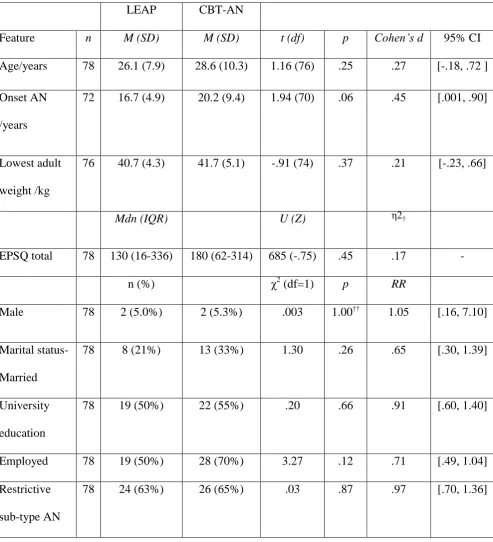
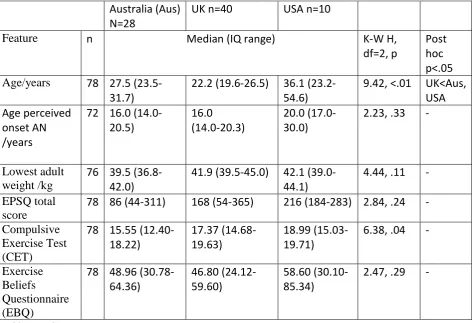
Seventy-eight adults were randomised (see Table 1): Sydney (n=28), Leicester (n=40) and New York (n=10). Between treatment group and site features are reported in Table 1 and
Additional online Table 1. Participants in the UK were older than others. There were no other
significant site differences (all p>.01).
INSERT TABLE 1 ABOUT HERE
Participant flow (see Additional online Figure 1): Thirty-five percent of those eligible
to participate were randomized. Eighty-seven percent completed LEAP and the comparable
CBT-AN treatment period. Fifty-five percent completed 75% of therapy sessions.
Assessment attrition at 6-months was 45%; higher in the LEAP arm (53% vs 38%)
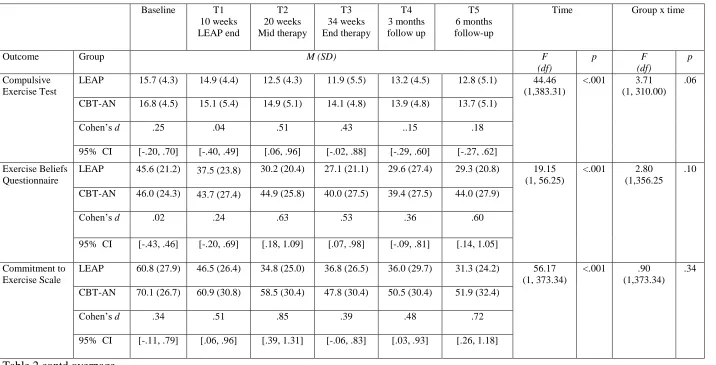
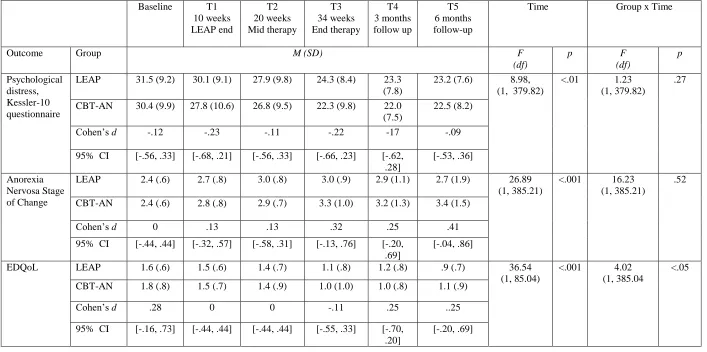
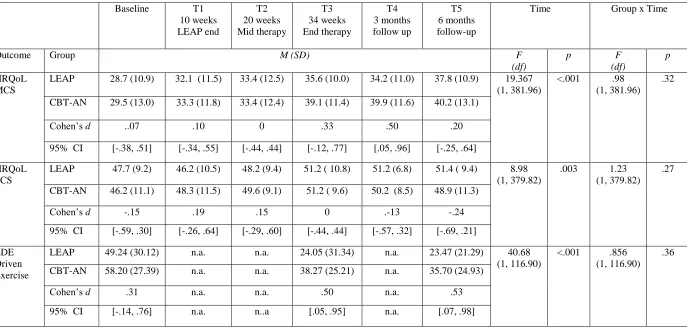
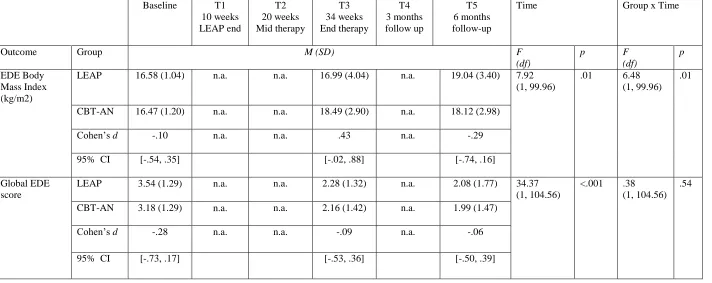
Between group outcome analyses: Primary and secondary outcome data are presented
in Table 2.
INSERT TABLE 2 ABOUT HERE
There was a significant effect of time for all outcomes. There were no significant
effects of group by time interactions with the exception of BMI (see also Additional online
Figure 2). At 6-months 20 (52.6%) in the LEAP and 15 (37.5%) in the CBT-AN arm had
BMI>18.5 and there were 22 (28%) people in “remission”, i.e. scoring within 1 SD of
community norms for Global EDE (Mond, Hay, Rodgers, Owen, & Beumont, 2004) BMI
>18.5 (n= 11 in each treatment group).
Fidelity: Three raters had mean inter-rater agreement range of 68.63-96.25 on CBT
components. Out of a total 56 rated sessions, only 3 sessions (5.4%) were rated as not
conforming to standard CBT protocol. In 94.6% of sessions (53/56), clinicians were
Client satisfaction: At end of treatment the mean overall CSQ score was 3.39 (SD .56,
range 3.12-3.53, n=48, maximum score of 4) and this did not differ between treatment groups
(t(46)=1.175, p=.862). The mean scores for the therapy’s suitability was 7.29 (SD 1.76, n=49), perceived success was 6.43 (SD=1.99, n=49), and recommendation to others was 7.49
(SD=1.77, n=49) (maximum scores of 9 for these three ratings).
Blinding: Thirty-nine (50%) participants answered the question on blinding, 14
considered they were in the novel group, 18 in the control group and seven did not know.
Eleven (61%) correctly identified they received novel therapy and 14 (66%) correctly
identified that they received the standard therapy. Overall 25 (64%) correctly identified their
treatment group.
Discussion
In this study there was improvement over time for all outcomes. The severity of core
compulsive exercise features on the CET improved to the levels of Australian young women
in the community (Taranis, Touyz, & Meyer, 2011) and patients “recovered” from AN
(Young, Rhodes, Touyz & Hay, 2015). There were no significant between group differences
with the exception of BMI. However, the pattern of change was difficult to interpret in that
BMI increased more rapidly during treatment in CBT-AN than in LEAP, but at 6-months
months follow-up BMI was higher in the LEAP compared to the CBT-AN group. Also, one
significant interaction out of 11 measures is nearing chance. Thus caution must be applied to
the result.
Limitations of the study were that participants had a range of levels of compulsive
exercise (albeit the mean CET was similar if not higher than reported in people with eating
disorders) and attrition which was particularly high at the six month follow-up. Further,
sessions in the later phase of CBT-AN) and 64% participants were correct in guessing their
treatment assignment, both of which may have reduced differences between groups.
Strengths were maintenance of treatment fidelity, use of multiple sites which improves
generalisability, and use of robust measures.
In conclusion, this study adds to previous literature regarding the incorporation of
physical activity and cognitive restructuring of attitudes towards compulsive exercise into
AN treatment. Clinicians may choose to use CBT-AN with or without LEAP for people with
Declarations
PH has received in sessional fees and lecture fees from the Australian Medical Council, Therapeutic Guidelines publication, and New South Wales Institute of Psychiatry and royalties from Hogrefe and Huber, McGraw Hill Education, and Blackwell Scientific Publications, and she has received research grants from the NHMRC and ARC. She is Deputy Chair of the National Eating Disorders Collaboration in Australia (2012-2013). In July 2017 she provided a commissioned report for Shire Pharmaceuticals on
lisdexamfetamine and binge eating disorder.
References
American Psychiatric Association. (2013). Diagnostic and statistical manual of mental disorders (DSM-5®). American Psychiatric Pub.
Andrews, G., & Slade, T. (2001). Interpreting scores on the Kessler psychological distress scale (K10). Australian and New Zealand Journal of Public Health, 25(6), 494-497. Cook, B., Wonderlich, S. A., Mitchell, J., Thompson, R., Sherman, R., & McCallum, K.
(2016). Exercise in eating disorders treatment: systematic review and proposal of guidelines. Medicine and Science in Sports and Exercise, 48(7), 1408-1414. Davis, C., Brewer, H., & Ratusny, D. (1993). Behavioral frequency and psychological
commitment: necessary concepts in the study of excessive exercising. Journal of Behavioral Medicine, 16(6), 611-628.
Davis, C., Kennedy, S. H., Ravelski, E., & Dionne, M. (1994). The role of physical activity in the development and maintenance of eating disorders. Psychological Medicine, 24(4), 957-967.
Engel, S. G., Wittrock, D. A., Crosby, R. D., Wonderlich, S. A., Mitchell, J. E., & Kolotkin, R. L. (2006). Development and psychometric validation of an eating disorder‐specific health‐related quality of life instrument. International Journal of Eating Disorders, 39(1), 62-71.
Fairburn, C. G., Cooper, Z., & O’Connor, M. (2008). The Eating Disorders Examination v6. In: Fairburn, C.G., editor. Cognitive Behavior Therapy and Eating Disorders. New York: Guildford Press; pp.265-308.
Fietz, M., Touyz, S., & Hay, P. (2014). A risk profile of compulsive exercise in adolescents with an eating disorder: a systematic review. Advances in Eating Disorders: Theory, Research and Practice, 2(3), 241-263.
Larsen, D. L., Attkisson, C. C., Hargreaves, W. A., & Nguyen, T. D. (1979). Assessment of client/patient satisfaction: development of a general scale Evaluation and Program Planning, 2(3),197-207.
Loumidis, K. S., & Wells, A. (1998). Assessment of beliefs in exercise dependence: The development and preliminary validation of the exercise beliefs questionnaire.
Personality and Individual Differences, 25(3), 553-567..
Meyer, C., Taranis, L., Goodwin, H., & Haycraft, E. (2011). Compulsive exercise and eating disorders. European Eating Disorders Review, 19(3), 174-189.
Mond, J. M., Hay, P. J., Rodgers, B., Owen, C., & Beumont, P. J. (2004). Validity of the Eating Disorder Examination Questionnaire (EDE-Q) in screening for eating disorders in community samples. Behaviour Research and Therapy, 42(5), 551-567.
Pike, K. M., Walsh, B. T., Vitousek, K., Wilson, G. T., & Bauer, J. (2003). Cognitive behavior therapy in the posthospitalization treatment of anorexia nervosa. American Journal of Psychiatry, 160(11), 2046-2049.
Rieger, E., Touyz, S.W., & Beumont, P. J. V. (2002) The Anorexia Nervosa Stages of Change Questionnaire (ANSOCQ). International Journal of Eating Disorders, 32, 24-38.
Steinhausen, H. C., Grigoroiu‐Serbanescu, M., Boyadjieva, S., Neumärker, K. J., & Winkler Metzke, C. (2008). Course and predictors of rehospitalization in adolescent anorexia nervosa in a multisite study. International Journal of Eating Disorders, 41(1), 29-36. Taranis, L., Touyz, S., & Meyer, C. (2011). Disordered eating and exercise: Development
preliminary validation of the Compulsive Exercise Test (CET). European Eating Disorders Review, 19, 256–268.
Ware Jr, J. E., Kosinski, M., & Keller, S. D. (1996). A 12-Item Short-Form Health Survey: construction of scales and preliminary tests of reliability and validity. Medical care, 34(3), 220-233.
Young, S., Rhodes, P., Touyz, S., & Hay, P. (2015). The role of exercise across the lifespan in patients with anorexia nervosa: a narrative inquiry. Advances in Eating Disorders, 3(3), 237-250.
Table 1
Participant demographic and clinical features by randomisation group
LEAP CBT-AN
Feature n M (SD) M (SD) t (df) p Cohen’s d 95% CI
Age/years 78 26.1 (7.9) 28.6 (10.3) 1.16 (76) .25 .27 [-.18, .72 ]
Onset AN
/years
72 16.7 (4.9) 20.2 (9.4) 1.94 (70) .06 .45 [.001, .90]
Lowest adult
weight /kg
76 40.7 (4.3) 41.7 (5.1) -.91 (74) .37 .21 [-.23, .66]
Mdn (IQR) U (Z) η2†
EPSQ total 78 130 (16-336) 180 (62-314) 685 (-.75) .45 .17 -
n (%) χ2 (df=1) p RR
Male 78 2 (5.0%) 2 (5.3%) .003 1.00†† 1.05 [.16, 7.10]
Marital status-
Married
78 8 (21%) 13 (33%) 1.30 .26 .65 [.30, 1.39]
University
education
78 19 (50%) 22 (55%) .20 .66 .91 [.60, 1.40]
Employed 78 19 (50%) 28 (70%) 3.27 .12 .71 [.49, 1.04]
Restrictive
sub-type AN
78 24 (63%) 26 (65%) .03 .87 .97 [.70, 1.36]
Note: CI = confidence interval; EPSQ = Exercise Participation Screening Questionnaire; RR = Risk Ratio; AN = Anorexia Nervosa; Employed = paid employment or home-maker;
†
Table 2
Primary and secondary outcomes between groups with between group effect size (Cohen’s d) at each time point and linear mixed effects modelling analyses with maximum likelihood imputation of complete sample (n=78).
Baseline T1 10 weeks LEAP end T2 20 weeks Mid therapy T3 34 weeks End therapy T4 3 months follow up T5 6 months follow-up
Time Group x time
Outcome Group M (SD) F
(df)
p F
(df)
p
Compulsive Exercise Test
LEAP 15.7 (4.3) 14.9 (4.4) 12.5 (4.3) 11.9 (5.5) 13.2 (4.5) 12.8 (5.1) 44.46 (1,383.31)
<.001 3.71 (1, 310.00)
.06
CBT-AN 16.8 (4.5) 15.1 (5.4) 14.9 (5.1) 14.1 (4.8) 13.9 (4.8) 13.7 (5.1)
Cohen’s d .25 .04 .51 .43 ..15 .18
95% CI [-.20, .70] [-.40, .49] [.06, .96] [-.02, .88] [-.29, .60] [-.27, .62]
Exercise Beliefs Questionnaire
LEAP 45.6 (21.2) 37.5 (23.8) 30.2 (20.4) 27.1 (21.1) 29.6 (27.4) 29.3 (20.8) 19.15 (1, 56.25)
<.001 2.80 (1,356.25
.10
CBT-AN 46.0 (24.3) 43.7 (27.4) 44.9 (25.8) 40.0 (27.5) 39.4 (27.5) 44.0 (27.9)
Cohen’s d .02 .24 .63 .53 .36 .60
95% CI [-.43, .46] [-.20, .69] [.18, 1.09] [.07, .98] [-.09, .81] [.14, 1.05]
Commitment to Exercise Scale
LEAP 60.8 (27.9) 46.5 (26.4) 34.8 (25.0) 36.8 (26.5) 36.0 (29.7) 31.3 (24.2) 56.17 (1, 373.34)
<.001 .90 (1,373.34)
.34
CBT-AN 70.1 (26.7) 60.9 (30.8) 58.5 (30.4) 47.8 (30.4) 50.5 (30.4) 51.9 (32.4)
Cohen’s d .34 .51 .85 .39 .48 .72
[image:15.842.70.786.151.516.2]95% CI [-.11, .79] [.06, .96] [.39, 1.31] [-.06, .83] [.03, .93] [.26, 1.18]
Table 2 contd
Baseline T1 10 weeks LEAP end T2 20 weeks Mid therapy T3 34 weeks End therapy T4 3 months follow up T5 6 months follow-up
Time Group x Time
Outcome Group M (SD) F
(df) p F (df) p Psychological distress, Kessler-10 questionnaire
LEAP 31.5 (9.2) 30.1 (9.1) 27.9 (9.8) 24.3 (8.4) 23.3 (7.8)
23.2 (7.6) 8.98, (1, 379.82)
<.01 1.23 (1, 379.82)
.27
CBT-AN 30.4 (9.9) 27.8 (10.6) 26.8 (9.5) 22.3 (9.8) 22.0 (7.5)
22.5 (8.2)
Cohen’s d -.12 -.23 -.11 -.22 -17 -.09
95% CI [-.56, .33] [-.68, .21] [-.56, .33] [-.66, .23] [-.62, .28]
[-.53, .36]
Anorexia Nervosa Stage of Change
LEAP 2.4 (.6) 2.7 (.8) 3.0 (.8) 3.0 (.9) 2.9 (1.1) 2.7 (1.9) 26.89 (1, 385.21)
<.001 16.23 (1, 385.21)
.52
CBT-AN 2.4 (.6) 2.8 (.8) 2.9 (.7) 3.3 (1.0) 3.2 (1.3) 3.4 (1.5)
Cohen’s d 0 .13 .13 .32 .25 .41
95% CI [-.44, .44] [-.32, .57] [-.58, .31] [-.13, .76] [-.20, .69]
[-.04, .86]
EDQoL LEAP 1.6 (.6) 1.5 (.6) 1.4 (.7) 1.1 (.8) 1.2 (.8) .9 (.7) 36.54 (1, 85.04)
<.001 4.02 (1, 385.04
<.05
CBT-AN 1.8 (.8) 1.5 (.7) 1.4 (.9) 1.0 (1.0) 1.0 (.8) 1.1 (.9)
Cohen’s d .28 0 0 -.11 .25 ..25
95% CI [-.16, .73] [-.44, .44] [-.44, .44] [-.55, .33] [-.70, .20]
[-.20, .69]
Table 2 contd
Baseline T1 10 weeks LEAP end T2 20 weeks Mid therapy T3 34 weeks End therapy T4 3 months follow up T5 6 months follow-up
Time Group x Time
Outcome Group M (SD) F
(df) p F (df) p HRQoL MCS
LEAP 28.7 (10.9) 32.1 (11.5) 33.4 (12.5) 35.6 (10.0) 34.2 (11.0) 37.8 (10.9) 19.367 (1, 381.96)
<.001 .98 (1, 381.96)
.32
CBT-AN 29.5 (13.0) 33.3 (11.8) 33.4 (12.4) 39.1 (11.4) 39.9 (11.6) 40.2 (13.1)
Cohen’s d ..07 .10 0 .33 .50 .20
95% CI [-.38, .51] [-.34, .55] [-.44, .44] [-.12, .77] [.05, .96] [-.25, .64]
HRQoL PCS
LEAP 47.7 (9.2) 46.2 (10.5) 48.2 (9.4) 51.2 ( 10.8) 51.2 (6.8) 51.4 ( 9.4) 8.98 (1, 379.82)
.003 1.23 (1, 379.82)
.27
CBT-AN 46.2 (11.1) 48.3 (11.5) 49.6 (9.1) 51.2 ( 9.6) 50.2 (8.5) 48.9 (11.3)
Cohen’s d -.15 .19 .15 0 .-13 -.24
95% CI [-.59, .30] [-.26, .64] [-.29, .60] [-.44, .44] [-.57, .32] [-.69, .21]
EDE Driven Exercise
LEAP 49.24 (30.12) n.a. n.a. 24.05 (31.34) n.a. 23.47 (21.29) 40.68 (1, 116.90)
<.001 .856 (1, 116.90)
.36
CBT-AN 58.20 (27.39) n.a. n.a. 38.27 (25.21) n.a. 35.70 (24.93)
Cohen’s d .31 n.a. n.a. .50 n.a. .53
95% CI [-.14, .76] n.a. n..a [.05, .95] n.a. [.07, .98]
Table 2 contd
Baseline T1 10 weeks LEAP end
T2 20 weeks Mid therapy
T3 34 weeks End therapy
T4 3 months follow up
T5 6 months follow-up
Time Group x Time
Outcome Group M (SD) F
(df)
p F
(df)
p
EDE Body Mass Index (kg/m2)
LEAP 16.58 (1.04) n.a. n.a. 16.99 (4.04) n.a. 19.04 (3.40) 7.92 (1, 99.96)
.01 6.48 (1, 99.96)
.01
CBT-AN 16.47 (1.20) n.a. n.a. 18.49 (2.90) n.a. 18.12 (2.98)
Cohen’s d -.10 n.a. n.a. .43 n.a. -.29
95% CI [-.54, .35] [-.02, .88] [-.74, .16]
Global EDE score
LEAP 3.54 (1.29) n.a. n.a. 2.28 (1.32) n.a. 2.08 (1.77) 34.37 (1, 104.56)
<.001 .38 (1, 104.56)
.54
CBT-AN 3.18 (1.29) n.a. n.a. 2.16 (1.42) n.a. 1.99 (1.47)
Cohen’s d -.28 n.a. n.a. -.09 n.a. -.06
95% CI [-.73, .17] [-.53, .36] [-.50, .39]
Additional online Table: Site group demographic, and primary outcome comparisons
Australia (Aus) N=28
UK n=40 USA n=10
Feature n Median (IQ range) K-W H,
df=2, p
Post hoc p<.05
Age/years 78 27.5 (23.5-31.7)
22.2 (19.6-26.5) 36.1 (23.2-54.6)
9.42, <.01 UK<Aus, USA Age perceived
onset AN /years
72 16.0 (14.0-20.5)
16.0 (14.0-20.3)
20.0 (17.0-30.0)
2.23, .33 -
Lowest adult weight /kg
76 39.5 (36.8-42.0)
41.9 (39.5-45.0) 42.1 (39.0-44.1)
4.44, .11 -
EPSQ total score
78 86 (44-311) 168 (54-365) 216 (184-283) 2.84, .24 -
Compulsive Exercise Test (CET)
78 15.55 (12.40-18.22)
17.37 (14.68-19.63)
18.99 (15.03-19.71)
6.38, .04 -
Exercise Beliefs Questionnaire (EBQ)
78 48.96 (30.78-64.36)
46.80 (24.12-59.60)
58.60 (30.10-85.34)
[image:19.595.70.544.123.446.2]2.47, .29 -
Additional online Table contd: Site group demographic, and primary outcome comparisons
Australia (Aus) N=28
UK n=40 USA n=10
Feature n Median (IQ range) K-W H,
df=2, p
Post hoc p<.05
Commitment to Exercise Scale (CES)
78 65.09 (41.70-86.94)
70.13 (54.75-90.88)
85.06 (59.75-87.50)
1.17, .56 -
EDE BMI kg/m2
78 16.40 (15.60-17.24)
16.80 (15.60-17.39)
17.36 (16.71-17.80)
5.03, .08 -
Global EDE score
78 3.0 (2.1-3.7) 3.9 (3.1-4.8) 2.4 (.8-4.2) 5.71, .06 -
EDE Driven exercise
78 54.5 (10.5-79.5)
60.0 (34.081.5) 73.0 (67.0 -84.0)
3.58, .17 -
n (% those within those with the feature) χ2, df=2, p
Male 78 2 (50%) 1 (25%) 1 (25%) 1.289, .53 -
Marital status- Married
78 9 (43%) 8 (38%) 4 (19%) 2.231,.33 -
University level education
78 18 (44%) 16 (39%) 7 (17%) 5.295,.07 -
In paid employment/ homemaker
78 19 (40%) 22 (47%) 6 (13%) 1.137, .57 -
Restrictive sub-type
78 18 (36%) 24 (48%) 8 (16%) 1.391, .50
Additional online Figure 1. Participant flow
*Note: None were returned to the study after less than 3 weeks of hospitalisation. A=Australia, UK=United Kingdom, USA=United States of America , LEAP =The
compuLsive Exercise Activity TheraPy added to Cognitive Behaviour Therapy for Anorexia Nervosa arm of the trial, CBT-AN = The Cognitive Behaviour Therapy for Anorexia
Nervosa without LEAP arm of the trial Assessed for eligibility (n=574)
324 UK plus 211 A plus 39 US
Excluded (n=496)
296 did not meeting inclusion criteria (n=72A , 213 UK, 11 USA)
144 declined to participate (n=97 A, 30 UK, 17 USA )
56 had other reasons /incomplete assessment/other treatment service (n=14A, 41UK, 1 USA)
Allocated to LEAP + CBT-AN (n=38)
33 Completed all LEAP sessions 87%
21 Completed 75% LEAP+CBT-AN sessions 55%
17 Discontinued intervention* (1 too busy, 4 admitted hospital, 9 non-engaged, 1 therapy break, 2 unknown) 45%
Allocated to CBT-AN (n=40)
35 Completed all therapy sessions 1-10 AN 87%
22 Completed 75% CBT-AN sessions 55%
18 Discontinued intervention* (n=14 non-engaged, 2 admitted to hospital, 1 therapy break, 1 unknown) 45%
Allocation
Follow-Up & Analyses
78 Randomized
Data Analysed n=38
Assessed:
End of LEAP n=31 End of Treatment n=24 6 months n=18
Data Analysed n=40
Assessed:
Additional online Figure 2. Body mass indices (BMI) for each intervention group over
time with maximum likelihood imputation of complete sample (N=78).
BMI (kg/m2) as measured during Eating Disorder Examination,