September 2008 http://www.becta.org.uk page 1 of 139
© Becta 2008 Research report
Implementing Web 2.0 in Secondary Schools:
Impacts, Barriers and Issues
Charles Crook, Tony Fisher, Rebecca Graber, Colin Harrison, Cathy Lewin
With
September 2008 http://www.becta.org.uk page 2 of 139
© Becta 2008 Research report
Contents
Executive summary ... 5
1.1 An overview of the Web 2.0 project ... 12 1 Context, methodology and authority of this report ... 12
1.2 The questions asked ... 12
1.4 Investigating impact: Boundaries and complexities ... 15 1.3 Sketching the methodology ... 14
2 Web 2.0 technologies in action ... 16
2.1.1 Social networking ... 17 2.1 More prevalent activities ... 16
2.1.2 Blogging ... 19 2.1.4 Conversational arenas ... 23 2.1.3 Wikis ... 22
2.1.5 Media sharing ... 28 2.2.1 Collaborative editing/composition ... 30 2.2 Less prevalent activities ... 30
2.2.2 Recommender systems ... 31 2.2.3 Less prevalent activities ... 31
3 Impact of Web 2.0 on learning and teaching ... 32 3.1 Stimulating new modes of enquiry ... 32 3.2 Supporting collaboration ... 36
3.2.1 Do practitioners find collaboration desirable? ... 36
3.2.2 Examples of practice of using Web 2.0 to foster collaboration ... 38
3.2.4 The compelling nature of collaboration ... 39 3.2.3 Peer assessment ... 38
3.3 Engaging with new literacies ... 40
3.3.2 Engagement through different modes of expression ... 41 3.3.1 Examples of practice of engaging with new literacies ... 41
3.3.3 Supporting learners with poor literacy skills ... 42 3.4.1 Examples of practices of generating publication ... 43 3.4 Generating publication ... 43
3.4.2 Ownership ... 44 3.4.4 Development and demonstration of interests ... 46 3.4.3 A sense of audience ... 44
September 2008 http://www.becta.org.uk page 3 of 139
© Becta 2008 Research report
4.1.1 Teachers’ views on learners’ Web 2.0 use ... 50
4.1.3 Teachers’ personal Web 2.0 use ... 53
4.1.2 Teachers’ views on the use of Web 2.0 for learning ... 50
4.2 E-safety and security ... 54
4.2.1 Negotiating the boundary between home and school ... 54
4.2.2 Regulating access to sites: Filtering and blocking ... 55
4.2.3 Monitoring and educating learners to behave responsibly online ... 59
4.2.4 Cyberbullying and other worst-case scenarios ... 60
4.3 Technical issues ... 61
4.3.1 Ensuring sufficient access to IT ... 61
4.3.2 Bandwidth ... 63
4.3.3 Access to technical and administrative support ... 64
4.4 Other implementation issues: Legal, content, portability ... 66
4.4.1 Legal issues ... 66
4.4.2 Content issues ... 68
4.4.3 Portability issues ... 69
4.5 Processes of innovation: From the innovators’ perspective ... 70
4.5.1 Motivations for Web 2.0 innovation: Individual innovators and innovating schools ... 70
4.5.2 Developing a context for innovation: Individual innovators and innovating schools ... 73
4.6.1 Training and disseminating good practice ... 75
4.6 Training, support and leadership ... 75
4.6.2 Time pressures ... 77
4.6.3 Provision of technical support ... 79
4.6.4 Leadership and management structures ... 79
5 Choices, opportunities and visions ... 82
5.1 Choices ... 82
5.1.1 Realising a platform for Web 2.0: The changing nature of the walled garden ... 82
5.1.2 Disseminating practice ... 84
5.1.3 Autonomy of technical implementation ... 86
5.2 Opportunities ... 88
5.2.1 Young people as a source of opportunity ... 88
5.2.2 Curriculum and assessment: Barriers preventing innovation or keys to good practice? ... 91
5.3.1 Nature of learning and relationship to technology ... 95
September 2008 http://www.becta.org.uk page 4 of 139
© Becta 2008 Research report
5.3.2 The changing role of teachers ... 97 5.3.3 A vision of engagement ... 99
6 Implications for policy-makers ... 101
September 2008 http://www.becta.org.uk page 5 of 139
© Becta 2008 Research report
Executive summary
This report presents evidence relating to Web 2.0 practices as they are currently realised in the educational community at Key Stages 3 and 4. It is one of several reports on Web 2.0 that can be accessed from the Becta website at:
http://partners.becta.org.uk/index.php?section=rh&catcode=_re_rp_02&rid=14543
This report aims to:
• evaluate the impact on learning and teaching of Web 2.0 and the opportunities presented by its use
• investigate barriers and challenges to implementation by evaluating experiences across local authorities
• examine teachers’ observations of impact on learners, and on the processes of innovation at individual and institutional levels
• highlight choices, opportunities and visions presented by Web 2.0 in education and draws out implications for current policy.
The report draws upon evidence from multiple sources: field studies of 27 schools across the country; guided surveys of 2,600 school students; 100 interviews and 206 online surveys conducted with managers, teachers and technical staff in these
schools; online surveys of the views of 96 parents; interviews held with 18 individual innovators in the field of Web 2.0 in education; and interviews with nine regional managers responsible for implementation of ICT at national level.
Two rather different approaches to Web 2.0 were encountered:
• For some, implementation was primarily about adopting Web 2.0 tools • For others, it was about practice resonating with the Web 2.0 ethos of
establishing and sustaining collaborative learning communities. Web 2.0 technologies in action
The project looked closely at the implementation of those Web 2.0 tools most prevalent among learners at home and at participating innovating schools: social networking, blogs, wikis, conversational arenas and media sharing (including podcasting). Unless otherwise stated, all statistics refer to the full data set.
September 2008 http://www.becta.org.uk page 6 of 139
© Becta 2008 Research report
lesson planning (whereas 45% had a social networking account for personal use).
• Blogs. Many teachers used personal blogs, but 48% thought it was not important for students to keep blogs in school. Some teachers used blogs to record information, opinion and ideas, and for sharing good practice among colleagues and some of these were available on the open internet. Some teachers used blogs with students, setting open-ended tasks with structured support provided through the blog, with the goal of encouraging enquiry and empowerment. Blogs were found to be useful both for in-class activities and for extra-curricular activities such as debate, peer
assessment and commenting on shared experiences.
• Wikis. Teachers were generally enthusiastic about the opportunities presented by wikis, with 46% believing that students should have the experience of building their own wiki encyclopaedia. Although examples of teachers editing wikis for schoolwork were comparatively few, 75.2% of teachers reported using a wiki – 32% had done so during lessons. Wikis were used with students for peer assessment, development of behaviour guidelines, and sharing knowledge and research. However, some teachers found that wikis were unsuitable as document repositories and were
unable to cope with the conversational demand generated, and moved from wikis to linked discussion forums.
• Discussion forums and online chat. Discussion forums were perceived by a number of teachers to have significant potential for learning –
provided activities were carefully structured and monitored. Where forums were used, they were normally ‘closed’, hosted within the protective environment of a school’s virtual learning environment (VLE). Discussion forums provided the means for supporting weaker students (through monitoring and additional, targeted prompts) and higher-ability students (through extension materials and activities). Nearly half of teachers felt competent or very competent with their use. However, only about 13% of teachers felt very competent with internet chat and instant messaging, and teachers were divided about the potential of these technologies for future use in the classroom.
• Uploading and downloading material. Three-quarters of teachers
surveyed believed that students needed more experience of uploading and downloading materials. Some languages teachers made extensive use of ‘vokis’ (where an avatar on a website is used to replay a sound recording of a student). However, podcasting was only used experimentally or sporadically. Some teachers used video clips from YouTube, but general access to YouTube was blocked in all but two of participating schools. • What tools were absent? Some Web 2.0 tools were absent in nearly all
September 2008 http://www.becta.org.uk page 7 of 139
© Becta 2008 Research report
editing/composition, recommender systems, syndication, and media manipulation and distribution. Where collaborative editing occurred, it was largely between teachers and students rather than between students; access to computer suites was reported as a constraint to this activity. Social bookmarking tools were only used by one innovator and one Web 2.0-innovating school.
Impact of 2.0 on teaching and learning
Student motivation and engagement were, for both teachers and innovators, the most powerful drivers behind using Web 2.0 tools for learning. Innovators tended to express a sense of continuity with existing practices rather than a radical departure from them.
Overall, the uses of Web 2.0 approaches that were encountered were exploratory rather than embedded, but four potential benefits to learning and teaching of using Web 2.0 to establish and sustain a participatory, collaborative and creative ethos of enquiry were found in the data, though in differing degrees:
• The first of these was stimulating new modes of enquiry. Enthusiasts often expressed their positive disposition in terms of the ‘independence’ of enquiry that Web 2.0 access offered; though this was tempered with an awareness that learners needed to be guided into acquiring this
independence, particularly when students were tentative or even suspicious of using internet resources.
• The social internet affords new opportunities for engaging in
collaborative learning activities. Activities grounded in communication (such as discussions, speaking and listening) can clearly be facilitated through technology, and 82% of teachers indicated that their students needed more experience of collaborative learning. Two-thirds of teachers thought that Web 2.0 tools could support such collaboration, although 41% of teachers had never used Web 2.0 to facilitate it. Perceived challenges included barriers presented by the examinations system and learners viewing Web 2.0 tools primarily as ‘chat spaces’. However, some teachers had found that Web 2.0 technologies could encourage simultaneous, learner-directed discussions which extended beyond the lesson, and examples of these are presented in the main report and in the case studies that follow it.
September 2008 http://www.becta.org.uk page 8 of 139
© Becta 2008 Research report
needs, and supported learners’ natural curiosity by enabling expression through different media and a sense of audience, providing access to further resources and the ability to gain confidence and skill in speaking and presenting.
• A small but significant group of innovating teachers saw publication of content as an important Web 2.0 area, and felt they had an important role in providing learners with the skills and confidence to do this. Publication was felt to enhance a learner’s sense of ownership, engagement and awareness of audience, lending weight to peer assessment and to
learning informally or outside the classroom. Learning platforms were the most common outlet for publication, through publishing presentations for use in lessons, engaging in writing competitions, building personal web spaces, and uploading images and text for peer assessment. Teachers were generally interested in publishing more of their students’ work online, but felt more comfortable doing this within a learning platform or VLE. Implementation: Barriers, tensions and facilitators
There was a generally high level of awareness and understanding among teachers of Web 2.0 technologies and their use by young people. While practically all teachers that were met were active internet users – 93% reported having used a search
engine within the last 24 hours, active Web 2.0 users represented a minority. • Potential. Of the teachers in the survey schools, 54% believed that ‘Web
2.0 resources could support more effective collaborative learning’, but many were unsure about the opportunities presented by Web 2.0 or felt they did not have enough information to decide. Some teachers were enthusiastic proponents: 59% believed that popular Web 2.0 resources should get more use in the classroom, but others were more concerned about issues such as time for familiarisation and planning, or problems of control and trust. Many teachers felt that curriculum and assessment pressures reduced their opportunities to introduce Web 2.0 approaches. More than a third (37.4%) of teachers believed adopting Web 2.0
resources would be very time-consuming, and teachers frequently (18.7%) or occasionally (47.0%) found that student use of the internet in class was hard for them to manage. Many teachers had concerns about being let down by technical failure, or even worse, removal of the facility due to rising costs/insufficient budgets.
September 2008 http://www.becta.org.uk page 9 of 139
© Becta 2008 Research report
tighter internet controls), many teachers reported frustration at being unable to access websites due to RBC/local authority and/or school
filtering systems. Not all staff were clear about how to unblock sites. While many teachers and ICT co-ordinators felt local authority filtering to be overly stringent, the RBC view was clear: filtering is in place because schools and teachers want it. In addition to cyberbullying worries, practitioners also expressed concerns about the privacy/safety of passwords, the use of public forums and the possible traceability of children.
• Access to technology was felt by teachers to be crucial for effective Web 2.0 use. In some schools, barriers included insufficient access to computer suites (where ICT subject teaching predominates), insufficient levels of technical support (including specialist support for Web 2.0 tools) and/or insufficient bandwidth. The most active Web 2.0 schools had high levels of ICT resourcing, particularly in terms of staffing to support
teachers as well as learners. Adequate bandwidth is important where schools need to access large files over the internet, and to run simulations and podcasting. Among the RBC leaders interviewed, all were looking to significantly expand bandwidth beyond current levels.
• Other barriers to uptake include legal, content and portability issues. Findings suggest most teachers have a lack of awareness of legal and copyright issues when using external resources. RBCs deal on schools’ behalf with a number of issues related to copyright and intellectual
property, and take positions aimed at facilitating schools’ access to asset collections. Staff rarely raised issues of intellectual property rights and plagiarism in relation to the ideas and work of pupils, despite the relevance of these issues to collaborative activities. Transition and portability were a concern of RBC leaders and were being addressed through developments in single sign-on workspaces and authentication of users.
• Innovation was most commonly identified as starting at the individual and local level, though management support could greatly facilitate the embedding of change. However, staffing changes could have a major impact when innovators moved to new posts. Effective staff development opportunities, with support and time for innovation, play a crucial role in the process of Web 2.0 adoption, and 56% of teachers indicated that they would welcome more guidance in the use of Web 2.0 technologies. Choices, opportunities and visions
September 2008 http://www.becta.org.uk page 10 of 139
© Becta 2008 Research report
• How large is a ‘walled garden’? Nearly all the Web 2.0 schools did have some form of VLE, whether developed in-house or externally. For most schools, hosting Web 2.0 activity implied a walled garden approach with password-protected content, but a minority of Web 2.0-innovating schools enabled some or all of their Web 2.0 activities to be visible on the open internet – podcasts, in particular, benefited from wider publication.
Nationally, some RBCs aim to replace the concept of a school-level walled garden with a much bolder and more extensive concept that will connect up to a million users (teachers, pupils and other stakeholders, including parents) in large-scale, protected learning communities while maintaining duty of care.
• Local autonomy or regional community? Schools have to choose how much autonomy to retain as regards implementation of the technical infrastructure needed for Web 2.0. In-house expertise, at its best, yielded tools which were more specific to the schools’ needs and more
immediately responsive to problems (for example, immediately facilitating access to a blocked website or updating content). However, use of
external services may be felt to offer a greater pool of functionalities and capabilities. Externally hosted VLEs solved many problems, but were sometimes felt to place a greater strain on bandwidth as pupils needed to upload and download resources. The need to moderate conversational arenas was also seen as a potential barrier, particularly in relation to staff time.
• The perceived rigidity of the secondary school timetable was viewed by managers and practitioners as a barrier to implementation. There was a perceived tension between requirements for assessment and adoption of Web 2.0 tools. Little mention was made of the formal assessment of work from Web 2.0 sources or where computer-supported collaboration has been involved.
• For the local authority and RBC managers interviewed, Web 2.0 approaches were particularly seen as key to developing
personalised, ‘anytime-anywhere’, independent learning. Related to this was an awareness that students needed to be prepared for new experiences of the workplace and its technologies.
Implications for policy-makers
Policy-makers need to be aware that:
September 2008 http://www.becta.org.uk page 11 of 139
© Becta 2008 Research report
• Many innovating teachers feel that current curriculum and assessment structures inhibit and de-incentivise the creative use of Web 2.0
technologies
• The implications of new digital assessment and recording capabilities are still being explored, and issues of permanence, ownership, file access, storage of large files and data transfer between schools will need very careful consideration
• Web 2.0 raises significant issues in relation to the authority of knowledge, and highlights the importance of developing critical internet literacy
• Web 2.0 activity highlights the importance of schools taking responsibility to exercise a duty of care in relation to e-safety that extends beyond the school wall; schools need to support learners in becoming independent users, skilled navigators and critical interpreters of the internet
• Web 2.0 pedagogies flourished where the following were in place:
o A reliable, resilient computer infrastructure with good access for teachers and students, sufficient bandwidth, hardware sustainability, and rapid, effective technical support
o Clear vision and supportive leadership from management, in
conjunction with targeted, effective staff development for all teachers (that covers both technical and pedagogical skills) and additional support for individual innovators
o Flexible models of learning with Web 2.0 approaches embedded in the curriculum, both within and across subjects, coupled with support for student learning at home as well as school
o Supportive leadership from managers who are sensitised to the opportunities of using Web 2.0 and who can enact an e-safety policy that provides protection while educating learners about responsible behaviour and critical literacy on the open internet.
September 2008 http://www.becta.org.uk page 12 of 139
© Becta 2008 Research report
1
Context, methodology and authority of this report
1.1 An overview of the Web 2.0 project
The Becta research project on Web 2.0 technologies for learning at Key Stages 3 and 4 had five primary objectives:
1 To present an overview of current research into Web 2.0 and its potential uses in education.
2 To provide insight into learners’ use of Web 2.0 both at home and at school.
3 To evaluate the impact on teaching and learning of Web 2.0 and opportunities presented by its use in education.
4 To investigate barriers and challenges to implementation by evaluating experiences across local authorities.
5 To identify e-safety and child protection issues surrounding the use of Web 2.0 and identify how these technologies can be used safely.
The present report is focused on the third and fourth of these objectives. In order to investigate these questions, the research team conducted in-depth investigations of 27 schools across the country, and also interviewed individual innovators within the field of Web 2.0 in education and regional managers responsible for the
implementation of ICT at a national level. Furthermore, online surveys and focus groups were conducted with 2,600 learners at Key Stages 3 and 4, more than 100 interviews and 206 online surveys were conducted with teachers in these schools, and online surveys of a cross-section of parents were administered. The data from the project therefore presents a significant opportunity to gain detailed understanding of Web 2.0 as it is currently practised in the educational community, evaluate the challenges and opportunities presented by these practices, and to highlight areas where further development of Web 2.0 may be promising.
This report builds upon the framework established in the project’s first report, The Current Landscape – Opportunities, Challenges and Tensions (see the first objective in the list above). That report constructed a taxonomy of activities for understanding Web 2.0 practices, highlighted some of the educational potential of Web 2.0, and provided a framework for understanding some of the systemic and technological challenges involved in implementation. Other reports have provided detailed
analyses of learners’ use of Web 2.0 both at home and at school (objective two) and have addressed the significant e-safety and child protection issues raised by Web 2.0 from a variety of informant and expert perspectives (objective five).
1.2 The questions asked
September 2008 http://www.becta.org.uk page 13 of 139
© Becta 2008 Research report
• What are teachers doing with Web 2.0 technologies? • How does this impact learning and teaching?
• What factors seem to assist or hinder teachers’ use of Web 2.0?
In order to address these questions, the report will draw on data from multiple sources, elicited from headteachers, ICT co-ordinators, teachers and ICT personnel from a nationally stratified ‘normative survey’ set of 15 secondary schools, and a second set of 12 ‘innovating schools’ in which Web 2.0 technologies were already being used in at least two curriculum areas. Survey data focused upon teachers’ and parents’ experiences with a variety of Web 2.0 technologies and platforms, and probed these groups’ evaluation of the opportunities and risks involved in using Web 2.0 for education, as well as perceived impact upon their children or students.
As well as interviewing individual teachers, the project aimed to capture
departmental, school and regional Web 2.0 activity, developing a number of school-level case studies and vignettes of innovating practice, while also looking at system-level factors such as the original stimulus to innovation, resource investment and development, technical infrastructure specification, the management of widespread adoption, barriers and facilitators to sustaining good practice, security and privacy concerns, and the integration of classroom innovation with learners’ out-of-school engagement.
In investigating factors which facilitated or inhibited Web 2.0 innovation in a school, the focus was on motivations for innovation, supportive aspects of the institutional context, and perceived effects for learners. Some of the barriers and facilitators to implementation which were specifically addressed with participants included e-Safety issues, legal, content and curriculum issues, and portability and access issues. Where challenges had been faced in implementation, the team sought detailed understanding of the processes and outcomes involved.
In both interviews and surveys, two rather different approaches to Web 2.0 were encountered. Some practitioners saw Web 2.0 as essentially a set of tools – such as wikis, podcasts or blogs. For others, however, the term ‘Web 2.0’ was seen as
indicative of certain educational practices and activities that used the internet to form and sustain networked communities, for example, through collaborative group work or peer assessment. Many people who were interviewed noted that Web 2.0 tools may be used in ways that do not resonate with such a Web 2.0 ethos – for example, a teacher may use a blog simply as a noticeboard for teachers to communicate with students, with no commentary from students allowed (or, if commentary is enabled, no engagement). For some practitioners, therefore, Web 2.0 implementation was primarily about adopting Web 2.0 tools; for others, it was about transforming education to resonate with the Web 2.0 ethos of establishing and sustaining
September 2008 http://www.becta.org.uk page 14 of 139
© Becta 2008 Research report
structure of this report by encouraging exploration first of tools, followed by practices deriving from the Web 2.0 ethos.
1.3 Sketching the methodology
In order to obtain a nationally representative picture, but also to ensure that the project encountered many examples of good practice, researchers worked with two populations of schools: a normative group; and a group of Web 2.0-innovating schools. The 15 normative sample (NS) schools were a subset of the 27 schools identified by the national ImpaCT2 project in 2002; where schools declined to
participate, others matching their demographic and ICT capability were approached. In the case of the 12 Web 2.0-innovating schools, inclusion necessitated evidence of active and sustained involvement with Web 2.0 approaches in at least two curriculum areas. In the event, the practice in over 70 schools was evaluated before selecting the 12 innovating schools whose practice is shown in this report. The final set of schools spanned 18 local authorities, from Devon to Teesside. Multimedia interviews with 18 teachers across the country who had made significant progress as Web 2.0 innovators within Key Stage 3 and Key Stage 4 contexts were also conducted. Most of them are currently working teachers in this sector, although three have adopted advisory or consultant roles and are significant leaders in the informal network of Web 2.0 innovators. Details of recruitment procedures for schools and individuals are recorded in Appendix 2.
The project team carried out surveys with more than 2,600 students and 206 teachers from the participating schools. In order to elicit the views of parents in the schools surveyed by the project, participating schools were asked to distribute a letter to all parents of students at Key Stages 3 and 4 inviting them to participate in an online parent survey, providing a URL and information for freepost return of a paper-based survey if they preferred. Only 76 parents from participating schools responded, six of whom used the freepost service, while 45 parents responded from the service, management and administrative listings of one of the research centres. Due to the size of this sample, which represents less than 5% of the target
population, generalisations from the results are indicative of the views of only an interested sub-sample of parents. In addition, approximately 100 focus groups were held with students at 25 schools. Interviews were also conducted with approximately 150 teachers, managers and technical staff at the project’s 27 schools. Unless otherwise indicated, survey data from the two populations of schools are reported together.
In addition to seeking examples of safe and effective practice within schools, the project also sought the views of national leaders of ICT in education on the
September 2008 http://www.becta.org.uk page 15 of 139
© Becta 2008 Research report
effort, extended telephone interviews were conducted with 10 RBC and local authority ICT managers.
The triangulation of data from surveys, focus groups and interviews with multiple informants from the participating schools, and the ability to compare this data with the observations of national managers, lends authority to the evidence presented throughout this report. The interview extracts presented are representative of the views of the subject group in question, except where debates and dissenting opinions are specifically noted.
1.4 Investigating impact: Boundaries and complexities
In this project’s view, there are three stages to engaging in educational research: • First, the field must be examined for trends – these trends should be
situated against existing practice and research, and tensions and
opportunities should be identified and explored. A taxonomy or map of the field is produced, and this new trend is located within the landscape. For Web 2.0, this was addressed in the Becta report, The Current Landscape – Opportunities, Challenges and Tensions.
• Second, more detailed analysis indicating the methods and impact of particular practices should be undertaken. In this stage, the aim is to capture existing and novel practice, to investigate the facilitators and barriers to use, and explore impact upon learning and teaching activity. The perceived experiences of participants provide valuable information about impact, and bring to the fore problems for subsequent research. This stage of research is crucial for identifying the boundaries of the topic under research, and for drawing out its complexities.
• Third, researchers may conduct intervention studies or analyse results of learning outcomes, such as standardised test scores, in order to provide evidence that the practice under investigation is effective in facilitating the learning of the individual student.
2
Web 2.0 technologies in action
This section of the report will describe and give examples of the use of particular Web 2.0 tools as practised by the Web 2.0 schools and innovators the project encountered. The taxonomy of activities that frames this section was derived from the first project report, The Current Landscape – Opportunities, Challenges and Tensions, in which interested readers will find discussions and explanations of different Web 2.0 technologies.
Social networking is discussed because of its ubiquity among learners out of school and relative absence in school, while blogging, wikis, conversational arenas and media sharing (including podcasting) are included because they were the four most prevalent expressions of Web 2.0 activities in the Web 2.0 schools. Most of the exemplars are drawn from the Web 2.0 schools, but some describe the activities of individual innovators. Discussion of each family of tools is preceded by a brief description and followed by key points. More details of exemplars may be found in Appendix 2: Case studies.
Less prevalent activities are then examined: media manipulation, social bookmarking, collaborative editing, syndication and recommender systems. Exemplars are provided where available.
[image:16.595.71.515.498.703.2]2.1 More prevalent activities
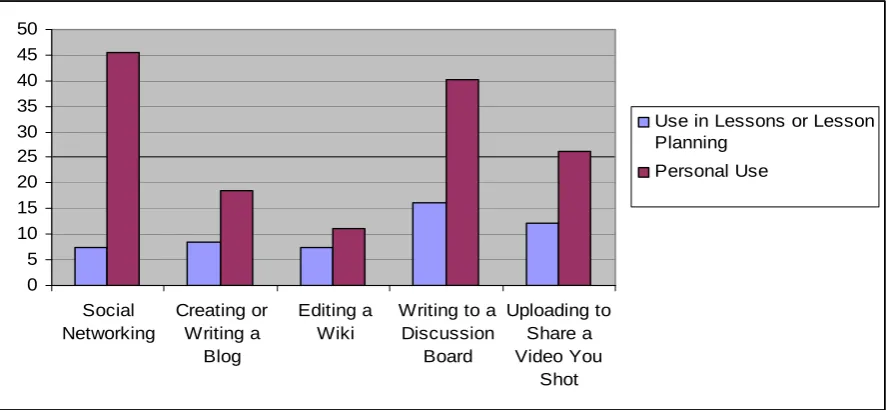
Figure 1: Use of more prevalent Web 2.0 tools by teachers in normative and Web 2.0 schools
0 5 10 15 20 25 30 35 40 45 50
Social Networking
Creating or Writing a
Blog
Editing a Wiki
Writing to a Discussion
Board
Uploading to Share a Video You
Shot
Use in Lessons or Lesson Planning
Personal Use
September 2008 http://www.becta.org.uk page 16 of 139
September 2008 http://www.becta.org.uk page 17 of 139
© Becta 2008 Research report
Even among the more prevalent Web 2.0 activities in the sample, widespread use of these tools is fairly low – as little as 7.3% of teachers have used social networking or editing of a wiki in their lessons or their lesson preparation. By contrast, teachers’ personal use of these technologies is greater, and similar to students’ reported use for tools such as discussion boards.
2.1.1 Social networking
Social networking sites are websites which structure social interaction between members who form sub-groups of friends. Examples popular among the learners and teachers studied include Bebo, MySpace and Facebook. Many of the more commercially successful sites incorporate extensive functionalities such as facilities for private messaging, blogs, uploading of photo, video and audio content,
commenting capabilities, multiplayer games and quizzes.
Project findings concerning student use of Web 2.0 indicate that 74% of the Key Stage 3 and 4 students surveyed have at least one social networking account. However, nearly all social networking is blocked in school, and therefore plays very little part in the ICT curriculum, although students commonly attempted to access such blocked sites through the use of proxy bypasses. Only 7.3% of teachers reported using social networking sites in lesson planning or in lessons. Likewise, teachers use these sites socially with less frequency; relative to students, only 45.6% of teachers use these sites recreationally.
A rare instance was found of a teacher sharing his Facebook and Bebo pages with students:
“Initially when I started sharing my Facebook and my Bebo pages and addresses and they find you, there’s a lot of, I guess, kudos to be someone who’s commented on the page of Mr [teacher’s name], I went on his page and I said this and stuff. But I have been surprised that they’re almost limited in the things they’ve got to talk about to me. They don’t know a great deal about my life, or even if they do, they don’t know if they should comment, so it’s ‘Hi sir’ but the next question is ‘Can you help me?’ or ‘What do you think of this?’ or ‘I found this website’. So in terms of interaction with teachers, that is the common ground we share, the common ground we share is that I teach them maths or I teach them ICT.” (Teacher, high user, W2)
Practitioners’ aspirations to utilise social networking in school encountered particular obstacles which then shaped the way the tools were used. In the initial contact with school W12, researchers were told that a social networking tool had been
September 2008 http://www.becta.org.uk page 18 of 139
© Becta 2008 Research report
source online photo album for A-level photography and an inexpensive online photo gallery tool as a general image library. The school was planning the introduction of a virtual learning environment (VLE) and assessing/trialling a range of options. They reported that they had been investigating hosting their own social networking. All of this development had apparently only taken place since September 2007 when they installed an open source server which would allow this.
However, during the research visit, it became clear that the actual prevalence of these activities had been very much exploratory and not widespread. This was not through lack of interest, but an overall problem with the external filter implemented by the RBC which, for example, blocked the social networking site and also certain search terms. This major barrier was at the root of the school’s desire to implement a ‘walled garden’ VLE, as this was seen as one of the easiest ways of overcoming the filtering issues experienced to date.
One Web 2.0 school (W7) developed an alternative to the content-heavy VLE that students can already access, harnessing Web 2.0 tools to engage learners. It has been created by teachers within the school and is now available for other schools to purchase. It offers a closed environment with blogs (for teachers and students), the facility to upload files either for assessment or publication, and an e-portfolio to support specific project work. In addition, students can edit their profile, sharing personal interests and uploading photographs. Finally, it facilitates instant messaging – the only means of engaging in this activity within school. Students can create friendship groups online allowing them to control who has access to personal spaces and who can communicate with whom. Sanctions are given for inappropriate use, placing the onus of responsibility with the student. The instant messaging is currently largely used for social communication, which sometimes requires controlling through classroom management. However, instant messaging is viewed as a positive
incentive to engage students with the environment (which is being populated with learning resources) rather than being perceived as a major classroom distraction. Thus, the benefits for teaching and learning are seen to outweigh the challenges. Currently, three or four departments are using it as well as some individual teachers across the school, but there will be a drive to encourage more widespread uptake in the next academic year:
September 2008 http://www.becta.org.uk page 19 of 139
© Becta 2008 Research report
class… they have a chance to contribute and without any kind of pressure on them. So it’s sort of levelled the playing field a bit with regard to feedback and peer assessment.” (Deputy headteacher, W7) Teachers perceived that it is popular with students because it is easy to use, and there is a degree of student ownership and control, although everything can be monitored by teachers.
The students who participated in focus groups had mixed views on the instant
messaging facility. It was not used outside school as public messaging systems were perceived to be better (one pupil said you cannot see who is online when in school). The purpose of this communication tool was questioned by some:
“There are only a few lessons when most of our mates aren’t there, so it’s easier to just get up and talk to them.” (Year 10, high user, W7) Key points: Social networking
• Social networking using popular commercial applications such as Bebo or Facebook (on which 75% of students surveyed had accounts) was very rare in schools. Only 7.3% of teachers reported having used a social networking site in lessons or lesson planning.
• Practitioners’ aspirations to utilise social networking in school encountered particular obstacles which then shaped the way the tools were used. These challenges included e-safety concerns, restrictive filtering
implemented by the RBC, and integrating a walled garden social network within a VLE.
• Where social networking occurred in schools, teachers attributed its popularity to ease of use and a degree of student ownership and control, although everything could be monitored by teachers. At school W7, instant messaging was viewed as a positive incentive to engage students with the environment (which is being populated with learning resources) rather than being perceived as a major classroom distraction.
• Another important aspect of the potential of social networking in schools is the fact that some students are more comfortable using online
communication than talking in class. 2.1.2 Blogging
September 2008 http://www.becta.org.uk page 20 of 139
© Becta 2008 Research report
way: for example, if a teacher assigns homework via blogs but students are not able to comment on the blog or post their own entries.
According to the teachers surveyed, 71.1% of teachers reported never having used a blog. Contributions to blogs are sporadic even among users, with 17.5% of teachers reporting having only used a blog ‘at some time’. Teachers are divided over whether they think it is important for students to keep blogs in schools: 29.8% think this is important or very important, whereas 48% think this is unimportant or very
unimportant. There was no significant difference in this opinion between normative and Web 2.0 schools, although Web 2.0 teachers were more likely to have created or written a blog.
Some evidence was found of teachers using blogs to record information, opinion and ideas, and one headteacher commented that he follows a number of educational leadership blogs. Blogs were also used for sharing good practice among staff, and an ICT teacher described how he keeps a blog under a screen name, partly to share teaching ideas but mainly to reflect on his practice, as he finds that writing things down forces him to think and come to decisions about them. Since it is available for all to see, he is careful about what he writes – ‘two or three’ students had stumbled across it and realised whose it was, but had added useful comments. Some teachers reported participation in forums directly connected with their work. One teacher commented that about half the comments on his Bebo page were work-related. Perhaps an important distinction here, therefore, is between teachers who see a blog as essentially a diary (which it is either presumptuous or an act of vanity to share), and those who see a blog as space for interaction between those with shared interests.
A geography teacher describing his use of blogs explained that he does not direct students straight to YouTube for clips he wishes them to use, and how this engages and empowers them:
“…because of the other things that could be on there which aren’t necessarily deemed appropriate, but what the blog allows me to do is to embed videos, so that when they click on it, they view the video inside the blog… and what I’m liking is that Year 11s are feeling more empowered in that they’re actually making comments on the things I put on there, and it’s becoming a dialogue between yourself and the students and as a result of that they feel… more ownership over their own learning…” (Geography teacher, W2)
September 2008 http://www.becta.org.uk page 21 of 139
© Becta 2008 Research report
Blogging at school W2 was at an experimental stage. At the time of data collection, there were eight blogs and one that had been closed. There was a blog associated with a Key Stage 4 course which has a small number of posts but the only comments were from staff. There was a Year 8 blog related to citizenship where learners had posted a piece about themselves as refugees. There were numerous posts in February 2008 as this was an activity undertaken in school but as of March 2008 there were no comments. In the previous year (2006-07), a modern foreign languages (MFL) teacher had created a website with blogs and podcasts for
German. The teacher had started a new post in another school in September 2007 and while the links to the site had been maintained, the resource had not yet been taken on by any other member of staff in the MFL department as staff felt ‘you need a little bit of technical nous to run with this stuff’. A geography blog was relatively well populated but the interaction was limited, in that it was largely being used as a
repository for multimedia resources that could help learners; evidence of two-way communication (comments and postings by learners) was extremely limited.
The project encountered some extra-curricular uses of Web 2.0 tools at school W2. One blog poses thought-provoking questions for anyone (within the school or not) to respond to. It was initiated in November 2006 with an initial vision of posting a ‘thought for debate’ on a weekly basis; 22 have been posted altogether, each attracting somewhere between five and 28 comments, mainly from staff and pupils. There are one or two voluntary discussion forums set up for pupils to use. One in relation to game design was described to be ‘lively’, run by pupils and used to share ideas about games. One teacher was running discussions on philosophy. There is evidence of regular activity, often out of school hours. The library staff have initiated a book reviews blog but this has not yet had any postings. A blog was set up initially to showcase multimedia work produced in a lunchtime club. There are only a few postings and nothing less than a year old.
The music department has had a blog since 2006 and uploads podcasts of
September 2008 http://www.becta.org.uk page 22 of 139
© Becta 2008 Research report
Key points: Blogging
• Many teachers used personal blogs, but 48% thought it was not important for students to keep blogs in school. There was no significant difference in this opinion between teachers in normative and Web 2.0 schools, although Web 2.0 teachers were more likely to have created or written a blog. • Some teachers used blogs to record information, opinion and ideas, and
for sharing good practice among colleagues; some of these were available on the open internet.
• Some teachers used blogs with students, setting open-ended tasks with structured support provided through the blog, with the goal of encouraging enquiry and empowerment. Blogs were found to be useful both for in-class activities and for extra-curricular activities such as debate, peer
assessment and commenting on shared experiences. 2.1.3 Wikis
Wikis are web-based services allowing users unrestricted access (sometimes conditional upon registration) to create, edit and link pages, providing an organised, socially constructed repository for knowledge. The public, collaborative
encyclopaedia Wikipedia is perhaps the best-known example, but smaller-scale wikis used in collaborative activities for learning are possible.
In most cases, the take-up and implementation of Web 2.0 to initiate and sustain wikis is best understood at the level of the individual teacher. For instance, a languages teacher explained how she began by introducing a wiki for students to access resources, upload their own work and hold discussions. However, it quickly became clear that it was becoming ‘quite clogged’ with discussions, so she moved the discussions to a VLE where she opened a forum for each piece of work, making it much more manageable. Another teacher described the use of a wiki to develop a set of ‘class rules’ for the ICT room:
“One of the first exercises that [the class] did was to compile a wiki – I put some rules on about you must run around in the class and you’ve got to chew and spill drink on the keyboards and they were all aghast at this, and I said ‘Well, you can change it if you like’. I showed them how to change a wiki and after 17 iterations we’d got a set of class rules that I couldn’t have bettered myself. So there was that community built up around the wiki… they all felt that they had a choice in what they said and did and that they were able to affect those around them by helping make the rules.” (ICT teacher, W2)
September 2008 http://www.becta.org.uk page 23 of 139
© Becta 2008 Research report
primarily for either of these purposes, it was not surprising that the teacher concerned found that the site was becoming ‘quite clogged’. Learners have a discussion within the VLE in relation to each piece of work, together with peer assessment. Wikis are used for knowledge/research-sharing projects, such as one recently on national heroes.
While examples of teachers editing wikis for work purposes are comparatively few, 75.2% of teachers have read a wiki (32% have done so during lessons), and 46.4% of teachers agree that students should have the experience of contributing to a wiki. Key points: Wikis
• Teachers were generally enthusiastic about the opportunities presented by wikis: 46% believed that students should have the experience of building their own wiki encyclopaedia.
• Although examples of teachers editing wikis for schoolwork were comparatively few, 75.2% of teachers reported using a wiki – 32% had done so during lessons.
• Wikis were used with students for peer assessment, development of behaviour guidelines, and sharing knowledge and research. However, some teachers found that wikis were unsuitable as document repositories and were unable to cope with the conversational demand generated, and moved from wikis to linked discussion forums.
2.1.4 Conversational arenas
This report uses the term ‘conversational arenas’ to refer to the variety of platforms through which one-to-one or one-to-many conversations between internet users can take place. Forums or discussion boards (in a forum the topics are generally fixed; a discussion board is often more open-ended in content) are online versions of bulletin boards, in which users post contributions on a topic-centred exchange and other users reply. Instant messaging and chat rooms enable real-time conversations between distinct users. Some users incorporate avatars or voice links into these arenas. It is the interaction and discussion using these media that are the focus of Web 2.0 style activity.
The use of chat rooms was perceived by a number of teachers to have potential in MFL, but such activity would have to be carefully structured and monitored to avoid inappropriate exchanges. Monitoring during the activity would be challenging. Forums are readily understood by teachers and are well established in some
September 2008 http://www.becta.org.uk page 24 of 139
© Becta 2008 Research report
supporting weaker students (through monitoring and additional, targeted prompts) and higher-ability students (through extension materials and activities).
Discussion boards seem to be a fairly accessible Web 2.0 tool for teachers to use: 44.9% feel competent or very competent with their use. By contrast, about 13% of teachers feel very competent with internet chat and instant messaging, and teachers are divided about the importance of these technologies for future use in the
classroom. Learning platforms are also relatively usable for teachers, as 20.2% judge themselves as very competent, and a further 32.2% as competent.
The use of discussion forums in one Web 2.0 school has helped the needs of particular populations in different ways. Higher-ability learners have engaged in rich discussions and debates. Lower-ability learners have contributed but are less inclined to take account of other contributions; rather they respond directly to the initial prompt. This group of learners requires more support from the teacher, in the same way that they would in a face-to-face situation. In terms of online discussions, this means monitoring by the teacher and more prompts to stimulate thinking and further responses. With mixed-ability classes, this results in the need for careful balancing.
To some extent the use of technology such as discussion forums is seen to level the playing field for different kinds of learners. For example, a less confident student could edit their thoughts before posting whereas in the classroom you cannot edit speech and this can act as a barrier:
“I’ve a Year 10 class with four statemented students in and they would never raise their hand and say something in a classroom. I think they've maybe done it once each all year. But they've all contributed a dozen, two dozen times on a forum.” (Head of English, W6)
Within a VLE more generally, quiet learners who may not otherwise ask questions in class requested help by messaging their teacher directly, in a private
communication. In relation to discussion forums in particular, such learners are able to find a voice within the confines of the virtual space. These students (often, but not always, of higher ability) who may not make many contributions in face-to-face contexts were able to articulate their ideas and share them with peers. For some learners, an online environment was the preferred medium for communication. In some cases, particular subject departments have taken up the use of a specific technology. For instance, one mathematics department, where the head of
department is developing the more general use of ICT as a priority, is particularly active in the use of forums in a learning platform to discuss mathematics questions. However, even in this school, where perhaps the greatest uptake of Web 2.0
September 2008 http://www.becta.org.uk page 25 of 139
© Becta 2008 Research report
responsible for the co-ordination and development of ICT comments that not all staff are comfortable with the use of forums, and that it:
“…comes down to that risk factor [as seen by] the member of staff who’s leading it, because people say ‘Ooh, isn’t that risky, because they could post…’ [and] sometimes, yes, things like that will happen. But [in] the majority of cases, they won’t, and the pupils, generally speaking – certainly the pupils here, will use it responsibly and will appreciate it… But it is a big risk for some staff and some staff just absorb that and don’t worry, whereas I think others will panic all the time.” (Assistant headteacher, W2)
Some use of forums is restricted to particular purposes of extending the curriculum, for instance, participants in an MFL exchange programme and ‘outside experts’ as guests on a business studies forum. Another teacher mentioned useful Year 10 and 11 ‘help forums’ on the school’s VLE.
School W6 was identified in relation to the development of discussion forums in a particular learning platform in English and MFL (and initially in A-level law). Six out of 18 English teachers were using the facility and two out of six MFL teachers.
However, frequency of use clearly varied by teacher. This particular school offers the opportunity to explore how a large institution is attempting to drive an initiative
throughout the school, albeit still in the early stages. Nevertheless, it is arguably more advanced in its practices than many schools. Currently, its use is supported by a member of the teaching staff and a member of the technical support staff who have other commitments and hence little time. Teachers from other curriculum areas have expressed a strong interest in developing use of forums but have been asked to wait until a new member of the technical support staff has been appointed, dedicated to supporting the VLE and the school website.
September 2008 http://www.becta.org.uk page 26 of 139
© Becta 2008 Research report
These repositories can be carried over from year to year so that later cohorts have access to an even more extensive range of resources.
The forums were largely used for homework tasks due to the constraints of the curriculum and because face-to-face activities were seen as more appropriate in the classroom: “It's bizarre to sit in a room altogether going [tap, tap] and typing. So if we're in a classroom and we can talk about a play, let's talk about the play.” This does however introduce opportunities for deeper learning as the forums were seen to be valuable in extending these classroom discussions, while supporting
autonomous, ‘anytime-anywhere’ learning. One teacher noted that discussions were most effective when there had been some prior classroom preparation in relation to the task. This approach emphasises the importance of the teacher. One of the impacts of this approach was that all pupils contributed – in one forum, a teacher said there were 600 postings by a class of 30 pupils:
“[What] was fascinating was that the conversations that would occur in the forum wouldn’t occur in a classroom. So you had the very
streetwise, in the best possible sense of the word, sassy, intelligent girls, fashion-conscious, and the more reticent, not yet into that scene, boys who would never talk to each other in a classroom because it just would not have been cool to have had a communication between these two [groups]. They were busy commenting away to each other in the forum, praising each other’s contributions, posing questions to each other and getting them to answer… and I sat there looking at these thinking this is unbelievable. So [the discussion forum] produced a level playing field.” (Deputy headteacher, W6)
September 2008 http://www.becta.org.uk page 27 of 139
© Becta 2008 Research report
(300 students) was being considered. However, as it was a voluntary, extra-curricular activity, it was felt that only a small number would participate.
The VLE itself was also used for resources and communication. This was seen as particularly valuable – by staff, students and parents – for students who were on study leave or not at school for other reasons (sickness, phobia, etc). In these cases, students could continue to seek advice on model answers to exam questions. For example:
“Some teachers are scared of that… that if you have a function that says that [pupils] can message you, that you're going to be inundated with hideous amounts of messages. It just doesn’t happen like that, it's just natural – every student won’t be messaging you. So it’s helpful for you as a teacher rather than a chore. Because for example if a
student’s off sick, you can message them and quite often they'll
message you first and say ‘I’m not in school this week, I'm very poorly. What work do I need to catch up on?’ And you can tell them. So for things like that, again, that is labour saving.” (Head of English, W6) In the art department, works of art, which are currently being discussed in the classroom, are posted on a forum. Pupils are invited to discuss the pieces,
responding to teacher-set, open-ended questions, for example, whether or not they would purchase it for the school grounds and who would pay for it. This was
perceived to link to other curricular areas such as citizenship. Key points: Conversational arenas
• Nearly half of teachers felt competent or very competent using discussion boards. Only about 13% of teachers felt very competent with internet chat and instant messaging and teachers were divided about their potential for future use in the classroom.
• Discussion boards were perceived by a number of teachers to have significant potential for learning – provided activities were carefully structured and monitored. They can also play an important role in
personalised learning. Use was most effective when there had been some prior classroom preparation for a task.
• Discussion boards provide a means for supporting weaker students (through monitoring and additional, targeted prompts) and higher-ability students (through extension materials and activities, or through bringing in outside experts).
September 2008 http://www.becta.org.uk page 28 of 139
© Becta 2008 Research report
• Discussion boards can be a valuable locus for peer comment or peer assessment.
• Where forums were used, they were normally hosted within the protective environment of a school’s VLE. Teachers were generally expected to moderate postings themselves.
• At some schools, forums were largely used for homework tasks due to the constraints of the curriculum and because face-to-face activities were seen as more appropriate in the classroom. The forums were seen as a means of extending and deepening learning from classroom discussions, and supporting autonomous, anytime-anywhere learning.
2.1.5 Media sharing
This report uses media sharing to mean the uploading and downloading of media files for the purposes of audience and exchange. Music-sharing websites and photo-sharing websites (for example, Flickr) are searchable repositories for user-donated content. Video-sharing websites (for example, YouTube) share captured film/TV clips or user-generated content, often with comment capabilities. Media sharing here includes podcasting, or broadcasting an audio or visual broadcast over the internet. Podcasts may be user-generated – for example, learners broadcasting a
self-produced film on a social networking site – or involve professionals (for example, accessing podcasts made by National Geographic).
Three-quarters (74.5%) of teachers believe that students need more experience of uploading and downloading materials. These materials may be traditional, text-based documents, or take different formats such as multimedia presentations. Proficiency in communicating using visual and audio media is of importance to 54.1% of
teachers.
Some languages teachers were making extensive use of ‘vokis’ – where an avatar on a website is used to replay a sound recording of a student (or a teacher modelling pronunciation). Students record themselves using digital recorders, and upload their sound files onto the voki site or an environment where the voki is embedded (such as a wiki). Others comment (using text which is turned into speech or direct voice recording) to support evaluation and improvement.
September 2008 http://www.becta.org.uk page 29 of 139
© Becta 2008 Research report
At another school, the school council does a monthly podcast as described by the headteacher:
“They do the news – what the school council’s doing at that time – and also a couple of songs… It’s run a little bit like a company, so we have a managing director who happens to be the head boy at this moment in time, then we have an audio editor and I have ultimate editorial control, so I have to check that it’s all right. But it’s done by the students – guided, I would say that, in terms of what we’re going to look at… but in fact now it’s getting less guided as they get more proficient at it…” (Headteacher, W2)
One individual innovator is involved with a media-sharing, internet-based network for videos made in the school. The site is organised by subject area, with varying take-up across departments. For instance, there are a variety of resources on the geography site. And these tend to be films that students have made. Now they make the films through Flash animation, through filming bits themselves…
Resources include clips of student-produced music and dance, teacher-produced revision sequences, and animated presentations created by the learners.
A number of teachers mention the use of video clips from YouTube, but whilst this clearly provides useful resources for teaching and learning, most of the use reported is not Web 2.0 per se. A teacher reports embedding YouTube videos in his blog, since he feels it would be inappropriate to direct students to YouTube itself owing to some of the other material on the site. Some other teachers report that they ask students to use YouTube directly, and in two cases the YouTube site is not blocked, and is hence available in school. One teacher mentions the use of free-to-use
photographs from Flickr in students’ work.
Key points: Media sharing
• Three-quarters (74.5%) of teachers surveyed believed that students needed more experience of uploading and downloading materials, and 54.1% believed proficiency in communicating using visual and audio media to be important.
• General access to YouTube was blocked in all but two of participating schools. A small number of teachers mention the use of video clips from YouTube but usually direct learners to particular videos owing to concerns about access to inappropriate material.
September 2008 http://www.becta.org.uk page 30 of 139
© Becta 2008 Research report
2.2 Less prevalent activities
Certain Web 2.0 tools were conspicuously absent or underused in the Web 2.0-innovating schools studied, despite regularly appearing in conversations with
innovators and Web 2.0-savvy teachers as valuable tools in their personal lives and ‘behind the scenes’ of their professional lives. The families of tools which research found to be less prevalent in participating schools, or absent entirely, were:
• collaborative editing/composition (for example, of novels or mixed media resources)
• recommender systems (that make use of intelligent browsing tools) • syndication (inviting/allowing others to subscribe to your web content) • media manipulation (for example, using picture and sound mashing tools).
Examples of the first two families will initially be explored, followed by a brief discussion about why these tools may have been found to be rarely used in participating schools.
2.2.1 Collaborative editing/composition
Despite the growing popularity in workplaces of collaborative editing tools allowing asynchronous editing of documents by multiple authors, few schools engage in collaborative editing. Where they do, it is largely between teachers and students, rather than between students themselves.
As an example of one-to-one collaboration (though this is not strictly Web 2.0), the geography department in one school uses the VLE for students to work on drafts of coursework. Alterations are made visible using the word processor’s ‘track changes’ tool, making it much easier for teachers to see where amendments have been made. Logs can also be consulted to see how often students have accessed the VLE. In addition, at school W2, pupils submit their work when it is ready. It is marked using ‘track changes’ and returned. When the work is resubmitted, the teacher only needs to check the text that has changed. This was perceived to have cut teacher workload substantially and improved the quality of coursework. There is no need for the
September 2008 http://www.becta.org.uk page 31 of 139
© Becta 2008 Research report
2.2.2 Recommender systems
Recommender systems include social bookmarking tools (such as del.icio.us) which enable easy sharing of online resources. A specific instance of planned collaboration is where a Year 8 class did a collaborative project on the history of the village where the school is located using a social bookmarking site. They evaluated each other’s sites after compiling lists of links to useful web pages. They used a pseudo-email to register, as the school has concerns about using personal email in such
circumstances. The social bookmarking site allows users to start building their page before registration is complete, which minimised the delays. One innovator describes using del.icio.us with colleagues to share useful language resources with students. Another innovator has introduced his students to del.icio.us, among other Web 2.0 tools, but finds that other staff do not think he is teaching the students what they need to know.
2.2.3 Less prevalent activities
There is little direct evidence from the research as to why some activities are less prevalent than others. However, it could be suggested that at least some of the activities which seem to be more readily taken up have direct analogies in non-digital contexts. Blogs, wikis, and conversational arenas, for instance, support the already familiar activities of writing and exchanging views. Syndication and recommender systems, by contrast, have little by way of direct analogy in non-digital contexts – they represent activities which did not exist previously, and hence may be more conceptually difficult to appropriate as they require genuinely new ways of thinking about the possibilities. To some extent, moreover, some of these activities depend on the extent of the user’s fluency in the ideas and skills of the more prevalent activities (for example, accepting the conventions of collaboratively constructing knowledge), and indeed being familiar with the tools themselves (for example, being aware of the tools and publication opportunities available for mash-ups). Clearly, however, even if true, this would not account for all variations in prevalence. Key points: Less prevalent activities
• Collaborative editing/composition, recommender systems, syndication and media manipulation were absent or rare in participating schools.
• Where collaborative editing occurred, it was largely between teachers and students rather than between students. Access to computer suites was a constraint to this activity.
September 2008 http://www.becta.org.uk page 32 of 139
© Becta 2008 Research report
3
Impact of Web 2.0 on learning and teaching
This section discusses the educational practices surrounding the use of Web 2.0 tools, as these tools open up possibilities for learning that is autonomous and exploits the social internet, and encourages communication beyond text-based media with easy publication of user-generated artefacts. Stimulating enquiry,
supporting collaboration, engaging with new literacies and generating publication will therefore be discussed, with a summary of key points following each topic. (The relation of these themes to the Web 2.0 ethos is discussed in the project’s first report, The Current Landscape – Opportunities, Challenges, Tensions.) By providing examples of how Web 2.0 can be used to achieve the aims addressed, this section will examine how Web 2.0 tools may meaningfully motivate and engage learners, and evaluate observable outputs to assess the value of the Web 2.0 tools used in learning and teaching. Both Web 2.0-innovating schools and individual innovators will be referenced in this discussion.
Interestingly, innovators did not generally elaborate their success strongly in terms of learning, or in terms of whether such new cognitive demands enhanced
collaboration, media literacy or generated new forms of research inquiry. Instead, there was a sense of continuity with existing practices rather than a radical departure from them.
Student motivation and engagement were, for both teachers and innovators, the most powerful drivers behind using Web 2.0 tools for learning.
3.1 Stimulating new modes of enquiry
Data gathered across the scope of the project suggests that, for learners, there are at least four possible rewards available from engaging with Web 2.0. Of these, ‘stimulating new modes of enquiry’ seems – at first sight – to be the clearest to recognise and, perhaps, the most potentially powerful. This challenge for learners to approach research and enquiry in a novel manner has several sources. It arises not just from the scale of the internet but also from the distinctive character of the
internet’s evolving contents (its ‘participatory’ character). This epic scale and idiosyncratic quality has, in turn, created the need for users to command a new toolset of skills: one that has emerged to help navigate, assemble and integrate the things that the enquiring Web 2.0 learner may now find.