1
BIS RESEARCH PAPER NUMBER 56
Options Study for the Long-term
Evaluation of Apprenticeships
By
Institute for Employment Research University of Warwick
Coventry, UK CV4 7AL
Lynn Gambin, Chris Hasluck, Terence Hogarth, Paul Ryan and Peter Elias
Views expressed in this report are those of the authors and not necessarily those of the epartment for Business Innovation and Skills or any other Government Department
usiness, Innovation and Skills
T D
Department for B 1 Victoria Street London, SW1H 0E
www.BIS.gov.uk
3
Acknowledgements
The research team would like to thank Simon McKee and Stanislav Petrov at the
Department for Business Innovation and Skills (BIS) for their support in carrying out the study. In addition, Matt Bursnall, David Collinge, James Davison and Ian Thomson at BIS and Anna Vignoles (Institute of Education) also provided invaluable advice and guidance on a number of data sets and data linkage.
The research team are most grateful to the participants in a workshop held at the
University of Warwick on 21 January 2011 where various methodological and data issues were discussed in the context of recommending the best way forward if Apprenticeships are to be evaluated.
Contents
Contents ... 1
Acknowledgements ... 3
Executive Summary... 4
1. Introduction ... 1
1.1 The Need to Evaluate Apprenticeships ... 1
1.2 Aims and Objectives... 2
1.3 Structure of the Report ... 3
2. Method ... 4
2.1 Over-Arching Approach... 4
2.2 What is an Apprenticeship?... 5
2.3 Who or What is to be Evaluated?... 6
2.4 Evaluating Apprenticeships ... 7
2.5 Why the Need for the Current Review?... 8
3. An Initial Model for Evaluating Apprenticeships ... 9
3.1 The Evaluation Problem ... 9
3.2 Modelling the Long Term Outcomes of Apprenticeship ... 11
3.2.1 The model specification... 11
3.2.2 Explanatory Variables ... 11
3.2.3 Defining and Measuring Outcomes ... 16
3.2.4 Timescales ... 20
3.3 Econometric Considerations ... 22
3.3.1 Econometric and Statistical Approaches ... 22
3.3.2 Choosing a Counterfactual... 23
3.4 Conclusion... 29
4. An Assessment of Evaluation Data... 30
4.1 Introduction... 30
4.2 Administrative Databases... 31
4.3 Recurrent and Longitudinal Survey Based Data Sources ... 42
4.3.1 Labour Force Survey (LFS) ... 42
4.3.2 Longitudinal Datasets – General Considerations ... 45
4.3.3 British Household Panel Survey (BHPS) and Understanding Society... 48
4.3.4 National Child Development Study (NCDS) ... 52
4.3.5 British Cohort Study (BCS70)... 55
4.3.6 Avon Longitudinal Study of Parents and Children (ALSPAC) ... 59
4.4 Longitudinal Surveys with a Training or Education Focus... 60
4.4.1 Youth Cohort Study (YCS) ... 60
4.4.2 Longitudinal Study of Young People in England (LSYPE) ... 63
4.5 Other Quantitative Datasets ... 69
4.5.1 Survey of Prior Qualifications ... 69
4.5.2 Apprenticeship Pay: Survey of Earnings by Sector ... 70
4.5.3 National Employers Skill Survey ... 70
4.6 Linked Datasets... 71
4.7 Qualitative Approaches ... 75
5. Apprenticeship Evaluation in Other Countries ... 80
6. Options for the Long Term Evaluation of Apprenticeships ... 85
6.1 Introduction... 85
6.2 Information Needs ... 86
6.3 Data Gaps ... 88
6.4 Comparator Group(s) ... 89
6.5 Core Options ... 90
6.6. Data Issues Relating to Options 1, 2, and 4... 95
6.6.1 Data Linking ... 95
6.6.2 Surveying Apprentices ... 95
6.7 Additional Options ... 98
6.8 Recommendations ... 99
References... 100
Glossary... 105
ANNEX 1: Additional Tables ... 106
Executive Summary
This study was commissioned by the Department for Business, Innovation and Skills (BIS) and undertaken by the University of Warwick Institute for Employment
Research (IER). The aim of the study was to investigate the options available for a long-term evaluation of Apprenticeships. Such an evaluation would:
i. produce robust quantified estimates of the outcomes of Apprenticeships for successful trainees, in terms of progression into further and/or higher learning and improved employment outcomes; and.
ii. establish under what conditions Apprenticeships produce the best results, for whom and the relative added value of an Apprenticeship compared to other forms of learning.
The study revisited a topic previously explored in 2001 and published by the Department for Education and Skills entitled “Feasibility Study for the Long Term Evaluation of Modern Apprenticeships”. Since then changes in the economy, the Further Education (FE) system, and within the Apprenticeship system, plus the increased number of datasets available, as well as Apprenticeship becoming the principal route for accessing vocational training, make the current review most timely.
The study has assessed how to track young people and adults into Apprenticeships, through their training (including into any subsequent learning), and then into
employment, in order to gauge the extent to which their future earnings and employment status (as well as other outcomes including progression to further learning, job satisfaction, acquisition of skills and mobility between jobs) were influenced by the completion of an Apprenticeship. It has therefore considered longitudinal approaches. The study has looked at how data can be disaggregated to obtain a greater understanding of how and why Apprenticeships delivered to certain individuals (e.g. according to their socio-demographic characteristics) in particular circumstances (e.g. at different levels and in different sectors) deliver better outcomes.
The primary objective of the study was to identify the potential methods for the
The dependent variables in the economic model include employment status and wage levels (either in cross-section or over time) as well as other outcomes such as career progression and job satisfaction. The independent variables can be grouped as:
the socio-demographic characteristics of the individual apprentice;
the educational attainment of the apprentice on entry to the Apprenticeship;
the motivations and aspirations of apprentices;
the characteristics of the Apprenticeship (level and subject);
the quality of the Apprenticeship (measured, for instance, with reference to the amount of on-the-job and off-the-job training delivered);
the characteristics of the employer.
A number of data sources have been identified which shed light on the returns to Apprenticeship. These data sets include:
administrative data including the National Pupil Database (NPD) and Individual Learner Records (ILR);
longitudinal surveys which are general in their focus (e.g. Understanding Society);
longitudinal surveys which have education and training as their focus (mainly Youth Cohort Survey (YCS) and the Longitudinal Survey of Young People in England (LSYPE));
ad hoc or occasional inquiries.
Despite the availability of these rich sources of data, none of them completely meet the requirements of a long-term evaluation of Apprenticeship outcomes. That being so, the issue becomes how to supplement these data such that it will be possible to assess the long term impacts of Apprenticeships with respect to relative earnings, employability, occupational mobility, and overall satisfaction with working life, as well as progression to further learning, including higher education. The options set out below suggest the ways in which existing data sources might be augmented in the future in order to capture the impact of Apprenticeship. In drawing up these options two important considerations were taken into account. First, while it is possible to evaluate the impact of Apprenticeships over the whole lifecycle, at some point the signal from Apprenticeship training will become too faint to detect, hence a more feasible approach is to measure the impact of Apprenticeships over a five to ten year period after apprentices have completed their training. Second, the evaluation needs to be flexible in its approach in order to accommodate changes in the
structure and provision of vocational education and training (VET) which might emerge at some point in the future.
Option 0: Rely Upon Existing Source of Data
As detailed throughout this report there are various datasets which provide information about Apprenticeships. At the moment, unless it is possible to find a means of linking datasets which provide information about: (a) the characteristics of the apprentice before entry to their Apprenticeship (e.g. from the NPD); (b) the details of the Apprenticeship (e.g. the ILR); and (c) post-Apprenticeship labour market experiences (e.g. Her Majesty’s Revenue and Customs (HMRC) and
Department for Work and Pensions (DWP) databases) then it is difficult to evaluate Apprenticeship as anything other than as a homogeneous entity. Even if this approach were considered acceptable any analysis is likely to be hampered by the small number of apprentices or former apprentices in many survey datasets. Option 1: Using Linked Administrative Data
As hinted in Option 0, one approach is to rely wholly on administrative data. This would include the NPD (for pre-Apprenticeship information), the ILR (for details of the Apprenticeship), HMRC data relating to employment and earnings, and the National Benefits Database relating to spells of unemployment/non-employment. Linking these datasets will generate evidence relating to two key measures of impact for an Apprenticeship, namely future employment and earnings. Initially this
evidence would relate to the short term impacts but if data were continually linked then longer-term outcomes could be examined as well. Data access and security could be an issue as could the extent to which matching cases across the different databases is feasible. This approach would provide a relatively narrow set of data relating to the outcomes of Apprenticeship, and the factors underlying differential outcomes (such as the absence of data on quality or why a person wanted to undertake an Apprenticeship). Nevertheless, there is potential to create an administrative database which contains data which will allow the labour market experiences of apprentices to be compared with other groups. To date, much
progress has been made by BIS and other Government departments in linking data. Option 1 is a most attractive proposition but there are drawbacks: (i) such a
database would contain no information about attitudinal factors which might shed light on why Apprenticeships deliver better outcomes in particular circumstances; and (ii) it would contain no information on ‘softer' outcomes beyond the traditional economic measures of employment and earnings. Surveys such as YCS and LSYPE contain such information.
Option2: Extending YCS and LSYPE and Linking to Administrative Data YCS and LSYPE provide detailed information about the learning received by young apprentices relative to others who have not taken an Apprenticeship. For an
evaluation of Apprenticeship, these surveys would need to be extended to
encompass early labour market experiences of apprentices and others, preferably until their mid-20s to see how they have established themselves in the labour
market. The multi-cohort approach adopted in YCS is considered essential to evaluating Apprenticeships since it allows the effect of new policy to be gauged through successive surveys.
If YCS/LSYPE were repeated with larger samples, these data could be linked to administrative datasets to provide a more complete record. The most important candidates for such a linkage are NPD (for details pre-Apprenticeship), the ILR (for details of the Apprenticeship), HMRC data relating to employment and earnings, and the National Benefits Database relating to spells of unemployment/non-employment. Option 2 provides the opportunity to comprehensively evaluate Apprenticeships. This would build upon expertise within BIS relating to undertaking YCS and LSYPE, and linking data sets.
At present, sample sizes in YCS/LSYPE are too small to fully evaluate
Apprenticeships. A further drawback of YCS/LSYPE is that it does not include older apprentices (those aged 24 on entry to their Apprenticeship). Option 2 is based on using the YCS/LSYPE approach (effectively using these previous surveys as a template) and linking to appropriate administrative data. The YCS/LSYPE-type survey would cover a much larger sample of apprentices (including older apprentices) and would follow multiple cohorts over longer periods than the YCS/LSYPE. This multi-cohort longitudinal survey would aim to include details regarding individuals’ attitudes, reasons for undertaking Apprenticeship and other more subjective outcomes and characteristics whilst more objective measures such as wages, employment status and institutional characteristics of the Apprenticeship programme (including Level and subject area) would be provided by linked
administrative records.
Option 3: Extending Use of the Labour Force Survey (LFS)
The identification of Apprenticeship training in the LFS is cursory in that it treats it as a homogeneous entity. The LFS data could be improved if respondents were asked the subject of their Apprenticeship and the date of its completion. Adding such information would provide a valuable source of data for evaluating the outcomes of Apprenticeships. There are concerns, however, that individuals are sometimes uncertain as to whether they have completed an Apprenticeship. As a result, the LFS tends to underreport the number of people who are undertaking or who have
completed an Apprenticeship. Nevertheless, this is a relatively straightforward and low-cost means of improving information about Apprenticeships.
Option 4: Maximising the Value of Longitudinal Surveys for Apprenticeships Extending the longitudinal dimension in a YCS/LSYPE type study would provide little information about older apprentices. There are now several longitudinal surveys following cohorts born on a single date in a given year or, in the case of
Understanding Society, the latest longitudinal survey in the field, all persons aged over 16 years in a sample of 40,000 households. These surveys provide a wealth of information about various aspects of a person’s life at various stages in their lifecycle but face a number of problems relating to sample attrition and the small number of
apprentices – or former apprentices – they contain. An alternative is to either boost the number of apprentices in these types of survey, or run a separate survey of apprentices in parallel with, for example, Understanding Society. The ILR provides a sampling frame from which to select apprentices.
If the aim of any supplementary survey of apprentices is simply to capture
information about older apprentices, then an alternative option might be to develop a variant of YCS for older apprentices to run in parallel with that survey. This would require older apprentices to provide, retrospectively, information about their pre-Apprenticeships experiences.
Option 5: The Employer Dimension
Options 1-4 gauge outcomes from Apprenticeships in terms of the impact on individuals. The role of the employer is, however, likely to be of critical importance with respect to the quality of the training provided and chances of completing an Apprenticeship. Little information is currently available about the characteristics of the employers of apprentices and there is merit in seeking to address that
information gap by:
i. linking ILR records of apprentices to employers who record they have an apprentice in the National Employers Skill Survey (NESS) in order to obtain a more comprehensive picture of the characteristics of apprentices and their employers. There is also potential to link NESS to the Annual Business Inquiry (ABI) which potentially extends the scope of analysis to the relationship between Apprenticeships and organisational performance; ii. more information could be asked in NESS – or in an additional survey
which uses NESS as a sampling frame - of those employers that recruit apprentices to inquire about the number of apprentices by Framework and level of Apprenticeship delivered.
Option 6: Qualitative Research
There is an important role for qualitative research - especially in-depth analysis of particular cases - in understanding the returns to Apprenticeship; in particular, understanding why returns vary within Apprenticeship frameworks as well as between them. This is seen as an important part of an iterative research process where both quantitative and qualitative research approaches are seen as
complementary. The report draws attention to the type of qualitative approaches which have done much to explain why the returns to Apprenticeships vary.
Summary of the Options
The table below summarises the information which will be produced through
adopting each of the options set out above. The table provides information relating to:
i. the main outcome variables, in particular whether these potentially extend beyond the measures of the likelihood of being in employment and wage levels;
ii. the time period existing data or new data would potentially cover. Ideally, data are required which follows people through their Apprenticeship and their initial labour market experience;
iii. the age groups covered – more specifically whether data will be provided for apprentices aged 16-18 / 19-24/ and over 24 years on entry to their Apprenticeship;
iv. the level of disaggregation by level (Level 2/3/4+) and broad subject area; and
v. the potential availability of comparator data to shed light on whether Apprenticeships are, from a number of different perspectives, better or worse than some alternative.
Which Option?
Options 0 and 1 are relatively low cost options in that the data are either already collected (Option 0) or would require a limited resource to link and match various data sets (in Option 1). Option 3 is also relatively low cost since it would require nothing more than a few additional questions being added to the LFS questionnaire. Option 1 would provide much of the information required but not all. Information on wage returns and employment returns and how these vary by age and
Apprenticeship framework and level (and other factors) would be available under this option. This option would not, however, provide information on more subjective measures such as job satisfaction and progression and how these and other outcomes are affected by individuals’ attitudes and reasons for undertaking an
Apprenticeship. Hence, whilst there is much to recommend Option 1 as the preferred option, in many respects the preferred option is a mix of Options 1 and 2: the use of administrative data linked to a YCS/LSYPE style multi-cohort longitudinal survey which follows people into their mid-20s - since this has the capacity to provide all of the data required to fully estimate the returns to Apprenticeship, providing robust estimates of the size of those returns over time and the factors which result in there being differential outcomes.
Such a study would require large sample sizes for each cohort (starting with a total of 10,000 interviews achieved) and would need to follow individuals for at least 3 to 5 years after completion. This would be a costly exercise. Nevertheless, BIS and DfE
7
Summary of the Information Potentially Provided by each Option
Option Outcome variables Time Period Age Groups
Available Level of disaggregation by framework
Comparator data
available Other comments Option 0: Rely on
Existing Sources of Information
Limited to economic outcomes related to wages and
employment
Difficult to provide a longitudinal record for an individual much beyond their initial training.(i.e. after they exit the ILR)
All potentially available
Difficult to address Level or subject once person has entered labour market
Yes Major weakness
is the difficulty of following people from their training through into the labour market.
Option 1: Linked Administrative Databases
Economic outcomes related to wages and employment
Potentially provides a longitudinal record from Apprenticeship through to
retirement
Available for all age
groups Allows for disaggregation by Level and subject
Yes, since education and training activities of everyone for a given cohort is available
Outcome variables limited to wage and employment
Option 2: Extending
YCS / LSYPE Wage and employment plus more qualitative measures such as job satisfaction, match of skills to current job. etc. are available
At present provides information up to the end of initial training for young people and some information about very early labour market experiences
At present YCS and LSYPE contain no information about older apprentices
Allows for
disaggregation by Level and subject
Yes, since activities of sample of everyone of a given age is included
Sample would need to be substantially increased to meet needs of
ix
Summary of the Information Potentially Provided by each Option (continued)
Option Outcome variables Time Period Age Groups
Available Level of disaggregation by framework
Comparator data
available Other comments Option 3: Extending
use of LFS
Economic outcomes related to wages and employment
Cross sectional data for people of
working age
Potentially all using cross-sectional analysis
Additional questions would allow
disaggregation by level and subject
Yes Additional questions added
as suggested will make it a valuable resource
Option 4:
Maximising Value of Longitudinal
Surveys
Variety of outcome variables available
Allows for an evaluation over the lifecycle but in practice attrition rates make this difficult
All age groups
included Generally allows for disaggregation by Level and subject
Yes Apprentice sample sizes
would need to be substantially boosted.
Option 5: Employer
Dimension Variety of outcome variables potentially available through surveys such as NESS (e.g.
alleviating skill shortages).
Data currently
cross-sectional. Current employer surveys ask about apprentices aged 16-18 / 19-24 / 24 plus
Potentially available but would require additional questions in surveys such as NESS
Yes Potentially provides
information about the characteristic of an apprentice’s employer
Option 6: Qualitative Research
Allows new outcome measures to be explored
Potentially any period can be looked at
Potentially all ages can be included
Potentially can look at specific levels and/or subjects Qualitative approaches should include some comparative dimension Qualitative approaches allow for explorative inquiries which can be picked up later by
1. Introduction
1.1 The Need to Evaluate Apprenticeships
Apprenticeship is the principal work-based training pathway through further education. There has been a longstanding debate in the UK, especially so in England, about the value of Apprenticeships relative to either other forms of
vocational preparation or programmes which operate in other countries.1 Compared with the attention given to higher education and the various studies which have sought to reveal the private and public returns to this form of learning, relatively little attention has been paid to Apprenticeships. Yet current policy places a strong emphasis on Apprenticeships delivering the skills the country needs. The recent White Paper – Skills for Sustainable Growth2 – commented:
Our goal is to build a skills system where responsibility for quality and investment is shared between Government, employers and learners; where those using the system are in the driving seat and can select training and qualifications that are designed and valued by business, prepare them for worthwhile careers and provide a foundation for further learning.
Apprenticeships will be at the heart of this. They bring together individuals, motivated and working hard to develop themselves, employers, investing in their own success but supporting a programme with wider social, environmental and economic value, and Government providing public funding and building the prestige and reputation of the programme. (p.16)
If would-be apprentices, and employers, are to make informed decisions about their investments in human capital this needs to be supported by evidence which shows the likely returns over the long term. To date, this evidence is rather limited with respect to Apprenticeships in England, though there are a number of studies which do their best with the limited data available.3 It is not just the returns which are of interest. From a public policy perspective there is a need to understand the processes which result in differential returns to Apprenticeships of different kinds. This is likely to relate to what happens during the Apprenticeship training period, as well as what happens afterwards, given the extent to which Apprenticeships prepare people to engage in further learning and take advantage of opportunities for career progression. Apprenticeship, as will be expanded on below, is a heterogeneous programme of vocational preparation with substantial differences in, for instance, the duration of the Apprenticeship and the volume of formal training delivered,
1 Steedman, H. (2001) Benchmarking apprenticeship: UK and continental Europe compared. CEPDP, 513. Centre for Economic Performance, London School of Economics and Political Science, London.
2 Available at: http://www.bis.gov.uk/assets/biscore/further-education-skills/docs/s/10-1274-skills-for-sustainable-growth-strategy.pdf
1
depending upon the Framework being considered. Even within Frameworks there is likely to be variation with respect to the delivery of the Apprenticeship. The inter- and intra-Framework variation in the delivery of Apprenticeships is likely to be important in understanding the returns eventually obtained by the apprentice, the employer, or the State. Hence any evaluation strategy needs to take into account explanatory variables and not focus solely on measuring outcomes.
The study builds upon the earlier study by Joan Payne and her colleagues which considered the options for evaluating Apprenticeships a decade ago.4 Much has changed since then with respect to both Apprenticeships and the collection of data which makes the current review timely.
1.2 Aims and Objectives
The aims and objectives of the study are to investigate the options available for a long-term evaluation of Apprenticeships which will:
i. produce robust quantified estimates of the outcomes of Apprenticeships for successful trainees, in terms of various indicators including progression into further and/or higher learning, improved employment outcomes, and greater job satisfaction; and
ii. establish under what conditions Apprenticeships produce the best results, for whom and why, and the relative added value of an Apprenticeship compared to other forms of learning.
The second objective is an important one. Not only is it important to show what the returns to Apprenticeship are, but additionally there is a need to provide information which sheds light on why the returns might differ according to the characteristics of both individual apprentices and the Apprenticeships they are working towards completing. This could potentially have important implications for policy
development.
With the above two objectives in mind, the study assesses how to track young people and adults into Apprenticeships, through their training (including into any subsequent learning) and then into employment, demonstrating the extent to which their future earnings and employment status are influenced by the experience of their Apprenticeship. Of key interest therefore are the outcomes for apprentices, relative to the most appropriate comparator group. This is considered in greater detail below. Bearing in mind (ii) above, the study looks at how data can be disaggregated by a number of different factors to obtain a greater understanding of how and why Apprenticeships delivered to certain individuals (e.g. by socio-demographic
4 Payne, J., Riley, R. and Coleman, N. (2001) ‘Feasibility Study for the Long Term Evaluation of Modern Apprenticeships’, Department for Education and Skills, Research Report 290.
characteristics) and in particular circumstances (e.g. at different levels and in different sectors) deliver better outcomes.
The primary objective of the study is to identify the potential methods for the evaluation and assess each one of them on their merits.
1.3 Structure of the Report
The report is structured as follows. Section 2 provides the overall approach to the study, while Section 3 builds upon this to specify an economic model to evaluate the impact of Apprenticeship training on an individual’s progression through the labour market. The model is used to highlight the data required to evaluate the impact of Apprenticeships over the long-term. The extent to which these data are available is described in Section 4. Section 5 discusses the approach to evaluation of
Apprenticeship in other countries, including information on the main sources of data available. Finally, Section 6 provides recommendations about how data gaps might be efficiently filled to allow for a much more nuanced and informed evaluation of the impact of Apprenticeships over the long-term.
2. Method
2.1 Over-Arching
Approach
In order to identify the data required to evaluate Apprenticeships, the starting point was to develop an economic model, or rationale, which sets out the relationships between the dependent variables of interest and a number of explanatory ones. This model is described in Section 3. The model is used to identify what data are already available to evaluate Apprenticeships and to identify data gaps. The study, however, is not solely an exploration of economic statistics. In Grubb and Ryan’s, The Roles of Evaluation for Vocational Education and Training, a practical guide is provided for those engaged in assessing the contribution of various training activities. As the book’s subtitle implies – Plain Talk in the Field of Dreams – it emphasises the need for an approach that is, at one and the same time, both practical and capable of delivering meaningful and timely results to those with an interest in VET policy.5 It emphasises the need for a well-rounded view of, in this case, Apprenticeships. With respect to evaluation of VET interventions such as Apprenticeship, Grubb and Ryan6 provide a number of recommendations which warrant adherence to:
i. evaluations of VET programmes should never lose sight of labour market outcomes, but in addition they should be concerned with processes leading to results;
ii. the analysis of VET programmes should try to use a variety of evaluation methods, since each of them is partial and incomplete;
iii. VET evaluations should consider a broader range of outcome measures in preference to a narrower range;
iv. evaluations should consider long run as well as short run effects of VET programmes;
v. evaluations of VET programmes should be concerned not only with their efficiency outcomes, but also their effects on equity.
These are useful guidelines for scoping the long-term evaluation of Apprenticeships by which the current study has sought to abide.
5 Grubb, W.N. and Ryan, P. (1999) The Role of Vocational Education and Training: Plain talk on the field of dreams, London: ILO/Kogan Page.
2.2 What is an Apprenticeship?
There is a need to clearly define the phenomenon under investigation.
Apprenticeship, as a publicly funded training programme has become the principal work-based training option for many young people.7 This is the phenomenon to be evaluated over the long-term. As a training programme it is one which has been subject to much review and reform in its modern incarnation following the
introduction of Modern Apprenticeships in the mid-1990s. Given that
Apprenticeships have been subject to substantial reform in the past, and might be again in the future as the programme adapts to changing needs of the labour market, any on-going long-term evaluation suggests a need for a flexible evaluative
approach.
Apprenticeship in England is, in essence, a system which comprises a number of programmes (Frameworks). Whilst Frameworks contain a number of common elements they also reveal a wide variety of activity depending upon, amongst other things, the content of the Framework and the level of learning. Indeed this is considered to be one of the strengths of the Apprenticeship system in England - a system which is responsive and adaptable to labour market demand and, in so doing, meets the skills needs of both the employer and the apprentice.8,9
Whilst there will be occasions when there is a need to report on Apprenticeships as a whole, it needs to be borne in mind that there is substantial variety by both sector and level. A Level 3 Apprenticeship under one of the Engineering Frameworks is likely to generate significantly different returns to the apprentice compared with, for instance, a Level 2 in Social Care. The duration of the training differs, the level of employer and employee investment differs, and the value-added in each respective sector is different. Similarly, the returns which accrue to the different age groups are also likely to vary according to whether the individual is aged: 16-18 years; 19-24 years; or over 24 years (adult Apprenticeships). There is a need, therefore, to disaggregate Apprenticeships in such a way as to account for these factors.
7 It is recognised that Apprenticeships are available to older people but they have other work-based training options available to them depending upon their experience and skills. 8 House of Lords (2007) Apprenticeship: a key route to skills: Volume I - Report, House of
Lords Select Committee on Economic Affairs, London: TSO.
5
2.3 Who or What is to be Evaluated?
If, for the purposes of tractability, the evaluation is concerned in the first instance with individual apprentices and what happens to them after they have completed their training and begin their long haul through the labour market, there are a number of outcomes which are of interest, including:
i. employability; ii. wage levels;
iii. occupational mobility and career progression; and
iv. progression to other education and training programmes / courses. The selection of dependent variables is, to a large extent, guided by the question: is Apprenticeship in some way better than the alternatives available?
The outcomes for apprentices can be viewed over different time periods, including taking a whole life approach. In practice, even though longitudinal data are
increasingly becoming available (e.g. BCS, MCS, YCS, LSYPE, etc.) much research still concentrates on employment and earnings effects over the short-term.
Nevertheless, given the increasingly rich store of longitudinal data, the study assesses the extent to which longitudinal data sets will allow a much longer term view of the impact Apprenticeship has upon those who were trained in this way. Bearing in mind the comments above, which drew on Ryan and Grubb’s evaluation guidelines, there is a need to take a more holistic approach than simply
concentrating on a relatively small number of economic outcomes related to wages and employability. There is the possibility to assess the extent to which an
evaluation might look at a wider set of outcomes. At best, earnings are a fairly crude indicator of skill levels – despite what human capital theory has to say - so there is a need to look at the extent to which there are alternative measures of skills available in some data sets. There is also a burgeoning literature on the determinants of job satisfaction which draws attention to the fact that where an individual’s skills are poorly matched to the demands of their job, this can result in job dissatisfaction and reduced job tenure. Potentially, there is a range of variables relating to these types of issues which might be usefully incorporated in any evaluation.
The benefits or returns to Apprenticeship are not necessarily shared equally across all groups. As will be explained below, Apprenticeship covers a wide range of activities which require differing levels of both financial and intellectual inputs from employers (e.g. with respect to the ratio between work and training) and apprentices (e.g. the amount of foregone income). This suggests that the returns to
particularly apposite given the efforts of Government to widen participation in Apprenticeships.
It is important to devise a methodological approach which is firmly rooted in understanding the behaviour of different actors. Unlike statistical models, econometric models are predicated on behavioural relationships which can be observed and measured. Ideally, econometric models should provide some insights into why returns to different types of Apprenticeship vary, such as the existence of wage rigidities and pay structures in some sectors of the economy. Though in practice, this may be a tall order. This study has outlined an economic model designed to highlight data needs.
2.4 Evaluating
Apprenticeships
There are a number of different approaches to evaluating programmes of one type or another. These are well known and the strengths and weaknesses of each
approach have been subject to considerable scrutiny. The general approaches are:
randomised control trials (RCT) – which are unlikely ever to prove tenable with respect to Apprenticeships because of associated ethical issues;10 attempts to compare or match apprentices to those who have the same
characteristics as apprentices except that they have made another choice with respect to VET. Typically this uses propensity score matching
techniques - which can compare favourably with the results which accrue for RCT designs11 – or to identify instrumental variables (in practice it is difficult to identify any);
fixed effects or difference in differences approaches which tend to compare different groups before and after the ‘treatment’.
The general comments made in the initial feasibility study by Joan Payne and her colleagues about each of the approaches listed above are still valid today.12 Persistent problems encountered in carrying out such analysis include sample attrition and selection bias. Whilst there are techniques available to deal with these problems, because relatively little is known about the labour market experiences of apprentices before they start their Apprenticeship (mainly because they have no experience) or for those who do not complete, a degree of uncertainty is attached to
10 Even in those large scale experiments where RCTs have been used to investigate the effect of training programmes on wages, formidable statistical issues remain to be addressed (Zhang et al, 2008).
11 Shadish, W. R., Clark, M.H and Steiner, P. M. (2008) ‘Can Nonrandomized Experiments Yield Accurate Answers? A Randomized Experiment Comparing Random to Nonrandom
Assignment’, Journal of the American Statistical Association, 103: 1334-1343. 12 Payne et al,ibid
how successful these measures are in practice.13,14,15With the emergence of longitudinal datasets which capture information from would-be apprentices before they commence their Apprenticeships, and which may provide more information on those who fail to or partially complete programmes, the use of these statistical
techniques is now improved. It remains the case, as with the Payne study, that RCTs are infeasible with respect to evaluating Apprenticeship. This is addressed in more detail later on.
2.5 Why the Need for the Current Review?
Since the initial feasibility study undertaken by Payne and her colleagues,16much has happened in the economy, the FE system, and the Apprenticeship system to warrant the new study, including the continued expansion of Apprenticeships in
non-traditional sectors and the changing demographic profile of apprentices. Much of the demographic shift can be attributed to policies directed at widening participatio particularly amongst harder to reach learners. It is also apparent that the education and learning alternatives available to people who might consider undertaking an Apprenticeship have changed or are about to change (c.f. the future funding of higher education). Moreover, the range of datasets available which potentially allow the returns to particular learning programmes to be assessed has also improved since the study by Payne and her colleagues. For all the reasons mentioned above, the current review is most timely.
to n,
13 Heckman, J. (1979) ‘Sample selection bias as a specification error’. Econometrica, 47: 153– 61.
14 LaLonde, R. (1986) ‘Evaluating the econometric evaluations of training programs with experimental data’. American Economic Review, 76: 604-620.
3. An Initial Model for Evaluating
Apprenticeships
3.1 The Evaluation Problem
In evaluating any labour market/training programme, such as Apprenticeship, the ‘evaluation problem’ is encountered. The ‘evaluation problem’ arises due to the fact that the true counterfactual, what would have happened to
participants/non-participants had they not participated/participated, cannot be observed. In order to truly estimate the impact of Apprenticeship on various labour market outcomes, the observed outcome needs to be compared with the outcome that would have come about had the apprentice not undergone the training.
The most robust solution to the ‘evaluation problem’ is the use of randomised controlled trials (RCTs). In an RCT, a pool of potential participants (based on whatever criteria of choice with, ideally, matching of individuals within the group on the basis of similar/identical characteristics) would be chosen and individuals randomly allocated to an Apprenticeship programme or not. The group not taking part in Apprenticeship training would form the control group. Such a set-up would, theoretically, eliminate self-selection problems that are encountered when people are observed retrospectively.
There are drawbacks to using RCTs, however, including costs and ethical considerations. RCTs are costly to set up and implement and require close monitoring of both control and treatment groups in order to ensure that the experiment is properly administered and to collect data. Moreover, random
assignment cannot guarantee comparability of the treatment and control group. All samples, even random samples, contain potential sampling error. The statistical basis of an RCT is that the average characteristics of repeatedly drawn random samples will converge. In practice it is mainly the case that just two samples (control and treatment) are drawn and these may differ due to sampling error. This concern diminishes as sample sizes increase and sampling error is reduced. Where sample sizes can be increased the consequence may be increased cost while in other instances sample sizes are limited by the size of the underlying population of interest.
There are also ethical concerns over denying participation in Apprenticeship (or any other programme). In the case of Apprenticeships, it is unlikely that denying access to individuals for the purposes of experimental evaluation would be seen as fair and would undoubtedly cause political issues. RCTs themselves may also throw up more practical problems in that the actual experiment may alter the behaviours of both treated and control individuals. ‘Randomisation bias’ may, for example, arise if individuals who have been randomly denied access to Apprenticeship training
become de-motivated as a result.17 This would result in non-apprentices having even worse labour market outcomes, not only because they did not undertake an
Apprenticeship but also because of the effect that their denied participation had on their underlying behaviours.
The use of RCTs in the evaluation of Apprenticeships has been ruled out as the programme is already in full operation and to attempt to randomly assign individuals would be looked upon unfavourably from an ethical and political point of view. In practical terms, it is also difficult to visualise how individuals could be randomly assigned to the set of alternatives: (a) direct entry to the labour market; (b) academic pathway through further education; (c) neither education, employment or training; or (d) Apprenticeship. The difficulty of generating a comparison group is also enhanced due to the recent emphasis on increasing participant numbers and providing
Apprenticeships for all young people wishing to undertake such training. As a programme such as Apprenticeship begins to resemble an entitlement programme, carrying out an RCT becomes even less feasible and appropriate.
A number of non-experimental approaches to evaluating programmes such as
Apprenticeship exist and the choice of method depends mainly on practical concerns including the characteristics of the programme and the nature and quality of data that are available. In the absence of experimental evidence on the causal links from Apprenticeship to labour market outcomes it is necessary to make as few
assumptions as possible in using a non-experimental approach to ensure that any estimated effects come close to the true effects of Apprenticeship on employment outcomes.
The discussion that follows considers the options for modelling the longer-term outcomes associated with completing an Apprenticeship when an RCT is not feasible. The discussion examines the approaches that might be adopted without consideration of whether or not the data required is currently available. Clearly, in practice any modelling is constrained by the availability of suitable data but it is illuminating to commence by considering all of the options. Whether the current data are adequate to the task of modelling long-term outcomes and, if such data are inadequate, whether, and what, steps should be taken in order to collect the required data in the future are considered in Sections 4 and 6.
3.2 Modelling the Long Term Outcomes of Apprenticeship
3.2.1 The model specification
The basic premise to be investigated is that completion of an Apprenticeship results in some positive future outcome to the individual apprentice. In terms of modelling the longer-term outcomes of Apprenticeship, let us represent a selected outcome (e.g. earnings, employment status, etc.) as Yi(t+n) for individual i in period t+n. The period of completion is indicated by t and the period in which the outcome is
observed is some n periods after completion thus t+n. In general terms, the model of interest can be specified as:
Yi(t+n) = 0 + 1Ai(t) + kXik(t) + i(t+n) (1) Where Ai(t) is a dummy variable representing whether or not individual i has completed an Apprenticeship (1 has completed; 0 has not completed) in period t,
Xik(t) represents a range of other factors (k in number) including personal
characteristics of the individual. 0, 1, kare coefficients which reflect the impact of the respective variables on the outcome, Y. Equation 1 indicates the additional impact of completing an Apprenticeship on the outcome of interest over and above the influence of other factors (which can be ascertained when Ai(t) is set to zero). i(t+n) is a random error term.
This simple specification of the model highlights a number of issues that the
modelling of the long term outcomes of Apprenticeship must address. These include the following questions:
What are the other factors (Xik(t)) that bear on the outcome and would lead to variations in outcomes and returns to Apprenticeship?
What is the outcome of interest (Yi(t+n)) and how is it defined?
When is the outcome of interest to be observed (what is time ‘n’)?
How is completion of an Apprenticeship (Ai(t)=0,1) to be defined? These issues are considered in turn in sections 3.2.2 to 3.2.4 below.
3.2.2 Explanatory Variables
Training as an apprentice is only one of many factors determining future earnings and career progression. In the model equation (1) above, Ai(t) represents the ‘pure’ impact of undertaking an Apprenticeship after all the other influences on outcomes (Xik(t)) have been taken into account. The influence of these other factors means that there will be a range of outcomes from an Apprenticeship, even within a given
Apprenticeship framework. The range of outcomes (and returns) will reflect the personal characteristics of apprentices, the nature and quality of their training, the
characteristics of their jobs after completing their Apprenticeship, as well as prevailing economic and labour market conditions.
Two further considerations need to be taken into account. First, some of these other factors will be inter-related. Some Apprenticeship frameworks are, for instance, predominantly undertaken by men and others by women so that separating the impact of the framework from that of gender could be difficult. Second, some variation in the returns to Apprenticeship will be observed simply because it is impossible to take account of every factor affecting outcomes. In addition, because all explanatory factors are not readily observable or, if observable, some can be difficult to quantify or measure.
Any model of the longer-term returns to Apprenticeship will, therefore, need to include a range of explanatory variables in addition to a simple binary ‘apprentice or not an apprentice’ variable. Relevant explanatory variables can be considered as falling into a number of broad groups and these are set out below.
Personal characteristics: Gender, age, ethnicity and health/disability are likely to be important personal characteristics associated with different outcomes. Such variables may be important in their own right but more often reflect other factors with which they are associated. For instance, differences in the returns to men and women may be a reflection of gender differences in the Apprenticeship frameworks undertaken and the job opportunities available post-Apprenticeship. Similarly, an apprentice with a disability may face a more limited choice of Apprenticeships, have prior educational attainment that was adversely affected by their disability or poor health, and face restricted job opportunities after completion.
There is also evidence from qualitative studies of education and training that attitudes and motivation are also important factors in determining outcomes but these factors are difficult to observe and quantify. Educational attainment prior to entry to an Apprenticeship may be taken as an indicator of ability or of motivation. Similarly an apprentice’s prior work history may also be used to indicate their attitude and motivation to work and employment. Again, there may be links between
variables. For instance, motivation and age could be related to one another if older apprentices have a different (more mature) attitude to their training.
The Nature and Level of the Apprenticeship: Apprenticeship does not comprise a homogeneous programme of vocational education and training. There are
considerable differences in terms of level, delivery and content of different frameworks. Identifying the influence of such factors would not only improve the modelling of outcomes but would also help identify the attributes of different Apprenticeships and the training associated with the best outcomes and inform future development of the programme.
reflected (in a competitive job market) in higher future earnings for Level 3 apprentices. Both McIntosh and Dearden et al found the impact of vocational
qualifications on the probability of being in employment was substantially greater for Level 3 qualifications than Level 2, while Dickerson and Vignoles found a positive wage return to gaining a Level 3 qualification (although the wage return to Level 2 depended critically on whether the qualification was an ‘academic’ or ‘vocational’ one).18,19,20These studies relate to qualifications in general, but it is plausible that these differences will also be found in regard to Apprenticeship, as found in McIntosh (2007).
In addition to the level of the qualifications attained as part of an Apprenticeship, the framework itself will be important, most critically because it will influence, even largely determine, the employment opportunities available upon completion.
Apprentices training to enter occupations in the engineering or construction industry, for instance, are potentially destined for well-paid jobs with excellent career
prospects. Other Apprenticeships, such as those in social care, while no less worthy, are training people to enter a career in a sector with relatively low pay and more limited career progression. Inevitably it can be expected that the financial return to the former apprentices will be greater than the returns to the latter.
Such differences are not restricted to differences between frameworks but will also occur within frameworks reflecting differences across employers of apprentices (e.g., size of employer, markets served, public or private sector). Differences in outcomes will also be found where frameworks cut across sectors. Examples of the latter include frameworks such as information technology (IT) and business administration where such apprentices can be found employed in a range of activities, both in the private and public sectors.
Framework and sector/industry are thus critical variables to include in the Apprenticeship returns model. As already observed, there is likely to be some interaction between some personal characteristics – such as gender and age – and frameworks and sectors. It is known, for instance, that female apprentices in
sectors/frameworks dominated by male apprentices have a lower probability of completing their Apprenticeship (and vice versa).21 Whether this disadvantage extends into the subsequent career is not known but is plausible.
The Quality of Apprenticeship: Apprenticeships vary in quality across frameworks, often reflecting the nature and practices of the sectors in which apprentices will
18 McIntosh S. (2004).The impact of vocational qualifications on the labour market outcomes of low achieving school leavers, Centre for Economic Performance Discussion Paper 621; McIntosh, S. (2007). A Cost Benefit Analysis of Apprenticeships and Other Vocational Qualifications, Department for Education and Skills Research Paper RR834.
19 Dearden L., McIntosh S., Myck M. and Vignoles A. (2001),The Returns to Academic, Vocational and Basic Skills in Britain, DfEE Research Report, London: DfEE.
20 Dickerson A. and Vignoles A.(2007), ‘The distribution and returns to qualifications in the Sector Skills Councils’, Sector Skills Development Agency, ISBN: 978-0-9552029-8-8.
13
eventually work. Even within a specific framework there is likely to be some variation in the quality of Apprenticeships, perhaps indicating different employer attitudes to Apprenticeships, and this would be reflected in the returns to Apprenticeship. Where employers provide high quality training it can be expected that the return to an
Apprenticeship will be high. It remains to be seen whether this applies mainly to the obvious ‘blue ribbon’ organisations or whether apprentices in smaller businesses offering high quality training also experience high returns. Some employers see Apprenticeship as a vehicle to acquire relatively cheap labour and where this is reflected in the quality of the training offered or the calibre of the apprentices hired then returns to the Apprenticeship may be lower than those obtained by other apprentices.
The ‘quality’ of an Apprenticeship is challenging to measure, not least because it is, to some extent, a subjective judgement. What suits one apprentice may not suit another and retrospective apprentice assessments of quality may also be
conditioned by the outcomes they experienced. Nonetheless, it is important to seek objective measures of quality and to include them in the model. Possible indicators of quality are the amount of time spent in the workplace, the length of time
undertaking formal learning activities off-the-job and so on.
A further dimension to the quality of Apprenticeships might relate to the quality of the training provider. The former Learning and Skills Council (LSC) provided an
assessment through its Minimum Levels of Performance criteria. In general, the quality of the training provider is largely ignored in econometric analyses of Apprenticeship outcomes.
Economic and Labour Market Conditions: Macroeconomic conditions and the state of the job market will have an influence on the outcomes and returns to an Apprenticeship. There are several aspects to this, both short-term and long-term. General fluctuations in economic activity will condition the job opportunities available to apprentices, both on completion and subsequently. The opportunities facing apprentices in a recession will be more limited than for those who complete in a period of economic growth. There may even be some continuing career ‘penalty’ for the former who, perhaps, make sub-optimal career choices in order to gain
employment. Moreover, sectors and occupations differ in their sensitivity to fluctuations in economic activity and some apprentices will be affected by such change to a greater or lesser degree. These effects could be reflected in employment stability (or otherwise) and earnings.
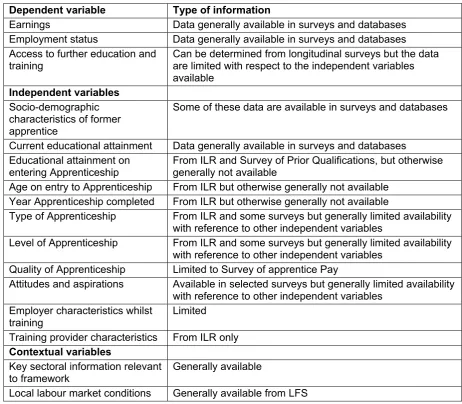
The impact of cyclical economic fluctuations and longer-term occupational change is often focussed on local labour markets. Apprentices resident in regions or areas where there is declining demand for their skills will obtain a lower return to their Apprenticeship than other apprentices located elsewhere or in growing occupations. This negative impact might be mitigated if apprentices were geographically mobile (they would go to where the returns were higher) but not all apprentices are likely to be equally mobile. Age and, particularly, gender are likely to be factors here, with women (especially those married or with children) and older ex-apprentices being least mobile and thus more exposed to variations in local labour demand. A number of indicators are available to indicate general labour market conditions including vacancy/unemployment ratios or even, simply, the local unemployment rate. Selecting Covariates for the Model: The discussion so far has set out the many factors that could be expected to impact upon the outcomes from an Apprenticeship and thus explain variations in such returns. In an ideal world measures of all these factors would be included in the economic model. In practice what is feasible to include in the model will be determined by data that has been collected from surveys and administrative databases. The following set of explanatory variables might be regarded as a ‘yardstick’ against which the capacity of any particular dataset to ‘explain’ longer-term outcomes could be assessed or as a specification for variables to be collected in any bespoke data collection exercise:
gender;
age at completion and when outcomes observed;
ethnicity;
household status – marital status; other household members (e.g. children, dependents);
presence of work limiting disability or health condition;
prior educational attainment/qualifications on entry to the Apprenticeship;
pre-Apprenticeship work history;
indicators of an individual’s motivation to work towards completing an Apprenticeship;
the Apprenticeship – Framework; level of NVQ; completion status;
measures of training quality – duration of training; time in formal, off-the-job training;
nature of Apprenticeship employer – public/private/voluntary/other; sector/industry; size of employer;
post-Apprenticeship learning;
labour market demand – macroeconomic indicators; measures of local labour demand; measures of occupational trends.
As always, the full range of desirable covariates available for modelling purposes will be conditioned by the availability of data and the suitability of the form in which such data is collected. This availability/suitability is considered in more detail in Section 4. It is likely that data of the type referred to above will have been collected in different datasets. Where that is the case then linking such data would be one way to create the required full dataset needed to adequately explain variations in the longer-term outcomes and returns to Apprenticeship.
3.2.3 Defining and Measuring Outcomes
The hypothesis to be evaluated is that completing an Apprenticeship leads to some economic benefit to the individual in the future. The positive outcome (Yi(t+n)) could be an indicator of:
higher earnings;
job retention;
career progression and advancement;
progression onto other learning or qualifications;
occupational or social mobility.
training/education and to perform better in such programmes, eventually resulting in better employment prospects and higher wages. The causal pathways between Apprenticeship participation/completion and higher lifetime earnings/reduced
unemployment/career progression are undoubtedly many in number. Exploring each and every facet of these relationships is impossible under the constraints posed by existing datasets. Nevertheless, untangling the various channels through which such benefits come about is a desirable objective and considerations for how to
incorporate data that could serve such a purpose is discussed (in limited fashion) in Section 4.
Earnings: Various indicators of earnings can be used in evaluating Apprenticeships. Most studies of the impact of education or training on earnings consider gross hourly earnings. This standardises for variations in hours of work. Nonetheless, it is also necessary to consider whether Apprenticeships are systematically associated with differences in hours of work (higher or lower than non-apprentices). McIntosh22uses weekly earnings, in order to convert to annual wage increases, for the purposes of estimating lifetime benefits. From the point of view of raising productivity and maximising the impact of government investment, however the labour supply
decisions of former apprentices are important. For example, hourly earnings may be greater, but if this is (at least partly) offset by a reduction in hours worked, then the impact on total productivity would be overestimated. Equally, if hours worked increase as a result of the Apprenticeship the productivity impact would be underestimated.
Employment retention: Under the current definition of Apprenticeship, participants must have, in nearly all instances, employee status within a business. This means that there is no employment retention effect during the Apprenticeship itself. There is, however, the important question of whether or not the apprentice is retained by their employer upon completion and what factors are associated with such retention. In the longer term the relevant question is whether or not apprentices have more stable employment (or fewer spells of not working) than non-apprentices. If apprentices entered jobs that were more stable than non-apprentices, then higher lifetime earnings would be the result (even if there were no significant differences in wages when in employment).
There are good grounds for believing that employers are more likely to retain skilled workers over the economic cycle (particularly those in whom they have invested through training) than less skilled workers. Employment retention could be
measured in several ways depending upon the data available. It could be measured, for instance, by:
22 McIntosh (2007), ibid.
whether or not individual is in employment at some future date (say 1 year, 5 year etc.) after completing the Apprenticeship (represented by a binary (1/0) variable);23
the duration of continuous employment with the same employer in some period prior to the date at which outcomes are evaluated;
the duration of continuous employment (in different jobs) over some period prior to the date at which outcomes are evaluated;
the cumulative duration of employment (regardless of any breaks in employment) over some period prior to the date at which outcomes are evaluated.
In an ideal world the period referred to in the above measures would be the lifetime (i.e. until retirement/death) in order to fully capture the effect of Apprenticeship training (or indeed any training/education) on all employment outcomes. As will be seen in the discussion of data in Section 4, in the real world, data constraints place restrictions on the time period to be used in evaluation approaches.
Career progression: Many employers report that apprentices form the main source from which they obtain supervisors and managers. Measuring career progression could take the form of estimated probabilities of making a transition from one occupation to a ‘higher’ occupation with supervisory or managerial responsibilities. To produce such a measure would require longitudinal data with work histories containing ‘fine grain’ occupational information. Alternately, changes in employment status if recorded in the data might be used (e.g., manual/non-manual/manager etc.). Access to additional learning: Another positive outcome from Apprenticeship could be increased participation in, and completion of, further learning and
acquisition of additional qualifications. These are positive outcomes in their own right but they may also reinforce or add to other effects stemming from Apprenticeship. This could be taken into account by examining the post-Apprenticeship qualifications of individuals (if such information is collected in the dataset).24The participation of individuals in employer provided training after completion of the Apprenticeship is another outcome of potential interest. Do apprentices tend to get jobs where employers are more inclined to continue investing in their employees’ skills by providing various types of training? This provision of training by employers can be considered a factor in determining the quality of a job, which is itself an outcome of interest.
23 The resulting estimate of the dependent variable will then be interpreted as the probability of being in employment at that future date.
24 Analysis of such progression and the attitudes of employers towards this progression is explored in Kewin, J., Hughes,T., Fletcher, T. and Sheen, J. (2011) “The Road Less
Travelled: Experiences of employers that support the progression of Advanced Apprentices to higher education” prepared by CFE for the Skills for Sustainable Communities Lifelong Learning Network. Leicester: CFE. Available at:
Job Quality and Job Satisfaction: The economic model set out above is principally concerned with wages, occupational progression, and job security. Such outcomes may not be the only ‘returns’ that are valued by apprentices. Within organisational psychology, rather than economics, there has been a longstanding interest in how workers may be motivated to bring about improvements in organisational
performance (c.f. the respective work of Herzberg, and Haslam).25 Herzberg, for example, distinguishes between those factors which are likely to cause
dissatisfaction at work, such as conflict over wage levels, and those factors which bring about satisfaction with a job, such as autonomy, control over the pace of work, etc.
Whilst it is difficult to account for indicators of job quality in a formal economic model concerned principally with wages and job security, it has become increasingly
recognised that these are important outcomes for the individual in their own right and are associated with the generation of relatively high wage levels. It is important therefore that any future quantitative modelling attempts to incorporate outcomes relating to job satisfaction. These might be:
i. indicators of job satisfaction and overall satisfaction with the individual’s position in life (some longitudinal studies capture these type of data); ii. the extent to which an individual’s skills are fully utilised in their current job
(the SKOPE Skills Surveys asked questions along these lines);
iii. measures of work-life balance (e.g. as captured in the former DTI series of work-life balance surveys); and
iv. indicators of job quality including the physical conditions of work (e.g. Eurofound’s European Working Conditions Surveys provide some comparative information about these issues).
To some extent these are second order issues to those which address wages and job security but they may well shed some light on understanding why some
apprentices and some sectors of the economy obtain higher returns than others, or relative to some comparator group. Longitudinal data sets are increasingly including questions not just about job satisfaction but overall life satisfaction and relating these to the overall health of the individual. This has implications for staying in work and absenteeism, both of which will be related to the economic returns obtained by an individual over the lifecycle.
There are also statistical issues to resolve if incorporating job quality / job
satisfaction into an economic model which attempts to explain any differences in wage levels or job security – especially since the direction of causality is not obvious – but it is well worth exploring how such factors can be included in any long-term evaluation of Apprenticeships.
19
3.2.4 Timescales
It is a key aspect of the evaluation that the impact of Apprenticeship is to be assessed in respect of future outcomes, in particular, long-term outcomes (and ideally lifetime outcomes). Indeed, it is an essential feature of the model (especially in its fixed effects form) that observations are taken on at least two occasions. A critical question is when such observations should be taken. Many studies of the returns to learning take a short-term view and consider outcomes just one or two years after undertaking that training. On the other hand, studies of the returns to higher education tend to take a lifetime perspective. There are several possibilities for the period to be considered after completion of an Apprenticeship:
a short time (e.g. 3-6 months) after completing an Apprenticeship. This would appear most appropriate to capture the immediate earnings benefits arising from the transition from ‘trainee’ status to ‘skilled worker’ status and the associated change in pay scales. This change in earnings tends to reflect part of the increased productivity of apprentices (research has suggested that employers t