PERISTALTIC MOTION
by
Trevor Parkes) B.Sc. (Manchester) December)
1967
1. INTRODUCTION AND SUMMARY 2. HISTORICAL SURVEY
3
.
STATEMENT OF THE PROBLEM 4. SOLUTION OF T:HE PROBLEM4.1
Peristalsis with constant pressure gradient and G small4.
2
The general case of peristalsis with sinusoidal pressuregradient and with G large
4.
3
Average flux in particular cases5.
NUMERICAL CALCULATIONS OF FLUX, STREAMLINES AND VELOCITY DISTRIBUTION5.1 Peristalsis with zero pressure gradient and G small
5.
2
Fixed boundary with prescribed constant pressure gradient5.
3
Peristalsis with zero pressure gradient and G large5
.
4
Fixed boundary with sinusoidal pressure gradient5
.
5
Peristalsis with sinusoidal pressure gradient6.
DIRECT CALCULATION OF THE COEFFICIENTS an, bn6.1
Evaluation of the coefficients cnr, etc.6.
2
Application of the method7
.
OTHER BOUNDARY CONDITIONS8.
CONCLUSIONAPPENDIX A APPENDIX B
Page l
4
8 12
45
61
62
64
---~11
Page
REFERENCES
74
Figure 2. Peristalsis. Flux through channel. er small. Figure
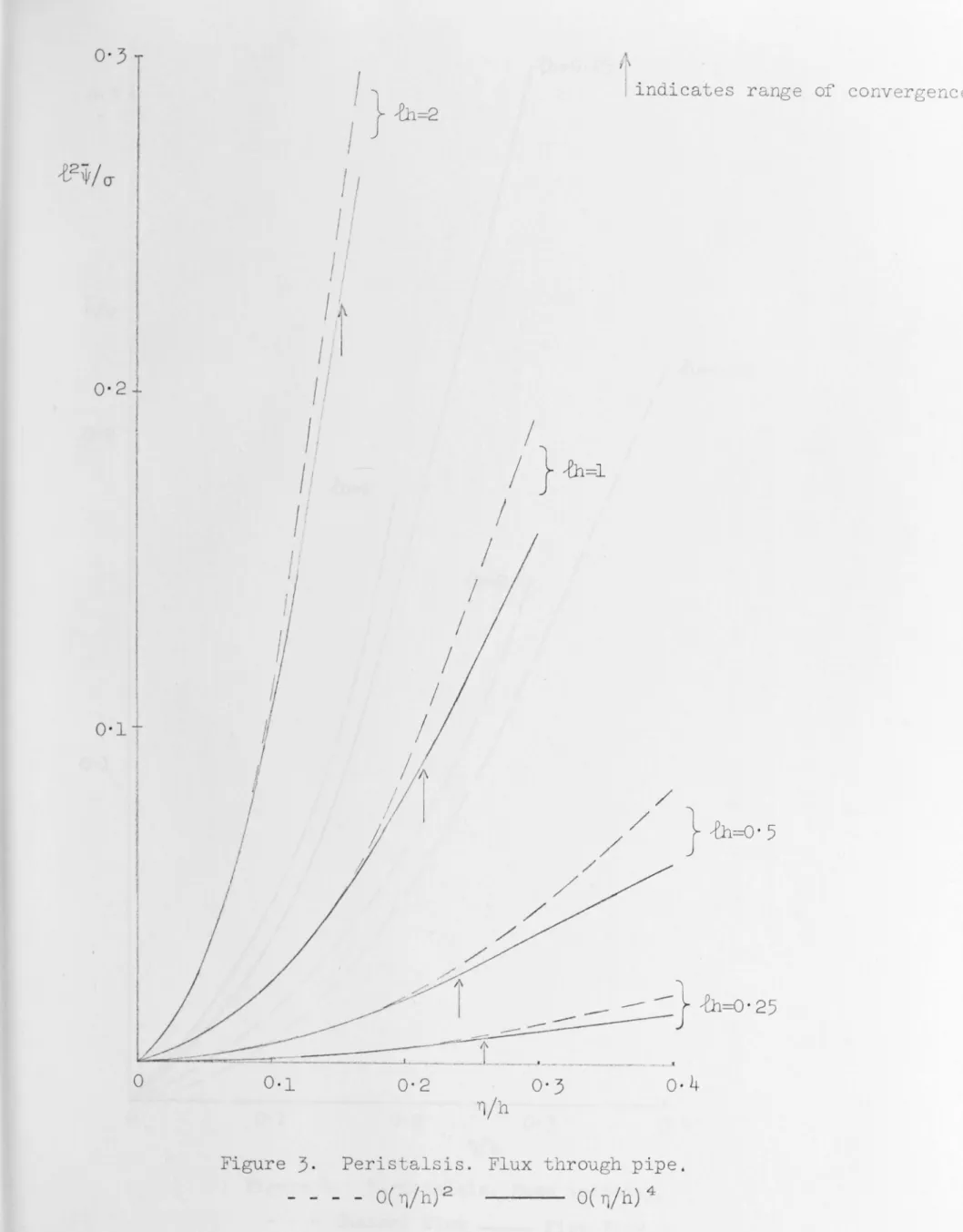
3
.
Peristalsis. Flux through pipe. er small.Figure
4
.
Peristalsis. Average velocity through pipe and channel.Figure
5
.
Peristalsis. Streamlines in channel flow.Figure
6
.
Peristalsis. Velocity distribution along axis in channel flow.Figure
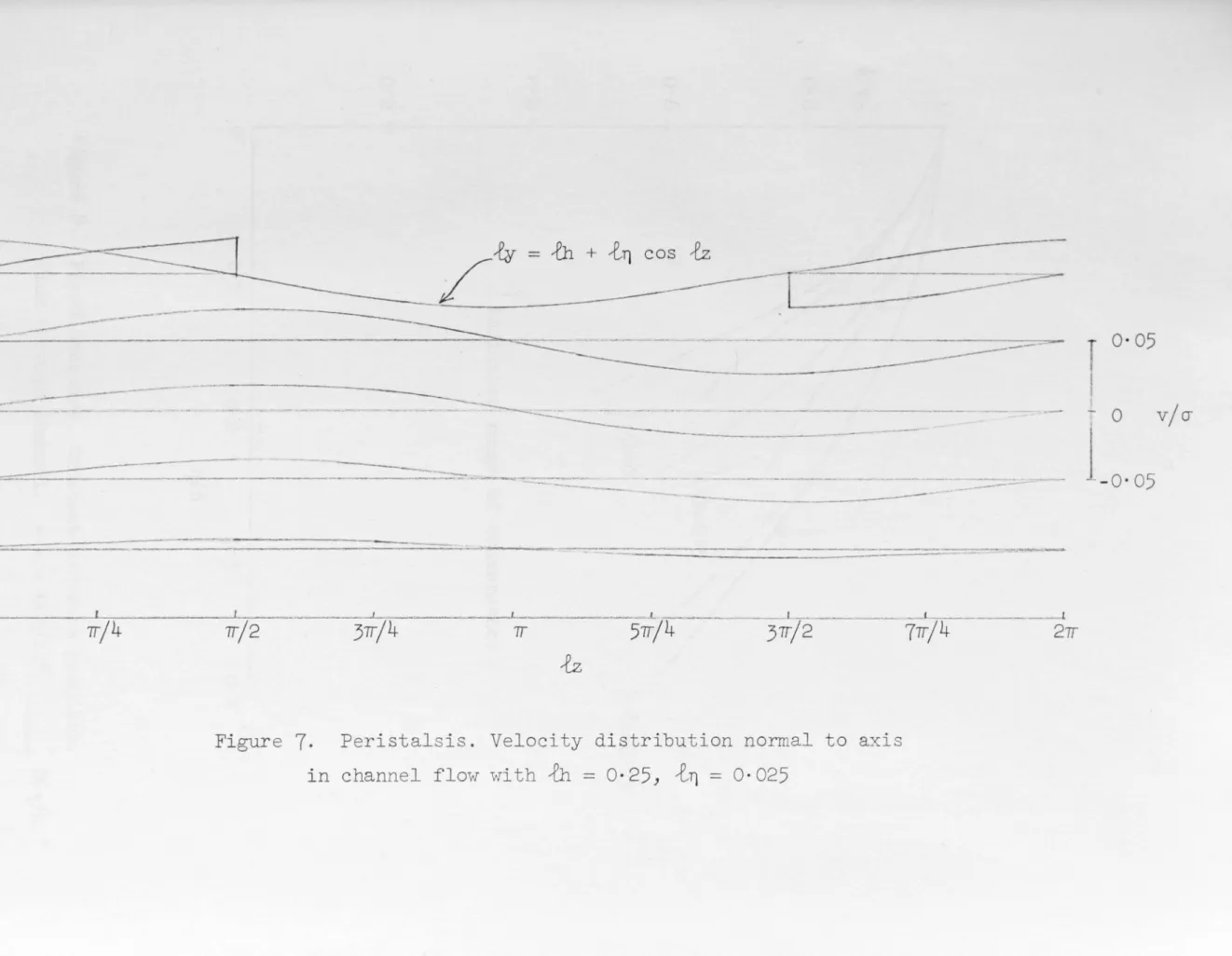
7.
Peristalsis. Velocity distribution normal to axis in chanriel flow.Figure
8
.
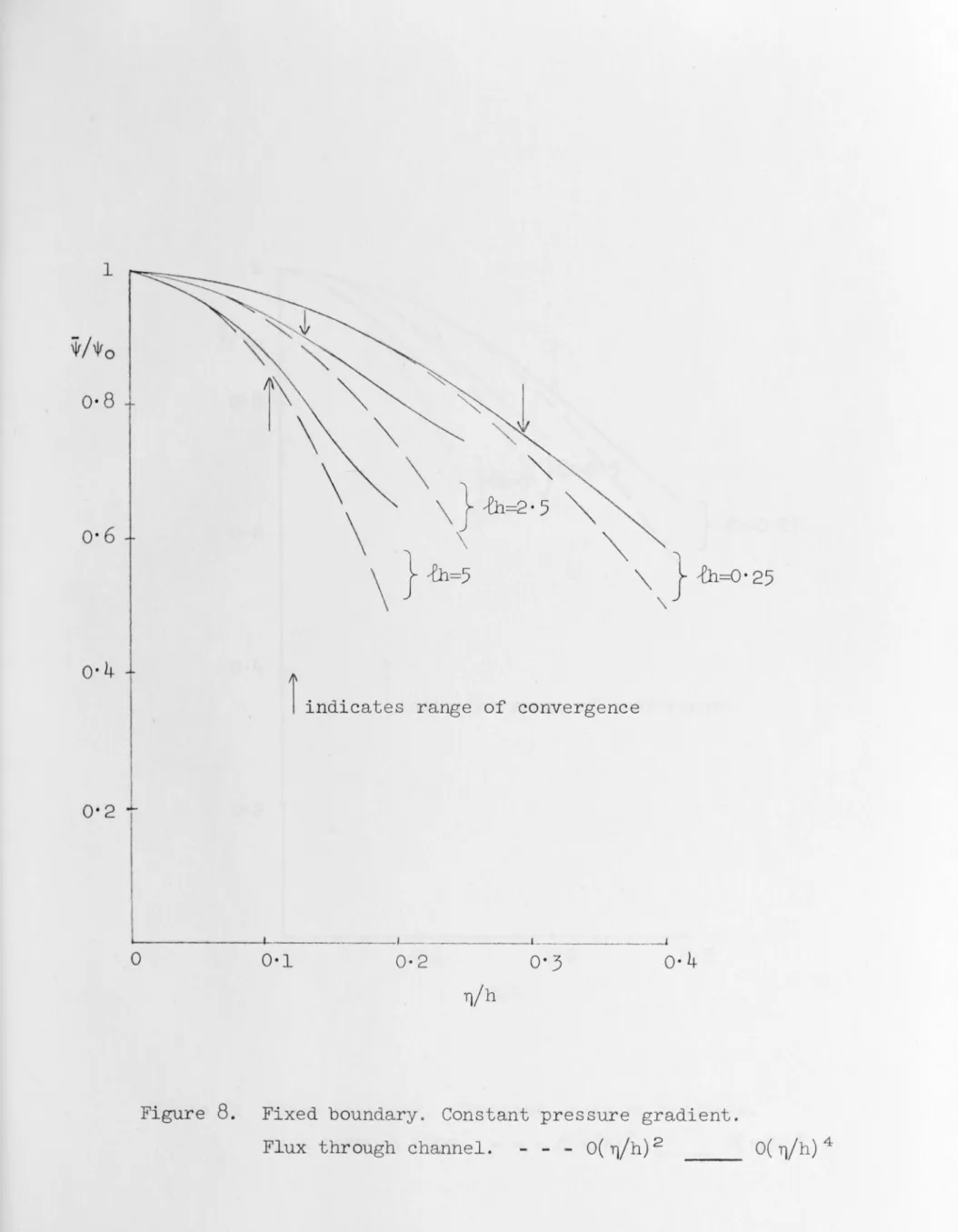
Fixed boundary. Constant pressure gradient. Flux through channel.Figure
9
.
Fixed boundary. Constant pressure gradient . Flux through pipe.Figure 10. Fixed boundary. Sinusoidal pressure gradient. Flux through channel.
Figure 11. Fixed boundary. Sinusoidal pressure gradient. Flux through pipe.
Table 2. Table
3
.
Table
4
.
Table 5.Peristalsis. Flux through channel. Direct method.
Peristalsis. Comparison of flux through channel using both methods.
Fixed walls. Flux through channel. Direct method. Fixed walls. Comparison of flux through channel using both methods.
I should like to thank my supervisor Dr. J .C. Burns who suggested
the topic and who has been a constant source of encouragement. I should
also like t o thank my colleagues of the Mathemati cs Department, Royal
Military College, Duntroon, with whom I have had useful discussions, and
Mrs. G. Whyatt who so ably typed this thesis.
The material reported in this thesis is the author ' s work except where
references t o other sources are explicitly stated.
1. Introduction and Summary
The study of the flow of an incompressible viscous liquid is greatly simplified if discussion is limited to Stokes flow in which the Reynolds
r u m - ~
number is small enough for the~inertia forces to be neglected in
comparison with the viscous forces so that the equations of motion
become linear. The Stokes flow approximation is a suitable model to take for peristaltic motion since the velocities met in practice are small and conditions at infinity are not considered.
In this thesis, two dimensional flow through a symmetrical channel
and axially symmetric flow through a pipe of circular cross-section are
considered. In each case the boundary varies sinusoidally.
Two causes of motion are studied. Firstly, it will be assumed
that there is a prescribed pressure gradient along the pipe or channel
and secondly that a progressive wave passes along the walls. If the prescribed pressure gradient is constant, and if the progressive wave
velocity is small enough, this peristaltic motion is governed by the
usual equations for steady Stokes flow. Thus --the two extreme cases, of motion caused solely by the variation in cross-section and of motion
under a constant pressure gradient when the walls are fixed can be
treated together. Moreover, the two cases of pipe flow and channel flow can be treated together by taking advantage of the notation of generalized axi-symmetric potential theory to develop the theory in a
form which is applicable to each case, leaving only the detailed
calcu-lations to be carried out separately. This simpler case is treated first .
If the prescribed pressure gradient varies sinusoidally with time then
the motion is governed by the unsteady Stokes flow equations. In this
case there is nothing to be gained by imposing the condition that the
progressive wave velocity should be small and so the general case of
peristalsis with sinusoidal pressure gradient has been solved.
It will be convenient, where it is not necessary to distinguish
between channel flow and pipe flow, to use "tube" to denote either the
symmetric channel or the axi-symmetric pipe and "radius of the tube" to
denote half the breadth of the channel or the radius of the pipe.
The problem is solved by expanding the stream function, which
detennines the flow, as a Fourier series involving two infinite sets of
unknown coefficients, real in the simple case but complex in general.
The boundary conditions on the wall of the tube give a set of linear
equations which can be solved for these coefficients . Following closely
the method used by Taylor
(1951)
in a similar problem, a perturbationsolution is found in which these coefficients are derived as power
series in ri/h, the ratio of the amplitude of the variation of the tube
radius to the mean tube radius. The solution is used to derive an
expression for the average flux through the tube in the general case.
This average flux is calculated numerically in some particular cases,
are the streamlines and the velocity distributions along and normal to
the axis of the tube.
An alternative method of direct calculation of the unknown
coefficients has been devised and tested in particular cases. This
3.
method works well for small {~, where it would be expected to do so, and agrees with the perturbation method. It should work better than the
2. Historical Survey
Peristaltic motion of a viscous fluid through pipes and channels
does not appear to have been discussed previously mathematically although the particular case of flow under a prescribed pressure gradient through a fixed tube whose walls vary sinusoidally has been treated by several authors. Langlois
(1
96
4)
discussed f ow along channels of varying breadth and obtained approximate solutions in several different cases. Gheorgita (1959) found solutions to the first order in~ f or symmetrical channels in which the breadth varies along the length according to a cosine law and also gave first order solutions in cases in which the distance of each wall from the centre plane varies periodically along the length with the same frequency but the channel is not symmetrical. Belinfante(1962) considered flow of a viscous fluid along pipes and channels in which the radius or breadth varies along the length according to a cosine law. He also obtained solutions for the Stokes flow approximation correct to the first order in ~/h_. He used these solutions as a basis for solutions of the Navier-Stokes equations in powers of the Reynolds number of the flow.He remarks that he has also obtained solutions of the Stokes flow.problem to the second order in ~/h for both pipe and channel flow. Burns (1965) used the methods of this thesis to obtain results for both pipes and
channels with fixed walls, which is a special case of the general
problem.of peristaltic flow with sinusoidal pressure gradient considered here. It is also, of course, a special case of peristaltic flow with
5.
The analysis of peristaltic motion may have several import ant
practical applications. Peristalsis occurs naturally in several parts
of the body. According to Wright
(1961)
"Bayliss and Starling definedtrue peristalsis as a coordinated reaction in which a wave of contraction
preceded by a wave of relaxation passes down a hollow viscus; the contents
of the viscus as they are propelled along would thus always enter a
segment which had actively relaxed and enlarged to receive them. This
type of movement was thought to be responsible for transferring the
contents of the alimentary canal from the oesophagus through the stomach,
small and large intestine and finally to the anus." Peristaltic waves
also occur in the ureter.
The flow of corrosive fluids along pipes is often brought about by
the use of peristaltic pumps which are designed so that the fluid does
not come into contact with the pump itself. Latham and Shapiro
(19
66)
have done some work on peristaltic pumping but this paper is not yet
available.
The flow of blood in arteries, while not being caused by peristaltic
-motion of the artery walls, has similarities, particularly if it is
assumed that the artery walls are sufficiently flexible so that they
oscillate in sympathy with the pressure gradient. For this reason it
seemed logical in this thesis to consider the general case of peristalsis
with sinusoidal pressure gradient. However it must be realised that the
Reynolds number associated with blood flow in arteries is not small, and
The particular case of flow through a fixed pipe of constant cross
section under a prescribed sinusoidal pressure gradient has also been
treated by several authors but the more general case of a pipe whose
walls vary sinusoidally does not appear to have been considered.
Womersley was very prolific on this subject both theoretically and
experimentally. Amongst other things, he (1955) considered the
oscil-latory motion of a viscous liquid in a rigid tube under a simple harmonic
pressure gradient and also similar motion in a thin walled elastic tube
with particular reference to the flow of blood in arteries. In the latter
case he showed that the longitudinal oscillation of the walls of the tube,
caused by viscous drag on its inner surface, is important in determining
the rate of flow, which may be 10%,greater than that in a rigid tube
under the same pressure gradient. Olsen and Shapiro (1967) considered
large amplitude, unsteady flow in liquid filled elastic tubes but only
where the wave-length is long compared with the diameter
(-Di<
0·06) sothat a one dimensional model can be used. Lance (1956) considered the
flow through a pipe or channel of constant cross section due to a pressure
gradient and a series of pulses acting in the opposite direction. He
showed that it is possible for the flow to be arrested when the pipe is
subjected to one or more pulses of sufficient strength. (This problem
was suggested by reports that the engines of a certain jet aircraft fail
when the guns are fired. The failure could be due to fuel starvation.)
Sanyal (1956) studied the flow in a circular tube under pressure gradients
which rise or fall exponentially with time. She found that for small
7
.
is parabolic in both cases but for large diameter tubes the two motions
are quite different. In the first case the flow has the boundary layer
character while this characteristic is completely absent in the second
case and the velocity depends on the wall distance.
3.
Statement of the ProblemIt is convenient to use "tube" to denote either the symmetrical
channel or the axi-symmetric pipe and "radius of tube" to denote half
the breadth of the channel or the radius of the pipe.
The wall of the tube is defined by the equation
y h + 'fl COS {_( X - ot)
(1)
so that a progressive wave of amplitude Tl, velocity rr and wave-length
A=
2v/t
passes along the tube in the positive x-direction. It willfrequently be convenient to write z
=
x - ot. If rr=
o,
the wall ofthe tube is a fixed cosine wave. The x-y plane is a meridian plane of
the tube, the axis OX being along the axis of symmetry and the axis OY
normal to OX. Let the velocity components in the x,y directions be u,v
respectively (see Figure 1).
9
.
The equations of motion governing the flow of an incompressible
fluid through the tube are the continuity equation and the Navier-Stokes
equation. These, in the absence of body forces, are
0 J ( 2)
av
1~ + V(!v2) - V X ill
=
-
-
'vP - VV X Q.) ,at
2- - - ( 3)where y is the velocity, vis the kinematic viscosity, pis the pressure,
pis the density and~= V x
y
is the vorticity (Rosenhead1963).
If squares of velocities can be neglected then equation (3) reduces
to
av
-at
1
- Vp - VV X ill.
p
It is possible to treat the two dimensional flow and the
axi-symmetric flow together by using the notation of generalized axially
symmetric potential theory (Weinstein
1953).
Let* be a stream function such that
u
=
y -k -a
ay*
and V -k81lr -y ..:::..:i:.
..
ax
where k
=
0 or l according as the flow is two dimensional oraxi-symmetric. Then equation (2) is satisfied.
and
If ill -
l~I
then the equations satisfied by* and w arek - -y (1)
L ( k ) l
a (
ykw\ ,-k Y w
=
v
at
~( 4)
( 5)
( 6)
where
32
+
-ay2
k 8
y 8y •
Also equation
(4)
produces the following pressure relations:au - p
-at
-k 8 k
µy ay ( Y ill) '
av
-k a k- P at + µy
ax (
Y ill) 'whereµ - pV is the viscosi ty.
( 8)
( 9)
The following conditions must be satisfied. On the axis of symmetry \jr
=
0 and ill+ 0 as y + O. On the outer boundary of the flow, the fluidmust have the same velocity as the wall of the tube. It will be assumed in the first instance that the particles of the tube wall move in
straight lines perpendicular to the axis of the tube so that the boundary
condition i s
-k
21
-y 8z
-k 8\jr
Y
=
u - 0 , 8yV ay
at {cn1 sin
{z
on y=
h +~cos{z
.
This condition requires that the wall of the tube be extensible. A modified boundary condition will be considered later in Section
7.
(10)
The problem is to solve equations
(6)
and(7)
for \jr and ill subject tothese conditions on the axis of symmetry and the wall of the tube.
It is necessary to prescribe the pressure gradient which produces
11.
drop over a wave-length has the value P cos ft. In particular, P 0
corresponds to peristalsis with zero pressure gradient and f 0
4
.
Solution of the problemIt is convenient to deal with a particular case first and then
consider the general case. It is assumed that the flow has existed long
enough for all transient terms to have decayed so that only the steady
state solution is considered.
4
.1
Peristalsis with constant pressure gradient and~ smalli . e. f = 0 and
~/tv
= o (1)This is the case of peristalsis with constant pressure gradient
av
where the progressive wave velocity is small enough for the termat
inequation
(4)
to be neglected (Rosenhead1963).
An account of this hasalready been published (Burns and Parkes
1967).
and
The equations to be solved are now
k -y (1)
0
with the conditions*= 0 on y = O and w ~ 0 on y = 0.
The boundary conditions (10) are unchanged. The pressure
relations
(8)
and(9)
become-k
a
k -µy ay ( Y w)and ~
ay
-k
a (
kµy
ax
Y w)( 6)
( 7A)
( 8A)
( 9A)
Since the boundary varies periodically with z and is symmetrical
about z = O, it follows that both* and ware even periodic functions of
13.
00
1jr(z,y) -
l
1jr ( y) cos n~ ,(
11
)
n n=O
00
ul..z,y) -
l
Cl.h ( y) cos n{z .( 12)
n=O
If
(11)
and(12)
are substituted in equations(6)
and(7A)
and thecoefficients of terms in cos n~ compared, then for n ~
o,
1jr (y) andn
llb(y) satisfy the equations
k
-y CD n '
-
o.
Tnese equations have to be solved under the conditions that
*n + 0 and CDn +Oas y +
o
.
The solutions of (14) satisfying these conditions are
and for n ~ 1
k y Clb
k
y CD
n
_ -A yk+l
0
k+l
- -A y 2
n (n~)
where A, o A are n arbitrary constants and Iv(x) is a modified Bessel
function of the first kind of order v.
(13)
(14)
( 15)
When CD n in equation
(13)
is replaced by the expressions given inintegrals can be found (Burns
(19
6
6))
and the complementary functionsare of course the general solution of equation (14). The functions
o/ (y) which satisfy these equations and the condition o/ ~ 0 as y ~ 0
n n
are found without difficulty and when these are substituted in (11) the resulting expression for o/(zJy) is
o/(zJy) 2(k Ao
3)
y k+3 + Boy k+l+
00 k+l
l
-
2 [2~:P, yik-1 ( n-fy) Bnik+l(n-fy)J
cos n{z.+ y +
n=l 2 2
( 16)
The arbitrary constants AnJ Bn for n ~ 0 must be determined from the
condition (lO)J that the fluid on the boundary has the same velocity as the wall of the tubeJ together with the condition that the pressure drop
per wave-length is P.
J.t
~
~
AR..J>rl\.~
tL.t,
~
L
o
..;;
,,
e<
,u
Yn/,1;_
~
~
~
J!:
J
t
-
rd
~ryt~boP
~~
~ a n be s~n from equation (9A) that~ is an odd periodic function
of z. Hence~~= OJ i .e. pis constant) on the sections z = OJ AJ 2A ...
of the tube. It can also be seen from equation (BA) that!~ = ~ will be an even periodic function of z and so the £ressure difference between successive points of maximum cross section is always the same. In this
case it is assumed to be P.
Since the pressure is constant over the sections z = OJ A it
follows that the pressure drop between these sections can be obtained by integrating~ along the line y = O.
15.
Equation (8A) gives
~
oz
-µy - k -aya
(y k ru)and this, with
(12)
and(15),
leads to00
µ(k + 1) A
0 +
I
fn cos n-tz , n lwhere the coefficients fn are constants. Integration of
(17)
fromz = 0 to z = A gives
p~
- 2µ7T( k + 1)
( 1 7)
(18)
Thus the constant A0 is known in terms of the prescribed pressure
gradient. The remaining boundary condition leads to equations sufficient
to determine the constants B0, ~ , Bn (n ~
1)
in terms of A0 and~.
At this point it becomes convenient to give separate (although
closely similar) discussions of the two cases of channel flow and pipe
flow.
For channel flow, k
=
0 and the stream function becomes'lr(z,y)
b
Ao y3 + Boycosh n,fy + Bn sinh n,fy} cos n-tz.
( 19)
The replacement of the Bessel functions I1(niy) and I 1(n,cy-) by
'2 - '2
expressions involving cash niy and sinh n,cy- leads to a considerable
simplification in the detailed analysis which follows.
For pipe flow, k
= 1 an
d the stream function becomes\jr(z,y) Ao y4 + Boy2
b
00
+
I
y {2~'.t ylo( n,fy) + BnI1 (n,fy)} cos n-i'z. n lIt is convenient to introduce new coefficients as follows :
For channel flow, let
and, for n ~ 1,
and for pipe
and, for n ~
a n flow, ao 1, an let !A
2 0 '
!A 2 0 )
An 2nt )
b
0
b n
) b
n
2B0 ,
B . n
The stream function for channel flow then becomes
\jr(z,y)
00
( 20)
( 21)
( 22)
+
I
{any cosh n,fy + bn sinh n,fy} cos n-i'z ( 23)n l
ch/r
=
0ay
andoz
o\jr-1
7.
sin .{z on y
=
h + T) cos {zwhich are obtained from (10) by putting k - O.
The stream function for pipe flow becomes
- 1 a y4 + ! b
y2
4 0 2 0
00
+
I
Y {any I0 ( n,fy) + bnI1 ( n,fy)} cos n--tzn l
(
24)
( 25)
where b0, an, bn (n ~ 1) are to be found in terms of a
0 and~ from the
conditions
1 o\jr
Y
ay
- 0 and 1 y 8\jroz
_ _ {o-T) sin {.zwhich are obtained from (10) by putting k
=
1.4.1.1 Evaluation of the coefficients an, bn.
on y
=
h + T) cos {.z(2
6)
The boundary conditions
(24)
and(26)
at the tube wall, which ineach case has equation y
=
h + T) cos {.z=
y1 say, lead to the f ollowing
equations:
For channel flow:
00
+
I
[(
an + n-bin) cosh n,fy1 + n~y1 sinh n,fy1 ]cos n--tz -
o
n l ( 27)
l
[any1 cosh n{i,1 + bn sinh n{i,1 ] n sin n-fz -~~
sin -fz; (28)n l
for pipe flow:
and
00
+
l [
(
2an + n-1'.bn) I0 ( n{y 1 ) + n-f'.any 1 I1 ( n{v 1 ) ] cos n-fzn 1
00
l
[any1I0(n{v1 ) + bnI1 (n{v1 )J
n sin n-fzn l
T)O- sin {z.
0
( 29)
(
30)
For channel flow, cosh n-lyl and sinh n,lyl and for pipe flow, I
0(n,lyl) and Il(n-lyl) are expanded in powers of cos
-tz
.
Substitutionin
(27),
(28)
and(29)
,
(30)
leads, in each case, to terms of the form cosP{z
cos n-lz and cosp{z
sin n--fz which are expanded in Fourier cosine and sine series respectively. Finally, the coefficients ofterms in cos r-lz and sin r--fz in the resulting equations are equated and linear equations for b
0, an, bn (n ~ 1) are obtained. In each case,
these are of the form
00
l
(
pm an + qm bn)n l
00
l
(pnran + qnrbn)n l
0 '
( h a + k b )
non non
r
=
1,19.
00
l
( h a + k b )nr n nr n r
=
1, 2, 3 ... , ( 31) n-1where all the coefficients p , q , h , k , c are known. These can
nr 11r nr nr r
be calculated to any required accuracy, so that direct numerical solution of the equations for as many coefficients a , b as are necessary to
n n
give a desired accuracy is possible. This method is discussed more fully in Section
6
.
For the purposes of the perturbation solution used here, the coefficients p q h k , c may be expanded in powers of .{n
nr' 11r' nr' nr r ·1
and the leading term of the series for each of the first four involves t71 raised to the power In - rl while cr is of the order (.{71)r. It
follows that an and bn are of order (.{71)n and it turns out that they are obtained as series in the form
a n b n 00
l
t=O 00l
t=O.{ n+2t
ex
n,n +2t ( 71){ n+2t t3n n+2t ( 71 )
'
n ~ 1
.
'
'
( 32)
' . n ~
o
.
At this stage it is assumed that the non-dimensional quantity, .{71,
is small and *(z,y) is to be calculated to order (.{71)n. Imposing this restriction, and comparing coefficients of powers .{71 in equations (31) gives a set of equations which can be solved for
ex
and t3 .nr nr
15
equations. This is the order of many of the calculations in this thesis.An alternative approach, which l eads to the same results for an and bn, is given in Appendix A. There it is assumed at the start that
t~
is small so that only a few terms in the expansions of cosh n{yl, sinh nty1 , I0(n~1 ) and Il(nty1) need be considered. 4.1.2 Calculation of the flux through the tube
To find the flux through the tube it is necessary to evaluate the stream function *(z,y) at a point on the boundary y
=
h +~cos--Ez.
For any value of x, this flux varies periodically with the time. Since an, b are determined as power series int~ it follows that the flux* isn
also a power series int~. Alternatively we can write* as a power series in ~/h, 1.e.,
where* is a periodic function of z. n
What is wanted is the average flux per cycle and this can be found
by integrating* at a point on the boundary over one period. Doing this removes all the odd powers of ~/h for it is easily seen (Appendix B) that
o
.
The mean flux is then
21 .
-
-and the expressions obtained for *o' *
2 , *4 are as follows:
(a) For channel flow:
*o - g a h3 ~
=
-h3 [a0 +t
2
a
sinh-01
+!t2~J
3 0 ' ~2 l l 2 '
+
i
a
22(2-01 cosh 2-01 + sinh 2-01)
J ;
(34)
(b) For pipe flow:
In each case
a
11,a
13, ~ 2 are obtained as indicated in section 4.1.1.
The expressions for some of these are given in Appendix A, where it can be seen that they are all linear functions of a0 and~.
In both cases therefore, the flux consists of two distinct parts, one due to the pressure gradient only, the other due to the movement of the walls only. There are no interaction terms which makes computing much easier. The numerical results are discussed in Section
5
.
4.2
The general case of peristalsis with sinusoidal pressure gradient and with~ largeThe e~uations to be solved are
k
1 ~ ( ykrn),
V
ot
( 7)with the conditions "ljr = 0 on y = 0 and rn ~ 0 on y
conditions
(10)
hold, i .e.,u
and
V
on y = h + T) cos
{z
.
'
and so do the pressure
-k o"l)r
Y ay
-k ~
-y
oz
relations 0
w-11
sin tzO. The boundary
ap
au -ka
k- p - µy
-
( Y rn)ax
at ay ( 8)and
ap
av -ka
k- - p - + µy ( Y rn) .
ay at ay ( 9)
It can easily be seen that, because of the term on the right hand
side of equation
(7),
"ljr and rn can no longer be even, periodic functionsof z and a more general form must be taken. If the pressure gradient
is to vary sinusoidally with time with frequency f then clearly "ljr and rn
must also be periodic functions oft with frequency f . The most general
form satisfying these conditions will be taken for "ljr and rn, namely,
00 00
t( z,y, t)
I
I
(~(y) cos mft + Brun( y) sin mft) cos ntzn=O m=O
+ ( cnrn( y) cos mft + Dnrn( y) sin mft) sin
with a similar expression for cr,(z,y,t).
This form of solution, however, is not convenient for solving
equations
(6)
and(7)
because it leads to a set of simultaneous dif-ferential equations and so it will be replaced by the equivalent form
23.
00 00
'V( z, y, t)
=
Rel
l
(
t
nm ( y) e i( n--1'.z+mft) + Inm ( y) ei( n--1'.z-mft )) (36)n=O m=O and
00 00
a{z,y,t)
=Rel l
(ronm(y)ei(n--1'.z+mft) + Qnm(y)ei(n--1'.z-mft)) ,( 37)n=O m=O
where~ (y) ,
f
(y), w (y) and Q (y) are complex functions of y only.run run run run
Note that z
=
x - ~t and is real.If
(
3
7)
is substituted in equation(7)
and the coefficients ofi(n-fz+mft) d i(ntz-mft) k k
e an e are compared, then y w and y Q satisfy
run run
the equations
d2 k k d k k
--
( y w ) - - - (y w ) K2 y w - 0dy2 run y dy run run run and
d2 k k d k k
( y Q )
-
- -
( y Q )-
12 y Q - 0 ,dy2 run y dy run nm nm
where
K2 = n2,e,2 _ i( nw - mf)
run V
and
12 = n2,e,2 _ i( nw + mf)
nm V
,
for n -
o
,
1, 2.
.
.
and m -o
,
1, 2.
.
.
Equations
(
38)
and(39)
are similar to equation(
1
4)
but nowwnm and Qnm are complex and n2t 2 in
(14)
is replaced by the complex quantity K2 in(38)
and by 1 2 in(39).
The solution therefore ofnm run
(
38)
(
39)
(38)
isk
-A k+l
Y moo - ooy
and
k+l
-k
-A 2
Y c.onm - nmy
Similarly the soluti on of
(39)
isk
y Qoo
and
k
Y Qnm
k+l
- - C y
00
k+l
2
- - C y
nm
Ik+l ( Kruny) for n
=
o,
1,
22
m -
o,
1,
2but not n
=
m=
O.for n
=
o,
1, 2m
=
o,
1, 2but not n = m = 0.
If these are substituted in
(37)
theny k CD=
Re
{-
(A
+C
)y k+l00 00
(
41)
. . .
( 42)
k+l
2
+ C y
nm
I
k+l(L
nmY )ei(n{z-mft))\L_r
2
where the swnrnation does not include the case n
=
m=
0. There is no loss of generality by taking C00
= 0 or
by taking A00 to bereal, so that
00 00 k+l
y\u= -Aoo/+l - Re
{l
l(Arrmy2 Ik+l(Kruny)ei(n~ +mft)n=O m=O 2
+ Crrrr7k;l Ik+l(Lrrmy)ei(n~-mft))} (43)
25
.
If
(43)
is now substituted in eQuation(6),
and if the coefficientsi(n-lz+mft) d i(n{z-mft)
of e an e are compared, then* and~ can be
nm -nm
shown to satisfy the following eQuations :
for n
=
o
,
1, 2. .
.
,
m =o
,
1, 2.
.
.
,
except n=m=o
,
k+l
d2 k d
--n2,t2i = 2 1k+l (Lnmy)
dy2
Inm-
- -
y dy nmf
-
nm C nmy2
for n - O, 1, 2 ... , m - O, 1, 2 ... , except n
=
m -o,
and
The solution of eQuation
(44)
which satisfies the condition*
run = 0 when y = 0 isk+l
- y 2
~
A:'.1"
for n
=
1, 2 . . . and m - 0 1 2'
'
andfor m
=
1, 2 ...k+l
A
om 2
- - y
K2 om
Ik+l(KomY) + BomYk+l
2
+ B
nm
Similarly the solution of eQuation
(45)
satisfying the conditionInm
= 0 when y = O is(
44)
( 45)
Ik+l(Lnmy) +
Dnm
Ik+l(n,&))
2 2
for n
= ~
,
2 ... and m=
o
,
1, 2 andk+l
C
om 2 k+l
Ik+l(LomY) + DomY
- - y
12
om 2
for m
=
1 , 2 ...The appropriate solution of equation (46) is
A ~+3
where B is real. 00
00 k+l
- + B y
- 2(k + 3) 00
If these solutions are substituted in (36) then
Aoo k+3 k+l
*
=
2(k + 3) y + Booy + Re00 k+l
+I G~m
y 2 Ik+l ( LomY)-ml om 2
00 00 k+l
+l l
-~
::2i2
2 y
n 1 m-0
00
{I
mlG
orn2
k+l- y
2
om
k+l)
-i
mft
+ DomY e
1k+ 1 ( lSunY) + B
nm
2
Ik+l (
n,&))
ei(
n-fz+mft)
2
Ik+l(n-&))
ei(n-fz-mft)}
2
27
.
It is easy to see, from (40), that ~o = 1~
0 for n = 1, 2 . . . . It follows, therefore, that the terms involving Cno and Dno can be absorbed
into those involving Ano and Eno respectively so there is no loss of
generality in taking Cno = Dno = 0. Similarly K2 = -1 2 form= 1, 2
om om
and it follows that there is no loss of generality in taking C0m =Dom= O.
A simpler expression for~ which is still perfectly general is
therefore
12
nm
00 k+l
Aoo k+3 k+l { \
2(k + 3) y + BooY + Re ~ (
A.om
2
- y
K2 om
I ( K ) + B k + 1 ) imft
k+l omY omY
m 1 2
00 00 k+l
+l
l
-(K2 ~U:2t2
Ik+l
(
n,cy-) )i( n-fz+mft)
2
1k+l (~y) + B
y run
n 1 m=O run 2 2
00 00 k+l
+l l
-(2
CIk+l(n,cy-J)i(n-fz•mft) .
2 run
1k+l ( 1nnY) + Drun
y
_ n2,t2
n--..:1 m 1 run 2
2
~g)
It is assumed in this solution that K2 - n2
-l
2I=
0 and thatrun
_ n2,t2
I=
0. From ( 40) it can be seen thatK2 n2,t2 i~ n,Eo- - mf) and 12 _ n2{2 i( n,Eo- + mf)
run V run V
so that, if n,Eo- - mf = 0 then K2 - n2
-l
2 =o
,
and if n,Eo- + mf = O then run1~ - n2{2 = 0. The first of these conditions is possible but the
second is not since all the ~uantities concerned are positive. This
condition will be dealt with later in section 4.3.6.
The arbitrary complex coefficients A , B , C and D in
equation
(48)
can be determined from the condition (10) namely, that thefluid on the boundary has the same velocity as the boundary, together
with the condition that the pressure drop per wavelength is P cos ft.
If the expressions for ykw and* given in
(43)
and(48)
aresubstituted in equation (8) then the following· result is obtained~
ap
ax
00
- µ A00(k + 1) - pRe
{l
m 1
n 1 m=O n 1 m 1
00 00
+ µRe
{l l
(Fm(y)ei(n--tz+mft) + ~(y)ei(n--tz-mft))}, n 1 m=OIt follows that
1
A ap dzax
0if y is kept
J
A2.£
dax
zconstant during the integration. Hence for all values of y, is the same, i. e. the change in pressure per wavelength is
0
the same for ally. If this change in pressure is -P cos ft then
-P cos ft .
( 49)
This result is similar.to that obtained in the simpler case treated in
29
.
If the coefficients of cos mft and sin mft in
(49)
are comparedthen the following results are obtained:
and
Aoo
=
o
,
B
01
Bom
=
0iP
Apf( k + 1)form 2, 3 ...
'
( 50)
Thus the constant B
01 is known in terms of the prescribed pressure
gradient, i .e. in terms of
P
and f . The remaining boundary condition(10)
at the wall leads to equations sufficient to determine the remainingarbitrary complex coefficients in terms of B
01
and~-It becomes convenient at this point to give separate discussions
of the two cases of channel flow and pipe flow. It is also convenient
to define new coefficients .
For channel flow, k 0 and the stream function in
(48)
becomes00
b0oY + Py sin ft + Re { \
Apf
L
. h K imft
a0m sin omye
00 00
ml
. h K b . h O ) in{z
sin noY + no sin n~y e
sinh K y + b
nm run sin n. h ,
P~-
Lo')
e i( n{z+mft)A
~o:rr
where a
-
- -
om for m=
1, 2.
.
.
boo BOO''
-om K2 om
A
~:7T
'
/n-ir
nmb
=
B for n=
1, 2 ( 52)a -
.
. .
nm ~ _ n2--f2 nm nm
m
=
o
,
1.
. .
'
cnm
J;.,
27T
'
d D/nZrr
for n=
1, 2C -
-nm 12 _ n2,e2 nm nm
nm
nm m
=
1 , 2For pipe flow, k
=
1 and the stream function in(48)
becomes00
b00 p~2
{l
\jr
=
-
y2
+ Y sin ft + Re2 2Apf
m 1
Il (K y) + b Il (nfy)) ein.-fz
no no
+
\c
I (L y) + d 11(n,fy)) ei(n
-fz
-mf
t)}
,
( 53)nm l nm nm
A
where a0m - om for m
=
1, 2.
. .
b=
2B'
oo'K2 00
om A
nm
b
Brun ' for n
=
1, 2a
-'
- ( 54)nm K2 n2{2 nm
nm m
=
O, 1
.
.
.
'
C
cnm
d
=
D for n=
1, 2
-'
'
.
.
.
nm 12 n2--f2 nm nm
31 .
4.2.1 Evaluation of the complex coefficients anm, bnm' cnm, dnm
The remaining complex coefficients a , b , c and d can be
nm nm nm nm
determined in terms of
P
,
f and~ by using the boundary conditions(10)
on the wall of the tube in a similar way to that developed in 4.1 .1 and Appendix A. However two factors make this analysis more complicated.Fir stly, if~ is not assumed small, then the expression fort contains cos n,£,z and sin n,£,z terms and this doubles the number of
coefficients. This means that instead of having two infinite sets of
coefficients an and bn there would be four infinite sets an, bn' en and d . The presence of both cos n,£,z and sin n,£,z terms also doubles the
n
number of equations obtained when comparing coefficients of cos n{z and sin n{z so that a solution is still possible.
Secondly, if the:pressure gradient varies sinusoidally with time
with frequency f and t i s assumed to contain cos mft and sin mft terms,
for all m, then the four infinite sets of coefficients an, bn' en and d become the four doubly infinite sets a , b , c and d .
n nm nm nm nm
When the boundary conditions
(10)
are applied then two equationsare obtained similar to equations
(27)
and(28)
or(29)
and(30)
of4.1.1 . If the -coefficients of cos mft and sin mft are compared in these
two equations then each one gives two more equations so that for each
value of m there are four equations which are sufficient to determine the coeffici ents needed in the solution. For the perturbation solution
an analysi s similar to that of Appendix A shows that
l
--e_ n +2tl
~ n+2ta - anmn+2t( ~) ' b - ~nmn+2t( ~) '
nm nm
t=O t=O
( 55)
00 00
l
t
n+2tl
t
n+2tC - lnmn+2t( ~) ' d - 5nrnn +2t ( ~) ·
nm nm
t=O t=O
fur~~
""--~
The per turbation solutionAto order
(
i
~)
2 has~been found for bothJ-,~~
:-..,...._ C.0.~2(:{~C
channel flow and pipe flow.~ '"The relevant coefficients are as follows :
d
k
~~
~
F
Vv~~J1,/V'
ff'J~J
~
~
J.Jf,vu._v'.,-~ 4-•2·~~
~
~
'.For channel flow:
A - 0,
f--'ooo
oioi
~lll
iP
a
omo- o- cosh
-{h
- 0 for m ~ 2,
- K cosh K h sinh
{h
-
{
sinh K h cosh=th
'
10 10 10
o-K cosh K h
10 10
- {(Kio cosh Kl
0h sinh
-01
-
{
sinh K10h cosh{h)'
-iPK tanh K h sinh
-{h
01 01
for m ~ 2,
iPK tanh K h sinh K h
01 01 11
- 0 for m ~ 2,
iPL tanh L h sinh
-{h
lill - 2Apf{( Lll cosh
1::
h sinh~~
- { sinh Li1 h coshTu)
'
l1m1
=
O for m ~ 2,( 56)
( 57)
( 58)
( 59)
( 60)
( 61)
( 62)
33.
- 21-pf{( Lll cash Lll h sinh {h -
t
sinh Lll h cash-01)
J-iPL tanh L h sinh L h
Ol Ol 11
olll
=
0 form~ 2J ( 63)( 64)
02 p {( 2 02)
ao12~ Kol cash Koih -
4.Aµ
-
2 Kll - ~ O:i.11 sinh Kllh- }( L~l -
t
2) 5lll sinh ~ J ( 65)-where olll is the complex conjugate of o11l J
and
a
0m2 - O form~ 2. ( 66)For pipe flow:
A - OJ
1--'ooo ( 67)
iP
=
0 for m ~ 2J ( 68)aOlO
-1-pfK0l I 0( K0l h) J a omo
-crI0 ( ~)
( 69)
4-0l
-- {I ( K h) I ( {h) J K I 0 (K h)Il({h) lO lO l lo o
crK I 0( K h)
t3l 01 - {(Kl o Io( Kl oh) Il lO (
-01)
lO ( 70)- { I1 ( Kloh) I
0({ h)}
J
O'.:i.1l - 21-pf:f'., I (K h) (K - iPKOl Il I (K h) I ( KOl h) Il ( ~)
(
-01)
- { I ( K h) I ( {h) } J0 Ol ll O ll l l ll 0
a
lml
=
0 for m ~ 2J ( T-L)iPK I ( K h) I ( K h)
t3lll
-
21-p f { I ( K h) ( K I ( K h) I Ol 1 01 1 ll( {h) - { I ( K h) I (
-01) }
J0 01 11 0 11 1 1 11 0
34
.
iPL I (L h) I (-01)
Ol l Ol l
'Y
=
0/ lffil for m ~ 2,
(
73)
-iPL I (L h) I (L h)
Ol l Ol l l l
~\mi
=
0 f or m ~ 2,(
74)
2(3
t
+ Re { CT:i.01
Kio 11
(JS_
oh) +~101{
2
11(,hi)}
-o,
002 ( 75)
4iµ
{i
-
I ( K h) }a
{2K I 0( K h) - l OlK h I ( K h)
Ol2 Ol 01
01 0 01
_ ,t(K2
2 11 - t2) CTi11 I1 ( K11 h)
- {,(12
2 11 - {,
2
)
6
111 Il(-01),( 76)
and
CXOm2 - 0 form ~ 2.
( 77)
Since
ex
,
cx1m1 etc. are all zero form~ 2, it follows that*omo
to order (~/h) 2 does not contain any terms in cos mft and sin mft for
m ~ 2. It can be shown that this is also true in the perturbation
solution for* to any power of ~/h so that some simplification could
have been achieved by assuming that m takes only the values O and l in
the expression
(36)
for* and(37)
for (D.so that the denominator of the expressions for
CX:i_01 and (3101 can be zero only if ,t
=
o
,
which is of no interest, or if ~=
O, the fixed wall case, which will be considered later in4
.
3
.
3.
The denominator of the expressions for 0:i_11 and (3
111 is zero only
-35
.
l'f K2
=
{
2, i .e. if {er - f=
O and in this case the alternative solution11
discussed later in 4.3.6 must be used.
The denominator of the expressions for y and 5 is never zero,
111 111
if~ is non zero.
L1 .. 2.2 Calculation of the flux through th tube
The average flux per wavelength, ~, can be calculated by evaluating
w on the boundary and integrating it with respect to z over one wave-length. In general, this average flux will consist of two parts, one independent oft which will be called the net flux, the other a linear function of
cos ft and sin ft,
Jk
,,._.};
~
U>
~
f:o
~
' ~
1
cl_~
~
/7L_
~~
(/j%Lu._~
f l _ ~ ~ ~
The expression for~ thus obtained is similar to that of 4.1.2 namely,
-The expressions for w
0 and w2 have been calculated for the general
case and are as follows: For channel flow:
·p tanh K h
-ift}
Wo Apf Ph sin ft + Re. ti ApfK 01 e , ( 78) 01
-
- h2 Re{th
(t2
sinh {h K2<Xioi)
'V ~101 + sinh K h
2 10 10
K tanh K
0lh ift ~p
+ 01 2f e AP
+
,t
sinh {h [( {er - f)~
- ( {er + f)5
J~
)
}
·
111 111 '
For pipe flow:
-'V 0
Ph2 { iPh I ( K h) ift}
- 2Apf sin ft+ Re A fK lI
f~
h) e ,p 01 0 01
iP I2
( K h)
1 01 e ift + K 01 h I 1 ( K 01 h)
2f I ( K h)
0 01
ift e
( 80)
( 81)
where the expressions for
as._
01, ~101, ~111 and 5111 are given in 4.2.1.
It can be seen, from (40), that K~
1
=
if/v so that, in both channelflow and pipe flow, ~o is dependent on P and f but independent of G
which is consistent with the simpler case of peristalsis with constant
pressure gradient.
It can also be seen that K~
0
= ~
2 - i{G/v so that the first term in
1jr
2 for channel flow and pipe flow depends on G but not on P and f.
However, Kf1 = { 2 - i({G - f)/v and Lf1 = ~2 - i(W + f)/v so that
~111 and 5111 depend on both G and p. This means that there are
inter-action terms in 1jr as well as tenns which depend only on G or only on
2
P and f .
The net flux in this general case for channel flow is:
where~ -'J. and~ are given by
(58)
and(59)
,
37
.
For pipe flow the net flux is
-
~
~ Re {{2 I (-Ol)A K2 I (K h) }l 1--'l Ol + l O l l O (Xl Ol J ( 83)
where CS.oi and t3ioi are given by
(69)
and(70)
.
4
.
3
Average flux in particular casesIt is now useful to consider the ave age flux through the tube in
the particular cases which can be derived from the general case already
discussed. These cases are listed in Table 1 below) together with the
sections in which they are considered.
o- large
o- small
Table 1
Peristalsis
Osc pg Const pg Zero pg
4
.
2
.
2
4
.
3
.
4
4
.
3
.
1
4.1
.
24
.
3
.
2
4
.
1
.
2
Fixed Wall
Osc pg Const pg
4
.
3
.
3
4
.
3.3
4.1.
24
.
1
.
2One other particular caseJ namely the flux through a uniform pipeJ
is discussed in
4
.
3
.
5
.
It was shown in
4
.
2
that the solution for~ was not valid whenn{o- - mf
=
O; the solution which is valid in this case is given in4
.
3.6.
4
.
3
.
1
Peristalsis, constant pressure gradient, o- largeThis particular case can be derived from the general case by letting
the values obtained in 4.1 .2 for the~ small case.
-The first term in *2 is independent of P and f so is not affected
by letting f tend to zero. The limit as f tends to zero of the second
part of* can be found easily and it turns out that,
2
for channel flow:
( 84)
-
-h3Re
{i
(t
2where
*2 - sinh {h
r3i
01 + K~ 0 sinh K101:J CXi, 01)for pipe flow~
-*
where
p
0+
2Aµ
v(
KRe{~
(t
21lAµ
0
+lO
i~
-01
sinh Kl h sinh {h0
cosh K h sinh
{h
-
~ sinh K hlO 10
11 ( {h) 13101 + Kf o 11 ( Ki oh) CXi. 01)
( 86)
v[K
lO
2i~ ~h Il(K10h) I1 ({h) ) } I ( K h) I (
-01)
.
-
{
I ( K h) I0(
-01)
]
0 lO l l lO
( 87)
This average flux is independent of time and so it is also the net
flux. If the approximation
~/{v
=
o(l) is now made then the resultingaverage flux agrees with that given by Burns and Parkes
(1967)
and in39
.
4
.
3
.
2
Peristalsis, zero pressure gradient, ~ largeThis particular case can be derived either from the general case
or from the case discussed in
4
.
3
.
1
by putting p=
0. If this is donethen for channel flow
- -~h Re 1..,:
3
{02
2
and for pipe flow,
sinh
-0113
lO l + K~0 sinh K1 0h
'\oi} (
11/h)2 ,
4
.
3
.
3
Fixed wall, sinusoidal pressure gradient( 88)
( 89)
This particular case can be derived from the general one by letting
-~ tend to zero. If this is done then *o given by
(78)
or(80)
is notaffected and the first term in~ given by
(79)
or(81)
tends to zero.2
-The limit as~ tends to zero of the second part of *
2 can be found
easily giving the f ollowing results :
For channel flow,
=
-
h2Re {iPK01 tanh Ko1 eift(1
2ApfFor pipe flow,
Ol ol ll
K tanh K h sinh K h sinh
-01
)}
_K_l_l_c_o ... s=h- K_l _l h--s '"""inh;;;..__-Ol-...---:e,.,.=.;:s=-i-nh- -K-l-l-h- c-o-s-h--.-Ol- '
f
.
PK h I ( Ol l K Ol h) l . ft ( 2Apf I0(K h) Ol e l
K I ( K h) I ( K h) I (
-01)
Ol l Ol l l l l
( 90)
Thus the average flux to order (~/h) 2 through a tube with fixed
sinusoidal walls and sinusoidal pressure gradient is*= *o + *
2(~/h)
2
where, for channel flow,
w
0 is given by(78)
and *2 by
(90)
while forpipe flow, ~o is given by
(80)
and *2 by(91)
.
In this case the averageflux is oscillatory and there is no net flux.
4
.
3
.
4
Peristalsis2 oscillatory pressure gradientz o- smallThis particular case is derived from the general case by taking
O-/{v = o(l) and f/ t 2 v = 0(1) .
In both channel flow and pipe flow*
0
is independent of o- and so is not affected by this approximation.
From
(40
),
and
K2
11
12 11
so that K11 and 1
11 are the same as in the
o-Kio - ,t2 - i{o-/ V so that KlO ~ -{
-. sinh K
10h ~ sinh
-0i
-
io-h 2V cosh {h,cosh K10h ~ cosh
-01
-
--
io-h sinh-Oi
,
2 VIo( K1oh) ~ I (
-Oi)
-
--
io-h I' ( -{h),0 2V 0
I1 ( Kloh) I ( -01) io-h
'
and ~
-I 1 ( -{h) .
1 2v
if -+ ,l2 +
-V
if
-+ ,{2
-V '
0 case
(4
.
3
.
3).
io-; 2V
'
If these expressions are substituted in
w
2 given by
(79)
or(81),
---41 .
For channel flow,
where *o i s given by
(78)
and- h2Re {~{2h (2~h + sinh 2{h) + iPKoi tanh Kolh eift
(1
2 \2-01 - s inh 2-01 2 A.pf
For pipe flow,
,
Ol OL 11
K tanh K h sinh K h sinh {h ) } _K_l_l_ c_o_s~h~K-l_l_h_s_i..::;nh:...=-...,:f'..,....h--__,{.,...._ -=s:.a:i:-n_h_ K_l_l_h_ c_o_s_h_ {h,.,...- ;
~o is given by
(80)
andiPK h I ( K h)
ol l Ol
K I (K h) I (K h) I ({h)
Ol l ol l ll l
( 92)
( 93)
In this case, with~ small, the interaction term disappears and so
the average flux consists of two parts, the net flux due to the moving
walls and an oscillatory flux due to the oscillatory pressure gradient. If now f ~ 0 then the average flux given in this section tends to the
simpler case of peristalsis with constant pressure gradient discussed in
4.1 .2.
4
.
3
.
5
Flux through a uniform pipeThe flux due to a sinusoidal pressure gradient through a uniform
pipe of radius h can be found from
(80)
,
i .e., ~0, by replacing P by
·---42.
then the flux through the pipe r educes to
pf {
2i 1
1 ( K 1 h) sin f t + Re K h 1 (~ h)
01 0 Ol
(
94)
This expression agrees with that derived by Womersley and given in
McDonald and Taylor
(1959)
if the appropriate changes in notation areused.
4
.
3
.
6
Solution when n{.o- - mf=
0It
was shown in4.
2
that equation(48)
is only valid ifK2 - n2{ 2
f
O and 12 - n21
2f
O and it was also shown thatnm nm
K2 n2
1
2 - 0 if n{.o- - mf=
0 but that 12 - n21
2 is never zero.nm nm
If n{.o- - mf
=
0 then (40) gives K=
ni and(44)
is changed to nm2
but only for the critical values of n and m satisfying n{.o- - mf - O.
The solution of
(95)
is(
95
)
which) by appropriate change of coefficients gives) for channel flow)
*nm - anmy cosh ni y + bnm sinh
n,qr
( 96)and) for pipe flow)
*nm
-\anmy I
The stream function, therefore, for channel flow is the expression
given in
(51)
for all m and n except those critical values satisfyingthe condition n-to- - mf = O, and then, for these values only, expression
(96)
must be used.Similarly for pipe flow, the stream function is the expression
given in
(53)
for all m and n except the critical values for which(97)
must be used.
If m = 0 is one critical value then n = 0 must be the other and
this is not applicable. If m = 1 is one critical value then n =
f/,to-and so the critical value for n could be any positive whole number.
However, in calculating average flux to order ~2, the only critical
value that needs to be considered is n = 1. Thus the special case
f ={a-is the critical one and this is the case when the frequency of
the pressure fluctuation is equal to the frequency of oscillation of
the wall. If both of these frequencies are zero then the problem reduces
to that of flow through a tube with fixed walls and constant pressure
gradient discussed by Burns
(1965)
using solutions of this kind.The only coefficients that need to be changed are
a
111 and ~111 and
these become, for channel flow,
a
1 K 2
1 sinh K h sinh
-01
0 0 0 Ol
t(
sinh 2-01 - 2-01)and ( 98)
~ l l l
a
010 K
2 h sinh K h cash
-01
01 01
and for pipe flow)
CS.11
a
K2 I (K h) I (1Ji)OlO Ol l Ol l
f3lll
a
K2 h I (K h) I (-01)010 01 l 01 0
(
99)
and
The average flux~ is still given by
with ~o and ~2 given by
(78)
and(79)
for channel flow and(80)
and(
81)
for pipe flow but with t:3