EU-
BELIZE
Joint Annual Report 2007
1 Update of the Political, Economic and Social Situation 2 1.1 Update on the political situation
1.2. Update on the economic situation
1.3. Update on the poverty and social situation 1.4 Update on the environmental situation
2. Overview of past and ongoing co-operation 12
2.1 Focal Sector 1: Consolidation of Infrastructure Development 2.2 Focal Sector 2: Development of Human and Natural Resources 2.3 Focal Sector 3: Rural Development with Focus on Agriculture 2.4 Projects and Programs outside Focal Sectors
2.5 Utilization of Envelope B 2.6 Community Budget Lines 2. 7 European Investment Bank
2.8 ECHO
2.9 Policy Coherence for Development (PCD) 2.10 Joint EU Strategy for the Caribbean 2.11 Donor Coordination and Harmonization 2.12 Dialogue With the NSAs, and Local Authorities
3. Conclusions 22
ANNEXES 23
a) Country at a glance:
1. Key macro-economic performance indicators
2. Key MDG indicators
3. Updated governance profile
b) Annexes with a retrospective character: fmancial situation for:
I. 9th EDF and any previous EDFs as per closure of the financial year 2007
2. Regional projects 3. EIB projects 4. Budget lines
5. Sector concentration of9'" EDF engagements c) Annexes with a prospective character:
Indicative time table for disbursements of9'" EDF and previous EDFs d) Annexes on aid effectiveness
I. EAMR aid effectiveness questionnaire
1. Update on the political, economic, social and environmental situation
l.l UPDATE OF THE POLITICAL SITUATION
Status of the Belize- Guatemala Negotiations
On 7 September 2005 Belize and Guatemala signed an "Agreement on a Framework for Negotiations and Confidence Building Measures between Belize and Guatemala". The Agreement sets out a new framework for the negotiation of the territorial differendum. It identified that the Guatemala claim included three components: territorial, insular and maritime. Under the Framework Agreement, the OAS Secretary General is empowered to recommend that the parties submit the Differendum to an international juridical body
"if
he determines that it is not possible to arrive at an agreement on some of the issues".
In November 2005 the Secretary General of the OAS, recommended that the maritime issues should be the start of the new round of negotiations since this is an area where a possible diplomatic agreement could be reached between the parties. Honduras was therefore invited to participate in the negotiations.
The Maritime Negotiations therefore were to be guided by the principles of International Law and the Law of the Sea, where the three countries would delimit their maritime spaces in the Gulf of Honduras. This clearly posed a great difficulty for Guatemala as it had to negotiate as if there was no differendum in existence, as maritime spaces are derived from territorial spaces. Guatemala nevertheless accepted to engage in the negotiations, although it reiterated its claim from the Sibun River to the Sarstoon, all the islands and cayes, with the exception of St. George's Caye, and all the maritime waters of Belize
Belize, Guatemala, and Honduras began discussions in April 2006 aimed at defming their respective maritime areas in the Gulf of Honduras. During the course of 2006 and 2007, a total of eight Technical Meetings were held in Belize, Guatemala, El Salvador, Honduras and Washington, DC. The negotiations collapsed in October 2007 when Guatemala announced, just when agreement was very close, that it was not interested in a delimitation exercise any longer but only interested in an agreement establishing a Modus Vivendi while the dispute was elevated to an International Court.
This prompted the Secretary General to issue his recommendation on 19 November 2007 stating that both parties should seek the International Court of Justice for the resolution of the dispute. The process now has to be taken through the constitutional procedures of each country and to national consultation by means of a referendum before a decision can be taken. In the case of Belize it has to go to Cabinet, then the National Assembly, and through the Senate. Once this is approved it will be taken to a referendum for the people to make a final decision.
Update on Elections
General Election was held on 7 February 2008 were the United Democratic Party under the leadership of the Honourable Dean Barrow won over the People's United Party. The United Democratic Party won a total of 23 out of the 29 seats contested. The change in leadership took place without any major muest. Local Government Elections are schedule to be held early in 2009.
Political Governance
The Office of Governance came into being in September 2005 resulting from recommendations and interventions for greater proficiency in the implementation of public sector administration issues, public sector reform endeavours, and good governance initiatives.
that will create the enabling environment for organisational response to the challenges brought about by the impact of globalisation, the call for improved services and information and communication technology.
The following activities were carried out under the various subheads:
L Human Capital Development 2. Human Capital Management 3. Public Sector Modernisation 4. Electronic Government
Governance and Modernisation Efforts
A Council on Good Governance and Public Sector Modernisation (CGM) was inaugurated in June 2007. The responsibilities ofthis body are as follows:
Make recommendations on good governance initiatives aimed at bringing awareness to Citizens on good governance principles
Provide guidance in the implementation of improvement infinitives in public sector administration
Serve as a forum for the interface between Government of Belize and Social partners for the sharing of ideas and information arising from modernisation and governance endeavours
Make recommendations on modernisation initiatives aimed at improving service delivery
1.2 UPDATE ON THE ECONOMIC AND FISCAL SITUATION
The structure of the Belize economy has changed over the last twenty years, with a decline in the primary and secondary sectors, as well as the discovery of oil. In Belize the bulk of manufacturing arises from processing of primary products, particularly citrus, sugar and banana. In 2006 primary industries accounted for 12.5% of GDP (agriculture at 8.6% of GDP), down from 2L4% in 1986 (agriculture at 16.3% of GDP). Allowing for agricultural processing, the sector employs around 18% of the total employed.
The tertiary industry has emerged in this current decade as the leading sector, accounting for 60.9% of GDP and 62.3% of the employed labour force in 2006. Outside of retail and government (respectively I4.5% and 9.8% of GDP in 2006), tourism is an important sector especially considering it makes up 13% of the total workforce. The performance of this economy is therefore measured in terms of how well each of these sectors perform in volume and value of production, as well as the level of income security that each sector offers to the thousands of individuals dependent on it.
The economy of the country is heavily exposed against hurricanes and other external shocks.
Growth in the Belizean economy has followed a downward trend in the period 2000-2007. From a record growth performance of 13.1% in 2000 economic real GDP (expressed in constant 2000 prices) slowed to L6% in 2007. A persistent growing fiscal imbalance forced the Government into a more conservative expenditure and the result has been a reduction in the overall central government deficit from lLI% ofGDP in 2003 to 4.6% of GDP in 2007.
Oil was discovered in Belize in late 2005. The volume of extracted oil reached 797,000 barrels in 2006, the first year of production, and in 2007, it exceeded one million barrels (1,048,000). According to industry estimates, oil resources will be exhausted in 2019. Belize's oil is fully exported there are no local refining facilities. In 2007, Belize's oil exports amounted to US$ 7 L3 million. In the same year, Belize imported US$ 116 million worth of gasoline and other refined products.
to around one month of imports. Thereafter, reserves increased, peaking at 3 months of imports in 1990.
The analysis of historical current account data suggests that reserves in the order of three months of imports would have been adequate to finance the current account deficit in most years, except for the 2001-05 periods. In 2007 Belize's reserves have been 2.3 months of imports of goods and services.
In 2005, policies were initiated to correct serious macroeconomic imbalances. However, the adjustment efforts were not sufficient to bring the economy back onto a sustainable path, and, therefore, Belize engaged with its external private creditors to achieve a cooperative debt restructuring.
Debt restructuring was completed in February 2007. Holders of eligible debt exchanged their claims for a new 22-year bond, repayable in semi-annual instalments starting in 2019. It is estimated that the restructuring will provide Belize with a 21% reduction in its debt burden in NPV terms, largely realised by 2013.
As a result of expansionary macroeconomic policies during 1999-2004, Belize's public debt increased rapidly and is currently one of the highest in the region. The current situation has evolved into one in which a high level of taxes (tax revenues increased of 44% from BZ$ 367.2 million in FY 2002/2003 to BZ$ 528.8 million in 2006/2007) since is supporting an even higher level of current expenditures (BZ$ 589.3 million in 2006/2007), resulting in a chronic budget deficit position.
Ratio of outstanding external public sector debt to GDP (excluding guaranteed debts) climbed from 52.1% at the end of2000 to 76.7% of GDP at the end of2007. By the end of 2007, the disbursed outstanding external debt had reached BZ$ 1,943.6 million while the domestic one accounted for BZ$ 322 million.
In the past, the reform in the system of planning and budgeting has been limited to reductions in Capital II expenditures, i.e. capital expenditures financed from government resources, in order to achieve some reduction in the fiscal deficit.
In FY2005/06, Capital II expenditures were reduced by 24.2%, from BZ$ 73.5 million (FY2002/03) to BZ$ 55.7 million. This trend was reversed in FY2006/07 where the Capital II expenditures reached BZ$ 79.9 million(+ 43%).
The sustainable solution is to link planning objectives to budget formulation and expenditure policy. Given the current complexities in the fmancial situation, consideration should be given to implementing a macro-economic framework that would predict future available resources and expenditure commitments. This is even more important in the light of the current emphasis being placed by the Government on substantially reducing the level of poverty in the medium term.
Integration to the World Economy
Like most small open economies, the Belizean economy is very sensitive to changes in its trading position with the rest of the world. Belize's export performance in 2007 reflects the basic reality that the country's producers have little influence over the prices of their products in the international market.
In 2007, earnings from domestic exports decrease by 5.3% to BZ$ 507.9 million.
The banana and sugar industries are central to rural development in Belize. Bananas are the fourth largest agricultural export after citrus, sugar and marine products.
Over the recent years the relative importance of sugar and bananas has declined while citrus has kept the increasing trend.
Belize produces in 2007 about 1.2 million tonnes of cane/year, of which most is exported to the EU, some to the US, and some within the Caribbean, including Jamaica. The domestic market is negligible
In 2007, citrus industry played an important role for Belize's economy. The exports accounted for about 5.5 million of gallons (- 28% compared to the previous year) and the good prices defmed an exports value of BZ$ ll7.4 million(+ 7.7% from the previous year).
Marine export production decreased significantly by 51% to BZ$ 42 million, reflecting the difficulties that the industry if facing since 2003 (where the output to be exported was ofBZ$ ll0.2).
EPA negotiations
The EU and the African, Caribbean and Pacific countries (ACP) have been working to put in place new Economic Partnership Agreements (EPAs) by the start of 2008. The EPAs aim at progressively and asymmetrically removing barriers to trade and enhancing cooperation in all areas related to trade. They are also aimed at providing an open, transparent and predictable framework for goods and services to circulate freely, as well as to promote incoming investment, thus increasing the competitiveness of the ACP.
On 16 December 2007, the European Commission initialled a comprehensive EPA with Belize and the other CARIFORUM countries (CARICOM plus the Dominican Republic) covering all areas under negotiation.
The general approach is to build on and reinforce regional integration in the Caribbean (market building) and, in subsequent market opening, to use asymmetric flexibility for the benefit of the Caribbean in terms of product coverage and periods for tariff elimination, thereby helping to promote sustained wealth creation and development.
Belize exporters have chosen to respond to the export challenges by increasing their competitiveness. The trade support services network is also being strengthened through the EU-CABCARI (Dec 2005 -July 2006) training exercise to increase market access to the European Union. The Belize Chamber of Commerce and Industry (BCCI) is facilitating the first consultation (17-19 May 2006) aimed at forming national and regional coalitions to promote competitiveness and expand the region's exports. Finally the BCCI is also addressing the issue of accessible trade information.
Belize is committed to the multilateral process in the WTO and to the Doha Development Round. Regarding market access, Belize supports the call for the resumption of Doha but the Government is of the view that this should not be done at the cost of sacrificing the interests of small developing countries in the area of special and differential treatment.
A significant relationship that could be bridged regionally may arise with the prospect of a CARICOM-Central America Agreement - whether in the form of a free trade agreement or a partial scope trade agreement building on the CARICOM-Costa-Rica Agreement. Assuming that this is negotiated, it may further change the dynamics of trade with respect to Belize's traditional export markets. Proximity to the rest of Central America could hint at direct advantages if there is successful exploration of the potential links for investments, services and cross-border trade.
The Development Finance Corporation
number of loans was also reduced from 4,417 loans to 3,158 loans. The non-performance at December 2006 was at $50.9 million or 32.2% of total portfolio. By December 2007, the value had reduced to BZ $21.7 million or 16.1% of total portfolio (the non-performance in 2005 was at 48.1 %). DFC attained the above without the assistance of the Government of Belize. DFC is not a drain on the public fmances and continues on a timely, orderly and effective liquidation.
2008 Forecast for DFC is that it will continue to focus on loan collection to improve its non-performance ratio to below I 0% of its portfolio and to maximise collection to continue with the objective of reducing its long term debt to under BZ $100.0 million. DFC will continue to contain its expenses but still maintain a strong presence to obtain its cash collection and portfolio performance objectives. Although DFC forecast a BZ $1.0 million operating loss, it will not seek financial assistance from GOB in 2008.
Statistical Institute Of Belize
The Statistical Institute of Belize (Sill) was established on I April 2007, replacing the Central Statistical Office as the national statistical agency of Belize. The Institute now has broader responsibilities than the current CSO, one of them being coordination and oversight of data collection by other public sector agencies in an effort to achieve improved quality of data.
Update on Trade Situation
Belize still does not have a presence in Geneva and its Embassy in Brussels remains accredited to the WTO. This has meant that our participation and influence in the process and progress in the multilateral negotiations have been seriously hindered. However, to the extent possible, we have been closely monitoring the developments in the trade negotiations and continue to actively support the work carried out by the small vulnerable economies working group.
How has Belize progressed in international trade negotiations? (WTO, EU etc.) Belize continues to actively support the WTO Doha Round negotiations and frrmly adheres to the belief that multilateralism can result in greater and more equitable gains than can be achieved by aroute of bilateralism.
Have there been any new Trade Agreements?
Belize along with the CARIFORUM region has recently concluded the negotiations of the Economic Partnership Agreement. This has been a major shift in relations between the EU and the CARICOM region. In terms of trade, the current EPA is reciprocal in nature although Belize along with CF has been allowed liberalisation over a longer period of time. The upset has been mostly internal whereby all CARICOM member states undertook trade liberalisation whereas prior to this set of negotiations, Belize along with the OECS did not commit to market access commitments. Belize also undertook to liberalise services and again, it is the frrst time that the region has made such services commitments on such a scale to any negotiating partner. Needless to say, the arrangement is reciprocal so that the EU has given us similar or even better access in some instances into their market. The difficulty is that Belize is structurally constrained to benefiting from this access and it is hoped that the development dimension of the EPA will allow for relative transformation of Belize's economy to reap the gains from early trade liberalisation.
What is the impact of Trade on Development?
Private Sector Development
Belize views the private sector as the engine of economic growth; it encourages its private investment by focusing on improving the enabling environment and on providing fiscal and other incentives to stimulate increased output of goods and services for domestic consumption and export.
1.3 UPDATE OF THE SOCIAL SITUATION
Pro Poor Policies and the MDGs
The National Poverty Strategy (NPES) and Action Plan (NPEAP)
The Government of Belize, through tbe Ministry of National Development (MND) undertook measures to update and strengthen its national strategy for poverty reduction. The updated strategy, known as the National Poverty Elimination Strategy and Action Plan (NPESAP) 2007-2011, is results based and contains specific poverty reduction targets for Belize that emulate tbe Millennium Development Goals (MDGs), to which Belize is a signatory. The primary target is to reduce the level of indigence by half by the year 2015.
The approach to the new strategy was grounded in participatory methods involving broad consultation with key public, private and civil society stakeholders, and witb rural and urban communities.
National Poverty Elimination Strategy (NPES) 2007-2011
The Ministry of National Development decided, in consultation witb the National Human Development Advisory Committee (NHDAC) and Inter-American Development Bank (!DB), to publish the National Poverty Elimination Strategy (NPES) 2007-2011 and the National Poverty Elimination Action Plan (NPEAP) 2007-2011 separately. Subsequently, the NPES was launched in 26 January 2007.
The results of the consultative process along with the different diagnostic, technical and institutional studies factored into tbe development of tbe National Poverty Elimination Strategy (NPES) 2007-2011. The NPES 2007-2011 was crafted around five policy pillars.
These are:
1) Economic Policies for Growth;
2) Good Governance and Sustainable Development; 3) Investment in Human Capital;
4) Infrastructure to Support Poverty Reduction; and
5) Strategic and Comprehensive Intervention in Special Attention Areas.
The NPES identifies short and medium-term objectives in poverty reduction and also identifies the priority targets and performance indicators derived from tbe national MDGs.
National Poverty Elimination Action Plan (NPEAP) 2007-2011
The National Poverty Elimination Action Plan (NPEAP) 2007-2011 was completed in April2007. The NPEAP expands on tbe activities indicated under the five policy pillars of tbe NPES. It indicates the expected outcomes of effective implementation and incorporates specific targets to support tbe achievement of poverty elimination objectives during the 2007-2011 periods along with the means of verification. The activities, expected outcomes, and targets included are consistent with the comprehensive nature of the NPES, and are therefore interwoven and mutually reinforcing.
The NPEAP outlines more specific actions following from the strategy, and details the mechanism for implementation, monitoring and evaluation. The NPES and the NPEAP, however, are two integral documents that together form the National Poverty Elimination Strategy and Action Plan (NPESAP).
Millennium Development Goals
Belize- MOH 2007
Prevalence of underweight 6.0* 7.3** 5.9%*** 6.2%'~"-* 5.5
children (under five years of
age)
26.0 19.0 23.5 24.8 20.5%
Under five mortality rate
Proportion of births attended by 83.8 97.0 89.3 91.0 94.6 95
skilled health personnel
92.0 96.8 95.1 99.58 95.5 100
Proportion of one year children immunized against measles
HIV prevalence among 15~24
years old pregnant women nla 1.23 1.05 0.96 0.84
* 1989 data, National Health Planning System, 1990 - 1994 ** UNICEF SOWC 2005, estimated average for 1995 -2003 *** MlCS 2006. Preliminary Report
***Estimation made from MCH record
The underweight prevalence rate among children under five years of age has an increasing trend when comparing results from population based studies done by Central Statistical Office. The last Poverty assessment showed an 18% stunting prevalence rate country wide, being most affected children under five in Toledo with 45%. In MICS report 2006 -UNICEF and CSO- the national average of stunting prevalence rate increased from 18% to 22%. Access to quality food is an issue that needs to be addressed with strong community participation to build ownership and behaviour change among those most affected.
The under-five mortality ratio (U5MR) measures the probability of survival between birth and five years of age, expressed per 1,000 live births, and is widely recognised as a critical indicator of the well-being of children. The Under-five mortality has reduced from 43 in 1991 to 17.8 in 2003, but shows a small increased over the period 2004-2006.
The highest proportion of deaths represented by the Under-five mortality rate between 1999 and 20031 was due to communicable diseases (24.3%) followed by external causes of injury, including transport accidents (11%), followed by accidental drowning (9.5%). Hospitalisation of children in this group during the 1999 - 2003 periods was primarily due to acute respiratory infections (ARI), intestinal infections, bronchitis, chronic and unspecified emphysema and asthma among others.
A skilled birth attendant is an accredited health professional -such as a midwife, doctor or nurse- who has been educated and trained to proficiency in the skills needed to manage normal (uncomplicated) pregnancies, childbirth and the immediate postnatal period, and in the identification, management and referral of complications in women and newborns.
1
In Belize the proportion of births attended by skilled birth attendants has increased from 76.9 to 94.6% in the year 2007.
The Expanded Programme on Immunization is one of the programs that had achieved and maintained high vaccine coverage following WHO recommendations. For the period 2004 to 2007, the countty average for vaccines among target population was equal or greater to the minimum acceptable of 95%. At district level there are some districts with lower coverage in one or more vaccines, although only in one vaccine the coverage is almost 90%.
HIV infection among young pregnant women hasn't change much in the last three years. The HIV prevalence rate among young pregnant women with access to antenatal care ranges from 1.23 in 2004 to 0.84 in 2007. There is a trend to slowly decrease this prevalence rate. One limiting factor that is being addressed recently is the availability of contraceptive methods for infected women. The Minis tty of Health has prioritised HN infected women to have access to these commodities, to help women to have adequate pregnancy spacing and I or facilitate the access to contraceptive services for those with satisfied parity by ensuring the procurement of contraceptive methods through UNFPA procurement services.
During the year 2007, there were a total of six maternal deaths. 67% of the total maternal deaths were due to complicated HIV infected women. HIV is now becoming an important cause of maternal death, hence the urgency to resolve the unmet contraceptive need of HIV infected women.
Education Updated
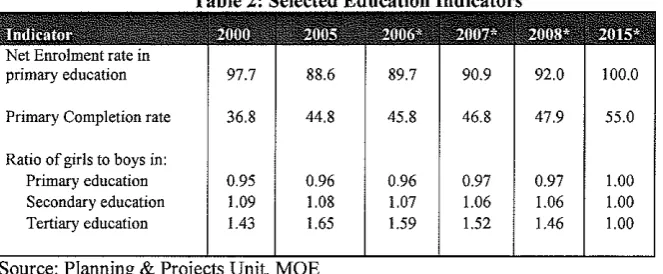
The table below presents updated figures for the years 2000 to 2005 for the following indicators: Primary Net Enrolment Rate, Primary Completion Rate, and Ratio of Girls to Boys Enrolled (Primary, Secondary, and Tertiary). The figures in the table below were obtained from statistical publications produced by the Planning and Projects Unit of the Ministty of Education.
Table 1: Selected Education Indicators 2000-2005
Indicator ~ ~;/ Actual Actual A'!etual Actual Actual ' .Actual~-~
~~~~r~;;;"'
..
sx " c
'"
"~:>
.
'~{103' ~•• • 200L •• ~
.
2001 2002 2005 2006Net Enrolment rate in primary
education 87.7 91.1 90.9 88.5 88.6 86.4
Primary Completion rate 38.2 38.2 39.7 37.0 44.8 41.4
Ratio of girls to boys in:
Primary education 0.95 0.96 0.96 0.95 0.96 0.97
Secondary education 1.04 1.05 1.09 1.05 1.08 1.09
Tertiary education 1.56 1.41 1.27 1.43 1.65 1.60
Source: Plannmg & Projects Umt, MOE
[image:10.596.116.491.409.556.2]Education
Table 2: Selected Education Indicators
":'fDilicator , '· ·' . Z' ~ . 2000 ., ' . 2005 " 2006* 2007* ",":ZOOS* 2015*
Net Enrolment rate in
primary education 97.7 88.6 89.7 90.9 92.0 100.0
Primary Completion rate 36.8 44.8 45.8 46.8 47.9 55.0
Ratio of girls to boys in:
Primary education 0.95 0.96 0.96 0.97 0.97 1.00
Secondary education 1.09 1.08 1.07 1.06 1.06 1.00
Tertiary education 1.43 1.65 1.59 1.52 1.46 1.00
Source: Plannmg & Projects Umt, MOE
[image:10.596.116.448.592.729.2]Achievements:
Primary completion rate - According to data from the Planning & Projects Unit, the Primary School Completion Rate declined by more than three percentage points from 44.8% to 41.4% in 2006. This was the first decline recorded in this statistic during the period from 2000 to 2006. In fact, over the six-year period under review this statistic has increased considerably, by 11.7 percentage points from a low of 29.7% in 2000. This is indicative of considerable improvement in the percentage of children who progress through and complete the primary school cycle within the prescribed eight years. Nonetheless, the recent decline in the primary completion rate warrants some attention on the part of the Ministry of Education.
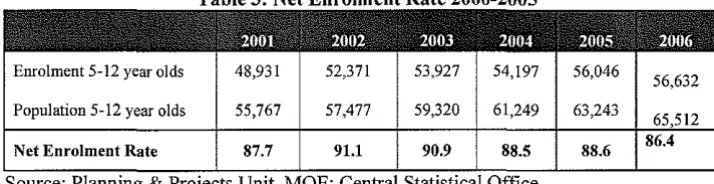
Net enrolment rate - This statistic, which measures the percentage of primary school aged children (ages 5-12) that are actually enrolled in primary schools, has tended to fluctuate around 90% over the period from 2001 to 2006. It should be noted that the population figure on which the net enrolment rate for the year 2000 was based on the 2000 Census. In all other years shown, the calculation is done using mid-year population estimates.
Table 3: Net Enrolment Rate 2000-2005
.
.·~
.
.
",':: 5>'
.
.
...
;•
",y:szs
2001 2002 2003 2004 2005.
2006Enrolment 5-12 year olds 48,931 52,371 53,927 54,197 56,046
56,632
Population 5-12 year olds 55,767 57.477 59,320 61,249 63,243
65,512
Net Enrolment Rate 87.7 91.1 90.9 88.5 88.6 86.4
Source: Plannmg & ProJects Umt, MOE; Central StatiStical Office
Net enrolment at the primary school level declined by 1. 7 percentage points, from 88.1% to 86.4%, between 2005 and 2006 - the fourth consecutive year that this statistic has declined, signalling another area that calls for the attention of the MOE.
While its calculation excludes children of primary school age who are enrolled in preschools or secondary schools (a total of 681 in 2006), these children constitute only 1.1% of the total population of 5-12 year olds. Even with the addition of these 681 children, the percentage of 5-12 year olds that were enrolled in any educational institution was only slightly higher (87.5%). This implies that a large number of primary school aged children (approximately 8,000) are not participating in the formal education system.
Ratio of girls to boys in the education system - The ratio of girls to boys enrolled at the primary level remained virtually unchanged over the six years from 2000 to 2006, at approximately 0.95 to 0.97 over the entire period. It should be noted, however, that this ratio has showed a slight upward trend between 2004 and 2006, indicative of an increase in the number of girls enrolled at the primary level relative to the number of boys.
There was more variation at the secondary level, where the ratio of girls to boys ranged from 1.04 to 1.09 over the course of this six-year period. Nonetheless, there is a dramatic difference in terms of gender equity between primary and secondary education, and females enrolled at these level consistently outnumbered males throughout the period. Other secondary education indicators, including repetition and dropout rates, further emphasise this disparity.
An even greater disparity is observed at the tertiary level, where girls outnumbered boys by almost two to one with a ratio of 1.60 females per each male at this level - indicating that girls comprise approximately two-thirds of the total tertiary level enrolment.
1.3.2: Other achievements:
Preschool education:
[image:11.598.116.473.283.375.2]o A total of 153 preschool teachers were fully paid by government (up from 140 in 2005).
o Preschool enrolment increased by 2.5% in 2006 from 4,861 to 4,983.
Primary education:
o Enrolment increased by 1.4% from 64,516 in 2005 to 65,430 in 2006.
Secondary education:
o Secondary enrolment increased by 1.5% from 16,696 in 2005 to 16,943 in 2006.
Tertiary education:
o Total enrolment junior colleges and universities increased by 11.5%, from 4,852 in 2005 to 5,412 in 2006
1.4. UPDATE OF THE ENVIRONMENTAL SITUATION
Goal 7 of the Millennium Development Goals (MDG) which aims to ensure environmental sustainability remains at the forefront of national policy and plans. The Government of Belize has articulated its commitment to ensure enviromnental sustainability at various national and international meetings and conferences. To reinforce this commitment, the Government has signed various Multilateral Environmental Agreements (MEAs) including the United Nations Framework Convention on Climate Change - UNFCCC, Convention on Biological Diversity - CBD, United Nationals Convention to Combat Desertification - UNCCD, the Cartegena Convention, the Stockholm Convention on Persistent Organic Pollutants -POPs, the Basel Convention on the Trans boundary movement of Hazardous wastes, the Rotterdam Convention on Prior Informed consent- PIC and the Vienna Convention under which is the Montreal Protocol relating to the gradual phase out of ozone depleting substances - ODS. However, there remain some issues of enforcement and compliance with these various MEAs.
With the discovery of crude oil in Belize, a new area of enviromnental concerns has opened. This relates to the exploration, production and subsequent use of the crude on the local market. In the absence of the much needed legislative and regulatory framework to manage this fast growing industry, several crude oil processing facilities have come on stream and threaten to wreak havoc on the Belizean environment by way of emissions associated with the burning of the crude and by way of waste products produced as a result of the processing of this product.
Apart from this, Solid Waste Management remains a key national priority area for the Government of Belize especially in local municipalities where open dumps are poorly managed and have significant health and environmental impacts on nearby residents and the environment. The Govermnent of Belize has developed a solid waste management plan and instituted a solid waste management authority with the legal mandate to address solid waste management issues nationally. Recently, the Government of Belize reaffirmed its commitment in addressing this problem and is looking at the implementation of the solid waste management plan through the construction of a central sanitary landfill.
The Government of Belize through the National Focal Point is presently in the process of preparing the Second National Communication on Climate Change. In addition, the Government of Belize through the Department of the Environment is presently developing a National Implementation Plan with regards to the Sound Management of Persistent Organic Pollutants (POPs) as required by the Stockholm Convention. Similarly, the Department of the Enviromnent is presently developing a National Implementation Plan under the Cartegena Convention for the Land Based Sources of Marine Pollution.
Department of the Environment is in the process of developing and proposing amendments to the Environmental Protection Act and the Pollution Regulations and is also developing new Hazardous Waste Regulations to address the Petroleum sector. Other amendments are also being developed to address other issues.
2.0 OVERVIEW OF PAST AND ONGOING CO-OPERATION
2.1 Focal sector 1: Consolidation oflnfrastructure Development
a) Results: The specific objective of this focal area is to facilitate the Government's efforts to improve the country's infrastructure in support of the productive and social sectors of the economy. Within this specific area, the European Commission (EC) is to contribute to the completion of infrastructure development already started under the previous European Development Fund (EDF), and to the improvement of the maintenance and operation of existing infrastructure. In this context, efforts were concentrated on the Road Sector.
The Hummingbird Highway is viewed as of strategic importance by the EC because it connects the capital city Belmopan with the coastal town of Dangriga, and is passing through one of the areas where the citrus industry is well developed. The highway is a significant contributor to the socio-economic development because it de-isolates, through its connection with the Southern Highway, the poor rural district of Toledo, and facilitates the transport of agricultural products towards markets.
This highway constituted also an important corridor to supplying emergency aid in the east and southern areas, when adverse natural conditions struck those parts of the country. The European Union's role focused in the past on the reconstruction of the Hummingbird Highway. The funds necessary for the rehabilitation were provided by both the United Kingdom (UK) government and the EU (under the 6th, 7th, and 8th EDF); for the upgrading of sections between Dangriga and Sibun River Bridge, and for the construction ofthelatter.
b) Activities:
New Bridge over the Silver Creek Bridge- B envelope- 9 ACP BEL 2- € 1.0 million
Following the conclusion of a financing agreement in 2005, a works tender was launched in July 2005. The contract was awarded to contractor Cisco Construction Ltd in December 2005. The works started in February 2006. The project was completed within time and budget. The works were provisionally accepted in October 2006. The year 2007 covered the maintenance period. The project was finally accepted in October 2007. The fmal administrative steps have to be carried out (release of performance guarantee and retention monies).
c) Integration of Cross Cutting Themes: the completion of the Hmnmingbird Highway saw the enhancement of transport operations between Belmopan and Dangriga, in the main citrus production belt of Belize and a region with growing potential for eco-tourism development, as well as for agricultural production. For the populations living along the road, the upgrading of the Highway has improved access to health services, to centres of employment and to the administrative and social services available in Belmopan and Dangriga.
2.2 Focal sector 2: Development of Human and Natural Resources
a) Results and Activities: The project started in September 1999 to promote the conservation and sustainable use of the Belize Barrier Reef Complex through integrated marine and coastal area management. This important ecosystem comprises the second longest barrier reef in the world, hundreds of patch reefs, three offshore atolls and over
l ,000 cays. With its mangrove forests and extensive beds of sea grass, it is home to several endangered species including the West Indian manatee, the American crocodile, marine turtles and several species of birds. At that time, there were concerns regarding impacts to the coral reefs and other coastal habitats by inappropriate coastal development involving dredging or the run-off of sediment, agricultural chemicals and sewage. Furthermore, the need arose to strengthen the public's awareness to increase the understanding of coastal zone management.
The project contributed to two of the major components of the larger GEF!UNDP Project. Among its main outputs is the completion of a Coastal Zone Policy Framework, which divides the coastal regions according to categories and intensity of use. As part of this, Coastal Advisory Committees (CACs) have been established in Caye Caulker, Turneffe Islands and Placencia/Laughing Bird Caye. Members have been trained in leadership skills, planning, conflict resolution and consensus building, and are preparing detailed regional guidelines facilitated by wide community participation.
Under the EU component, several items of equipment were purchased to support the monitoring activities for water quality, flagship species and the condition of the reef. Specific attention was given to the Manatee Research Program, which continued its tagging and monitoring activities in conjunction with Wildlife Trust International. A sophisticated data centre was equipped with an up-to-date Geographical Information System. It processes and disseminates the scientific and technical data gathered from these monitoring activities, thereby greatly increasing the baseline kuowledge available for decision-making.
The results of the fmal evaluation of the project conducted during the 4th Quarter of2004 were presented in February 2005. The evaluation was conducted by a team of three consultants (two international, one national) in accordance with the UNDP/GEF Monitoring and Evaluation (M&E) policy at the project level. The evaluation found that many project activities could be checked off as successfully accomplished. The main conclusion was that the project has made significant progress in establishing the Network of Marine Protected Areas. These were marked with demarcation buoys and continue to be patrolled by Rangers. However, CZMAI, the national institution, is at present time floundering as a result of poor management and lack of vision and commitment for the future.
The project was implemented by the Coastal Zone Management Authority and Institute (CZMAI), and received € 537,918.88 to date from the EU. The general and individual de-commitments have been done in 2007.
b) Integration of Cross Cutting Themes: The CSU Barrier Reef project integrates environmental matters related to biodiversity conservation and sustainable management of coastal ecosystems, with the development of socio-economic opportunities for local communities. The CZMAI improved its policy making, planning and managerial capacity as a result of the execution of CSU Reef project.
2.3 Focal sector 3: Rural Development with focus on Agriculture
Belize Rural Development Progranune (BRDP)- 9 ACP BEL 003 (€ 7,000,000)
efforts of marginalised populations to enter the mainstream of economic activity. As a result of the implementation of the BRDP, the percentage of rural poverty is expected to decrease by 5% in 2008.
The project's expected results are as follows (i) more efficient and competitive rural enterprises (both farming and non-farming ones established), (ii) basic services of the rural population improved and (iii) policies and institutional environment strengthened within which rural enterprises, traders, processors, local organisations and communities operate. In order to reach these results, the BRDP is intended to (i) strengthen policies, institutions and communities to ensure the sustainability of "integrated rural development" in the long-term without donor support, (ii) promote an efficient rural sector and facilitate the development of farming and non-farming activities as by stimulating the Small, Medium and micro Enterprises (SMEs) and (iii) support the development of rural infrastructure in the most disadvantaged areas in Belize.
b) Activities: The overriding objective of the BRDP is to support sustainable economic growth of Belizean rural areas. The project aims at reducing poverty in Belize and improving the standard of living of the rural population by supporting the rural sector, bearing in mind the agriculture base of the Belizean rural areas. This will be done through the participation of rural communities in the plarming and implementation of this program.
The overall responsibility for the implementation of the program lies with the National Authorising Officer (NAO) for the EDF, and the Ministry of National Development, Investment and Culture that is the Contracting Authority. A Project Steering Committee (PSC) has been set up to provide guidance and policy direction to the project and is chaired by the MND. BRDP is implemented by an independent Project Coordination &
Management Unit (PCMU), which assumes an administrative and fmancial role and co-ordinates the project's implementation at community, district and national level with the various line Ministries and donor agencies. The PCMU also coordinates all the activities carried out by the partner organisations, especially the District Development Committees (DDCs) and service providers.
The project inception was effective in April 2006. The inception phase lasted 6 months and was completed in November 2006. A startup Program Estimate (PE) (Aug. 06 -Nov.06) was entirely implemented during this period .. The 2nd PE originally covering the period Nov 06 -Oct 07 and amounting to € 1,460,000 was subsequently revised to € I, 144,000 and the period of implementation was extended to 31 April, 2008. The reasons for this were (i) that funds saved could be used to partially fund a new project for hurricane Dean relief (see after) and also (ii) because of the time needed to identify and implement the 82 small-scale projects that are funded under this PE.
Because of this constraint, discussions concerning a revision of the BRDP Finance Agreement (FA) were initiated in February 2007 and on 8 October, 2007, an addendum to the FA allowing for larger projects to be implemented, for an increase in the amount that can be spent on infrastructure, and an increase in the total funds available to BRDP by an amount of € 199,000. This additional amount is reserved for the repair of the Middlesex Bridge in Stan Creek district. The above Addendum No I to the FA authorises larger grants that will be committed through 7 calls of proposal that have been launched in August 2007: and evaluated in December 2007. These funds will be committed during 2008 as follow:
• € 3.0 million for seven grants to non-profit organisations • € 1.0 million for rural feeder roads
• € 990,000 for three programme estimates • € 600,000 for hurricane Dean relief (see after) • € 199,000 for the Middlesex Bridge repair • € 110,000 for audits and mid-term evaluations
• € 1.30 million for the cost of the PMU (programme implementation)
timely preparation of the tender dossiers in order to commit the funds before the d+3-deadline. Additionally, the tender dossier for the rehabilitation of the Middlesex Bridge was prepared (funded by GoB) and presented to the Delegation for review.
During the night of 20-21 August 2007, a category 5 hurricane (named: "Dean") had made landfall at the Belizean- Mexican border and had brought severe destruction to the agricultural crops (papaya, sugar cane, trees) and to houses in villages of Corozal and Orange Walk and (partially) in Belize Districts. The EC Delegation in Jamaica had offered assistance to Belize by being prepared to re-allocate funds under the BRDP. A B$ 1,620,000 (€ 600,000) request for a grant to support (a) the construction of new simple one room houses for families who have lost everything (b) the repair of hurricane shelters (c) for agricultural rehabilitation projects has been submitted by the Social Investment Fund (SIF) with the assistance of the PMU to NAO in the last week of November and was forwarded to the EC Delegation for consideration. These € 600,000 will be fmanced from the Finance Agreement (FA) cost category "Contingency" (€ 390,000) and € 210,000 would be taken from savings from PE2 and from the budget of PE3 (May 2008 to November 2009).
c) Integration of Cross Cutting Themes: The financial support, which is being given to the underprivileged groups including single women, did not have an initially high economic impact. However, these small sums : (i) helped ensuring that benefits reach a wide cross section of beneficiaries, (ii) acted as a catalyst for economic activities that are successful, and (iii) stimulated further economic activity in the medium to long term.
d) Progress in donor coordination: some Grants will be implemented by UNDP, in partuership with local organisations, through the FAFA. The BRDP is collaborating closely with the Taiwanese cooperation manages many activities in rural areas of Belize. BRDP is also involved in communication campaign with other donors and missions in Belize (in particular !DB and the British High Commission) to present and explain their action and to seek synergies with them.
2.4 Projects and Programmes outside Focal Sectors
Technical Cooperation Facility (TCFl - 9 ACP BEL 001 (€ 546,000)
a) Results: As a consequence of the closure of the EC office in Belize in 2002, the changing nature of EC rules and the expanding role of the NAO under the new EDF Regulations there was a need to reinforce the capacities of the NAO Office. For this reason a Technical Cooperation Facility (TCF) of € 546,000 was adopted in early 2004 with the objective of strengthening the capacity of the NAO Office through (i) the provision of Technical Assistance, (ii) the defmition of an appropriate rural development policy, (iii) and the organisation of training and seminars for the NAO Office's staff. The implementation of the TCF became effective in 2005 and the following activities were implemented since then:
b) Activities:
l. TA NAO: (January- July 2005): The main roe of theTA was to increase the capacity of the NAO's office in (i) the design of programmes/projects in their formulation and appraisal, their implementation and monitoring (project cycle management) according to the Budget and EDF procedures and (ii) the capacity of the NAO's office to cope with the volume of fmancial and administrative tasks related to project implementation.
2. Programme Estimate 1 (May 2005 -December 2005): The first PE was signed in May 2005 and covers the period December 2005. The main activities carried out in this PE are: (i) Organisation of a seminar in Belize on EU - Belize partuership and (ii) sponsoring of various trainings and seminars to Belizeans Officials.
according to the district is available, (ii) an overview on marketing practices and marketing possibilities, (iii) expressed needs by local population have been registered and (iv) recommendations have been made for measures to improve the rural situation. 4. Preparation of the CSP (May- June 2006): A consultancy to prepare the 2008-2013 CSP was awarded to HTSPE & completed in 2006. The focal area of the EC Support Strategy for Belize will be Poverty Reduction with institutional and capacity building, in support of a two-tiered rural development approach including: a) Local (district, community and group) level interventions to promote market-led rural enterprise development; b) Strategic infrastructure interventions to create an enabling environment for rural development.
5. Programme Estimate 2 (November 2006 - September 2007): The second and last PE was prepared and signed during this period. The preparation was delayed due to the difficulties met by the NAO in receiving contributions from other Ministries (especially the Ministry of Foreign Trade). The PE was signed in November 2006 and covers the period Nov.06-Sep.07. The main activities carried out in this PE are: (i) A Marketing Study (€ 126,400) conducted in partnership with Belize Trade and Investment Development Enterprise (BELTRAIDE); (ii) A seminar on Phyto-Sanitary Standards (€ 11,164) in association with the Belize Agricultural Health Authority (BAHA); (iii) Training for Belizeans in EU procedures (€ 6,000) and; (iv) Evaluation/Audit of the Program (€ 20,000).
6. Marketing study (March 2007 - on-going): As a result of poor marketing performance in Belize, a marketing study was launched to support sustainable economic growth in the rural areas of Belize in order to reduce rural poverty. The study identified potential markets for priority products of small producers, to analyse productive and institutional capacities and resources to access identified markets and to accordingly develop an action plan which will enable Belizean producers to access such markets.
The FDC of the TCF is March 2007. At the end of2007, 88% of the funds (€ 446,513.81) were committed. All the remaining funds, except the contingencies, shall be committed through an audit and an evaluation.
2.5 Utilisation of Envelope B
See text on activities in focal sector I on the New Bridge over the Silver Creek Bridge-B envelope -9 ACP BEL 2 -€ 1.0 million
2.6 Community Budget Lines
2.6.1 Special Framework of Assistance to the Banana Industry (SF A)
The objective of the EUBSP is to assist traditional ACP- Banana export countries to come to terms with the increased liberalisation of the banana regime by: i) improving the competitiveness of the banana industry, and; ii) supporting diversification where improvement in the competitiveness is not sustainable. The purpose is to maintain living standards of farmers, farm and port workers and their communities in the banana producing areas in the short term and to improve their living standards in the long term. Since 1999 Belize has received € 23.880.000 from the SFA programme.
Until 2005, the Program had been managed under centralised procedures following the previous Financial Regulations, with the Banana Growers Association (BGA), througb a Project Management Unit (PMU), as implementing agent of the Project througb Annual Work Programs (A WP). However, following the entry into force of the New Financial Regulations and as a result of a verification exercise carried out in November 2004, partial decentralisation was granted to the GOB with the Ministry of Agriculture (MOA) replacing BGA as implementing agency, effective at end 2005. Financing Proposals for SF As 1999 and 2000 gave assistance solely for enbanced banana competitiveness. From SFA 200 I to SFA 2005 rural development was introduced representing up to 15% of the total value of the allocation. This allocation was increased up to a level of 50% under SFA 2006. SFA 2007 will be entirely dedicated towards improving the lot of banana workers and their dependents, and will further strengthen two important areas of rural development througb [1] provision of additional economic infrastructure and [2] improvement in quantity and quality of education and skills development in the banana belt. It is anticipated that SFA 2008 will complement [2].
A Financing Proposal for the 2007 SF A allocation (€1.8 million) was approved at the end of 2007. In line with the strategy of Belize the fimds have been allocated to the Rural Development Component. This new project seeks to improve economic opportunity and to improve access to education and training of the target group. Its main objective is to further assist workers and their families in the banana belt enter a more diversified economy. The purpose is to [l] improve small business' opportunities to offer produce to local and tourist markets and [2] to assist improvement in provision of appropriate education to workers and their families in the banana belt. The anticipated results are [I] market facilities for small business people in the banana belt enhanced, with trading space, with hygienic facilities for handling of produce and a tourist and transport transit facility provided [2] access to a technical high school education improved by increasing class-room and workshop training space for up to 400, curricula further developed for technical training courses and up to 40 teachers skills and qualifications enbanced and [3] access to adult education and skills training in facilities created under [2] for I 00 provided annually.
b) Activities carried out during 2007 and results achieved:
From a contractual perspective, implementation in 2007 improved and a substantial part of the backlog in contracting was cleared. All funds subject to the D+3 rule were contracted by the end of the year (i.e. all SF A 2004 funds). More than € 4,822,804 has been contracted during 2007 reducing the RAC of all SF As by 43% (from € 11,370,000 at the beginning of the year to € 6,547,000 at year-end).
Major results achieved are:
SFA 1999: Drainage and Irrigation Project- Phase I (€ 3,100.000) (BAN/2000/003-093): No actions were carried out in 2007 under this SFA. The balance left under this SFA is € 231,192. These remaining funds will be used to conduct marketing activities in 2008.
SFA 2000: Rehabilitation and Quality Improvement - Phase I (€ 3.100.000) (BAN/2000/004-650): As for SFA 1999, no activity was conducted in 2007 under this SFA. The balance left is € 72,083. These remaining funds will be used to purchase meristems plants and to finance an evaluation (after de-commitment of unspent funds).
SFA 2001: Drainage and Irrigation -Phase II (€ 3,450.000) CBAN/2001/004-096): The recruitment of the Project Director of the PMU was fmalised in 2007 (co-financed by SFA 2002). A Grant contract was also awarded to SIF under this SFA (co-financed also througb SFA 2004 and 2005) for a Banana Belt Clean Water Project in Trio, San Isidro, Bladen & San Pablo Villages, in Toledo District for a value of € 549,687.63 (EC contribution).
targeting the workers of the industry. A grant for rural electrification was also signed in 2007 with Belize Electricity Ltd for a value € 1,364,339 (EC Contribution) targeting also communities of the Banana Belt (co-financed through SFA 2005 and 2006). Concerning the Competitiveness component, the Agricultural Inputs Tender was fmalised and the contract signed for a value of € 279,614.65 (co-fmanced also through 2004)
SFA 2003: Value added component, Marketing and Rural Development SFA 2003 (€ 3,200,000) CBAN/2003/006-019): This FA was signed at the end of the N+l leaving less than 2 years for contracting. In 2005, the NAO, after the request of BGA, wanted to reconsider the activities within the SF A and plarmed to introduce a nematode control management component instead of the drying plant component. While this idea has been abandoned, it has led to a postponement in the implementation of the program. A Rider to SFA 2003 granting full decentralisation was signed in 2006 enabling the use of PEs. Subsequently a PE for a period of 18 months was also signed under which all the remaining funds have been committed. The marketing study and the food processing study were carried out. The Rural Development Component has been fully implemented through the PE that will expire in April 2008.
SFA 2004: Financing Proposal SFA2004 (€ 2,930,000) CBAN/2004/016-92]): High priority was given in 2007 to this SFA since all the funds had to be committed by the end of the year due to the expiration of the D+3. Under the Competitiveness component, many activities were conducted including supply of 420,000 hardened meristems plants, Rehabilitation and preparation of 494 acres of land, supply and after sale of agricultural inputs for a total value of€ 1,929,568. At the end 94% of the funds (€ 2,762,107.66) were committed. The balance, except the contingencies, will be contracted through an evaluation and an audit.
SFA 2005: Plant Nutrition, Environmental Monitoring and Rural Development (€ 2,490,000) (BAN/2005/017-616). The main components of this SFA are (i) Plant Nutrition Program (62%), (ii) Environmental Monitoring Program (8%) and (iii) a Rural Development Fund (15%). In 2007 only the last one was implemented (see paragraph on SFA 2001 and 2002). In 2008, it is foreseen to appoint a plant nutrition expert and purchase agricultural inputs to carry out trials to optimize the use of fertilizers in the industry. In parallel, an environmental monitoring will be designed and implemented to assess and correct the environmental impact of the industry. It is expected that buy the end of 2008, all the fnnds under this SFA will be committed.
SFA 2006: Nematode Control Programme, Rehabilitation and Rural Development. (€2,110,000) CBAN/2006/018-439): The lack of competitiveness of the sector will be reinforced through (i) increased costs and reduced yields in the industry due to nematodes (21%), (ii) increasing farm cost due to aged and diseased plantations and the need for improved crop timing (21% ), (iii) low standards of living and persistently elevated levels of poverty for communities based in the banana-producing areas (42%). This component represents 50% of the allocation of the SFA compared to 15% in the previous one. It aims at supporting economic and social activities at the community level of the Banana Belt through a Rural Development Fund. Some of these funds have been committed in 2007 (see paragraph on SFA 2002). In 2008, it is foreseen to appoint a nematode expert and purchase agricultural inputs to carry out trials to optimise the use of fertilizers in the industry.
rivers, in the banana industry. An environmental management project forms a part of Belize's Banana Country Strategy.
2.6.2 Accompanying measures for sugar protocol countries (AMS)
a) Results:
The Accompanying measures for sugar protocol countries (2006-13), fmanced via the commission budget, foresee annual allocation for a total of € 48 million for the period 2006-10, in support of the implementation of the national sugar adaptation strategy.
The 2006 Financing Agreement signed in February 2007, with the objective of reducing poverty and improving the living standards of the rural population in Northern Belize through support to the sugar industry and the vulnerable groups.
The Financing Proposal for the 2007 AMS allocation (€ 6 million) was approved at the end of2007. In line with the strategy of Belize and the EC MIP, two areas of intervention have been identified: improvement of the 'Sugar Belt' Road Network' (€ 4.8 million) and policy development and capacity building (€ 1.2 million).
b) Activities carried out during 2007 and results achieved:
AMS 2006: EC Support to the Belize Country Adaptation Strategy for Sugar - 2006 Allocation (Phase I) (€ 3.030 million)
AMS2006BZ 2,886,665
Allocation 3,038,000
Contracted Paid
752,000 4,457,000
RAC RAL
2,285,819
A number of key studies to prepare the ground for the more consistent interventions under AMS 2008 have been completed (e.g. a transport study, cost-benefit of the sugar cane sector, diversification study). A tender for the recruitroent of a PIU was launched and the contract awarded (€ 0.8 million). The tender for the rehabilitation of rural roads is about to be launched (€ 1.45 million). The threshold to have contracted 30% of the primary commitments by August 2008 should be achieved. Following hurricane Dean the Government decided, in agreement with the Delegation, to allocate funds for the rehabilitation of the sugar cane areas; a contract of the value of€ 410.000 was signed in December for the supply of agriculture inputs for farmers affected by the Hurricane Dean. Distribution of the agriculture inputs should start in spring 2008.
Major obstacles
The main challenge is to manage and implement such a large programme (€ 46 million) through project approach without having an EC representation office in the Country and considering the limited capacity of the NAO, Ministry of Agriculture and Ministry of Works.
The recruitment of a PIU in spring 2008 should help the Government to manage the funds foreseen for the next years and improve performance.
2.7 European Investment Bank
In December 2006 the Bank signed its first operation in Belize under the Cotonou Agreement, providing a loan of USD 4.7 million (equivalent to some € 3.7 million) to Astrum Travel International Ltd. This direct Investment Facility operation in the private sector is in line with the Bank's mandate under Cotonou and consistent with national priorities, targeting the tourism and transport sectors that are key to the development of Belize's economy.
Also under the Cotonou Agreement, in terms of indirect financing, i.e. EIB funding channelled to projects in Belize through regional financial facilities, the EIB disbursed USD 5m under its credit line with the Caribbean Development Bank to the Water and Sewerage Authority (WASA) for the fmancing of the expansion and improvement of the supply of water from the water treatment plant at Double Run which serves Belize City.
During 2007, EIB approved that the remaining € 2 million available for disbursement under the EIB credit line with DFC could be transferred to the Belize Citrus sector organization as the new borrower. This will benefit the small citrus growers.
2.8ECHO
In August 2007 DG ECHO deployed a humanitarian expert from DG ECHO's Caribbean office in Santo Domingo to Jamaica for an assessment mission of the impact of Hurricane Dean. A 6-month Emergency decision ECHO/-CR/EDF/2007/01000 (€ 3 million), valid from 17 August 2007, assisted 50,000 hurricane victims in Belize, Dominica, Haiti, J arnaica and Saint Lucia.
This was the operation in Belize: Norwegian Red Cross in Belize
Type of aid: Relief items, Food, Water and Sanitation-€ 526,289.13
A considerable degree of Disaster Preparedness and Disaster Risk Reduction was included in the operations e.g. in Belize there were some pre-positioned emergency kits and capacity-building of the Belize Red Cross, which have recently been used in the response to Tropical Storm Arthur. In Jamaica, the rehabilitation of Bellevue Hospital included retrofitting, in order to withstand future hurricanes, and the shelter rehabilitation operation trained local communities in hurricane-proof building techniques.
It would also be appropriate to add a reference to the Sixth DIPECHO Action Plan in the Caribbean (€ 4 million), which was launched in September 2007 and runs until February 2009. In Belize there is an operation under the Norwegian Red Cross (€ 306,000) entitled "Strengthening the Capacity of Communities to Prepare, Mitigate and Respond to Disasters in the Stann Creek and Toledo Districts in Belize with emphasis on Public Health". This is currently suspended due to Tropical Storm Arthur, so extra time will be granted.
2.9 POLICY COHERENCE FOR DEVELOPMENT (PCD)
The EU-Belize cooperation is coherent with EU policies, especially in the area of agriculture through the budget lines for bananas, sugar and the rural development programme.
2.10 JOINT EU STRATEGY FOR THE CARIBBEAN
The EU - Caribbean Partnership, as expressed in the EU strategy for the Caribbean, is composed of three interrelated facets, shaping political partnership, addressing socioeconomic and environmental vulnerabilities and combating poverty, inequality, HIV/AIDS and drugs.