Int. J. Electrochem. Sci., 12 (2017) 11487 – 11495, doi: 10.20964/2017.12.72
International Journal of
ELECTROCHEMICAL
SCIENCE
www.electrochemsci.org
Short Communication
The Preparation and Performance of WO
3@C as a Counter
Electrode Catalyst for Dye-Sensitized Solar Cell
Weizhen Cui1,2, , Jing Ma1,Kezhong Wu1,* , Jing Chen1, mingxing Wu1,*
1
Department of Chemistry and Material Science, Hebei Normal University, Shijiazhuang 050024, China
2
Department of Chemistry and chemical engineering, Cangzhou normal College, Hebei Cangzhou 061001, China
*
E-mail: [email protected]
Received: 5 May 2017 / Accepted: 20 September 2017 / Published: 12 November 2017
Tungsten trioxide (WO3) loaded on activated charcoal powder (ACP) was sprayed onto ITO
conductive glass for using in dye-sensitized solar cells(DSSC). The results showed that the composite electrode of WO3@ACP had apparently catalytic activity as a counter electrode for the regeneration of
the traditional iodide / triiodide (I-/I3-) redox pair. In the dye-sensitized solar cell, the power conversion efficiency on WO3@ACP was 5.04%, which was 3.15 times higher than 1.61% on the WO3. The
followed were the electrical properties test of cyclic voltammetry(CV), electrochemical impedance spectroscopy(EIS) and Tafel polarization curve. It was further explained that the catalytic activity of WO3 @ ACP was obviously affected by the dispersion of WO3 particles on activated carbon powder.
Keywords: Tungsten trioxide;activatrd charcoal powder; Catalyst; Counter electrode; Solar cell
1. INTRODUCTION
Dye-sensitized solar cell (DSSC) is a potential candidate to the silicon solar cell, owing to their particular advantages such as casual assembly processes, clearness, environmental friendliness, potty architectural combination, and corking plasticity[1-3]. The construction of a representative DSSC system is consisted of a counter electrode (CE), a dye-sensitized TiO2 photoanode and an electrolyte
metal compounds[10-11] have been leaded into DSSC to substitute the Pt CE. Besides, loading is a commonly used method to decrease the quantity of the precious metal without endowing its catalytic activity. As we all know, composite materials usually include two or more modules, such as, Pt/C[12], MoC/C[13] , C/PEDOT/PSS[14], CoS/PEDOT/PSS[15], PtNP/MWCNT[16], Pt/graphene, PEDOT/graphene, CNTs/graphene, and Pt/CNT[17-19], etc. Normally, the strengths of the compound CE are as follows: firstly, a composite material is made up of the best qualities of all components by it; secondly, materials can decrease the amount of Platinum regard to the Platinum matrix composite CEs; thirdly, materials can apparently increase the catalytic activity.
Metal oxides have the strength of liable preparation and rich species in the composites. WO2 as
a counter electrode (CE) in the DSSC acquired power conversion effectiveness of 7.25%[20]. Hematite (a-Fe2O3) with distinct geomorphologies such as nanofibers, nanoparticles (NP), nanorods and
nanoflowers was successfully prepared by hydrothermal reactions and leaded into DSSC as a counter electrode (CE). The use of NP cells in a CE[21]resulted in a maximum efficiency of 4.60%. WO3 have
caused widespread concern as general materials employed in field emitters, gas sensors, electrochromic devices [22] and photooxidation of H2O to O2 as a photocatalyst[23]. Yet, rare report
news concentrate on making use of tungsten oxides as counter electrodes in DSSC. In this work, tungsten dioxide (WO3) that was supported on activated charcoal powder (ACP) was composed and
checked as CE catalysts for using in the DSSC system.
2. EXPERIMENTAL
2.1 Main reagents
Ammonium paratungstate ((NH4)10H2(W2O7)6), lithium perchlorate(LiClO4), lithium
iodide(LiI), iodine(I2), acetonitrile (Aladdin, Shanghai). Isopropano (Sinopharm, Shanghai). Titanium
dioxide (TiO2) (Degussa, Germany). N719 dye (Solaronix, Switzerland). Activated charcoal
powder(ACP) (Yongda, Tianjin).
2.2 Preparation of CE catalysts
(1) WO3 was prepared by high-temperature solid-state method. Which is, dissolving 1.2750g
(NH4)10H2(W2O7)6) in distilled water of 5 mL. Ultrasonically distributing the solution for 1h and then
diverting it to a drying oven to except the distilled water and getting the precursor of WO3. Afterwards,
it was acquired by agglutinating the precipitate twice at 500oC for 8 h and 900 oC for 9 h in air.
(2) The preparation of WO3@ACP was as follows. A certain number of 0.0030g ACP mixed
with 0.1000g WO3. The solutions were dispersed for 1h to obtain the final WO3@ACP .
2.3 Electrode fabrication and cell fabrication
ACP, WO3 and WO3@ACP CEs were prepared as follows: 125mg of ACP (or WO3 and
1h to acquire the atomization ointment. With a spray gun, applying the prepared ointment to the FTO glass. Afterwards, the FTO glass oiled with ACP (or WO3 and WO3@ACP) membrane was sintered at
500 oC for 0.5h in N2 atmosphere. DSSC was made of a light-anode, an electrolyte and a counter
electrode. The photoanode was used in this work with a 4 mm thick and N719 dye-sensitized TiO2
film. The electrolyte involves 0.1 M·L-1 of LiI, 0.07 M L-1 I2, 0.5 M L-1 4-tert-butyl pyridine, 0.6 M L-1
1-propyl-3-methylimidazolium iodide, and 0.1 M L-1 guanidinium thiocyanate in 3-methoxypropionitrile (MPN). A cell was assembled with two same counter electrodes to clip the electrolyte. Using a hot-melt surlyn membrane to seal the cells.
2.4 Measurements
X-ray powder diffractometer (D8 ADVANCE, Germany) to perform X-ray diffraction (XRD) gauges. Showing the characteristics of the surface morphologies of ACP, WO3 and WO3@ACP by
SEM, S-4800, Hitachi, Japan.Using an electrochemical workstation system (CHI 660E, Chenhua Shanghai) to show the characteristics of cyclic voltammetry (CV),electrochemical impedance spectroscopy (EIS) and Tafel-polarization experiments.
10
20
30
40
50
60
70
ACP WO3
WO3/ACP
In
te
r
si
ty
/(
a
.u
.)
[image:3.596.165.425.378.607.2]2θ/
degree
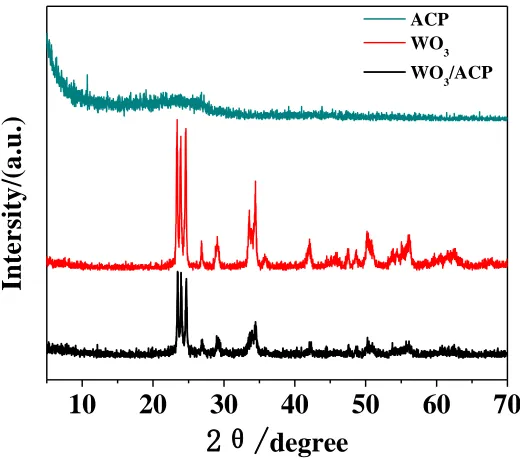
Figure 1. XRD patterns of ACP, WO3 and WO3@ACP
The CV was carried out in a three-electrode system with a scanning rate of 0.02V/s. In EIS, the gauged rate of recurrence range was from 100mHz to 1M Hz. The margin of the AC(alternating current) was designed at 10 mV. Measuring Tafel polarimetric measurements using electrochemical analyzers. The scan rate was 10mV/s. The electrochemical parameter of CV, EIS and Tafel measurements, Pt was used as CE and Hg/Hg2Cl2 was stored as the reference electrode. In acetonitrile
PV capability of the DSSC was implemented under imitated AM 1.5 illumination (I =100mWcm-2, PEC-LO1, Yokohama, Japan) using the electrochemical workstation CHI 660E.
3. RESULTS AND DISCUSSION
[image:4.596.197.400.175.666.2]3.1 Characterization of counter electrode
Figure 2. SEMimagesof the prepared (a) ACP (b) WO3 (c) WO3@ACP
The Fig.1 shows XRD patterns of ACP, WO3 and WO3@ACP. In Fig.1a indicates that WO3
(No.32-1395, PDF-2 Database) was synthesized. The WO3 imbedded in ACP successfully. The Fig.2
WO3 exhibited a typical blocks and particle size was uneven, from 500nm to 2μm. Fig.2a shows that
the AC is the small block. Fig.2b presented the form of blocks was bigger than ACP. Fig.2c showed that the WO3 was loaded on ACP.
3.2 Photovoltaic performance
0 100 200 300 400 500 600 700 800
0 2 4 6 8 10 12 14 16 18 WO3 ACP WO3/ACP
[image:5.596.183.404.197.382.2]P h o to c u r r e n t d e n si ty /m A c m -2 photovoltage/mV
Figure 3. J−V curves of the DSSC in the I−/I3− electrolyte with ACP, WO3, and WO3@ACP
-0.2 0.0 0.2 0.4 0.6 0.8 1.0 1.2
-0.9 -0.6 -0.3 0.0 0.3 0.6 0.9 1.2 ACP WO 3 WO 3/ACP C u r r e n t d e n si ty / m A c m -2 Voltage/V vs.SCE
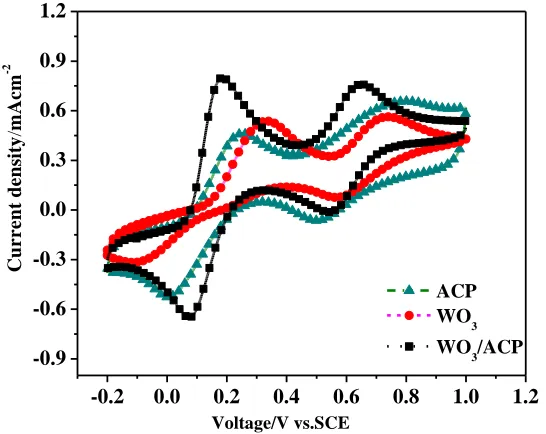
Figure 4. CV of I-/I3- redox couple for ACP, WO3 and WO3@ACP electrodes
J-V curve is the most intuitive way to reflect the performance of a battery. Therefore,in this work, we prepared WO3、ACP、WO3@ACP . Then, they were used as CEs in DSSC,to carry out
testing. Fig4 showed the J-V curve of the DSSC using ACP, WO3 and WO3@ACP CEs. And the
[image:5.596.154.427.435.652.2]
activity and the DSSC gave a PCE of 5.04%, much higher than the DSSC with the ACP(2.10%) and WO3(1.61%). Zheng et al. [24] reported for the first time that WO3 nanostructures have been used
as alternative photoelectrode materials in DSSC. The commercial WO3 nanoparticles was investigated
the effect of various parameters on the cell performance. DSSC based on WO3 nanoparticles exhibited
a conversion efficiency of 0.75%, which was enhanced up to 1.46% by the surface modification. Kim et al. [10] reported the conversion efficiency of 1.05% for the photoelectrode based on the TiCl4-treated
WO3 nanoparticles. In this work, the PCE was improved from 1.61% to 5.04% by tungsten dioxide
(WO3) that was supported on activated charcoal powder (ACP). The measurement results were shown
[image:6.596.43.558.291.349.2]that the composite materials CE could greatly reduce the cost of DSSC without sacrificing the PCE value. The WO3@ACP fully combines the advantages and disadvantages of the ACP and WO3.
Table 1. Photovoltaic parameters of the DSSC
Counter electrodes Voc/mV Jsc/mAcm-2 FF PCE/%
ACP 673 6.38 0.49 2.10
WO3 745 14.50 0.15 1.61
WO3@ACP 764 12.75 0.52 5.04
3.3 Electrochemical property
Fig.4 shows the CV curve of the ACP, WO3 and WO3@ACP electrodes in the iodide
electrolyte. It can be seen from the figure 4 that the cyclic voltammetry curves have two pairs of redox peaks, corresponding to the two reactions (1) (2), the peak current density and the peak potential difference are important parameters that affect the electrocatalytic activity of the electrode[24]. The greater the peak current the smaller the peak potential difference, the better the electrocatalytic activity of the electrode, we analyze the results of the test,the current densities of the reduction peak for WO3
was much higher than ACP. And the ΔEp (peak-to-peak separation) of the left redox peak for WO3@ACP (0.11V) was smaller than that of WO3(0.45V).
I3-+2e-⇌3I- (1)
3I2+2e-⇌2I3-(2)
CV results show that WO3 @ ACP exhibits relatively good electrocatalytic performance during
catalyzing the conversion process of I- / I3-. Therefore, it is a promising CE catalyst. This is also in
conformity with the J-V curves results.
EIS experiments were performed with three-electrode system to investigate the electrochemical process for ACP, WO3 and WO3@ACP. Figure 5 shows the Nyquist diagram of the three kinds of
electrode materials, whose series resistance (Rs) on the real axis and the right half arch of the load
resistance (Rct) are an important factor in the electrocatalytic performance of the electrode[25]. The
values of the EIS electrochemical parameters were determined by fitting the EIS plots with an equivalent circuit (Fig.5). By counting the data, it can be viewed intuitively that WO3> ACP>
WO3@ACP. The resistance of WO3@ACP is the smallest, which indicates that it has a better
In order to further study the electrocatalytic activity of the three kinds of electrode materials, the Tafel curves of ACP, WO3 and WO3 @ ACP are characterized. As shown in Fig. 6.
0 30 60 90 120 150 0
30 60 90 120 150
-Z
''
/Ω
Z'/Ω
ACP WO3
[image:7.596.165.418.128.338.2]WO3/ACP
Figure 5. Nyquist plots of ACP, WO3 and WO3@ACP electrodes
-0.6 -0.4 -0.2 0.0 0.2 0.4 0.6
-8 -7 -6 -5 -4 -3 -2
L
o
g
J
/L
o
g
m
A
c
m
-2
U/V
ACP WO3
[image:7.596.166.418.386.596.2]WO3/ACP
Figure 6. Tafel curves of ACP, WO3 and WO3@ACP electrodes
Table 2. The data of Tafel curves with ACP, WO3 and WO3@ACP electrodes.
electrodes LogJ0/LogmAcm-2 Corrosion potential/V LogJlim/LogmAcm-2
ACP -4.759 0.076 -3.284
WO3 -5.319 0.104 -3.660
[image:7.596.47.552.677.735.2]
It can be seen from Fig. 6 that the three kinds of samples WO3, ACP and WO3 @ ACP show
different polarization behavior curves, which are divided into polarized and Tafel regions according to the degree of polarization. By analyzing the Tafel curve, a series of data can be obtained of which the exchanged current density J0 and Jlim have some influence factors on the electrocatalytic performance
of the electrode. It can be seen that the Jlim of the three kinds of electrode materials is not much
different, and the J0 shows the following law. The exchanged current density (J0) of WO3 is much
lower than WO3@ACP, in other words, WO3 has a lower catalytic activity than WO3@ACP.
ct 0
nFR RT
J (3)
Where J0 is the exchanged current density, R is the gas constant, T is the temperature, F is
Faraday’s constant, n is the number of electrons involved in the reduction of triiodide at the electrode, and Rct is the charge transfer resistance[26].
The Jlim is determined by the diffusion of the redox couple (I-/I3-) in the electrolyte. In the
diffusion zone, WO3@ACP shows a slightly higher Jlim than that of ACP and WO3. Base on equation
(4), bigger diffusion coefficient (D) value for WO3@ACP was obtained. Through the data comparison
of J0, the corrosion potential, and Jlim in Table 2, the parameters of the sample improved after adding
activated carbon, the catalytic performance is improved.
lim n 2
1
J fc
D (4)
Where D is the diffusion coefficient of the triiodide in the electrolyte , l is the spacer thickness, c is the electrolyte concentration and n and f retain their established meanings[27].
By comparing the data analysis of CV, EIS and Tafel, we conclude that the addition of ACP can improve the electrocatalytic activity of WO3.
4. CONCLUSIONS
The WO3 and ACP synthesized successfully were applied to the solar cell to be a counter
electrode, and the photoelectric conversion efficiency of 1.61% and 2.10% was obtained respectively. In order to improve the photoelectric conversion efficiency, composite electrode materials were prepared. When WO3 was load with ACP, the catalytic activity was improved obviously. The
photoelectric conversion efficiency was 5.04% when it was used as CEs of the DSSCs. The power conversion efficiency on WO3@ACP is 5.04%, which is 3.15 times higher than 1.61% on the WO3.
Approximately 80% of the battery efficiency based on Pt CE can be achieved.
Obviously, Adding the ACP can obtain the composite with the lower Rct and the better catalytic
activity than WO3. The CV, EIS and Tafel polarization curve results proved that the catalytic activity
of the synthesized WO3@ACP was importantly affected by the dispersion of the WO3 particles on
ACKNOWLEDGEMENTS
This research was supported by the National Natural Science Foundation of China (No. 21473048, 21303039), the Natural Science Foundation of Hebei Province (No. B2015205163, B2016205161), and 2015 Hebei Province Undergraduate Training Programs for Innovation and Entrepreneurship. The fourteenth batch of teaching reform project of Hebei Normal University.
References
1. B. E. Hardin, H. J. Snaith, and M. D. McGehee, Nat. Photonics. 6(2012)162-169. 2. K. Abbas, Z. Amir, and H. Muhammad, J. Chin. Chem. Soc. 10(2015)915-924.
3. H.K. Zheng, H. Y. Guo,D. An,K.Z. Wu,C. J. Gao,Q. J. Han,Y. J. Zhu, Y. N. Lin, and M. X. Wu, J. Mater. Chem. C 4(2016)6533-6538.
4. J. Halme, P. Vaheremaa, K. Miettunen, and P. Lund, Adv. Energy Mater. 22(2010)E210-E234. 5. M. D. Ye, X. R.When, and M. Y. Wang, Mater. Today. 18(2015)155-162.
6. H. Zhou, Y. Shi, L.Wang, H. Zhang, C. Zhao, A. Hagfeldt, and T. Ma, Chem. Commun. 49(2013)7626-7628.
7. Y. Hou, Z. Chen, D. Wang, B. Zhang, S. Yang, H. Wang, P. Hu, H. Zhao, and H. Yang, Small 10(2013)484-492.
8. S. H. Chang, M.D. Lu, Y. L. Tung, and H. Y. Tuan, ACS NANO 79(2013)9443-9451.
9. S. Yun, L. Wang, C. Zhao, Y. Wang, and T. Ma, Phys. Chem. Chem. Phys. 28(2013)4286-4290. 10.S.M. Yong, T. Nikolay, B.T. Ahn,D.K.Kim, J. Alloys Compd. 547 (2013) 113–117.
11.B.G. Zhao, S.P. Li, M. Che, L. Zhu, Int. J. Electrochem. Sci. 11 (2016) 6514 – 6522. 12.S. Arman, N. M. Hoda, Int. J. Electrochem. Sci. 9 (2014) 2029 – 2037.
13.F. Gong, Z. Q. Li, and H. Wang, J Mater Chem. 22(2012)17321-17327. 14.J. H. Wu, Q. H. Li, and L. Q. Fan, J. Power Sources.181(2008)172-176.
15.K. Z. Wu, J. Ma, W. Z. Cui, B. Ruan, and M. X. Wu, J. Photochem. Photobiol. A Chem. 340(2017) 29–34.
16.X. Zhang, X. Chen, S. Dong, Z. Liu, X .Zhou, J. Yao, S. Pang, H. Xu, Z. Zhang, and L. Li, J. Mater. Chem. A 1(2013)6067-6071.
17.M. X.Wu, Y. N. Lin, H. Y. Guo, and T. L. Ma, J. Power Sources. 263(2014)154-157. 18.G. Xin, W. Guo, and T. L. Ma, Appl. Surf. Sci. 256(2009)165-169.
19.K. Z. Wu, L. Chen, C. Y. Duan, J. Gao, and M. X. Wu, Mater. Design, 104 (2016)298–302. 20.M. X. Wu, L. Mu, Y. D. Wang, Y. N. Lin, H. Y. Guo and and T. L. Ma, J. Mater. Chem. A
1(2014)7519-7524.
21.M. Shahpari, A. Behjat, M. Khajaminian,and N. Torabi, Solar Energy. 119(2015)45–53. 22.S. Adhikan, R. Swain, D. Sarkar and G. Madras, Mol. Catal. 432(2017)76-87.
23.D. Sudha, P. Sivakumar, Chem. Eng. Process. 97 (2015)112-133.
24.H.D. Zheng, Y. Tachibana, K. Kalantar-zadeh, Langmuir, 26 (2010) 19148–19152.
25.K. Sim, S. J. Sung, H. J.Jo, D.H. Jeon, D.H. Kim, J.K. Kang, Int. J. Electrochem. Sci. 8 (2013) 8272-8281
26.D.D. Song, P. Cui, X. Zhao, M.C. Li, L.H. Chu, T.Y. Wang and B. Jiang. Nanoscale 7(2015)5712-5718
27.Q. Zhang, Y.F. Liu, Y.D. Duan, N.Q. Fu, Q.P. Liu, Y.Y. Fang, Q.W. Sun and Y. Lin, RSC Adv. 4( 2014) 15091-15097.