https://doi.org/10.5194/gmd-12-3017-2019 © Author(s) 2019. This work is distributed under the Creative Commons Attribution 4.0 License.
Reducing climate model biases by exploring parameter
space with large ensembles of climate model simulations
and statistical emulation
Sihan Li1,2, David E. Rupp3, Linnia Hawkins3,4, Philip W. Mote3,4, Doug McNeall5, Sarah N. Sparrow2, David C. H. Wallom2, Richard A. Betts5,6, and Justin J. Wettstein4,7,8
1Environmental Change Institute, School of Geography and the Environment, University of Oxford, Oxford, UK 2Oxford e-Research Centre, University of Oxford, Oxford, UK
3Oregon Climate Change Research Institute, College of Earth, Ocean, and Atmospheric Science, Oregon State University, Corvallis, Oregon, USA
4College of Earth, Ocean, and Atmospheric Science, Oregon State University, Corvallis, Oregon, USA 5Met Office Hadley Centre, FitzRoy Road, Exeter, UK
6College of Life and Environmental Sciences, University of Exeter, Exeter, UK 7Geophysical Institute, University of Bergen, Bergen, Norway
8Bjerknes Centre for Climate Change Research, Bergen, Norway
Correspondence:Sihan Li ([email protected])
Received: 6 August 2018 – Discussion started: 23 October 2018
Revised: 11 April 2019 – Accepted: 7 May 2019 – Published: 17 July 2019
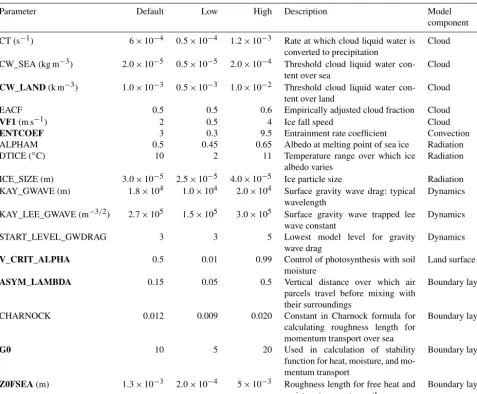
Abstract.Understanding the unfolding challenges of climate change relies on climate models, many of which have large summer warm and dry biases over Northern Hemisphere continental midlatitudes. This work, with the example of the model used in the updated version of the weather@home distributed climate model framework, shows the potential for improving climate model simulations through a multi-phased parameter refinement approach, particularly over the northwestern United States (NWUS). Each phase consists of (1) creating a perturbed parameter ensemble with the coupled global–regional atmospheric model, (2) building statistical emulators that estimate climate metrics as functions of pa-rameter values, (3) and using the emulators to further refine the parameter space. The refinement process includes sensi-tivity analyses to identify the most influential parameters for various model output metrics; results are then used to cull parameters with little influence. Three phases of this iterative process are carried out before the results are considered to be satisfactory; that is, a handful of parameter sets are identified that meet acceptable bias reduction criteria. Results not only indicate that 74 % of the NWUS regional warm biases can be reduced by refining global atmospheric parameters that con-trol convection and hydrometeor transport, as well as land
surface parameters that affect plant photosynthesis, transpi-ration, and evapotranspi-ration, but also suggest that this iterative ap-proach to perturbed parameters has an important role to play in the evolution of physical parameterizations.
1 Introduction
apply-ing a bias correction conditioned on temperature to account for model deficiencies, the Mediterranean summer temper-ature projections were reduced by up to 1◦C. Cheruy et al. (2014) demonstrated that of the climate models contribut-ing to the Coupled Model Intercomparison Project Phase 5 (CMIP5), the models that simulate a higher-than-average warming overestimated the present climate net shortwave radiation, which increased more than the multi-model av-erage in the future; those models also showed a higher-than-average reduction of evaporative fraction in areas with soil-moisture-limited evaporation regimes. Both studies sug-gested that models with a larger warm bias in surface tem-perature tend to overestimate the projected warming. The im-plication of the warm bias goes beyond climate model sim-ulations, as many impact modeling (e.g., hydrological, fire, crop modeling) studies (e.g., Brown et al., 2004; Fowler et al., 2007; Hawkins et al., 2013; Rosenzweig et al., 2014) use climate model simulation results as driving data. Recently, there have been coordinated research efforts (Morcrette et al., 2018; van Weverberg et al., 2018; Ma et al., 2018; Zhang et al., 2018) to better understand the causes of the near-surface atmospheric temperature biases through process-level under-standing and to identify the model deficiencies that generate the bias. These studies suggest that biases in the net short-wave and downward longshort-wave fluxes as well as surface evap-orative fraction are contributors to surface temperature bias.
In the aforementioned climate models, many small-scale atmospheric processes have significant impacts on large-scale climate states. Processes such as precipitation forma-tion, radiative balance, and convection occur at scales smaller than the spatial resolution explicitly resolved by climate models, though very-high-resolution regional climate mod-els are able to resolve or partially resolve some of these processes (e.g., convection). These processes must be rep-resented by parameterizations that include parameters whose uncertainty are often high because (1) there are insufficient observations with which to constrain the parameters, (2) a single parameter is inadequate to represent the different ways a process behaves across the globe, and/or (3) there is in-complete understanding of the physical process (Hourdin et al., 2013). Many studies have demonstrated the importance of considering parameterization uncertainty in the simula-tion of present and future climates by perturbing single and multiple model parameters within plausible parameter ranges usually established by expert judgment (e.g., Murphy et al., 2004; Stainforth et al., 2005; Sanderson et al., 2008a, b, 2010; Sanderson, 2011; Collins et al., 2011; Bellprat et al., 2012a, b, 2016). These studies have argued for careful tuning of models not only to reduce model parameter uncertainties by selecting parameter values that result in a better match between model simulation results and observations, but also to better understand relationships among physical processes within the climate system via systematic experiments that al-ter individual parameal-ter values or combinations thereof in order to assess model responses to perturbing parameters.
Older-generation Hadley Centre coupled models (HadCM2 and HadCM3), and atmosphere-only global (HadAM) and regional (HadRM), models have been used in numerous attribution studies (e.g., Tett et al., 1996; Stott et al., 2004; Otto et al., 2012; Rupp et al., 2017a; van Oldenborgh et al., 2016, 2017; Schaller et al., 2016; Uhe et al., 2018), and the same models have been used for future projections (e.g., Rupp and Li, 2017; Rupp et al., 2017b; Guillod et al., 2018). These model families exhibit warm and dry biases during JJA over continental midlatitudes, biases that have persisted over model generations and enhancements (e.g., Massey et al., 2015; Li et al., 2015; Guillod et al., 2017). The more recent generations of Hadley Centre models, HadGEMx (HadGEM1, Johns et al., 2006; HadGEM2, Collins et al., 2008), also have the same biases to some extent.
Many of the aforementioned studies using HadAM and HadRM generated simulations through a distributed comput-ing system known as climateprediction.net (CPDN; Allen, 1999), within which a system called weather@home is used to dynamically downscale global simulations using re-gional climate models (Massey et al., 2015; Mote et al., 2016; Guillod et al., 2017). As with the previous ver-sion of weather@home, the current operational verver-sion of weather@home (version 2: weather@home2) uses the cou-pled HadAM3P–HadRM3P with the atmosphere component based on HadCM3 (Gordon et al., 2000), but it updates the land surface scheme from the Met Office Surface Exchange Scheme version 1 (MOSES1; Cox et al., 1999) to version 2 (MOSES2; Essery et al., 2003).
Although the current model version in weather@home2 produces some global-scale improvements in the global model’s simulation of the seasonal mean climate, warm bi-ases in JJA increase over North America north of roughly 40◦compared with the previous version in weather@home1 (Fig. 2 in Guillod et al., 2017). The warm and dry JJA bi-ases appear clearly in the regional model simulations over the northwestern US region (NWUS, defined here as all the continental US land points west of 110◦and between 40 and 49◦N – the grey bounding box in Fig. S1 in the Supplement). These biases may be related to, among other things, an im-perfect parameterization of certain cloud processes, leading to excess downward solar radiation at the surface, which in turn triggers warm and dry summer conditions that are fur-ther amplified by biases in the surface energy and water bal-ance in the land surface model (Sippel et al., 2016; Guillod et al., 2017). The fact that recent model enhancements did not reduce biases over most of the northwest US motivates the present study, which aims at reducing these warm–dry biases by way of adjusting parameter values, herein referred to as “parameter refinement”.
2012; Schirber et al., 2013). This iterative process can be both computationally expensive and labor-intensive. Any pa-rameter refinement process performed with the intent of im-proving the model also unavoidably involves arbitrary deci-sions – though guided by expert judgment – about which pa-rameter(s) to adjust, which metric(s) to evaluate (i.e., which feature(s) of the climate system to simulate at some level of accuracy), and which observational dataset(s) to use as the basis for the evaluation metric(s). Nonetheless, model tuning through parameter refinement is invariably needed to better match model simulations with observations (Schirber et al., 2013).
One systematic, yet computationally demanding, approach to model tuning is through perturbed parameter experiments (Allen, 1999; Murphy et al., 2004). These experiments use a perturbed parameter ensemble (PPE) of simulations from a single model for which a handful of uncertain model pa-rameters are varied systematically or randomly. Each set of perturbed parameter (PP) values is considered to be a differ-ent model variant – a PP set refers to a combination of pa-rameter values from here on. PPEs can be treated as a sparse sample of behaviors from a vast, high-dimensional parame-ter space (Williamson et al., 2013). A PPE directly informs us about model behavior at those points in parameter space where the model is run (the PP sets) and helps us infer model behavior in nearby parameter space where the model has not been run. Besides parameter refinement, PPEs have also been used in many studies to estimate probability distribu-tion funcdistribu-tions (PDFs) of equilibrium climate sensitivity (e.g., Murphy et al., 2004) and transient regional climate change (e.g., Sexton et al., 2012; Sexton and Murphy, 2012), permit-ting the probabilistic projection of climate change (Murphy et al., 2007, 2009; Harris et al., 2013). PPEs are becoming common as a means to assess the range of uncertainty in climate model projections (Murphy et al., 2004; Stainforth et al., 2005; Collin et al., 2006; Sanderson, 2011; Sexton et al., 2012, 2019; Sexton and Murphy, 2012; Shiogama et al., 2012; Karmalkar et al., 2019).
Studies of climate model tuning using PPEs generally fall into three categories. The first category makes only direct use of the ensemble itself (e.g., Murphy et al., 2004; Row-lands et al., 2012) by screening out ensemble members that are deemed too far from the observed target metrics. This is often referred to as ensemble filtering. However, this ap-proach can overlook certain critical parts of the parameter space not sampled by the PPE. One promising improvement of this approach is to estimate the response of metric(s) in a geophysical (e.g., atmospheric) model to parameter perturba-tions using a computationally efficient statistical model (i.e., emulator) that is trained from the PPE results. The emulator’s skill is evaluated based on its metric prediction accuracy us-ing independent simulations of the model and, if deemed suf-ficiently skillful, can be used to estimate the model’s output metrics as a function of the model parameters in the parame-ter space not sampled by the PPE.
The second category uses a PPE to train a statistical em-ulator or establish some cost function, which is then used to automatically search for optimal parameter values that produce simulations closest to observations (e.g., Bellprat et al., 2012a, 2016; Zhang et al., 2015; Tett et al., 2017). Different approaches have been used in optimization, in-cluding ensemble Kalman filters (Annan et al., 2005; Annan and Hargreaves, 2007, and the references therein), stochas-tic Bayesian approaches (e.g., Jackson et al., 2004), Markov chain Monte Carlo integrations (Jackson et al., 2008; Järvi-nen et al., 2010), and optimization over multiple objectives (Neelin et al., 2010). These studies advocated for this ap-proach particularly because of the efficiency and automa-tion of available searching algorithms. However, as with any model evaluation effort, the use of a cost function with mul-tiple target metrics means that optima for different metrics may occur at different parameter values. This approach (au-tomatically searching for optimal parameters) also runs the risk of being trapped into local minima in the associated cost function; thus, searching results are heavily dependent on the initial parameter values. Admittedly, the idea of automatic searching to obtain optimal combinations of model param-eters is appealing, but in reality there is still a high level of subjectivity, e.g., selecting which model performance metrics and observation(s) to use in evaluating the model, as well as the methods of optimization and searching algorithm.
Unlike the second category, which searches for the op-timal parameter values that result in the closest match to observations, the third category, named “history matching” (McNeall et al., 2013, 2016; Williamson et al., 2013, 2015, 2017), seeks to rule out parameter choices that do not ade-quately reproduce observations. History matching uses PPEs to train statistical emulators that predict key metrics from the model output and then uses the emulators to rule out pa-rameter space that is implausible. Williamson et al. (2017) demonstrated that this method is more powerful when itera-tive steps are taken to rule out implausible parameter space, whereby each step helps refine the parameter space contain-ing potentially better-performcontain-ing model variants. A draw-back is that iterative history matching requires more model runs in the not-ruled-out-yet parameter space for later itera-tions. It is worth pointing out that the second and third cat-egories may not be different from each other if a sufficient number of model simulations are used to train a statistical emulator over the full parameter space. With a good emula-tor, it is possible to rule out parameter space and optimize parameter values, in which case categories two and three are post-processing steps. The method we adopted in this study fits into the third category, borrowing the idea of “iterative refocusing” wherein parameter values are refined through phases of experiments. Our methodology differs from his-tory matching in that we do not employ a formal statistical framework based on the definition of implausibility.
of free parameters. To cope with the computational demand, many previous studies have generated PPEs from a global climate model (GCM) using CPDN. The studies span a range of topics, from the earlier studies focusing on climate sen-sitivity (e.g., Murphy et al., 2004; Stainforth et al., 2005; Sanderson et al., 2008a, b, 2010; Sanderson, 2011), to later ones attempting to generate plausible representations of the climate without flux adjustments (e.g., Irvine et al., 2013; Ya-mazaki et al., 2013) and using history matching to reduce pa-rameter space uncertainty (Williamson et al., 2013). More re-cently, Mulholland et al. (2017) demonstrated the potential of using PPEs to improve the skill of initialized climate model forecasts with 1-month lead time, and Sparrow et al. (2016) showed that large PPEs can be used to identify subgrid-scale parameter settings that are capable of best simulating the ocean state over the recent past (1980–2010). However, very little (Bellprat et al., 2012b, 2016) has been published on us-ing PPEs for parameter refinement with the aim of improvus-ing regional climate models (RCMs).
The goals of this study were to (1) identify model param-eters that most strongly control the annual cycle of near-surface temperature and precipitation over the NWUS in weather@home2 and (2) select model parameterizations that reduce the warm–dry summer biases without introducing or unduly increasing other biases. We acknowledge that chang-ing a model in any way inevitably involves makchang-ing sequences of choices that influence the behavior of the model. Some of the model behavioral changes are targeted and desirable, but parameter refinement may have unintended negative con-sequences. There is a general concern that “improved” pformance arises because of compensation among model er-rors, and an “accurate” climate simulation may very well be achieved by compensating errors in different processes, rather than by best simulating every physical process. This concern motivated us to select multiple parameter sets from the tuning exercise rather than seeking an “optimal” set. Though having multiple parameter sets does not eliminate the problem, to the degree that each parameter set compen-sates for errors uniquely, obtaining a similar model response to some change in forcing across parameter sets may provide more confidence in that response. An alternative approach would be to interpolate between the sampled points in the parameter space and estimate a posterior parameter proba-bility density function (PDF), which could then be used to produce a PDF of model outputs of interests (e.g., Murphy et al., 2004; Sexton et al., 2012; Sexton and Murphy, 2012). We chose to select multiple parameter sets instead of using parameter PDFs because the intended use is to make projec-tions with a small ensemble of parameter sets with reduced biases in summer temperature and precipitation.
It is worth noting that this study looks mainly at atmo-spheric parameters because we intended to focus this study on larger-scale atmospherics dynamics that influence the boundary conditions of the regional model, especially how much moisture and heat are advected to the regional model,
while local land surface–atmosphere interactions are being examined in a subsequent study that perturbs a suite of atmo-spheric and land surface parameters in the regional model.
2 Methodology
Throughout this paper we use “simulated” to refer to outputs from climate models and “emulated” results to refer to esti-mated and/or predicted outputs from statistical emulators. 2.1 Overview of the parameter refinement process This study carried out an iterative parameter refinement ex-ercise, or an “iterative refocusing” procedure to use a term coined in Williamson et al. (2017). The multidimensional parameter space is reduced in phases, whereby each phase includes the following steps:
1. use space-filling Latin hypercube sampling (McKay et al., 1979) to randomly sample the initially defined pa-rameter space (defined by the bounds of the 17 parame-ters listed in Table 1) to generate sets of parameter com-binations;
2. generate a PPE with the parameters sets from step (1) through weather@home;
3. train statistical emulators for multiple climate metrics using the PPE from step (2);
4. reduce the parameter space (i.e., narrow the ranges of acceptable values for parameters) such that the space excludes ensemble parameter sets that are “too far away” from target metrics;
5. randomly sample the reduced parameter space to design a new set of parameter combinations;
6. use the trained emulators to filter the sample from step (5), and reject a parameter set if the emulator pre-diction is too far away from a target value; and
7. repeat steps (2) through (6) until the desired outcome is achieved.
Detailed descriptions of the parameter refinement process throughout the three phases is presented in Appendix A, in-cluding decisions on what key climate metrics to use in each phase and the stopping point of this iterative exercise after three phases.
Table 1.Parameters perturbed in our tuning exercise with the post-culling parameters highlighted in bold.
Parameter Default Low High Description Model
component
CT (s−1) 6×10⁻⁴ 0.5×10⁻⁴ 1.2×10⁻³ Rate at which cloud liquid water is converted to precipitation
Cloud
CW_SEA (kg m−3) 2.0×10⁻⁵ 0.5×10⁻⁵ 2.0×10⁻⁴ Threshold cloud liquid water con-tent over sea
Cloud
CW_LAND(k m−3) 1.0×10⁻³ 0.5×10⁻³ 1.0×10⁻² Threshold cloud liquid water con-tent over land
Cloud
EACF 0.5 0.5 0.6 Empirically adjusted cloud fraction Cloud
VF1(m s−1) 2 0.5 4 Ice fall speed Cloud
ENTCOEF 3 0.3 9.5 Entrainment rate coefficient Convection
ALPHAM 0.5 0.45 0.65 Albedo at melting point of sea ice Radiation
DTICE (◦C) 10 2 11 Temperature range over which ice
albedo varies
Radiation
ICE_SIZE (m) 3.0×10⁻⁵ 2.5×10⁻⁵ 4.0×10⁻⁵ Ice particle size Radiation
KAY_GWAVE (m) 1.8×10⁴ 1.0×10⁴ 2.0×10⁴ Surface gravity wave drag: typical wavelength
Dynamics
KAY_LEE_GWAVE (m−3/2) 2.7×10⁵ 1.5×10⁵ 3.0×10⁵ Surface gravity wave trapped lee wave constant
Dynamics
START_LEVEL_GWDRAG 3 3 5 Lowest model level for gravity
wave drag
Dynamics
V_CRIT_ALPHA 0.5 0.01 0.99 Control of photosynthesis with soil moisture
Land surface
ASYM_LAMBDA 0.15 0.05 0.5 Vertical distance over which air parcels travel before mixing with their surroundings
Boundary layer
CHARNOCK 0.012 0.009 0.020 Constant in Charnock formula for
calculating roughness length for momentum transport over sea
Boundary layer
G0 10 5 20 Used in calculation of stability
function for heat, moisture, and mo-mentum transport
Boundary layer
Z0FSEA(m) 1.3×10⁻³ 2.0×10⁻⁴ 5×10⁻³ Roughness length for free heat and moisture transport over the sea
Boundary layer
refine parameter space, specifically to reduce the JJA warm and dry bias over the NWUS.
The principal climate metrics used to access the effect of parameter perturbation are the following. In Phase 1 were TOA radiative fluxes, wherein we considered outgoing (re-flected) shortwave radiation (SW) and outgoing longwave ra-diation (LW) separately. In Phase 2 were NWUS regional surface metrics – the mean magnitude of the annual cy-cle of temperature (MAC-T) and mean temperature (T) and precipitation (Pr) in December–January–February (DJF) and (JJA), while still being mindful of SW and LW. Phase 3 was the same as Phase 2, except for selecting model parameter-izations that reduce the JJA warm and dry biases over the NWUS.
2.2 Climate simulations with weather@home
The climate simulations used in this study were gener-ated through the weather@home climate modeling system (Massey et al., 2015; Mote et al., 2016) with updates (Guil-lod et al., 2017) that include MOSES2. MOSES2 simulates the fluxes of CO2, water, heat, and momentum at the interface of the land and atmospheric boundary layer and is capable of representing a number of subgrid tiles within each grid box, allowing for a degree of subgrid heterogeneity in the surface characteristics to be modeled (Williams et al., 2013).
and Rupp et al. (2017b). Notable warm–dry biases in JJA were present over the NWUS and these biases persist with MOSES2 (Fig. S1), with a temperature bias of 3.9◦C and a precipitation biases of−8.5 mm per month (−32 %) in JJA over Washington, Oregon, Idaho, and western Montana com-pared with the PRISM gridded observational dataset (Daly et al., 2008). Note that these were biases using default, i.e., standard physics (SP), model parameter values.
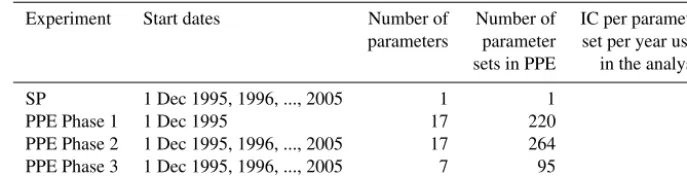
Each simulation in the PPE spanned 2 years, with the first year serving as spin-up and only the second year used in the analysis. Simulations began on 1 December of each year for the years 1995 to 2005, except for Phase 1 (see description of phases in Appendix A). Climate metrics were averaged over December 1996 to November 2007 (except Phase 1). This time period was chosen because it contained a wide range of sea surface temperature (SST) anomaly patterns, including the very strong 1997–1998 El Niño, which helps reduce the influence that any particular SST anomaly pattern may have on the sensitivities of chosen climate metrics to parameters.
2.3 Perturbed parameters
In our PPE, we initially selected 17 model parameters to per-turb simultaneously: 16 in the atmospheric model and 1 in the land surface model (Table 1). The parameters reside in the global model as well as the regional model and are set to the same values in HadAM3P and HadRM3P in the ex-periments performed for this study; thus, any reduction of regional biases is considered to have been achieved through the improvement of boundary fluxes from the GCM to the RCM and improvement of the RCM itself. The atmospheric parameters are a subset of those perturbed in Murphy et al. (2004) and Yamazaki et al. (2013); both studies also turbed ocean parameters, and Yamazaki et al. (2013) per-turbed forcing parameters (e.g., scaling factor for emission from volcanic emissions) as well. Our selection of parame-ters was constrained to those available to be perturbed us-ing weather@home at the time. Ranges for most parame-ter perturbations were 1/3 to 3 times the default value, but for certain parameters (e.g., empirically adjusted cloud frac-tion, EACF), only values greater than the default value were used (Table 1). We intentionally began with ranges gener-ally wider than those used in previous studies (Murphy et al., 2004; Yamazaki et al., 2013) because we intended to refine the ranges through multiple phases of PPEs.
Though a principal objective was to evaluate the sensitiv-ity of the regional climate to atmospheric parameters, sen-sitivities may be a function of land–atmosphere exchanges (Sippel et al., 2016; Guillod et al., 2017). While many param-eters influence land–atmosphere energy and water exchanges in MOSES2, one (V_CRIT_ALPHA) has been shown to be particularly important (Booth et al., 2012), so it was included in our tuning exercise. V_CRIT_ALPHA defines the soil wa-ter content below which transpiration begins being limited by soil water availability and not solely the evaporative demand.
2.4 Observational data
The regional biases in MAC-T, JJA-T, JJA-Pr, DJF-T, and DJF-Pr were all calculated with respect to the 4 km reso-lution monthly PRISM dataset, after regridding the PRISM data to the HadRM3P grid. To consider observational uncer-tainty, we also compared JJA-T biases using four other ob-servational datasets: (1) NCEP–NCAR Reanalysis 1 (NCEP; Kalnay et al., 1996), (2) the Climate Forecast System Re-analysis and Reforecast (CFSR; Saha et al., 2010), (3) the Modern-Era Retrospective Analysis for Research and Ap-plications Version 2 (MERRA2; Gelaro et al., 2017), and (4) the Climatic Research Unit temperature dataset v4.00 (CRU; Harris et al., 2014). The four datasets are not shown here for the regional analysis because the maximum region-ally averaged difference (0.71◦C) among the datasets is less than 1/5 of the regionally averaged JJA-T bias. Throughout this paper, biases of the regional model outputs are calculated with respect to PRISM.
The biases in global temperature were calculated with re-spect to CRU, MERRA2, CSFR, NCEP, and the Climate Pre-diction Centre global land surface temperature data; the latter is a combination of the station observations collected from the Global Historical Climatology Network version 2 and the Climate Anomaly Monitoring System (GHCN–CAMS; Fan and van den Dool, 2008). The biases in global precipita-tion were calculated with respect to CRU, MERRA2, CFSR, Global Precipitation Climatology Project monthly precipi-tation (GPCP; Adler et al., 2003), Global Precipiprecipi-tation Cli-matology Centre monthly precipitation (GPCC; Schneider et al., 2011), the ERA-Interim reanalysis dataset (ERAI; Dee et al., 2011), the Japanese 55-year Reanalysis (JRA-55; Onogi et al., 2007), NOAA–CIRES 20th Century Reanalysis ver-sion 2c (20CRv2c; Compo et al., 2011), the Climate Predic-tion Center (CPC) Merged Analysis of PrecipitaPredic-tion (CMAP; Xie and Arkin, 1996), and the version 7 Tropical Rain-fall Measuring Mission (TRMM) Multi-Satellite Precipita-tion Analysis (3B42 research version; Huffman et al., 2014). All the datasets were regridded to the HadAM3P grid before biases were calculated.
For all the observational datasets, data from December 1996 to November 2007 (the same time period the model simulations cover, as shown in Table 2) were used to cal-culate model biases, except TRMM, which is only available starting from 1998.
2.5 Emulators
Al-Table 2.The specifics of four ensembles used in this study.
Experiment Start dates Number of Number of IC per parameter
parameters parameter set per year used sets in PPE in the analysis
SP 1 Dec 1995, 1996, ..., 2005 1 1 6
PPE Phase 1 1 Dec 1995 17 220 3
PPE Phase 2 1 Dec 1995, 1996, ..., 2005 17 264 3
PPE Phase 3 1 Dec 1995, 1996, ..., 2005 7 95 6
though an ANN has the advantage of using multiple metrics as targets simultaneously, the underlying emulator structure remains obscure. From Phase 2, for the sake of simplicity and transparency, we used kriging – which is similar to a Gaussian process regression emulator – following McNeall et al. (2016) as coded in the package DiceKriging (Roustant et al., 2012) in the statistical programming environment R. We used universal kriging, with no “nugget” term, meaning that the uncertainty on model outputs shrinks to zero at the parameter input points that have already been simulated by the climate model (Roustant et al., 2012). Please refer to Ap-pendix A for further details.
2.6 Sensitivity analysis
The response of the climate model to perturbations in the multidimensional parameter space can be nonlinear. In order to isolate the influence of each parameter on key climate met-rics and eliminate parameters that do not have a strong con-trol on those metrics, we performed two types of sensitivity analysis. One determines the sensitivity of a single param-eter by perturbing one paramparam-eter with all other paramparam-eters fixed, i.e., one-at-a-time (OAAT) sensitivity analysis. Fol-lowing Carslaw et al. (2013) and McNeall et al. (2016), we also used a global sensitivity analysis with a Fourier ampli-tude sensitivity test (FAST) to validate the results of OAAT and to estimate interactions among parameters. FAST allows for the computation of the total contribution of each input parameter to the output’s variance, wherein the total includes the factor’s main effect, as well as the interaction terms in-volving that input parameter. In the FAST method, the frac-tion of the total variance due to the interacfrac-tions is not re-solved as the sum of individual interactions but is computed from the parameter contribution to the residual variance, i.e., variance not accounted for by the main effects. The com-putational aspects and advantages of FAST are described in Saltelli et al. (1999). Emulators are used for the sensitivity analysis.
3 Results and discussion
Top-of-atmosphere (TOA) radiative balance is an emergent property in GCMs (Irvine et al., 2013), and the fact that the
models of the IPCC Assessment Report 4 did not need flux adjustment was seen as an improvement over earlier models (Solomon et al., 2007). Although climate models approxi-mately balance the net absorption of solar radiation with the outward emission of longwave radiation (OLR) at the TOA, the details on how solar absorption and terrestrial emission are distributed in space and time depend on global atmo-spheric and oceanic circulation, clouds, ice, and other aspects of model behavior. The surface expression of those global processes is also important given that a primary and practical purpose of climate modeling is to understand how (surface) climate will change. We describe the responses of both global TOA and regional surface climate to parameter refinement.
3.1 TOA radiative fluxes
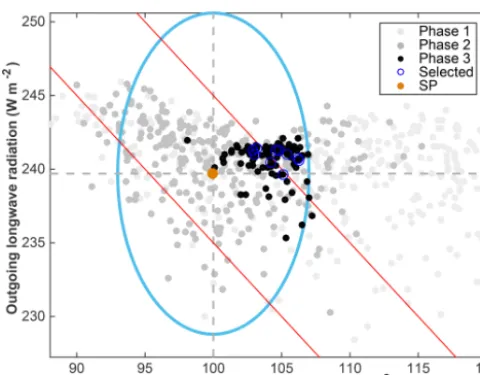
de-Figure 1. Global mean top-of-atmosphere (TOA) outgoing (re-flected) shortwave radiation (SW) and outgoing longwave radiation (LW) from the four ensembles run through weather@home2. Hori-zontal and vertical dashed lines denote the reference values for SW and LW taken from Stephens et al. (2012). The filled brown circle denotes our SP. The ellipse indicates the uncertainty ranges we are willing to accept for SW and LW, respectively, which includes the observational uncertainty range taken from Stephens et al. (2012), but tripled, plus the uncertainty range due to initial condition per-turbations estimated from our SP reference ensemble. The red solid lines highlight net TOA energy flux of±5 W m−2.
termination R2>0.9 for both LW and SW. Please refer to Appendix B for further details on emulator validations.
Rowlands et al. (2012) discarded any ensemble member that required a global annual mean flux adjustment of abso-lute magnitude greater than 5 W m−2(see red lines in Fig. 1), and Yamazki et al. (2013) defined a confidence region (SW, LW) that corresponded to a TOA imbalance of less than 5 W m−2as one that did “not drift significantly” from a real-istic TOA state. Although the ranges of acceptability (Fig. 1) permits net TOA imbalance greater than 5 W m−2, more than half (55.8 %) of the Phase 3 parameter sets generated a TOA imbalance less than 5 W m−2, and the smallest TOA imbal-ance was less than 0.1 W m−2.
The entrainment coefficient (ENTCOEF) and the ice fall speed (VF1) were the dominant controls on the TOA out-going SW and LW fluxes, respectively (see SW and LW re-sponse to these two parameters shown in the bottom two rows of Fig. S2). Why these parameters are important becomes clear from understanding their respective roles in the climate model, especially with respect to convection and hydrome-teor transport.
The atmospheric model simulates a statistical ensemble of air plumes inside each convectively unstable grid cell. On each model layer, a proportion of rising air is allowed to mix with surrounding air and vice versa, representing the process of the turbulent entrainment of air into convection
and the detrainment of air out of the convective plumes (Gre-gory and Rowntree, 1990). The rate at which these processes occur in the model is proportional to ENTCOEF, which is a parameter in the model convection component (Table 1). The implication of perturbing ENTCOEF has been investi-gated by Sanderson et al. (2008b) using single perturbation experiments, and they showed that a low ENTCOEF leads to a drier middle troposphere and moister upper troposphere. Conversely, increasing ENTCOEF results in increased low-level moisture (more low-low-level clouds) and decreased high-level moisture (fewer high-high-level clouds). Because the albedo effects of low clouds dominate their effects on emitted ther-mal radiation (Hartmann et al., 1992; Stephens, 2005), in-creasing ENTCOEF increases the outgoing SW fluxes.
VF1 is the speed at which ice particles may fall in clouds. A larger ice fall speed is associated with larger particle sizes and increased precipitation. Wu (2002) studied ice fall speed parameterization in radiative convective equilibrium models and found that a smaller ice fall speed leads to a warmer, moister atmosphere, more cloudiness, weak convection, and less precipitation, which could lead to decreased outgoing LW TOA flux due to absorption in the cloud itself and/or in the moist air. Higher ice fall speeds produce the opposite – a cooler and clearer atmosphere, less cloudiness, strong con-vection, and more precipitation, which increases the outgo-ing LW flux.
3.2 Regional climate improvements
A primary and practical purpose of climate modeling is to un-derstand how (surface) climate will change, but model biases can have non-negligible impacts on projections. In Phases 2 and 3 we evaluate the response of regional surface climate to parameter perturbations and refine the parameter space to reduce biases in regional temperature and precipitation.
In Phase 2, we identified ENTCOEF and VF1 as distinct from the other 15 parameters with respect to their influence on the overall suite of climate metrics to a first-order approx-imation (Fig. S3). Recall that the regional surface metrics considered were MAC-T, JJA-T, JJA-Pr, DJF-T, and DJF-Pr. Though MAC-T is our principal metric (Sect. 2.1), MAC-T covaries with JJA-T, JJA-Pr, and DJF-T (Fig. S3), so mov-ing in parameter space toward lower bias in MAC-T reduces biases in JJA-T, JJA-Pr, and DJF-T. MAC-T does not covary strongly with DJF-Pr.
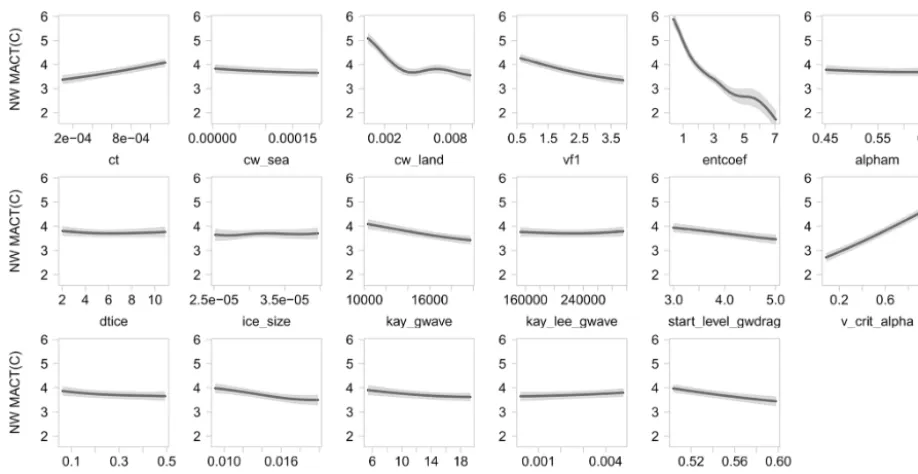
lim-Figure 2.One-at-a-time sensitivity analysis of the magnitude of the annual cycle of temperature (MAC-T) over the northwest to each input parameter in turn, with all other parameters held at the mean value of all the designed points. Heavy lines represent the emulator mean, and shaded areas represent the estimate of emulator uncertainty at the±1 SD level.
its photosynthesis (and thereby latent heat flux via transpi-ration) as a function of soil water (V_CRIT_ALPHA) were the most influential individual parameters and counter each other when both increase (Figs. 2 and S3). The parameter that controls the cloud-droplet-to-rain threshold over land (CW_LAND) also had a strong influence on MAC-T across the lower end of the parameter perturbation range (up to 0.004). The other parameters had little to effectively no in-fluence on MAC-T. The results of OAAT sensitivity analysis for the other output metrics considered in Phase 2 are pre-sented in Figs. S6–S11.
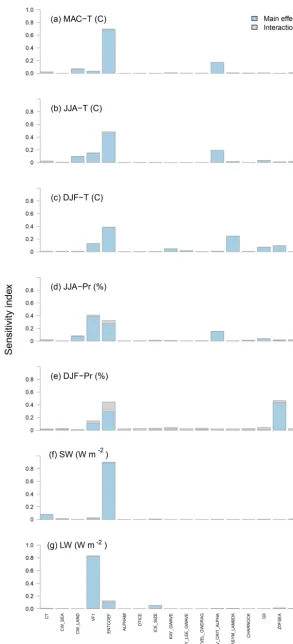
The global sensitivities of the simulated outputs (the ones considered in Phase 2) due to each input, as both a main effect and total effect, including interaction terms, are pre-sented in Fig. 3. ENTCOEF was the most important param-eter for all three surface temperature metrics, with a total sensitivity index of ∼0.7, 0.5, and 0.4 for MAC-T, JJA-T, and DJF-T, respectively, wherein maximum sensitivity is 1 (see Saltelli et al., 1999). For the metrics MAC-T and JJA-T, V_CRIT_ALPHA was the next most important, with a total sensitivity index of ∼0.3 for both metrics. For JJA-Pr, the most important parameter was VF1, followed by ENTCOEF; for DJF-Pr, the most important parameter was ENTCOEF, closely followed by the parameter that controls the rough-ness length for free heat and moisture transport over the sea (Z0FSEA).
The interaction terms were relatively small, accounting for a few percent of the variance, except for the effect of ENT-COEF on DJF-Pr, wherein the interaction with other
parame-ters accounts for∼1/3 of the variance. In a study constrain-ing carbon cycle parameters by comparconstrain-ing emulator output with forest observations, McNeall et al. (2016) also found the importance of the interaction terms negligible. In con-trast, Bellprat et al. (2012b) used a quadratic emulator to ob-jectively calibrate a regional climate model and found non-negligible interaction terms. They showed that excluding the interactions in the emulator increased the error of the emu-lated temperature and precipitation results by almost 20 %. Further work could be done to assess the magnitude and functional form (i.e., linear or nonlinear) of the interaction terms, but this is beyond the scope of this study.
Only the parameters with a total sensitivity index larger than ∼0.1 for MAC-T, JJA-T, DJF-T, JJA-Pr, or DJF-Pr were retained for perturbation in Phase 3: CW_LAND, VF1, ENTCOEFF, V_CRIT_ALPHA, ASYM_LAMBDA, G0, and Z0FSEA. Although the parameter that controls the rate at which cloud liquid water is converted to precipitation (CT) had a total sensitivity index of∼0.1 for SW, it was ex-cluded from further perturbation because the primary interest in Phase 2 was in regional surface metrics, not TOA radiative fluxes.
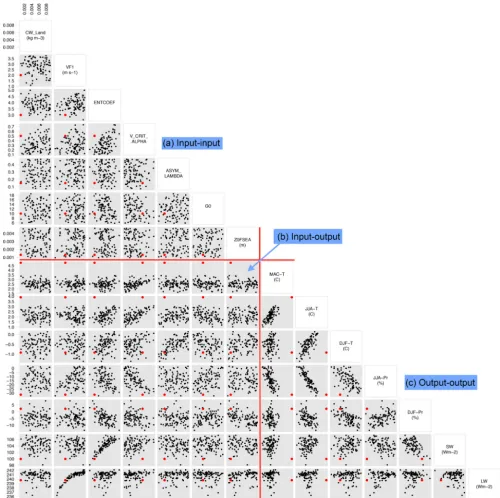
Figure 4.Phase 3 PPE parameter inputs and summary model output metrics evaluated; 95 parameter sets are shown. The parameter values and model outputs under SP are marked in red. The horizontal and vertical red lines mark the transition from parameter inputs and model output metrics.
over the 4◦C SP bias. However, these improvements come at a small price, namely a larger regional (NWUS) dry bias in DJF-Pr (about−15 % compared with PRISM in the worst case). Because our primary goal was to reduce JJA warm and dry biases, any model variant from Phase 3 is preferable to SP. Any subset of parameterizations from Phase 3 can now be used in subsequent experiments.
limited by soil water availability. When V_CRIT_ALPHA is 0, transpiration starts to be limited as soon as the soil is not completely saturated, whereas when it is 1, transpiration continues unlimited until soil moisture reaches the wilting point at which point transpiration switches off. Lower val-ues of V_CRIT_ALPHA reduce the critical point, allowing plant photosynthesis to continue unabated at lower soil mois-ture levels; i.e., plants are not water-limited. As plants photo-synthesize water is extracted from soil layers and transpired, increasing the local atmospheric humidity and lowering the local temperature through latent cooling. Our results are con-sistent with previous findings by Seneviratne et al. (2006), who also show that reducing the temperature and increasing humidity can feed back onto the regional temperature and precipitation during the summer months.
The only apparent constraints on ranges of parame-ter values through three phases of parameparame-ter refinement were seen for V_CRIT_ALPHA and ENTCOEF. Values of V_CRIT_ALPHA lower than 0.7 were required to keep the bias of MAC-T under 3◦C. For ENTCOEF, the range be-tween 3 and 5 contains the best candidates to reduce re-gional warm–dry biases. The range of ENTCOEF identified here is consistent with the findings of Irvine et al. (2013), which also show that low values of ENTCOEF tend to give warmer conditions. However, results from other previous studies vary. Williamson et al. (2015) found that low values of ENTCOEF are implausible and that there are more plau-sible model variants at the upper end of its perturbed range, whereas Sexton et al. (2012) and Rowlands et al. (2012) con-sider the range between 2 and 4 to contain the best model variants. The discrepancy in optimal ranges for ENTCOEF is to be expected given that the primary metrics used to eval-uate the effect of parameter refinement are different, with ours being JJA warm–dry biases over the NWUS, that of Williamson et al. (2015) being the behavior of the Antarc-tic Circumpolar Current, and those of other previous stud-ies being climate sensitivitstud-ies. This demonstrates that any parameter refinement process is tailored to a specific objec-tive, and choices regarding metrics (e.g., variables, validation dataset(s), and/or cost functions) may determine which part of the parameter space is ultimately accepted.
3.3 Effects on global-scale climate
To avoid introducing or increasing biases over other parts of the globe with our regionally focused model improvement effort, we investigated the large-scale effects of the selected 10 “good” (least biased in MAC-T) sets of global parameter values. We focused on surface temperature and precipitation because they are key variables of the climate system and are of high interest for impact studies.
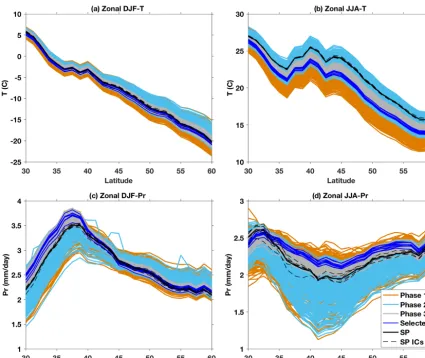
Figure 5 shows the meridional distribution of Northern Hemisphere (NH) midlatitude temperature (over land) and precipitation in DJF and JJA. Because of the wide range of parameter values in the PPEs of Phase 1 and Phase 2, the
spread for these PPEs is quite large, whereas the ensemble spread in Phase 3 is substantially smaller. Compared with the SP ensemble, the new parameter values (final 10 sets) re-duced the zonal mean JJA temperature throughout the NH midlatitudes (30–60◦N) by∼1–4◦C (depending on the par-ticular combination of parameters) and increased JJA pre-cipitation over the same latitude bands, except for latitudes south of 33◦N and north of 58◦N. In DJF, the effects are not as large nor are the changes consistent in sign across the NH midlatitude region (though south of∼38◦N all 10 parameter sets give increasing precipitation). The SP simulations have warm and dry biases over the NWUS and midlatitude land in general (as shown in Figs. 4, 6, and 7). In JJA all the se-lected PP model variants show considerably different results compared with the SP – cooler and wetter, i.e., reduced bi-ases and improved model performance. Figure 5 also demon-strates that varying model parameters has a bigger influence than varying initial conditions, as seen from the wider spread of PP results compared with the spread of SP initial condition perturbation results.
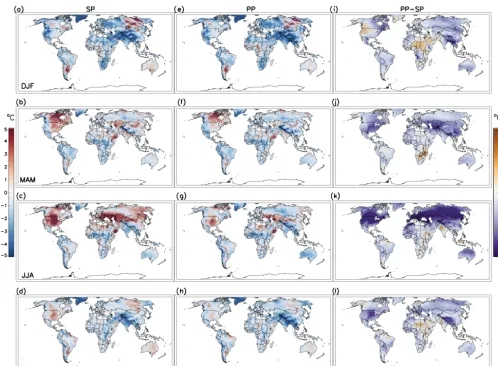
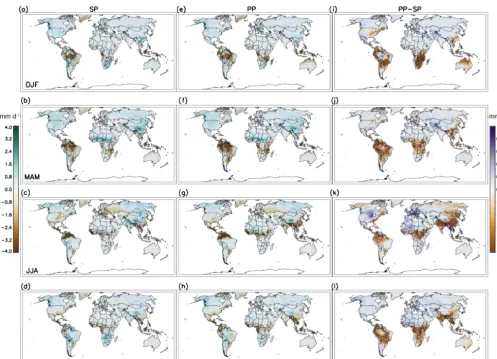
To examine how parameter refinements affect spatial pat-terns of biases, we compare the seasonal mean biases of tem-perature (Fig. 6) and precipitation (Fig. 7) under SP and the selected PP settings against CRU data. The SP simulations have large warm biases in JJA (and to a lesser extent in MAM and SON; Fig. 6b–d) over the NH midlatitude land region that are substantially lower in the PP simulations (Fig. 6f–h and j–l). In the tropics, the SP simulations have cold biases over northern South America, central Africa, and southern Asia in most seasons that are ameliorated in the PP simula-tions in some cases (e.g., central Africa in DJF and SON) – even though the focus of the PP simulations was improving the climate of the NWUS. The SP simulations also have cold biases over most of the Southern Hemisphere continents at midlatitudes in most seasons. A large fraction of the JJA tem-perature biases was reduced in the PP simulations, as shown in Fig. 6c, g, and k. These salient features in JJA temperature biases under SP and PP are not particular to the selection of the observational dataset (see Figs. S12–S13 for compari-son with other datasets). In the other three seacompari-sons, however, the spatial patterns of temperature biases are not consistent across observational datasets.
Figure 5.Comparison between three PPEs and SP zonal mean HadAM3P-simulated Northern Hemisphere midlatitude (30–60◦N)(a)DJF mean temperature over land,(b)JJA mean temperature over land,(c)DJF mean precipitation, and(d)JJA mean precipitation. Outputs from the 10 parameter sets selected, based on NWUS MAC-T, are shown in blue. Note that the plotting order is the same as the legend, so most Phase 1 curves are obscured by subsequent phases. The results from different initial conditions (ICs) under SP are shown as black dashed lines.
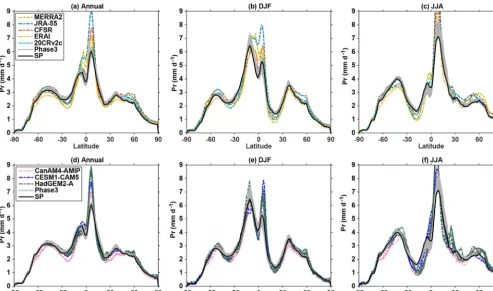
For precipitation, the largest biases in SP are over Ama-zonia in DJF and MAM (Fig. 7a and b) and northern South America, equatorial Africa, and south Asia in JJA (Fig. 7c). These summer biases are increased in the PP simulations (Fig. 7k). However, it is difficult to know whether we are improving the model’s global precipitation patterns because of the large uncertainty in historical precipitation observa-tional datasets. Still, it is worth comparing the PP simula-tions with both a variety of observational-based datasets and other GCMs (Fig. 8). The precipitation amounts differ sub-stantially across different observational datasets, as well as across climate models. In the tropics, Phase 3 PP-simulated precipitation is mostly lower (except DJF just north of the Equator) and has a narrower range than the observations or other climate models, but it is higher in DJF and JJA (up to 25 % higher) than the SP simulation results. Outside the tropics, the precipitation distributions in PP remain similar
to those of SP, and differences from observational datasets and other GCMs are less affected by the use of PP. The tropi-cal precipitation improvements in JJA can be taken as a gen-eral improvement, though not with high confidence due to the variability across observational datasets. To further highlight the uncertainties in precipitation, global maps of differences in biases between SP and our selected parameter settings, in comparison with other observational-based datasets, are pre-sented in Figs. S15–S22.
param-Figure 6.Biases of SP temperature over land in(a)DJF,(b)MAM,(c)JJA, and(d)SON compared with CRU over December 1996 through November 2007. Biases of selected PP compared with CRU are shown in panels(e)–(h), while the differences between selected PP and SP, i.e., the absolute increase or decrease in biases in PP with respect to the SP values, are shown in panels(i)–(l). The PP results are the composites of the 10 selected sets with six ICs per set.
eter refinements and that these JJA temperature biases are not necessarily structural issues of the climate model. These improvements in simulating JJA temperature generally did not improve JJA precipitation patterns overall across the globe and even worsened the bias in some places (e.g., South America).
4 Conclusions
Through an iterative parameter refinement approach to im-prove model performance, we identified a region of climate model parameter space in which HadAM3P outperforms the SP variant in simulating summer climate over the NWUS specifically and over NH midlatitude land in general, while approximately maintaining TOA radiative (near) balance. Improving the northwest US climate comes with trade-offs, e.g., a larger JJA dry bias over Amazonia. However, it is
important to note that there are large uncertainties in ob-served precipitation climatology, especially outside of the North American and European midlatitudes, so both appar-ent increases and decreases in biases should be treated with caution and compared against the range across observational datasets. In the end, we consider the cost of increasing biases in parts of the globe acceptable for the purposes of selecting multiple global model variants to drive the regional model with reduced JJA biases over the NWUS. The fact that im-provements can be made at all (for a substantial area of the world) through targeted PPE is encouraging.
re-Figure 7.Same as Fig. 6, but for precipitation.
ducing JJA biases. These parameters control cloud forma-tion and latent heat flux, respectively. Bellprat et al. (2016) found that the key parameter responsible for the reduction of JJA biases is increased hydraulic conductivity, which in-creases the water availability at the land surface and leads to increased evaporative cooling, stronger low cloud forma-tion, and associated reduced incoming shortwave radiation. We only perturbed one land surface parameter, but the effects of additional land surface parameters are being explored in a subsequent study. Given that land model parameters such as V_CRIT_ALPHA could reasonably be expected to inter-act with sensitive atmospheric parameters like ENTCOEF, it is particularly interesting to consider the multivariate sensi-tivity of a range of parameters that span across component models (e.g., land, ice, atmosphere, ocean). We argue that this frontier of parameter sensitivity should be explored in a transparent and systematic manner, and we have demon-strated that statistical emulators can be effectively leveraged to reduce computational expense.
The fact that V_CRIT_ALPHA (which is a parameter in the land surface scheme MOSES2) was found to be an
impor-tant parameter in regional MAT-C and JJA-T has much fur-ther implications beyond this study. MOSES2 is the land sur-face scheme used in the HadGEM1 and HadGEM2 family, which were used in CMIP4 and CMIP5. Moreover, the Joint UK Land Environment Simulator (JULES) model (which is the land surface scheme of the CMIP6 generation Hadley Centre HadGEM3 family; https://www.wcrp-climate.org/ wgcm-cmip/wgcm-cmip6, last access: 10 July 2019) is a de-velopment of MOSES2. What we have learned about the atmosphere–land surface interactions here is relevant to even the most recent HadGEM model generation and the in-progress CMIP6.
Figure 8.Annual(a, d), DJF(b, e), and JJA(c, f)meridional distributions of precipitation from Phase 3 and SP (all panels). Reanalysis datasets MERRA2, JRA-55, CFSR, ERAI, and 20CRv2c are shown in panels (a–c), and GCMs CanAM4-AMIP, CESM1-CAM5, and HadGEM2-A are shown in panels(d)–(f).
values. However, with the reduction in JJA temperature bias, future projections using the new parameter settings over the SP should be at less risk of overestimating projected warm-ing in summer (as discussed in the Introduction).
It is also worth noting that we restricted our analysis to seasonal and annual mean climate metrics. Given the use of weather@home for attribution studies of many extreme weather events (e.g., Otto et al., 2012; Rupp et al., 2017a) as well as their impacts, such as flooding-related property damage (Schaller et al., 2016) and heat-related mortality (Mitchell et al., 2016), an important next step would be to investigate how the tails of distributions of weather vari-ables respond to parameter perturbations. Furthermore, look-ing at biases in seasonal mean temperature and precipita-tion is insufficient to fully assess model performance. As a follow-up step to this study, we recommend a process-based model evaluation and physical explanation of model improvements to further refine the parameter space that pro-vides improvements (e.g., reduce summer biases) through appropriate physical mechanisms. For example, a more ac-curate representation of clouds in the model could lead to better-simulated downward solar radiation at the surface, as well as better-simulated surface energy and water balance.
Another important next step would be to apply the selected PPE over the weather@home European domain, given the
nontrivial JJA warm bias identified over Europe by previ-ous studies (Massey et al., 2015; Sippel et al., 2016; Guil-lod et al., 2017). Bellprat et al. (2016) showed that regional parameters tuned over the European domain also produced similar promising results over the North American domain, but the same model parameterization yielded larger over-all biases over North America than for Europe. One could test the transferability of parameter values over different re-gional domains in the weather@home framework, given that weather@home currently uses the same GCM to drive sev-eral RCMs over different parts of the world, all using the same parameter values.
Code availability. HadRM3P is available from the UK Met Of-fice as part of the Providing REgional Climates for Impacts Stud-ies (PRECIS) program. Access to the source code is depen-dent on attendance at a PRECIS training workshop (https://www. metoffice.gov.uk/research/applied/international/precis, last access: 10 July 2019). The code to embed the Met Office models within weather@home is proprietary and not within the scope of this pub-lication.
Appendix A: Detailed experimental process
The overarching goal is to refine parameter values to reduce warm and dry summer bias in the NWUS. In total four en-sembles were generated, one using the SP values and one for each of three PPE phases. Details on each ensemble are listed in Table 2.
Internal variability of the atmospheric circulation can con-found the relationship between parameter values and the re-sponse being sought (i.e., result in a low signal-to-noise ra-tio). Averaging over multiple ensemble members with the same parameter values but different atmospheric initial con-ditions (ICs) can clarify the true sensitivity to parameters by increasing the signal-to-noise ratio. We set up multiple ICs for each parameter set, but the numbers of ICs applied were not consistent throughout the experiment. The IC applied in each phase was determined somewhat subjectively to strike a balance between running a large enough PPE to probe as many processes and interactions between parameters as pos-sible and to have multiple ICs so that the results were rep-resentative of the parameter perturbations instead of reflect-ing the influence of any particular IC while under the prac-tical limitation of data transfer, storage, and analysis. The actual IC ensemble size used in the final analysis was also constrained by the number of successfully completed returns from the distributed computing network.
The four ensembles are summarized below.
SP. A preliminary “standard physics” (SP) ensemble with 10 ICs that used only the default model parameters was gen-erated to provide a benchmark to access the effects of param-eter perturbations.
Phase 1. The objective of this phase was to eliminate regions of parameter space that led to top-of-atmosphere (TOA) radiative fluxes that are strongly out of balance. Ex-clusion criteria were deliberately lenient to avoid eliminat-ing regions of the parameter space that could potentially re-produce the observed temperature and precipitation over the western US. We perturbed 17 parameters simultaneously us-ing space-fillus-ing Latin hypercube samplus-ing (McKay et el., 1979) – maximizing the minimum distance between points – to generate 340 sets of parameterizations across the range of parameter values described in Table 1. To generate enough ensemble members for a statistical emulator, Loeppky et al. (2009) suggested that the number of sets of parameter values be 10 times the number of parameters (p). We used more than 10p sets of parameter values in this and subse-quent phases of PPE. A total of 2040 simulations (340 sets of parameter values×6 ICs) were submitted to the volun-teer computing network. This phase was considered finalized when simulations with 220 sets of parameter values and three IC ensemble members per set were returned from the com-puting network.
Model results were used to train a statistical emulator that maps the relationship between parameter values and key cli-mate metrics. In this phase, the metrics were outgoing LW
and (reflected) SW TOA radiative fluxes. We considered these two metrics separately because the total net radiation could mask deficiencies in both types of radiation through cancellation of errors.
For the emulator, a two-layer feed-forward artificial neural network (ANN; Knutti et al., 2003; Sanderson et al., 2008a; Mulholland et al., 2017) was used. Although other machine-learning algorithms could be suitable (Rougier et al., 2009; Neelin et al., 2010; Bellprat et al., 2012a, b, 2016), we chose an ANN because it permits multiple simultaneous emulator targets (i.e., TOA SW and LW at the same time). We used an ellipse (Fig. 1) to define the space of acceptability for SW and LW, starting with the observational uncertainty ranges given in Stephens et al. (2012), but tripling them (deliber-ately setting a lenient elimination criteria), and then expand-ing both the negative and positive thresholds by an additional 1 W m−2to account for internal variability as estimated from SP (Fig. S5). Sets of parameter values that fall within our range of acceptability were retained, and the ranges of these refined or restricted parameter values defined the remaining parameter space.
A new set of 1000 parameter configurations was generated from the remaining parameter space using space-filling Latin hypercube sampling. With this new ensemble we increased the sample density within the refined parameter space. The statistical emulator was used to predict SW and LW for each of these 1000 new sets of parameters, and 41 % fell within our range of acceptability, reflecting the deficiency of the emulator to some extent. Parameter sets that fell within the acceptable range were used in Phase 2.
Phase 2. The objective of this phase was to reduce biases in the simulated climate of the NWUS, where the warm sum-mer biases were the most obvious (Fig. S1), while not stray-ing far from TOA radiative (near) balance. The climate met-rics considered were the mean magnitude of the annual cy-cle of temperature (MAC-T) and mean temperature (T) and precipitation (Pr) in December–January–February (DJF) and June–July–August (JJA). Although a primary motivation for this study was to investigate and reduce the warm and dry bias in JJA over the NWUS, MAC-T was treated as the pri-mary metric in Phase 2 because it is a comprehensive mea-sure of climate feedbacks in response to a large change in forcing, e.g., solar SW (Hall and Qu, 2006). MAC-T is also strongly correlated with the other regional metrics (partic-ularly JJA-T) as evident in Fig. S3 – MAC-T against other metrics. We chose a NWUS average MAC-T of±3◦C as the bias threshold over which parameter space would be elim-inated. Though this threshold is arbitrary, falling below it would mean reducing the MAC-T bias for the NWUS by about 50 %.
We did not treat all metrics as equally important. The order of importance in this second phase was MAC-T> JJA-T, JJA-Pr, DJF-T, and DJF-Pr>SW and LW.
of parameter values×6 ICs×11 years) was submitted to the computing network. This phase was considered finalized when simulations with 170 sets of parameter values and three IC ensemble members per set and per year were completed. These 5610 simulations were used to train a suite of statis-tical emulators for various climate metrics. An additional 94 sets of parameters with three IC ensemble members per set and per year completed after starting Phase 3 and were used to validate the emulators trained within Phase 2 (see Ap-pendix B).
Separate statistical emulators were trained for MAC-T, JJA-T, JJA-Pr, DJF-T, DJF-Pr, SW, and LW. Although an ANN has the advantage of using multiple metrics as tar-gets simultaneously, the underlying emulator structure re-mains obscure because an ANN is a network of simple el-ements called neutrons that are organized in multilayers, and different layers may perform different kinds of transforma-tions on the inputs. For the sake of simplicity and trans-parency, in Phase 2 we used kriging instead – which is sim-ilar to a Gaussian process regression emulator – following McNeall et al. (2016) as coded in the package DiceKrig-ing (Roustant et al., 2012) in the statistical programmDiceKrig-ing en-vironment R. We used universal kriging, with no “nugget” term, meaning that the uncertainty on model outputs shrinks to zero at the parameter input points that have already been run through our climate model (Roustant et al., 2012). To determine whether the emulators were adequate to predict outputs at unseen parameter inputs, we needed to ensure that it predicted relatively well across our designed parame-ter inputs. For each emulator, we performed “leave-one-out” cross-validation. The cross-validation results showed no sig-nificant deviations in the prediction of the outputs (results not shown).
In addition to reducing parameter space in Phase 2, we also looked for parameters that consistently showed little in-fluence on our metrics of interest, as any reduction in param-eters could benefit subsequent experiments by reducing the overall dimensionality. To identify which parameters have the most influence over the metrics of interest, we performed two types of sensitivity analyses as described in Sect. 2.5. In the end, the seven most influential parameters were retained after parameter reduction in Phase 2; these are the bold-faced parameters in Table 1.
After eliminating parameter space resulting in MAC-T biases larger than 3◦C and reducing the number of per-turbed parameters to seven, we continued the parameter re-finement process and randomly selected 100 parameter sets that emulated MAC-T biases less than 3◦C and had large spread in ENTCOEF and VIF1 (within the refined ranges of Phase 2). As a cutoff number of new PPE sets to run through weather@home in the next phase, 100 was subjec-tively chosen, mainly due to not knowing how many more phases would be required to reach our goal, while recogniz-ing the practical constraints posed by the large datasets that would potentially be generated in the following phases.
Phase 3. This objective of this phase was to further refine parameter space to reach the target of the northwest US re-gional bias in MAC-T less than 3◦C and then select 10 sets of parameter values that met this criterion. The results in this phase satisfied our target, so we stopped the iterative process here.
We were aware that our approach of regionally targeted pa-rameter refinements might degrade model performance else-where. Upon achieving our regional target, we investigated the effects of our model tuning on global model metrics.
Appendix B: Emulated vs. simulated results
We used 94 additional ensemble members returned from Phase 2 (the 94 simulations that completed after building the emulators from the Phase 2 PPE and starting Phase 3) to provide out-of-sample validations of the emulators trained in Phase 2. In Fig. B1, we show predictions from emulators against model-simulated values for all the output metrics. In all cases, the linear relationship between the emulated and simulated results is very strong (regression coefficient reg-coef>0.9), while the emulated results can predict the simu-lated results relative well, with a coefficient of determination R2 >0.9 in the best cases (SW, LW, and JJA-T). It is not surprising that R2 for DJF-Pr is the smallest considering that precipitation in DJF over the NWUS is dominated by larger-scale atmospheric features such as the polar jet stream, the Pacific subtropical high, and storm tracks (e.g., Mock, 1996; Neelin et al., 2013; Seager et al., 2014; Langenbrunner et al., 2015); the internal variability of this metric is also the highest among those considered.
In Fig. B2, we present the emulated vs. simulated re-sults in Phase 3 for the 95 PP sets that were returned in Phase 3. These 95 PP sets were run through the emulators from Phase 2 to predict the climate metrics, then the emu-lated results were compared with the simuemu-lated results re-turned from weather@home simulations. In most cases, r and R2 are lower than the Phase 2 results (Fig. B1), except for LW and DJF-T, wherein R2 increases by a few percent. This decrease in emulator prediction accuracy could be due to the fact that in Phase 3, only seven parameters were per-turbed simultaneously while keeping the rest at their default values, so we have eliminated parts of the parameter space that are no longer available to the emulators.
Appendix C: Soil moisture control on plant photosynthesis in MOSES
The critical pointθcrit(cubic meters of water per cubic meters of soil) is the soil moisture content below which plant pho-tosynthesis becomes limited by soil water availability and is calculated by
Supplement. The supplement related to this article is available online at: https://doi.org/10.5194/gmd-12-3017-2019-supplement.
Author contributions. The model simulations were designed by SL, DER, and LH, with inputs from PWM and DM. All the results were analyzed and plotted by SL. The paper was written by SL, with edits from DER, LH, PWM, DM, SNS, DCHW, RAB, and JJW.
Competing interests. The authors declare that they have no conflict of interest.
Acknowledgements. We would like to thank our colleagues at the Oxford e-Research Centre for their technical expertise. We would also like to thank the Met Office Hadley Centre PRECIS team for their technical and scientific support for the development and appli-cation of weather@home. Finally, we would like to thank all of the volunteers who have donated their computing time to climatepre-diction.net and weather@home.
Financial support. This research has been supported by the USDA NIFA (grant no. 2013-67003-20652), Graduate School of Oregon State University, and RCUK Open Access Block Grant.
Review statement. This paper was edited by James Annan and re-viewed by two anonymous referees.
References
Adler, R. F., Huffman, G. J., Chang, A., Ferraro, R., Xie, P. P., Janowiak, J., Rudolf, B., Schneider, U., Curtis, S., Bolvin, D., Gruber, A., Susskind, J., Arkin, P., and Nelkin, E.: The Version 2 Global Precipitation Climatology Project (GPCP) Monthly Precipitation Analysis (1979-0Present), J. Hydrometeor., 4, 1147–1167, https://doi.org/10.1175/1525-7541(2003)004<1147:TVGPCP>2.0.CO;2, 2003.
Allen, M.: Do-it-yourself climate prediction, Nature, 401, 642, https://doi.org/10.1038/44266, 1999.
Annan, J. D. and Hargreaves, J. C.: Efficient estimation and ensem-ble generation in climate modelling, Philos. T. Roy. Soc. A, 365, 2077–2088, 2007.
Annan, J. D., Lunt, D. J., Hargreaves, J. C., and Valdes, P. J.: Pa-rameter estimation in an atmospheric GCM using the Ensem-ble Kalman Filter, Nonlin. Processes Geophys., 12, 363–371, https://doi.org/10.5194/npg-12-363-2005, 2005.
Bellprat, O., Kotlarski, S., Lüthi, D., and Schär, C.: Explor-ing perturbed physics ensembles in a regional climate model, J. Climate, 25, 4582–4599, https://doi.org/10.1175/JCLI-D-11-00275.1, 2012a.
Bellprat, O., Kotlarski, S., Lüthi, D., and Schär, C.: Objective cal-ibration of regional climate models, J. Geophys. Res.-Atmos., 117, D23115, https://doi.org/10.1029/2012JD018262, 2012b.
Bellprat, O., Kotlarski, S., Lüthi, D., De Elía, R., Frigon, A., Laprise, R., and Schär, C.: Objective calibration of regional cli-mate models: application over Europe and North America, J. Cli-mate, 29, 819–838, https://doi.org/10.1175/JCLI-D-15-0302.1, 2016.
Boberg, F. and Christensen, J. H.: Overestimation of Mediterranean summer temperature projections due to model deficiencies, Nat. Clim. Change, 2, 433–436, https://doi.org/10.1038/nclimate1454, 2012.
Booth, B. B. B., Jones, C. D., Collins, M., Totterdell, I. J., Cox, P. M., Sitch, S., Huntingford, C., Betts, R. A., Harris, G. R., and Lloyd, J.: High sensitivity of future global warming to land carbon cycle processes, Environ. Res. Lett., 7, 024002, https://doi.org/10.1088/1748-9326/7/2/024002, 2012.
Brown, T. J., Hall, B. L., and Westerling, A. L.: The impact of twenty-first century climate change on wildland fire danger in the western United States: an applications perspective, Climatic Change, 62, 365–388, 2004.
Carslaw, K. S., Lee, L. A., Reddington, C. L., Pringle, K. J., Rap, A., Forster, P. M., Mann, G. W., Spracklen, D. V., Woodhouse, M. T., Regayre, L. A., and Pierce, J. R.: Large contribution of natural aerosols to uncertainty in indirect forcing, Nature, 503, 67–71, 2013.
Cheruy, F., Dufresne, J. L., Hourdin, F., and Ducharne, A.: Role of clouds and land-atmosphere coupling in midlatitude conti-nental summer warm biases and climate change amplification in CMIP5 simulations, Geophys. Res. Lett., 41, 6493–6500, https://doi.org/10.1002/2014GL061145, 2014.
Collins, M., Booth, B. B., Harris, G. R., Murphy, J. M., Sexton, D. M., and Webb, M. J.: Towards quantifying uncertainty in tran-sient climate change, Clim. Dynam., 27, 127–147, 2006. Collins, M., Booth, B. B., Bhaskaran, B., Harris, G. R., Murphy,
J. M., Sexton, D. M., and Webb, M. J.: Climate model errors, feedbacks and forcings: a comparison of perturbed physics and multi-model ensembles, Clim. Dynam., 36, 1737–1766, 2011. Collins, W. J., Bellouin, N., Doutriaux-Boucher, M., Gedney, N.,
Hinton, T., Jones, C. D., Liddicoat, S., Martin, G., O’Connor, F., Rae, J., Senior, C., Totterdell, I., Woodward, S., Reichler, T., and Kim, J.: Evaluation of the HadGEM2 model, Hadley Cent. Tech. Note, 74, Met Office Hadley Centre, Exter, UK, 2008.
Compo, G. P., Whitaker, J. S., Sardeshmukh, P. D., Matsui, N., Al-lan, R. J., Yin, X., Gleason, B. E., Vose, R. S., Rutledge, G., Bessemoulin, P., Brönnimann, S., Brunet, M., Crouthamel, R. I., Grant, A. N., Groisman, P. Y., Jones, P. D., Kruk, M. C., Kruger, A. C., Marshall, G. J., Maugeri, M., Mok, H. Y., Nordli, Ø., Ross, T. F., Trigo, R. M., Wang, X. L., Woodruff, S. D., and Worley, S. J.: The Twentieth Century Reanalysis Project, Q. J. Roy. Meteor. Soc., 137, 1–28, https://doi.org/10.1002/qj.776, 2011.
Cox, P. M., Betts, R. A., Bunton, C. B., Essery, R. L. H., Rown-tree, P. R., and Smith, J.: The impact of new land surface physics on the GCM simulation of climate and climate sensitivity, Clim. Dynam., 15, 183–203, 1999.
Daly, C., Halbleib, M., Smith, J. I., Gibson, W. P., Doggett, M. K., Taylor, G. H., Curtis, J., and Pasteris, P. P.: Physiographically sensitive mapping of climatological temperature and precipita-tion across the conterminous United States, Int. J. Climatol., 28, 2031–2064, 2008.