Talking about Forests:
an Example of Sharing Information
Expressed with Vague Terms
Luc´ıa G´omez ´Alvareza, Brandon Bennettaand Adam Richard-Bollansa aUniversity of Leeds, The United Kingdom
Abstract.Most natural language terms do not have precise universally agreed defi-nitions that fix their meanings. Even when conversation participants share the same vocabulary and agree on taxonomic relationships (such as subsumption and mutual exclusivity, which might be encoded in an ontology), they may differ greatly in the specific semantics they give to the terms.
We illustrate this with the example of ‘forest’, for which the problematic arising of the assignation of different meanings is repeatedly reported in the literature. This is especially the case in the context of an unprecedented scale of publicly available geographic data, where information and databases, even when tagged to ontologies, may present a substantial semantic variation, which challenges interoperability and knowledge exchange.
Our research addresses the issue of conceptual vagueness in ontology by pro-viding a framework based on supervaluation semantics that explicitly represents the semantic variability of a concept as a set of admissible precise interpretations. Moreover, we describe the tools that support the conceptual negotiation between an agent and the system, and the specification and reasoning within standpoints.
Keywords.concept negotiation, supervaluation, standpoint, forest, GIS, vagueness
1. Introduction
Since the shift in philosophy of language from logical positivism to behaviourism and pragmatism, it is widely accepted that most natural language terms do not have precise universally agreed definitions that fix their meanings. Even when conversation partici-pants share the same vocabulary and agree on taxonomic relationships (such as subsump-tion and mutual exclusivity, which might be encoded in an ontology), they may differ greatly in the specific semantics they give to the terms in a particular situation. More-over, except for certain technical terms, individuals do not hold permanent and precise interpretations of the meaning of terms themselves [1].
To support human-machine interactions, ontologies are aimed at providing a com-mon vocabulary in which shared knowledge can be represented [3]. However, in most ontology-driven systems, concepts have rigid and static semantics that do not take ac-count of vagueness or context dependence, and in this respect fail to reproduce the con-ditions of human conversation. Meanwhile, the extensive and increasing amount of data accessible through the internet encourages research on the remaining core challenges facing ontology construction, among them semantic heterogeneity.
In this paper we take the example of negotiating the interpretation of the term ‘for-est’, and propose a framework based on supervaluation semantics to allow for seman-tic variability within the ontology. We first introduce what we understand as vagueness and how it affects geographical objects in general, followed by the specific case of for-est. We then summarise different approaches to vagueness and how they relate to our research. We propose a framework based on standpoint semantics and its tools for sup-porting share of information, concept negotiation and querying and reasoning within an agent’s standpoint.
2. Vagueness and Knowledge Sharing in a Geographic Ontology
Vagueness is pervasive in language [4] and arises whenever a concept or linguistic ex-pression admits of borderline cases of application [5]. We adopt here the distinction pro-posed in [6] betweensoritesvagueness andconceptualvagueness. WhileSorites vague-nessoccurs when the applicability of a predicate depends on specific measurable param-eters but their thresholds are undetermined,conceptual vaguenessarises when there is a lack of clarity on which attributes or conditions are essential to fix the meaning of a given term, so that it is controversial how it should be defined [7,6]. This is different from ‘simple ambiguity’, where a term has more than one distinct meaning.
Moreover, the geographic domain is particularly characterised by objects lacking
bona fideboundaries and by the inherent vagueness in the definition of geographic de-scriptors, frames of reference and context [8,9]. When thinking about geographic space, people typically employ several different concepts, and change between them frequently depending on the scale and the perceptual and geometrical properties of the space [10] in addition to the contextual and pragmatic information.
While the value of ontologies is now well established [11], their support of vague-ness and semantic heterogeneity1remains challenging. One of the main advantages of ontologies is that they improve the interoperability acting to enforce a consensus view reached by a community regarding a certain domain [7]. This is done by formalising the semantics of the terminology of the domain of discourse in some logic formalism. Typ-ically this process involves the cooperation of domain experts which results in a unified decision on the formalization of the semantics of the terminology. However, as a result of the semantic heterogeneity and vagueness of the concepts to define, strong semantic commitments favour specific interpretations of language and involve a loss of general-ity, thus restricting the opportunities for interoperability. On the other hand, approaches with shallower semantics rely fundamentally on taxonomic relationships, such as sub-sumption and mutual exclusivity, thus leaving uncertainty on the specific semantics of instances of these terms and potentially compromising the sound reuse of information.
1Occurs when ontologies, schemas or datasets of the same domain present differences in meaning and
2.1. The Case of Forests
In this research we examine the term ‘forest’, for which a broad range of definitions (more than 600 were reported in [12]) have been specified for different purposes. Be-yond the spatio-temporal context dependence and fuzziness of their boundaries, many factors contribute to the semantic variability of ‘forest’. They arise from: fundamental differences between theland cover /land use2 perspectives, specific uses of the term in different disciplines (ecology, forestry, environmental science, ...) and for different management objectives [14], pragmatic differences between conceptualizations created for science and policy [15], different aspects involved in classifying land as opposed to individuating and demarcating geographic objects [7], and the modelling from endurant or perdurant perspectives on fundamental ontology [16,14].
This scenario poses challenges both for the acquisition of global forest knowledge, particularly its extent and spatial distribution [17,18,19], and for the sound reuse of in-formation and knowledge extraction from the many resources that are increasingly pub-licly available [20,21]. Moreover, different pieces of research point at cases of cross-disciplinary information reuse among semantically non-interoperable datasets in science, resulting in misleading results [15,14]. At the same time, the option of a centralised and standard definition of ‘forest’ (the definition of the FAO3plays that rolede facto) only supports the discourse of certain institutions and is reported to be unsuitable to capture the needs of different contexts, disciplines and agents [15,14]. In these cases, the lack of recognition for alternate definitions may distort the understanding of certain scenarios such as in the case of contested spaces [16].
Despite the call for addressing the variability of interpretations and definitions of ‘forest’ in the literature [19,14,15,20], most public ontologies containing the concept ‘forest’ either avoid any semantic commitments beyond those embedded in the tax-onomies or reduce them to the FAO definition. In the best scenarios, the forest concept has a fuzzy boundary thus not committing to that fixed by the FAO. In this paper we propose a framework that explicitly recognises a variety of acceptable definitions of ‘for-est’ and we outline how such a system can support different interactions in a context of semantic heterogeneity. Specifically, we support agents to discover the semantic hetero-geneity of a concept in the ontology, to analyse it and to take their standpoint. Subse-quently, they can reason and query the ontology according to their standpoint.
3. Approaches to Vagueness
Our intent is to provide a novel way of tackling the prior issues by approaching them from the perspective ofvagueness in ontology, more specifically conceptual vagueness. In this section, we briefly review some approaches to vagueness and concept creation and negotiation, and how they relate to our research on forest definitions.
The most broadly used logic-based techniques to model vagueness in information systems are multivalued logics [22], in particular fuzzy logic [23]. Fuzzy logic works by assigningdegreesof truth to statements rather than making truth valuation a binary choice. As a result, this approach provides a reasonably intuitive model forsorites vague-ness[7], assigning a gradually increasing value to borderline cases as they transition from
2While the former defines forest in terms of the ecological layer and the physical characteristics of the land,
the latter does it with regard to the purpose to which the land is put to use by humans [13].
less to more likely. However, fuzzy sets do not fully characterise the different precise overlapping meanings that a term can adopt, which can be sharp but diverse, and fails to incorporate penumbral connections [24] among them. For these reasons, we consider that Fuzzy logic and similar formalisms are not suitable for the problem under consideration. Conceptual spaces (Gardenfors, [25]), have received great attention in the last years. Although they are not a formal theory of vagueness, they are relevant for this research as they deal with concept formation and representation, expressed within a geometrical space. A concept, say vanilla flavour, is then defined as some region of a four dimensional space of taste, where the dimensions are salt, sour, sweet and bitter. This approach shows interesting features for concept comparison through geometrical operations within a spe-cific n-dimensional space, conceptual adaptation to context (location) in GIS [26] and an account of prototypicality and borderline cases [27]. However, it remains unclear how to tackle the issue of conceptual vagueness, as every concept is defined within a fixed set of quality dimensions; choosing the relevant ones and thus describing the underlying conceptual space for complex and ambiguous categories is not trivial [25].
Semantic heterogeneity and concept negotiation in information systems have been mainly investigated as a separate phenomenon from that of concept creation and vague-ness. Instead, they are approached as a phenomenon thatarisesin the context of the need for interoperability of two systems, ontologies or agents, and the necessary conciliations for their successful interoperation. In the area of ontology matching, a wide literature review is provided in [28]. It is our intention to provide a complementary approach to the existing work on the topic, based on the explicit support for semantic variation within an ontology. Thus, the framework aims to support the semantic negotiation of the meaning of its concepts, by providing agents with expressive power to represent their interpreta-tion of the terms of the ontology both when instantiating its concepts and when querying and reasoning within it.
4. A Framework Based on Standpoint Semantics
Standpoint Semanticsis our theoretical framework for representing, interpreting and rea-soning about information expressed using vague terminology. This theory is an elabora-tion of the Supervaluaelabora-tion approach, in which the semantics of a vague language is mod-elled by a set of precise interpretations called precisifications, where each precisification corresponds to a precise and coherent interpretation of all vocabulary of the language.
4.1. Supervaluation Semantics
Consider a formal language based on classical first order logic, with a vocabularyV =
N ∪C∪R, whereN is a set of name symbols (these may be used as constants or as variables when used with a quantifier),C a set of unary concept terms andRa set of binary relation symbols. The setL of formulae of the language is the smallest set that containsCaandRabfor everyC∈C everyR∈Rand everya,b∈N , and, for everyϕ
andψinL, formulae¬ϕ,ϕ∧ψ andϕ∨ψ are also inL.4 We define an interpretation structureI =hP,D,V,δi, where:
• Pis a set of precisifications,
• Dis a set of individuals (the domain of discourse),
4Here we omit the implication symbol ‘→’ from the syntax. But it can easily be defined by
• δ is a denotation function, which, for each precisification and each vocabulary
symbol inV, gives the semantic value of that symbol. It is a compound of the following sub-functions:
— δN :(P×N)→D maps name symbols to elements of the domain, — δC :(P×C)→2D maps concept terms to subsets of the domain, — δR:(P×R)→2D×D maps relation symbols to sets of ordered pairs of
elements of the domain.
The only difference from the usual classical logic semantics is that the denotation of each symbol is relative to a precisificationp∈P, which determines a precise interpretation of that predicate. We write p I ϕto mean that the formulaϕis true for precisificationp, in interpretation structureI. This determines the truth of propositions as follows:
• p ICa iff δ(p,a)∈δ(p,C)
• p I Rab iff hδ(p,a),δ(p,b)i ∈δ(p,R)
• p I ¬ϕ iff it is not the case that p I ϕ
• p I ϕ∧ψ iff p I ϕ and p I ψ
• p I ϕ∨ψ iff p I ϕ or p I ψ
• p I ∀x[ϕ] iff p I0ϕ for every interpretation structureI0=hP,D,V,δ0i
that is identical toI, except that the value ofδ0(p,x)may be any element ofD.5 Notice that this semantics not only accounts for variability in the meaning of vocab-ulary terms but also allows one to enforce dependencies between the terms occurring in a formula. For example, precisifications might vary in the set of people considered tall. If precisification p1sets a greater height threshold thanp2for applicability of the vague propertyTall, we might haveδ(p1,Tall) ={sally,tom},δ(p2,Tall) ={sally,tom,uli}. Hence, we would havep1 I Tall(uli)andp2 I ¬Tall(uli). But no precisification can make the formulaTall(uli)∧ ¬Tall(uli)true. Moreover, we can also enforce constraints between different terms in a formula. For instance, we might require that the denota-tions ofTallandShortare disjoint for all precisifications. Thus, no formula of the form Tall(x)∧ ¬Short(x)would be true in any precisification.
The supervaluation semantics allows us to to augment the logical language with operators that are interpreted relative to the set of precisifications. In particular, we can specify a semantics forUϕ, meaning thatϕisunequivocallytrue, andSϕ, meaning that ϕisin some sensetrue:
• p I Uϕ iff q I ϕ for every precisificationq∈P,
• p I Sϕ iff q I ϕ for some precisificationq∈P.
4.2. Standpoint Semantics
Standpoint semantics adds detail to the basic supervaluation approach in several ways. The semantic choices that determine each particular precisification are modelled explic-itly. These consist of choices of (a) threshold values that determine the applicability of ‘sorites vague’ predicates such as ‘tall’ and ‘bald’; and (b) choices of definitions that resolve conceptual ambiguities, such as which kinds of vegetation species can be consid-ered as constituting a forest.
5Here, for simplicity, we are assuming that the domain of entities will be the same for every precisification.
Standpoint semantics explicitly models the variability of vague terminology in re-lation to precise observable measurements and properties. Such measurements could be heights, weights, distances and the properties might relate to physical composition, topo-logical relationships. This is the kind of information one might store in a database (or compute directly from the information in a database). Of course, in practice such infor-mation might be inaccurate for various reasons such as limitations of measuring equip-ment or errors in data capture. But these issues are not due to vagueness of terminology, so in formulating the standpoint theory we need not worry about the correctness of the measurement data: we take it as we find it.
4.2.1. A Sublanguage of Objective Observables
We now specify a classical first order language Lofor describing entities in terms of objective measurements, properties and relations. Let its vocabulary be the set Vo=
N ∪D∪F∪G∪C∪R, whereN is a set of names,Dis a set of numerical expressions (e.g. standard decimals), F is a set of unary function symbols, G is a set of binary function symbols,C is a set of (precise) unary concepts andRis a set of (precise) binary relations. So in a forestry related domain a vocabulary might be something like:
h{tree1, ...,boris, ...},{height,radius},{distance},{Oak,Beech, ...},{Owns, ...}i.
Here we have identifiers for individual trees, names of people, unary functions giv-ing height and (canopy) radius measurements of the trees, a binary function givgiv-ing the distance between any two trees, predicates specifying the species of trees and an owen-ership relation between trees and people.
In addition to the predications,CaandRab, ofL, the vocabulary ofVoenables us to include inLoatomic formulae of the formsτ1=τ2andτ1≤τ2, where each ofτ1and
τ2can be either a functional term (of the form f(a)org(a,b)) or a numerical expression (e.g. in standard decimal notation). So we can write formulae such as:
distance(tree1,tree2) =23.5 or height(tree6)≤height(tree57).
LikeL, the languageLois also closed under combination by Boolean connectives and the quantification operators. An interpretation ofLois determined by a structureIo=
hD,Vo,δoi, where
• Dis a domain of entities,
• δomaps the vocabulary inVoto their semantic denotations and is a compound of
the following sub-functions:
— δN :N →D maps names to elements of the domain,
— δD:D→Q maps numerical expressions to rationals,
— δF:F→(D→Q) maps unary function symbols to functions from
el-ements of the domain to rationals,
— δG:G →((D×D)→Q) maps binary function symbols to functions from
pairs of elements of the domain to rationals,
— δC :C →2D maps concept terms to subsets of the domain,
— δR:R→2D×D maps relation symbols to sets of ordered pairs of elements of the domain.
The truth conditions of the languageLorelative to interpretationIoare as follows:
• IoCa iff δ(a)∈δ(C)
• Ioτ1=τ2 iff δ(τ1) =δ(τ2)
• Ioτ1≤τ2 iff δ(τ1)≤δ(τ2)
The interpretation of formulae formed by the Boolean connectives and quantifiers will be exactly the same as for standard first order logic, so we do not specify it here.
4.2.2. Adding Vague Predicates
We now specify a languageLvin which we can specify possible precise interpretations of vague predicates. In adition toVo, we also have the vocabularyVv=Cv∪Rv∪Tv. whereCvis a set of vague unary predicates,Ra set of vague binary relationsTva set of thresholdvariables. The specification is technically complex, although it has a rela-tively simple informal explanation. Each precisification determines a mapping of vague conceptual terms and relations to possible definitions and also determiens a valuation of threshold variables that fix the limits of applicability of vague graded predicates. Thus each precisification provides a translation from formulae containing vague terms of Vv into formulae containing only the precise objective vocabulary ofVo.
LetLdbe the set of possible defining formulae. These are any well formed formulae over the vocabulary Vo∪Tv, where as well as measurement functions and decimals, the terms that can occur in atomic formulae ofLd formed with the=and≤relations also include threshold variables. So for example, we could have height(x)≤thresh1. We writeLdnto refer to the subset ofLdncontaining those formulae that have exactlyn
distinct free variables — i.e. formulae in which exactlynsymbols inN occur outside the scope of any quantifier.
We now give an explicit specification of the particular interpretation associated with a precisification. Let each precisificationpbe associated with a tuplehpT,pC,pRi, where:
• pT :Tv→Qmaps each threshold variable to a number,
• pC:Cv→Ld1maps each vague unary predicate to a precise unary definition, • pR:Rv→Ld2maps each vague binary predicate to a precise binary definition.
So for example, for precisification pwe could have:
pC(Tree) =Plant(x)∧Woody(x)∧min tree height thresh≤height(x)
andpT(min tree height) =10, so precisificationpdefinesTreeto be a woody plant of
height greater than or equal to 10 (metres).
We can now give an interpretation function for the full languageLvin which formu-lae containing vague terms are interpreted relative to a precisification, which maps them into precise formulae ofLo. The interpretation is specified byIv=hD,Vo,δo,P,Vv,δvi,
where the interpretation of symbols inVois given as for the structureVogiven above, and the interpretation of formulae inLvis given by:
• p Iv ϕis evaluated as Io ϕ iff ϕdoes not contain any symbol inVv,
• p Ivτ1=τ2 iff δ0(p,τ1) =δ0(p,τ2), whereδ0(p,τ) =δo(τ)for all terms in
the precise languageLo(for whose interpretationpis not relevant) andδ0(p,τ) =
pT(p,τ), whereτis a threshold variable (i.e.τ∈Tv),
• p Iv τ1≤τ2 iff δ0(p,τ1)≤δ0(p,τ2), whereδ0(τ)is defined the same way
as in the previous clause,
• p Iv Rab iff Io pR(R)(a/x,b/y), wherepR(R)(a/x,b/y)is the result of
substitutingaandbfor the free variablesxandy, in order of their occurrence in the definition ofRdetermined by the functionpRof precisificationp,
5. Towards Sharing Information Linked to Different Precisifications
In this section we explore the potential of the proposed system to enable communication between agents holding diverse standpoints, by providing a shared ontology that sup-ports vague semantics. Our framework enables agents to both link data to the ontology according to their precise interpretation and also to query and reason within the ontol-ogy according to a specific standpoint, which can be modified during the interaction. In a context of sharing information, the proposed framework offers tools that enable both the analysis of the relations that hold between precisifications and the execution of mod-ifying operations such as calculating the intersection or union of a pair of precisifica-tions. This, together with information on the instances satisfying these precisifications, serves as a support to the agent for the specification of sound standpoints that guarantee integrity and enable interoperation with the ontology.
5.1. Relations
Assuming that a concept negotiation is necessary, we support the analysis of the relations that hold between precisifications. We identify five main relations, analogous to RCC5, to be inferred by the system. These are:
1. Equivalence: p1↔p2. Anything that is a ‘forest’ inp1must be a ‘forest’ in p2 and vice versa.
2. Subsumption:p2→p1. Anything that is a ‘forest’ inp2must be a ‘forest’ in p1.
3. Inverse subsumption: p1→p2. Anything that is a ‘forest’ in p1must also be in
p2.
4. Disjunction:p1→ ¬p2. No entity can be a ‘forest’ in bothp1andp2
5. Overlap:None of the previous (NP)relations hold between p1andp2. Thus there may be entities that are classified as ‘forest’ in bothp1andp2, although neither precisification has a stronger definition that the other.
Relations between precisifications show, to some degree, the connections among them. While overlap is the most common scenario, other relations such as subsumption and disjunction provide valuable information to the agent, to the point of interoperation becoming trivial (such as when information is linked to a definition that is subsumed by the agent’s definition) or not feasible because of explicitly conflicting commitments (in the case of disjoint definitions).
Table 1. The operations (columns) than can be performed betweenp1 andp2 and the result with respect to the relations holding between them
Operations Logic definitions
p1↔p2 p2→p1 p1→p2 p1→ ¬p2 NP
Union p1∪p2 p1,p2 p1 p2 p1∨p2* p1∨p2
Intersection p1∩p2 p1,p2 p2 p1
ø
p1∧p2Complement p2\p1
ø
ø
p2∧ ¬p1* p2 p1∧ ¬p2Symmetric difference p1∆p2
ø
p1∧ ¬p2 p2∧ ¬p1 p1,p2 p1⊕p25.2. Operations
In order to support both the analysis of the differences and variation among the existing instantiations of the concepts of the ontology and also to facilitate the specification of standpoints that comprise the appropriate subset of precisifications, we define four basic operations between precisifications.
1. Union: p1∪p2. All the instances that satisfy eitherp1 orp2 (or both). E.g. Both
p1 and p2 are considered admissible precisifications for a specific use of the ontology by a certain agent.
2. Intersection: p1∩p2 . All the instances that satisfy bothp1 andp2. E.g. An agent is interested on the intersection between their own interpretation p1 and a pre-cisification in the ontologyp2.
3. Complement: p2\p1. All instances that satisfyp2 but notp1. E.g. An agent finds
p1 conflicting with its interpretation and wants to prevent instances ofp1 from his query onp2.
4. Symmetric difference: p1∆p2. All instances that satisfy either p1 or p2 but not
both. E.g. An agent is interested in exploring the borderline scenarios in which
p1 andp2 disagree.
Table 1 shows the analysis of these operations with respect to the relations holding between p1 and p2, which allows for the simplification of the result in some scenarios and shows the operation to be trivial or the empty set (ø) in others. In the table, two cases are marked with a star (*), the union of two disjoint precisifications and the complement of a precisificationp1 subsumed inp2. Albeit legal, both operations are potentially prob-lematic and the agent should be aware of the explicit inconsistencies between p1 andp2 in the former and the subsumption ofp1 inp2 in the latter.
5.3. Applications in the Context of Interoperability and Knowledge Sharing
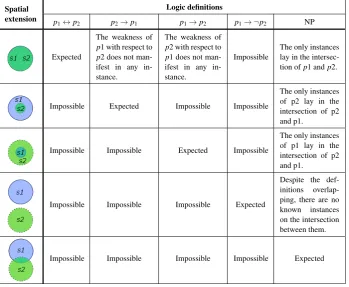
spa-Table 2. Relations between the logical relations among two definitions,p1 andp2 (columns), and the RCC5 spatial relations between the projections of the instances satisfying those definitions,s1 ands2 (rows).
Spatial extension
Logic definitions
p1↔p2 p2→p1 p1→p2 p1→ ¬p2 NP
Expected
The weakness of
p1 with respect to
p2 does not man-ifest in any in-stance.
The weakness of
p2 with respect to
p1 does not man-ifest in any in-stance.
Impossible
The only instances lay in the intersec-tion ofp1 andp2.
Impossible Expected Impossible Impossible
The only instances of p2 lay in the intersection of p2 and p1.
Impossible Impossible Expected Impossible
The only instances of p1 lay in the intersection of p2 and p1.
Impossible Impossible Impossible Expected
Despite the def-initions overlap-ping, there are no known instances on the intersection between them.
Impossible Impossible Impossible Impossible Expected
tial projection is available, thus providing powerful means for understanding the way definitions perform in specific areas of interest.
Moreover, once the process of concept negotiation is complete for a particular use of the ontology, operations can be used to support the formalization of the agent’s stand-points1. During further interactions of the agent with the ontology, queries will be as-sociated with this standpoint.s1 acts by restricting the admissible precisifications of the ontology to those which are consistent withs1 and enabling reasoning and information retrieval within the subset.
5.4. Interpreting the Spatial Projections of Precisifications/Standpoints
[image:10.595.124.474.183.470.2](a) (b)
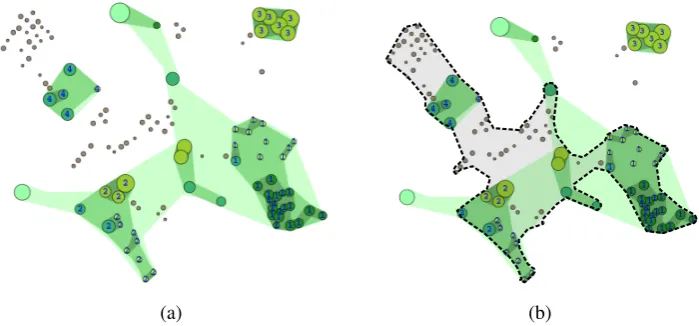
Figure 1. Example forest diagrams. Figure 1(a) shows four numbered forests with stricter and loser extensions. Figure 1(b) shows the overlap with a different definition of forest
In Table 2 we show the possible relations holding in the different scenarios. While the analogous to RCC5 is the expected relation to hold, other possibilities are allowed. These may be symptomatic of different circumstances. Take, for example, the case where the spatial projection of p1 is equal to that of p2. It may be the case thatp1 andp2 are equivalent. p1 could also be weaker thanp2 by allowing some more scenarios, but they never manifest in the available data about the state of the world. Even, it could be that
p1 and p2 describe forest in a logically different way (e.g. one uses tree proximity and the other canopy cover) that is highly correlated, and therefore both map to the same objects. In other cases it may be due to mere exemplar clustering6. Finally, even when the expected spatial relation holds between the projections, it is expected to be useful for the agent to know how populated are the intersections or borderline scenarios of the definitions under consideration.
6. Examples from Implementation Prototype
The diagrams in Figure 1 give some output examples from our prototype standpoint se-mantics based software, which enables visualisation of forest data in accordance with different standpoints. In Figure 1(a) we see forest extensions according to three different precisifications in different shades of green. The darker green corresponds to a stricter definition, which requires trees to be closer together to count as constituents of a forest. None of these precisifications consider the shrubs (small brown discs) to be forest con-stituents. In Figure 1(b) another precisification (demarcated by a black dashed line) is overlayed over the map. According to this precisification the shrubs are counted as for-est constituents, so the forfor-est takes on a very different shape, overlapping the extensions associated with the other precisifications.
6In ordinary situations, objects that exhibit one property, will very often also exhibit another property and
7. Conclusion
It is widely agreed that, while domain specific ontologies can be used within a commu-nity of users for achieving a consensus about conceptualizing, structuring and sharing domain knowledge [29], it is unrealistic to expect that a fixed interpretation could satisfy the needs of different communities in real-world applications. In that scenario, seman-tic heterogeneity challenges the successful interoperation of systems and agents within decentralized environments. In this paper we have analysed the needs of the multidisci-plinary forest community. The semantics of the key concepts of their ontology need to be negotiated depending on the context of use, and systems should be semantically rich to guarantee the sound reuse of information between different domains.
We present a novel approach, consisting on a framework based on ‘Standpoint Se-mantics’, that makes explicit the semantic variability of the terms of an ontology. We suggest that our framework can support agents with different interpretations and stand-points on their interoperation with a common ontology. Our aim is to provide a descrip-tion of such a theory and to outline the particular features that can support the conceptual negotiation between agents.
Further work remains to be done to provide a fully operable standpoint semantics ontology, so, in a sense, this paper is only a preliminary step. However, we expect to open the possibility for a complementary approach to the research on semantic align-ment in distributed systems. We consider that, in the current context, it is key to support ontologies that can both bring together the views of interdisciplinary domains and that are expressive enough to prevent reasoning and inference from what can be inconsistent interpretations. Moreover, we believe that the explicit acknowledgement of the semantic variability of the terms of the ontology is key for that purpose.
References
[1] P. Egr´e, V. de Gardelle, and D. Ripley, “Vagueness and Order Effects in Color Categorization,”Journal of Logic, Language and Information, vol. 22, no. 4, pp. 391–420, 2013.
[2] H. P. Grice, “Logic and conversation,” inSyntax and Semantics, Vol. 3, Speech Acts, pp. 41–58, New York: Academic Press, 1975.
[3] T. R. Gruber, “A translation approach to portable ontology specifications,”Knowledge Acquisition, vol. 5, pp. 199–220, 6 1993.
[4] L. C. Burns,Vagueness : an Investigation into Natural Languages and the Sorites Paradox. Springer Netherlands, 1991.
[5] A. C. Varzi, “Vagueness,”Encyclopedia of Cognitive Science, pp. 459–464, 2003.
[6] B. Bennett, “Modes of Concept Definition and Varieties of Vagueness,”Applied Ontology, vol. 1, no. 1, pp. 17–26, 2005.
[7] L. G´omez ´Alvarez and B. Bennett, “Classification, Individuation and Demarcation of Forests: formal-ising the multi-faceted semantics of geographic terms,” in13th International Conference on Spatial Information Theory, Leibniz International Proceedings in Informatics, 2017.
[8] P. Agarwal, “Ontological Considerations in GIScience,”International Journal of Geographical Infor-mation Science, vol. 19, no. 5, pp. 501–536, 2005.
[9] B. Smith and D. M. Mark, “Ontology and geographic kinds,” inInternational Symposium on Spatial Data Handling, 1998.
[10] M. J. Egenhofer and D. M. Mark, “Naive Geography,” inInternational Conference on Spatial Informa-tion Theory, pp. 1–15, Springer Berlin Heidelberg, 1995.
[11] N. Guarino, “Formal Ontology and Information Systems,”Formal ontology in information systems: Proceedings of the first international conference, vol. 46, pp. 81–97, 1998.
[13] W. Meyer and B. Turner,Changes in land use and land cover : a global perspective. Cambridge Uni-versity Press, 1994.
[14] R. Chazdon, P. Brancalion, and L. Laestadius, “When is a forest a forest? Forest concepts and definitions in the era of forest and landscape restoration,”Ambio, vol. 45, no. 5, pp. 538–550, 2016.
[15] A. Grainger, “Uncertainty in the construction of global knowledge of tropical forests,”Progress in Phys-ical Geography, vol. 34, no. 6, pp. 811–844, 2010.
[16] T. Wong, C. O. Delang, and D. Schmidt-Vogt, “What is a forest? Competing meanings and the politics of forest classification in Thung Yai Naresuan Wildlife Sanctuary,”Geoforum, vol. 38, pp. 643–654, 2007.
[17] D. Fuller, “Tropical forest monitoring and remote sensing: A new era of transparency in forest gover-nance?,”Singapore Journal of Tropical Geography, vol. 27, no. 1, pp. 15–29, 2006.
[18] C. Giri, Z. Zhu, and B. Reed, “A comparative analysis of the Global Land Cover 2000 and MODIS land cover data sets,”Remote Sensing of Environment, vol. 94, no. 1, pp. 123–132, 2005.
[19] H. G. Lund, “What is a forest? Definitions do make a difference: An example from Turkey,”Avrasya Terim Dergisi, vol. 2, no. 1, pp. 1–8, 2014.
[20] A. Comber, P. Fisher, and R. Wadsworth, “What is land cover?,”Environment and Planning B: Planning and Design, vol. 32, no. 2, pp. 199–209, 2005.
[21] A. Comber, P. Fisher, and R. Wadsworth, “You know what land cover is but does anyone else? an investigation into semantic and ontological confusion,”International Journal of Remote Sensing, vol. 26, no. 1, pp. 223–228, 2005.
[22] A. Tarski,Logic, semantics, metamathematics: papers from 1923 to 1938. Hackett Publishing, 1980. [23] L. Zadeh, “Fuzzy sets,”Information and Control, vol. 8, no. 3, pp. 338–353, 1965.
[24] H. Kamp and B. Partee, “Prototype theory and compositionality,”Cognition, vol. 57, no. 2, pp. 129–191, 1995.
[25] P. Gardenfors, “Conceptual spaces as a framework for knowledge representation,”Mind and Matter, vol. 2, no. 2, pp. 9–27, 2004.
[26] B. Adams and K. Janowicz, “Constructing geo-ontologies by reification of observation data,” in Pro-ceedings of the 19th ACM SIGSPATIAL- GIS ’11, p. 309, 2011.
[27] I. Douven, L. Decock, R. Dietz, and P. ´Egr´e, “Vagueness: A Conceptual Spaces Approach,”Journal of Philosophical Logic, vol. 42, no. 1, pp. 137–160, 2013.
[28] Y. Kalfoglou and M. Schorlemmer, “Formal Support for Representing and Automating Semantic Inter-operability,” inEuropean Semantic Web Symposium, pp. 45–60, Springer Berlin Heidelberg, 2004. [29] A. Maedche, B. Motik, N. Silva, and R. Volz, “MAFRA—a mapping framework for distributed